APRAXIA AND SPEECH PRODUCTION:
EFFECTS OF VERBAL RELATIONS’ STRENGTHENING
Apraxia e produção da fala:
efeitos do fortalecimento de relações verbais
Ana Claudia Moreira Almeida-Verdu(1), Célia Maria Giacheti(1),
Fernando Del Mando Lucchesi(1), Geisa Rodrigues de Freitas(1),
Jeniffer de Cássia Rillo Dutka(2), Jéssica Aline Rovaris(1), Priscila Foger Marques(1)
(1) Universidade Estadual Paulista Júlio de Mesquita Filho, Faculdade de Ciências - UNESP. Bauru, SP, Brasil. (2) Hospital de Reabilitação de Anomalias Craniofaciais,
Uni-versidade de São Paulo - USP. Bauru, SP, Brasil.
Funding: Instituto Nacional de Ciência e Tecnologia sobre o Comportamento, Cognição e Ensino (CNPq #573972/2008-7, FAPESP #2008/57705-8, CAPES/INC&T-ECCE).
Conlict of interest: non-existent
females.3 Studies on infant speech apraxia began
in the 1970s, and speech therapists indicated that
children with speech apraxia do not improve or
minimally improve with conventional speech therapy.
Apraxia has two diagnostic markers. The irst marker is related to voluntary speech programming (e.g., a task of repeating dictated words said by another person). The second marker refers to the
inconsistency of errors in speech sounds, in which an individual can correctly produce a word in one situation but produce the word with errors in another situation. The literature presents a consensus when describing3 and characterizing speech apraxia and
reporting the importance of therapeutic procedures that utilize the principles of motor learning to acquire control or improve precision and consistency in speech programming and planning, thus achieving word production and its point-by-point
correspon-dence with the conventions deined by the verbal
community in repeated trials (programming and planning).
The production of speech that can be compre-hended by a listener is one of the principal targets of speech investigation and intervention. However, no consensus has been reached in the literature with regard to what must be evaluated4.
INTRODUCTION
Infant speech apraxia is deined as dificulty
in voluntarily programming articulatory gestures.
Although the individual knows that he wants to speak, he has dificulty producing the appropriate sounds
(syllables and words). The topography of infant
speech apraxia resembles apraxia that is acquired
in adulthood. The difference between these two
types of apraxia is related to the etiology and type of
impairments1. The literature presents several terms
that identify this condition. In the present article, we
use the term “infant speech apraxia” based on the
American Speech-Language-Hearing Association (ASHA)2.
The prevalence of this communication disorder is 1-2 in every 1000 children. It is more common in males, but more severe manifestations occur in
ABSTRACT
This study proposed to report the effect of improvement of reading relations and transfer of stimuli
control on speech production of a child diagnosed with speech apraxia. The program “Learning to Read and Write in Small Steps®” was used. The activities were conducted in 22 sessions, in two weekly sessions of 30 minutes each. As result there was improvement in the correct responses percentage on speech production of the participant with different stimuli. The results corroborate the preview studies that speech outcome can be improved by strengthening the reading and writing
network while addressing the equivalence relations.
words (C), with the goal of verifying whether this teaching method would favor the emergence of responses in symbolic character, thus broadening auditory comprehension and possibly speech. The majority of the participants learned conditional relations that were taught, with the emergence
of non-taught relations for a signiicant number of
words. Additionally, performance in naming probes and the periodic imitation of words were considered strategically favorable for demonstrating a gradual increase in the number of correct responses by the participants.
Anastácio Pessan14 demonstrated how
expressive language in deaf children with cochlear
implants could improve with similar procedures by
teaching six children to emit more comprehensible
speech and transfer the functions of speech control
from text to igures. Although the children displayed precise reading skills, they presented many distor -tions in naming. The study consisted of strength-ening conditional relations between dictated words
and igures (AB) and between dictated words
and printed words (AC), tests of the formation of equivalence classes (BC and CB), and teaching conditional relations between printed syllables and dictated syllables, each followed by tests of naming
igures (BD) and reading words (CD). The results
of this study demonstrated that strengthening the
network of relations favored the transfer of control
from reading to naming and, therefore, to speech production, with increased point-by-point
correspon-dence with the conventions deined by the verbal community in tasks of naming igures.
A recent study15 evaluated children with cochlear
implants who were exposed to the program
“Aprendendo a Ler e a Escrever em Pequenos Passos®” and taught relations between dictated
words, printed words, and igures and relations
between dictated syllables and printed syllables. The results showed the transfer of control from reading to naming, with an improvement in the production of verbal responses when presented
with igures after teaching, thus creating method -ological and therapeutic methodologies using this program to teach reading and writing in populations with speech language problems.
Combining the monitoring of speech in systematic reading programs, the fact that visual and auditory stimuli facilitate the correction of speech production, and the model of stimulus equivalence as an operational criterion in the description of behavior,
the present study sought to verify the inluence of strengthening speciic relations that describe reading
and procedures to transfer stimulus control over speech production (with point-by-point matching) on
speech apraxia. With regard to apraxia speciically, the literature
has shown different possibilities of intervention,
highlighting the complexity of the cases and the slow and dificult therapeutic process. Although apraxia is a disorder in the linguistic-phonological
domain, therapeutic processes that emphasize only
this perspective are not fully eficacious in clinical
speech therapy because essentially articulatory
aspects are not suficiently strengthened. According to the literature, mixed therapeutic perspectives in interventions for apraxia are more effective5.
In the scope of behavioral analysis, studies on stimulus equivalence can guide research to identify the conditions under which verbal behaviors that are independently established (e.g., listening,
speaking, reading, and writing) can be related
to each other6. Verbalizations by a subject when
presented with text (reading designates) and igures (naming designates) are established under
independent conditions. The establishment of one of these behaviors does not necessarily result in the establishment of the other; unless the necessary conditions for learning are provided7,8. Equivalence
relations between stimuli describe the symbolic values that topographically distinct stimuli have in the behavior of individuals with well-established verbal repertoires.
Sidman9 presented a pioneering study on
stimulus equivalence, in which a 17-year-old boy with microcephaly was taught to pair printed words (designated by the letter C) with the respective dictated word (designated by the letter A). The
participant was already able to select igures
(designated by the letter B) that corresponded to
dictated igures (A), and he also already knew how to vocalize responses (designated by the letter D) when presented with igures (B). After teaching
conditional AC relations (dictated word-printed word), the emergence of performance in selecting
between igures and printed words (BC) and printed words and igures (CB) was observed, in addition
to vocalization when presented with printed words
(CD). Therefore, Sidman demonstrated that the
proposed arrangement was able to promote the
emergence of skills that were not directly taught,
including reading with comprehension10.
Other studies have been conducted with this model11, 12, reafirming that the teaching of condi
-tional relations with an element in common results in other non-taught relations under different condi-tions and with different procedures. More recently, Golfeto13 performed a study on speech production
in children with pre-language audition deiciency
The tradition in this type of research has been to present results individually16. In the present study,
we evaluated the effects of different teaching
proce-dures on the production of speech in igure naming tasks.
Materials and conditions of data collection
We used the programs “Avaliação da Rede de
Leitura e Escrita” and “Aprendendo a Ler e a Escrever
em Pequenos Passos®” that were controlled by the
LECH-GEIC platform. This platform is a web system that enables the authoring and remote and online application of learning programs without the need to download the programs on the computer17,18.
The “Avaliação da Rede de Leitura e Escrita”
program was initially used to characterize the participant’s repertoire in different relations that describe reading and writing and evaluate the ability of the program to teach reading. This was used to teach basic repertoires of reading and writing simple words, predominantly consisting of syllables of the consonant-vowel type, with a total of 60 words. The
procedure was divided into ive units that consisted
of the following steps: training selection and naming
of igures, teaching conditional relations between dictated and printed words (AC) and writing skills
under dictation based on the composition of syllables that were presented on the computer screen (AE screen), and pre- and posttests that were presented before and after each unit, respectively.
In addition to these programs, we used slides created and applied via Microsoft PowerPoint
2010, with the presentation of igures and printed
words according to the four steps of the procedure described below.
The sessions were performed in the clinical school that the subject attended. The data described in this study were collected over the course of 22 sessions performed by the subject, with an average duration of 30 min each.
Procedures
The overall design of the study involved the
evaluation of the network of reading and writing, exposure to training steps, and selection and naming of igures according to the steps of word
and syllable teaching, which were all managed by GEIC software17. After teaching, the transfer of the
maximum control exerted by the written word to the naming of igures was performed. The teaching
procedures are described in detail below.
1. Evaluation of reading and writing network. This step was developed to characterize the subject’s
performance in three types of tasks: selection,
vocalization and writing.
PRESENTATION OF THE CASE
The participant in this study, DJ, was 12 years old and had a diagnosis of infant speech apraxia.
He presented inconsistent speech errors, problems combining speech sounds, increased pauses between words, syllables, and sounds, word
simpli-ication, the omission of syllables and sounds,
and the production of inadequate articulatory movements. These characteristics had a severe impact on speech production. In addition to speech
apraxia, DJ also had a cleft palate that was surgically
corrected but continued to have velopharyngeal
insuficiency, which was treated with a palatal prosthesis and speech therapy. Speech apraxia may at least partially explain the failure of speech
therapy to correct speech disorders related to
velopharyngeal insuficiency, explaining the dificulty
obtaining improvement in point-by-point matching
in speech production. Velopharyngeal insuficiency
was corrected with a prosthetic palate, and speech therapy improved the articulatory accuracy and consistency of the correct production of speech sounds, but inconsistent errors that are
charac-teristic of speech apraxia remained unresolved.
The palate prosthesis was successfully used daily
by DJ, creating a velopharyngeal condition that
allowed its proper closure when required during
speech. We then opted for an apraxia intervention
using the programs “Avaliação da Rede de Leitura
e Escrita” and “Aprendendo a Ler e a Escrever
em Pequenos Passos®.” Using this approach, we
sought to improve speech production by
strength-ening speciic relations that describe reading in the present case of apraxia.
At the time of the intervention, DJ was attending
the fourth year of elementary school in a public school in a city in the countryside of São Paulo
state, Brazil. DJ also underwent therapy twice per week in specialized institutions where he received
speech and psychological care. The participant was already literate, had preserved hearing, and
understood language. DJ’s responsible guardian
signed a Statement of Informed Consent to allow the disclosure of intervention data.
This research was part of a larger project that was approved by the Ethical Committee in Research of the Faculdade de Ciências de Bauru/Universidade
Estadual Paulista “Julio de Mesquita Filho” (FC/
UNESP-Bauru; approval no. 13653/46/01/12).
Experimental design
In the present study, we adopted a single-subject
experimental design, in which the participant’s
(BB), printed word/printed word (CC), dictated word/
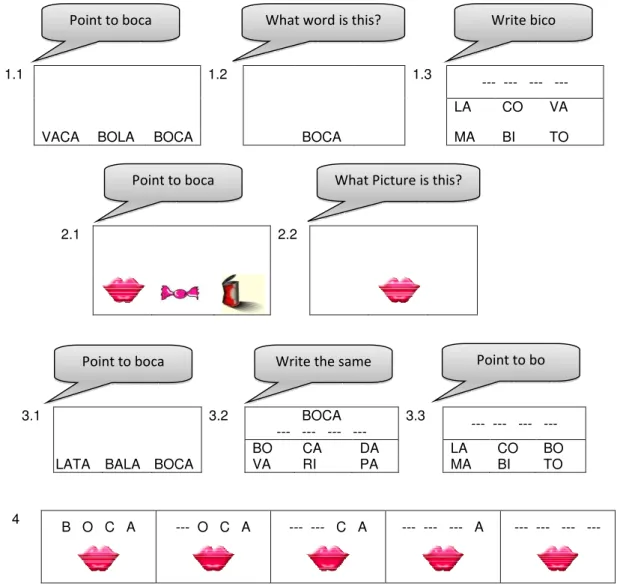
igure (AB), dictated word/printed word (AC), igure/ printed word (BC), and printed word/igure (CB). Item 1.1 in Figure 1 shows an example of a relation
between a dictated word and printed word (AC).
1.1. Selection tasks. Tasks of selecting between dictated words, printed words, and igures were
conducted, in which one was presented as the model and three were presented as comparisons using a
matching-to-sample procedure. The task was to select the correct comparison stimulus: igure/igure
Figure 1 - Examples of the trials used in the study. The numbers represent the corresponding procedures. (1) Evaluation of the network of reading and writing. (2) Training of selection and naming
test. (3) Teaching of words and syllables. (4) Transfer of control of the written word to the igure in
successive fading out steps.
1.2. Vocalization tasks. After the presentation of a stimulus (igure or text), the subject had to make
a corresponding vocal response that consisted of naming or reading. Therefore, we tested the naming
of igures (BD) and the reading of words (CD), letters (CD letter), syllables (CD syllable), and vowels (CD
vowel; see item 1.2 in Figure 1).
1.3. Writing tasks. We sometimes presented
printed words on the computer screen and
sometimes dictated words via the speaker. The tasks were divided into dictation according to the
composition of letters (AE) or handwriting with pen and paper (AF) and copying according to the composition of letters (EC) and handwriting with pen and paper (CF; see item 1.3 in Figure 1).
2. Training of selection and naming of igures.
This step sought to strengthen the relations
between dictated words/igures (AB) followed
1.1 1.2 1.3
--- --- --- ---
LA CO VA
VACA BOLA BOCA BOCA MA BI TO
2.1 2.2
3.1 3.2 BOCA
--- --- --- ---
3.3
--- --- --- ---
BO CA DA LA CO BO
LATA BALA BOCA VA RI PA MA BI TO
4
B O C A --- O C A --- --- C A --- --- --- A --- --- --- ---
Point to boca What word is this? Write bico
Point to boca What Picture is this?
the igure and text were simultaneously displayed
on the computer screen). The subject had to read the word when it was presented. Gradually, every letter that formed the printed word was removed (i.e., faded out) until the visual stimulus was only
the igure. This was done so that the control exerted by the printed word was transferred to the igure
because the latter did not provide clues about which phoneme must be emitted (see 4 in Figure 1).
This procedure was applied to the 14 words that were trained previously. Because the words had different lengths, the number of fading steps varied
by length. Words with four letters had ive steps (e.g., “Boca”). Words with ive letters had six steps (e.g., “Navio”). Words with six letters had seven steps (e.g., “Peteca”).
In each step of the procedure, a vocalization analysis was performed based on transcriptions of the audio recordings of the sessions by counting the phonemes that were emitted by the subject and verifying the matching percentage with the word model according to the conventions in the verbal community.
RESULTS
The results are presented according to the steps of the procedure, with a focus on performance in the
naming igure tasks after each of the procedures.
1. Evaluation of the reading and writing network
Figure 2 shows the percentage of correct
responses obtained by DJ in the different relations
tested during the evaluation of the reading and writing
network. In the tasks that involved selection (black
bars), his performance was 100% correct responses,
with a few mistakes caused by distraction. In writing
(light gray bars), his performance was also precise,
with the exception of dictation according to the
composition of letters (AE), for which he obtained
86.6% correct responses. His principal dificulty was in vocalization (dark gray bars). Although he
presented good performance in the recognition of stimuli, the percentage of correct responses was low with regard to speech production based on point-by-point correspondence with the conventions
deined by the verbal community, with 57.3% correct responses in naming igures (BD), 75.7% correct responses in word reading (CD word), and poorer performance for syllables (CD syllables) and letters (CD letter). Given these results, he underwent training of the selection and naming of igures. by tests of naming igures (BD). In the training of
selection, a succession of discrete trials presented
dictated words as the model and three igures as the comparison. The subject’s task was to select with the mouse the igure that corresponded to the
referred word (item 2.1 in Figure 1). The subjected
only progressed to the stage of naming igures (BD) after achieving 100% correct responses in the selection of pictures (AB). Otherwise, the block of selection tasks was repeated.
In the test of naming igures, a single igure (e.g., the drawing of a beak) was presented to the subject, and he was asked, “What igure is this?” If he did not achieve 100% accuracy, then he was exposed
again to the training of selection, which could be
repeated ive times (see item 2.2 in Figure 1).
3. Teaching of words and syllables. We used
tasks of selecting printed words when presented
with dictated words (AC) and composing words by
selecting dictated syllables (AE syllables). DJ was exposed to ive teaching steps. Each step taught
three different words, for a total of 15 words. The teaching steps were evaluated by conducting retention tests of what was learned in the previous step (AC and AE), with pre- and posttesting of target words in the respective step.
Generally, words were taught using a multiple-copy teaching procedure, in which steps of selecting a printed word when presented with a dictated word, writing when presented with dictation, and copying by composition were interspersed. If the subject made any errors during the posttest of selecting printed words after being presented with dictated syllables (AC), then all of the teaching steps were repeated.
Syllabic teaching was characterized by steps of
syllabic contextualization and teaching the selection
of printed syllables based on the model of dictated
syllables (AC syllable). The syllabic contextual
-ization step was composed of tasks of pairing dictated words and igures (AB), with writing based on composition from the igure (BE syllable), dictated
word (AE syllable), and printed word (EC syllable). This step evaluated the ability to focus on dictation that was composed of syllables (AE syllables). Item 3 in Figure 1 presents the types of trials in this step of the procedure.
4. Transfer of control of the written word to
the igure in successive steps of fading out. After strengthening reading, we performed the transfer of
stimulus control of the written word to the igure by
overlapping a written word that was already taught in
Figure 2 - Percentage of correct responses in the evaluation of the network of reading and writing. Black bars represent the results in the selection tasks. Dark gray bars represent the vocalization tasks. Light gray bars represent the composition tasks.
2. Training of selection and naming igures
In training the selection of igures when presented
with dictated words (AB; hatched bars in Figure 3),
DJ achieved 100% correct responses in all of the trials with three word sets. In the block of naming igures (BD; white bars), he presented variability
in performance, presenting increases from 50% to
75% with the irst word set, 50% to 62.5% with the
second word set, and 50% to 75% with the third word set.
Because the percent increase in correct
responses was slight, we veriied whether strength
-ening the relation between the spoken word and printed word and selection of syllables in the next
step would increase the percentage of correct responses for speech production. After an increase in the degree of control of the printed word over reading, we tested whether this control could be
extended to the igure in naming tasks.
Figure 3 - Percentage of correct responses in the training of selection (hatched bars) and test of
naming igures (white bars)
Pe
rce
n
ta
g
e
o
f
co
rre
ct
Relations tested
Conjunto 1 Conjunto 2 Conjunto 3
Pe
rce
n
ta
g
e
o
f
co
rre
ct
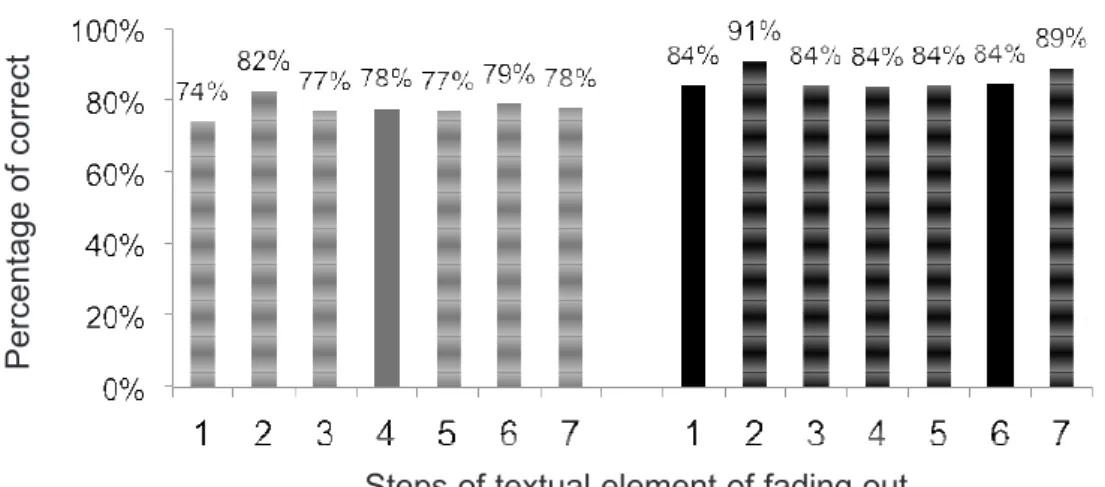
and so on. Because the longest words had six letters, the maximum number of steps was seven. On the vertical axis, the values indicate the mean
of the percentage of phonemes that were correctly
verbalized by DJ. Figure 4 shows the data from two
sessions of the transfer of control using the fading
out procedure. Despite the gradual removal of the textual stimuli, the percentage of correct responses was still high, even in the inal steps, during which only the igure was presented. These results indicate that the control exerted by the written word was transferred to the igure. Notably, during the second session of the fading out procedure (black bars),
the percentage of correct responses increased
compared with the irst session (i.e., from 5% to 11%
between each step; e.g., from 74% to 84% in Step 1 and from 78% to 89% in Step 7).
3. Teaching of words and syllables and transfer of control from reading to naming
In reading training, DJ presented 100% correct
responses in all of the relations of selecting printed words when presented with dictated words and selecting printed syllables when presented with dictated syllables, for which he required only the minimal number of trials in each teaching step.
Figure 4 shows the subject’s performance during
the transfer of maximal control by the printed word in tasks of naming igures in successive steps of fading out in two sessions. The horizontal axis
indicates the steps of fading out. Each column represents one phase of fading or gradually
removing the textual stimulus. Step 1 refers to the
complete word that was presented together with the
igure. Step 2 refers to removing the irst letter of the word that was presented together with the igure,
Training with fading out the textual component
allowed improvement by 14.9% in the participant’s
vocalization. Comparing the data of the inal step of
the transfer of control by fading out with regard to
performance in reading (CD) in the evaluation of the reading and writing network (Figure 1), improvement of more than 31% correct responses in DJ’s vocal -izations was observed.
DISCUSSION
The present study revealed that DJ, who
was evaluated with regard to the reading and
writing network, had a high percentage of correct
responses in activities of reading by selection and a lower percentage in activities of vocalization with regard to speech production3. These indings
suggest that the dificulties presented by DJ derived
from a failure to program and produce speech and not from a failure to understand written language. Although the subject had a corrected palatine
issure, the team at the reference center where
the subject received care determined that these alterations were not attributable to the palatine
issure, which only caused a more nasal voice.
Additionally, the transcription of the subject’s vocal responses indicated that omissions, transpositions,
and phonemic distortions were nonspeciic and
Figure 4 - Percentage of correct responses in naming igures after successive steps of fading out the textual component of the tasks. Words with four letters (e.g., “Bolo”) had ive steps. Words with ive
letters (e.g., “Navio”) had six steps. Words with six letters (e.g., “Peteca”) had seven steps. Session 1 (gray bars); Session 2 (black bars).
Pe
rce
n
ta
g
e
o
f
co
rre
ct
correspondence in a procedure of naming compound
stimuli (printed word + igure) while fading out the
printed word component11, 12. Given that stimulus
control in this step was transferred to the igure, the
gains that were obtained with such interventions were clearly important. In addition to transferring reading performance to naming, the results showed an increase in the percentage of correct responses, a fact that was related to the large number of oppor-tunities of vocalization20,23 that served as a device
of speech generalization24. These results replicate
those of other studies on improvements in speech after procedures of establishing or strengthening
equivalence relations between spoken words
and syllables, written words and syllables, and
igures,15,19-21 indicating a potential procedure that
can be applied for different diagnostic conditions that target the establishment of language.
CONCLUSION
These results replicate the potential of estab-lishing equivalence relations and its generative capacity to form new verbal behaviors in
popula-tions with apraxia. We consider that this study marks the beginning of a promising research ield
that favors the development of speech in children
with apraxia by strengthening equivalence relations
between stimuli. The data presented herein are consistent with results of other studies on the gains obtained with guided teaching procedures based on the paradigm of establishing equivalence relations and transferring control between verbal behaviors in the development of speech in different diagnostic conditions, suggesting a therapeutic pathway with great potential for various groups. According to the objectives of this study, we found that different conditions of teaching relations between stimuli positively affected speech production in a child with
speech apraxia, thus contributing to the literature on
this communication disorder.
inconsistent, which are characteristics of apraxia and not palatine issure. These data showed better performance in expressive speech in reading tasks
to the detriment of naming the corresponding items, demonstrating the functional independence of these behaviors, which can be seen in other popula-tions15,19-21. When presented with printed words, DJ
received hints that guided his speech movements that are necessary for the emission of a deter-mined sound, in contrast to what occurred with the
igure that indicated only the object that was to be
named but did not provide hints for the movement
to be performed. For children with speech apraxia,
support for speech (monitoring) using point-by-point correspondence is important. Support can be provided for the written word, and hints for the production of the sequence of sounds (words) can be offered by the therapist during training3. The
present indings corroborate the literature3, showing
an overall improvement of 31% in DJ’s vocalization
and indicating that support for speech (monitoring) with point-by-point correspondence is important for
children with speech apraxia.
In the selection and naming activities, despite
the 100% correct responses in the irst type of task, dificulties were observed in the inal task. The improvement in DJ’s performance in naming activities in the inal exposures compared with the irst replicates data from this type of procedure
in other populations with regard to the cyclical
relationship between listening and speaking22.
Listening, pointing to a igure, saying the name of the igure, hearing what is said, and listening again in successive tasks can be a successful model for speaking. Although the increase in the percentage
of correct responses was not substantial, it can be
considered a signiicant gain because traditional audition therapies for children with speech apraxia
have not shown satisfactory results1,3.
The last step of the present study priori-tized the use of support for written words with a
11. Carr D, Wilkinson KM, Blackman D, McIlvane
WJ. Equivalence classes in individuals with
minimal verbal repertoires. J Exp Anal Behav.
2010;74(1):101-14.
12. Sidman M, Cresson O Jr, Wilson-Morris M. Acquisition of matching to sample via mediated
transfer. J Exp Anal Behav.1974;22:261-73.
13. Golfeto RM. Compreensão e produção de fala
em crianças com deiciência auditiva pré-lingual
usuárias de implante coclear [tese]. São Carlos (SP): Universidade Federal de São Carlos; 2010. 14. Anastácio-Pessan FL. Evolução da Nomeação
após Fortalecimento de Relações Auditivo-Visuais em Crianças com Deiciência Auditiva e Implante
Coclear [dissertação].Bauru (SP): Universidade Estadual Paulista; 2011.
15. Lucchesi FD. Avaliação do efeito de um
programa de ensino de leitura e escrita sobre a fala de crianças usuárias de implante coclear [dissertação]. Bauru (SP): Universidade Estadual Paulista; 2013.
16. Cozby P. Método de pesquisa em ciências do
comportamento. São Paulo: Editora Atlas, 2003. 17. LECH-GEIC Gerenciador de ensino individualizado por computador [homepage na internet]. São Carlos: Universidade Federal de São Carlos, 2009 (atualizada em 2011; acesso em
dezembro 2012). Disponível em: http://geic.ufscar. br:8080/site/index.jsp
18. Marques LB, Golfeto RM, Melo RM. Manual do usuário de programas de ensino via GEIC: Aprendendo a ler e a escrever em pequenos passos, 2011, volume 1, módulo 1. São Carlos.
Acesso em: 20/novembro/2012. Disponível em:
http://geic.ufscar.br:8080/site/documentacao.jsp.
19. De Souza DG, De Rose JC, Domeniconi C.
Applied relational operants to reading and spelling.
In: Refeldt RA, Barnes-holmes Y. (Ed.) Derived
Relational Responding: Applications for learning
REFERENCES
1. Souza TU, Payão LM. Apraxia da fala adquirida e
desenvolvimental: semelhanças e diferenças. Rev Soc Bras Fonoaudiol. 2008;13(2):193-202.
2. American Speech-Language-Hearing Association [homepage na Internet]. Estados Unidos da
América: A Associação; c1997-2012 [criada em “2007”; atualizada em “23 janeiro 2013”, acesso em janeiro 2013]. Childhood apraxia of speech [cerca de 2 telas]. Disponível em: http://www.asha.org/
policy/PS2007-00277.htm.
3. Payão LMC, Lavra-Pinto B, Wolff CL, Carvalho
Q. Características clínicas da apraxia de fala na
infância: revisão de literatura. Letras de hoje. 2012;47(1):24-9.
4. Barreto SS, Ortiz KZ. Medidas de inteligibilidade nos distúrbios da fala: revisão crítica da
literatura. Pró-Fono R Atual Cient. 2008;20(3):201-6.
5. Souza TNU, Payão LMC, Costa RCC. Apraxia
da fala na infância em foco: perspectivas teóricas e tendências atuais. Pró-Fono R Atual. Cient. 2009;21(1):75-80.
6. De Rose JC. Análise comportamental da
aprendizagem de leitura e escrita. Rev Bras Anal Comport. 2005;1(1):29-50.
7. Guess D. A functional analysis of individual
differences in generalization between receptive and productive language in retarded children. J Appl Behav Anal.1969;2:55-64.
8. Córdova LF, Lage M, Ribeiro AF. Relações de independência e dependência funcional entre os operantes verbais mando e tato com
a mesma topograia. Rev Bras Anal Comport.
2007;3(2):279-98.
9. Sidman M. Reading and auditory-visual equivalence. J Speech Hear Res. 1971;14:5-13. 10. Sidman M, Tailby W. Conditional discrimination
vs. matching to sample: an expansion of the testing paradigm. J Exp Anal Behav. 1982;37(1):5-22.
RESUMO
Este estudo propõe relatar o efeito do fortalecimento de relações de leitura e da transferência de
controle de estímulos sobre a produção da fala de uma criança com apraxia de fala. Utilizou-se o pro -grama Aprendendo a Ler e a Escrever em Pequenos Passos®. As atividades foram realizadas em 22 sessões, com duas sessões semanais, de 30 minutos cada. Como resultados houve aumento na
por-centagem de acertos na produção da fala do participante frente a diferentes estímulos. Os resultados
corroboram os estudos anteriores sobre o favorecimento da fala por meio de relações de equivalência
e dados sobre o benefício do trabalho a partir do fortalecimento da rede de leitura e escrita.
22. Neves AJ, Almeida-Verdu ACM. Efeitos de ensino
envolvendo equivalência entre palavra ditada, palavra escrita e objeto sobre a inteligibilidade da fala em adolescente com hipoplasia cerebelar. Rev CEFAC. No prelo.
23. Ferrari C, Giacheti CM, de Rose JC. Procedimentos de emparelhamento com o modelo
e possíveis aplicações na avaliação de habilidades
de linguagem. Salusvita. 2009;28(1):85-100.
24. Lüke, C. Impact of speech-generating devices on
the language development of a child with childhood
apraxia of speech: a case study. Disabil Rehabil
Assist Technol. 2014; 29 [Epub ahead of print]. with autism and other developmental disabilities.
New HarbingerPublications, Inc., 2009. P. 171-208. 20. Benitez PA. Aplicação de um programa informatizado de ensino de leitura e escrita por
familiares de indivíduos com deiciência intelectual
[dissertação]: São Carlos (SP): Universidade Federal de São Carlos; 2011.
21. Anastácio-Pessan FL, Almeida-Verdu ACM, Bevilacqua MC, de Souza DG. Relações de equivalência em crianças com deiciência auditiva e implante coclear: de leitura a nomeação. Psicol rel
e crit. No Prelo.
Received on: January 15, 2014 Accepted on: May 22, 2014 Mailing address:
Ana Claudia Moreira Almeida-Verdu
Universidade Estadual Paulista Júlio de Mesquita Filho, Faculdade de Ciências - Campus de Bauru,
Departamento de Psicologia
Av. Engº Edmundo Carrijo Coube s/nº Bauru - SP – Brasil
CEP: 17033-360