MACRONUTRIENT ACCUMULATION AND PARTIONING
IN FERTIGATED SWEET PEPPER PLANTS
Francisco Fernando Noronha Marcussi1; Roberto Lyra Villas Bôas2*; Leandro José Grava de Godoy2; Rumy Goto3
1
UNESP/FCA - Depto. de Engenharia Rural, C.P. 237 - 18603-970 - Botucatu, SP - Brazil. 2
UNESP/FCA - Depto. de Recursos Naturais / Ciência do Solo. 3
UNESP/FCA - Depto. de Produção Vegetal / Horticultura. *Correponding author <[email protected]>
ABSTRACT: Information on nutrient demand during each growth stage is essential for efficient application of nutrients. A pot experiment was carried out with a Typic Hapludox under greenhouse conditions in Botucatu, SP, Brazil, aiming was to determine nutrient uptake and partition of sweet pepper plants, cultivar Elisa in randomized block design with four replications. The fertigation was simulated through 2-L PET bottles (neck down with a tube and a flow regulator at the end, simulating a drip irrigation system). Four plants per replication were collected at eight growth stages (0, 20, 40, 60, 80, 100, 120 and 140 days after the seedling transplant - DAT). The period of largest extraction of nutrients for the plant occurred from 120 to 140 DAT, which coincides with the highest accumulation of dry phytomass. The highest Mg and Ca accumulation occurred in the leaves, while N, K, S and P were mostly accumulated in the fruits. Only 8 to 13% of the total amount of the accumulated macronutrientes at 140 DAT were absorbed up to the 60th DAT. Between the 61st
and 100th
DAT, K was the most absorbed macronutrient (60% of the macronutrients accumulated during the whole cycle). P, Ca and S were the most absorbed nutrients at the end of the cycle. Considering rates (g per plant), the most absorbed macronutrients were: N (6.6) > K (6.4) > Ca (2.6) > Mg (1.3) > S (1.1) > P (0.7). Key words: Capsicum annuum L., irrigation, greenhouse, growth
ACÚMULO E PARTIÇÃO DE MACRONUTRIENTES EM
PLANTAS DE PIMENTÃO FERTIRRIGADAS
RESUMO: A demanda de nutrientes em cada etapa do crescimento de uma planta é uma informação essencial para que se possa aplicar os nutrientes de forma mais eficiente. Com objetivo de determinar a marcha de absorção e a partição de macronutrientes em plantas de pimentão cultivar Elisa foi conduzido um experimento em vasos de 29 dm3 contendo um Latossolo Vermelho aluminoférrico sob condições de cultivo protegido em
Botucatu, SP em delineamento experimental em blocos ao acaso com quatro repetições. A fertirrigação foi simulada utilizando garrafas (2 L) com uma mangueira e um controlador de vazão na extremidade.Foram coletadas quatro plantas por repetição, em oito épocas (0, 20, 40, 60, 80, 100, 120, e 140 dias após o transplantio das mudas DAT). O período de maior extração de nutrientes pela planta ocorreu de 120 aos 140 DAT coincidindo com o maior acúmulo de fitomassa seca. O maior acúmulo de Mg e Ca ocorreu nas folhas, enquanto, N, K, S e o P foram mais acumulados nos frutos. Apenas 8 a 13% da quantidade total dos macronutrientes acumulados em 140 DAT foram absorvidos até os 60 DAT. Dos 61 aos 100 DAT o K foi o macronutriente mais absorvido (60% do total acumulado no ciclo); P, Ca e S foram mais absorvidos no final do ciclo. Os macronutrientes mais absorvidos foram, em g por planta: N (6,6) > K (6,4) > Ca (2,6) > Mg (1,3) > S (1,1) > P (0,7). Palavras-chave: Capsicum annuum L., irrigação, ambiente protegido, crescimento
INTRODUCTION
Sweet pepper (Capsicum annuum L.) is one of the
most consumed vegetables in Brazil, and is better adjusted and most frequently produced under greenhouse condi-tions (Melo, 1997). Cultivation of sweet pepper in green-houses demands intensive use of agri-inputs and labour. Moreover, this activity is part of a dynamic market in which seasonal prices fluctuate, demanding from the pro-ducer rigorous planning for both crop production and
For planning fertilization it is also very impor-tant to be aware of new genotypes and growth features in different conditions, since dry matter and nutrient ac-cumulations are closely associated to each other, so that one deficit harms other, directly or indirectly (Benincasa, 1988). The optimal nutrient absorption curve (nutrient accumulation curve) determines both the rate for appli-cation of a specific nutrient to avoid possible deficits or luxury uptake, and the adequate proportion of nutrients. One of the first studies on the nutrient absorption curves in Brazil was carried out by Haag et al. (1970) for sweet-pepper (variety “casca dura”) grown in nutrient solution. Further studies on nutrition, however, are necessary as a consequence of constant genetic changes of the crop, made to improve quality (Fernandes & Haag, 1972).
Application of adequate nutrient rates decreases salinity problems which otherwise could negatively af-fect production in closed crop systems (Raij, 1993). The aim of the present study was to determine nutrient accu-mulation and partition along the whole cycle of a fertigated Elisa sweet pepper crop grown in greenhouse, as a support for the improvement of fertilization pro-grams.
MATERIAL AND METHODS
The experiment was carried out inside a green-house (plastic tunnel; 20 m long, 7 m wide, and 2.5 m high) in Botucatu, SP, Brazil (22º51’S, 48º26’W; altitude 786 m). Air temperature and relative humidity were re-corded by a portable thermo hygrograph placed 1.5 m above ground.
Amianthus pots (29-dm3) were filled with a
sandy-clayey Typic Hapludox and placed inside the plas-tic tunnel. The physical and chemical properties of the soil were determined according to EMBRAPA (1997) and Raij et al. (1987), obtaining the following results: pH
(CaCl2) 4.0; 24 g dm-3 OM; 3 mg dm-3 P (resin); H++Al+3,
K, Ca and Mg concentrations of 61, 0.4, 1 and 1 mmolc
dm-3, respectively; base saturation (BS) of 3%; and sand,
clay and silt compositions of 670, 260 and 70 g kg–1,
re-spectively.
Based on Raij et al. (1996), after adding dolomite lime (86% Total Neutralizing Relative Power) until the
BS reached 80%, each pot received 150 g P dm-1 of soil,
as thermal phosphate (17% P2O5, 20% Ca, 9% Mg and
6% S), 117 mg K as KCl, and also 150 g of an organic compound. Pots were watered to 70% of the volume cor-responding to the 0.033 MPa matric potential covered with a plastic sheet and maintained for 30 days.
Each pot received two seedlings of Elisa sweet
pepper (Capsicum annuum L.), cultivated in trays
con-taining commercial substratum, on July 19th, 1999 (66
days after sowing). A distance of 0.24 m between seed-lings within rows and 1.30 m row spacing were used. The
development of the sweet pepper plants was limited to three stems and then the first flower (relative to the first internode) was removed. Structures for plant sustentation and growth were set up. To simulate a local irrigation sys-tem, a 2-L PET bottle was used for each pot. This bottle was suspended upside down, with removed bottom to al-low infal-low of water and dissolved fertilizers. A pipe was connected to the PET bottle cap, which had a water-flow
controller to allow a dripping rate of 2 L h-1. Drippers
were installed 10 cm above the plant base.
Nutrient rates applied through fertigation were strictly related to levels used in the field and were
ap-plied after the 54th day after transplantation (DAT). The
fertigation scheme consisted of: 1.9 g calcium nitrate di-luted into 250 mL of water per plant (0.285 g nitrogen and 0.361 g calcium) up to the 66 DAT. After the fourth application (66 DAT), the level of nitrogen was increased to 0.392 g per plant (2.72 g calcium nitrate) and then the potassium (KCl) application was initiated (0.295 g K per
plant). During the 10th and 14th applications (102 and 122
DAT, respectively), boron (0.150 mg B plant-1) and
man-ganese (0.132 mg Mn plant-1) were added in the form of
borax and manganese sulphate, respectively. N and K were applied every 4 days, (16 and 13 applications, re-spectively), until 133 DAT, corresponding to a total of
5.95 g N and 3.84 g K plant-1.
A randomized block design with four replications and eight sampling dates was used. Samples of plants were taken every 20 days, from day 0 to 140 DAT. In each of these eight samplings dates, four plants were collected per repetition (two pots with two plants each).
Plants were collected by cutting their base close to the ground. Plant height, first-bifurcation height and number of leaves and bifurcations were recorded in the laboratory. Fruit collections started at 80 DAT, and the fruits produced by the plants that would be collected later (at 100, 120, and 140 DAT) were removed from the plant for fresh and dry matter determinations (these data were included for determination of the plant dry matter at the collection moment). Fruits larger than 10 cm in length or 7 cm in diameter were classified as commercial fruits, and smaller ones as non-commercial.
Plants were washed and taken apart into indi-vidual leaves, stems, roots and fruits, and then dried in a
forced-air oven at 65oC. Each dried plant organ was
weighed (dry matter), ground and submitted to chemical analyses according to Malavolta et al. (1997). Based on dry matter and nutrient concentrations, absolute and rela-tive growth rates and nutrient levels were determined for each plant organ.
Models (equation) were selected for best statistical
ad-justment (F test, 5%), best fit (R2), and biological
sig-nificance.
RESULTS AND DISCUSSION
Accumulation of dry matter by sweet pepper was slow until 60 DAT and then increased as the fructifica-tion began (Figure 1). Haag et al. (1970), Fernandes & Haag (1972) and Fontes & Monnerat (1984) observed slow growth until 75 DAT, but they used varieties rather than hybrid genotypes.
The maximal growth of sweet pepper was not reached until 140 DAT (Figure 1), in contrast to reports by Crespo-Ruiz et al. (1988) who found the maximal dry matter accumulation point at 100 DAT for cv Cubanelle in Puerto Rico. After 120 DAT, the plant dry matter ac-cumulation was greatly increased, probably because of the great fruit harvest (60% of the total commercial fruit pro-duction), which occurred up to 110 DAT (Table 1), thus reducing plant drains (Taiz & Zieger, 1991). These pro-cesses may have stimulated new vegetative growth (root, leaves and stem) that was indicated also by increased plant height and number of bifurcations and leaves (Table 2). Villas Bôas (2001) studied this same hybrid under similar conditions and found taller plants (109 cm) with fewer leaves (55) and more bifurcations (34) at 174 DAT. Panelo (1995) reported that the Vidi hybrid had the low-est plant length (50 to 70 cm) after two month of ongo-ing harvest (~ 143 DAT), while Elisa hybrid presented intermediate length (80 to 90 cm) at this time, in com-parison to the other studied hybrids.
The first-bifurcation height reached 19 cm at the end of the observations. This may depend on the culti-vation system (Faria Jr., 1997), but may also be altered by the number of conducted stalks (Tivelli et al., 1998). An excess of fertilizers, mainly nitrogenous, may promote excessive plant growth and, consequently, the first
bifur-cation. For Elisa hybrids of the same age, Tivelli (1999) found 22.4 cm height for the first bifurcation.
After transplantation, the plant remains in an ad-justment period up to 20 DAT, named “establishment phase” (Crespo-Ruiz et al., 1988), during which dry mat-ter is accumulated mostly in the leaves. Afmat-ter that (from 20 to 60 DAT), dry matter is allocated to the stem and roots (Figure 2), enlarging the radicular system. Dry mat-ter accumulated in the leaves decreased from 64.5% at
r e t f a s y a D
n o i t a t n a l p s n a r t
l a i c r e m m o c f o . o N
s t i u r
f Freshmatter Lenght Diameter g gperfruit --- cm--- -0
6 1 -- -- -- -- -
-0
8 2 70.86 35.43 10.8 6.1 7
9 5 365.31 73.06 11.1 7.4 0
0
1 1 46.51 46.51 10.7 6.8 0
1
1 2 266.41 133.21 10.9 7.7 0
2
1 1 53.50 53.50 8.8 6.5 5
3
1 1 172.81 172.81 10.8 8.5 0
4
1 1 82.31 82.31 10.8 7.0 l
a t o
T 13 1267.70 1267.70 10.5 7.1
Table 1 - Sweet pepper fruit production performance according to days after transplantation.
1harvesting either without ripe fruits and without commercial fruits.
Figure 1 - Accumulation of dry matter (total and for each organ) by sweet pepper fertigated at different days after transplantation (DAT).
0 50 100 150 200 250
0 20 40 60 80 100 120 140
Days after transplantantion (DAT)
Dry matter, g per plant
Fruit Leaf Stem Root Total
Figure 2 - Percentual distribution of dry matter in each organ of sweet pepper fertigated at different days after transplantation.
30.3 42.3 54.2
36.7
4.4
22.9 22.2 20.4
29.4
54.6 64.5
41.7 33.4
28.2 21.7 16.7 21.8
27.4 20.0 16.1
25.0
18.7 13.9 12.0
34.8 25.5 19.4 33.3
8.6
0 20 40 60 80 100
0 20 40 60 80 100 120 140
Days after transplantation (DAT)
% of dry matter of each organ
20 DAT to 20.4% at 100 DAT (Figure 2), probably as a function of dry matter allocation to the stem and root until 60 DAT and then to fruit formation (from 60 to 100 DAT). The most intense fructification from 80 to 100 DAT increased dry matter in fruits (54.2% at 100 DAT) instead of leaves, stems and roots. During this period, the number of bifurcations did not increase, but plant height and number of leaves increased slightly (Figure 2). At the fructification period (60 to 100 DAT), the ab-solute growth rate (AGR) of plants increased from 0.6
to 1.8 g plant day-1, mainly because fruits increased from
0.7 to 14 g plant day-1 (Figure 3).
Plant AGR decreased slightly (1.6 g plant day-1)
from 100 to 120 DAT, followed by a high increase (6.2
g plant day-1) from 120 to 140 DAT, probably as a result
of generalized growth of all plant organs. The maximal AGR found by Dias (2000) for the hybrid Elisa until 224
DAT (6.85 g plant-1) was similar to that herein described.
The dry matter distribution at 140 DAT was similar to that observed at 80 DAT when harvesting was initiated, with about 70% of dry matter accumulated in roots, leaves and steams (Figure 2).
The period of highest nutrient extractions oc-curred from 120 to 140 DAT, coinciding with the great-est accumulation of dry matter (Figure 1). During this pe-riod the accumulated N levels doubled from 3 to 6 g N
day-1 (Figure 4). On the other hand, absorption of P, Mg
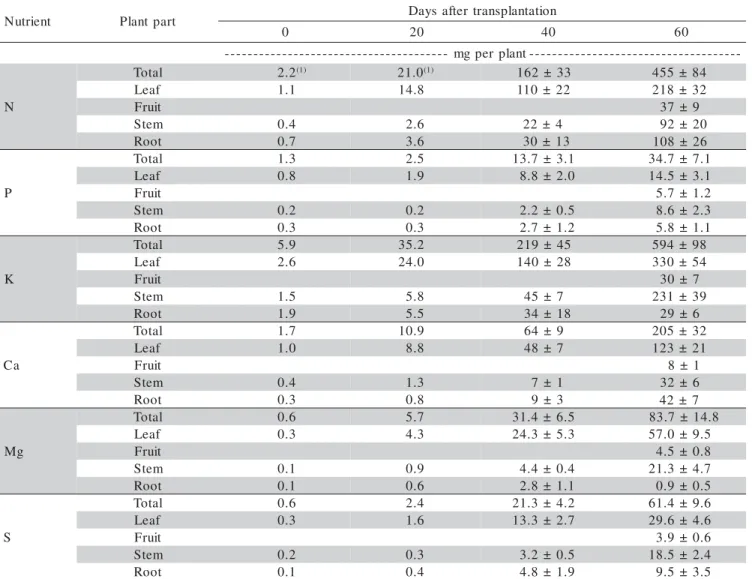
and S increased only after 80 DAT, while absorption of N, K and Ca increased after 60 DAT (Figures 4 and 5). The higher accumulation of Mg and Ca occurred in the leaves, but N, K, S and P were mostly accumulated in the fruits (Tables 3 and 4).
The accumulation curves plotted in Figures 4 and 5 allow the estimation of the amount of extracted nutri-ents by the plants during each developmental phase, start-ing from 40 DAT. This indicate the need of fertilizer per fertigation, which for sweet pepper crops should begin between at 40 to 50 DAT, since fertilization during the
transplantation period, made mainly with manure, meets plant demands efficiently (Villas Bôas, 2001).
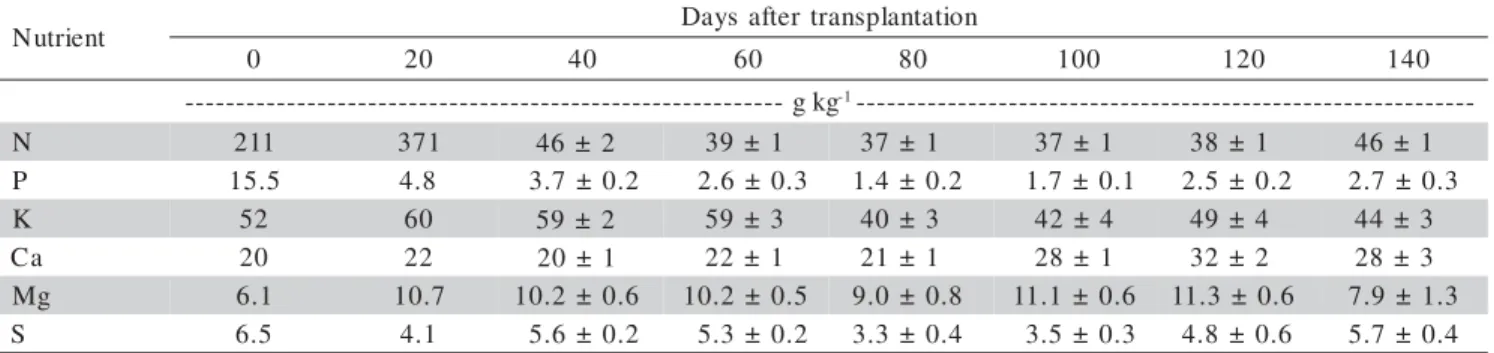
N and K were the most extracted macronutrients, with similar rates of extraction for N, followed by Ca, Mg, S and P in decreasing order of concentration (Table 3). The levels of extracted nutrients found by Silva (1998) for the Mayata hybrid sweet pepper (N = 5.6 g; P = 0.5 g; K = 10.0 g; Ca = 3.5 g; Mg = 1.7 g and S = 1.0 g) were similar to those observed here, except for K, which was 56% higher. Haag et al. (1970), Santiago & Goyal (1985), Graifenberg et al. (1985), Dias (2000) and Villas Bôas (2001) also reported greater extraction of K in com-parison to N. This might be a consequence of using dif-ferent cultivars and/or luxury uptake, since in the present study there was no K deficiency; and K levels in the leaves are within the range considered normal by Trani et al. (1996), or even above this range, as considered by Malavolta et al. (1997) (Table 5). According to these two later studies, the levels of the other macronutrients are within the adequate range for sweet pepper at 100 DAT (complete flowering), which is the indicated period for sampling leaves for chemical analyses.
Figure 3 - Absolute growth rate (AGR) for the whole plant (total) and for each plant organ for sweet peppers fertigated at different days after transplantation.
0 1 2 3 4 5 6
0 20 40 60 80 100 120 140
Days after transplantation (DAT)
AGR, g plant day
-1
Fruit
Leaf
Stem
Root
Total
Figure 4 - Adjusted curves for accumulation of N, K e Ca in sweet pepper plants fertigated from 40 to 140 days after transplantation. *significant R2 by F test at α = 5%.
Figure 5 - Adjusted curves for accumulation of P, Mg, and S in sweet pepper plants fertigated from 40 to 140 days after transplantation. *significant R2 by F test at α = 5%.
yMg = 0.0006x2.9091
R2 = 0.99*
yS = 0.0003x2.971
R2 = 0.98*
yP = 0.0001x3.1377
R2 = 0.98*
0 250 500 750 1000 1250 1500
40 60 80 100 120 140
Days after transplantation (DAT)
Nutrient accumulation, mg per plant
P
Mg
Table 2 - Means (± SE) of plant and first-bifurcation heights, number of bifurcations and leaves according to days after transplantation. s c i t s i r e t c a r a h
C Days After Transplantation
0 20 40 60 80 100 120 140 ) m c ( t h g i e h t n a l
P 8.4 10.8 20.1±2.1 42.1±2.0 52.1±2.9 58.0±4.1 68.1±3.6 79.9±3.1 ) m c ( t h g i e h n o i t a c r u f i b t s
1 1.5 1.5 17.5±1.0 18.7±1.1 18.7±1.3 19.0 ±1.1 19.3±1.4 18.6±1.8 n o i t a c r u f i b f o º
N 1 2 2±0.5 4±0.6 5±0.8 5±0.9 8±1.0 11 ±1.2 s e v a e l f o º
N 6 13 21±3 54±8 76 ±7 102±10 164±34 247±23
SE = standard error
Table 3 - Accumulation of nutrients (mean ± SE) in total dry matter and plant parts of fertigated sweet pepper, according to days after transplantation (DAT).
(1)Because of insufficient material, samples of blocks were mixed for analyses, not allowing mean and SE evaluations. SE = standard error P was the most extracted element by the fruits,
followed by N, S and K at similar percentages (Table 6). On the other hand, Ca and Mg were the nutrients least extracted by the fruits. Dias (2000) found the same ma-cronutrient exportation order for the Elisa sweet pepper: P=60%; N=40%; K=40%; S=35%; Ca=24% and Mg=18%.
From the total amount of macronutrients accu-mulated until 140 DAT, only 8 to 13% were absorbed up to 60 DAT (Table 7). Between 61 and 100 DAT, K was the most absorbed macronutrient (60% of the to-tal accumulated in the cycle); P, Ca and S were more absorbed at the end of the cycle (from 101 to 140 DAT). t n e i r t u
N Plantpart Days after transplantation
0 20 40 60
t n a l p r e p g m -- --- -N l a t o
T 2.2(1) 21.0(1) 162±33 455±84
f a e
L 1.1 14.8 110 ±22 218±32 t
i u r
F 37±9
m e t
S 0.4 2.6 22±4 92±20 t
o o
R 0.7 3.6 30±13 108±26
P
l a t o
T 1.3 2.5 13.7±3.1 34.7±7.1 f
a e
L 0.8 1.9 8.8±2.0 14.5±3.1 t
i u r
F 5.7±1.2
m e t
S 0.2 0.2 2.2±0.5 8.6±2.3 t
o o
R 0.3 0.3 2.7±1.2 5.8±1.1
K
l a t o
T 5.9 35.2 219±45 594±98 f
a e
L 2.6 24.0 140±28 330±54 t
i u r
F 30±7
m e t
S 1.5 5.8 45±7 231±39 t
o o
R 1.9 5.5 34±18 29±6
a C l a t o
T 1.7 10.9 64±9 205±32 f
a e
L 1.0 8.8 48±7 123±21 t
i u r
F 8±1
m e t
S 0.4 1.3 7±1 32±6 t
o o
R 0.3 0.8 9±3 42±7
g M l a t o
T 0.6 5.7 31.4±6.5 83.7±14.8 f
a e
L 0.3 4.3 24.3±5.3 57.0±9.5 t
i u r
F 4.5±0.8
m e t
S 0.1 0.9 4.4±0.4 21.3±4.7 t
o o
R 0.1 0.6 2.8±1.1 0.9±0.5
S
l a t o
T 0.6 2.4 21.3±4.2 61.4±9.6 f
a e
L 0.3 1.6 13.3±2.7 29.6±4.6 t
i u r
F 3.9±0.6
m e t
S 0.2 0.3 3.2±0.5 18.5±2.4 t
o o
Production of commercial fruit of green sweet pepper up to 140 DAT reached 1.3 kg per plant (Table 1). Tivelli (1999) found similar results for Elisa hybrids cultivated in a closed system, which reached about 1.1 kg per plant. Higher yield in commercial fruits was
ob-SE = standard error
Table 4 - Accumulation of nutrients (mean ± SE) in dry matter of total plant and plant parts of fertigated sweet pepper, according to days after transplantation (DAT).
tained as a result of larger space between plants (0.48 x 1.30 m) (Villas Bôas, 2001) and because of the extended fruit-harvesting period (5 months) (Melo, 1997). In these cases, the commercial fruit yield reached 2.5 and 3.85 kg per plant, respectively.
t n e i r t u
N Plantpart Daysaftertransplantation 0
8 100 120 140
-t n a l p r e p g m -N l a t o
T 1110 ±97 2000±342 3029±337 6661±77 f
a e
L 453±51 595 ±82 929±65 2122±174 t
i u r
F 429±72 1029±255 1363±179 2432±483 m
e t
S 124±12 210 ±23 403±42 1090±98 t
o o
R 103±14 167 ±22 335±70 1017±77
P
l a t o
T 66.2±11.2 185.9±39.8 333.4±79.3 715.6 ±4.5 f
a e
L 17.0±2.9 27.1±4.7 60.9±9.2 124.1±6.5 t
i u r
F 36.5±8.8 128.3±33.3 197.4±52.5 362.1±26.7 m
e t
S 7.4±1.3 16.4±2.5 40.9±11.7 128.8±24.0 t
o o
R 5.2±0.8 14.1±3.1 34.2±8.1 100.7±5.0
K
l a t o
T 1353±189 2512±466 3785±218 6450±130 f
a e
L 490±80 663±82 1205±118 2041±266 t
i u r
F 486±87 1262±363 1645±186 2041±181 m
e t
S 327±47 439±36 704±66 1734±124 t
o o
R 50±10 148±20 231±69 635±130
a C l a t o
T 391±50 717±109 1283±108 2790±65 f
a e
L 253±42 439±68 781±62 1276±234 t
i u r
F 34 ±2 127±25 165±38 444±76 m
e t
S 61 ±10 102±11 211±7 64 ±82 t
o o
R 44 ±5 49±11 127±22 427±65
g M l a t o
T 190.5±36.4 396.8±68.6 629.5±68.4 1261.7 ±58.2 f
a e
L 109.2±21.5 176.9±27.7 277.4±25.3 365.2 ±89.9 t
i u r
F 31.5 ±5.8 102.9±23.8 132.8±16.0 234.3 ±27.5 m
e t
S 41.3±10.2 80.2±11.4 142.1±7.9 406.2 ±50.2 t
o o
R 8.5±1.4 36.9±10.4 77.3±23.9 256.0 ±58.2
S
l a t o
T 126.5±21.4 246.2±39.0 437.3±26.2 1036.4 ±16.5 f
a e
L 39.6±8.8 56.3±7.6 118.1±10.8 263.2 ±33.2 t
i u r
F 43.3±7.5 117.7±31.9 168.0±19.6 365.6 ±57.0 m
e t
S 31.8±7.4 48.5±2.2 102.3±3.9 264.2 ±19.2 t
o o
R 11.8±1.4 23.7±4.3 48.9±16.1 143.3 ±16.5
Table 5 - Concentration of nutrients in leaves (mean ± SE), according to the cycle of fertigated sweet pepper.
(1)Because of insufficient material, samples of blocks were mixed for analyses, not allowing mean and SE evaluation. SE = standard error
t n e i r t u
N Days after transplantation
0 20 40 60 80 100 120 140 g k g
-- -1------------------------------------------------------------
-N 211 371 46±2 39±1 37 ±1 37 ±1 38±1 46 ±1 P 15.5 4.8 3.7±0.2 2.6±0.3 1.4 ±0.2 1.7±0.1 2.5±0.2 2.7 ±0.3 K 52 60 59±2 59±3 40 ±3 42 ±4 49±4 44 ±3
a
C 20 22 20±1 22±1 21 ±1 28 ±1 32±2 28 ±3 g
Table 7 - Percent macronutrients uptake during the cycle of fertigated sweet pepper.
ACKNOWLEDGMENTS
To FAPESP for an undergraduate fellowship (N° 99/02880-9).
REFERENCES
BAR-YOSEF, B. Advances in fertigation. In: SPARKS, D.L. (Ed.) Advances in agronomy. New York: Academic Press, 1999. p.1-77.
BENINCASA, M.M.P. Análise de crescimento de plantas: noções básicas. Jaboticabal: FUNEP, 1988. 42p.
CRESPO-RUIZ, M.; GOYAL, M.R.; BÁEZ, C.C.; RIVERA, L.E. Nutrient uptake and growth characteristics of nitrogen fertigated sweet peppers under drip irrigation and plastic mulch. Journal of Agricultural of University of Puerto Rico, v.72, p.575-584, 1988.
DIAS, E.N. Absorção de nutrientes, crescimento vegetativo e produção de frutos maduros de pimentão, em estufa. Viçosa: Universidade Federal de Viçosa, 2000. 70p. (Dissertação - Mestrado).
EMPRESA BRASILEIRA DE PESQUISA AGROPECUÁRIA. Manual de métodos de análise de solo. Rio de Janeiro: EMBRAPA, CNPS, 1997. 212p.
FARIA JR., M.J.A. Avaliação de híbridos de pimentão no cultivo protegido microclima sob estufas de diferentes arquiteturas e da eficácia de diferentes materiais plásticos como cobertura do solo. Jaboticabal: FCAV/ UNESP, 1997. 104p. (Tese - Doutorado).
FERNANDES, P.D.; HAAG, H.G. Nutrição mineral de hortaliças. XXII. Diferenças nutricionais entre variedades de pimentão (Capsicum annuum
L.) Anais da ESALQ,v.28, p.145-151, 1972.
FONTES, P.C.R.; MONNERAT, P.H. Nutrição mineral e adubação das culturas de pimentão e pimenta. Informe Agropecuário, v.10, p.25-31, 1984.
GRAIFENBERG, A.; PETSAS, S.; LENZI, I. Crescita e asportazione degli elementi nutritive nel peperone allevato in serra fredda. Coltore Protette, v.12, p.33-38, 1985.
HAAG, H.P.; HOMA, P.; KIMOTO, T. Nutrição Mineral de hortaliças: V-Absorção de nutrientes pela cultura do pimentão. O Solo, v.62, p.7-11, 1970.
MALAVOLTA, E.; VITTI, G.C.; OLIVEIRA, S.C. Avaliação do estado nutricional das plantas: princípios e aplicações. 2.ed. Piracicaba: Potafos, 1997. 317p.
MELO, A.M.T. Análise genética de caracteres de fruto em híbridos de pimentão. Piracicaba: ESALQ/USP, 1997. 112p. (Tese - Doutorado). PANELO, M. Adaptabilidad de cultivares de pimiento a condiciones de
cultivo protegido. Horticultura Brasileira, v.13, p.101, 1995. Suplemento. Resumo 209.
PAPADOPOULOS, I. Nitrogen fertigation of greenhouse-grown french beans. Communications in Soil Science and Plant Analysis, v.17, p.893-903, 1986.
RAIJ, B. V. Princípios de correção e de adubação para mudas e para produção comercial. In: SIMPÓSIO SOBRE NUTRIÇÃO E ADUBAÇÃO DE HORTALIÇAS, 1990, Jaboticabal. Anais.Piracicaba: Potafos, 1993, p.75-84.
RAIJ, B.; QUAGGIO, J.A.; CANTARELLA, H.; FERREIRA, M.E.; LOPES, A.S.; BATAGLIA, O.C. Análise química do solo para fins de fertilidade. Campinas: Fundação Cargill, 1987. 170p.
RAIJ, B.; CANTARELLA, H.; QUAGGIO, J.A.; FURLANI, A.M.C. Recomendações de adubação e calagem para o estado de São Paulo. 2.ed. Campinas: Instituto Agronômico; Fundação IAC, 1996. 285p. (Boletim Técnico, 100).
SANTIAGO, C.L.; GOYAL, M.R. Nutrient uptake and solute movement in drip irrigated summer peppers. Journal of Agricultural of the University of Puerto Rico, v.69, p.63-68, 1985.
SILVA, M.A.G. Efeito do nitrogênio e potássio na produção e nutrição do pimentão em ambiente protegido. Piracicaba: ESALQ/USP, 1998. 86p. (Tese - Doutorado).
TAIZ, L.; ZEIGER, E. Plant physiology. Redwwood City: The Benjamin-Cummings Publishing Company, 1991. 559p.
TIVELLI, S.W. Avaliação de híbridos e sistemas de condução na cultura
do pimentão (Capsicum annuum L.) vermelho em ambiente protegido. Botucatu: FCA/UNESP, 1999. 240p. (Tese - Doutorado).
TIVELLI, S.W.;OLIVEIRA, J.A.S.; GOTO, R. Caracterização morfológica de híbridos de pimentão vermelho indicado para o cultivo em ambiente protegido. Horticultura Brasileira, v.16, p.148, 1998. Suplemento.
Resumo 351.
TRANI, P.E.; MELO, A.M.T.; PASSOS, F.A.; TAVARES, M.; NAGAI, H.; SCIVITTARO, W.B. Berinjela, jiló, pimenta-hortícola e pimentão. In: RAIJ, B.; CANTARELLA, H.; QUAGGIO, J.A.; FURLANI, A.M.C. (Ed.) Recomendação de adubação e calagem para o Estado de São Paulo. 2.ed. Campinas: IAC; Fundação IAC, 1996. p.150-151. (Boletim Técnico, 100).
VILLAS BÔAS, R.L. Doses de nitrogênio para o pimentão aplicadas de forma convencional e através da fertirrigação. Botucatu: FCA/UNESP, 2001. 123p. (Tese - Livre Docência).
Received February 07, 2003 Accepted November 24, 2003
t n e i r t u
N Daysafter transplantation 0
6 o t
0 61to100 101to140 -d o i r e p s i h t t a p u n e k a t s t n e i r t u n f o %
-N 9.60 46.7 43.71 P 7.28 35.2 57.48 K 13.24 59.9 26.84
a
C 10.07 39.7 50.21 g
M 9.62 46.5 43.83 S 8.27 36.0 55.77
Table 6 - Quantities of nutrients extracted by the plant and exported by fertigated sweet pepper during the 140-day cycle.
t n e i r t u
N Quantityofnutrients Percentageexported s t i u r f e h t y b d
e t c a r t x
E Exported t
n a l p r e p
g gper fruit % N 6.66 2.43 36.5 P 0.72 0.36 50.6 K 6.45 2.04 31.6
a
C 2.79 0.44 15.9 g