(Lepidoptera: Gracillariidae) larvae in three scales
Jesus, CR.
aand Redaelli, LR.
b,a*
aPrograma de Pós-Graduação em Fitotecnia, Faculdade de Agronomia,
Universidade Federal do Rio Grande do Sul – UFRGS, Av. Bento Gonçalves, 7712, CEP 91540-000, Porto Alegre, RS, Brazil
bDepartamento Fitossanidade, Faculdade de Agronomia – UFRGS,
Av. Bento Gonçalves, 7712, CEP 91540-000. Porto Alegre, RS, Brazil *e-mail: [email protected]
Received June 19, 2006 – Accepted September 18, 2006 – Distributed February 29, 2008 (With 1 figure)
Abstract
The spatial distribution of larvae of Phyllocnistis citrella Stainton (Lepidoptera: Gracillariidae), the citrus leaf miner,
in leaves, shoots, and tree crowns of Montenegrina tangerine (Citrus deliciosa Tenore) and Murcott tangor (Citrus
sinensis L. Osbeck x Citrus reticulata Blanco) was determined. Fortnightly samplings from July/2001 to June/2003,
in orchards located in Montenegro (29° 68’ S and 51° 46’ W), RS, Brazil, were carried out. At each sampling occa-sion eighth shoots randomly selected were collected. The spatial distribution pattern of P. citrella larvae between tree crowns and in the shoots was aggregated in most sampling occasions in both citrus species. Nevertheless, on the leaves,
this pattern followed a random distribution, as indicated by the indices I, Iδ and k parameter.
Keywords: citrus leafminer, spatial distribution, ‘Montenegrina’, ‘Murcott’.
Distribuição espacial das larvas de
Phyllocnistis citrella
Stainton
(Lepidoptera: Gracillariidae) em três escalas
Resumo
Com o objetivo de determinar a distribuição espacial das larvas de Phyllocnistis citrella Stainton, (Lepidoptera: Gracillariidae), o minador-dos-citros, nas folhas, nos brotos e nas copas das plantas de tangerineira ‘Montenegrina’
(Citrus deliciosa Tenore) e de tangor ‘Murcott’ (Citrus sinensis L. Osbeck x Citrus reticulata Blanco), foram
realiza-das amostragens quinzenais de julho de 2001 a junho de 2003 em pomares localizados em Montenegro (29° 68’ S e 51° 46’ W), RS, Brasil. Em cada ocasião de amostragem foram coletados aleatoriamente oito brotos. Através da
aná-lise, pelos índices de dispersão I e Iδ, o padrão de distribuição espacial das larvas de P. citrella entre as plantas e nos
brotos de ‘Montenegrina’ e ‘Murcott’ foi agregado na maioria das ocasiões de amostragem. O padrão de distribuição espacial das larvas do minador-dos-citros nas folhas mostrou-se diferente do registrado em copas das plantas e brotos,
os índices I, Iδ e o parâmetro k indicaram distribuição aleatória.
Palavras-chave: minador-dos-citros, distribuição espacial, ‘Montenegrina’, ‘Murcott’.
1.
Introduction
The spatial distribution of a population, that is, the position that individuals occupy in environment ones relative to the others, at a given time, is a central issue in population dynamics studies. A population may show three basic patterns of distribution: random, uniform (regular) and aggregated (clustered). The pattern may change in time, among developmental stages of a same species or even occur superposed in a given population (Southwood, 1978; Elliott, 1983). The identification of the distribution pattern is essential to the development of sampling programs, especially those involving species considered pests (Davis, 1993).
The citrus leafminer, Phyllocnistis citrella Stainton
(Lepidoptera: Gracillariidae), has been considered one
disease is difficult, the eradication of the affected plants being the main measure (Amaral, 2003).
The spatial distribution of the immature stages of P. citrella have been studied in several citrus cultivars and in different spatial scales, mainly in the USA (Knapp, 1995), in India (Rao et al., 2002) and in Brazil (Dantas, 2002).
This study aimed to determinate the spatial distribu-tion of P. citrella larvae on leaves, on shoots and on plants of ‘Montenegrina’ tangerine and ‘Murcott’ tangor, in or-chards under organic management, in Montenegro, RS.
2. Material and Methods
The samplings were carried out in an orchard of ‘Montenegrina’ tangerine trees and in other of the
hy-brid ‘Murcott’ (Citrus sinensis L. Osbeck x Citrus
reticulata Blanco), located at Montenegro (29° 68’ S and 51° 46’ W), RS, Brazil.
Each orchard, with an area of 0.6 ha, comprehends 315 plants, 12 years old, spaced 3 m between plants and 6 m between rows. The orchards are maintained under organic management since their implantation.
The orchards were subdivided in three subareas ap-proximately 0.2 ha each with a similar number of plants to ensure that all the area be represented in the sam-plings. Fortnightly samplings were carried out from July 2001 to June 2003, and in each occasion 12 plants were randomly selected, being four in each subarea. At each selected plant, if present, eight shoots were collected.
The collected shoots were individually packed in la-beled plastic bags, stored in thermal box and transported to the laboratory.
At the laboratory, with the aid of a stereomicroscope Leica MZ 12, each leaf was examined and the number of larvae per leaf registered.
The spatial distribution of P. citrella larvae was ana-lyzed in the leaves, shoots and tree crowns, only on those sampling occasions when the number of individuals (n) was higher than eight. It was calculated the ratio between the variance and the sample average (I), the Morisita Index
(Iδ) and the k parameter of the Negative Binomial, using the
software Ecological Methodology (Krebs, 2000). Values
of I and Iδ equal to unity indicates a random distribution,
lesser than one a uniform distribution and significantly higher than one an aggregated distribution. Otherwise,
values of 0 < k ≤ 8 indicate a random distribution (Poole,
1974). Significance was tested by the χ-square (α = 0.05).
The dispersion index of Iwao was calculated by the
ratio of the accumulated average (x’ = x + [(s² / x) – 1])
and the average (x), resulting in the linear equation:
x’ = βx + α, where βgives the aggregation coefficient
(Southwood, 1978; Elliott, 1983).
3. Results and Discussion
Along the two study years 53 sampling occasions occurred. In ‘Montenegrina’ orchard, 1,487 shoots were collected totaling 7,313 examined leaves and 767 larvae of P. citrella registered. In ‘Murcott’ orchard, were col-lected 1,045 shoots, 4, 536 leaves and 655 larvae.
The greatest number of larvae was registered in summer and in autumn either in ‘Montenegrina’ as in ‘Murcott’ (Table 1). In both orchards, along the study there was a marked decrease of the citrus leaf miner
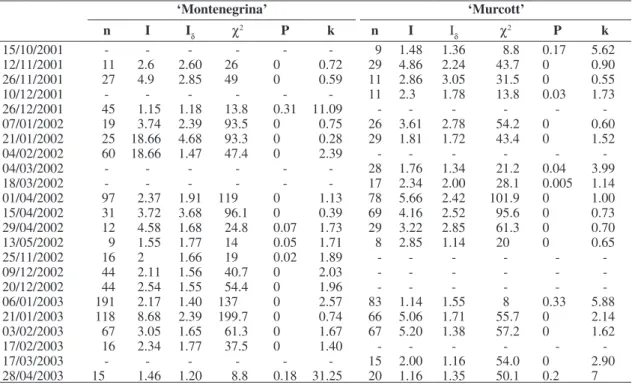
Table 1. Number of Phyllocnistis citrella larvae (n), I index (I), Morisita (Iδ) and k parameter of the Negative Binomial distribution (k), used to determine the spatial distribution of larvae in tree crowns of Montenegrina (Citrus deliciosa Tenore) and of the hybrid Murcott (Citrus sinensis x Citrus reticulata), chi-square test (χ2) to test the goodness of fit of the observed distributions and probability (P), from July 2001 to June 2003, Montenegro (29°68’ S and 51° 46’ W), RS.
‘Montenegrina’ ‘Murcott’
n I Iδ χ2 P k n I I
δ χ2 P k
15/10/2001 - - - 9 0.95 0.90 7.6 0.52 1.89
12/11/2001 11 3.31 2.61 23.1 0 0.73 29 6.50 1.78 26 0 1.81
26/11/2001 27 8.83 4.01 88.2 0 0.35 11 2.61 2.29 20.9 0 0.92
10/12/2001 - - - 11 4.23 2.61 21.1 0 0.74
26/12/2001 45 6.08 3.88 152 0 0.35 - - -
-07/01/2002 19 5.86 2.35 29.3 0 0.88 26 5.52 2.91 60.7 0 0.54
21/01/2002 - - - 29 2.55 1.66 30.6 0 1.76
04/02/2002 60 4.59 1.54 41.3 0 2.29 - - -
-04/03/2002 - - - 28 3.91 1.64 23.5 0 2.09
18/03/2002 - - - 17 2.11 1.69 21.1 0.01 1.75
01/04/2002 97 5.55 1.53 66.3 0 2.06 78 4.12 1.44 45.3 0 2.82
15/04/2002 31 4.12 2.66 66.0 0 0.64 69 9.23 2.81 138.5 0 0.57
29/04/2002 12 1.51 1.69 22.6 0.09 1.72 29 3.59 2.20 46.7 0 0.91
13/05/2002 9 1.80 1.50 9 0.10 3.6 8 2.75 2.50 16.5 0.01 0.83
25/11/2002 16 2 1.47 14 0.05 3.22 - - -
-09/12/2002 44 2.14 1.31 25.7 0.01 4.30 - - -
-20/12/2002 44 3.18 1.72 44.6 0 1.58 - - -
-06/01/2003 191 5.51 1.57 132 0 1.89 83 4.15 1.26 29.0 0 7.83
21/01/2003 118 12.10 1.66 84.4 0 190 66 5.76 1.73 57.6 0 1.58
03/02/2003 67 3.66 1.44 40.2 0 2.85 67 3.50 1.60 56.0 0 1.85
17/02/2003 16 2.06 1.38 18.6 0.02 3.75 - - -
-17/03/2003 - - - 15 1.80 2.09 12 0.21 1.02
pling occasions. The k parameter indicated aggregated distribution in 89.5% and random in 5.9%.
In the ‘Murcott’ orchard, indexes I and Iδ revealed an
aggregated distribution in 88.2% and regular in 11.8% of the sampling occasions. Considering the k parameter, 94.1% and 5.9% of the occasions showed respectively an aggregated and a regular distribution. These results indicate that besides the preference for some plants in the orchard there is also a selection of most suitable ar-eas to the offspring in the host plant. Dantas (2002) also registered an aggregated distribution pattern of larvae in shoots. Otherwise Knapp (1995) in a study realized in southern Florida in lime orchards, found a regular distri-bution pattern in shoots.
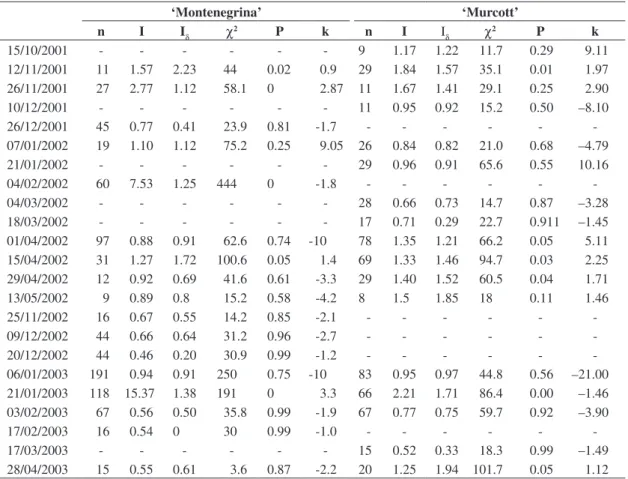
The spatial distribution pattern of the citrus leaf min-er larvae, in leaves, was diffmin-erent from those found in plants and shoots. In ‘Montenegrina’, the indexes I and
Iδ and the k parameter indicated a random distribution
in 77.7% and aggregated in 22.2% of the sampling oc-casions (Table 3). In ‘Murcott’, it was registered a ran-dom distribution in 64.7% and aggregated in 35.3%. The k parameter evidenced that in 52.9% of the sampling occasions the distribution was random and in 47% ag-gregated. This pattern observed in leaves reflects one of the strategies showed by miner insects to maintain the population, considering that competition by interfer-ence in leaves with numerous mines represents one of the main mortality factors. Aggregation could increase the occurrence of intraspecific interference (Auerbach et al., 1995). Rao et al. (2002), in a study carried out in population in the winter (n < 8 in every sampling
oc-casion).
The analysis through the dispersion indexes I and Iδ
and the spatial distribution pattern of P. citrella larvae
in plants of ‘Montenegrina’ cultivar, revealed an aggre-gated distribution in 100% of the sampling occasions and in only three occasions was not detected significance (Table 1).
In plants of the tangor ‘Murcott’ in 17 occasions the distribution pattern was aggregated and in two it was random. The k parameter also indicated the aggregated distribution as the most frequent pattern, in just one oc-casion a random distribution was registered (Table 1). Dantas (2002) obtained a similar result, which registered
an aggregated distribution pattern of the P. citrella
lar-vae in orchards of ‘Pera-Rio’ orange in São Paulo state. The aggregation observed in both studies may be result-ant of an intrinsical behavior of the individuals and/or a response to the food and habitat resources distribution. Concentration of a suitable resource in some areas has been considered as the prevailing cause of aggregation of most organisms (Ricklefs and Miller, 2000). According to Knapp (1995), the citrus leaf miner distribution among plants seems to be related to the availability of shootings in the plant, which may differ among them.
In ‘Montenegrina’ shootings, it was observed an ag-gregated distribution pattern through the use of index I in 94.7% of the sampling occasions (Table 2). Otherwise, the Morisita index rendered an aggregated distribution in 84.2%, random in 10.5% and regular in 5.3% of the
sam-Table 2. Number of Phyllocnistis citrella larvae (n), I index (I), Morisita (Iδ) and k parameter of the Negative Binomial dis-tribution (k), used to determine the spatial disdis-tribution of larvae in shoots of Montenegrina trees (Citrus deliciosa) and of the hybrid Murcott (Citrus sinensis xCitrus reticulata), chi-square test (χ2) to test the goodness of fit of the observed distributions
and probability (P),from July 2001 to June 2003, Montenegro (29° 68’ S and 51° 46’ W), RS.
‘Montenegrina’ ‘Murcott’
n I Iδ χ2 P k n I I
δ χ2 P k
15/10/2001 - - - - 9 1.48 1.36 8.8 0.17 5.62
12/11/2001 11 2.6 2.60 26 0 0.72 29 4.86 2.24 43.7 0 0.90
26/11/2001 27 4.9 2.85 49 0 0.59 11 2.86 3.05 31.5 0 0.55
10/12/2001 - - - 11 2.3 1.78 13.8 0.03 1.73
26/12/2001 45 1.15 1.18 13.8 0.31 11.09 - - -
-07/01/2002 19 3.74 2.39 93.5 0 0.75 26 3.61 2.78 54.2 0 0.60
21/01/2002 25 18.66 4.68 93.3 0 0.28 29 1.81 1.72 43.4 0 1.52
04/02/2002 60 18.66 1.47 47.4 0 2.39 - - -
-04/03/2002 - - - 28 1.76 1.34 21.2 0.04 3.99
18/03/2002 - - - 17 2.34 2.00 28.1 0.005 1.14
01/04/2002 97 2.37 1.91 119 0 1.13 78 5.66 2.42 101.9 0 1.00
15/04/2002 31 3.72 3.68 96.1 0 0.39 69 4.16 2.52 95.6 0 0.73
29/04/2002 12 4.58 1.68 24.8 0.07 1.73 29 3.22 2.85 61.3 0 0.70
13/05/2002 9 1.55 1.77 14 0.05 1.71 8 2.85 1.14 20 0 0.65
25/11/2002 16 2 1.66 19 0.02 1.89 - - -
-09/12/2002 44 2.11 1.56 40.7 0 2.03 - - -
-20/12/2002 44 2.54 1.55 54.4 0 1.96 - - -
-06/01/2003 191 2.17 1.40 137 0 2.57 83 1.14 1.55 8 0.33 5.88
21/01/2003 118 8.68 2.39 199.7 0 0.74 66 5.06 1.71 55.7 0 2.14
03/02/2003 67 3.05 1.65 61.3 0 1.67 67 5.20 1.38 57.2 0 1.62
17/02/2003 16 2.34 1.77 37.5 0 1.40 - - -
-17/03/2003 - - - 15 2.00 1.16 54.0 0 2.90
Faeth (1990), aggregation in miner insects is widespread, because the immature stages are usually sedentary due to their feeding habit. Meanwhile, the formation of aggre-gates in individual leaves could result in an increase of the intraspecific competition or cannibalism (Auerbach and Simberloff, 1989).
The aggregated distribution of P. citrella larvae origi-nates from the females’ preference to oviposit only in young leaves of the shoots (Garijo and Garcia, 1994; Peña and Schaffer, 1997). Nevertheless, the distribution pattern in shoots was also aggregated, suggesting that even among young leaves, some are preferred. This female oviposition preference could be due to factors as leaf position in the tree crowns and/or to an asynchrony between flushings and the adults´ presence in the orchard (Faeth, 1990).
Based upon the obtained results it was verified that the spatial distribution of the citrus leafminer was not homogeneous in the orchards of ‘Montenegrina’ and ‘Murcott’, mainly due to plant heterogeneity as a con-sequence of the organic management. These results indi-cate that for the monitoring and sampling of P. citrella, the spatial distribution pattern should be considered mainly in the tree crown and shoot scales.
Table 3. Number of Phyllocnistis citrella larvae (n), I index (I), Morisita (Iδ) and k parameter of the Negative Binomial dis-tribution (k), used to determine the spatial disdis-tribution of larvae in leaves of Montenegrina trees (Citrus deliciosa) and of the hybrid Murcott (Citrus sinensis xCitrus reticulata), chi-square test (χ2) to test the goodness of fit of the observed distributions
and probability (P), from July 2001 to June 2003, Montenegro (29°68’ S and 51° 46’ W), RS.
‘Montenegrina’ ‘Murcott’
n I Iδ χ2 P k n I I
δ χ2 P k
15/10/2001 - - - 9 1.17 1.22 11.7 0.29 9.11
12/11/2001 11 1.57 2.23 44 0.02 0.9 29 1.84 1.57 35.1 0.01 1.97
26/11/2001 27 2.77 1.12 58.1 0 2.87 11 1.67 1.41 29.1 0.25 2.90
10/12/2001 - - - 11 0.95 0.92 15.2 0.50 –8.10
26/12/2001 45 0.77 0.41 23.9 0.81 -1.7 - - -
-07/01/2002 19 1.10 1.12 75.2 0.25 9.05 26 0.84 0.82 21.0 0.68 –4.79
21/01/2002 - - - 29 0.96 0.91 65.6 0.55 10.16
04/02/2002 60 7.53 1.25 444 0 -1.8 - - -
-04/03/2002 - - - 28 0.66 0.73 14.7 0.87 –3.28
18/03/2002 - - - 17 0.71 0.29 22.7 0.911 –1.45
01/04/2002 97 0.88 0.91 62.6 0.74 -10 78 1.35 1.21 66.2 0.05 5.11
15/04/2002 31 1.27 1.72 100.6 0.05 1.4 69 1.33 1.46 94.7 0.03 2.25
29/04/2002 12 0.92 0.69 41.6 0.61 -3.3 29 1.40 1.52 60.5 0.04 1.71
13/05/2002 9 0.89 0.8 15.2 0.58 -4.2 8 1.5 1.85 18 0.11 1.46
25/11/2002 16 0.67 0.55 14.2 0.85 -2.1 - - -
-09/12/2002 44 0.66 0.64 31.2 0.96 -2.7 - - -
-20/12/2002 44 0.46 0.20 30.9 0.99 -1.2 - - -
-06/01/2003 191 0.94 0.91 250 0.75 -10 83 0.95 0.97 44.8 0.56 –21.00
21/01/2003 118 15.37 1.38 191 0 3.3 66 2.21 1.71 86.4 0.00 –1.46
03/02/2003 67 0.56 0.50 35.8 0.99 -1.9 67 0.77 0.75 59.7 0.92 –3.90
17/02/2003 16 0.54 0 30 0.99 -1.0 - - -
-17/03/2003 - - - 15 0.52 0.33 18.3 0.99 –1.49
28/04/2003 15 0.55 0.61 3.6 0.87 -2.2 20 1.25 1.94 101.7 0.05 1.12
India, verified that in low densities P. citrella present an aggregated distribution in leaves, and at high densities it is random.
The β values and the determination coefficients
ob-tained through Iwao regression in tree crowns (β=1.40
and β= 1.17) and shoots (β= 3.25 and β= 1.54) of
‘Montenegrina’ (Figure 1a,c) and ‘Murcott’ (Figure 1b,d), respectively, indicated that larval distribution was aggre-gated in these levels along all the sampling period.
The aggregation coefficient of the larval distribu-tion on the leaves of ‘Montenegrina’ trees (Figure 1e)
was near one (β= 0.09) but not significant, nevertheless
indicating a trend to a regular distribution. Otherwise, in ‘Murcott’ tree crowns, this coefficient denoted an
ag-gregated distribution of P. citrella larvae in the leaves
(β= 1.31) (Figure 1f).
AMARAL, AM., 2003. Cancro cítrico: permanente preocupação da citricultura no Brasil e no mundo. EMBRAPA Recursos Genéticos e Agrobiologia, Brasília, 5 p.
AUERBACH, M. and SIMBERLOFF, D., 1989. Oviposition site preference and larval mortality in a leaf-mining moth. Ecological Entomology, vol. 14, no. 2, p. 131-140.
AUERBACH, MJ., CONNOR, EF. and MOPPER, S., 1995. Minor miners and major miners: Population dynamics of leaf-mining insects. In CAPPUCCINO, N. and PRICE, PW. (eds.), Population dynamics: new approaches and synthesis, Academic Press, California.
Mean y = 1.4034x + 1.1167 R2 = 0.8823
0 5 10 15 20 25 30
0 5 10 15 20
P < 0.001
Mean cro
wding
Mean cro
wding
Mean
Mean cro
wding
y = 3.2559x - 2.6904 R2 = 0.6946
0 5 10 15 20 25
0 2 4 6
P < 0.001
Mean
Mean cro
wding
y = 1.5469x + 0.4744 R2 = 0.8943
0 5 10 15
0 2 4 6 8
P < 0.001
Mean y = 0.9294x - 0.1082 R2 = 0.4471
0 1 1 2 2 3
0 0.5 1 1.5 2
P = 0.06
Mean
Mean cro
wding
y = 1.3165x - 0.1683 R2 = 0.7129
0 0.5 1 1.5 2 2.5 3 3.5
0 0.5 1 1.5 2
P = 0.007 Mean
Mean cro
wding
y = 1.17x + 1.8112 R2 = 0.7832
0 5 10 15 20
0 5 10 15
P < 0.001
a
b
f e d
c
Figure 1. Iwao regression for Phyllocnistis citrella larvae in tree crowns (a,b), shoots (c,d) and leaves (e,f) of Montenegrina tangerine trees (Citrus deliciosa) (a,c,e) and Murcott tangor trees (Citrus sinensis xCitrus reticulata), (b,d,f), Montenegro (29° 68’ S e 51° 46’ W), RS.
Acknowledgments — The authors gratefully, acknowledge Programa RS-Rural for funding and Conselho Nacional de Desenvolvimento Científico e Tecnológico (CNPq) for fellowships conceded to the authors.
References
KNAPP, JL., 1995. “Citrus leafminer”, Phyllocnistis citrella Stainton: current status in Florida. Univesity of Florida, Gainsville, 35 p.
KREBS, CJ., 2000. Ecological methodology. Bennjamin/ Cummings, Menlo Park, 2nd.ed. 654 p.
MOPPER, S., FAETH, SH., BOECKLEN, WJ. and SIMBERLOFF, DS., 1984. Host-specifc variation in leaf miner population dynamics: effects on density, natural enemies and behaviour of Stilbosis quadricustatella (Lepidoptera: Cosmopterigidae). Ecological Entomology, vol. 9, no. 2, p. 169-177.
PEÑA, JE. and SCHAFFER, B., 1997. Intraplant distribution and sampling of the citrus leafminer (Lepidoptera: Gracillariidae) on lime. Journal Economic Entomology, vol. 90, no. 2, p. 458-464. POOLE, RW., 1974. An introduction to quantitative ecology. McGraw Hill, New York, 525 p.
RAO, KR., PATHAK, KA. and SHYLESHA, AN., 2002. Spatio-temporal changes in the infestation of citrus leafminer, Phyllocnistis citrella Stainton in Meghalaya. Entomon, vol. 27, no. 2, p. 169-178.
RICKLEFS, RE. and MILLER, GL., 2000. Ecology. WH. Freeman and company, New York, 4th edition, 822 p.
SCHAEFFER, B., PENA, JE., COLLS, AM. and HUNSBERGER, A., 1997. Citrus leafminer (Lepidoptera: Gracillariidae) in lime: Assessment of leaf damage and effects on photosynthesis. Crop Protection, vol. 16, no. 4, p. 337-343. SOUTHWOOD, TRE., 1978. Ecological methods, with particular reference to the study of insect populations. Chapman and Hall, London, 2nd. ed., 524 p.
VOLPE, A., CASTRO, PRC. and APPEZZATO-DA-GLORIA, B., 1998. Alterações anatômicas causadas pela lagarta minadora nas folhas de tangerineira Ponkan. Laranja, vol. 19, no. 1, p. 27-38. CHAGAS, MCM., PARRA, JRP., NAMEKATA, T., HARTUNG,
JS. and YAMAMOTO, PT., 2001. Phyllocnistis citrella Stainton (Lepidoptera: Gracillariidae) and its relationship with the Citrus Canker Bacterium Xanthomonas axonopodis pv citri in Brazil. Neotropical Entomology, vol. 30, no. 1, p. 55-59.
DANTAS, IM., 2002. Distribuição espacial e plano de amostragem seqüencial para lagarta do minador-dos-citros Phyllocnistis citrella Stainton, 1856 (Lepidoptera: Gracillariidae), em laranjeira Pêra-Rio Citrus sinensis (L.) Osbeck. (PhD Thesis) – Faculdade de Ciências Agrárias e Veterinárias/UNESP - SP, Brazil.
DAVIS, PM., 1993. Statistics for describing populations. In: PEDIGO, LP. and BUNTIN, GD. Handbook of sampling methods for arthropods in agriculture. CRC Press, Boca Raton.
ELLIOTT, JM., 1983. Some methods for the statistical analysis of sampling of benthic invertebrates. Freshwater Biological Association, Cumbria, 176 p.
FAETH, SH., 1990. Aggregation of a leafminer, Cameraria sp. nov. (Davis): consequences and causes. Journal Animal Ecology, vol. 59, no. 2, p. 569-586.
GARIJO, C. and GARCÍA, EJ., 1994. Phyllocnistis citrella (Stainton, 1856) (Insecta: Lepidoptera: Gracillariidae: Phyllocnistidae) en los cultivos de cítricos de Andalucía (Sur España): Biología, ecología y control de la plaga. Boletín de Sanidad Vegetal, Plagas, vol. 20, p. 815-826.
HEPPNER, JB., 1993. Citrus leafminer, Phyllocnistis citrella, in Florida (Lepidoptera: Gracillariidae: Phyllocnistinae). Tropical Lepidoptera, vol. 4, no. 1, p. 49-64.