The Role of Ludic Activities in Primary English Classrooms – do they
really
help
children to learn?
Eunice Ascensão Nascimento Miletic
March 2017
Practicum Report Submitted in Partial Fulfilment of the Requirements for a
Masters in Teaching English in the 1
stCycle of Basic Education, under the
Supervision of Dr Sandie Mourão and Professor Carlos Ceia
Acknowledgements
I would like to thank all my professors for their guidance, especially my supervisor, Sandie Mourão, who guided me through this MA and my study and helped me to learn more as a teacher.
I would like to thank Marta Arrais for having me in her class and for her help and support.
I would also like to thank my colleagues for taking and completing this journey with me.
I am also deeply in debt to my family, husband and daughters Beatriz and Helena, for their endless support and patience. You were my rock during this time.
A special thank goes to my good friend Nance for her dedication.
Abstract
The present study is relevant at a time when English has become a curricular subject from grade 3 in the first cycle of Portuguese primary school. The main aim was to verify the possible benefits of using ludic activities in English language learning and teaching by analysing the effect that they have in enhancing and maintaining student motivation and participation in class. First, I defined ludicity, then analysed the activities implemented in ten taught lessons. I gave two questionnaires to students and also collected their oral feedback, in addition to keeping a teacher diary.
Doing this study helped me realize how I could be more proactive when planning lessons by implementing engaging activities and creating my own ludic resources to complement the course book. I also realized that it is not the activity per se that is ludic,
but the way the activity is set up that makes it ludic. An activity can be complemented by pre-, during or after activities to bring ludicity to the activity and to engage students. My definition of ludicity and the results from this study may help teachers adapt or follow a ludic approach to complement a course book as a way to facilitate the learning process, resulting in students being more relaxed, motivated and participative.
Resumo
O presente estudo torna-se relevante numa altura em que o Inglês tornou-se numa disciplina curricular desde o 3º ano do 1º ciclo nas escolas primárias portuguesas. O principal objetivo era verificar os possíveis benefícios do uso de atividades lúdicas na aprendizagem e ensino da língua inglesa através da análise do seu efeito em manter a motivação e participação dos alunos nas aulas. Primeiro, eu defini lúdico, depois analisei as atividades implementadas em 10 aulas lecionadas. Fiz dois questionários aos alunos e ouvi as suas opiniões e, ainda, mantive um diário.
Fazer este estudo ajudou-me a perceber como posso ser mais proactiva aquando da planificação das minhas aulas ao organizar atividades estimulantes e criar os meus próprios recursos lúdicos para complementar o livro de inglês. Apercebi-me, também, que uma atividade por si só não é essencialmente lúdica, mas sim a forma como a organizamos é que a torna lúdica. A minha definição de lúdico e os resultados deste estudo podem ajudar outros professores a adaptar ou a seguir uma abordagem lúdica para complementar o livro de inglês como forma de facilitar o processo de aprendizagem, tendo como resultado alunos mais motivados, descontraídos e participativos.
Table of Contents
Chapter 1. Introduction ……….. 1
Chapter 2. Literature Review: The Ludic in English Classrooms ……….. 2
2.1 Introduction ………... 2
2.2 Ludicity – a definition ……….. 2
2.3 Why ludicity in primary English classrooms ………... 3
2.3.1 Ludic activities and motivation ………. 4
2.3.2 Which activities are ludic? ……… 5
2.4 Closing comments ……… 6
Chapter 3. The Action Research ………. 7
3.1 Context ………. 7
3.2 Methodology ……… 8
3.2.1 The action research ………... 8
3.2.2 Procedures ……… 8
3.2.3 Data collection ………. 9
3.2.3.1 Student questionnaires ……….. 9
3.2.3.2 The teacher journal ……….. 10
3.2.3.3 Student feedback ………. 10
4. Results and discussion ……… 11
4.1 Introduction ……….. 11
4.2 The lessons ………... 11
4.2.1 Lesson 1: Group work ………... 11
4.2.3 Lesson 3: A story ………... 13
4.2.4 Lesson 4: A song ……….. 14
4.2.5 Lesson 5: A survey ………... 14
4.2.6 Lesson 6: Homework correction ……….. 15
4.2.7 Lesson 7: A movie ……… 15
4.2.8 Lesson 8: Animated song and writing a short story ………. 16
4.2.9 Lesson 9: A mime game ……… 17
4.2.10 Lesson 10: A memory game ……… 17
4.3 Student feedback ………... 18
4.4 The student questionnaires ………... 19
4.4.1 Questionnaires I and II ……… 19
4.5 Summary ……… 21
5. Conclusion ……… 22
5.1 Brief summary of research question and findings ……….. 22
5.2 What do these results mean for me as a teacher? ……… 22
5.3 Relevance of these results to other teachers or classrooms ………. 24
5.4 Final comments ……… 24
Bibliography ………. 26
Appendix ……….. 28
Appendix I – Letter of consent to school board ……… 28
Appendix II – Letter of consent to parents ……… 29
Appendix III – Letter of consent to students ………. 30
Appendix V – Questionnaire II ………. 32
Appendix VI – Opening and closing song ……… 33
Appendix VII – Image portraying a health problem (lesson 1) ………. 33
Appendix VIII – Grammar Puzzle (lesson 2) ……… 34
Appendix IX – Song “Fit and Healthy” (lesson 4) ……… 35
Appendix X – Survey (lesson 5) ……… 36
Appendix XI – Story written by students: “Trick or Treat” (lesson 8) ………. 36
Appendix XII – Solutions for health problems (lesson 9) ………. 37
Chapter 1. Introduction
As teachers we know that for some students learning a foreign language can be stimulating and they embrace it with great interest, but for others it can be challenging. Therefore, it is necessary to develop activities which can enable students to be successful in this process, by preparing dynamic classes and meaningful activities that contribute to a lighter and effective learning environment and, at the same time, students will enjoy themselves as they learn English.
I have been teaching English to young learners within the programme Actividades Extra-Curriculares for almost a decade and this has been my concern since the beginning.
Since these are extracurricular activities they take place at the end of the day when students are tired, not focused and bored. I always thought of how I could overcome these obstacles to learning and keep my students motivated and interested in order to promote active learning. My strategy was to favour ludic activities in order to keep students motivated and engaged. Therefore, when I had the opportunity to research an area of interest for my studies, I thought it would be relevant to research in the topic of using ludic activities in primary English language classrooms.
The main aim of this study is to reflect upon the use of ludic activities in English language learning and teaching by analysing the effect that they might have in enhancing and keeping students motivated and participative in class. In this sense, the proposed study is based on the following research question: “Do ludic activities contribute to more effective language learning in the primary classroom?”
Chapter 2. Literature Review: The Ludic in the English Classroom 2.1Introduction
This chapter starts with a possible definition for ludicity and I will explain the importance of using ludic activities in the primary English classroom and why ludicity can be seen as a pedagogical tool. Then I will talk about the important role of ludic activities in keeping students motivated and interested in learning English. Finally, I will explain what makes an activity ludic and give examples of some ludic activities and their pedagogical aspect. I will end the chapter with closing comments to sum up all these ideas.
2.2 Ludicity – a definition
Ludic is defined as of, relating to, or characterized by play according to the Oxford Dictionary, ludic shows “a tendency to play and have fun” and is “spontaneous”. Dearden (1967, p. 59) defines play as “a non-serious and self-contained activity which we engage in just for the satisfaction involved in it.” As stated by Bernardo (2009, p. 60) “ludic is everything that allows the construction of knowledge in a more free and spontaneous way”. The ludic element adds feelings of joy, satisfaction and enthusiasm, enabling at the same time knowledge and understanding of the world.
Therefore, ludicity is of great value to the learning process since it is rich in meaning (Bernardo, 2009). A ludic activity involves children in a way that fosters their creative imagination and enables indirect learning, for students are not focussing on the language but using it for real (Constantinides, 2009; Halliwell, 1992). Following Halliwell’s (1992) suggestions, a ludic activity allows children’s creative use of limited language resources, promotes indirect learning and makes the most of the children’s need to play and have fun.
Thus, this is what I have taken from what the above mentioned authors have said about a ludic activity:
gives students opportunities to practise the language in a more relaxed and enjoyable way
promotes indirect learning
makes the most of the children’s need to play and have fun
is spontaneous
is mentally and emotionally stimulating
is associated with a feeling of joy
is a more natural way to learn
2.3Why Ludicity in Primary English Classrooms?
Since an early age the child communicates and makes sense of the world through play. Consequently, if “children have a natural instinct for fun and play” (Halliwell, 1992, p. 6), using ludic activities in the context of the classroom is a way of taking advantage of this natural predisposition and to put it to work on the behalf of children. Ludicity promotes learning in a more real and dynamic way, it helps the student to socialize and it develops the ability to interact with others (Bernardo, 2009). Through ludic activities students can learn new concepts, bond with their colleagues, stimulate their reasoning and feel more at ease and motivated. As a result, students will improve their performance.
Read (2015) states that the advantage of taking a ludic approach to teaching is seen “in terms of the whole learner and the more elusive social, psychological, cognitive, metacognitive, affective and emotional benefits that underpin children’s motivation and learning success” (xii). Therefore, when using ludic activities we are not just aiming for students having fun, but, extremely importantly, we are taking into account the overall development of the child, social, emotional and cognitively.
sense. When choosing to do ludic activities teachers should take into account the value of their pedagogical purpose, for example, in providing stimulation, interest and motivation or in promoting the acquisition of communicative competences (more examples are presented in 2.3.2).
In the classroom, taking into consideration the Encounter, Engage and Exploit model (EEE model) which is a student-centred teaching model, play of a ludic kind can accompany each stage. In this sense, ludicity is associated with the Encounter and Engage stages where students are exposed to the new language and “practice it through specific games and tasks that will develop understanding, fluency and accuracy” (Robinson, Mourão & Kang, 2015, p. 14). These stages are more teacher-led, as the teacher scaffolds and models. Ludicity is also associated with the Exploit stage as it is about students using language freely, letting them “be creative with it in childlike ways” (p. 15). This last stage is less teacher- led, as students use the “language for their own pleasure” (p. 15).
Bernardo (2009, p. 79) sums up the issue of ludicity being a pedagogical tool by saying that it is “a vehicle for learning.” We know that for some students, learning a foreign language can be stimulating and they embrace it with great interest, but for others it can be challenging. Teachers are responsible, not only for the adequacy of the teaching, but also for students’ learning process. Not all ludic activities have a pedagogic value in the context of the classroom and therefore, it is necessary to develop activities which can enable students to succeed in this process. This can be done by preparing dynamic classes and meaningful activities that contribute to a lighter and effective learning environment and, at the same time, students will enjoy themselves as they learn English.
2.3.1 Ludic activities and motivation
In this sense, when working with young learners, teachers should implement activities which associate teaching and learning with fun and pleasure, making students feel more at ease. Krashen (1982), in his Affective Filter Hypothesis, considers the student emotional state or attitudes as an adjustable affective filter. When a student feels anxious and threatened, their affective filter is raised, blocking input which is necessary to acquisition. When students are relaxed, their affective filter is lowered, which contributes more effectively to their acquisition of new language. Correspondingly, Halliwell (1992) emphasizes that it is important to balance enjoyment with “cognitive engagement in tasks” to stimulate motivation.
2.3.2 Which activities are ludic?
A wide range of activities can be referred to as ludic. When setting up ludic activities in the classroom, the teacher must consider the goals that he wants the students to achieve through the activity (Bernardo, 2009). It is necessary to create an explicit context for the use of the ludic activity which motivates and keeps students interested. On the other hand, students need to understand the reason and purpose of the activity, so they can realize that they are learning as well as playing when engaging in activities which are fun and which involve reading, writing, listening and speaking.
When planning activities for the classroom the teacher must keep in mind not only the ludic aspect but, also, the pedagogical aspect of the activity. For example:
a) Games are good tools to promote acquisition of communicative competences and cooperation between students. According to Read (2007), games are an essential part when teaching English to young learners, since they provide stimulation, variety, interest and motivation and help to promote positive attitudes towards learning English. Games are enjoyable and fun and lead children to use the language in a more natural and spontaneous way.
c) Songs/Rhymes/Chants: through repetition children can produce language in a more natural, spontaneous and enjoyable way. They promote positive attitudes and motivation towards learning English, and can be used to introduce new language or to consolidate, develop listening comprehension and speaking skills (Read, 2007).
d) Role-plays/Dramatizations: enhance children’s imagination, fantasy, collaborative and interaction skills, catch their attention and interest. They engage students in “learning by doing”, since students can associate gestures, “action, words and meanings and memorize key language in a natural and enjoyable way” (Read, 2007, p. 115).
e) Flashcards/Illustrations: they provide stimulating visual support and allow children to “grasp meaning” and to produce “meaningful language” (Halliwell, 1992, p.4).
f) Stories: are “build on children’s innate capacity for fantasy and imaginative play” (Read, 2007, p.114). Halliwell (1992, p.7), says that imagination provides a “powerful stimulus for real language usage.”
2.4 Closing comments
I started this chapter by defining ludicity as being fun, enjoyable, spontaneous and different from the normal. It fosters children’s creative imagination, enables indirect learning and is mentally and emotionally stimulating. I also described how ludicity can be seen as a vehicle for learning. Through ludic activities students can learn new concepts, bond with their colleagues, stimulate their reasoning and feel relaxed and motivated.
If playing is a natural process for children, the introduction of ludic activities in the classroom can lead to more effective learning since it can enhance students’ motivation, help children to make sense of the surrounding environment, build their knowledge and develop their communicative skills.
supplement it with engaging activities which are fun and which involve reading and writing and also listening and speaking.
Chapter 3. The Action Research 3.1 Context
This research project was carried out in a renowned private school founded in 1898. The school offers several modalities in education that range from pre-school to high school and English is taught in all modalities. The school’s philosophy is based on the idea of equal opportunities for all students and promotes the defence of civil rights, freedom and both national and international solidarity.
This research project was conducted in a third grade class composed of 28 children, 12 girls and 16 boys, of 8 and 9 years old. The majority were Portuguese L1 speakers. One of the participants was a bilingual (English and Portuguese) boy who was born in the United States of America and moved to Portugal when he was six years old. There were also two Chinese students, a boy and a girl, for whom English was their third language and Portuguese was the second. These three students were well integrated in the class and had no difficulties in speaking Portuguese. All participants had English since the first grade and the majority of them had experienced the English language since pre-school, meaning from the age of three. All students in primary school in this school had had four English classes of 45-minutes each per week as a curricular subject.
The class followed a course book, High Five! Level 3 (Shaw & Ramsden, 2014,
Macmillan). The book did not follow the Metas Curriculares de Inglês no 1º Ciclo
3.2Methodology
3.2.1 The Action Research
The research methodology used in this research project was action research. According to Burns (2010, p. 2), “action research involves taking a self-reflective, critical and systematic approach to exploring your own teaching context”. The idea is to be critical by questioning and problematizing our own teaching context. Taking one area we think could be improved upon, subjecting it to questioning and then developing new ideas and alternatives to improve our practice.
The advantage of doing action research is that by taking the context into account it is more realistic and provides a holistic view, since it allows the researcher teacher to think about everything that happens in the classroom and gives a greater understanding of the “teaching dilemmas” (Burns, 2010, p. 6). Therefore, this methodology allowed me to reflect on the teaching and learning processes and to be critical about the findings during my project. Consequently, it helped me to decide what materials and activities were more effective in the classroom.
3.2.2 Procedures
To put this research project into practice, the school board, parents and students were informed of the purpose of my study. Therefore, I first wrote a letter to the school board to inform them about my intention and to ask for permission to conduct my research in their school. Afterwards, parents were also informed, through a letter of consent, about the study in which their children would be involved. The children also had a word to say, and hence they were asked to give consent. They also received a letter of consent and had to indicate if they wanted to participate in the research or not and sign. The letters explained the aims of the study, the length, the way data would be collected and the purpose of the study. Samples of the three consent letters can be accessed in the Appendices (Appendix I, II and III).
3.2.3 Data Collection
The improvements that happen in action research are based on the data, or information, collected by the teacher-researcher in a systematic way. The data for this research were collected through three different research tools: questionnaires, my teacher’s journal based on my observations and while teaching and the students’ oral feedback. Therefore, there was both a qualitative and quantitative approach to data analysis.
3.2.3.1 The student questionnaires
There were two student questionnaires: Questionnaire I was given at the beginning of my ten-lesson teaching practice to collect information about student’ s opinions concerning activities when learning English and how they like to learn. It was composed of ten statements (see Appendix IV). Questionnaire II was given after completing my practice and was composed of twelve statements (see Appendix V). The goal was to get students’ opinion about the activities, what activities they thought would be more useful to learn English, whether they thought the activities had contributed to helping them learn more and whether they felt they were really learning at the same time that they were having fun.
3.2.3.2 The teacher journal
I wrote a journal to keep a record of my impressions, doubts and ideas based on my observations while teaching. The entries were written retrospectively just after the lesson. I would write my first reaction, impressions and emotions about what had happened and might add more information later on, after reflecting about the lesson. This was an advantageous tool because it was a way of organizing, formulating and reflecting on the experience, about what had gone right or wrong and what could be changed. Afterwards, the data was accessible for reflection and analysis. The data resulting from this tool were both subjective and objective. Subjective because it is introspective and results from my impressions and ideas, and objective because it contains essential details of what happened (McDonough and McDonough, 1997).
3.2.3.3 The student feedback
During my practicum, at the end of every lesson students were asked to give their opinion about the lesson and the activities. If the students liked the activities they would put their thumb up, if not the thumb would be down. I adopted this system keeping in mind the ludic premise of this research. It was important to get students’ feedback as the activities were being implemented to see if they were of any meaning to the students and, on the other hand, if they were effective for the purpose of this research.
However, in the last lesson students were asked to give oral feedback bearing in mind all ten lessons. The goal was for them to speak their minds with no constraints. Since the students were active participants in the research, I thought that this “face-to-face interaction” (McDonough and McDonough, 1997, p. 182) was important at that point.
4. Results and discussion 4.1 Introduction
Bearing in mind the research question “Do ludic activities contribute to more effective language learning in the primary classroom?” the main aim of the conducted research was to ascertain the real contribution of ludic activities to the students’ learning process and discover to what extent it motivated students to participate in class and use English. I selected one ludic activity per lesson and the chosen activities were implemented in ten taught lessons. The lessons were based on the whole of unit 3 of the adopted course book under the theme “Fit and Healthy”. The data from these lessons were based on my observation, the notes in my journal and students’ feedback. In this section I describe the ludic activities and discuss whether they were successful or not. I complete this chapter by presenting and discussing the two questionnaires the students completed.
4.2 The lessons
As a way of creating an optimal atmosphere for learning to occur and in order to create an enjoyable environment, all lessons started and ended with a smallsong created by me. The objective was to settle the students at the beginning of the lesson and to get them ready for English and to end the lesson in a good mood. The song lyrics were the same but slightly adapted depending on whether it was sung in the opening or closing parts of the lesson (see Appendix VI for the lyrics). Each song had three verses: the first verse was sung by the girls, the second by the boys and the last verse by all the students. Singing songs can be ludic and dividing the verses between girls and boys was a fun and different thing to do. Through the ludicity of singing the song, I observed that students were motivated to start the English class and were also happy to end the lesson on a high note.
4.2.1 Lesson 1: Group work
suggested activities in the book but instead with activities aiming to promote students’ collaborative and co-operative ability.
Students were divided into groups of four and all groups had twelve images of people with a health problem and under each image the health problem was written in English (See Appendix VII). Students had to discuss together which health problem was portrayed in the images. For example, they had to realise that headache meant “dor de cabeça” in
Portuguese. After the group discussion, students were asked to identify in Portuguese the twelve health problems and to say the words in English.
The discussion: I observed in class and noted in my journal that students seemed to like the group work because they were doing something different from the routine and had some freedom to choose different working strategies within each group. For example, some groups divided the images between them and each one of them was responsible for their set of images, while others discussed the options as a group. Students appeared to be engaged and enjoying themselves while doing the group work. Consequently, when doing the after-group-work activity, students’ answers provided evidence that the activity was effective since they were able to match the Portuguese and the English words. As stated by Bernardo (2009, p. 60) “ludic is everything that allows the construction of knowledge in a more free and spontaneous way”. This idea was the basis for planning the lesson.
4.2.2 Lesson 2: A grammar puzzle
The activity: for this lesson I created a grammar puzzle to explain and to help students to visualize how the question with have/has got and do/does works. I used A5 size cards
with each element of the questions and together, the students and I had to combine each piece of the puzzle to create the question according to the different pronouns. The pieces were displayed on the board as the students discovered the missing parts (see Appendix VIII).
meaningful activity that could contribute to lighter and effective learning (Halliwell, 1992).
4.2.3 Lesson 3: A story
The activity: each unit of the adopted course book had a chapter of a story which featured the characters from the book and the language under study. I used the chapter from Unit 3 exactly as it was presented in the teacher’s guide. After listening to the CD and reading the story, students had to answer some true or false questions about the story. To introduce something different, I asked the students to put their thumb up or down if the answer was true or false. The twist of using the thumbs to answer to the questions can, from my point of view, be considered ludic because it had a play element.
The discussion: according to the definition of ludic presented at the beginning of this report, the approach to the story was not ludic. There was no pre-story activity to present the language such as flashcards or a mime game to prompt the language. It is not the activity per se that is ludic, but the approach to the activity. This was a book-based lesson
rather than one based on ludicity.
Even though this lesson was not as ludic as it could have been, I noticed around this time a change in the students’ behaviour and willingness to participate orally in the class. Even the more agitated group was getting calmer and started to pay attention and to participate in class with some enthusiasm. As I wrote in my journal:
“This change, obviously, gives me more confidence and shows me that I am on the right track as far as my research project is concerned, meaning that I am starting to get the evidence that ludic activities are a way of easing English learning and of showing young English learners
that English can be fun” (journal, 19/10/2016).
4.2.4 Lesson 4: A song
The activity: I used the song “Fit and Healthy” from the book introducing the new language healthy habits and what one must and mustn’t do in order to be fit and healthy
on the board (must/good; mustn’t/bad) and students had to fit each habit into the right column.
The discussion: the after-song activity was an activity that I set up (it was not from the book) to collect evidence of the effectiveness of the song activity. Students were successful in completing each column correctly.
Using songs and repetition children can produce language in a more natural, spontaneous and enjoyable way. It also promotes positive attitudes and motivation towards learning English. Although the first part was book-based, students appeared to be relaxed and at this point more students appeared willing to participate orally. They were putting their hands up more often and getting a little cross when they were not given the opportunity to speak during the follow-up activity. Students seemed to be happy in the class and, for example, on this day they gave me a warm reception by hugging me in a big group hug (journal, 21/10/2016).
4.2.5 Lesson 5: A survey
The activity: each student received a grid with six questions that they had to answer about themselves and to ask to three friends. The grid title was “Fit and Healthy” (see Appendix X). The objective was to give students the opportunity to practise the language in a more enjoyable way and to interact with their colleagues.
As a preparation for the activity, students were asked to name things that one must or mustn’t do in order to be fit and healthy. Secondly, I put on the board an A4 sheet with the grid and gave lockstep instructions for the survey activity. Finally, students were invited to freely circulate around the classroom and to choose friends to question. This is something that doesn’t happen regularly since students are normally in their seats during classes and not allowed to speak freely with each other. During the activity I moved around the room monitoring, helping students to ask their peers and helping the shy ones to find a pair. Fast finishers were asked to help other colleagues and I noticed they did it with satisfaction. Afterwards students had the opportunity to share the collected information.
In this activity, ludicity was used to generate meaning (Halliwell, 1992) and the students seemed to be motivated and enthusiastic participating in the activity.
4.2.6 Lesson 6: Homework correction
The activity: when planning this lesson my concern was turning homework correction into a fun activity. My main focus was on involving all students in a more enjoyable situation and one way of doing this was favouring interaction between students and not individualizing answers, but involving all students.
The first exercise was a simple one: putting ticks or crosses for true or false. Students were asked to do peer correction and they had to correct each other’s exercises. Here I understood that I had made my point as students looked amazed at this power to check their pair work. There was general enthusiasm with students smiling and eager to start. For the next exercises, since they required full answers, I decided to ask for a volunteer to read his/her answer and students had to put their thumb up for agreement or down for disagreement. If they disagreed we would have another student give another answer. For this section, the ludic activity involved the students putting their thumbs up or down because it introduced a play element.
The discussion: from my perspective, it was a much more productive and engaging activity supported by the students’ interaction. I managed to turn homework correction into a ludic activity and observed excitement in most of the students. My point is that a homework correction activity can be set up in a more fun way. Students seemed to be motivated to participate and share their answers.
4.2.7 Lesson 7: A movie
The activity: this lesson had a cultural content and was planned around Scotland, following the course book’s cultural section. I diverged from the book’s suggestions to make the lesson more ludic, since the activity from the book was to read testimonies of what it was like to live in different parts of Scotland and to answer some questions. The theme for this lesson was the legend Loch Ness and we started with visual support: a map of Great Britain (GB) was displayed on the board and students could see where the four countries that make up GB are located.
of Loch Ness legend. Again, we went back to the map to see the location of the lake. As a way to prompt students for discussion we watched a small movie, The Amazing Professor Ambrosiu’s’ Mansion: The Loch Ness Monster (Alonso & Junior, 2011). The
next step was the debate about the veracity of the legend. Students were eager to share their opinion and every student wanted to participate.
The discussion: the use of different attractive visual supports to maximize students’ interest was a way of engaging and stimulating students for the discussion part and they seemed motivated to participate orally. Students were using L2 as much as possible, although a few students with more difficulties were using L1. Once again, as I wrote in the journal, “students participated with enthusiasm and enjoyment” (journal, 28/10/2016).
4.2.8 Lesson 8: Animated song and writing a short story
The activity: following the definition of ludic presented at the beginning of this chapter, the focus was on challenging students’ imagination, creativity and oral skills. The theme was Halloween and initially students were asked to share their experiences of this festivity. Then students watched the animated song, Trick or Treat Halloween Song
(Turtle Interactive) as an introduction to the next activity and a way to trigger their creativity. Students were then challenged to create a story in English based on the main character in the video clip of the song. They felt insecure in doing it, but I assured them in Portuguese that they were capable of doing this.
It was of great importance to challenge the students and to help them to see that they were capable of doing much more than they thought. I felt the end result was positive because of the ludic approach to the lesson.
4.2.9 Lesson 9: A mime game
The activity: in order to prompt the language and to engage students, several flashcards with solutions for the health problems we were learning were displayed on the board. The cards had a written solution and the respective drawing for visual support (see Appendix XII).
Students were organized into groups of three and one had to mime a health problem, another had to identify the problem and the third one had to find a solution for the health problem according to the flashcards displayed on the board. Each group had to do this one at a time in front of the class and if they needed help they would say “Help please!” and the classmates would help them.
The discussion: as I wrote in my journal:
“From my point of view this was a very productive and effective lesson and students had a good opportunity to exploit the language while engaging in a game and to communicate in English. Students were enthusiastic about the game. Of course they all wanted to have a role in the mime part, but they were good sports and engaged in their part nevertheless. Students were having fun, playing with the language, using it correctly, making connections, looking for solutions and, also, being collaborative and cooperative”
(journal, 04/11/2016).
My goal when preparing this lesson was to balance the fun/enjoyable part while students were cognitively engaged in the task. Halliwell says that this means to let “students’ subconscious mind work on the processing of language while the conscious mind is focused on the task” (1992, p. 6).
4.2.10 Lesson 10: A memory game
The activity 1: the activities from this lesson were an introduction to a project proposed by the book called “Zoo Animals” where students had to create a zoo with different animals. Since the students were going to do the project with my co-operating teacher to be displayed in the school, we decided that I would do this introduction.
and decide if it was a wild or farm animal. The flashcards were displayed on the board according to their answers. Suddenly, an incident occurred. One boy spontaneously started to talk about his pets saying “I have four dogs e three cats” (journal, 07/11/2016).
Other students that had pets felt confident to share their experiences and started to put their hands up.
The discussion: since it was a good opportunity for them to explore the language in a free and relaxed mood, I decided to let them speak but in English as much as possible. These spontaneous moments of language use can be an evidence of students feeling confident and comfortable in an environment characterized by ludicity, where they can take part with no constraints.
The activity 2: then students played a memory game which required concentration, observation and memory skills. I displayed some animal flashcards on the board and students had to watch and memorize the order of the cards. Then I took the cards off the board and students had to recreate the same sequence. For another version of the game, after memorizing the sequence, I asked the students to close their eyes. I switched two cards and they had to identify the changes.
The discussion: Students were enthusiastic about the game and seemed to be having fun and participating with laughter, enthusiasm and expectation. I ended my reflection with this thought: “Ludic activities can create a much more relaxed environment and engage students. They really are learning and having fun at the same time” (Journal, 07/11/2016).
4.3 Student feedback
After every lesson students were asked to give their opinion about the lesson and the activities. If the students liked the activities, they would put their thumb up, if not, it would be thumbs down. The students always gave positive feedback.
groups was never to put the agitator students together because they just want to have fun with their friends which can disrupt the class. When they are separated they tend to be calmer and more respectful. My goal was to create a warm and enjoyable environment for all the students.
4.4 The student questionnaires
The purpose of doing the questionnaires was to collect students’ opinions about activities done in English classes and to see if they thought more ludic activities could help them to learn better.
4.4.1 Questionnaires I and II
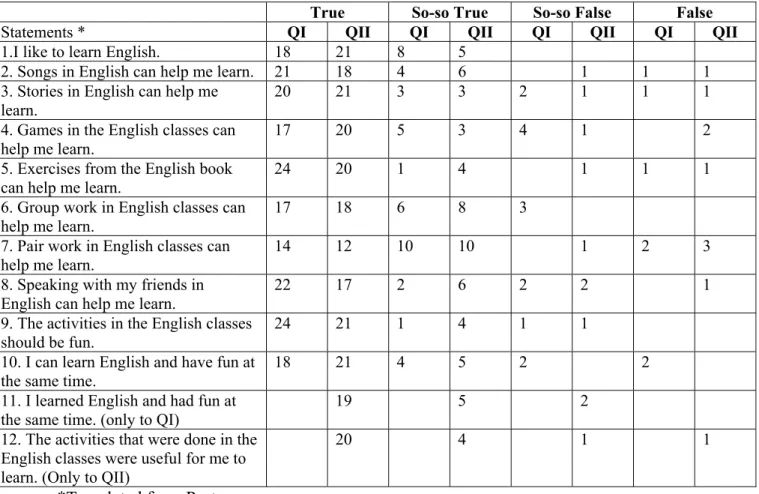
Table 1: Results from Questionnaires I (QI) and II (QII). Total sample = 26 per questionnaire
True So-so True So-so False False
Statements * QI QII QI QII QI QII QI QII
1.I like to learn English. 18 21 8 5
2. Songs in English can help me learn. 21 18 4 6 1 1 1
3. Stories in English can help me
learn. 20 21 3 3 2 1 1 1
4. Games in the English classes can
help me learn. 17 20 5 3 4 1 2
5. Exercises from the English book
can help me learn. 24 20 1 4 1 1 1
6. Group work in English classes can
help me learn. 17 18 6 8 3
7. Pair work in English classes can
help me learn. 14 12 10 10 1 2 3
8. Speaking with my friends in
English can help me learn. 22 17 2 6 2 2 1
9. The activities in the English classes
should be fun. 24 21 1 4 1 1
10. I can learn English and have fun at
the same time. 18 21 4 5 2 2
11. I learned English and had fun at
the same time. (only to QI) 19 5 2
12. The activities that were done in the English classes were useful for me to learn. (Only to QII)
20 4 1 1
As we can see, the data from Table 1 showed that, before implementing the ludic activities, 18 students stated that they liked to learn English (statement 1), but after the implementation this number increased to 21. It is relevant to remember that while teaching, I observed that students seemed to be having fun and motivated. This result may be a consequence of learning in a relaxed and enjoyable environment. We should note that there were no negative reactions to this statement in both questionnaires.
As far as the actual ludic activities were concerned, in QI 21 students stated that songs could help them to learn English (statement 2); however, in QII this number decreased to 18 and there was one false statement. It is worth noting that the bilingual student always indicated as false all statements about the ludic activities helping him learn English since he already knows and speaks the language, except for statements 4 and 8 in QI and 6 in QII. As I explained before in point 4.2.4, lesson 4 was not as ludic as it could have been since it was more book-based and therefore, students did not get the most out of the song activity. The figures from QII may be an indication of that situation.
The data from the table, also showed that most students maintained a positive response to statement 3 in both questionnaires and they agreed that stories can help them learn. Even though the approach to the story in lesson 3 was not ludic, in lesson 7 students were challenged to create a story. Although apprehensive at the beginning, students seemed to embrace the challenge with great enthusiasm and this may be the reason why they maintained a positive opinion about the statement. For statement 4, the data showed that in QI 17 students stated that games could help them learn (statement 4) and in QII this number also increased to 20.
It is also clear from the figures from QI that almost all students (n = 24) agreed that the exercises from the English book could help them learn (statement 5). At this point, before implementing the ludic activities, this statement was important since students were used to book-centred lessons. After implementing the activities only 20 students agreed with the statement, four stated that it was so-so true and there were two negative responses. This figure may be an indication that students became aware of how they can learn in a more enjoyable environment.
students agreed with statement 7 about pair work to help learning, ten said it was so-so true and two said that it was false. While the data showed that in QII only 12 students had a positive response to statement 7, ten students maintained their opinion that the statement was so-so true, but there were four negative responses. It is interesting, when comparing these figures to the results of other statements, to see that a low number of students had a positive response to pair work. After the implementation of the activities this number even dropped a little. Students might not like doing pair work, and sometimes the shy students can feel intimidated in a one-to-one situation.
From what we can see from the table above, the results from statements 8, about speaking with friends to help learning, and 9, that the activities in English classes should be fun, remained similar in both questionnaires. The data also showed that the number of students who stated that they could learn and have fun at the same time (statement 10) increased in QII (n = 21). This was an important statement for the research and students seemed to reflect upon the ludic activities and acknowledged that their experience in the classroom can be more enjoyable.
Statements 11 and 12 were only in questionnaire II and were also important statements for the research. Students had a positive response to statement 11: 19 students agreed that they learned and had fun at the same time, while five stated that it was so-so-true and two students stated that it was so-so false. On statement 12, most students agreed that the activities were useful for them to learn (n = 20).
In short, the data from QI showed that, before implementing the ludic activities, most students already had the idea that ludic activities in English classes could help them learn and that they could learn and have fun at the same time. On the other hand, although some activities were not as successful as they could be and therefore, students did not get the most out of them, the data from QII showed that students maintained a positive attitude towards learning through ludic activities.
4.5 Summary
students’ opinions about activities done in English classes and on whether more ludic activities could help them learn better. From the qualitative data we can see that most students seemed to be enthusiastic about the ludic activities, motivated to work and having fun. The quantitative data showed that most students agreed that they can learn and have fun at the same.
As I wrote in my journal:
“It was a good experience and I came out of it sure that a light and easy-going environment really does help when teaching English to young learners. A light environment can boost students’ confidence. These students were participating more and with a smile on their faces, they were engaged and happily working. At the beginning of the lessons they would ask with much curiosity what we were going to do. It was like an
expectation of what now?” (Journal, 07/11/2016).
5. Conclusion
5.1 Brief summary of research question and findings
This chapter will present the conclusion of the study answering the question “Do ludic activities contribute to more effective language learning in the primary classroom?” The main goal of this study was to verify the real contribution of ludic activities to students’ learning process and to discover to what extent it is a guarantee of keeping students motivated to participate in class and to use English.
As can be seen from the qualitative and quantitative data analysis presented in the previous section, the use of ludic activities had an important role to play in my lessons. One of the major findings of this study was that the real contribution of ludic activities lies in the fact that this kind of activities can keep students motivated and increase their interest in learning English.
5.2 What do these results mean for me as a teacher?
I truly believe that students learn more when they are motivated and, after doing this study, I am more convinced that it is up to the teacher, when working with young learners, to implement activities which can promote teaching and learning in a funnier and more pleasurable way, helping students to feel more at ease. We know that play and fun are two of the most common characteristics of children’s everyday life. Both characteristics have an important role to play in early childhood as a part of children’s cognitive and social development. Hence, it will be of great value to the students’ learning process to take advantage of these natural instincts. Therefore, in my opinion, using ludic activities becomes more important when teaching children who are starting their educational journey especially as the first contact with the school environment will define their attitude to school for the rest of their educational journey.
On the other hand, as suggested by Halliwell (1992), students must have a more active role in the classroom. For that to happen, it is necessary to change the focus from the teacher and the course book to the student. It is not appropriate to keep students sitting on a chair doing exercises and passively receiving input. They should have a more active role and be the centre of the learning process. One way to do that is through the use of materials and activities that engage and help students to assimilate the input they are receiving in a more natural and relaxed way. Once again, after this study I understand that ludic activities are a vehicle to encourage interaction in the classroom and to promote a better learning process.
When choosing this topic for my research I was hoping to find new ways and methods to improve my practice in order to provide better opportunities for my students. The results of my study have contributed to my development as a teacher since I had the opportunity to see how I could be more proactive when planning lessons by organizing engaging activities and creating my own ludic resources to supplement the course book.
activity that makes it ludic. For example, a song or a story can be complemented with pre-, during or after activities to bring ludicity to the activity and to engage students. In some of my activities didn’t follow this approach and the lessons were not as effective as expected. An activity can become ludic with tiny changes, for example, the inclusion of a physical response to something, allowing movement even if the students are still sitting on a chair.
This research helped me to reflect upon my teaching and I think now I am equipped with more tools that allow me to become a better teacher and to create more opportunities for my students to learn in a more relaxed and enjoyable way. I ended my journal writing that it was a good experience and it reinforced my belief that a light and easy-going environment really does help when teaching English to young learners. Ludic activities can create a more relaxed environment and engage students in learning and having fun at the same time. Thus, a light environment can also boost students´ confidence to participate more. I observed students participating more and with a smile.
5.3. Relevance of these results to other teachers or classrooms
I think that the relevance of this study for other teachers is in providing a concise definition of ludicity together with the realization that an activity, game, song or story, for example, may not necessarily be ludic. It is the way we set up the activity that makes it ludic and the response we require from the students.
5.4 Final comments
When planning the lessons my main focus was to expose students to a variety of activities to introduce vocabulary, to engage with and to exploit the new language, to increase and foster learners’ motivation and interest. In fact, students appeared to be motivated, paid attention, worked in every task, were willingly to participate orally, asked questions and volunteered to answer and to read.
Obviously, the use of different ludic activities to supplement the suggestions of the course book is a good way to sustain what students are doing in the classroom and, concomitantly, to support their learning process. My practicum school used a course book which prepares students for taking external exams, with a focus on learning grammar. Knowing the importance of ludicity when teaching English to young learners, I made changes and supplemented activities so children had fun and, consequently, students seemed to be motivated.
Bibliography
Alonso, F. & Junior, N.B. (2011, August 25). The Amazing Professor Ambrosiu’s’ Mansion: The Loch Ness Monster. (Video file). Retrieved from
https://www.youtube.com/watch?v=lfnKh1mrtSU
Bernardo, V.B.C. (2009). O lúdico na sala de aula: a importância das histórias infantis na aprendizagem do Inglês no 1ºCiclo (unpublished master’s thesis). Universidade da
Covilhã: Covilhã.
Burns, A. (2010). Doing Action Research in Language Teaching: A Guide for Practitioners. New York: Routledge.
Chen, H-F. & Dornyei, Z. (2007). The use of motivational strategies in language instruction: the case of EFL teaching in Taiwan. Innovation in Language Learning and Teaching. 1 (1), 153-172.
Constantines, M. (2009). The power of play for education and language development. Retrieved from http://marisaconstantinides.edublogs.org/2009/09/02/the-power-of-play-for-education-and-language-development/#.WBN4GQrK-U
Dearden, R.F. (1967). The Concept of Play. In Peters, R.S. (Ed), The Concept of Education. (pp.51-63). London: Routledge & Kegan Paul.
Ellis, G & Ibrahim, N. (2015). Teaching Children How to Learn. Peaslake: Delta
Publishing.
Enever, J. (2015). The advantages and disadvantages of English as a foreign language with young learners. In Bland, J. (Ed), Teaching English to Young Learners. Critical Issues in Language Teaching With 3-12 Year Olds. (pp.13-27). London: Bloomsbury.
Halliwell, S. (1992). Teaching English in the Primary Classroom. London: Longman.
Krashen, S. (1982). Principles and Practices in Second Language Acquisition. Oxford:
Pergamon.
McDonough, J. & McDonough, S. (1997). Research Methods for English Language Teacher. London: Arnold.
Read, C. (2015). Foreword. In Bland, J. (Ed), Teaching English to Young Learners. Critical Issues in Language Teaching With 3-12 Year Olds. (xi-xiii). London:
Bloomsbury.
Robinson, P., Mourão, S. & Kang, N.J. (2015). English Learning Areas in Pre-primary Classrooms: An Investigation of Their Effectiveness. London: British Council. Retrieved
from
http://englishagenda.britishcouncil.org/sites/ec/files/English%20learning%20areas%20i n%20pre-primary%20classrooms%20(1).pdf
APPENDIX
Appendix I – Letter of consent to school board
Eunice Miletic
Mestrado em Ensino do Inglês no 1º Ciclo FCSH – Universidade Nova, Lisboa
Colégio Valsassina Quintas das Teresinhas Lisboa
Assunto: Pedido de autorização para a realização do projeto de investigação “O papel das atividades lúdicas no ensino do inglês na Escola Primária – ajudam realmente as crianças na aprendizagem?” no Colégio Valsassina
Exmo. (s.) Sr. (s),
Venho por este meio solicitar a Vossa autorização para realizar o meu projeto de investigação, parte integrante do mestrado em Ensino do Inglês no 1º Ciclo realizado na FCSH – Universidade Nova de Lisboa intitulado “O papel das atividades lúdicas no ensino do inglês na Escola Primária – ajudam realmente as crianças na aprendizagem?”.
Este trabalho de investigação será realizado de setembro a dezembro de 2016. A recolha de dados será feita através de questionários, fichas de trabalho, observação em sala de aula, por vezes com registo áudio, e excertos do meu diário de professor.
A instituição, todos os seus funcionários e as crianças permanecerão anónimas em qualquer circunstância. A qualquer momento os alunos, se assim o pretenderem, podem escolher não participar. As informações obtidas serão incluídas no meu relatório final de mestrado e, eventualmente, em artigos académicos e conferências.
Agradeço a vossa disponibilidade e simpatia para me receberem no vosso colégio para a realização do meu estágio e projeto de investigação. Fico feliz por poder realizar este trabalho numa instituição como o Colégio Valsassina com muito valor histórico, cultural e moral.
Ao vosso inteiro dispor pra qualquer dúvida que possa surgir a qualquer momento,
Eunice Miletic
Appendix III – Letter of consent to children
Con v i t e p a r a p a r t i ci p a r es n o m eu est u d o
O m eu n om e é Eu n i ce M i l et i c e est ou a est u d a r n u m a u n i v er si d a d e em L i sboa p a r a ser p r of essor a d e i n gl ês d e m en i n os e m en i n a s d a t u a i d a d e. V ou est a r com a t u a t u r m a d e ou t u br o a d ez em br o a est a gi a r , ou sej a , a a p r en d er e a p r a t i ca r p a r a ser p r of essor a .
V ou f a z er u m p equ en o est u d o com a t u a t u r m a e gost a v a d e t e con v i d a r a p a r t i ci p a r n o m eu est u d o. A t u a p a r t i ci p a çã o v a i ser i m p or t a n t e p a r a a r ea l i z a çã o d est e p r oj et o em qu e p r et en d o p er ceber se a s ca n ções, a s h i st ór i a s e os j ogos, p or ex em p l o, sã o i m p or t a n t es n a a p r en d i z a gem d a l í n gu a i n gl esa .
A t u a p a r t i ci p a çã o é v ol u n t á r i a , ou sej a , p od es d eci d i r p a r t i ci p a r ou n ã o. E se n ã o qu i ser es p a r t i ci p a r m a i s p od es d esi st i r a qu a l qu er m om en t o sem n en h u m p r obl em a .
V ou r ecol h er a l gu m a i n f or m a çã o sobr e t i a t r a v és d e qu est i on á r i os, gr a v a ções á u d i o d e a l gu m a s a t i v i d a d es e obser v a çã o d e a l gu m a s a u l a s d e i n gl ês. O t eu n om e n u n ca ser á r ev el a d o. A t u a p a r t i ci p a çã o ser á a n ón i m a . N i n gu ém sa ber á o t eu n om e p or qu e t er á s u m n ú m er o ou u m n om e d e cód i go, em v ez d o t eu n om e v er d a d ei r o.
Os t eu s p a i s sa bem qu e v ou f a z er est e est u d o e se t i v er es a l gu m a d ú v i d a , p od es sem p r e f a l a r com i go ou com a p r of essor a M a r t a L op es
Eu n i ce M i l et i c
L i sboa , 3 d e ou t u br o d e 20 16
Eu , ……… a cei t o / n ã o a cei t o
p a r t i ci p a r n o est u d a d a Eu n i ce M i l et i c.
F oi -m e ex p l i ca d o qu e a m i n h a p a r t i ci p a çã o é v ol u n t á r i a e qu e p osso d esi st i r sem p r e qu e qu i ser sem p r obl em a n en h u m e a Eu n i ce M i l et i c p od e u sa r os m eu s d a d os n o seu est u d o n a ga r a n t i a d e qu e n ã o v a i r ev el a r o m eu n om e e ou t r a s i n f or m a ções sobr e m i m .
Appendix IV - Questionnaire I
O que eu acho do Inglês
Este questionário serve para tu dares a tua opinião sobre algumas atividades das aulas de inglês. Tens que pintar a cara que representa para ti a verdade, mais ou menos verdade, mais ou menos falso e falso.
Verdade Mais ou menos verdade Mais ou menos falso Falso
Gosto de aprender inglês.
As canções em inglês ajudam a aprender inglês.
As histórias em inglês ajudam a aprender inglês.
Os jogos nas aulas de inglês ajudam a aprender inglês.
Os exercícios do livro de inglês ajudam a aprender inglês.
Trabalhos de grupo nas aulas de inglês ajudam a aprender inglês.
Trabalhos a pares nas aulas de inglês ajudam a aprender inglês.
Falar com os meus colegas em inglês ajuda a aprender inglês.
As atividades das aulas de inglês devem ser divertidas.
Posso aprender inglês ao mesmo tempo que me divirto.
Appendix VI – Opening and closing song
Opening song
We are girls We are boys
We are ready for English
Closing song
We are girls We are boys
With Marta and Eunice We’ll be fine.
Appendix IX – Song “Fit and Healthy” (lesson 4)
Appendix X – Survey (lesson 5)
Fit and Healthy
Me Friend 1 Friend 2 Friend 3
Do you eat fruit?
Do you eat lots of sweets?
Do you do sports?
Are you lazy?
Do you go to bed early?
Do you go to bed late?
Appendix XI - Story written by the students “Trick or Treat” (lesson 8)
Trick or Treat