Development of fetal nicotine and
muscarinic receptors
in utero
1Soochow University School of Medicine, Suzhou, China
2Loma Linda University School of Medicine, Loma Linda, CA, USA 3Center for Reproduction, Suzhou Hospital, Suzhou, China C. Mao1, J. Lv1,
H. Li3, Y. Chen1, J. Wu1 and Z. Xu1,2
Abstract
The role of acetylcholine in the central and peripheral nervous systems is well established in adults. Cholinergic modulation of vascular functions and body fluid balance has been extensively studied. In the embryo-fetus, cholinergic receptors are widespread in the peripheral and central systems, including smooth muscle and the epithelial lining of the cardiovascular, digestive, and urinary systems, as well as in the brain. Fetal nicotine and muscarinic receptors develop in a pattern (e.g., amount and distribution) related to gestational periods. Cholin-ergic mechanisms have been found to be relatively intact and func-tional in the control of vascular homeostasis during fetal life in utero
at least during the last third of gestation. This review focuses on the development of fetal nicotine and muscarinic receptors, and provides information indicating that central cholinergic systems are well devel-oped in the control of fetal blood pressure and body fluid balance before birth. Therefore, the development of cholinergic systems in utero plays an important role in fetal vascular regulation,
gastrointes-tinal motility, and urinary control. Correspondence
Z. Xu
Soochow University School of Medicine Suzhou 215123 China
E-mail: [email protected] or [email protected]
Research supported by NSFC (No. 30570915), JiangSu High Education NSF (No. 05KJB310109), JiangSu NSF Key Project Grant (No. BK2006703), Soochow University Research Grant (No. EE134501), Suzhou Social Development Grant (No. ssy0632), Suzhou Key Grant (No. SZS0602), and Soochow University Program Project Grant (No. 90134602).
Presented at the International Symposium of Neuroendocrinology “Neuroendocrine control of body fluid homeostasis: past, present and future”. Ribeirão Preto, SP, Brazil, September 1-3, 2006.
Received October 11, 2006 Accepted February 13, 2007
Key words
•Acetylcholine •Muscarinic/nicotinic
receptors
•Fetus •Swallowing
•Vascular homeostasis
Introduction
Cholinergic systems play an important role in body fluid and vascular regulation. Progress has been made in demonstrating that in utero development can have an im-pact on prenatal and postnatal health, and certain putative mechanisms, including cho-linergic mechanisms, have been proposed. The present mini-review focuses on the progress in the development of cholinergic receptors and on how cholinergic mechan-isms mediate fetal vascular and body fluid regulation.
Development of peripheral cholinergic receptors in the heart, urinary, and digestive systems
Fetal cardiovascular systems
Acetylcholine (ACh) acts as a transmitter in the developing heart of humans. Musca-rinic responses to ACh can be detected from the 4th post-conception week onwards after the initiation of the first heartbeats. Under in vitro conditions, muscarinic-cholinergic
fetal tachycardiac response to atropine can be demonstrated within 15-17 weeks. The parasympathetic-cholinergic control of the developing human heart then becomes func-tional and plays a role in antenatal cardiac functions (1).
Muscarinic agonists inhibit the pace-maker current of embryonic pig ventricular myocytes and can reverse ß-adrenergic stim-ulation (2). Muscarinic ACh receptors (mAChR) in the embryonic cardiomyocytes of rats are involved in the inhibition of L-type calcium current (3). Expression of rat choline acetyltransferase (ChAT) and ace-tylcholinesterase (AChE) mRNA was ob-served from 15 embryonic days in the neural tissue covering the dorsocranial wall of the atria. mAChR subtypes (M1, M2, M4) were
observed at the same location as AChE and ChAT mRNA, while M1 and M4 receptors
showed a low level of expression in the atrial myocardium during the fetal period. ChAT, AChE, and mAChR (M1, M2, M4) mRNA
are usually co-localized in the rat cardiac ganglia (Table 1). M1, M2, M3, and M4
recep-tors were detected in the cultured neonatal ventricular myocytes of rats (4,5). No M3 or
M5 expression was observed in the
embry-onic heart. Low concentrations of ACh (≤1 nM) increased automaticity in the neonatal rat heart, with the excitatory response being mediated via stimulation of a post-synaptic M1 receptor in non-innervated myocytes.
Sympathetic innervation prevents the func-tional expression of the post-synaptic myo-cardial M1 receptor. Pharmacological
analy-sis with mAChR antagonists has indicated that M1 and M2 receptors are important
me-diators of the response to carbachol in neo-natal atria (6). These data suggest that cho-linergic mechanisms start to function in the control of fetal heart and vascular systems during the prenatal period, at least at 70% of gestation in different species observed. In addition, it seems that the cholinergic mech-anism via M receptors is critical to fetal cardiovascular control in utero.
Fetal swallowing, digestive and urinary systems
Fetal swallowing is an important behav-ior during the period of in utero develop-ment. This behavior causes fetal intake of amniotic fluid that may influence fetal body fluids and vascular volume. In the digestive tract, cholinergic systems are already pres-ent during prenatal life. The developmpres-ent of cholinergic regulation of upper gastrointes-tinal motility occurs in near-term fetal rab-bits. Atropine injected into the fetal rabbit during the late gestational period could sup-press upper gastrointestinal motility, indi-cating that fetal cholinergic mechanisms may be functional in fetal digestive systems dur-ing late gestation (7-9). Many studies con-ducted on adults have demonstrated that cho-linergic stimulation such as administration of carbachol plays an important role in water intake and body fluid regulation. For ex-ample, a previous study suggested that this portion of the hypothalamus contains two populations of neural elements which par-ticipate in the regulation of food and water intake and are preferentially sensitive to ad-renergic and cholinergic stimulation, respec-tively (10). Although several reports have shown that fetal swallowing (fluid intake) can be controlled by angiotensin and os-motic mechanisms (11,12), there are very few studies regarding the functional devel-opment of fetal swallowing produced by cholinergic stimulation or mechanisms in utero. A preliminary study by our group
Despite the very limited data currently available on cholinergically stimulated fetal swallowing, many studies have demonstrated cholinergic development in the digestive tract of the fetus. M2 receptors are predominant in
the gastric smooth muscle of rabbit fetuses. Administration of cholinergic agonists or an-tagonists potentially modulates fetal gas-trointestinal motility and absorption of amni-otic fluid (13,14). Intravenous bethanechol improves electromechanical coordination in the fetal colon. Cholinergic stimulation evokes local contractile/expulsive mechanisms in meconium passage in sheep fetuses at near-term. Cholinergic mechanisms may be critical to the regulation of colonic motility since defects in the cholinergic system have been reported in infants born with Hirschsprung’s disease, in which a delay in meconium pas-sage was clinically observed (15).
The urinary system is also important for water and salt reabsorption and excretion in the regulation of body fluids. Cholinergic re-ceptors appear very early in the human fetal bladder since contractile responses to bethan-echol, competitively blocked by atropine, were observed in the prepared detrusor muscle at three months and in the sphincter at four months. Later, the density of cholinergic re-ceptors increases in the detrusor muscle, whereas there is a progressive reduction in the sphincter (16). The density of mAChR was significantly greater than the density of α- or ß-adrenergic receptors in the smooth muscle of the fetal bovine bladder during the mid-gestational period (17). Voluntary or involun-tary contraction of the detrusor muscle of the urinary system mainly depends on mAChR stimulated by ACh that is released from para-sympathetic terminals (18). The M2 receptor is
the predominant subtype in the bladder and uterus. The bladder of the fetal rabbit has been shown to respond to muscarinic stimulation (19,20). The development of sheep fetuses is associated with increased contractile activa-tion between 65 and 140 gestaactiva-tional days, and atropine-increased bladder capacity is observed
at 120 days’ gestation (21-23). M receptor-mediated mechanisms are important in the regulation of fetal urinary systems, including the bladder, at pre-term and near-term.
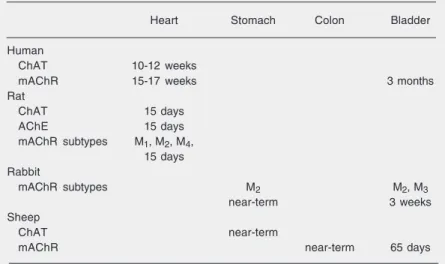
Table 1 shows the development of periph-eral cholinergic elements in the fetal heart and in the urinary and digestive systems during different gestational periods and in different species. In general, cholinergic systems, in-cluding their receptors and key enzymes, are developed and functional in the cardiovascu-lar, urinary, and digestive systems regarding body fluid balance. However, functional de-velopment of cholinergic mechanisms in the control of fetal swallowing, kidney function, and vascular volume regulation is still unclear. Further studies are needed to clarify the pos-sible contribution of fetal cholinergic mechan-isms to the development of systems that con-trol body fluids.
Development of fetal brain cholinergic receptors and their effects on vascular and body fluid control
ACh receptors are differentially expressed throughout the central nervous system, where
Table 1. Development of peripheral cholinergic elements in the fetal heart and in the fetal urinary and digestive systems during different gestational periods and in different species.
Heart Stomach Colon Bladder
Human
ChAT 10-12 weeks
mAChR 15-17 weeks 3 months
Rat
ChAT 15 days
AChE 15 days
mAChR subtypes M1, M2, M4, 15 days Rabbit
mAChR subtypes M2 M2, M3
near-term 3 weeks
Sheep
ChAT near-term
mAChR near-term 65 days
they play a role in the modulation of neuro-transmitter release, neuronal differentiation, regulation of gene expression, and neuronal pathfinding. The nicotinic AChR (nAChR) are ligand-gated ion channels with different
α (α2-7) and ß (ß2-4) units (Table 2). It has been demonstrated that multiple subtypes of neuronal nAChR can be formed from vari-ous combinations of subunits, including the
α4ß2, α3ß2, α4ß4, and α7 subtypes. Most
nAChR in the brain appear to be heteromeric
α4ß2, and homomeric α7 (24-26). nAChR
is present in the human fetal brain as early as the first trimester, gradually increasing up to mid-gestation and then declining in the third trimester. α3, 4, 5, 7, and ß2, 3, 4, but not α2, 6 receptors are expressed in the human fetal brain. α5 levels are higher in the cortex, while α7 levels are higher in the hindbrain, and ß3 in the cerebellum. ß4 is equally dis-tributed in all regions, whereas ß2 levels are higher in the cortex and cerebellum. nAChR decrease in all regions of the human brain after birth (27-30). α2, 3, 7 in the cortex and
α4, 7 in the brainstem are increasingly ex-pressed in humans exposed to nicotine (31, 32).
Five subtypes of mAChR have been iden-tified: M1, M3, and M5 receptors that are
preferentially coupled to G-protein and stimulate phospholipase C, and M2 and M4
receptors that are coupled to G-protein asso-ciated with the inhibition of adenylate
cy-clase (33). In general, the ontogeny of mAChR in the human fetal brain shows two distinct phases during in utero development: first, they appear between 16 and 18 weeks and gradually increase up to 20 weeks. Sec-ond, there is a lag period between 20 and 24 weeks, at which time the receptor density does not change perceptibly. mAChR de-crease in all regions of the human brain after birth (34,35). mAChR are extensively dis-tributed in the striatum, brainstem, cortex, and midbrain, and their levels are relatively lower in the cerebellum and hippocampus. M1 receptors are concentrated mainly in the
forebrain regions while M2 receptors
domi-nate in the thalamus (36,37). During middle and late gestation, M2 receptors are
abun-dant in the cerebellum of human fetuses and M3, M4 receptors appear to predominate in
the brainstem (38) (Table 3). High mAChR densities are noted in certain brainstem nu-clei that are important for the development of fetal and neonatal behaviors (39). The development of central N and M receptors in the fetal brain provides the basis for central cholinergic actions in utero.
During the early development of the brain, the main processes are proliferation of neu-ronal stem and progenitor cells, migration of different cells to a pre-designated area and differentiation into neurons and glial cells. Cholinergic neurons innervate almost the entire neuraxis and mAChR are distributed
Table 2. Brain nicotinic acetylcholine receptor (nAChR) levels of human fetuses at different gestational periods.
First trimester Mid-gestation Late gestation
Cortex α3, α4, α5*, α7, ß2*, ß3, ß4 Medulla oblongata α3, α4, α5, α7*, ß2, ß4
Pons α3, α4, α5, α7*, ß2, ß3, ß4 nAChR↑ nAChR↓
(tegmental nuclei) (tegmental nuclei) Cerebellum α3, α4, α5, α7, ß2*, ß3*, ß4
Mesencephalon α3, α4, α5, α7*, ß2, ß3, ß4 nAChR nAChR↓
(periaqueductal gray) (periaqueductal gray) Subcortical forebrain α3, α4, α5, α7, ß2, ß3, ß4
throughout the central nervous system (40-48). At early stages of embryogenesis, fetal neurons are releasing ACh that triggers the depolarization of adjacent cells in the spinal cord (49,50). Previous studies have shown that α7 receptors play a role in axonogenesis, synaptogenesis, and synaptic plasticity, are also related to developmental neurotoxicants, and increase glutamate release onto post-synaptic NMDA receptors (51,52).
The major populations of cholinergic neurons in the brain include two “projec-tions” located in the pontine reticular forma-tion and in the basal forebrain. These two complexes comprise, in part, the anatomical substrates for the “ascending reticular acti-vating system”. The pontine cholinergic sys-tem relays its rostral information mainly through thalamic intralaminar nuclei, but it also connects to the basal forebrain and pro-vides a minor innervation of the cortex. The basal forebrain cholinergic complex projects directly to the cortex and the hippocampus, and has a minor connection with the thala-mus. The basal forebrain cholinergic com-plex acts in tandem or in parallel with the pontine cholinergic projection to activate the electro-encephalogram, to increase cere-bral blood flow, to regulate sleep-wake cy-cling, and to modulate cognitive functions (53-55). Abnormal development of the cho-linergic basal forebrain has been implicated in numerous developmental disorders such as Rett syndrome and Down syndrome.
Muscarinic cholinergic neurotransmis-sion is involved in fetal breathing. Near-term ovine fetal swallowing activity occurs predominantly during low-voltage electro-cortical activation. Atropine suppressed fe-tal swallowing activity in the ovine fetus (56), while carbachol increased high-volt-age fetal sheep electrocortical activity and breathe amplitude. These effects were medi-ated by M1 receptors (57). Central
cholin-ergic systems are important in the control of fetal cardiovascular activity. Stimulation of central mAChR results in hypertension and
a change of heart rate in the fetal lamb (58). Our recent study demonstrated that intra-cerebroventricular carbachol can increase systolic, diastolic, and mean arterial pres-sure accompanied by a bradycardia in sheep fetuses (59).
Neuronal activity labeled with c-fos was significantly enhanced after central admin-istration of carbachol in the fetal anterior third ventricle region of the forebrain, and in the area postrema, lateral parabrachial nu-cleus, nucleus tractus solitarii, and rostral ventrolateral medulla in the hindbrain. This central neural activation labeled with c-fos was associated with cardiovascular changes in sheep fetuses (59). Central cholinergic systems are also involved in fetal hormone secretion that may also contribute to vascu-lar regulation. For example, acetylcholine evoked CRH secretion in Lewis rat fetal hypothalamic cells (60). Notably, hormonal mechanisms may be well developed in the fetal brain for the control of fetal vascular functions.
In summary, both peripheral and central cholinergic systems, particularly cholinergic receptors, are relatively mature before birth in all systems that are linked to the regula-tion of body fluids. Both N receptors and M receptors as well as their subtypes appeared in the fetal cardiovascular, ingestive, and urinary systems as well as in the fetal brain. Cholinergic mechanisms are relatively in-tact and functional in the control of cardio-vascular homeostasis during fetal life in utero in the last third of gestation. It is apparent
Table 3. Brain muscarinic acetylcholine receptors of human fetuses at different gesta-tional periods.
Forebrain Thalamus Cerebellum Pons
Mid-gestation M1 high M2 high M3 high
Late gestation M2 high M3 high
that central cholinergic systems are well de-veloped in the control of fetal blood pressure before birth. Although further studies are required to determine the functional devel-opment of cholinergic control of fetal body fluid balance and its influence on prenatal
and postnatal health, the data obtained so far have opened up intriguing possibilities for future studies of the functional development of drinking behavior regulated by cholin-ergic mechanisms.
References
1. Papp JG. Autonomic responses and neurohumoral control in the human early antenatal heart. Basic Res Cardiol 1988; 83: 2-9. 2. Shigenobu K, Tanaka H, Satoh H. Developmental changes in the
pacemaker current and membrane currents of the guinea pig myo-cardium. Nippon Yakurigaku Zasshi 1996; 107: 259-272.
3. Liang HM, Tang M, Liu CJ, Luo HY, Song YL, Hu XW, et al. Muscarinic cholinergic regulation of L-type calcium channel in heart of embryonic mice at different developmental stages. Acta Pharma-col Sin 2004; 25: 1450-1457.
4. Franco D, Moorman AF, Lamers WH. Expression of the cholinergic signal-transduction pathway components during embryonic rat heart development. Anat Rec 1997; 248: 110-120.
5. Sun LS, Huber F, Robinson RB, Bilezikian JP, Steinberg SF, Vulliemoz Y. Muscarinic receptor heterogeneity in neonatal rat ven-tricular myocytes in culture. J Cardiovasc Pharmacol 1996; 27: 455-461.
6. Sun LS, Vulliemoz Y, Huber F, Bilezikian JP, Robinson RB. An excitatory muscarinic response in neonatal rat ventricular myocytes and its modulation by sympathetic innervation. J Mol Cell Cardiol 1994; 26: 779-787.
7. Vannucchi MG, Faussone-Pellegrini MS. Differentiation of cholin-ergic cells in the rat gut during pre- and postnatal life. Neurosci Lett 1996; 206: 105-108.
8. Kolivas S, Volombello T, Shulkes A. Expression of receptors regu-lating gastric acidity in the developing sheep stomach. Regul Pept 2001; 101: 93-100.
9. Seidel ER, Johnson LR. Ontogeny of gastric mucosal muscarinic receptor and sensitivity to carbachol. Am J Physiol 1984; 246: G550-G555.
10. Grossman SP. Effects of adrenergic and cholinergic blocking agents on hypothalamic mechanisms. Am J Physiol 1962; 202: 1230-1236. 11. Xu Z, Nijland MJ, Ross MG. Plasma osmolality dipsogenic thresh-olds and c-fos expression in the near-term ovine fetus. Pediatr Res 2001; 49: 678-685.
12. Xu Z, Glenda C, Day L, Yao J, Ross MG. Central angiotensin induction of fetal brain c-fos expression and swallowing activity. Am J Physiol Regul Integr Comp Physiol 2001; 280: R1837-R1843. 13. Acosta R, Lee JJ, Oyachi N, Buchmiller-Crair TL, Atkinson JB, Ross
MG. Anticholinergic suppression of fetal rabbit upper gastrointesti-nal motility. J Matern Fetal Neonatal Med 2002; 11: 153-157. 14. Tomomasa T, Hyman PE, Hsu CT, Jing J, Snape WJ Jr.
Develop-ment of the muscarinic receptor in rabbit gastric smooth muscle. Am J Physiol 1988; 254: G680-G686.
15. Oue T, Yoneda A, Shima H, Puri P. Muscarinic acetylcholine recep-tor expression in aganglionic bowel. Pediatr Surg Int 2000; 16: 267-271.
16. Mitolo-Chieppa D, Schonauer S, Grasso G, Cicinelli E, Carratu MR.
Ontogenesis of autonomic receptors in detrusor muscle and bladder sphincter of human fetus. Urology 1983; 21: 599-603.
17. Lee JG, Macarak E, Coplen D, Wein AJ, Levin RM. Distribution and function of the adrenergic and cholinergic receptors in the fetal calf bladder during mid-gestational age. Neurourol Urodyn 1993; 12: 599-607.
18. Jimenez Cidre MA. Urinary incontinence: anticholinergic treatment. Rev Med Univ Navarra 2004; 48: 37-42.
19. Brandes SB, Ruggieri MR. Muscarinic receptor subtypes in normal, fetal, and gravid rabbit bladder, heart and uterus. Adv Exp Med Biol 1995; 385: 241-249.
20. Baselli EC, Brandes SB, Luthin GR, Ruggieri MR. The effect of pregnancy and contractile activity on bladder muscarinic receptor subtypes. Neurourol Urodyn 1999; 18: 511-520.
21. Nyirady P, Thiruchelvam N, Godley ML, David A, Cuckow PM, Fry CH. Contractile properties of the developing fetal sheep bladder. Neurourol Urodyn 2005; 24: 276-281.
22. Levin RM, Macarak E, Howard P, Horan P, Kogan BA. The re-sponse of fetal sheep bladder tissue to partial outlet obstruction. J Urol 2001; 166: 1156-1160.
23. Kogan BA, Iwamoto HS. Lower urinary tract function in the sheep fetus: studies of autonomic control and pharmacologic responses of the fetal bladder. J Urol 1989; 141: 1019-1024.
24. Paterson D, Nordberg A. Neuronal nicotinic receptors in the human brain. Prog Neurobiol 2000; 61: 75-111.
25. Clementi F. Handbook of experimental pharmacology, neuronal nicotinic receptors. In: Sargent PB (Editor), The distribution of neu-ronal nicotinic acetylcholine receptors. 2000. p 163-192.
26. Dani JA. Overview of nicotinic receptors and their roles in the central nervous system. Biol Psychiatry 2001; 49: 166-174.
27. Gotti C, Fornasari D, Clementi F. Human neuronal nicotinic recep-tors. Prog Neurobiol 1997; 53: 199-237.
28. Hellstrom-Lindahl E, Gorbounova O, Seiger A, Mousavi M, Nordberg A. Regional distribution of nicotinic receptors during prenatal devel-opment of human brain and spinal cord. Brain Res Dev Brain Res 1998; 108: 147-160.
29. Falk L, Nordberg A, Seiger A, Kjaeldgaard A, Hellstrom-Lindahl E. The alpha7 nicotinic receptors in human fetal brain and spinal cord. J Neurochem 2002; 80: 457-465.
30. Reddy SC, Panigrahy A, White WF, Kinney HC. Developmental changes in neurotransmitter receptor binding in the human periaq-ueductal gray. J Neuropathol Exp Neurol 1996; 55: 409-418. 31. Hellstrom-Lindahl E, Seiger A, Kjaeldgaard A, Nordberg A.
Nicotine-induced alterations in the expression of nicotinic receptors in pri-mary cultures from human prenatal brain. Neuroscience 2001; 105: 527-534.
Smoking during early pregnancy affects the expression pattern of both nicotinic and muscarinic acetylcholine receptors in human first trimester brainstem and cerebellum. Neuroscience 2005; 132: 389-397.
33. Ravikumar BV, Sastry PS. Muscarinic cholinergic receptors in hu-man foetal brain: characterization and ontogeny of [3H]quinuclidinyl benzilate binding sites in frontal cortex. J Neurochem 1985; 44: 240-246.
34. Ravikumar BV, Sastry PS. Cholinergic muscarinic receptors in hu-man fetal brain: ontogeny of [3H]quinuclidinyl benzilate binding sites in corpus striatum, brainstem, and cerebellum. J Neurochem 1985; 45: 1948-1950.
35. Bar-Peled O, Israeli M, Ben-Hur H, Hoskins I, Groner Y, Biegon A. Developmental pattern of muscarinic receptors in normal and Down’s syndrome fetal brain - an autoradiographic study. Neurosci Lett 1991; 133: 154-158.
36. Egozi Y, Sokolovsky M, Schejter E, Blatt I, Zakut H, Matzkel A, et al. Divergent regulation of muscarinic binding sites and acetylcholines-terase in discrete regions of the developing human fetal brain. Cell Mol Neurobiol 1986; 6: 55-70.
37. Schlumpf M, Palacios JM, Cortes R, Lichtensteiger W. Regional development of muscarinic cholinergic binding sites in the prenatal rat brain. Neuroscience 1991; 45: 347-357.
38. Aubert I, Cecyre D, Gauthier S, Quirion R. Comparative ontogenic profile of cholinergic markers, including nicotinic and muscarinic receptors, in the rat brain. J Comp Neurol 1996; 369: 31-55. 39. Berger-Sweeney J. The cholinergic basal forebrain system during
development and its influence on cognitive processes: important questions and potential answers. Neurosci Biobehav Rev 2003; 27: 401-411.
40. Lauder JM, Schambra UB. Morphogenetic roles of acetylcholine. Environ Health Perspect 1999; 107 (Suppl 1): 65-69.
41. Adams PR, Brown DA. Synaptic inhibition of the M-current: slow excitatory post-synaptic potential mechanism in bullfrog sympa-thetic neurones. J Physiol 1982; 332: 263-272.
42. Fibiger HC, Damsma G, Day JC. Behavioral pharmacology and biochemistry of central cholinergic neurotransmission. Adv Exp Med Biol 1991; 295: 399-414.
43. Adams CE, Broide RS, Chen Y, Winzer-Serhan UH, Henderson TA, Leslie FM, et al. Development of the alpha7 nicotinic cholinergic receptor in rat hippocampal formation. Brain Res Dev Brain Res 2002; 139: 175-187.
44. Adams CE. Comparison of alpha7 nicotinic acetylcholine receptor development in the hippocampal formation of C3H and DBA/2 mice. Brain Res Dev Brain Res 2003; 143: 137-149.
45. Vizi ES, Lendvai B. Modulatory role of presynaptic nicotinic recep-tors in synaptic and non-synaptic chemical communication in the central nervous system. Brain Res Brain Res Rev 1999; 30: 219-235.
46. McGehee DS, Heath MJ, Gelber S, Devay P, Role LW. Nicotine
enhancement of fast excitatory synaptic transmission in CNS by presynaptic receptors. Science 1995; 269: 1692-1696.
47. Edwards JA, Cline HT. Light-induced calcium influx into retinal axons is regulated by presynaptic nicotinic acetylcholine receptor activity in vivo. J Neurophysiol 1999; 81: 895-907.
48. Slotkin TA, Cousins MM, Seidler FJ. Administration of nicotine to adolescent rats evokes regionally selective upregulation of CNS alpha 7 nicotinic acetylcholine receptors. Brain Res 2004; 1030: 159-163.
49. Myers CP, Lewcock JW, Hanson MG, Gosgnach S, Aimone JB, Gage FH, et al. Cholinergic input is required during embryonic development to mediate proper assembly of spinal locomotor cir-cuits. Neuron 2005; 46: 37-49.
50. Phelps PE, Barber RP, Brennan LA, Maines VM, Salvaterra PM, Vaughn JE. Embryonic development of four different subsets of cholinergic neurons in rat cervical spinal cord. J Comp Neurol 1990; 291: 9-26.
51. Slotkin TA, Southard MC, Adam SJ, Cousins MM, Seidler FJ. Al-pha7 nicotinic acetylcholine receptors targeted by cholinergic devel-opmental neurotoxicants: nicotine and chlorpyrifos. Brain Res Bull 2004; 64: 227-235.
52. Aramakis VB, Metherate R. Nicotine selectively enhances NMDA receptor-mediated synaptic transmission during postnatal develop-ment in sensory neocortex. J Neurosci 1998; 18: 8485-8495. 53. Berger-Sweeney J. The effects of neonatal basal forebrain lesions
on cognition: towards understanding the developmental role of the cholinergic basal forebrain. Int J Dev Neurosci 1998; 16: 603-612. 54. Ricceri L, Minghetti L, Moles A, Popoli P, Confaloni A, De Simone R,
et al. Cognitive and neurological deficits induced by early and pro-longed basal forebrain cholinergic hypofunction in rats. Exp Neurol 2004; 189: 162-172.
55. Hohmann CF, Berger-Sweeney J. Cholinergic regulation of cortical development and plasticity. New twists to an old story. Perspect Dev Neurobiol 1998; 5: 401-425.
56. Nijland MJ, Chao CR, Ross MG. Anticholinergic suppression of ovine fetal swallowing activity. Am J Obstet Gynecol 1997; 177: 1105-1112.
57. Joseph SA, Walker DW. Catecholamine neurons in fetal brain: effects on breathing movements and electrocorticogram. J Appl Physiol 1990; 69: 1903-1911.
58. Szeto HH, Hinman DJ. Central muscarinic modulation of fetal blood pressure and heart rate. J Dev Physiol 1990; 13: 17-23.
59. Shi L, Zhang Y, Morrissey P, Yao J, Xu Z. The association of cardiovascular responses with brain c-fos expression after central carbachol in the near-term ovine fetus. Neuropsychopharmacology 2005; 30: 2162-2168.