Craniofacial changes and symptoms of
sleep-disordered breathing in healthy children
Maria Christina Thomé Pacheco1, Bruna Santos Fiorott2, Nathalia Silveira Finck2, Maria Teresa Martins de Araújo3
How to cite this article: Pacheco MCT, Fiorott BS, Finck NS, Araújo MTM. Craniofacial changes and symptoms of sleep-disordered breathing in healthy chil-dren. Dental Press J Orthod. 2015 May-June;20(3):80-7.
DOI: http://dx.doi.org/10.1590/2176-9451.20.3.080-087.oar
Submitted: July 04, 2014 - Revised and accepted: November 25, 2014
» The authors report no commercial, proprietary or financial interest in the prod-ucts or companies described in this article.
Contact address: Maria Christina Thomé Pacheco E-mail: [email protected]
1 Full professor, Dental Clinic department, Universidade Federal do Espírito
Santo, UFES, Vitória, Brazil.
2 MSc in Dental Clinic, Universidade Federal do Espírito Santo, Vitória, ES.
Brazil.
3 Adjunct professor, Physiological Sciences department, Universidade Federal do
Espírito Santo, Vitória, ES, Brazil.
Introduction: The main cause of mouth breathing and sleep-disordered breathing (SDB) in childhood is associated with upper airway narrowing to varying degrees. Objective: The aim of this study was to assess the prevalence of morphological and functional craniofacial changes and the main clinical symptoms of SDB in healthy children. Meth-ods: A cross-sectional observational study was conducted. A sample comprising 687 healthy schoolchildren, aged 7-12 years old and attending public schools, was assessed by medical history, clinical medical and dental examination, and respiratory tests. The self-perceived quality of life of mouth breathing children was obtained by a validated question-naire. Results: Out of the total sample, 520 children were nose breathers (NB) while 167 (24.3%) were mouth breathers (MB); 32.5% had severe hypertrophy of the palatine tonsils, 18% had a Mallampati score of III or IV, 26.1% had exces-sive overjet and 17.7% had anterior open bite malocclusion. Among the MB, 53.9% had atresic palate, 35.9% had lip incompetence, 33.5% reported sleepiness during the day, 32.2% often sneezed, 32.2% had a stuffy nose, 19.6% snored, and 9.4% reported having the feeling to stop breathing while asleep. However, the self-perception of their quality of life was considered good. Conclusion: High prevalence of facial changes as well as signs and symptoms of mouth breathing were found among health children, requiring early diagnosis and treatment to reduce the risk of SDB.
Keywords:Malocclusion. Mouth breathing. Quality of life.
DOI: http://dx.doi.org/10.1590/2176-9451.20.3.080-087.oar
Introdução: a principal causa da respiração bucal e dos distúrbios respiratórios do sono (DRS) está associada ao es-treitamento das vias aéreas superiores, em diferentes graus. Objetivo: avaliar a prevalência de alterações morfológicas e funcionais da face e os principais sintomas clínicos de DRS em crianças saudáveis. Métodos: estudo transversal, obser-vacional, com amostra de 687 escolares saudáveis, provenientes de escolas públicas, com idades entre 7 e 12 anos. Foram avaliados pela história clínica, exame clínico médico e odontológico e testes respiratórios. A autopercepção da qualidade de vida dos escolares com respiração bucal foi obtida por meio de um questionário validado. Resultados: na amostra total, 520 crianças eram respiradoras nasais (RN) e 167 (24,3%) eram respiradoras bucais (RB); 32,5% tinham hipertrofia das amígdalas palatinas, 18% tinham índice Mallampati obstrutivo (III e IV); 26,1% tinham overjet exagerado e 17,7%, mordida aberta anterior. Entre os RB, 53,9% tinham palato atrésico; 35,9% com ausência de selamento labial; 33,5% relataram sonolência diurna; 32,2%, espirros frequentes; 32,2%, nariz entupido; 19,6% roncavam e 9,4% relataram ter a sensação de parar de respirar durante o sono. Entretanto, a autopercepção da qualidade de vida desses escolares foi consi-derada boa. Conclusão: foi encontrada alta prevalência de alterações faciais, de sinais e de sintomas clínicos de respiração bucal nos escolares saudáveis examinados, necessitando diagnóstico e tratamento para reduzir o risco de DRS.
INTRODUCTION
Sleep-disordered breathing (SDB) varies in severity; ranging from snoring, upper airway resistance syndrome (UARS) and, the most severe, obstructive sleep apnea (OSA). In contrast with SDB in adults, which is usually as-sociated with obesity, the pediatric population experiences these disorders in association with hypertrophy of tonsils and
adenoids, allergies, frequent colds and mouth breathing.1-7
The association between mouth breathing and SDB has been described as a public health concern because of the clinical impact of these disorders on craniofacial development and growth, delay in height and weight growth and behavioral changes, such as hyperactivity, irritability, restless sleep, impaired concentration and
reduced school performance.8,9,10
SDB during childhood is rather frequent. However, its signs are not always appropriately recognized or even diagnosed. Anamnesis should tackle aspects of sleep
pattern, especially in mouth-breathing children.2-5
With regards to the impact on craniofacial growth and development, the persistence of mouth breath-ing throughout the growth stage causes speciic facial changes, such as vertical increase of the lower face; nar-row palate; dental malocclusions, mainly anterior open bite and posterior crossbite; lip incompetence; short upper lip and everted lower lip; hypotonic masticatory muscles; and changes in tongue posture at resting,
swal-lowing, speaking and chewing.8-11
Because mouth breathing is one of the predisposing factors to SDB in children, this study aims to assess the prevalence of the morphological and functional craniofacial changes and the main nasal and sleep symptoms reported by healthy schoolchildren aged between 7 and 12 years old.
MATERIAL AND METHODS
A cross-sectional, observational study with a quan-titative epidemiological approach was conducted with 687 schoolchildren aged between 7 and 12 years old. The subjects were from eight diferent elementary schools, each school randomly selected from each one of the eight micro regions of the city Vitória, ES, Brazil. The selection of healthy schoolchildren, rather than pa-tients seeking medical or dental care, was due to lack of a preventive policy for health problems in Brazilian public schools. Moreover, most parents or legal guard-ians only seek health care when the child already has some type of disease symptom.
All schoolchildren were invited to participate; how-ever, we examined only those whose parents or legal guardians had signed the informed consent form (ICF) allowing them to participate. Exclusion criteria were as follows: unerupted irst molars, previous orthodontic treatment, patients under medical care and presenting some type of neurological, neuromuscular or motor changes that would hinder their participation.
This study was approved by Universidade Federal do Espírito Santo Institutional Review Board and had permission from local City Hall to be conducted in the public schools.
The examiners (two orthodontists and two Oto-laryngology internship medical residents) underwent calibration. Average values for inter- and intraexaminer agreement of 0.84 and 0.93 were obtained by Kappa test.
A survey instrument was designed to collect the main morphological and functional clinical characteris-tics of the face, occlusion and upper airways. In order to have some of their facial features assessed, children were carefully observed in their natural state, without letting them realize that they were being examined. Each child was assessed under natural light, sitting on a chair in front of the researcher who wore biosafety equipment and disposable material for clinic examination.
The medical residents examined facial and airway features (seeking for size, coloration, nasal secretions, obstruction and edema). Dental students examined cra-niofacial features, malocclusion and performed the respi-ratory tests. The mirror test was performed by placing a graded mirror under the nose, and a halo of water vapor was marked ater the third normal expiration. Two lip seal tests were also performed for three minutes each, one using a sticky tape to close the lips and the other with water into the child’s mouth. At the end of the clinical examination, a diagnostic impression was established by both medical and dental groups, concerning the child’s respiratory function. Each child was classiied as mouth breather (MB) or nose-breather (NB), distinguishing be-tween chronic and occasional mouth breathers.
Only children diagnosed as mouth breathers an-swered a structured questionnaire titled “The mouth
breather quality of life questionnaire”, developed11 and
validated12 by Ribeiro.11,12 The questionnaire comprises
es-thetics, education, communication and atopy. An ordi-nal value was associated to the sequential answer scale: 0 (zero) for “no/never”, 1 or 2 for “hardly ever”, 3 for “once in a while”, 4 or 5 for “oten”, 6 for “always”, with the highest score referring to the worst quality of life. However, in the present study, we focused mainly on the ields “nasal problems” and “sleeping problems” to assess the schoolchildren self-perception on some of the main symptoms of SDB during childhood.
Statistical analysis
Statistical tests for comparison of two proportions were performed considering two populations with a
Bernoulli distribution and parameters p1 and p2. For
larger samples, the proportions were considered an
ap-proximation of the normal distribution N (0.1). It was
assumed that the null hypothesis was p1 = p2. An alpha
level of 5% and a conidence interval of 95% were ad-opted. The statistical programs used were Action (with the system developed under the R platform) and IBM SPSS Statistics 19.
RESULTS
The initial sample comprised 687 healthy schoolchil-dren of which 329 (47.9%) were males and 358 (52.1%) were females. The majority of schoolchildren aged be-tween 8 and 9 years old (42.9%). The distribution per school varied according to the size of the school and the survey acceptance through the signing of an ICF by the parent/legal guardian. From the total sample, 167 (24.3%) schoolchildren were diagnosed as MB while 520 (75.7%) were diagnosed as NB.
Table 1 shows the main alterations on the upper air-ways (UA). The occurrence of palatine tonsils (grades III and IV) and Mallampati classes II, III and IV were dominant in MB schoolchildren. These data are rele-vant and point to the predominance of narrowed air-ways in MB schoolchildren.
Changes in nasal septum and turbinate hyper-trophy were also more prevalent in the MB group, highlighting edema (36.5%), nasal septal deviation (19.2%) and turbinate hypertrophy (73.1%). Some children simultaneously experienced edema and de-viated nasal septum. The presence of tonsils grade III, Mallampati class III, edema of the nasal septum and turbinate hypertrophy were relevant findings for the MB group (p < 0.050).
Table 2 describes the most important facial features assessed. Although most schoolchildren have a normal facial type (mesofacial), there is a high incidence of the dolichofacial pattern (34.7%) in the MB group. This pattern was perceived in only 11.7% of the NB group. Convex facial proile was predominant (50.9%) in the MB group. Absence of lip competence was higher in the MB group (35.9%) in comparison to the NB group in which it was only 2.5%.
The most relevant indings in the MB group (p < 0.050) were dolichofacial pattern and the absence of lip competence.
Table 3 shows the prevalence of malocclusion in schoolchildren. The MB group presented a prevalence of deep overbite, anterior open bite, posterior crossbite, pronounced overjet, Angle Class II molar relationship and atresic palate. The relevant indings (p < 0.050) were overjet greater than 4 mm and atresic palate.
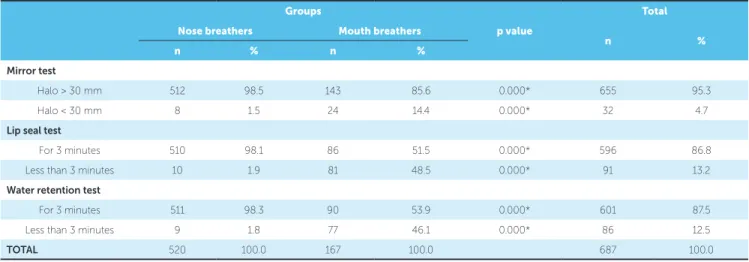
On the mirror test (Table 4), most children (95.3%) showed a halo of water vapor larger than 30 mm, which demonstrates lack of nasal obstruction. However, when assessing the MB group, the prevalence of a halo smaller than 30 mm (14.4%) was statistically signiicant, which suggests that the presence of mouth breathing was caused by nasal obstruction.
On both lip seal tests, using sticky tape (48.5%) or water retention (46.1%), the prevalence of lip seal for less than 3 minutes was signiicant for the MB group, which suggests diiculty breathing through the nose.
The results yielded from the quality of life question-naire applied to mouth breathers are shown in Table 5. They show the seven ields surveyed and the overall score. Higher scores mean worse quality of life, while lower scores show better quality of life. Both mean and median values in all ields were below half the maxi-mum value possible for each ield, showing good assess-ment of quality of life. However, taking into account the wide variability of the standard deviation, one can see that a great part of children reported having a not so good quality of life.
DISCUSSION
The presence of hypertrophied palatine tonsils was re-markable for the entire sample, with predominance of grades I and II (non obstructive) in the NB group and grades III and IV (obstructive) in the MB group. Palatine tonsils
Table 1 - Prevalence of upper airway (UA) problems in nose breathers and mouth breathers schoolchildren.
Table 2 - Prevalence of facial features in nose breathers and mouth breathers schoolchildren.
Groups
p value
Total
Nose breathers Mouth breathers
n %
n % n %
Palatine tonsils
I 83 16.0 20 12.0 0.230 103 15.0
II 281 54.0 80 47.9 0.167 361 52.5
III 138 26.5 59 35.3 0.025* 197 28.7
IV 18 3.5 8 4.8 0.434 26 3.8
Mallampati score
I 221 42.5 41 24.5 0.000* 262 38.2
II 219 42.1 82 49.1 0.113 301 43.8
III 71 13.7 37 22.2 0.009* 108 15.7
IV 9 1.7 7 4.2 0.067 16 2.3
Nasal septum
Normal 302 58.1 67 40.1 0.000* 369 53.7
Swollen 119 22.9 61 36.5 0.000* 180 26.2
Deviated 86 16.5 32 19.2 0.492 118 17.2
Swollen/
deviated 13 2.5 7 4.2 0.383 20 2.9
Turbinate hypertrophy
No 223 42.9 45 26.9 0.000* 268 39.0
Yes 297 57.1 122 73.1 0.000* 419 61.0
* Statistically signiicant (p < 0.05).
* Statistically signiicant (p < 0.05).
Groups
p value
Total
Nose breathers Mouth breathers
n %
n % n %
Facial type
Mesofacial 404 77.7 100 60.5 0.000* 505 73.5
Dolichofacial 61 11.7 58 34.7 0.000* 119 17.3
Brachyfacial 55 10.6 8 4.8 0.000* 63 9.2
Facial profile
Straight 367 70.6 75 44.9 0.000* 442 64.3
Convex 142 27.3 85 50.9 0.000* 227 33.1
Concave 11 2.1 7 4.2 0.144 18 2.6
Lip competence
Present 507 97.5 107 64.1 0.000* 614 89.3
Table 3 - Prevalence of malocclusion in nose breathers and mouth breathers groups
* Statistically signiicant (p < 0.05).
Groups
p value
Total
Nose breathers Mouth breathers
n %
n % n %
Overbite
Normal 271 52.1 73 43.7 0.072 344 50.1
Moderate 135 26.0 45 26.9 0.897 180 26.2
Severe 24 4.6 9 5.4 0.832 33 4.8
Does not apply 90 17.3 40 24.0 0.070 130 18.9
Open bite
Absent 437 84.1 128 76.6 0.025* 565 82.3
Top 40 7.7 18 10.8 0.274 58 8.4
Present 43 8.2 21 12.6 0.121 64 9.3
Crossbite
Absent 417 80.2 137 82.0 0.909 554 80.6
Anterior 28 5.4 4 2.4 0.165 32 4.7
Posterior 67 12.8 24 14.4 0.689 91 13.2
Ant/Posterior 8 1.6 2 1.2 0.997 10 1.5
Overjet
1-2 mm 341 65.6 88 52.7 0.004* 429 62.4
3-4 mm 109 21.0 48 28.7 0.051 157 22.9
> 4 mm 11 2.1 11 6.6 0.009* 22 3.2
Does not apply 59 11.4 20 12 0.943 79 11.5
Molar relationship
Class I 409 78.7 123 73.7 0.098 532 77.5
Class II 92 17.7 35 21.0 0.400 127 18.5
Class III 19 3.7 9 5.4 0.460 28 4.1
Palate
Normal 328 63.1 77 46.1 0.000* 405 58.9
Atresic 192 36.9 90 53.9 0.000* 282 41.0
TOTAL 520 100.0 167 100.0 687 100.0
up 25% of the oropharyngeal airway space), grade II (25 to 50%), grade III (50 to 75%) and grade IV (more than 75% of the oropharyngeal airway space).
The American Academy of Pediatrics1 highlights
hypertrophy of palatine tonsils as a signiicant risk factor for the development of SDB during childhood. Never-theless, the severity of SDB is not always related to the size of tonsils. Many children with signiicant hypertro-phy do not present breathing disorders related to sleep. Therefore, other risk factors, such as changes in facial morphology or alterations in breathing control during sleep, may coexist. For this reason, we surveyed most morphological, craniofacial and upper airway changes related to SDB in children.
Unlike tonsils grades that identify lateral airway nar-rowing, the Mallampati score identiies vertical airway
narrowing. A modiied Mallampati score,14,15 in total
mouth opening, with the tongue relaxed and lying in the oral cavity, was used. In the NB group, there was a predominance of class I Mallampati, which suggests wide airways. In the MB group, Mallampati classes III and IV (obstructive) were predominant, which suggests narrow
or small airways.6,7 The presence of a swollen or
devi-ated nasal septum (59.9%) in the MB group was striking, as it contributes to increased mouth breathing.
Palom-bin et al3 recommend investigating any type of nasal
Table 6 - Prevalence of the main questions related to the nose-problems and sleep-problems fields reported by the MB group (adapted from Ribeiro11). Table 5 - Median, mean and overall score obtained with the quality of life questionnaire for mouth breathers at the seven assessed fields.
Fields Lowest value Highest value Median Mean Standard deviation
Nose problem 0 52 17.00 18.08 10.73
Sleeping problem 0 51 19.00 20.34 11.95
Food 0 35 15.00 13.98 7.98
Dentition / esthetic 0 26 10.00 10.29 6.27
Education 0 18 6.00 5.99 4.42
Communication 0 47 21.00 18.51 11.69
Atopy 0 48 15.00 16.41 11.96
Overall score 0 241 102.00 103.61 48.07
Nose problems field Frequency (%) Sleep problems field Frequency (%)
Do you have any nasal problems? 32.00 Do you have any sleeping problems? 33.54
Does your nose bother you? 30.00 Is your sleep usually restless? 31.00
Do you often feel a stufy nose? 32.27 Do you wake up during the night? 32.27
Do you often sneeze? 32.27 Do you often complain of being sleepy during the day? 33.54
Do you present any nose itching? 22.78 Do you sleep with your mouth open? 38.60
Do you ever have a runny nose? 17.72 Have you ever stopped breathing while sleeping? 9.49
Do you snore at night? 19.62 Do you ever wake up with a headache? 11.39
Do you ever feel your mouth or throat itch? 23.41 Does your mouth feel dry when you wake up? 41.13
Table 4 - Prevalence found for respiratory tests in nose breathers and mouth breathers schoolchildren.
* Statistically signiicant (p < 0.05).
Groups
p value
Total
Nose breathers Mouth breathers
n %
n % n %
Mirror test
Halo > 30 mm 512 98.5 143 85.6 0.000* 655 95.3
Halo < 30 mm 8 1.5 24 14.4 0.000* 32 4.7
Lip seal test
For 3 minutes 510 98.1 86 51.5 0.000* 596 86.8
Less than 3 minutes 10 1.9 81 48.5 0.000* 91 13.2
Water retention test
For 3 minutes 511 98.3 90 53.9 0.000* 601 87.5
Less than 3 minutes 9 1.8 77 46.1 0.000* 86 12.5
TOTAL 520 100.0 167 100.0 687 100.0
and mouth breathing during clinical examination of chil-dren with suspected SDB. In the present study, long face pattern (dolichofacial), convex proile and absence of lip seal were predominant in MB children.
The main morphological changes found were: atresic palate, anterior open bite, posterior crossbite and exces-sive overjet. These malocclusions are mainly caused by an imbalance between forces exerted by the tongue, lips
and the perioral muscles.16,17 In the MB group, atresic
palate and overjet equal to or greater than 3 mm were more prevalent. A V-shaped palatal arch, with maxillary width equal or smaller than the mandible, was classiied as an atresic palate. Some schoolchildren showed several concurrent morphological changes.
The mirror test18,19,20 helped to detect the presence of
determining the diferential diagnosis between obstruc-tive mouth breathing and an acquired habit of mouth breathing ater temporary obstruction. The conse-quences associated with morphological changes will be the same, but knowing the cause for mouth breathing (whether obstruction or habit) provides the most efec-tive treatment for the child.
The lip seal test (51.5%) and the water retention test (53.9%) for 3 minutes in the MB group revealed there was a slight predominance of mouth breathing habits in comparison to obstructive mouth breathing.
Only the MB group completed “The mouth breather quality of life questionnaire” to determine schoolchildren self-perception of their quality of life, as
recommended by Ribeiro.11 The authors of the
pres-ent study tried to encourage the participation of chil-dren, believing that there is information that only they could provide and thus be closer to their reality. The
American Academy of Pediatrics1 and other pediatric
organizations recommend the involvement of children and direct questioning about their health conditions and
functions, mainly for those over the age of 6.21
According to the questionnaire, 54% of schoolchil-dren quality of life self-perception was considered good, with below-average scores and mostly negative answers. This result is not surprising and can be supported by school attendance records and children’s good health. However, 46% of those children had a negative quality of life self-perception. The most expressive results were those related to sleeping problems and nose-related problems. These schoolchildren reported having the feeling to stop breathing while asleep, waking up with headache, having daytime sleepiness, sleeping with an open mouth, waking up with dry mouth, runny nose, snore, stufy nose and sneezing. According to
Palombi-ni,2 Palombini et al,3 and Guilleminault et al,4 these are
some of the major symptoms of SDB during childhood.
Popoaski et al22 also applied a quality of life
question-naire adapted from Ribeiro.11 They found that
sleep-problem and nose-sleep-problem ields were the ones with greater scoring, thereby suggesting that these ields can negatively afect the quality of life of mouth breathers. In
their study,22 the prevalence of trouble while asleep was
nearly three times greater than in the study by Ribeiro.11
Although most schoolchildren reported having good self-perception of their quality of life, the prevalence of signs and symptoms related to SDB during childhood was high in the present study. According to
Zettergren-Wijk et al,23 SDB in young children has an unfavorable
efect on the development of several dental and facial components. However, if SDB is diagnosed and treated at an early age, nearly complete normalization of dento-facial morphology may be achieved.
Due to the negative repercussion of mouth breathing and its close relation to functional and morphological facial changes that favour SDB during childhood, the implementation of policies to prevent breathing prob-lems is of particular relevance, as clearly evidenced by our results. These preventive measures must be set to provide proper nasal breathing via orthodontic and oto-laryngological treatment, so as to develop educational guidance strategies and to stimulate healthy habits that might avoid mouth breathing. Furthermore, signs and symptoms related to SDB in children should be carefully investigated to justify the need for referrals to speciic diagnostic exams.
CONCLUSION
» The prevalence of functional and morphological
facial changes was considerably high among all schoolchildren assessed, mainly in those diag-nosed as mouth breathers (MB).
» The most prevalent alterations found in MB, in
order of prevalence, were: deviated or swollen nasal septum; atresic palate; hypertrophic ton-sils; lip incompetence; dolichofacial pattern; ex-cessive overjet; anterior open bite; Mallampati classes III and IV; and posterior crossbite.
» Self-perception of children’s quality of life was
considered good for most MB schoolchildren despite the high prevalence of SDB symptoms reported, mainly those related to nasal and sleep problems.
Acknowledgements
1. American Academy of Pediatrics. Clinical practice guideline: diagnosis and management of childhood obstructive sleep apnea syndrome. Pediatrics. 2002;109(4):704-12.
2. Palombini LO. Diagnostic criteria and treatment for sleep-disordered breathing:
RERA. J Bras Pneumol. 2010;36(supl. 2):19-22.
3. Palombini L, Lopes M, Tuik S, Guilleminault C, Bittencourt LR. Upper
airway resistance syndrome: still not recognized and not treated. Sleep Sci. 2011;4(2):72-8.
4. Guilleminault C, Lee JH, Chan A. Pediatric obstructive sleep apnea syndrome.
Arch Pediatr Adolesc Med. 2005;159(8):775-85.
5. Palombini L, Pelayo R, Guilleminault C. Eicacy of automated continuous
positive airway pressure in children with sleep-related breathing disorders in an attended setting. Pediatrics. 2004;113(5):412-7.
6. Dayyat E, Kheirandish-Gozal L, Sans CO, Maarafeya MM, Gozal D. Obstructive
sleep apnea in children: relative contributions of body mass index and adenotonsillar hypertrophy. Chest. 2009;136(1):137-44.
7. Sinha D, Guilleminault C. Sleep disordered breathing in children. Indian J Med
Res. 2010;131:311-20.
8. Chen W, Kushida CA. Nasal obstruction in sleep-disordered breathing.
Otolaryngol Clin N Am. 2003;36(3):437-60.
9. Huynh NT, Morton PD, Rompré PH, Papadakis A, Remesi C. Associations
between sleep-disordered breathing symptoms and facial and dental morphometry, assessed with screening examinations. Am J Orthod Dentofacial Orthop. 2011;140(6):762-70.
10. Villa MP, Malagola C, Pagani J, Montesano M, Rizzoli A, Guilleminault C, et al. Rapid maxillary expansion in children with obstructive sleep apnea syndrome: 12-month follow-up. Sleep Med. 2007;8(2):128-34.
11. Ribeiro ML, Pinto JA. Qualidade de vida no respirador oral: avaliação sistemática
em crianças de 6 a 12 anos, atendidas em centro de referência da UFMG [dissertação]. Minas Gerais: Universidade Federal de Minas Gerais; 2006. 12. Ribeiro ML. Validação do questionário de qualidade de vida e avaliação do
bem-estar subjetivo de crianças respiradoras orais [tese]. Belo Horizonte: Universidade Federal de Minas Gerais; 2012.
REFERENCES
13. Brodsky L. Modern assessment of tonsils and adenoids. Pediatric Clin North Am. 1989;36(6):1551-69.
14. Mallampati SR, Gatt SP, Gugino LD, Desai SP, Waraksa B, Freiberger D, et al. A clinical sign to predict diicult tracheal intubation: a prospective study. Can Anaesth Soc J. 1985;32(4):429-34.
15. Samsoon GLT, Young JRB. Diicult tracheal intubation: a retrospective study. Anaesthesia. 1987;42(5):487-90.
16. Luzzi V, Ierardo G, Viscogliosi A, Fabbrizi M, Consoli G, Vozza I, et al. Allergic rhinitis as a possible risk factor for malocclusion: a case–control study in children. Int J Paediatr Dent. 2013;23(4):274-8.
17. Min-Ho J, Won-Sik Y, Dong-Seok N. Maximum closing force of mentolabial
muscles and type of malocclusion. Angle Orthod. 2010;80(1):72-9. 18. Pochat VD, Alonso N, Mendes RRS, Cunha MS, Menezes JVL. Nasal patency
after open rhinoplasty with spreader grafts. J Plastic Reconst Aesthetic Surg. 2012;65(6):732-38.
19. Zastrow MD, Grando LJ, Carvalho AP, Rath IBS, Calvo MC. A comparative study of the breathing pattern and amount of nasopharynx obstruction by the pharyngeal tonsil in HIV infected and non-infected children. Braz J Otorhinolaryng. 2007;73(5):583-91.
20. Motta LJ, Bachiega JC, Guedes CC, Laranja LT, Bussadori SK. Association between halitosis and mouth breathing in children. Clinics. 2011;66(6):939-42. 21. Riley AW. Evidence that school-age children can self-report on their health.
Ambul Pediatrics. 2004;4(4):371-6.
22. Popoaski C, Marcelino TF, Sakae TM, Schmitz LM, Correa LHL. Evaluation from the quality of life in the oral breathers patients. Int Arch Otorhinolaryngol. 2012;16(1):74-81.