Inluence of coarse aggregate on shear resistance
of self-consolidating concrete beams
Inluência do agregado graúdo na resistência ao
cisalhamento de vigas de concreto autoadensável
Abstract
Resumo
Self-compacting concrete can be characterized by its lowability, achieved by adding superplasticizer and reducing the amount and particle size of coarse aggregate in relation to conventional concrete, which allows passing by the reinforcement and illing the forms without the need for mechanical vibration. The reduction in volume and particle size of the coarse aggregate can result in lower shear strength of beams due to reduced aggregate interlock. Therefore, an experimental investigation was conducted objecting to evaluate the inluence of the reduction in volume content and the nomi -nal size of coarse aggregate on the concrete shear strength. Six concrete mixes, four self-compacting and two conventio-nally vibrated, were used for a total of 18 beams with longitudinal reinforcement and without shear reinforcement. These beams were tested under four-point loading condition. Their failure modes, cracking patterns and shear resistance were evaluated. The shear resistances were compared to the theoretical values given by the ACI-318 and EC-2 codes. The results demonstrated a lower shear resistance of self-compacting concrete beams, caused mainly due to the reduced aggregate size.
Keywords: self-consolidating concrete, shear resistance, aggregate interlock, beams.
O concreto autoadensável pode ser caracterizado pela sua luidez, obtida a partir da utilização de aditivos superplastiicantes e da redução da granulometria e volume de agregado graúdo em relação ao concreto convencional, o que possibilita a transposição das armaduras e o preenchi -mento das formas sem a necessidade de vibração mecânica. Esta redução do volume e da granulometria do agregado graúdo pode acarretar em uma menor resistência ao cisalhamento de vigas devido à uma possível redução do efeito de engrenamento entre os agregados. Sendo assim, um programa experimental foi realizado com a intenção de investigar a inluência da redução do volume e do diâmetro máximo do agregado graú -do na resistência ao cisalhamento. Foram utilizadas seis -dosagens, quatro de concreto autoadensável e duas de concreto convencionalmente vibrado para um total de 18 vigas com armadura de lexão e sem armadura transversal. Estas vigas foram ensaiadas à lexão a quatro pontos sendo avaliados os modos de ruptura, padrões de issuração e a força cortante última. As resistências obtidas experimentalmente foram com -paradas com as estimativas das normas ACI-318 e EC-2. Os resultados demonstram menor resistência ao cisalhamento em vigas de concreto autoadensável em relação ao concreto convencional, principalmente quando reduzido o diâmetro máximo do agregado.
Palavras-chave: concreto autoadensável, resistência ao cisalhamento, engrenamento de agregados, vigas.
a Universidade Tecnológica Federal do Paraná – Campus Toledo, Toledo-PR, Brasil. b Universidade Federal de Santa Catarina, Florianópolis-SC, Brasil.
Received: 14 May 2015 • Accepted: 20 Jun 2016 • Available Online: 06 Feb 2017
G. SAVARIS a
R. C. A. PINTO b
1. Introduction
Recent researches have enabled the development of new materi -als and improvements in properties of usually employed materi-als, in order to optimize the construction process. In the late 80, the reduction of skilled workers and the need to increase the durability of reinforced concrete structures led researchers at the University of Tokyo to develop a high-performance concrete, characterized by the ability to low under its own weight. This new material, named self-consolidating concrete, was able to ill the formwork and to pass through reinforcing bars without the need of vibration [1]. The higher lowability of self-consolidating concrete (CA), as compared to conventional vibrated concrete (CC), is obtained by limiting the volume and the size of the coarse aggregates, by adding superplasticizer (SP) and a viscosity-modifying admixture (VMA) in some cases to improve concrete behavior and to avoid segregation. Also, in order to increase water retention and viscosity of the mixture, ine materials are employed, such as limestone iller, ly ash, silica fume and metakaolin. However, the proportion of these ine constituents depends on the characteristics of materials, the mixing equipment, and the use of concrete [2].
According to EFNARC [3], self-consolidating concrete has the same engineering properties of traditional vibrated concrete. It may have a higher compressive strength due to a better compac -tion. Parra et al. [4] reported that besides the more eicient com -paction, the use of superplasticizers and the reduction of the water/ cement (w/c) ratio led to higher compression strength of concrete. Recent researches with conventional concretes have shown that the nominal size of the coarse aggregate directly inluences the aggre -gate interlock through the shear crack surfaces. Higher shear resis -tance was obtained with concrete mixtures with larger aggregates [5] [6]. Since self-consolidating concrete requires lesser amount and smaller size of coarse aggregate, a reduction in its shear strength as compared to conventional concrete`s could be expected [7]. However, there is no agreement among researchers of this reduc -tion in shear strength with self-consolidating concrete. Desnerck et al. [8] suggest that improvements in the concrete matrix provided by a higher amount of ine materials may result in an increased friction between the surfaces of the cracks. This increased friction
would supply the reduction of the aggregate interlock and could even increase shear strength.
Although self-consolidating concrete exists for almost three de-cades, there are divergences among researchers regarding the behavior and design of reinforced concrete structures with this material. Therefore, it is necessary to evaluate the inluence of us -ing smaller coarse aggregate size with reduced volume fraction on the shear strength of self-consolidating concrete beams. Current shear design methods also need to be evaluated.
This paper presents the results of an experimental investigation on the behavior of conventional and self-consolidating concrete beams with lexural reinforcement only. Eighteen concrete beams were produced using six diferent concrete mixes. Two conventional mixtures were produced with two diferent sizes of coarse aggregate, 9.5 and 19 mm. Two other self-consolidating mixtures were also produced with these aggregate sizes. The last two mixtures were self-consolidating mixtures in which the volume of coarse aggregates was reduced by 30%. The beams were subjected to four-point bending test. Their fail -ure mode, cracking patterns and ultimate shear strength were mea -sured. The experimental tests results were compared to the equations given by ACI 318 [9] and EC-2 [10].
2. Experimental program
2.1 Beam specimens
The beams were designed with adequate lexural reinforcement and no shear reinforcement, so that failure would occur by diago -nal tension. All beams were 10 cm wide (bw), 25 cm depth (h) with a total length of 150 cm, providing an efective span of 130 cm. The specimens were tested as simply supported under four-point loading condition, with loading distant 50 cm from the support, re -sulting in a shear span-to-depth ratio (a/d) close to 2.25. Figure 1 schematically presents the experimental set-up.
All beams had a lexural reinforcement of one layer with two 500 MPa yield strength 16 mm reinforcing bars, which, correspond to a lexural reinforcement ratio of 1.61%. Two other reinforcing bars were positioned at the upper part of the cross section, and four others as stirrups placed at the ends and in the central region of the beam. These reinforcing bars were of 5 mm diameter with yield strength of 600 MPa, as shown in Figure 2.
Figure 1
Four-point bending test set-up (dimensions in cm)
Figure 2
2.2 Mix design
In order to evaluate three factors that, according to the literature, diferentiate self-consolidating concrete from conventional con -crete: lowability, nominal size of coarse aggregate and coarse ag -gregate volume fraction in the mix, ive concrete mixtures were established from a conventional concrete mixture. The mix design has a target strength close to 40 MPa.
The mixes were designated by the type of concrete, conventional (CC) or self-consolidating (CA), the maximum aggregate size, 9.5 mm (0) or 19.0 mm (1), and the volume of coarse aggregate nor -mal, (N) or reduced by 30% (R). This 30% reduction in the mix design was compensated with an increase in the ine aggregate content. All self-consolidating concrete mixes were produced with limestone iller and a polycarboxylate-based superplasticizer, in or -der to promote high-viscosity and high lowability.
Brazilian Portland cement type CP V-ARI-RS with high initial strength and sulfate resistance was used, enabling formwork removal after 24 hours of casting. This type of cement is frequently used in the production of self-consolidating concrete. A composition of 50% natural ine quartz sand and 50% artiicial crushed granite rock sand was used as ine aggregate. The coarse aggregates were crushed granite rock with maximum nominal sizes of 9.5 mm and 19.0 mm. Conventional concretes were produced without the use of addi -tives. Table 1 presents the concrete mix proportions.
All mixes had the same 0.52 water/cement ratio. The superplas -ticizer amount was adjusted according to the slump low reached for each self-consolidating mix, resulting in amounts between 0.2% and 0.3% of the cement mass.
Self-consolidating concrete mix with normal coarse aggregate vol -ume fraction underwent a 25% replacement of dry ine aggregate mass by limestone iller. The same amount of iller was used in the concrete with reduced coarse aggregate volume fraction, thus keeping the amount of ine materials in concrete around 600 kg/ m³ to all self-consolidating concretes. CA0N, CA1N, CC0 and CC1 mortar content was 56% while mortar content of CA1R and CA0R rose to 69% due to the reduced volume of coarse aggregate and consequently increase volume of ine aggregates.
Slump test was performed for conventional concrete to evaluate its workability according to Brazilian standard NBR NM 67 [11]. The fresh properties of self-consolidating concrete such as lowability, passing ability and plastic viscosity were determined by Brazilian standard NBR 15823 [12]. The compressive strengths of all mix -tures were determined in compliance with NBR 5739 [13] standard on cylinders specimens. The results are summarized in Table 2.
2.3 Casting and instrumentation
A 150 liter concrete mixer was used to produce all concrete mixtures. Three beams and three cylindrical specimens per
Table 1
Mixture proportions for CC and CA mixtures (kg/m³)
Concrete Cement (kg) Filler (kg) Natural sand (kg) Artificial sand (kg) Coarse aggregate 0 (kg) Coarse aggregate 1 (kg) Water (kg) Superplasticizer (kg)
CC1 385.18 - 418.54 417.41 - 964.59 200.29
-CC0 385.18 - 418.54 417.41 961.10 - 200.29
-CA1N 385.18 214.77 312.88 312.04 - 964.59 200.29 0.87
CA0N 385.18 214.77 312.88 312.04 961.10 - 200.29 0.77
CA1R 385.72 215.08 456.45 455.23 - 676.02 200.57 1.15
CA0R 385.72 215.08 456.45 455.23 673.58 - 200.57 1.11
Table 2
Fresh and hardened properties of CC and CA mixtures
Concrete Slump (mm) Slump flow (mm) Density (kg/m³) V-funnel (s) L-box (mm) Natural sand (kg)
CC1 385.18 - 418.54 417.41 418.54 418.54
CC0 385.18 - 418.54 417.41 418.54 418.54
CA1N 385.18 214.77 312.88 312.04 312.88 312.88
CA0N 385.18 214.77 312.88 312.04 312.88 312.88
CA1R 385.72 215.08 456.45 455.23 456.45 456.45
batch were cast. The formworks were made of medium density iberboard (MDF). A 25 mm needle immersion vibrator was applied to consolidate the conventional concrete beams.
The formworks were removed after 24 hours of casting. The beams and the cylinder specimens were then stored under a plastic tarpaulin bag, moistened daily for the irst seven days. All beams and specimens remained in laboratory conditions, with an average temperature of 22.5 °C and relative humidity about 75.4%. The tests were performed after 28 days.
Beam instrumentation is schematically shown in Figure 3. In order to measure the central delection, two linear variable dis -placement transducers (LVDTs), with 10 mm measurement ca -pability, were placed on each side of the beam. The LVDTs were ixed in aluminum bars supported by sheaves screwed on the ends of the beams. In the mid-span of the beam, steel angles bolted close to the expected neutral axis served as support bases for the LVDTs measures.
The width of the inclined shear cracks were measured by LVDTs installed 15 cm distant from the load application points. They were ixed with screws on the top side face of the beam and on a steel an -gle screwed into the lower face of the beam. Since the initial crack could appear on both sides of the beam, two LVDTs were used. The load was applied using a hydraulic jack coupled to a 200 kN load cell capacity at a load increase ratio of 500 N/s until shear failure. Loading stopped at 20 kN and 40 kN, to allow to evaluate the number and extension of the cracks.
The displacement transducers and load cell were connected to a data acquisition system, which allowed acquiring information about delection and shear crack opening during loading.
3. Test results and discussion
3.1 Cracking pattern and failure
Figures 4 to 6 present the observed cracking patterns of the con
-ventional and the self-consolidating concrete beams after failure. The numbers indicate the cracks observed at the applied load in kN, whereas the letter “R” represents the cracks that occurred be -tween the last stop and failure. The vertical dotted lines correspond to the LVDT position measuring the inclined crack width, while the inclined dashed lines correspond to the angle of shear crack with the corresponding value indicated at the top of the beam face. Initially, lexural cracks developed in the mid-span of the beam, propagating vertically with increased loading followed by some in -clined cracks with small slope in the shear regions.
At the inal load stages, a sudden formation of the shear crack occurred in one or both shear spans. This crack propagated rap -idly diagonally towards the load application point and the support. Simultaneously, parallel cracks to the lexural reinforcement bars developed, since the bond stress between reinforcing bars and concrete was surpassed. A sudden failure of the beam followed. The development of the shear crack could be observed visually during loading, being conirmed by a sudden jump in the elonga -tion of the LVDTs mounted for measuring delec-tions and for the shear crack widths. However, due to the lack of shear reinforce -ment, the failure occurred shortly after this crack formation. The inclination of the shear cracks was determined considering a tan -gent line to crack at the mid depth of the beam, intercepting the points where there was a sudden change in slope. It was noted that the angle varied between 27.2° and 42.6°, with an average angle greater for conventional concrete than for self-consolidating concrete.
3.2 Shear resistance
According to some code based equations, shear resistance of re -inforced concrete beams is related to the concrete compressive strength. The American Building Code ACI 318 [9] considers that the ultimate shear force of beams is proportional to the square root of this strength while the European Standard EC-2 [10] considers it proportional to the cube root.
Figure 3
Figure 4
Figure 5
Figure 6
Due to variation of the compressive strength of the concrete mixes used in this study, beam shear strength analysis was carried out considering a normalized shear load, Vn, calculated as shown in Equation 1, by using the resistance correlation adopted by the ACI:
(1)
=
un c
V
V
f
Where Vu is the ultimate shear force (kN) and fc is the compressive strength of concrete (MPa).
Table 3 presents the ultimate shear force, the normalized ultimate shear force, the average of ultimate shear force, and the inclination angle of the shear cracks for each beam tested.
The comparison between the average normalized ultimate shear forces and the shear crack inclination angles observed for conven -tional and self-consolidating concrete beams shows that higher shear strengths were achieved for beams with more inclined cracks. This would indicate the occurrence of a greater vertical force transfer through the crack. However, the results do not show a signiicant variation of the shear crack inclination when the volume or the size of the coarse aggregate changed.
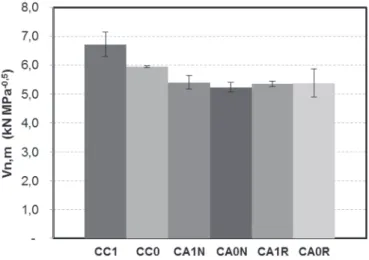
Figure 7 presents the mean and the respective standard deviation values of the normalized ultimate shear force for the diferent beams. It can be observed that the conventional concrete beams achieved a mean nor -malized ultimate shear load higher than the self-consolidating concrete
beams. Similar results were presented by Helincks et al. [14], where a reduction on the shear resistance of self-consolidating concrete was at -tributed to the smaller aggregate size and decreased volume of coarse aggregate in the mixes, thus resulting in lesser aggregate interlock. Moreover, it was observed that the amount of ines in the
Table 3
Ultimate shear capacity, normalized and average value, and shear crack inclination angle
Concrete Vu
(kN)
Vn (kN.MPa-0,5)
Vn,m (kN.MPa-0,5)
Crack angle (°)
Average angle (°)
CC1 – V1 38.03 6.32
6.71
40.3
38.7
CC1 – V2 40.01 6.65 34.7
CC1 – V3 43.16 7.17 41.2
CC0 – V1 38.77 5.98
5.95
38.5
38.4
CC0 – V2 38.56 5.94 42.6
CC0 – V3 38.41 5.92 34.1
CA1N – V1 36.75 5.29
5.40
34.4
34.6
CA1N – V2 36.50 5.25 32.9
CA1N – V3 39.31 5.66 36.4
CA0N – V1 32.92 5.40
5.23
36.6
34.5
CA0N – V2 30.90 5.07 36.5
CA0N – V3 31.75 5.21 30.3
CA1R – V1 38.11 5.46
5.34
30.1
33.1
CA1R – V2 36.94 5.29 34.3
CA1R – V3 36.94 5.29 31.9
CA0R – V1 33.48 4.97
5.37
38.4
33.6
CA0R – V2 39.92 5.92 27.2
CA0R – V3 35.24 5.23 35.3
Figure 7
conventional mixes has inluenced aggregate interlock, thus re -ducing the shear strength, since beam CC1 with a lower content of ine materials achieved higher strengths than beam CC0.
To evaluate the inluence of some parameters of the concrete mixes on the shear strength of beams, such as the lowability, the maximum nominal diameter and the volume of coarse aggregate, the experimental results were analyzed grouped according to these parameters.
a) Inluence of lowability
In order to achieve the required lowability for the self-consolidating concrete mixes, some amount of ine aggregates was replaced by limestone iller and superplasticizer was added to the mix. The efects of such changes on the shear strength can be evaluated when conventional concrete and self-consolidating mixes pro -duced with the same diameter and volume of coarse aggregate are compared, i.e., CC1xCA1N and CC0xCA0N.
According to the results presented in Table 3, the average normal -ized ultimate shear force for conventional concrete was 24.3% high -er than the one for self-consolidating concrete when larg-er coarse aggregates were used (6.71 kN.MPa-0,5 for CC1 and 5.40 kN.MPa-0,5
for CA1N). For mixes with smaller coarse aggregate, this diference
was 13.8% (5.95 kN.MPa-0,5 for CC1 and 5.23 kN.MPa-0,5 for CA1N).
Considering that the same lexural reinforcement was used in all beams, ensuring the same dowel action, it seems that besides the better compaction of the material, the use of a larger amount of ine material in self-consolidating concrete caused a reduction on aggregate interlock, and consequently a reduction on the shear strength, as also presented by Choulli et al. [15].
b) Inluence of the coarse aggregate volume
The results obtained for self-consolidating concrete beams produced with the same coarse aggregate size, but with diferent volumes, CA1Nx -CA1R and CA0NxCA0R, did not show signiicant variations in the ulti -mate shear resistance of the beams, with diferences lower than 3%. Among conventional and self-consolidating concrete, it was ob -served that the reduction of the coarse aggregate volume com -bined with ine aggregate replacement by ine materials resulted in a greater reduction on the shear strength for concrete beams with largest aggregate size. While among beams CC0xCA0R no signiicant variation on resistance was observed, among beams CC1xCA1R there was an observed reduction of 20.4% on the aver -age ultimate normalized resistance. Similar results were presented by Hassan et al. [14] and Helincks et al. [16], where the reduction
Table 4
Ultimate shear load form experiments, code based prediction and these values ratio
Concrete
Experimental Code based prediction Comparison (Ratio)
Vu (kN)
Vu,m (kN)
Vu,ACI (kN)
Vu,EC
(kN) Vu, ACI / Vu,m Vu,EC / Vu,m
CC1 – V1 38.03
40.4 22.12 31.31 0.55 0.78
CC1 – V2 40.01
CC1 – V3 43.16
CC0 – V1 38.77
38.6 23.60 32.92 0.61 0.85
CC0 – V2 38.56
CC0 – V3 38.41
CA1N – V1 36.75
37.5 25.07 34.46 0.67 0.92
CA1N – V2 36.50
CA1N – V3 39.31
CA0N – V1 32.92
31.9 22.37 31.58 0.70 0.99
CA0N – V2 30.90
CA0N – V3 31.75
CA1R – V1 38.11
37.3 25.18 34.58 0.67 0.93
CA1R – V2 36.94
CA1R – V3 36.94
CA0R – V1 33.48
36.2 24.39 33.75 0.67 0.93
CA0R – V2 39.92
on shear strength were attributed to lower aggregate interlock due to the reduced volume of coarse aggregate.
c) Inluence of the coarse aggregate nominal size
Since the concrete beams CC1xCC0, CA1NxCA0N and CA1RxCA0R diferentiate only by the coarse aggregate size, the inluence of this parameter on their shear strength can be evalu -ated by comparing the observed values among these beams. The reduction of the coarse aggregate size showed higher inlu -ence on conventional concrete beams, with ultimate shear force of CC1 12.8% higher than the one of CC0.
For self-consolidating concrete, there was not an observed signii -cant reduction in the shear strength for beams with diferent coarse aggregate sizes. The variation on ultimate strength for CA1N was 3.3% higher than for CA0N, while for CA1R this resistance was practically the same as CA0R.
3.3 Comparison of test results with codes predictions
The ultimate shear resistances obtained from the conventional and self-consolidating concrete beams tests were compared to the ones estimated by ACI-318 [9] and EC-2 [10] equations (2) and (3), respectively, for shear resistance (VR) of beams without shear
reinforcement. A safety factor equal to 1.0 was applied.
(2)
.
.
120. .
.
0,3.
. .
7
æ
ö
=
ç
+
÷
£
è
ø
u w
R c l c w
u
V d b d
V
f
f b d
M
r
(3)
(
)
13
200
0,18. 1
æ
ö
. 100. .
. .
=
ç
ç
+
÷
÷
è
ø
R l c w
V
f
b d
d
r
Where fc is the concrete compressive strength (MPa), ρl is the lex -ural reinforcement ratio, Vu is the ultimate shear force (kN), Mu is the ultimate bending moment (kN.m), bw is the beam width (m) and d is the efective depth of the beam cross section (m).
Table 4 presents the ultimate shear resistance obtained experi -mentally and the ones given by the code based predictions. For both codes, the self-consolidating concrete shear strength estima-tive was less conservaestima-tive than the one for conventionally vibrated concrete shear strength.
ACI 318 equation underestimated the ultimate strength of concrete beams without shear reinforcement, with the ratio between predict -ed to experimental values ranging from 0.55 to 0.70. An average ratio value of 0.65 was obtained from all beam results. ACI 318 equation was found to be less conservative for self-consolidating concrete beams.
The ratio between predicted values given by EC-2 to experimental values were between 0.78 and 0.99. Similar to ACI, EC-2 values were less conservative for self-consolidating concrete. In fact, the values estimated for the self-consolidating concrete beams were close to the experimental values, especially for CA0N, indicating a reduction in the safety factor for beams cast with this material as compared to conventionally vibrated concrete beams. Even though the ACI 318 equation considers a greater contribution of concrete compressive strength on the shear resistant of beams
as compared to the EC-2, the results show that shear resistances estimated by this code were more conservative, regardless of the concrete type.
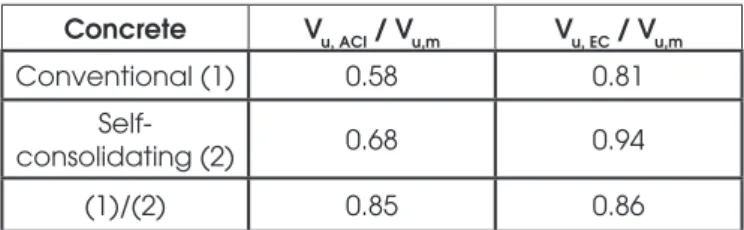
The ratio between the average ultimate shear resistance estimated by the codes to the ones obtained experimentally for conventional and self-consolidating concrete beams (Table 5) were similar, be -ing equal to 0.85 and 0.86 for ACI 318 and EC-2, respectively.
4. Conclusions
Despite the small number of beams tested, it was possible to eval -uate the inluence of volume fraction and size of coarse aggregate on shear resistance of beams produced with these materials, even though a larger number of samples would be necessary for a com -plete evaluation of the inluence of the parameters that diferentiate conventionally vibrated to self-consolidating concretes behavior. Regardless of the type of concrete, the beams showed similar be -havior during the tests. Initially, lexural cracks in the mid-span of the beam appeared together with few cracks with small slope in the shear regions. In the inal stages of loading, a sudden formation of inclined crack occurred which was followed by failure.
The inclination of the shear cracks ranged between 27.2 ° to 42.6 °. Conventional concrete beams showed a greater average value when compared to self-consolidating concrete beam values. The more inclined shear cracks resulted in higher shear strength due to greater transfer of forces through the crack.
Beams cast with conventional concrete mixes showed higher shear strengths than the ones obtained for self-consolidating con-crete mixes with same size and volume fraction of coarse aggre -gate. This reduction on resistance of self-consolidating concrete beams can be attributed to the higher content of ine materials, thus reducing the aggregate interlock.
Among the self-consolidating concrete mixes, it was observed that the reduction of coarse aggregate volume did not inluence the ulti -mate resistance, probably due to the similar amount of ines in their mix proportions. A higher efect of reducing the volume of coarse aggregate was observed between CC1 and CA1R, also due to the replacement of the ine aggregate by iller.
The size reduction of coarse aggregate in the mixture resulted in a reduction of the ultimate normalized shear force for conventional concrete beams. The same efect, however, was not observed for self-consolidating concretes beams.
ACI 318 and EC-2 code equations yielded less conservative values for shear predictions of self-consolidating concrete beams than for
Table 5
Ratio bewteen ultimate shear loads given by codes
to the ones obtained experimentally for conventional
and self-consolidating concrete beams
Concrete Vu, ACI / Vu,m Vu, EC / Vu,m
Conventional (1) 0.58 0.81
Self-consolidating (2) 0.68 0.94
conventionally vibrated concrete beams. ACI 318 equation under -estimated the ultimate strength of concrete beams without shear reinforcement, with a ratio of predicted to experimental values rang -ing from 0.55 and 0.70. EC-2 equation provided less conservative estimates than the ACI 318, with the ratio of predicted to experi -mental values between 0.78 and 0.85 for conventional concrete and between 0.92 and 0.99 for self-consolidating concrete, indicating a reduction on safety of the structures when used this material.
5. Acknowledgements
The authors gratefully acknowledge the Coordination for the Im -provement of Higher Education Personnel (CAPES) and the Graduate Program in Civil Engineering of the Federal University of Santa Catarina for support, as well as Professor Wellington Lon -guini Repette and doctoral student Ronaldo Pilar by major collabo -rations in the development of the concrete mixes.
6. References
[1] OKAMURA, H., OUCHI, M., Self-consolidating Concrete. Journal of Advanced Concrete Technology, Vol. 1, No. 1, 5-15, 2003.
[2] REPETTE, W. L. Concreto autoadensável. In: Geraldo Ce -chella Isaia. (Org). Concreto: Ciência e Tecnologia. 1ed. São Paulo: IBRACON, 2011, V.2, P. 1769-1806.
[3] EFNARC. Speciication and Guidelines for Self-consolidat -ing Concrete. European Federation of Specialist Construc-tion Chemicals and Concrete Systems, 2005.
[4] PARRA, C., VALCUENDE, M., GÓMEZ, F.. Splitting tensile strength and modulus of elasticity of self-consolidating concrete. Construction and Building Materials, v. 25, p. 193-198, 2011. [5] SHERWOOD, E. G., BENTZ, E. C., COLINS, M. P.. Evalua
-tion of shear design methods for large, lightly-reinforced con-crete beams. Advances in Engineering Structures, Mechanics & Construction, p. 153-164, Springer: Netherlands, 2006. [6] YANG, K. H., SIM, J. I., CHOI, B. J., LEE, E. T.. Efect of
Aggregate Size on Shear Behavior of Lightweight Concrete Continuous Slender Beams. ACI Materials Journal, V. 108, N° 5, Sep.-Oct. 2011, p. 501-509.
[7] HASSAN, A. A. A., HOSSAIN, K. M. A., LACHEMI, M.. Be -havior of full-scale self-consolidating concrete beams in shear. Cement & Concrete Composites, 30 (2008) 588-596. [8] DESNERCK, P., DE SCHUTTER, G., TAERWE, L.. Shear friction of reinforced self-consolidating concrete members. ACI Special publication 261-9. American Concrete Institute, Farmington Hills, Michigan. p. 133-141, 2009.
[9] ACI Committee 318, Building code requirements for structur -al concrete and commentary. American Concrete Institute, Farmington Hills, Michigan, 2011.
[10] Eurocode 2. Design of concrete structures – Part 1-1: Gen -eral rules and rules for buildings. 2004.
[11] ASSOCIAÇÃO BRASILEIRA DE NORMAS TÉCNICAS. NBR NM 67: Concreto – Determinação da consistência pelo abatimento do tronco de cone. Rio de Janeiro, 1998. [12] ASSOCIAÇÃO BRASILEIRA DE NORMAS TÉCNICAS.
NBR 15823: Concreto autoadensável. Rio de Janeiro, 2010.
[13] ASSOCIAÇÃO BRASILEIRA DE NORMAS TÉCNICAS. NBR 5739: Concreto – Ensaio de compressão de corpos-de-prova cilíndricos. Rio de Janeiro, 2007.
[14] HELINCKS, P., BOEL, V., DE CORTE, W., DE SCHUTTER, G., DESNERCK, P.. Structural behaviour of power-type self-consolidating concrete: Bond performance and shear capac-ity. Engineering Structures, V. 48, p. 121-132, 2013.
[15] CHOULLI, Y., MARÍ, A. R., CLADERA, A.. Shear behaviour of full-scale prestressed-beams made with self compacting concrete. Materials and Structures, n°41, p. 131-141, 2008. [16] HASSAN, A. A. A., HOSSAIN, K. M. A., LACHEMI, M..