QUALITY OF INFORMATION IN THE BIDDING
PROCESSES TO HIRING ENGINEERING WORKS AT
UNIVERSIDADE ESTADUAL DE LONDRINA
(UEL)
Lucimeiry Maria Minuzzi-Nascimento
Maria Inês Tomaél
Universidade Estadual de Londrina (UEL)
Brazil
ABSTRACT
Information is considered a high value product, which can turn out to be the differential in an institution, and good quality of information is what distinguishes it in any administrative process, including the bidding process. This way, based in the classification of the information presented by Moresi (2000), critical, minimal and potential information, the purpose of this survey was to analyze the quality of information in the bidding processes to hiring engineering works at Universidade Estadual de Londrina (UEL). The methodological procedures were accomplished in
two phases: (i) documental research and (ii) open questionnaire. The main results of the survey indicate the value of minimal information is about management information, and this was found in the bidding processes registration and identification data; the critics, that offers security to the actions with less imperfection, was found in many parts of the processes, with emphasis in the announcement, and the potential information, reputable as competitive edge, was used in selecting the winning firm, upon analysis of the presented proposal. The results of this survey provided the opportunity of discovery of aspects related to: (a) work experience - in front of the importance of ability to discern among the information which is more appropriate in the decision making process at hand; (b) the efficiency in the use, storage and information disposal, processes that lead one to find possible faults, flaws or divergent information, which have obstructed the improvement of work activities, with production of imperfect tasks that need modification in the course of their execution. Therefore, it’s thought to be appropriate to suggest the fulfillment of a
research related to informational behavior of the managers involved in the elaboration of the technical chart and in the bidding processes of works at UEL, covering the hiring and contract alteration; due to what was verified in the work here presented.
1 INTRODUCTION
In contemporary times, information is considered a high value product that, when well analyzed and treated, can become, in a direct way, an institutional differential, and good quality information is what distinguishes an institution during any administrative process, including a bidding process. Thus, norm NBR ISSO 8402
defines quality as a sum of an entity’s characteristics which enables it to meet explicit
and implicit needs within two perspectives: (i) external: to manage users’
expectations; and (ii) internal: to reduce the consequences of failures and minimize defects. Therefore, the quality of information can be observed when it meets the
users’ expectations and reduces mistakes, bringing out good results since “[…]
information will be considered of great value whenever the visceral state of
restlessness that originated the need for it is satisfied” (CHOO, 2003b, p.102).
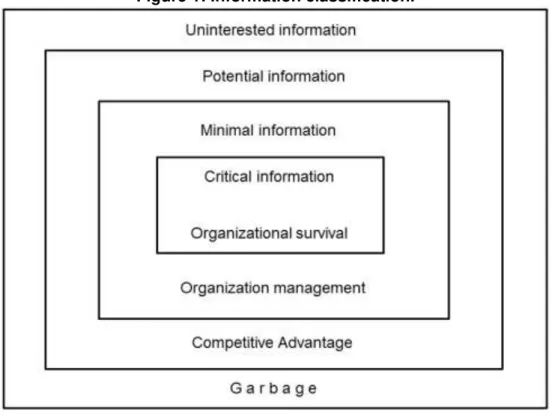
For Gonçalves, Gouveia and Petinari (2008), value added information, technically treated and differentiated, promotes both fast recovery and duly use, according to the classification and objective of the organization (Figure 1).
Figure 1: Information classification.
Figure 1 presents information classification according to Moresi’s perception
of quality (2000). According to the author, ‘critical information’ is the organization’s
reason for survival, ‘minimal information’ is for the administration, ‘potential information’ is the institution’s competitive edge, and ‘uninterested information’ is
basically garbage to be discarded. “Based on this classification, it is possible to determine information that should be collected and analyzed under the company’s strategic view to help the decision making process” (GOMES, 2002, p.48).
In this research, information quality was considered according to the bidding procedures adopted for hiring Universidade Estadual de Londrina (UEL) engineering
projects. Bidding procedures, or just bidding, is conceptualized by Gasparini (2011, p.529) as a procedure through which the public administration, according to the law,
selects, “[…] based on previously established objective criteria and among the
participating parties”, the most advantageous proposal for the contract or act of
interest.
Bidding, therefore, is used by a public agency to select the best proposal to meet their needs, which may result in; (i) failure, when all proposals are rejected or all companies are considered unqualified, and the causes for rejection or non-qualification were not corrected; (ii) or success (BRASIL, 1993).
A UEL, a state-owned entity, constituted as a State Autarchy, is a public institution for Higher Education and, therefore, must, according the law, make a bid every time engineering services or projects are needed. The university made a single bidding under the Invitation modality1 and 13 (thirteen) under the Competitive modality2, to contract engineering projects. The Invitation modality failed and 11 (eleven) under the Competitive modality were successful.
amendment/addendum3, whose specific objective is to regularize changes made in the original contract (GASPARINI, 2002). Each change brings problems not only to the Administration but also to the contracted company. As for the Administration, besides helping it take the necessary actions, it may not only extend the deadline for construction site use but also increase project cost.
As for the hired company, the problems caused by the extension of the deadline involve more time spent on the project which may prevent the company to take on new assignments.
As for the increase in work to be carried out, it may involve the recruitment of more workers to meet the established deadline, provided qualified workforce is available in the market, an increase in cost, and, considering the suppression case, the company may end up earning less than the expected and planned.
Due to the importance of information in these processes, the objective of this research was to analyze the quality of information in bidding processes for hiring UEL engineering projects.
According to Goldenberg (2001, p.14) “[…] what determines how we should work is the problem we want to work with: a road can only be chosen when we know
where we are going”. To meet the objectives of this work, the following
methodological procedures were adopted, in two phases: (i) documental research and (ii) questionnaire.
The first phase included an analysis of documents, using a form specially prepared to verify documents from the 11 (eleven) bidding processes analyzed. In the second phase, an open-question questionnaire was given to six university workers from the engineering and architecture areas, who worked in 2009, involved in the preparation of the technical portfolio - projects, budget spreadsheet, memorial and others - and in the development of the projects.
Three of the six respondents are architects and three are engineers, and they have been in the same position from 3 (three) to 12 (twelve) years.
2 UNIVERSIDADE ESTADUAL DE LONDRINA (UEL)
Located in the city of Londrina, in the State of Paraná, UEL hosts students from different Brazilian locations, enrolled in 64 (sixty-four) undergraduate courses and 189 (one hundred eighty-nine) graduate courses, at the PhD 19 (nineteen), Masters 42 (Forty-two), Specialization 76 (seventy-six) and Medical Residency 52 (Fifty-two) levels, 3.682 (three thousand, six hundred eighty-two) employees and 1.635 (one thousand six hundred thirty-five) faculty members, including tenure and collaborators –, 17.976 (seventeen thousand nine hundred seventy-six) enrolled students, 13.549 (thirteen thousand five hundred forty-nine) in undergraduate courses and 4.427 (four thousand four hundred twenty-seven) in graduate courses distributed as follows: 509 (five hundred and nine) at the PhD level, 1.554 (one thousand five hundred four) at the Masters level, 2.052 (two thousand and fifty-two) at the Specialization level, and 312 (three hundred and twelve) at the Medical Residency level. Currently, 1.055 (one thousand and fifty-five) research projects, 164 () extension projects and 63 (one hundred sixty-four) teaching projects are being developed by UEL faculty and students (UNIVERSIDADE…, 2011).
The campus of UEL covers an area of 235.57 ha (2.355.731, 81m2). It has currently 190.108,93 m2 of constructed facilities and 8.305,95 m2 of under construction facilities. Campus facilities include: (i) Office of the President’s bodies;
(ii) six supporting bodies; (iii) eight supplementary bodies; and (iv) eight centers of study. The following supplementary bodies are located off-campus: University School Hospital, History Museum of Londrina ‘Padre Carlos Weiss’, Legal Affairs Practicum Office, House of Culture, Dental School Clinic, Children’s Specialties Clinic and part
of the Laboratory School. The Center for Health Sciences is also located off-campus (UNIVERSIDADE…, 2011).
SICOR4 purchasing system, with information on Project specificities, location, budget (own or partnership), maximum estimated value for the contract, and other details needed for the bidding (BARBOSA, 2008). This information can be classified according to Moresi (2000) in critical, minimum, potential and waste to be discarded, and each bit of information must be used within their specificity, so that the bidding can fulfill its objective.
3 INFORMATION QUALITY
Information takes on a considerable and essential importance in any activity, and its use, although not in an orderly and systematic fashion, is necessary
considering that “[…] the concept of information, so far highly discussed in the literature, has created circular references [...] and a highly vague and intuitive
concept” (MIRANDA et al., 2006, p.167), since even the act of reading a newspaper
or a magazine is to occupy oneself with some type of information.
[...] When a question is asked, some type of information is always requested. When we see a movie, some information is being absorbed. When we read a newspaper, a magazine or listen to a song, the person is dealing with some type of information. At all times, people use, absorb, assimilate, manipulate, transform and produce some type of information (MIRANDA et al., 2006, p.168).
If information is used, absorbed, assimilated, manipulated, transformed and sent at all times, according to Choo (2003) its use must make sense, create meaning, and build up the necessary knowledge to help organizations with their decision-making processes.
“Initially, the analysis of the information quality theme has to deal with the
difficulty of conceptualizing the term quality”, says Paim, Nehmy and Guimarães (1996, p.111). The user must be information-literate, since he or she may run the risk of considering good quality information based on intuition and common sense, guarantees Oleto (2006). To avoid common sense, the transcendent, intrinsic and contingent dimensions must be analyzed.
dimension where issues such as “[...] validity, reliability, precision, completeness,
novelty, updatedness, timelessness and scope” are observed, and in analyzing the contingent characteristics [...] whose central proposition is that information quality depends on the user and the context in which it is being considered”, including, in the view of the user, qualities such as “[…] perceived value, efficacy, relevance and
redundancy” (PAIM; NEHMY; GUIMARÃES, 1996, p.114-115).
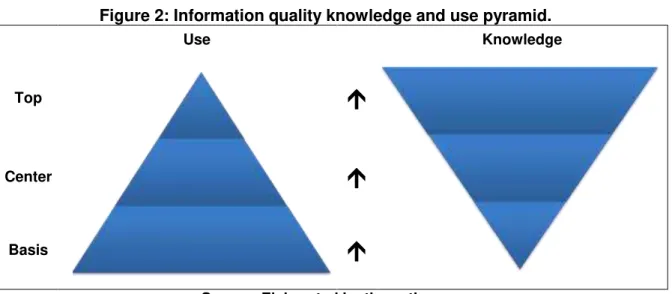
As for the value added by the user, there are cases in which some of them may need information of excellence but are unable to assess what is critical, minimal and potential information while others know how important good quality information is or the value of good quality added to information; but they don’t make use of them
(Figure 2).
Figure 2: Information quality knowledge and use pyramid.
Use Knowledge
Top
Center
Basis
Source: Elaborated by the authors.
Considering information use, the criteria for assessing its quality are subjective and information valuing, according to Couto and Macedo-Soares (2004), becomes difficult for being of transitory value for the user, since its permanence involves a problem to be solved. Once the decision is made, information may not
have the same value to other similar issues to be solved, even though it is an “[…]
intangible, non-material and therefore inexhaustible resource”. Its consumption does
not destroy as well as, when discarded, it leaves no physical traces. Ceding it “[...]
does not mean that they are lost” (LASTRES, 1999, p.3).
To show the importance of information quality, Davenport (2004, p.15) says:
Imagine a world obsessed by plumbing. In this odd universe, hundreds of magazines and books and possibly some TV channels, deal with plumbing, advertising innovations on valves, connectors and pipes. At social gatherings, conversation is about which brand of sink allows faster water drainage [...] Companies pay millions, billions or even trillion dollars to interconnect their plumbing systems [...] However, one issue has been neglected: the water. Is it clean and fresh?
Without information knowledge is not created; but is the information ‘clean and fresh’? For an information to be ‘clean and fresh’, i.e., relevant and consistent, with good value, it must meet some secrecy, availability, authenticity, integrity requirements and be raw material for strategic decision-making (BEAL, 2004).
According to Butarello et al. (2010, p.99), “[…] to be part of the organizational reality, relevant information must expand to the exterior of the individual”, and, in this
study, this expansion was made through registration in an information document about the engineering project to be developed, to help the institution choose the best
contractor, considering that “[…] lack of information may cause disharmony during
the development of the whole” (LIMA FILHO et al., 2010, p.65).
Thus, considering the relevance of information, society must fight against lack of information as it fights against hunger, and to fight against lack of information does not represent only information quantity but quality of information, since bad quality information can bring great problems to those who issued it or to those who are receiving it, guarantees Davenport, Marchand and Dickson (2004).
garbage) provided to people is what makes the difference. People must become literate in information to be able to use it effectively, considering that “[…] instead of being drowned in the abundance of information that inundate our lives, information-literate people know how to find, evaluate and use information efficiently to solve
problems” (AMERICAN…, 1989, p.1).
When evaluating information, the question to be observed is its quality, considering that the critical information “[...] must be valid, reliable and precise”
emphasizes Paim, Nehmy and Guimarães (1996, p.116). For these authors, validity presupposes integrity (entire, complete); content and source reliability and precision infers exactitude, accuracy (accurate records). Therefore, critical information helps
the organization to survive (MORESI, 2000), since it is essential for the organization’s
development, operations, and survival in the competitive market, showing less imperfect products and providing greater safety to the user (JAKOBIAK, 1988).
For being basically information for management purposes, the value of minimum information is not strictly economic or mercantile. The minimum idea in
relation to the other classifications inherent to quality, is intangible, and “[…] lies in
knowing how to use it, not in owning it”, says Cruz (2003, p.93). Information classified as potential generates competitive edge, which, in practice , carry attributes such as range, objectivity, accessibility, current, reliability, precision and validity, which, according to Oleto (2006) confer a multidimensional character to information quality.
Finally, it is understood that information, a truly necessary factor in any organizational management, must have a reliable flow to be able to face the current
highly competitive market. “The more reliable, timely and continuous the information, the more cohesion and competitiveness companies will become” affirms Spinato
(2010, p.1), emphasizing that for this to happen the importance of a correct flow of adequate information must be recognized.
4 INFORMATION FLOW
Information flow in an organization depends on management, since
human thinking capable of evaluate the real relevance and reliability of the
information, adding value to its final format” (GOMES, 2002, p.69). Management
today, for Belluzo (2010, p.23), “[…] involve a broader and more diversified range of
activities than before”, and information must aim at the construction of organizational knowledge (MOLINA, 2010) and information flow can occur horizontally, transversally and vertically.
Horizontal information flows are constituted by different organizational units of the same hierarchical level, transversal information flows occur through different organizational units of different hierarchical levels and vertical information flows are constructed by different hierarchical levels from the same organizational area. It is important to emphasize that flows occur through formalized and systematized interactions, in an organizational environment (MONTEIRO; VALENTIM, 2008, p.56).
Being of horizontal, transversal or vertical constitution, information flow travels
“[...] with data and information to subsidize the construction of knowledge in
organizational individuals, leading them to action” (VALENTIM, 2010, p.17). Action, in this study, is the realization of engineering projects bids, using quality information to bring efficient results, i.e., to bring out the desired effect (the best contract).
The more cohesive and continuous the information flow, the greater the opportunity to realize reliable procedures will be. Sources location and information availability, the organizational environment and information sharing style can affect the flow, making it appropriate and convenient and Institution culture can influence
managers’ perception on the importance of information flow for the work to be carried
out, in this case, the bidding process. Depending on how the user deals with information during the flow, information may be consolidated or lose consistency (MORESI, 2000; CHOO 2003b; SPINATO, 2010; AMORIM; TOMAÉL, 2011).
For Barreto (1998), traditional information flow and used by the written document has strong characteristics and a solid , whose main points : (i) unilateral directionality; (ii) information structure with the same characteristic in its totality; (iii) professional mediation; (iv) internal events linking; and (v) information relevance.
an image; mediation by an interface professional so that the user can interact with the information flow; the internal events link is full of information hiding, i.e., secrecy is found in several phases of the internal organization of information for storage and recovery, and the judgment of the received information relevance is done by the user after having interacted with the information flow, according to Barreto (1998).
Information flow in one organization, in a determined activity, constitutes an informational environment that established the origin, the maintenance and use of relevant information, with safety in order to achieve the proposed objective.
5 INFORMATION QUALITY IN BIDDING PROCESSES: RESEARCH FINDINGS
Quality is the factor that differentiates information, making its effective use possible. Information is of good quality whenever it meets the need at hand (CHOO, 2003b). So, Moresi (2000) presents a categorization that classifies information as minimum, critical, potential and that considered garbage, which must be discarded. Thus, in this research, each bidding process was classified according to these categories, through documental analysis – minimum, which was recognized in the records and identification of the processes. Information classified in this study as minimum were: (i) administrative process number; (ii) record date; (iii) call for bid date; (iv) project designation; (v) date: (a) publication of the Call for bid in the DIOE4; (b) ratification; (c) contract; (d) start up order dispatch; (e) effective beginning of services; (vi) project estimated deadline (vii) initial value.
In addition, bidding processes information mentioned in the documents that
lead to the manager’s decision also included critical information and this type of
information helps organization survival since they are fundamental for the development of the organization, its operations and maintenance in the competitive market, presenting less imperfect products (MORESI, 2000; JAKOBIAK, 1988).
which included all projects, specifications, list of materials, budget spreadsheet, schedules, contract provisions; (ii) in the Attorney’s Office opinion
registered in the bidding processes opening - “In compliance with the legal norms
and the Call for bid instructions, we understand that the competition is ready to be
approved by the competent authority”; (iii) in the Call for bid.
The critical information found in the Call for bid may, many times, be discarded by the managers, and divergences or lack of critical information may occur, which may end up promoting disharmony to the development of the project as a whole, bringing damages to the Administration (LIMA FILHO et al., 2010). Both the
lack and flaws in the information, as well as divergent information on the same subject (BEAL, 2004) may become informational reasons that lead to contract amendments.
In the Call for bids, critical information may be found in the following segments:
(i) “integrate the Call to Annex IV – “Site Visitation Declaration
Model” - which attests that the proponent technician , duly identified, visited and acknowledged local and physical conditions, in reference to the service object of this bid , thus , it is understood that after the conclusion of the bid and the issuing of the services start up order, motivate an amendment with information on the problems with lamp posts, inclusion of
lightning conductors and project foundation shouldn’t be
accepted;
(ii) Obligation of the contracted company “to protect the
construction project and the buildings around it with nylon screen. Protection screens should be sewn longitudinally. Wood hoardings must be placed along the platbands of existing constructions to minimize the incidence of dust in the
surrounding units”. Thus, it is understood that to motivate an
amendment with information on the need to place a hoarding
shouldn’t be accepted;
(iii) “Integrate this Call, as they were transcribed in it , the Annexes [...] in case of divergence and/or duplicity among instructional technical elements [...] the following order of priority [...] will prevail: projects, project specifications and budget spreadsheet,
considering that in the projects, greater detailing will prevail”.
According to Tarapanoff (2001, p.111) the realization of activities “[...] demands an objective and precise perception of information values”; however, by
disregarding the value of the information included in the Call for bid , justifications such as divergent information, flaws and lack of information on the services to be provided have motivated the need for contract amendments, for both an increase in contract value and project deadline extension, as observed in one of the processes whose maximum bid value was R$ 1.259.502,07 and the contracted value was R$ 1.249.960,42; however, after all amendments the current value is R$ 1.338.184,78. An extra R$ 78.682,71 was added to the maximum value estimated for the project. The initial contracted deadline was for 180 (one hundred eighty) days, and after the 30 + 30 + 90 + 60 day amendments, the project took an extra 210 (two hundred and ten) days to be developed,
However, not all amendments are undue. Some are predictable, such as the need to extend the deadline due to a long period of rain.
It is relevant to emphasize that, according to article 71 (seventy-one) of State Law, number 15.608/2007 (PARANÁ, 2007), any company or citizen interested in participating in the bid has the legal right to contest the call for bid, before the realization date , whenever a mistake, divergences, flaws or lack of information are observed, demanding corrections which would prevent so many amendments, contribute to the society and sparing the Public Treasury7. However, no impugnation of bid rules was filed against the analyzed processes.
be used to enable, guide and instruct managers during the execution of pertinent tasks to the bid, searching for the best contract (MOURA, 1996).
As for the classification of information quality as garbage to be discarded (MORESI, 2000), the duplication of information due to several filings of processes for the same amendment falls into this category.
Taking into consideration that it is possible for the flow to cooperate with bidding expediency, this work also tried to describe the possible contributions of information flow to the information quality that subsidizes decision-making.
5.1 Information Flow and Quality
In relation to the importance of observing information flow to carry out a bidding process, 5 (five) respondents informed that they ‘think’ the flow can contribute to information quality; one respondent went a bit beyond in his answer by guaranteeing that before considering information flow, it is extremely important to analyze information in projects and in complete and harmonized budgets; and one respondent highlighted that the relevance is in information itself.
When questioned whether the current configuration of information flow is pertinent to bidding processes, 4 (four) respondents stated that it is pertinent and 2 (two) said that the problem with UEL bidding processes lies not on the flow but on the
reasons that led to “[...] the number of value and deadlines amendments needed to
conclude practically all our the projects” (R2) and that “[…] more precise technical specifications are necessary to prevent mistakes in determining materials and
execution methods” (R5).
53.092,659. Information on the amendments were filed on September 8, 2010 and the formalization of the term occurred on January 25, 2011, period considered by the proceedings documents analysis as unnecessary, when information was dispatched between the HU (School Hospital)8/ and the Campus and on Campus between PROPLAN/PCU9, unnecessarily.
As for the modifications in the flow adopted by UEL so that it could contribute to information quality, four respondents (R2, R4, R5 and R6) developed a flow, for the area of Architecture and Engineering, where most amendment problems were found. One flow proposal presented by one of the respondents (R4) was considered the most complete, since it included
Architecture Program standardization;
Preliminary study;
Approval by a competent body;
Preparation of the Architecture Preliminary design and specifications;
Complementary projects;
Harmonization (‘fit’ one project into another);
Architecture basic project preparation and specifications;
Legal project preparation;
Detailed budget;
Resources collection;
Technical portfolio;
Bidding process;
Project.
An efficient information flow is coherent and reliable to all Administrative action. Information need identification, information collection, treatment, storing or distribution and disposal are the stages of an information flow.
making no sense, adding no meaning (MORESI, 2000; CHOO, 2003b; BEAL, 2004; SPINATO, 2010; VALENTIM, 2010).
Thus, based on the answers and suggestions made by the professional from the UEL Architecture and Engineering areas, the flow contributions to information quality were described to promote better contracting and construction processes, thus meeting the needs of the institution.
6 FINAL CONSIDERATIONS
In an information-dependent society such as ours, the existence of quality information as well as its due use must be verified.
This research adopted the classification of information into critical, minimal and potential, and the information found in bidding proceedings, such as (a) administrative, (b) engineering, and (c) judicial, were emphasized.
Administrative information (a) were found in the following documents: (i) project justification( motivation), (ii) requisition through the SICOR (budget estimation with respective allocations), and (iii) bidding opening authorization; engineering information (b) were found in documents such as the technical portfolio including projects, descriptive memorials, list of materials, budget spreadsheet, schedule and contract provisions; and finally juridical information (c) found in documents such as (c): (i) proof of publication, (ii) Call for bids, (iii) legal opinion, (iv) signed contract, and (v) amendments with due justification.
The reasons for contractual alterations in the services spreadsheet such as extension of the deadline for project development and increase in the previously contracted value were examined.
To analyze the information value found in the bidding procedures, this research classified them into minimum, critical and potential; however, more than to have this information, it is important to know how to use them effectively and properly.
Whenever the Administration needs to carry out a specific bid proceeding, managers make use of categorized information, which, in this research, was the minimum information, referring, for instance, to the administrative proceeding number or to the call for bid number and year of realization. By using the technical portfolio,
the Attorney’s Office opinion or the Call for bid, managers work with information
categorized as critical, since they provide safety to actions so that actions can be carried out with greater level of perfection. However, the analyzed proceedings showed some information found in the Call for bid and classified by this research as critical were sometimes discarded or presented differently in the proceedings, which may have caused problems for the Administration such as amendments which could have been prevented.
Information classified as potential was considered strategic by UEL during engineering projects bidding proceedings. This way, potential information was found in the price proposals and licensing documents submitted by the companies which led managers and CPLO10 members to decide for the best bid, which would meet the needs of the Institution.
The mapping of the flow of information in the bidding proceedings made us understand that its importance lies on the time spent on bidding proceedings and contract formalization, bringing out lower costs with no need for contract value readjustments.
(ix) resources contributions; (x) technical portfolio preparation. Next, the proceedings move to the bidding flow stage, recruitment and finally the development of the project.
Thus, results from this research brought to light aspects related to professional practice regarding the importance of continuous learning, developing capacity to select the most appropriate information; use it efficiently, store and discard information, use procedures that help to find possible mistakes, flaws or divergent information in projects, which have created obstacles for labor work improvements, with imperfect tasks that need to be modified during the development of the project.
Based on the findings of this research, it is appropriate to recommend that the Administration: (i) instruct the personnel involved in Project biddings, especially those responsible for the technical portfolio, on the available information, giving them their due consideration to prevent mistakes either during the hiring process or contract amendments; (ii) recognize the proposed contribution for the information flow, considering the preparation and harmonization of projects and their specifications to then raise funds and not the other way around when the Administration first prepare the technical portfolio and later looks for funds to for the construction of the desired building, and(iii) create conditions for technical portfolio/call for bid preparation and bidding realization by giving them enough time to be developed to prevent many, and many times, undue contract amendments.
Based on the findings presented in this study, the realization of a research on the informational behavior of managers involved both in the preparation of the technical portfolio as well as in project bidding procedures at UEL is recommended, including recruitment and contract amendments.
REFERENCES
AMORIM, F. B.; TOMAÉL, M. I. O uso de sistemas de informações e seus reflexos na cultura organizacional e no compartilhamento de informações. Perspectivas em Gestão & Conhecimento, João Pessoa, v.1, n.1, p.74-91, jan./jun. 2011.
BARBOSA, P.R. Licitações e contratos: noções básicas. In: ________. Sistema de registro de preços (SPR). Curitiba: Negócios Públicos, 2008. p.11-57
BARRETO, A. de A. Mudança estrutural no fluxo do conhecimento: a comunicação eletrônica. Ciência da Informação, Brasília, v.27, n.2, p.122-127, maio/ago. 1998.
BEAL, A. Gestão estratégica da informação. São Paulo: Atlas, 2004.
BELLUZZO, R. C.B. Competências e novas condutas de gestão: diferenciais de bibliotecas e sistemas de informação. In: VALENTIM, M. L. P.(Org.). Ambientes e fluxos de informação. São Paulo: Cultura Acadêmica, 2010.
BRASIL. Lei Federal no 8.666, de 31 de junho de 1993. Regulamenta o art. 37, inciso XXI, da Constituição Federal, institui normas para licitações e contratos da Administração Pública e dá outras providências. 1993. Available:
<http://www.planalto.gov.br/ccivil_03/Leis/L8666cons.htm>. Access: Sep.30, 2010.
BUTARELLO, N. A. L. et al. Informação e conhecimento: proteger ou compartilhar?
In: TOMAÉL, M. I.; JESUS, J. A. G. (Org.). Informação em múltiplas abordagens: acesso, compartilhamento e gestão. Londrina (PR): Midiograf, 2010. p.99-116
CHOO, C. W. Gestão da informação para a organização inteligente: a arte de explorar o meio ambiente. Lisboa: Caminho, 2003a.
________. A organização do conhecimento: como as organizações usam a informação para criar significado, construir conhecimento e tomar decisões. São Paulo: Editora SENAC, 2003b.
COUTO, L. E. D.; MACEDO-SORES, T. D. L. V. A. de. Três estratégias para turbinar a inteligência organizacional. Rio de Janeiro: FGV Editora, 2004. CRUZ, T. Sistemas de informações gerenciais: tecnologias da informação e a empresa do século XXI. 3.ed. São Paulo: Atlas, 2003.
DAVENPORT, T., H. Resgatando o “I” da “TI”. In: DAVENPORT, T.; MARCHAND,
D.; A; DICKSON, T.(Orgs.). Dominando a gestão da informação. São Paulo: Artmed, 2004.
GASPARINI, D. Prazo e prorrogação do contrato de serviço continuado. Revista Diálogo Jurídico, Salvador, n.14, jun./ago. 2002. Available:
<http://www.direitopublico.com.br/>. Access: Feb. 22, 2011.
________. Direito Administrativo. 16.ed. São Paulo: Saraiva, 2011.
GOLDENBERG, M. A arte de pesquisar: como fazer pesquisa em Ciências Sociais. Rio de Janeiro: Record, 2001.
GOMES, E. Inteligência competitiva: como transformar informação em um negócio lucrativo. Rio de Janeiro: Campus, 2002.
GONÇALVES, M. R.; GOUVEIA, S. M.; PETINARI, V. S. Informação para negócios: a informação como produto de alto valor no mundo dos negócios. CRB-8 Digital, São Paulo, v.1, n.1, p.43-54, jul. 2008. Available:
<http://revista.crb8.org.br/index.php/crb8digital/article/viewFile/42/43>. Access: Apr. 27, 2011.
JAKOBIAK, F. Maitriser l' information critique. Paris: Les Éditions d' Organization, 1988.
LASTRES, H. M. M. Informação e conhecimento na nova ordem mundial. Ciência da informação, Brasília, v.28, n.1, jan. 1999. Available:
<http://www.scielo.br/pdf/ci/v28n1/28n1a09.pdf>. Access: Jun. 21, 2011.
LIMA FILHO, A. B. et al. Acesso a informações institucionais na Universidade
Estadual de Londrina: algumas percepções dos servidores. In: TOMAÉL, M. I.; JESUS, J. A. G. (Orgs.). Informação em múltiplas abordagens: acesso, compartilhamento e gestão. Londrina (PR): Midiograf, 2010. p.57-77
MIRANDA, A. L. P.et al. Avaliação das habilidades em TI: um estudo do ensino de
informática no curso de Administração. Revista de Gestão da Tecnologia e Sistemas de Informação, São Paulo, v.3, n.2, p.163-192, 2006.
MOLINA, L. G. Gestão do conhecimento aplicada aos portais corporativos. In:
VALENTIM, M. L. P.(Org.). Ambientes e fluxos de informação. São Paulo: Cultura Acadêmica, 2010. p.123-155
MONTEIRO, N. A.; VALENTIM, M. L. P. Necessidades informacionais e
aprendizagem no ciclo de vida de um projeto. Revista Digital de Biblioteconomia e Ciência da Informação, Campinas (SP), v.5, n.2, p.53-66, jan./jun. 2008. Available: <http://www.sbu.unicamp.br/seer/ojs/index.php/sbu_rci/article/viewFile/380/257>. Access: Dec. 16, 2010.
MORESI, E. A. D. Delineando o valor do sistema de informação de uma
Available: <http://www.scielo.br/scielo.php?script= sci_arttext&pid=S0100-196520000001 00002>. Access: Dec. 14, 2010.
MOURA, L. R. Informação: a essência da qualidade. Ciência da Informação, Brasília, v.25, n.1, 1996. Available:<http://revista.ibict.br/index.php/ciinf/
article/viewArticle/488>. Access: Jul. 21, 2011.
OLETO, R. R. Percepção da qualidade da informação. Ciência da Informação, Brasília, v.35, n.1, p.57-62, jan./abr. 2006.
PAIM, I.; NEHMY, R. M. Q.; GUIMARAES C. G. Problematização do conceito
“qualidade” da informação. Perspectiva em Ciência da Informação, Belo Horizonte, v.1, n.1, p.111-119, jan./jun. 1996.
PARANÁ. Lei Estadual no 15.608/2007 de 16 de agosto de 2007. Estabelece normas sobre licitações, contratos administrativos e convênios no âmbito dos Poderes do Estado do Paraná. Curitiba, 2007.
POZO, J. I. A sociedade da aprendizagem e o desafio de converter informação em conhecimento. In: Diretor UDEMO. Projeto pedagógico. 2007. p.34-36 Available: <http://www.udemo.org.br/A%20Sociedade.pdf>. Access: Apr. 30, 2011.
SPINATO, P.A importância do fluxo de informações organizacional. Available: <http://www.administradores.com.br/informe-se/artigos/a-importancia-do-fluxo-de-informacoes-organizacional/45057/>. Access: Dec. 17, 2010.
TARAPANOFF, K. (Org.). Referencial teórico: introdução. In: ________. Inteligência organizacional e competitiva. Brasília: Editora UnB, 2001.
UNIVERSIDADE ESTADUAL DE LONDRINA. Portal. Available: <http://www.uel.br/portal/>. Access: Mar. 3, 2011
VALENTIM, M. L. P.(Org.). Ambientes e fluxos de informação. In: ________.
Ambientes e fluxos de informação. São Paulo: Cultura Acadêmica, 2010. p.13-22
NOTES
1 Art. 22, §3o, Federal Law nº 8.666/1993 – Invitation - bidding modality among interested applicants from the sector of the bid’s object , registered or not , chosen and invited, in the minimum number of 3 ( three) by administrative unit which will post , in an appropriate location, a copy of the call for bid and will extend to other registered in the corresponding bidding specialty who manifested their interest 24 ( twenty-four) hours before the presentation of the proposals (BRASIL, 1993).
international suppliers or an invitation, whenever a supplier of goods or services are not found in the Country (BRASIL, 1993).
3“The celebration of the amendment is mandatory to any contract alteration” GASPARINI (2002, p.1).
"The instrument a contract is changed is the addition (contract complement to include what the contracting party has determined [when unilateral] or that both parties have agreed on [plurilateral] (GASPARINI, 2011, p.828).
4 DIOE - Departamento de Imprensa Oficial do Estado (do Paraná). (State Official Press (Paraná)
6 PROPLAN/DPDF – University Project Planning Office/Physical Development and Project Planning
Department.
7 Public Treasury
– Term that generically identifies the State Finances. Public Treasury Funds.
8 HU – School Hospital.
9 PCU – Campus Administration Office.
10 CPLO – Permanent Bidding Committee.
Lucimeiry Maria Minuzzi-Nascimento Universidade Estadual de Londrina (UEL) E-Mail: [email protected]
Brazil
Maria Inês Tomaél
Universidade Estadual de Londrina (UEL) E-Mail: [email protected]