Timing of initial surfactant treatment in very low birth
weight newborns
Momento do tratamento com surfactante em recém-nascidos de muito baixo peso
Celso Moura Rebello1, Luciene Ferreira do Amaral Nacif2, Alice D´Agostini Deutsch3, Ângela Tavares Paes4
ABSTRACT
Objective: To correlate the timing of treatment using exogenous surfactant with the main variables related to respiratory distress syndrome or prematurity. Methods: A historic cohort study between January 1, 2004 and June 30, 2007, including very low birth weight newborns (birth weight <1,500 g) admitted to the hospital and who required surfactant therapy. Newborns were divided into three study groups: early (treatment during the first two hours); intermediate (treatment between two and six hours) and late (treatment after six hours). Variables analyzed were: air leak syndrome, mortality, bronchopulmonary dysplasia, intracranial hemorrhage, patent ductus arteriosus, retinopathy of prematurity, duration of oxygen therapy, duration of mechanical ventilation, length of hospital stay and number of surfactant doses. Results: A total of 63 newborns were included (Early Group, n = 21; Intermediate Group, n = 26 and Late Group, n = 16), there was a statistical significance between birth weight and gestational age. Multivariate logistic regression analysis was used to compensate the effects of gestational age, birth weight and other possible interferences over the variables. This analysis revealed a greater incidence of air leak syndrome among newborns of the Early Group compared to the Intermediate Group (OR = 6.98; 95%CI = 1.24-39.37; p = 0.028), with no difference compared to the Late Group (OR = 3.72; 95% CI = 0.28-49.76; p = 0.321). There were no differences regarding the other variables analyzed. Conclusions: In this retrospective, non-randomized study, surfactant administration during the first two hours of life enhanced the risk of air leak syndrome, compared to the treatment between two and six hours after birth, with no reduction of early or late neonatal mortality or bronchopulmonary dysplasia, compared to later treatment after birth.
Keywords: Pulmonary surfactants; Infant, premature; Infant, newborn; Pneumothorax
RESUMO
Objetivo: Relacionar o momento do tratamento com surfactante com as principais variáveis relacionadas à síndrome do desconforto respiratório do recém-nascido ou à prematuridade. Métodos: Coorte histórica, sendo analisados os dados de recém-nascidos de muito baixo peso (peso de nascimento < 1.500 g) admitidos no período entre 1º de janeiro de 2004 e 30 de junho de 2007, que necessitaram de tratamento com surfactante. Os recém-nascidos foram divididos em três grupos: precoce (tratamento até a segunda hora); intermediário (tratamento entre duas e seis horas); e tardio (tratamento a partir da sexta hora). Foram analisadas: ocorrência de síndrome de escape de ar, mortalidade, displasia broncopulmonar, hemorragia intracraniana, persistência do canal arterial, retinopatia da prematuridade, tempo de oxigênio, de ventilação mecânica, tempo de internação e o número de doses de surfactante. Resultados: Foram analisados 63 recém-nascidos (Grupo Precoce, n = 21; Grupo Intermediário, n = 26 e Grupo Tardio, n = 16); os grupos diferiram em relação ao peso de nascimento e à idade gestacional. Na análise multivariada por regressão logística, realizada para compensar os efeitos da idade gestacional, do peso de nascimento e de outras possíveis interferências sobre as variáveis analisadas, foi observada uma maior incidência de síndrome de escape de ar entre os recém-nascidos do Grupo Precoce em relação aos do Grupo Intermediário (OR = 6,98; IC95% = 1,24-39,37; p 0,028), porém sem diferença em relação ao Grupo Tardio (OR = 3,72; IC95 = 0,28-49,76; p = 0,321). Não foram observadas diferenças em relação às outras variáveis analisadas. Conclusões: Neste estudo retrospectivo e não-randomizado, a administração de surfactante nas primeiras duas horas de vida aumentou o risco da ocorrência de síndrome de escape de ar em relação ao tratamento realizado entre duas e seis horas de vida, sem redução na mortalidade neonatal precoce ou tardia e sem modificação na evolução para displasia broncopulmonar, em comparação com o tratamento realizado em períodos mais tardios em relação ao nascimento.
Descritores: Surfactantes pulmonares; Prematuro; Recém-nascido; Pneumotórax
Study carried out at Hospital Israelita Albert Einstein – HIAE, São Paulo (SP), Brazil.
1 PhD, Hospital Israelita Albert Einstein – HIAE, São Paulo (SP), Brazil.
2 Graduate student, Latu sensu graduate course, Hospital Israelita Albert Einstein – HIAE, São Paulo (SP), Brazil. 3 PhD, Hospital Israelita Albert Einstein – HIAE, São Paulo (SP), Brazil.
4 Master’s degree, Hospital Israelita Albert Einstein – HIAE, São Paulo (SP), –Brazil.
INTRODUCTION
Respiratory distress syndrome (RDS) is one of the most common respiratory diseases in premature newborns (NB). Considerable advances have been made in the treatment of this disease, especially due to pharmacological interventions, such as the use of corticosteroids to accelerate pulmonary maturity before birth, and the therapeutic use of exogenous
surfactant for the treatment of established disease(1).
In 1980, Fujiwara et al. were the first to publish data on a series of premature babies with diagnosis of RDS
and treated with exogenous surfactants(2). Since then,
randomized clinical trials(3,4) and meta-analyses(5-10)
have demonstrated the efficacy of RDS treatment with exogenous surfactant in reducing mortality and the incidence of air leak syndrome. However, the use of exogenous surfactant is still controversial. For example, there is no consensus regarding the best timing to start treatment with exogenous surfactant. According to the international literature, some authors agree that both the prophylactic treatment (use of surfactant in the reanimation room) and therapeutic treatment (use of surfactant in established RDS) reduce the incidence on air leak syndrome and improve oxygenation,
resulting in a 40% decrease in mortality(7-9). In theory,
the prophylactic use of surfactant improves response to treatment due to reduction of pulmonary lesions associated with mechanical ventilation, resulting in less alveolar edema at the time of treatment, which, in turn, would reduce the inactivation of exogenous surfactant. On the other hand, the disadvantage of this technique is the fact that it is more frequently associated with administration errors, either due to inadequate position of the tracheal tube or due to interference from reanimation maneuvers. Nonetheless, most criticism is associated to the unnecessary use of surfactants in newborns who, although premature, did not develop severe RDS.
The therapeutic use of surfactant can be divided, according to the moment of treatment, into early (up to two hours after birth) or late (later than two hours after birth). There is evidence in the international literature that early treatment reduces the incidence of air leak syndrome and newborn mortality when compared to late
use(5); however, there are no national data that associate
the timing of treatment with exogenous surfactant and response to this treatment. Therefore, the aim of this study was to have local data regarding the timing of exogenous surfactant treatment and the main variables associated with RDS or prematurity. The hypothesis that here treatment carried out up to two hours after birth would have better results than treatment administered later was raised.
METHODS
After approval by the Research Ethics Committee of
Hospital Israelita Albert Einstein – HIAE, a historic
cohort study was performed based on analysis of medical charts. The study contemplated the analysis of data from very low birth weight newborns (VLBW; birth weight < 1,500 g), who had been admitted to the Neonatal Unit of the HIAE in the period between January 1, 2004 and June 30, 2007, with diagnosis of RDS and requiring endotracheal intubation. VLBW newborns with severe malformations or membrane rupture for a period equal or longer than 18 hours were excluded from the study.
The NB were divided into three groups, according to the timing of exogenous surfactant treatment: Early Group: comprising NB who received surfactant up to two hours after birth; Intermediate Group: composed of NB treated with exogenous surfactant between two and six hours after birth; and Late Group: including NB treated later than six hours after birth.
The assisting physician was responsible for treatment indication and administration of surfactant, according to the routine of the service. Briefly, treatment with exogenous surfactant is indicated in premature NB with a diagnosis of RDS who were initially treated with nasal
CPAP, when they require a FiO2 ≥ 40% and pressure
≥ 6 cmH2O to maintain oxygen saturation between
88 and 94%. In the case of intubated NB diagnosed with RDS, treatment is indicated when they require
FiO2 ≥ 25% to maintain oxygen saturation between
88 and 94%. Surfactant from animal origin was used, at a dose of 100 mg/kg. The main variables included in the study were occurrence of air leak syndrome (pneumothorax, pneumomediastine, or interstitial emphysema), early newborn mortality and late newborn mortality. The secondary variables analyzed comprised occurrence of bronchopulmonary dysplasia (defined as
O2 dependence at 36 weeks of adjusted gestational age),
diagnosis of intracranial hemorrhage grades I, II, III,
or IV, according to the classification of Papile et al.(11),
occurrence of patent ductus arteriousus, retinopathy of prematurity, total time of oxygen therapy, mechanical ventilation, duration of hospital stay and number of surfactant doses.
At first the three groups were compared in regards to each variable of the study. In this phase, the continuous variables were compared by ANOVA models using a factor and the qualitative variables were analyzed by the
χ2 or Fisher’s exact test. Then, in order to compensate
of quantitative results (duration of oxygen treatment, mechanical ventilation and hospital stay). In both approaches, the multivariate model included variables with p < 0.15 in the univariate approach and/or those that were statistically different among the three groups. A significance level of p = 0.05 was adopted. The statistical program SPSS, version 17.0, was used for all analyses.
RESULTS
During the study period a total of 10,792 NB were admitted to the HIAE maternity unit. Out of these, 197 (1.82%) were VLBW premature babies, and 77 of these were treated with exogenous surfactant. The data of 63 out of 77 NB were retrieved: 21 were classified into the Early Group; 26 were placed in the Intermediate Group; and 16 in the Late Group.
In the analysis of demographic characteristics, it was revealed that the three groups differed in terms of birth weight and gestational age. The NB included in the
Early Group tended to be more premature and to weigh less when compared to those of the Intermediate and Late Groups (Table 1). The incidence of C-section and multiple gestations was lower among NB of the Early Group, whereas multiple gestations were more common among newborns of the Late Group (Table 1).
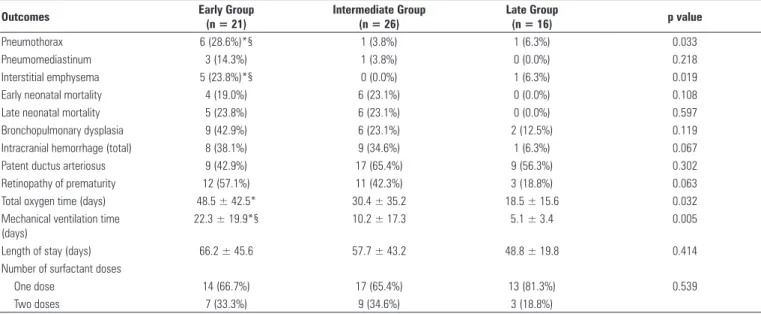
The comparison between groups concerning outcomes of interest showed that the incidence of pneumothorax (p = 0.027), interstitial emphysema (p = 0.019); total time of mechanical ventilation (p = 0.02) and total time of oxygen therapy (p = 0.032) was higher among NB of the Early Group (Table 2).
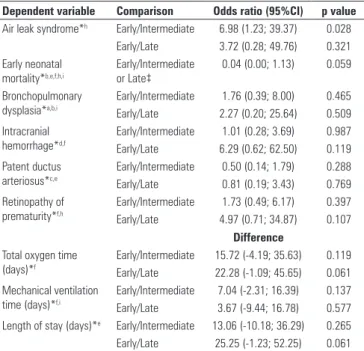
The multivariate logistical regression was carried out to compensate the effects of gestational age, birth weight and other possible interferences in the variables analyzed in this study. The incidence of air leak syndrome was more frequent in NB of the Early Group when compared to the Intermediate Group (OR = 6.98; 95%CI = 1.24-39.37; p = 0.028), but without difference when compared to the Late Group (OR = 3.72; 95%CI = 0.28-49.76; p = 0.321).
Table 1. Demographic characteristics of the three study groups. Results shown as n (%) or mean ± standard deviation
Characteristics Early Group
n = 21
Intermediate Group n = 26
Late Group
n = 16 p value
Gestational age (weeks) 26.7 ± 2.0* 28.0 ± 2.2* 30.2 ± 1.3 < 0.01 Birth weight (g) 837 ± 213*§ 1,012 ± 270* 1,296 ± 161 < 0.01 C-section (%) 14 (66.7%)* 23 (88.5%) 16 (100.0%) 0.017 Multiparous (%) 8 (38.1%)* 11 (42.3%) 10 (62.5%) 0.021 Use of prenatal corticoids (%) 12 (57.1%) 15 (57.7%) 12 (75.0%) 0.458
Male 8 (38.1%) 14 (53.8%) 8 (50.0%) 0.548
Multiple gestation 10 (47.6%)* 16 (61.5%) 14 (87.5%) 0.043 Apgar 1st minute ≤ 3 6 (28.6%) 4 (15.4%) 0 (0.0%) 0.061 Apgar 5th minute ≤ 3 1 (4.8%) 1 (3.8%) 0 (0.0%) 0.662 * p<0.05 when compared to Late Group; § p<0.05 when compared to Intermediate Group.
Table 2. Comparisons among the three study groups regarding outcomes of interest. Results shown as n (%) or mean ± standard deviation
Outcomes Early Group
(n = 21)
Intermediate Group (n = 26)
Late Group
(n = 16) p value
Pneumothorax 6 (28.6%)*§ 1 (3.8%) 1 (6.3%) 0.033
Pneumomediastinum 3 (14.3%) 1 (3.8%) 0 (0.0%) 0.218 Interstitial emphysema 5 (23.8%)*§ 0 (0.0%) 1 (6.3%) 0.019 Early neonatal mortality 4 (19.0%) 6 (23.1%) 0 (0.0%) 0.108 Late neonatal mortality 5 (23.8%) 6 (23.1%) 0 (0.0%) 0.597 Bronchopulmonary dysplasia 9 (42.9%) 6 (23.1%) 2 (12.5%) 0.119 Intracranial hemorrhage (total) 8 (38.1%) 9 (34.6%) 1 (6.3%) 0.067 Patent ductus arteriosus 9 (42.9%) 17 (65.4%) 9 (56.3%) 0.302 Retinopathy of prematurity 12 (57.1%) 11 (42.3%) 3 (18.8%) 0.063 Total oxygen time (days) 48.5 ± 42.5* 30.4 ± 35.2 18.5 ± 15.6 0.032 Mechanical ventilation time
(days)
22.3 ± 19.9*§ 10.2 ± 17.3 5.1 ± 3.4 0.005
Length of stay (days) 66.2 ± 45.6 57.7 ± 43.2 48.8 ± 19.8 0.414 Number of surfactant doses
One dose 14 (66.7%) 17 (65.4%) 13 (81.3%) 0.539
No difference was observed between early treatment and treatment performed between two and six hours after birth, or more than six hours after birth, in regards to neonatal mortality, incidence of brochopulmonary dysplasia, intracranial hemorrhage, patent ductus arteriosus, retinopathy of prematurity, total time of oxygen treatment, mechanical ventilation, length of hospital stay (Table 3).
not demonstrate that timing of surfactant treatment influenced the remaining variables analyzed. Thus, our results are different from the meta-analysis published
by Yost and Soll(5), who combined four randomized
clinical studies (two using synthetic surfactant and two using surfactant of animal origin). This meta-analysis demonstrated a reduction in the incidence of pneumothorax (RR = 0.70; 95%CI= 0.59, 0.82) and of pulmonary interstitial emphysema (RR = 0.63; 95%CI = 0.43, 0.93) in NB randomized for treatment with surfactant up to two hours after birth when compared to NB who received late treatment (more than two hours after birth). These authors also demonstrated a reduction in neonatal mortality (RR = 0,87; 95%CI = 0,77, 0,99), in chronic pulmonary disease (RR = 0,70; 95%CI = 0,55, 0,881) and in the variable chronic pulmonary disease or death at 36 weeks adjusted gestational age (RR = 0,84; 95%CI= 0,75, 0,93), with no difference on other complications typically observed in premature NB or in RDS patients. On the other hand, the studies included in this meta-analysis used different criteria for the timing of treatment in
the late group. FiO2 varied between 0.25 and 0.60;
the description of ventilation support provided was considerably wide, varying from “requiring mechanical
ventilation” to “average airway pressure of 7 cmH2O”,
an indication of the considerable heterogeneity of the cases included in the study. On the other hand, studies in animals and humans demonstrated that early treatment with surfactant is associated with improved development of various forms, and the timing difference that showed best development is less, or up
to one hour after birth(12,13). The present study results
differ from those demonstrated before, since a clear influence of the timing of treatment with surfactant and improvement of the main variables analyzed were not observed.
The design of the present study may have influenced in part the results, since it is a retrospective study, with no adequate randomization of individuals. Therefore, it is reasonable to admit that the assisting physician would tend to prescribe early treatment with exogenous surfactant for more premature NB, creating a bias associated with gestational age and birth weight. However, the logistical regression used to neutralize the effects of birth weight and gestational age in the main variables considered for analysis, also compensated for the consequences associated with no randomization. Another factor that must be taken into consideration is associated with the total number of individuals included in the study, which was relatively small, and may have had a negative influence in the
Table 3. Result of multivariate analysis by logistic regression and by ANCOVA
of the primary and secondary variables
Dependent variable Comparison Odds ratio (95%CI) p value
Air leak syndrome*h Early/Intermediate 6.98 (1.23; 39.37) 0.028 Early/Late 3.72 (0.28; 49.76) 0.321 Early neonatal
mortality*b,e,f,h,i
Early/Intermediate or Late‡
0.04 (0.00; 1.13) 0.059
Bronchopulmonary dysplasia*a,b,i
Early/Intermediate 1.76 (0.39; 8.00) 0.465 Early/Late 2.27 (0.20; 25.64) 0.509 Intracranial
hemorrhage*d,f
Early/Intermediate 1.01 (0.28; 3.69) 0.987 Early/Late 6.29 (0.62; 62.50) 0.119 Patent ductus
arteriosus*c,e
Early/Intermediate 0.50 (0.14; 1.79) 0.288 Early/Late 0.81 (0.19; 3.43) 0.769 Retinopathy of
prematurity*f,h
Early/Intermediate 1.73 (0.49; 6.17) 0.397 Early/Late 4.97 (0.71; 34.87) 0.107
Difference
Total oxygen time (days)*f
Early/Intermediate 15.72 (-4.19; 35.63) 0.119 Early/Late 22.28 (-1.09; 45.65) 0.061 Mechanical ventilation
time (days)*f,i
Early/Intermediate 7.04 (-2.31; 16.39) 0.137 Early/Late 3.67 (-9.44; 16.78) 0.577 Length of stay (days)*e Early/Intermediate 13.06 (-10.18; 36.29) 0.265 Early/Late 25.25 (-1.23; 52.25) 0.061 *OR and contrasts adjusted by: a. parity; b. maternal age; c. premature rupture of membranes; d. use of prenatal
corticoids; e. Apgar 5th minute; f. multiple gestation; g. number of surfactant doses; h. gestational age; i. birth
weight; ‡: The intermediate and late treatment groups were put together due to the low number of deaths. CI:
confidence interval.
DISCUSSION
The aim of this study was to report, for the first time in Brazil, the effects of the timing of treatment with exogenous surfactant in the most frequent events of very low birth weight NB diagnosed as RDS. The timing of treatment with exogenous surfactant did not interfere in most variables analyzed, except for higher incidence of air leak syndrome associated with surfactant treatment up to two hours after birth, when compared to treatment performed between two and six hours after birth. This difference was not observed when early treatment was compared to late treatment.
observation of differences among the groups analyzed in this study.
The absence of significant differences in the study may indicate that in our population other factors associated with neonatal care may also have influenced the main variables, in addition to the timing of treatment with exogenous surfactant. Thus, the importance of treatment timing may have been overestimated. In this regard, it is also important to point out that the incidence of C-sections was higher in NB of the Early Group. However, the impact of C-section on the final result is not clear.
CONCLUSIONS
In this retrospective non-randomized study, surfactant treatment up to two hours after birth of NB with RDS, who required mechanical ventilation, increased the risk of air leak syndrome when compared to surfactant treatment between two and six hours of life, without reducing early or late neonatal mortality and with no influence on the development of bronchopulmonary dysplasia, in comparison to treatment carried out at later periods in relation to birth.
ACKNOWLEDGEMENT
The authors thank Elivane da Silva Victor, statistician of the Instituto de Ensino e Pesquisa for assistance in statistical analysis.
REFERENCES
1. Halliday HL. History of surfactant from 1980. Biol Neonate. 2005;87(4):317-22. 2. Fujiwara T, Maeta H, Chida S, Morita T, Watanabe Y, Abe T. Artificial surfactant
therapy in hyaline-membrane disease. Lancet. 1980;1(8159):55-9.
3. Rodriguez RJ. Management of respiratory distress syndrome: an update. Respir Care. 2003;48(3):279-86.
4. Halliday HL. Recent Clinical Trials of Surfactant Treatment for Neonates. Biol Neonate. 2006;89(4):323-9.
5. Yost CC, Soll RF. Early versus delayed selective surfactant treatment for neonatal respiratory distress syndrome. Cochrane Database Syst Rev. 2000;(2):CD001456. 6. Stevens TP, Harrington EW, Blennow M, Soll RF. Early surfactant administration with brief ventilation vs. selective surfactant and continued mechanical ventilation for preterm infants with or at risk for respiratory distress syndrome. Cochrane Database of Syst Rev. 2007;(4):CD003063.
7. Soll RF, Morley CJ. Prophylactic versus selective use of surfactant in preventing morbity and mortality in preterm infants. Cochrane Database Syst Rev. 2001;(2):CD000510.
8. Soll RF. Prophylactic synthetic surfactant for preventing morbidity and mortality in preterm infants. Cochrane Database Syst Rev. 2000;(2):CD001079. 9. Soll RF. Prophylactic natural surfactant extract for preventing morbidity
and mortality in preterm infants. Cochrane Database Syst Rev. 2000;(2):CD000511.
10. Soll RF. Synthetic surfactant for respiratory distress syndrome in preterm infants. Cochrane Syst Rev. 2000;(2):CD001149.
11. Papile LA, Burstein J, Burstein R, Koffler H. Incidence and evolution of subependymal and intraventricular hemorrhage: a study of infants with birth weights less than 1,500 gm. J Pediatr. 1978;92(4):529-34.
12. Krause MF, Hoehn T. Timing of surfactant administration determines its physiologic response in a rabbit model of airway lavage. Biol Neonate. 2000;77(3):196-202. 13. [No authors listed]. Early versus delayed neonatal administration of a synthetic