The Efect of Propolis As A Biological Storage Media on
Periodontal Ligament Cell Survival in An Avulsed Tooth:
An
In Vitro Study
Zohreh Ahangari, DDS., MSD.1, Samiye Alborzi, DDS.2, Zahra Yadegari, M.Sc.3,
Fatemeh Dehghani, DDS.2, Leila Ahangari, B.Sc.4, Mandana Naseri, DDS., MSD.1*
1. Department of Endodontics, Dental School, Shahid Beheshti University of Medical Sciences, Tehran, Iran 2. Student Research Committee, Shahid Beheshti University of Medical Sciences, Tehran, Iran 3. Oral Biology Laboratory, Dental School, Shahid Beheshti University of Medical Sciences, Tehran, Iran
4. Islamic Azad University, North Tehran Branch,Tehran, Iran
* Corresponding Address: Department of Endodontics, Dental School, Shahid Beheshti University of Medical Sciences, Tehran, Iran
Email: [email protected]
Received: 12/May/2012, Accepted: 15/Jan/2013 Abstract
Objective: Both the length of extra-alveolar time and type of storage media are signiicant factors that can affect the long-term prognosis of replanted teeth. This study aims to com
-pare propolis 50%, propolis 10%, Hank’s balanced salt solution (HBSS), milk and egg white on periodontal ligament (PDL) cell survival for different time points.
Materials and Methods: In this in vitro experimental study, we divided 60 extracted teeth
without any periodontal diseases into ive experimental and two control groups that con
-sisted each experimental group with 10 and each control group with 5 teeth. The storage times were one and three hours for each media. The controls corresponded to 0-minute (positive) and 12-hour (negative) dry time. Rinsing in the experimental media, the teeth were treated with dispase and collagenase for one hour. Cell viability was determined by using trypan blue exclusion. Statistical analysis of the data was accomplished by using two-way analysis of variance (ANOVA) complemented by the Tukey’s HSD post-hoc. Results: Within one hour, there was no signiicant difference between the two propolis groups, however these two groups had signiicantly more viable PDL cells compared to the other experimental media (p<0.05). The results of the three-hour group showed that propolis 10% was signiicantly better than egg white, whereas both propolis 10% and 50% were signiicantly better than milk (p<0.05).
Conclusion: Based on PDL cell viability, propolis could be recommended as a suitable biological storage media for avulsed teeth.
Keywords:Avulsed Tooth, Periodontium, Propolis, Transport Media
Cell Journal(Yakht eh), Vol 15, No 3, Aut um n 2013, Pages: 244- 249
Citation: Ahangari Z, Alborzi S, Yadegari Z, Dehghani F, Ahangari L, Naseri M. The effect of propolis as a biological
Storage media on periodontal ligament cell survival in an avulsed tooth: an in vitro study. Cell J. 2013; 15(3): 244-249.
Introduction
Avulsion is deined as the total displacement of a tooth from the alveolar socket. Clinical surveys indi
-cate that avulsion occurs in 1to 16% of all traumatic injuries to permanent dentition (1). Extra oral time of the avulsed tooth and storage medium are two impor
-tant factors that prevent damage to the periodontal ligament cells (PDL) (2). Immediate replantation of the tooth preserves the vitality of the PDL cells, which
is an essential factor for increasing long term prog
-nosis (3).Water is more acceptable than desiccation as storage for up to 15 minutes. Milk is acceptable for up to 60 minutes; cool milk reduce swelling and increases cell viability (3). Hank’s balanced salt solu
Recently propolis has been recognized as a use
-ful material for human and veterinary medicine. It is an antifungal (6), antibacterial and anti-inlam
-matory resinous material collected by bees from the buds of plants (7). In general, propolis is com
-posed of 50% resin and vegetable balsam, 30% wax, 10% essential and aromatic oils, 5% pollen and 5% various other substances, that include or
-ganic debris depending on the place and time of its collection (8, 9). The constituents of propolis vary widely due to climate, season and location, there
-fore its chemical formula is not stable (10, 11). The effect of this media on PDL cells was exam
-ined in several studies and it has been reported to be more effective than HBSS (12, 13). In one study there was no statistical difference in the viability of PDL cells between egg white and HBSS as storage media, but both were more effective than milk (14).
In this study, we compared the viability of PDL cells using milk and egg white as available storage media, HBSS as the golden standard storage media approved by the American Association of Endo
-dontists (2, 3, 15), and two different concentrations of Iranian propolis as a new biological storage me
-dia for the maintenance of viable PDL cells.
Materials and Methods
This was an in vitro experimental study that exam
-ined a total of 60 periodontal disease-free anterior sin
-gle root teeth which, due to prosthodontic considera
-tion, were extracted without trauma. The teeth were randomly divided into ive experimental and two con
-trol groups ive each (Save-A-Tooth, Pottstown, PA, USA). After drying for 30 minutes, a total of 10 teeth were used for each of the following experimental me
-dia: propolis 10%, propolis 50%, Hank’s balanced salt solution [HBBS (Save-A-Tooth, Pottstown, PA, USA)], milk and egg white. We evaluated each of the groups at one and three hours after immersion, with a total of ive teeth used for each immersion.
Propolis was produced by honeybees in Azerbai
-jan, Iran. Solid propolis was ground by a mortar and pestle, then divided into 1.6 and 8 mg portions and dissolved in 40 ml of the 0.4% ethanol solution by a using vortex mixer (Techno Inc., USA) to make prop
-olis 10 and 50%, respectively. The prop-olis extract was iltered to exclude any rough particles. Prior to immersion of the teeth in prepared propolis, the solu
-tions were agitated well by a shaker. After drying and soaking in all storage media for the determined time,
each tooth was incubated in 15 ml falcon tubes with 0.8 ml of collagenase (1.3 mg/ml) (Gibco, UK) and also 0.8 ml dispase (0.5 mg/ml) (Gib
-co, UK) for one hour in a water bath at 37˚C. The tubes were shaken every ten minutes. We added 8 ml of fetal bovine serum (FBS) (Gibco, Australia) to each tube, after which tubes were centrifuged for ten minutes at 1200 rpm for cell separation. A total of 50 ml of 0.4% trypan blue (Merck, Germany) was added to label the cells for determination of cell viability. Cell viabil
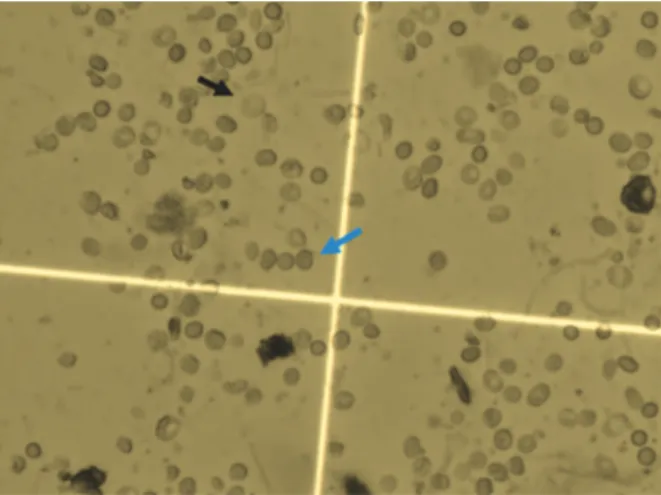
-ity was calculated as the number of viable cells divided by the total number of cells within the grids on the hemocytometer at ×400 magnifica
-tion under a light microscope. Cells that took up trypan blue were considered non- viable (Fig 1). We calculated the viable cell count as follows: % viable cells=[1.00-(Number of blue cells/ Num
-ber of total cells)]×100
We treated the control groups with dispase and col
-lagenase. The positive control group were treated immediately after extraction whereas the negative ones were treated after leaving to dry for 12 hours. All the procedures were done by a skilled practi
-tioner who was blinded to the treatment.
Statistical analysis
Statistical analyses were conducted using a two-way analysis of variance (ANOVA) complemented by the Tukey’s HSD post-hoc test. The level of sig
-niicance was p<0.5. The analyses were performed using SPSS17.
Results
The mean percent values for cell viability for the different groups are shown in table 1. There was no signiicant difference in the one-hour groups between HBSS (62.97 ± 8.44), milk (63.82 ± 4.68) and egg white (59.79 ± 5.54) in numbers of re
-maining vital cells (p>0.05). Although there was no signiicant difference between the two propo
-lis groups, both propo-lis 50% (77.78 ± 9.22) and propolis 10% (78.55 ± 3.64) were signiicantly bet
-ter than the other experimental groups (p<0.05). The milk (34.64 ± 26.80) and egg white (50.38 ± 11.31) three-hour groups were not signiicantly different. There was no signiicant difference be
-tween propolis 50% (64.00 ± 15.16), propolis 10% (79.97 ± 2.54) and HBSS (60.23 ± 7.78), either (p>0.05). Propolis 10% was signiicantly better than the egg white group, whereas both propolis 50% and propolis 10% were signiicantly better than the milk group (p<0.05).
Table1: The mean values and standard deviations of alive to total periodontal ligament (PDL) cells in study groups
3 hours (no/unit) 1hour (no/unit)
Groups
50.38 ± 11.31 59.79 ± 5.54
Egg white
34.64 ± 26.80 63.82 ± 4.68
Milk
60.23 ± 7.78 62.97 ± 8.44
HBSS
64.00 ± 15.16 77.78 ± 9.22
Propolis 50%
79.97 ± 2.54 78.55 ± 3.64
Propolis 10%
80.33 ± 24.15
Positive control
3.92 ± 5.70
Negative control
HBSS; Hank’s balanced salt solution.
Discussion
Avulsions are the worst dentoalveolar injuries. Successful tooth replantation is directly dependent on the viability of PDL cells that remain on the root surface (16). Numerous studies have exam
-ined the best storage medium for PDL cell viabil
-ity or the critical dry time that cells remain viable. In this study, as with the study by Martin and Pillegi, the dry time was considered to be 30 min
-utes (12). Andreasen and Hjorting-Hansen (17) showed that teeth replanted within 30 minutes had a better chance for survival than longer periods of dry time. In addition, 30 minutes of desiccation is
similar to the clinical setting. Other studies have shown that with a two hour dry time no vital PDL cells remain (18, 19). In addition, other investiga
-tions have used a dry time that differed from the normal clinical setting (13, 14, 20, 21).
According to previous studies that examined dif
-ferent storage media, the results showed that water, saliva, and saline were ineffective on PDL cell vital
-ity because of bacterial contamination or the hypo
-tonic effect that lead to the death of PDL cells (15). HBSS has been used in numerous studies to protect different cell types. It is non-toxic, pH balanced, and contains many essential nutrients. HBSS is available as "Save-A-Tooth" in pharma
-cies, but not widely (4, 5).
Lindskog et al. in an in vivo study on monkeys
evaluated saliva and milk. The results have shown that saliva was less suitable than milk due to its low osmolality and bacterial contamination (22). Milk, however, is a suitable transport medium be
-cause of its pH=6.5-6.8 and osmolality of 275 mil
-liosmol/kg, in addition to the presence of essential nutrients (4).
Viaspan is presently used for organ transplant storage. It’s lactobionate and raffinose are pre
-sumed to prevent cellular swelling (23). Vias
-pan has an effective hydrogen ion buffer, which maintains the pH, in addition to adenosine, which is necessary for cell division (24). Pet
-tiette and colleagues (25) have shown that vi
-aspan was more effective than HBSS and milk, however other studies disagreed (26). Viaspan has a pH=7.4 and osmolality of 320 milliosmol/ kg, which has proven that it is among the most effective of media. However, viaspan is not widely available (4).
Propolis is an aromatic sticky substance collect
-ed by bees from trees and plants. The bees work on it to produce a type of adhesive that seals their hives (7). Propolis is composed of resin (55%), essential oils and wax (30%), pollen (5%) and other constituents (10%) that consist of amino ac
-ids, minerals ethanol, in addition to vitamins A, B complex, E and biolavonoid (7).
-ping (33), in addition to research as a media stor
-age for avulsed teeth (12, 13).
There are three methods in use for evaluating the eficacy of different storage media. One method initially removes ibroblasts from the root surfaces after which they are added to a storage medium for culturing. The viability of cells is evaluated at dif
-ferent times. The advantage of this method is the large number of cells produced, however this dif
-fers from the clinical setting (34). Another method, after tooth extraction and different dry times, soaks the tooth in storage media. By isolating the tooth and using enzymes, the cell viability is evaluated. This method more closely approximates the actual clinical scenario. In the third method, apoptotic levels are determined by an apoptosis assay and low cytometry.
Additional cell viability and proliferation are analyzed by the XTT assay under both dry and wet conditions. The present study used the second method, as have Martin and Pillegi (12) and Kha
-demi et al. (14), in contrast with research by Ozan et al. (13, 20) and Thomas et al.
(21) who used the irst method and Gjertsen et al. (35) who has used the third method. We have used the trypan blue exclusion staining technique because it is quick, easy, and can differentiate be
-tween viable and nonviable cells.
The results of present study showed that both propolis 10 and 50% were more effective than oth
-er groups at the studied times, howev-er th-ere was no difference between propolis 10 and 50%. After one hour, milk and egg white were observed to be effective as HBSS but signiicantly less effective than both propolis groups. At three hours, the ef
-fects of both concentrations of propolis were the same as HBSS, whereas milk and egg white were less effective than HBSS and both propolis groups.
Martin and Pillegi (12) showed that propolis 100% and propolis 50% were the most effective storage media, with no statistical differences be
-tween these two groups, also there was no differ
-ence between HBSS, milk and saline. Although the percent of propolis in their study differed from the current study, the results were similar.
Khademi et al. (14) reported no signiicant dif
-ference between HBSS and egg white at any stor
-age time. Both were more suitable than water or
milk. In the present study there was no signiicant difference between milk and egg white at both in
-tervals. The use of different enzymes or lack of dry time in Khademi and his colleagues’ investigation might have led to different results.
Ozan et al. (13) compared the eficacy of propo
-lis 10%, propo-lis 20%, milk and HBSS. He found that propolis was signiicantly more effective than HBSS and milk at 3, 6, 24, 72 hours. However at one hour no signiicant difference existed among the groups. Propolis 20% had a worse result than HBSS but better than HBSS and milk at three and six hours. No difference existed between propolis groups at one, three and six hours. In their study milk kept signiicantly less numbers of PDL cells viable compared to HBSS, which supported the re
-sults of the current study.
Thomas et al. (21) compared coconut water, HBSS and milk on PDL cell survival. He found HBSS to be more effective at 15 minutes. No sig
-niicant difference existed among groups at 30, 45 and 60 minutes. The results of this study resem
-bled ours in the HBSS and milk groups.
Gopikrishna et al. (36) compared coconut water, propolis 50%, HBSS and milk on PDL cell viabil
-ity and found coconut water to be the most effec
-tive group. Propolis 50% and HBSS were more effective than milk, such as our results.
Buttke and Trope have suggested that storing avulsed teeth in medium that contain antioxidants might increase replantation success (37). One of the major components of propolis is lavonoids, the most important pharmacologically active constitu
-ent and powerful antioxidant, which would explain its ability to maintain cell viability. Propolis also has an antibacterial property, which assists with successful replantation and decreases the chance of inlammatory resorption-a common sequel in delayed replantation. Iron and zinc which are used in collagen synthesis are also found in propolis.
Conclusion
Many storage media can be considered for avulsed teeth according to the circumstances and properties of the natural or chemical cellular pro
-tective solutions.
-age medium for maintaining the viability of PDL cells in avulsed teeth. Further research is needed to produce a standard formulation for propolis in addition to studies on animal models of traumatic injuries.
Acknowledgments
This article was based on an undergraduate thesis by Samiye Alborzi which was successfully com
-pleted under supervision of Dr. Zohreh Ahangari at the Dental School of Shahid Beheshti University of Medical Sciences. There is no conlict of inter
-est in this article.
References
1. Adil NF, Ahmed SS, Jindal MK, Arshad SH. Delayed re
-plantation of avulsed teeth. J Indian Soc Pedod Prev Dent. 2007; 25 Suppl: S17-19.
2. Kenny DJ, Barrett EJ. Pre-replantation storage of avulsed teeth: fact and iction. J Calif Dent Assoc. 2001; 29(4): 275-281.
3. Bakland LK, Flores MT. Management of traumatic dental
injuries. In: Torabinejad M, Walton RE, editors. Endodon
-tics: principles and practice. 4th ed. St. Louis, Missouri: Saunders Elsevier; 2009; 176-180.
4. Hiremath G, Kidiyoor KH. Avulsion and storage media. J Investig Clin Dent. 2011; 2(2): 84-94.
5. Krasner P, Person P. Preserving avulsed teeth for replan
-tation. J Am Dent Assoc. 1992; 123(11): 80-88.
6. Ahangari Z, Naseri M, Jalili M, Mansouri Y, Mashhadiab
-bas F, Torkaman A. Effect of propolis on dentin regen
-eration and the potential role of dental pulp stem cell in Guinea pigs. Cell J. 2012; 13(4): 223-228.
7. Almas K, Dahlan A, Mahmoud A. Propolis as a natural remedy: An update. SDJ. 2001; 13(1): 45-49.
8. Molan P. Why honey is effective as a medicine. Part 2.The scientiic explanation of its effects. Bee World. 2001; 82(1): 22-40.
9. Nieva Moreno MI, Isla MI, Cudmani NG, Vattuone MA,
Sampietro AR. Screening of antibacterial activity of Amai
-cha del Valle (Tucuman, Argentina) propolis. J Ethnophar
-macol. 1999; 68(1-3): 97-102.
10. Sforcin JM, Fernandes A Jr, Lopes CA, Bankova V, Funari
SR. Seasonal effect on Brazilian propolis antibacterial ac
-tivity. J Ethnopharmacol. 2000; 73(1-3): 243-249. 11. Markham KR, Mitchell KA, Wilkins AL, Daldy JA, Lu Y.
HPLC and GC-MS identiication of the major organic con
-stituents in New Zealand propolis. Phytochemistry. 1996; 42: 205-211.
12. Martin MP, Pileggi R. A quantitative analysis of Propolis: a promising new storage media following avulsion. Dent Traumatol. 2004; 20(2): 85-89.
13. Ozan F, Polat ZA, Er K, Ozan U, Deger O. Effect of propo
-lis on survival of periodontal ligament cells: new storage media for avulsed teeth. J Endod. 2007; 33(5): 570-573.
14. Khademi AA, Saei S, Mohajeri MR, Mirkheshti N, Ghas
-sami F, Torabi nia N, et al. A new storage medium for an avulsed tooth. J Contemp Dent Pract. 2008; 9(6): 25-32.
15. McDonald RE, Avery DR, Dean JA, Jones JE. Manage
-ment of trauma to the teeth and supporting tissues. In: Dean JA, Avery DR, McDonald RE, editors. Dentistry for
the child and adolescent. 9th ed. Maryland Heights, Mis
-souri: Mosby Elsevier; 2011; 428-434.
16. Hammer H. Replantation and implantation of teeth. Int Dent J. 1955; 5:439-457.
17. Andreasen JO, Hjorting-Hansen E. Replantation of teeth.
I. Radiographic and clinical study of 110 human teeth re
-planted after accidental loss. Acta Odontal Scand. 1966; 24(3): 263-286.
18. Andreasen JO. Effect of extra-alveolar period and storage
media upon periodontal and pulpal healing after replanta
-tion of mature permanent incisors in monkeys. Int J Oral Surg. 1981; 10(1): 43-53.
19. Soder PO, Otteskog P, Andreasen JO, Modéer T. Effect of drying on viability of periodontal membrane. Scand J Dent Res. 1977; 85(3): 164-168.
20. Ozan F, Polat ZA, Tepe B, Er K. Inluence of storage me
-dia containing Salvia oficinalis on survival of periodontal ligament cells. J Contemp Dent Pract. 2008; 9(6): 17-24.
21. Thomas T, Gopikrishna V, Kandaswamy D. Compara
-tive evaluation of maintenance of cell viability of an ex
-perimental transport media "coconut water" with Hank’s balanced salt solution and milk, for transportation of an avulsed tooth: An in vitro cell culture study. J Conserve Dent. 2008; 11(1): 22-29.
22. Lindskog S, Blomlof L, Hammarstrom L. Mitoses and mi
-croorganisms in the periodontal membrane after storage in milk or saliva. Scand J Dent Res. 1983; 91(6): 465-472.
23. Blomlof L, Andersson L, Lindskog S, Hedstrom KG, Ham
-marstrom L. Periodontal healing of replanted monkey teeth prevented from drying. Acta Odontal Scand. 1983; 41(2): 117-123.
24. Todo S, Nery J, Yanaga K, Podesta L, Gordon RD, Starzl TE. Extended preservation of human liver grafts with UW solution. JAMA. 1989; 261(5): 711-714.
25. Pettiette M, Hupp J, Mesaros S,Trope M. Periodontal healing of extracted dogs’ teeth air- dried for extended
periods and soaked in various media. Endod Dent Trau
-matol. 1997; 13(3): 113-118.
26. Ashkenazi M, Sarnat H, Keila S. In vitro viability, mito
-genicity and clonogenic capacity of periodontal ligament
cells after storage in six different media. Endod Dent Trau
-matol. 1999; 15(4): 149-156.
27. Margo Filho O, De Carvalho AC. Application of propolis to dental sockets and skin wounds. J Nihon Univ Sch Dent. 1990; 32(1): 4-13.
28. Magro-Filho O, de Carvalho AC. Topical effect of propolis in the repair of sulcoplasties by the modiied Kazanjian technique. Cytological and clinical evaluation. J Nihon Univ Sch Dent. 1994; 36(2): 102-111.
29. Al-Shaher A, Wallace J, Agarwal S, Bretz W, Baugh D. Effect of propolis on human ibroblasts from the pulp and periodontal ligament. J Endod. 2004; 30(5): 359-361. 30. Silva FB, Almeida JM, Sousa SM. Natural medicaments in
endodontics -- a comparative study of the anti-inlamma
-tory action. Braz Oral Res. 2004; 18(2): 174-179. 31. Gebara ECE, Zardetto CGDC, Mayer MPA. In vitro study
of the antimicrobial activity of natural substances against S.mutans and S. sobrinus. Rev Odontol Univ Sao Paulo. 1996; 10: 251-256.
32. Murray MC, Worthington HV, Blinkhorn AS. A study to in
-vestigate the effect of a propolis-containing mouthrinse
on the inhibition of de novo plaque formation. J Clin Peri
-odontol. 1997; 24(11): 796-798.
33. Ahangari Z, Eslami G, Koosedghi H, Ayatolahi A. Com
-parative study of antibacterial activity of propolis and Ca (OH) 2 against lactobacillus, entrococus feacalis, peptostreptococus and candida albicans. JIDA. 2009; 21(1): 50-56.
of human periodontal ligament cells in vitro. J Dent Res. 1985; 64(8): 1026-1030.
35. Gjertsen AW, Stothz KA, Neiva KG, Pileggi R. Effect of
propolis on proliferation and apoptosis of periodontal
liga-ment ibroblasts. Oral Surg Oral Med Oral Pathol Oral Ra
-diol Endod. 2011; 112(6): 843-848.
36. Gopikrishna V, Baweja PS, Venkateshbabu N, Thomas
T, Kandaswamy D. Comparison of coconut water, propo
-lis, HBSS, and milk on PDL cell survival. J Endod. 2008; 34(5): 587-589.