DOI: 10.14260/jemds/2014/2791
ORIGINAL ARTICLE
J of Evolution of Med and Dent Sci/ eISSN- 2278-4802, pISSN- 2278-4748/ Vol. 3/ Issue 24/June 16, 2014 Page 6619
EFFECTIVITY OF INJECTION SCLEROTHERAPY WITH POLIDOCANOL IN
EARLY HAEMORRHOIDS
Madhumita Mukhopadhyay1, Avijit Roy2, Gautam Piplai3, Abhiram Maji4, Aveesha Bhattacharya5, Aditya Mukherjee6, Manas Karmakar7, Q. M. Rahaman8
HOW TO CITE THIS ARTICLE:
Madhumita Mukhopadhyay, Avijit Roy, Gautam Piplai, Abhiram Maji, Aveesha Bhattacharya, Aditya Mukherjee, Manas Karmakar, Q. M. Rahaman. Effectivity of Injection Sclerotherapy with Polidocanol in Early Haemorrhoids. Journal of Evolution of Medical and Dental Sciences 2014; Vol. 3, Issue 24, June 16;
Page: 6619-6622, DOI: 10.14260/jemds/2014/2791
ABSTRACT: BACKGROUND: Hemorrhoids are one of the most common complaints that coloproctologists must evaluate. Polidocanol is widely used as a sclerosing agent for the treatment of hemorrhoids. OBJECTIVES: To study the efficacy and safety of polidocanol for sclerotherapy in the treatment of hemorrhoids. METHODS: A prospective study of 58 patients over a period of one year. The treatment details, efficacy and adverse effects were studied. RESULTS: In our study the male to female ratio was 1.52:1. The age ranged from 22 to 60 years. Out of 58 patients, 36(62.07%) patients were having first degree haemorrhoids and 22(37.93%) patients had early second degree haemorrhoids. In our study, after three doses of injection (89.66%) patients had satisfactory results. After the first dose of injection 39(67.24%) patients had satisfactory results. Rest 19 patients were given second dose of injection, of which 11(57.89%) patients had satisfactory results. Third dose of injection given to the remaining 8 patients proved satisfactory only in 2 cases. After three doses of injection, 6(10.34 %) cases failed to show any response. All the six cases had early second degree haemorrhoids. CONCLUSION: Polidocanol is an effective sclerosant for the treatment of early hemorrhoids.
KEYWORDS: Polidocanol, haemorrhoids, sclerotherapy.
INTRODUCTION: Sclerotherapy is a time-honored method and is widely practiced all over the world for the treatment of 1st and 2nd degree hemorrhoids by creating a fibrous reaction.(1) There are many types of sclerosants but they all do the same thing; they cause a low grade, long- standing
inflammation reaction which scar the vein and mucosal tissue, collapse the vein walls and cause the
hemorrhoids to shrivel.
Polidocanol has a sclerosant and at the same time a local anesthetic effect. This permits almost painless sclerotherapy. It is easy to administer and can be used as an out- patient procedure. The aim of the present study was to study the efficacy and side effects of polidocanol as a sclerotherapeutic agent in the treatment of hemorrhoids.
DOI: 10.14260/jemds/2014/2791
ORIGINAL ARTICLE
J of Evolution of Med and Dent Sci/ eISSN- 2278-4802, pISSN- 2278-4748/ Vol. 3/ Issue 24/June 16, 2014 Page 6620 The patient was advised to defecate shortly before the treatment and was laid down on his or her left side in the left lateral position. A proctoscope with a wide bore was inserted into the anal canal to illuminate the hemorrhoid to be injected. Injection was done at the base of the hemorrhoid, above the dentate line. Once the correct injection site was located, the needle was inserted 1 to 2cms deep, parallel to the anal canal. About 1 ml of polidocanol (30 mg) was injected slowly, allowing time for dispersion in the tissue. The needle was held in place for about 2 minutes and then slowly withdrawn to facilitate the sealing of the tract. A maximum of three separate injections to the bases of the hemorrhoids were given at intervals of three weeks if required.
Sitz baths after each bowel movement were suggested for 2 days post treatment. The patients were re- examined on days 14, 28 and then on a 2 monthly basis.
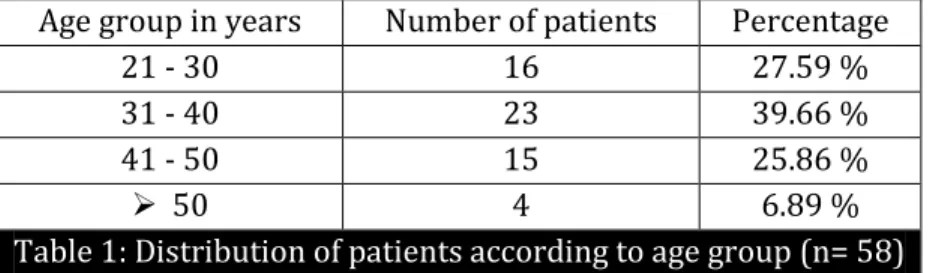
RESULTS: 58 patients were included in the study of which there were 35 males and 23 females. The male: female ratio was 1.52: 1. The age ranged from 22 to 60 years.
Age group in years Number of patients Percentage
21 - 30 16 27.59 %
31 - 40 23 39.66 %
41 - 50 15 25.86 %
50 4 6.89 %
Table 1: Distribution of patients according to age group (n= 58)
All the patients presented with per rectal bleeding which was painless in most of the cases (91.38 %). Constipation was present in 55.17 % cases. Out of 58 patients, 36(62.07 %) patients were having first degree haemorrhoids and 22(37.93 %) patients had early second degree haemorrhoids.
Number of injections Number of patients Satisfactory Percentage Unsatisfactory
First 58 39 67.24 % 19
Second 19 11 57.89 % 8
Third 8 2 25 % 6
Table 2: Number of injections required for satisfactory response
After the first dose of injection 39(67.24 %) patients had satisfactory results. Rest 19 patients were given were given second dose of injection, of which 11(57.89%) patients had satisfactory results. Third dose of injection given to the remaining 8 patients proved satisfactory only in 2 cases. After three doses of injection, 6(10.34 %) cases failed to show any response. All the six patients had early second degree haemorrhoids. There were no complications during the procedure.
Complications occurred in the form of mild bleeding episodes in three patients. During the follow up period of 10 months recurrence was observed in 3 patients. Complications like prostatitis, infection or ulceration were not observed in any case. None of the patients complained of pain during the procedure.
DOI: 10.14260/jemds/2014/2791
ORIGINAL ARTICLE
J of Evolution of Med and Dent Sci/ eISSN- 2278-4802, pISSN- 2278-4748/ Vol. 3/ Issue 24/June 16, 2014 Page 6621 frequency in men and women.(2, 3, 4) In our study the male to female ratio was 1.52: 1. This may be partly due to the fact that women are often reluctant to approach a doctor for rectal bleeding and much less reluctant to undergo an invasive procedure.
There still exists controversies and lack of agreement on the treatment strategies. Due to the superficial nature of the disease and the general lack of life threatening complications, most physicians feel comfortable to prefer methods that are readily available.(4) Despite the relatively good resulted reports in literature, a surgical hemorrhoidectomy is associated with major complications including postoperative pain, incontinence, stenosis and bleeding. More than 80% of the hemorrhoidal symptoms can usually be controlled by non-excisional techniques.(5,6) The most common interventions are sclerotherapy and rubber band ligation. Use of various kinds of sclerosants has been reported in literature. They include phenol in almond oil, phenol in arachus oil, phenol in olive oil, sodium tetradecyl sulphate, polidocanol, quinine, ethanolamine oleate and OC-108. Use of hypertonic saline and absolute alcohol has also been reported.(7, 8, 9)
Bleeding is the principal and earliest symptom of haemorrhoids.(10,11) In our study bleeding was observed in all the patients. Similar findings have been found in another study by Bhuiya et al.(11) Immediate complications of injection sclerotherapy are local pain, bleeding, ulceration and prostatitis in case of males if injection is too deep and anterior. Prostatitis should be treated immediately with antibiotics. There may be late complication like fibrosis with anal canal stenosis.(11) Most common post injection symptom is pain which is normally short lived and subsides within 24 hours. Usually this can be managed by topical pain killers and analgesics.(9) In a study by Chauhan VF et al,(9) pain was felt in 38.8% of the patients injected with hypertonic saline and 52.2 % of the patients injected with absolute alcohol. In our study there were no immediate complications like pain or bleeding. Polidocanol has a sclerosant and at the same time a local anesthetic effect which permits almost painless sclerotherapy. In a study(11) using phenol in olive oil, complication in the form of bleeding was observed in 2.08 % cases. In our study minor bleeding was observed after 72 hours in 3 patients which subsided without any treatment.
In our study, after three doses of injection (89.66%) patients had satisfactory results. 67.24 % patients were relieved of bleeding after the first dose and of the remaining, 57.89 % patients were relieved after the second dose. In a study(11) using 5% phenol in olive oil as slerosant, satisfactory results were seen in 60.41% patients after the first dose, 15.78 % after the second dose and 3.12% after the third dose of injection of sclerosant. In another study with sclerosants 76.1% patients were relieved of bleeding with the use of hypertonic saline and 80.5% patients were relieved of bleeding with the use of absolute alcohol as sclerosant. To conclude, polidocanol is an effective sclerosant for the treatment of early hemorrhoids and permits almost painless sclerotherapy.
REFERENCES:
1. Al-Ghnaniem R, Leather AJM, Rennie JA. Survey of methods of treatment of haemorrhoids and complications of injection sclerotherapy. Ann R Coll Surg Engl 2001; 83: 325-328.
2. Has PA, Has GP, Smaltz S, Fox TA. Prevalence of haemorrhoids. Dis Colon Rectum 1983; 26: 435-9.
DOI: 10.14260/jemds/2014/2791
ORIGINAL ARTICLE
J of Evolution of Med and Dent Sci/ eISSN- 2278-4802, pISSN- 2278-4748/ Vol. 3/ Issue 24/June 16, 2014 Page 6622 4. Ahmet G, Bulent MB, Oge T, Yuksel A, Ugur K, Ertan T. The Turkish Journal of Gastroenterology
1999; 10(2): 66-71.
5. Polglase AL. Haemorrhoids: a clinical update. MJA 1997; 167: 85-8.
6. Eisenstat T, Selvati EP, Rubin RJ. The outpatient management of acute hemorrhoidal disease. Dis Colon Rectum 1979; 22: 315-7.
7. Ponsky JL, Mellinger JD, Simon IB. Endoscopic retrograde hemorrhoidal sclerotherapy using 23.4% saline: a preliminary report. Gastrointest Endosc. 1991 Mar-Apr; 37(2): 155-8.
8. Dudenko FI, Liulka AN, Shidlovsky IN, Kovalev AP, Gorlachev MI, Mazurik SM. Treatment of hemorrhoids with sclerosing solutions. Klin Khir. 1991; (2):27-8.
9. Chauhan VF, Patel K, Anchalia MM. Prospective coparitive study of sclerotherapy by hypertonic saline and absolute alcohol for the treatment of haemorrhoides. Gujrat Medical Journal 2014; 69(1); 82-86.
10.Zinberg SS, Stern DH, Furman DS, Wittles JM. A personal experience in comparing three nonoperative techniques for treating internal haemorrhoids. Am J Gastroenterol 1989; 84: 488-92.
11.Bhuiya MFA, Rahman S, Ali A. Effectivity of injection sclerotherapy on early haemorrhoids reported to surgical outpatient department. JAFMC Bangladesh 2010; 6 (2): 25-27.
AUTHORS:
1. Madhumita Mukhopadhyay
2. Avijit Roy
3. Gautam Piplai
4. Abhiram Maji
5. Aveesha Bhattacharya
6. Aditya Mukherjee
7. Manas Karmakar
8. Q. M. Rahaman
PARTICULARS OF CONTRIBUTORS:
1. Associate Professor, Department of Surgery, NRS Medical College and Hospital, Kolkata. 2. RMO, Department of Surgery, Murshidabad
Medical College. West Bengal.
3. Associate Professor, Department of
Anaesthesiology, Calcutta National Medical College and Hospital, Kolkata.
4. Associate Professor, Department of Surgery,
Calcutta National Medical College and
Hospital, Kolkata.
5. PGT, Department of Anaesthesiology, Calcutta National Medical College and Hospital, Kolkata.
6. PGT, Department of Anaesthesiology, Calcutta National Medical College and Hospital, Kolkata.
7. PGT, Department of Anaesthesiology, Calcutta National Medical College and Hospital, Kolkata.
8. Professor, Department of Surgery, Calcutta National Medical College and Hospital, Kolkata.
NAME ADDRESS EMAIL ID OF THE CORRESPONDING AUTHOR:
Dr. Madhumita Mukhopadhyay, Block 2, Flat 7A,
Ekta Heights,
56, Raja S.C. Mullick Road, Kolkata – 700032,
West Bengal.
E-mail: [email protected]