564
Short Communication
ISSN 0102-695X
doi: 10.1590/S0102-695X2011005000046 Received 21 May 2010
Accepted 24 Sep 2010 Available online 25 Mar 2011 Revista Brasileira de Farmacognosia Brazilian Journal of Pharmacognosy
21(3): 564-567, May./Jun. 2011
Extraction with supercritical l uid and
comparison of chemical composition from
adults and young leaves of
Zanthoxylum
tingoassuiba
Lourenço L. B. Santana,
1Cinara V. Silva,
*,1Lafaiete C.
Almeida,
2Tadeu A. C. Costa,
2Eudes S. Velozo
11Laboratório de Pesquisa em Matéria Médica, Departamento do Medicamento,
Faculdade de Farmácia da Universidade Federal da Bahia, Brazil,
2Departamento de Química Orgânica, Instituto de Química, Universidade Federal
da Bahia, Brazil.
Abstract: Plants differ in metabolism during their life cycle. In species used as phytotherapics, these changes determine the quality and effectiveness of the product. The aim of this study to evaluate the differences of chemical extracts obtained with supercritical CO2 from young and adult leaves of Zanthoxylum tingoassuiba St.-Hil., Rutaceae, a species used in the folk medicine in Brazil. The chemical composition of the extracts was elucidated by spectroscopic analysis and comparison with literature data. The results showed difference in the composition of the leaves from Z. tingoassuiba and allowed the determination
of parameters for the extraction of α-bisabolol and furanocoumarins in this
vegetal matrix. Keywords:
Rutaceae
Zanthoxylum tingoassuiba
supercritical fluid extraction
Introduction
Natural products have been the source of most of the active ingredients of medicines (Harvey, 2008). Although in the past 15 years the pharmaceutical industry
has signii cantly reduced the research, natural products
are still an important source for the development of new drugs. Survey conducted between the years 1981 to 2007 showed that nearly half of the drugs approved in the U.S. since 1994 was obtained directly or indirectly from natural products. Thirteen new drugs derived from natural products have been approved in the period from 2005 to 2007 (Harvey, 2008; Li & Vederas, 2009).
Taking into account the expense of purii ed and
isolated natural products, the use of herbs is expanding throughout the world (Breevoort, 1998). However, the use of herbs for therapeutic applications demands
the assurance of quality, safety and efi cacy of these
products. The plants show differences in metabolism during their life cycle (Phillipson, 2001). According to this, the harvest season is an important variable, since the secondary metabolites or active ingredients, vary with seasonal and circadian consequent change in the safety
and efi cacy of the product (Reis et al, 2007).
Previously study of fruits and stem from Zanthoxylum tingoassuiba A. St.-Hil., Rutaceae, resulted
in the isolation of i fteen substances: two alkaloids:
norchelerythrine and arnottianamide; one lignin: sesamin; four terpenoids: citronellyl acetate, lupeol,
α-bisabolol and spatulenol; i ve coumarins: xanthotoxin,
isopimpinelin, O-prenylumbelliferone, imperatorin and aurapten; one protoalkaloid: methyl N-methylanthranilate
and two steroids: stigmasterol and β-sitosterol (Silva et
al., 2008). Continuing the chemical characterization of Z. tingoassuiba, leaves at different stages of maturity were analyzed because they showed clear morphological
differences in the i eld.
The young leaves of Z. tingoassuiba are smaller, lighter and brighter than adult ones (Santana et al., 2006a). Concerning to this, this study aimed to assess the correlation between differences in morphology and chemical composition of extracts from leaves, by supercritical carbon dioxide (CO2) extraction.
Natural products are often obtained from medicinal plants by separation techniques and conventional phytochemical extraction, using organic solvents, column chromatography with silica or HPLC. However, these methods are time consuming; possess multiple steps, adsorption losses of the sample, besides polluting waste solvents (Peng et al., 2006). One alternative is the
supercritical l uid extraction (SFE) which consists of an
analytical technique, using as an organic solvent inert
l uid in supercritical state, such as CO2, light alkanes, gas
Extraction with supercritical luid and comparison of chemical composition from adults and young leaves of Zanthoxylum tingoassuiba
Lourenço L.B. Santana et al.
Rev. Bras. Farmacogn. Braz. J. Pharmacogn. 21(3): May./Jun. 2011 565 The CO2, in particular shows high selectivity,
eficiency, under conditions that allow the minimization
of chemical and thermal treatments used in conventional phytochemical, a smaller amount of material, avoiding the degradation of components of matrix studied, in addition to its treatment environmentally responsible. (Santana et al., 2006b; Lang & Wai, 2001).
Material and Methods
The specimen of Zanthoxylum tingoassuiba St. -Hil., Rutaceae, was collected in the city of Feira de Santana-BA, identified by Prof. Lenise Maria Guedes da Silva and a voucher specimen was deposited in the Herbarium Alexandre Leal Costa of the Institute of Biology, Federal University of Bahia, under the number 67,894.
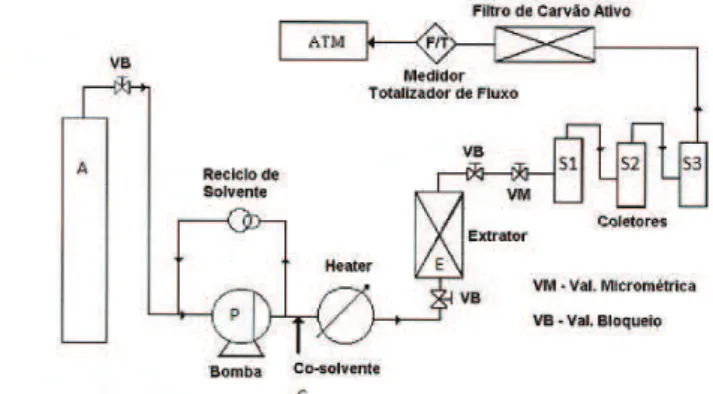
Leaves of Z. tingoassuiba were separated according to the degree of maturation in young and adult, as evidenced by morphological differences. After drying and grinding, the two groups of leaves were submitted to supercritical CO2 at pilot plant SFE 500
SEPAREX. This unit consists of a cylinder containing
CO2 (a), a pump (P) for the transport of CO2, an external module for the application of co-solvent (C),
a Extractor cylinder (E) of 400 mL and three tabs (S1,
S2, S3) of 16 mL each (Figure 1).
NMR analyses were performed on a Varian spectrometer (Gemini 300 model), operating at 300 to 75 MHz for 1H and 13C with reference to tetramethylsilane as internal standard. GC analyses were performed on
a gas chromatograph (GC) Perkin Elmer coupled to a
mass spectrometer (Model Clarus 500) equipped with a capillary column (30 m x 0.25 mm x 0.1 µm). The injector temperature was maintained at 250 °C. The sample (1.0 µL) dissolved to 2 ppm in CH2Cl2, was injected using helium as carrier gas at the linear velocity of 1 mL.min-1. The oven temperature was initially kept at 60 °C for 5 min, then at 7 °C. min-1 was raised up to 210 °C and remained constant for 34.5 min.
Results and Discussion
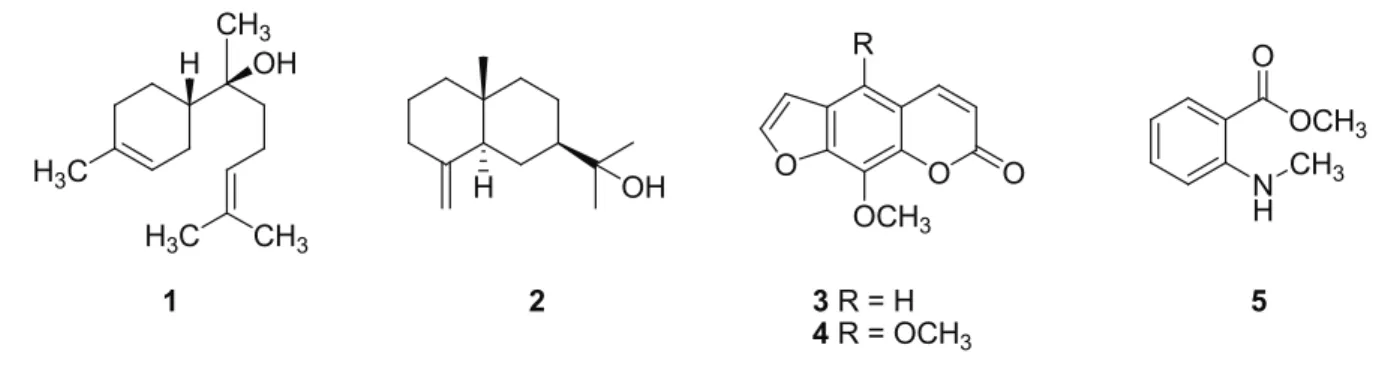
The extracts initially analyzed by (NMR) 1H (300 MHz) and 13C (75 MHz), showed differences in chemical compositions of extracts obtained from young leaves and those from mature leaves. The interpretation of NMR spectra of the samples and the comparison with the spectra of substances isolated by conventional phytochemical techniques (Silva, 2006) and literature data (Stevenson, 2003; Schwartz, 1979) allowed characterizing mixtures derived samples, as sesquiterpenes (1 and 2), furanocoumarins (3 and 4) and a protoalkaloid (5) extracted from young and adults leaves of Z. tingoassuiba by SFE.
The sesquiterpenes α-bisabolol (1) and
β-eudesmol (2) were identified as major components of young leaves extracts, whereas samples from mature leaves contained a mixture of furocoumarins xanthotoxin (3), isopimpinelin (4) and α-bisabolol (1), as well.
The second stage of research consisted of analysis of samples by gas chromatography coupled to mass spectrometry (GC/MS) and comparison of Kovat’s retention indexes with those described by Adams (1995), confirming the results obtained by NMR (Figure 2). The high sensitivity of this method allowed identifying substances that were not detected
by NMR analysis, such as the sesquiterpene β-eudesmol
(2) and protoalkaloid methyl N-methylanthranilate (5), both found in extracts of mature leaves. Compounds 1, 3, 4 and 5 were previously isolated in fruit and stems of Z. tingoassuiba (Silva, 2008). Spectroscopic data of the substances identified:
α-bisabolol (1): 13C RMN (CDCl3, 75 MHz), δ ppm: 43.3 (C1), 26.1 (C2), 120.8 (C3), 133.8 (C4), 31.1 (C5), 24.0 (C6), 74.4 (C7), 39.3 (C8), 22.3 (C9), 124.6 (C10), 131.7 (C11), 25.7 (C12), 17.6 (C13), 23.9 (C14), 23.3 (C15). GC-MS. m/z (%): 204 (10), 161 (8), 121 (23), 119 (48), 109 (78), 95 (39), 93 (62), 79 (30), 69 (100); KI: 1686.
β-eudesmol (2): due to low concentrations in mixtures this Five samples were extracted from 30 g for each
group of leaves, keeping the conditions of pressure and temperature for 45 min for each extraction. The
extractor vessel (E) maintained at 10 x 107 pascal and 313 K, while the tabs had pressure in decreasing order of 1.38 x 10⁷, 0.69 x 10⁷ and 0.55 x 10⁷ pascal, occurring variation only on the used co-solvent. On the first condition no co-solvent was used, whereas in the second and third, 5% methanol and isopropanol, respectively, were added to CO2.
Figure 1. Schematic of pilot plant for supercritical luid extraction SFE 500 SEPAREX containing: CO2 cylinder (A), a
pump (P) for the transport of CO2, an external module for
Extraction with supercritical luid and comparison of chemical composition from adults and young leaves of Zanthoxylum tingoassuiba
Lourenço L.B. Santana et al.
Rev. Bras. Farmacogn. Braz. J. Pharmacogn. 21(3): May./Jun. 2011 566
component was only identiied by GC-MS technique. m/z
(%): 222 (2), 204 (5), 189 (8), 164 (12), 149 (30), 135 (9), 122 (10), 108 (15), 93 (21), 81 (27), 67 (20), 59 (100), 41 (28). KI: 1651.
xanthotoxin (3): 1H RMN (CDCl
3, 300 MHz): δ 6.30 (1H, d, J=9.6 Hz, H-3), 7.78 (1H, d, J=9.6 Hz, H-4), 7.36 (1H, s, H-5), 7.63 (1H, d, J=2.7Hz, H-2’), 6.82 (1H, d, J=2.1 Hz, H-3’), 4.31 (3H, s, 8- OCH3); 13C RMN (CDCl
3, 75 MHz):
δ 160.3 (C2), 147.7 (C7), 145.0 (C2’), 144.3 (C4), 139.3
(C8a), 132.5 (C8), 126.0 (C6), 116.3 (C4a), 114.4(C3), 112.8 (C5), 106.6 (C3´), 61.5 (8-OCH3); GC-MS. m/z (%): 216 (100), 201 (29), 188 (11), 173 (69), 145 (24), 143 (1), 89 (51), 63 (39), 44 (25).
isopimpinelin (4): 1H RMN (CDCl
3, 300 MHz): δ 6.38(1H, d, J=9.6 Hz, H-3), 8.14 (1H, d, J=9.9 Hz, H-4), 4.18 (3H, s, 5-OCH3), 7.70 (1H, d, J=2.1Hz, H-2’), 7.01 (1H, d, J=2.4 Hz, H-3’), 4.17 (3H, s, 8- OCH3); 13C RMN (CDCl
3,
75 MHz): δ 160.3 (C2), 147.4 (C7), 145.0 (C-2’), 144.3
(C4), 139.3 (C8a), 132.5 (C-8), 126.0 (C6), 116.3 (C4a), 114.4 (C3), 146.5 (C5), 106.6 (C3´), 61.1 (8-OCH3), 60.6 (5-OCH3); GC-MS m/z (%): 246 (81), 231 (100), 188 (31), 175(30%), 160 (25) 147 (18), 132 (10), 104 (17).
methyl N-methylanthranilate (5): due to its low concentration in the mixture was only possible to identify it using the technique of GC-MS. m/z (%): 165 (94), 150 (1) 134 (16), 132 (51), 105 (100), 104 (98), 77 (81); KI: 1406.
H3C
H3C CH3 CH3
OH H
1
H OH O O
R
OCH3 O
3 R = H
4 R = OCH3
N H
CH3 OCH3 O
5 2
Extraction with supercritical luid and comparison of chemical composition from adults and young leaves of Zanthoxylum tingoassuiba
Lourenço L.B. Santana et al.
Rev. Bras. Farmacogn. Braz. J. Pharmacogn. 21(3): May./Jun. 2011 567
This study found a signiicant difference in
chemical composition from those obtained from young and mature leaves of Zanthoxylum tingoassuiba by
supercritical luid extraction, demonstrating once again
the importance of the collection period and characteristics of the plant for medical use. Besides, it was possible to determine parameters for the selective extraction of
substances such as α-bisabolol and furanocoumarins of
plant using supercritical CO2.
Acknowledgements
The authors thank to FAPESB for scholarships and inancial support, to Prof. Dr. Janice Izabel Druzian
and Ms. Jaff Ribeiro, from Department of Food, Faculty of Pharmacy, UFBA and Ms. Iura Alves for support in developing part of the experimental work.
References
Adams RP 1995. Identiication of essencial oil components by
gas chromatography/mass spectrometry. Carol Stream, Illinois: Allured Publishing Corporation.
Brevoort P 1998. The booming US botanical market: a new overview. HerbalGram 44: 33-46.
Harvey AL 2008. Natural products in drug discovery. Drug Discov Today 13: 894-901.
Lanças FM 2002. Extração com luido supercrítico: quo vadis?
Revista Analytica 2: 30-37.
Lang Q, Wai CM 2001. Supercritical luid extraction in herbal
and natural product studies - a practical review. Talanta 53: 771-782.
Li JW-H, Vederas JC 2009. Drug discovery and natural
products: End of an era or an endless frontier? Science 325: 161-165.
Peng J, Fan G, Chai Y, Wu Y 2006. Eficient new method for extraction and isolation of three lavonoids from
Patrinia villosa Juss. by supercritical luid extraction
and high-speed counter-current chromatography. J Chromatogr A 1102: 44-50.
Phillipson JD 2001. Phytochemistry and medicinal plants.
Phytochemistry 56: 237-243.
Reis MS, Mariot A, Steenbock W 2007. In Simões CMO,
Schenkel EP, Gosmann G, Mello JCP, Mentz LA,
Petrovick PR (org.). Farmacognosia: da planta ao medicamento. Porto Alegre: Editora da UFRGS.
p.45-74.
Santana LLB, Silva CV, Velozo ES 2006a. Estudo itoquímico
das folhas de Zanthoxylum tingoassuiba St Hil. XIX Simpósio de Plantas Medicinais do Brasil. Salvador, Brasil.
Santana LLB, Cardoso LA, Druzian JI, Souza VF, Costa TAC,
Nóbrega DA, Hohlemwerger SV, Velozo ES 2006b.
Selectivity in the extraction of 2-quinolones alkaloids with supercritical CO2. Braz J Chem Eng 23: 525-553.
Schwartz MA, Swanson GC 1979. Stereospeciic syntheses of the diastereomeric(+-)-α-bisabolol. A caveat on the assignment of stereochemistry to natural α-bisabolol. J Org Chem 44: 6.
Silva CV 2006. Alcalóides benzofenantridínicos e outros
metabólitos do caule e frutos de Zanthoxylum tingoassuiba A. St.-Hil. Salvador, 123p. Dissertação
de Mestrado, Programa de Pós-graduação em Química,
Universidade Federal da Bahia.
Silva CV, Detoni CB, Velozo ES, Guedes MLS 2008. Alcalóides
e outros metabólitos do caule e frutos de Zanthoxylum tingoassuiba A. St.-Hil. Quim Nova 31: 2052-2055. Stevenson PC, Simmonds MSJ, Yule MA, Veitch NC, Kite
GC, Irwin D, Legg M 2003. Insect antifeedant furanocoumarines from Tetradium danielli.
Phytochemistry 63: 41-46. *Correspondence
Cinara V. Silva
Laboratório de Pesquisa em Matéria Médica, Departamento do Medicamento, Faculdade de Farmácia da Universidade Federal da Bahia
Rua Barão de Jeremoabo s/n, Campus Universitário de Ondina,