ABSTRACT
Objective
Tea has been considered a healthy alternative to other industrialized beverages. The objective of this study was to assess the erosive potential of teas commercially available in Brazil by pH and titratable acidity measures.
Methods
Eighteen teas available in Brazilian market were selected for this study (read to drink and brewed tea), and a brand of yerba mate (Ilex paraguariensis). Each product was analyzed for pH and titratable acidity. For comparison between different kinds of teas, the Student t test was used.
Results
The mean pH values for ready to drink teas ranged between 2.89 and 4.03, while for the brewed teas and yerba mate the values ranged between 6.75 and 7.89. The difference between the two groups was significant (p < 0.05). Regarding titratable acidity, the ready to drink teas showed mean values ranging between 3.77 ml and 12.68 ml. Brewed teas (including yerba mate) were not tested for titratable acidity because their pH values were greater than 7.0.
Conclusion
Among the teas commercially available, ready to drink teas have lower pH values and higher titratable acidity compared to other teas. It suggests that they have an erosive potential.
Indexing terms: Oral health. Tea. Tooth erosion.
RESUMO
Objetivo
Avaliar o potencial erosivo de chás comercialmente disponíveis no mercado brasileiro através da avaliação dos valores de pH e de titrabilidade ácida.
Métodos
Foram selecionados dezoito chás disponíveis no mercado brasileiro (prontos para beber e para preparo em infusão), além de uma marca de erva-mate (Ilex paraguariensis). Cada produto foi avaliado quanto ao seu pH e titrabilidade ácida. A comparação entre os tipos de chá foi realizado pelo teste t de Student.
Resultados
Os valores médios de pH dos chás prontos para beber variaram entre 2,88 e 4,03 enquanto que para os chás para preparo em infusão e erva mate os valores variaram entre 6,75 e 7,89. A diferença entre os dois grupos foi significativa (p < 0,05). Em relação à titrabilidade ácida os chás prontos para beber apresentaram valores médios variando entre 3,77 ml e 12,68 ml. Os chás para preparo em infusão (incluindo a erva mate) não foram avaliados quanto a titrabilidade ácida por terem apresentado valores de pH > 7,0.
Conclusão
Dentre os chás comercialmente disponíveis, os chás prontos para beber apresentam os menores valores de pH e os maiores valores para titrabilidade ácida comparados aos demais chás. Estes achados sugerem um potencial erosivo para este tipo de chá.
Termos de indexação: Saúde bucal. Chá. Erosão dentária.
1 Universidade Federal do Rio Grande do Sul, Faculdade de Odontologia, Departamento de Odontologia Preventiva e Social. Rua Ramiro Barcelos, 2492, Rio
Branco, 90035-003, Porto Alegre, RS, Brasil. Correspondence to: LN HASHIZUME. E-mail: <[email protected]>.
Evaluation of the pH and titratable acidity of teas commercially
available in Brazilian market
Avaliação do pH e titrabilidade ácida de chás comercialmente disponíveis no mercado brasileiro
Letícia Bello Flores LUNKES1
INTRODUCTION
In recent years, significant changes happened in
the eating behavior of the Brazilian population, mainly in
relation to replacement of homemade and natural food by
industrialized food
1-2. Along with that has been also a wide
diversity on the beverages consumption behavior as well
on the offer of ready to drink beverages in the Brazilian
market
3-4.
Following this change in the eating behavior,
an increase on prevalence of tooth erosion cases among
children and teenagers
5has been observed. The tooth
erosion is characterized by a chemical wear of dental
mineralized tissues without bacterial involvement
6-7.
Previous studies have shown a significant relationship
between dental erosion and dietary behavior
8-9. The
majority have associated this problem with beverages
present in the modern diet, for example wine
10-11, sport
beverages
12-13, soft drinks
14-16and juices
13-14,17.
Teas are among the industrialized beverages
commercially available on the Brazilian market. Tea
consumption is associated with great benefits to health as
it has been shown to have antioxidant properties
18-19. Many
people consume tea as replacement to other industrialized
beverages that are considered harmful, due to the belief
that tea is a healthier option. However, the literature
is scarce in relation to studies that evaluate the erosive
potential of teas commercially available in the Brazilian
market through assessment of pH values and titratable
acidity.
METHODS
Eighteen commercial brands of teas available in the
city of Porto Alegre, RS, Brazil were analyzed in the present
study. Of these, 12 were in the ready to drink form and 6 in
the teabag form. Furthermore, a commercial brand of yerba
mate (
Ilex paraguariensis
) that is widely used as
chimarrão
by the local population was also evaluated. Three units of
each tea or yerba mate were bought in different stores in
the metropolitan region of Porto Alegre, RS. Charts 1 and
2 show the composition of tested teas.
Tea and yerba mate samples preparation
Samples of ready to drink tea (canned or bottled)
were collected directly from the product package
immediately after its opening. Brewed teas were prepared
using a standard method by which the tea bag was
allowed to infuse in 200 ml of distilled water at 100°C
for 4 minutes. The yerba mate was prepared by putting it
inside a
cuia
(cup for the preparation and consumption of
chimarrão
) with a volume of 2/3 of the cup. The rest (1/3
of the
cuia
) was filled with distilled water at 100°C. After
the water was added, the prepared yerba mate brew was
removed from the
cuia
and filtered using a filter paper.
Evaluation of beverages' pH values
The measurement of the beverages’ pH values
were made at 25°C through a pH electrode connected to
an ion analyzer (DM-23, Digimed, São Paulo, SP, Brazil).
Previously to the measurements the equipment was
calibrated with standard solutions of pH 4.01 and 6.86.
The readings were performed in triplicate for each sample.
Titratable acidity of beverages
In the sequence of pH measurements, the samples
which showed a pH value below 7.0 were submitted to
titratable acidity analysis. Increments of 0.5 ml of 0.1M
NaOH solution were added, in a tea volume of 25 ml, until
pH 7 was reached. The volume of 0.1M NaOH solution
(in milliliters) necessary to achieve a neutral solution was
recorded and it corresponded to titratable acidity of each
beverage
20. The procedure was also conducted in triplicate
for each sample.
Statistic analysis
Chart 1. Composition of the ready to drink teas tested in this study, Porto Alegre (RS), 2011.
Tea’s commercial brand (manufacturer) Composition
Black Tea zero lemon flavor(Matte Leão, Coca Cola® Brasil, Rio de Janeiro, Brazil)
Water, sugar, black tea extract, acidulant citric and phosphoric acid, synthetic aroma identical to natural, preservatives sodium benzoate and potassium sorbate, artificial sweetener sodium cyclamate (45 mgs) and sodium saccharin (6,5 mgs) per 100 ml, sequestrant sodium hexametaphosphate and dimethylpolysiloxane antifoam
Black tea peach flavor (Nestea, Nestlé, São Paulo, Brazil)
Water, sugar, black tea extract, acidulant citric and phosphoric acid, sequestrant sodium hexametaphosphate, preservatives sodium benzoate and potassium sorbate, flavoring, caramel color and dimethylpolysiloxane antifoam
Black tea peach flavor (Lipton®, Ambev, Jaguariúna, Brazil) Water, sugar, acidulant citric acid INS 330, black tea extract, concentrated peach juice, flavoring (aroma identical to natural peach), antioxidant ascorbic acid INS 300
Black tea zero peach flavor (Matte Leão, Coca Cola® Brasil, Rio de Janeiro, Brazil)
Water, sugar, black tea extract, acidulant citric and phosphoric acid, synthetic aroma identical to natural, preservatives sodium benzoate and potassium sorbate, artificial sweetener sodium cyclamate (45 mgs) and sodium saccharin (6,5 mgs) per 100 ml, sequestrant sodium hexametaphosphate and dimethylpolysiloxane antifoam
Black tea ligth lemon flavor (Lipton®, Ambev, Jaguariúna, Brazil)
Water, acidulant malic acid INS 296, acidulant citric acid INS 330, black tea extract, concentrated lemon juice, flavoring (aroma identical to natural peach), acidity regulator: sodium citrate INS 331 iii, antioxidant ascorbic acid INS 300, artificial sweetener: aspartame INS 951 (10 mgs/100 ml) and acesulfame K INS 950 (8 mgs/100 ml) and sodium cyclamate INS 952 (22 mgs/100 ml)
Black tea lemon flavor (Lipton®, Ambev, Jaguariúna, Brazil) Water, sugar, acidulant citric acid INS 330, black tea extract, concentrated lemon juice, flavoring (aroma identical to natural peach), acidity regulator: sodium citrate INS 331 iii, antioxidant ascorbic acid INS 330
Black tea lemon flavor (Matte Leão, Coca Cola® Brasil, Rio de Janeiro, Brazil)
Water, sugar, black tea extract, acidulant citric and phosphoric acid, flavoring identical to natural, acidity regulator sodium citrate, preservative sodium benzoate and potassium sorbate, sequestrant sodium hexametaphosphate and dimethylpolysiloxane antifoam
Black tea peach flavor (Matte Leão, Coca Cola® Brasil, Rio de Janeiro, Brazil)
Water, sugar, black tea extract, acidulant citric and phosphoric acid, synthetic aroma identical to natural, acidity regulator sodium citrate, preservative sodium benzoate and potassium sorbate, sequestrant sodium hexametaphosphate and dimethylpolysiloxane antifoam
Green tea (Feel Good, Wow Nutrition, São Bernardo do Campo, Brazil)
Water, green tea powder (Camellia sinensis), stabilizing sodium citrate, acidulant citric acid, antioxidant ascorbic acid (vitamin C), aroma identical to lemon natural, concentrated lemon juice and artificial sweetener sodium cyclamate (40 mgs/100 ml), sucralose (6 mgs/100 ml) and sodium saccharin (4 mgs /100 ml)
Black tea lemon flavor (Nestea, Nestlé, São Paulo, Brazil)
Water, sugar, black tea extract, acidulant citric and ascorbic acid, sequestrant sodium hexametaphosphate, preservative sodium benzoate and potassium sorbate, flavoring, caramel color and dimethylpolysiloxane antifoam
Black tea ligth peach flavor (Lipton®, Ambev, Jaguariúna, Brazil)
Water, acidulant malic acid INS 296, black tea extract, concentrated peach juice, flavoring (aroma identical to peach natural), preservative potassium sorbate INS 202, acidity regulator: sodium citrate INS331 iii, antioxidant ascorbic acid INS 300, artificial sweetener: aspartame INS 951 (22 mgs/100 ml) and acesulfame K INS 950 (7,2 mgs/100 ml)
Natural mate tea (Matte Leão, Coca Cola® Brasil, Rio de Janeiro, Brazil) Water, mate extract, sugar, acidulant citric acid, antioxidante ascorbic acid, preservatives sodium benzoate and potassium sorbate
Chart 2. Composition of the brewed teas and yerba mate tested in this study, Porto Alegre, (RS), 2011.
Tea’s commercial brand (manufacturer) Composition
Green tea (Matte Leão, Coca Cola® Brasil, Rio de Janeiro, Brazil) Leaves and stalks of green tea (Camellia sinensis, L. kuntze)
Chamomile (Dr. Oetker Brasil, São Paulo, Brazil) Chamomile (Matricaria recutita), floral chapters
Lemongrass (Prenda, Senador Salgado Filho, Brazil) Leaves of lemongrass (Cymbopogon citratus)
Black tea (Matte Leão, Coca Cola® Brasil, Rio de Janeiro, Brazil) Leaves and stalks of black tea (Camellia sinensis L. kuntze)
Natural mate tea (Matte Leão, Coca Cola® Brasil, Rio de Janeiro, Leaves and stalks of yerba mate toasted (Ilex paraguariensis)
Boldo (Prenda, Senador Salgado Filho, Brazil) Leaves of boldo (Pneumus boldus, Molina)
Table 2. pH values (mean ± standard deviation) of each brewed tea and yerba mate analyzed in this study, Porto Alegre (RS), 2011.
Tea’s commercial brand (manufacturer) pH
Green tea (Matte Leão, Coca Cola® Brasil, Rio de
Janeiro, Brazil) 7.02 ± 0.05
Chamomile (Dr. Oetker Brasil, São Paulo, Brazil) 7.89 ± 0.03
Lemongrass (Prenda, Senador Salgado Filho, Brazil) 7.45 ± 0.09
Black tea (Matte Leão, Coca Cola® Brasil, Rio de
Janeiro, Brazil) 6.75 ± 0.11
Natural mate tea (Matte Leão, Coca Cola® Brasil,
Rio de Janeiro, Brazil) 7.37 ± 0.01
Boldo (Prenda, Senador Salgado Filho, Brazil) 7.29 ± 0.08
Yerba mate (Seiva Pura®, Ijuí, Brazil) 7.10 ± 0.01
When comparing the type of tea, ready to drink
teas showed a mean pH values significantly lower than
brewed teas and yerba mate (p < 0.05).
DISCUSSION
Erosion lesions on enamel surface happen due
to demineralization caused by subsaturated solutions in
relation to hydroxyapatite and fluorapatite considering that
the dissolution kinetic is associated to reactions controlled
by the diffusivity degree of acids in solution
21. One of the
most important extrinsic factors in dental erosion is the
high consumption of acidic beverages and foods. The
consumed amount and the frequency of consumption of
products containing acids have increased due to changes
in life style
22.
All brewed teas and yerba mate presented pH
values close to neutrality, showing no erosive potential to
teeth. This finding can be explained through the Stephan's
report
23, which did not observe loss of superficial hardness
of teeth when they were in contact with teas without an
acid component. In the present study, the water used to
prepare the brewed teas and yerba mate showed a pH =
7.0. After beverage preparation, little variation in pH value
was observed. This finding indicates that the water utilized
for the preparation of brewed tea and yerba mate can be
determinant for the final pH of these beverages.
The yerba mate (
Ilex paraguariensis
) is a natural
product widely known and consumed in the southern
region of Brazil, similarly in Paraguay, Uruguay and
Argentina. In the southern region of Brazil it is consumed
by the infusion of leaves, in a way called
chimarrão
,
RESULTS
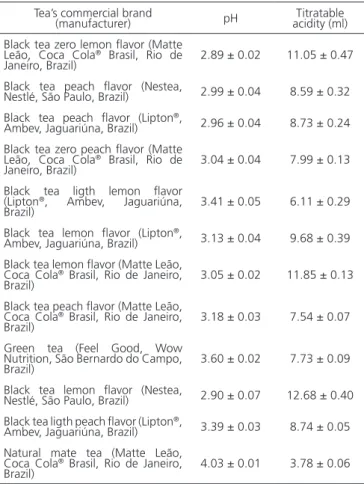
Table 1 shows the results of pH values and titratable
acidity of ready to drink teas. Mean values of pH of ready
to drink teas (canned and bottled) varied between 2.89
and 4.03. The smallest pH value (2.89) was found for a
commercial brand of canned black tea with a lemon flavor.
In regard to titratable acidity, ready to drink teas showed
mean values varying between 3.77 ml and 12.68 ml. The
tea which required the highest volume of NaOH solution
to neutralize its pH was also a commercial brand of canned
black tea with a lemon flavor.
Table 1. pH and titratable acidity values (mean ± standard deviation) of each ready to drink tea analyzed in this study, Porto Alegre (RS), 2011.
Tea’s commercial brand
(manufacturer) pH acidity (ml)Titratable
Black tea zero lemon flavor (Matte Leão, Coca Cola® Brasil, Rio de
Janeiro, Brazil) 2.89 ± 0.02 11.05 ± 0.47
Black tea peach flavor (Nestea,
Nestlé, São Paulo, Brazil) 2.99 ± 0.04 8.59 ± 0.32
Black tea peach flavor (Lipton®,
Ambev, Jaguariúna, Brazil) 2.96 ± 0.04 8.73 ± 0.24
Black tea zero peach flavor (Matte Leão, Coca Cola® Brasil, Rio de
Janeiro, Brazil) 3.04 ± 0.04 7.99 ± 0.13
Black tea ligth lemon flavor (Lipton®, Ambev, Jaguariúna,
Brazil) 3.41 ± 0.05 6.11 ± 0.29
Black tea lemon flavor (Lipton®,
Ambev, Jaguariúna, Brazil) 3.13 ± 0.04 9.68 ± 0.39
Black tea lemon flavor (Matte Leão, Coca Cola® Brasil, Rio de Janeiro,
Brazil) 3.05 ± 0.02 11.85 ± 0.13
Black tea peach flavor (Matte Leão, Coca Cola® Brasil, Rio de Janeiro,
Brazil) 3.18 ± 0.03 7.54 ± 0.07
Green tea (Feel Good, Wow Nutrition, São Bernardo do Campo,
Brazil) 3.60 ± 0.02 7.73 ± 0.09
Black tea lemon flavor (Nestea,
Nestlé, São Paulo, Brazil) 2.90 ± 0.07 12.68 ± 0.40
Black tea ligth peach flavor (Lipton®,
Ambev, Jaguariúna, Brazil) 3.39 ± 0.03 8.74 ± 0.05
Natural mate tea (Matte Leão, Coca Cola® Brasil, Rio de Janeiro,
Brazil) 4.03 ± 0.01 3.78 ± 0.06
characterized as one of the region’s main cultural habits
24which justify its inclusion in the study.
In relation to ready to drink teas, it was verified,
in the present study, that they showed lower pH values,
and higher values of titratable acidity compared to brewed
teas and yerba mate. Ready to drink tea is submitted to
an industrialization process in which other components are
added to the tea. Among them there are acidulants. The
addition of acidulants to the product causes a significant
reduction of the beverage pH value. All pH values observed
for ready to drink teas tested in this study were below 4.03.
When evaluating the erosive potential of a
beverage there are other variables which can be considered
such as calcium, fluoride and phosphorus concentrations
and the type and concentration of acids present in the
beverage. However, the major factor when analyzing the
action of erosive beverages remains the pH value
25-26.
The titratable acidity measurement has also been
used to assess beverages’ erosive potential. This method
considers the type and concentration of the present acid.
The majority of erosive beverages have weak acids and the
concentration of these acids determines not only the pH
value but also the buffering properties. Many authors have
found a strong association between titratable acidity and
erosive potential of beverages
27-29. All ready to drink teas
evaluated in this study showed the high titratable acidity
values.
Analyzing the composition of ready to drink teas
tested in the present study, it was found that most of them
contained citric acid as the acidulant, be it associated or not
to phosphoric acid. Citric acid has a high erosive potencial
due to its acidic nature and chelating properties
30-31. This
finding can justify the reduced pH values and high titratable
acidity values found in ready to drink teas.
In the present study the green tea was analyzed
in both forms ready to drink and brewed. The literature
has reported many different properties of this tea against
dental caries due to presence of their catechins
32-33.
Furthermore, green tea has components which can inhibit
matrix metalloproteinase that are present on saliva and on
mineralized dental tissues
34decreasing the dental erosion/
abrasion
in situ
35.
To determine the erosive potential of a beverage it
is necessary to consider aspects other then pH and titratable
acidity values, although results from these two factors can
be used as indicators for this issue. Others studies are being
conducting to evaluate the erosive potential of these teas
on mineralized dental tissues, considering other variables
involved.
CONCLUSION
The present study demonstrated that, among teas
commercially available on the Brazilian market, ready to
drink teas show lowest pH values and highest titratable
acidity values compared to brewed teas tested. These
findings suggest an erosive potential for this kind of tea.
Collaborators
LBL LUNKES was responsible for performance
of the experimental phase, data analysis and writing
the manuscript. LN HASHIZUME was responsible for
conception the research project, planning, analysis and
results interpretation and writing the manuscript.
REFERENCES
1. Kac G, Sichieri R, Gigante DP. Epidemiologia nutricional. Rio de Janeiro: Fiocruz; 2007.
2. Instituto Brasileiro de Geografia e Estatística - IBGE. Pesquisa de orçamentos familiares 2002-2003: antropometria e análise do estado nutricional de crianças e adolescentes no Brasil. Rio de Janeiro: IBGE; 2006.
3. Brown CJ. The erosive potential of flavoured sparkling water drink. Int J Paediatr Dent. 2007;17(2):86-91. doi: 10.1111/j.1365-263X.2011.01206.x.
4. Brasil. Ministério da Saúde. Notícias [citado 2011 Dez. 20]. Disponível em: <http://portal.saude.gov.br/portal/aplicacoes/ noticias/default.cfm?pg=dsp>.
5. Kreulen C, van ‘t Spijker A, Rodriguez J, Bronkhorst E, Creugers N, Bartlett D. Systematic review of the prevalence of tooth wear in children and adolescents. Caries Res. 2010;44(2):151-9. doi: 10.1159/000308567.
6. Eccles JD. Dental erosion of nonindustrial origin. A clinical survey and classification. J Prosthet Dent. 1979;42(6):649-53.
7. Zero DT. Etiology of dental erosion--extrinsic factors. Eur J Oral Sci. 1996;104(2):162-77.
9. Bartlett DW, Fares J, Shirodaria S, Chiu K, Ahmad N, Sherriff M. The association of tooth wear, diet and dietary habits in adults aged 18-30 years old. J Dent. 2011;39(12):811-6. doi: 10.1016/j.jdent.2011.08.014.
10. Mulic A, Tveit AB, Hove LH, Skaare AB. Dental erosive wear among Norwegian wine tasters. Acta Odontol Scand. 2011;69(1):21-6. doi: 10.3109/00016357.2010.517554.
11. Meurman JH, Vesterinen M. Wine, alcohol, and oral health, with special emphasis on dental erosion. Quintessence Int. 2000;31(10):729-33.
12. Buratto EM, Andrade L, Rath IBS, Tames DR. Avaliação do potencial erosivo aos tecidos duros dentais de bebidas esportivas nacionais. Rev ABO Nac. 2002;10(2):109-12.
13. Rytomaa I, Meurman JH, Koskinen J, Laakso T, Gharazi L, Turunen R. In vitro erosion of bovine enamel caused by acidic drinks and other foodstuffs. Scand J Dent Res. 1988;96(4):324-33. doi: 10.1111/j.1600-0722.1988.tb01563.x.
14. Attin T, Weiss K, Becker K, Buchalla W, Wiegand A. Impact of modified acidic soft drinks on enamel erosion. Oral Dis. 2005;11(1):7-12. doi: 10.1111/j.1601-0825.2004.01056.x.
15. Jensdottir T, Arnadottir IB, Thorsdottir I, Bardow A, Gudmundsson K, Theodors A, et al. Relationship between dental erosion, soft drink consumption, and gastroesophageal reflux among Icelanders. Clin Oral Investig. 2004;8(2):91-6. doi: 10.1007/ s00784-003-0252-1.
16. Murakami C, Oliveira LB, Sheiham A, Nahás Pires Corrêa MS, Haddad AE, Bönecker M. Risk indicators for erosive tooth wear in Brazilian preschool children. Caries Res. 2011;45(2):121-9. doi: 10.1159/000324807.
17. Okunseri C, Okunseri E, Gonzalez C, Visotcky A, Szabo A. Erosive tooth wear and consumption of beverages among children in the United States. Caries Res. 2011;45(2):130-5. doi: 10.1159/000324109.
18. Del Rio D, Calani L, Scazzina F, Jechiu L, Cordero C, Brighenti F. Bioavailabity of catechins from ready- to- drink-tea. Nutrition. 2010;26(5):528-33. doi: 10.1016/j.nut.2009.06.013.
19. Bahorun T, Luximon-Ramma A, Neergheen-Bhujun VS, Gunness TK, Googoolye K, Auger C, Crozier A, et al. The effect of black tea on risk factors of cardiovascular disease in a normal population. Prev Med. 2012;54(Suppl):S98-102. doi: 10.1016/j. ypmed.2011.12.009.
20. Díaz ED, Hernádez AC, Martín JD, Romero CD. Comparative study of methods for determination of titrable acidity in wine. J Food Compost Anal. 2003;16(5):555-62. doi: 10.1016/S0889-1575(03)00032-2.
21. Larsen MJ. Dissolution of enamel. Scand J Dent Res. 1973;81(7):518-22.
22. Packer CD. Cola-induced hypokalaemia: a super-sized problem. Int J Clin Pract. 2009;63(6):833-5. doi: 10.1111/j.1742-1241.2009.02066.x.
23. Stephan RM. Effects of different types of human foods on dental health in experimental animals. J Dent Res. 1996;45(5):1551-61. doi: 10.1177/00220345660450054701.
24. Gonzatti CS, Mussoi TD, Fleck J. Efeito do consumo de chimarrão na diurese de mulheres jovens. Alim Nutr. 2010;21(3):385-90.
25. Barbour ME, Lussi A, Shellis RP. Screening and Prediction of Erosive Potential. Caries Res. 2011;45(1):24-32. doi: 10.1159/000325917.
26. Lussi A, Schlueter N, Rakhmatullina E, Ganss C. Dental erosion: an overview with emphasis on chemical and histopathological aspects. Caries Res. 2011;45(1):2-12. doi: 10.1159/000325915.
27. Jensdottir T, Bardow A, Holbrook P. Properties and modification of soft drinks in relation to their erosive potential in vitro. J Dent. 2005;33(7):569-75. doi: 10.1016/j.jdent.2004.12.002.
28. Lussi A, Jaeggi T, Jaeggi-Schärer S. Prediction of the erosive potential of some beverages. Caries Res. 1995; 29:349-354.
29. Barbour ME, Shellis RP. An investigation usind atomic force microscopy nanoindetation of dental enamel demineralization as a function of undissociated acid concentration and differential buffer capacity. Phys Med Biol. 2007;52(4):899-910. doi:10.1088/0031-9155/52/4/003.
30. West NX, Hughes JA, Addy M. Effect of pH on the erosion of dentine and enamel by dietary acids in vitro. J Oral Rehabil. 2001;28(9):860-4. doi: 10.1111/j.1365-2842.2001.00778.x.
31. Elsbury WB. Hydrogen-ion concentration and acid erosion of the teeth. Br Dent J. 1952;93:177-9.
32. Taylor PW, Hamilton-Miller JMT, Stapleton PD. Antimicrobial properties of green tea catechins. Food Sci Technol Bull. 2005; 2:71-81.
33. Suyama E, Tamura T, Ozawa T, Suzuki A, Iijima Y, Saito T. Remineralization and acid resistance of enamel lesions after chewing gum containing fluoride extracted from green tea. Aust Dent J. 2011;56(4):394-400. doi: 10.1111/j.1834-7819.2011.01359.x.
34. Kato MT, Magalhaes AC, Rios D, Attin T, Buzalaf MAR. Protective effect of green tea on dentin erosion and abrasion. J Appl Oral Sci. 2009;17(6):560-4. doi: 10.1590/S1678-77572009000600004.
35. Magalhães AC, Wiegand A, Rios D, Hannas A, Attin T, Buzalaf MA. Chlorhexidine and green tea extract reduce dentin erosion and abrasion in situ. J Dent. 2009;37(12):994-8. doi: 10.1016/j. jdent.2009.08.007.