Validation of the 36-item version of the WHO
Disability Assessment Schedule 2.0 (WHODAS
2.0) for assessing women
’
s disability and
functioning associated with maternal morbidity
Validação da versão de 36 itens do
WHO Disability
Assessment Schedule 2.0
(WHODAS 2.0) para a
avaliação de incapacidade e funcionalidade da
mulher associada à morbidade materna
Carla Silveira
1Mary Angela Parpinelli
1Rodolfo Carvalho Pacagnella
1Carla Betina Andreucci
1,2Carina Robles Angelini
1Elton Carlos Ferreira
1José Guilherme Cecatti
1and the COMMAG study group
1Department of Medicine, Obstetrics and Gynecology, Faculdade de Ciências Médicas, Universidade Estadual de Campinas, Campinas, Brazil 2Universidade Federal de São Carlos (UFSCAR), São Carlos, SP, Brazil
Rev Bras Ginecol Obstet 2017;39:44–52.
Address for correspondenceJose Guilherme Cecatti, Departmento de Obstetrícia e Ginecologia, Universidade Estadual de Campinas, Rua Alexander Fleming, 101, 13083-891 Campinas, SP, Brazil
(e-mail: [email protected]).
Keywords
►
International
Classi
fi
cation of
Functioning
►
Disability and Health
(ICF)
►
pregnancy
complications
►
validation studies
►
maternal and child
health
Abstract
Objective
To validate the translation and adaptation to Brazilian Portuguese of
36 items from the World Health Organizaton Disability Assessment Schedule 2.0
(WHODAS 2.0), regarding their content and structure (construct), in a female
popula-tion after pregnancy.
Methods
This is a validation of an instrument for the evaluation of disability and
functioning and an assessment of its psychometric properties, performed in a tertiary
maternity and a referral center specialized in high-risk pregnancies in Brazil. A sample of
638 women in different postpartum periods who had either a normal or a complicated
pregnancy was included. The structure was evaluated by exploratory factor analysis
(EFA) and con
fi
rmatory factor analysis (CFA), while the content and relationships among
the domains were assessed through Pearson
’
s correlation coef
fi
cient. The
sociodemo-graphic characteristics were identi
fi
ed, and the mean scores with their standard
deviations for the 36 questions of the WHODAS 2.0 were calculated. The internal
consistency was evaluated byCronbach
’
s
α
.
Results
Cronbach
’
s
α
was higher than 0.79 for both sets of questons of the
question-naire. The EFA and CFA for the main 32 questions exhibited a total variance of 54.7%
(Kaiser-Meyer-Olkin [KMO] measure of sampling adequacy
¼
0.934;
p
<
0.001) and
53.47% (KMO
¼
0.934;
p
<
0.001) respectively. There was a signi
fi
cant correlation
received
September 25, 2016 accepted
December 7, 2016 published online February 23, 2017
DOI http://dx.doi.org/ 10.1055/s-0037-1598599. ISSN 0100-7203.
Copyright © 2017 by Thieme-Revinter Publicações Ltda, Rio de Janeiro, Brazil Original Article
Introduction
Although both genders face similar challenges, women live
longer in general.1However, specific conditions only
experi-enced by women may cause a negative impact on health, such as those from the reproductive period. Major functional changes occur during pregnancy, childbirth and the postpartum period, and they may either lead to maternal death or to different levels of morbidity. Then, a consequent reduction in the quality of life and functioning of women is observed, as well as a negative impact on their children and the economical and social burden
for their families.2Each year, 15 to 20 million women develop
morbid conditions related to pregnancy, with a long-term
reduction in functioning.3,4Functioning is the human ability
to perform activities, so individuals may take care of themselves
and interact independently with society.5 Disability is the
restriction or lack of the ability to develop normal functions.5,6
Both are conceived originating from the dynamic interaction
between health conditions and contextual factors.5,7
The interaction between health conditions and contextual factors was already demonstrated, and it showed that there is
a decline in functioning with age that depends on the basal
functioning.8Some important studies also showed a
remark-able decrease in functioning and frequent and more serious disabilities mainly in the elderly, poor people and women
living in low-income countries.9,10
Various methods and instruments based on multidimen-sional conceptual models have been used to measure dis-ability. They seek to evaluate health status and quality of life in the general population or in groups with special needs, addressing health through items related to physical, mental and social aspects. The World Health Organization Disability Assessment Schedule 2.0 (WHODAS 2.0) is an example of such
methods. It considers the profile, functioning and disability of
individuals in different cultures and languages,11 and it
evaluates activity limitations and participation restrictions, regardless of the medical diagnosis, due to its solid theoretical foundations, adequate psychometric properties, applicability
to different groups, in addition to being easy to use.7,11,12
There are two translated and adapted versions of the
WHODAS 2.0 into Portuguese. The first was translated to
among the 6 domains (r
¼
0.571
–
0.876), and a moderate correlation among all
domains (r
¼
0.476
–
0.694).
Conclusion
The version of the WHODAS 2.0 instrument adapted to Brazilian
Portu-guese showed good psychometric properties in this sample, and therefore could be
applied to populations of women regarding their reproductive history.
Resumo
Objetivo
Validar a versão adaptada para o português brasileiro do instrumento World
Health Organizaton Disability Assessment Schedule 2.0 (WHODAS 2.0), em seu
conteúdo e estrutura (construto), em uma população de mulheres após a gravidez.
Métodos
Trata-se de validação de um instrumento para incapacidade e
funcionali-dade, incluindo suas propriedades psicométricas, realizada em uma maternidade de
referência em gestação de alto risco no Brasil. Incluiu uma amostra de 638 mulheres em
diferentes períodos pós-parto que tiveram uma gravidez normal ou com complicações.
A estrutura foi avaliada por análise fatorial exploratória (AFE) e análise fatorial
con
fi
rmatória (AFC), enquanto o conteúdo e as associações entre os domínios foram
avaliados por meio do coe
fi
ciente de correlação de Pearson. Foram identi
fi
cadas
características sociodemográ
fi
cas, e os escores médios do WHODAS 2.0 para as 36
questões foram calculados. A consistência interna foi avaliada pelo método
α
de
Cronbach.
Resultados
O
α
de Cronbach foi maior do que 0,79 para os dois conjuntos de
perguntas do questionário. A AFE e a AFC para as 32 questões apresentaram uma
variância total de 54,7% (medida de adequação da amostra de Kaiser-Meyer-Olkin
[KMO]
¼
0,934;
p
<
0,001) e 53,47% (KMO
¼
0,934;
p
<
0,001), respectivamente.
Houve uma correlação signi
fi
cativa entre os 6 domínios (r
¼
0,571
–
0,876), e moderada
correlação entre todos os domínios (r
¼
0,476
–
0,694).
Conclusão
O instrumento WHODAS 2.0, adaptado para o português do Brasil,
mostrou boas propriedades psicométricas nessa amostra e, portanto, pode ser aplicado
a populações de mulheres com relação à sua história reprodutiva.
Palavras-chave
►
Classi
fi
cação
Internacional de
Funcionalidade
►
Incapacidade e Saúde
(CIF)
►
complicações na
gravidez
Brazilian Portuguese in a female population in the
postpar-tum period,13 and the other was translated to European
Portuguese using a population suffering from
musculoskele-tal disabilities.14Although the psychometric properties of the
original instrument were well established in English, it is necessary to determine such properties for the version in Brazilian Portuguese. Taking into account the concepts of
content and construct validity,15the aim of the current study
is to assess both in the Brazilian Portuguese version of the WHODAS 2.0 in a population of Brazilian women in repro-ductive age who had experienced previous pregnancies with and without severe maternal morbidity to assess the
psycho-metric properties of this instrument for this specific
popula-tion. This is necessary before recommending its routine use for assessing functioning possibly associated with pregnancy and maternal outcome.
Methods
Design and Setting
This is a validation study of the Brazilian Portuguese version of the WHODAS 2.0 among women admitted during preg-nancy or the postpartum period to a tertiary referral mater-nity in the southeast region of Brazil from July 2008 to June 2012. This hospital is specialized in high-risk pregnancies, and has an obstetric intensive care unit (ICU) for cases of severe maternal morbidity.
Participants
Trained interviewers contacted women selected through
the hospital admissions’ database system by telephone,
inviting them to participate in the retrospective cohort study of the multidimensional assessment of severe mater-nal morbidity. If the telephone contact was unsuccessful, an invitation letter was sent, explaining the study and asking the women to contact the interviewers back. Further meth-odological details about the study have already been
pub-lished elsewhere.16,17This validation study used the sample
population of the retrospective cohort involving women who had a severe maternal morbidity episode due either to a WHO potentially life-threatening condition or maternal near miss conditions (both are here considered as having severe maternal morbidity and constituting the exposed group, 315 women, 49.4%), and women whose childbirth had no complications (unexposed group, 323 women,
50.6%).16
A total of 840 women were eligible, and 638 were selected and invited for an interview. The group answered the WHO-DAS 2.0 questionnaire, and 202 women were not enrolled because they were not reached either by phone or letter, or even declined to participate. Two women were excluded from the analysis once they failed to answer one domain of the questionnaire, which was completely answered by 636 women. A total of 334 women did not have a job or were no longer in school, and answered only 32 questions of the instrument. Therefore, only 302 women answered all the 36 questions of the questionnaire. Five more women were ex-cluded from the analysis due to incomplete response of
domain 5 (“life activities”), totalling 297 questionnaires of
the 36-item version completely answered. The women were
predominantly young (20–34 years), in a relationship, had
around 9–11 years of schooling, worked at home and were
primipara.
Instrument–WHODAS 2.0 36-item Version
The 36-item version of the WHODAS 2.0 intends to mea-sure activity function and participation in daily life activ-ities in the 30 days preceding its application. It includes six domains: domain 1 (D1)- cognition (six questions): evalu-ates communication and thinking activities, including
con-centration, memory, problem-solving, learning and
comprehension; domain 2 (D2)- mobility (five questions):
evaluates activities such as standing up, moving around inside the house, going outside the house, and walking a long distance; domain 3 (D3)- self-care (four questions): evaluates hygiene, getting dressed, eating and staying
alone; domain 4 (D4)- relationship with people (five
ques-tions): evaluates the interactions with others and the
difficulties that may be encountered due to adverse health
conditions; domain 5 (D5)- life activities (eight questions):
evaluates the difficulty with daily life activities (household
chores, leisure, work and school); and domain 6 (D6)-participation (eight questions): assesses social dimensions, such as joining in community activities, barriers and obstacles in the world surrounding the woman being interviewed, and other problems, such as maintenance of personal dignity. The answer options for each question
include: no difficulty, little, moderate, severe or extreme
difficulty. The total score ranges from 0 to 100, and a higher
score was indicative of a greater limitation in daily life.11,12
All women were invited to answer the 36 questions, but those who had no job or were no longer in school could only answer 32 questions of this version.
Ethics Aspects and Funding
The local Institutional Review Board approved the study under protocol number 097/2009. All volunteers signed an informed consent form. The study followed the principles of the Declaration of Helsinki, which were reviewed in 2008.
Procedure and Data Management
The data collected in the interview were entered by a research
assistant in the Lime Survey®database, and then transferred
to the Statistical Package for the Social Sciences (SPSS®,
IBM-SPSS, Inc., Chicago, IL, USA) software. For quality control, researchers performed the data cleaning and logical consis-tency of the database, in addition to the revision of each question in all domains of the WHODAS 2.0.
Statistical Analysis
Initially, the mean scores and standard deviations were calculated per domain, for all the women answering the 32 questions, as well as for those answering all the 36 questions
of the questionnaire. The internal consistency was verified
included content validity and construct validity. The factorial structure was examined by exploratory factor analysis (EFA)
and confirmatory factor analysis (CFA).18In the EFA, factorial
analysis was applied according to the Kaiser-Meyer-Olkin (KMO) measure of sampling adequacy, and the method used for extraction was the Varimax method with Kaiser
Normalization.19Pearson
’s correlation coefficient was used to
assess the content and correlations between all of the WHO-DAS 2.0 domains. Values above the cut-off point of 0.7 were
considered as good correlations. Pvalues below 0.05 were
considered statistically significant. The software used was
SPSS®version 20.0.
Results
Reliability of the Whodas 2.0 36-item Brazilian Portuguese Version
►Table 1shows that the reliability analysis by Cronbach’sα demonstrated values higher than 0.79. For both groups (the ones who answered 32 and 36 questions), the highest scores
were found in D5 (“life activities”) and D6 (“participation”).
Validity
The results of the factorial analysis for each domain and question, the factor loading, and the percentage of variance
and self-values are shown in ►Tables 2 and 3. Questions
with factor loading higher than 0.50 were considered
significant and were boldfaced. ►Table 2 shows the EFA
for 32 questions in 6 domains divided into 7 factors, with a
total variance of 54.7% (KMO¼0.934; p<0.001). Some
questions were not related to their own domains, showing an association with other factors. For example, questions
6.2 (“because of environmental barriers”) and 6.3 (“others
affect one’s dignity”) were associated with factor 7, and not
with factor 3, as the remaining questions were grouped in this domain.
The CFA showed a total variance of 53.47% (KMO
¼0.934; p<0.001) and reproduced the results of the
EFA of 32 questions in 6 domains and 7 factors, identifying the same questions with low factor loading and the remaining concentrated in each domain, that is,
interre-lated with only one factor (►Table 3).►Fig. 1, which was
derived from the CFA, illustrates the variations in the correlations between minimum and maximum values in the 6 domains with 32 questions, detailing each domain, and corresponding loading of each question. There were
significant correlations (p<0.001) between each domain
and the 7 factors.
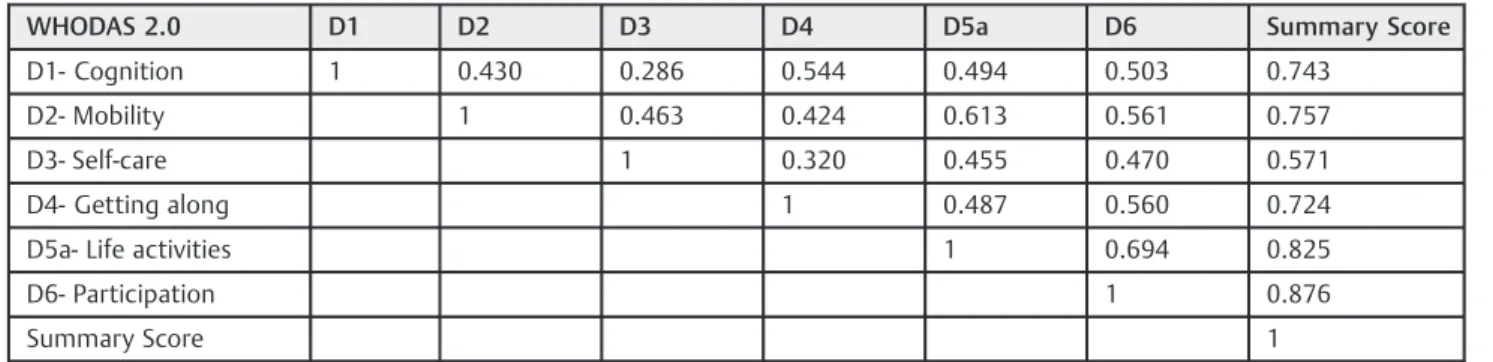
►Table 4 shows a moderate to good correlation
(r¼0.571 for the self-care domain, and r¼0.876 for the
participation domain) in the 6 WHODAS 2.0 domains
against the summary score. Domain 6 (“participation”)
also showed a moderate correlation (r¼0.470 for D3, and
r¼0.694 for D5a), while the remaining specific domains
showed a week correlation for the most part. The highest
correlation indexes occurred between D5a (“life activities”)
and D6 (“participation”), and the lowest occurred among
the questions of D3 (“self-care”).
Table 1 Reliability of the 32 and the 36 questions of the Brazilian Portuguese version of the WHODAS 2.0 questionnaire, using the mean score and SD for each one of its domains
Factor (domains) Mean SD N Cronbach’s Alpha
if item deleted
With 32 questions of the Brazilian Portuguese version of the WHODAS 2.0a
D1- Cognition 21.420 18.214 636 0.826
D2- Mobility 13.760 19.013 636 0.815
D3- Self-care 5.367 12.338 636 0.844
D4- Getting along 14.592 20.240 636 0.823
D5a- Life activities: household 23.354 28.348 636 0.806
D6- Participation 20.336 20.717 636 0.793
With all 36 questions of the Brazilian Portuguese version of the WHODAS 2.0b
D1- Cognition 20.108 17.392 297 0.870
D2- Mobility 10.212 15.725 297 0.863
D3- Self-care 4.602 11.099 297 0.881
D4- Getting along 12.675 18.231 297 0.867
D5a- Life activities: household 20.146 27.072 297 0.850
D5b- Life activities: work and school 15.897 23.646 297 0.845
D6- Participation 17.432 19.784 297 o.844
Abbreviations: SD, standard deviation; WHODAS 2.0, World Health Organizaton Disability Assessment Schedule 2.0. a
Cronbach’s Alpha¼0.929!Number of items¼32 (questions), Cronbach’s Alpha¼0.845!Number of items¼6 (domains). bCronbach
Discussion
The Adequacy of the Brazilian Portuguese Language version of the WHODAS 2.0
We validated the Brazilian Portuguese version of WHODAS 2.0 that had already been translated and cross-culturally
adapted from the original English version in another study.13
When applied to a population of women during the repro-ductive age, it showed appropriate psychometric properties
and better results than the European Portuguese version.14
Internal Consistency and Reliability
We found a slight difference between Cronbach’sα values
when analyzing both groups. Even excluding one question
Table 2 Exploratory Factor Analysis of the Brazilian Portuguese version of the WHODAS 2.0 questionnaire in 32 questions and 7 factors (generalized least squares method)
Factor
Questions and their main topics 1 2 3 4 5 6 7
D11a- Concentration 0.220 0.138 0.195 0.157 0.596 0.113 0.097
D12a- Remembering to do important things 0.167 0.138 0.033 0.077 0.654 0.087 0.039
D13a- Problem-solving 0.140 0.101 0.149 0.199 0.614 0.020 0.167
D14a- Learning a new task 0.121 0.147 0.098 0.154 0.493 0.003 0.027
D15a- Understanding 0.030 0.119 0.124 0.286 0.476 0.059 0.069
D16a- Conversation 0.038 0.099 0.142 0.394 0.512 0.011 0.054
D21a- Standing for long periods 0.209 0.684 0.113 0.030 0.172 0.093 0.056
D22a- Standing up from sitting 0.150 0.679 0.173 0.095 0.128 0.115 0.090
D23a- Moving around inside home 0.126 0.632 0.139 0.108 0.159 0.174 0.066
D24a- Getting out of home 0.157 0.673 0.195 0.253 0.132 0.216 0.005
D25a- Walking a long distance 0.332 0.595 0.209 0.125 0.120 0.171 0.096
D31a- Washing your whole body 0.155 0.177 0.113 0.059 0.076 0.817 0.076
D32a- Getting dressed 0.130 0.250 0.098 0.085 0.017 0.806 0.111
D33a- Eating 0.117 0.066 0.173 0.062 0.095 0.494 0.093
D34a- Staying by self for a few days 0.114 0.143 0.091 0.120 0.158 0.214 0.202
D41a- Dealing with strangers 0.122 0.050 0.118 0.573 0.251 0.101 0.091
D42a- Maintaining a friendship 0.151 0.114 0.068 0.782 0.137 0.080 0.127
D43a- Getting along with people close 0.076 0.145 0.110 0.555 0.216 0.077 0.208
D44a- Making new friends 0.131 0.115 0.129 0.748 0.200 0.025 0.127
D45a- Sexual activities 0.278 0.177 0.234 0.270 0.219 0.093 0.153
D51a- Household responsibilities 0.765 0.225 0.245 0.167 0.155 0.138 0.079
D52a- Do important household tasks well 0.742 0.184 0.252 0.163 0.173 0.137 0.108
D53a- Do all needed household work 0.754 0.271 0.276 0.115 0.197 0.211 0.121
D54a- Household work performed as quickly as needed 0.605 0.293 0.327 0.139 0.245 0.142 0.134
D61a- Joining in community activities 0.334 0.264 0.330 0.345 0.145 0.127 0.187
D62a- Because of environmental barriers 0.113 0.060 0.180 0.184 0.083 0.175 0.699
D63a- Others affect one’s dignity 0.139 0.093 0.116 0.268 0.091 0.078 0.579
D64a- Health affects time consumption 0.235 0.209 0.645 0.095 0.133 0.166 0.128
D65a- Health affects one’s emotions 0.311 0.201 0.597 0.146 0.233 0.123 0.198
D66a- Health affects familyfinances 0.225 0.120 0.705 0.093 0.102 0.165 0.056
D67a- Health affects family 0.199 0.210 0.657 0.144 0.131 0.055 0.080
D68a- Doing things for relaxation or pleasure 0.269 0.208 0.462 0.200 0.242 0.116 0.328
% Variance 320.71 60.35 40.15 30.77 20.79 30.04 10.87
% Cumulative variance 320.71 390.07 430.22 460.99 490.78 520.81 540.69
Abbreviation: WHODAS 2.0, World Health Organizaton Disability Assessment Schedule 2.0. Notes: Total R2
¼54.7% KMO¼0.934;p<0.001.
(D5b– “work and school activities”), the Cronbach’sαvalue
maintained good internal consistency. Similarfindings were
reported in other studies, such as in a survey conducted in
Canada among adults suffering from inflammatory
arthritis.20
Compared with other studies of cross-cultural adaptation and construct validity, our results were similar to the Chinese
version applied to elderly adults or institutionalized
pa-tients.21In the Spanish version, internal validation showed
a higher Cronbach’sαvalue for patients with schizophrenia.22
In contrast, it ranged from 0.68 to 0.91 for elderly individuals
with hearing loss in the United States,23while a recent study
investigating patients with chronic morbid conditions
showed values from 0.70 to 0.97.24 Therefore, the internal
Table 3 Confirmatory Factor Analysis of the Brazilian Portuguese version of the WHODAS 2.0 questionnaire in 32 questons, 6 domains and 7 factors (maximum likelihood method)
Questions and their main topics Factor
1 2 3 4 5 6 7
D11a- Concentration 0.141 0.194 0.202 0.153 0.593 0.122 0.099
D12a- Remembering to do important things 0.138 0.032 0.154 0.071 0.645 0.090 0.047
D13a- Problem-solving 0.100 0.147 0.125 0.195 0.611 0.027 0.167
D14a- Learning a new task 0.145 0.099 0.110 0.150 0.491 0.003 0.028
D15a- Understanding 0.120 0.122 0.019 0.282 0.462 0.060 0.072
D16a- Conversation 0.099 0.139 0.030 0.387 0.502 0.009 0.052
D21a-Standing for long periods 0.677 0.116 0.188 0.034 0.180 0.095 0.052
D22a-Standing up from sitting 0.676 0.176 0.127 0.097 0.136 0.114 0.087
D23a- Moving around inside home 0.612 0.145 0.110 0.111 0.165 0.171 0.068
D24a- Getting out of home 0.654 0.194 0.139 0.248 0.148 0.210 0.018
D25a- Walking a long distance 0.600 0.212 0.308 0.127 0.132 0.174 0.098
D31a- Washing your whole body 0.189 0.106 0.135 0.061 0.074 0.837 0.070
D32a- Getting dressed 0.267 0.097 0.118 0.088 0.016 0.769 0.110
D33a- Eating 0.076 0.172 0.105 0.064 0.090 0.487 0.095
D34a- Staying by self for a few days 0.149 0.091 0.103 0.123 0.157 0.212 0.200
D41a- Dealing with strangers 0.057 0.111 0.111 0.560 0.259 0.107 0.097
D42a- Maintaining a friendship 0.116 0.070 0.139 0.768 0.156 0.085 0.120
D43a- Getting along with people close 0.141 0.111 0.063 0.555 0.227 0.080 0.200
D44a- Making new friends 0.119 0.127 0.119 0.725 0.220 0.025 0.132
D45a- Sexual activities 0.181 0.240 0.262 0.269 0.228 0.093 0.155
D51a- Household responsibilities 0.242 0.266 0.738 0.169 0.172 0.147 0.088
D52a- Do important household tasks well 0.201 0.271 0.718 0.165 0.188 0.146 0.115
D53a- Do all needed household work 0.290 0.296 0.727 0.120 0.209 0.220 0.123
D54a- Household work performed as quickly as needed 0.308 0.342 0.579 0.142 0.258 0.149 0.130
D61a- Joining in community activities 0.270 0.338 0.312 0.347 0.159 0.131 0.182
D62a- Because of environmental barriers 0.060 0.184 0.098 0.189 0.085 0.183 0.700
D63a- Others affects one’s dignity 0.095 0.127 0.129 0.277 0.100 0.084 0.527
D64a- Health affects time consumption 0.219 0.616 0.218 0.098 0.149 0.169 0.132
D65a- Health affects one’s emotions 0.213 0.582 0.286 0.152 0.245 0.137 0.192
D66a- Health affects familyfinances 0.130 0.693 0.201 0.093 0.115 0.175 0.063
D67a- Health affects family 0.212 0.664 0.171 0.146 0.142 0.063 0.077
D68a- Doing things for relaxation or pleasure 0.210 0.464 0.246 0.207 0.248 0.128 0.313
% Variance 320.51 50.99 40.19 30.58 20.66 20.83 10.69
% Cumulative variance 320.51 380.50 420.69 460.27 480.93 510.77 530.46
Abbreviation: WHODAS 2.0, World Health Organizaton Disability Assessment Schedule 2.0. Notes: Total R2
validation of the WHODAS 2.0 has been performed in differ-ent cultures and populations. We did not know the reasons why the versions perform differently according to different cultures and populations; however, we can hypothesize that the understanding of how illness and disability are perceived
by the respondants is involved in this result. In addition, we cannot make an exact parallel with previous available in-formation, considering that, to the best of our knowledge, this
is the first time this instrument is applied in a female
population regarding the reproductive process.
Fig. 1 Confirmatory Factor Analysis (CFA) of the Brazilian Portuguese version of the WHODAS 2.0 questionnaire with 36 questions and 6 domains (maximum likelihood method) for disability (
p<0.01).
Table 4 Correlation of the WHODAS 2.0 with all domains and the summary score (n¼636)
WHODAS 2.0 D1 D2 D3 D4 D5a D6 Summary Score
D1- Cognition 1 0.430 0.286 0.544 0.494 0.503 0.743
D2- Mobility 1 0.463 0.424 0.613 0.561 0.757
D3- Self-care 1 0.320 0.455 0.470 0.571
D4- Getting along 1 0.487 0.560 0.724
D5a- Life activities 1 0.694 0.825
D6- Participation 1 0.876
Summary Score 1
The WHODAS 2.0 Domains and Mean Scores
The highest mean scores for this version when considering all cases within the 32-question group were concentrated in the
following domains: D1 (“concentration, memory,
problem-solving, learning and comprehension”); D5 (“life activities:
household”); and D6 (“participation”). This suggests that in
this population there was a greater dysfunction for these domains, irrespective of the fact that the respondants had or not experienced severe maternal morbidity. They differed from those of a study involving patients with spinal cord injury, in
which the highest means were concentrated in D2 (“mobility”),
D3 (“self-care”) and D5 (“life activities”),findings that would be
obviously expected.25In a multicenter European study with
1,119 patients suffering from different chronic diseases, the
highest scores were concentrated in D2 (“mobility”), D5 (“life
activities”) and D6 (“participation”).26 These results suggest
that the burden of morbidity interferes with the functional capacity of the individuals, and the instrument is capable of identifying the domains in which disability is greater,
con-firming its importance for planning health care for these
populations. Specifically for this population (women who
have experienced an episode of severe maternal morbidity
and women who have not), significant differences associated
with the occurrence of severe maternal morbidity were found
for D2 (“mobility”), D5a (“household acitivities”), D6 (“
parti-cipation”) and the general score.27These results do not seem
surprising if we think in the possible limitations and dysfunc-tioning that women who had a severe morbidity could have due to the care of a baby in the context of local society.
Construct Validity
The interdomain correlation analysis offered additional
informa-tion: the weakest correlations were identified for D1 and D3
(“cognition”and“self-care”), D3 and D4 (“self-care”and“
rela-tionship with people”), and the strongest correlations were
identified for D2 and D5a (“mobility”and“household activities”)
and D5a and D6 (“household activities” and“participation”).
Suchfindings reinforce the relationships among these activities.
The structural relationship between domains is demon-strated by the EFA and the CFA. On the CFA and EFA, this may
be confirmed by intercorrelations among some questions in
different factors. Three questions in 3 different domains (D34a,
D45a and D61a) did not show significant loading factor in any of
the 7 factors. Question 34a is about“difficulty in staying alone
for a few days”in the 30 days preceding the application of the
questionnaire. We believe that this question does not apply to our study population, since these women had children, domes-tic and family demands, and were rarely alone. Question D45a is
about“sexual activity”over the previous 30 days. We could not
justify the lack of a significant factor loading. Question D61a is
about“how difficult it is to participate in community activities
with other people”. Similar to question 34a, it did not seem to
apply to our study’s population.
Two other questions (D62a and D63a) were not grouped in the same factor on the EFA, unlike the remaining questions on
D6. Both questions derive from Chapter 9 (“Community, social
and civic life”), and belong to the topic“Community life (how
people are affected by attitudinal components of society and
human rights)”.5 Here, it appears that these questions are
really not directly related to the domain.6
The questions that individually reflected a higher signifi
-cance for the evaluation of difficulties in each domain, that is,
those that had a higher factor loading on the CFA were:
D1.2–“remembering to do important things”; D2.1–“
remain-ing standremain-ing for prolonged periods of time, such as 30
minutes”; D3.1–“washing the whole body”; D4.2–“
maintain-ing a friendship”; D5.1–“taking care of domestic
responsibil-ities”; and D6.6–“how much her health influences her pocket
or thefinancial resources of her family”. Of these 6 questions,
4 are present in the short WHODAS 2.0 version, which
contains 12 questions. This leads us to reflect on the power
of analysis of this short version, which in the clinical practice is easier and faster to apply. Several women who were
interviewed required referrals to other health profissionals
and healthcare facilities at the end of the interview. The short version was applied in a study involving 124 patients suffer-ing from psychic morbid conditions, and the same properties
as the 36-item version were identified.28 A future analysis
using the short version for our data may confirm these results.
A recent systematic review on the use of the WHODAS 2.0
identified that it has already been translated into 47 languages
and dialects, and used in 27 areas of research, with psychiatry
being the most common.29The review also showed thtat the
instrument seems to be useful in a variety of settings and populations, which reinforces the results of the current study.
Limitations
Our results cannot be generalized, and this is the main limitation of the study. On the other hand, the study popula-tion was composed of women in reproductive age, who are deemed to be more vulnerable and were less extensively investigated by other studies. Furthermore, the socioeco-nomic and cultural aspects of these women, who live in an upper-middle-income country, contribute to a greater chance of developing certain maternal complications along with several barriers to access health care facilities.
Conclusion
Our results may contribute to raise awareness about the issue of disabilities among women experiencing morbidity during childbirth, and that has the potential of fomenting the crea-tion of public policies for this populacrea-tion group. The results of our study support the use of the WHODAS 2.0 for studies or for the routine data assessment of the impact of maternal morbidities on the lives and functioning of women.
Supplementary Data
The full Brazilian Portuguese version of the WHODAS 2.0
can be accessed at the following link (►supplementary
material)
Acknowledgments
study: Juliana P. Santos, Dulce M. Zanardi, Maria L. Costa, Rodrigo P. Camargo, Gustavo N. Cecchino, Jamile C. Bussa-dori, and Renato T. Souza.
This study was sponsored by the Brazilian National
Research Council (CNPq research grant 471142/2011–5).
The authors have no conflicts of interest to declare.
References
1 World Health Organization [Internet]Women’s health. Geneva: WHO; 2016 [cited 2016 Sep 18]. Available from: http://www.who. int/topics/womens_health
2 World Health Organization [Internet]Women and health: today’s evidence tomorrow’s agenda. Geneva: WHO; 2009 [cited 2016 Sep 18]. Available from: http://apps.who.int/iris/bitstream/10665/ 44168/1/9789241563857_eng.pdf
3 Ferdous J, Ahmed A, Dasgupta SK, et al. Occurrence and determi-nants of postpartum maternal morbidities and disabilities among women in Matlab, Bangladesh. J Health Popul Nutr 2012;30(02): 143–158
4 Koblinsky M, Chowdhury ME, Moran A, Ronsmans C. Maternal morbidity and disability and their consequences: neglected agenda in maternal health. J Health Popul Nutr 2012;30(02): 124–130
5 World Health Organization [Internet]International Classification of Functioning, Disability and Health: ICF. Geneva: WHO; 2001 [cited 2016 Sep 18]. Available from: http://www.who.int/classifi -cations/icf/en/
6 Brandt DE, Ho PS, Chan L, Rasch EK. Conceptualizing disability in US national surveys: application of the World Health Organiza-tion’s (WHO) International Classification of Functioning, Disabil-ity, and Health (ICF) framework. Qual Life Res 2014;23(10): 2663–2671
7 World Health Organization [Internet]Summary: world report on disability. Geneva: WHO; 2011 [cited 2016 Sep 18]. Available from: http://www.who.int/disabilities/world_report/2011/acces-sible_en.pdf
8 Peeters G, Dobson AJ, Deeg DJ, Brown WJ. A life-course perspective on physical functioning in women. Bull World Health Organ 2013; 91(09):661–670
9 World Health OrganizationWorld Health Survey 2002–2004. Gen-eva: WHO; 2004
10 Instituto Brasileiro de Geografia e Estatística[Demographic cen-sus: general characteristcs of population, religion and individuals with deficiency]. Rio de Janeiro: IBGE; 2010. Portuguese. 11 Üstün TB, Kostanjsek N, Chatterji S, Rehm J, Eds. Measuring health
and disability: manual for WHO Disability Assessment Schedule (WHODAS 2.0) [Internet]. Geneve: WHO; 2010 [cited 2016 Sep 18]. Available from: http://apps.who.int/iris/bitstream/10665/ 43974/1/9789241547598_eng.pdf
12 Ustün TB, Chatterji S, Kostanjsek N, et al; WHO/NIH Joint Project. Developing the World Health Organization Disability Assessment Schedule 2.0. Bull World Health Organ 2010;88(11):815–823 13 Silveira C, Parpinelli MA, Pacagnella RC, et al. [Cross-cultural
adaptation of the World Health Organization Disability Assess-ment Schedule (WHODAS 2.0) into Portuguese]. Rev Assoc Med Bras (1992) 2013;59(03):234–240
14 Silva C, Coleta I, Silva AG, et al. Adaptation and validation of WHODAS 2.0 in patients with musculoskeletal pain. Rev Saude Publica 2013;47(04):752–758
15 Pasquali L. [Psychometry: theory of tests in psychology and education]. Petrópolis: Vozes; 2009. [Validity of tests]; p. 58–
191. Portuguese.
16 Cecatti JG, Souza JP, Parpinelli MA, et al; Brazilian Network for Surveillance of Severe Maternal Morbidity. Brazilian network for the surveillance of maternal potentially life threatening morbidity and maternal near-miss and a multidimensional evaluation of their long term consequences. Reprod Health 2009;6:15 17 Pacagnella RC, Cecatti JG, Camargo RP, et al. Rationale for a
long-term evaluation of the consequences of potentially life-threaten-ing maternal conditions and maternal“near-miss”incidents using a multidimensional approach. J Obstet Gynaecol Can 2010;32(08): 730–738
18 Hair JF Jr, Anderson RE, Taham RL, Black WC. [Multivariate analysis of data]. 5th ed. Porto Alegre: Bookman; 2005. [Factorial analysis]; p. 89–127. Portuguese.
19 Floyd FJ, Widaman KF. Factor analysis in the development and refinement of clinical assessment instruments. Psychol Assess 1995;7(03):286–299
20 Baron M, Schieir O, Hudson M, et al. The clinimetric properties of the World Health Organization Disability Assessment Schedule II in early inflammatory arthritis. Arthritis Rheum 2008;59(03): 382–390
21 Chiu TY, Yen CF, Chou CH, et al. Development of traditional Chinese version of World Health Organization disability assessment sche-dule 2.0 36–item (WHODAS 2.0) in Taiwan: validity and reliability analyses. Res Dev Disabil 2014;35(11):2812–2820
22 Guilera G, Gómez-Benito J, Pino O, et al. Utility of the World Health Organization Disability Assessment Schedule II in schizophrenia. Schizophr Res 2012;138(2-3):240–247
23 Chisolm TH, Abrams HB, McArdle R, Wilson RH, Doyle PJ. The WHO-DAS II: psychometric properties in the measurement of functional health status in adults with acquired hearing loss. Trends Amplif 2005;9(03):111–126
24 Pösl M, Cieza A, Stucki G. Psychometric properties of the WHO-DASII in rehabilitation patients. Qual Life Res 2007;16(09): 1521–1531
25 Wolf AC, Tate RL, Lannin NA, Middleton J, Lane-Brown A, Cameron ID. The World Health Organization Disability Assessment Scale, WHODAS II: reliability and validity in the measurement of activity and participation in a spinal cord injury population. J Rehabil Med 2012;44(09):747–755
26 Garin O, Ayuso-Mateos JL, Almansa J, et al; MHADIE consortium. Validation of the“World Health Organization Disability Assess-ment Schedule, WHODAS-2”in patients with chronic diseases. Health Qual Life Outcomes 2010;8:51
27 Silveira C, Parpinelli MA, Pacagnella RC, et al. A cohort study of functioning and disability among women after severe maternal morbidity. Int J Gynaecol Obstet 2016;134(01):87–92
28 Norton J, de Roquefeuil G, Benjamins A, Boulenger JP, Mann A. Psychiatric morbidity, disability and service use amongst primary care attenders in France. Eur Psychiatry 2004;19(03):164–167 29 Federici S, Bracalenti M, Meloni F, Luciano JV. World Health