Factors associated with dental luorosis
Fatores associados à luorose dentária
Lilian Rigo a
Arnaldo de França Caldas Junior b
Eliane Helena Alvim de Souza b
a Programa de Doutorado em Odontologia em Saúde Coletiva, Faculdade de Odontologia, Universidade de Pernambuco (UPE), Recife, PE, Brasil
b Departamento de Odontologia Social, Faculdade de Odontologia, Universidade de Pernambuco (UPE), Recife, PE, Brasil
Correspondence:
Lilian Rigo
Av. Major João Schell, 1121 Vila Santa Terezinha Passo Fundo, RS – Brasil 99020-020
E-mail: [email protected]
Received: September 7, 2009 Accepted: October 26, 2009
Abstract
Purpose: To assess the prevalence and severity of dental fluorosis and its associated factors in teenagers attending schools with oral health programs.
Methods: The sample consisted of 535 students (12- and 15-19-year-olds) living in a city in the Southern Region of Brazil. For data collection, clinical examinations were performed using the Dean’s index. Exploratory data on demographics, socioeconomic conditions, access to dental service and hygiene habits were collected using a semi-structured questionnaire. Data were analyzed by multiple logistic regression analysis.
Results: The prevalence of dental fluorosis was 25% in this sample, and a very low level of fluorosis was the most frequent category found (18.3%). Fluorosis was associated with female gender (OR=1.55; CI95%1.03-2.32). Drinking water from an artesian well or bottled water
was protective against fluorosis (OR=0.51; CI95%0.27-0.95).
Conclusion: The prevalence of dental fluorosis in this sample of students was high, but the fluorosis was of low severity. The type of drinking water and gender were shown to be determinant factors of fluorosis in the tested model.
Key words: Fluorosis, dental; fluoridation; fluorides; risk factors
Resumo
Objetivo: Avaliar a prevalência e a severidade da fluorose dentária e verificar os fatores associados em adolescentes de escolas com atividades coletivas de promoção em saúde bucal.
Metodologia: A amostra foi composta de 535 escolares de 12 e 15-19 anos moradores de um município da Região Sul do Brasil. Para a coleta de dados foram realizados exames clínicos utilizando o índice de Dean. As variáveis exploratórias demográficas, socioeconômicas, de acesso a serviços odontológicos e de hábitos de higiene bucal foram coletadas utilizando-se um questionário utilizando-semi-estruturado. Os dados foram analisados por análiutilizando-se de regressão logística múltipla.
Resultados: A prevalência de fluorose dentária foi de 25%, sendo que o grau predomi- nante foi o muito leve (18,3%). A fluorose foi associada ao sexo feminino (OR=1,55; IC95%1,03-2,32). Beber água de poço artesiano ou engarrafada foi um fator de proteção
para fluorose no grupo de escolares investigado (OR=0,51; IC95%0,27-0,95).
Conclusão: A prevalência de fluorose dentária nos escolares desta amostra foi elevada, porém sua severidade foi baixa. A água ingerida e o sexo foram associados à fluorose dentária no modelo testado.
Introduction
With the decreasing incidence of dental caries in Brazil since
the 1980s, attention has been paid to the control of luoride content and the quantity of ingested luorides. The latter has
been associated with the increase in prevalence of dental
luorosis in regions with and without public water supply luoridation. Dental luorosis often occurs at mild levels without greatly affecting dental esthetics or function, but the control of luoride ingestion is considered important for the prevention of oral health problems in the general population. Thus, oral health professionals should orient their communities to the correct use of luorides in several presentations (1).
Recent national data indicate luorosis prevalence rates of 8.5% in 12-year-old adolescents and 5% in 15-to-19-year-old subjects, conirming the fact that luorosis is not a major public health problem in Brazil (2). Nevertheless, the prevalence of the disease is high in some cities (3-6). Previous studies have demonstrated an association between dental luorosis and sociodemographic factors. For example, an association between the quantity and frequency of topical sources of luorides was observed in the countryside of the Rio Grande do Sul state in the South Region of Brazil (3). Other studies reported that luorosis was associated with luoridation of the public water supply (4-6).
Dental luorosis is a signal of chronic luoride intoxication during dental formation (7), and children are at risk to develop the disease from birth until 6-8 years of age. The risk period for developing luorosis in the maxillary central incisors occurs within 15 to 24 months for boys and 21 to 30 months for girls because this is the period of transition and initial maturation of the dental enamel for these teeth (8). Thus, the irst two months of a child’s life are critical periods for exposure to luorides at higher levels than recommended (9).
Fluorosis is a disturbance that occurs during tooth formation. It affects dental enamel structure by altering its shape and results in esthetic and functional problems depending on the severity of the lesions. Poor esthetics due to luorosis may have psychological, inancial and behavioral implications for the quality of life of the individual. Therefore, studies on the prevalence of dental luorosis as well as its characteristics and determinants in the general population are relevant for public health.
One study examined 633 students (aged 12 or 15-19 years old) attending 26 elementary schools without oral health programs in Passo Fundo in the countryside of the Rio Grande do Sul state. This study showed that the prevalence of dental luorosis was 32.8%, and the most frequent type was very mild luorosis (78%) (10). Eight schools in the same city provided their students with an oral health program under the supervision of dental surgeons beginning during childhood. The procedures include supervised tooth brushing, topic and systemic application of luoride and educational discussion. This study aimed to assess the prevalence and severity of dental luorosis and its associated factors in teenagers attending those schools with oral health programs.
Methods
This investigation was approved by the Ethical Committee from the Institute of Cardiology of Porto Alegre (Process # 174/05), in Porto Alegre, RS, Brazil, in agreement with Brazilian Resolution 196/96 and the international standards for conducting research with human beings.
Study location
This cross-sectional study was performed in the city of Passo Fundo, Rio Grande do Sul state, in the South Region of Brazil. The city population estimate is 185,279 inhabitants. The city has a predominantly temperate climate (temperatures varying from 3 to 36ºC), altitude of 687 m, total area of 780 km2 and demographic density of 219.05 inhabitants/km2
(11). The city has had luoridation of the public water supply since 1972, with adequate levels of 0.7 ppm F.
Sample selection
From a census of the students attending the eight elementary schools with oral health programs in the city of Passo Fundo, a sample of adolescents 12 and 15-19 years in age was selected after calculating the sample size. The inclusion criteria were: being a resident in the city since birth or moving to the city before 2 years of age; being present in one of two visits for data collection; absence of ixed orthodontic appliance; signature of an informed consent form by parents or legally responsible person. A total of 710 students of the established ages were enrolled; however, 119 students were excluded and 56 lost during data collection, resulting in a inal sample of 535 subjects.
Investigator calibration and luorosis classiication were performed in an earlier epidemiological study carried out in 26 schools from the same city (10). A pilot study with three examiners and 40 students revealed high intra- and inter-examiner agreement for the use of the Dean’s index (Kappa=0.91 and Kappa from 0.88 to 0.90, respectively). Data were collected from November to December 2007 in two steps. First, clinical examinations were carried out using sterilized dental mirrors and probes. The students were evaluated under natural and artiicial light after careful drying of the teeth. The prevalence and severity of dental luorosis was assessed by using the Dean’s index, with levels from 0 to 5 following the WHO recommendations (12). In the second step, a self-applied questionnaire was used to collect data on demographic, socioeconomic, dental care access and oral hygiene variables. The information on demographic and socioeconomic variables was checked against the student enrollment iles at the schools.
Statistical analysis
Data were stored in a database built in the Epi Data 3.1 program and imported into SPSS 15.0 software for statistical analysis.
After exploratory analysis to obtain descriptive statistics, inferential statistical testing was performed to examine the association between the outcome variable and other independent variables. Statistical testing used a bivariate analysis with a Chi-square test and a signiicance level of 5%. To assess the effect of variables that showed a signiicant association with the outcome (identiied in the simple logistic regression analysis), multivariate analysis was performed with the variables with p-values less than or equal to 0.20 in the bivariate analysis. A backward stepwise method was used for variable selection in the construction of the model.
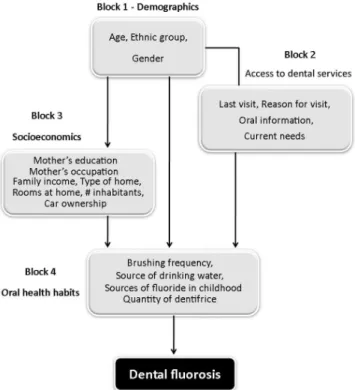
To verify the inluence of independent variables and the outcome of dental luorosis using a multiple logistic regression model, a hierarchic model classifying explanatory variables into blocks via levels of a multivariate model was used. For this, a theoretical model was built for the associations among different variables and the outcome with the explanatory demographic factors as block 1 (irst
level), the variables describing access to dental services
as block 2 (second level), the socioeconomic variables as block 3 (third level) and the oral hygiene variables as block 4 (fourth level, the closest to the outcome measure) (Fig. 1). A backwards stepwise regression model was used to test for possible risk and protective factors associated with dental luorosis. Conidence intervals (95%) were calculated, and associations with a p-value larger than 0.05 were considered statistically signiicant.
Results
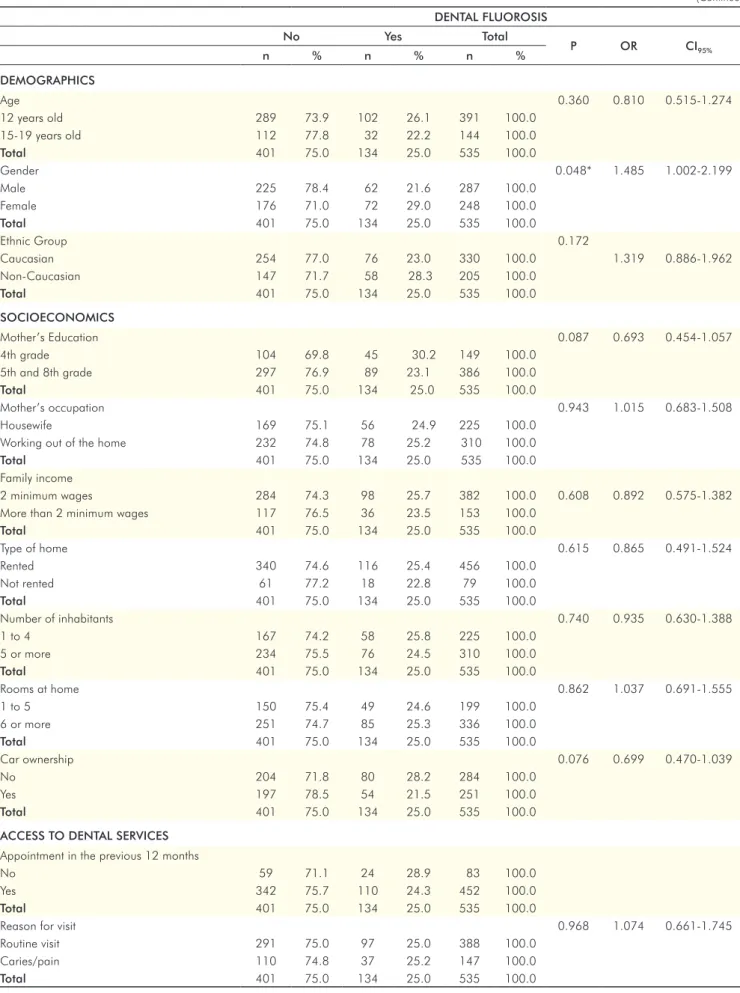
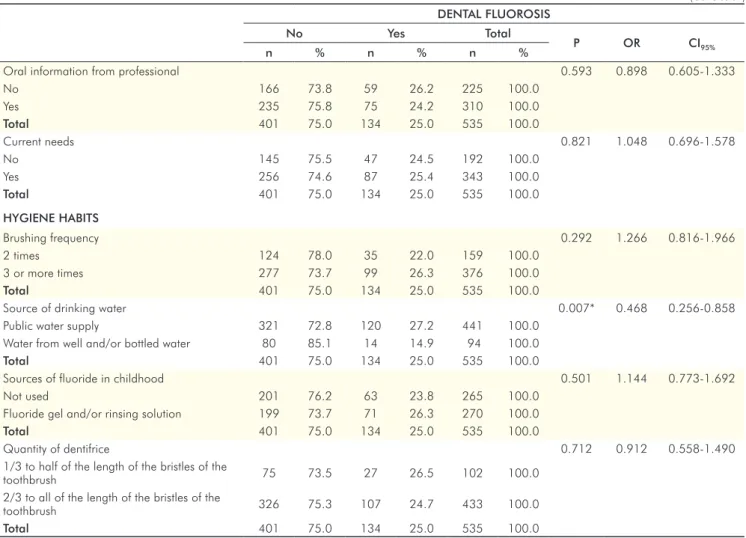
Sample descriptive analysis (Table 1)
The majority of the students were 12 years old (73.1%), male (53.6%) and Caucasian (61.5%). With regard to socioeconomic data, most mothers worked out of the home (57.9%), and the most frequent family income was two minimum-wage incomes (71.4%). In relation to the access to dental services, most students (66.9%) had had a dental appointment within the previous 12 months (mostly for routine visits, 72.5%) and had received information from dental professionals regarding the prevention of oral problems (57.9%); however, they still reported having current dental treatment needs (64.1%). For oral hygiene, half of the sample reported brushing their teeth 3 times per day (50.5%). The most frequently used water source for daily ingestion was the public water supply (78.7%). With regard to dental luorosis, 69.5% of the students did not show any signs of luorosis and 5.4% were questionable. The prevalence of luorosis was 25%, with levels of severity categorized as very mild (18.3%), mild (5.2%) and moderate (1.5%).
Bivariate analysis of luorosis and the explanatory variables (Table 1)
For the demographic variables, a signiicant association was found between luorosis and gender (P=0.048), with
female subjects (prevalence of luorosis in girls: 29%) being at higher risk for luorosis (OR=1.48; CI95%
1.00-2.19). Fluorosis was more common in 12-year-old subjects (26.1%) and in non-Caucasians subjects (28.3%), but no signiicant association was found. Dental luorosis was not signiicantly associated with any socioeconomic factors or variables describing access to dental services. With regard to the oral hygiene habit variables, dental luorosis was associated with the source of ingested water (P=0.007);
drinking water from a well or bottled water instead of water from the public supply system was a factor of protection against dental luorosis (OR=0.46; CI95% 0.25-0.85). Most
subjects with luorosis reported brushing their teeth 3 or more times per day (26.3%) with the use of some kind of luoride during childhood (gel, rinsing or both); however, no statistically signiicant difference was found.
Multiple logistic regression and inal model (backward stepwise) (Table 2)
All variables with a p-value ≤0.20 in the bivariate analyses of association with the outcome dental luorosis were selected for inclusion in the multiple logistic regression model. The demographic variables of block 1 included in the model
were gender (P=0.048) and ethnic group (P=0.172). No
variables describing access to dental services (block 2, second level) were associated with luorosis, and so none were included. From block 3, the socioeconomic variables entered into the model were having a car (P=0.076) and
mother’s education (P=0.087). For block 4, the source of
drinking water (P=0.007) was included.
Fig. 1. Hierarchical model of the variables used for the dental
Table 1. Bivariate analysis of demographic, socioeconomic, access to dental services and oral hygiene habit variables associated with dental fluorosis. Passo Fundo, RS, Brazil, 2008.
(Continue)
DENTAL FLUOROSIS
No Yes Total
P OR CI95%
n % n % n %
DEMOGRAPHICS
Age 0.360 0.810 0.515-1.274
12 years old 289 73.9 102 26.1 391 100.0
15-19 years old 112 77.8 32 22.2 144 100.0
Total 401 75.0 134 25.0 535 100.0
Gender 0.048* 1.485 1.002-2.199
Male 225 78.4 62 21.6 287 100.0
Female 176 71.0 72 29.0 248 100.0
Total 401 75.0 134 25.0 535 100.0
Ethnic Group 0.172
Caucasian 254 77.0 76 23.0 330 100.0 1.319 0.886-1.962
Non-Caucasian 147 71.7 58 28.3 205 100.0
Total 401 75.0 134 25.0 535 100.0
SOCIOECONOMICS
Mother’s Education 0.087 0.693 0.454-1.057
4th grade 104 69.8 45 30.2 149 100.0
5th and 8th grade 297 76.9 89 23.1 386 100.0
Total 401 75.0 134 25.0 535 100.0
Mother’s occupation 0.943 1.015 0.683-1.508
Housewife 169 75.1 56 24.9 225 100.0
Working out of the home 232 74.8 78 25.2 310 100.0
Total 401 75.0 134 25.0 535 100.0
Family income
2 minimum wages 284 74.3 98 25.7 382 100.0 0.608 0.892 0.575-1.382
More than 2 minimum wages 117 76.5 36 23.5 153 100.0
Total 401 75.0 134 25.0 535 100.0
Type of home 0.615 0.865 0.491-1.524
Rented 340 74.6 116 25.4 456 100.0
Not rented 61 77.2 18 22.8 79 100.0
Total 401 75.0 134 25.0 535 100.0
Number of inhabitants 0.740 0.935 0.630-1.388
1 to 4 167 74.2 58 25.8 225 100.0
5 or more 234 75.5 76 24.5 310 100.0
Total 401 75.0 134 25.0 535 100.0
Rooms at home 0.862 1.037 0.691-1.555
1 to 5 150 75.4 49 24.6 199 100.0
6 or more 251 74.7 85 25.3 336 100.0
Total 401 75.0 134 25.0 535 100.0
Car ownership 0.076 0.699 0.470-1.039
No 204 71.8 80 28.2 284 100.0
Yes 197 78.5 54 21.5 251 100.0
Total 401 75.0 134 25.0 535 100.0
ACCESS TO DENTAL SERVICES Appointment in the previous 12 months
No 59 71.1 24 28.9 83 100.0
Yes 342 75.7 110 24.3 452 100.0
Total 401 75.0 134 25.0 535 100.0
Reason for visit 0.968 1.074 0.661-1.745
Routine visit 291 75.0 97 25.0 388 100.0
Caries/pain 110 74.8 37 25.2 147 100.0
DENTAL FLUOROSIS
No Yes Total
P OR CI95%
n % n % n %
Oral information from professional 0.593 0.898 0.605-1.333
No 166 73.8 59 26.2 225 100.0
Yes 235 75.8 75 24.2 310 100.0
Total 401 75.0 134 25.0 535 100.0
Current needs 0.821 1.048 0.696-1.578
No 145 75.5 47 24.5 192 100.0
Yes 256 74.6 87 25.4 343 100.0
Total 401 75.0 134 25.0 535 100.0
HYGIENE HABITS
Brushing frequency 0.292 1.266 0.816-1.966
2 times 124 78.0 35 22.0 159 100.0
3 or more times 277 73.7 99 26.3 376 100.0
Total 401 75.0 134 25.0 535 100.0
Source of drinking water 0.007* 0.468 0.256-0.858
Public water supply 321 72.8 120 27.2 441 100.0
Water from well and/or bottled water 80 85.1 14 14.9 94 100.0
Total 401 75.0 134 25.0 535 100.0
Sources of fluoride in childhood 0.501 1.144 0.773-1.692
Not used 201 76.2 63 23.8 265 100.0
Fluoride gel and/or rinsing solution 199 73.7 71 26.3 270 100.0
Total 401 75.0 134 25.0 535 100.0
Quantity of dentifrice 0.712 0.912 0.558-1.490
1/3 to half of the length of the bristles of the
toothbrush 75 73.5 27 26.5 102 100.0
2/3 to all of the length of the bristles of the
toothbrush 326 75.3 107 24.7 433 100.0
Total 401 75.0 134 25.0 535 100.0
* P<0.05 indicates a statistically significant difference.
Table 2. Multiple logistic regression
model. Odds Radio (OR) and confidence interval (CI95%)of factors associated with dental fluorosis. Passo Fundo, RS, Brazil, 2008.
Table 1. Bivariate analysis of demographic, socioeconomic, access to dental services and oral hygiene habit variables associated
with dental fluorosis. Passo Fundo, RS, Brazil, 2008.
(Conclusion)
Dental Fluorosis
Crude OR (CI95%) P* Adjusted OR (CI95%) P*
Block 1
Gender
Male Female
1 1.485 (1.002-2.199)
0.048 1
1.552 (1.038-2.321)
*0.032
Ethnic Group
White
Non-white 1.319 1
(0.886-1.962)
0.172 1
1.276 (0.845-1.926)
0.246
Block 3
Car ownership
No Yes
1 0.699 (0.470-1.039)
0.076 1
0.815 (0.541-1.229)
0.329
Mother’s Education
4th grade
5th and 8th grade 1
0.693 (0.454-1.057)
0.087 1
0.740 (0.482-1.137)
0.170
Block 4
Source of drinking water
Public water supply Water from well and/or bottled water
1 0.468 (0.256-0.858)
0.007 1
0.513 (0.276-0.956)
*0.036
After adjustment of the inal model, variables with no signiicant association with luorosis were ethnic group, having a car and mother’s education (P>0.05). The variable
gender showed signiicant association (P=0.032), and girls
had 1.5-times greater chance of having luorosis than boys (OR=1.55; CI95%1.03-2.32). The source of drinking water
variable was also signiicantly associated with luorosis
(P=0.036), and drinking water from a well or bottled
water was protective against dental luorosis (OR=0.51; CI95% 0.27-0.95).
Discussion
Students in this sample showed a high prevalence of luorosis (25%) considering the fact that the city has excellent levels of luoride in the public water supply. The frequency was lower than that reported in a previous epidemiological study of the city, where the subjects were students who attended schools without programs of oral health promotion (prevalence: 32.8%) (10). In contrast to the present investigation, the authors of that study classiied the ‘questionable’ severity degree as an occurrence of dental luorosis. Even when those data were reassessed with questionable luorosis considered as the absence of luorosis, the prevalence of luorosis in that sample is 30% (10) – still higher than the indings of the present study.
The cross-sectional design was a limitation of this study because it did not allow the assessment of causality between the explanatory variables and the outcome measure. Nevertheless, the present indings are related to the oral health of a young population and may be relevant to prevent health and social problems derived from possible risks factors for dental luorosis. Cangussu et al. (13), in a critical review on luorosis in Brazil, reported that dental luorosis is a public health problem in the country and that more epidemiological studies are needed to record the prevalence and severity of the disease due to its signiicant variability in different regions.
In the present study, the age of the adolescents was not associated with the dental luorosis outcome. Conversely, a study performed in 8- to 16-year-old subjects from Brasilia (14), the national capital located in the Centre-West Region of Brazil, reported a higher frequency of children than adolescents with luorosis; further, luorosis became more severe as age decreased. A systematic review on luorosis work in Brazil from 1993 to 2004 revealed a certain consensus regarding its association with age (15). Campos et al. (16) also found that younger children were more severely affected by luorosis. One possible explanation for these results, which are contradictory to those in the present study, may involve exposure to luoride since birth. Water luoridation in Passo Fundo began 37 years ago, and the students may have been exposed to the same levels of luoride from other sources.
Ethnic group was not associated with outcome in the multivariate model; to avoid possible cluster factors, therefore, it was not kept in the inal adjusted model. Another
study in Feira de Santana in the state of Bahia, Northeast Region of Brazil, found a high prevalence of luorosis but no association between luorosis and ethnic group (17). A study that assessed two cities with different concentrations of luoride in the state of Sao Paulo showed similar results, in which the ethnic group variable was signiicant in the bivariate analysis but lost signiicance in the adjusted model (6). ender was associated with dental luorosis, and girls had a 1.5-times greater chance of having dental luorosis than boys. In a study with students born and residing in São Paulo, where the public water supply has a concentration of 0.7 ppm of luoride, 49% of the youngest children (mostly females) showed chronic intoxication by luoride (5). Similar results were found in different locations of the country (18,19) (e.g., in the state of Paraiba in the Northeast of Brazil, boys showed a higher prevalence of luorosis than girls) (20). Conversely, some studies did not ind any association between gender and luorosis in subjects living in the states of Minas Gerais, Bahia and Santa Catarina, located in the Southeast, Northeast and South regions of Brazil, respectively (17,21,22).
associated with the outcome in the multivariate analysis was the type of water used for drinking. In comparison to the public water supply, drinking water from a well or bottled water seemed to be protective against dental luorosis in this sample of students. Several studies in Brazil have described the signiicant association between the ingestion of luoridated public water and dental luorosis (4-6,24). Mandatory luoridation in cities with water treatment stations was required by Brazilian Federal Law 6050 in March 1974, but it is important to monitor water luoridation via epidemiological surveillance to assess the effectiveness of the measure. Although bottled water was protective against luorosis, Villena et al. analyzed 104 commercial brands of bottled mineral water in Brazil and found that 7.7% contained levels higher than 1 ppm of luoride. Although luorosis occurred at mild levels in this sample, health educational actions should focus on the risks of this disturbance in children up to 8 years in age. Further studies are necessary to clarify the effect of luoridated water over time and to assess the effectiveness of monitoring water luoridation on the incidence of luorosis.
Conclusions
Based on the indings presented and considering the limita-tions of the present study, it was possible to conclude that: • the prevalence of dental luorosis in this sample of
adolescents was high but that the severity level was mostly very mild or mild;
• females were more likely than males to exhibit luorosis, and the ingestion of water from wells or bottled water was a protection factor.
Acknowledgments
The authors thank the Health Division of Passo Fundo for supporting the study; the municipal Education Division for permitting the conduction of this epidemiological survey at selected schools; the school teachers and staff for their collaboration; all of the students who participated in this investigation. Special thanks to Dr. Zara D’Agostini and Dr. Leodinei Lodi for their collaboration to elaborate and execute the “Projeto Sorria Passo Fundo”.
References
1. Buzalaf MAR, Kobayashi CAN, Philippi ST. Fontes de ingestão de fluoretos. In: Buzalaf MAR. Fluoretos em saúde bucal. São Paulo: Santos; 2008. p.11-44.
2. Brasil. Ministério da Saúde. Secretaria de Políticas de Saúde. Departamento de Atenção Básica. Área Técnica de Saúde Bucal. Projeto SB2000: condições de saúde bucal da população brasileira no ano de 2000. Brasília; 2004.
3. Toassi RFC, Abegg C. Fluorose dentária em escolares de um município da serra gaúcha, Rio Grande do Sul, Brasil. Cad Saúde Pública 2005;21:652-5.
4. Cangussu MCT, Castellanos- Fernandez RA, Pinheiro MF, Albuquerque SR, Pinho C. Cárie e fluorose dentária em adolescentes de 12 e 15 anos em Salvador, Bahia, no ano de 2001. Pesqui Odontol Bras 2002;16:379-84.
5. Buscariolo IA, Penha, SS, Rocha RG. Intoxicação crônica por flúor. Prevalência de fluorose dentária em escolares. Rev Cienc Farm Básica Apl 2006;27:83-7.
6. Catani DB, Hugo FN, Cypriano S, Souza MLR, Cury JA. Relação entre níveis de fluoreto na água de abastecimento público e fluorose dental. Rev Saúde Pública 2007;41:732-9.
7. Dean HT. Classification of mottled enamel diagnosis. J Amer Dent Assoc 1934;21:1421-6.
8. Evans RW, Darvell BW. Refining the estimate of the critical period for susceptibility to enamel fluorosis in human maxillary central incisors. J Public Health Dent 1995;55:238-49.
9. Hong L, Levy SM, Broffit B, Warren, JJ, Kanellis MJ, Wefel, Dawson D. Timing of fluoride intake in relation to development of fluorosis on maxillary central incisors. Community Dent Oral Epidemiol 2006;34:299-309.
10. Rigo L, Caldas Junior AF, Souza EHA, Abegg C, Lodi L. Estudo sobre a fluorose dentária num município do Sul do Brasil. Ciência & Saúde Coletiva [serial on the Internet] 2008 [cited 2008 aug 30];394. Avalilable from: <http://www.cienciaesaudecoletiva. com.br>.
11. IBGE. Instituto Brasileiro de Geografia e Estatística. Avaliable from: <www.ibge.gov.br/>. [cited 2007 may 21].
12. Organização Mundial da Saúde. Levantamento Epidemiológico Básico de Saúde Bucal. 4ª ed. São Paulo: Santos; 1999.
13. Cangussu MCT, Narvai PC, Castellanos- Fernandez RA, Djehizian V. Dental fluorosis in Brazil: a critical review. Cad Saúde Pública 2002;18:7-15.
14. Oliveira Junior, SR, Cangussu ,MCT, Lopes, LS, Soares, AP, Ribeiro, AA, Fonseca, LA. Fluorose dentária em escolares de 12 e 15 anos de idade. Salvador, Bahia, Brasil, nos anos 2001 e 2004. Cad Saúde Pública 2006; 22:1201-6.
15. Cunha, LF, Tomita, NE. Dental fluorosis in Brazil: a systematic review from 1993 to 2004. Cad Saúde Pública 2006;22:1809-16. 16. Campos DL, Farias DG, Toledo OA, Bezerra ACB. Prevalência de
fluorose dentária em escolares de Brasília - Distrito Federal. Rev Odonto Univ São Paulo 1998;12:225-30.
17. Alves TDB. Saúde bucal de escolares com doze anos de idade do município de Feira de Santana / Bahia - zona urbana [thesis]. São Paulo (SP): Universidade de São Paulo; 2003.
18. Moysés SJ, Moysés ST, Allegretti ACV, Argenta M, Werneck R. Fluorose dental: ficção epidemiológica. Rev Panam Salud Publica 2002;12:339-46.
19. Bardal PAP, Olympio KPK, Buzalaf MAR, Bastos JRM . Dental caries and dental fluorosis in 7-12 years-old scholchildren in Catalão, Goiás, Brasil. J Appl Oral Sci 2005;13:35-40.
20. Forte FDS, Freitas CHSM, Sampaio FC, Jardim MCAM. Fluorose dentária em crianças de Princesa Isabel, Paraíba. Pesq Odontol Bras 2001;5:87-90.
21. Mendonça LL, Kirchner UL, Costa RN, Giovannini JFBG, Pinto MR, Luz MAR. Estudo multicentro de fluorose dental e da cárie dental em escolares de 7 e 10 anos de Belo Horizonte. RPG 1998;5:101-9.
22. Michel-Crosato E, Biazevic MGH, Crosato E. Relationship between dental fluorosis and quality of life: a population based study. Braz Oral Res 2005;19:150-5.
23. Meneghim MC, Kozlowski FC, Pereira AC, Ambrosano GMB, Meneghim ZMAP. Classificação socioeconômica e sua discussão em relação à prevalência de cárie e fluorose dentária. Cienc Saúde Coletiva 2007;12:523-9.