S
ho
rt
R
e
p
o
rt
J. Braz. Chem. Soc., Vol. 19, No. 3, 604-610, 2008. Printed in Brazil - ©2008 Sociedade Brasileira de Química 0103 - 5053 $6.00+0.00
*e-mail: [email protected]
Solubility Prediction of Solutes in Non-Aqueous Binary Solvent Mixtures
Abolghasem Jouyban,*
,aMaryam Khoubnasabjafari,
bSomaieh Soltani,
cShahla Soltanpour,
dElnaz Tamizi
eand William E. Acree Jr.
faFaculty of Pharmacy and Drug Applied Research Center, Tabriz University of Medical Sciences, 51664, Iran
bKimia Research Institute, P.O. Box 51665-171, Iran
cResearch Center for Pharmaceutical Nanotechnology, Tabriz University of Medical Sciences, 51664, Iran
dBiotechnology Research Centre, Tabriz University of Medical Sciences, 51664, Iran
eStudent Research Center, Tabriz University of Medical Sciences, 51664, Iran
fDepartment of Chemistry, University of North Texas, Denton, TX 76203-5070, USA
Foi investigada a possibilidade de substituir os parâmetros de Abraham calculados teoricamente pelos parâmetros experimentais, na previsão da solubilidade de solutos não-aquoso em misturas de solventes binários, utilizando-se o modelo de Jouyban-Acree. As solubilidades de 90 conjuntos de dados, coletados a partir da literatura, foram preditas utilizando-se estes parâmetros, os coeficientes de solventes e também as solubilidades de sistemas mono-solventes. A precisão das solubilidades previstas foi avaliada calculando-se a média percentual do desvio (MPD) e também dos desvios percentuais (IPDs) individuais. O MPD global para a análise utilizando os parâmetros de Abraham, experimentais e teóricos, foram os mesmos e <14%. Uma boa distribuição (IPD) foi obtida por estas análises numéricas. Os conjuntos de dados investigados neste trabalho foram coletados a várias temperaturas e os resultados confirmaram a possibilidade de previsão da solubilidade em solventes binários a diferentes temperaturas. Explorou-se a possibilidade de cálculos ab initio nesta previsão utilizando as solubilidades calculadas em sistemas mono-solventes. No entanto, a diferença entre os valores previstos e observados, para os coeficientes dos solventes, aumentou para aproximadamente 60% e 200% quando usou-se gás e água, respectivamente. Estes, são valores muito grandes para várias aplicações de previsão.
The possibility of replacing theoretically computed Abraham parameters with the experimental Abraham parameters in solubility prediction of solutes in non-aqueous binary solvent mixtures using the Jouyban-Acree model was investigated. The solubilities of 90 data sets collected from the literature were predicted using their Abraham parameters, the solvent coefficients and also the solubilities in mono-solvent systems. The accuracy of the predicted solubilities was evaluated by calculating the mean percentage deviation (MPD) and also individual percentage deviations (IPDs). The overall MPD for the analysis using experimental and computed Abraham parameters were the same and was < 14%. A favoured IPD distribution was obtained for these numerical analyses. The data sets investigated in this work were collected at various temperatures and the results confirmed the possibility of solubility prediction in binary solvents at various temperatures. We did explore the possibility of ab initio solubility prediction of solutes in binary mixtures using the calculated solubilities in mono-solvent systems, however, the difference between the predicted and observed values increased to ca. 60% for gas-to-solvent coefficients and ca.200% for water-to-solvent coefficients, which is too large for many predictive applications.
Keywords: solubility, prediction, non-aqueous mixed solvents, Abraham model, Jouyban-Acree model
Introduction
Solubility of a solute is affected by solvent’s and
Jouybanet al. 605 Vol. 19, No. 3, 2008
Abraham models employ five parameters for each solute and six solvent coefficients that were computed for a number of common solvents.3-4 The basic models proposed for process within condensed phases is:
(1)
and for process involving gas-to-condensed phase transfer is:
(2)
whereCS and CW are the solute solubility in the organic solvent and water (in mole per liter), respectively, CG is the gas phase concentration of the solute, E is the excess molar refraction,S is dipolarity/polarizability of solute, Adenotes the solute’s hydrogen-bond acidity, B stands for the solute’s hydrogen-bond basicity, V is the McGowan volume of the solute, and L is the logarithm of the solute gas-hexadecane partition coefficient at 298.15 K. In equations (1) and (2) the coefficients c, e, s, a, b, v and l are the model constants (i.e. solvent’s coefficients), which depend upon the solvent system under consideration. Numerical values of the model constants have been reported in the literature3-4 for several water-to-organic solvent and gas-to-organic solvent systems.
Solvent mixing or cosolvency is the most common method to alter the solubility of a solute. There is an infinite number of solvent compositions for a given binary solvent, and for some compounds, both linear and non-linear solubility behavior have been reported in mixed solvent systems. The most accurate model to represent the solubility data in mixed solvent systems is the Jouyban-Acree model.7-9 Its general form is:
(3)
where X is the mole fraction solubility of the solute, f denotes the mole fraction of the solvents 1 and 2 in the solvent mixture, subscripts m, 1 and 2 are the mixed solvent and solvents 1 and 2, respectively, Bj is the model constant which represent various solute-solute, solvent-solvent and solute-solvent interactions. In a previous study,10 QSPR models were proposed to calculate the numerical values of theBj terms using the Abraham coefficients for 22 solvents and solute descriptors for 5 solutes.
The QSPR models proposed in an earlier work using water-to-solvent coefficients were:
(4)
(5)
(6)
and the QSPR models using gas-to-solvent coefficients were:
(7)
(8)
(9)
The applicability of the proposed method was checked using 194 solubility data sets of five different solutes in various non-aqueous binary solvents. In this work, the possibility of replacing experimentally obtained Abraham parameters with the computed parameters is examined. The prediction capability of the previously developed QSPR models is checked using 90 solubility data sets11-24 of solutes which were not used in training process of the QSPR models. The applicability of the proposed method is also shown for predicting solubility at various temperatures. The main limitation of the Abraham model is that solute solvational parameters are known for only 4,000 organic compounds. In a recently released software25, this limitation is overcome and one is able to compute E, S, A, B, V and Lparameters.
Computational Methods and Experimental
Data
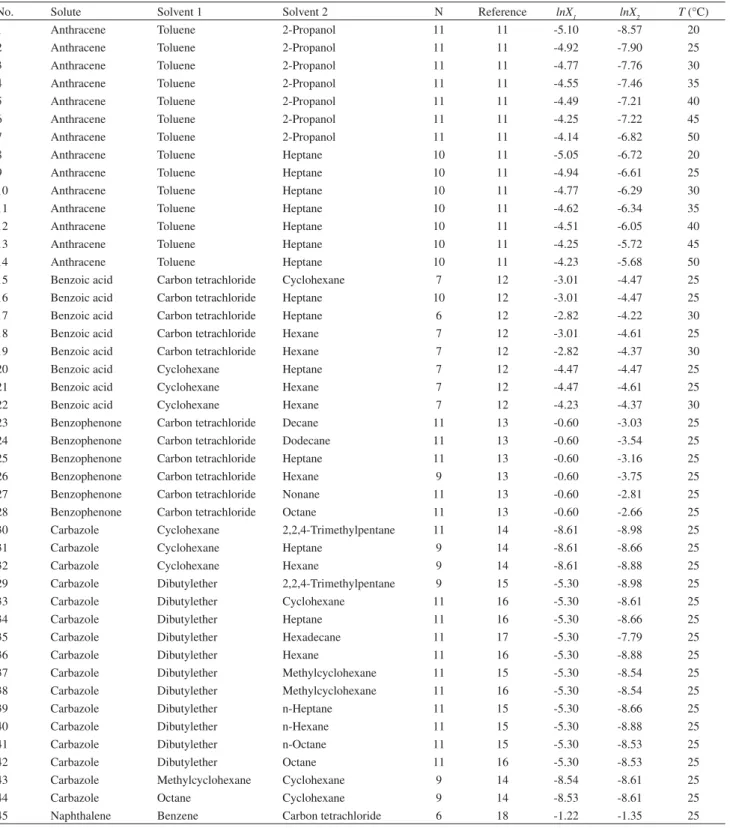
The solubilities of the solutes in binary solvent mixtures were collected from the literature.11-24 Table S1 listed details of the experimental solubility data. The numerical values of the solvents’ coefficients were listed in Table S2. In addition to the experimental database of solute’s parameters, commercial software is also available to compute the parameters.25 Table S3 lists the experimental and computed values of solute’s parameters. Since the numerical values of A term for the solutes studied in the previous paper10 were equal to zero, the corresponding terms have been omitted from the QSPR models.
Solubility Prediction of Solutes in Non-Aqueous Binary Solvent Mixtures J. Braz. Chem. Soc. 606
of solutes in binary solvents. The predictions still required numerical values of the solute solubility in each pure solvent, i.e.X1 and X2. In order to provide a predictive model (without any experimentally determined data), CS values of the solutes in the neat solvents under consideration were computed using Abraham models (using experimental values of CW or CG). The calculated molar solubilities, CS, were converted to the mole fraction solubilities using density of the pure organic solvent. The calculated X1 and X2 values were then substituted into equation (3), along with theBj values from equations (4)-(6) (or equations (7)-(9)) to predict the solubility in binary solvents by the Jouyban-Acree model. The density of pure organic solvents has been used to convert the molar solubility to mole fraction solubility and the effect of solute on density of the solution has been ignored. Table 1 summarizes the various numerical methods discussed in this work.
The predicitve ability of each computational method was assessed in terms of the mean percentage deviation (MPD) of observed ((Xm)obs.) and calculated ((Xm)cal.) solubilities, defined by equation (10):
(10)
whereN is the number of data points. In addition, we also calculated the individual percentage deviation (IPD):
(11)
for each solubility data point.
Results and Discussion
Validation of the previously derived coefficients for solubility predictions using computed Abraham solute descriptors
The solubilities of the solutes in 194 different binary solvent mixtures (for details see Table 1 of a previous paper10) were predicted using the Jouyban-Acree model and calculated Bj values based on equations (4)-(6) and
(7)-(9). Both experimental and computed Abraham solute descriptors were used in the Bj calculationss. Table 2 gives the overall MPD (± SD) values for the four predictive methods employed. There are no significant differences betweenMPDs for methods I and II that used experimental or computed Abraham parameters and experimental values ofX1 and X2 (t-test, p > 0.05). This observation is important in that it is possible to use computed solute descriptors instead of experimentally based values for predicting Bj constants of the Jouyban-Acree model. However, significant differences are observed using predicted X1 and X2 by equations (1) and (2) for the same set of data and the coefficients (p < 0.0005), revealing that the computed Abraham parameters using PharmaAlgorithm software produced less accurate solubility predictions in mono-solvent systems in comparison with the experimental Abraham parameters. To confirm this hypothesis, readers could refer to the predicted solubilities using equations (1) and (2) employing experimental Abraham parameters. As examples, the IPDs of the predicted solubilities of anthracene using equation (1) in various solvents were listed in Table S4 where the differences between predicted solubilities using experimental and computed Abraham parameters were statistically significant (paired t-test, p < 0.001 or p < 0.0005, for details see footnote of Table 1. Details of various numerical analyses carried out using experimental and computed Abraham parameters
Method No. Bj terms computed by Solubility in mono-solvents
I Water-to-solvent coefficients (equations (4)-(6)) Experimental data
II Gas-to-solvent coefficients (equations (7)-(9)) Experimental data
III Water-to-solvent coefficients (equations (4)-(6)) Computed by equation (1)
IV Gas-to-solvent coefficients (equations (7)-(9)) Computed by equation (2)
Table 2. Overall MPD (±SD) for solubility prediction of 194 sets from a previous work,10 and this work using experimental and computed Abraham solute parameters
Numerical method
Experimental parameters
Computed parameters
Significance
194 data set from a previous work
I 4.6 ± 3.9 4.6 ± 4.0 Not significant
II 11.3 ± 13.3 10.5 ± 13.0 Not significant
III 33.0 ± 20.6 52.0 ± 32.2 p < 0.0005
IV 23.9 ± 21.5 118 ± 258.4 p < 0.0005
This work
I 13.7 ± 14.0 13.6 ± 13.8 Not significant
II 12.7 ± 13.9 12.5 ± 13.7 Not significant
III 228.4 ± 337.7 168.8 ± 325.4 Not significant
Jouybanet al. 607 Vol. 19, No. 3, 2008
Table S4). A possible reason for such deviations could be the non-ideally adjusted water-to-solvent coefficients of some solvents as it was reported slightly different c, e, s, a, b and v values for cyclohexane in an earlier report1 and a recent one5 in which the IPD of anthracene solubility in cyclohexane predicted by equation (1) using earlier1 and amended5c, e, s, a, b and v values were 213.2 and 148.4%, respectively. We have computed the IPD of anthracene in cyclohexane using amended5c, e, s, a, b and v values equal to 149.6%. The second reason for very large deviations between theoretically derived and experimentally determined solubility values could be any error in the solute’s parameter calculations. The third reason could be the temperature effects on X1 and X2 values which did not considered in the equations (1) and (2).
It is possible to improve our ab initio prediction approach by developing better methods to predict the solubility in mono-solvent systems. It is difficult to guesstimate the error that one could reasonably expect from employing predictive methods to estimate the solubility in the neat organic solvents as the published methods have been tested on relatively few of the many possible solute-solvent combinations. Based on our review of the published comparisons, we do not think that it would be unreasonable to assign an expected error in the range of 0.1 to 0.3 log units to solubilities predicted by group contribution and linear free energy correlations for many of the simpler systems.
Predictions using water-to-solvent process and experimental solubility data in mono-solvents
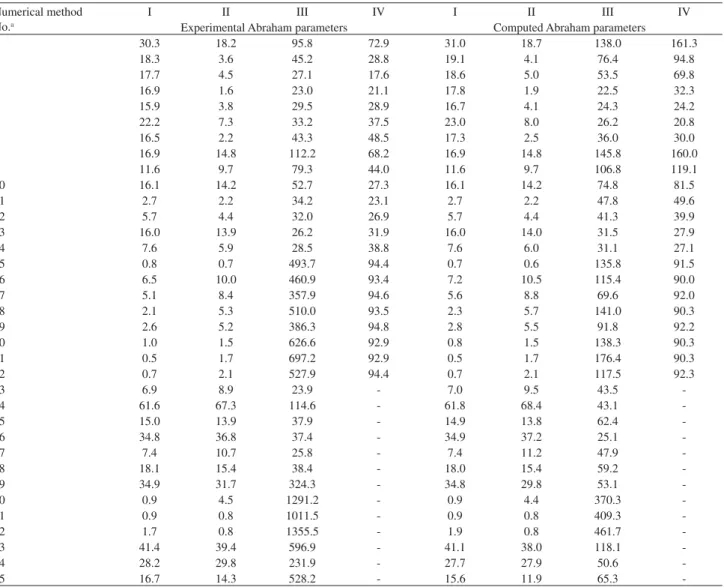
The predictive calculations discussed in the preceding section concerned solubility data used in generating equations (4)-(9). A more stringent test of any predictive solubility method is its ability to accurately predict solubilities of additional solute molecules, or solubilities of solutes dissolved in additional binary solvent mixtures. To better assess the applications and limitations of methods I-IV, we have compiled from the published literature experimental solubility data for 90 additional data sets (see Table S1). In the first set of calculations on the new data set, we computed the Bj coefficients using equations (4)-(6) and experimentally-based Abraham solute descriptors. The calculated Bj values were then combined with experimentally measured solubility data in the mono-solvents to predict the mole fraction solubility lnXm values for the 90 additional data sets (numerical method I of Table 1) using equation (3). The prediction accuracy of the data was evaluated using MPD values for this analysis and reported in column 2 of Table S5. The
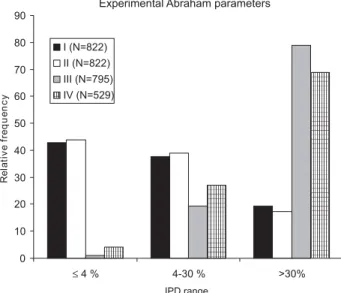
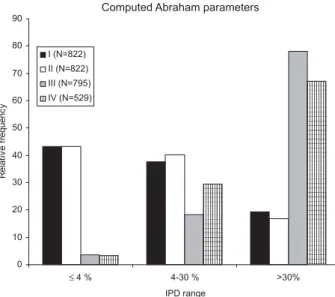
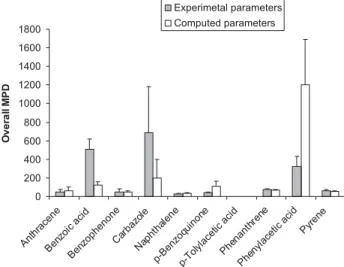
minimum (0.2%) and maximum (61.6%) MPDs were observed for p-benzoquinone in 2, 2, 4-trimethylpentane + cyclohexane and benzophenone in carbon tetrachloride + dodecane mixtures both at 25 nC. The overall MPD(± SD) was 13.7 ± 14.0%. A similar set of calculations were performed using computed Abraham parameters by PharmaAlgorithm software (see column 6 of Table S5). The minimum (0.2%) and maximum (61.8%) MPDs were observed for the same data sets and the overall MPD (± SD) was 13.6 ± 13.8%. There was no significant difference between 13.7 and 13.6% (paired t-test, p > 0.05). Figures 1 and 2 showed the relative frequencies of IPDs sorted in three subgroups, i.e.a 4, 4-30 and > 30%, for various numerical methods employing experimental and computed Abraham parameters. There was no significant difference between frequencies of IPDs of both parameters for numerical method I. Figure S1 depicted the overall MPDs for various solutes and there was no difference between MPDs calculated using experimental and computed Abraham parameters. These findings confirm the above results using 194 data sets from a previous work10 and reveal that it is possible to replace the experimentally determined Abraham parameters with the computationally obtained parameters for solubility prediction in mixed solvent system using method I.
The equations (4)-(6) were obtained employing the Bj terms calculated using solubility data of solutes at 25 and 26 nC, however, the equations were able to predict the solubility a wider temperature range (20-50 nC) as is evident (as examples) from set numbers 1-7 or 8-14 of Table S1. This is an oversimplification on the constants of the Jouyban-Acree model where it has been assumed that
Solubility Prediction of Solutes in Non-Aqueous Binary Solvent Mixtures J. Braz. Chem. Soc. 608
the Jouyban-Acree model constants are not temperature dependent. The reason for this simplification was the shortage of the solubility data of solutes in non-aqueous binary solvents at various temperatures. The capability of the Jouyban-Acree model for calculating the solubility of solutes in binary solvents at various temperatures has been shown earlier.26
Predictions using gas-to-solvent process and experimental solubility data in mono-solvents
In the second set of calculations on the new data set, we computed the Bj coefficients using equations (7)-(9) and experimentally-based Abraham solute descriptors. The calculated Bj values were then combined with experimental lnX1 and lnX2 data to predict the mole fraction solubility lnXm values for the 90 additional data sets (numerical method II of Table 1) using equation (3). The obtained MPD values are reported in column 3 of Table S5. The minimum (0.2%) and maximum (67.3%) MPDs were observed for p-benzoquinone in heptane + cyclohexane and for benzophenone in carbon tetrachloride + dodecane mixtures both at 25 nC. The overall MPD (± SD) was 12.7 ± 13.9%. The same calculations were carried out using the computed Abraham parameters by PharmaAlgorithm software and theMPDs were listed in the column 7 of Table S5). The minimum (0.2%) and maximum (68.4%) MPDs were observed for p-benzoquinone in heptane + cyclohexane and benzophenone in carbon tetrachloride + dodecane mixtures and the overall MPD (± SD) was 12.5 ± 13.7%. There were i) no significant difference between 12.7 and 12.5% (pairedt-test, p >0.05), ii) the same frequency pattern for
bothIPDs and iii) no difference between overall MPDs for various solutes (see Figure S2) employing experimental and computed Abraham parameters, revealing that one can employ solute parameters computed by PharmaAlgorithm instead of their experimentally obtained values. Full agreement was observed from the results of the 90 and 194 data sets (see Table 2) and the relative frequency of IPDs was favorable.
Ab initio predictions using water-to-solvent process and computed solubility data in mono-solvents
In the third set of predictive calculations we again calculated the Bj terms using equations (4)-(6) and the experimentally-based Abraham solute descriptors; however, in equation (3) the experimental mole fraction solubilities in the two mono-solvents were replaced with estimated X1 and X2 values based on equation (1). Results of these calculations are summarized in the fourth column of Table S5 for 86 of the 90 data sets considered. Predictions could not be made for the four p-tolylacetic acid systems because the molar solubility of p-tolylacetic acid in water, Cw, was not known. The molar solubility of the solute in water is a required input parameter in the estimation of solute’s solubility in mono-solvents through equation (1). A minimum MPD of 11.2% was observed for naphthalene in benzene + toluene at 25 nC, and a maximum MPD of 1811.2% was obtained for carbazole in octane + cyclohexane at 25 nC. The overall average MPD was 228.7%. The largest MPDs were observed for data set numbers 15-22 (benzoic acid), 29-44 (carbazole) and 77-82 (phenylacetic acid). Similar computations were performed using computed Abraham parameters for predicting X1,X2 andB
j terms using the relevant equations. The MPD values
of these computations are listed in column 8 of Table S5. A nearly identical MPD pattern was observed for data predicted by the experimental and computed parameters. The overall MPD was 168.9%. Figure S3 showed overall MPD for various solutes studied for experimental and computed parameters. This particular estimational scheme (method III) requires a prior knowledge of the solute’s aqueous molar solubility, and based on the relatively large IPD and MPD between predicted and observed values the method did not provide a very reasonable prediction of the observed solubility behavior.
Ab initio predictions using gas-to-solvent process and computed solubility data in mono-solvents
Numerical method IV (see Table 1) involved using Bj coefficiens based on equations (7)-(9), and estimated Figure 2. The relative frequency of the individual percentage deviations
Jouybanet al. 609 Vol. 19, No. 3, 2008
values for the solubility of the solute in both mon-solvents computed from equation (2). The minimum and maximum MPD for method IV (see column 5 of Table S5) were 3.6 and 101.5%, respectively, for naphthalene dissolved in benzene + toluene at 25 nC and for pyrene dissolved in toluene + heptane at 20 nC using experimentally-based Abraham solute descriptors. The overall MPD was 53.5 (± 30.0)%. A slightly larger minimum MPD of 5.6% (for naphthalene in carbon tetrachloride + hexane) and larger maximum MPD of 197.5% (for pyrene in toluene + heptane at 20 nC) were obtained using computed Abraham solute descriptors. The overall MPD was also larger, MPD = 62.7%, for the method IV predictions that used computed solute descriptors as input values (see column 9 of Table S5). As discussed above, the large deviations in binary solvents result mostly from the high IPDs of the solutes in mono-solvents (see Table S6 for details). It is difficult to accurately predict solubility in binary solvent mixtures when the inputted solubility data for the mono-solvents that make up the binary solvent mixtures is poorly predicted. Better estimation methods for solute solubility in mono-solvents should allow one to reduce these deviations significantly.
Conclusions
Published methods for estimating the Bj constants of the Jouyban-Acree model were applied successfully to a data set containing experimental solubility data for 90 additional solute-binary solvent-temperature combinations. None of the binary solvent solubility data was used in the regression analyses used to develop the predictive Bj correlations. The predicted Bj constants, when combined with experimental solubility data for the solute dissolved in the mono-solvents, enabled one to estimate the solubility of crystalline organic solutes in binary solvents using the Jouyban-Acree model. The expected prediction errors were < 14 and < 13%, respectively for water-to-solvent and gas-to-solvent coefficients employing both experimentally determined and theoretically calculated Abraham solute descriptors. The relatively small prediction errors indicate that it is possible to predict the solubility in binary solvents with minimum experimental efforts. Experimental solubility data exists in the published literature for many organic solutes in mono-solvents, and the Jouyban-Acree model allows one to quantitively estimate the extent to which cosolvency increases or decreases solute solubility. Such predictions are important in both solubilization and crystallization processes. Moreover, predictive methods, such as the Jouyban-Acree model, provide a convenient means to screen compiled experimental solubility data
in order to detect possible outliers for re-determination. For any solubility datum with very high IPD, the re-measurement is recommended. The proposed methods could also be extended to predict the solubility in mixed solvents at various temperatures. We tried to develop an ab initio prediction method employing CW or CG data of the solute (numerical methods III and IV); however, the obtainedMPDs were ca. 200 and 60%.
As a practical conclusion, there are a number of possible solutions depending on the availability of the required input data:i) If the experimental solubility data of the solute in mono-solvent systems, i.e. X1 and X2, are available, the best solution to predict the solubility in mixed solvents is the numerical methods I or II and the expected prediction error is ca. 14%. ii) If X1 and X2 are not available and the aqueous solubility of the solute is known, one could use the numerical method III and the expected prediction error is relatively high (170%) for computed Abraham parameters. iii) If X1 and X2 are not available and CG of the solute is known, the numerical method IV could be a solution and the expected prediction error is slightly high (ca. 60%) for computed Abraham parameters.
Supplemenatry Information
Supplementary data are available free of charge at http://jbcs.sbq.org.br, as PDF file.
Acknowledgments
The financial support from Drug Applied Research Center (under grant number 85-64) was gratefully acknowledged. The authors also thank PharmaAlgorithm Inc. for the trial version of their software.
References
1. Abraham, M. H.; Green, C. E.; Acree, Jr., W. E.; Hernandez, C. E.; Roy, L. E.; J. Chem. Soc., Perkin Trans. 1998,2, 2677. 2. Acree, Jr., W. E.; Abraham, M. H.; Can. J. Chem.2001,79,
1466.
3. Stovall, D. M.; Acree, Jr., W. E.; Abraham, M. H.; Fluid Phase
Equilib.2005,232, 113.
4. Stovall., D. M.; Givens, C.; Keown, S.; Hoover, K. R.; Barnes, R.; Harris, C.; Lozano, J.; Nguyen, M.; Rodriguez, E.; Acree, Jr., W.E.; Abraham, M.H.; Phys. Chem. Liq. 2005,43, 351. 5. Acree, Jr.,W. E.; Abraham, M. H.; Fluid Phase Equilib. 2002,
201, 245.
6. Acree, Jr., W. E.; Abraham, M. H.; J. Solution Chem. 2002,31, 293.
Solubility Prediction of Solutes in Non-Aqueous Binary Solvent Mixtures J. Braz. Chem. Soc. 610
8. Jouyban-Gharamaleki, A.; Valaee, L.; Barzegar-Jalali, M.; Clark, B.J. Acree, Jr., W.E.; Int. J. Pharm. 1999,177, 93. 9. Jouyban, A.; Chan, H.K.; Chew, N. Y. K.; Khoubnasabjafari,
M.; Acree, Jr., W. E.; Chem. Pharm. Bull. 2006,54, 428. 10. Jouyban, A.; Acree, Jr., W. E.; Fluid Phase Equilib. 2006,249,
24.
11. Al-Sharrah, G.K.; Ali, S.H.; Fahim, M.A.; Fluid Phase Equilib. 2002,193, 191
12. Acree, Jr., W.E.; Bertrand, G.L.; J. Pharm. Sci.1981,70, 1033.
13. Azizian, S.; Haydarpour, A.; J. Chem. Eng. Data2003, 48, 1476.
14. Acree, Jr., W.E.; Phys. Chem. Liq.1990,22, 157.
15. McCargar, J.W.; Acree, Jr., W.E.; Phys. Chem. Liq.1987,17, 123.
16. Acree, Jr., W.E.; Tucker, S.A.; Int. J. Pharm.1993,101, 199. 17. McCargar, J.W.; Acree, Jr., W.E.; J. Pharm. Sci. 1987,76,
572.
18. Heric, E.L.; Posey, C.D.; J. Chem. Eng. Data1964,9, 35. 19. Heric, E.L.; Posey, C.D.; J. Chem. Eng. Data1965,10, 25. 20. Heric, E.L.; Posey, C.D.; J. Chem. Eng. Data1964,9, 161. 21. Acree, Jr., W.E.; Rytting, J.H.; J. Pharm. Sci.1982,10, 231.
22. Judy, C.L.; Acree, Jr., W.E.; Int. J. Pharm.1985,27, 39. 23. Ali, S.H.; Al-Mutairi, F.S.; Fahim, M.A.; Fluid Phase Equilib.
2005,230, 176.
24. Acree, Jr., W.E.; J. Chem. Eng. Data1985,30, 70.
25. P h a r m a A l g o r i t h m s , A D M E B o x e s , Ve r s i o n 3 . 0 , PharmaAlgorithms Inc., 591 Indian Road, Toronto, ON M6P 2C4, Canada, 2006.
26. Jouyban, A.; Acree, Jr., W. E.; Fluid Phase Equilib. 2003,209, 155.
27. Abraham, M.H.; Zissimos, A.M.; Acree Jr., W.E.; Phys. Chem.
Chem. Phys. 2001,3, 3732.
28. Abraham, M.H.; Le, J.; J. Pharm. Sci.1999,88, 868. 29. Yalkowsky, S.H.; Valvani, S.C.; J. Pharm. Sci. 1980,69, 912. 30. Abraham, M.H.; Le, J.; Acree, W.E.; Carr, P.W.; Dallas, A.J.;
Chemosphere. 2001,44, 855.
31. Yalkowsky, S.H.; He, Y.; Handbook of aqueous solubility data, CRC press, Florida, 2003.
32. Monte, M.J.S.; Hillesheim, D.M.; J. Chem. Eng. Data2001, 46, 1601.
Received: August 23, 2007
S
u
p
p
le
m
e
nta
ry
Inf
o
rm
a
ti
o
n
J. Braz. Chem. Soc., Vol. 19, No. 3, S1-S9, 2008. Printed in Brazil - ©2008 Sociedade Brasileira de Química 0103 - 5053 $6.00+0.00
*e-mail: [email protected]
Solubility Prediction of Solutes in Non-Aqueous Binary Solvent Mixtures
Abolghasem Jouyban,*
,aMaryam Khoubnasabjafari,
bSomaieh Soltani,
cShahla Soltanpour,
dElnaz Tamizi
eand William E. Acree Jr.
faFaculty of Pharmacy and Drug Applied Research Center, Tabriz University of Medical Sciences, 51664, Iran
bKimia Research Institute, P.O. Box 51665-171, Iran
cResearch Center for Pharmaceutical Nanotechnology, Tabriz University of Medical Sciences, 51664, Iran
dBiotechnology Research Centre, Tabriz University of Medical Sciences, 51664, Iran
eStudent Research Center, Tabriz University of Medical Sciences, 51664, Iran
fDepartment of Chemistry, University of North Texas, Denton, TX 76203-5070, USA
Figure S3. The overall MPD (± SD) for numerical method III for various
solutes
Figure S2. The overall MPD (± SD) for numerical method II for various
solutes
Figure S1. The overall MPD (± SD) for numerical method I for various
Solubility Prediction of Solutes in Non-Aqueous Binary Solvent Mixtures J. Braz. Chem. Soc.
S2
Table S1. Details of solutes and solvents names, the references of experimental data sets, logarithms of solubility in mono-solvents (lnX1 and lnX2) and
temperature (T)
No. Solute Solvent 1 Solvent 2 N Reference lnX1 lnX2 T (nC)
1 Anthracene Toluene 2-Propanol 11 11 -5.10 -8.57 20
2 Anthracene Toluene 2-Propanol 11 11 -4.92 -7.90 25
3 Anthracene Toluene 2-Propanol 11 11 -4.77 -7.76 30
4 Anthracene Toluene 2-Propanol 11 11 -4.55 -7.46 35
5 Anthracene Toluene 2-Propanol 11 11 -4.49 -7.21 40
6 Anthracene Toluene 2-Propanol 11 11 -4.25 -7.22 45
7 Anthracene Toluene 2-Propanol 11 11 -4.14 -6.82 50
8 Anthracene Toluene Heptane 10 11 -5.05 -6.72 20
9 Anthracene Toluene Heptane 10 11 -4.94 -6.61 25
10 Anthracene Toluene Heptane 10 11 -4.77 -6.29 30
11 Anthracene Toluene Heptane 10 11 -4.62 -6.34 35
12 Anthracene Toluene Heptane 10 11 -4.51 -6.05 40
13 Anthracene Toluene Heptane 10 11 -4.25 -5.72 45
14 Anthracene Toluene Heptane 10 11 -4.23 -5.68 50
15 Benzoic acid Carbon tetrachloride Cyclohexane 7 12 -3.01 -4.47 25
16 Benzoic acid Carbon tetrachloride Heptane 10 12 -3.01 -4.47 25
17 Benzoic acid Carbon tetrachloride Heptane 6 12 -2.82 -4.22 30
18 Benzoic acid Carbon tetrachloride Hexane 7 12 -3.01 -4.61 25
19 Benzoic acid Carbon tetrachloride Hexane 7 12 -2.82 -4.37 30
20 Benzoic acid Cyclohexane Heptane 7 12 -4.47 -4.47 25
21 Benzoic acid Cyclohexane Hexane 7 12 -4.47 -4.61 25
22 Benzoic acid Cyclohexane Hexane 7 12 -4.23 -4.37 30
23 Benzophenone Carbon tetrachloride Decane 11 13 -0.60 -3.03 25
24 Benzophenone Carbon tetrachloride Dodecane 11 13 -0.60 -3.54 25
25 Benzophenone Carbon tetrachloride Heptane 11 13 -0.60 -3.16 25
26 Benzophenone Carbon tetrachloride Hexane 9 13 -0.60 -3.75 25
27 Benzophenone Carbon tetrachloride Nonane 11 13 -0.60 -2.81 25
28 Benzophenone Carbon tetrachloride Octane 11 13 -0.60 -2.66 25
30 Carbazole Cyclohexane 2,2,4-Trimethylpentane 11 14 -8.61 -8.98 25
31 Carbazole Cyclohexane Heptane 9 14 -8.61 -8.66 25
32 Carbazole Cyclohexane Hexane 9 14 -8.61 -8.88 25
29 Carbazole Dibutylether 2,2,4-Trimethylpentane 9 15 -5.30 -8.98 25
33 Carbazole Dibutylether Cyclohexane 11 16 -5.30 -8.61 25
34 Carbazole Dibutylether Heptane 11 16 -5.30 -8.66 25
35 Carbazole Dibutylether Hexadecane 11 17 -5.30 -7.79 25
36 Carbazole Dibutylether Hexane 11 16 -5.30 -8.88 25
37 Carbazole Dibutylether Methylcyclohexane 11 15 -5.30 -8.54 25
38 Carbazole Dibutylether Methylcyclohexane 11 16 -5.30 -8.54 25
39 Carbazole Dibutylether n-Heptane 11 15 -5.30 -8.66 25
40 Carbazole Dibutylether n-Hexane 11 15 -5.30 -8.88 25
41 Carbazole Dibutylether n-Octane 11 15 -5.30 -8.53 25
42 Carbazole Dibutylether Octane 11 16 -5.30 -8.53 25
43 Carbazole Methylcyclohexane Cyclohexane 9 14 -8.54 -8.61 25
44 Carbazole Octane Cyclohexane 9 14 -8.53 -8.61 25
Jouybanet al. S3 Vol. 19, No. 3, 2008
Table S1. continuation
No. Solute Solvent 1 Solvent 2 N Reference lnX1 lnX2 T (nC)
46 Naphthalene Benzene Cyclohexane 8 18 -1.22 -1.91 25
47 Naphthalene Benzene Hexadecane 6 18 -1.22 -1.59 25
48 Naphthalene Benzene Hexane 8 18 -1.22 -2.15 25
49 Naphthalene Benzene Toluene 7 18 -1.22 -1.23 25
50 Naphthalene Carbon tetrachloride Cyclohexane 6 19 -1.35 -1.91 25
51 Naphthalene Carbon tetrachloride Hexadecane 6 19 -1.35 -1.59 25
52 Naphthalene Carbon tetrachloride Hexane 8 19 -1.35 -2.15 25
53 Naphthalene Cyclohexane Hexane 6 19 -1.91 -2.15 25
54 Naphthalene Hexadecane Cyclohexane 7 19 -1.59 -1.91 25
55 Naphthalene Hexadecane Hexane 6 19 -1.59 -2.15 25
56 Naphthalene Toluene Carbon tetrachloride 6 20 -1.23 -1.35 25
57 Naphthalene Toluene Cyclohexane 6 20 -1.23 -1.91 25
58 Naphthalene Toluene Hexadecane 6 20 -1.23 -1.59 25
59 Naphthalene Toluene Hexane 6 20 -1.23 -2.15 25
60 p-Benzoquinone 2,2,4-Trimethylpentane Cyclohexane 7 21 -5.01 -5.03 25
61 p-Benzoquinone Carbon tetrachloride Heptane 8 21 -3.37 -5.01 25
62 p-Benzoquinone Carbon tetrachloride Octane 7 21 -3.37 -4.89 25
63 p-Benzoquinone Dodecane Heptane 7 21 -4.74 -5.01 25
64 p-Benzoquinone Heptane Cyclohexane 7 21 -5.01 -5.03 25
65 p-Tolylacetic acid Cyclohexane 2,2,4-Trimethylpentane 7 22 -4.32 -4.83 25
66 p-Tolylacetic acid Cyclohexane Heptane 7 22 -4.30 -4.78 25
67 p-Tolylacetic acid Cyclohexane Hexane 8 22 -4.32 -4.85 25
68 p-Tolylacetic acid Cyclohexane Octane 7 22 -4.32 -4.75 25
69 Phenanthrene Toluene 2,2,4-Trimethylpentane 7 23 -0.77 -3.96 20
70 Phenanthrene Toluene 2,2,4-Trimethylpentane 7 23 -0.70 -3.32 30
71 Phenanthrene Toluene 2,2,4-Trimethylpentane 7 23 -0.55 -2.44 40
72 Phenanthrene Toluene 2,2,4-Trimethylpentane 7 23 -0.50 -1.98 50
73 Phenanthrene Toluene Heptane 11 23 -0.77 -4.17 20
74 Phenanthrene Toluene Heptane 11 23 -0.70 -3.70 30
75 Phenanthrene Toluene Heptane 11 23 -0.55 -3.32 40
76 Phenanthrene Toluene Heptane 11 23 -0.50 -2.96 50
77 Phenylacetic acid Carbon tetrachloride 2,2,4-Trimethylpentane 11 24 -1.75 -4.40 25
78 Phenylacetic acid Carbon tetrachloride Cyclohexane 11 24 -1.75 -3.70 25
79 Phenylacetic acid Carbon tetrachloride Heptane 11 24 -1.75 -4.31 25
80 Phenylacetic acid Carbon tetrachloride Octane 11 24 -1.75 -4.24 25
81 Phenylacetic acid Cyclohexane 2,2,4-Trimethylpentane 9 24 -3.70 -4.40 25
82 Phenylacetic acid Cyclohexane Heptane 8 24 -3.70 -4.31 25
83 Pyrene Toluene 2,2,4-Trimethylpentane 12 20 -2.87 -4.72 20
84 Pyrene Toluene 2,2,4-Trimethylpentane 12 20 -2.41 -4.47 30
85 Pyrene Toluene 2,2,4-Trimethylpentane 12 20 -2.21 -4.37 40
86 Pyrene Toluene 2,2,4-Trimethylpentane 12 20 -1.57 -3.94 50
87 Pyrene Toluene Heptane 11 20 -2.87 -4.47 20
88 Pyrene Toluene Heptane 11 20 -2.41 -4.17 30
89 Pyrene Toluene Heptane 11 20 -2.21 -3.63 40
Solubility Prediction of Solutes in Non-Aqueous Binary Solvent Mixtures J. Braz. Chem. Soc.
S4
Table S2. Coefficients in equations (1) and (2) for water-to-solvent and gas-to-solvent processes of the solvents used in this studya
No. Water-to-solvent coefficients c e s a b v
1 2,2,4-Trimethylpentane 0.288 0.382 -1.668 -3.639 -5.000 4.461
2 2-Propanol 0.063 0.320 -1.024 0.445 -3.824 4.067
3 Benzene 0.142 0.464 -0.588 -3.099 -4.625 4.491
4 Carbone tetrachloride 0.260 0.573 -1.254 -3.558 -4.558 4.589
5 Cyclohexane 0.159 0.784 -1.678 -3.740 -4.929 4.577
6 Decane 0.160 0.585 -1.730 -3.440 -5.080 4.582
7 Dibutyl ether 0.203 0.369 -0.954 -1.488 -5.426 4.508
8 Dodecane 0.114 0.668 -1.640 -3.550 -5.010 4.459
9 Heptane 0.325 0.670 -2.061 -3.317 -4.733 4.543
10 Hexadecane 0.087 0.667 -1.620 -3.59 -4.870 4.433
11 Hexane 0.361 0.579 -1.723 -3.599 -4.764 4.344
12 Methylcyclohexane 0.246 0.782 -1.982 -3.517 -4.293 4.528
13 Nonane 0.240 0.619 -1.710 -3.530 -4.920 4.482
14 Octane 0.223 0.642 -1.647 -3.480 -5.067 4.526
15 Toluene 0.143 0.527 -0.720 -3.010 -4.824 4.545
No. Gas-to-solvent coefficients c e s a b l
1 2,2,4-Trimethylpentane 0.275 −0.244 0.000 0.000 0.000 0.972
2 2-Propanol -0.060 -0.335 0.702 4.017 1.040 0.893
3 Benzene 0.107 −0.313 1.053 0.457 0.169 1.020
4 Carbone tetrachloride 0.282 −0.303 0.460 0.000 0.000 1.047
5 Cyclohexane 0.163 -0.110 0.000 0.000 0.000 1.013
6 Decane 0.156 -0.140 0.000 0.000 0.000 0.989
7 Dibutyl ether 0.165 −0.421 0.760 2.102 −0.664 1.002
8 Dodecane 0.053 0.000 0.000 0.000 0.000 0.986
9 Heptane 0.275 −0.162 0.000 0.000 0.000 0.983
10 Hexadecane 0.000 0.000 0.000 0.000 0.000 1.000
11 Hexane 0.292 −0.169 0.000 0.000 0.000 0.979
12 Methylcyclohexane 0.318 −0.215 0.000 0.000 0.000 1.012
13 Nonane 0.200 -0.145 0.000 0.000 0.000 0.980
14 Octane 0.215 −0.049 0.000 0.000 0.000 0.967
15 Toluene 0.121 −0.222 0.938 0.467 0.099 1.012
a Data taken from a reference.5
Table S3. The experimental and computed Abraham parameters along with the input properties for solutes studied in this work and their references
Solute E S A B V L logCW logCG Reference
Experimental Abraham parameters
Anthracene 2.290 1.34 0.000 0.280 7.568 -6.430 -9.460 2
Benzoic acid 0.730 0.90 0.590 0.400 4.395 -1.550 -6.690 27
Benzophenone 1.447 1.50 0.000 0.500 6.852 -3.12028 -a 25
Carbazole 1.787 2.01 0.180 0.080 7.982 -5.27028 -a 25
Naphthalene 1.340 0.92 0.000 0.200 5.161 -3.61029 -5.340 30
p-Benzoquinone 0.750 0.55 0.000 0.810 3.492 -0.88031 -a 25
p-Tolylacetic acid 0.730 0.97 0.600 0.640 5.480 -a -a 25
Phenanthrene 2.055 1.29 0.000 0.290 7.632 -5.170 -7.970 2
Phenylacetic acid 0.730 1.01 0.590 0.610 4.933 -0.89028 -7.562b 25
Pyrene 2.808 1.71 0.000 0.280 8.833 -6.150 -9.650 5
Computed Abraham parameters
Anthracene 1.99 1.34 0.000 0.23 1.454 7.706 25
Benzoic acid 0.75 1.08 0.570 0.44 0.932 4.533 25
Benzophenone 1.37 1.59 0.000 0.51 1.481 7.308 25
Carbazole 1.94 1.43 0.310 0.39 1.315 7.869 25
Naphthalene 1.27 1.02 0.000 0.17 1.085 5.332 25
p-Benzoquinone 0.90 0.43 0.000 0.76 0.791 3.500 25
p-Tolylacetic acid 0.77 1.02 0.570 0.45 1.214 5.499 25
Phenanthrene 1.99 1.34 0.000 0.23 1.454 7.706 25
Phenylacetic acid 0.75 1.08 0.570 0.45 1.073 5.028 25
Pyrene 2.60 1.52 0.000 0.25 1.585 9.110 25
a The data was not available.
b logC
G of phenylacetic acid was calculated using the extrapolated vapor pressure data from a reference
Jouybanet al. S5 Vol. 19, No. 3, 2008
Table S4. The individual percentage deviations (IPDs) of solubilities of solutes10 in some of the solvents predicted by equations (1) and (2) employing
experimental and computed Abraham parameters
Solutea Solventa T (nC) Experimental parameters Computed parameters
Equation (1) Equation (2) Equation (1) Equation (2)
Anthracene 1,4-Dioxane 25 20.5 20.0 64.4 36.1
Anthracene 1-Butanol 25 25.5 1.0 45.6 43.7
Anthracene 1-Octanol 25 17.0 23.9 35.7 8.8
Anthracene 1-Pentanol 25 34.4 21.9 47.0 13.5
Anthracene 2,2,4-Trimethylpentane 25 40.3 36.3 18.5 2.6
Anthracene 2-Butanol 25 21.2 24.0 55.6 22.8
Anthracene 2-Methyl-1-propanol 25 37.7 11.7 64.8 34.1
Anthracene 2-Propanol 25 28.5 5.4 60.0 40.4
Anthracene Acetonitrile 25 14.6 6.3 80.0 70.1
Anthracene Benzene 25 97.7 52.7 143.6 155.2
Anthracene Carbon tetrachloride 25 49.3 3.3 69.7 65.7
Anthracene Cyclohexane 25 149.6 7.7 156.1 37.3
Anthracene Dibutyl ether 25 11.5 32.4 61.2 33.8
Anthracene Heptane 25 16.7 28.2 9.6 9.7
Anthracene Hexane 25 12.0 26.2 2.0 13.2
Anthracene Methanol 25 3.2 1.8 24.0 27.9
Anthracene Methyl tert-buthyl ether 25 22.6 24.6 82.0 44.6
Anthracene Methylcyclohexane 25 66.8 17.8 59.4 31.4
Anthracene Octane 25 46.8 18.7 68.8 14.3
Anthracene Toluene 25 132.9 78.7 181.0 182.0
Benzil 1-Butanol 25 5.3 15.8 94.8 1599.5
Benzil 1-Octanol 25 60.1 29.0 91.8 1540.8
Benzil 1-Pentanol 25 10.9 95.6 95.1 1421.3
Benzil 1-Propanol 25 5.7 25.1 94.9 1146.8
Benzil 2,2,4-Trimethylpentane 25 38.2 29.4 99.0 375.6
Benzil 2-Butanol 25 46.5 32.3 91.0 2172.1
Benzil 2-Propanol 25 25.4 14.0 92.6 1882.9
Benzil Carbon tetrachloride 25 38.6 51.6 97.8 337.6
Benzil Cyclohexane 25 4.2 36.7 98.0 373.9
Benzil Heptane 25 34.2 10.9 99.1 521.9
Benzil Octane 25 25.6 14.2 97.7 498.8
Pyrene 1-Butanol 26 33.8 42.0 17.2 115.8
Pyrene 1-Octanol 26 39.8 1.9 0.0 45.3
Pyrene 1-Pentanol 26 34.0 43.1 18.1 16.8
Pyrene 1-Propanol 26 21.2 13.8 35.0 26.1
Pyrene 2,2,4-Trimethylpentane 26 75.4 23.1 40.1 59.7
Pyrene 2-Butanol 26 36.8 2.8 11.0 50.2
Pyrene 2-Methyl-1-propanol 26 26.4 21.0 29.4 77.3
Pyrene 2-Propanol 26 27.7 41.5 26.2 100.7
Pyrene Benzene 26 64.4 210.3 124.4 300.3
Pyrene Cyclohexane 26 59.5 38.1 215.3 173.6
Pyrene Dibutyl ether 26 32.0 9.7 23.6 86.4
Pyrene Heptane 26 66.0 5.7 16.1 88.8
Pyrene Hexane 26 57.4 0.0 5.2 100.7
Pyrene Methylcyclohexane 26 25.8 1.2 61.5 105.9
Pyrene Octane 26 23.5 8.7 62.1 103.4
Thianthrene 2,2,4-Trimethylpentane 25 45.2 27.1 71.1 112.5
Thianthrene Cyclohexane 25 53.1 22.9 29.4 121.9
Thianthrene Heptane 25 12.3 3.1 56.2 176.4
Thianthrene Hexane 25 17.7 12.6 58.4 149.3
Solubility Prediction of Solutes in Non-Aqueous Binary Solvent Mixtures J. Braz. Chem. Soc.
S6
Solutea Solventa T (nC) Experimental parameters Computed parameters
Equation (1) Equation (2) Equation (1) Equation (2)
Thianthrene Octane 25 57.1 7.7 25.1 189.8
Trans-Stilbene 1-Propanol 25 23.4 10.8 33.9 57.4
Trans-Stilbene 2,2,4-Trimethylpentane 25 22.2 9.5 16.7 63.0
Trans-Stilbene 2-Butanol 25 53.2 28.5 79.9 32.5
Trans-Stilbene Cyclohexane 25 32.2 14.5 22.7 67.7
Trans-Stilbene Heptane 25 6.0 5.4 23.9 62.6
Trans-Stilbene Hexane 25 17.7 8.7 22.0 63.7
Trans-Stilbene Methylcyclohexane 25 21.4 4.3 8.8 62.5
Trans-Stilbene Octane 25 27.2 11.9 27.5 65.9
Anthracene 1,4-Dioxane 25 20.5 20.0 64.4 36.1
All 36.3b 24.4c 59.7b 262.8c
25 34.6d 22.2e 64.5d 319.4e
a Details of the references of data were reported in an earlier work.10;b7KHGLIIHUHQFHZDVVWDWLVWLFDOO\VLJQL¿FDQWSDLUHGWWHVWScThe difference
ZDVVWDWLVWLFDOO\VLJQL¿FDQWSDLUHGWWHVWSd7KHGLIIHUHQFHZDVVWDWLVWLFDOO\VLJQL¿FDQWSDLUHGWWHVWSeThe difference was statistically
VLJQL¿FDQWSDLUHGWWHVWS!
Table S4. continuation
Table S5. The mean percentage deviation (MPD) of various numerical analyses employing the experimental and computed Abraham parameters of the
solutes and the overall (± SD) of MPDs
Numerical method No.a
I II III IV I II III IV
Experimental Abraham parameters Computed Abraham parameters
1 30.3 18.2 95.8 72.9 31.0 18.7 138.0 161.3
2 18.3 3.6 45.2 28.8 19.1 4.1 76.4 94.8
3 17.7 4.5 27.1 17.6 18.6 5.0 53.5 69.8
4 16.9 1.6 23.0 21.1 17.8 1.9 22.5 32.3
5 15.9 3.8 29.5 28.9 16.7 4.1 24.3 24.2
6 22.2 7.3 33.2 37.5 23.0 8.0 26.2 20.8
7 16.5 2.2 43.3 48.5 17.3 2.5 36.0 30.0
8 16.9 14.8 112.2 68.2 16.9 14.8 145.8 160.0
9 11.6 9.7 79.3 44.0 11.6 9.7 106.8 119.1
10 16.1 14.2 52.7 27.3 16.1 14.2 74.8 81.5
11 2.7 2.2 34.2 23.1 2.7 2.2 47.8 49.6
12 5.7 4.4 32.0 26.9 5.7 4.4 41.3 39.9
13 16.0 13.9 26.2 31.9 16.0 14.0 31.5 27.9
14 7.6 5.9 28.5 38.8 7.6 6.0 31.1 27.1
15 0.8 0.7 493.7 94.4 0.7 0.6 135.8 91.5
16 6.5 10.0 460.9 93.4 7.2 10.5 115.4 90.0
17 5.1 8.4 357.9 94.6 5.6 8.8 69.6 92.0
18 2.1 5.3 510.0 93.5 2.3 5.7 141.0 90.3
19 2.6 5.2 386.3 94.8 2.8 5.5 91.8 92.2
20 1.0 1.5 626.6 92.9 0.8 1.5 138.3 90.3
21 0.5 1.7 697.2 92.9 0.5 1.7 176.4 90.3
22 0.7 2.1 527.9 94.4 0.7 2.1 117.5 92.3
23 6.9 8.9 23.9 - 7.0 9.5 43.5
-24 61.6 67.3 114.6 - 61.8 68.4 43.1
-25 15.0 13.9 37.9 - 14.9 13.8 62.4
-26 34.8 36.8 37.4 - 34.9 37.2 25.1
-27 7.4 10.7 25.8 - 7.4 11.2 47.9
-28 18.1 15.4 38.4 - 18.0 15.4 59.2
-29 34.9 31.7 324.3 - 34.8 29.8 53.1
-30 0.9 4.5 1291.2 - 0.9 4.4 370.3
-31 0.9 0.8 1011.5 - 0.9 0.8 409.3
-32 1.7 0.8 1355.5 - 1.9 0.8 461.7
-33 41.4 39.4 596.9 - 41.1 38.0 118.1
-34 28.2 29.8 231.9 - 27.7 27.9 50.6
-Jouybanet al. S7 Vol. 19, No. 3, 2008
Numerical method No.a
I II III IV I II III IV
Experimental Abraham parameters Computed Abraham parameters
36 35.5 34.5 348.6 - 34.4 32.9 61.1
-37 36.2 37.2 282.8 - 32.2 35.8 87.7
-38 35.6 36.6 268.2 - 31.0 35.0 87.3
-39 28.2 29.8 231.9 - 27.7 27.9 50.6
-40 35.5 34.5 349.0 - 34.3 32.8 61.2
-41 32.2 28.3 581.9 - 32.3 26.4 83.7
-42 32.2 28.3 581.9 - 32.3 26.4 83.7
-43 2.2 0.6 1208.1 - 5.3 0.6 602.1
-44 1.3 3.3 1811.2 - 1.1 3.3 547.9
-45 2.4 3.5 23.1 16.3 2.6 3.7 21.3 30.7
46 4.7 3.5 26.5 31.5 4.3 3.1 28.6 22.7
47 1.9 4.1 26.8 12.8 2.2 4.6 29.5 26.8
48 5.4 4.2 36.7 27.6 5.0 3.8 38.0 18.2
49 1.1 1.3 11.2 3.6 1.1 1.4 4.7 48.6
50 1.9 0.7 32.4 39.1 2.0 0.5 39.3 11.2
51 6.0 8.4 30.3 17.5 6.0 8.5 36.9 18.4
52 2.0 1.1 42.0 33.2 2.0 1.4 47.7 5.6
53 1.1 0.3 37.6 41.7 1.1 0.3 46.5 15.1
54 6.4 6.2 28.3 25.7 6.4 6.2 37.4 11.0
55 4.7 2.6 36.7 25.6 4.7 2.7 44.7 7.5
56 2.1 3.4 18.7 12.3 2.1 3.6 17.9 34.2
57 5.1 3.3 22.3 27.5 4.7 3.0 25.0 23.5
58 2.1 3.6 23.1 9.9 2.3 4.0 26.4 29.2
59 5.2 5.1 32.7 24.7 4.8 4.7 34.7 18.2
60 0.2 1.1 45.5 - .2 1.1 88.3
-61 10.0 12.7 42.0 - 9.5 12.5 96.1
-62 17.2 17.0 52.5 - 16.6 16.7 51.4
-63 3.3 0.3 28.9 - 3.1 0.3 160.3
-64 1.0 0.2 27.7 - .9 0.2 167.5
-65 1.1 0.7 - - 1.1 0.7 -
-66 1.1 0.5 - - 1.0 0.5 -
-67 0.9 2.6 - - 1.0 2.6 -
-68 0.5 2.3 - - 0.5 2.3 -
-69 36.0 33.4 70.1 40.3 35.9 33.3 54.8 35.2
70 31.2 28.3 77.3 49.9 31.1 28.1 65.8 39.0
71 26.5 23.3 84.5 66.9 26.4 23.1 76.7 59.8
72 20.3 16.7 86.1 70.8 20.2 16.4 79.1 64.4
73 42.2 43.0 61.7 55.2 42.1 42.9 52.4 53.0
74 45.1 45.8 71.3 56.0 44.9 45.7 59.6 50.4
75 43.3 44.1 77.1 58.2 43.1 43.9 67.4 53.1
76 40.5 41.4 80.3 61.9 40.3 41.2 71.8 54.0
77 11.4 16.5 274.9 98.3 10.4 16.8 994.3 97.9
78 6.4 6.6 158.9 99.0 6.9 6.5 620.2 98.8
79 6.1 9.3 263.2 98.4 6.2 9.5 901.2 97.9
80 14.7 19.3 323.8 98.3 13.4 19.5 1096.2 97.9
81 2.1 4.0 439.8 97.9 2.1 4.0 1823.2 97.4
82 3.7 3.0 458.7 97.8 3.6 3.0 1769.7 97.3
83 8.1 11.3 58.9 80.5 8.1 10.4 55.9 166.5
84 6.7 4.8 60.1 50.1 7.0 5.0 46.7 70.7
85 16.8 12.5 66.0 49.1 17.3 13.1 51.7 40.8
86 8.6 7.1 78.3 48.0 8.8 7.3 61.9 25.0
87 6.7 6.8 50.0 101.5 6.5 7.4 70.9 197.5
88 11.0 9.6 43.9 65.1 10.2 9.0 43.7 119.7
89 7.9 8.1 54.0 48.4 7.9 8.3 40.5 59.6
90 4.7 5.3 74.9 48.9 4.9 5.8 58.3 34.4
Overall: 13.7 12.7 228.7 53.5 13.6 12.5 168.9 62.7
SD 14.0 13.9 337.7 30.0 13.8 13.7 325.4 43.6
a Details of the data is the same as Table S1.
Solubility Prediction of Solutes in Non-Aqueous Binary Solvent Mixtures J. Braz. Chem. Soc.
S8
Table S6. The individual percentage deviations (IPDs) of solubilities of solutes in some of the solvents of this work predicted by equations (1) and (2)
employing experimental and computed Abraham parameters
Solute Solvent T(nC) Experimental parameters Computed parameters
equation (1) equation (2) equation (1) equation (2)
Anthracene 2-Propanol 20 180.1 105.3 248.7 204.8
Anthracene 2-Propanol 25 43.1 4.9 78.1 55.7
Anthracene 2-Propanol 30 24.3 8.9 54.7 35.2
Anthracene 2-Propanol 35 7.9 32.5 14.6 0.2
Anthracene 2-Propanol 40 28.5 47.6 10.9 22.2
Anthracene 2-Propanol 45 27.8 47.1 10.1 21.4
Anthracene 2-Propanol 50 51.5 64.5 39.7 47.2
Anthracene Heptane 20 8.9 6.5 18.2 42.9
Anthracene Heptane 25 2.9 16.7 5.4 27.3
Anthracene Heptane 30 29.3 39.3 23.3 7.3
Anthracene Heptane 35 25.8 36.3 19.5 2.7
Anthracene Heptane 40 44.1 52.0 39.4 26.7
Anthracene Heptane 45 59.8 65.5 56.4 47.3
Anthracene Heptane 50 61.8 67.2 58.5 49.9
Anthracene Toluene 20 181.9 115.5 240.1 239.9
Anthracene Toluene 20 169.4 105.9 225.0 224.8
Anthracene Toluene 25 136.4 80.7 185.2 185.0
Anthracene Toluene 25 139.4 83.0 188.9 188.7
Anthracene Toluene 30 102.3 54.7 144.1 144.0
Anthracene Toluene 35 63.4 24.9 97.1 97.0
Anthracene Toluene 35 74.8 33.6 110.9 110.8
Anthracene Toluene 40 53.7 17.5 85.5 85.4
Anthracene Toluene 40 57.1 20.0 89.5 89.4
Anthracene Toluene 45 20.9 7.6 45.8 45.8
Anthracene Toluene 50 8.1 17.3 30.5 30.4
Anthracene Toluene 50 18.5 9.4 43.0 42.9
Benzoic acid Carbon tetrachloride 25 336.2 95.2 100.8 92.1
Benzoic acid Carbon tetrachloride 30 258.9 96.1 65.2 93.5
Benzoic acid Cyclohexane 25 690.6 93.4 176.6 90.9
Benzoic acid Cyclohexane 30 522.7 94.8 117.8 92.9
Benzoic acid Heptane 25 569.9 92.1 101.2 89.3
Benzoic acid Heptane 30 419.5 93.9 56.0 91.7
Benzoic acid Hexane 25 708.0 92.1 177.1 89.2
Benzoic acid Hexane 30 541.2 93.7 119.9 91.5
Benzophenone Carbon tetrachloride 25 49.2 - 64.4
-Benzophenone Decane 25 28.7 - 25.9
-Benzophenone Dodecane 25 182.0 - 64.7
-Benzophenone Heptane 25 7.6 - 51.1
-Benzophenone Hexane 25 87.7 - 8.3
-Benzophenone Nonane 25 15.4 - 33.2
-Benzophenone Octane 25 15.7 - 32.3
-Carbazole 2,2,4-Trimethylpentane 25 761.8 - 158.0
-Carbazole Cyclohexane 25 1967.8 - 661.6
-Carbazole Dibutyl ether 25 391.4 - 57.4
-Carbazole Heptane 25 333.7 - 193.8
-Carbazole Hexadecane 25 1017.3 - 280.2
-Carbazole Hexane 25 835.7 - 282.4
-Carbazole Methyl cyclohexane 25 557.4 - 470.5
-Carbazole Heptane 25 333.7 - 193.8
-Carbazole Hexane 25 835.7 - 282.4
-Jouybanet al. S9 Vol. 19, No. 3, 2008
Solute Solvent T(nC) Experimental parameters Computed parameters
equation (1) equation (2) equation (1) equation (2)
Naphthalene Benzene 25 16.5 8.7 9.4 43.0
Naphthalene Carbon tetrachloride 25 33.6 29.8 37.1 8.7
Naphthalene Cyclohexane 25 28.7 46.1 39.0 21.6
Naphthalene Hexadecane 25 34.7 20.5 42.4 9.3
Naphthalene Hexane 25 46.6 37.3 54.1 8.7
Naphthalene Toluene 25 6.6 0.4 0.9 51.1
p-Benzoquinone 2,2,4-Trimethylpentane 25 54.8 - 44.4
-p-Benzoquinone Carbon tetrachloride 25 68.0 - 8.8
-p-Benzoquinone Cyclohexane 25 37.6 - 126.9
-p-Benzoquinone Dodecane 25 47.5 - 83.3
-p-Benzoquinone Heptane 25 16.7 - 215.2
-p-Benzoquinone Octane 25 45.7 - 89.6
-Phenanthrene 2,2,4-Trimethylpentane 20 46.7 41.8 17.6 72.5
Phenanthrene 2,2,4-Trimethylpentane 30 71.9 25.2 56.5 9.0
Phenanthrene 2,2,4-Trimethylpentane 40 88.4 69.2 82.1 62.5
Phenanthrene 2,2,4-Trimethylpentane 50 92.7 80.4 88.6 76.2
Phenanthrene Heptane 20 20.5 173.4 64.2 228.3
Phenanthrene Heptane 30 24.9 70.5 2.4 104.7
Phenanthrene Heptane 40 48.5 17.0 29.8 40.4
Phenanthrene Heptane 50 64.3 18.9 51.3 2.6
Phenanthrene Toluene 20 59.1 29.2 39.7 14.2
Phenanthrene Toluene 30 62.1 34.5 44.2 20.7
Phenanthrene Toluene 40 67.3 43.4 51.7 31.4
Phenanthrene Toluene 50 68.7 45.9 53.9 34.5
Phenyl acetic acid 2,2,4-Trimethylpentane 25 561.6 97.1 2363.6 96.5
Phenyl acetic acid Carbon tetrachloride 25 76.9 99.3 283.1 99.0
Phenyl acetic acid Cyclohexane 25 339.2 98.6 1405.1 98.2
Phenyl acetic acid Heptane 25 574.0 96.9 2107.4 96.2
Phenyl acetic acid Octane 25 701.5 97.2 2677.3 96.6
Pyrene 2,2,4-Trimethylpentane 20 80.2 37.8 51.7 29.3
Pyrene 2,2,4-Trimethylpentane 30 84.5 51.4 62.3 0.9
Pyrene 2,2,4-Trimethylpentane 40 86.1 56.4 66.2 9.4
Pyrene 2,2,4-Trimethylpentane 50 90.9 71.5 77.9 40.7
Pyrene Heptane 20 67.2 8.8 19.2 82.6
Pyrene Heptane 30 75.7 32.5 40.2 35.2
Pyrene Heptane 40 85.8 60.6 65.1 21.1
Pyrene Heptane 50 92.5 79.0 81.4 57.9
Pyrene Toluene 20 105.4 284.4 188.8 394.2
Pyrene Toluene 30 30.2 143.6 83.0 213.2
Pyrene Toluene 40 6.4 99.2 49.6 156.1
Pyrene Toluene 50 43.8 5.2 21.0 35.2
All 207.2a 59.1b 188.0a 73.6b
25 343.6c 62.6d 331.1c 76.2d
a The difference was not statistically significant (paired t-test, p>0.05); bThe difference was statistically significant (paired t-test, p<0.008); c The
differ-ence was not statistically significant (paired t-test, p>0.05); dThe difference was not statistically significant (paired t-test, p>0.05).