The infl uence of the day of the week of hospital
admission on the prognosis of stroke patients
O dia da semana de admissão hospitalar
infl uenciando o prognóstico de pacientes com
acidente vascular cerebral
Infl uencia del día de la semana de admisión
hospitalaria en el pronóstico de pacientes con
accidente vascular cerebral
1 Hospital das Clínicas, Faculdade de Medicina, Universidade de São Paulo, São Paulo, Brasil.
Correspondence A. C. Goulart Hospital das Clínicas, Faculdade de Medicina, Universidade de São Paulo. Av. Lineu Prestes 2565, Hospital Universitário, 3o andar, São Paulo, SP 05508-000, Brasil. [email protected]
Juliana B. Barros 1
Alessandra Carvalho Goulart 1
Airlane P. Alencar 1
Paulo A. Lotufo 1
Isabela M. Bensenor 1
Abstract
This study aimed to evaluate the weekday and weekend distribution of stroke case hospital ad-missions and their respective prognosis based on a sample from the Estudo de Mortalidade e Mor-bidade do Acidente Vascular Cerebral (EMMA), a cohort of stroke patients admitted to a com-munity hospital in the city of São Paulo, Brazil. We ascertained all consecutive cases of first-time strokes between April 2006 and December 2008 and performed a subsequent one-year follow-up. No association was found between frequency of hospital admissions due to ischemic and hem-orrhagic strokes and the specific day of the week on which the admission occurred. However, ten-day and twelve-month case-fatality was higher in hemorrhagic stroke patients admitted at the weekend. We also found that intracerebral hem-orrhage patients admitted on weekends had a worse survival rate (50%) compared with those admitted during weekdays (25.6%, P log-rank = 0.03). We found a multivariate hazard ratio of 2.49 (95%CI: 1.10-5.81, P trend = 0.03) for risk of death at the weekend compared to weekdays for intracerebral hemorrhage cases. No difference in survival was observed with respect to the overall sample of stroke or ischemic stroke patients.
Stroke; Survival; Patient Admission
Resumo
O estudo avaliou a distribuição de casos inciden-tes de acidente vascular cerebral (AVC) que pro-curaram hospital de 2a a 6a feira ou nos finais
de semana no Estudo de Mortalidade e Morbi-dade do AVC (EMMA). O EMMA é uma coorte de pacientes com AVC em hospital comunitário da cidade de São Paulo, Brasil. Casos consecutivos de primeiro episódio de AVC internados entre abril de 2006 e dezembro de 2008 foram segui-dos prospectivamente por um ano. Não houve diferença na frequência das internações por AVC isquêmico ou hemorrágico pelos dias da sema-na. Entretanto, a letalidade em dez dias e após um ano estava aumentada no AVC hemorrágico. Na análise da sobrevida de um ano, pacientes admitidos nos finais de semana por hemorra-gia intraparenquimatosa apresentaram menor sobrevida (50%) quando comparados aos admi-tidos de 2a a 6a (22%) (p log-rank = 0.03).
Encon-trou-se uma razão de risco multivariada de 2,49 (IC95%: 1,10-5,81, p tendência = 0,03) de morrer nos fins de semana em comparação ao período de 2a a 6a feira para hemorragia intracerebral.
Não houve diferença na sobrevida para amostra total de AVC nem para AVC isquêmico.
Introduction
Strokes are one of the most common causes of death worldwide. Despite the fact that 87% of stroke-related deaths occur in low-and middle-income countries 1, reliable data on cerebrovas-cular mortality in Latin America is scarce, and most studies have concentrated on cases in small towns 2,3,4,5. Stroke mortality rates in Brazil are the highest in the Americas 2. Despite this fact, few studies have evaluated incidence, case fatal-ity and stroke prevalence rates 4,5,6,7.
Research in different countries has detected a variation in stroke occurrence according to the day of week on which the patient is admitted to hospital, with most studies showing that the onset of stroke is more common on Mondays 8,9,10. In contrast to this data, other studies re-port a peak of stroke onset on Tuesdays 11,12 and Wednesdays 13, or a mixed pattern of occurrence between Saturday and Tuesday 14 or Sunday and Monday 15. Other studies report an increase in frequency of stroke onset on weekends among young women 16 On the other hand, other stud-ies did not observe any weekly pattern with regard to stroke onset 17,18. Some studies show that different patterns occur between men and women; Wang et al. 19, for example, found that frequency of stroke and cerebral infarct in men was greater on Mondays, while in women the frequency of cerebral hemorrhage was greater on Mondays and the frequency of cerebral in-farction was greater on Thursdays and Fridays. In some cases, weekday variations in frequency of stroke onset according to gender occurred on-ly in specific age groups or were associated with low socioeconomic status 15. Research carried out by Manfredini et al. 20 using a large sample showed no differences in frequency between men and women.
Previous epidemiological studies show that risk of death is higher in stroke patients admit-ted to hospital on weekends than in those ad-mitted on weekdays 21,22,23,24. This phenomenon
has also been observed for other diseases and has been defined by some authors as the “week-end effect”. However, the evidence supporting the weekend effect related to stroke cases is in-consistent and a number of studies confirm that no such association exists for stroke cases or for other diseases 25,26.
This study aimed to evaluate the daily distri-bution (weekdays or weekends) and prognosis of cases of the main stroke subtypes (ischemic and hemorrhagic) using data from the EMMA (Estudo de Mortalidade e Morbidade do Acidente Vascular Cerebral), a cohort of stroke patients admitted to a community hospital in the city of
São Paulo, Brazil that adopts the STEPS Stroke WHO protocol 6,27.
Methods
The sample consisted of patients participating in the EMMA, a stroke assessment study conduct-ed in the Butantan region that encompasses six districts of the city of São Paulo. This sample is representative of a local community with varying social characteristics and has been described in detail in other studies 6,27.
The present study analyzes 430 stroke pa-tients aged 35 years and over admitted to the Uni-versity of São Paulo Hospital that participated in the EMMA. This study only uses data obtained in STEP 1 of the WHO protocol that consists of a hospital assessment that analyzes the risk factors associated with stroke cases and survival after 10, 28, 180 days and 12 months. First-time stroke cases (ischemic stroke and intracerebral hem-orrhage) occurring between April 2006 and De-cember 2008 were analyzed and subject to a one year follow-up conducted by the neurological liaison team. Since the number of subarachnoid hemorrhage cases was minimal this subtype was excluded from the analysis. All potential stroke patients were informed about the questionnaire, follow-up and risks of blood sample collection and medical records review to check clinically relevant information. Information, including vi-tal status during follow-up, was updated through telephone contact, medical registers and death certificates with the collaboration of the mu-nicipal and state health offices. All participating patients signed and received a copy of a written informed consent form.
This study was approved by the hospital’s Ethics Research Committee.
Statistical analysis
using the Cox proportional hazards model. All tests were two-sided, and p < 0.05 was considered as statistically significant. Statistical analysis was carried out using the SPSS software version 16.0 (SPSS Inc., Chicago, USA) and the free software R (The R Foundation for Statistical Computing, Vienna, Austria; http://www.r-project.org).
Results
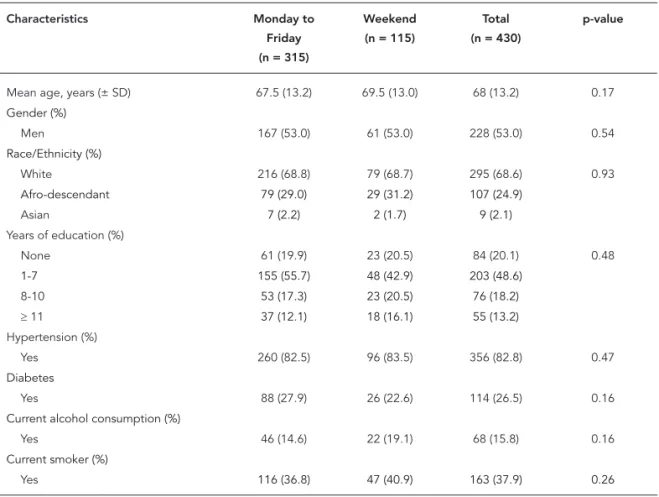
Table 1 shows the general characteristics of the study sample by the specific day of the week on which the patient was admitted to hospital. A total of 430 first-time stroke patients aged 35 years and over admitted between April 2006 and December 2008 were included in our analysis. No variation in frequency was found between weekday and weekend admissions. Figure 1 shows stroke cases by the specific day of the week of admission. The highest frequency of stroke onset was on Tues-day (18.1%) and ThursTues-day (16.7%) for ischemic
stroke, and Monday (20%), Thursday (20%) and Tuesday (18.5%) for intracerebral hemorrhage. No statistically significant differences in frequen-cy of stroke subtypes across specific days of the week of admission (Monday to Sunday) (p = 0.59) were found. Frequency of ischemic strokes was higher on weekends and frequency of hemor-rhagic strokes was higher on weekdays (Monday to Friday); however these differences were not statistically significant (p = 0.11). No statistically significant differences were found between gen-ders. With regard to case fatality after 10, 28, 180 days and 12 months, no statistically significant difference in the number of deaths across specif-ic days of the week of admission was found with regard to ischemic stroke. However, a statistically significant difference in case fatality after 10 days and 12 months was found with respect to hemor-rhagic stroke (Table 2).
With regard to one-year survival, we found that patients admitted on weekends had a lower survival rate than those admitted on weekdays
Table 1
Baseline characteristics of 430 fi rst-time stroke patients from the EMMA by the specifi c day of the week of admission to hospital.
Characteristics Monday to Friday (n = 315)
Weekend (n = 115)
Total (n = 430)
p-value
Mean age, years (± SD) 67.5 (13.2) 69.5 (13.0) 68 (13.2) 0.17
Gender (%)
Men 167 (53.0) 61 (53.0) 228 (53.0) 0.54
Race/Ethnicity (%)
White 216 (68.8) 79 (68.7) 295 (68.6) 0.93
Afro-descendant 79 (29.0) 29 (31.2) 107 (24.9)
Asian 7 (2.2) 2 (1.7) 9 (2.1)
Years of education (%)
None 61 (19.9) 23 (20.5) 84 (20.1) 0.48
1-7 155 (55.7) 48 (42.9) 203 (48.6)
8-10 53 (17.3) 23 (20.5) 76 (18.2)
≥ 11 37 (12.1) 18 (16.1) 55 (13.2)
Hypertension (%)
Yes 260 (82.5) 96 (83.5) 356 (82.8) 0.47
Diabetes
Yes 88 (27.9) 26 (22.6) 114 (26.5) 0.16
Current alcohol consumption (%)
Yes 46 (14.6) 22 (19.1) 68 (15.8) 0.16
Current smoker (%)
Yes 116 (36.8) 47 (40.9) 163 (37.9) 0.26
Table 2
Case-fatality after 10, 28, 180 days and the one-year follow-up in in-hospital admissions for stroke by stroke subtype (ischemic and hemorrhagic).
Monday to Friday n (%)
Weekends n (%)
p-value
Ischemic
Time of follow-up
10 days 19 (7.0) 6 (6.5) 0.86
28 days 31 (11.4) 10 (10.8) 0.87
180 days 50 (18.4) 20 (21.5) 0.51
One-year 60 (22.1) 26 (28.0) 0.25
Hemorrhagic Time of follow-up
10 days 5 (11.6) 7 (31.8) 0.047
28 days 7 (16.3) 7 (31.8) 0.15
180 days 10 (23.3) 10 (45.5) 0.07
One-year 11 (25.6) 11 (50.0) 0.049
Figure 1
Ischemic and parenchymal hemorrhagic stroke cases by the specifi c day of the week of admission to hospital.
(p = 0.039). The analysis of survival by stroke subtypes showed no statistically significant dif-ference with regard to ischemic stroke patients (Figure 2). However, with respect to intracerebral hemorrhage, a significant difference in survival
Figure 2
Kaplan-Meier curves showing deaths after fi rst-ever stroke with one-year follow-up by specifi c day of the week of admission to hospital of ischemic stroke patients participating in the EMMA.
admitted on weekdays (Figure 3). The results of the Cox analyses demonstrate a similar pat-tern (Table 3) with an increased risk of death on weekends among intracerebral hemorrhage pa-tients (multivariate hazard ratio of 2.49; 95%CI:
1.10-5.81, p trend = 0.03).
Discussion
The frequency of ischemic strokes was highest on Tuesdays and Thursdays, while hemorrhagic strokes were more common on Mondays, Tues-days and ThursTues-days. No statistically significant difference in the weekday patterns was observed between the ischemic and hemorrhagic stroke subtypes. However, risk of death from hemor-rhagic stroke after 10 days and 12 months was greater for patients admitted on weekends and chance of survival from intracerebral hemor-rhage was lower in patients admitted on week-ends. No difference in survival was found among ischemic stroke patients.
Most studies show that the frequency of stroke onset is higher in the beginning of the week 8,9,10,11,12,13. However, a number of studies show that frequency of stroke onset is higher on the weekend 18,19 or that a mixed pattern of fre-quency occurs beginning on the weekend and continuing into the beginning of the week until Monday 14 or Tuesday 15. Our analysis showed that the frequency of strokes was lower at week-ends followed by higher frequencies on Mon-days, Tuesdays and Thursdays; however, these differences are small and statistically insignifi-cant. Several authors have questioned whether
frequency is really higher in the beginning of the week or lower on the weekend 11,15. The only study that observed higher frequency at the end of the week (Thursdays and Fridays) analyzed frequencies by gender and stroke subtype, find-ing that frequency of ischemic stroke onset on Thursdays and Fridays was highest in women 19. Our study showed no statistically significant differences in frequency of the different stroke subtypes between men and women. It should be noted however that the present study may lack power of analysis when it comes to gender.
In Brazil, the only retrospective study to eval-uate cardiovascular deaths (International Classi-fication of Diseases – ICD 9; codes 390 to 459) by the day of the week of occurrence, carried out in Ribeirão Preto, State of São Paulo, showed that in-cidence peaked on Mondays. However, this study does not provide separate information for stroke cases 21. The weekly pattern of occurrence of coronary heart disease has been widely studied and results suggest that onset frequency is high-est on Mondays. However, there is no consensus on this possibility, even in the case myocardial infarction. The reasons for a possible pattern of increased stroke onset on Mondays are not clear, but may include stress associated with the begin-ning of weekly activities, higher blood pressure or an inadequate profile of lifestyle risk factors on Monday after weekends 28. The profile of car-diovascular risk factors between the two groups in this study was very similar and the reasons for this pattern remain unclear.
case-Table 3
Adjusted hazard ratios (95%CI) for fatal stroke cases by the specifi c day of the week of admission to hospital in the EMMA during one-year of follow-up.
Stroke (deaths/events) Day of the week (deaths/events)
Monday to Friday Weekend p-trend
All stroke (108/430) (71/315) (37/115)
Age-adjusted Reference (1.00) 1.42 (0.95-2.11) 0.09 Cardiovascular risk factors adjusted Reference (1.00) 1.44 (0.97-2.15) 0.07
Ischemic stroke (86/365) (60/272) (26/93)
Age-adjusted Reference (1.00) 1.18 (0.78-1.87) 0.48 Cardiovascular risk factors adjusted Reference (1.0) 1.20 (0.75-1.90) 0.45
Intracerebral hemorrhage (22/65) (11/43) (11/22)
Age-adjusted Reference (1.00) 2.47 (1.07-5.73) 0.04 Cardiovascular risk factors adjusted Reference (1.00) 2.49 (1.10-5.81) 0.03
Note: cardiovascular risk factors model included adjustments by age, history of diabetes, alcohol consumption and smoking status.
Figure 3
Kaplan-Meier curves showing deaths after fi rst-ever stroke with one-year follow-up by specifi c day of the week of admission to hospital of intracerebral hemorrhage patients participating in the EMMA.
fatality after seven days 22,23. One study carried out in a stroke center that evaluated mortality at a three-month follow-up showed no significant differences for cases that occurred during normal office hours and out of office hours 25. Most stud-ies show higher mortality among patients admit-ted at weekends 22,23,24,26. One study concluded that weekends represent a period of increased risk of death for ischemic stroke patients, but that this increased risk appears to represent an exacerbation of underlying night-time risk pres-ent during weekdays 26. Another study showed no differences in stroke mortality by day of week
of occurrence 25. Our results suggest a higher ten-day and 12-month case-fatality among hemor-rhagic stroke patients admitted at the weekend.
patients admitted at the weekend. One study found that mortality was higher on the week-end and showed that certain types of hospital care, such as brain scans, were less available on these days and this could explain the higher risk of mortality at weekends 29. In contrast, with re-gard to ischemic stroke, no difference was found between in-hospital mortality rates and day of admission. However, the rate of ten-day and twelve-month case-fatality was higher among hemorrhagic stroke patients.
We found a high rate of mortality after twelve months among the intracerebral hemorrhage patients in our sample. The only study that eval-uated late case-fatality (after 90 days) was that of Albright et al. 25. One important difference is that they evaluated stroke fatality in a stroke unit as opposed to a community hospital and therefore differences in patient profile could ex-plain any differences. It is possible to speculate that certain factors related to the hospital stay could be associated with the survival rates ob-served at the one-year follow-up. However, the effect of these factors is very small and unclear due to the small number of stroke deaths at one-year follow-up.
The weekend effect is not restricted to stroke patients and several possible explanations for this phenomenon have given for a number of different conditions worldwide. One of the most plausible explanations is the reduced number of hospital staff and lack of availability of certain invasive procedures at weekends. Furthermore, the weekend effect may exist due to differences in the profiles of weekend and weekday stroke patients; however, this was not the case in our study because the cardiovascular risk factors and sociodemographic characteristics of the two groups were very similar. Manfredini et al. 20
also suggests that patients with multiple comor-bidities and more severe stroke cases are more likely to arrive at hospital at the weekend as is the case with more severe cases of acute myo-cardial infarction (with ST segment elevation). In our analysis, a multivariate adjustment for age and certain cardiovascular risk factors did not af-fect the results. However, the EMMA adopts the original protocol of WHO protocol and informa-tion regarding other cardiovascular risk factors, such as diet and physical activity, that may also influence the results and could help to explain the higher mortality from hemorrhagic strokes at the weekend, were not available.
Our study has the following advantages: it was performed at a community hospital that accounts for approximately 80% of all hospital-izations in the study region; the diagnosis of the stroke subtype was performed by a neurologi-cal liaison team using CT-scan; the present study evaluated survival after a one-year follow-up as opposed to most studies that evaluated only in-hospital mortality or seven-day case-fatality. Limitations of this study include: the exclusion of outpatients, which might be considered as a bias due to the exclusion of mild cases that do not seek medical care or more severe cases that died before being admitted to hospital; the sample size may not provide for certain stratified analyses; since this was an observational study losses (66 individuals or 15.3%) occurred during the twelve-month follow-up. Despite the latter limitation, additional missing data analysis found no signifi-cant changes to the findings described here.
Resumen
El estudio evaluó la distribución de casos incidentes de accidente vascular cerebral (AVC) que fueron al hospital de lunes a viernes o durante los fines de semana en el Estudio de Mortalidad y Morbilidad del AVC (EMMA). El EMMA es una cohorte de pacientes con AVC en un hospital comunitario de la ciudad de São Paulo, Bra-sil. Casos consecutivos de primer episodio de AVC inter-nados, entre abril de 2006 y diciembre de 2008, fueron seguidos prospectivamente durante un año. No hubo diferencia en la frecuencia de las internaciones por AVC isquémico o hemorrágico durante los días de la sema-na. Sin embargo, la letalidad en 10 días y tras un año había aumentado en el AVC hemorrágico. En el análi-sis de supervivencia de un año, pacientes admitidos los fines de semana por hemorragia intraparenquimatosa presentaron menor supervivencia (50%), comparados con los admitidos de Lunes hasta Viernes (22%, p log-rank = 0.03). Se encontró una razón de riesgo multiva-riada de un 2,49 (IC95%: 1,10-5,81; p tendencia = 0,03) de morir los fines de semana en comparación con los lunes y viernes para la hemorragia intracerebral. No hubo diferencia en la supervivencia para la muestra to-tal de AVC ni para el AVC isquémico.
Accidente Cerebrovascular; Supervivencia; Admisión del Paciente
Contributors
J. B. Barros performed statistical analysis, wrote the first draft of this manuscript and reformulated subsequent versions. A. C. Goulart participated in study design, per-formed statistical analysis and revised the final version of this manuscript. A. P. Alencar performed statistical analysis and revised the final version of this manuscript. P. A. Lotufo participated in study design, performed statistical analysis and revised the final version of this manuscript. I. M. Bensenor participated in study de-sign, performed statistical analysis and revised the final version of this manuscript.
Acknowledgments
We are grateful to all interviewers, to the research staff of the EMMA, to the University of São Paulo Hospital and FAPESP.
References
1. Feigin VL, Lawes CM, Bennett DA, Barker-Collo SL, Parag V. Worldwide stroke incidence and early case fatality reported in 56 population-based studies: a systematic review. Lancet Neurol 2009; 8:355-69. 2. Lotufo PA. Stroke in Brazil: a neglected disease.
São Paulo Med J 2005; 123:3-4.
3. Lavados PM, Sacks C, Prina L, Escobar A, Tossi C, Araya F, et al. Incidence, case-fatality rate, and prognosis of ischaemic stroke subtypes in a predominantly Hispanic-Mestizo population in Iquique, Chile (PISCIS Project): a communi-ty-based incidence study. Lancet Neurol 2007; 6:140-8.
4. Minelli C, Fen LF, Minelli DP. Stroke incidence, prognosis, 30-day, and 1-year case fatality rates in Matão, Brazil: a population-based prospective study. Stroke 2007; 38:2906-11.
5. Cabral NL, Gonçalves AR, Longo AL, Moro CH, Costa G, Amaral CH, et al. Incidence of stroke sub-types, prognosis and prevalence of risk factors in Joinville, Brazil: a 2 year community based study. J Neurol Neurosurg Psychiatry 2009; 80:755-61. 6. Goulart AC, Bensenor IM, Fernandes TG, Alencar
AP, Fedeli LM, Lotufo PA. Early and one-year stroke case fatality in Sao Paulo, Brazil: applying the World Health Organization’s stroke STEPS. J Stroke Cerebrovasc Dis 2011; 21:832-8.
8. Kelly-Hayes M, Wolf PA, Kase CS, Brand FN, McGuirk JM, D’Agostino RB. Temporal patterns of stroke onset. The Framingham Study. Stroke 1995; 26:1343-7.
9. Manfredini R, Casetta I, Paolino E, La Cecilia O, Boari B, Fallica E, et al. Monday preference in on-set of ischemic stroke. Am J Med 2001; 111:401-3. 10. Manfredini R, Manfredini F, Boari B. The Monday
peak in the onset of ischemic stroke is indepen-dent of major risks factors. Am J Emerg Med 2010; 28:715-9.
11. Milosevic V, Zivkovic M, Djuric S, Vasic V, Pekm-ezovic T. Weekly variation of hospital admissions for stroke in Nis (Serbia). Clin Neurol Neurosurg 2010; 112:485-9.
12. Johansson BB, Norrving B, Winder H, Wu JY, Hal-berg F. Stroke incidence: circadian and circaseptan (about weekly) variations in onset. Prog Clin Biol Res 1990; 341A:427-36.
13. Brackenridge CJ. Daily variation and other factors affecting the occurrence of cerebrovascular acci-dents. J Gerontol 1981; 36:176-9.
14. Pasqualetti P, Natali G, Casale R, Colantonio D. Epidemiological chronorisk of stroke. Acta Neurol Scand 1990; 81:71-4.
15. Jakovljevic D; on behalf of the FINSTROKE Regis-ter Group. Day of the week and ischemic stroke. Is it Monday high or Sunday low? Stroke 2004; 35:2089-93.
16. Haapaniemi H, Hillbom M, Juvela S. Weekend and Holiday increase in the onset of ischemic stroke in young women. Stroke 1996; 27:1023-7.
17. Anderson N, Feigin V, Bennett D, Borad J, Pledger M, Anderson C, et al. Diurnal, weekly, and season-al variations in stroke occurrence in a population-based study in Auckland, New Zealand. N Z Med J 2004; 117:U1078.
18. Khan FA, Engstrom G, Jerntorp I, Pessah-Hasmus-sen H, Janzon L. Seasonal pattern of incidence and case fatality of stroke in Malmö. Neuroepidemiol-ogy 2005; 24:26-31.
19. Wang H, Sekine M, Chen X, Kagamimori S. A study of weekly and seasonal variation of stroke onset. Int J Biometeorol 2002;47:13-20.
20. Manfredini R, Fabbian F, Pala M, Tiseo R, De Giorgi A, Manfredini F, et al. Seasonal and weekly patterns of occurrence of acute cardiovascular diseases: does a gender difference exist? J Women’s Health 2011; 20:1663-8.
21. Yazzle Rocha JS, Silva GC. Myocardial infarction hospitalization by the day of the week: retrospec-tive study. Rev Saúde Pública 2000; 34:157-62. 22. Saposnik G, Baibergenova A, Bayer N, Hachinski V.
Weekends: a dangerous time for having a stroke? Stroke 2007; 38:1211-5.
23. Janszky I, Ahnve S, Ljung R. Weekend versus week-day admission and stroke outcome in Sweden from 1968 to 2005. Stroke 2007; 38:e94.
24. Reeves MJ, Smith E, Fonarow G, Hernandez A, Pan W, Schwamm LH, et al. Off-hour admission and in-hospital stroke case fatality in the get with the guidelines-stroke program. Stroke 2009; 40:569-76. 25. Albright KC, Raman R, Ernstrom K, Hallevi H, Mar-tin-Schild S, Meyer BC, et al. Can comprehensive stroke centers erase the ‘weekend effect’? Cerebro-vasc Dis 2009; 27:107-13.
26. Luyt CE, Combes A, Aegerter P, Guidet B, Trouillet JL, Gibert C, et al. Mortality among patients ad-mitted to intensive care units during weekday day shifts compared with “off” hours. Crit Care Med 2007; 35:3-11.
27. Goulart AC, Bustos IR, Abe IM, Pereira AC, Fedeli LM, Benseñor IM, et al. A stepwise approach to stroke surveillance in Brazil: the EMMA (Estudo de Mortalidade e Morbidade do Acidente Vascular Cerebral) study. Int J Stroke 2010; 5:284-9.
28. Murakami S, Otsuka K, Kubo Y, Shinagawa M, Ya-manaka T, Ohkawa S, et al. Repeated ambulatory monitoring reveals a Monday morning surge in blood pressure in a community-dwelling popula-tion. Am J Hypertens 2004; 17(12 Pt 1):1179-83. 29. Palmer WL, Bottle A, Davie C, Vincent CA, Aylin
P. Dying for the weekend: a retrospective cohort study on the association between day of hospital presentation and the quality and safety of stroke care. Arch Neurol 2012; 9:1-7.
Submitted on 25/May/2012