Mild Hypothermia May Offer Some
Improvement to Patients with MODS after CPB
Surgery
Xiaoqi Zhao
1, MD; Tianxiang Gu
1, PhD; Zongyi Xiu
1, MD; Enyi Shi
1, PhD; Lei Yu
1, MD
Abstract
Objective: To summarize the effect of mild hypothermia on function of the organs in patients with multiple organ dysfunction syndrome after cardiopulmonary bypass surgery.
Methods: The patients were randomly divided into two groups, northermia group (n=71) and hypothermia group (n=89). We immediately began cooling the hypothermia group when test results showed multiple organ dysfunction syndrome, meanwhile all patients of two groups were drawn blood to test blood gas, liver and kidney function, blood coagulation function, and evaluated the cardiac function using echocardiography from 12 to 36 hours. We compared the difference of intra-aortic balloon pump, extracorporeal membrane oxygenation rate and mortality within one month after intensive care unit admission.
Results: Among the 160 patients, 36 died, 10 (11.24%) patients were from the hypothermia group and 26 (36.6%) from the northermia group (P<0.05). In northermia group, 45 (63.38%) patients used intra-aortic balloon pump and 4 (5.63%), extracorporeal membrane oxygenation; in hypothermia group, 35 (39.32%) patients used intra-aortic balloon pump and 2 (2.25%), extracorporeal membrane oxygenationP<0.05). The patients’
heart rate decreased signiicantly in the hypothermia group. The heart rate of hypothermia group is signiicantly slower than the northermia group at the 36th hour (P<0.05). But the mean arterial pressure of hypothermia group is signiicantly higher than the northermia group at the 36th hour (P<0.05). In hypothermia group, PO2, SvO2 and lactate were improved signiicantly compared to pre-cooling (P<0.05), and they were signiicantly better than the northermia group at the 36th hour (P<0.05%). Prothrombin time and activated partial thromboplastin time have no signiicantly difference between the two groups (P>0.05). But the platelet count has signiicantly difference between the two groups at the 36th hour (P<0.05). The aspartate transaminase, alanine transaminase and creatinine were improved signiicantly in the hypothermia group, and they were signiicantly better than the northermia group (P<0.05).
Conclusion: Mild hypothermia is feasible and safe for patients with multiple organ dysfunction syndrome after cardiopulmonary bypass surgery.
Keywords: Hypothermia. Multiple Organ Failure. Shock, Cardiogenic.
DOI: 10.5935/1678-9741.20160048
1Department of Cardiac Surgery ICU, The First Affiliated Hospital of China Medical
University, Shenyang, P.R. China.
This study was carried out in the Department of Cardiac Surgery ICU, The First Affiliated Hospital of China Medical University, Shenyang, P.R. China. No financial support.
No conflict of interest.
Correspondence Address: Xiaoqi Zhao
Nanjingbei Street 155 Heping Shenyang District, People’s Republic of China E-mail: [email protected]
Article received on January 5th, 2016
Article accepted on June 8th, 2016
Abbreviations, acronyms & symbols ALB
ALT APTT AST ATP BSA CI CPB ECMO Emax HR HT
= Albumin
= Alanine transaminase
= Activated partial thromboplastin time = Aspartate transaminase
= Adenosine triphosphate = Body surface area = Cardiac index
= Cardiopulmonary bypass
= Extracorporeal membrane oxygenation = Ventricular end-systolic maximum elastance = Heart rate
= Hypothermia group
IABP ICU LCOS MAP MODS NT PLT PT PVA SIRS SV
= Intra-aortic balloon pump = Intensive Care Unit
= Low cardiac output syndrome = Mean arterial pressure
= Multiple organ dysfunction syndrome = Northermia group
= Platelet count = Prothrombin time = Pressure-volume area
diseases before surgery; patients with massive blood transfusion (massive blood transfusion defined as the replacement of a patients’ total blood volume in less than 24 hours, or as the acute administration more than half the patients’ estimated blood volume per hour); patients died within 24 hours after ICU admission.
The MODS diagnosis criterion of MODS[4] is shown in Table 1.
All the patients used urine catheter with temperature probe by which we can monitore the patients’ bladder temperature. At the admission to Cardiac Surgery ICU, the patients were assisted by ventilator, tidal volume (ml) = Body weight (kg)*10(ml/ kg); respiratory frequency 12-14 times/min; FiO2:0.50-0.75. At the same time, intravenous sedation and muscular relaxation agent were infused. We used the echocardiography to monitor cardiac stroke volume (SV), then we calculated cardiac index (CI), CI=heart rate (HR)*SV/body surface area (BSA).
The basic treatments for the patients of the two groups are same, including intravenous infusion of vasoactive agents to maintain hemodynamic stability and improve organs function. However, in the hypothermia group (HT), hypothermia treatment was implemented by a computer cooling blanket (CJ-1 temperature lowering instrument). The patient was placed on the blanket which is filled with the variable temperature cycle of cryogenic mat. We adjusted the temperature of cooling blanket until the patients’ bladder temperature reached and maintained 35℃. The cooling rate was about 1.0℃/h[5]. The bladder
temperature was reduced from 36.1℃±0.2℃ to 33.1℃±0.1℃ within 168±10min of starting cooling and remained lowered at 32.9±0.5℃ during 36 hours.
Table 1. The diagnostic criteria of MODS[4].
System Criterion
Circulatory
(1) SBP <90 mmHg; (2) MAP <70 mmHg;
(3) shock, ventricular tachycardia or ventricular fibrillation, myocardial infarction
Any of the three
Respiratory Oxygenation index (PO2/FiO2) <300 mmHg
Nervous (1) Indifference or agitation, drowsiness, coma
(2) Glasgow score ≤14 Any of the two
Blood (1) PLT<100*10
9/L
(2) TT, APTT Prolonged or shortened PT,3P(+) Any of the two
Liver (1) TBIL >20.5 µmol/L
(2) ALB <28 g/L; Any of the two
Urinary system (1) blood Cr>123.8 µmol/L;
(2) urine volume < 500 ml/24h. Any of the two
Gastrointestinal
(1) bowel sounds weaken or disappear;
(2) gastric drainage fluid or stool occult blood (+), or black stool, haematemesis.
(3) intra-abdominal pressure ≥11 cmH2O.
Any of the three
ALB=albumin; APTT=activated partial thromboplastin time; Cr=creatinine; MAP=mean arterial pressure; PLT=platelet count; PT=prothrombin time; SBP=systolic blood pressure; TBIL=total bilirubin; TT=thrombin time
INTRODUCTION
Multiple organ dysfunction syndrome (MODS) is defined as “the presence of altered organ function in an acutely ill patient such that homeostasis cannot be maintained with intervention”[1]. It is a
cause of high mortality and morbidity in Intensive Care Unit (ICU)[2].
Many advances have been made in the treatment of MODS. Hypothermia has become an established therapeutic concept in the treatment of cardiovascular and neurological diseases[3],
and it has shown myocardial and neurological protection, yet the benefits for MODS after cardiac surgery have not been well defined. We hypothesized that mild hypothermia has organ protective effects and can ameliorate organ dysfunction to improve the survival rate for the patients with MODS after cardiopulmonary bypass (CPB) cardiac surgery.
METHODS
Study Design
The study was designed as prospective unblended intervention trial where patients served as their own controls. This study protocol was approved by the ethics committee of the First Affiliated Hospital of China Medical University. The patients with MODS after cardiac surgery underdoing CPB from May 2011 to February 2015 were screened for this study. The cardiac function of all the patients was class II-III (New York Heart Association).
Data Collection
If patients’ postoperative test results (we marked it as pre-cooling) showed two or more abnormal organ function, we considered the existence of MODS. The patients were randomly divided into two groups, one is northermia group (NT) n=71, the other one is HT (hypothermia group) n=89. Then we immediately began cooling the HT (we marked the time as 0h), meanwhile all patients were drawn arterial blood and venous blood to test blood gas, liver and kidney function, blood coagulation function, and evaluated the cardiac function using echocardiography from 12 to 36 hours. We monitored each patient closely about the parameters of vital signs: mean arterial pressure (MAP), HR, urinary volume.
Statistical Analysis
All statistical analysis were performed using SPSS 17.0, measurement data of each group were performed using normality test, F-test and tested with Rank test.
RESULTS
Among the 160 patients considered for inclusion, 36 died, 10 (11.24%) patients were from the HT and 26 (36.6%) were from the NT (P<0.05). In NT, there were 45 patients who used IABP = Intra-aortic balloon pump (63.38%), 4 patients who used extracorporeal membrane oxygenation (ECMO) (5.63%). In HT, there were 35 patients who used IABP (39.32%), 2 (2.25%) patients ECMO (P<0.05). The patients’ HR decreased significantly after the application of hypothermia. The HR difference between the two groups at the 36th hour is significant (P<0.05), shown as
Figure 1. The MAP of HT is lower than NT significantly at 0 hour, because we used the sedation and muscular relaxation agent, and the depth of sedation in HT is much more deeply than
NT in order to prevent chill. But the MAP of HT is significantly higher than NT after hypothermia at the 36th hour (P<0.05),
shown as Figure 2. PO2, SvO2, lactate and CI have no significantly difference between the two groups pre-cooling (P>0.05). In HT group, PO2, SvO2 and lactate were improved significantly at the 36th hour compared with pre-cooling (P<0.05), and they were
better than NT group significantly at the 36th hour (P<0.05%) as
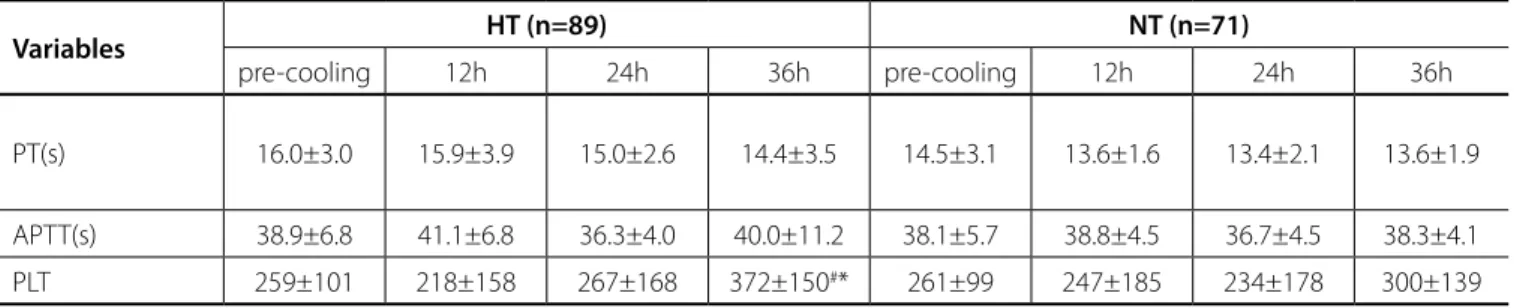
shown in Table 2. Prothrombin time (PT) and activated partial thromboplastin time (APTT) have no significantly difference between the two groups (P>0.05). But the platelet count (PLT) has significantly difference between the two groups at the 36th
hour (P<0.05%), shown in Table 3. The aspartate transaminase (AST), alanine transaminase (ALT) and creatinine were improved significantly in the HT group, and they were significantly better than the NT group (P<0.05), shown in Table 4.
DISCUSSION
The first major finding of the present study is that the induction of mild hypothermia until the 36th hour is feasible and
safe for patients with MODS after CPB. There are several proposed mechanisms for the development of MODS, including[6]:(1)
cell or tissue hypoxia; (2) induction of cellular apoptosis; (3) translocation of microbes or components of microbes from the gastrointestinal tract; (4) immune system dysregulation, and (5) mitochondrial dysfunction. The predominant failure organs involved in MODS are hepatic, respiratory, gastrointestinal, cardiovascular, coagulation, renal, central nervous and endocrine Fig. 1 - Heart rate (HR) changes of the two groups. The patients’ heart
rate decreased significantly after the application of hypothermia. The HR difference between two groups at the 36th hour is significant
(P<0.05).
so that the organization oxygen can achieve balance between supply and demand, maintain each organ function. It reduces metabolic demand and high energy phosphate utilization in the myocardium[13-15], it is advantageous to oxygen uptake and
utilization of the heart cells. At the same time, mild hypothermia can avoid ventricular fibrillation which may be caused by deep hypothermia, and Bernard et al.[16] have discovered the incidence
of infection is not common in short term hypothermia treatment (12-36 hours), so we chose the mild hypothermia for 36 hours in this study.
Some studies have shown that mild hypothermia inhibits inflammation reaction, inhibit the release and expression of TNF-alpha and ICAM-1, and protect the organ function. In the hypothermia application process, it should be fully realized the systems[7]. Most cardiac surgery need CPB, but intra-operation
of cardiac surgery, CPB can lead to a variety of inflammatory medium content increased significantly. As a result abnormal cytokine expression and systemic inflammatory reaction in tissues impaired the organs function[8], and even lead to further
multiple organ dysfunction[9].
Hypothermia can be divided into mild hypothermia (32-35℃), moderate hypothermia (28-32℃), deep hypothermia (20-28℃), super-deep hypothermia (<20℃)[10]. Many studies
have shown that mild hypothermia interference with the body’s homeostasis is not significant. It can decrease the oxygen consumption of the tissue, delay the adenosine triphosphate (ATP) consumption when tissue is ischemia[11]. The mild hypothermia
can improve the organization of ischemia hypoxia tolerance[12],
Table 3. Coagulation index changes.
Variables HT (n=89) NT (n=71)
pre-cooling 12h 24h 36h pre-cooling 12h 24h 36h
PT(s)
16.0±3.0 15.9±3.9 15.0±2.6 14.4±3.5 14.5±3.1 13.6±1.6 13.4±2.1 13.6±1.9
APTT(s) 38.9±6.8 41.1±6.8 36.3±4.0 40.0±11.2 38.1±5.7 38.8±4.5 36.7±4.5 38.3±4.1
PLT 259±101 218±158 267±168 372±150#* 261±99 247±185 234±178 300±139
#P<0.05 versus pre-cooling; *P<0.05 versus NT.
APTT=activated partial thromboplastin time; PLT=platelet count; PT=prothrombin time
Table 4. Liver and kidney index changes.
Variables HT (n=89) NT (n=71)
pre-cooling 36h pre-cooling 36h
rank (ALT) 341 257 321 398
rank (AST) 338 268.1 318 370.8
rank (Cr) 388 246.5 364 379.5
ALT=alanine transaminase; AST=aspartate transaminase; Cr=creatinine Table 2. Changes of blood gas and CI.
Variables HT (n=89) NT (n=71)
pre-cooling 12h 24h 36h pre-cooling 12h 24h 36h
PO2 (mmHg) 88±13 89±17 95±9 102±11#* 85±15 88±10 90±12 89±14
SvO2 (%) 41±3.0 44±2.5 50±1.4 53±1.1#* 43±2.9 42±2.0 45±2.3 48±1.7
Lac (mmol/L) 8.2±2.6 8.9±2.0 8.0±1.1 5.5±1.5#* 7.9±2.7 8.5±3.0 8.2±1.9 8.1±1.8
CI (ml.m-1.m-2) 30±5.0 34±4.6 37±5.2 42±5.0#* 30.2±4.5 32±2.9 31±4.1 34±2.8
#P<0.05 versus pre-cooling; *P<0.05 versus NT
side effect as its influence on blood coagulation function and so on. But in our study, we did not observe any complication of clinical relevance associated with mild hypothermia, especially bleeding, thrombosis, arterial or pulmonary embolism and no adverse haemodynamic events. Rodriguez et al.[17] showed that, in
the case of patients with chill, oxygen consumption will increase by 45%. Frank et al.[18] found that for patients with a history of
myocardial ischemia, chill increased the risk of myocardial infarction, so we should use sedation and neuromuscular blockade to anti-shiver in the duration of hypothermia.
The second major finding is that moderate hypothermia significantly improves parameters of organ function in the patients with MODS after CPB surgery. Low cardiac output syndrome (LCOS) is a predominant cause of the MODS after cardiac surgery[19], meanwhile, MODS may lead to cardiovascular
dysfunction characterized by biventricular dilatation, decreased ejection fraction and hypotension[20]. Then MODS may lead to
form a vicious circle, and make the condition worse. So, in order to treat the MODS after cardiac surgery, correcting heart function effectively is the most important. Because of the improvement of cardiac function, the perfusion of the other organs was improved and the organ functions were improved further. As cardiac power output predicts mortality during LCOS[21], our data
indicate that the improvement to the patients with MODS after CPB surgery in the hypothermia group may in part be related to improved cardiac performance. In a situation of severely depressed left ventricle function, cooling may improve systemic oxygen supply-demand balance not only by reducing demand but also by increasing cardiac output via its positive inotropic effect[22]. The positive inotropic effect of hypothermia has been
confirmed by Gotberg et al.[23] using whole-animal models
of cardiogenic shock. The inotropic effect of hypothermia is associated with an effect at the level of myofilaments[24],
without causing changes in sarcoplasmatic calcium content or intracellular calcium concentration[25]. This implies that
hypothermia can recruit a contractile reserve without increasing energy demand. In the acute myocardial infarction model, therapeutic hypothermia has been proved that it improves myocardial dysfunction by reducing ischemia-reperfusion injury and results in a decreased size of infarction[26,27]. Ristagno et
al.[28] studied the effect of hypothermia on ventricular myocyte
contractility, and discovered that hypothermia increased ventricular myocyte contractility either under conditions of normal perfusion or after perfusion following a 10 min interval of ischemia. Shattock & Bers[29] and Miao & Lynch[30] showed that
hypothermia increases in myocardial force generation and this was confirmed by Fukunami & Hearse[31] and Nishimura et al.[32].
Suga et al.[33] resported that cardiac cooling increased ventricular
end-systolic maximum elastance (Emax) without affecting systolic pressure-volume area (PVA)-independent VO2 and has energetically more advantages in saving myocardial oxygen-consumption compared to catecholamine in cross circulated canine heart preparations.
Some limitations of our study should be acknowledged. Firstly, this study was designed as a prospective unblended intervention trial, so there is a chance that sicker patients might have been considered for normothermia. But in our study, the
initial parameters have no significant differences between the two groups. So the authors think the potential bias induced by that is limited. Another limitation is the information on temperature. We recorded the time in which TH was reached, but we didn’t document the course of the temperature during rewarming. Thus, maybe further research is needed to identify the effect of the course of rewarming on mortality.
CONCLUSION
In summary, our studies demonstrate that mild hypothermia is feasible and safe also for patients with MODS after CPB surgery. Mild hypothermia can improve the organ function effectively, and improve the morbidity and mortality of the patients. It can slow the MODS/Systemic inflammatory response syndrome (SIRS) development speed and reduce the time of protection and further treatment for cells and organs.
Authors’ roles & responsibilities
XZ TG ZX ES
LY
Final manuscript approval
Conception and design study; final manuscript approval Statistical analysis; final manuscript approval
Manuscript redaction or critical review of its content; final manuscript approval
Statistical analysis; final manuscript approval
REFERENCES
1. American College of Chest Physicians/Society of Critical Care Medicine Consensus Conference: definition for sepsis and organ failure and guidelines for the use of innovative therapies in sepsis. Crit Care Med. 1992;20(6):864-74.
2. Umegaki T, Ikai H, Imanaka Y. The impact of acute organ dysfunction on patients’ mortality with severe sepsis. J Anaesthesiol Clin Pharmacol. 2011;27(2):180-4.
3. Thygesen K, Alpert JS, Jaffe AS, Simoons ML, Chaitman BR, White HD; Joint ESC/ACCF/AHA/WHF Task Force for Universal Definition of Myocardial Infarction; Authors/Task Force Members Chairpersons, ECG Subcommittee, Imaging Subcommittee, Classification Subcommittee, Intervention Subcommittee, Trials & Registries Subcommittee, ESC Committee for Practice Guidelines (CPG). Third universal definition of myocardial infarction. J Am Coll Cardiol. 2012;60(16):1581-98. 4. Shuwen Z, Chao W. Multi-center studies about the criterion of MODS.
Chin J Surg. 2009;47(1):40-5.
5. Hypothermia after Cardiac Arrest Study Group. Mild therapeutic hypothermia to improve the neurologic outcome after cardiac arrest. N Engl J Med. 2002;346(8):549-56.
6. Osterbur K, Mann FA, Kuroki K, DeClue A. Multiple organ dysfunction syndrome in humans and animals. J Vet Intern Med. 2014;28(4):1141-51. 7. Khadaroo RG, Marshall JC. ARDS and the multiple organ dysfunction
syndrome. Common mechanisms of a common systemic process. Crit Care Clin. 2002;18(1):127-41.
on-20. Hoesel LM, Niederbichler AD, Ward PA. Complement-related molecular events in sepsis leading to heart failure. Mol Immunol. 2007;44(1-3):95-102. 21. Tan LB. Cardiac pumping capability and prognosis in heart failure.
Lancet. 1986;2(8520):328:1360-3.
22. Alessio A, Martin M, Michael S, Birgit Z, Paul S, Jochen V, et al. Inotropic effects of experimental hyperthermia and hypothermia on left ventricular function in pigs-comparison with dobutamine. Crit Care Med. 2016;44(3):e158-67.
23. Götberg M, van der Pals J, Olivecrona GK, Götberg M, Koul S, Erlinge D. Mild hypothermia reduces acute mortality and improves hemodynamic outcome in a cardiogenic shock pig model. Resuscitation. 2010;81(9):1190-6.
24. Kusuoka H, Ikoma Y, Futaki S, Suga H, Kitabatake A, Kamada T, et al. Positive inotropism in hypothermia partially depends on an increase in maximal Ca(2+)-activated force. Am J Physiol. 1991;261(4 Pt 2):H1005-10. 25. Weisser J, Martin J, Bisping E, Maier LS, Beyersdorf F, Hasenfuss G, et
al. Influence of mild hypothermia on myocardial contractivity and circulatory function. Basic Res Cardiol. 2001;96(2):198-205.
26. Hypothermia after Cardiac Arrest Study Group. Mild therapeutic hypothermia to improve the neurologic outcome after cardiac arrest. N Engl J Med. 2002;346(8):549-56.
27. Bernard SA, Gray TW, Buist MD, Jones BM, Silvester W, Gutteridge G, et al. Treatment of comatose survivors of out-of-hospital cardiac arrest with induced hypothermia. N Engl J Med. 2002;346(8):557-63. 28. Ristagno G, Tantillo S, Sun S, Weil MH, Tang W. Hypothermia improves
ventricular myocyte contractility under conditions of normal perfusion and after an interval of ischemia. Resuscitation. 2010;81(7):898-903. 29. Shattock MS, Bers DM. Inotropic response to hypothermia and
temperature-dependence of ryanodine action in isolated rabbit and rat ventricular muscle: implications for excitation-contraction coupling. Circ Res. 1987;61(6):761-71.
30. Miao N, Lynch C 3rd. Effect of temperature on volatile anesthetic
depression of myocardiac contractions. Anesth Analg. 1993;76(2):366-71. 31. Fukunami M, Hearse DJ. The intropic consequences of cooling: studies
in the isolated rat heart. Heart Vessels. 1989;5(1):1-9.
32. Nishimura Y, Naito Y, Nishioka T, Okamura Y. The effects of cardiac cooling under surface-induced hypothermia on the cardiac function in the in situ heart. Interact Cardiovasc Thorac Surg. 2005;4(2):101-5. 33. Suga H, Goto Y, Igarashi Y, Yasumura Y, Nozawa T, Futaki S, et al. Cardiac
cooling increases Emax without affecting relation between O2 consumption and systolic pressure-volume area in dog left ventricle. Circ Res. 1998;63(1):61-71.
pump coronary artery bypass grafting: a study on myocardial, pulmonary, renal, intestinal, and hepatic injury. Chest. 2005;128(4):2677-87. 9. Sablotzki A, Friedrich I, Mühling J, Dehne MG, Spillner J, Silber RE, et
al. The systemic inflammatory response syndrome following cardiac surgery: different expression of proinflammatory cytokines and procalcitonin in patients with and without multiorgan dysfunctions. Perfusion. 2002;17(2):103-9.
10. Tissier R, Chenoune M, Ghaleh B, Cohen MV, Downey JM, Berdeaux A. The small chill: mild hypothermia for cardioprotection? Cardiovasc Res. 2010;88(3):406-14.
11. Birdi I, Caputo M, Underwood M, Angelini GD, Bryan AJ. Influence of normothermic systemic perfusion temperature on cold myocardial protection during coronary artery bypass surgery. Cardiovasc Surg. 1999;7(3):369-74.
12. Lewis ME, Al-Khalidi AH, Townend JN, Coote J, Bonser RS. The effects of hypothermia on human left ventricular contractile function during cardiac surgery. J Am Coll Cardiol. 2002;39(1):102-8.
13. Gilbert NF, Meyer PE, Tauriainen MP, Chao RY, Patel JB, Malloy CR, et al. Effects of hypothermia on myocardial substrate selection. Ann Thorac Surg. 2002;74(4):1208-12.
14. Buckberg GD, Brazier JR, Nelson RL, Goldstein SM, McConnell DH, Cooper N. Studies of the effects of hypothermia on reginal myocardial blood flow and metabolism during cardiopulmonary bypass-I. The adequately perfused beating, fibrillating, and arrested heart. J Thorac Cardiovasc Surg. 1977;73(1):87-94.
15. Ning XH, Xu CS, Portman MA. Mitochondrial protein and HSP70 signaling after ischemia in hypothermic-adapted hearts augmented with glucose. Am J Physiol. 1999;277(1 Pt 2):R11-7.
16. Bernard SA, Gray TW, Buist MD, Jones BM, Silvester W, Gutteridge G, et al. Treatment of comatose survivors of out-of-hospital cardiac arrest with induced hypothermia. N Engl J Med. 2002;346(8):557-63. 17. Rodriguez JL, Weissman C, Damask MC, Askanazi J, Hyman AI, Kinney
JM. Physiologic requirements during rewarming: suppression of the shivering response. Crit Care Med. 1983;11(7):490-7.
18. Frank SM, Fleisher LA, Breslow MJ, Higgins MS, Olson KF, Kelly S, et al. Perioperative maintenance of normothermia reduces the incidence of morbid cardiac events. A randomized clinical trial. JAMA. 1997;277(14):1127-34.
![Table 1. The diagnostic criteria of MODS [4] .](https://thumb-eu.123doks.com/thumbv2/123dok_br/15421229.590407/2.914.90.857.679.1055/table-diagnostic-criteria-mods.webp)