ISSN online: 1807-1775
DOI: 10.4301/S1807-17752014000300005
___________________________________________________________________________________________ Manuscript first received/Recebido em: 15/01/2014 Manuscript accepted/Aprovado em: 30/06/2014
* Fast Track – 11th CONTECSI International Conference on Information Systems and Technology Management Address for correspondence / Endereço para correspondência
Gislaine Cristina dos Santos Teixeira, Mestranda do Programa de Mestrado Profissional em Administração - Gestão de Projetos da Universidade Nove de Julho - UNINOVE
Emerson Antonio Maccari, Doutor em Administração pela Universidade de São Paulo - FEA/USP. Diretor do Programa de Pós-Graduação em Administração - PPGA da Universidade Nove de Julho - UNINOVE.
Published by/ Publicado por: TECSI FEA USP – 2014 All rights reserved.
PROPOSITION OF AN ALUMNI PORTAL BASED ON
BENCHMARKING AND INNOVATIVE PROCESS
PROPOSIÇÃO DE UM PORTAL DE EGRESSO (ALUMNI) BASEADO
EM BENCHMARKING E PROCESSO INOVADOR
Gislaine Cristina dos Santos Teixeira Emerson Antonio Maccari
UNINOVE - Nove de Julho University, São Paulo, SP, Brazil
___________________________________________________________________________________________
ABSTRACT
A common concern in institutions of higher education is to keep its former students involved with academic activities. It is a consensus that one of the most valuable assets of universities is their alumni, given that their accomplishments ensure more exposure for the university. In recent years, universities have encouraged a movement toward the establishment of alumni associations, as they provide networking opportunities and contact between the university and the alumni or among the alumni. An association that seeks membership and participation of its alumni should invest in the development of an attractive portal. In this sense, this research aims to analyze the portal of alumni associations of well-ranked universities, using a benchmarking process and a creative technique called SCAMPER. We also present a portal prototype that meets the current needs of the market.
Keywords: Alumni, Alumni Association, Benchmarking, SCAMPER
RESUMO
JISTEM, Brazil Vol. 11, No. 3, Sept/Dec., 2014 pp. 591-610 www.jistem.fea.usp.br
analisar o portal de associações de alumni de universidades bem avaliadas, por meio de benchmarking e de um processo inovador denominado SCAMPER. Ao final, apresenta-se a um protótipo de portal de egresso que atenda as atuais necessidades do mercado.
Palavras-chave: Egresso, Associação de Egressos, Alumni, Benchmarking, SCAMPER
1. INTRODUCTION
Globalization and advances in information technology have transformed the traditional business models in networks of relationships, so much so that the way people think and relate to one another is currently affected by the creative use of the media and information provision. Technology plays an important role by providing opportunities to develop resources and networking services that benefit both the company and its stakeholders (Kandampully, 2003). In addition, the new technology of the Internet offers innovative and effective ways to connect customers and companies, creating new sources of strategic positioning (Hax & Wilde II, 2002).
Primo (1997) states that the Internet revolutionized human communication as it allows the interactive exchange of information, synchronous or asynchronous, without physical proximity. The author also highlights that virtual communities, created by the technological society, are based on intellectual proximity and favor relationships, approaching people with common interests, and allow data sharing, regardless of geographical position, physical contact or time.
Among other purposes, virtual communities are used for entertainment, business, and education. Examples of the use of these communities include corporate portals, libraries, teaching/learning portals, alumni associations, among others. This type of virtual space allows people to extend contact beyond physical proximity or ordinary time.
In terms of promoting extended contact in the educational field, a common concern is to keep alumni connected to their educational institutions, given that it is a consensus that the alumni are some of the most valuable assets of universities. The
effective contribution of education to the society is observed based on the alumni’s
experiences during the university course, proving the university name. Chia, Jonesa, and Grandhama (2012) state that alumni are people who represent the university in the real world.
Alumnus, plural alumni, is the term used to designate a graduated student (former student) of a university. The term originates from the Latin verb “alere”, which means to nurture, develop and maintain (Wikipedia, 2013). For Barnard (2007), a grouping of alumni has great potential to contribute financially, socially and strategically to enhance credibility of an educational institution that aspires to thrive in a rapidly changing and competitive market. The author adds that an integrated network of relationships could give the institution the opportunity to create a win-win situation.
JISTEM, Brazil Vol. 11, No. 3, Sept/Dec., 2014 pp. 591-610 www.jistem.fea.usp.br
However, the lack of updated data of alumni hinders the effective development of an alumni association. Existing associations are thinking of ways to increase the rapprochement with the alumni, such as the creation of specific areas to favor the relationship with the alumni, in order to transcend the mere dissemination of employment opportunities (Arcoverde, 2013).
Cunha et al. (2007) state that the alumni show no interest in keeping their data up-to-date even on the Lattes platform (database of résumés, research groups and institutions maintained by the Conselho Nacional de Desenvolvimento Científico e Tecnológico – CNPq – in Brazil), which gathers data from Brazilian researchers. The authors also emphasize that there is a clear lack of communication between the alumnus and the advisor and with the program/course as a whole. The lack of data updating can be tied to disinterest or ignorance of the alumnus about the potential of an alumni association to promote a professional network, academic and even personal relationships.
One of the ways to consolidate the relationship between alumni and educational institutions is to create a virtual and interactive portal to provide useful information to the alumni to help extend the contact between the alumni and the university to beyond the period of course completion, regardless of geographic location or time. For an educational institution that aims to create an alumni association and deploy an online attractive portal, it is important to analyze how the best Brazilian educational institutions ranked by the Coordenação de Aperfeiçoamento de Pessoal de Nível Superior [CAPES], and international ones, classified in rankings, create their portals. For Porter (1996), companies have to compare themselves with rivals to obtain greater efficiency and continuously evolve; therefore, the development of a portal based on benchmarking has a greater chance of success.
More important than creating something completely new or seeking an unprecedented response to common problems is to create new possibilities or solutions using different sets of knowledge that may result from experiences or from search processes (Tidd, Bessant, & Pavitt, 2008). In this sense, creative and innovative processes can favor the creation of an attractive portal for the alumni that allows them to keep contact with the university and their colleagues.
Considering the difficulties related to the relationship between the alumni and universities and the variety of features that can aggregate or pollute an online portal of an alumni association, it is necessary to plan the project properly in order to obtain better results. Thus, this study seeks to answer the following question: analyzing the online portals of alumni of high-ranking associations, what characteristics should be considered to create a new attractive portal?
In order to minimize the efforts spent in developing a portal of an alumni association, we propose to study the composition of online portals of alumni associations of high-ranking business schools in Brazil and in the world. We also propose, based on the creative technique called SCAMPER, a prototype portal of an alumni association that encourages the construction of a network of relationships among alumni and institutions of higher education.
JISTEM, Brazil Vol. 11, No. 3, Sept/Dec., 2014 pp. 591-610 www.jistem.fea.usp.br
this study involves qualitative research based on a literature review and a proposal of plans to solve organizational problems that have been diagnosed.
In addition to this section, this article includes other four sections, namely bibliographical review about alumni associations, social networks and innovative processes, methodology, analysis of the results with a proposal for a portal and the conclusion.
2. BIBLIOGRAPHICAL REVIEW
According to Teixeira, Maccari and Kniess (2012), in the scientific literature, studies related to educational projects focus on aspects that transcend administrative operations, such as training and teaching practices, program quality, social inclusion, legal regulation models, among others, with no reference in the specific literature for smaller projects that emerge from the difficulties of everyday operations. In this sense, the theoretical framework of this study is focused on alumni associations, social networks and innovative processes with emphasis on the creative technique SCAMPER.
2.1. ALUMNI ASSOCIATIONS AND SOCIAL NETWORKS
For the Council for Advancement and Support of Education (2005), the relationship programs for the alumni and educational institutions aim to build and strengthen long-term relationships and facilitate communication between both. For the institution, the alumnus is a representative who helps preserve its history and traditions, ensuring the future of the organization. The council also posits some principles that could help the professionals that work closely with alumni to strengthen ties:
I.Provide a wide range of communication devices, including electronic mail.
II.Involve all the institution staff in the engagement of students.
III.Ensure that the mission, objective and programs of the alumni association are consistent with the objectives of the educational institution.
IV.Inform students and alumni about the institutional mission, objectives and programs of the association.
V.Obtain feedback from alumni to align services with existing and emerging needs. Involve them to think of ideas and have opinions in any planning process to define or modify the mission of the association.
VI.Ensure that the personal data provided by the alumni are treated professionally and confidentially.
JISTEM, Brazil Vol. 11, No. 3, Sept/Dec., 2014 pp. 591-610 www.jistem.fea.usp.br
Also about the role of this type of professional, Brant and Regan (2002) state that they are in the connections business and through these connections they promote the advancement of the institution, but it is often difficult to measure the impact of the work, requiring additional effort to asses and quantify the points of contact with the alumni. The authors add that benchmarking, regarding the alumni relationships and universities, has historically been difficult, since this type of program reflects unique histories, cultures, customs, structures and environments of their campuses in a way that every institution seems to want to introduce something different.
There is a great potential to raise funds from the alumni, in addition to the large capacity to build a network of knowledge that can be shared, providing lifelong learning, making a difference in the way the institution is perceived by potential external and internal clients, and even by competitors. Therefore, it is vital for an educational institution to establish and maintain a good relationship with its students and alumni by involving them in the decision-making process and building a relationship network, contributing to the global advancement of the institution. However, this requires the establishment of an open and direct channel of communication with students to ensure that relevant information can be continuously disseminated (Barnard, 2007).
Studies on alumni associations show that there are several challenges related to their implementation, success or even interest in this type of organization. For Barnard (2007), keeping valuable relationships with the alumni is a challenge, but the dissemination of information on online portals of alumni associations is even more challenging, because it is necessary to provide information generic enough to be understood and customized enough to generate interest in the target audience.
Newman and Petrosko (2011) clarify that there are few published studies on the registering of alumni to associations, most research in this area examines indicators related to donations. The authors have determined that the experiences the students undergo after graduation have an impact on the motivation to become a member of the association and, therefore, the work of professionals of these associations can help
improve the alumni’s perceptions, reflecting on the increase in the number of
members. The results indicate that the alumni more likely to become members of the association are those who: (a) were donors, (b) had a phone number stored in the files, (c) are relatively older, (d) had positive experiences while students, (e) have a positive perception of the alumni association, (f) were more often involved with the university and (g) were acquainted with other members of the association.
For Chia et al. (2012), a major challenge to promote the relationship between alumni and universities is to improve mentoring between the alumni and current students. For the authors, incorporating social network features and data mining to the alumni system can favor the orientation.
According to Brant and Regan (2002), there are two stages to be followed by associations to increase alumni commitment:
I. Strive to know the alumnus or increase the knowledge about him/her by obtaining a comprehensive profile involving their names, addresses, telephone numbers and e-mails.
II. Learn how the alumni are involved with the institution. The commitment can take many forms such as the use of e-mails to keep in contact with the
institution, participation in annual events, credit cards, volunteering or
JISTEM, Brazil Vol. 11, No. 3, Sept/Dec., 2014 pp. 591-610 www.jistem.fea.usp.br
hosting of events and services through the site, the release of regional bulletins or the cross-promotion of events.
Still about the dissemination of information, Barnard (2007) highlights that we should be concerned with the message content and with the channel used to disseminate it to reach the audience.
Amidst the various challenges listed, there are other concerns related to the operation of an online portal and especially how this portal should be designed to become attractive enough to draw interest when compared with many other social media to which, possibly, the alumnus is already linked.
Chia et al. (2012) claim that social networks are a powerful tool for people to meet and interact based on common interests and also that data mining can be used to understand the social interactions in order to increase the effectiveness of the services provided. The activity of a social network can be described as the act of sharing business or social relationships with the purpose of exploring the needs, interests or common goals. Relationship networks have been facilitated by the development of technology in a way that people can interact with each other, sharing ideas, discussing their personal or professional lives, without the need of traveling.
According to Chia et al. (2012), data from alumni networks can be used to enhance mentoring programs, to develop online networking and above all, they could be key components of maintaining students and strengthening university programs. The authors clarify that initially alumni networks emerged as regional groups to raise funds, however, they gained importance for their potential to promote the name of the university, which benefits the career of all the alumni as well as current students.
In recent years, the development of the Internet and social networks have led the alumni associations to undergo major changes. The existing systems are usually developed to facilitate networking between students and their institutions of higher education, but students, for many reasons, do not use most of the current systems significantly, for example: the systems are static, they provide information only about the university through one-way communication, and they have little room for future activities and interaction between the members. In addition, traditionally, these systems are only available for the alumni and do not identify the current students or professors as potential users. Therefore, it is important for universities to find modern ways to develop networks for their alumni, in order to increase the interactions between the various categories of people associated with the university. The authors propose separated fields for general, personal and professional information and interaction (Chia et al., 2012).
The little use of existing systems require reorganization or re-engineering of the existing alumni portals. Innovation is necessary in light of new demands, otherwise this important relationship tool will run the risk of becoming useless.
2.2. INNOVATIVE PROCESSES AND CREATIVE TECHNIQUES
JISTEM, Brazil Vol. 11, No. 3, Sept/Dec., 2014 pp. 591-610 www.jistem.fea.usp.br
innovation and environments to ensure the development of innovation are increasingly clear (Cagnazzo, Taticchi, & Botarelli, 2008).
For Tidd et al. (2008), Joseph Schumpeter is considered the creator of the subject. He describes innovation and creative destruction associated with the theory of economic innovation. However, for this research, the most suitable line of thought is described by the authors as incremental innovation, because although innovation sometimes involves a discontinuous change starting from something completely new, most of the time the products are not new to the world and innovation can be understood as creating new possibilities through the combination of different sets of knowledge in response to an articulated or latent need. The knowledge can be previously based on own experiences or result from the search process of technology, market or competitors’ actions.
According to Khandwalla (2006), one must keep in mind the principles of creativity to be innovative. In addition, it is necessary to consider three common features in most innovations: they are performed amidst uncertainties, they have economic implications and a political dimension that makes the management of innovations a challenge. The challenge can be minimized using management tools and an organizational design that allows a continuous flow of innovations at all levels and functions. The author adds that creativity does not necessarily originate within the organization, often the idea comes from an external environment. This study introduces 16 management tools to stimulate innovation and, among the tools designed to stimulate intelligence enhancement are: creative research, creative experiences, creative benchmarking and reverse brainstorming. Two of these techniques are especially considered in this research.
I. Creative research: it refers to studies that request information that is rarely collected and the data is used in an innovative way.
II. Creative benchmarking: it seeks a standard of excellence, even though the standards come from an external environment. The data produced is used to reflect on new ways to fill gaps.
Corroborating the subject, Hidalgo and Albors (2008) highlight that innovation does not mean using cutting-edge technology; on the contrary, it is more a way of thinking and finding creative solutions within the company instead of it being a matter of technology. The authors present several techniques of management innovations, among the techniques available on the market, the study selected those that meet the following parameters: systematic and standardized methods that have an application; methods aimed at improving competitiveness of enterprises having knowledge as the greatest benefit; methods that have free access. SCAMPER and benchmarking are among the cited techniques that develop creativity and improve processes. Such techniques and methods support the innovation process, helping companies to meet the new challenges of the market.
JISTEM, Brazil Vol. 11, No. 3, Sept/Dec., 2014 pp. 591-610 www.jistem.fea.usp.br
According to Michalko (2006), SCAMPER is a checklist of ideas stimulated by issues. The first issues were suggested by Alex Osborn, professor of creativity, and later transformed into mnemonics by Bob Eberle:
S – Substitute something
C – Combine with something else A – Adapt something
M – Modify or magnify P – Put to other uses E – Eliminate something
R – Rearrange or revert something
According to Serrat (2010), the SCAMPER technique uses a set of directed questions to solve a problem (or find an opportunity). The aim is to generate creative ideas to specific problems or indicate creative ways to improve a current process or procedure. The technique is also recognized as a learning tool that promotes awareness, unity, fluency, flexibility and originality. Stimulation arises from questions that would not be normally formulated and answered otherwise. Santos (2012) adds that the SCAMPER technique is particularly suitable to examine the possible transformations to be applied to a product or process and, perceive the problem from
different perspectives, enabling approaches of the “outside-the-box” thought.
The use of the SCAMPER technique to redefine a process or product is made from a checklist of questions, exemplified in Figure 1:
Figure 1: Examples of questions in the checklist of the SCAMPER technique
Transformations Typical Questions
S – Substitute
What can I replace to improve? What happens if I change X to Y?
How can I replace the place, time, materials or people?
C – Combine
What materials, features, processes, people, products or components can we combine within the problem area?
Where can I create synergy with other products/processes or areas?
A – Adapt What other products/processes are similar to our problem? What could we change in order to adapt them to our problem?
M – Modify or Magnify or Minimize
How can we change the product/process entirely?
Can the product/process be improved making it stronger, bigger, more exaggerated or more frequent?
Can the product/process be improved making it smaller, lighter, shorter, less important or less frequent?
P – Put to other uses What other products/processes could do what we want? How can we reuse other products/processes that are happening?
E – Eliminate
What would happen if we removed a part of the product/process? What would happen if we removed everything?
How can we achieve the same objective, if we were not able to do it this way?
R – Rearrange or Revert
What if we revert the process? What if we do step B before step A?
What if A becomes the last step and Z becomes the first? What if we perform the two steps together?
SOURCE: (SANTOS, 2012, P.102)
3. METHODOLOGY
JISTEM, Brazil Vol. 11, No. 3, Sept/Dec., 2014 pp. 591-610 www.jistem.fea.usp.br
processes. Data collection involved research on documentary sites and social networks of alumni associations for a basis of benchmarking and implementation of the SCAMPER technique. Therefore, based on this sequence, we propose a portal prototype of an alumni association in order to achieve maximum membership provided by the appropriate approach and planning.
Following the recommendations of Marconi and Lakatos (2010), we started the study from a bibliographical review, which involved surveying the theoretical framework about the topics. The purpose of this step is to place the researcher in direct contact with everything that was published about a particular subject. The bibliographical review serves as a first step to identify how the problem is addressed by the literature, the works that have already been carried out and the prevailing opinions on the matter. The second step allows for establishing an initial theoretical model of reference. Martins and Theophilo (2009) corroborate this view by stating that the literature review is a strategy required to conduct any scientific research, once it is aimed at the construction of a theoretical platform of the subject.
Also according to Martins and Theophilo (2009), the proposition of plans and programs is a strategy that provides solutions to organizational problems already diagnosed, sought, by means of empirical-analytical research, a study on the viability of alternative plans for the solution of problems. The author should, preferably, propose the use of models in practical situations, valuing ingenuity and creativity as the adjustments of the theoretical model to a specific situation. As for data collection, the documentary research seeks unedited material, and can be a source of data and auxiliary information that subsidizes a better understanding of the findings.
In the first phase, we defined the guiding questions of the literature review that served as support for the analysis of the results and subsequent proposal of a prototype.
The second phase involved choosing the units of benchmarking analysis. According to Melo, Carpinetti and Silva (2000), benchmarking is a powerful instrument of improvement that seeks to achieve competitive advantage through learning from best practices in the industry, leading to better performance. Among the possible classifications of benchmarking, the present study uses the functional/generic approach, because it identifies best practices in any type of organization that has established a reputation for excellence in a specific area. The authors also state that, in general, the benchmarking process involves five basic steps: determining the object of benchmarking, identifying partners, collecting and analyzing data, establishing goals, implementing actions and monitoring results.
Brazilian educational institutions were selected based on the triennial evaluation comparative worksheets from CAPES (2010) in the field of Business Management, Accounting and Tourism. We decided to analyze the portals of alumni associations of the institutions that had the highest scores (6 and 7) in academic programs, which culminated in four institutions: Federal University of Rio Grande do Sul (UFRGS), University of São Paulo (USP), Getulio Vargas Foundation – São Paulo (FGV-SP) and Federal University of Minas Gerais (UFMG). International institutions were selected from the Global Ranking MBA 2013 published by the Financial Times newspaper (2013), the first three of the ranking are: Harvard Business School, Stanford Graduate School of Business and University of Pennsylvania – Wharton.
JISTEM, Brazil Vol. 11, No. 3, Sept/Dec., 2014 pp. 591-610 www.jistem.fea.usp.br
4. ANALYSIS OF RESULTS
The analysis of the results is composed of three stages, namely benchmarking results that considered the points in common and the particularities of the portals of the institutions selected, application of the SCAMPER technique to propose an innovative portal and finally the prototype design.
4.1.BENCHMARKING OF ALUMNI PORTALS
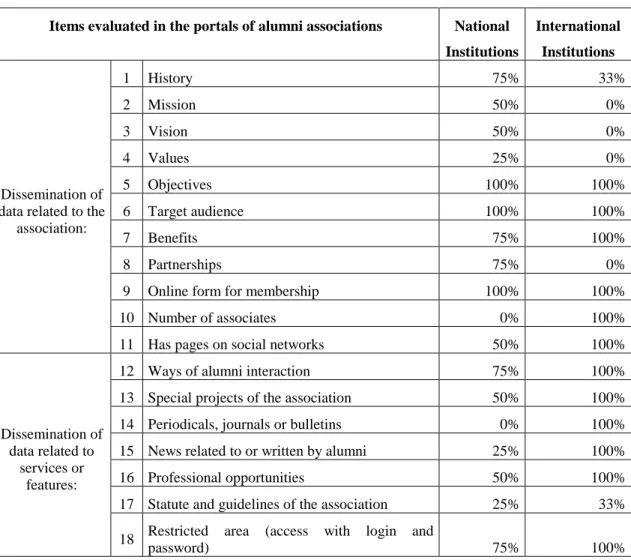
As defined in the methodology, we proceeded to the stage of benchmarking completion. The study evaluated 18 items, usually displayed in the portals of alumni associations. Seven universities, four in Brazil and three in the United States, had their portals examined based on these items, the percentage of positive response, that is, the items are disclosed in the portals (Table 1).
Table 1: Items evaluated in the portals of alumni associations
Items evaluated in the portals of alumni associations National
Institutions
International
Institutions
Dissemination of data related to the
association:
1 History 75% 33%
2 Mission 50% 0%
3 Vision 50% 0%
4 Values 25% 0%
5 Objectives 100% 100%
6 Target audience 100% 100%
7 Benefits 75% 100%
8 Partnerships 75% 0%
9 Online form for membership 100% 100%
10 Number of associates 0% 100%
11 Has pages on social networks 50% 100%
Dissemination of data related to
services or features:
12 Ways of alumni interaction 75% 100%
13 Special projects of the association 50% 100%
14 Periodicals, journals or bulletins 0% 100%
15 News related to or written by alumni 25% 100%
16 Professional opportunities 50% 100%
17 Statute and guidelines of the association 25% 33%
18 Restricted area (access with login and
password) 75% 100%
JISTEM, Brazil Vol. 11, No. 3, Sept/Dec., 2014 pp. 591-610 www.jistem.fea.usp.br
The objective, through the analysis of the frequency of disclosure items, was to understand the importance of each item for higher education institutions nationally and internationally, having as evidence the fact that they have a space in the portal to disseminate such information. The answers were analyzed separately, because international institutions have their consolidated associations while in Brazil, they are still seeking space.
The analysis in Table 1 shows that the portals of international institutions are similar because of the 18 items examined, 12 are present in 100% of the universities (5-7, 9-16 and 18). The other four do not appear in any of them (2-4 and 8) and only two items are found in only one institution (1 and 17). In the national institutions, the display of items varies, only three of them occur in 100% of the institutions (5, 6 and 9), and these same three items are displayed in all international institutions. Still about the national institutions of higher education, only one item does not appear in any of them (14).
The results in Table 1 indicate the market practice of the selected institutions, but they can also give rise to trends regarding the use of best practices to achieve superior performance. In addition, a more specific analysis of some items corroborates largely with the development of a portal for alumni.
Regarding item 6, target audience, 100% of the institutions have established alumni associations involving students of all levels of higher education with no specific association for undergraduates or graduates.
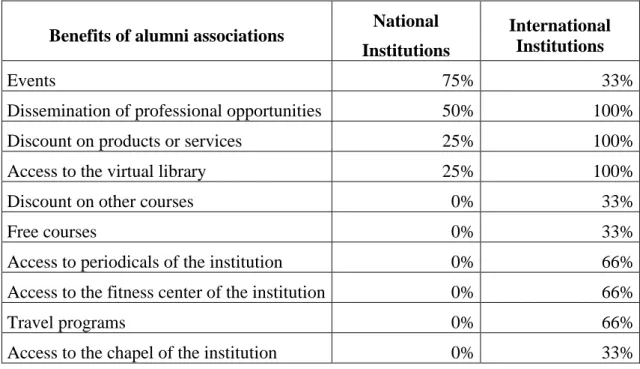
About item 7 (Table 2), benefits, it was found that national institutions do not disclose them. Only one national institution cites virtual library access and has a program of discounts on products or services, while 100% of international institutions allow access to the virtual library and databases and offer discount programs for alumni.
Table 2: Benefits of alumni associations
Benefits of alumni associations National
Institutions
International Institutions
Events 75% 33%
Dissemination of professional opportunities 50% 100%
Discount on products or services 25% 100%
Access to the virtual library 25% 100%
Discount on other courses 0% 33%
Free courses 0% 33%
Access to periodicals of the institution 0% 66%
Access to the fitness center of the institution 0% 66%
Travel programs 0% 66%
Access to the chapel of the institution 0% 33%
JISTEM, Brazil Vol. 11, No. 3, Sept/Dec., 2014 pp. 591-610 www.jistem.fea.usp.br
Concerning item 9, online form for membership, it was found that 100% of the institutions request registration validation of the alumni. International institutions use the alumni ID number, while the national institutions request data on the year of completion and course name, to manually search in the files and subsequent approval.
With respect to item 11, pages on social networks, it was found that all international institutions have at least two pages on social media, while only two national institutions of higher education have pages on social media. The distribution is shown in Table 3.
Table 3: Pages on social network
Social network National
Institutions
International Institutions
Facebook 50% 100%
LinkedIn 50% 66%
Twitter 25% 100%
Flickr 25% 33%
Source: Elaborated by the authors
Regarding ways of interaction (item 12), the prevalence is of encounters at annual events. Only one national institution does not disseminate events. International institutions offer virtual environments for discussion of topics of common interest (virtual communities) as well as links to lectures and virtual courses (learning environment).
The special projects (item 13) involve volunteering, diversity groups or mentoring and are more common in international institutions.
About item 15, only one national institution releases news, while 100% of the international institutions disseminate news and matters related to alumni.
Regarding the features of the restricted area (item 18), Table 4 shows that 100% of international institutions provide access to the profile of their members and to employment vacancies, but the events are usually available in the public area of the site.
Table 4: Features of the restricted area
Restricted Area National Institutions
International Institutions
Profile of the alumni members 25% 100%
Professional opportunities 50% 100%
Timetable of events 25% 33%
Library and database 0% 33%
Discussion forum 0% 33%
Story reports 0% 33%
News 0% 33%
JISTEM, Brazil Vol. 11, No. 3, Sept/Dec., 2014 pp. 591-610 www.jistem.fea.usp.br
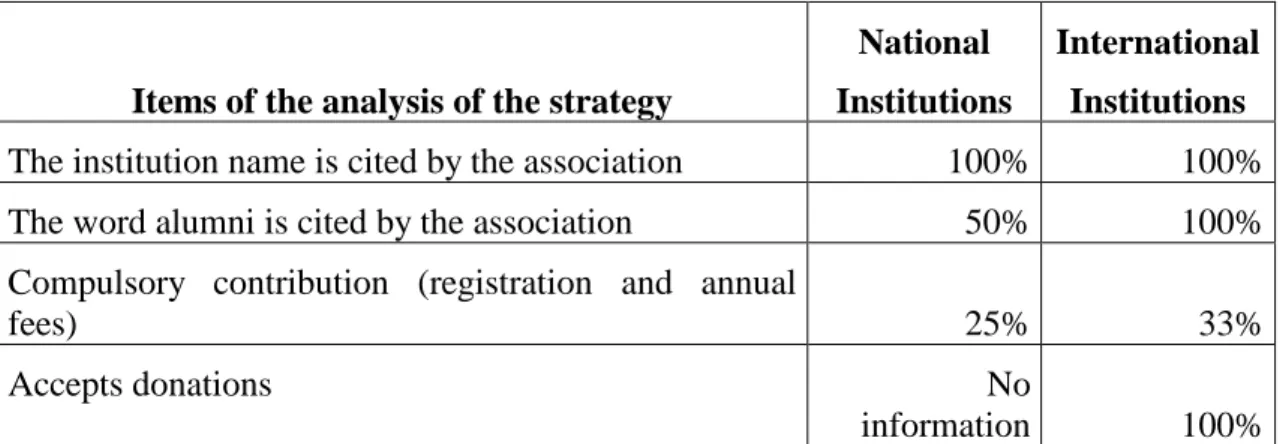
This study does not encompass the analysis of the strategy or the operation of alumni associations; still, some data about the functioning of associations have emerged from empirical observation and deserve to be reported in order to assist academic managers in the design of the portal (Table 5).
Table 5: Items of the analysis of the strategy observed in alumni associations
Items of the analysis of the strategy
National
Institutions
International
Institutions
The institution name is cited by the association 100% 100%
The word alumni is cited by the association 50% 100%
Compulsory contribution (registration and annual
fees) 25% 33%
Accepts donations No
information 100%
Source: Elaborated by the authors
The data interpretation makes one believe that the term alumni is not as publicized in Brazil, as well as the culture of accepting donations, present in 100% of the international institutions. The culture of maintaining a link between the alumni and the university in Brazil does not follow the same pace of the international institutions, which could be a hindrance to deploy an association, however, it poses as a business opportunity as observed with the success of the international entities.
The analysis of the portals allows for the identification of particularities and findings that may assist in the innovative process, among which we highlight:
I. National Institutions
a) The social network Facebook was used for massive dissemination of the first alumni meeting, which featured the presentation of alumni who have become major executives.
b) Provision of an electronic form for the donation of missing books in the university library.
c) An area named Nostalgia for the alumni to write their stories.
d) All information is available in the restricted area of the site. In the public area, only two videos are offered on YouTube. One is a welcome video and the other features the importance of being a member of the institutions community.
e) Because email addresses were stored only from 2007 onwards, stakeholders who graduated before this period and wish to join the association have to update their files in an online form.
II. International Institutions
JISTEM, Brazil Vol. 11, No. 3, Sept/Dec., 2014 pp. 591-610 www.jistem.fea.usp.br
b) Clubs throughout the country for local interactions among alumni geographically near.
c) A lifelong email address connected to the institution.
d) Event photos for sale at cost price.
e) Online form for feedback about the site.
f) Disclosure of some statistics about alumni: programs, the alumni’s gender, location, type of participation in the association and types of employment.
g) Permission for visitors to register to the site to have access to some restricted areas.
h) Displays suggestions for reading books written by alumni.
i) A lifelong email addresses managed by Google. It includes the following features at no charge to the alumni: POP and IMAP email, 25 GB of storage, Google Calendar and Google Docs.
j) Disclosure of data of alumni classes in the space “find my class”, some classes have unique pages on social media sites such as Facebook, LinkedIn or Twitter.
k) Lectures around the world, with differentiated prices for the alumni.
l) It offers related institutions dedicated to facilitating relations between future students, current students and alumni.
Online stores to sell products, such as t-shirts and souvenirs.
4.2. THE USE OF THE SCAMPER TECHNIQUE
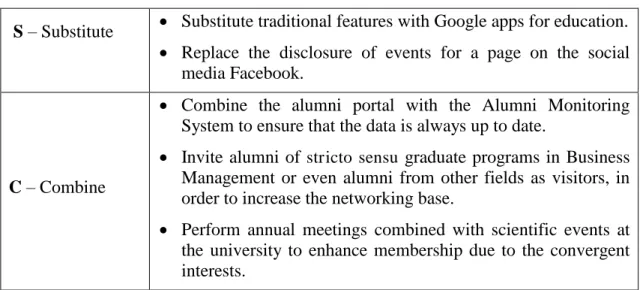
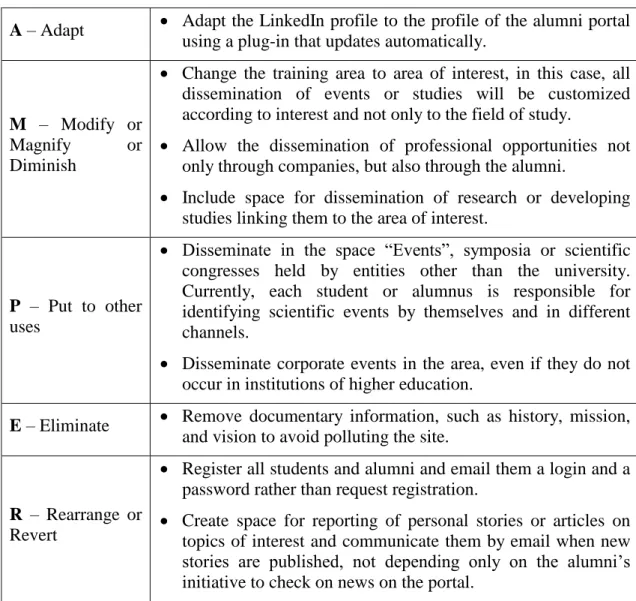
In order to create new opportunities from the combination of different sets of information in response to the need to create an attractive alumni portal, the authors discussed the checklist of questions using the SCAMPER technique and found business opportunities, as described in Figure 2.
Figure 2: The use of the SCAMPER technique to develop an alumni portal
S – Substitute Substitute traditional features with Google apps for education.
Replace the disclosure of events for a page on the social media Facebook.
C – Combine
Combine the alumni portal with the Alumni Monitoring System to ensure that the data is always up to date.
Invite alumni of stricto sensu graduate programs in Business Management or even alumni from other fields as visitors, in order to increase the networking base.
JISTEM, Brazil Vol. 11, No. 3, Sept/Dec., 2014 pp. 591-610 www.jistem.fea.usp.br
A – Adapt Adapt the LinkedIn profile to the profile of the alumni portal using a plug-in that updates automatically.
M – Modify or
Magnify or
Diminish
Change the training area to area of interest, in this case, all dissemination of events or studies will be customized according to interest and not only to the field of study.
Allow the dissemination of professional opportunities not only through companies, but also through the alumni.
Include space for dissemination of research or developing studies linking them to the area of interest.
P – Put to other uses
Disseminate in the space “Events”, symposia or scientific congresses held by entities other than the university. Currently, each student or alumnus is responsible for identifying scientific events by themselves and in different channels.
Disseminate corporate events in the area, even if they do not occur in institutions of higher education.
E – Eliminate Remove documentary information, such as history, mission, and vision to avoid polluting the site.
R – Rearrange or Revert
Register all students and alumni and email them a login and a password rather than request registration.
Create space for reporting of personal stories or articles on topics of interest and communicate them by email when new
stories are published, not depending only on the alumni’s
initiative to check on news on the portal.
Source: Elaborated by the authors
Understanding innovation as the action of finding creative solutions, the answers obtained from the checklist of questions help educational institutions to deal differently with the challenges concerning alumni participation in alumni associations.
4.3. PROPOSITION OF AN ALUMNI PORTAL PROTOTYPE
Based on the benchmarking result and the use of the SCAMPER technique, the authors suggested an alumni portal prototype to serve the interests of the target audience and at the same time innovate what is already practiced in the market, in order to increase membership and alumni participation.
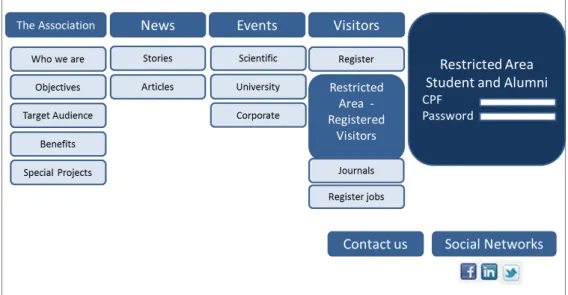
Figure 3 suggests the design of the public area of the portal. Aiming to increase the number of accesses by both the alumni and visitors, the menus “The Association”,
“News” and “Events” do not require a login or password for access. In addition, there
JISTEM, Brazil Vol. 11, No. 3, Sept/Dec., 2014 pp. 591-610 www.jistem.fea.usp.br
objective of this area is to increase the database for possible dissemination. Three other
menus are presented: “Alumni Restricted Area”, “Contact us” and shortcut to “Social Network”.
Figure 3: Prototype of an Alumni Portal – Public Area
Source: Elaborated by the authors
Figure 4 illustrates that the area restricted to current students and alumni of the
educational institution include the following features: “Google Apps” for e-mail and
other benefits; “Virtual Community” for discussions on topics of common interest;
“Research in development” for registration or consultation of areas of interest; “Follow-up of Alumni” for the university to follow the professional and academic
career of its alumni; “Virtual Library” to access databases; “Consultation Profile” localizable from class, courses or area of interest; “Profile” imported from LinkedIn with the option for editing and finally “Professional Opportunities” to register and
consult employment opportunities.
JISTEM, Brazil Vol. 11, No. 3, Sept/Dec., 2014 pp. 591-610 www.jistem.fea.usp.br
Source: Elaborated by the authors
This is a study based on creative technique, whose aim is to obtain the largest number of possible ideas, meaning that not all the ideas that have emerged will be implemented, because their implementation requires a complementary study on the technical and operational feasibility.
5. CONCLUSIONS
Admittedly, the alumni are some of the most valuable assets of the institutions of higher educations, because from their actions, the university’s name is evidenced in the society. Thus, the more extended the contact between the institution and its alumni, the greater opportunities for feedback and knowledge development. An alumni portal facilitates the promotion of research, the exchange of experience, in addition to providing personal, professional and academic networking.
JISTEM, Brazil Vol. 11, No. 3, Sept/Dec., 2014 pp. 591-610 www.jistem.fea.usp.br
An alumni association portal should be designed to attract the alumni to the
institution’s current activities, a fact that hardly occurs when the student completes the
course and no longer has the obligation to be physically involved in academic activities. It is necessary to consider that the alumni have their practical actions affected by experiences during the university course and that it transcends the issuing of the diploma. It is important that the relationships between students/institutions or students/students perpetuate beyond the course completion, as they contribute to the personal, professional and academic careers of the alumni from the networking generated. A portal of an alumni association should be intuitive and interesting in order to assist in enhancing the sense of belonging of the alumni to the educational institution.
The innovations arising from this study combine frequent elements at renowned educational institutions with demands of the target audience. Main innovations encompass the inclusion not only of the alumni, but also the current students to the alumni portal, therefore, the link with the university is strengthened from the beginning with a tendency to bolster the bond between the students (current and alumni) and the educational institution. The portal should also include all students
of the programs regardless of the student’s initiative to register and use the LinkedIn
profile, which is a current networking tool and already used by most students and alumni. All innovations seek to establish a portal of an alumni association that facilitates interaction and information sharing about issues that transcend academic graduation, greatly contributing to the development of society.
A limiting factor of the study refers to the absence of a study on the operational and technical feasibility for the development of the alumni portal; therefore, the prototype is just a reference, with no purpose to be deterministic. Further studies could involve a bibliographical review and action research to support the development of the portal, or even with the strategic and cultural aspects of the alumni association.
REFERENCES
Arcoverde, L. (24 de Outubro de 2013). Valor Econômico. Acesso em 24 de Outubro de 2013, disponível em Valor Econômico:
http://www.valor.com.br/carreira/3314624/ex-alunos-e-universidades-buscam-maior-aproximacao#
Barnard, Z. (2007). UJDigispace. Online Community Portals for Enhanced Alumni Networking, Tese de Doutorado, University of Johannesburg. Johannesburg, South Africa.
Brant, K. E., & Regan, P. J. (Fevereiro de 2002). The Spectrum of Alumni Involvement.
Acesso em 29 de Outubro de 2013, disponível em University at Albany :
http://www.albany.edu/alumni/images/D5_spectrum_involvement.pdf
Cagnazzo, L., Taticchi, P., & Botarelli, M. (2008). A literature review on innovation management tools. Revista de Administração da UFSM, 1(3), 316-330.
JISTEM, Brazil Vol. 11, No. 3, Sept/Dec., 2014 pp. 591-610 www.jistem.fea.usp.br
Trienal 2010: http://www.capes.gov.br/component/content/article/44-avaliacao/4355-planilhas-comparativas-da-avaliacao-trienal-2010
Chia, H., Jonesa, E. L., & Grandhama, L. P. (2012). Enhancing Mentoring between Alumni and Students via Smart Alumni System. Procedia Computer Science, 1390-1399.
Council for Advancement and Support of Education. (Março de 2005). Principles of Practice for Alumni Relations Professionals at Educational Institutions. Acesso em 24 de Outubro de 2013, disponível em Case - Council for Advancement and Support of Education:
http://www.case.org/About_CASE/About_Advancement/About_the_Disciplines.html
Cunha, I. C., Freitas, M. A., Yázigi, L., Junior, L. K., Pietro, M. S., Poz, M. E., et al. (set./dez. de 2007). Construindo Instrumentos de Avaliação para os Cursos de Pós-Graduação Lato Sensu da Unifesp: relato de experiência. Estudos em Avaliação Educacional, pp. 29-40.
Financial Times. (2013). Business Educacion. Acesso em 15 de Outubro de 2013, disponível em Financial Times: http://rankings.ft.com/businessschoolrankings/global-mba-ranking-2013
Hax, A. C., & Wilde II, D. L. (Setembro de 2002). The Delta Model - Toward a Unified Framework of Strategy. Working Paper.
Hidalgo, A., & Albors, J. (2008). Innovation management techniques and tools: a review from theory and practice. R&d Management, 38(2), 113-127.
Kandampully, J. (2003). B2B relationships and networks in the Internet age.
Management Decision, Vl. 41(5), 443-451.
Khandwalla, P. N. (2006). Tools for Enhancing Innovativeness in Enterprises.
VIKALPA, 31(1), 1-16.
Marconi, M. d., & Lakatos, E. M. (2010). Fundamentos de Metotologia Científica. São Paulo: Atlas.
Martins, G. d., & Theóphilo, C. R. (2009). Metodologia da Investigação Científica para Ciências Sociais Aplicadas. São Paulo: Atlas.
Melo, A. M., Carpinetti, L. C., & Silva, W. T. (2000). Proposta de Metodologia para Identificação de Objeto de Estudo de Benchmarking. ENEGEP.
Michalko, M. (2006). Thinkertoys - A Handbook of Creative-Thinking Techniques.
Berkeley: Ten Speed Press.
Newman, M. D., & Petrosko, J. M. (25 de January de 2011). Predictors of Alumni Association Membership. Research in Higher Education, pp. 52:738–759.
Porter, M. E. (1996). What is Strategy? Harvard Business Review, 61-78.
Primo, A. F. (1997). A emergência das comunidades virtuais. Intercom 1997 - XX Congresso Brasileiro de Ciências da Comunicação, (pp. 1-17). Santos.
Santos, V. M. (Janeiro de 2012). Criatividade e Inovação no Processo de Planeamento de Sistemas de Informação, Tese de Doutorado, Universidade do Minho Escola de Engenharia. Minho, Portugal.
Serrat, O. (2010). The SCAMPER Technique. Acesso em 29 de Outubro de 2013, disponível em DigitalCommons@ILR - Cornell University ILR School:
JISTEM, Brazil Vol. 11, No. 3, Sept/Dec., 2014 pp. 591-610 www.jistem.fea.usp.br
Teixeira, G. C., Maccari, E. A., & Kniess, C. T. (jul./dez. de 2012). Impactos do uso de técnicas de gerenciamento de projetos na realização de um evento educacional.
Revista de Gestão e Secretariado - GeSec, pp. 67-86.
Tidd, J., Bessant, J., & Pavitt, K. (2008). Gestão da Inovação. Porto Alegre: Bookman.