Energy averages and fluctuations in the decay out of superdeformed bands
A. J. Sargeant,1M. S. Hussein,1M. P. Pato,1and M. Ueda2
1Nuclear Theory and Elementary Particle Phenomenology Group, Instituto de Fı´sica, Universidade de Sa˜o Paulo, Caixa Postal 66318, 05315-970 Sa˜o Paulo, Brazil
2Institute of Physics, University of Tsukuba, Ten-noudai 1-1-1, Tsukuba, Ibaraki, 305-8571, Japan
~Received 20 March 2002; published 4 December 2002!
We derive analytic formulas for the energy average~including the energy average of the fluctuation contri-bution!and variance of the intraband decay intensity of a superdeformed band. Our results may be expressed in terms of three dimensionless variables:G↓/G
S, GN/d, and GN/(GS1G↓). HereG↓is the spreading width for the mixing of a superdeformed~SD!stateu0&with the normally deformed~ND!statesuQ&whose spin is the same asu0&’s. TheuQ&have mean lever spacingdand mean electromagnetic decay widthGNwhilstu0&has electromagnetic decay widthGS. The average decay intensity may be expressed solely in terms of the variables
G↓
/GSandGN/dor, analogously to statistical nuclear reaction theory, in terms of the transmission coefficients T0(E) andTN describing transmission from the uQ& to the SD band via u0& and to lower ND states. The variance of the decay intensity, in analogy with Ericson’s theory of cross section fluctuations, depends on an additional variable, the correlation lengthGN/(GS1G↓)5(d/2p)TN/(GS1G↓). This suggests that analysis of an experimentally determined variance could yield the mean level spacingd as does analysis of the cross section autocorrelation function in compound nucleus reactions. We compare our results with those of Gu and Weidenmu¨ller.
DOI: 10.1103/PhysRevC.66.064301 PACS number~s!: 21.60.2n, 24.60.2k
I. INTRODUCTION
The basic feature to be explained in the decay out of superdeformed~SD!rotational bands@1– 4#is that the inten-sity of the collectiveg rays emitted during the cascade down an SD band remains constant until a certain spin is reached whereafter it drops to zero within a few transitions. The sharp drop in intensity is believed to arise from mixing of the SD states with normally deformed ~ND! states of identical spin@5#. The model of Refs.@6 –9#attributes the suddenness of the decay out to the spin dependence of the barrier sepa-rating the SD and ND minima of the deformation potential. References@10–12#discuss the effect of the chaoticity of the ND states on the decay out.
In the present paper, we derive analytic formulas for the energy average~including the energy average of the fluctua-tion contribufluctua-tion!and variance of the intraband decay inten-sity of a superdeformed band in terms of variables which usefully describe the decay out @3,4,13,14#. We achieve this using the MIT approach to statistical nuclear reaction theory @15–17#. The MIT approach tackles calculation of the fluc-tuation cross section and other moments of theS matrix by directly calculating averages of fluctuating functions of en-ergy.
In agreement with Gu and Weidenmu¨ller @13# ~GW! we find that average of the total intraband decay intensity can be written as a function of the dimensionless variables G↓/G
S
andGN/d, whereG↓is the spreading width for the mixing of
an SD state with normally ND states of the same spin, d is the mean level spacing of the latter and GS (GN) are the
electromagnetic decay widths of the SD ~ND! states. Our formula for the variance of the total intraband decay inten-sity, in addition to the two dimensionless variables just men-tioned, depends on the dimensionless variable GN/(GS
1G↓). This additional variable is analogous to the
correla-tion width of the Ericson’s theory of cross seccorrela-tion fluctua-tions. Its appearance suggests that measurement of the vari-ance of the decay intensity could yield the mean level spacingd.
The paper is organized in the following manner. In Sec. II we express the average decay intensity as an average term plus the average of a fluctuation term. In Sec. III the expres-sion for the average decay intensity obtained in Sec. II is evaluated approximately. In Sec. IV we calculate the vari-ance of the intensity within the same approximation scheme as Sec. III. In Sec. V we interpret our results by analogy with statistical nuclear reaction theory, expressing our results in terms of transmission coefficients and compare our results with those of GW. In particular we suggest a reason why GW did not observe the variable GN/(GS1G↓
) in their calcula-tion of the variance. Finally in Sec. VI we make some con-cluding remarks incon-cluding mention of the limitations of our results.
II. ENERGY AVERAGES AND FLUCTUATIONS
The total intraband decay intensity has the form @12,13,18#
Iin5~2pGS!21
E
2``
dEuA00~E!u2, ~1!
where the intraband decay amplitude is given by
A00~E!5gS
^
˜0uG~E!u0&
gS. ~2!Here gS is the electromagnetic decay amplitude of
superde-formed stateu0
&
defined such thatGS5gS2. We assume that the amplitude feeding u0
&
is also given by gS. The totalG~E!5~E2H!21, ~3! where the full nuclear Hamiltonian is denoted byHand has a non-Hermitian part which accounts for coupling to the electromagnetic field @see Eqs. ~5!, ~18!, and ~19! below#. The tilde is used to indicate the dual state or adjoint@15#of u0
&
.In what follows we employ the optical background repre-sentation introduced Kawai, Kerman, and McVoy @16#. These authors investigated fluctuation cross sections using a representation of the S matrix in which the background S matrix is chosen to be the energy average of the S matrix itself, that is, the S matrix corresponding to the optical po-tential. Here we use the same idea to decompose the decay amplitude, Eq. ~2!, into the sum of its Lorentzian energy average~Lorentzian energy averaging intervalI),
A00~E![A00~E1iI/2!, ~4!
plus a fluctuating part.
We proceed by introducing Feshbach’s projection opera-tors @15#
P5u0˜
&^
0u and Q512P. ~5!Let us introduce the notation G5PG P for the effective Green’s function in the P space and let HP P5PH P, HPQ
5PHQ, etc. Using the techniques of Ref.@16#we obtain
G5G¯1Gfl, ~6! where the average effective Green’s function ¯G5G(E
1iI/2) is given by
G
¯5@E2H¯#21 ~7!
and the average effective Hamiltonian is given by
H¯5HP P1W¯P P, ~8!
where coupling to the eliminatedQspace is accounted for by
W¯P P5HPQ
1
E2HQQ1iI/2HQ P5
22i
I VPQVQ P ~9!
and the energy dependent coupling potentialVintroduced in Ref. @16#is defined by
VPQ5HPQ
A
iI/2 E2HQQ1iI/2
,
VQ P5
A
iI/2
E2HQQ1iI/2HQ P.
The fluctuating part of the effective Green’s function G is given by
Gfl5G¯ VPQ
1
E2HQQ2WQQVQ PG¯, ~10!
where coupling back to the Pspace is accounted for by
WQQ5VQ P¯ VG PQ. ~11!
By construction Gfl50 in so much as ¯G is unchanged by reaveraging, that is ifG¯¯5G¯.
The corresponding decomposition of Eq. ~2!for the tran-sition amplitude is
A00~E!5A00~E!1A00fl~E!, ~12! where the energy average of the transition amplitude is
A005gSG¯00gS ~13!
and the fluctuating part of the transition amplitude is
A00fl5gSG00 flg
S. ~14!
Thus the average of Eq.~1!for the relative intensity may be written as the incoherent sum
Iin ¯5I
in av
1Iinfl, ~15! where
Iinav5Iinav5~2pGS!21
E
2` `
dEuA00~E!u2 ~16!
and
Iinfl5~2pGS!21
E
2``
dEuA00fl~E!u2. ~17!
Up to this point no assumptions have been made except that the transition amplitude can be written in the form of Eq.~2!. As will be made clear in Sec. III the meaning of this assump-tion is thatu0
&
is a doorway for the decay from the SD band to the ND states and vice versa. In the manipulations subse-quent to Eq.~2!we have put the average intensity in a form consisting of a background term coming from the smooth energy dependence of the doorway plus a term resulting from fluctuations on this background.The representation we have used is particularly suitable for approximation when the ND states are overlapping. In Sec. III we evaluate Eqs. ~15!–~17! for the average decay intensity Iin assuming that this is the case. In Sec. IV we calculate the variance which describes the way in whichIin fluctuates aboutIin.
III. AVERAGE DECAY INTENSITY
Let us assume thatHP P satisfies the eigenvalue equation
HP Pu0
&
5~E02iGS/2!u0&
~18!andHQQ
Here,E0 denotes the energy of SD stateu0
&
, GS it’selectro-magnetic width for decay to the next lowest state in the SD band,EQ (Q51, . . . ,N) the energy of theNND statesuQ
&
with the same spin asu0
&
andGN the commonelectromag-netic width of theuQ
&
for decay to ND states of lower spin. Further, let us write the matrix element ofWP P, Eq.~9!,as
W¯005
^
0uW¯P Pu0&
5D↓ 2iG↓/2. ~20!
Here, D↓
5ReW¯00 is an energy shift that we ignore and G↓ 522 ImW¯00. Combining these definitions with Eqs. ~7!, ~8!, and~13!the average of the transition amplitude can be written as
A005 GS
E2E01i~ GS1G↓!/2
. ~21!
We see that Eq. ~21! exhibits the structure of an isolated doorway resonance. The doorway u0
&
has an escape width GS for decay to the SD state with next lower spin and aspreading widthG↓ for decay to the ND states with the same
spin which are reached by tunneling through the barrier sepa-rating the SD and ND wells. The doorway structure of Eq. ~21! is due to the assumption that the transition amplitude can be written as in Eq.~2!. The most general expression for the transition amplitude has the form Aab5gab
1(cc8gac
^
cuGuc8
&
gc8b, where gac describes the couplingof channelsaandc. In our doorway model thecandc
8
stand for u0&
or uQ&
, Q51, . . . ,N, i.e., (cuc&^
cu5P1Q, and aand b denote channels the ~electromagnetic! coupling to which is taken is accounted for by the non-Hermitian part of H@Eqs.~18!and~19!#, that is they denote the SD state above u0
&
, the SD belowu0&
, and ND states whose spin is different from that of u0&
. The direct coupling of channelsa andb, gab, is taken to be zero.In order to evaluateA00fl it is useful to introduce eigenvec-tors and eigenvalues of the operator HQQ1WQQ defined by
~HQQ1WQQ!uq
&
5~Eq2iGq/2!uq&
, q51, . . . ,N.~22!
Then from Eq. ~14!and Eq.~10!for Gflwe obtain
A00fl5gSG¯00
(
q
^
˜0uVPQuq&^
˜quVQ Pu0&
E2Eq1iGq/2
G ¯
00gS
5A00
(
q
g0qgq0/GS
E2Eq1iGq/2A00, ~23!
where
g0q5
^
˜0uVPQuq&
, ~24!gq05
^
˜quVQ Pu0&
. ~25!We now employ some statistical assumptions which are fre-quently used in statistical nuclear reaction theory@15#to de-rive an analytic formula for the decay intensityIin. We shall assume that the Lorentzian and box energy averages and the average over the labelqare all approximately equal, i.e., that for a suitable function fq(E) ofq andE,
fq~E!5fq~E1iI/2!' 1
DE
E
E01DE/2E01DE/2
dE
8
fq~E8
!'1
N q5
(
1N
fq~E!. ~26!
The width of the box average,DE, is related to the width the Lorentzian energy average by DE'pI/2 and to the mean spacingdof theNND states byDE'Nd. This approxima-tion is good as long as G/d@1 @see Eq.~39! below for the definition of G]. Within these assumptions we see from Eq. ~9!that theg0q andgq0 are related toW¯00 by
W¯005
22i
I
(
qg0qgq0'
2pi DE
(
qg0qgq0'
2pi d g0qgq0.
~27!
Thus the spreading with is given by
G↓
52dpRe g0qgq0 ~28!
and the energy shift by
D↓
5pdIm g0qgq0. ~29!
From Eq.~23!we can calculate the amplitude autocorrelation function
A00fl~E!A00fl~E
8
!*5 1GS2A00~E! 2
(
qq8
g0qgq0g0*q8gq*80
~E2Eq1iGq/2!~E
8
2Eq82iGq8/2!A00~E
8
!*2 ~30!5 1
GS2A00~ «
¯1«/2!2
(
qq8
g0qgq0g0q
8
* gq
80
*
~ «¯1«/22Eq1iGq/2!~ «¯2«/22Eq82iGq8/2!
where we have made the variable changes «5E2E
8
and¯«5(E1E8
)/2. Consider the middle factor in Eq. ~31!which we anticipate is a function of« onlya~ « !5
(
qq8
g0qgq0g0*q8gq*80 ~ «¯1«/22Eq1iGq/2!~ «¯2«/22Eq
82iGq8/2!
. ~32!
We interpret the energy average in Eq. ~32!to be an average over¯«. Employing a box energy average
a~ « !' 1 DE
(
qq8
E
E02DE/2E01DE/2
d¯« g0qgq0g0q8
* gq
80
*
~ «¯1«/22Eq1iGq/2!~ «¯2«/22Eq82iGq8/2!. ~33!
IfDE is large compared to theGq but small enough for the
EqandGq to be treated as constants then we may extend the
limits of integration to 6` and perform the integral using the calculus of residues to obtain
a~ « !'2pi DE
(
qq8
g0qgq0g0*q8gq*80 «1Eq82Eq1i~ Gq81Gq!/2
. ~34!
Assuming that the phases of the g0q and the gq0 are ran-domly distributed as a function of q the double sum in Eq. ~34!collapses to a single sum giving
a~ « !'2pi DE
(
qug0qgq0u2 «1iGq
. ~35!
Then employing the definition of the average given by Eq. ~26!
a~ « !'2pi
d
F
ug0qgq0u2 «1iGq
G
. ~36!
Assuming that the average of a ratio is equal to the ratio of the averages we get
a~ « !'G
↓2 2p
id
«1iG, ~37!
withG↓andGintroduced according to Eq.~38!and Eq.~39! below. The introduction of G↓ is based on the assumption
that
ug0qgq0u2'2ug0qgq0u2'2
F
G↓d2p
G
2. ~38!
The factor of 2 which appears in the first manipulation in Eq. ~38! accounts for the self-correlation ~present since the en-trance and exit channel are both u0
&
) and is equal to the elastic enhancement factor for compound elastic scattering in the overlapping resonance region. In the second manipula-tion in Eq. ~38!we have again ignored the energy shift@see Eqs. ~28!and~29!#.Equation~37!also introduces the correlation width
G'Gq ~39!
522 Im
^
˜quHQQ1WQQuq&
~40!5GN1G↑ ~41!
'GN, ~42!
where we used Eq.~19!for the electromagnetic width of the uQ
&
and introducedG↑
522 Im
^
˜quWQQuq&
522 Imgq0g0q
E2E01i~ GS1G
↓
!/2
5G ↓d
2p
~ GS1G↓!
~E2E0!2
1~ GS1G↓!2/4
,
~43!
which is the width for their decay back tou0
&
. The approxi-mations represented by Eqs. ~39!and~42!will be discussed in Sec. V. Using Eq.~37!and approximation~42!we finally obtainA00fl~E!A00fl~E
8
!*'2~2pGN/d!21~ G↓/GS!2A00~E!2
3 iGN
E2E
8
1iGNA00~E
8
!*2. ~44! WhenE8
5E this reduces touA00flu2
52~2pGN/d!21 GS 2G↓2
@~E2E0!21~ GS1G↓!2/4#2
, ~45!
which is the average of the fluctuation contribution to the transition intensity.
The integrals in Eqs. ~16! and ~17! for the average and fluctuation contributions to the total decay intensity may now be carried out using the calculus of residues. Substituting Eq. ~21!into Eq.~16!we obtain
Iinav5 1 11G↓/G
S
Equation ~46! is identical with the equivalent result in GW ~see also Ref. @14#!. Substituting Eq. ~45!into Eq. ~17! we obtain
Iinfl52~pGN/d!21
~ G↓/GS!2
~11G↓
/GS!3 ~47!
52~pGN/d!21Iinav~12Iinav!2 ~48! for the average fluctuation contribution to the average decay intensity.
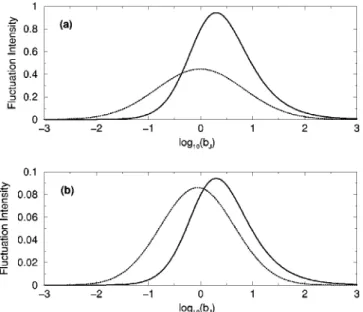
Equation~47!forIinfl is plotted in Fig. 1 and for compari-son we have also plotted a fit formula which was obtained by GW,
Iin[email protected]~ GN/d!0.2172#
3exp
H
2F
0.4343 ln
S
G↓
GS
D
20.45
S
GN dD
20.1303
G
2 ~ GN/d!20.1477J
.
~49!
Qualitative agreement is seen between the two formulas. Note that Eq. ~49! yields a negative intensity for GN/d
.1.51 which excludes its use in this regime. Our result which is only strictly valid when GN/d@1 is simply in-versely proportional toGN/d. The exact result of GW forIin fl @Eq. ~24! in GW# which can be used for any GN/d also
decreases monotonically with increasingGN/d.
The dependence of Iinfl ~and that of Iinav) on G↓
/GS results from the resonant doorway energy dependence of the decay amplitude A00(E) @Eq. ~21!#. This energy dependence also manifests itself in the average of the fluctuation contribution
to the transition intensity uA00fl(E)u2 @Eq. ~45!#. GW include precisely the same energy dependence in their calculation by use of an energy dependent transmission coefficient to de-scribe decay to the SD band @see Eq. ~78! below and the discussion in Sec. V C#. This is the reason for our qualitative agreement with GW concerning Iin.
IV. VARIANCE OF THE DECAY INTENSITY
The error incurred in making the energy average is given by
DIin5Iin2Iin5Iinfl2Iinfl12 Re
E
2` `
dEA00~E!A00fl~E!*. ~50!
The average of the error vanishes:DIin50. A measure of the dispersion of the calculatedIinis given by the variance
~ DIin!25~Iin2Iin!2. ~51! In order to evaluate (DIin)2 the averages indicated in Eq. ~51!must be performedbeforethe integration which appears in the definition ofIin, Eq.~1!. We obtain
~ DIin!2'~2pGS!22
E
2` `
dE
E
2` `
dE
8
$uA00fl~E!A00fl~E8
!*u212 ReA00~E!*A00fl~E!A00fl~E
8
!*A00~E8
!%. ~52! In deriving Eq. ~52! we have used A00fl(E)5A00fl(E)A00fl(E
8
)50, A00fl(E)A00fl(E8
)*Þ0 and A00fl (E)A00fl (E)*A00fl (E8
)A00fl (E8
)*5uA00fl (E)u2 uA00 fl (E
8
)u21uA00fl(E)A00fl(E
8
)*u2 and we have assumed that averages of terms containing odd powers ofA00fl vanish.Substituting Eqs. ~44! and ~21! in Eq. ~52!, making the changes of integration variable
E2E05~ GS1G↓!x/2, ~53!
E
8
2E05~ GS1G↓
!x
8
/2, ~54!and using Eq. ~46! and~47! for Iinav and Iinfl we are able to write (DIin)2 in the form
~ DIin!2
5Iinfl 2f1~j!12IinavIinflf2~j!, ~55! where the variablej is defined by
j[GS1G
↓
GN
~56!
5GGS
N
~11G↓/G
S!5
GS
GN
Iinav21 ~57!
5G ↓
GN
~11GS/G
↓
!21
5G ↓
GN
~12Iinav!. ~58! FIG. 1. Average of the fluctuation contribution to the intraband
intensity Iinfl vs log10(bJ), wherebJ[G↓/GS. The solid lines were
calculated using Eq.~47!and the dotted lines by GW’s fit formula, Eq.~49!. The variableGN/dtook the value 0.1 for graph~a!and 1
The functions f1 and f2 which have been introduced in Eq ~55!are given by
f1~j!5
S
4 pjD
2
E
2` ` dx@x211#2
3
E
2`
` dx
8
@~x2x
8
!214/j2#@x8
211#2528 p2jIm
E
2` ` dx
@x211#2
3
E
2`
` dx
8
@x2x
8
12i/j#@x8
1i#2@x8
2i#2 ~59!52pj4Im
E
2` ` dx
@x211#2
S
1 x1i~2/j11!1 i
@x1i~2/j11!#2
D
~60!and
f2~j!5 4 p2jRei
E
2`
` dx
@x2i#@x1i#2
3
E
2`
` dx
8
@x2x
8
12i/j#@x8
2i#2@x8
1i# ~61!
52pj2Re
E
2`
` dx
@x2i#@x1i#2@x1i~2/j11!#. ~62!
Carrying out the second integrations in Eq.~60!and~62!we obtain
f1~j!5 1 ~11j!1
j
~11j!21 j2
2~11j!3 ~63! and
f2~j!52~11
1j!. ~64!
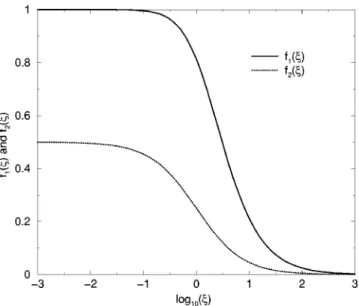
The integrations in the calculation of f1 and f2 above were again carried out using the calculus of residues and were checked by numerical integration. The functions f1(j) and f2(j) are plotted in Fig. 2.
We have thus shown that a complete description of the decay out of a superdeformed band within the energy aver-age approach requires three requires three dimensionless variables,G↓/G
S,GN/d, andGN/(GS1G↓). We find the
fol-lowing: ~1! The average contribution of the background to the intraband decay intensity,Iinav,@Eq.~46!#depends only on G↓/G
S. ~2!The average of the fluctuation contribution,Iin fl , @Eq. ~47!# depends on two variables: G↓/G
S andGN/d. ~3!
The variance, (DIin)2,@Eq.~55!#depends on three variables: G↓/G
S, GN/d, andGN/(GS1G↓).
Figure 3 shows a plot of the average intraband decay in-tensityIin@Eq.~15!#calculated using Eqs. ~46!and~47!for IinavandIinfl. For comparison we also show theIinthat results when the GW fit formula@Eq.~49!#is used forIinfl instead of FIG. 2. The functions f1(j) @Eq. ~63!# ~solid line! and f2(j) @Eq.~64!# ~dotted line!plotted vs log10(j).
FIG. 3. Average intraband intensity Iin vs log10(bJ) where bJ
[G↓/G
S. The filled circles were calculated using Eq.~15!together
with Eqs.~46!and ~47!. The error bars for the filled circles show
A
(DIin)2calculated using Eq.~55!withjin the form given by Eq.~58!. The dotted lines were calculated in the same manner as the filled circles except that GW’s fit formula, Eq.~49!, was used in the place of Eq.~47!. The variableGN/dtook the following values: 0.1
in graphs~a!,~b!, and~c!; 1 in graphs~d!,~e!, and~f!; 10 in graphs
~g!, ~h!, and ~i!. The variable G↓/G
N took the following values:
1023in graphs~a!,~d!, and~g!; 1 in graphs~b!,~e!, and~h!; 103in
Eq. ~47!. The two curves are barely distinguishable for GN/d51. The GW fit formula incorrectly gives intensities that are greater than unity when GN/d50.1 as does our Eq.
~47!. The exact formula of GW @Eq. ~24!in GW#does not suffer from this problem. Our results are only strictly valid when GN/d@1.
The error bars in Fig. 3 were calculated using Eq. ~55! withj in the form given by Eq.~58!. We calculate
A
(DIin)2 for three values of the ratioG↓/GN~see figure caption!. Since
(DIin)2 is proportional toIinfl it also increases monotonically to a maximum before decrease monotonically to zero as a function of G↓/G
S. For the same reason the error increases
monotonically with decreasing GN/d. The error estimate
presented in GW exhibits the same trends with G↓/G
S and
GN/d.
Since the variance depends only on (GS1G↓)/GN in
ad-dition to G↓/G
S and GN/d, upon fixing the latter two
vari-ables the variance may be considered a function of any one of G↓/G
N, GS/GN, G↓/d, orGS/d @see Eqs.~57!and~58!#.
In Fig. 3 we chose to use Eq. ~58!forj and fixed the value ofG↓/G
N. WhenGS/GNis fixed instead, a slightly different
dependence on G↓/G
S is obtained @compare Eqs. ~57! and
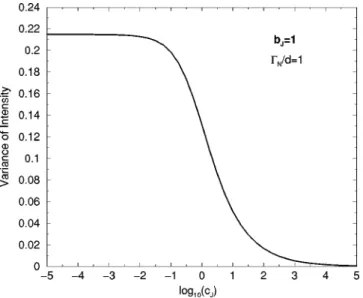
~58!#. Figure 4 shows a plot of the standard deviation,
A
(DIin)2, @Eq.~55!#as a function ofG↓/GNfor fixedG↓/GS
and GN/d. Ultimately, the variance like the intensity is a function of the spin of the decaying nucleus and could pro-vide an additional probe to the spin dependence of the barrier separating the SD and ND wells which is contained in the spreading width G↓ @5–9#.
Our result for the variance of the decay intensity (DIin)2 @Eq.~55!#has a structure reminiscent of Ericson’s expression for the variance of the cross section @17#. This connection will be fully explored in the Sec. V. For now we note only that what distinguishes Eq. ~55! from Ericson’s expression for the variance of the cross section are the functions f1(j) and f2(j) which result from the energy integrations in Eq. ~52!.
V. VARIANCE OF THE DECAY INTENSITY VERSUS AUTOCORRELATION FUNCTIONS OF STATISTICAL
NUCLEAR REACTION THEORY
A. Results familiar from statistical nuclear reaction theory
All moments of theS matrix,Sab(E), the quantities that describe the way in whichSab(E) fluctuates about it’s
aver-age,Sab(E), can be expressed in terms ofSab(E) itself@19#.
Normally, specific moments such as the amplitude and cross section autocorrelation functions are expressed in terms of transmission coefficients, defined to be
Ta5Taa, 0<Ta<1, ~65!
and their generalization
Tab512
(
cSac Sbc*5
(
cSacflSbcfl*. ~66! Here Sabfl 5Sab2Sab is the fluctuating part of the S matrix.
The transmission coefficient Ta is the probability of
trans-mission from a compound nucleus resonance to channel a and is obtained from the optical model.
In what follows we quote results for both the amplitude and cross section autocorrelation functions in the overlap-ping resonance region for the purpose of comparison with our results for the decay intensity. The amplitude autocorre-lation functioncab(E,E
8
) for amplitudeAab5dab2iSab, ~67!
is defined by
cab~E,E
8
!5Aab~E!Aab~E8
!*2Aab~E! Aab~E8
!*~68!
5Aabfl ~E!Aabfl ~E
8
!* ~69! 'sabfliG
E2E
8
1iG. ~70!The correlation width G is given by
G52dp
(
a
Ta. ~71!
Derivation of Eq. ~70!requires the assumption thatAab(E)
5Aab(E
8
). This assumption together with statisticalas-sumptions equivalent to those employed in our treatment of the factor a(«) @Eq. ~32!# gives rise to acab(E,E
8
) whichdepends solely on the difference of the two energies E
2E
8
.Equation ~44!, which is essentially c00(E,E
8
) does not depend solely onE2E8
. The background energy modulation in bothEandE8
which is characteristic of an isolated door-way resonance is explicit. In the present case it cannot be assumed that A00(E)ÞA00(E8
) for arbitraryE andE8
. The double integral for the variance of the decay intensity @Eq. FIG. 4. The standard deviation of the decay intensityA
(DIin)2vs log10(cJ), wherecJ[G↓/GNplotted using Eq.~55!withjin the
form given by Eq.~58!for fixedbJ5G
↓
~52!and Eq.~77!below#is sensitive to this fact as it contains products of the background amplitudes at arbitraryEandE
8
. The amplitude autocorrelation function, Eq.~44!, contains two distinct energy dependences, one characterized by GN which is analogous to Ericson’s correlation width as defined by Eq.~71! and another characterized byGS1G↓ the widthof the doorway. Writing Eq.~44!in terms ofxandx
8
defined by Eqs.~53!and~54!c00~E,E
8
!516jiIinavIinfl 1@x1i#2@x2x
8
12i/j#@x8
2i#2, ~72!we see that it in fact depends only on the ratio GN/(GS
1G↓) and it is through Eq.~44!that this variable enters our
calculation of the variance of the decay intensity.
The amplitude autocorrelation function is not an observ-able quantity. The correlation width, Eq. ~71!, must be ex-tracted from correlation analysis of the cross section. The cross section autocorrelation function, Cab(E,E
8
), for cross section sab5uAabu2 is defined byCab~E,E
8
!5sab~E!sab~E8
!2sab~E! sab~E8
! ~73!'ucab~E,E
8
!u212 ReAab~E!*cab~E,E
8
!Aab~E8
! ~74!'@sabfl 212sab
avs
ab
fl
# G
2 ~E2E
8
!21G2.~75!
Here,sab
av
5uAabu2 is the background cross section. The
fluc-tuation contribution to the cross section in terms of the trans-mission coefficients is given by the Hauser-Feshbach for-mula
sab
fl ' TaTb
(
c Tc, ~76!
or some modification of it designed to account of width fluc-tuations, direct reactions, etc.@15,20#.
Equation ~52! for the variance of the decay intensity can be written in terms of the cross section autocorrelation func-tion defined by Eq.~74!as
~ DIin!25~2pGS!22
E
2` `
dE
E
2` `
dE
8
C00~E,E8
!. ~77!The same comments concerning the energy independence of the background amplitude apply to the derivation of Eq.~75! as applied to the derivation of Eq.~70!. LikewiseC00(E,E
8
) in the case of the present paper@the integrand in Eq.~52!#is distinguished from Eq. ~75! by its explicit inclusion of the energy dependence of the background. Equation ~52! and ~74!assume that only pairwise correlations are present. BothEqs. ~70! and ~75!are valid when (aTa@1, that is, in the
strongly overlapping resonance region.
B. Expression of the decay intensity and variance in terms of transmission coefficients
Following GW we introduce two transmission coeffi-cients,T0(E) andTN, where
T0~E!512uS00u25
GSG↓
~E2E0!21~ GS1G
↓
!/4 ~78!
5
4Iinav~12Iinav! 4~E2E0!2/~ GS1G
↓
!11 ~79!
describes transmission from theuQ
&
to the SD band andTN52pGN/d ~80!
describes their transmission to ND states of lower spin. We have not derived Eq. ~80!. For the purposes of the present paper it can be taken as the definition of TN. The reader is
referred to the discussion in Sec. VIII H of Ref. @21#which contrasts the relation of the correlation widthG to transmis-sion coefficients with the the corresponding relation for the average widthGq.
We have writtenT0(E) in the form given by Eq. ~79!in order to emphasise that it isnotsimply a function of a single dimensionless variable, the ratioG↓/G
S. It is energy
depen-dent, the energy dependence being characterized by GS
1G↓, the total width of doorway stateu0
&
. Only it’smaxi-mumT0(E0)54Iinav(12Iinav) can be expressed solely in terms of G↓/G
S. Thus, a quantity sensitive to the gross energy
dependence ofT0(E) should depend onGS1G↓
. Writing the average decay intensity Eq.~15!in terms transmission coef-ficients
Iin512~2pGS!21
E
2``
dE$T0~E!22@T0~E!#2/TN%,
~81!
we see that it compares the total width of the doorway u0
&
with the width for the feeding of u0
&
@thanks to inclusion of the normalization factor 2pGS in the definition ofIinin Eq. ~1!#. The variance, Eq.~52!, may be written as~ DIin!2
'~2pGS!22
E
2``
dE
E
2` `
dE
8
H
4T0~E! 2T0~E
8
!2 @2p~E2E8
!/d#21TN214 ImA00~E!T0~E!T0~E
8
!A00~E8
!* 2p~E2E8
!/d1iTNJ
. ~82!
two characteristic energy scales in fact only depends on their ratio,GN/(GS1G↓), the ratio of the correlation width to the
doorway width.
Equation~41!may also be expressed in terms of the trans-mission coefficients T0(E) and TN. Using Eq. ~43! for G↑
we get
G5 d
2pTN
F
12T0~E!/TN
Iinav
G
, ~83!so that the neglect of G↑ in G is justified when T
0(E)/TN
!Iinav<1. Let us also write the correlation lengthj, Eq.~56!, in terms of the transmission coefficients
j5~2p/TN!
GS1G↓
d . ~84!
In the case of compound nucleus scattering, extraction ofG from a measurement of cross section autocorrelation func-tion, using say Eq. ~75!, permits the determination of the density of compound nucleus states 1/dby application of Eq. ~71! @22#. A more recent example of energy-autocorrelation analysis may be found in Ref. @23# where fluctuations in dissipative binary heavy ion collisions are studied. In the present case of the decay out of a superdeformed band ex-traction of j from the variance of the intensity, permits the determination of the ratio (GS1G↓)/GN, or, given TN
~equivalently GN/d) determination of the ratio (GS
1G↓)/d.
C. Comparison with the results of Gu and Weidenmu¨ller
GW also take inspiration from statistical nuclear reaction theory but use the MPI approach@24#. The MPI approach is concerned with the analytic calculation of ensemble aver-ages, a procedure which is equivalent to the calculation of energy averages. Reference @24# use the supersymmetry method of calculating ensemble averages to derive an exact expression for Sabfl (E)Scdfl (E
8
). Their result is found to be expressible in terms of the difference of the two energies, E2E8
, and transmission coefficients. The transmission co-efficients themselves are expressed as functions of (E1E
8
)/2. The relationship between the results of@15–17#and those of Ref. @24# is discussed in Refs.@20,25#. Several re-sults of Refs.@15–17#can be obtained from that of Ref.@24# by expanding in powers of the transmission coefficients or inverse powers of the sum of the transmission coefficients @20#.Calculation of the average of the fluctuation intensity re-quires the energy integral of the average of the product of two S-matrix elements at the same energy. GW use the re-sults of Ref.@24#foruS00fl(E)u2to calculate the average decay intensity. As was already noted in Sec. III, GW include the energy dependence of the background amplitude characteris-tic of an isolated doorway resonance in their calculation by using the energy dependent transmission coefficient T0(E), Eq. ~78!, in their Eq. ~24! for Iinfl. The fact that we use the same energy dependence as GW for the background is
re-sponsible for the agreement we obtain with GW concerning Iin’s dependence onG↓/G
S. The differences between our
re-sults and those of GW for the decay intensity stem from the assumptions we make which restrict our results to GN/d
@1.
Calculation of the variance of the intensity requires the four-point function at two energies integrated over both en-ergies, that is, it requires S00fl(E)S00fl(E)*S00fl(E
8
)S00fl(E8
)*integrated overEandE
8
. Calculation of the four-point func-tion at two energies was carried out using the supersymmetry method in Ref.@26#. Their result, like that of Ref.@24#for the two-point function depends explicitly only onE2E8
and the transmission coefficients which are again expressed as func-tions of (E1E8
)/2. Within the assumption that only pairwise correlations are important, as was assumed in Eqs.~52!and ~74!, the two-point function is enough to calculate the vari-ance. Reference @20#showed numerically that the exact ex-pression of Ref.@24#specialized to the amplitude autocorre-lation function confirms the correctness of Eq. ~70! in the region of strongly overlapping resonances. However, unlike Eq. ~70!, the amplitude autocorrelation function as given by Eq.~44!depends on the background amplitude at two differ-ent energies, that is, it depends on A00(E) and A00(E8
). WhenE5E8
it reduces to Eq.~45!which can be expressed in terms of the transmission coefficientsT0(E) andTN. Thus the decay intensity can be expressed in terms of these trans-mission coefficients as was done in Eq.~81!. The applicabil-ity of Ref. @24# to calculation of the decay intensity owes itself to the fact that the decay intensity may be expressed in terms of transmission coefficients.Equation ~44! cannot be written in terms of T0(@E
1E
8
#/2) and the same applies to the variance as is apparent from Eq.~82!. Thus it is not clear whether Ref.@24#serves as a means to obtain results corresponding to Eqs.~44!and~82! which are valid for arbitrary GN/d. It would be aninterest-ing challenge to derive an expression for the variance which could be used for any value of GN/d since for the regions
which have been most frequently studied experimentally@2#, the A'150 andA'190 regions,GN/d!1.
GW do not use the supersymmetry method to calculate the variance. They instead estimate the variance by perform-ing a numerical simulation. The analytic structure of the vari-ance was not investigated in GW and their results make no reference to the variable GN/(GS1G↓). Given the close
re-semblance of the conclusions about the analytic structure of the decay intensity which may be inferred from the exact result of GW and our approximate result for GN/d@1 it
seems probable that the dependence of the variance on GN/(GS1G↓
) which we have found for GN/d@1 persists for arbitraryGN/d.
VI. CONCLUSIONS
Eq. ~55! for the variance (DIin)2 were derived by making assumptions and approximations which are strictly valid only in the strongly overlapping resonance region, GN/d@1.
However, these formulas are seen from Figs. 2 and 3 to work well when GN/d51 and provide a qualitative description
even when GN/d50.1. This means that Eq. ~47! and Eq. ~55! cannot be applied to the mass 150 and 190 regions whereGN/d;0.001 but they may prove themselves of
prac-tical use in other mass regions. In any case our results clarify the analytic structure of the results obtained by GW. In par-ticular we have revealed that the variance of the decay
inten-sity depends on the correlation lengthGN/(GS1G↓) in
addi-tion to the two dimensionless variables G↓/G
S andGN/d on
which the average of the decay intensity depends. Measure-ment of the variance of the decay intensity could yield the mean level density of the ND states in analogy with autocor-relation analysis of cross sections.
ACKNOWLEDGMENTS
This work was partially supported by FAPESP.
@1#T. Lauritsenet al., Phys. Rev. Lett.88, 042501~2002!.
@2#A. Lopez-Martenset al., Phys. Scr.T88, 28~2000!.
@3#A. Dewaldet al., Phys. Rev. C64, 054309~2001!.
@4#R. Krucken, A. Dewald, P. von Brentano, and H.A. Weiden-muller, Phys. Rev. C64, 064316~2001!.
@5#E. Vigezzi, R.A. Broglia, and T. Dossing, Phys. Lett. B249, 163~1990!; Nucl. Phys.A520, 179c~1990!.
@6#Y.R. Shimizu, F. Barranco, R.A. Broglia, T. Dossing, and E. Vigezzi, Phys. Lett. B274, 253~1992!.
@7#Y.R. Shimuzu, E. Vigezzi, T. Dossing, and R. Broglia, Nucl. Phys.A557, 99c~1993!.
@8#Y.R. Shimizu, M. Matsuo, and K. Yoshida, Nucl. Phys.A682, 464c~2001!.
@9#K. Yoshida, M. Matsuo, and Y.R. Shimizu, Nucl. Phys.A696, 85~2001!.
@10#S. Aberg, Phys. Rev. Lett.82, 299~1999!; Nucl. Phys.A649, 392c~1999!.
@11#R. Krucken, Phys. Rev. C62, 061302~R! ~2000!.
@12#A.J. Sargeant, M.S. Hussein, M.P. Pato, N. Takigawa, and M. Ueda, Phys. Rev. C65, 024302~2002!.
@13#J.z. Gu and H.A. Weidenmuller, Nucl. Phys.A660, 197~1999!.
@14#H.A. Weidenmuller, P. von Brentano, and B.R. Barrett, Phys. Rev. Lett.81, 3603~1998!.
@15#H. Feshbach,Theoretical Nuclear Physics: Nuclear Reactions
~Wiley, New York, 1992!, Chap. IV.
@16#M. Kawai, A.K. Kerman, and K.W. McVoy, Ann. Phys.~N.Y.!
75, 156~1973!.
@17#T. Ericson, Ann. Phys.~N.Y.!23, 390~1963!.
@18#P. R. Wallace, Mathematical Analysis of Physical Problems
~Dover, New York, 1984!, Chap. VIII.
@19#J. Richert, M.H. Simbel, and H.A. Weidenmuller, Z. Phys. A 273, 195~1975!.
@20#J.J. Verbaarschot, Ann. Phys.~N.Y.!168, 368~1986!.
@21#T.A. Brody, J. Flores, J.B. French, P.A. Mello, A. Pandey, and S.S.M. Wong, Rev. Mod. Phys.53, 385~1981!.
@22#T. Ericson and T. Mayer-Kuckuk, Annu. Rev. Nucl. Sci. 16, 183~1966!.
@23#M. Papaet al., Phys. Rev. C61, 044614~2000!.
@24#J.J. Verbaarschot, H.A. Weidenmuller, and M.R. Zirnbauer, Phys. Rep.129, 367~1985!.
@25#Y. Takahashi and S. Yoshida, Nucl. Phys.A507, 371~1990!.