Universidade de Aveiro ANO 2014 Departamento de Química
CARLA MARIA
BATISTA
GONÇALVES
PROPRIEDADES DE BARREIRA DE FILMES
BASEADOS EM POLI(ÁCIDO LÁCTICO)
BARRIER PROPERTIES OF POLY(LACTIC ACID)
BASED FILMS
Universidade de Aveiro ANO 2014 Departamento de Química
CARLA MARIA
BATISTA
GONÇALVES
PROPRIEDADES DE BARREIRA DE FILMES
BASEADOS EM POLI(ÁCIDO LÁCTICO)
BARRIER PROPERTIES OF POLY(LACTIC ACID)
BASED FILMS
Tese apresentada à Universidade de Aveiro para cumprimento dos requisitos necessários à obtenção do grau de Doutor em Engenharia Química, realizada sob a orientação científica da Doutora Isabel Maria Delgado Jana Marrucho Ferreira, Investigadora Coordenadora do Instituto de Tecnologia Química e Biológica António Xavier da Universidade Nova de Lisboa e do Professor Doutor João Manuel da Costa Araújo Pereira Coutinho, Professor Catedrático do Departamento de Química da Universidade de Aveiro.
Apoio financeiro do POCTI no âmbito do III Quadro Comunitário de Apoio.
Apoio financeiro da FCT e do FSE no âmbito do III Quadro Comunitário de Apoio.
o júri
presidente Doutor Luís Filipe Pinheiro de Castro
professor catedrático da Universidade de Aveiro
Doutor Adélio Miguel Magalhães Mendes
professor associado com agregação da Faculdade de Engenharia da Universidade do Porto
Doutor Nelson Simões Oliveira
professor adjunto do Instituto Politécnico de Leiria
Doutora Ana Maria Antunes Dias
investigadora auxiliar da Faculdade de Ciências e Tecnologia da Universidade de Coimbra
Doutor João António Baptista Pereira de Oliveira professor associado da Universidade de Aveiro
Doutora Isabel Maria Delgado Jana Marrucho Ferreira
investigadora coordenadora do Instituto de Tecnologia Química e Biológica Antonio Xavier da Universidade Nova de Lisboa
agradecimentos À Universidade de Aveiro e, em particular, ao Departamento de Química e ao CICECO, pelas condições e meios proporcionados para a execução do presente trabalho. À Fundação para a Ciência e a Tecnologia (FCT), pelo financiamento dos meus estudos através de uma bolsa de doutoramento (SFRH/BD/23455/2005 ) e apoios associados.
À Doutora Isabel Marrucho e ao Professor Doutor João Coutinho por me integrarem na sua equipa de investigação, pelo apoio e confiança.
Ao Professor Doutor Adélio Mendes e à Lúcia Brandão pela ajuda na construção do equipamento de time-lag.
Ao Professor Doutor João Oliveira pelos esclarecimentos sobre a técnica de QCM
A todos os colegas e amigos que estão sempre por perto e que têm demonstrado ao longo destes anos uma verdadeira amizade.
Ao pessoal da Enarpur, em especial ao Hugo e ao Sérgio, por me auxiliarem nestes últimos meses para finalização desta dura etapa.
palavras-chave Poliácido láctico, PLA, embalagem activa, α-tocoferol, BHT, TBHQ,
microbalança de cristais de quartzo, QCM, time-lag, sorção, permeabilidade, solubilidae e difusão.
resumo Nos últimos anos temos assistido à procura de produtos amigos do ambiente. Um dos maiores desafios tem sido a procura de materiais biodegradáveis que possam substituir materiais vulgarmente designados por “plástico”. Se há dezenas de anos o plástico veio, por exemplo, substituir o marfim nas bolas de bilhar, salvando vidas de milhares de elefantes, hoje, procuramos um substituto para esse plástico, de forma a preservar as condições ambientais que nos permitem viver harmoniosamente com a restante fauna e flora, e que a espécie humana tem, nos últimos anos, vindo a destruir. O plástico é um derivado do petróleo, cujo preço tem vindo a crescer exponencialmente, devido ao facto de ser barato e possuir propriedades que permitem desenhar produtos essenciais à vida quotidiana. Por isso, precisamos de sair da era petroquímica e entrar numa nova era ambientalmente sustentável, baseada em materiais biodegradáveis provenientes de fontes renováveis. Esta mudança para rotas “verdes”, só será possível com o apoio de grandes empresas, e medidas governamentais drásticas. O poliácido láctico, PLA, produzido a partir da lactose presente no amido ou no açúcar, tem sido intensivamente estudado nos últimos anos e possui potencial para substituir os tradicionais polímeros derivados do petróleo, se forem melhoradas algumas propriedades necessárias ao processamento por extrusão. O PLA, é muito frágil, pouco resistente e pouco flexível. Neste trabalho foram adicionados antioxidantes naturais (alfa-tocoferol) e sintéticos (BHT e TBHQ) ao PLA com o objetivo não só de melhorar as suas propriedades mecânicas, mas também de criar uma embalagem ativa que prolongue o prazo de validade dos alimentos e melhore as suas propriedades organoléticas prevenindo alterações ou perda de sabor. O impacto da adição destes antioxidantes nas propriedades originais do PLA a nível mecânico, térmico e de barreira foi estudado pela utilização das técnicas de FTIR, DSC, SEM, AFM, DMA, TGA, QCM e time-lag.
keywords Poly(lactic acid), PLA, active packaging, α-tocopherol, BHT, TBHQ, quartz crystal microbalance, time-lag, sorption, permeability, solubility and diffusivity.
abstract In recent years, the search for a environmentally friendly products has increased. One of the major challenges has been the demand for biodegradable materials that can replace plastic. If a few decades ago, plastic replaced, for example, the ivory in billiard balls, and in other products, saving the lives of thousands elephants, nowadays a replacement for that plastic is being searched, to prevent the change of the environmental conditions, essential to life in harmonly with the fauna and flora that the human specie has, in recent years, destroyed. Plastic is a petroleum derivate, whose price has been growing exponentially, mainly due to the fact of beind a cheap material and also to enable the production of products that are essential to modern life. Therefore, the petrochemical era is going to come to an end and a new environmentally sustainable era, based on biodegradable materials from renewable sources, will follow. The change to green routes only will be possible with the support of the major companies, and the implementation of drastic governmental law.
Poly(lactic acid), PLA, is produced from the lactose present in the corn or sugarcane and has been intensively studied in recent years because if some limitants properties required its extrusion are overcome, it has the potential to replace the traditional polymers. PLA have high brittleness, low toughness and low tensile elongation. In this work, natural antioxidant (alpha-tocopherol) and synthetics antioxidants (BHT ant TBHQ) were added to the PLA with the aim not only to improve their flexibility, but also to create an active packaging to extend the shelf life of the foods and improve the organoleptic properties by preventing food losses. The impact of the addition of antioxidants into the PLA films, in its mechanical, thermal and barrier properties were studied by FTIR, DSC, SEM, AFM, DMA, TGA, QCM and time-lag techniques.
i
Contents
Contents ... i
List of Figures ... iii
List of Tables ... ix Nomenclature... xi 1. Introduction ... 1 1.1. Context ... 2 1.2. Poly(lactic acid) ... 9 1.3. Active packaging ... 13 1.4. Scope ... 17
2. Antioxidants Poly(lactic acid) Composite Films Characterization ... 19
2.1. Introduction ... 20
2.2. Experimental ... 26
2.2.1. Materials ... 26
2.2.2. Samples preparation ... 27
2.2.3. Film Characterization ... 27
2.3. Results and discussion ... 30
2.3.1. Infra-red spectroscopy ... 31
2.3.2. Optical microscopy ... 34
2.3.3. Dynamic mechanical analysis ... 34
2.3.4. Thermal properties ... 36
2.3.5. Scanning electron microscope (SEM) ... 45
2.3.6. X-ray and AFM ... 50
2.3.7. Contact angles and surface energy ... 52
2.4. Conclusion ... 54
3. Selectivity and barrier properties of poly(lactic acid) films using quartz crystal microbalance ... 55
3.1. Introduction ... 56
3.2. Gas/Vapor Sorption Models ... 58
ii
3.4. Experimental ... 65
3.4.1. Materials ... 65
3.4.2. Quartz crystal coating ... 65
3.4.3. Mass measurements using QCM ... 68
3.5. Oxygen and Carbon dioxide Sorption in antioxidants Poly(lactic acid) films ... 69
3.6. Ethyl Acetate and Butyl Acetate sorption in Poly(lactic acid) films ... 82
3.6.1. Introduction ... 82
3.6.3. Conclusions ... 95
3.7. Ethane/ethylene sorption in Poly(lactic acid) films ... 95
3.7.1. Sorption Results and Discussion ... 97
3.8. Conclusions ... 105
4. Barrier Properties study using Time-lag Technique ... 107
4.1. Introduction ... 108 4.2. Experimental ... 115 4.2.1. Time-lag apparatus ... 115 4.2.2. Materials ... 116 4.2.2.1. Membranes performance ... 116 4.3. Results ... 117
4.3.1. Gas permeation properties ... 117
4.3.2. Carbon dioxide permeation ... 118
4.3.3. Oxygen permeation ... 125
4.4. Conclusions ... 132
5. General Conclusions and Final Remarks ... 135
6. References ... 137
Appendix A ... 146
A.1.1 – Measurement of the volumes of the tanks ... 146
iii
List of Figures
Figure 1 - Estimates of the worldwide production of plastics. 4... 3
Figure 2 – European Plastics demand and its sectors of application.6 ... 4
Figure 3 – Types of plastic packaging divided by type of use and type of resin.7 ... 5
Figure 4 – Bio-based polymers produced by different processes.11 ... 6
Figure 5 – Evolution of production capacities of bio-based polymers.12 ... 7
Figure 6 – Citation trends of (a) publications and (b) patents on bio-based polymers in recent years.10 ... 8
Figure 7 – Chemical structure of L - and D - lactic acid and the enantiomeric forms of lactic acid: (S) - and (R) – 2- hydroxypropionic acid.15 ... 9
Figure 8 – Lactic acid condensation reactions-interchange between lactide, oligomers, and poly(lactic acide).15 ... 10
Figure 9 – Physical properties of PLA compared to other common plastics.17... 12
Figure 10 – Semi-crystalline polymer structure presenting lamellar crystals connected by polymer chains (amorphous regions). ... 20
Figure 11 – Glass transition temperature and melting temperature of PLA and other thermoplastics.38 ... 23
Figure 12 – Chemical structures of antioxidants used in this work. a)-α-tocopherol, b)- 2,6-bis(1,1-dimethylethyl)-4-methylphenol or (Butylated hydroxytoluene) BHT and c)- 2-(1,1-Dimethylethyl)-1,4-benzenediol or tert-Butylhydroquinone (TBHQ)). ... 26
Figure 13 – ATR-FTIR spectra of PLA and enriched PLA with α-tocopherol films. ... 31
Figure 14 - ATR-FTIR spectra of PLA and enriched PLA with TBHQ films. ... 32
Figure 15 - ATR-FTIR spectra of PLA and enriched PLA with BHT films. ... 33
Figure 16 - Photomicrographs of the films annealed at 140 ºC from the melt for PLA enriched with 0 wt%, 2.2 wt% and 4.4 wt% of α-tocopherol. ... 34
Figure 17 – Young’s modulos of PLA and enriched αtocopherol PLA (—) neat PLA, ( -) PLA/α-tocopherol 2.2 wt%, (— .—) PLA/α-tocopherol 4.4 wt%. ... 35
iv
Figure 18 – Tan δ of PLA and enriched α-tocopherol PLA (—) neat PLA, (- - -) PLA/α-tocopherol 2.2 wt%, (— .—) PLA/α-tocopherol 4.4 wt%. ... 36 Figure 19 – TGA of PLA/α-tocopherol films (PLA/alphatocopherol-2 refers to 2 wt % of α-tocopherol content, and PLA/alphatocopherol-4 refers to 4 wt % of α-tocopherol into films. ... 36 Figure 20 – TGA of PLA/BHT films (PLA/BHT-# refers to the BHT content in the films. ... 37 Figure 21 – TGA of PLA/TBHQ films (PLA/TBHQ-# refers to the TBHQ content in the films. ... 37 Figure 22 - DSC thermograph of first heating of neat PLA and PLA films containing 2 wt % of BHT and TBHQ. ... 39 Figure 23 - DSC thermograph of PLA films containing 2 wt%, 5 wt% and 10 wt% of TBHQ. Black and red lines present the first and second heating runs, respectively. ... 39 Figure 24 – First Cooling DSC thermograph of PLA films containing 2 wt%, 5 wt% and 10 wt% of TBHQ. ... 40 Figure 25 - DSC thermograph of PLA films containing 2 wt%, 5 wt% and 10 wt% of BHT. Black and red lines present the first and second heating runs, respectively. ... 40
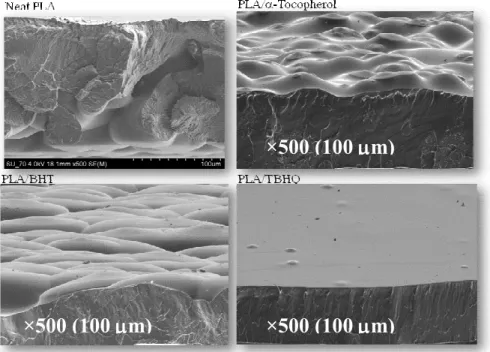
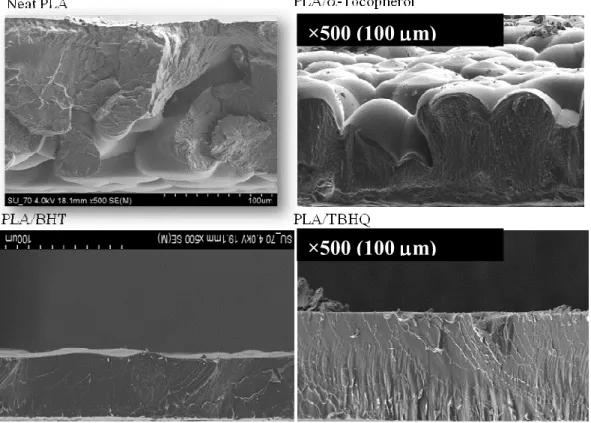
Figure 26 - DSC thermogram obtained during second heating of samples enriched with 2
wt%, 4 wt%, 6 wt% and 8 wt% of α-tocopherol. ... 42 Figure 27 – SEM micrographs of fracture surfaces of blends with 2 % of each antioxidant. ... 45 Figure 28 – SEM micrographs of fracture surfaces of blends with 5 % of each antioxidant. ... 46 Figure 29 – SEM micrographs of fracture surfaces /surfaces of blends with 5 % of each antioxidant. ... 46 Figure 30 – SEM micrographs of fracture surfaces /surfaces of blends with 10 % of each antioxidant. ... 47 Figure 31 – SEM micrographs of surface of PLA with and without α-tocopherol (α-TC). 48 Figure 32 – SEM micrographs of the pure PLA films with 4 and 10 wt% of α-tocopherol or BHT incorporated. ... 49 Figure 33 - X-ray diffraction data of neat PLA and enriched films with 2 wt%, 4 wt%, 6 wt% and 8 wt% of α-Tocopherol (α-TC). ... 50 Figure 34 – X-ray diffraction data of enriched films with 2,4, 6 and 8 wt % of
v
Figure 35 – AFM images of neat PLA (left) and PLA/α-tocopherol 2 wt % (right). ... 51 Figure 36 – AFM images of neat PLA (top) and PLA/α-tocopherol (bottom). ... 52 Figure 37 - A typical quartz crystal resonator used for mass measurements left picture: A-Schematic of typical quartz crystal microbalance; B-Illustration of transverse shear mode of oscillation; right picture: A-Simplified oscillating driving circuit schematic for a quartz crystal; B-Circuit equivalent diagram for a quartz crystal.69 ... 57
Figure 38 – vapour sorption isotherms in glassy polymers.76 ... 59
Figure 39 – Basic sorption mechanism according to the ENSIC model. Insertion of a solvent molecule (● ) in the polymer (○) / solvent matrix is governed by the two
elementary insertion probabilities ks and kp.78 ... 61 Figure 40 – Left picture: SEM image of the fracture surface of duralumin79; Right picture: scheme of the surface of a glassy polymer.76 ... 62
Figure 41 – Schematic representation of the new DMS model.76 ... 63
Figure 42 – SEM images of thin films trapped on quartz crystal. ... 66 Figure 43- AFM topography of neat PLA thin films with and without thermal treatment. 66 Figure 44 – AFM images of PLA films content 2 (top) and 4 (bottom) wt% of
α-tocopherol. ... 67 Figure 45 – AFM images of meted PLA films content 2 (left) and 4 (right) wt% of α-tocopherol. ... 67 Figure 46 - Sorption isotherms at 283 K of (a) oxygen and (b) carbon dioxide in PLA and enriched α-tocopherol PLA. The solid lines and the dash lines are the new DMSM and DMSM equation, respectively. ... 74 Figure 47 - Effect of α-tocopherol on Langmuir capacity of O2 and CO2 sorption in PLA (○) and enriched PLA 2.2 % (∆) and 4.4 % (◊) of α-tocopherol. ... 77 Figure 48 - CpK’ results for O2 and CO2 to the PLA and enriched PLA. ... 78
Figure 49 - van’t Hoff relationship for O2 and CO2 to PLA (◊) and α-tocopherol enriched PLA 2.2% (∆) and 4.4 % (○). ... 79 Figure 50 - Sorption isotherms at 303 K of oxygen in PLA and enriched PLA. ... 80 Figure 51 – Oxygen sorption of melted antioxidants PLA films. a-TC refers to
α-tocopherol. ... 81 Figure 52 – Possible interactions between foodstuff, polymer film, and the environment and their adverse consequences.96 ... 83
vi
Figure 53 – Chemical structures of the flavours used in this work. ... 86 Figure 54 - Response of uncoated (fill symbols) and PLA melted coated crystals (open symbols) as a function of the ethyl acetate vapour pressure. ... 88 Figure 55 – Ethyl acetate sorption isotherms for temperatures between 293-303 K for ethyl acetate en PLA. The lines represent the new dual mode sorption model. ... 89 Figure 56 - A’ and k’ fitting parameters of the new DMS model as a function of
temperature. ... 91 Figure 57 –Cp fitting parameter of the new DMS model as a function of temperature. .... 92 Figure 58 - SEM images of the surfaces of PLA films before and after exposure at ethyl acetate. ... 93 Figure 59 – Ethyl acetate solubility in melted and annealed PLA 98:2 over a range of temperatures (this work) and PLA 98:2 (Auras et al).102 ... 94
Figure 60 – Solubility data of ethyl acetate and butyl acetate in melted PLA 98:2, at 303 K. ... 94 Figure 61 - Sorption isotherms of ethane (solid lines), present work, and ethylene (dashed lines), previous work73 at 283 K. The lines represent, in both cases, the correlation with dual-mode sorption model. ... 99 Figure 62 - Sorption isotherms of ethane (solid lines), present work, and ethylene (dashed lines), previous work73 at 313 K. The lines represent, in both cases, the correlation with dual-mode sorption model. ... 99 Figure 63 - Henry’s law coefficient for ethane in annealed PLA 80:20 and 98:2 and in melted PLA 98:2 from 283 K to 313 K. ... 102 Figure 64 - Langmuir concentration for ethane and affinity parameter between ethane and annealed PLA 80:20 and 98:2 and in melted PLA 98:2 from 283 K to 313 K. ... 102 Figure 65 - Temperature dependence of the solubility coefficients of ethane and ethylene for PLA 98:2. ... 103 Figure 66 - Temperature dependence of the solubility selectivity of ethylene over ethane for the three different PLA films. ... 104 Figure 67 – Sketch of the diffusion process through a film.125 ... 109
Figure 68 – Examples of extrinsic and intrinsic factors affecting P, D and S in polymers such as PLA. (adapted from ref. 15 ). ... 112
vii
Figure 70 -Time-lag apparatus. P represents the pressure sensors, V the manual valves, VF
the feed tank, Vp the permeate tank and T a thermostatic air bath. ... 116
Figure 71 – SEM image of the membrane obtained by scattering method. ... 117
Figure 72 - Typical pressure history for CO2 permeation in the neat PLA film at different temperatures... 118
Figure 73 – Carbon dioxide permeability of antioxidants PLA films. ... 120
Figure 74 – Carbon dioxide diffusivity of antioxidants PLA films. ... 120
Figure 75 – Carbon dioxide solubility of antioxidants PLA films. ... 121
Figure 76 – SEM images of fracture surfaces of PLA based films containing 2 and 5 wt% of α-tocopherol. ... 122
Figure 77 - Temperature dependence of CO2 permeation in PLA with and without antioxidants. The lines represent the data fitting to an Arrhenius equation for PLA (...), PLA/BHT-2 wt.% (- - - -), PLA/TBHQ-2 wt.% (—), PLA/α-tocopherol-4 wt % (— . —). ... 123
Figure 78 - Temperature dependence of CO2 diffusivity in PLA with and without antioxidants. The lines represent the data fitting to an Arrhenius equation for PLA (...), PLA/BHT-2 wt.% (- - - -), PLA/TBHQ-2 wt.% (—), PLA/α-tocopherol-4 wt % (— . —). ... 123
Figure 79 - Temperature dependence of CO2 solubility in PLA with and without antioxidants. The lines represent the data fitting to an Arrhenius equation for PLA (...), PLA/BHT-2 wt.% (- - - -), PLA/TBHQ-2 wt.% (—), PLA/α-tocopherol-4 wt % (— . —). ... 124
Figure 80 – Oxygen permeation of antioxidants PLA films. ... 127
Figure 81 – Oxygen diffusivity of antioxidants enriched PLA based films. ... 128
Figure 82 – Oxygen solubility of antioxidants PLA films. ... 128
Figure 83 – Effect of each antioxidant on the O2 permeability of antioxidants enriched in PLA-based films with the temperature. ... 129
Figure 84 – Effect of each antioxidant on the O2 diffusivity of antioxidants enriched in PLA-based films with the temperature. ... 129
Figure 85 – Effect of each antioxidant on the O2 diffusivity of antioxidants enriched in PLA-based films with the temperature. ... 130
Figure 86 - Temperature dependence of O2 permeation in PLA with and without
viii
PLA/BHT-2 wt.% (- - - -), PLA/TBHQ-2 wt.% (—), PLA/α-tocopherol-4 wt % (— . —). ... 130
Figure 87 - Temperature dependence of O2 diffusivity in PLA with and without
antioxidants. The lines represent the data fitting to an Arrhenius equation for PLA (...), PLA/BHT-2 wt.% (- - - -), PLA/TBHQ-2 wt.% (—), PLA/α-tocopherol-4 wt % (— . —). ... 131
Figure 88 - Temperature dependence of O2 solubility in PLA with and without
antioxidants. The lines represent the data fitting to an Arrhenius equation for PLA (...), PLA/BHT-2 wt.% (- - - -), PLA/TBHQ-2 wt.% (—), PLA/α-tocopherol-4 wt % (— . —). ... 131 Figure 89 – Comparison of carbon dioxide permeability of antioxidants/PLA based
membranes against the most widely polymers in food packaging industry. (adapted from Ref. 122). ... 133 Figure 90 – Comparison of oxygen permeability of antioxidants/PLA based membranes against the most widely polymers in food packaging industry. (adapted from Ref. 122).133 Figure 91 - Empty tanks. ... 146 Figure 92 - Tank A empty and tank B with spheres of glass... 148 Figure 93 – Relationship between output signal of the temperature sensor and a standard thermocouple. ... 151
ix
List of Tables
Table 1 – Historical trend in market development of PLA.15 ... 11
Table 2 – Examples of factors limiting shelf-life of some food products.21 ... 15
Table 3 – Weight loss and degradation temperature of PLA films. ... 37
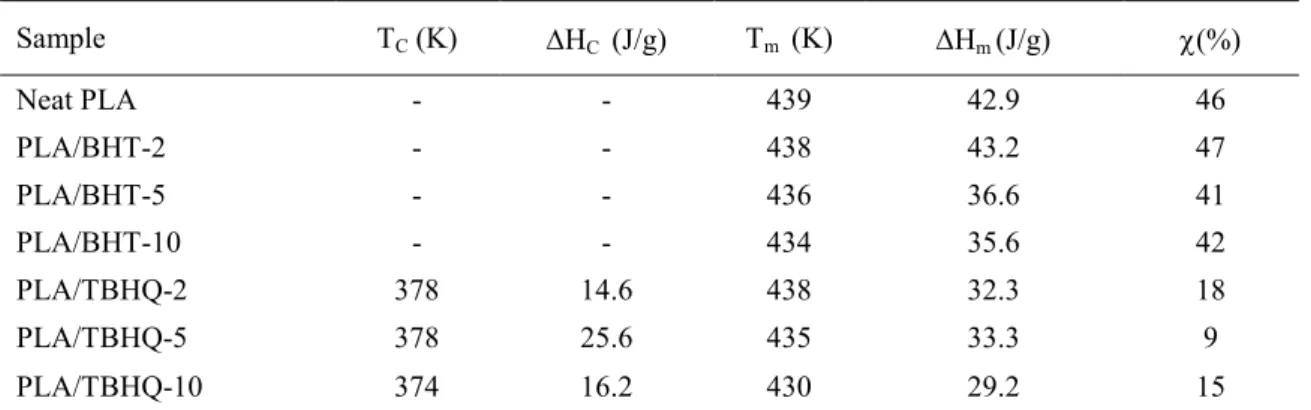
Table 4 – Thermal properties of PLA films containing different percents of antioxidants (first heating). ... 41
Table 5 - Thermal properties of PLA films containing different percents of antioxidants (second heating). ... 43
Table 6 - Thermal properties of PLA films containing different percents of antioxidants from others works. ... 44
Table 7 – Water contact angles (θ, degree), polar (
γ
sp) and dispersive (γ
s) components of surface energy (γ
s) of the PLA films. ... 53Table 8 – Impregnation of antioxidants in polymers. ... 70
Table 9 - Sorption of O2 in PLA and PLA enriched with α-tocopherol. ... 72
Table 10 - Sorption of CO2 in PLA and PLA enriched with α-tocopherol. ... 73
Table 11 - Estimated values of the parameters of the New DMSM for oxygen in PLA and PLA enriched with α-tocopherol. ... 75
Table 12 - Estimated values of the parameters of the new DMSM and DMSM for carbon dioxide in PLA and PLA enriched with α-tocopherol. ... 76
Table 13 – Properties of PLA and other common plastics used in packaging industry.99 .. 86
Table 14 – Estimated values of the parameters of the new DMS and CDMS models for ethyl acetate vapour sorption in PLA subjected to the two different temperature protocols over the studied range of temperatures. ... 90
Table 15 - – Comparison of the fitting efficiencies of the two models for ethyl acetate vapour sorption in PLA. ... 90
Table 16 - Experimental results of sorption of ethane in PLA using QCM in the temperature range between 283 K up to 313K. ... 98
Table 17 - Dual-Mode Sorption Model parameters for ethane and ethylene in the studied films and respective average absolute deviation in percentage (AAD %). ... 101
x
Table 18 – Experimental data obtained from time-lag technique for carbon dioxide in PLA films with and without antioxidants. Each result is an average of least three measurements. ... 119 Table 19 - Activation energy for CO2 permeability, diffusivity and solubility in neat PLA and enriched antioxidants. ... 124 Table 20 – Experimental data obtained from time-lag technique for oxygen in PLA films with and without antioxidants. Each result is an average of least three measurements. ... 126 Table 21 - Activation energy for O2 permeability, diffusivity and solubility in neat PLA ant enriched antioxidants. ... 132
xi
Nomenclature
aTC -α-tocopherol,
BHT - 2,6-bis(1,1-dimethylethyl)-4-methylphenol C - solubility of the gas in polymer
D – diffusion coefficient
DMSM - dual-mode sorption model ED - activation energy for gas diffusion EP – activation energy for gas permeation ES - activation energy for gas sorption MAP - modified atmosphere packaging New- DMS – New dual-mode sorption model P - octanol-water partition coefficient
P – permeation coefficient PA - polyamide
PBS – polybutadiene styrene PC – polycarbonate
PE - Polyethylene
PEG - poly(ethylene glycol) PEN – Polyethylene napthalene, PET - polyethylene terephthalate PHB-co-V-
PLA – Poly(lactic acid) PLA (98:2)- PLA ( % L: % D) PP - polypropylene PS - polystyrene PVC - polyvinylchloride S – sorption coefficient TBHQ- 2-(1,1-Dimethylethyl)-1,4-benzenediol or tert-Butylhydroquinone TC – Crystallization temperature Tg - Transition temperature
xii Tm – melting temperature
1
2
1.1.
Context
Since their pioneering days over a hundred years ago, plastics have greatly improved human living conditions and are indispensable and irreplaceable in modern everyday life. As a result of their resource, efficient production processes, facile processing, and high versatility in terms of tunable properties and broad range of applications, these materials render high technologies affordable for all humankind.1 Plastics are versatile materials potentially indestructible, ideal for a number of commercial and domestic applications. Every day thousands of tones of plastic are used and disposed in the form of disposable cups to thin cellular packing. Statistics show that about 85 % of these plastics are sent to landfill or dumped elsewhere.2 Every year in Europe, 10 million tones of post-consumer plastic waste are buried in landfills3,that are quickly reaching their capacities, and consequently new landfills are opened, generating great environmental threat in the coming years. Although plastics take long time to break down, only about 5 % of plastics used are currently being recycled.2 Plastics make our life easier and better, e.g. when used as packaging they can safely protect from damage and leaking and deliver a product unalterable from the manufacturer to the consumer, in a world where one more day of shelf life matters and simultaneously safety cannot be compromised. The world’s plastic consumption has increased incredibly in recent decades, generating more and more plastic waste, thus increasing the public concern.4 Petrochemical-based plastics such as Polyethylene (PE) polypropylene (PP), polyvinylchloride (PVC), polystyrene (PS) and polyethylene terephthalate (PET) and polyamide (PA) have been increasingly used as packaging materials due not only to their large availability at relatively low cost, but also to their good mechanical performance such as tensile and tear strength, good barrier to oxygen, carbon dioxide and aroma compound, heat sealability, and so on. 5
Worldwide plastics production increased 4 % in 2011, with more than 10 million tons of plastics produced. Polyolefins, PP, PVC, PET and PS account for about 70 % of the total global demand, i.e. 200 million tons. From 2010 to 2016, global plastics consumption is expected to grow by an average of about 4 % each year. The world will consume 540 million tons of plastic in 2020.6 Figure 1 present the estimates of worldwide production by 2016. 4
3
Figure 1 - Estimates of the worldwide production of plastics. 4
During the 20th century, a great variety of synthetic polymers became available at industrial scale. This was mainly due to the petrochemistry, a strong technology emerging since the 1950s. Exploitation of oil and gas as fossil raw materials for the chemical industry and polymer production greatly improved cost-effectiveness and simplified manufacturing of macromolecular materials. Since then, the attractive combination of low cost with facile processing and innovation represents the key feature of plastics. In the 1990s, new recycling technologies enabled the effective reuse of polymer products that had completed their first lifecycle.1
Polymer wastes can thus become a valuable source of raw materials and energy. In today’s highly efficient industrial polymerization processes, polymers are tailored to be stiff, soft or rubbery, conducting or insulating, optically transparent or opaque, permeable or impermeable, stable or (bio)degradable. Prominent examples of polymer applications include food and medical packaging materials, lightweight engineering plastics in the automotive and aerospace industries, damage-tolerant construction materials for modern architecture, high-strength fibers for textiles and composite materials, printed circuit boards and photoresists for microelectronics, solvent-free coatings for corrosion protection, adhesives, and new materials for biomedical applications such as wound dressing, membranes for artificial kidneys and water purification, dental fillings, drug delivery systems, artificial hearts, and implants. Plastics have become essential components of
4
virtually any kind of consumer product, meeting the highly diversified demands of human society.1 Despite the many applications that a wide diversity of plastics find in different sectors, the packaging industry is by far the one that shows the highest use of these materials, as depicted in Figure 2.6
Figure 2 – European Plastics demand and its sectors of application.6
Food packaging is a necessary part of exchanging goods around a country and the world, securing the food supply chain. The way consumers buy goods demands protection and preservation.5 In industrialized countries, polymer packaging secures the food supply chain, whereas in developing countries around half the food is lost in transportation.1
For a long time polymers have supplied most of common packaging materials because they are able to present several key features like softness, lightness and transparency. However, increased use of synthetic packaging has led to serious ecological problems due to their total non-biodegradability.5 Figure 3 illustrates the different types of plastics used in the different packaging applications.
5
Figure 3 – Types of plastic packaging divided by type of use and type of resin.7
It is widely accepted that the use of long-lasting polymers from petrochemicals in products with a short life-span, such as engineering applications packaging, catering, surgery, and hygiene, is not adequate. Persistent polymers generate significant sources of environmental pollution, harming wildlife when they are dispersed in nature.8 Moreover, incineration of plastic waste presents severe environmental issues since it yields toxic emissions (e.g., dioxins).8 Although their complete replacement with eco-friendly packaging films is just impossible to achieve, at least for specific applications, like food packaging, the use of bioplastics is clearly the future.5
Today the world is quickly coming to realize the impact of packaging on human life. The world is beginning to see the effects of our existence on the planet. This has sparked a major movement towards maintaining society’s thirst for goods while improving the footprint left on our planet.5 The past few years, marked by the paradigm of sustainable development, have brought about a renewed interest in biodegradable polymers originating from renewable resources. The most important market for those novel polymers will be the packaging sector, within which food packaging represents approximately 65 % in volume.9 Bio-based polymers offer important contributions by reducing the dependence on fossil fuels and through the related positive environmental impacts such as reduced carbon dioxide emissions.10 The first generation of bio-based polymers focused on deriving polymers from agricultural feedstocks such as corn, potatoes, and other carbohydrate feedstocks. However, the focus has shifted in recent years due to a desire to move away from food-based resources and also significant breakthroughs in biotechnology.10
Bio-6
based polymers similar to conventional polymers are produced by bacterial fermentation processes synthesis of the building blocks (monomers) from renewable resources, including lignocellulosic biomass (starch and cellulose), fatty acids, and organic waste.10 Natural bio-based polymers are the other class of bio-based polymers which are found in nature, such as proteins, nucleic acids, and polysaccharides (collagen, chitosan, etc.). These bio-based polymers have shown enormous growth in recent years in terms of technological developments and their commercial applications.10
The terms bio-based polymers and biodegradable polymers are used extensively in the literature.10 Biodegradable polymers are defined as materials whose physical and chemical properties undergo deterioration and completely degrade when exposed to microorganisms, carbon dioxide (aerobic) processes, methane (anaerobic processes), and water (aerobic and anaerobic processes).10 Bio-based polymers can be biodegradable (e.g., polylactic acid) or nondegradable (e.g., biopolyethylene). Similarly, while many bio-based polymers are biodegradable (e.g., starch and polyhydroxyalkanoates), not all biodegradable polymers are bio-based (e.g., polycaprolactone).10 There are three principal ways to produce bio-based polymers as shown in Figure 4:
Production of
Biobased Polymers
Polymers from Agro resources (by extraction and
separation) From microorganisms (by fermentation) From biotechnology (via conventional synthesis) Polysaccharides and Lipids ( Starch, Cellulose, Alginates) Polyhydroxyalka noates (mcl-PHA, PHB, PHB-co-V) Poly lactides, PBS, PE, PTT, PPP
7
Bio-based polymers hold a tiny fraction of the total global plastic market. Recent data show that the production of bio-based polymers should increase from 1.5 % in 2011 to 3 % in 2020. Figure 5 shows the evolution of production capacities of bio-based polymers.12
Figure 5 – Evolution of production capacities of bio-based polymers.12
The worldwide interest in bio-based polymers has accelerated in recent years due to the desire and need to find non-fossil fuel-based polymers as shown in Figure 6.10 Several synthetic polymers are biodegradable and compostable like natural carbon-based polymers, such as starch, cellulose and lignin. In the same way some bioplastics based on natural monomers, can lose biodegradability through chemical modifications, like polymerization, such as for example Nylon 9 types polymers obtained from polymerization of oleic acid monomer or Polyamid 11 obtained from the polymerization of castor oil monomer.5
Synthetic and natural polymers stand at the opposite ends of a spectrum of properties: i) polyolefins are hydrocarbon hydrophobic polymers, resistant to peroxidation
8
and biodegradation, highly resistant to hydrolysis, which is their main attribute for the application in packaging. To make polyolefins biodegradable it is necessary to introduce pro-oxidant additives which promote the oxo-biodegradation by producing low molar mass oxidation compounds bioassimilable by the microorganisms; ii) natural compounds, like cellulose, starch and so on, are hydrophilic polymers, water wettable or swellable and consequently biodegradable. They are not technologically useful for food packaging where water resistance is required. Between these two extremes are the hydro-biodegradable aliphatic polyesters such as polylactic acid (PLA) and the poly(hydroxyacid) (PHA).5 Among bio-source-based polymers emerging on the food market, the semi-crystalline polyester poly(lactic acid) (PLA) is one of the most applied.9
9
1.2.
Poly(lactic acid)
Lactic acid (2-hydroxy propionic acid) is a molecular compound with a chiral carbon atom and exists in two enantiomeric forms (Figure 7). The lactide monomer, from which PLA is made of, comes from lactic acid, that has two enantiomers, L and D13 (Figure 7).14 Control of the (L:D) monomer ratio is a very important feature in PLA, since it has a large effect on material properties, including the degradation time,13 melting temperature, degree of crystallinity, and barrier properties. Generally, higher L-lactide content should result in higher barrier properties of the polymer because of greater stereochemical purity.15 The L-type is the most abundant naturally.15 The chiral nature of lactic acid results in distinct forms of polylactide, namely, poly(L-lactide) (PLLA), poly(D-lactide) (PDLA), and poly(DL-lactide) (PDLLA), which are synthesized from the L-, D- and DL-lactic acid monomers, respectively, or from the corresponding L,L-lactide, D,D-lactide, and DL-lactide, respectively.15
The future widespread availability of PLA raises interesting and important questions regarding its application.13
(R)-Lactic acid D-(-) Lactic acid
(S)-Lactic acid L-(+) Lactic acid
Figure 7 – Chemical structure of L - and D - lactic acid and the enantiomeric forms of lactic acid: (S) - and
(R) – 2- hydroxypropionic acid.15
The lactic acid molecule has a hydroxyl and an acid functional group, which may result in intermolecular and intramolecular esterification reactions.14 Almost all lactic acid available in the market is produced by fermentation. During fermentation, a suitable carbohydrate is converted to lactic acid by microorganisms. 14
10
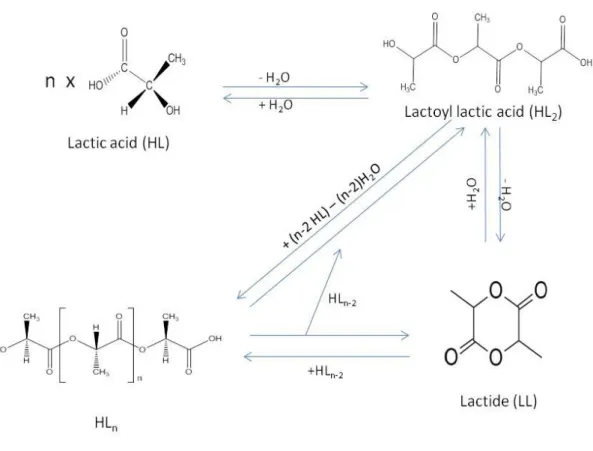
The first step of the polymerization is the formation of a linear dimer (lactoyl lactic acid). This condensation reaction can proceed to higher oligomers and is promoted by elimination of water. Also a cyclic dimer, lactide, is formed in small amounts. Lactide can be formed by intramolecular esterification of lactoyl lactic acid or by breakdown of higher oligomers. All reactions are equilibrium reactions (Figure 8).15
Figure 8 – Lactic acid condensation reactions-interchange between lactide, oligomers, and poly(lactic
acide).15
Lactic acid can form PLA by means of the reaction of the hydroxyl and carboxylic acid groups of lactic acid. By removing the water formed during this condensation reaction, the reaction proceeds towards the product side, PLA. The preparation of PLA from lactic acid by direct condensation can be divided into three principal stages: i) removal of the free water content, ii) oligomer polycondensation, and iii) melt polycondensation of high molecular weight PLA.15
High molecular mass PLA is obtained either by the polycondensation of lactic acid or by ring-opening polymerization (ROP) of the cyclic dimer
2,6-dimethyl-1,4-dioxane-11
2,5-dione commonly referred to as dilactic or lactide. The generally applied ROP process for polylactides involves three separate steps: polycondensation, lactide manufacturing, and ring-opening polymerization.15
Commercial PLA is usually prepared from L-lactic (LLA), because the resulting polymer poly(L-lactic acid) (PLLA) is semicrystalline with a relatively high melting and glass transition temperature (Tg).
Polylactides have been known for several decades but only recently have these polymers gained commercial significance as a leading environmentally benign plastic available from renewable resources. The production of lactic acid started in the United States in the 1880s, and, unfortunately the process of fermentation of vegetable sugars was not very sucessful.15 In 1950, the first commercial production of synthetic lactic acid started in Japan.15 In 1966 occurred the first application of polylactides as implants, sutures and orthopedic fixation, with advantage over nondegradable biomaterials eliminating the need to remove implants and providing long-term biocompatibility, furthermore, it was observed that the degradation of PLLA powder implanted had a nontoxic tissue response.15
Only in 1990, the use of poly (lactic acid) (PLA) in packaging and other commercial ends started (Table 1).15
Table 1 – Historical trend in market development of PLA.15
Early 1990s Latter 1990s 2000s Concept Biodegradability Plant origin
Biodegradability Plant origin Target application Fishline, net, Compostable
material, Agricultural film
Packaging container Agricultural and engineering Compostable material
Packaging container Durables
Fibers Social topics keyword Landfill life, Dumping of plastic
articles
Poly(lactic acid) (PLA) is a biodegradable thermoplastic polyester that has been the subject of intensive research due to its intrinsic characteristics, such as biodegradability and sustainability, since it is made from natural resources like corn, sugar beet and wheat. PLA exhibits many properties that are equivalent or superior to those of many petroleum-based plastics, which makes it suitable for a large variety of applications. 16
12
Figure 9 presents a comparison of the physical properties of PLA to other commodity thermoplastics. It is seen that PLA compares favourably with polystyrene, (PS), a widely used plastic based on non-renewable resources. It should be noted though, that PLA has a glass transition temperature that is significantly lower, Tg ≈ 59 ºC, than polystyrene,Tg ≈ 100 ºC. This translates into a lower heat distortion temperature and limits the applicability of PLA for applications requiring better heat resistance. 17
Figure 9 – Physical properties of PLA compared to other common plastics.17
Packages made with plastic, in contrast to glass or metal packaging material, are permeable, at different degrees, to small molecules like gases, water vapour, and organic vapour and to other low molecular weight compounds like aromas, flavour, and additives present into food.18 The knowledge of the solution/diffusion/permeation behaviours of these molecules through the polymer film has become increasingly important in recent years, especially for polymers used in the food packaging field where contamination from external environment has to be avoided and the shelf life of the food controlled by the use of modified atmosphere packaging (MAP) techniques.18
PLA is currently used for single or multilayer films, trays, cups, and bottles, and can be manufactured by extrusion, thermoforming, injection and blow molding processes for packaging applications. PLA is also suitable for the production and use of functional membranes.19 It has been reported that PLA is more suitable than polyethylene or
13
polystyrene as packaging material for juices, yoghurt, salad dressing and sour cream. Nevertheless, when tested with cheese, a moisture loss of 10 times higher than of the reference packaging (PET) material was observed.20
Despite PLA shows good physical properties, similar to those of PS and poly(ethylene terephthalate, PET, the relatively high oxygen permeability of PLA and its brittleness are main drawbacks for flexible packaging applications, namely foods and/or pharmaceuticals products susceptible to oxidation.19 The fact that PLA has higher carbon dioxide and oxygen permeability than polystyrene, low density polyethylene, LDPE, and poly(ethylene terephthalate), clearly indicates that the development of PLA packaging requires further efforts.
1.3.
Active packaging
Important functionalities of packaging are not only to ensure food safety, but also to guarantee the organoleptic quality of the packed product during its shelf- life. Shelf-life is defined as the time during which the food product will: i) remain safe; ii) be certain to retain desired sensory, chemical, physical and microbiological characteristics; iii) comply with any label declaration of nutritional data, when stored under the recommended conditions.21 Many factors can influence shelf-life, and can be categorized into intrinsic and extrinsic factors. Intrinsic factors are influenced by variables such as raw material type and quality, and product formulation and structure.
They include the following:
• Water activity (aw) (available water). • pH value and total acidity; type of acid. • Redox potential (Eh).
• Available oxygen. • Nutrients.
• Natural microflora and surviving microbiological counts.
• Natural biochemistry of the product formulation (enzymes, chemical reactants). • Use of preservatives in product formulation (e.g. salt).
Extrinsic factors are those the final product encounters as it moves through the food chain. They include the following:
14
• Time–temperature profile during processing; pressure in the headspace. • Temperature control during storage and distribution.
• Relative humidity (RH) during processing, storage and distribution. • Exposure to light (UV and IR) during processing, storage and distribution. • Environmental microbial counts during processing, storage and distribution. • Composition of atmosphere within packaging.
• Subsequent heat treatment (e.g. reheating or cooking before consumption). • Consumer handling.
All these factors can operate in an interactive and often unpredictable way, and the possibility of cross-interactions must be investigated. A particularly useful type of interaction occurs when factors such as reduced temperature, mild heat treatment, antioxidant action and controlled atmosphere packaging operate in synergy to restrict microbial growth, the so-called ‘hurdle effect’. This way of combining factors which, individually, are unable to prevent microbial growth but, in combination, provide a series of hurdles, allows manufacturers to use milder processing techniques which retain more of a product’s sensory and nutritional properties.21
The interaction of such intrinsic and extrinsic factors inhibits or stimulates a number of processes which limit the product shelf-life. These processes can be classified as microbiological, chemical, physical and temperature related.21
Table 2 shows some examples of processes associated to the deterioration of several food classes. In composite foods the factors limiting shelf-life can be quite different from those that limit the shelf-life of the individual components. For example, an important factor limiting shelf-life in breakfast cereals containing a mixture of cereal and dried fruit is the hardening of the fruit from moisture migration into the cereal. In contrast, the limiting factors for the individual fruit and cereal components would be flavor changes arising from chemical reactions, and moisture uptake and softening of the cereal. There are many factors to be considered in choosing the optimal packaging form and material for any particular product, including the product characteristics, processing considerations, shelf-life required and overall cost. In many cases, packaging is an integral part of the processing stage. Advances in packaging materials and techniques have increased the options available for maintaining quality and for improving the shelf-life of foods.21
15
Table 2 – Examples of factors limiting shelf-life of some food products.21
Product Deterioration processes Limiting changes Fruit and vegetables (Soft fruit, Hard fruit,
Coleslaw, prepared salads)
Moisture loss; Enzymic action; Mould growth; fat oxidation
Textural softening; dry appearance; Loss of crispness; microbial growth; rancidity
Meat products (fresh red meat, fresh poultry, fresh bacon, canned ham)
Oxidation; microbial growth; chemical reactions
Loss of red color; rancidity; off-odors and flavors; freezer burn; microbial; gas generation
Cereal and other dry products (bread, cakes, dried pasta, breakfast cereals)
Starch retrogradation; moisture migration; moisture uptake; oxidation; starch changes; protein change
Stable texture and flavor; dry texture; mould growth; drying and hardening; mould formation; rancidity
Beverages (carbonated beverages, beer; coffee; fruit juices, tea, wine)
Gas evolution,
hydrolysis/oxidation; microbial growth; volatile loss; enzymic reactions
Carbonation loss: flavor loss; rancidity; turbidity; nutrient loss; flavor loss
Dairy products (ice-cream, butter, cheese, yoghurt)
Moisture migration; oxidation; hydrolysis reactions; microbial growth; lactose crystallization; syneresis
Ice crystal formation; rancidity; gritty texture; mould production; serum separation;
Modified Atmosphere Packaging (MAP), which involves replacing the air in the headspace of a packaged product with a single or mixture of special gases, has made the greatest impact on the shelf-life of chilled products. The gases commonly used are carbon dioxide and nitrogen. Carbon dioxide is used to suppress microbial growth, but its effectiveness is very much dependent on the sensitivity of different classes of microorganisms to this gas. Nitrogen is used as a inert filler, since oxygen is to be excluded to prevent aerobic spoilage. One special case, however, is that of fresh fruit and vegetables, where a delicate balance of carbon dioxide and oxygen is necessary to allow aerobic respiration to continue at a very low rate and thereby extend shelf-life. One of the requirements of food packaging is that it should play a passive role, remaining inert and not interacting with the food it contains. 21 However, as a result of new consumer trends, a demand for better fresh-like quality using convenient food products intensifiers made traditional packaging concepts outdated. Besides the protection of the foods shape and texture, preservation of flavors and odours, shelf-life extension and control of the water or moisture content of foods, the packaging industry has been developing a new innovative concept: active packaging. 22–24
16
This is a type of packaging where changes in the packaging atmosphere are promoted in order to fulfil one or more specific objectives, such as the extension of its shelf-life and the increase of the packaged foods safety and quality. 22
Active packaging systems can be regarded as active scavenging/releasing systems. While in the first type undesired compounds such as oxygen, ethylene, carbon dioxide or moisture are removed, in the last compounds such as carbon dioxide, water, antioxidants or preservatives are added. The most studied of these compounds are undoubtly oxygen and carbon dioxide. Although CO2 has a beneficial effect in microbiological control and in the storage of foods such as meat, cheese or fish, an excess of CO2 may cause package collapse, promoting anaerobic metabolism, pH reduction and flavor change. Micro-perforation is the most used method to control CO2 content inside the package, due the deterioration or respiration reactions, by increasing the permeability of the gas through the packaging material. 25,26
On the other hand, oxygen is responsible for several undesirable chemical reactions in foods, promoting the growth of aerobic microbes and the spoilage of many foods by microbial attack. Nonetheless, oxygen inhibits the growth of anaerobic micro-organisms.25,26 The mould growth control and the delay in the rancidity development of vegetable oils are the most important application of oxygen scavenging systems in food packaging.26 Usually, these active packaging technologies make use of sachets with active compounds, such as iron powder, ascorbic acid, photosensitive dyes and enzymes but these approaches meet some resistance due to the accidental spill and consumption of sachet contents.24,25
There is a growing interest in bioactive packaging through the use of natural compounds incorporated into the polymer wall of the package in order to increase the foods shelf-life and, at same time, prevent the oxidation of polymer by thermal degradation. Antioxidants are widely used as food additives to improve the stability of lipids to oxidation and to prolong shelf-life of dried products and oxygen sensitive foods. They have also been incorporated in small concentrations into plastic films to obtain additional stability under processing conditions.27–29
Therefore, the barrier properties of the packaging polymer against the transfer of small gaseous molecules, such as O2, CO2 or H2O, are important9, and should prevent food degradation and oxidation, preserving aromas and flavours13. In particular, oxygen is an
17
excellent oxidizing agent of lipids which can cause deterioration of product quality. Moreover, barrier properties against light, water vapor, atmospheric gases and larger volatile molecules, such as aroma compounds, need to be assessed since the transfer of these compounds into the polymer could cause a modification of the aroma formulation of the packaged food leading to a deterioration of its quality.9
1.4.
Scope
The central idea behind this thesis was to develop a biodegradable poly(lactic acid) (PLA)-based packaging system that can provide an extended shelf life for foods and improve food safety, improving its barrier properties. PLA, was selected for this study since it is obtained from natural renewable resources and presents mechanical properties comparable to hydrocarbon based polymers and with excellent flavor and odor barrier.30,31,32 PLA is already used as a packaging material for the storage of fresh-fruits and vegetables or foods with short shelf-life. In order to improve PLA’s barrier properties, antioxidants (natural and artificial) were incorporated in films of PLA. The objective of this study is to evaluate the impact of the addition of three antioxidants α-tocopherol, 2,6-bis(1,1-dimethylethyl)-4-methylphenol or (Butylated hydroxytoluene), BHT, and 2-(1,1-Dimethylethyl)-1,4-benzenediol or tert-Butylhydroquinone (TBHQ) (Figure 12) in PLA films. For that purpose, films with different quantities of antioxidant were prepared and thermal, mechanical and barrier properties were measured so that their suitability as a polymer materials for food packaging can be assessed.
19
2. Antioxidants Poly(lactic acid)
Composite Films Characterization
20
2.1.
Introduction
The selection of a polymeric material for certain application depend on the performance of the membrane and specially of the glass transition temperature, Tg, and the crystallinity which are important parameters and affect directly the transfer of small molecules through the membrane. These parameters are determined by structural factors such as chain flexibility, chain interaction, chain symmetry, presence of lateral chains, extent of polymer chain unsaturation, presence of polar groups in the polymer backbone, orientation of the polymer chains and degree of crosslinking, cohesive energy of the polymer and molecular weight and presence of additives.33,34 The knowledge of Tg is essential in the selection of materials for various applications. In general, values of Tg well below room temperature define the domain of elastomers and values above room temperature define rigid and structural polymers, i.e., the mechanical and physical properties change drastically over a relatively small temperature interval covering the glass transition temperature. The glassy state of a polymer can be considered as a frozen state with a highly restricted chain mobility.33 However, in the presence of some substances, depression of the glass transition may occur due to an increase on the free volume.
Most of the dense materials used as food packaging are made up of semi-crystalline polymers (PE, PP, PET) in which both phases can be distinguished: an amorphous phase and a crystalline phase (Figure 10). When the crystallization occurs in solution, the polymeric chains fold back and forth, forming folded chain lamellar crystals, connected to the amorphous regions by polymer chains.
Figure 10 – Semi-crystalline polymer structure presenting lamellar crystals connected by polymer chains
21
In the melted state, the polymer chains are highly entangled therefore the folding of chains during the nucleation and crystallization process is hindered.35 Crystallization from the melted polymer results in the formation of spherical crystal aggregates, the so-called spherulites, notably at isothermal crystallization at low supercooling.35
Typically, polymer crystals are not in thermal equilibrium since their formation is strongly complicated and hindered due to the connectivity of the segments, involving co-operative movements of a large number of connected monomers.35 Although the free energy would be lowest for fully extended crystalline molecules, long polymers usually form much thinner lamellae (“chain-folding”). Therefore, polymer crystals represent meta-stable states with a significant degree of disorder, mainly characterized by the degree of chain foldind.35
Three parameters whose role is essential when dealing with mass transfer through polymeric matrices are free volume, glass transition temperature, and crystallinity of the polymer, which are also function of previously given factors.34 Diffusion in semicrystalline polymers is complicated by the presence of crystallites. Crystalline zones are excluded volumes where molecules cannot sorb and increase the path that diffusing molecules must pass in the membrane because they increase tortuosity and may also decrease the mobility of the amorphous polymeric chains because chain ends could be trapped in the neighboring crystalline lamellae.34 In the amorphous part, the diffusion mechanism is different according to whether the membrane is in a rubbery or a glassy state at the temperature of use (above or below of Tg).34 Membranes in the glassy state are actually not in equilibrium because the time necessary for a polymer in the glassy state to relax, i.e., for its structure to rearrange in response to external changes, is long. Membranes in the rubbery state are at equilibrium and do not contain fixed regions of non equilibrium excess volume because the structure rearranges promptly in response to external changes.34
The concept of free volume is useful for explaining aspects of the chain mobility and permeability of polymers. Free volume (microvoids), including its nanostructure characteristics (mean size and size distribution of microcavities, their spatial arrangement and topology), determines many properties of glassy polymers and in particular, the transport parameters of membrane materials such as permeability and diffusion coefficients of gases.36 The relation between the free volume and the polymer mobility is frequently studied by measuring the diffusion properties of small molecules in polymers. As a general
22
rule, gases solubility, diffusivity and permeability increase with the increase in free volume. In semi-crystalline polymers (PP, PE, PET…), free volume is linked to Tg of the amorphous part.34 Conceptually, permeation of small gas molecules through a glassy polymer is viewed as proceeding by jump motion whereby a permeant molecule spends most of the time in free-volume cavities and occasionally jumps to a neighboring cavity.37 The jump motion proceeds by formation of a channel between two neighboring holes. Thus gas permeation depends on the number and size of cavities in the polymer matrix (static free volume) and the frequency of channel formation (dynamic free volume). Static free volume is essentially independent of thermally accessible motions of the polymer chains and relates to gas sorption, S. Dynamic free volume derives from accessible conformational changes and segmental motions of the polymer chain and relates to gas diffusivity, D.37
In recent years many efforts have been devoted to the development, formulation and characterization of new ecologically friendly and sustainable plastic materials that can overcome the major environmental problems created by the extensive use of petrochemical based plastics. In particular, PLA has been playing a dominant role among biorenewable resources plastics. As we mentioned in the previous section, many important properties of PLA are controlled by ratio of D- to L- enantiomers used and the sequence of arrangement of the enantiomers in the polymers. PLLA constitutes the main fraction of PLA derived from renewable sources since the majority of lactic acid obtained from biological sources exists as LLA. PLA with PLLA content higher than 90 % tends to be crystalline while that with lower optical purity is amorphous. The melting temperature, Tm, glass transition temperature, Tg, and crystallinity of PLA decrease with decreasing amounts of PLLA.15
Thermoplastic polymers exhibit many properties ideal for use in packaging and other consumer products, such as light weight, low process temperature (compared to metal and glass), variable barrier properties to match endues applications, good printability, heat sealable, and ease of conversion into different forms.38 Similar to many thermoplastics polymers, semicrystalline PLA exhibits Tg and Tm. Above Tg (~58 ºC) PLA is rubbery, while below Tg, it becomes a glass. Figure 11 displays the Tg and Tm of thermoplastics polymers.38
23
Figure 11 – Glass transition temperature and melting temperature of PLA and other thermoplastics.38
The properties of PLA such as thermal stability and impact resistance are inferior to those of conventional polymers used for thermoplastic applications.38 The inherent brittleness of PLA has been a major bottleneck for its large-scale commercial applications.39 Therefore, PLA is not ideally suited to compete against the conventional polymers.38 Despite the good mechanical properties and processability as well as biocompatibility of PLA, to replace the polyolefins in packaging material and hygiene products, as diapers, and milk cartons, PLA film have to be flexible, because in the industrial production line of packaging material as well as diapers, there is no tolerance for the film cracking or tearing when folded or subject to force during manufacturing.40 Since PLA is rigid and brittle with low ability to plastic deformation below glass transition temperature, numerous approaches such as plasticization, block copolymerization, blending with tough polymers, and rubber toughening have been adopted to improve the toughness of brittle polylactide bioplastic.39 The major drawbacks of these methods are the substantial decreases in the strength and modulus of the toughened polylactide. So, a polylactide-based material having good stiffness-toughness balance along with high biobased polylactide content is still elusive.39
One of the most used methods to overcome the problem of the brittleness is plasticize the PLA in order to produce flexible films. Several types of chemicals have been tried to plasticize PLA such as citrate esters, poly(ethylene glycol) (PEG), glucose monoesters and partial fatty acid esters, resulting in materials with better deformation capacity and
24
resilience.41 Also, blends of PLA with various non-biodegradable polymers, and with others aliphatic polyesters such as poly (ε−caprolactone), poly(butylene succinate) and poly(hydroxy butyrate) were also reported in the literature.41 Various compounds are reported as efficient plasticizing for PLA including poly(3-methyl-1,4-dioxan-2-one), poly(ethylene oxide), citrate esters, triacetine, and poly(ethylene glycol)s (PEGs).42 Some of these blends were found to be immiscible, resulting in fairly poor mechanical properties.41
The expansion of PLA´s application to the packaging industry passes essentially through the ability to tailor its gas barrier properties and flexural properties such as rigidity and brittleness, which are an expression of its low deformation at break. The choice of polymers or plasticizers to be used as modifiers for PLA is limited by the requirements of the application. For packaging and hygiene applications, only nontoxic substances approved for food contact and personal care can be considered as plasticizing agents.40
Antioxidants are widely used as food additives to improve the stability of lipids to oxidation and to prolong shelf-life of dried products and oxygen sensitive foods. They have also been incorporated in small concentrations in films to obtain additional stability (chemical, thermal) under processing conditions. 27–29,43–45
In this context, antioxidant-active packaging is a promising approach to extend the shelf-life and improve safety and sensorial properties, while maintaining the food quality. Several antioxidants have already been incorporated into different polymeric film structures for the intentional purpose of migration into food to prevent its oxidation.28,46–48 The impregnation of Food and Drug Administration (FDA) approved antioxidants, in polymeric films has also been subject of research. α-tocopherol (the component of Vitamin E which has the highest free radical scavenging activity) is a natural antioxidant that has already been studied as a polymer film stabilizer as well as an antioxidant. Recognized as safe and worldwide approved for use in food applications, α-tocopherol has been used to improve the biostability and biocompatibility of different materials.43,49,50 Reno et al.51 studied the effect of α-tocopherol added to poly((D,L)lactic acid) for medical applications and it was verified that it alters the surface wettability. Wessling et al.29 observed that incorporation of high levels (3600 ppm) of α-tocopherol into LDPE films inhibits the oxidation of organic acids stored in contact with the film. More recently, Byun et. al52 clearly showed the high antioxidant activity of α-tocopherol, by the incorporation of 1 %
25
of α-tocopherol PLA films, which increased the radical scavenging activity from 0.84 % to 90.43 %.52 Manzanares-López et al.53 added 2.58 wt% of α-tocopherol into PLA films and studied the films thermal and optical properties as well as effect of the release of the antioxidant on the oxidative stability of soybean oil. No significantly effect was observed on Tg and Tm. Ortiz-Vazquez et al.54 studied the use of butylated hydroxytoluene (BHT), another antioxidant also approved by FDA, in PLA films for packaging of coconut oil and concluded that the addition of 0.79 wt.% of BHT to the PLA film had no effect on thermal, oxygen and water barrier properties of the PLA films.
Nevertheless, recent contradictory results show that the addition of 1 wt.% of synthetic phenolic antioxidants including BHT, butylated hydroxyanisole, tert-butylhydroquinone (TBHQ) and propyl gallate had no significant effect on the glass transition and melting temperature, water vapour and oxygen permeability of PLA films.55 However, Hwang et
al. 56 demonstrated that the combination effect of two natural antioxidants (α-tocopherol and resveratrol) with differing concentrations can play a critical role on the thermal and mechanical properties of PLLA films.
In conclusion, the available literature only addresses the incorporation of very small amounts of antioxidant and most studies only assess rates, effects and release mechanisms of the antioxidants. This chapter explores the incorporation of antioxidants into PLA films and their effect on thermal, surface and mechanical properties. For that purpose, three antioxidants were selected, one natural (α-tocopherol) and two synthetic (BHT and TBHQ). α-tocopherol, a lipid-soluble antioxidant that has already been intensively studied as a polymer film stabilizer, was chosen due to its highest free radical scavenging activity.57 BHT and TBHQ are commonly used in food industry and were chosen because they have similar structures but different molar volumes.55 The chemical structures of the antioxidants used in this work are shown in Figure 12.