A Work Project presented as part of the requirements for the Award of a Master Degree in Management from the Nova School of Business and Economics
The effect of technostress on the acceptance of Artificial Intelligence-enabled machine feedback systems
Patrick Weber | 33715
Work project carried out under the supervision of:
Samantha Sim
ABSTRACT
Master Thesis Patrick Weber 1
Abstract
This paper provides an analysis of how technostress influences the technological acceptance of machine feedback systems and tools. To test the relationship, data was collected with a survey, in which the participants were introduced to a workplace scenario which utilizes an Artificial Intelligence-enabled machine feedback system. The results of the executed analysis (N = 286) suggest that technostress, especially techno-complexity, has a significant inverse relationship with technology acceptance’ core construct perceived ease of use. For the second core construct, perceived usefulness, no relationships with technostress have been identified. From these results, this paper derives managerial implications.
Keywords: Technostress, Technology Acceptance, Artificial Intelligence, Machine Feedback System
INTRODUCTION
Master Thesis Patrick Weber 2
1 Introduction
Artificial Intelligence (AI) is expected to increase the efficiency of almost all businesses within the next years (Lawrence, 1991; Manyika et al., 2017). While Artificial General Intelligence (AGI) describes systems, which are capable of solving tasks entirely independent, the current state of AI systems requires human interaction. Experts argue that AGI might never be fully achieved, or at least not within the next two to three decades (Müller & Bostrom, 2016). A significant share of the gain in efficiency will, therefore, be caused by systems which are based on a collaboration of human workforce and AI. Human-AI Collaboration systems could be implemented in many scenarios of daily work, making outputs more precise and reliable and reducing the effort of working time spent to create these outputs (Amershi et al., 2014). At the same time, the success and realization of potential efficiency gains of the implementation of Human-AI Collaboration systems are heavily dependent on the acceptance of those systems by employees. If new information technology systems lack acceptance, a successful implementation is unlikely (Davis, 1989).
One area that limits the full realization of potential efficiency gains could be due to the levels of technostress employees are experiencing at their workplace. Information and communication technologies (ICT) can cause technostress, which describes stress experienced due to the use of ICT. Technostress is considered as impacting employees’ performance and productivity negatively (Tarafdar et al., 2007). Connecting the intention of businesses to implement AI systems to increase efficiency and productivity and the threat of decreased employees’ productivity due to technostress caused by ICT and its constant development, the following central question arises: How does technostress affect the technology acceptance of Human-AI Collaboration systems? The purpose of this thesis is to understand if the implementation of AI systems, which are based on a collaboration between employees and AI, would find acceptance by employees’ and how technostress impacts the level of acceptance. The outcome of this research might help to understand human-centric challenges which come with the
LITERATURE REVIEW AND THEORY
Master Thesis Patrick Weber 3
implementation of AI-Human collaboration systems and could, therefore be used by IT Experts and Managers involved in the implementation process to develop successful human-centric implementation approaches.
2 Literature Review and Theory
2.1 Human-AI Collaboration and AI-Human Interaction
Artificial Intelligence can be utilized in many applications and tools used at work, making it part of the general term of ICT (Antonelli et al., 2000; Laalaoui & Bouguila, 2015). The current wave of AI technologies and its integration in business processes and tasks leads to rapid evolvement of the ICT landscape in organizations. As such, it is a fundamental driver of change for how employees work and how businesses create value (Amershi et al., 2014; Brynjolfsson & Mcafee, 2017). Cam, Chui and Hall, (2019) define AI as machines which are able to perform cerebral functions like learning, perceiving, problem-solving and decision making.
Human-AI Collaboration systems can be considered as the technological status quo of AI systems. Humans hold a significant role in interaction with AI systems and without human interaction in the loop of AI-infused processes, the improvement of AI systems would not see any progress (Brynjolfsson et al., 2018). To understand the concept of Human-AI Collaboration, the “Taxonomy of hybrid intelligence design” by Dellermann et al. (2019) provides a hierarchical approach of four meta-dimensions in Human-AI Collaboration1. AI-Human interaction describes a model of collaboration where humans are requested by the system for some reaction or interaction. In AI-Human interaction, the human interaction is either based on providing input to the AI system upon the system’s request, e.g. active learning (Settles, 2010) (Query Strategy) or making use of outputs of the AI system, e.g. machine
1 The four meta dimensions are Task Characteristics, Learning Paradigm, Human-AI Interaction and AI-Human Interaction, where AI-Human Interaction has three sub-dimensions, namely Query Strategy, Machine Feedback and Interpretability. This thesis focusses only on machine feedback as part of AI-Human Interaction.
LITERATURE REVIEW AND THEORY
Master Thesis Patrick Weber 4
feedback systems (Machine Feedback) based on clustering or optimization algorithms. Clustering algorithms can be used to classify and cluster large unlabelled datasets and find data structures in an explanatory (unsupervised) approach (Xu & Wunsch, 2005). A specific optimization problem which is addressed by machine feedback systems is the “Traveling Salesman Problem” (TSP). TSP requires the optimization of a travel route, providing the shortest connection between all required destinations. An optimization algorithm developed by Lin and Kernighan (1973) showed to be very reliable in solving TSP at a high quality (Xu & Wunsch, 2005). TSP is a representative problem which can be easily mapped to an extensive set of other optimization problems (Mulder & Wunsch, 2003). It is, therefore, a representative problem for other business processes in which machines provide feedback about the best options available to a human counterpart and help in the decision-making process.
2.2 The concept of technostress
Technostress describes stress experienced by employees due to the usage of ICT, which is in turn caused by the requirements for the adaption to new technologies, e.g. cognitive abilities (Ragu-Nathan et al., 2008). Tarafdar, Tu and Ragu-Nathan (2010) differentiate the technostress model in five different technostressors. Techno-overload describes the perception of employees that they are required to work more and faster due to new technologies. Techno-invasion embodies the feeling of employees to be unable to disconnect from work and having difficulties in drawing a line between leisure and working time. Techno-complexity refers to the employee’s feeling of a lack of skills, knowledge and understanding of new technologies and therefore feeling unable to handle new technologies. Techno-insecurity is associated with the employee’s perception of the constant threat of replacement, either by automation or by other employees who are firmer with technologies. Techno-uncertainty refers to an employee’s perception regarding the necessity of continuous adaption to new technologies due to a constant change and progress of available technologies. Theory suggests that higher levels of
LITERATURE REVIEW AND THEORY
Master Thesis Patrick Weber 5
technostress experienced by the use of ICT harm employees’ productivity (Tarafdar et al., 2007; Atanasoff & Venable, 2017). In the context of the progressive implementation of new technologies at workplaces to realize efficiency potentials, it might be questionable to which degree technology implementation in collaborative human-machine processes is supportive or not. Technostress has been subject to many studies over the last decades and developed from research focused only on the use of computers (hardware) (Brod, 1984) to now capture a broader definition of ICT (Ragu-Nathan et al., 2008), which includes usage of hardware as well as software. However, the current research lacks a deeper understanding of technostress in the context of specific technologies, such as AI and more precisely, machine feedback systems, as described in section 2.1. As AI is fundamentally disruptive and developing exponentially, business models and processes and work environments evolve in unpredictable kinds and speed. Those characteristics of AI lead to a high level of anxiety towards AI (Johnson and Verdicchio 2017) and volatile working environments (Ernst et al., 2019) which might in return cause increasing levels of stress for employees. Unlike other personality and environmental factors, the concept of technostress and the underlying technostressors have not been connected to the main components of the technology acceptance model (TAM), namely perceived usefulness and perceived ease of use, for AI. The TAM is explained in the following.
2.3 The concept of information technology acceptance
The acceptance of technology is a complex issue related to the use of systems and software. Davis (1989) developed the technology acceptance model (TAM) in order to understand why and under which conditions computers are accepted. The promised gains of technology implementation are limited by the unwillingness to accept and use available systems. The TAM predicts the user’s intention to use the system based on two primary constructs, perceived usefulness (PU) and perceived ease of use (PEU). PU refers to “the degree to which a person believes that using a particular system would enhance his or her job performance” (Davis, 1989,
LITERATURE REVIEW AND THEORY
Master Thesis Patrick Weber 6
p. 320). Thus, if PU is manifested to a high degree, the user believes that job performance increases. PEU is defined as “the degree to which a person believes that using a particular system would be free of effort” (Davis, 1989, p. 320). PEU claims that systems perceived to be easier to use, are more likely to be accepted by users (Davis, 1989). Both core constructs underlie the productivity-oriented approach of the TAM (Alexandre et al., 2018). PU and PEU influence the concept’s third core construct, behavioural intention to use (BI).
The TAM has since been developed further (e.g. TAM2), and factors like group pressure and subjective norms in technology usage have been added to the model (Alexandre et al., 2018; Venkatesh & Davis, 2000). However, the TAM has proven to be applicable for estimating the acceptance of various technologies in a quantitative approach and the core constructs, PU and PEU, are considered as highly reliable for that purpose (King & He, 2006). So far, technology acceptance is rarely applied to specific AI technologies such as machine feedback systems. Literature suggests that TAM is influenced by personality factors, such as the Big Five (Svendsen et al., 2013) and emotional factors like technology anxiety (Venkatesh, 2000). It is not yet fully explored to what extent technostressors influences the core constructs of technology acceptance. However, if there is an impact, the progressive development in workplace-technologies could have harming effects on employees, their productivity, and their acceptance of even higher levels of technological developments. A recent study, and to the author’s knowledge one of the few of its kind, researching this connection made use of the Person-Environment fit theory in order to investigate how techno-strain, due to technostress influences the intention to use for new technologies. The results of this study by Kim and Park (2018) partially supported the idea that techno-strain due to technostress is influencing the behavioural response towards new technologies negatively. Specifically, they found that technostress creates innovation-resistance, which leads to a lower intention to use (BI). The
LITERATURE REVIEW AND THEORY
Master Thesis Patrick Weber 7
effects on PU and PEU were not measured, and the study might not apply to AI technologies since an overall willingness to use new IT was tested without any specific context.
However, this study aims to understand how the five dimensions of the techno-stress concept affect the two dimensions of the productivity-oriented TAM in the specific context of machine feedback systems as part of AI-Human Collaboration. The focus on the productivity-oriented approach of the TAM and the described technostress concept could allow a better understanding if the success of technology implementations is predetermined by employees’ level of technostress and could also cause a perilous cycle of harming employee’s performance with each new not accepted but forced technological change at the workplace.
2.4 Research question and hypotheses
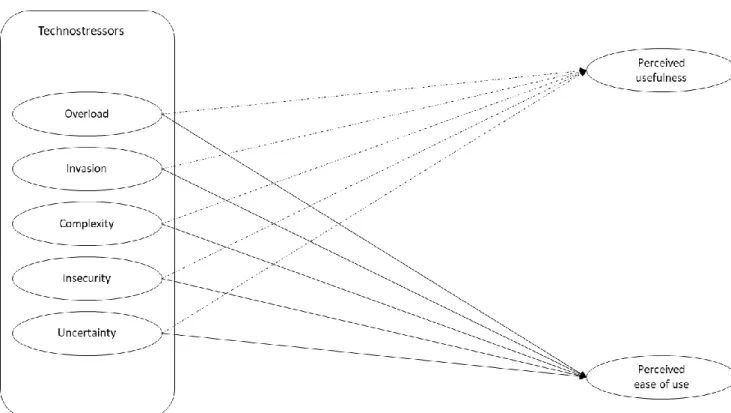
The research question of this study aims to assess: “How does technostress affect the acceptance of machine feedback systems in AI-Human Collaboration?” To answer this question, acceptance will be evaluated by the aspects of PE and PEU. Figure 1 shows the conceptual model upon which this study is based. Previous research indicates that stress causes strain (Cooper et al., 2001) and technostress affects the perception of technologies and the openness towards technological developments negatively (Kim & Park, 2018; Tarafdar et al., 2010). Therefore, this study hypothesizes that technostress influences the perception of usefulness and ease of use of machine feedback systems negatively.
H1: Technostress has an inverse relationship with PU of machine feedback systems. H2: Technostress has an inverse relationship with PEU of machine feedback systems.
According to previous research, the enhancement of job performance is limited with an increasing level of techno-overload (Karr-Wisniewski & Lu, 2010). This is not only caused by ICT-related increase of quantity and speed of work as a root of technostress, but also by the effort for adaption to changed processes and workload due to handling the system itself
LITERATURE REVIEW AND THEORY
Master Thesis Patrick Weber 8
(Tarafdar et al., 2007). Disruptive changes in processes due to the implementation of new technologies are rejected by employees and constrain PU of machine feedback systems (Fast & Horvitz, 2017). The effort of becoming familiar with machine feedback systems conflicts with techno-overload and the available time to invest in training and usage (Tarafdar et al., 2007). Thus, specific to techno-overload, this thesis posits that:
H1.a: Techno-overload has an inverse relationship with PU of machine feedback systems. H2.a: Techno-overload has an inverse relationship with PEU of machine feedback systems.
Techno-invasion describes invasion into employees’ life caused by technology, meaning they cannot disconnect from work and transfer challenges, e.g. getting familiar with a new system or technology, into their personal life. Research on the perception of current technological developments like AI shows that such technology is increasingly associated negatively in the context of work. This association is mainly caused by the perceived invasion of AI systems along with a loss of control over systems, applications and decisions (Fast & Horvitz, 2017). Systems which demand a human response could increase the effect of a stressful intervention in employees’ autonomy and thus might not be perceived as beneficial to increase productivity. A prior study revealed that a user’s perception of controlling technology influenced PEU (Venkatesh, 2000) positively. If employees show higher levels of techno-invasion because systems override employees’ control and decisions in an invasive way, PEU of machine feedback systems could be limited. Thus, regarding techno-invasion, this study hypothesizes an inverse relationship with PU and PEU of machine feedback systems:
H1.b: Techno-invasion has an inverse relationship with PU of machine feedback systems. H2.b: Techno-invasion has an inverse relationship with PEU of machine feedback systems.
In the context of current technological developments, the associated level of techno-complexity becomes apparent with the perception of machine-learning applications as “black boxes”.
LITERATURE REVIEW AND THEORY
Master Thesis Patrick Weber 9
People find it difficult to put into intuitive language how the underlying algorithms of the system function (Anastasopoulos & Whitford, 2018; Coglianese & Lehr, 2019). Furthermore, users tend to personify machines, systems and algorithms and judge algorithms on their moral authenticity (Jago, 2019). The complexity of AI-based systems leads to a fundamental lack in understanding the capabilities, threats and benefits of such systems (Lyons et al., 2011); thus the relationship on PU is expected to be inverse. Corresponding to the perceived level of complexity and the lack of understanding of the technology, the impact of techno-complexity on PEU is also expected to be inverse. Since algorithms and AI systems are perceived as “black boxes”, employees would find it challenging to learn about and use machine feedback systems. Hence, this study expects an inverse relationship between techno-complexity and PU of machine feedback systems and PEU of machine feedback systems, respectively.
H1.c: Techno-complexity has an inverse relationship with PU of machine feedback systems. H2.c: Techno-complexity has an inverse relationship with PEU of machine feedback systems.
Regarding techno-insecurity, the thesis deviates from the negative prediction in relation to PU of machine feedback systems. Research suggests that employees perceive a high threat of being replaced by new systems or new employees who have more knowledge in technology, e.g. AI (Frank et al., 2019; Frey & Osborne, 2013). Indeed, economic outlooks to employment indicate cross-industrial and cross-occupational job cutbacks of up to 40% due to automation with the deployment of AI over the next two decades (Lee, 2018). The threat for employees to lose jobs due to increasing levels of automation should be indicated by higher levels of techno-insecurity, and this effect should have a positive relationship with PU. It will be assumed that employees who feel insecurity because of technological developments at their workplace perceive those developments also as useful. I therefore suggest a positive relationship.
LITERATURE REVIEW AND THEORY
Master Thesis Patrick Weber 10
Techno-insecurity is caused by the fear of getting replaced due to technology implementation. If the perceived threat due to technological development is high, the perceived ease of use should be manifested low. Employees would only have reasons to fear technological developments in the workplace if they are not able to acquire new needed skills easily. The aspect of fearing to be unable to handle new systems and technology is addressed by the field of user interface design, trying to develop user-friendly systems and interfaces (Laurel & Mountford, 1990). Usability and interface design represent two of the main aspects of developing new applications and implementing them as this determines user acceptance through PEU to a high degree (Hong et al., 2011). Thus, this study hypothesizes an inverse relationship between techno-insecurity and PEU of machine feedback systems.
H2.d: Techno-insecurity has an inverse relationship with PEU of machine feedback systems.
High levels of techno-uncertainty, describing a state of being forced to adapt to technological developments continuously, could lead to lower PU and PEU since employees are confronted with fast-developing technology in daily work environments. Research found that technostress limits the openness towards technological innovation of individuals (Kim & Park, 2018). Another study showed that techno-uncertainty through job satisfaction significantly impacts the intention to use new ICT systems (Fuglseth & Sørebø, 2014). This leads to the hypotheses that techno-uncertainty might overstrain employees’ willingness to keep up with the speed and scope of that development and directly affect the perception of usefulness (H1.e) and ease of use (H2.e) negatively.
H1.e: Techno-uncertainty has an inverse relationship with PU of machine feedback systems. H2.e: Techno-uncertainty has an inverse relationship with PEU of machine feedback systems.
METHODOLOGY
Master Thesis Patrick Weber 11
3 Methodology
3.1 Data collection and procedures
The target sample of this study was conducted using individual employees who use ICT at their workplace. In order to test the proposed hypotheses, a survey was conducted by using SAP Qualtrics and subsequent analysis of the collected data with SPSS. The survey was distributed with the snowball method (Emerson, 2015) via the author’s private network and social media, e.g. LinkedIn. After two weeks, 418 responses have been collected whereof 119 responses have been removed from the dataset due to incompletion. Responses from unemployed or retired participants (six responses) and responses of non-ICT users (seven responses) have also been removed from the dataset because it would not be adequate to test workplace-related technostress. The final dataset was processed for further analysis with N = 286 responses. The demographics of the survey participants are shown in table 1. 42.0 % of the participants are female, 57.3 % are male, and 0.7% identify with neither. The average age of the sample is 31.25 years (SD = 9.73), ranging from 17 to 64 years.
3.2 Measures and reliability measures
The survey (appendix 1) used existing and validated scales.
Technostressors. To measure the five technostressors, the technostress-scales of
Ragu-Nathan et al. (2008) were used. The applied scales consist of 5-point Likert scales ranging from (1) “strongly disagree” to (5) “strongly agree”. Cronbach’s alpha range from α = 0.70 to α = 0.86.
Perceived Use and Perceived Ease of Use of the proposed tool. The measurements of the TAM core-constructs, PU and PEU of AI, were examined using a scenario type question to
understand respondents’ attitudes towards a proposed system. BI, as the third component of the TAM, was dropped from the framework since the purpose of this research is to understand the direct effects of technostress on the determining factors of technology acceptance. To measure
METHODOLOGY
Master Thesis Patrick Weber 12
PU and PEU of machine feedback systems, the participants of the survey were introduced to a workplace scenario (appendix 1). For the scenario, the TSP (section 2.2) was used in order to provide a verified scientific problem in which tools based on machine feedback systems can be used to suggest the best option (travel-route) available (Lin & Kernighan, 1973). The TSP was applied to a business process in which certain process steps must be followed, e.g. getting approval by the department head in order to change the suggest travel-route. The participants were then asked to evaluate the proposed tool by answering the PU-scale and PEU-scale of the TAM (Davis, 1989). The applied scales consist of 7-point Likert scales ranging from (1) “extremely unlikely” to (7) extremely likely”. Cronbach’s alpha of PU = 0.957, Cronbach’s alpha of PEU = 0.914.
In addition, to verify the proposed scenario, the participants were asked to rank the scenario in the characteristics “realistic”, “nonsensical” and “probable”, applying a 5-point Likert scales ranging from (1) “not at all” to (5) “extremely” to all characteristics (with nonsensical reverse coded). Cronbach’s alpha for the scenario rating was calculated with 0.67. The scenario was rated with mean = 3.88 (SD = 0.70) (i.e. leaning towards the option “moderately”), suggesting the robustness of the scenario.
The survey included additional control variables in order to detect effects on the variables despite the hypothesized effects. The control variables included (1) age, (2) gender (3) education, (4) employment type (full-time, part-time, intern), (5) ICT use (6) ICT satisfaction, (5) and knowledge about AI. The control variable “ICT use” served as an ex-post selection criterion among the survey participants and was measured in frequency on a 5-point Likert scale (Vagias, 2006), ranging from (1) “Never” to (5) “All the time”. Participants who stated “never” were excluded from the sample.
Additional control variables about AI and COVID-19. Knowledge about AI was measured
RESULTS
Master Thesis Patrick Weber 13
capabilities in which each of the items was correct. Sample items include: (1) find patterns in data, (2) learn from examples, (3) make logical decisions, (4) recognize images and text and (5) recognize and process language. For each chosen item, the participant scored one point, resulting in a scale from a minimum of 0 to a maximum of 5 points, where 5 points represent a robust theoretical understanding of AI capabilities.
To account for the exceptional circumstances, due to COVID-19, under which the survey was carried out, the participants were asked if their workplace was currently relocated to the home office due to the pandemic. If the respondents reported a partial or full relocation to the home office, they were then asked on a 5-point Likert scale in which frequency they are experiencing technical difficulties, ranging from (1) “Never” to (5) “Always”. Those two additional questions were included in order to detect effects on the variables since the COVID-19 pandemic is highly impactful on the personal life and job and workplace conditions. This could cause a work-home conflict (Llave & Messenger, 2017) and have negative effects on mental health (Torales et al., 2020), thus affect people’s overall stress levels and their capabilities to handle stress.
The survey, including the scales, was translated to German (appendix 2) by using the translating functionality of SAP Qualtrics and was adjusted in three iterations of pre-testing with a German-speaking psychologist to ensure equivalence.
4 Results
4.1 Descriptive Statistics
The participants reported an ICT use of M = 4.27 (SD = 1.00), while the meaning of 4 equals “almost every time” and 5 equals “every time”, showing that ICT is a substantial part of today’s work environment. The respondents report an average ICT satisfaction of M = 3.27 (SD = 1.11). This indicates that participants are rather satisfied with ICT at their workplace but leaving space for improvement of this substantial part of the work environment.
RESULTS
Master Thesis Patrick Weber 14
Regarding the means of the five technostressors, they range from M = 1.86 (SD = 0.83) for techno-insecurity to M = 2.95 (SD = 0.96) for techno-uncertainty. Overall, this is below the scale midpoint of 3.00 ("neither disagree nor agree").
PU of the described tool was rated with M = 5.46 (SD = 1.42). PEU was rated with M = 5.30 (SD = 1.06). Both measures indicate that the proposed tool is perceived as rather useful and relatively easy to use and understand.
The participants, on average, showed a solid theoretical understanding of AI capabilities. The mean score for AI knowledge was M = 4.24 (SD = 1.07), indicating that most of the participants have chosen four out of the five correct answers. The measurement of the frequency of interaction with AI technologies and the extent of AI utilization at the respondents’ workplaces provide a rough estimate about the (perceived) presence of AI in work environments. The mean scores of M = 2.01 (SD = 0.94) and M = 2.24 (SD = 0.962) respectively show that AI technologies are only used and utilized “sometimes” and “slightly”. Additionally, the responses show that the participants are only “somewhat confident” (M = 3.28, SD = 1.05) when they are asked about their judgement on how extensive AI is utilization at their workplace. Taken together, the answers to these questions suggest that while most people understood what AI can be used for, they believe that AI is not being used or are unsure if AI is being used at their workplace. Employees’ uncertainty about the use of AI technologies in the workplace could indicate a lack of transparency and communication in companies about the deployment of new technologies.
Out of 286 complete and analysed surveys, only 33 employees have not been affected by workplace relocation due to the COVID-19 Pandemic. For the rest of the 253 participants working partially or entirely from the home office, they report experiencing technical difficulties only rarely (M = 2.25, SD = 0.84).
RESULTS
Master Thesis Patrick Weber 15
4.2 Hypothesis Testing
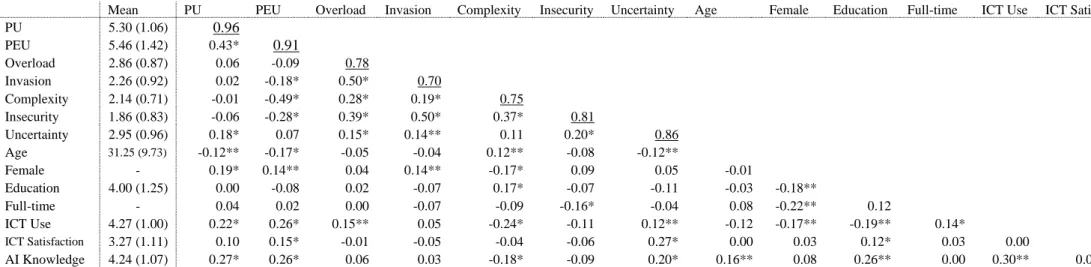
To test the proposed hypotheses, the survey data were first analysed for potential correlations among the different quantifiable variables by using Pearson’s r to account for linear associations. The test for H1 and H2 included the five technostressors (independent variables IV2), PU and PEU (dependent variables DV) and the eight control variables stated above (table 3). For H1.a-e (relating to PU) none of the technostressors correlates with PU in the hypothesized direction, nor have other explicit correlations been identified. Therefore, H1 is
not supported.
For H2.a-e (relating to PEU), three out of the five technostressors correlate with PEU in the hypothesized inverse direction, namely technoinvasion (r = 0.180), technocomplexity (r = -0.493) and techno-insecurity (r = -0.278). Therefore, H2 is partially supported. Those findings suggest that technostress is influencing PEU in the hypothesized negative direction but has neither the hypothesized negative nor other positive significant effects on PU. While employees seem to able to judge the usefulness of the proposed machine feedback system objectively, their perception on how easy it will be to learn and handle the tool is negatively influenced by technostress, in particular by techno-invasion, techno-complexity and techno-insecurity. To further test H1.a – H1.e and H2.a – H2.e, a regression analysis was conducted. The applied hierarchical regression model examines the direct effect of the control variables and IVs on each of the DVs, PU and PEU. The regression model was designed in a way that in the first part of the analysis, only the control variables3 were introduced (model 1), followed by the technostressors as the IVs (model 2).
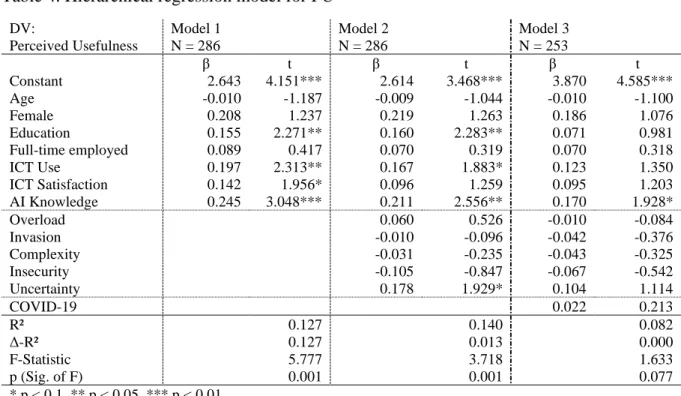
The regression model for PU (table 4) shows that the control variables explain 12.7 % (R²) of
the effect on PU machine feedback systems. The level of education, ICT use and theoretical AI
2 Referring to IVs and DVs in the regressions for the ease of reference. Does not allow inference of causality. 3 Control Variables introduced: Age, female (gender), education, full-time employed (employment type), ICT use, ICT satisfaction and AI knowledge.
RESULTS
Master Thesis Patrick Weber 16
knowledge show significant positive relationships with PU (βeducation = 0.16, βICTuse = 0.20,
βAIknowledge = 0.25, all ts > 2.27, all p < .05). ICT satisfaction is marginally significant, also
positively influencing PU (βICTsatisfaction = 0.14, t = 1.96, p = .05). Introducing the
technostressors, the change in R² is very low and not significant (ΔR² = 1.3 %, F(5,273) = 0.86, p = .51). None of the technostressors significantly influences PU. For that reason, each of the hypotheses H1.a – H1.e are not supported. Additionally, H1 is not supported because technostress has no significant relationship in the hypothesized direction with PU. Technostress has no effects on PU.
The regression model for PEU (table 5) shows significant effects of the tested control
variables which account for 14.3 % (R²) of the effect on PEU. Age, ICT Use, ICT Satisfaction and theoretical AI knowledge have significant effects, while only the participant’s age has a slightly negative relationship with PEU. Introducing the technostressors in model 2 leads to a high change in R² as it increases by 19.4 % (ΔR²), amounting to R² = 33.7 %. This change is significant (F(5,273) = 16.00, p < .05).
Techno-complexity (H2.c) has a strong inverse (β = -0.60, t = -6.91) and significant (p < 0.01) relationship with PEU, thus the higher techno-complexity is, the lower the level of PEU is. The hypothesis is supported.
Techno-invasion (H2.b) and techno-insecurity (H2.d) show effects in the hypothesized inverse direction on PEU. However, techno-invasion (p = 0.05) and techno-insecurity (p = 0.07) show marginal significance.
Techno-overload (H2.a) and techno-uncertainty (H2.e) show no significant effects in the hypothesized inverse direction on PEU. Both technostressors are not able to predict PEU, and the hypotheses are not supported.
Summarizing, H2 is partially supported, such that techno-complexity aspect of technostress can negatively influence PEU of the proposed AI tool.
RESULTS
Master Thesis Patrick Weber 17
4.3 Additional Findings
To account for the potential impacts of the COVID-19 pandemic on the conducted research and hypothesis testing, for both, PU and PEU, the test was extended by introducing the COVID-19 variable in model 3. The variable assessed how often the respondents experience technical difficulties due to a shift to home-office and remote work. The introduction of this variable might, therefore, account for negative biases towards the proposed machine feedback tool due to recent negative experiences. As not all participants’ workplaces were relocated to home-office, the sample size for model 3 is smaller and thus not directly comparable to the hypothesis testing in regression models 1 and 2. The introduced variables stayed the same, but the sample size was decreased to N = 253 (ΔN = -33). Adding the COVID-19 variable does not change R² in the regression model predicting PU. As the other variables, no significant effects on PU have been found. Thus, biases due to recent experiences with workplace technologies in home-office environments did not affect PU of the proposed AI tool. Adding the variable in the PEU regression model, the model becomes slightly more predictive: ΔR² = 1.5 %. However, the regression model shows a significant negative impact of technical issues due to the relocation of workplaces to home-office (β = -0.164, t = -2.36 p = .02). This indicates that currently experienced technical issues cause a negative bias towards PEU of the proposed AI tool. Furthermore, the predictive power of PEU on PU in the overall model (excluding COVID-19 because of variations in sample size) was assessed. PEU almost doubles the predictive power of the model to R² = 26.4 % (ΔR² = 12.4 %). PEU shows to strongly affect PU with β = 0.577, p < 0.001), in a way that respondents who perceive higher ease of use also perceive higher usefulness of the proposed machine feedback system.
DISCUSSION
Master Thesis Patrick Weber 18
5 Discussion
5.1 Discussion of results
The observations of the conducted study only partially matched the expected results that technostress negatively impacts technology acceptance’ core constructs PU and PEU. Specifically, technostress does not affect PU of the proposed machine feedback system, and the only results that converged with the hypotheses were regarding techno-complexity and PEU. Previous studies have shown that psychological conditions – such as technology anxiety (Mohammadi & Isanejad, 2018) and emotional stability (Svendsen et al., 2013),– rarely impact PU of technological tools. Similarly, the result of this study indicates that participants evaluate the usefulness of the proposed tool independent from their individual level of technostress. However, in this study, it was found that internal factors – such as the respondent’s educational background and understanding of the tool’s capabilities – rather than psychological workplace conditions (i.e. technostressors) affect PU.
Regarding the results related to the PEU of machine feedback systems, this study found no significant correlation between techno-overload, techno-uncertainty and PEU, which could be explained by various factors. The absence of evidence for techno-overload affecting PEU (H2.a) could be explained by increasing ICT literacy and ICT literacy facilitation (Fuglseth & Sørebø, 2014) among employees, such that despite the measured levels of techno-overload, employees are able to effectively find and get help in learning and handling new systems. Indeed, in this particular sample, respondents were mainly high-frequency users of ICT systems which imply that they have high ICT literacy and were relatively satisfied with the ICT systems deployed at their workplace which implies they have high ICT literacy facilitation at work. Regarding the lack of evidence for techno-uncertainty affecting PEU (H2.e), it might be that employees perceive most of the changes in ICT as an ongoing and incremental development, rather than highly impactful events. Previous studies found that techno-uncertainty is a
stand-DISCUSSION
Master Thesis Patrick Weber 19
alone technostressor (Srivastava et al., 2015; Tu et al., 2008), which is unrelated to the intensity of ICT-changes. The mean of techno-uncertainty of M = 2.96, which is relatively low, indicates that most employees surveyed were less uncertain. This suggests that they might face changes in ICT more often, and those changes in ICT could be rather small and less disturbing. Only accounting for the frequency of changes in ICT might not be appropriate anymore as this measurement does not consider the continuous small-scale ICT-changes in the work-environment. This study suggests further research and a potential adjustment in the technostress framework to account for this effect. While techno-overload and techno-uncertainty do not seem to affect perceived ease of use, techno-complexity (H2.c) shows a strong inverse connection (β = -0.603; p < 0.001) between the two variables, as predicted. This result provides some evidence for the conceptual model. If employees struggle with the increasing complexity of technology at work, it should be more challenging to learn and use additional and new progressive systems as they have lower acceptance levels for the proposed machine feedback system among the respondents. For the hypothesized relationships of techno-invasion (H2.b) and techno-insecurity (H2.d) with PEU, these relationships were only marginally significant. To present robust and scientifically acceptable results, both hypotheses have been rejected. Nevertheless, the identified relationships close to significance allow for a glimpse into the negative impact of technostress on PEU that warrants further investigation with a larger and more generalized sample.
5.2 Managerial implications
As intended, the study helps to understand how technostress affects technology acceptance of machine feedback systems and allows to derive solutions to implement systems based on AI technologies successfully. This matter is of high importance. Lee (2018) suggests that no single occupation and workplace will not be affected by AI in the future and Human-AI collaboration, as enabled by, e.g. the tested machine feedback system, will become a reality.
DISCUSSION
Master Thesis Patrick Weber 20
Looking at the nonsignificant relationships between the technostressors and PU of the proposed system, the result suggests that perceived usefulness of new tools and technologies is independent of technostress and that PU is better managed through other factors. This is an important insight for future technology implementation projects and system developments. With PU as a core construct of technology acceptance, PU shapes the intention to use a tool and hence the success of technology implementation at the workplace (Davis, 1989; Marangunić & Granić, 2015). While negative results in research are rarely reported, the rejection of the hypotheses H1.a – H1.e can be understood as a positive outcome for managers involved in technology implementation and the related change processes in work environments. However, it is still essential to tackle technostress as its effects on PEU show.
Similar to PU, PEU is critical in the overall acceptance construct as it shapes PU and the behavioural intention to use technologies (Davis, 1989; Svendsen et al., 2013). For
techno-complexity, the hypothesized negative relationship with PEU was supported: the higher the
level of techno-complexity, the lower PEU. The experienced complexity in existing work-related ICT can cause a negative bias towards new AI-enabled systems, which are not deployed yet. The finding that techno-complexity strongly affects PEU of the proposed AI-based tool emphasizes the importance of user interface design of systems and user acceptance testing as part of every IT implementation project. The risk of techno-complexity needs to be mitigated in order to increase the likelihood for success of future AI technology implementations. Managers who are involved in vendor decisions for new IT systems or in the in-house development processes for new systems and tools need to be aware of the importance of a system’s usability (Laurel & Mountford, 1990) in order to limit techno-complexity. Companies should consider reassessing the usability of already operational systems and adjust system interfaces, if required and possible.
DISCUSSION
Master Thesis Patrick Weber 21
Furthermore, to ensure good usability of newly implemented systems, every implementation project should contain user acceptance tests as part of the release and deployment plan. In this way, test users can give feedback to developers for adjustments to the interface before the systems are deployed across the organization. Research suggests that gamification approaches of work-related software could increase flow and usability (Johnson & Wiles, 2003). The implementation of machine feedback systems might enable tangible gamification approaches since the software is based on interaction and collaboration and has a guiding function. This approach could be suitable to limit techno-complexity, thus increase PEU for other AI-enabled systems. Machine feedback systems would serve as a facilitator to mitigate techno-complexity induced stress.
The results show that techno-invasion affects PEU negatively but marginally significantly. Even though the hypothesis regarding techno-invasion was rejected, it still seems adequate to consider the implications for managers of the found relationship. As Venkatesh (2000) found, the level of control over systems pre-determines PEU. The level of control over systems limits the erosion of employees’ autonomy and thus tendency to feel techno-invasion. Thus, in order to improve PEU and the overall acceptance of machine feedback systems, managers should clearly address the danger of blurring lines by the use of ICT. Particularly, AI-technologies AI is perceived in general as intruding on privacy and invasive (Fast & Horvitz, 2017). To reduce techno-invasion and a self-accelerating cycle of technostress levels due to AI implementations, managers can establish rules and norms of when remote connectivity is required and act as role models by abiding to those rules and norms. Furthermore, managers in human resources and IT departments should strongly consider emphasizing the benefits of AI technology implementations and be transparent about why, how and what for AI is used in the company. According to the results of this study, techno-insecurity also affects PEU negatively but marginally significantly. Again, the hypothesis was rejected, but with the increasing importance
DISCUSSION
Master Thesis Patrick Weber 22
of Human-AI collaboration and presence of AI at daily work, the implications of this relationship should be considered. The progressive development of AI technologies could again cause a self-accelerating cycle of techno-insecurity and the decrease in acceptance of new technologies and systems. This would threaten workers health and productivity due to stress (Tarafdar et al., 2019) and, besides, the success of technology implementations and the realization of the expected organizational gains because employees find it too difficult to handle new systems and tools. To prevent employees and companies from those negative consequences, managers are required to facilitate ICT- and AI-literacy. Literacy and knowledge about ICT and AI will allow them to understand the technologies better and to derive their capabilities (Fuglseth & Sørebø, 2014). This, in return, enables employees to better estimate the threat of being replaced and allows to identify current skills- and knowledge-gaps. Companies should assist in that process by providing adequate training to close skills-gaps according to the employees’ needs and according to the company’s strategy of ICT and AI utilization.
With the aspect of machine feedback systems as a mechanism to prevent stress, the general importance of positive technology needs to be considered as a closing argument for managerial implications in the light of the effects of technostress on technology acceptance. Considering the idea and framework of positive technology, the technology itself can become a tool to limit technostress, thus having a second purpose besides the functionalities to handle and process business tasks. Intelligent systems could be able to adapt to employees’ skills and behaviour (Brivio et al., 2018) more than any static and strictly rule-based system. Implementing such features in work environment technology would be a preventive approach of technology utilization rather than a remedial approach to limit technostress consequences on technology acceptance. Managers should embrace those possibilities and allocate resources for the development of this early stage concept.
DISCUSSION
Master Thesis Patrick Weber 23
5.3 Limitations and future research
Although the findings provide meaningful implications related to the acceptance of technology and machine feedback systems in specific, the study has some limitations. First, the TAM was applied to a hypothetical scenario and not in vivo assessments of proposed technology as the original concept of Davis (1989) suggests. However, prior studies have also applied the TAM in a similar hypothetical approach such as Koufaris, (2002), Hong et al. (2011) and Svendsen et al. (2013). Thus, to extend this research, machine feedback systems should be applied in beta testing conditions, where users actually use the proposed AI-tools before their assessment of PU and PEU. Second, the results could also be biased by the effect of a general rejection of AI by the participants besides the manifestation of technostress. The concept of this study does not account for effects on acceptance of AI-based technologies which originate from personal beliefs and preferences. Third, the study was conducted in the particular context of machine feedback systems. One reason no relationships were found could be that the tool was related to planning travel routes more efficiently. Given the circumstances of the COVID-19 pandemic, such tasks might be perceived as no longer essential at a considerable extent. Therefore, future studies may show that the present results are due to the contextual effects of the pandemic. However, it was the purpose of this study to understand more about the influence of external, user specifics factors, namely technostress, on progressive and critical workplace technologies such as machine feedback systems. Future research on technology acceptance of AI should assess other specific use cases to gain a bigger picture. For AI, it does not seem appropriate to conduct technology acceptance research and its influencing external factors without a high level of specification, since AI is a broad and complex field of different technological methods which leaves vast space for individual interpretation if not specified. Fourth, future research should also focus on the moderating effects of ICT literacy on technostress as well as on acceptance factors. Increasing ICT literacy represents an important technostress inhibitor (Fuglseth &
CONCLUSION
Master Thesis Patrick Weber 24
Sørebø, 2014), which might create a fully new understanding of the underlaying theoretical concepts as literacy facilitation in companies needs to be more emphasised. Fifth and lastly, future research should investigate on possibilities how intelligent and adaptive AI-enabled systems could be used to limit user specific determinants of technology acceptance. If the technology is designed in a way to help to reduce technostress, the focus of technostress mitigation could shift from curative to preventive approaches and facilitate a more positive attitude towards technological change.
6. Conclusion
The acceptance of new workplace technologies by employees is critical for successful implementations and the realization of potential economic gains in a digital future. The better companies can implement and use progressive technologies, the greater their competitive advantage. The success of technology implementations, however, shows to be dependent on external factors, besides the technology itself, such as technostress levels of employees. Understanding technostress as a limiting factor for the acceptance of new technologies, as in the case of the proposed machine feedback tool, is incredibly important. Especially the perceived ease of use of new systems is predetermined by technostress, in specific techno-complexity. As technological progress is unlikely to slow down, it is crucial to avoid circular relationships in which rising levels of technostress due to implemented technologies cause even lower acceptance for new systems. The derived recommendations for managers put emphasize on increasing ICT- and AI-literacy and the importance of a user-centric approach for system developments in order to facilitate adaptive systems itself to prevent technostress which hinders their acceptance.
BIBLIOGRAPHY
Master Thesis Patrick Weber 25
Bibliography
Alexandre, B., Reynaud, E., Osiurak, F., & Navarro, J. (2018). Acceptance and acceptability criteria: a literature review. Cognition, Technology and Work, 20(2), 165–177.
https://doi.org/10.1007/s10111-018-0459-1
Amershi, S., Cakmak, M., Knox, W. B., & Kulesza, T. (2014). Power to the people: The role of humans in interactive machine learning. AI Magazine, 35(4), 105–120.
https://doi.org/10.1609/aimag.v35i4.2513
Anastasopoulos, L. J., & Whitford, A. B. (2018). Machine Learning for Public Administration Research, With Application to Organizational Reputation. Journal of Public
Administration Research and Theory, 29(3), 491–510. https://doi.org/10.1093/jopart/muy060
Antonelli, C., Geuna, A., & Steinmueller, W. E. (2000). Information and communication technologies and the production, distribution and use of knowledge. International Journal of Technology Management, 20(1–2), 72–94.
Atanasoff, L., & Venable, M. A. (2017). Technostress: Implications for Adults in the Workforce. Career Development Quarterly, 65(4), 326–338.
https://doi.org/10.1002/cdq.12111
Brivio, E., Gaudioso, F., Vergine, I., Mirizzi, C. R., Reina, C., Stellari, A., & Galimberti, C. (2018). Preventing technostress through positive technology. Frontiers in Psychology, 9(DEC). https://doi.org/10.3389/fpsyg.2018.02569
Brod, C. (1984). Technostress: The human cost of the computer revolution. Addison Wesley Publishing Company.
Brynjolfsson, E., & Mcafee, A. (2017). The Business of Artificial Intelligence: what it can and cannot do for your organization. Harvard Business Review Digital Articles, 1–20. Brynjolfsson, E., Mitchell, T., & Rock, D. (2018). What Can Machines Learn, and What Does
It Mean for Occupations and the Economy? AEA Papers and Proceedings, 108, 43–47. https://doi.org/10.1257/pandp.20181019
Cam, A., Chui, M., & Hall, B. (2019). Global AI Survey: AI proves its worth, but few scale impact. November.
Coglianese, C., & Lehr, D. (2019). Transparency and algorithmic governance. Admin. L. Rev., 71, 1–4.
Cooper, C. L., Cooper, C. P., Dewe, P. J., O’Driscoll, M. P., & O’Driscoll, M. P. (2001). Organizational stress: A review and critique of theory, research, and applications. Sage. Davis, F. D. (1989). Perceived usefulness, perceived ease of use, and user acceptance of
information technology. MIS Quarterly: Management Information Systems, 13(3), 319– 339. https://doi.org/10.2307/249008
Dellermann, D., Calma, A., Lipusch, N., Weber, T., Weigel, S., & Ebel, P. (2019). The Future of Human-AI Collaboration: A Taxonomy of Design Knowledge for Hybrid Intelligence Systems. Proceedings of the 52nd Hawaii International Conference on System Sciences. https://doi.org/10.24251/hicss.2019.034
BIBLIOGRAPHY
Master Thesis Patrick Weber 26
Dellermann, D., Ebel, P., Söllner, M., & Leimeister, J. M. (2019). Hybrid Intelligence. Business and Information Systems Engineering, 61(5), 637–643.
https://doi.org/10.1007/s12599-019-00595-2
Emerson, R. W. (2015). Convenience Sampling, Random Sampling, and Snowball Sampling: How Does Sampling Affect the Validity of Research? Journal of Visual Impairment & Blindness, 109(2), 164–168. https://doi.org/10.1177/0145482X1510900215
Ernst, E., Merola, R., & Samaan, D. (2019). Economics of Artificial Intelligence: Implications for the Future of Work. IZA Journal of Labor Policy, 9(1). https://doi.org/10.2478/izajolp-2019-0004
Fast, E., & Horvitz, E. (2017). Long-term trends in the public perception of artificial
intelligence. 31st AAAI Conference on Artificial Intelligence, AAAI 2017, January 1986, 963–969.
Frank, M. R., Autor, D., Bessen, J. E., Brynjolfsson, E., Cebrian, M., Deming, D. J., Feldman, M., Groh, M., Lobo, J., Moro, E., Wang, D., Youn, H., & Rahwan, I. (2019). Toward understanding the impact of artificial intelligence on labor. Proceedings of the National Academy of Sciences of the United States of America, 116(14), 6531–6539.
https://doi.org/10.1073/pnas.1900949116
Frey, C. B., & Osborne, M. A. (2013). The Future of Employment: How susceptible are jobs to computerisation?
Fuglseth, A. M., & Sørebø, Ø. (2014). The effects of technostress within the context of employee use of ICT. Computers in Human Behavior, 40, 161–170.
https://doi.org/10.1016/j.chb.2014.07.040
Hong, J. C., Hwang, M. Y., Hsu, H. F., Wong, W. T., & Chen, M. Y. (2011). Applying the technology acceptance model in a study of the factors affecting usage of the Taiwan digital archives system. Computers and Education, 57(3), 2086–2094.
https://doi.org/10.1016/j.compedu.2011.04.011
Jago, A. S. (2019). Generating Authenticity in Automated Work. Academy of Management Proceedings, 2019(1), 15590.
Johnson, D. G., & Verdicchio, M. (2017). AI Anxiety. Journal of the Association for Information Science and Technology, 68(9), 2267–2270.
https://doi.org/10.1002/asi.23867
Johnson, D., & Wiles, J. (2003). Effective affective user interface design in games.
Ergonomics, 46(13–14), 1332–1345. https://doi.org/10.1080/00140130310001610865 Karr-Wisniewski, P., & Lu, Y. (2010). When more is too much: Operationalizing technology
overload and exploring its impact on knowledge worker productivity. Computers in Human Behavior, 26(5), 1061–1072. https://doi.org/10.1016/j.chb.2010.03.008 Kim, K., & Park, H. (2018). The effects of technostress on information technology
acceptance. Journal of Theoretical and Applied Information Technology, 96(24), 8300– 8312.
King, W. R., & He, J. (2006). A meta-analysis of the technology acceptance model.
BIBLIOGRAPHY
Master Thesis Patrick Weber 27
Koufaris, M. (2002). Applying the Technology Acceptance Model and flow theory to online Consumer Behavior. Information Systems Research, 13(2), 205–223.
https://doi.org/10.1287/isre.13.2.205.83
Laalaoui, Y., & Bouguila, N. (2015). Artificial Intelligence Applications in Information and Communication Technologies. In Y. Laalaoui & N. Bouguila (Eds.), Studies in
Computational Intelligence 607 (Vol. 607). Springer International Publishing. https://doi.org/10.1007/978-3-319-19833-0
Laurel, B., & Mountford, S. J. (1990). The art of human-computer interface design. Addison-Wesley Longman Publishing Co., Inc.
Lawrence, T. (1991). Impacts of artificial intelligence on organizational decision making. Journal of Behavioral Decision Making, 4(3), 195–214.
https://doi.org/10.1002/bdm.3960040306
Lee, K.-F. (2018). AI superpowers: China. Silicon Valley, and the New World Order. Houghton Mifflin Harcourt, 14.
Lin, S., & Kernighan, B. W. (1973). An Effective Heuristic Algorithm for the Traveling-Salesman Problem. Operations Research, 21(2), 498–516.
Llave, O. V., & Messenger, J. (2017). Working anytime, anywhere: the effects on the world of work. https://doi.org/10.2806/425484
Lyons, J. B., Stokes, C. K., Eschleman, K. J., Alarcon, G. M., & Barelka, A. J. (2011). Trustworthiness and IT suspicion: An evaluation of the nomological network. Human Factors, 53(3), 219–229. https://doi.org/10.1177/0018720811406726
Manyika, J., Chui, M., Miremadi, M., Bughin, J., George, K., Willmott, P., & Dewhurst, M. (2017). A future that works: Automation, employment, and productivity. Mckinsey Global Institute, January, 148.
http://njit2.mrooms.net/pluginfile.php/688844/mod_resource/content/1/Executive Summary of McKinsey Report on Automation.pdf
Marangunić, N., & Granić, A. (2015). Technology acceptance model: a literature review from 1986 to 2013. Universal Access in the Information Society, 14(1), 81–95.
https://doi.org/10.1007/s10209-014-0348-1
Mohammadi, S., & Isanejad, O. (2018). Presentation of the extended technology acceptance model in sports organizations. Annals of Applied Sport Science, 6(1), 75–86.
https://doi.org/10.29252/aassjournal.6.1.75
Mulder, S. A., & Wunsch, D. C. (2003). Million city traveling salesman problem solution by divide and conquer clustering with adaptive resonance neural networks. Neural
Networks, 16(5–6), 827–832. https://doi.org/10.1016/S0893-6080(03)00130-8
Müller, V. C., & Bostrom, N. (2016). Future progress in artificial intelligence: A survey of expert opinion. In Fundamental Issues of Artificial Intelligence (pp. 553–571).
https://doi.org/10.1145/2639475.2639478
Ragu-Nathan, T. S., Tarafdar, M., Ragu-Nathan, B. S., & Tu, Q. (2008). The consequences of technostress for end users in organizations: Conceptual development and validation. Information Systems Research, 19(4), 417–433. https://doi.org/10.1287/isre.1070.0165 Settles, B. (2010). Active Learning Literature Survey. Computer Sciences Technical Report.
BIBLIOGRAPHY
Master Thesis Patrick Weber 28
Srivastava, S. C., Chandra, S., & Shirish, A. (2015). Technostress creators and job outcomes: Theorising the moderating influence of personality traits. Information Systems Journal. https://doi.org/10.1111/isj.12067
Svendsen, G. B., Johnsen, J. A. K., Almås-Sørensen, L., & Vittersø, J. (2013). Personality and technology acceptance: The influence of personality factors on the core constructs of the Technology Acceptance Model. Behaviour and Information Technology, 32(4), 323– 334. https://doi.org/10.1080/0144929X.2011.553740
Tarafdar, M., Cooper, C. L., & Stich, J. F. (2019). The technostress trifecta - techno eustress, techno distress and design: Theoretical directions and an agenda for research.
Information Systems Journal, 29(1), 6–42. https://doi.org/10.1111/isj.12169 Tarafdar, M., Tu, Q., Ragu-Nathan, B. S., & Ragu-Nathan, T. S. (2007). The impact of
technostress on role stress and productivity. Journal of Management Information Systems, 24(1), 301–328. https://doi.org/10.2753/MIS0742-1222240109
Tarafdar, M., Tu, Q., & Ragu-Nathan, T. (2010). Impact of technostress on end-user
satisfaction and performance. Journal of Management Information Systems, 27(3), 303– 334. https://doi.org/10.2753/MIS0742-1222270311
Torales, J., O’Higgins, M., Castaldelli-Maia, J. M., & Ventriglio, A. (2020). The outbreak of COVID-19 coronavirus and its impact on global mental health. International Journal of Social Psychiatry, 3–6. https://doi.org/10.1177/0020764020915212
Tu, Q., Wang, K. L., & Shu, Q. (2008). Technostress under different organizational environments: An empirical investigation. Computers in Human Behavior.
Vagias, W. M. (2006). Likert-type Scale Response Anchors. Clemson International Institute for Tourism. & Research Development, Department of Parks, Recreation and Tourism Management, Clemson University, 4–5.
Venkatesh, V. (2000). Determinants of Perceived Ease of Use: Integrating Control, Intrinsic Motivation, and Emotion into the Technology Acceptance Model. Information Systems Research, 11(4), 342–365. https://doi.org/10.1287/isre.11.4.342.11872
Venkatesh, V., & Davis, F. D. (2000). Theoretical extension of the Technology Acceptance Model: Four longitudinal field studies. Management Science, 46(2), 186–204.
https://doi.org/10.1287/mnsc.46.2.186.11926
Xu, R., & Wunsch, D. (2005). Survey of clustering algorithms. IEEE Transactions on Neural Networks, 16(3), 645–678. https://doi.org/10.1109/TNN.2005.845141
TABLES
Master Thesis Patrick Weber 29
Tables
Table 1. Demographics of participants
Variable Value Abs. Value Rel. in %
Gender Female 120 42.0
Male 164 57.3
Neither 2 0.7
Age Under 18 (17 years) 1 0.3
18 to 24 years 59 20.6
25 to 34 years 153 53.5
35 to 44 years 34 11.7
45 to 54 years 31 10.8
55 to max. (64 years) 8 2.8
Employment Status Full-time 234 81.8
Part-time 38 13.3
Intern 14 4.9
COVID-19 Not relocated to home office 33 11.5
Partially relocated to home office 58 20.3
Fully relocated to home office 195 68.2
N = 286; for regression model 3: N = 253 (excluding “not relocated to home office”)
Table 2. Hypothesis testing
H1: Technostress has an inverse relationship with PU of machine feedback systems. Not supported H1.a: Techno-overload has an inverse relationship with PU of machine feedback systems. Not supported H1.b: Techno-invasion has an inverse relationship with PU of machine feedback systems. Not supported H1.c: Techno-complexity has an inverse relationship with PU of machine feedback systems. Not supported H1.d: Techno-insecurity has a positive relationship with PU of machine feedback systems. Not supported H1.e: Techno-uncertainty has an inverse relationship with PU of machine feedback systems. Not supported
H2: Technostress has an inverse relationship with PEU of machine feedback systems. Partially supported H2.a: Techno-overload has an inverse relationship with PEU of machine feedback systems. Not supported H2.b: Techno-invasion has an inverse relationship with PEU of machine feedback systems. Not supported† H2.c: Techno-complexity has an inverse relationship with PEU of machine feedback systems. Supported** H2.d: Techno-insecurity has an inverse relationship with PEU of machine feedback systems. Not supported† H2.e: Techno-uncertainty has an inverse relationship with PEU of machine feedback systems. Not supported
TABLES
Master Thesis Patrick Weber 30
Table 3. Reliability Measures and Correlations
Mean PU PEU Overload Invasion Complexity Insecurity Uncertainty Age Female Education Full-time ICT Use ICT Sati.
PU 5.30 (1.06) 0.96 PEU 5.46 (1.42) 0.43* 0.91 Overload 2.86 (0.87) 0.06 -0.09 0.78 Invasion 2.26 (0.92) 0.02 -0.18* 0.50* 0.70 Complexity 2.14 (0.71) -0.01 -0.49* 0.28* 0.19* 0.75 Insecurity 1.86 (0.83) -0.06 -0.28* 0.39* 0.50* 0.37* 0.81 Uncertainty 2.95 (0.96) 0.18* 0.07 0.15* 0.14** 0.11 0.20* 0.86 Age 31.25 (9.73) -0.12** -0.17* -0.05 -0.04 0.12** -0.08 -0.12** Female - 0.19* 0.14** 0.04 0.14** -0.17* 0.09 0.05 -0.01 Education 4.00 (1.25) 0.00 -0.08 0.02 -0.07 0.17* -0.07 -0.11 -0.03 -0.18** Full-time - 0.04 0.02 0.00 -0.07 -0.09 -0.16* -0.04 0.08 -0.22** 0.12 ICT Use 4.27 (1.00) 0.22* 0.26* 0.15** 0.05 -0.24* -0.11 0.12** -0.12 -0.17** -0.19** 0.14* ICT Satisfaction 3.27 (1.11) 0.10 0.15* -0.01 -0.05 -0.04 -0.06 0.27* 0.00 0.03 0.12* 0.03 0.00 AI Knowledge 4.24 (1.07) 0.27* 0.26* 0.06 0.03 -0.18* -0.09 0.20* 0.16** 0.08 0.26** 0.00 0.30** 0.04
TABLES
Master Thesis Patrick Weber 31
Table 4. Hierarchical regression model for PU
DV: Perceived Usefulness Model 1 N = 286 Model 2 N = 286 Model 3 N = 253 β t β t β t Constant 2.643 4.151*** 2.614 3.468*** 3.870 4.585*** Age -0.010 -1.187 -0.009 -1.044 -0.010 -1.100 Female 0.208 1.237 0.219 1.263 0.186 1.076 Education 0.155 2.271** 0.160 2.283** 0.071 0.981 Full-time employed 0.089 0.417 0.070 0.319 0.070 0.318 ICT Use 0.197 2.313** 0.167 1.883* 0.123 1.350 ICT Satisfaction 0.142 1.956* 0.096 1.259 0.095 1.203 AI Knowledge 0.245 3.048*** 0.211 2.556** 0.170 1.928* Overload 0.060 0.526 -0.010 -0.084 Invasion -0.010 -0.096 -0.042 -0.376 Complexity -0.031 -0.235 -0.043 -0.325 Insecurity -0.105 -0.847 -0.067 -0.542 Uncertainty 0.178 1.929* 0.104 1.114 COVID-19 0.022 0.213 R² 0.127 0.140 0.082 Δ-R² 0.127 0.013 0.000 F-Statistic 5.777 3.718 1.633 p (Sig. of F) 0.001 0.001 0.077 * p < 0.1, ** p < 0.05, *** p < 0.01
Model 3 is not a continuation of models 1 and 2 because the sample differs (excl. non-remote employees).
Table 5. Hierarchical regression model for PEU
DV:
Perceived Ease of Use
Model 1 N = 286 Model 2 N = 286 Model 3 N = 253 β t β t β t Constant 3.561 7.543*** 5.692 11.492*** 6.435 11.161*** Age -0.014 -2.220** -0.010 -1.827* -0.008 -1.270 Female -0.047 -0.379 0.009 0.075 0.065 0.549 Education 0.063 1.257 0.052 1.143 0.025 0.514 Full-time employed -0.017 -0.106 -0.144 -1.003 -0.164 -1.089 ICT Use 0.190 3.005** 0.093 1.598 0.091 1.457 ICT Satisfaction 0.149 2.772** 0.101 2.021** 0.073 1.347 AI Knowledge 0.153 2.562** 0.094 1.738* 0.076 1.253 Overload 0.120 1.618 0.049 0.590 Invasion -0.140 -1.942* -0.137 -1.814* Complexity -0.603 -6.914*** -0.605 -6.725*** Insecurity -0.150 -1.842* -0.099 -1.168 Uncertainty 0.082 1.355 0.072 1.136 COVID-19 -0.164 -2.356** R² 0.143 0.337 0.342 Δ-R² 0.143 0.194 0.015 F-Statistic 6.645 11.587 9.557 p (Sig. of F) 0.001 0.001 0.001 * p < 0.1, ** p < 0.05, *** p < 0.01
ILLUSTRATIONS
Master Thesis Patrick Weber 32
Illustrations