A CASE STUDY WITH PMATE IN THE LEARNING OF
MATHEMATICAL SUBJECTS AT UNIVERSITY LEVEL
Sónia Pais
Instituto Politécnico de LeiriaIsabel Cabrita and António Batel Anjo
Universidade de Aveiro
ABSTRACT
Since 1989, the Mathematics Education Project (PmatE – Projecto Matemática Ensino) has developed several strategies to increase the interest and improve the success of students in Mathematics. PmatE developed a platform of computer aided education (PCA), currently available only in the internet, including all grades since primary school. The main goal of this platform is to support teaching, being a tool that allows: the management of the groups involved; the elaboration of tests; the research of student performance; the analysis of results and other functionalities of management. The developed programs are a tool to support education, evaluation and learning.
It’s presented a case study with Science Food Engineering students. The major goal of the study is to evaluate the impact of the platform of computer aided education (PCA) developed for the PmatE in the learning of mathematical subjects at the University level. This paper describes how it is conceived as well as the main results.
KEYWORDS
Computer assisted learning, higher education, mathematics education, self-regulated learning, technology
1.
INTRODUCTION
Modern Information and Communication Technologies (ICT) are woven into the information society as well as social lives. It is not easy to imagine life without the Internet and other high-tech services and devices. ICT are broadly used at work, at home and at school.
A "new learning generation" is around. The “new” students, who actually are “digital native”, make large use of ICT in their everyday life for both leisure and communication/social interaction purposes. This emerging situation has major potential implications also in the field of education. Constructivists have argued that instructional technologies can be useful to help learners find their own meaning. In the specific case of mathematics, “these technologies allow to perspective the education of the mathematics in a deeply
innovative mode, strengthening the paper of the graphical language and new forms of representation and relativising the importance of the calculation and the symbolic manipulation. Moreover, they allow that the teacher gives greater attention to the development of capacities of superior order, valuing the accomplishment possibilities, in the classroom, activity and project of exploration, investigation and modelling. In this way, the ICT can allow the development in the students of important abilities, as well as of more positive attitudes in respect to the mathematics and stimulating a more complete vision on the nature of this science” (Varandas et al, nd, p. 1).
As a consequence, entirely new learning scenery is emerging. The instructional use of digital devices, applications and services is becoming more and more broadcast and new educational approaches are envisaged.
2.
THE MATHEMATICS EDUCATION PROJECT (PMATE – PROJECTO
MATEMÁTICA ENSINO)
Was born, in 1989 at the University of Aveiro, the Mathematics Education Project (PmatE). A bold project that, foreseeing the current situation, early began to develop informatics tools and contents in diverse areas of knowledge. The fact to have been born in the Department of Mathematics gave it the name and its main objective - to increase the interest and the success in Mathematics.
PmatE developed a platform of computer aided education (PCA). The main goal of this platform is to support teaching of disciplines, being a tool that allows: the management of the groups involved; the elaboration of tests; the research of student performance; the analysis of results and other functionalities of management. The developed programs are a tool to support education, evaluation and learning. Without repetition of questions, it stimulates the learning and the understanding and not the memorization of taught subjects. This platform can be used trough a registry (that it is lifetime). The access is free to all the competitions and tests of training for all the education degrees, except for Superior Education, whose access is restricted to the University of Aveiro’s students and other Superior Education institutions since these establish priorly one agreement with the PmatE.
2.1 The Tests in PmatE
There are two types of tests - training and evaluation.
In the training mode, the student can accede to several versions (the tests of training of the competitions), except of Superior Education level. These tests, concerning mathematical contents, are distributed by education level. Within the scope of Superior Education level, it’s the teacher of the group himself who creates the tests of training, and only the enrolled students in the group have access to these tests. The tests are presented in a game type version, with a chronometer in decreasing counting and several levels. In each level he has two “lives”: in the case of, in one first attempt, the student has one or more questions wrong (of the 4 presented in each level), he has the chance to try to detect the error(s) and correct it (them).
In the evaluation mode, it’s the teacher who creates the tests, being these exclusive for his students. For each test, each student has access to a different formulation of the same test, while maintaining the same objectives that are being evaluated. In this version, the students have access to a different test format: they can see, in the screen, several questions with scroll, instead of see one question per screen (levels format), as it happens in the training version.
The main difference between them resides in the fact that in the first case the student has to correctly answer the presented question to see the next screen, while in the second case the student has access to all questions at once and the freedom to navigate between all questions just as it would be with a hand written exam. The system corrects the tests automatically and the evaluation is, generically, quantitative. However, the information that system makes available concerning the performance of the students goes much more beyond what a simple classification - it is, also, possible to analyse their performance in each one of the included subjects in the test - evaluation for objectives -, allowing the teacher to obtain information about how is the learning process of different subjects (Anjo et al, 2005).
When finishing the accomplishment of a test, either in the training mode, or in the evaluation mode, the student has access to the obtained result, being able to verify which questions he failed. However the platform does not possess the functionality “to explain the student why he has failed”, therefore what’s intended is that the student looks for information (appealing to text books, lessons notes, or other resources), speaks with the colleagues and/or the teacher with the goal of clarify his doubts and the reason of the error, allowing to the student assume a more autonomous and active role in his learning process.
3.
THE CASE STUDY
The study encompassed students of the curricular unit of Mathematical Analysis I (2008/2009 1st semester), of the plan of studies of the Science Food Engineering of the Superior School of Tourism and Sea Technology (ESTM), of Leiria's Polytechnical Institute. Given the extension of the program, the study only included the Module of Integral Calculus. The teacher responsible for the curricular unit in question is, simultaneously, the researcher.
3.1 Description of the Study
Previously, before the beginning of the semester, the teacher designed the curricular unit, including the thematic unit on which the study focused. At the beginning of the semester one first questionnaire was applied to the students. The main objective of this questionnaire was to characterize the students and to know their starting point. It was, also, applied a pre-test, that had a function, essentially, of diagnosis, but that it will serve, also, to evaluate the evolution of the students (with the application of the same test at a posterior moment). This pre-test was applied before initiating the approach to thematic unit in question. Depending on the diagnosis made, it’s verified the necessity, or not, to restructure the planning of this thematic unit.
The following step was the didactic approach of the thematic unit in the lessons. In simultaneous and parallel with the lessons, the students had explored the platform and had worked with it. Before the approach of the thematic unit, it was given to students a session of clarification about the platform and its use. The students have worked also in the platform outside classroom.
It was intended, also, to verify the capacity that the students have to transfer their learning (learned with resource of the platform, in an autonomous and self-regulated way) to another type of tasks, of the same nature or different nature, worked inside classroom. As the platform works in a logic of resolution of exercises, tasks of another nature were developed by the researcher (in simultaneous teacher of the curricular unit), for example, problems or research tasks. These tasks happened on real situations in a daily context or a context of the area of training of the students (Food Science engineering).
In this phase, the data collecting was made through direct observation and documental analysis, supported in the following instruments: field notes, documents produced by students in diverse situations (HW), including a portfolio, and computer register of the students’ performance (one of the functionalities available in the platform).
After finished the teaching of thematic unit, was applied the same test that was applied in the beginning. It was, also, applied a second questionnaire. This questionnaire has the intention to try to gauge concerning the opinion of the students on the platform and how the contact with the platform was advantageous, or not.
Six months after the ending of the curricular unit, the post-test was applied again. The analysis of the results of the three versions of the test will allow assess the evolution/progress of the students.
4.
STATISTICAL ANALYSIS
The PmatE platform allows observing every interaction between the platform and users. When we consulted the results of these interactions, we observed that we could compose two groups of students: those who used the PmatE platform (from now on simply mentioned as group 1) and those who didn’t (from now on simply mentioned as group 2).
Comparison of means, analysis of variance and t tests have been conducted to determine whether the mean differences, between the two groups of students, are significant and to determine the effect of the platform on the outcomes obtained by the two groups of students.
4.1 Arithmetic Mean
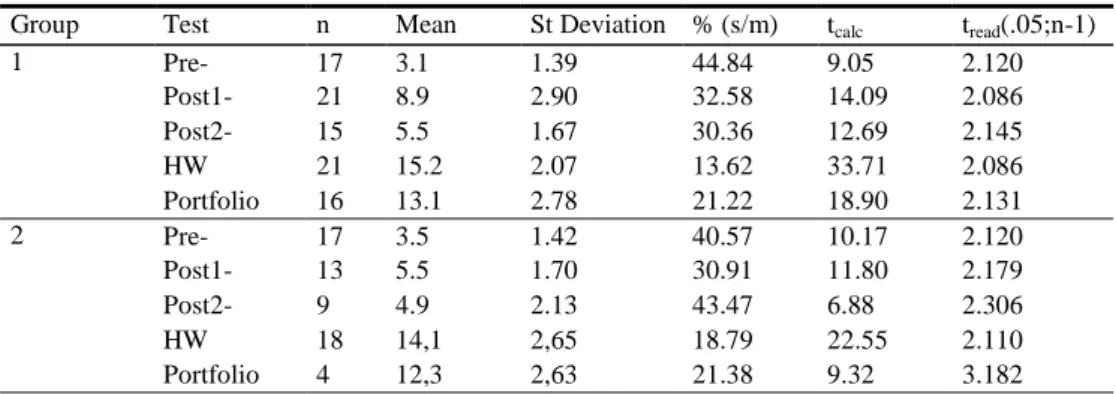
First of all, we calculate the mean and the standard deviation. Then we applied one-sample t Test, to verify the sample representativeness. The results obtained are given in table 1.
Table 1. Mean, standard deviation, percentage of the standard deviation from the mean and the results of t Test Group Test n Mean St Deviation % (s/m) tcalc tread(.05;n-1)
1 Pre- 17 3.1 1.39 44.84 9.05 2.120 Post1- 21 8.9 2.90 32.58 14.09 2.086 Post2- 15 5.5 1.67 30.36 12.69 2.145 HW 21 15.2 2.07 13.62 33.71 2.086 Portfolio 16 13.1 2.78 21.22 18.90 2.131 2 Pre- 17 3.5 1.42 40.57 10.17 2.120 Post1- 13 5.5 1.70 30.91 11.80 2.179 Post2- 9 4.9 2.13 43.47 6.88 2.306 HW 18 14,1 2,65 18.79 22.55 2.110 Portfolio 4 12,3 2,63 21.38 9.32 3.182
For both groups, the average increases from pre-test to post-test1, and decreases in post-test2.
On the other hand, while in pre-test group 2 has an average value slightly higher than group 1, in the other two times of assessment group 1 has higher values for the average. The most significant difference between the means obtained by the two groups was verified at the time of application of post-test1.
Also concerning HW and the portfolio, the outcomes presented by group 1 are slightly higher than the results presented by group 2.
4.2 Significance of the Difference between the Mean
In order to determine if:
• the difference in results obtained at diverse moments of application of the test is significant;
• the difference in results on the attitudes on the two groups is significant;
• interaction is significant;
were made analysis of variance, for independent groups, involving factors: G (group), M (moments of application of the test) and A (attitudes).
To determine the degree of significance of Fcalc, we used the classification proposed by D'Hainaut (1997):
• VS (very significant), if the test statistic value is equal or higher than F critical value at p-value
.01;
• S (significant), if the test statistic value is equal or higher than F critical value at p-value .05;
• NS (not significant), if the test statistic value is lower than F critical value at p-value .05
This analysis of variance indicates that the difference between the means obtained by the group 1, at the different moments of application of the test, is very significant. Also with regard to group 2, the analysis of variance shows the differences between the means at the different moments of application of the test as very significant.
The two-way analysis of variance also reveals the effect Moments as very significant. The effect of Attitudes is, also, very significant, as well the interaction between this two effects.
5.
CONCLUSION
Poor grades in mathematics seem to be widely accepted as a fact of our educational system, and what is more disappointing is that such a fact is confirmed by international statistics reports. It is important to face this reality and take a proactive approach towards this problem, to reduce its effect.
The information and communication technologies (ICT) have a fundamental paper to reform the educational model. Informatics tools, mainly those allowing remote use, can become a major element in the educational context, facilitating the function of the teacher to accompany each student of a differentiated form and respecting the rhythm and preferences of each one, facilitating the creation of complementary
Although this project is still ongoing, therefore, not yet been concluded, the statistical analysis presented above, seems to indicate that the use of PmatE platform proved to be more successful. The students who used PmatE platform presented better grades than the students who didn’t.
We believe that PmatE is an interesting alternative to the dominant pedagogies in superior education (where education assumes a form almost exclusively magisterial and is based on the transmission of knowledge), with greater advantage in the construction of knowledge on the part of the students, centered in a logic of skill development.
However, a limitation of the platform is the fact to work in a logic of exercises resolution, not allowing to accomplish another type of tasks, for example, projects of exploration, investigation and modelling.
Another limitation of the platform is the fact not to present the resolution of the exercises (presenting, only, the final result), nor to give feedback on the resolution process. One way to decrease this limitation of the platform is, for example, the students to present, to the professor, the process of resolution of the exercises and the professor give feedback to them.
REFERENCES
Anjo, A. et al, (2005). Computerized Diagnostic Test. In Cadernos de Matemática - Série de Divulgação CM 05/D-3. Aveiro: University of Aveiro.
Belanger, F. & Jordan, D. (2000). Evaluation and implementations of distance learning: Technologies, tools and techniques. Hershey: Idea Group Publishing.
Biggs, J. (1999). Teaching for Quality Learning at University. Buckingham: Open University Press.
Boulton-Lewis, G., Marton, F., Lewis, D. & Wilss, L. (2000). Learning in formal and informal contexts: Conceptions and strategies of Aboriginal and Torres Strait Islander university students. Learning and Instruction, 10, pp. 393-414. Collis, B. (1999). Designing for differences: cultural issues in the design of WWW – based course-support sites. In:
British Journal of Educational Technology, 30(3), pp. 201-215.
D’Hainaut, L. (1997). Conceitos e Métodos da Estatística. Vol. I. Lisboa: Livraria Almedina.
Dowling, S. (1996). Internet education: reform or false panacea? Documento disponível em http://www.isoc.org/inet96/proceedings, accessed March 24, 2008.
Light, G. & Cox, R. (2001). Learning and teaching in higher education – the reflective professional. Thousand Oaks: Sage Publications.
Morin, E. (2002). Os Sete saberes para a Educação do Futuro. Lisbon: Instituto Piaget.
OCDE (2006). O Relatório da OCDE: A avaliação do sistema de ensino superior em Portugal. Lisboa: Ministério da Ciência, Tecnologia e Ensino Superior – Gabinete do Ministro.
Pinto, J. et al, (2007). "TDmat - Mathematics Diagnosis Evaluation Test for Engineering Sciences Students", In: International Journal of Mathematical Education in Science and Technology, 38:3, pp. 283 – 299. Reino Unido: Taylor & Francis.
Tschang, F. T. (2001). Virtual universities and learning environments: characterizing their emergence and design. In: F. T. Tschang & T. D. Senta (ed.), Access to knowledge. New information technologies and the emergence of virtual university. Amsterdam: Elsevier.
Varandas, J. et al, (sd) As Tecnologias de Informação e Comunicação na Formação Inicial de Teacheres de Matemática: Uma Experiência Baseada na Internet. <http://www.educ.fc.ul.pt/recentes/mpfip/pdfs/jpponte-tic.pdf>, accessed April 23, 2009.
Vieira, D. et al, (2004). Modelo Gerador de Questões. In: proceedings of IADIS Ibero-Americana Conference WWW/Internet 2004. Madrid, Spain, pp. 105-113.