On the Existence of Equilibria in
Discontinuous Games: Three Counterexamples
Guilherme Carmona
Universidade Nova de Lisboa
September 29, 2003
Abstract
We study whether we can weaken the conditions given in Reny [4] and still obtain existence of pure strategy Nash equilibria in quasi-concave normal form games, or, at least, existence of pure strategy ε−equilibria for all ε > 0. We show by examples that there are:
1. quasiconcave, payoff secure games without pure strategy ε−equi-libria for small enough ε > 0 (and hence, without pure strategy Nash equilibria),
2. quasiconcave, reciprocally upper semicontinuous games without pure strategy ε−equilibria for small enough ε > 0, and
3. payoff secure games whose mixed extension is not payoff secure. The last example, due to Sion and Wolfe [6], also shows that non-quasiconcave games that are payoff secure and reciprocally upper semi-continuous may fail to have mixed strategy equilibria.
1
Introduction
Recently, there has been an attempt to extent Nash’s existence result [3] from finite normal form games to infinite-action games with discontinuous payoff functions (see Baye et al. [1], Dasgupta and Maskin [2], Reny [4] and Simon [5]). The most general result is due to Reny [4], which showed that a quasiconcave normal form game has a pure strategy Nash equilibrium if it is better-reply secure.
Better-reply security combines and generalizes two intuitive conditions, payoff security1 and reciprocal upper semicontinuity.2 Our goal is to study
whether any such condition alone is enough to guarantee, in quasiconcave games, the existence of pure strategy Nash equilibria or, at least, the exis-tence of pure strategy ε−equilibria, for all ε > 0.
We provide two examples that show that we cannot drop either of the two condition and still obtain a pure strategy Nash equilibrium. Both games in the examples are simples games, games in which each player’s payoff function is simple (i.e., has a finite range). Since a simple game has a Nash equilibrium if and only if it has ε−equilibria for all ε > 0 (see proposition 2), our examples also show that neither payoff security nor reciprocal upper semicontinuity alone are enough to guarantee the existence of pure strategy ε−equilibrium, for all ε > 0, in quasiconcave games.
When applied to the mixed extension of a normal form game, Reny’s Theorem asserts that a mixed strategy equilibrium exists for a given normal form game provided that its mixed extension is payoff secure and reciprocally upper semicontinuous. It is useful to know when we can conclude that the mixed extension of a given normal form game satisfies those conditions by studying the properties of the original game, since the analysis of the latter is typically easier than that of its mixed extension. In this line of research, Reny showed that a sufficient condition for the mixed extension of a given normal form game to be reciprocally upper semicontinuous is that the sum of the payoff function of the original game is upper semicontinuous.
Given the above result, we ask whether the payoff security of the mixed extension of a given normal form game follows from the payoff security of
1“Payoff security requires that for every strategy x, each player has a strategy that
virtually guarantees the payoff he receives at x, even if the others deviate slightly from x” (Reny [4]).
2“Reciprocal upper semicontinuity requires that some player’s payoff jumps up
the original game. We use the example in Sion and Wolfe [6] to show that this conjecture is false. This implies that non-quasiconcave, payoff secure, reciprocally upper semicontinuous games may fail to have mixed strategy equilibria.
2
Normal form games
A normal form game G consists of a finite set of players N = {1, ..., n}, and, for every player i ∈ N, a pure strategy set Xi, represented by a nonempty
topological space, and a payoff function Ui : X → R, where X = ×i∈NXi. A
normal form game is said to be simple if for all i ∈ N, Ui is a simple function
(i.e., a function with the property that its range is a finite set).
Throughout, the product of any number of sets is endowed with the prod-uct topology. Given a player i ∈ N, the symbol −i denotes “all players but
i.” In particular, X−i = ×j6=iXj.
The vector of the players’ payoff functions will be denoted by U : X → RN
and is defined by U(x) = (U1(x), ..., Un(x)) for every x ∈ X. The graph of U
is the subset of X × Rn given by {(x, u) ∈ X × Rn : u = U(x)}. It will be
denoted by graph(U).
Given a player i ∈ N, we say that player i can secure a payoff of α ∈ R
at x ∈ X if there exists ˜xi ∈ Xi and a neighborhood Vx−i of x−i such that
Ui(˜xi, x0−i) ≥ α for all x0−i ∈ Vx−i (see Reny [4]).
A payoff function Ui for player i ∈ N is payoff secure if for every x ∈ X
and every ε > 0, player i can secure a payoff of Ui(x) − ε at x (see Reny [4]).
A normal-form game G = hN, (Xi, Ui)i∈Ni is payoff secure if for all i ∈ N, Ui
is payoff secure.
A game G = hN, (Xi, Ui)i∈Ni is reciprocally upper semicontinuous if for
all (x, u) ∈ graph(U) such that Ui(x) ≤ ui holds for all i ∈ N, then Ui(x) = ui
for all i (see Simon [5] and Reny [4]).3
A game G = hN, (Xi, Ui)i∈Ni is quasiconcave if for all i ∈ N, Xi is convex
and Ui(·, x−i) is quasiconcave on Xi, for all x−i ∈ X−i.
Let Mi be the set of all regular probability measures in Xi and M =
×i∈NMi. If Ui is Borel measurable and integrable with respect to all µ ∈ Mi,
we define vi : M → R by
vi(µ) =
Z
X
Uidµ. (1)
Finally, we define the mixed extension of G to be ˜G = hN, (Mi, vi)i∈Ni .
Given a normal form game G = hN, (Xi, Ui)i∈Ni , a pure strategy Nash
equilibrium of G is x∗ ∈ X such that, for all i ∈ N and x
i ∈ Xi,
Ui(x∗) ≥ Ui(xi, x∗−i). (2)
Given ε > 0, a pure strategy ε−equilibrium of G is x∗ ∈ X such that, for all
i ∈ N and xi ∈ Xi,
Ui(x∗) ≥ Ui(xi, x∗−i) − ε. (3)
A mixed strategy Nash equilibrium of G is a pure strategy Nash equilibrium of ˜
G, and a mixed strategy ε−equilibrium of G is a pure strategy ε−equilibrium
of ˜G.
3
On the Existence of Nash Equilibria
The following is an example of a simple, quasiconcave and payoff secure game that doesn’t possess any pure strategy Nash equilibrium. Since a simple game has a pure strategy Nash equilibrium if and only if it has an ε−equilibrium for all ε > 0 (proposition 2), we conclude that payoff security is not enough to guarantee the existence of pure strategy ε−equilibrium, for all ε > 0, in quasiconcave games.
Example 1 Let G1 be described by N = {1, 2}, X1 = X2 = [0, 1], U1 : X →
R be defined by U1(x1, x2) = 0 if x2 ≤ 12 − x1; 2 if x1 = 0 and x2 > 12; 1 otherwise, (4) and U2 : X → R be defined by U2(x1, x2) = 0 if x1 ≤ 12 and x2 > 0; 1 if x1 ≤ 12 and x2 = 0; 1 if x1 > 12 and x2 ≤ 12; 2 if x1 > 12 and x2 > 12. (5)
Figure 1 0 1 2 U1 ¾ x1 x2 -6 @ @ @ @ U2 0 16 ª 2 x1 x2 -6
Proposition 1 The game G1 is quasiconcave and payoff secure but has no
pure strategy ε−equilibrium, if ε > 0 is small enough. In particular, G1 has
no pure strategy Nash equilibrium.
Proof. One easily checks that G1 is quasiconcave: Let α ∈ R. For
0 ≤ x2 ≤ 1/2, {x1 : U1(x1, x2) ≥ α} = [0, 1] if α ≤ 0, (1 2 − x2, 1] if 0 < α ≤ 1, ∅ otherwise, (6) and for 1/2 < x2 ≤ 1, {x1 : U1(x1, x2) ≥ α} = [0, 1] if α ≤ 1, {0} if 1 < α ≤ 2, ∅ otherwise. (7) Similarly, for 0 ≤ x1 ≤ 1/2, {x2 : U2(x1, x2) ≥ α} = [0, 1] if α ≤ 0, {0} if 0 < α ≤ 1, ∅ otherwise, (8) and for 1/2 < x1 ≤ 1, {x2 : U2(x1, x2) ≥ α} = [0, 1] if α ≤ 1, (1 2, 1] if 1 < α ≤ 2, ∅ otherwise. (9) Hence, G1 is quasiconcave.
As for payoff security: to show that U1 is payoff secure it is enough to
show that U1 is payoff secure at (x1, x2) satisfying x1 = 0 and x2 > 1/2.
This is so because in points x at which U1(x) = 0 there is noting to show,
and in the remaining case, i.e., when U1(x) = 1, U1 is continuous. If x1 = 0
and x2 > 1/2 then U1(x1, x2) = 2. Let ˜x1 = 0 and Vx2 be the open ball
centered at x2 with radius δ = x2− 1/2. Then U1(˜x1, x02) = 2 for all x02 ∈ Vx2.
Similarly for U2 it is enough to consider the following two cases: the first is
when x2 = 0 and 0 ≤ x1 ≤ 1/2, in which case we let ˜x2 = 0; and the second
is when x2 = 1/2 and x1 > 1/2, in which case we let ˜x2 = 1/2 and Vx1 be
the open ball centered at x1 with radius δ = x1 − 1/2. Hence, G1 is payoff
secure.
Letting βi denote player i’s best reply correspondence, we obtain
β1(x2) = ½ (1 2 − x2, 1] if x2 ≤ 12 {0} if x2 > 12. (10) and β2(x1) = ½ {0} if x1 ≤ 12; (1 2, 1] if x1 > 12. (11) Since their graphs don’t intercept, it follows that there is no pure strategy Nash equilibrium. Also, we can conclude from proposition 2 that G has no pure strategy ε−equilibrium, if ε > 0 is small enough.
As claimed above, for simples games the existence of Nash equilibria is equivalent to the existence of ε−equilibria for all ε > 0.
Proposition 2 Let G = hN, (Xi, Ui)i∈Ni be a simple game. Then, G has a
pure strategy Nash equilibrium if and only if G has a pure strategy ε−equilibrium, for all ε > 0.
Proof. Since necessity is obvious, we prove only sufficiency. For all i ∈ N, let Ui(X) = {di1, . . . , diLi}, with d
i
1 < . . . < diLi and let ε > 0 be such that ε < mini∈Nminl∈{1,...,Li−1}(d
i
l+1− dil). It follows that if x∗ ∈ X is
an ε−equilibrium, which exists by assumption, then x∗is a Nash equilibrium,
since Ui(x∗) + ε ≥ Ui(xi, x∗−i), for all xi ∈ Xi implies Ui(x∗) ≥ Ui(xi, x∗−i), for
all xi ∈ Xi, given the way ε was constructed.
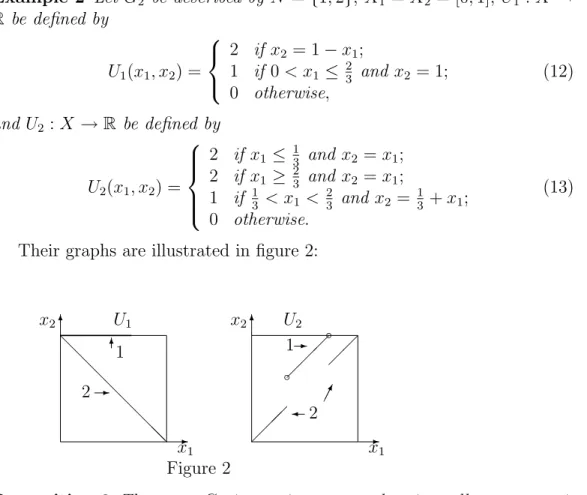
The following is an example of a simple, quasiconcave and reciprocally upper semicontinuous game that doesn’t possess any pure strategy Nash equilibrium. Hence, we conclude that reciprocally upper semicontinuity is not enough to guarantee the existence of pure strategy ε−equilibrium in quasiconcave games.
Example 2 Let G2 be described by N = {1, 2}, X1 = X2 = [0, 1], U1 : X → R be defined by U1(x1, x2) = 2 if x2 = 1 − x1; 1 if 0 < x1 ≤ 23 and x2 = 1; 0 otherwise, (12) and U2 : X → R be defined by U2(x1, x2) = 2 if x1 ≤ 13 and x2 = x1; 2 if x1 ≥ 23 and x2 = x1; 1 if 1 3 < x1 < 23 and x2 = 13 + x1; 0 otherwise. (13)
Their graphs are illustrated in figure 2:
Figure 2 U1 1 6 2 -x1 x2 -6 @ @ @ @ @ @ @@ U2 2 ¢¢¸ ¾ 1 -x1 x2 -6 ¡¡ ¡ ¡¡ ¡¡ ¡ b b
Proposition 3 The game G2 is quasiconcave and reciprocally upper
semi-continuous but has no pure strategy ε−equilibrium, if ε > 0 is small enough. In particular, G2 has no pure strategy Nash equilibrium.
Proof. We first show that G2 is reciprocally upper semicontinuous: Let
α ∈ R. We have that {U1+ U2 ≥ α} = ∅ if α > 2, {U1+ U2 ≥ 2} if 1 < α ≤ 2, {U1+ U2 ≥ 1} if 0 < α ≤ 1, X otherwise. (14) Since {U1+ U2 ≥ 2} ={(x1, x2) : x1 + x2 = 1}∪ {(x1, x2) : x1 = x2 and x1 ≤ 1/3}∪ {(x1, x2) : x1 = x2 and x1 ≥ 2/3}, (15)
and
{U1+ U2 ≥ 1} ={U1+ U2 ≥ 2} ∪ {(x1, x2) : x1 ≤ 2/3 and x2 = 1}∪
{(x1, x2) : x2 = 1/3 + x1 and 1/3 ≤ x1 ≤ 2/3},
(16) it follows that both {U1 + U2 ≥ 2} and {U1 + U2 ≥ 1} are closed. Hence,
U1+U2 is upper semicontinuous and G2is reciprocally upper semicontinuous.
We show in what follows that G2 is quasiconcave: Let α ∈ R. If α ≤ 0
then {x1 : U1(x1, x2) ≥ α} = [0, 1] and if α > 2 then {x1 : U1(x1, x2) ≥ α} =
∅. If 0 < α ≤ 1 then {x1 : U1(x1, x2) ≥ α} = ½ [0,2 3] if x2 = 1, {1 − x2} otherwise, (17) and if 1 < α ≤ 2, {x1 : U1(x1, x2) ≥ α} = {1 − x2}. (18) Similarly, for 0 < α ≤ 1, {x2 : U2(x1, x2) ≥ α} = {x1} if 0 ≤ x1 ≤ 13, {1 3 + x1} if 13 < x1 < 23, {x1} otherwise, (19) and for 1 < α ≤ 2, {x2 : U2(x1, x2) ≥ α} = {x1} if 0 ≤ x1 ≤ 13, ∅ if 1 3 < x1 < 23, {x1} otherwise. (20) Hence, G2 is quasiconcave.
Letting βi denote player i’s best reply correspondence, we obtain
β1(x2) = {1 − x2}, (21)
for all x2 ∈ X2 and
β2(x1) =
½
{1
3 + x1} if 13 < x1 < 23;
{x1} otherwise. (22)
Since their graphs don’t intercept, it follows that there is no pure strategy Nash equilibrium. Hence, G has no pure strategy ε−equilibrium, if ε > 0 is small enough.
When applied to the mixed extension of a normal form game G, Reny’s Theorem 3.1 [4] asserts that a mixed strategy equilibrium exists for G pro-vided that ˜G is payoff secure and reciprocally upper semicontinuous. It is
useful to know when we can conclude that ˜G satisfies those conditions by
studying the properties of G, since the analysis of G is typically easier than that of ˜G. In this line of research, Reny showed that a sufficient condition for
˜
G to be reciprocally upper semicontinuous is that Σi∈NUi is upper
semicon-tinuous, because this will imply that Σi∈Nvi is upper semicontinuous, which
in turn implies that ˜G is reciprocally upper semicontinuous.
Given the above result, we ask whether the payoff security of ˜G follows
from the payoff security of G. The following example shows that the fact that a game is payoff secure in pure strategies does not imply that it is payoff secure in mixed strategies.
Example 3 (Sion and Wolfe [6]) Let G3 be described by N = {1, 2}, X1 =
X2 = [0, 1], U1 : X → R be defined by U1(x1, x2) = −1 if x1 < x2 < x1+ 12; 0 if x1 = x2 or x2 = x1+ 12; 1 otherwise, (23)
and U2 : X → R be defined by U2(x1, x2) = −U1(x1, x2), for all (x1, x2) ∈ X.
The graph of U1 is illustrated in figure 3:
Figure 3 0 ¾ ? 1 1 -1 x1 x2 -6 ¡¡ ¡¡ ¡¡ ¡¡ ¡¡ ¡¡
Proposition 4 The game G3 is payoff secure but its mixed extension ˜G3 is
Proof. One easily checks that G3 is payoff secure. For player 1, it is
enough to consider x ∈ X such that U1(x) = 0 since when U1(x) = −1 there
is noting to show, and U1 is continuous in the remaining case (i.e., for x such
that U1(x) = 1). If x1 = x2, we let ˜x1 = 1 except when x1 = 1, in which
case we let ˜x1 = 0; if x2 = x1 + 1/2, we let ˜x1 = 0 except when x1 = 1/2, in
which case we let ˜x1 = 1. In all these cases we can find a neighborhood Vx2
of x2 such that U1(˜x1, x02) = 1 for all x02 ∈ Vx2.
For player 2, it is again enough to consider x ∈ X such that U1(x) = 0.
We let ˜x2 = x1+ 1/4 except when x = (x1, x2) = (1, 1), in which case we let
˜
x2 = 1. In all these cases we can find a neighborhood Vx1 of x1 such that
U2(x01, ˜x2) = 1 for all x01 ∈ Vx1.
Also, since G3 is a zero-sum game, so is ˜G3; hence, ˜G3 is reciprocally
upper semicontinuous. However, as Sion and Wolfe [6] have shown, G3 has
no Nash equilibrium (pure or mixed), and so it follows from Reny’s Theorem that ˜G3 is not payoff secure.
Sion and Wolfe [6] have shown that G3 has no Nash equilibrium (pure
or mixed); hence, G3 is also an example of a (non-quasiconcave) reciprocally
upper semicontinuous and payoff secure game without Nash equilibria.
References
[1] Baye, M., G. Tian, and J. Zhou (1993), “Characterization of the Exis-tence of Equilibria in Games with Discontinuous and Non-quasiconcave Payoff,” Review of Economics Studies, 60, 935-948.
[2] Dasgupta, P. and E. Maskin, (1986), “The Existence of Equilibrium in Discontinuous Economic Games, I: Theory,” Review of Economics
Studies, 53, 1-26.
[3] Nash, J. (1950), “Equilibrium Points in n-Person Games,” Proceedings
of the National Academy of Science, 36, 170-174.
[4] Reny, P. (1999) “On the Existence of Pure and Mixed Strategy Equilib-ria in Discontinuous Games,” Econometrica, 67, 1029-1056.
[5] Simon, L., (1987), “Games with Discontinuous Payoffs,” Review of
[6] Sion, M. and P. Wolfe, (1957), “On a Game without a Value,” in
Con-tributions to the Theory of Games, volume III, edited by M. Dresher,