MESTRADO
Desenvolvimento e Cooperação
Internacional
TRABALHO
FINAL
DE
MESTRADO
DISSERTAÇÃO
The way of Chinese medical reform : new
trends in the era of the “Internet+” and big
data
WANG MENGYUAN
MESTRADO EM
Desenvolvimento e Cooperação
Internacional
TRABALHO
FINAL
DE
MESTRADO
DISSERTAÇÃO
The way of Chinese healthcare insurance
system: new trends in the era of the
“Internet+”and big data
WANG MENGYUAN
ORIENTAÇÃO:
MANUEL FRANCISCO PACHECO COELHO
GLOSSARY
“Internet+” : a new economic form, which refers to the integration of the Internet
and traditional industries based on Internet information technology, to optimize production factors, update business systems, and reconstruct business models to complete economic transformation and upgrading.
“DT” era: Data tecnology era, It is a technology that serves the public and
stimulates productivity.
GDP: Gross Domestic product
UK:United Kingdom
USA : United states America
- 1 -
Abstract
China is a population republic country has insufficient medical resources and uneven distribution. Therefore, there are many medical problems. Due to the backward development of the medical system, the quality of medical resources is poor, the efficiency of medical services is low, and the cost is high, which brings many difficulties for the Chinese people to seek medical treatment. However, one of the main factors of these problems is the lack of government support and imperfect medical insurance. To solve this problem, the government began to reform the medical security system. Since the 1988 medical insurance reform, after several changes, China's medical insurance system has gradually matured. The thesis will briefly describe the basic framework, content and path of change in health care. And the shortcomings of the current medical insurance system. According to the characteristics of the times, talk about the impact of "Internet +" and "Big Data" on the current Chinese industry, including people's lives. Therefore, the analysis introduces the positive role of big data Internet for the reform of medical insurance system, and provides convenience for the management and governance of medical insurance system. Analyze whether “Internet +” and “Big Data” can lead to new trends in the reform of the health care system.
Plavra-chave: Healthcare; Medical insurance system; “Internet+”; “Big Data” JEL :
P
Content
Introduction ... 4
The question of investigation ... 4
Review the thesis ... 5
How to approach this question ... 6
Some new view ... 7
Describe simple chapter next ... 9
Chapter 1 The concept of medical insurance system ... 11
Chapter 2 Some medical insurance system model in the world ... 13
2.1 National health service model represent by UK ... 14
2.2 Social insurance model represent Germany ... 14
2.3 Commercial insurance model represented by the United States... 15
Chapter 3 The way of development of Chinese medical insurance system ... 18
3.1 Overview of the reform of China's medical insurance system ... 18
3.2 Historical changes in the medical insurance system ... 19
3.3 The basic framework of China's medical insurance system ... 21
3.4 Current problems and shortcomings in China's medical insurance system ... 22
Chapter 4 How does “Internet +” and “Big Data” affect the reform of the health care system? ... 24
4.1 What is “Internet +” and “Big Data”? ... 24
4.2 What positive effect of “Internet +” and “Big Data” ... 26
4.3 The application of big data of new medical insurance system... 30
4.4 The application of big data to the development of new medical insurance system ... 35
Conclution ... 37
Table list Table 1 The sructure of basic Chinese medical insurance system-page ... 22
- 3 -
Acknowledgment
First of all, I would like to express my deepest gratitude to Professor Daniel for his valuable guidance on my thesis. Without his enlightened guidance, impressive kindness and patience, Unable to complete my thesis. Thanks for his tips and help. Secondly, I would like to thank my school for giving me this opportunity to study this major to repair my master's degree. There is a good learning atmosphere, excellent teachers, and a wealth of books. Finally, I would also like to thank my family and friends around me for giving me great help and support during my study.
Introduction
The question of investigation
There are two big question about take medical in China, “hard and expensive”. China is a big country with the largest population in the world. But the medical resource is very limited. Due to the large population and uneven distribution of population, and the level of regional economic development varies greatly. China is not only facing a relatively scarce medical resource, but also faces uneven resource allocation. So it is a big question to take medical for people live in China.
The expense of take medical is too much to ordinary person offered.The weak supervision of the medical and health industry have brought the medicine are too expensive or less quality in china. Most of important medecine is rely on imports. Many people went bankrupt because the burden of imported medicine. The major factor of those conditio is lack investment from goverment and the the medical insurance system insufficent.
To solve those questions, the Chinese government has made a lot of efforts in Chinese healthcare insurance system what has produced a lot of positive effects. According to the results of the international authoritative medical journal Lancet on the quality and accessibility of medical care in 195
- 5 -
countries and regions around the world, the quality of medical care in China has risen to 48th in the world in 2016. Through this way to reduce the difficult of people to take medical and improve the level of medical service. After several stages of improvement of healthcare insurance system, China’s health care has improved greatly. However, the difficult to see a doctor and expensive to see a doctor is still one of the main contradictions in Chinese society.
Nowadays, China is in an era of Internet and big data. This high-speed, high-quality and efficient informationization model has penetrated into various industries and people's lives. So, what impact will this new era feature have on China's healthcare insurance ? What opportunities are there? Can it predict the new trend of development of China's healthcare insuance system?
Review the thesis
First, This text would be briefly talk about the question about take medica in China. And the government how to use the healthcare insurance system to solve this problem. There would be talk abut the way of Chinese healthcare insurance system from 1988. Introduce the main contents of Chinese healthcare insurance system. It would be divided into five different stages what is constantly improving the Chinese health care system. Summarize the
characteristics of every stages of Chinese healthcare insurance. A simple analysis of the achievements and shortcomings of each stage. In particular, it is necessary to point out the problems still existing in the medical treatment situation in China.
Then, introduces the impact of the Internet big data era on the lives of contemporary Chinese. After detailed analysis and research, how much convenience does the Internet big data era provide for the advancement of the medical insurance service system, and what impact it has on the development of the medical insurance system.
Finally, Through qualitative research methods, what changes and positive impacts of the Internet big data era on the contemporary medical insurance system? speculate that in the case of the continuous development of Internet big data. What new opportunities can be brought about for the reform of the medical insurance system, which can predict the new trend of the progress of the medical insurance system.
How to approach this question
Perfecting the medical insurance system is one of the important means for the Chinese government to solve the problem of medical treatment and medical care. Through the improvement of the medical insurance system, it provides a basic guarantee for people to see and cure diseases. It has
- 7 -
alleviated the problem of medical treatment for many Chinese residents. However, due to China's large territory and large population, the level of regional development is also quite different. There are many problems with the specific policies and implementation of medical insurance. China's national conditions also bring some complexity to the actual medical treatment of residents. We need to try new ways to help the health care system bring new breakthroughs to create better medical secrity conditions for Chinese residents.
With the active promotion of the "Internet" action plan and the close promulgation of the medical reform policy recommendations, Internet medical care has become a new direction for the development of China's medical field. Among them, the management and governance of medical insurance has also greatly helped. At present, medical insurance faces many challenges such as increased pressure on fund balance and payment, frequent violations of medical services, and backward decision-making methods in traditional experiences. From the perspective of information construction, the human and social departments promote the registration of national insurance, intelligent monitoring of medical insurance, and payment methods. Reform and mobile payment exploration, etc. actively carried out the application of medical insurance big data. Deepening the application of medical insurance big data can help solve these problems effectively.
Some new view
Although China’s healthcare insurance system have been got some success, but there are still too much problems. Under the combined effect of the gradual improvement of the universal health insurance system, the increasing population aging trend, the rapid release of medical needs, and the rising medical expenses, medical insurance faces increased pressure on fund balance and payment, and medical service violations are frequent, and traditional experience decision-making methods Beyond many other challenges, how to make full use of big data, "Internet +" and other information-based means to further support the continued development of medical insurance in the new situation, to achieve universal health insurance, safe medical insurance, scientific medical insurance and convenient medical insurance, and comprehensively improve the quality of medical insurance, It is an important topic before us. "Internet +" is the further practice of Internet thinking, promoting the continuous evolution of economic forms, thereby driving the vitality of social and economic entities and providing a broad network platform for reform, innovation and development. Big data is also a product of this high-tech era. It refers to a collection of data that cannot be captured, managed, and processed by conventional software tools within a certain time frame. It requires a new processing model to have stronger
- 9 -
decision-making power, insight, and process. Optimize the massive capacity, high growth rates and diverse information assets. Under the background of the Internet era, the application prospect of big data in the field of healthcare insurance governance is very broad, but its specific functional value and application method and path are still unclear. Based on the analysis of the Internet big data healthcare insurance governance relationship, this text will theoretically discuss the function and value of big data in healthcare insurance governance, and discuss the application and path of big data in healthcare insurance governance. Analyze and further propose the development strategy of applying big data to medical insurance governance and management. Predict the development trend of healthcare insurance system.
Describe simple chapter next
The first chapter.A definition of the health insurance system will be given. The second chapter will be brief description of some of the major healthcare insurance systems in the world,
The third chapter will pointing out the characteristics of China's healthcare insurance system.Describe the basic framework of China's healthcare security system. Introduce the basic content of China's healthcare insurance system. Describe the Reform process and history of the way of development of
China's one-package system since 1988. And how to resolver this question through develop the healthcare insurance system. Discribe the specific content and implementation method of healthcare insurance. Introduce the development path of the healthcare insurance system in the past 40 years. And then woud be describe the problem of take medical in Chinese society. A comprehensive evaluation of the current healthcare insurance system will be conducted. Aponit at the positive effects and the problems that still exist. Some of the difficulties and problems faced by the Chinese medical insurance system. What are the shortcomings and drawbacks of the existing medical insurance model. Combine China's national conditions and predict what challenges will be faced in the future. How to continuously improve the healthcare insurance system and solve more well the problem difficult and expensive of Chinese residents' take medical.
The last chapter, Introduce what is "Internet +" and "Big Data", from the Internet big data development status, market size, demand analysis, commercial big data value, information security, enterprise development form, etc. Briefly analyze the Internet big data application in the DT era . Research on the problems existing in the current medical security system. Through qualitative analysis methods, analyze the application of Internet and big data new technologies in the field of medical insurance system. The mining and application of medical insurance data was carried out, which
11
-effectively improved the level of medical insurance supervision and -effectively alleviated the problem of the lack of traditional regulatory means. Based on the analysis of the relationship between big data and national governance and medical insurance governance, the function and value of big data in medical insurance governance are theoretically discussed and the application and path of big data in medical insurance governance are discussed and analyzed. And further proposed the development strategy of big data applied to medical insurance governance.
Chapter 1 The concept of medical insurance system
China is a big population country. The medical resource in China is not enough to satisfy all public people. and the good quality medical resource most concentrate in the few developed regions. Cause of the high expense to take medicine, people are hard to afford. Even someone went bankrupt when he was serious illness. To change those situations actual, The Chinese government promote positive the medical insurance system reform.
The positioning and functional characteristics of the medical security system : Medical and health issues include two aspects: First, the problem is who provides medical services ; second, who pays for medical expenses is a medical security issue. The medical security system is not only an important part of the social security system, namely, the safety net of the people and the stabilizer of the
society; it is also the main payer of medical expenses, and is an important part of the medical and health system, and thus one of the important areas of medical reform.
The main goal of medical security is to rationally organize financial resources to meet the needs of medical funds that are compatible with the level of economic development. In short, it is “having money to see a doctor”. Such a seemingly simple problem is a recognized "world problem". First, it involves many systems, including individuals, organizations, governments, and society. The relationship between them is complicated. Second, it is necessary to purchase medical services. In order to achieve the security function, compared with other social insurance such as pension insurance, the link to purchase medical services has increased, and the difficulty and complexity of management services have increased significantly. Third, the relationship between supply and demand is difficult to measure, the development of medical technology is endless, and people are facing life. And health expectations are endless, and funding is limited, especially as aging progresses, the contradiction between supply and demand will become more prominent.
Medical security is directly related to, influential and inseparable from the medical and health undertakings. The medical security function must be realized through the purchase of medical services; at the same time, the process of medical insurance purchase services will also promote the development of medical and
13
-health care. On the one hand, the continuous improvement of the medical security system will provide a stable source of funds for national health. Another hand, These funds will eventually be converted into income from medical and health institutions through the purchase of services, providing a stable source of funding for the development of medical and health care; As a representative of the interests of all insured persons, the safeguarding agency will play a role in supervising, restricting and guiding the medical institutions in the process of purchasing medical services, which is conducive to the formation of external checks and balances, standardizing medical service behavior, and promoting medical and health system reform and medical care. The organization strengthens management.
Chapter 2 Some medical insurance system model in the world
The medical security system is a social security subsystem that addresses the risks of diseases and accidental injuries faced by the public. In 1883, Germany promulgated and implemented the "Sickness Social Insurance Law", which was the first in the modern social security system. Up to now, the main system of the medical security system is still based on the risk theory and the law of large numbers. There are three basic types of medical insurance systems in the world, namely, the type of national health service represented by the UK, the type of social medical insurance represented by Germany, and the type of commercial
medical insurance represented by the USA .
2.1 National health service model represent by UK
The Commonwealth countries such as Canada and Australia mainly adopt this kind of guarantee. The basic concept is the welfare state theory proposed in the Beveridge Report. In 1948, the UK enacted the National Health Service Law, which adopted the national health service system as the main system of the medical security system. Its expenses accounted for more than 90% of the total national health care costs, and residents enjoyed a high degree of free medical care. In the implementation and management of health care, the state centralized control of the distribution of health resources, the adoption of the general practitioner system, the integration of medical services and fund management, and the focus of community health care. Its advantages are comprehensive coverage, and the direct cost of medical treatment for the national is low; the disadvantages are low efficiency, long waiting time for medical treatment, low quality medical service, low public satisfaction, and patients who are not treated in time have to choose a private hospital. Or seek medical treatment abroad. Basic features: difficult and not expensive.
2.2 Social insurance model represent by Germany
15
-basic idea is that the members of the society are united and help each other. German statutory medical insurance covers more than 90% of the population. It is the main system of the German medical insurance system. It is paid by both employers and employees. The government subsidizes appropriately and covers the income-free family members. Private insurance covers about 10% of high-income people. From the perspective of fundraising, statutory insurance accounted for 77.4%, private insurance accounted for 8.4%, and the rest came from taxes and personal payments. Social insurance can solve economic risks through social mutual aid, and can form a stable fund-raising mechanism, cost-sharing mechanism and third-party paid medical service control mechanism, which has become the choice of most countries. Among the 136 countries and regions in which the medical insurance system has been established around the world, 105 countries (regions) have social medical insurance as their main basic medical security system. Some countries in transition such as the Czech Republic have also changed from the original national health service model to the social insurance model. The downside is that as medical costs rise, premiums continue to rise. Overall characteristics: not difficult but a bit expensive.
2.3 Commercial insurance model represente by the USA
The US medical security system is a diversified system that reflects the institutional arrangements under the liberalism concept. The US health care system consists of
two parts: a government plan and a private plan. The government's protection plan covers about 25% of the population, mainly the elderly, children and the poor. The private insurance plan covers 60% of the population, mainly because employers provide medical insurance for employees by purchasing commercial insurance. The advantage of this is that the government has limited liability. The downside is that commercial insurance has a strong profit motive, which makes medical expenses expensive. In 2007, the total US health expenditure accounted for 16% of GDP, and the per capita health expenditure was $7,290, which is the highest in the world. However, there are still 45 million Americans without any medical insurance, and the average life expectancy is much lower than the average of developed countries. The basic feature of the American model is: expensive but not difficult. Since the beginning of the last century, many US presidents have used medical insurance as a highlight in their campaign speeches, and they have vowed to achieve universal health insurance, but in addition to Roosevelt’s promulgation of the Social Security Law, the elderly and children have basic guarantees. Others ended in failure. On March 23 this year, US President Barack Obama signed a health care reform bill, plans to invest 940 billion US dollars in the next 10 years, and integrate 32 million people into the medical insurance system, increasing the coverage of medical insurance from 85% to 95%, close to universal health insurance, known as the USA. Medical insurance "a hundred years of dreams come true." However, in the process of the formation of
17
-the bill, it experienced a severe political wrangling and -the struggle of various interest groups. Eventually, Obama made a major concession (such as completely abandoning "public choice") and then barely passed. The American society has mixed opinions on the health care reform bill. Many Republican ruling states have announced boycotts; therefore, its prospects remain to be seen, and its success or failure will have a major impact on American society. This also reminds us that medical security has a very strong rigid feature, and once a vested interest group is formed, it is very difficult to change.
The characteristics and development trends of the international medical security system: First, determine the basic medical security system based on national conditions. So far, there is no recognized perfect medical insurance system, and each system has its advantages and limitations. The choice of medical security systems in all countries is based on national conditions, taking into account factors such as their respective levels of economic development, medical resources, cultural traditions and value orientations, rather than simply copying the experience of other countries. Second, it is difficult for a single system to cover the entire population. A mixed model is used to achieve comprehensive coverage of medical security, and a positive role in all aspects of society is emphasized. For example, Germany is mainly based on the social insurance system, but about 10% of the population solves the medical security problem with commercial insurance. Third, the common direction is to cover all citizens. Medical security is inseparable
from the level of economic and social development. Basically, it starts from the employment group. With the development of social economy, it establishes corresponding systems and policies, gradually realizes comprehensive coverage, and gradually integrates the system to form a main system and a multi-level guarantee system. For example, after Germany’s 1883 medical insurance system legislation, the total population coverage of medical insurance increased from 5% before implementation to 10%, about 50% in 1930, and about 70% in 1950. More than 90% of the population in 1975 The statutory health insurance registration, the remaining 10% of the population is mostly covered by private insurance or other health insurance. Fourth, the funds invested by the government are both for the support of the medical service institutions and for the subsidies for individual insurance. Fifth, the institutional model is basically stable. The medical security system is a basic social policy that involves citizens' expectations. Most countries have achieved a relatively stable system and a clear direction. The reforms will make the people lack basic trust in the system.
Chapter
3
The way of development of Chinese medical insurance
system
3.1 Overview of the reform of China's medical insurance system
19
-economy to the market economic system, the dual society has transformed into urban-rural integration. China's medical security system has developed in parallel with economic and social reform and opening up. It has gone through a magnificent 40-year journey. From the “one country, two kinds of welfare” of the economic system, the “public-unit guarantee” public medical and labor insurance system, the “community mutual assistance” rural cooperative medical care system, change to the urban and rural system of the market economy system,“National One The universal medical security system for social security ( as the “national health insurance” system).
The Chinese government has made many decisions on medical insurance reform, and actively promoted the reform of the basic medical insurance system: in 1994, in Jiangsu Zhenjiang, Jiangxi Jiujiang, pilot medical insurance reform pilots; at the end of 1998, the implementation of urban workers' basic medical insurance system reform To realize the transition from the unit welfare system of public labor insurance to the social insurance system; in 2003, the pilot program of the new rural cooperative medical system was launched nationwide in 2008; in 2003 and 2005, the rural and urban medical assistance system was established respectively. In 2007, we launched a pilot program for basic medical insurance for urban residents, and included urban, non-employed workers such as students, children, and the elderly into the scope of protection. In 2009, the urban residents' medical insurance system was fully promoted nationwide.
3.2 Historical changes in the medical insurance system
The following will briefly summarize the development of China's medical insurance system into several important stages.
From 1978 to 1993, the public medical care, labor insurance and rural cooperative medical security system under the planned economic system carried out the path-finding reform in a pluralistic way in the reform and opening up of the economy, society and politics.
In 1993, the goal of establishing a basic medical insurance system for urban workers was put forward: “The combination of social pooling and individual accounts will gradually cover all urban workers.” “The focus of reform is to solve the problem that public medical care and labor medical insurance itself are unsustainable. At the same time, it will provide solutions to the social problems arising from the transformation of the economic system and promote the reform of state-owned enterprises."
1993-2002: The socialization system for urban workers' medical insurance was initially formed. To clarify the market-oriented reforms, the socialized reform of China's medical insurance system has determined that the urban workers' medical insurance system covers the formal employees of enterprises and institutions across the country in accordance with the “dual-track system” reform path. 2002-2010: The social medical insurance system expanded from covering urban
21
-workers to the whole people. The new rural cooperative medical care (referred to as “new rural cooperative medical care”) and the urban residents' basic medical insurance (referred to as “urban residents' medical insurance”) were created, urban and rural medical insurance rapidly advanced in the “divided” system, and the “national medical insurance” system was initially formed.
2010—today: “Integration” Urban and rural medical insurance and the construction of a multi-level medical insurance system and urban and rural residents' medical insurance “divided” the same time dimension of the system, “integration” urban and rural medical insurance from local exploration to top-level policy comprehensive advancement.
3.3 The basic framework of China's medical insurance system
However, in order to achieve the goal of universal health insurance, China must have inclusive institutional arrangements, which are mainly reflected in the general subsidies for urban and rural residents' participation in insurance and the medical assistance policies for the needy. From the basic national conditions of China, it is impossible to implement completely The government-funded “free medical care for all” model should be shared by the government, society, families and individuals. "Opinions of the Central Committee of the Communist Party of China and the State Council on Deepening the Reform of the Medical and Health System" (Zhongfa [2009] No. 6) clearly defines the medical insurance system
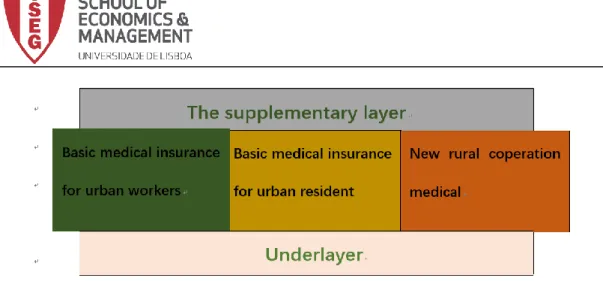
associated with the payment and treatment enjoyment as the main system of the medical security system, and raises funds through multiple channels to purchase basic medical service. After years of reform and exploration, the framework of the medical security system with Chinese characteristics of “three verticals and three horizontals” has basically taken shape, like Table 1. The three verticals, namely the basic medical insurance for urban workers, the basic medical insurance for urban residents and the new rural cooperative medical care, which cover urban employment, urban unemployed residents and rural residents, are the main parts of the basic medical security system. “Three horizontals” means the main layer, the bottom layer and the supplementary layer. The three basic medical insurance systems constitute the main level; the urban and rural medical assistance and social charitable donations help the poor people to participate in the insurance and personal burden, and constitute the bottom of the insurance; for the higher and diverse medical needs of the masses, through supplementary medical care Insurance and commercial health insurance are available to meet. This basic framework has distinct Chinese characteristics. In line with China's current level of economic development and the status quo of the medical service market, it is also conducive to promoting reforms related to the medical and health system.
23
-Table 1 The sructure of basic Chinese medical insurance system-page
3.4 Current problems and shortcomings in China's medical insurance
system
Because local medical insurance centers have policies for their respective regions, there are differences in the proportion of medical insurance diseases and reimbursement in various regions. There is also a lack of integrated regulations and effective interconnections among various insurance types in various regions of the country. Therefore, the fairness of this national system needs to be improved. With the development of society, the forms of employment are diversified, and the diversity of the demand for medical insurance is gradually becoming insufficient. Moreover, the transfer of insured personnel and the emergence of medical insurance in the region are difficult, and the “one card” measures are imperfect.
The medical insurance policy management system is not sound enough. Due to the different levels of economic development in various regions of China, the
medical insurance policies are implemented separately at the provincial, municipal, and county levels, or by industry-based division. As a result, the medical insurance fund has poor mutual aid and cannot be applied smoothly to the whole country. The basic medical insurance fund, the supplementary medical insurance fund, and the large-scale commercial insurance fund lack coordination in the application connection, and various medical insurance funds cannot function most effectively. Medical insurance funds involve the government, medical insurance centers, insured personnel and hospitals. Occasionally, the doctor-patient relationship is tense, the insured unit pays insufficient medical insurance funds, the insured people take personal medical insurance account funds, fraudulently obtain medical insurance funds, medical institutions and medical representatives' black-box operations, and so on.
The characteristics of the system structure of the medical insurance system have greatly restricted the government's allocation of medical insurance resources. The differences between medical and health facilities, industries, and urban and rural areas are huge. Shanghai, Beijing, Guangzhou and other central cities have concentrated the most in the country. Excellent medical talents, state-of-the-art medical equipment, and medical facilities in underdeveloped areas are far from meeting the needs.
Insufficient settlement management may lead to uncontrolled treatment of medical consumption, leading to collusion and moral decay in a small number of
25
-local doctors and patients. Someone went to the pharmacy to cash out.
Chapter 4 How does “Internet +” and “Big Data” affect the reform
of the health care system?
4.1 What is “Internet +” and “Big Data”?
"Internet +" is a concept that refers to the further practice of Internet thinking. It represents an advanced productivity that promotes the constant evolution of the economic shape. Thereby driving the vitality of social and economic entities and providing a broad network platform for reform, development and innovation. Big data, also known as huge amount of data, means that the amount of data involved is so large that it cannot be passed through the human brain or even mainstream software tools, and it can be learned, managed, processed, and organized in a reasonable time to help the business decision-making. Positive purpose information.
As an important product of the Internet era, the development of big data technology is profoundly changing the way we live, work and think. In recent years, China has paid more and more attention to the development and application of big data, and has deployed systems from the national strategic level. Big data has been widely used in various fields of national governance.
4.2 What positive effect from
“Internet +” and “Big Data” on Chinese
healthcare insurance system
The basic realization of “National Health Insurance” marks a great achievement in China's medical insurance reform. At the same time, however, the gradual release of medical needs and the ever-increasing demands for quality of medical services pose significant challenges to the development of health care. In the process of medical insurance development, issues such as the system fairness of medical insurance, operational efficiency, urban-rural integration, the relationship between basic medical insurance and commercial medical insurance, and medical insurance management information systems have always been the focus of academic research. Among these issues, a widely recognized conclusion is that the government should reposition its functions, build a multi-agent cooperation mechanism, integrate multiple resources, and use modern means to gradually realize the transition from “medical insurance management” to “medical insurance governance”.
a)Enrich the participants in the governance of medical insurance
The application of the Internet and big data technology has built a platform for information openness and resource sharing. The medical insurance and medical data of the insured and patients have been aggregated into a huge database for development and utilization by all parties. The right of the insured to obtain medical insurance information is equal to that of the medical insurance
27
-department. The right of the patient to obtain medical health information is equivalent to that of the doctor and the hospital. Various emerging market-oriented medical elements such as third-party independent testing, imaging, pathology, ECG, and chronic disease management have emerged in large numbers, spanning the original “digital wall” and participating as an important actor in the open medical ecosystem. in. Medical institutions and government outsourcing medical insurance and medical services provide opportunities and ways for other social entities to participate in medical insurance and medical insurance services. Social diversified entities realize information sharing and collaborative cooperation in an increasingly open environment, bringing new working methods and concepts to medical insurance governance, providing more possibilities for the development of medical insurance governance, thereby improving the quality and efficiency of medical insurance governance.
b) Enhance the fairness of medical insurance
The use of big data in health insurance can effectively achieve “technology to promote fairness”. The development of big data has broadened the breadth and depth of information acquisition. The information asymmetry between the government as the main actor of medical insurance and the residents participating in medical insurance will be greatly reduced, making the threshold for access to medical services and medical services lower. More and more residents can obtain corresponding medical services and medical insurance information, thereby
improving the accessibility of services and expanding the coverage of medical insurance. At the same time, because the government, which is the main body of medical insurance, can obtain the medical insurance information of each patient across regions and time periods, it can effectively avoid adverse selection in the interaction with residents. Reduce the likelihood of moral hazard. Therefore, the in-depth application of big data in the field of medical insurance can reduce information asymmetry and enhance fairness through technological advancement, thereby improving the governance level of medical insurance.
c) Improve the overall level of medical insurance
Introducing big data in the field of medical insurance can coordinate information at a higher level and solve the problem of “information island”. At present, different units of the same level have different standards for the entry and storage of hardware, software and medical insurance information databases, and the interoperability between databases is blocked, resulting in the break of medical insurance information between different units and regions, resulting in waste of information resources. , greatly reducing the comprehensive use value of medical insurance information resources. The application of big data can realize the structure of medical insurance data. Through higher level information coordination, the unit area of the same level can be guided to run the medical insurance information database to construct a horizontal resource sharing and open platform. Through data integration and platform construction, medical
29
-insurance information exchange and resource sharing can be realized. The technical difficulty and information threshold of cross-level coordination can be reduced, and the medical insurance information of residents can be delivered across the city and even across provinces, thus greatly improving the efficiency and fairness of medical insurance governance. Sexuality ultimately benefits every insured.
d) Changing the way in which health care needs are met
On the one hand, the application of big data in medical insurance governance has promoted the transformation of the way in which medical insurance needs are satisfied, and promoted the construction of active seeking mechanism for medical insurance services. The large-scale and in-depth application of big data enables the public to more easily understand medical insurance, master the service content and access of medical insurance, and actively seek and obtain medical insurance services based on their own needs, and change the status of passive medical insurance services. On the other hand, big data enables every resident to have their own electronic medical record, promote the formation of active detection mechanism for medical insurance needs, and realize the personalization and precision of medical insurance services. Through the precise positioning of medical insurance service needs, the transition from “governing the disease” to “treating the disease” is realized. The medical insurance service active seeking mechanism and the medical insurance demand active discovery mechanism can
form a benign interaction and cycle, synchronously improve the efficiency and quality of the medical insurance service provider, and the satisfaction and satisfaction of the medical insurance service recipient.
e) Creating new economic value of medical insurance
The development of information technology represented by big data can break the barrier between information resources, promote higher-level coordination of medical insurance information in different regions, build a valuable data resource database, and realize information data from fragmentation to system. Change and open to the public. The mining and application of medical insurance big data can make business intelligence, information security and cloud computing have greater potential. On this basis, through the mining, analysis and processing of medical insurance data, the medical insurance data can be better structured. In-depth exploration in the areas of commercial insurance, life and medical science offers possibilities. In addition, the application of big data in medical insurance is conducive to segmenting the demand for medical services and promoting the refinement of medical insurance services; it is conducive to strengthening cooperation between various government departments and various entities in the medical service industry, in clinical and payment. Innovate products and services in research and development, business models and public health to improve the economic and social benefits of medical insurance.
31
-4.3 The new development trend of medical insurance: "Internet + big data" drives management to governance.
Under the traditional state management mode, medical insurance activities are planned, organized, commanded, coordinated, controlled and supervised by means of single-point, one-way, single-subject and monopoly. In the new era, this medical insurance management model faces a series of problems, which limits the communication space between the management department and the public, leading to insufficient participation of other entities outside the government, showing obvious unidirectionality, closure and coercion. Sexual characteristics. With the continuous advancement of national governance, medical insurance has also begun a gradual transformation from “management” to “governance”. Based on the application of big data in the field of medical insurance governance, the new trend of medical insurance governance is mainly reflected in five aspects: First, from a single point to integration, that is, from a single point of medical insurance information to data information integration, and open to the whole society. The public can log in at any port on the data platform to facilitate access to medical information for doctors and patients.
Second, from one-way to interaction, from the unilateral service delivery and information output of the health care provider to the public as a health care service user can also participate in the process of medical insurance governance. The public “sounds” on the platform of information opening and resource sharing,
and forms the daily supervision of medical institution service supply and government department medical insurance management in an interactive manner, and medical institutions and medical insurance management departments collect information of public feedback and take measures to optimize The mode of operation of medical insurance enhances the public's trust in medical insurance. Third, from single-subject to multi-agent, that is, from the unified management of the government to the participation of many parties in the society. The development of big data provides a platform for medical institutions and other social entities to participate in medical insurance governance. The open sharing of data is conducive to the exchange of information and multiple interactions among various entities, and promotes the equality of status among the various subjects.
Fourth, from monopoly to openness. Thanks to the development of information technology and the new requirements put forward by the society for medical insurance management, medical insurance has gradually changed from internal closure and monopoly of information to open sharing, and the public can obtain more medical insurance information related to itself.
Fifth, from regulation to service. As the development of big data technology forced the reform of medical insurance, the government's participation mode gradually changed from mandatory control to service supply and service quality improvement.
33
-In summary, “medical insurance governance” is a concept corresponding to “medical insurance management”. Its main features are the opening of the medical insurance system and the participation of different stakeholders, with the aim of providing more fair and effective medical insurance services to the public. So what effect does big data have on the transformation of the medical insurance system into governance? Big data is both an information-based resource and an important tool in the information age. The introduction and application of big data can effectively improve the quality and efficiency of national governance, and will become an important foundation to support the transformation of modern medical insurance system and the power to promote governance reform. This is mainly reflected in three aspects: First, big data is an important resource for national governance, and 3 provides data support for government decision-making and collaborative governance. The flattening of information transmission in the Internet era can effectively solve the problem of information asymmetry in public management, and provide information support for multi-collaborative state governance; the addition of social forces such as enterprises and markets can make up for the lack of government unified management. Moreover, by applying big data, departments can explore the corresponding rules and improve the accuracy of public service objects and content recognition, thereby improving management efficiency. Secondly, big data is the driving force for the development of national governance. Its development and application can
increase the transparency of the government, thus reconstructing the power structure and promoting the overall transformation of the country. The government service supported by big data can force the construction of transparent government, broaden the sources of information, enhance the voice of Internet users and consumers, and promote the reform and development of the country in various fields. Finally, the development of big data provides technical possibilities for the optimization of national governance tools. Each governance subject can dig deep-level rules from structured data. Through multi-dimensional analysis and research, it can fully grasp the national affairs, construct corresponding models and forecast trends, and seek the optimization of governance methods and paths.
4.4 The application of big data to the development of new medical insurance system
As medical insurance moves from “management” to “governance”, big data has been initially developed and applied as an important resource and tool for innovative medical insurance management and improving the level of medical insurance governance. However, its functional value is still limited, and its implication The enormous development potential is constrained by factors such as institutions, technology and basic conditions. Based on the actual situation of the development and management of China's medical insurance system, it is
35
-necessary to plan the development of big data in an integrated manner, and to promote the application of big data in medical insurance management in a phased and step-by-step manner by standardizing the system, unifying standards, and opening up the market. The value and utility of data in health care governance. The government should avoid the problems of “sectoralism” and “localism” in the previous management system. Further design how to further establish the concept of modern medical insurance governance of sharing, co-construction and co-governance, promote the all-round expansion and application of big data in medical insurance governance, and realize the scientific decision-making, fine management and humanized service of medical insurance governance. Application value, actively eliminate "data barriers", providing a broader space for the development and application of big data.
The establishment of a standardized big data system medical insurance system does not uniformly restrict the integration and application of big data. First, the differences in data standards affect the convergence of data, that is, the regional nature of health insurance policies affects the unified governance of local health insurance. The key to data value-added is integration. The prerequisite for data integration lies in the unification of data standards. However, the metadata of different medical insurance systems affects the data mining and integration, which is mainly reflected in the difference between the entry categories of medical insurance data and the corresponding classifications, which hinders the sharing
and intercommunication of big data. To this end, the government should promote the development of data standards, obtain data in the field of medical and medical insurance through the informationization of hospitals and medical insurance, and establish a standardized standard system to lay the foundation for further application of big data. Second, the current application of big data in health care governance lacks operational normative guidance. Since the construction of the big data system for medical insurance governance is basically framework and principle, the sharing of infrastructure is easier to achieve, but how to actively share the data content at a higher level and structure it and Further application analysis has no clear operational guidelines, which affects the practical application of big data in the field of medical insurance. Finally, because big data involves information security issues, every social person becomes an individual who is “monitored” in the data network, which is likely to cause information security problems and constitute the source of social risks. Therefore, as the main actor in the coordinated management of medical insurance, the government should lead the establishment of unified medical and medical insurance data standards, and support the development of specific operational norms and data security systems.
Comprehensively develop multiple values of big data. The introduction of market competition mechanism has gradually become an important direction for the reform of social security management system. An important feature of medical
37
-insurance governance is multi-agent, which is a key component of the market. The government can make full use of the financial and technological advantages of market forces, build partnerships with companies, and enhance vitality by introducing competitive mechanisms. For example, in cooperation with different types of institutions such as the medical informationization category, the development of specialized medical information systems, and scientific research enterprises, the medical insurance intelligent audit service, the fund fine management service, and the insured person’s A number of explorations, such as health management services, 1 achieve “specialization in the industry”. At the same time, the participation of market forces is also an exploration of the commercial value of big data. Enterprises not only serve as the government project, but also simultaneously explore the business model of big data in this process, thus forming an actor network for the development of big data under the supervision of the government, thereby cooperating and mutually restricting each other. Participate in the value development of medical insurance big data. In addition, the government can also select the best partners through the competition mechanism, fully utilize the power of the enterprise to promote the development and utilization of big data, and make up for the shortcomings that affect the efficiency of medical insurance treatment due to limited government resources, and maximize the value of the multiple subjects of medical insurance governance.
Conclusion
The establishment and continuous development of China's medical insurance system has promoted the rapid development of the medical and health care industry and played a positive role in ensuring the health of urban and rural residents and improving the physical fitness of the people. In particular, reforms that have undergone several stages have used a relatively stable basic framework. However, China's basic medical security system reform adopts a gradual approach, starting from some people to design the system and gradually advancing itself. It has a strong stage and experimentation, and needs to be continuously explored and perfected in practice. There are inevitably some limitations.
The characteristics and advantages of big data itself create opportunities for the innovation of medical insurance governance and the improvement of governance capabilities. Medical insurance is the link between the provider of the medical service and the demander. There are many relationships that need to be coordinated, and it is easy to cause problems such as adverse selection and moral hazard. The key to these problems lies in information asymmetry. The characteristics of big data are the collection, integration and regular exploration of massive data, which can promote the mode of medical insurance management from single point, one-way, single subject and monopoly to integration, interaction and multi-agent. , open and service. Therefore, the application of big
39
-data is to connect the medical insurance to control the various subjects to achieve better interaction and cooperation, promote the equal status of each subject to achieve information transparency, eliminate monopoly and closure, and better realize the supply of medical insurance and medical services. Supervision and promotion of the improvement of medical insurance governance have important functions and values.
The application of big data in medical services and medical insurance governance is not only an inevitable outcome of information technology innovation, but also a requirement for medical service revolution and medical insurance governance innovation. The application of big data in medical service and medical insurance management originates from the application logic based on data technology media, network connection as form and policy support, and constructs a complete chain of medical health data collection, analysis, integration and utilization; From information integration to data integration, data interconnection to resource interoperability, data sharing to healthy sharing application path, realize the structure, dynamic and intelligent application of medical health data, and promote medical service and medical insurance governance with big data technology. The feasible path of “healthy China”; the application of big data technology in the whole process of medical service and medical insurance, relying on the premise of information security maintenance, data standardization management as the guarantee and digital innovation as the driving mechanism for application,
ultimately targeting Through the enhancement of the capacity of medical resources allocation, the quality improvement of medical services and the optimization of the functions of medical insurance management, the construction of big data from sharing to sharing health.
Internet +, big data is a new trend for the medical insurance system, including fund operation monitoring, medical service intelligence monitoring, credit-based supervision, medical insurance payment method reform and medical insurance data capability output, etc. Come to new changes. Leading the new trend of medical insurance system reform
41
-Bibligraphy:
[A]Yue Jinglun. Construction of China's Social Security System from the Perspective of Social Policy Science
The social identity standard to the human needs standard [J]. Public Administration Review, 2008 (4): 58 - 83.
[B] Gu Yu, Fang Liming. Between Voluntary and Mandatory--China Rural Cooperative Medical Care
Analysis of System Embeddedness and Sustainable Development [J]. Social Sciences, 2004( 5) : 1 - 18.
[C] Chen Wei, Zhang Mao. China's New Rural Cooperative Medical Development Report (2002-2012)[M]. Beijing: People's Medical Publishing House, 2013.
[D] Hu Xiaoyi. Towards Harmony: China's Social Security Development for 60 Years [M]. Beijing: China
Labor and Social Security Press, 2009.
[E] Xiong Xianjun. Medical Insurance Review [M]. Beijing: Chemical Industry Press, 2016.
[F] Sun Shuyun. Top-level design of urban and rural medical insurance system: Effective implementation of integration from top to bottom [J].
China Rural Watch, 2015(3): 16 - 23.
[H] Sun Shuyun, Zhou Rong. Discussion on the connection problem of multi-level medical insurance system [J]. Shanxi Province, China
Journal of the Party School, 2013( 1) : 69 - 71.
[I] Shen Shuguang. Reform and development of China's social medical insurance system in the new era [J].
Will guarantee comments, 2017 (1): 40 - 53.
[J]Sun Shuyun. Research on China's Basic Medical Insurance Legislation[M]. Beijing: Legal Publishing
Society, 2012.
[K] Sun Shuyun. Opportunities and Development of China's Basic Medical Insurance Legislation in the New Era[J].
Beijing Social Sciences, 2018(6): 89 - 96.
[L]Zheng Gongcheng. China's Social Security Reform: Opportunities, Challenges and Orientations [J]. National Administration
Journal of the College, 2014( 6) : 24 - 32.
[M]Zheng Gongcheng. Building a social security system covering urban and rural residents in an all-round way [J]. China Society
Will be guaranteed, 2015(1): 36 - 39.
[N] Sun Shuyun, Chai Zhikai. Linking the multi-level medical insurance system [N]. Health News, 2013 - 03 - 18( 3)
43
-Notice on improving the basic medical insurance participation policy for urban and rural residents and preventing duplicate subsidies (Liaorenshe [2017] No. 102) 2017.
[P] Shen Wei. Progress in the construction of hospital information in China[J]. Chinese Journal of Digital Medicine, 2017, 12 (7): 37-43.
[Q] Wang Wenhui, Zhang Xiaodong, Gao Feng, et al. Hospital informationization and strategic management [J]. China Health Care Management, 2011, (12): 901-903.
[R] Huang Huabo. Winning the national network settlement for 100 days tough battles [J]. China Social Security, 2017, (7): 84.
[S] Song Daping, Zhao Donghui, Wang Zaili. Reflections on the Participation of Commercial Insurance Institutions in Basic Medical Insurance Services[J]. China Health Economics, 2017, (6): 45-49.
[T] Chen Zhishui, Leng Jiaxuan, Heng Fangxiu, et al. Discussion on the impact of medical institution information-assisted prompts on medical insurance refusal[J]. Chinese Hospital Management, 2017, (4): 50-52.
[U] Chen Qinghua. Hospital Computer Data Security Analysis [J]. Wireless Internet Technology, 2017, (16): 107-108.
[V] Lan Fuqiang, Shen Lining, Li Wei, et al. Analysis of hospital informationization investment and staffing fairness in China [J] Chinese Journal of Health Information Management, 2017, (5): 717-721.
[W] Wang Haiyang, Yan Xuefeng. Practical Exploration and Thinking on Intelligent Improvement of Medical Insurance Supervision Efficiency——Taking Wuxi City as an Example[J]. China Medical Insurance, 2017, (9): 43-46.
Anexo:
Internacional Health Regulations(IHR) monitoring framework: implementation of IHR core capacities 2010
Internacional Health Regulations(IHR) monitoring framework: implementation of IHR core capacities 2017