Combinatory Examples Extraction
for Machine Translation
0Alberto Sim˜oes and Jos´e Jo˜ao Almeida
Universidade do Minho, Campus de Gualtar, 4710-057 Braga
Abstract
One of the bottlenecks of example-based machine translation (EBMT) is to be able to amass automatically quantities of good examples. In our work in EBMT, we are investigating how far one can go by performing example extraction from parallel corpora using Probabilistic Translation Dictionaries to obtain example segmentation points. In fact, the success of EBMT highly depends on examples quality and quantity, but also in their length. Thus, we give special importance on methods to extract different size examples from the same translation unit. With this article we show that it is possible to extract quantities for examples from parallel corpora just using probabilistic translation dictionaries extracted from the same corpora.
1
Introduction
Recent research on Machine Translation (MT) have been focused on corpus based translation, and two specific trends: Statis-tic Based Machine Translation (SBMT) and Example Based Machine Translation (EBMT — Somers, 1999; Hutchins, 2005).
In this second approach to MT, parallel corpora is used as a base of examples of pre-viously done translations. The translation process is defined as:
translate : sentence × tmdb −→ sentence translate(s, db)def=
let l1 = split(s)
l2 = <match(db, x) | x ∈ l1> in recombine(l2)
Basically, we will first split the sentence to be translated in segments, try to translate them using a database (db) of translations, and then recombine the translations in a fi-nal sentence. To split into segments is im-portant because it is highly improbable we find the full sentence we want to translate in the examples database.
0
This work has been partially funded by Fun-da¸c˜ao para a Ciˆencia e Tecnologia of Portu-gal through grant POSI/PLP/43931/2001, and co-financed by POSI, within Linguateca.
This approach to translation is being one of the more promising, mainly because it just depends on corpora. Traditional trans-lation approaches used language specific grammars that were difficult to write and error prone1.
So, EBMT quality highly depends on the used corpora quality and the number and length of the examples available2. In fact, the granularity of the examples is very im-portant during EBMT. While a full-sentence example if very liable, it is not flexible (not easy to reuse). In the other hand, a sin-gle word example is very flexible, but not liable for translation (because it lacks con-text). So, we need examples with different sizes between these two extremes.
This paper describes an algorithm to ex-tract segments from parallel corpora, using different example granularities and combi-nations. This algorithm is based on a trans-lation matrix where transtrans-lation probabilities between words are set, and the relationship between words and segments are extracted.
1
In this paper we will not discuss the differences between SBMT and EBMT systems. For some dis-cussion on the subject please refer to Hutchins, 2005
2
EBMT depends as well on the type of corpora used, as it should be the same kind of the text we are trying to translate.
These segments are then consolidated in a database with occurrence count for proba-bilities measures.
To create the matrix, we need probabil-ities between words, which are extracted from Probabilistic Translation Dictionaries (PTDs).
PTDs are one kind of the results obtained from a word aligner. They associate to each word a set of translation hypothesis with a probability. By analyzing large number of parallel texts in English and Portuguese and in Spanish and Portuguese, we have got siz-able dictionaries for the two language pairs (in the two directions).
We use PTDs instead of traditional bilin-gual dictionaries for two main reasons:
• PTDs are easier to obtain, as they are automatically extracted from parallel corpora, and they are highly depen-dent from the corpus they are based on. Thus, the translations obtained from PTDs should be more adequate to seg-ment the corpus they were extracted from than the translations from tradi-tional bilingual dictionaries;
• PTDs include probabilistic information which will be crucial for the examples extraction algorithm we present bel-low. Without this kind of information it would be quite hard to find suitable points where to cut examples.
Section 2 describes NATools, the scalable PTDs extractor used. Follows the main sec-tion with our algorithm. In secsec-tion 4 we pro-pose a simple way to evaluate the extracted examples.
2
Probabilistic
Translation
Dictionaries extraction
This section presents a brief explanation of the structure of NATools (Hiemstra, Au-gust 1996; Sim˜oes, 2004; Sim˜oes & Almeida, 2003), the Probabilistic Translation Dictio-nary extractor we used.
NATools is composed of different modules, which work as a pipeline: a corpora splitter, a corpora encoder, a co-occurrence counter,
the EM-Algorithm, the dictionary creation, and junction at the end.
The extractor processes two sentence aligned texts (a sequence of translation units), and creates a probabilistic transla-tion dictransla-tionary with the following structure:
wα* (occur × wβ * P (T (wα) = wβ))
That is, we map to each word on the source language (Lα) a pair: the occurrence
counter of that word on the corpora (occur), and another map, from possible translations from target language (wβ) to its respective
probability of being a translation.
The following example is from EuroParl (Koehn, 2002) with more than a million translation units, and 30 million words in each language. The resulting PTD include about 100 000 entries, each with 1 to 8 pos-sible translations. ** Word: europe ** OccurrenceCount: 42853 europa: 94.71 % europeus: 3.39 % europeu: 0.81 % europeia: 0.11 % ** Word: stupid ** OccurrenceCount: 180 est´upido: 17.55 % est´upida: 10.99 % est´upidos: 7.41 % avisada: 5.65 % direita: 5.58 % impasse: 4.48 % ocupado: 3.75 %
While it is possible to perform transla-tion using only PTDs, it will end being a word-by-word translation, not respecting the grammar of the target language, but preserving the order of the source-language unit.
3
Example Extraction
Algo-rithm
The examples extraction algorithm can be applied both to translation units present in
the corpus from where we extracted PTDs, as well as to other translations units. Qual-ity will depend on the knowledge of PTDs regarding the words used in the translation units.
With each translation unit, we create a matrix where the relationship between words will be marked, and then the exam-ples extracted. This is an approach similar to Carl, 2001 and Melamed, 1999.
3.1 Alignment Matrix Creation
For each translation unit, a matrix is cre-ated with the probabilities of translations between words, and a translation diagonal is searched. This diagonal (normally near the main matrix diagonal) will include the cells where words are translations. This is explained bellow:
1. create the translation matrix where each row is a word in the source segment (wSL), and each column is a word in the
target segment (wT L). For each cell in
the matrix add the mean of the transla-tions probabilities from the source lan-guage to the target lanlan-guage and from the target language to the source lan-guage:
P(T (wT L) = wSL) + P(T (wSL) = wT L)
2
While the PTDs extraction algorithm creates a matrix with all translation units in the corpus and fills each cell with the co-occurrence count for each word pair, this algorithm uses those ob-tained values to extract segments.
2. for words that do not appear in the cor-pus used to extract the PTDs, we do not have their probabilities of being a trans-lation of any other word. This happens a lot with proper nouns and numbers. Thus, we use a filter to find words (or numbers) that are written in the same way in both languages and, for these words relationships we force a probabil-ity value of 80%.
Table 1 shows the translation matrix3 after the first two steps of the algo-rithm. Translations probabilities were added, and probabilities for words writ-ten in the same way were set to 80%.
el perro lad r´o a l g a to . o 60.6 0.0 0.0 0.0 0.0 0.0 c˜ao 0.0 74.5 0.0 0.0 0.0 0.0 ladrou 0.0 0.0 71.5 0.0 0.0 0.0 ao 2.2 0.0 0.0 45.9 0.0 0.0 gato 0.0 0.0 0.0 0.0 80.0 0.0 . 0.0 0.0 0.0 0.0 0.0 80.0
Table 1: Alignment matrix
3. we are working primarily with Por-tuguese, Spanish and English. While translations between these languages can change words in the sentences, as well as some phrases, it is known that most of the translations will have a sim-ilar order in the words (if we consider only Indo-European languages). This means that the correct translation rela-tions will appear in a diagonal near the matrix main diagonal.
Thus, we use a smoothing algorithm in order to lower the cells’ values accord-ing to their distance to the main diag-onal (we just multiply the values by a distance factor).
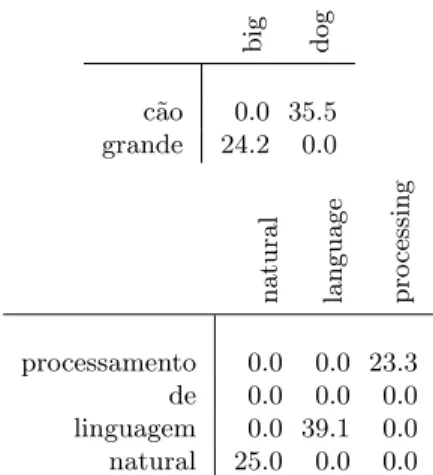
4. while in the previous example we used Portuguese and Spanish, whose word order in the sentence are normally the same, this does not happen for lan-guages pairs as Portuguese and English. With this in mind, we define a set of patterns for words’ common or-der change in the sentence, like the name/adjective order4. Table 2 shows two translation matrices where patterns would be found. Note that these patters are language specific.
3This is a simple example just to illustrate the
translation matrix.
4
These patterns are described using a simple Do-main Specific Language that will not be detailed in this article
b ig d o g c˜ao 0.0 35.5 grande 24.2 0.0 n a tu ra l la n g u a g e p ro c essi n g processamento 0.0 0.0 23.3 de 0.0 0.0 0.0 linguagem 0.0 39.1 0.0 natural 25.0 0.0 0.0
Table 2: Alignment matrix examples where pat-terns would be applied
Patterns found are automatically marked with all cells in the rectangular area defined by the pattern cells. These are marked with a special mark so we can identify patterns later.
5. the most important bit of the algorithm is the diagonal-finder, constructing the translation diagonal for each transla-tion unit. This translation diagonal passes by the cells with more probabil-ity in the matrix.
This algorithm relies on anchor points. A point xi,j is an anchor point if its
value is 20% bigger than all elements in the i row and 20% bigger than all el-ements in the j column. Pattern blocks (rectangles with more than 1×1 of size) are also anchor points.
When no near anchor points are found, the algorithm proceeds by enlarging a rectangle step by step, until it finds one. These blocks include at two of their cor-ners (top left, and bottom right) an an-chor point, or pattern block. Notice that pattern blocks are totally included
3.2 Examples Extraction
As soon as the translation diagonal is com-puted, we extract a tree of examples:
1. step the translation diagonal, finding blocks. These blocks can have any size, from the one unit square (word to word segments), and getting bigger to (in ex-treme) the size of the translation unit
(if no anchor point was found, which is highly improbable).
2. extract single blocks. These will result in the following kind of dictionary:
todos / todos os / los dias / d´ıas ...
poder mandar os seus / poder en-viar a sus
filhos para a / hijos a la escola / escuela
Notice that there are one-word entries (the ones found in one-unit squares) and bigger examples. The examples ex-tracted are often not traditional linguis-tic constituents like phrases or multi-word expressions, as is the case in most of the EBMT literature as well.
3. The we concatenate two and three con-tiguous examples extracted from the same translation unit creating bigger examples.
For instance, from the previous exam-ple, if we join two examples, we get:
todos os / todos los os dias / los d´ıas
...
poder mandar os seus fil-hos para a / poder en-viar a sus hijos a la filhos para a escola / hi-jos a la escuela
And joining three examples:
todos os dias / todos los d´ıas ...
poder mandar os seus fil-hos para a escola / poder en-viar a sus hijos a la escuela
4. Finally, examples are joined under the same head entry and counted. The more frequently a given exam-ple is extracted from the corpus, the higher probability of being commonly used. See two entries in the examples database:
i no podemos toler
ar
que la comisión continúe jugando al gato y al ratón ! não 0.4 83.2 0.0 0.0 0.2 0.0 0.0 0.0 0.0 0.0 0.0 0.0 0.0 0.0 0.0 podemos 0.0 0.0 73.8 1.8 0.4 0.0 0.0 0.0 0.0 0.0 0.0 0.0 0.0 0.0 0.0 tolerar 0.0 0.0 0.0 72.9 0.0 0.0 0.0 0.0 0.0 0.0 0.0 0.0 0.0 0.0 0.0 por 0.0 0.0 0.0 0.0 1.5 1.0 0.0 0.0 0.0 0.0 0.0 0.0 0.0 0.0 0.0 mais 0.0 0.0 0.0 0.0 0.0 0.0 0.0 0.0 0.0 0.0 0.0 0.0 0.0 0.0 0.0 tempo 0.0 0.0 0.0 0.0 0.2 0.0 0.0 0.0 0.0 0.0 0.0 0.0 0.0 0.0 0.0 que 0.0 0.1 0.0 0.0 74.7 0.0 0.0 0.0 0.0 0.0 0.0 0.1 0.0 0.0 0.0 a 0.3 0.3 0.0 0.0 2.0 52.9 0.0 0.0 0.0 1.7 0.0 0.4 1.3 0.0 0.0 comissão 0.0 0.0 0.0 0.0 0.0 0.0 92.5 0.0 0.0 0.0 0.0 0.0 0.0 0.0 0.0 continue 0.0 0.0 0.0 0.0 0.0 0.0 0.0 33.2 0.0 0.0 0.0 0.0 0.0 0.0 0.0 este 0.0 0.0 0.0 0.0 0.0 0.0 0.0 0.0 0.0 0.0 0.0 0.0 0.0 0.0 0.0 jogo 0.0 0.0 0.0 0.0 0.0 0.0 0.0 0.0 0.0 0.0 0.0 0.0 0.0 0.0 0.0 do 0.0 0.0 0.0 1.0 0.5 0.8 0.0 0.0 0.0 1.5 0.0 0.0 1.4 0.0 0.0 gato 0.0 0.0 0.0 0.0 0.0 0.0 0.0 0.0 0.0 0.0 75.6 0.0 0.0 1.0 0.0 e 0.0 0.0 0.0 0.0 0.1 0.0 0.0 0.0 0.0 0.0 0.0 83.2 0.0 0.0 0.0 do 0.0 0.0 0.0 0.7 0.3 0.6 0.0 0.0 0.0 1.2 0.0 0.0 1.5 0.0 0.0 rato 0.0 0.0 0.0 0.0 0.0 0.0 0.0 0.0 0.0 0.0 0.0 0.0 0.0 39.1 0.0 ! 1.4 0.0 0.0 0.0 0.0 0.0 0.0 0.0 0.0 0.0 0.0 0.0 0.0 0.0 79.1
Figure 1: Alignment matrix with translation diagonal
todos os 642 todos los 3 cada a~no 2 todas las 2 los de todos todos os dias
2 todos los d´ıas
1 recordemos todos los
While it should be possible to extract a quality measure from the alignment matrix, at the moment we are just us-ing the number of times an example was actually extracted from the corpus.
3.3 Dynamic Examples Extraction
Because we are having big problems on stor-ing efficiently examples, and because the granularity of the examples needed highly depend on the sentence we are trying to translate, we are developing a method for dynamic examples extraction from parallel corpora.
Instead of simply perform the examples extraction from the alignment matrix in batch mode, we are preparing to store a bit-compressed version of all translation unit matrices, and consult them at run-time.
For each segment we are trying to trans-late, we search the corpus for translation units where it occurs. We retrieve the align-ment matrix and calculate on-the-fly the ex-ample translation for that segment.
Notice that the extracted translation us-ing this methodology is not necessarily just
the translation of the source segment we had to translate. This happens because we will fit the source segment in the matrix, and cut the smaller example that contains it.
4
Evaluation
Although these examples may be useful for tasks other than EBMT, we are primarily interested in evaluating their quality for MT. A primarily evaluation was done extract-ing random examples from the ones ex-tracted, before grouping them under the same head entry. We skipped 1000 exam-ples, and then extracted 100 examples: tak-ing one, skipptak-ing 100 taktak-ing other, and so on. We did this both for Portuguese/English and Portuguese/Spanish. This is shown on table 3, in the column “Single”.
The second evaluation was done using the examples grouped under the same head en-try. We joined equal examples, counting the number of times they appear in our database. Then, sorted from more occur-rence to less occuroccur-rence. Done the same pro-cess as before to select 100 unities. Then, we did the same for 100 examples of pairs (glued examples). The result of evaluating these 200 units is shown in the column “Ac-cumulated.”
The selection of good examples was done just in case they mean exactly the same. For instance, pairs like:
tudo para / todo lo posible para
Single Accumulated Nr of exs Good % Nr of exs Good % Portuguese/Spanish 100 66 66% 200 191 95% Portuguese/English 100 45 45% 200 156 78%
Table 3: Portuguese/Spanish and Portuguese/English examples evaluation
be used in the same context and without ma-jor problems they do not mean really the same.
Also, we should note that the quality of the examples (the ones in the second col-umn) raise with the number of translation units we process. For instance, the portion processed from the Portuguese/English cor-pus is 20% of the portion already processed for the Portuguese/Spanish corpus.
5
Conclusions
Examples extracted so far are of reasonable quality as our first experience shown. Al-though we need to prepare an expedite way evaluate them, we are continuing extracting examples. The process is not as fast as we would like (takes about 12 hours to extract examples from 40000 units in a Pentium IV 3GHz) but we are continuously extracting more and more examples from our corpora. Examples are not useful just for MT. They can be used for anything parallel corpora is used, as they roughly consist on translation units as well. Also, many of the tasks that usually deal with parallel corpora can gain using an example-based parallel corpora.
We are working on a characterization of the PTDs and the examples extracted, in order to analyse the kinds of material that are possible to extract with this algorithm, and investigate which if any linguistic clues (like part of speech, lemmatization or canon-ical order) can help us in both reducing the number of examples and increase their qual-ity and generalqual-ity.
Acknowledgment
We would like to thank Diana Santos for the help reviewing the article and for relevant comments.
References
Carl, M. (2001). Inducing probablilis-tic invertible translation grammars from aligned texts. In M. Carl & A. Way (Eds.), Workshop on example-based ma-chine translation (pp. 12–22). Santiago de Compostella, Spain.
Hiemstra, D. (August 1996). Using statis-tical methods to create a bilingual dictio-nary. Unpublished master’s thesis, De-partment of Computer Science, University of Twente.
Hutchins, J. (2005). Towards a definition of example-based machine translation. In Mt summit x workshop on example-based machine translation. Phuket, Thailand. Koehn, P. (2002). Europarl: A
mul-tilingual corpus for evaluation of machine translation. (Draft, Unpub-lished, http://people.csail.mit.edu/ ~koehn/publications/europarl.ps) Melamed, I. D. (1999). Bitext maps and
alignment via pattern recognition. Com-putational Linguistics, 25 (1), 107–130. Sim˜oes, A. M., & Almeida, J. J. (2003).
Natools – a statistical word aligner work-bench. SEPLN.
Sim˜oes, A. M. B. (2004). Parallel corpora word alignment and applications. Unpub-lished master’s thesis, Escola de Engen-haria - Universidade do Minho.
Somers, H. (1999). Review article: Exam-ple based machine translation. Machine Translation, 14 (2), 113–157.