Universidade de Lisboa
Faculdade de Ciências
Departamento de Biologia Animal
\
The Effectiveness of Environmental Enrichment in Two Captive
South-African Fur Seals
(Arctocephalus pusillus pusillus)
Mariana Vieira Lã
Dissertação
Mestrado em Biologia da Conservação
2012
Universidade de Lisboa
Faculdade de Ciências
Departamento de Biologia Animal
\
The Effectiveness of Environmental Enrichment in Two Captive
South-African Fur Seals
(Arctocephalus pusillus pusillus)
Mariana Vieira Lã
Dissertação orientada por:
Prof. Doutora Leonor Galhardo
Prof. Doutora. Maria do Mar Oom
Dissertação
Mestrado em Biologia da Conservação
2012
Para a minha mãe...
por estar sempre,
sempre, sempre,
sempre
cá!
Índice
Nota Introdutória ... 4
Resumo ... 5
The Effectiveness of Environmental Enrichment in Two Captive South-African Fur
Seals (Arctocephalus pusillus pusillus) ... 9
ABSTRACT...9
1. INTRODUCTION...9
2. METHODS ...12
2.1 Animals and housing ...12
2.2 Preliminary observations ...13
2.3 Experimental design and data collection ...13
2.4 Methods of enrichment ...14
2.5 Data Analysis...16
3. RESULTS ...16
3.1 Baseline behaviour ...16
3.2 Behavioural changes due to enrichment ...17
3.3 Initial and final behaviour without enrichments...21
4. DISCUSSION ...21
4.1 Baseline behaviour ...21
4.2 Behavioural changes due to enrichment ...22
4.3 Initial and final baselines ...25
4.4 Recommendations and limitations of this project ...25
5. CONCLUSION...27
6. REFERENCES...27
Nota Introdutória
Uma vez que esta dissertação foi escrita em formato de artigo científico e que a
formatação varia entre revistas, foram escolhidas as regras de formatação da revista Applied
Animal Behaviour Science.
É reconhecido que será necessário diminuir algumas secções quando o artigo for
submetido para publicação devido às restrições de tamanho, tal como terá que ser feita uma
selecção mais rigorosa das imagens a apresentar e colocá-las a preto e branco. Contudo, foi
considerado que alguma da informação que poderia ser eliminada para publicação é relevante
para contextualizar este trabalho num mestrado em Biologia da Conservação.
Resumo
A otária Sul-Africana (Arctocephalus pusillus pusillus) é uma subespécie encontrada em zoos por todo o mundo, que se adapta geralmente bem a condições de cativeiro, reproduzindo-se com frequência. Não se encontra ameaçada pelo que, tal como a maioria dos pinípedes, é mantida em zoos principalmente por ser emblemática e ter um papel importante na atração e sensibilização dos
visitantes. Apesar de potencialmente controversa, a manutenção de animais em cativeiro é o que permite aos zoos desenvolverem o seu papel na conservação, através da educação, investigação e envolvimento em projetos de conservação in situ e/ou ex situ. De qualquer modo, as condições em cativeiro estão longe de ser ideais, o que levou a uma preocupação em relação ao bem-estar destes animais nas últimas décadas. O bem-estar é geralmente avaliado em termos de saúde física, sucesso reprodutivo e bem-estar mental. Um dos indicadores mais comuns de baixos níveis de bem-estar mental é a ocorrência de estereotipias, que se definem como comportamentos repetitivos, invariáveis e sem nenhuma função aparente. Estes comportamentos desenvolvem-se como forma de lidar com instalações inadequadas e/ou um maneio inapropriado, quer no presente quer em fases cruciais da ontogenia do animal. As condições em cativeiro são frequentemente estéreis, excessivamente previsíveis e pouco complexas, podendo diferir bastante do ambiente em que a espécie evoluiu. Em cativeiro, o comportamento estereotipado mais comum em pinípedes é a natação circular, que pode chegar a representar 50% da atividade diária de alguns indivíduos.
Na natureza, as otárias Sul-Africanas vivem na costa sudeste de África. A sua vida divide-se em três fases: acasalamento na primavera, renovação do pelo no verão e longos períodos de
alimentação no outono e no inverno. No mar, conseguem mergulhar até mais de 200 m (embora a maioria dos mergulhos seja por volta dos 50 m). Durante a época de acasalamento, os machos estabelecem e defendem territórios e haréns. As fêmeas dão à luz quando chegam a terra e acasalam durante os dias seguintes. Fora da época de acasalamento não há territórios delimitados e não existe muita interação entre os animais, embora vivam vulgarmente em grupos quando em terra.
Em zoos, as otárias não conseguem expressar todo o seu reportório comportamental, não podem caçar nem comer livremente e têm pouca escolha e controlo em relação ao ambiente em que se encontram. Estas condições são geralmente associadas a baixos níveis de bem-estar, sobretudo quando associadas a elas se diagnostica a exibição de comportamentos estereotipados. Um dos métodos mais comuns para contrariar estas condições é a utilização de técnicas de enriquecimento ambiental. Enriquecimentos frequentemente utilizados em pinípedes incluem presas vivas, blocos de gelo com peixe congelado, dispensadores de comida, objetos manipuláveis, mistura de mais do que uma espécie na mesma instalação e treino.
Neste projeto foram aplicadas técnicas de enriquecimento ambiental a duas otárias Sul-Africanas (um macho e uma fêmea) mantidas em cativeiro no Aquário Vasco da Gama (Lisboa, Portugal). Os objetivos eram determinar 1) alterações no comportamento dos animais como resultado dos enriquecimentos e 2) o efeito de diferentes técnicas de enriquecimento. Foi previsto que ambos os
animais interagiriam com os enriquecimentos, o que levaria a uma diminuição da natação circular, a um aumento de outros padrões comportamentais e à promoção de uma utilização mais equilibrada do espaço disponível (duas piscinas e duas plataformas interiores e uma instalação exterior). Todos estes resultados seriam indicadores de uma melhoria do bem-estar destes animais.
O design experimental consistiu num período de quatro dias de amostragem antes, durante e após cada enriquecimento. As fases pós-enriquecimento funcionavam como baseline para o
enriquecimento seguinte. Em cada dia ocorria uma sessão de amostragem de uma hora. O primeiro enriquecimento, “Random Fish”, consistiu em atirar peixes (quatro vezes, três peixes de cada vez) para diferentes áreas da instalação, sem nenhum aviso. O segundo, “Felt Curtain”, baseou-se na colocação de uma estrutura com tiras de feltro numa abertura através da qual os animais nadavam, criando uma cortina análoga a algas a flutuar. O terceiro enriquecimento foi a combinação dos dois anteriores. O quarto, “Textured Rugs”, consistiu em dois tapetes de plástico com pequenos pinos de um dos lados, criando uma textura diferente. Um foi preso a um local tipicamente usado para comportamentos de manutenção do pelo e o outro foi deixado livremente a flutuar. Para o quinto enriquecimento, “Fish in Ice”, utilizaram-se peixes congelados dentro de blocos de gelo. O último enriquecimento usado foi a combinação dos dois anteriores. Os resultados foram comparados através da interpretação de gráficos e análise estatística. As proporções de tempo passado em diferentes comportamentos e áreas antes, durante e após cada enriquecimento foram comparadas através de um teste de Friedman. A primeira e última baseline foram comparadas através de um teste Wilcoxon Signed Ranks, Em ambos os testes foi também calculado o p-value exato através de testes de permutações, uma vez que esta é a abordagem recomendada em estudos com pequenas amostras. Neste caso os animais foram analisados em separado e, devido às limitações estatísticas, este projeto foi considerado apenas como um caso de estudo, não pretendendo extrapolar em relação à espécie ou outros animais.
Durante a baseline inicial, os dois animais passaram a maior parte do tempo em natação estereotipada na piscina direita. Este comportamento foi o mais frequente durante todo o estudo. A natação estereotipada nestes animais é realizada de uma forma circular e (quase sempre) no sentido dos ponteiros do relógio. O macho utiliza apenas a piscina direita mas a fêmea alterna entre usar só a piscina direita ou ambas as piscinas para cada volta.
Os enriquecimentos “Random Fish” e “Fish in Ice” aumentaram comportamentos desejáveis, como a natação normal e comportamentos de alerta. Além disso, também promoveram uma utilização mais equilibrada do espaço da instalação. O macho monopolizava toda a comida, revelando uma clara hierarquia. Mesmo quando o macho não estava perto dos enriquecimentos alimentares a fêmea hesitava antes de interagir com eles. De uma maneira geral, estes foram os enriquecimentos mais eficazes e tiveram um efeito mais forte no macho do que na fêmea, tendo sido os únicos que tiveram algum efeito na diminuição da natação estereotipada
Os enriquecimentos não alimentares, “Felt Curtain” e “Textured Rugs”, não causaram nenhuma alteração significativa no comportamento dos animais ou no uso do espaço. Os resultados
sugeriram até que os animais os evitavam um pouco, mas nunca de um modo suficientemente intenso para serem considerados enriquecimentos negativos. A colocação da cortina levou à criação de uma rota alternativa na natação estereotipada da fêmea. Este resultado é positivo, uma vez que introduziu variabilidade num comportamento que geralmente tem um padrão fixo.
A combinação de diferentes enriquecimentos mostrou que, para o macho, o efeito positivo dos enriquecimentos alimentares foi mais forte que um eventual desejo de evitar os não alimentares. Na fêmea observou-se o oposto. Este projeto mostra, assim, que o mesmo enriquecimento pode ter diferentes efeitos quando é apresentado sozinho ou em combinação com outro. É, por isso, importante testar todos os enriquecimentos individualmente e em associações antes de serem incorporados num plano de enriquecimento, assim como ter em conta a variação individual na resposta aos
enriquecimentos.
Por fim, não se observou nenhuma diferença entre a primeira e a última baseline, sugerindo que os resultados observados durante os enriquecimentos não tiveram um efeito duradouro. Estes animais estão sozinhos há bastante tempo, com pouca variabilidade na sua rotina diária e numa instalação muito pequena, estéril e com dois tanques circulares e pouco profundos. O evidente
contraste com as condições naturais sugere que a natação circular seja o comportamento mais parecido com o reportório natural que os animais podem fazer nesta instalação. É também possível que a elevada ocorrência destes comportamentos estereotipados já não seja inteiramente reversível, por se tratarem de mecanismos de adaptação há muito estabelecidos. Nestas condições, o enriquecimento ambiental assume uma particular importância na introdução de variabilidade, como mecanismo de forçar a interrupção do padrão estereotipado da natação, substituindo-o por outros comportamentos. É também importante para estimular os animais a usarem o pouco espaço disponível de forma mais equilibrada.
Baseado nos resultados deste estudo, com recomendações adicionais, pode ser aplicado um plano de enriquecimento sobretudo relacionado com alimento no maneio diário destes animais. Estes enriquecimentos demoram menos de cinco minutos a preparar, o que significa que não ocupam muito tempo do horário, geralmente sobrecarregado, dos tratadores. Adicionalmente, novos enriquecimentos devem ser testados para aumentar a variabilidade e evitar a habituação aos enriquecimentos atuais. Potenciais fontes de inspiração para novos enriquecimentos são a instalação exterior (raramente usada pelos animais neste momento) e o uso de técnicas de treino. O treino, baseado em princípios de reforço positivo, é uma das técnicas de enriquecimento ambiental mais usadas em mamíferos marinhos e é considerado bastante eficaz na estimulação cognitiva, física e social dos animais.
Este projeto demonstrou que o enriquecimento ambiental teve efeitos benéficos no aumento de comportamentos desejados, na promoção de um uso mais equilibrado do espaço e na diminuição de comportamentos estereotipados, mesmo que apenas residualmente. Estas alterações têm um grande potencial na melhoria do bem-estar destes animais, que é uma obrigação ética essencial para a manutenção destes animais em cativeiro. O enriquecimento ambiental é, também, importante para garantir que estes animais sejam apresentados de forma adequada aos visitantes, de modo a transmitir
uma mensagem apropriada. Como membro da EAZA (European Association of Zoos and Aquaria), o Aquário Vasco da Gama está envolvido em práticas conservacionistas, organizando frequentes visitas guiadas para escolas locais. Devido ao seu estatuto emblemático, torna-se então importante que estes dois indivíduos sejam percecionados pelos visitantes como representantes dos seus conspecíficos na natureza.
Em conclusão, este projeto junta-se à já existente literatura que mostra que a relação custos/benefícios do enriquecimento ambiental é largamente compensatória para que seja aplicado como ferramenta na rotina de maneio de otárias em parques zoológicos.
PALAVRAS CHAVE: Arctocephalus pusillus pusillus, enriquecimento ambiental, bem-estar,
The Effectiveness of Environmental Enrichment in Two Captive
South-African Fur Seals (Arctocephalus pusillus pusillus)
ABSTRACT
South-African fur seals have been held at various zoos around the world, mostly due to their appeal to visitors. Captivity conditions differ from nature, leading to concerns over captive animals’ welfare. A common behavioural indicator of poor welfare is the occurrence of stereotypies, and a common method used to attempt to decrease them is environmental enrichment. In this project, enrichment techniques were applied to two South-African fur seals. There were two feeding enrichments (unpredictable fish thrown into the enclosure and ice blocks with frozen fish), two non-feeding (an algae-like felt curtain and textured plastic rugs), and two combinations of the above. During the initial baseline, both animals spent the majority of time in stereotypical swimming, and in only one pool. The feeding enrichments increased non-stereotypical locomotion and alertness, and promoted a more balanced use of area. The non-feeding enrichments didn’t cause major changes but the curtain created a new stereotypical route for the female. Despite the tendency to reduce
stereotypical swimming overall, enrichments did not reduce it significantly. There were no differences between the first and last baseline, suggesting that the effects didn’t outlast the enrichment periods. This is probably due to two concurrent reasons: the importance of swimming in their natural
behavioural repertoire and their living conditions in captivity. These animals have been kept alone for a long time, with little variation in their daily routine and in an enclosure too small and barren. This project demonstrated that environmental enrichment had beneficial effects even if it only decreased stereotypical swimming marginally and can be developed in future studies, further exploring food-related enrichments, especially in their appetitive component. Adding this to the multitude of other positive studies, it seems that environmental enrichment has high enough benefits and low enough costs, to be applied as a common and mandatory husbandry tool.
Keywords: Arctocephalus pusillus pusillus, environmental enrichment, welfare, stereotypical
behaviours, captive pinnipeds
1. INTRODUCTION
Seals, sea lions and other pinnipeds are a common sight in many zoological institutions (from now on referred as zoos, for simplicity). The California sea lion (Zalophus californianus) is the most common pinniped in captivity, and Harbour seals (Phoca vitulina) are also very common in North America and Europe (Reeves and Mead 1999). South-African fur seals (Arctocephalus pusillus
pusillus) have also been held at various zoos around the world (South Africa, Japan, Canada, Belgium,
breeding (Bonner 1981). This is not a threatened species (Arctocephalus pusillus is classified as ‘Least Concern’ status by IUCN’s 2008 Red List) and its population seems to be increasing (Hofmeyr and Gales 2008). However, like most captive pinnipeds, these seals are kept in zoos mostly as
ambassadors, due to their appeal (Ridgway 1995). Adding to an emblematic profile, these animals are often involved in “animal shows” which, in many countries, draw people to zoos, helping to raise awareness to less popular species, groups or even ecosystems (Hosey et al. 2009). In fact, while potentially controversial (Kirkwood 2003), keeping animals in captivity is what allows zoos to achieve their conservation goals (Conde et al. 2011) through education, research and involvement in in situ and/or ex situ conservation programs. It is believed that by seeing the animals and learning about them, the visitors become more aware of conservation problems and the natural world of animal species (Hosey et al. 2009, WAZA 2005).
In recent years, most pinnipeds in captivity are not captured from the wild but came from captive breeding programs, stranding networks, and rehabilitation centres (Wilkinson and Worthy 1999). Even so, captivity conditions are usually far from ideal and a concern for captive animals’ welfare has risen in the last decades (Fraser et al. 1997). Common welfare indicators include physical health status, reproductive success, and mental health, the latter being less straightforward to measure (Mason et al. 2007). With the purpose of measuring mental experiences of animals, a range of
neurological, physiological and behavioural parameters are used alone or in combination. One of the most common behavioural parameters assessed is the occurrence of abnormal behaviours, generally associated to poor welfare (Hill and Broom 2009, Mason and Rushen 2006). The most extreme abnormal behaviours are stereotypies, which are repetitive behaviours, invariant and with no apparent function. They are thought to be related to frustration, stress and lack of stimulation (Swaisgood 2007), and usually result from bad enclosures and/or inappropriate husbandry in the present or in crucial moments in the animal’s ontogeny (Dawkins 2004). Captivity conditions are often barren, too predictable, and lacking in complexity (Newberry 1995), very different from those the species has encountered during its evolution, and captive animals may develop stereotypical behaviours as a coping mechanism (Bassett and Buchanan-Smith 2007, Hill and Broom 2009, Mason and Rushen 2006). In captive pinnipeds, the most common stereotypical behaviour is circular swimming, which can represent up to 50% of the daily activities in some individuals (Smith and Litchfield 2010). Other behavioural parameters include behavioural diversity (ideally the animal in captivity would express most of the species’ natural behavioural repertoire when appropriate stimulus are present - Hill and Broom 2009, Markowitz and Gavazzi 1996), aggressive behaviours (should occur rarely - Bassett and Buchanan-Smith 2007), and enclosure usage (ideally the animal would use all its available space - Dawkins 2004).
South-African fur seals live in the South and South West coasts of Africa. They live in colonies on rookeries but split their time between land and sea. The time spent on the water depends on the maturation state and gender, with adult males spending up to 34 weeks per year in the water, and juveniles only a few days (Rand 1967). At sea, they can dive over 200 m but most dives are
around 50 m (Kooyman and Gentry 1986). They tend to feed alone or in small groups, except when large schools of fish are available, in which case they form large cooperative groups (Riedman 1990). Their natural diet includes mostly pelagic fish but also cephalopods and crustaceans (Davis 1987), and they feed throughout the day although fast days are quite common. On land, these seals live in
colonies where they breed and moult. During the breeding season, the males choose and defend a territory on which they form a harem to mate. The births occur when the females arrive on land and they mate during the following days. Shortly after all the females are impregnated, the territories disperse and out of the breeding period there is little interaction between the animals. Out of the breeding season they come to land mostly to rest, although they also rest in the water. Females spend more time on shore to feed the cubs and usually stay in groups. Overall, these animals’ lives are divided in three phases: breeding in the spring, moulting in the summer, and extensive feeding in the autumn and winter (Rand 1967).
As for most captive animals, the natural environment of the fur seals is very different from the one generally encountered in captivity. They cannot express their natural behavioural repertoire, cannot forage for food, and have little choice or control over their environment. These are conditions usually associated with poor welfare (Hill and Broom 2009, Meehan and Mench 2007). One of the most common methods used in zoos to tackle these problems is environmental enrichment (Mason et al. 2007, Swaisgood 2007). This can be defined as “an animal husbandry principle that seeks to enhance the quality of captive care by identifying and providing environmental stimuli necessary for optimal psychological and physiological well-being” (Shepherdson 2003). The overall goal of any enrichment action is to give captive animals the opportunity to express their natural behaviours when motivated to do so (Young 2003). The techniques used are generally divided into non-exclusive categories: food-based, physical, sensory, social, and cognitive (Hosey et al. 2009, Young 2003). Common enrichments used with pinnipeds are live prey, frozen blocks of ice with fish, food dispenser, various manipulative objects, mixed species exhibitions, and training (Delfour and Beyer 2011, Grindrod and Cleaver 2001, Hunter et al. 2002, Smith and Litchfield 2010, etc.). The category and specific details of each enrichment should be adapted to the species and to individual characteristics of each animal (Young 2003). The frequency, duration and presentation time of each enrichment should also be considered to minimize habituation, and avoid predictability in order to maintain the enriching potential of the action (Kuczaj et al. 2002). The number of enrichment items should be adapted to the group size, and hierarchical relationships (Newberry 1995) to decrease the possible occurrence of aggressive behaviours (Young 2003).
In this project, environmental enrichment techniques were applied to two South African fur seals in captivity. The specific objectives of this project were to determine: 1) changes on animals’ behaviour as a result of enrichment, and 2) the effect of different enrichment approaches. It was hypothesized that both animals would interact with the enrichments, which would lead to a decrease in circular swimming and an increase in other patterns of behaviour, and to a more balanced occupation of the available space, concurrent with a better welfare.
2. METHODS
2.1 Animals and housing
The project involved two captive South-African fur seals, a male and a female, at Aquário Vasco da Gama in Lisbon, Portugal. The male, Vitinho, was 24 years old, with an estimated weight of 300 kg, and was born in the aquarium. The female, Olívia, was 23 and had an estimated weight of 100 kg. She was captured in South Africa, taken to another facility and entered the aquarium with an estimated age of 2 years. At the age of five she was the mother of a cub, having a second cub 4 years later. Both animals have been living alone for 12 years, since another female and the cubs left the aquarium.
The animals had access to an outdoor pool (15 m3 of volume) with a small dry area, and to an
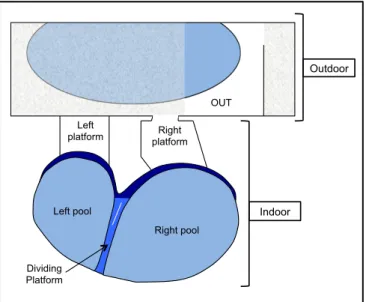
indoor pool (50 m3) with two haul-out platforms (Figure 1). Both interior and exterior areas were connected through the right platform, and the door was always open. Both seawater pools had a depth of 1 m and an independent recirculation system with sand filters. The interior pool was drained and cleaned four days a week and there was a 1/3 water change on the other days. The exterior pool was drained and cleaned once a week and no further maintenance was necessary due to the little amount of time the animals spent there. Visitors only had access to the interior area and could see the animals from above, all around the enclosure.
There were two public feeding sessions (at 11:30 and 15:30) and the animals were fed either from above (where visitors stood) or from inside, in the right platform. For consistency, the animals were fed from above in all sampling days. Their diet consisted of mackerel (Trachurus trachurus), squid (Loligo gahi) and the male also ate hake (Merluccius hubssi). The total daily food intake consisted of about 11 kg for the male and 5 kg for the female.
Right pool Left Pool
Left
platform platform Right OUT Indoor Outdoor Dividing Platform Left pool Right pool
Figure 1: Enclosure structure. Darker blue areas are partially submerged slopes. Dividing
platform: submerged dividing wall. Animals can swim above it or pass through a circular opening (represented by a white straight line). The inside platforms have a ceiling about 1.1 m high. The exterior shaded area is covered and has a height of 1.30 m.
2.2 Preliminary observations
Preliminary observations were made between 01/09/2011 and 20/12/2011 during more than 130 hours. During this period, the animals had free access to both indoor and outdoor enclosures. Most observations were made when the aquarium was open (09:00 to 18:00). The 3 hours before opening and the 4 hours after closing were sampled once and three 5-minute visits were performed during the night (at midnight, two and four in the morning). As a result of these observations, the period between feeding sessions was chosen as the sampling period. During this period, there were no ongoing enclosure maintenance procedures and the animals showed a high level of stereotypical swimming. During this first stage ad libitum behavioural sampling was performed in order to develop the ethogram in Table 1 (adapted from Caudron 1995 and Teixeira 1993).
In a second stage of the preliminary observations, the enrichments were tested to analyse neophobia and to produce a preliminary evaluation of the animals’ response to them. As a result of this, it was concluded that the animals were curious, yet cautious about non-food related enrichments and that the male exerted a dominant behaviour over the female regarding food-related enrichments. These preliminary observations determined the enrichment items used and their respective
presentation to the animals during the systematic observations.
2.3 Experimental design and data collection
The sampling phase occurred between 01/02/2012 and 07/05/2012. It consisted of a four-day period for each enrichment and a four-day period before and after each enrichment period (baseline
Behavioural Categories Stereotypical swimming Alertness Walking Sliding Random swimming Directional swimming Climbing up Climbing down Feeding Standing Floating Resting out of the water Grooming Social interactions Others Description
Ingestion and interaction with food. It includes shaking the food in the mouth to break it, throwing the food against a wall or into the water, biting, chewing and swallowing.
Locomotion
Swimming in a constant circular pattern, with breathing occurring at similar places in each circle. It can be clockwise (most common) or anticlockwise (rare), involving one or both pools for a single circle. Purposely looking up. This can be done while swimming by moving the head towards the object of interest or while stationary, using the hind flipper to stand upright out of the water. Sometimes the front flippers are
used for support against a wall or platform edge.
Sliding from the platform to the water.
Locomotion out of the water using the flippers as legs with the belly not touching the ground.
Locomotion out of the water by sliding with the belly touching the ground and the flippers stretched along the body.
Locomotion in the water with no apparent pattern or direction. Locomotion in the water towards a determined point in a straight line. Climbing to the platform by swimming towards it and using the front flippers for the
small impulse needed to get out of the water.
Stationary position with animal supported by the four flippers and belly without performing any other behaviour.
Resting in the water surface without moving or slowly drifting and turning, with closed eyes and regular breathing. The body may be in a horizontal or vertical position with
some or no flippers stretched out of the water.
Lying on the belly, side or back with front flippers stretched along the body and hind flippers stretched together in the continuity of the body, under the body or laterally. Another common resting position is sitting with neck stretched upwards almost without moving or leaning the front part of the body against a wall. The animals may be asleep or
not. Inactivity
Rare categories not used for analyses (for a complete description see Appendix A)
1
Table 1:Ethogram describing only the behavioural categories used in the analyses (for a full ethogram see Appendix A). 1 only occurs during feeding enrichments, as these are the only
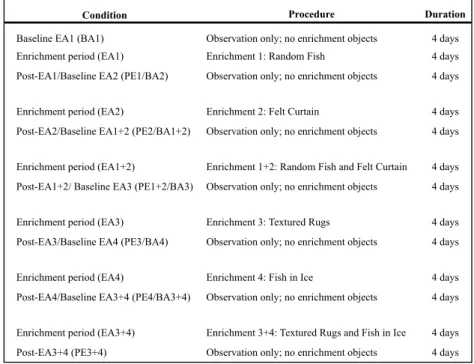
periods with no interference in the animals’ life). Post-enrichment observations of each given enrichment also functioned as pre-enrichment baselines for the subsequent enrichment according to Table 2. There was at least one day without sampling between a baseline and the following
enrichment, except for the first enrichment.
In every sampling day there was a one-hour sampling session (starting at 14:15) consisting of four 10-minute sampling intervals, each separated by a 5-minute pause. Data was recorded using instantaneous scan sampling of behaviour and location at 15-second intervals, with an audio recording marking the sampling point. This resulted in a total of 160 sampling points per session and, therefore, 640 total sampling points (per period) for each animal. Rare events were occasionally sampled separately. Use of area was sampled based on the areas shown in Figure 1. When the animals went outside, the observer was unable to see them so they were registered as OUT regarding both location and behaviour. During sampling, it was also registered how many of the female’s stereotypical swimming circles included both pools. The animals were habituated to the presence of the observer during the preliminary phase and all observations were made by the same person.
2.4 Methods of enrichment
Four individual enrichments (two food-related and two non-food related) were used individually and in combination, as follows:
- EA1 (Random Fish): this consisted of three fishes being thrown into one of four locations (right and left pool, and right and left platform) in each of the four sampling intervals. The order of locations was randomly chosen. Care was taken to ensure that the animals didn’t see the person throwing the fishes. The first sampling point coincided with the moment the last fish touched the pool or platform. Registered behaviour included how many fishes each animal had eaten.
Procedure Duration
Baseline EA1 (BA1) Observation only; no enrichment objects 4 days Enrichment period (EA1) Enrichment 1: Random Fish 4 days Post-EA1/Baseline EA2 (PE1/BA2) Observation only; no enrichment objects 4 days
Enrichment period (EA2) Enrichment 2: Felt Curtain 4 days Post-EA2/Baseline EA1+2 (PE2/BA1+2) Observation only; no enrichment objects 4 days
Enrichment period (EA1+2) Enrichment 1+2: Random Fish and Felt Curtain 4 days Post-EA1+2/ Baseline EA3 (PE1+2/BA3) Observation only; no enrichment objects 4 days
Enrichment period (EA3) Enrichment 3: Textured Rugs 4 days Post-EA3/Baseline EA4 (PE3/BA4) Observation only; no enrichment objects 4 days
Enrichment period (EA4) Enrichment 4: Fish in Ice 4 days Post-EA4/Baseline EA3+4 (PE4/BA3+4) Observation only; no enrichment objects 4 days
Enrichment period (EA3+4) Enrichment 3+4: Textured Rugs and Fish in Ice 4 days Post-EA3+4 (PE3+4) Observation only; no enrichment objects 4 days
Condition
- EA2 (Felt Curtain): this consisted of a structure that fit the opening in the dividing platform and had strips of thick green felt attached that sunk in the water but undulated as the animals swam by it (Figure 2). It created an algae-like curtain through which the animals could swim. The sampling session started less than a minute after the structure was set up and the structure was removed less than a minute after the last sampling point. Registered behaviour included the number of times each animal passed through the curtain and over the dividing platform.
- EA2 + EA3: this was a combination of Random Fish and Felt Curtain, as described above.
- EA3 (Textured Rugs): this consisted of two green plastic rugs with plastic pins on one side, creating a somewhat rough physical texture (Figure 2). One was left floating freely in the water and the other was hung on the wall in the dividing platform where the male occasionally groomed. In each enrichment day, the fixed rug was attached 1/3 underwater and the free rug was released in the right pool in front of the platform. Sampling started less than a minute after the free rug was released and both rugs were removed less than a minute after the last sampling point.
- EA4 (Fish in Ice): this consisted of two large cylindrical blocks of ice with six fishes inside each one, and six small blocks with one fish inside each (Figure 2). The small blocks were used to increase the duration of this enrichment, as the big ones never lasted more than one sampling interval. On the first day of enrichment, the large blocks were presented right before the first sampling interval and two small blocks were presented before the remaining sampling intervals. On the second day, the large blocks were presented before the second interval, on the third day before the third interval and on the fourth day before the fourth interval. Two small blocks were presented before every other sampling interval. Before each interval, the first block was thrown into the left pool and when the male
EA Images Dimensions Felt Curtain Textured Rugs Fish in Ice (big) Fish in Ice (small)
was near it, the second block was thrown into the right pool (to increase the chances of the female interacting with it). The sampling interval started when the second block reached the water.
- EA3 + EA4: this was a combination of Textured Rug and Fish in Ice, as described above.
2.5 Data Analysis
Behaviours belonging to the same functional category were grouped and analysed together (Table 1). The mean proportion of each behavioural category and location (per period) was compared through exploratory analysis and graphical interpretations in Microsoft Excel!. This is a valuable method in studies with very small sample sizes and its use is advised even when it’s complemented by statistical analysis (Fisch 2001, Todman and Dugard 2001).
The proportions of each behavioural category and location were statistically compared between baseline, enrichment and post-enrichment baseline for each enrichment. The statistical comparisons followed a Friedman’s test, also calculating the exact p-value. The exact p-value is calculated through randomization tests, which are the recommended analysis to perform on single-case studies or very small-n studies by BIAZA (Plowman 2006). In these cases, more conventional
statistical analyses have severe limitations, and randomization tests produce more reliable results (for a thorough review see p.e. Todman and Dugard 2001 or Mehta and Patel 2010 for its uses in SPSS!). Due to the small sample size, no extrapolation to other animals was intended by this analysis. Pooling of a single group’s data was avoided by analysing both animals separately, as two animals living together in the same enclosure can’t be used as independent data points. However, using the values of consecutive days as independent data points for each animal caused a pseudoreplication, which would severely compromise any extrapolations if they were intended (Plowman 2006, Swaisgood and Shepherdson 2005, Young 2003). The behaviours grouped in the categories grooming, social interactions, and others were not include in the analysis. This was due to them being extremely rare and not having any significant variation throughout the enrichments. The location OUT was also removed from analysis for the same reasons. The statistical analyses were performed on SPSS! and a significance level of 0.05 was used.
3. RESULTS
3.1 Baseline behaviour
During the initial baseline both animals had the typical behaviour observed in preliminary observations for that time period. They spent the majority of time in stereotypical swimming
(male=92%, female=97%), with some time spent in alertness behaviours (male=7%, female=2%). All other behavioural categories occupied only 1% of total time when grouped together. During this period, both animals spent most of the time in the right pool (male=97%, female=92%). They also spent some time in the dividing platform (male=3%, female=4%), and the female in the left pool (4%).
Stereotypical swimming was the most frequent behavioural category through the entire duration of the observations. Both animals performed stereotypical swimming in a circular, (mostly)
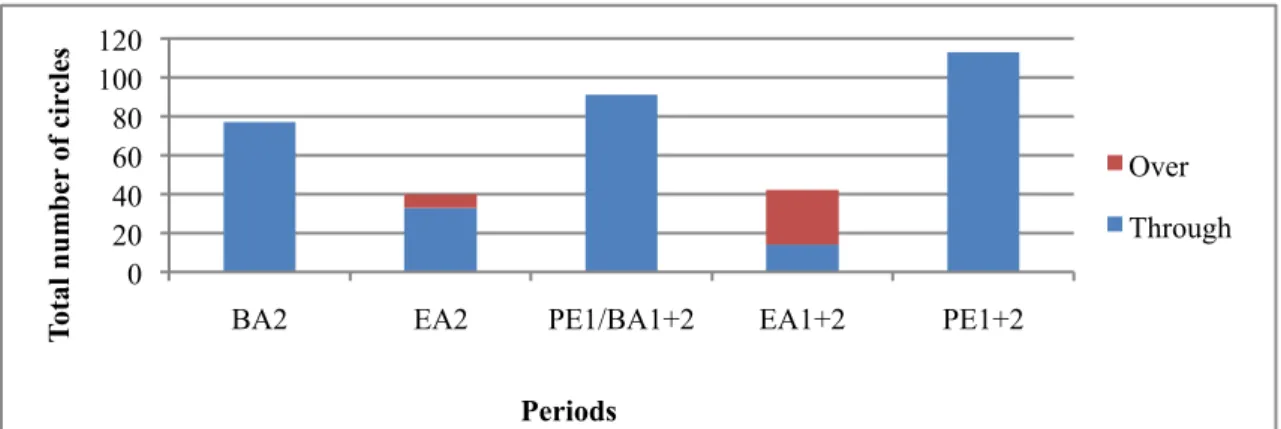
clockwise direction. The male used exclusively the right pool and the exact shape of the circular path varied a little across days but remained constant during each session of stereotypical swimming. Sometimes he switched to an anticlockwise direction but only for a few circles. The female alternated between using only the right pool and using both pools. When using both pools she went from the right to the left pool over the dividing platform near the wall of the enclosure and went back to the right pool through the opening in the dividing platform. She alternated between exclusively using the right pool, exclusively using both pools or switching between one and both pools. During one stereotypical session any combination could occur.
3.2 Behavioural changes due to enrichment
3.2.1 Random Fish
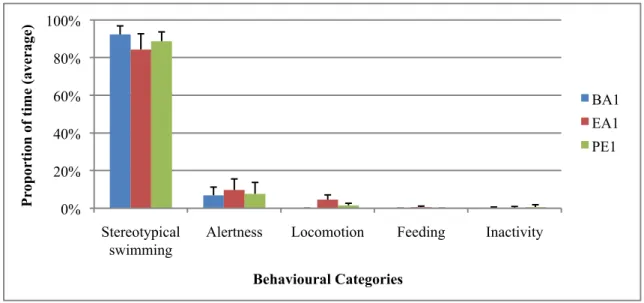
This enrichment led to a significant variation in the male’s non-stereotypical locomotion, which increased during enrichment (Figure 3, Table 3). There was also a significant variation in the female’s stereotypical swimming, which decreased during enrichment (Figure 4, Table 3). The male ingested most of the fishes thrown during this enrichment (46 out of 48). Additionally, there was a non-significant decrease in the male’s stereotypical swimming and a non-significant increase in both animals’ alertness (Figure 3 and 4). No other changes in behaviour or use of area were noted.
3.2.2 Felt Curtain
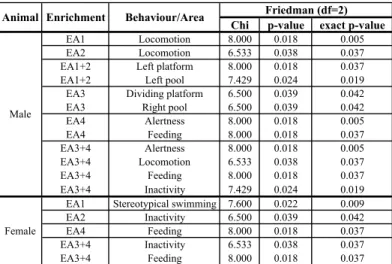
This enrichment promoted a significant variation in the male's locomotion behaviours, which decreased during the enrichment period (Table 3). He never left the right pool (this being his normal use of area) and therefore didn’t interact with the curtain. The felt curtain also changed the female’s stereotypical route due to some level of avoidance. The number of times she used the left pool during stereotypical circles decreased (Figure 5). Furthermore, when the left pool was used, she started crossing the dividing platform over it instead of through the opening where the curtain was placed. She did, however, pass through it a few times. The enrichment also led to a variation in the female’s inactivity behaviours, which increased after the enrichment had been removed (Table 3). This
Chi p-value exact p-value
EA1 Locomotion 8.000 0.018 0.005 EA2 Locomotion 6.533 0.038 0.037 EA1+2 Left platform 8.000 0.018 0.037 EA1+2 Left pool 7.429 0.024 0.019 EA3 Dividing platform 6.500 0.039 0.042 EA3 Right pool 6.500 0.039 0.042 EA4 Alertness 8.000 0.018 0.005 EA4 Feeding 8.000 0.018 0.037 EA3+4 Alertness 8.000 0.018 0.005 EA3+4 Locomotion 6.533 0.038 0.037 EA3+4 Feeding 8.000 0.018 0.037 EA3+4 Inactivity 7.429 0.024 0.019 EA1 Stereotypical swimming 7.600 0.022 0.009 EA2 Inactivity 6.500 0.039 0.042 EA4 Feeding 8.000 0.018 0.037 EA3+4 Inactivity 6.533 0.038 0.037 EA3+4 Feeding 8.000 0.018 0.037 Friedman (df=2) Male Female
Animal Enrichment Behaviour/Area
Table 3: Significant statistical results of the comparisons between each enrichment and the
previous and following baselines. EA1: Random Fish; EA2: Felt Curtain; EA1+2: Random Fish and Felt Curtain; EA3: Textured Rugs; EA4: Fish in Ice; EA3+4: Textured Rugs and Fish in Ice. A significance level of 0.05 was used.
enrichment did not cause any other changes in behaviour or use of area.
3.2.3 Random Fish and Felt Curtain
This combination caused significant differences in the use of area by the male, who increased the use of the left platform and the left pool during the enrichment period (Table 3). The fishes that fell on the left pool led the male to swim through the curtain, but never over the dividing platform. There were no significant differences in the female’s behaviour or use of area. She continued to use the alternative route, more commonly than before. There was again a decrease in the use of the left pool for stereotypical circles during the enrichment (Figure 5). The male ingested most of the fishes thrown during this enrichment (47 out of 48). Finally, the male showed a non-significant decrease in stereotypical swimming and increase in alertness during the enrichment. No other differences in behaviour or use of area occurred.
3.2.4 Textured Rugs
The textured rugs only led to a significant variation in the male’s use of area. After the
enrichment he spent less time in the right pool and more time in the dividing platform (Figure 6, Table 3). He spent 76% of the time in the same area as the floating rug. The female didn’t show any
significant changes in behaviour or use of area due to the rugs. She spent 74% of the time in the same area as the floating rug.
3.2.5 Fish in Ice
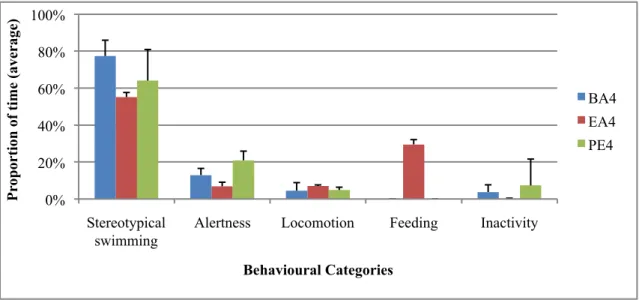
Feeding, including manipulation and ingestion of the enrichment, emerged as a significant behavioural category due to food availability in this period (Figure 7 and 8, Table 3). However, the proportion of time both animals spent feeding was very different, with the male spending more time
0% 20% 40% 60% 80% 100% Stereotypical swimming
Alertness Locomotion Feeding Inactivity
P rop or ti on of ti me (ave rage ) Behavioural Categories BA1 EA1 PE1
Figure 3: Mean (+ standard deviation) proportion of time spent in each behavioural category by the male, during
0% 20% 40% 60% 80% 100% Stereotypical swimming
Alertness Locomotion Feeding Inactivity
P rop or ti on of ti me (ave rage ) Behavioural Categories BA1 EA1 PE1 0 20 40 60 80 100 120
BA2 EA2 PE1/BA1+2 EA1+2 PE1+2
T otal n u mb er of c ir cl es Periods Over Through 0% 20% 40% 60% 80% 100%
Left platform Right platform Dividing
platform
Left pool Right pool
P rop or ti on of ti me (ave rage ) Enclosure Areas BA3 EA3 PE3
Figure 4 – Mean (+ standard deviation) proportion of time spent in each behavioural category by the female, during
“Random Fish”. BA1: baseline, EA1: enrichment period, PE1: baseline post-enrichment
Figure 5 – Total number of circles including both pools for the female’s stereotypical swimming during “Felt
Curtain” (EA2) and “Random Fish and Felt Curtain” (EA1+2). Over: swimming from the left to the right pool over the dividing platform. Through: swimming from the left to the right pool through the opening in the dividing platform. BA2: baseline enrichment 2, EA2: enrichment period 2, PE1/BA1+2: baseline post-enrichment 2/baseline pre-enrichment 1+2, EA1+2: pre-enrichment period, PE1+2: baseline post-pre-enrichment 1+2
Figure 6 – Mean (+ standard deviation) proportion of time spent in each area by the male, during “Textured Rugs”.
0% 20% 40% 60% 80% 100% Stereotypical swimming
Alertness Locomotion Feeding Inactivity
P rop or ti on of ti me (ave rage ) Behavioural Categories BA4 EA4 PE4 0% 20% 40% 60% 80% 100% Stereotypical swimming
Alertness Locomotion Feeding Inactivity
P rop or ti on of ti me (ave rage ) Behavioural Categories BA3+4 EA3+4 PE3+4 0% 20% 40% 60% 80% 100% Stereotypical swimming
Alertness Locomotion Feeding Inactivity
P rop or ti on of ti me (ave rage ) Behavioural Categories BA3+4 EA3+4 PE3+4
Figure 7 – Mean (+ standard deviation) proportion of time spent in each behavioural category by the male, during
“Fish in Ice”. BA4: baseline, EA4: enrichment period, PE4: baseline post-enrichment
Figure 8 – Mean (+ standard deviation) proportion of time spent in each behavioural category by the male, during
“Textured Rugs and Fish in Ice”. BA3+4: baseline, EA3+4: enrichment period, PE3+4: baseline post-enrichment
Figure 9 – Mean (+ standard deviation) proportion of time spent in each behavioural category by the female, during
engaged in this activity (male=30%, female=4%). The big blocks lasted on average 9’30±2’12, and the small blocks 1’36±1’12. This enrichment also promoted a significant variation in the male’s alertness behaviour (Table 3). It decreased during the enrichment and afterwards occupied a higher proportion of time than before the enrichment (Figure 7). Finally, a non-significant decrease in stereotypical swimming during the enrichment was noted in the male (Figure 7). Apart from feeding, no other female’s behaviours were changed due to the enrichment.
3.2.6 Textured Rugs and Fish in Ice
The last enrichment led to significant differences in feeding, locomotion, alertness and inactivity in the male (Table 3). Feeding and locomotion increased during the enrichment. Alertness decreased during the enrichment and even more afterwards (Figure 8). The male spent 49% of the time in the same area as the floating rug. The female showed a significant difference in feeding and
inactivity (Table 3). Feeding behaviours increased during the enrichment and inactivity increased afterwards (Figure 9). She spent 50% of the time in the same area as the floating rug. There was also a non-significant increase in stereotypical swimming during enrichment (Figure 9). The big blocks lasted on average 12’42±4’06, and the small blocks 2’00±0’48. This combination didn’t cause any other variations in behaviour or use of area.
3.3 Initial and final behaviour without enrichments
The comparison between the first and last baselines, both for behaviours and use of area didn’t show any significant differences for either animal.
4. DISCUSSION
The feeding enrichments, “Random Fish” and “Fish in Ice”, increased some desirable behaviours and promoted a more balanced use of area for both animals, but especially for the male. The non-feeding enrichments, “Felt Curtain” and “Textured Rugs”, didn’t cause major changes in behaviour or use of area, and results suggested a mild avoidance. However, the curtain did create a new stereotypical route for the female. Despite the tendency to reduce stereotypical behaviour overall, enrichments did not reduce it significantly. The combined enrichments showed that for the male, the positive effects of the feeding enrichments were stronger than the eventual avoidance of the non-feeding ones. The opposite result was seen for the female. The lack of differences between the first and last baseline suggests that the effects didn’t outlast the enrichment periods.
4.1 Baseline behaviour
Results of baseline behaviour show that the animals spent the majority of time in stereotypical swimming. These animals have been kept alone for a long time, with very little variation in their daily routine and in an enclosure too small and barren. In nature, outside of the breeding season, these are pelagic animals, swimming in open-sea while searching for prey (Rand 1967). It is already well identified that wide-ranging carnivores have problems in adapting to captive conditions (Clubb and Mason 2003). Besides the already limited dimensions of the enclosure, for almost all stereotypical
swimming the animals only use half of the space available (right pool). On the other hand, during the night, they only rest on the left platform, and during the breeding season almost all of the social interactions occur on the left platform and pool (personal observations). They may have a preference of different areas for different activities but since they spend most of the day in stereotypical
swimming and that the enclosure is already small, it would be beneficial if they used all the space available. Despite this, the female seems to be more flexible in her swimming patterns and she occasionally visits the left pool. Besides being prevented from swimming long distances, these animals cannot dive. In the wild, they can dive over 200m (Kooyman and Gentry 1986) but in these pools they only have 1m of depth. In the present conditions, the lack of stimuli between feeding times does not facilitate these animals’ engagement in any kind of activities. Baseline behaviour also confirms what is known in natural habitats in relation to social interactions out of the breeding season. Although they form same or mixed-gender groups, there is very little interaction between males and females, as the latter are mainly focused on feeding the cubs (Rand 1967). This may justify why social interaction was almost negligible during this project.
4.2 Behavioural changes due to enrichment
Despite being difficult under the conditions discussed above (Young 2003), environmental enrichment assumes a particular importance in small, barren enclosures (Watters 2009), even when the total elimination of stereotypical swimming is not achievable.
During “Random Fish”, when the fish hit the water, the male would swim immediately towards it and eat it. Afterwards, he would frequently visit the areas where the fish had fallen before or on previous days, an action analogous to foraging, which was represented by an increase in
locomotion behaviours. These non-stereotypical swimming behaviours are a desirable result, and were very rare outside of the enrichment periods. During this enrichment, the female almost didn’t eat any fishes but there was still a significant difference in stereotypical swimming. Even when the fish was very close to her, she spent more time trying to find where it came from (alertness) than interested in eating it. Probably the dominant male inhibited her from considering the fish as her legitimate resource. The possibility that she did not regard the fish as a relevant resource is not very likely because the event was strong enough to cause an interruption of stereotypical swimming.
The “Felt Curtain” caused a decrease in locomotion behaviours in the male. He usually didn’t go to the left pool during the sampling period so there was no reason for him to swim through the curtain. The fact that locomotion decreased during the enrichment and increased in the post-enrichment period seems to indicate that although he didn’t avoid the curtain, he preferred the enclosure without it. The female’s results related to the use of area seem to indicate some mild
avoidance of the curtain by avoiding the left pool for stereotypical swimming. However, the change in her stereotypical route is a positive outcome, especially since the stereotypical swimming is such a strong feature in these animals’ profile. The female also showed an increase in inactivity in the post-enrichment period. This inactivity represents resting behaviours that occurred in the dividing platform
where the structure holding the curtain was placed. The fact that she spent more time there after the curtain had been removed suggests that she avoided going there when the structure was present.
When “Random Fish” and “Felt Curtain” were presented together, the male showed a more balanced use of the enclosure with an increased use of the left platform and left pool, which were areas that he normally didn’t visit during these hours. Also, having to swim to the left pool to eat the fish, he had to react to the presence of the curtain. He always swam through it, just as he always swam through that opening in the absence of the curtain, which shows no particular aversion to it. The female
repeated her previous pattern, using both pools for circular swimming less often during the enrichment and reverted to higher than baseline values afterwards. She also used the alternative route during this enrichment and did it more frequently than when the curtain was presented alone. This seems to indicate that she became more comfortable with this alternative route. Overall, the male seemed more affected by the feeding enrichment and didn’t let the curtain interfere in his movements across the pool, showing that the feeding resource was more valuable than the curtain was negative. On the other hand, the female didn’t show the positive results seen during “Random Fish” alone (the decrease in stereotypical swimming), probably due to being more negatively affected by the curtain than positively affected by the fish.
The “Textured Rugs” led to significant changes in the use of area for the male. He increased the use of the right pool and decreased the use of the dividing platform, reversing this tendency in the post-enrichment period. The fixed rug was on the pool’s wall close to where the male usually stands in the dividing platform. The fact that he used it less when the rug was present and more when it was removed seems to indicate some avoidance to the fixed rug. However, there was no apparent avoidance of the floating rug, near which he spent most of the time, even touching it occasionally while swimming by it. This enrichment seemed to have a neutral effect on the female. There was no apparent attraction or avoidance in relation to the rugs, since she spent most of the time in the same area as the floating rug and touched it occasionally.
During “Fish in Ice” there was a significant difference in feeding behaviours as these occupied all the male’s time until the blocks melted and all the fish was ingested. The fact that he would also bite and eat the small pieces of ice that broke off the main block seems to indicate that his interest in this enrichment went beyond the feeding resources. The increase in alertness behaviours could be related to the anticipation of more ice blocks in the post-enrichment period. The female was motivated to interact with “Fish in Ice”, causing a significant difference in the feeding behaviours. Although she only interacted with it when the male was very far away (i.e. on the other side of the pool), she rarely failed to touch the block when she had the chance. The fact that there were always two blocks presented at the same time, and that the second block was only presented after the male touched the first one was not enough for her to freely interact with the enrichment (similar result in Smith and Litchfield 2010).
When “Textured Rugs” and “Fish in Ice” were presented together, the male increased locomotion and feeding, which were positive results but there was no difference in the use of area as
during “Textured Rugs” alone. This seems to show that, as seen in the previous combination, the male was more positively affected by the feeding resource than negatively affected by the rugs. The
decrease in time spent near the floating rug is probably not very significant as his location on the enclosure was mostly determined by where the ice blocks were. There was also a decrease in alertness during the enrichment and an even lower value afterwards, the opposite from the increase in the post-enrichment period when the ice blocks were presented alone. This could be due to learning: he may have learned that during enrichment the small blocks were cues for the big block and they were coming in regular intervals. He may also have learned that if at the time of the sampling session there was no enrichment, than that period was over and there would be no further enrichments. The female showed a significant difference in the feeding behaviours, showing once again, that this was an attractive enrichment for her. She had shown little reaction to the rugs before and the same result was apparent during this combination. The decrease in time spent near the floating rug was probably because, due to the male’s interaction with the ice blocks, there was a stronger water movement, making the floating rug move more freely and more frequently to the left pool, while the female spent most of her time on the right pool. For both animals, the increase in inactivity during the
post-enrichment period was the result of a sampling day in which both animals slept through the whole session. This was unlikely to be caused by the enrichments and was probably due to an external variable (an increase in temperature).
Overall, the feeding enrichments were much more effective and had a stronger effect on the male than on the female. The male monopolized all the food and there was an implicit hierarchy present so that even if the male was not close, the female was reluctant to interact with the food. The positive changes noted in stereotypical swimming were only obtained with this kind of enrichments. They are very relevant since this is such an important category of behaviour for these animals. This shows a trend that should be explored further in the future, with more effective food-related
enrichments. The non-feeding enrichments caused a mild level of avoidance, which, although not enough to consider them as negative enrichments, lead to a post-enrichment period characterized by a return to baseline levels of desirable behaviours, suggesting some relieve in the removal of the objects. The new route created by the female as a result of the “Felt Curtain” was a very positive result as it has shown that the enrichment was a stimulus, requiring processing and a changing in route decisions. As a variant to a fixed swimming pattern, it was regarded as a very positive result.
The joint enrichments allowed an evaluation of the differential effects of the enrichments in each animal. The male seemed to be more affected by the feeding enrichments, minimizing the effects that the non-feeding ones had caused when presented alone. The female had a less positive reaction to Random Fish when combined with Felt Curtain, while in the second combination there was a small increase in stereotypical swimming, which didn’t occur during “Fish in Ice” alone. These
combinations could be used to minimize residual avoidance of enrichments that also have positive effects (like the curtain in creating a new stereotypical route for the female). This project shows that the same enrichment can have different effects when presented alone or in a combination. It is
important then to evaluate each new enrichment independently and in any proposed combination, before incorporating it in any more complex enrichment plans. It’s also important to assess differential reactions, as they existed in this project, and this should always be considered when planning an enrichment plan. The differences could be due to individual personality (Smith and Litchfield 2010) or life history (the male was born in the aquarium, while the female is wild-born and was at another facility before entering the aquarium).
4.3 Initial and final baselines
The comparison between the first and last baseline showed no significant differences in any behavioural category or use of area, which shows that the enrichment items presented only had a temporary influence on the animals. The fact that they did not have a lasting effect or didn’t contribute to a significant decrease in stereotypical swimming is probably due to the importance of swimming in their natural behavioural repertoire. The only way these two animals can behave in any similar way in a small, round enclosure is by swimming in circles. Also, it is very likely that these behaviours are not reversible at this late stage, as these have been for long their coping mechanism to past and ongoing artificial conditions (Hill and Broom 2009, Mason and Rushen 2006).
4.4 Recommendations and limitations of this project
An enrichment plan based on the findings of this project, with some additional
recommendations, could be applied to their daily husbandry with the objective of providing additional stimulation, and promoting behavioural diversity and a more balanced use of the area. These results show that food-related enrichments tended to be more effective for these animals, despite the
limitations created by the existent dominance relationship. Therefore, the food-related items could be used in a future plan with some improvements. The “Random Fish” could involve throwing fishes to two locations simultaneously, in order to increase the chance of the female actually eating the fish. The “Fish in Ice” was a promising strategy, especially if one could increase the
manipulatory/appetitive part of the behaviour. It would be interesting to introduce a visual barrier in the enclosure (like a panel above the dividing platform), to allow the female more freedom to interact with one ice block while the male is engaged with another. Since the male frequently tried to swallow large ice pieces, with the danger of choking, it is recommended that this enrichment be always supervised by a keeper. Also, instead of a big block, several small blocks could be presented at once. The “Textured Rugs” should probably be removed from a future plan, considering they didn’t have any significant positive effect. The “Felt Curtain” had a problem of the individual felt strips floating too much when there was a strong water movement (like when it was coupled with “Random Fish”). The structure that holds the curtain could be redesigned so that the strips are attached to the bottom and float up (in this case with thinner felt). In this way, the water movement will send them even more towards the surface, while keeping them secure to the bottom. This would also eliminate the structure that was placed over the dividing platform that seemed to prevent the female from standing there.
The enrichments tested in this project require less than five minutes to put together, which means they are not unpractical for the keeper’s usually tight schedule (Hoy et al. 2010). However,
other enrichments could also be tested to increase variability and avoid habituation to the existing ones (Kuczaj et al. 2002). Creativity is the key but there are two promising sources of inspiration. One is the exterior enclosure, which although much smaller than the interior one, it offers a lot of variety. It is subjected to different weather conditions, but more than half of it is covered so animals can always hide. Also, there are different sounds, smells, birds flying above, etc. Any action that encourages the animals to spend more time outside is worth exploring. It’s very important however to always give them the choice to remain inside. The outside enclosure has been used in the past as a restraining area (for births, for when the inside is being repainted, etc.), and most of the times the animals were forced to go and stay outside. That’s probably why it is now so rare for them to go out spontaneously. Another enrichment technique that could be developed is training. They are trained to do a few “tricks” during public feeding sessions. However, they were never subjected to a more systematic training program based on positive reinforcement. Training is one of the most common environmental enrichment techniques used with marine mammals and it has been shown to stimulate them
cognitively, physically and socially. Also it can improve veterinary care (Brando 2010).
A possible limitation of this study was the fact that the intervals between baselines and the following enrichments didn’t all have the same duration due to unavoidable time restraints. Of the five intervals, one lasted fifteen days (between PE1/BA2 and EA2), other five days (between PE1+2/BA3 and EA3) and the remaining one day. The longer intervals may have made comparisons between the baseline and the following enrichment period less accurate. However this may not have been a problem since significant results appeared to reflect a difference between the enrichment and the post-enrichment periods.
The results of this project refer to a case study of two animals and as such cannot be generalized to other fur seals in captivity. Even with all the restrictions in the data analysis (as
explained in Methods - Data Analysis), the decision to undertake statistical analysis to complement the qualitative data analysis was related to the increased possibility of making a more objective
interpretation of data, showing the most significant trends. It also allows data from this small case study to be analysed in future meta-analysis that can produce broader conclusions in the future (Shyne 2006, Swaisgood and Shepherdson 2006).
In fact, similar studies with pinnipeds also used feeding and non-food related enrichments to tackle stereotypical swimming, and many were successful in reducing it. Besides, all of them noticed individual variations between the animals under study, suggesting individual preferences, as occurred in this project (Grindrod and Cleaver 2001 - three common seals; Hunter et al. 2002 – seven harbor seals, two gray seals, and one harp seal; Smith and Litchfield 2010 – two Australian sea lions; etc.). Also, some meta-analysis of published enrichment papers for different animals show an overall trend for stereotypical behaviours to be reduced in the presence of enrichment (Shyne 2006, Swaisgood and Shepherdson 2006, etc.). Therefore, this project adds to several publications that show good evidences about the effectiveness of environmental enrichment in general.
5. CONCLUSION
This project demonstrated that environmental enrichment had beneficial effects in these animals by increasing desirable behaviours and promoting a more balanced use of area, as well as in decreasing stereotypical swimming, even if only marginally. These can all be perceived as
improvements in these animals’ welfare, which is their intrinsic right. Further studies and continuing the application of enrichment techniques are advised.
Besides improving welfare, environmental enrichment is important to ensure an adequate presentation of these animals to visitors. As a member of EAZA, Aquário Vasco da Gama is involved in conservation, with regular guided tours for local schools. Due to their status as emblematic animals and the big part they play in attracting visitors, it should be of the utmost important to correctly portray these animals as adequate representatives of their natural counterparts. Enrichment is also a useful tool to educate the visitors about natural behaviours and needs.
It can be said, in conclusion, that environmental enrichment has high enough benefits and low enough costs, to be applied as a common and mandatory husbandry tool in every 21st century
zoological facility.
6. REFERENCES
Bassett, L., Buchanan-Smith, H.M., 2007. Effects of predictability on the welfare of captive animals. Appl. Anim. Behav. Sci. 102, 223–245.
Bonner, W.N., 1981. Southern fur seals – Arctocephalus. In: Ridgway, S.H., Harrison, R.J. (Eds.), Handbook of Marine Mammals, vol. 1: The Walrus, Sea Lions, Fur Seals and Sea Otter. American Press, London, pp. 161-208.
Brando, S.I.C.A., 2010. Advances in Husbandry Training in Marine Mammal Care Programs. Int. J. Comp. Psychol. 23, 777-791.
Caudron, A.K., 1995. Social behaviour of Cape fur seals (Arctocephalus pusillus pusillus) in captivity. Aqu. Mamm. 21.1, 7-17.
Clubb, R., Mason, G., 2003. Captivity effects on wide-ranging carnivores. Nature 425, 473. Conde, D.A., Flesness, N., Colchero, F., Jones, O.R., Scheuerlein, A., 2011. An Emerging Role of
Zoos to Conserve Biodiversity. Science 331, 1390–1391.
David, J.H.M., 1987. South African fur seal, Arctocephalus pusillus pusillus. In: Croxall, J.P., Gentry, R.L. (Eds.), Status, Biology, and Ecology of Fur Seals: Proceedings of an International Symposium and Workshop, Cambridge, England, 23–27 April 1984. NOAA Technical Report NMFS 51, pp 65–71.
Dawkins, M.S., 2004. Using behaviour to assess animal welfare. Anim. Welfare13, 3-7.
Delfour, F., Beyer, H., 2011. Assessing the Effectiveness of Environmental Enrichment in Bottlenose Dolphins (Tursiops truncatus). Zoo Biol. 29, 1-14.
Fisch, G.S., 2001. Evaluating data from behavioral analysis: visual inspection or statistical models?. Behav. Process 54, 137–154.
Fraser, D., Weary, D.M., Pajor, E.A., Milligan, B.N., 1997. A scientific conception of animal welfare that reflects ethical concerns. Anim. Welfare6, 187–205.
Grindrod, J.A.E., Cleaver, J.A., 2001. Environmental enrichment reduces the performance of
stereotypic circling behaviour in captive common seals (Phoca vitulina). Anim. Welfare10, 53-63. Hill, S.P., Broom, D.M., 2009. Measuring Zoo Animal Welfare: Theory and Practice. Zoo Biol. 28,
531–544.
Hofmeyr, G., Gales, N., 2008. Arctocephalus pusillus. In: IUCN, 2011. IUCN Red List of Threatened Species. Version 2012.2. Available at: http://www.iucnredlist.org (accessed September 2012). Hosey, G., Melfi, V., Pankhurst, S., 2009. Zoo animals: behaviour, management, and welfare. Oxford
University Press, Oxford.
Hoy, J.M., Murray, P.J., Tribe, A., 2010. Thirty years later: Enrichment Practices for Captive Mammals. Zoo Biol. 29, 303-316.
Hunter, S.A., Bay, M.S., Martin, M.L., Hatfield, J.S., 2002. Behavioural Effects of Environmental Enrichment on Harbour Seals (Phoca vitulina concolor) and Gray Seals (Halichoerus grypus). Zoo Biol. 21, 375–387.
Kirkwood, J.K., 2003. Welfare, husbandry and veterinary care of wild animals in captivity: changes in attitudes, progress in knowledge and techniques. Int. Zoo Yrbk 38, 124-130.
Kooyman, G.L., Gentry, R.L., 1986. Diving Behaviour of South African Fur Seals. In: Kooyman, G.L., Gentry, R.L. (Eds.), Fur seals: Maternal strategies on land and at sea. Princeton University Press, Princeton.
Kuczaj, S., Lacinak, T., Fad, O., Trone, M., Solangi, M., Ramos, J., 2002. Keeping Environmental Enrichment Enriching. Int. J. Comp. Psychol. 15, 127-137.
Markowitz, H., Gavazzi, A.J., 1996. Definitions and goals of enrichment. In: Burghardt, G.M., Bielitzki, J.T., Boyce, J.R., Schaeffer, D.O. (Eds.), The Well-Being of Animals in Zoo and Aquarium Sponsored Research. Greenbelt: Scientists Center for Animal Welfare, pp. 85-90. Mason, G., Rushen, J. (Eds.), 2006. Stereotypic Animal Behaviour: Fundamentals and Applications to
Welfare, 2nd ed. CAB International, Wallingford.
Mason, G., Clubb, R., Latham, N., Vickery, S., 2007. Why and how should we use environmental enrichment to tackle stereotypic behaviour?. Appl. Anim. Behav. Sci. 102, 163-188.
Meehan, C.L., Mench, J.A., 2007. The challenge of challenge: Can problem solving opportunities enhance animal welfare?. Appl. Anim. Behav. Sci. 102, 246-261.
Mehta, C.R., Patel, N.R., 2010. IBM SPSS Exact Tests. IBM, United States of America.
Newberry, R.C., 1995. Environmental enrichment: Increasing the biological relevance of captive environments. Appl. Anim. Behav. Sci. 44, 229-243.
Plowman, A.B. (Ed.), 2006. Zoo Research Guidelines: Statistics for typical zoo datasets. BIAZA, London.
Rand, R.W., 1967. The Cape fur seal (Arctocephalus pusillus pusillus). 3. General behaviour on land and at sea. Division of Sea Fisheries, Investigational Report, South Africa (60) 1–39.