http://dx.doi.org/10.1590/2175-35392019015825
Cyberbullying and homophobic content
communication in adolescence: an exploratory study
of their relations
Mariana Magalhães
1; http://orcid.org/0000-0003-1392-4176
Miguel Cameira
1; http://orcid.org/0000-0002-1629-3608
Liliana Rodrigues
1; http://orcid.org/0000-0001-6900-9634
Conceição Nogueira
1; http://orcid.org/0000-0002-9152-754X
Abstract
Following previous attempts to integrate bullying and homophobia in adolescence, this research aimed to extend the study to c yberbullying and address the phenomenon in the Portuguese context. Thus, 688 students from the University of Porto were asked to recall their experiences of cyberbullying and homophobic content communication (CTH) during adolescence. The results revealed that 67% of the sample had targeted, and 34% agent, of at least one occurrence of cyberbullying. We also identified 44 frequent victims and 10 frequent perpetrators. CTH is frequent (45%), particularly with friends (34%), but also with strangers (23%). Confirming our hypotheses, significant correlations had found between the frequencies of cyberbullying and CTH behaviors, as a victim or as a perpetrator. The results therefore suggest that there is a need, at the level of intervention in adolescent bullying and cyberbullying, to confront directly its homophobic component.
Keywords: Cyberbullying; homophobia; adolescence.
Cyberbullying y comunicación de contenido homofóbico en la adolescencia:
estudio exploratorio de sus relaciones
Resumen
En la secuencia de anteriores tentativas de integrar el bullying y a la homofobia en la adolescencia, la presente investigación tuvo por objetivo comprender el estudio al cyberbullying y abordar el fenómeno en el contexto portugués. Así, se solicitó a 688 estudiantes de la Universidad de Porto, que recordasen a sus experiencias de cyberbullying y de Comunicación de Contenido Homofóbico (CTH) durante la adolescencia. Los resultados apuntaron que el 67% del muestreo fueran objeto y el 34 % agente de por lo menos una incidencia de cyberbullying. Aún se identificaron 44 víctimas frecuentes y 10 perpetradores/as frecuentes. La CTH es frecuente (e l45%) particularmente con amigos/as (el 34%), pero también con desconocidos/as (el 23%). Confirmando nuestras hipótesis, se encontraron correlaciones significativas entre las frecuencias de comportamientos de cyberbullying y de CTH, como víctima o como perpetrador. Los resultados sugieren, pues que hay necesidad, a nivel de la intervención en el bullying y cyberbullying adolescente, de confrontar directamente a su componente homofóbica.
Palabras clave: Cyberbullying; homofobia; adolescencia.
Cyberbullying e comunicação de teor homofóbico na adolescência: estudo
exploratório das suas relações
Resumo
Na sequência de anteriores tentativas de integrar o bullying e a homofobia na adolescência, a presente investigação visou estender o estudo ao cyberbullying e abordar o fenómeno no contexto Português. Assim, foi pedido a 688 estudantes da Universidade do Porto que recordassem as suas experiências de cyberbullying e de Comunicação de Teor Homofóbico (CTH) durante a adolescência. Os resultados revelaram que 67% da amostra foram alvo e 34% agente de pelo menos uma ocorrência de cyberbullying. Foram ainda identificadas 44 vítimas frequentes e 10 perpetradores/as frequentes. A CTH é frequente (45%) particularmente com amigos/as (34%), mas também com desconhecidos/as (23%). Confirmando as nossas hipóteses, foram encontradas correlações significativas entre as frequências de comportamentos de cyberbullying e de CTH, como vítima ou como perpetrador. Os resultados sugerem, pois, que há a necessidade, ao nível da intervenção no bullying e cyberbullying adolescente, de confrontar diretamente a sua componente homofóbica.
Palavras-chave: Cyberbullying; homofobia; adolescência.
1 Universidade do Porto – Porto – Portugal; [email protected]; [email protected]; [email protected]; [email protected]
P
a
p
e
Introduction
The evolution of information and communication tech- nologies (ICTs) and their increasing use by the general popu- lation has led them to assume an increasingly important role in contemporary society and, in particular, in the interactions we establish in our daily lives (Matos, Pessoa, Beloved, & Jäger, 2011). We found the highest percentages of Internet users for interpersonal communication purposes in the 16-24 age group, with 90% of them using chat, blog or social me- dia, and 95% communicating by e-mail (Matos et al., 2011).
However, just as they provide facilitated forms of com- munication, information and dissemination of knowledge, ICTs have created a new space for the manifestation of pre- judiced and violent attitudes - the virtual space - giving way to cyberbullying (Buelga, Cava, & Musitu, 2010; Kowalski & Limber, 2007; Maidel, 2009; Matos et al., 2011; Wanzinack & Reis, 2015). Cyberbullying can be defined as intentional, aggressive and repeated behavior through the use of various electronic devices that make contact with others possible, and in which there is an unequal power relationship aggrava- ted by the fact that the victim often does not know who is as- saulting (Belsey, 2005; Olweus, 1993, 1994; Rodrigues, Gra- ve, Oliveira, & Nogueira, 2015; Smith, Mahdavi, Carvalho, & Tippet, 2006). Specifically, the phenomenon is translated by the posting or sending of harmful material or other types of aggression using the Internet or other digital technologies. Such practice is facilitated by the diversity of media provided by ICT: e-mail, discussion groups, text / digital messaging (Willard, 2005), blogs, chat rooms, instant messaging (Pes- citelli, 2013; Willard, 2005), networks reviews, movie review sites, video sharing sites or online games (Pescitelli, 2013). Regardless of the type of channel used for aggression, they all have a major psychological, emotional, and even physical impact, not only on the individuals involved but also on their families (Matos et al., 2011).
Cyberbullying has some characteristic aspects such
as the possibility of anonymity of the aggressor using pseu- donyms or false names, thus increasing the power imbalan- ce (Buelga & Pons, 2012; Pereira, 2015). It also provides the possibility of overcoming time and space barriers, making it difficult for victims to escape and increasing their perception of vulnerability (Kowalski & Limber, 2007; Maidel, 2009; Ma- tos et al., 2011).
As cyberbullying can take many forms, Willard (2005) proposed six behavioral categories: Harassment, which con- sists of repeated sending offensive messages, Cyberstalking (or Persecution), based on repeated sending of threats or highly intimidating messages, Defamation, which consists in sending or posting false or cruel statements, the Impersona-
tion (or Identity Theft) regarding the victim’s identity theft in
order to blacken the victim’s image, the Intimate Violation, which occurs when the perpetrator posts or sends mate- rial containing private information about the victim, and the
Exclusion, intentional deletion of the victim from an online
group, ostracizing him/her.
In Portugal, Coelho, Sousa, Marchante, Brás and Ro- mão (2016) studied this phenomenon among 1,039 students from 6th to 8th grade in the Lisbon district, noting that 4% of boys and 7% of girls reported they have been victims of threatening messages over the Internet or mobile phone at least once, in the last school year. It should be noted that these percentages are in contradiction with those of studies in other countries where higher percentages of boys than girls were found, either among the victims or among the per- petrators (eg, Bosworth, Espelage, & Simon, 1999; Crick & Bigbee, 1998; Pellegrini & Long, 2002).
Also in Portugal, seeking to investigate the underlying reasons for cyberbullying among adolescents, Caetano et al. (2017) found that most attackers invoked hedonistic motives (joking or boredom escape), dislike of the target, or personal revenge. Most victims attributed the same acts to immaturity, jealousy, or the need to feel superior to the perpetrators.
Homophobia in Adolescence. Discrimination that in-
dividuals with sexual orientation and non-normative gender identity (LGBT) endure, sometimes, referred to globally as “homophobia”, generally takes the form of symbolic violence against non-heterosexual and / or transgender people, re- lated to language, although it can also manifest by physical aggression (Dantas & Neto, 2015). These people are con- sidered as deviant beings and placed in an inferior position because they do not conform to the heteronormativity and / or socially established and culturally predominant gender norms (Dantas & Neto, 2015).
As several authors have noted, there is a close link between homophobia and heterosexism as a belief in the superiority of heterosexuality over all other forms of sexu- ality (eg, Dantas & Neto, 2015; Epstein, 1997). The hostile attitude towards people identified as lesbian, gay or bisexual (LGB) oversees the expression of gender positions and rela- tionships, reinforcing traditional versions of hegemonic mas- culinity and femininity (Epstein, 1997). Thus, homophobia may consist of widespread hatred directed not only at LGB people but also at those who by their behavior may threaten the validity of traditional gender patterns or those perceived as such (Dantas & Neto, 2015). In fact, homophobic bullying is also exerted on people who identify as heterosexual or who have not identified with any sexual orientation (Rodri- gues et al., 2015).
All individuals who resist conforming to conventional gender identities suffer reprisals, which are generally harder for males (Epstein, 1997). An example of this is gender-
bashing: a common discriminatory practice based on attacks
or insults based on gender or gender expression (Costa, Pereira, Oliveira, & Nogueira, 2010). In fact, what motivates homophobic bullying is homophobia, even if it is exercised against people who do not identify as LGBT but who are perceived as breaking with the heteronormative code (Ro- drigues et al., 2015).
According to Epstein (1997), homophobia directed at boys who do not fit the heteronormative male role is often intended to focus on the similarity found with the female gen- der role. In other words, while a girl’s assimilation of typically
male traits does not usually elicit obvious negative reactions, a boy’s display of traditionally female traits is generally seen as more offensive to gender status. Thus, we can conclude that homophobia is used to control not only sexuality but also relative positions of both genders in society.
The school context is one of the places where this discrimination is most observed (António, Pinto, Pereira, Far- cas, & Moleiro, 2012). For many LGB youths, or those who do not conform to gender norms, the daily school routine is fraught with episodes of harassment and victimization (Antó- nio et al., 2012; Rodrigues et al., 2015).
Cyberbullying and Homophobia. Cyberspace is not
an isolated context and should be viewed as an expansion of the real (Lima, 2009). Thus, the experience of different sexual identities also occurs in virtual spaces. Online spa- ces of belonging have become increasingly important as a means of mitigating the social stigma experienced by LGBT people and as spaces of mutual support, thus enabling a less conflicting experience of their sexual orientation (Blumenfeld & Cooper, 2010; Dantas & Neto, 2015). However, while they may play an important role in mitigating stigma against LGBT people, enabling a less conflicting experience of their sexual orientation through specific websites and forums, new information technologies have also allowed displacement of homophobic discourses and practices into the virtual spa- ce, more and more regularly and aggressively (Wanzinack & Reis, 2015). Thus, homophobia is present in the virtual community, which assumes itself as one of the instances of controlling body appearance and the expression of sexuality, taking increasingly aggressive and constant proportions in social networks (Dantas & Neto, 2015; Wanzinack & Reis, 2015).
For example, Varjas, Meyers, Kiperman and Howard (2012) found that 61% of participants in their study pointed to sexual orientation as a frequent reason for cyber-victimi- zation. From their observations, Wiederhold (2014) conclu- ded that young people who identify as LG or who question their sexual identity are perhaps the group most affected by cyberbullying. Thus, in addition to being victims of direct aggression (primary victimization; Pescitelli, 2013), these pe- ople are constantly exposed to homophobic communication directed at third parties (secondary victimization).
In order to analyze the relationship between face-to--face bullying and homophobic communication, Poteat and Espelage (2005) conducted a study with about 200 eighth graders from a US school. The authors found a very high prevalence of homophobic terms in their sample. They found that 43% of boys and 29% of girls reported receiving at least one homophobic communication from a friend in the previous week; when referring to unknown issuers, the percentages dropped to 26% and 21% respectively. The frequencies re- lated to homophobic communication were identical to recep- tion frequencies, that is, that the exchange of homophobic insults among friends was recorded by almost half of male respondents and about 1/3 female respondents. Correlations with bullying measures were significant, between r = .58 and
r =.68, including boys and girls, in the role of the perpetrator
or victim, confirming the hypothesis that face-to-face bullying often has a considerable homophobic component.
Young LGB, or perceived as such, report a higher number of health problems (especially mental health) as- sociated with homophobic bullying (Russell, Ryan, Toomey, Diaz, & Sanchez, 2011), such as: emotional and psycholo- gical pain, low self-esteem, high anxiety levels (Hinduja & Patchin, 2011), isolation, sadness, loneliness (António et al., 2012), risky sexual behaviors, depression, suicidal thou- ghts (Oliveira, Pereira, Costa, & Nogueira, 2010; Russell et al., 2011) or even suicide attempt (Walker, 2015), low participation and school achievement (Hinduja & Patchin, 2011; Walker, 2015). Wanizack and Reis (2015), in a study of about 1000 students from 5th to 9th grade, revealed that about 5% of participants reported having suffered negative consequences due to aggressions suffered in virtual media, mostly related to non-heterosexual sexual orientation.
Empirical Study
Research Objectives and Hypotheses
This research aims to evaluate the role of homopho- bic attitudes and, specifically, homophobic communication (HC) in cyberbullying. To this end, some of its characteristics are analyzed, namely, prevalence, types of transmitters and receivers, preferred ICTs, and perceived impact levels in the various areas of life of the interveners. We also wanted to analyze possible gender differences in the frequencies of these behaviors, as this is the most relevant sociodemogra- phic variable in the occurrence of this phenomenon.
In terms of the general hypothesis of the study, we predict that, consistent with the results of Poteat and Espe- lage (2005) obtained with American adolescents, there is a significant relationship between cyberbullying and homopho- bic communication (H1). Based on the literature reviewed above, we anticipate that boys are more frequent victims and perpetrators than girls of both cyberbullying behavior (H2; Bosworth, Espelage, & Simon, 1999; Crick & Bigbee, 1998; Pellegrini & Long, 2002) or homophobic communication (H3; e.g., Epstein, 2001). Also according to the revised literatu- re (e.g., Poteat & Espelage, 2005; Rodrigues et al., 2015), homophobic communication is directed not only to people perceived as LG, but also to those who are not perceived as such. Thus, our hypothesis is that there will be no differences in occurrence in homophobic communication directed to both types of receptors (H4). We also anticipate that receiving ho- mophobic communication will have a significant impact on the subjects’ lives, namely in the social (experiencing social isolation), psychological (e.g. higher levels of depression and anxiety), school (such as being afraid of going to school) spheres or worsening academic outcomes), and family and that issuers also suffer consequences in these spheres, but this impact is less than that of victims (H5; e.g, Wanzinack & Reis, 2015).
Participants
Method
factor may have been due to their lower frequency comparedto the other victimization items, as can be seen in Table 1. Both the four items of the first factor (victimization) and the seven items of the second factor (perpetration), presented acceptable internal consistency values, Cronbach’s alpha = The final sample of this study consisted of 688 stu-
dents from the University of Porto. The most represented courses were: Psychology (30% of respondents), Medicine (13%), Literature (13%), Science (11%), and Economics (9 %) - The remaining nine courses have frequencies below 5%. The average age of the sample was 22 years, SD = 5, and 26% of respondents attended the 1st year of the respective course. Although the questionnaire was sent indiscriminately to all students from the University of Porto (see procedure below), there was much more adherence by female students, 522, than male students, 166 (only 24% of the sample). As an explanatory proposal for this difference, we can refer to the fact that there is a higher percentage of women than men are attending higher education in Portugal. In addition, by analyzing by sex the most representative courses in the study, we can mention that they are also courses attended mostly by female students (Pordata, 2017).
Used instruments
The questionnaire used began with items related to the participants’ sociodemographic data and measures de- signed to measure the frequency of victimization and perpe- tration of cyberbullying behavior, the frequency of reception and emission of homophobic communication, among others. Due to the lack of a validated instrument for the Portuguese population directly evaluating cyberbullying, we elaborated seven retrospective questions that measured the frequency of victimization / perpetration of cyberbullying behaviors based on the Willard (2005) classification. The res- pondent was asked to note how often he or she had, during childhood and / or adolescence, experiences such as sending insulting, ordinary or threatening messages, spreading a ru- mor about the person, using data or photographs of the victim to impersonate it, post a victim’s secret or an intimate pho- tograph. These acts generally correspond to Willard’s (2005) types of Harassment, Persecution, Defamation, Identity Usur- pation, and Intimate Violation, respectively. Items were answe- red on ordinal scales of “Never”, “Only once”, “Occasionally” and “Frequently”. In the items related to the victimization, the frequency with which s/he had suffered these aggressions was questioned and in the items related to the perpetration, the frequency with which s/he had performed them.
The factor analysis of the 14 items (ACP with Varimax rotation; KMO = .81) retained three factors explaining 48% of the total variance, confirming that the items of victimization (20% of explained variance) differed from those of perpe- tration (17%) with exception of the items “Disclose secret”, “Identity theft” and “Disclose intimate photography” from the perspective of the victim, which saturated in a 3rd factor (11%). The aggregation of these three items into a separate
.76 and .71, respectively, and therefore were aggregated in the respective subscales.
For questions about homophobic communication, we used the Homophobic Content Agent Target Scale (Poteat & Espelage, 2005), and permission was previously reques- ted from the authors for its use and adaptation. The scale is divided into 2 subscales, perpetrator (Agent) and victim (Target), with 5 items each, in which the participant is asked to record if, in their social interactions of the previous week, s/he used or was targeted with expressions such as “fufa”, “bicha/bichona”, “sapatona”, or “paneleiro”, relative to a friend, someone who didn’t know very well, etc. (see items in Table 1). The Homophobic Content Agent Target Scale was adapted to our study by shifting the focus to childhood and / or adolescence and the response options to “Never,” “Once,” “Occasionally,” and “Frequently.”
As in the original study, we performed a factor analysis of the items (ACP with Varimax rotation; KMO = .78), obtaining three factors explaining 73% of the total variance. The first factor aggregated items from the perspective of the victim ex- cept Friend (31% of variance), the second factor aggregated items from the perspective of the perpetrator, except Friend and Non-LG (23%), and the third factor (19%) aggregated the remaining items. The aggregation of Friend sender / receiver items may have been due to their frequency, which is much higher than other sender / receiver items. The internal con- sistency of both subscales (relative to the first two factors), Cronbach’s Alphas = .89 and .79, respectively, was identical to that obtained in the original subscales, both with Cronbach’s Alphas = .85 (cf. Poteat & Espelage, 2005). It should be no- ted that in these subscales the frequencies relative to Friend were not aggregated given not only to its loading in another factor, but presumably, the use of homophobic epithets does not comprise, in this case, the aggressiveness inherent tothe communication with other emitters / receivers.
Another group of questions measured how often text messages, social networks, calls, chats and emails were used to perpetrate homophobic cyberbullying. The response scales were also ‘Never’, ‘Only once’, ‘Occasionally’ and ‘Of- ten’. The ACP performed (KMO = .85) retained three factors explaining 73% of the variance. In the first factor (32%), lo- aded items related to victimization, except Email, and in the second, items related to perpetration except Email (28%); the third factor (13%) aggregated the two Email items. The internal consistency of both subscales (relative to the first two factors), as victim and perpetrator, was good, Cronbach’s Alphas = .90 and 85, respectively.
Finally, we insert questions that mediate respondents’ perceptions about the impact of homophobic cyberbullying suffered or perpetrated on the respondent’s family, social, and psychological spheres, answered on “Not Affected”, “Affected a little”, “Affected a lot” scales. ”And“ Affected too much ”. The
ACP performed (KMO = .78) retained two factors explaining 75% of variance, and subsequent Varimax rotation accurately distinguished victimization items (38%) from perpetration items (37%). The internal consistency of the two subscales (relative to the two factors obtained) was excellent, Cronbach’s Alphas = .89 and .90, respectively, for victimization and perpetration.
Procedure
In order to collect as much data as possible, the questionnaire was introduced on the Google Forms online platform and sent to University of Porto students using the webmail platform with a brief explanation of the scope of the questionnaire. The link was also published on the social ne- twork Facebook, in order to widely disclose the
questionnai-re. As the research context was online, and as regards ethi- cal procedures for gathering information, informed consent was integrated into the questionnaire, further informing that participation in the study was voluntary, bringing no cost or harm to the subject participant, and that all responses would remain anonymous. All clarifications were provided through the webmail platform. It should also be noted that the study plan was previously submitted to the Ethics Committee of the Faculty of Psychology and Educational Sciences of the University of Porto (FPCEUP).
Results
We began by analyzing the relative frequencies of answers to questions one by one (Table 1). We then analyzed
Table 1. Frequencies by occurrence levels (at least once and often) and by role in the occurrence (victim or aggressor). Total sample, n = 688. Atleastonce Often Vitimization (%) Perpetration (%) Vitimization Perpetration (%) (f) (%) (f) Cyberbullying Insulting messages 49 21 2 11 1 5 Ordinary messages 44 15 3 23 1 6 Rumor 34 8 3 19 0 1 Threatening messages 27 9 1 8 0 1 Identity theft 9 5 1 5 0 1 Secret Post 5 4 0 2 0 1
Intimate photo publication 3 3 0 2 0 3
Total 67 34 6 44 2 10
HC
Friend 34 48 15 104 11 76
Someone who didn’t know very well 23 21 5 34 1 6
Someone I didn’t liked 23 24 7 45 2 15
Someone who didn’t think I was LG 20 21 7 48 4 25
Someone who thought I was LG 16 26 4 29 2 14
Total 45 61 17 123 14 93 ICTs used in HCC Chats 17 18 3 20 4 20 Sms 15 19 2 15 3 16 Social network 13 12 6 19 2 14 Calls 12 11 2 11 2 12 E-mails 3 1 1 6 0 1
the averages of the Cyberbullying Scale, the Homophobic
Content Agent Target Scale, the ICTs used for homophobic
communication, and the perceived harm, comparing them between boys and girls, victimization and perpetration se- parately (usingt-tests). Finally, aiming at the main objective of the study, we analyzed the relationships between cyber-
bullying frequencies and homophobic communication fre-
quencies (using Pearson’s correlation coefficient).
Descriptive Analysis and Gender Differences
Victimization and Perpetration of Cyberbullying. Ta-
ble 1 shows the answers to the questions on the various sca- les, namely the percentages of respondents who recorded an occurrence, that is, marked “Only once”, “Occasionally” or “Frequently” (left columns). It can be seen that almost half of the respondents received at least one insulting message and one ordinary message, and that about 1/3 were, at least once, the victim of a defamatory rumor spread through an ICT medium. In total, that is, considering all its forms, 67% had been target of cyberbullying. The number of respondents who reported perpetrating aggression is much lower than the number of respondents who reported having suffered it: in total, only 34% confess to having perpetrated some form of
cyberbullying at least once.
Given that the purpose of the present investigation was to analyze the phenomenon of cyberbullying, which by definition involves the repetition of aggression, we were in- terested in identifying the percentage of participants who re- ported having been frequent victims or perpetrators of these behaviors, to say that, having reported “Frequently”. These frequencies, absolute (f) and relative (%), can be observed in the right-hand columns of Table 1. Counting the cases that recorded “Frequently” in at least one form of cyberbullying, allowed us to find 44 severe cyberbullying victims, accounting for 6% of the total sample, 28 female and 16 male. The 28 girls in the subsample correspond to 6% of the total female sample, and the 16 boys correspond to 10% of the total male sample, thus confirming our hypothesis (H2) that boys are more victims than girls, X² = 3.84, p = .05. Given the lower overall frequency of perpetrated behaviors, it is understan- dable that we identified only 10 participants who reported having been frequent perpetrators of at least one type of cyberbullying, accounting for 2% of the total sample. From these 10 cyberbullies, eight were boys and two were girls.
Homophobic Reception and Communication Issue
Homophobic Content Communication (HCC). Regar-
ding the reception / emission of homophobic communication, Table 1 shows that the most common emitters are friends with the recipients (34%), and vice versa (15%). However, HCC directed at strangers or someone you dislike also oc- curs in about a quarter of the sample, either as victims or as perpetrators. In total, that is, taking into account all types
of transmitters / receivers, 45% of the sample was receiver and 61% was homophobic communication emitter, with 17% being frequent receiver and 14% being frequent emitter.
Contrary to what we anticipated (H4), the percentage of respondents who reported that the perpetrator thought he / she was LG is lower than the percentage who reported that the perpetrator did not think that he / she was LG, Wilcoxon
Z = 3.98, p<.001. Homophobic communication thus seems
to be so widespread in adolescence that it does not require targets to be perceived as LG.
ICTs used in HCC. Still in Table 1, it is found that the
ICTs are widely used for transmission of HCC, with chats and text messages (sms) being the preferred means (17 and 15%) and email the least used medium (3%). It was also observed that about 21% of the total sample received at least one message of homophobic content through an ICT.
Perceived Impact of Homophobic Content Communi- cation. Finally, we analyzed the perceived impact of homo-
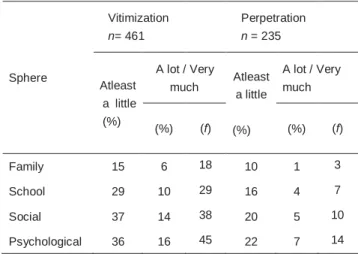
phobic communication in various spheres of the subjects’ lives (Table 2). As predicted, the negative impact of HCC is greater on the receivers than on the emitters. About 1/3 of the HCC recipients reported feeling socially, educationally and psychologically affected, while about 1/5 of the emitters reported feeling the same. This confirms our hypothesis (H5) that HCC reception experiences have far more adverse effects than emission experiences.
Table 2 further shows that 45 of the HCC receptors (16% of all receptors) reported to be a lot or very much psychologically affected by HCC. This only happens to 14 of the emitters (7% of all emitters). There are also high per- centages of a lot or very much-affected recipients at school and social level, 10 and 14% of all recipients. The perceived impact is lower at the family level, whether for emitters or recipients, suggesting that these occurrences of HCC are not reported within the family. Even so, 6% of recipients (18 res- pondents) report they have been affected at household level.
Table 2. Percentages of responses to HCC perceived impact by role in occurrence (as a victim and as an aggressor).
Vitimization n= 461 Perpetration n = 235 Sphere Atleast a little (%) A lot / Very much Atleast a little (%) A lot / Very much (%) (f) (%) (f) Family 15 6 18 10 1 3 School 29 10 29 16 4 7 Social 37 14 38 20 5 10 Psychological 36 16 45 22 7 14
Gender Differences of Respondents. To test the sta-
tistical significance of respondents’ gender differences, we used the scales constructed for each of the variables in ques- tion. Table 3 shows the means obtained by the respondents of both sexes, as well as the test for their differences. Male respondents have higher average frequencies in all varia- bles except cyberbullying where both sexes have identical average frequencies, thus invalidating our H2 hypothesis for the total sample. The biggest difference is in HCC reception followed by the use of ICTs for HCC. These results confirm our hypothesis H3.
Table 3. Means and standard deviations and sex difference tests.
* p < .05; ** p < .01; *** p < .001
Relationship between Cyberbullying and HCC
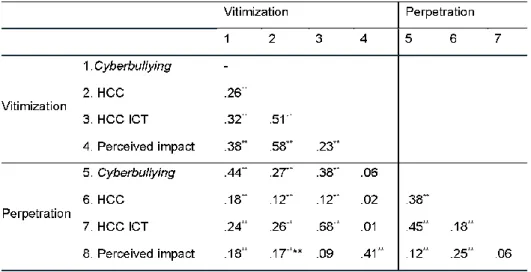
To analyze the relationships between the variables, we performed Pearson correlations with the four scales, Cy- berbullying, HCC, ICT Media and HCC Perceived Impact, for Victimization and Perpetration. As can be seen in Table 4, with regard to victimization (upper left quadrant), the Cyberbullying frequency is significantly correlated with the frequency of HCC reception (r = .26, p <.01) and the latter with the use of ICTs for this purpose (r = .51, p<.01). The Perceived impact intensity is
also correlated with both Cyberbullying and HCC - the more frequent the greater the perceived impact on the respondent’s various spheres of life. In perpetration, the correlation between cyberbullying frequency and HCC reception frequency is even higher, r = .38, p<.01 (lower right quadrant). Taken together, these results confirm our main hypothesis (H1), indicating that cyberbullying has a strong homophobic component, and its agents use homophobic language to assault and harass their targets.
Discussion and Conclusion
This research aimed to study and characterize, retrospectively, cyberbullying in adolescence and its rela- tionship with homophobia in college students. To this end, the frequencies of associated behaviors, the relationship of the participants with the aggressors and the targets of these behaviors, the means used to perform the aggressions and the perceived impact of these experiences in various sphe- res of the respondents’ lives, were evaluated.
As mentioned in the methodology, given that the evo- cation of past events were at stake, wide-range response scales were used, similar to studies measuring adult bullying evocation (Goodboy, Martin, & Goldman, 2016; Schäfer et al., 2004 ). For these reasons, the comparison of the present results with those of previous studies (obtained from adoles- cents themselves, referring to temporally closer periods, as in last week, and using scales that are more detailed) can only be made in approximate terms. However, the rigor of the evocation of events after several years cannot and should not be called into question, especially when dealing with traumatic events such as peer aggression, as has already been stated (e.g. Brewin, Andrews, & Gotlib, 1993; Rivers, 2001; Rubin, 2002).
Table 4. Correlations between measured variables (Pearson’s coefficient).
Looking at the cyberbullying frequencies in our sample, we found that 67% of our sample reported having been victims at least once and 34% reported having perpetrated any such aggression at least once. The high numbers of victimization show that cyberbullying marks its presence in the lives of most adolescents (about 2/3 of the sample). However, as one per- petrator may have multiple victims, it is even more revealing the percentage of perpetrators who took over (about 1/3 of the sample). Of course, the percentage of frequent victims is nevertheless very high in absolute terms, much lower - 6%. This is a number to take into account for future intervention in this phenomenon, especially when it is found that 16% of them admitted to have been very affected psychologically, and 14% socially. The percentage of frequent perpetrators was lower - 2%. The percentages of victims and frequent perpetrators confirm previous numbers being identical to those obtained by Coelho et al. (2016) among elementary school youths: 5% reported having been victims and 3% reported being abusers during the year prior to the survey.
Our hypothesis that boys would be more often victims of cyberbullying than girls was not verified in the total sam- ple. However, when we delimited theanalyzes to frequent victims, the differences between the percentages of boys and girls included, emerged. We may therefore say that boys and girls have been subjected to occasional cyber-attacks to the same extent, but boys are more likely to be frequent victims than girls are. The present results also confirmed the hypothesis regarding the gender differences of the perpe- trators, which predicted a higher frequency among boys: in fact, boys reported more often than girls did, that they had perpetrated some form of cyberbullying.
In short, with regard to gender differences, we found a predominantly male perpetrator profile and a mixed victim profile (although, in the extreme cases, it is predominantly male). These results are globally consistent with previous empirical evidence. In fact, with regard to offenders, the male profile found is consistent with the results of the recent study on cyberbullying by Coelho et al. (2016) conducted in Por- tugal. The boys have higher levels of perpetration than girls have in several other regions (e.g. USA and Italy: Poteat & Espelage, 2005; Prati, 2012), and this regularity may be due to their more stereotypically attributed characteristics ag- gressiveness and proactivity in most societies. With regard to victimization, previous studies have yielded contradictory results. For example, although several studies on homopho- bic bullying have found that males are more often targeted by this aggressive conduct (e.g. António et al., 2012; Bosworth et al., 1999; Crick & Bigbee, 1998; Pellegrini & Long, 2002; Russell et al., 2011), in the recent study by Coelho, Sousa, Marchante, Brás and Romão (2016), have found that girls were the most frequent cyberbullying victim group (see also Schäfer et al. 2004). We can therefore infer that the gender difference in cyberbullying victimization will depend on fac- tors that have not been identified, such as the gender norms prevailing in the societies or schools themselves.
We also anticipate that cyberbullying with homopho- bic content would be more often directed at people perceived
as LGB than people not perceived as such. This hypothesis was not confirmed as participants perceived as being LGB were even less frequently targeted by these aggressions compared to participants perceived as not being LGB. These results do not confirm the results of Poteat and Espelage (2005), who found no differences between the responses to the two items. In fact, the non-confirmation of the hypothesis may be due to a limitation of the instrument itself. That is, since non-normative sexual orientation has been considered less legitimate, and as such has been discriminated against, it is expected that the percentage of violence against LGB and those perceived as such will be higher. In this sense, we cannot say that the results of our sample contradict several previous studies that found that young LGB (António et al., 2012; Wiederhold, 2014) or those perceived as such (Rodri- gues et al., 2015) are more targeted for homophobic bullying and cyberbullying than other young people.
Our results also confirmed the negative consequen- ces that homophobic communication has on its stakehol- ders, consistent with emotional and psychological problems, low self-esteem, high levels of anxiety, decreased school participation, failure and attempted suicide found in previous studies (Hinduja & Patchin, 2011; Walker, 2015). About 1/3 of homophobic communication recipients were reported to have been socially and psychologically affected and about 15% reported to be severely affected. These results show once again that it is crucial to intervene in this phenomenon. Finally, and as the main objective of the study, we confirmed earlier findings, such as Poteat and Espelage’s (2005), on the existence of a strong homophobic component in cyberbullying. Our results indicate that peer cyber-aggres- sion often materializes through peer-to-peer homophobic communication content. Given that their purpose is to as- sault the target, such communications signal the existence of strongly biased attitudes toward individuals with non-norma- tive sexual orientations. They are symptomatic of negative feelings developed throughout the socialization process and upheld in order to preserve a social system based on the predominance of heterosexuality, condemning all those who deviate from heteronormativity. Although they are often not addressed to individuals who are recognized as LGB, their aim is always to assert the superiority of heterosexuality over other sexual orientations and the inferiority of individuals who show to have the latter.
Finally, we will highlight some of the limitations of the study. Although retrospective, as we have already discussed above, memories of traumatic events such as these are generally considered quite accurate and valid, and should not be considered a limitation (Rivers, 2001; Rubin, 2002). However, it should be remembered that these are the expe- riences of a specific population: young people who continued their studies at the University. If the sample were more diver- se, the data obtained could differ from those now presented. Thus, the potential for generalizing the present results to the Portuguese adolescent population is reduced.
We believe that the present study, by exploring and characterizing the relationship between cyberbullying and
the use of homophobic language among adolescents, may contribute to the development of intervention and prevention models aimed at reducing heterosexist attitudes and beha- viors future adults, and promote their positive coexistence with sexual and gender diversity, in families, schools, work and public space.
References
António, R.; Pinto, T.; Pereira, C.; Farcas, D.; Moleiro, C. (2012). Bullying homofóbico no contexto escolar em Portugal.
Psicologia,26, 17-32. Recuperado de http://www.scielo.mec.pt/
scielo.php?script=sci_arttext&pid=S0874-20492012000100002 Belsey, B. (2005). Cyberbullying: An emerging threat to the “always
on” generation. Recuperado de http://www.inukshuk.com/pdf/
Cyberbullying_Presentation_Description.pdf
Blumenfeld, W.; Cooper, R. (2010). LGBT and allied youth responses to cyberbullying: Policy implications. The International Journal of
Critical Pedagogy, 3(1), 112.
Bosworth, K.; Espelage, D. L.; Simon, T. R. (1999). Factors associated with bullying behavior in middle school students. The Journal of Early
Adolescence, 19, 341 – 362. doi: 10.1177/0272431699019003003
Brewin, C. R.; Andrews, B.; Gotlib, I. H. (1993). Psychopathology and early experience: a reappraisal of retrospective reports.
Psychological Bulletin, 113, 82-98. doi:
10.1037/0033-2909.113.1.82
Buelga, S.; Pons, J. (2012). Agresiones entre adolescentes a través del teléfono móvil y de Internet. Psychosocial Intervention, 21, 91- 101. doi: 10.5093/in2012v21n1a2
Buelga, S.; Cava, M.; Musitu, G. (2010). Cyberbullying: Victimización entre adolescentes a través del teléfono móvil y de Internet.
Psicothema, 22, 784-789. Recuperado de http://www.redalyc.org/
articulo.oa?id=72715515039
Caetano, A. P.; Amado, J.; Martins, M. J. D.; Simão, A. M. V.; Freire, I.; Pessôa, M. T. R. (2017). Cyberbullying: motives of aggression from the perspective of Young Portuguese. Educação & Sociedade, 38, 1017-1034. doi: 10.1590/ES0101-73302017139852
Coelho, V. A.; Sousa, V.; Marchante, M.; Brás, P.; Romão, A. (2016). Bullying and cyberbullying in Portugal: Validation of a questionnaire and analysis of prevalence. School Psychology International, 37, 223-239. doi: 10.1177/0143034315626609
Costa, C.; Pereira, M.; Oliveira, J.; Nogueira, C. (2010). Imagens
sociais das pessoas LGBT. Estudo sobre a discriminação em função da orientação sexual e da identidade de gênero. Lisboa:
Comissão para a Igualdade de Género.
Crick, N. R.; Bigbee, M. A. (1998). Relational and overt forms of peer
victimization: A multiinformant approach. Journal of Consulting
and Clinical Psychology, 66, 337–347. doi: 10.1037/0022-
006X.66.2.337
Dantas, M.; Neto, A. (2015). O discurso homofóbico nas redes sociais da internet: Uma análise no Facebook “Rio sem Homofobia-Grupo Público”. Cadernos do Tempo Presente, 19. Recuperado de http://www6.ensp.fiocruz.br/repositorio/sites/default/files/arquivos/ DiscursoHomofobico.pdf
Epstein, D. (1997). Boyz’Own Stories: Masculinities and sexualities in schools [1]. Gender and Education, 9, 105-116. doi: 10.1080/09540259721484
Goodboy, A. K.; Martin, M.; Goldman, Z. (2016). Students’ experiences of bullying in high school and their adjustment and motivation during the first semester of college. Western Journal of Communication,
80, 60-78. doi: 10.1080/10570314.2015.1078494
Hinduja, S.; Patchin, J. W. (2011). Cyberbullying and Sexual Orientation. Cyberbullying Research Center. Recuperado de http:// www.cyberbullying.us
Kowalski, R.; Limber, S. (2007). Electronic bullying among middle school students. Journal of Adolescent Health, 41, S22-S30. doi: 10.1016/j.jadohealth.2007.08.017
Lima, A. S. (2009). Da cultura da mídia à cibercultura: as representações do eu nas tramas do ciberespaço. In III Encontro
de Pesquisa em Comunicação e Cidadania. Goiânia, Brasil.
Maidel, S. (2009). Cyberbullying: Um novo risco advindo das tecnologias digitais. Revista Electrónica de Investigación y
Docencia (REID), 2. Recuperado de http://revistaselectronicas.
ujaen.es/index.php/reid/article/view/1158
Matos, A.; Pessoa, T.; Amado, J.; Jäger, T. (2011). Agir contra o cyberbullying: Manual de formação.Literacia, Media e Cidadania, 183-196. Recuperado de http://www.lasics.uminho.pt/ojs/index. php/lmc/article/view/463/434
Oliveira, J. M.; Pereira, M.; Costa, C. G.; Nogueira, C. (2010). Pessoas LGBT: Identidades e discriminação. In Nogueira,C.; Oliveira, J. M. (Eds.), Estudo sobre a discriminação em função da orientação
sexual e da identidade de género (pp.149-210). Lisboa: CIG.
Olweus, D. (1993). Bullying at school. Oxford & Cambridge: Blackwell.
Olweus, D. (1994). Bullying at school: basic facts and effects of a school based intervention program. Journal of Child Psychology
and Psychiatry and Allied Disciplines, 35(7), 1171-1190. doi:
10.1111/j.1469-7610.1994.tb01229.x
Pellegrini, A. D. ; Long, J. (2002). A longitudinal study of bullying, dominance, and victimization during the transition from primary to secondary school. British Journal of Developmental Psychology,
Pereira, F. (2015). Ciberassédio na adolescência: Prevalência(s),
reações à vitimação e mediação parental. Tese de Doutoramento
em Psicologia Aplicada. Universidade do Minho, Braga.
Pescitelli, A. (2013). My Space or yours? Homophobic and
transphobic bullying in cyberspace, Tese de Doutoramento. Simon
Fraser University, Canadá. Recuperado de http://summit.sfu.ca/ item/13577
Pordata (2017). Alunos matriculados no ensino superior: total e por sexo. Recuperado de https://www.pordata.pt/Portugal/Alunos+ma triculados+no+ensino+superior+total+e+por+sexo-1048
Poteat, V.; Espelage, D. (2005). Exploring the relation between bullying and homophobic verbal content: The Homophobic Content Agent Target (HCAT) Scale. Violence and Victims, 20, 141-150. doi: 10.1891/vivi.2005.20.5.513
Prati, G. (2012). Development and psychometric properties of the homophobic bullying scale. Educational and Psychological
Measurement, 72, 649-664. doi:10.1177/0013164412440169
Rivers, I. (2001). Retrospective reports of school bullying: Stability of recall and its implications for research. British
Journal of Developmental Psychology, 19, 129-141. doi:
10.1348/026151001166001
Rodrigues, L.; Grave, R.; Oliveira, J.; Nogueira, C. (2015). Estudio sobre bullying homofóbico en Portugal con recurso al Analisis de Correspondencias Multiples (ACM). Revista Latinoamericana de
Psicología, 48, 191-201. doi: 10.1016/j.rlp.2016.04.001
Rubin, D. C. (2002). Autobiographical memory across the lifespan. In Graf, P.; Ohta, N. (Eds.), Lifespan development of human memory (pp. 159-184). Cambridge, MA: MIT Press.
Russell, S.; Ryan, C.; Toomey, R.; Diaz, R.; Sanchez, J. (2011). Lesbian, gay, bisexual, and transgender adolescent school victimization: Implications for young adult health and adjustment.
Journal of School Health, 81, 223-230. doi: 10.1111/j.1746-
1561.2011.00583.x
Schäfer, M.; Korn, S.; Smith, P. K.; Hunter, S. C.; Mora-Merchán, J. A.; Singer, M. M.; Van der Meulen, K. (2004). Lonely in the crowd: Recollections of bullying. British Journal of Developmental
Psychology, 22, 379–394. doi: 10.1348/0261510041552756
Smith, P. K.; Mahdavi, J.; Carvalho, M.; Tippett, N. (2006). An investigation into cyberbullying, its forms, awareness and impact, and the relationship between age and gender in cyberbullying.
Research Brief No. RBX03-06. London: DfES. Recuperado de
http://webarchive.nationalarchives.gov.uk/20130323025443/ https://www.education.gov.uk/publications/eOrderingDownload/ RBX03-06.pdf
Varjas, K.; Meyers, J.; Kiperman, S.; Howard, A. (2013). Technology hurts? Lesbian, gay, and bisexual youth perspectives of technology and cyberbullying. Journal of School Violence, 12, 27-44.doi: 10.1080/15388220.2012.731665
Walker, C. (2015). An analysis of cyberbullying among sexual minority university students. Journal of Higher Education Theory and
Practice, 15, 44-50. Recuperado de http://www.na-businesspress.
com/JHETP/WalkerC_Web15_7_.pdf
Wanzinack, C.; Reis, C. (2015). Cyberbullying e violência na rede: Relações entre poder e desenvolvimento no litoral do Paraná. In
XXXVIII Congresso Brasileiro de Ciências da Comunicação, Rio de Janeiro, Brasil. Recuperado de http://portalintercom.org.br/
anais/nacional2015/resumos/R10-2414-1.pdf
Wiederhold, B. (2014). Cyberbullying and LGBTQ youth: A deadly combination. Cyberpsychology, Behavior, and Social Networking,
17, 569-570. doi: 10.1089/cyber.2014.1521
Willard, N. (2005). Cyberbullying and Cyberthreats. OSDSF
Nacional Conference. Washington. Recuperado de http://bcloud.
marinschools.org/SafeSchools/Documents/BP-CyberBandT.pdf
Received on: April 24, 2018 Approved on: September 12, 2018
This paper was translated from Portuguese by Ana Maria Pereira Dionísio.
License information: This is an open-access article distributed under the terms of the License (type CC-BY), which permits