The Role of Movement and Gesture in Communica ng Music Expressiveness
to an Audience - An experiment on dynamics percep on a er a
contemporary percussion performance.
O papel do gesto na comunicação da expressividade musical - uma experiência para a análise da
percepção das dinâmicas durante uma performance de percussão contemporânea.
Aroso, N.
Uminho - Universidade do Minho
Re rado de: h p://convergencias.esart.ipcb.pt
1. Introduc on
Percussion music is a unique type of instrumental music allowing performers to tell stories with the help of gestures. When percussionists play percussion instruments, the audience may not only hear sounds, but also see musicians’ body movements and facial expressions that help to transmit certain emo ons (Mowi , 2002). Overall, percussive music performance is extremely wide, and is accompanied by bright visual images provided by musicians themselves. From this perspec ve, observa on over percussionists’ playing manner provides an audience with an opportunity to understand a narra ve ability of music through musicians’ gestures.
ABSTRACT: Musical performa ve gestures are recognised by the majority of theore cians as a cri cal factor of a musical performance. Gestures can be considered as opera ng features of a person’s percep on-ac on system. It presupposes significance of a meaning that involves more than just a physical movement. Movements can be subdivided into specific pa erns and conceptualised. Dynamics are one of the most relevant expressive element in music and they are strongly related to the physical musical ac on - sound producing gestures. Used effec vely, dynamics allow sustain narra ve per nence in a musical performance, communica ng for example a par cular emo onal state or feeling. For this research, solo percussion contemporary music performance was in focus and an audience divided in between “visual and non visual” listeners was studied. From this perspec ve, observa on over percussionists’ playing manner and it ́s audience provides the researcher an opportunity to understand dynamics percep on through musicians’ gestures in this par cular repertoire. The quan ta ve research design divided in the experiment was chosen for the purpose of this study, which can be referred to as the descrip on of the objec ve reality by using numbers in order to construct meaningful models reflec ng various rela onships between objects or phenomena. These numerical en es are not the reality itself, but a way of represen ng it. How does the percussive gesture influences the percep on of musical dynamics by an audience? KEYWORDS: percussion, dynamics, percep on, music, audience RESUMO: Os gestos musicais inerentes à produção de som são reconhecidos por parte significa va dos teóricos como um fator crí co de uma performance musical. Os gestos, para além da funcionalidade, podem ser considerados recursos operacionais do sistema de percepção-ação de um individuo. Pressupõe, portanto, esta gestualidade a cripercepção-ação de um significado que envolve mais do que apenas um movimento sico. Os movimentos podem ser subdivididos em padrões específicos de conceptualização. A dinâmica é um dos elementos expressivos mais relevantes da música e está fortemente relacionada com a fiscalidade da ação musical. Usada de maneira eficaz, a dinâmica permite sustentar a per nência narra va de uma performance musical comunicando, por exemplo, um estado emocional geral ou sen mento específico. Neste estudo, a performance da música contemporânea de percussão solo esteve em foco e uma audiência dividida entre ouvintes “visuais" e "não visuais”, foram analisados. Nesta perspec va, a observação sobre a maneira de tocar do percussionista e o estudo da reação ao es mulo sonoro e sonoro/visual do público oferece ao autor uma oportunidade de entender a percepção da dinâmica. O desenho quan ta vo da experiência foi escolhido para a ngir os propósitos deste estudo, e que pode demonstrar uma realidade obje va usando números para imitar modelos significa vos que refletem as árias relações entre objetos ou fenómenos. Essas en dades numéricas não são a realidade em si, mas uma maneira de representá-la. Assim, procurou-se responder à pergunta de inves gação: como pode o gesto percussivo influenciar a percepção da dinâmica musical de uma plateia?
Mee ng the present-day demand for understanding music, the present study focuses on the analysis of percussion gestures’ ability to transmit expression, including dynamics. To be more specific, this work will demonstrate how percussionists’ body movements and facial expressions can be understood concerning the dynamics percep on by the listeners.
Dynamics in music according to Ma hias Thiemel can be defined as: The intensity of volume with which notes and sounds are expressed., Furthermore, the author explains that, In the 20th century dynamics came to be seen as one of the fundamental parameters of composi on which func on interdependently to create musical meaning and structure.
2. Literature Review
Researches by Armontrout et al. (2009) and Schutz and Lipscomb (2007) demonstrated that visual informa on inten onally provided by musicians may create a certain illusion that determines audience’s percep on of musical performance. According to the researchers, live musical performance may lead to a naturally occurring audiovisual illusion provided by a musician’s gestures (that occur in the process of playing) the visual informa on of which changes the perceived dura on of simultaneous auditory informa on. However, they underlined that this illusion is controlled by the dura on of musician’s post- impact mo on that influences the audience’s percep on of event dura on (Armontrout et al., 2009). The inten onal crea on of this illusion can be explained by the musician’s desire to strengthen the effect and audience’s unforge able impressions of his or her musical performance. Overall, non-verbal musical gestures are a part of human body language. This way, by ges cula ng during performance, a musician communicates with the audience. According to the recent sta s cal data, “55% of the impact of human communica on is a ributable to body language”; besides, “over 65% of our communica on is non-verbal” (Psaila, 2007, p. 1). All these facts demonstrate that the significance of bodily movements should not be underes mated.
By using gestures during musical performance, musicians provide the audience with conceptual and emo onal messages (Psaila, 2007). Music-related ancillary bodily movements (mainly, gestures) are an essen al part of communica on between a performer of live music and the audience. The research evidence (provided by Kühl, n.d.; Nusseck & Wanderley, 2009; McNeill, n.d.; Psaila, 2007, etc.) suggested that the majority of musicians’ gestures traced in musical performance have special psychological and emo onal effects on public. For example, McNeill (n.d.) applied a psycholinguis c approach to musical gestures in order to demonstrate in his ar cle that a gesture is a communica ve movement that becomes a representa on of a sign language. According to the author, beats (some mes called as “baton” by musicians) are musical ges cula ons or speech-farmed gestures accompanied by rhythmical bea ng me by a hand; beats highlight important moments “signalling the temporal locus of something the speaker feels to be important with respect to the larger context” (McNeill, n.d., p. 4). Overall, musician’s beats usually a ract the audience’s a en on because they may echo human heart beats, reflect emo onal and psychological states (for example, stress, excitement, expecta on, etc.), and provide a musical composi on with rhythmical harmony. Some mes, a musical performance can be accompanied by a musician’s expressive gestures.
Nusseck and Wanderley (2009) revealed that “expressive performer movements in musical performances represent implied levels of communica on and can contain certain characteris cs and meanings of embodied human expressivity” (p. 335). The authors suggested that some mes, classic musicians inten onally use large body mo ons for exaggera ng par cular moments in musical phrases; this behaviour produces an expressive effect on audience causing it to make more emo onally coloured judgments about a musical performance (Nusseck & Wanderley, 2009). Meanings embodied in musical gestures form corresponding impressions of the audience experiencing a musical performance. For example, Kühl (n.d.) underlined that “gesture becomes the key to the understanding of musical meaning” (p. 1). In other words, musical gestures should be treated as physical expression of par cular feelings (for example, love, sadness, etc.) and emo onal states (such as joy, disappointment, etc.) that, in their turn, shape audience’s impressions of musical performance.
Each music piece possesses a narra ve or inner content that can be understood by the audience through music performance (Schnapp, 2011). Overall, to understand the concept of narra ve in the context of music is a rela vely complicated task. However, professional experiences of specialists on semio cs (the study of signs, sign processes, linguis c and non- linguis c sign systems) and narratology (the study of narra ve, its structure and the ways affec ng people’s percep on) help to elucidate the phenomenon of narra ve in music (Fludernik, 2012). According to them, both language and music rely on their own signs, which serve the star ng point for the crea on of the content itself (Callaghan & McDonald, 2002).
Percussion music presents one of the bright areas that may help to reveal the concept of narra ve in musical performance. Percussion music is created with the help of gestures commonly realised through performers’ body movements and facial expressions (Halmrast, Gue ler, Bader, & Godøy, 2009). This evidence implies that percussion music is characterised by obvious expressiveness. In other words, percussionists’ music performance is accompanied by certain physical expressive gestures that, in their turn, generate an inner content of a performed musical composi on. Depending on a chosen tonality, rhythm, and harmony as well as on the cultural context, this content may consist of par cular messages and feelings that create listeners’ overall impressions about a performed musical piece and musical performance in general (Ystad, Kronland-Mar net, & Jensen, 2009, p. 250). Understanding of a narra ve embedded in a musical composi on greatly depends on the audience’s percep on of a musician’s performance (Lehmann, Sloboda, & Woody, 2007). Finally, awareness of percussionist’s gestures and their influence on people’s percep on allows to iden fy the rela onship between musician’s body movements and audience’s experience.
Overall, for the reason that understanding narra ve of percussion gestures is significant, the present work focuses on the men oned topic-related issues. The studies by Armontrout et al. (2009) and Schutz and Lipscomb (2007) demonstrated that visual informa on inten onally provided by musicians may create a certain illusion that determines audience’s percep on of musical expressiveness. According to the researchers, live musical performance may lead to a naturally occurring audiovisual illusion provided by a musician’s gestures (that occur in the process of playing) the visual informa on of which changes the perceived dura on of simultaneous auditory informa on. However, they underlined that this illusion is controlled by the dura on of musician’s post- impact mo on that influences the audience’s percep on of event dura on (Armontrout et al., 2009). The inten onal crea on of this illusion can be explained by the musician’s desire to strengthen the effect and audience’s unforge able impressions of his or her musical performance. Overall, non-verbal musical gestures are a part of human body language. This way, by ges cula ng during performance, a musician communicates with the audience. According to the recent sta s cal data, “55% of the impact of human communica on is a ributable to body language”; besides, “over 65% of our communica on is non-verbal” (Psaila, 2007, p. 1). All these facts demonstrate that the significance of bodily movements should not be underes mated.
By using gestures during musical performance, musicians provide the audience with conceptual and emo onal messages (Psaila, 2007). Music-related ancillary bodily movements (mainly, gestures) are an essen al part of communica on between a performer of live music and the audience. The research evidence (provided by Kühl, n.d.; Nusseck & Wanderley, 2009; McNeill, n.d.; Psaila, 2007, etc.) suggested that the majority of musicians’ gestures traced in musical performance have special psychological and emo onal effects on public. For example, McNeill (n.d.) applied a psycholinguis c approach to musical gestures in order to demonstrate in his ar cle that a gesture is a communica ve movement that becomes a representa on of a sign language.
According to the author, beats (some mes called as “baton” by musicians) are musical ges cula ons or speech-farmed gestures accompanied by rhythmical bea ng me by a hand; beats highlight important moments “signaling the temporal locus of something the speaker feels to be important with respect to the larger context” (McNeill, n.d., p. 4). Overall, musician’s beats usually a ract the audience’s a en on because they may echo human heart beats, reflect emo onal and psychological states (for example, stress, excitement, expecta on, etc.), and provide a musical composi on with rhythmical harmony. Some mes, a musical performance can be accompanied by a musician’s expressive gestures.
Nusseck and Wanderley (2009) revealed that “expressive performer movements in musical performances represent implied levels of communica on and can contain certain characteris cs and meanings of embodied human expressivity” (p. 335). The authors suggested that some mes, classic musicians inten onally use large body mo ons for exaggera ng par cular moments in musical phrases; this behavior produces an expressive effect on audience causing it to make more emo onally colored judgments about a musical performance (Nusseck & Wanderley, 2009). Meanings embodied in musical gestures form corresponding impressions of the audience experiencing a musical performance. For example, Kühl (n.d.) underlined that “gesture becomes the key to the understanding of
musical meaning” (p. 1). In other words, musical gestures should be treated as physical expression of par cular feelings (for example, love, sadness, etc.) and emo onal states (such as joy, disappointment, etc.) that, in their turn, shape audience’s impressions of musical performance.
3. Research Procedure and Methodology
Specifics of the Dependent and Independent Variables.The measurable aspect of the dependent variable considered during the experiment was the sensi vity of the percep on of dynamic characteris cs. The independent variable was the visual component – the the musical performance that was demonstrated to one group of listeners as accompanying the aural percep on, whereas the other group being blindfolded, had to rely on the sounds of music exclusively. The hypothesis offered for tes ng was that the audience exposed to the full performance and, correspondingly, perceiving the pieces in progression by using two percep on channels would respond to musical dynamic differently than the audience whose only source of informa on incoming from the piece performed was the aural channel. Therefore, sensi vity of dynamic percep on, being the influenced area, can be assigned the role of the dependent variable. The audience was offered two musical works. The first one was Sen VI by Toshio Hosokawa for Mul percussion, the other – Vox Sum Vitae by João Pedro Oliveira for Vibraphone. All par cipants were using a 10K poten ometer, which they were asked to use in order to report their percep on of dynamics during a solo percussion performance. Sen VI is an unusual musical piece that can serve the purpose of this research quite effec vely. The piece was wri en for solo percussion and one of its outstanding features is its strong links to the visual significance of gesture, which condi ons the propriety of using this piece for the experimental research design addressing the importance of the visual component for listeners’ percep on of music. According to Tolen no (n.d.), Inspira on for these gestures comes from the art of Japanese calligraphy and the use of a significant, expressive gesture before each brush stroke.
During the piece, the performer ac vates vocal noises and uses only hands and so mallets to play skin drums and a single crotale (p. 8). The opening pages of Sen VI encompass vast, graceful arm gestures drawing on the preparatory strokes of the Japanese calligraphy. The score wri en by Toshio Hosokawa harnesses ed and empty measures in order to demonstrate circular moves some mes followed by an intense a ack, and some mes not by an a ack, but a period of silence or a preparatory movement. It is the performer’s decision ul mately how these gestures should be carried out (Tolen no, n.d.). There is claimed to be a rela onship uni ng the gestures executed by the performer and the physical impact tracing either “a disjointed a ack, where the gesture ends before the a ack is ini ated; or an exaggerated a ack, where an unnecessary large gesture is connected to and immediately precedes an a ack” (Tolen no, n.d., p. 4). In case if the disjointed a ack is used, the musician should incisively thwart the energy of movement that would otherwise reflect on the drum severing the preparatory movement from its subsequent impact. On the other hand, the dispropor onate version presupposes that the performer should use the unnecessary accumula on of movement for a strong and individual a ack. Therefore, Tolen no as a performer argued that the technique of gesture is equally important for the aesthe c effect of the performance of this piece as the score itself (Tolen no, n.d.).
Tolen no indicated in rela on to this work: “In percussion performance, a performer executes an a ack using the gesture he finds necessary to execute the sound. Sen VI pulls at the heart of this no on by asking us to control not only a sound and its precision, but also the mechanical direc on of our mo on leading up to that sound.” (n.d., p. 4) The choice of a gesture during the performance of Sen VI might affect listeners in various ways. A linguis cs student majoring in American Sign Language cited by Tolen no maintained that deaf people have a visual connec on to sound. An individual with a strong link between the visual and aural channels of percep on might associate the volume of the sound with the scale and size of the gesture accompanying it (Tolen no, n.d., p. 4). By way of using the example of hearing-impaired individuals the author suggested that “a preparatory mo on that preserves momentum that lacks a resul ng a ack” might actually sound for that individual, if he or she watched a performance of Sen VI. The ability to “see” the sound might preserve the inspira onal content of the piece for a person who cannot actually hear it. Another interes ng hypothesis is that this person might have a more conven onal music listening experience if this person was posi oned closer to the area where drum vibra ons are physically percep ble. Tolen no called this a “cogni ve twist”, since “normal-hearing listeners [are] perceptually limited by what they can in fact hear” (n.d., p. 4). Finally, Sen VI is cri cised for what disapproving individuals call latent “inaccessibility” to all people, which can be viewed from a diametrically opposite standpoint. More specifically, Sen VI deserves close a en on for an indica on of a strong connec on between movement, image, sound and the ul mate effect on the audience.
For some gesture can arguably speak louder that music itself (Tolen no, n.d., p. 4). Such an inherent connec on between sound and gesture stressed by performers and researchers makes this piece a perfect instrument for the study of the effects of the visual component of the performance.
Fig. 1 – Score excerpt of Sen VI by Toshio Hosokawa
The second piece used for the first experimental stage of the research is Vox Sum Vitae composed by João Pedro Oliveira. This composer is one of the most prominent modern composers of Portugal. He has an extensive educa on that involves such different arts as music (organ performance) and architecture, so his esthe cal views are quite rich. His music is represented by varying genres: a chamber opera, a range of orchestral composi ons, one Requiem, three string quartets, solo instrumental music pieces, as well as electroacous c music. His experience and eclec c taste resulted in experimental music exploring the possibili es of interac on between electroacous c and instrumental sounds, which draws equally on both sources (Babel Scores, 2013). The tle of Oliveira’s work Vox Sum Vitae (I am the voice of life) is an allusion to an inscrip on in a church bell located in Strasbourg.
The essence of the piece is described in the following way: “In one of my trips to Germany, on a Sunday morning I was woke suddenly with the sound of hundreds of church bells, announcing the early morning church service. This piece is a representa on of that sound image. It intends to lead the listener in a trip where bell sounds are around him” (emphasised by the distribu on of the loudspeakers in the room and the spa aliza on of the electronic sounds) (New York City
Electroacous c Music Fes val, 2013, p. 31). The produced sounds and instrumental gestures carried out in the process of performance are blurred and melted in the electronics, which leads to an illusion that the vibraphone turns into a “carillon of infinite bells” (New York City Electroacous c Music Fes val, 2013, p. 31). The blend of media used for the performance of this piece and its inherent strength seeking to imitate the power of a bell consonance through the u liza on of contemporary technology also jus fies the choice of this musical work for the study of the effect of the visual component on listening percep on. While listening to the pieces the par cipants were asked to use their poten ometers to signal the dynamics of the music while solo percussion performance was in progress. U lisa on of a poten ometer proved a useful instrument for the establishment of one aspect of the visual modality in music percep on. The dynamics of the reac ons of the par cipants correlated with the pieces’ progression in detail, which allowed the researcher to use empirical data and build models reflec ng the rela onship between the visual and audial modali es as linked to the percep on of musical dynamics.
4. Data Collec on and Processing
The collec on of the data and transferring it into codifcable and comparable form that is useful for quan ta ve research requires u lisa on of special so ware that is likely to simplify the data analysis and model construc on stages. To this end, Laboratory Virtual Instrument Engineering Workbench (LabVIEW) so ware was employed at this stage of the study. LabVIEW is a method with a high standard produc vity that is condi oned by a set of characteris cs:
1) readability – the overall bulk of informa on obtained is easy to process and implement, a single computer can present a significant amount of the problem domain;
2) writability – designs developed by using the so ware are easily transferrable into the real world;
3) editability – the so ware gives an opportunity to edit the exis ng developments rather than create new ones, a range of templates is available to facilitate data collec on;
4) reusability – once developed code may be reused for other projects;
5) understandability – the so ware provides a large toolkit for the visualiza on of the problem (Conway & Wa s, 2003).
LabVIEW is supported by a wide range of toolboxes designed for specialized applica ons which are essen ally compact collec ons of code that are specific to the applica on. Using these code templates is useful and prac cal because they help save a significant amount of development me. Among these toolboxes is the signal processing toolkit, which is applied to digital filter design and me-frequency analysis. Sound and vibra on toolset maintains audio measurement, sound level assessment, transient analysis, and frequency response. State diagram toolkit provides a basic tool set u lized for interac ve development and state machines implementa on (Gupta & John, 2010). This so ware allows the researcher to select experimental parameters for the control of instruments used in this experimental research. Therefore, the LabVIEW instrument sets developed as templates modifiable to apply to varying types of data ensures the simplicity of opera on, neatness and the possibility of transforma on of the obtained measurements into a visual model reflec ng the dependency of the listeners’ percep on on the absence or presence of the experimental s mulus. Also, LabVIEW instruments are helpful for the task of drawing tendencies in the variances of the percep on of dynamics in either of the groups.
Since the data used in this experiment is quan ta ve, the rela onships established as a result can be presented in the graphical form that would reflect the variances and dependencies characterising the correla on of the aspects of the dependent and independent variables defined for this research. Graphical presenta on of quan ta ve data may take the form of a graph or a diagram constructed by using the resources of Microso Excel or a similar so ware op on.
4.1. Significance of the Data
The data obtained at this stage of the research appeared to be illustra ve of the trends characterizing the abovemen oned rela onships. It also indicated that the choice of the sample consis ng of 30 people was representa ve, as the measured variances allowed the researcher to establish illustra ve trends, as the visual and blind listening audiences demonstrated different levels of music percep on sensi vity. Moreover, the study gave an opportunity to register minor aspects of this dependency that served as addi onal confirma on to the hypothesis. The specific aspects of the experiment results will be discussed in the corresponding sec on. The data obtained from the first experimental context provided the researcher with a sufficiently objec ve model. It reflected the rela onship between the chosen variables viewed from one perspec ve and es mated on the basis of one characteris c. The sample size, professional data analysis so ware tools, and an adequate dura on were the aspects that s pulated the validity of the obtained results. The experiment was directed at the inves ga on of dynamics percep on among par cipants. To dis nguish between the ways in which people perceive a percussion performance only with their ears and with visual cues, the group of 30 music students at Escola Profissional de Musica de Espinho was divided into two equal groups of 15 par cipants, and one group was exposed to blind listening to the musical performance (with their eyes covered), while the other one could listen to, and watch the percussion performance.
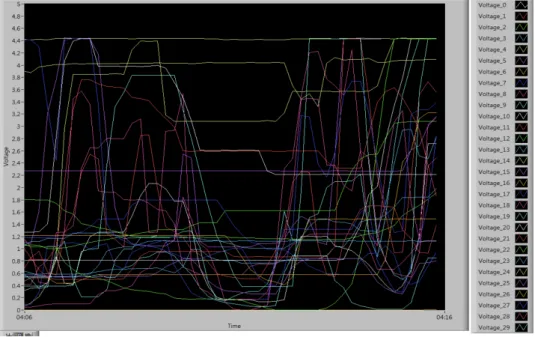
The instrument with which respondents could report their percep on of musical dynamics was the 10K poten ometer that students held in their hands and “drew” the dynamics by naviga ng the rota on control bu on reflec ng the intensity of their percep ons. The poten ometer was equipped with relief surface on its scale so that respondents did not have to look at it to navigate it, and were able to move the bu on even with their eyes covered. The respondents were presented with two musical performances – Sen IV by Hoshio Hosokawa for Mul percussion, and the Vox Sum Vitae by Joao Oliveira for Vibraphone. During the performance, they had an opportunity to manipulate the bu on on the poten ometer to reflect their percep ons of music’s dynamics. The preliminary tes ng results may be seen in Figure 2.
As one can see from Fig. 2, all par cipants revealed differing extents of understanding the musical dynamics, and some par cipants displayed a low ability of dis nguishing the twists and changes in dynamics of the percussion performance. The majority of respondents nevertheless exhibited a more or less similar tendency of musical dynamics’ assessment, which proves that the experiment may yield highly posi ve results, and may inform the present research with frui ul findings. The compara ve tes ng results from two groups of respondents may be viewed - Figure 3.
Fig. 3 – Dynamics Tes ng Results
As it comes from Figure 4, both groups displayed a rela vely high level of dynamics’ percep on, and the majority of respondents managed to provide a sensi ve image of musical dynamics in progress. However, some tendencies s ll stand out from the compara ve analysis of the ways in which blind and non-blind groups perceived the musical dynamics. First, it is evident that the blind listening group demonstrated a much more sensi ve percep on of musical dynamics – the diagram of blind group’s reac on to the changes in dynamics, and the presence of numerous varied peaks and plateaus reveals the fact that blind listeners managed to grasp a much larger group of musical changes and variances. Moreover, a much higher level of musical percep on’s sharpness may be seen in the moments of silence while the non-blind group seeing the pause in the percussionist’s movements moved the poten ometer bu on to the zero indicator, the blind group’s par cipants s ll sensed the dynamics of music and preferred not to choose the zero level, indica ng certain levels of musical dynamics. It is thus possible to infer that the blind group did not indicate a zero level of ac vity as they reacted to the resonances and remaining sounds more sharply than the visual listeners did, most probably because of their inability to see the absence of movements and ac vity from the side of the percussionist.
Speaking about the visually enhanced group of listeners, the researchers noted that visual listening was accompanied with an ability to react to the percussionist’s gesture before it was executed, which was reflected in the diagram – some fragments of musical dynamics were indicated by visual listeners before they actually occurred, which means that visual listeners perceive the dynamics present in music more with their eyes than with ears. Moreover, such observa ons imply that there is a tendency to rely on visual cues more predominantly throughout the process of listening to percussion performance, which is usually less melodic than other types of instruments can be. Therefore, the gestures performed by the percussionist are a vital component of the whole complex of musical performance’s percep on, speaking about those who are able to view and hear the performance simultaneously.
that blind listening was much more homogeneous in terms of musical percep on among par cipants. This fact suggests that in case viewers have an opportunity to interpret the musical performance through dual channels, that is, sight and hearing, they may involve a much wider spectrum of criteria into their personal analysis of percep ons and impressions from the performance. Hence, those who only hear the performance have a much more objec ve and sensi ve percep on thereof, simply because they have only one available channel for the analysis of input data. Those who see and hear the performance have a wider range of opportuni es for interpreta on, and they may employ addi onal factors such as their opinion about the appearance of percussionist, his or her emo onal involvement, etc. in their judgments about musical dynamics. Thus, such extraneous variables may affect the ways in which par cipants perceive the performance, ul mately bringing about a much higher level of results’ diversity. Percussionist’s gestures have proven to have a tremendous impact on the musical percep on of the audience, but there is an obvious need to confirm the findings by means of conduc ng addi onal tes ng.
5. Results
Since the experiment dealt primarily with understanding of respondents’ percep on of percussion music’s dynamics, which was measured by means of manipula ng the poten ometer by both the blind and visual listening groups, one can assume that the results obtained from this experiment indicate the level of sensi vity to rhythmic varia ons, twists, and changes by both groups. The experiment resulted in understanding that blind listeners revealed a much higher level of sensi vity towards music’s dynamics reflected in the changes, peaks, and plateaus registered more accurately and more diversely by the respondents. The present observa on may be explained through the lens of Boros and Toops’ (1996) idea that despite the fact that gestures and visual informa on provide an opportunity for listeners to perceive music idiosyncra cally, reduc on of musical percep on to visual and aural cues only leads to emp ness in music. Opposite to the commonplace opinion that visual cues provide the richness of listening experience, the authors indicated that in fact, visual cues may distract the listeners from perceiving music only, in its pure form. Miclaus (2011) agreed with the researchers in this aspect by assessing the visual component in music as destruc ve, and by assuming that inclusion of visual cues distorts the listeners’ percep on of music, adding the unnecessary details that may distract the audience from crucial musical elements and aspects. In addi on, the findings from the experiment related to the blind listening group imply the need to refer to the findings of Thompson et al. (2005) who indicated that listeners with professional musical schooling tend to rely more on visual cues for affec ve meaning.
Though the researchers a ributed a large extent of confidence in the need to use visual cues, it is notable that they emphasized the importance of the la er for the affec ve meaning, which is emo on and not dynamics. Therefore, it is logical to assume that in case visual cues are regarded as more helpful for communica on of emo on, more objec ve and unchangeable aspects of a musical performance such as dynamics can be perceived be er and more sensi vely without visual cues, that is, by the visual listening group.
The ideas of Schutz and Kubovy (2006) are also relevant in this regard, as the authors found out that the length of percussionists’ gesture does not influence the dura on of a note, which enables the blind listening group to assess the performance’s dynamics much more objec vely that the visual group can. Such difference stems from the visual percep on of gestures’ varia on, which may make the visual group falsely assume that different gestures may produce musical sounds of varying dynamics, which is reflected in the diagram of visual group’s poten ometer indicators. In this situa on, the blind listening group unable to see the varia on of percussionists’ movements is in a much be er posi on regarding produc on of the objec ve assessment of the performance’s dynamics. However, at the same me, the visual listening group revealed an interes ng tendency of an cipa ng certain elements of music dynamics because of the ability to see the visual cues provided by the performer.
The present findings can be proven by the fact that the visual listening group’s par cipants registered the changes in musical dynamics before they actually occurred, which is consistent with the research of Blades (1992), Dahl et al. (2009), Kalani (2008), and Kühl (n. d.) claiming that percussionists’ gestures help to visualize music for the audience and other musicians. Moreover, Bresin and Dahl (2003) stated that percussionists usually make certain movements not only to produce sound, but also to prepare for it. Consequently, people familiar with the peculiari es of percussion music can be knowledgeable about such prepara ons, and can an cipate and register the changes in musical dynamics before they actually take place because they know what certain gestures mean.
6. Conclusions
The difference in visual and blind listening groups’ percep on of the musical performance may be partly explained by the findings of Ryan (2007) about the musical narra ve represen ng a story, which is an image with certain spa al, temporal, mental, and pragma c components. In this context, the musical performance (if one follows the logic of Barthes (1981)) possesses the feature of textuality, which is the interplay or weaving of codes. These statements, coupled with the observa on of Leman (2008) about music represen ng a polyseman c unit making sense of several codes simultaneously provides an addi onal understanding of the reasons for which the par cipants of blind and visual listening groups manage to hear the percussion performance differently.
To understand the ability of an cipa ng musical dynamics by visual listeners, one should refer to the findings of Clarke (2002) who claimed that musical gestures are a construc on of significa on in music. Significa on is the crea on of meaning, which, in case it is coupled with the ideas of Ryan (2007), Barthes (1981), and Leman (2008), provides an image of music as a narra ve, a story with its own plot and development of ac on. If such an analogy is drawn, a musical performance may be perceived as text, and reading a text always involves an cipa ng the further ac ons of characters.
The listeners’ an cipa on may come true or be false, but in any case, visual percep on of a performance involves thinking in advance about the musical twists, changes, peaks, and silence, while blind listening s ll involves the factual percep on of music dynamics only a er it has been produced by percussionists with the help of certain movements.
Bibliographic references
Armontrout, J., Schutz, M. & Kubovy, M. (2009). Visual determinants of a cross-modal illusion. A en on, Percep on, & Psychophysics, 71, 1618 - 1627. Babel, Scores (2013). João Pedro Oliveira. Babel Scores: Contemporary Music Online. Retrieved September 1, 2013 from h p://www.babelscores.com/joaopedrooliveira.
Barthes, Roland (1981). “Textual Analysis of Poe’s ‘Valdemar”, in Robert Young (ed.), Untying the Text: A Post-Structuralist Reader, 135. Boston, London and Henley: Routledge & Kegan Paul.
Blades, J. (1992). Percussion Instruments and Their History. London, UK: Bold Strumme. Boros, James & Toop, Richard (1996). Brian Ferneyhough - Collected Wri ngs. London: Harwood.
Clarke, Erik (2002). “Understanding the Psychology of Performance”, in John Rink (ed.), Musical Performance – a Guide to Understanding, 59-72. Cambridge: Cambrigde.
Fludernik, M. (2012) How Natural Is “Unnatural Narratology”; or, What Is Unnatural about Unnatural Narratology?, Volume 20, Number 3, pp. 357-370. Ohio:The Ohio State University Press
Tor Halmrast, Knut Gue ler, Rolf Bader, and Rolf Inge Godøy (2009). Musical Gestures: Sound, Movement, and Meaning. New York: Routledge. Kalani, (2008). All About Hand Percussion: Everything You Need to Know to Start Playing Now! Los Angeles, CA: Alfred Music Publishing.
Kühl, O. (n.d.). The semio c gesture. Retrieved February 12, 2013, from h p:// www.hum.au.dk/semio cs/docs2/pdf/kuehl_ole/semio c_gesture.pdf Leman, M. (2008). Embodied Music Cogni on and Media on Technology. Cambridge, MA: MIT Press.
McNeill, David. 2005. Thought, Imagery, and Language: How gestures fuel thought and speech. Chicago: University of Chicago Press.
Miclaus, C. (2011). Music and Visual Elements. Buzzle. Retrieved 8 February 2012 from h p://www.buzzle.com/ar cles/music-and-visual-elements.html Mowi , J. (2002). Percussion: Drumming, Bea ng, Striking. Durham, NC: Duke University Press
New York City Electroacous c Music fes val (2013) NYCEMF program 2013. Retrieved 1st September 2013, from h p://www.nycemf.org/2013/programs. +2013_program.pdf&ie=UTF-8&oe=UTF-8
Nusseck, M., & Wanderley, M.M. (2009). Music and Mo on – How Music-Related Ancillary Body Movements Contribute to the Experience of Music. Music Percep on, vol. 26(4), 335-353.
Psaila, P. J. (2007). Body talk – mastering the power of body language. Retrieved from h p:// www.workassist.eu/images/bodytalk-mastering.pdf
Ryan, Marie-Laurel (2007). “Toward a Defini on of Narra ve”, in D. Herman (ed.), The Cambridge Companion to Narra ve, 22–35. Cambridge: Cambridge UP. Schutz, M. & Kubovy, M. (2006). Seeing music: the percussionists’ strategic use of gesture in live performance. Retrieved from h p://www.michaelschutz.net/documents/M&G2%20- %20Strategic%20use%20of%20Gesture%20in%20Live%20Performance%20.pdf
Schutz, M. & Lipscomb, S. (2007). Hearing gestures, seeing music: Vision influences perceived tone dura on. Percep on, 36, 888 - 897. Thiemel, M. (2001) Grove Dic onary of music. h ps://doi.org/10.1093/gmo/9781561592630.ar cle.08458
Thompson, W. F., Graham, P., & Russo, F. A. (2005). Seeing music performance: Visual influences on percep on and experience. Semio ca, vol. 156, 203-227. Tolen no, L. (n.d.). Fields of Vision, Limits of the World: Contempla ng New Contexts in Contemporary Music. Retrieved September 1, 2013 from <h p://musicweb.ucsd.edu/ ~percussion/papers/rr_ltolen .pdf.>
Ystad, Kronland-Mar net, & Jensen, (2009) Auditory Display: 6th Interna onal Symposium, CMMR/ICAD 2009. Copenhagen: Springer
Reference According to APA Style, 5th edi on:
Aroso, N. ; (2020) The Role of Movement and Gesture in Communica ng Music Expressiveness to an Audience - An experiment on dynamics percep on a er a contemporary percussion performance.. Convergências - Revista de Inves gação e Ensino das Artes , VOL XIII (25) Retrieved from journal URL: h p://convergencias.ipcb.pt