CERN-EP/2016-300 2017/01/02
CMS-EXO-16-025
Search for high-mass Zγ resonances in proton-proton
collisions at
√
s
=
8 and 13 TeV using jet substructure
techniques
The CMS Collaboration
∗Abstract
A search for massive resonances decaying to a Z boson and a photon is performed in events with a hadronically decaying Z boson candidate, separately in light-quark and b quark decay modes, identified using jet substructure and advanced b tagging tech-niques. Results are based on samples of proton-proton collisions collected with the CMS detector at the LHC at center-of-mass energies of 8 and 13 TeV, corresponding to integrated luminosities of 19.7 and 2.7 fb−1, respectively. The results of the search are combined with those of a similar search in the leptonic decay modes of the Z bo-son, based on the same data sets. Spin-0 resonances with various widths and with masses in a range between 0.2 and 3.0 TeV are considered. No significant excess is observed either in the individual analyses or the combination. The results are pre-sented in terms of upper limits on the production cross section of such resonances and constitute the most stringent limits to date for a wide range of masses.
Submitted to Physics Letters B
c
2017 CERN for the benefit of the CMS Collaboration. CC-BY-3.0 license
∗See Appendix A for the list of collaboration members
arXiv:1612.09516v1 [hep-ex] 30 Dec 2016
1
Introduction
Searches for resonant production of new particles, postulated in theories beyond the standard model (SM), are a cornerstone of the CERN LHC physics program. Of particular interest are searches for resonances decaying into a pair of massive SM gauge bosons (WW, WZ, ZZ, with the most recent results described in Refs. [1–4]), as well as final states with photons, such as Wγ, Zγ, and γγ. The search in the diphoton final state (together with the results from the WW and ZZ channels) played a key role in the discovery of the H(125) boson by the ATLAS and CMS Collaborations [5–7] in 2012.
In general, any resonance decaying into the γγ or ZZ channels should also have a Zγ decay mode, with the relative branching fractions fixed by the SU(2)Lcouplings of the new resonance.
Resonances with a spin of 0, 1, or 2 that can decay via the Zγ channel feature in a variety of proposed theoretical extensions of the SM. Examples include: technicolor [8], extended Higgs boson sector [9, 10], extra spatial dimension [11, 12], and little Higgs [13] models, as well other beyond the SM theories. The Zγ mode is also an important, and yet to be established, decay of the Higgs boson. In particular, the H(125) boson is expected to decay in the Zγ channel with a branching fraction of 0.16%, compared to the 0.23% and 2.67% branching fractions in the γγ and ZZ channels, respectively [14]. Thus, if a new resonance is observed in one or both of these final states, the analysis of the Zγ channel may provide crucial information on its nature. In this Letter we describe a search for spin-0 Zγ resonances in the hadronic decay channel of the Z boson, as well as a combination with the previously published results of an analogous search in the leptonic decay channels [15]. The analysis and the combination are based on data sets recorded with the CMS detector at the LHC in proton-proton collisions at center-of-mass energies of 8 and 13 TeV, corresponding to integrated luminosities of 19.7 and 2.7 fb−1, respectively.
We look for a resonance with a relatively narrow width appearing on top of a smooth Zγ invari-ant mass spectrum constructed with an energetic photon and with the Z boson decay products corresponding to the largest branching fraction: Z →qq. While a search in the leptonic Z bo-son decay modes has lower SM background, resulting in a higher sensitivity for new rebo-sonance masses less than about 1 TeV, for higher mass values it is the hadronic Z boson decay channel that dominates the sensitivity.
Depending on the mass of a new resonance, the Z boson decay products may be reconstructed as two resolved jets, or as a single jet resulting from the merging of the two quark jets. The fraction of events corresponding to the merged topology, which has low SM backgrounds, in-creases with the mass of the resonance. In this analysis we focus on relatively high invariant masses of a hypothetical resonance X→Zγ, and therefore consider only the merged jet topol-ogy. We use jet substructure techniques and advanced tagging methods to infer the presence of a subjet originating from b quark fragmentation. This allows us to distinguish a signal from the dominant background from direct photon and QCD multijet production, with one of the jets spuriously passing jet substructure requirements. The background is determined directly from a fit to data.
Previous searches for resonances decaying into Zγ have been pursued by the L3 Collabora-tion at the CERN LEP [16] and the D0 CollaboraCollabora-tion at the Fermilab Tevatron [17, 18]. At the LHC, searches for such resonances have been carried out by the ATLAS Collaboration at
√
s= 7 TeV [19] and 8 TeV [20] in the context of technicolor-like spin-1 resonances or extended Higgs sector spin-0 resonances, as well as by the ATLAS and CMS Collaborations using the combined 7 and 8 TeV data sets in the context of a search for H→ Zγ decay [21, 22]. All these
2 3 Event selection and Monte Carlo simulation
analyses have been performed in the dilepton (e+e−and µ+µ−) decay channels of the Z boson.
Recently, the ATLAS Collaboration completed a search for high-mass spin-0 Zγ resonances at
√
s = 13 TeV in the combination of leptonic and hadronic Z boson decay channels, also using jet substructure techniques, but without identification of b quarks within the jet [23].
2
The CMS detector
The central feature of the CMS apparatus is a superconducting solenoid of 6 m internal diame-ter, providing a magnetic field of 3.8 T. Within the solenoid volume are a silicon pixel and strip tracker, a lead tungstate crystal electromagnetic calorimeter (ECAL), and a brass and scintilla-tor hadron calorimeter (HCAL), each composed of a barrel and two endcap sections. Forward calorimeters extend the pseudorapidity coverage provided by the barrel and endcap detectors up to |η| < 5. Muons are measured in gas-ionization detectors embedded in the steel
flux-return yoke outside the solenoid.
The silicon tracker measures charged particles within the pseudorapidity range|η| <2.5. For
nonisolated particles of 1< pT <10 GeV and|η| <1.4, the track resolutions are typically 1.5%
in pTand 25–90 (45–150) µm in the transverse (longitudinal) impact parameter [24].
In the region |η| < 1.74, the HCAL cells have widths of 0.087 in pseudorapidity and 0.087
in azimuth (φ). In the η-φ plane, and for |η| < 1.48, the HCAL cells map on to 5×5 arrays
of ECAL crystals to form calorimeter towers projecting radially outwards from close to the nominal interaction point. For|η| >1.74, the coverage of the towers increases progressively to
a maximum of 0.174 in∆η and ∆φ.
The first level of the CMS trigger system, composed of custom hardware processors, uses in-formation from the calorimeters and muon detectors to select the most interesting events in a fixed time interval of 3.2 µs. The high-level trigger (HLT) processor farm further decreases the event rate from around 100 kHz to less than 1 kHz, before data storage.
A detailed description of the CMS detector, together with a definition of the coordinate system used and the relevant kinematic variables, can be found in Ref. [25].
3
Event selection and Monte Carlo simulation
The data sets used in the analysis correspond to integrated luminosities of 19.7 and 2.7 fb−1 collected with the CMS detector in pp collisions at the LHC in 2012 (√s = 8 TeV) and 2015 (√s =13 TeV), respectively. Events are selected with an online HLT algorithm, which requires one photon candidate, passing loose identification requirements, with pT > 150 (165) GeV and |η| <2.5 in 8 (13) TeV data. The trigger is fully efficient for reconstructed photons with pT >170
(180) GeV.
In the subsequent analysis, events are reconstructed using a particle-flow (PF) algorithm [26, 27] that identifies each individual particle (photon, electron, muon, charged hadron, and neu-tral hadron) with an optimized combination of information from the various elements of the CMS detector. The energy of photons is obtained from the ECAL measurement. The energy of electrons is determined from a combination of the electron momentum at the primary in-teraction vertex as determined by the tracker, the energy of the corresponding ECAL cluster, and the energy sum of all bremsstrahlung photons spatially compatible with originating from the electron track. The energy of muons is obtained from the curvature of the corresponding track. The energy of charged hadrons is determined from a combination of their momentum
measured in the tracker and the matching ECAL and HCAL energy deposits, corrected for zero suppression effects and for the response function of the calorimeters to hadronic showers. Fi-nally, the energy of neutral hadrons is obtained from the corresponding corrected ECAL and HCAL energy.
Events are required to have at least one reconstructed collision vertex within 24 cm along the beam axis and 2 cm in the plane transverse to the beams of the mean pp interaction position. The vertex with the highest sum of p2T of all the associated tracks is taken to be the primary vertex in the event.
Photon candidates are reconstructed from the energy deposits in the ECAL and required to be within the barrel fiducial region of the detector (|η| <1.4442) and have pT >170 (180) GeV in
the 8 (13) TeV analysis, thus ensuring that the trigger is fully efficient. Events with a photon reconstructed in the endcap region (1.566 < |η| < 2.5) suffer from a large γ+jet background
and do not add to the sensitivity of the analysis; therefore, they are not considered. Photon identification is based on a multivariate analysis, employing a boosted decision tree (BDT) al-gorithm. The input to the BDT algorithm contains shower shape and isolation variables, as well as variables that account for the dependencies of the shower shape and isolation variables on the additional interactions in the same or neighboring bunch crossings (pileup) [28]. In ad-dition, a conversion-safe electron veto (CSEV) [28] is applied. Isolation variables are computed from PF candidates in a cone of radius ∆R = √(∆φ)2+ (∆η)2 < 0.3 around the photon
can-didate. The photon BDT has been trained and optimized separately for 8 and 13 TeV data, so the standard working points are different for the two data sets. In each case we use a working point that corresponds to a typical photon reconstruction and identification efficiency of 90% in the photon pTrange used in the analysis.
Large-cone jets are used to reconstruct hadronically decaying Lorentz-boosted Z boson candi-dates in the event. In both 8 and 13 TeV analyses, they are reconstructed using PF candicandi-dates. The 8 TeV analysis employs the Cambridge–Aachen (CA) clustering algorithm [29], while the 13 TeV analysis uses the anti-kT algorithm [30], both with a distance parameter of 0.8. (The
change in the default jet clustering algorithm for 13 TeV data was motivated by commissioning of new jet substructure triggers, which rely on the faster AK8 algorithm.) Charged hadrons not originating from the primary vertex are not considered in jet clustering. Corrections based on the jet area [31] are applied to remove the energy contribution of neutral hadrons from pileup interactions. The energy of the jets is further corrected for the response function of the cal-orimeter. Jet energy corrections are derived from simulation and are confirmed with in situ measurements using the energy balance of dijet and γ+jet events [32, 33]. Additional quality criteria are applied to the jets in order to remove rare spurious noise patterns in the calorime-ters, and also to suppress leptons misidentified as jets. All jets are required to have pT > 170
(200) GeV and|η| < 2.0 in the 8 (13) TeV analysis. The requirement on the jet η suppresses the
background from γ+jets and QCD multijet events and ensures that the core of the jet is within the tracker volume of the CMS detector (|η| < 2.5). The latter requirement is important for
subsequent b quark jet tagging. All jets are required to be separated from the photon candidate in the event by a minimum distance of∆R>1.1.
To identify Z boson candidates, the reconstructed jet mass, evaluated after applying a jet prun-ing algorithm [34, 35], is used. The prunprun-ing technique reclusters jet constituents and reduces soft, large-angle QCD radiation, which would increase the mass of the jet. The algorithm first reclusters each jet starting from its original constituents with the CA algorithm and then dis-cards soft and wide-angle radiation in each step of the iterative CA procedure. The same prun-ing algorithm parameters are used for 8 and 13 TeV data [36]. The pruned jet mass (Mj) is
4 3 Event selection and Monte Carlo simulation
computed from the sum of the four-momenta of the remaining constituents, and is corrected with the same factor as the one used to correct the jet energy. To select a Z boson candidate we require the pruned jet mass to be between 70 and 110 GeV (75 and 105 GeV) in 8 (13) TeV data. To further discriminate against the direct photon and QCD multijet backgrounds, pruned jets are split into two subjets by reversing the final iteration in the jet clustering algorithm. These subjets are classified as those originating or not originating from b quark fragmentation using the combined secondary vertex (CSV) b tagging algorithm [37–39]. The jet is identified as one consistent with a Z → bb candidate if at least one of its subjets satisfies the medium working point of the CSV algorithm and the other subjet satisfies the loose working point. The medium and loose working points correspond to 70 and 85% (20 and 50%) b quark jet tagging efficiency for pT <300 GeV (pT = 1 TeV), and 1–2% (10–15%) light-flavor quark or gluon jet
misidentifi-cation rate. The b tagging efficiency in the simulation is corrected to match the one measured in data [38, 39].
In order to further enhance the signal sensitivity, a requirement on the photon pTwith respect
to the reconstructed invariant mass of the Z candidate and the photon is imposed: pγ
T/Mjγ >
0.34. This requirement is similar to a selection on the scattering angle of the γ+jet system, which peaks at higher values for signal than for the background, particularly in case of spin-0 resonances. The value of the cutoff is chosen to maximize the discovery potential for a narrow resonance over the considered mass range. It has 85–90% selection efficiency for the signal, and about 65% selection efficiency for the SM background, dominated by γ+jet production.
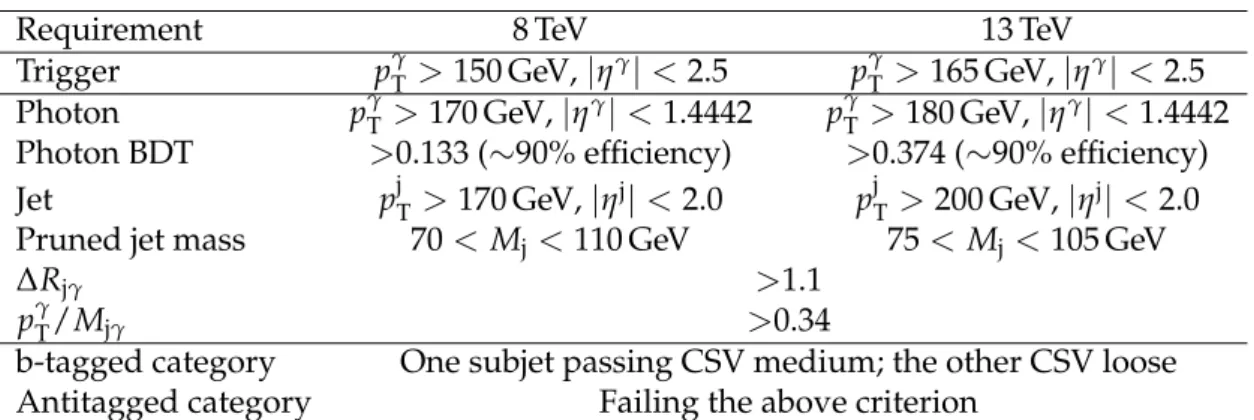
The events with a reconstructed photon and a large-cone jet consistent with a Z boson candidate are split into two categories: with or without a Z → bb candidate. These two categories are mutually exclusive and are used simultaneously in the analysis. The summary of the selections is given in Table 1.
Table 1: Summary of event selection.
Requirement 8 TeV 13 TeV
Trigger pγ T >150 GeV,|ηγ| <2.5 p γ T >165 GeV,|ηγ| <2.5 Photon pγ T >170 GeV,|ηγ| <1.4442 p γ T >180 GeV,|ηγ| <1.4442
Photon BDT >0.133 (∼90% efficiency) >0.374 (∼90% efficiency) Jet pjT >170 GeV,|ηj| <2.0 pjT >200 GeV,|ηj| <2.0
Pruned jet mass 70< Mj <110 GeV 75< Mj<105 GeV
∆Rjγ >1.1
pγ
T/Mjγ >0.34
b-tagged category One subjet passing CSV medium; the other CSV loose
Antitagged category Failing the above criterion
A Monte Carlo (MC) simulation, including the effects of pileup, is used to model the signal invariant mass peak and calculate the signal selection efficiency for various mass hypotheses between 0.65 and 3.0 TeV and for two width assumptions for a spin-0 resonance. One width assumption is termed “narrow”, and has the width set to 0.014% of the particle mass, and the second is referred to as “broad” with the width set to 5.6% of the mass. The first choice corre-sponds to a resonance with a natural width much less than the detector resolution. The second width value was chosen for direct comparison with the ATLAS Collaboration analysis [40] and corresponds to a resonance somewhat broader than the detector resolution. We assume no interference between the signal and the SM Zγ background.
the CTEQ6L [42] (NNPDF3.0 [43]) parton distribution functions (PDFs) for the 8 (13) TeV anal-ysis. In a second step, the PYTHIA 8 program is used to simulate hadronization and parton showering using the tune 4C [44] (CUETP8M1 [45, 46]) for the 8 (13) TeV analysis.
In addition, simulated SM background processes are used to optimize the analysis sensitivity. The SM Zγ and Wγ backgrounds are small compared to the dominant backgrounds from jets misidentified as photons in γ+jets and QCD multijet events, so we did not use SM Zγ and Wγ samples. However, this contribution to the background is included in the background estimate from data, as detailed in Section 5. In the 8 TeV analysis, the γ+jets and QCD multijet events are simulated at LO usingPYTHIA6.126 [47] with tune Z2* [46, 48], while the W+jets and Z+jets processes are simulated at LO with MADGRAPH v5.1.3.30 [49]. In both casesPYTHIA6
is used to describe fragmentation and hadronization processes. In the 13 TeV analysis, all these samples are simulated at LO with MADGRAPH5 aMC@NLO v2.2.2 [50] with the fragmentation and hadronization described by PYTHIA 8. The CMS detector response is modeled with the GEANT4 package [51]. The effect of pileup is taken into account by superimposing minimum bias events on the hard scattering, with the multiplicity of additional interactions adjusted to that observed in data. The average pileup in the 8 (13) TeV data sample was 21 (12). Simulated events are processed with the same chain of reconstruction programs as used for collision data.
4
Search strategy
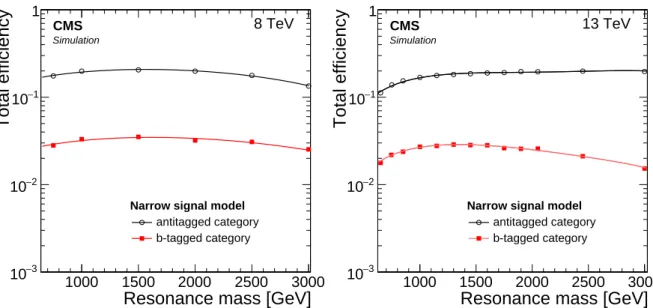
The search focuses on the mass range from 0.65 to 3 TeV. At the lower edge of this mass range about 50% of Z boson decays correspond to the merged jet topology; for resonance masses above 2 TeV this fraction exceeds 90%. In order to profit from both the high acceptance and low background, two exclusive search categories are formed in the analysis: a b-tagged category with a large-cone jet required to be consistent with the Z → bb decay (as described in the previous section), and an antitagged category with the large-cone jet failing this requirement. While the branching fraction of Z → bb decay is only about 20% of all hadronic decays, and there is an additional signal loss due to b tagging inefficiency, the background rejection due to b tagging exceeds a factor of 100. Consequently, the sensitivity of the b-tagged category in the low-mass range with large background is significant, leading to a sizable improvement (as large as 50%) in the signal sensitivity by splitting an inclusive selection into the two categories. Figure 1 shows the total selection and reconstruction efficiency for the X→Zγ decay mode of a narrow resonance in the two analysis categories. The total signal efficiency increases from 17% (12%) at 0.65 TeV to 20% (20%) at 2 TeV in the antitagged category for the 8 (13) TeV analysis, and is between 2 and 3% for the masses below 2 TeV in the b-tagged category. At very high res-onance masses the b tagging efficiency drops owing to the inability of the b tagging algorithm to disentangle individual jet components among highly boosted decay products. For a broad resonance at high masses (>1.5 TeV) the effect of rapidly falling PDFs introduces a lower tail in the mass distribution. The exact characteristics of this tail are very sensitive to the description of the resonance line-shape. Therefore, in this search, we require that the mass of the resonance corresponds to the core of the distribution, defined as a window centered on the CB function maximum with the width given by±5 times the CB function parameter σ, describing the stan-dard deviation of its Gaussian core. As a result, the efficiency of the analysis requirements, which include this request, for a heavy and broad resonance is lower than for a narrow one and drops to about 3% (0.3%) for the antitagged (b-tagged) category for a resonance mass of 3 TeV.
6 5 Background and signal modeling
Resonance mass [GeV]
1000 1500 2000 2500 3000 Total efficiency 3 − 10 2 − 10 1 − 10 1
Narrow signal model antitagged category b-tagged category
8 TeV
CMS
Simulation
Resonance mass [GeV]
1000 1500 2000 2500 3000 Total efficiency 3 − 10 2 − 10 1 − 10 1
Narrow signal model antitagged category b-tagged category
13 TeV
CMS
Simulation
Figure 1: Full selection and reconstruction efficiency (includingB(Z→ qq)) of the two search categories for a narrow resonance signal as a function of its mass in the 8 TeV analysis (left) and 13 TeV analysis (right).
5
Background and signal modeling
Using MC simulation and data studies based on a lower sideband of the jet mass distribution (50 < Mj < 70 GeV), we observed that the invariant mass distribution MZγ of the SM
back-ground is smoothly falling and that the distributions of kinematic observables derived from the lower jet mass sideband match those for the signal selection. We further checked that the background shapes in the b-tagged and antitagged categories are consistent with each other. Various families of functions to model the background shape have been tested in the lower jet mass sideband region, with selection requirements similar to those in the search region. The functions used to fit the background shape in the b-tagged and in the antitagged categories are chosen using the Fisher F-test. This test selects the optimal function by balancing the quality of the fit against the number of parameters required. In each case the following function is chosen: dN dMZγ =P0(MZγ/ √ s)P1+P2log(MZγ/ √ s) , (1)
where MZγis the invariant mass of the photon and the large-cone jet, √
s is the center-of-mass energy, P0 is a normalization parameter, and P1, P2 describe the shape of the invariant mass
spectrum.
In order to check for the presence of a possible systematic bias from the choice of the functional form, several tests are carried out with alternative functional forms, with or without signal in-jection. For these tests, the mass spectra in the two analysis categories derived either from the low-mass sideband in data or from MC simulation are fitted with a variety of test functions. The shapes obtained in these fits are used to generate pseudo-datasets with a total number of events randomly drawn from a Poisson distribution with the mean equal to the yields observed in data. Additionally, in a set of pseudo-experiments, signals with different mass values and cross sections close to the expected 95% confidence level (CL) limits are injected. The full spec-trum is fitted with the chosen function of Eq. (1) together with a signal model, and the signal cross section is extracted. Distributions of the difference between the data and the fit divided by the overall uncertainty for the obtained signal cross sections are constructed, and their shapes
are found to be consistent with a normal distribution with mean less than 0.5 and width con-sistent with unity. Thus, we conclude that any possible systematic bias from the choice of the functional form is small compared to the statistical uncertainty of the fit, and use the latter as the only uncertainty in the background prediction.
The observed MZγ invariant mass distributions in data in the antitagged and b-tagged
cate-gories along with the corresponding fits are shown in Fig. 2, separately for 8 and 13 TeV data.
[GeV] γ Z M 1000 1500 2000 2500 3000 3500 Events / 50 GeV 2 − 10 1 − 10 1 10 2 10 3 10 4 10 Data: antitagged Fit model 1 s. d. ± Fit 2 s. d. ± Fit (8 TeV) -1 19.7 fb CMS [GeV] γ Z M 1000 1500 2000 2500 3000 3500 stat σ (data-fit) 5 − 0 5 1000 1500 2000 2500 3000MZγ [GeV] 3500 Events / 50 GeV 2 − 10 1 − 10 1 10 2 10 3 10 4 10 Data: b-tagged Fit model 1 s. d. ± Fit 2 s. d. ± Fit (8 TeV) -1 19.7 fb CMS [GeV] γ Z M 1000 1500 2000 2500 3000 3500 stat σ (data-fit) 5 − 0 5 [GeV] γ Z M 1000 1500 2000 2500 3000 3500 Events / 50 GeV 2 − 10 1 − 10 1 10 2 10 3 10 4 10 Data: antitagged Fit model 1 s. d. ± Fit 2 s. d. ± Fit (13 TeV) -1 2.7 fb CMS [GeV] γ Z M 1000 1500 2000 2500 3000 3500 stat σ (data-fit) 5 − 0 5 MZγ [GeV] 1000 1500 2000 2500 3000 3500 Events / 50 GeV 2 − 10 1 − 10 1 10 2 10 Data: b-tagged Fit model 1 s. d. ± Fit 2 s. d. ± Fit (13 TeV) -1 2.7 fb CMS [GeV] γ Z M 1000 1500 2000 2500 3000 3500 stat σ (data-fit) 5 − 0 5
Figure 2: Fits to the MZγ invariant mass spectra in the search region for the antitagged (left
column) and b-tagged (right column) categories. Upper (lower) row corresponds to 8 (13) TeV data. The results of the fits to the two categories with the parametric background shape are shown. The lower panels show the difference between the data and the fit, divided by the statistical uncertainty in data σstat. For bins with a low number of data entries, the error bars
correspond to the Garwood confidence intervals [52]. The upper error bars for bins with zero data entries are shown only in the region up to the highest nonzero entry.
8 7 Results
The signal shape is extracted from MC simulation for various signal hypotheses tested in the analysis. The shape is parameterized with the combination of a Crystal Ball [53] (CB) function and a Gaussian function in order to ensure a good description of the tails. To derive the sig-nal shapes for the intermediate mass values where simulation points are not available, a linear morphing [54] of the shapes obtained from the MC simulation is used. The typical MZγ
res-onance core width is found to be 3 and 5% of the resres-onance mass for the narrow and broad resonance hypotheses, respectively.
6
Systematic uncertainties
Since the background estimation is obtained from a fit to the data, the only source of the sys-tematic uncertainty in the background estimate is associated with the possible bias in the choice of the fit function. This potential bias is checked as described in Section 5 and is found to be negligible with respect to the statistical uncertainty in the background normalization.
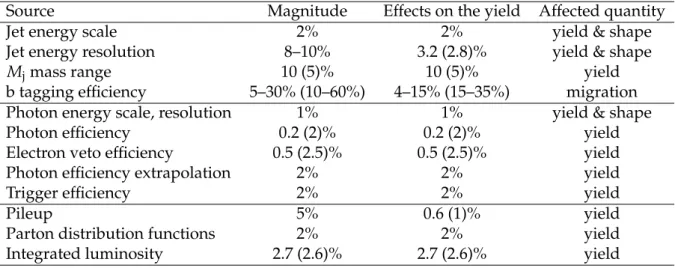
For the signal selection efficiency, there are several sources of systematic uncertainties, which are summarized in Table 2. Most of the uncertainties affect the overall signal efficiency, and only the b tagging efficiency uncertainty can result in signal category migration. The latter is larger for the 13 TeV analysis owing to the relatively small sizes of control samples in data available for their derivation.
The uncertainties in the jet energy scale and resolution [32, 33] are propagated to all relevant quantities, and affect both the signal yield and its shape. The overall effect of these uncertain-ties is found by changing the four-momenta of the jets by an amount equal to the uncertainty in their energy scale, or by smearing them with a resolution function, and carrying out the full analysis with modified quantities. The corresponding uncertainties in the signal yield are approximately 2.0 and 2.5%, respectively.
To account for a slight dependence of the pruned jet mass scale on the jet pT, an uncertainty in
the Z boson tagging efficiency of 10 (5)% is applied in the 8 (13) TeV analysis.
The systematic uncertainties in the photon energy scale and identification efficiency are derived from Z → e+e− events. The uncertainty in the photon energy scale is found to be about 1% and it includes the uncertainty on the extrapolation to higher-pTphotons. The ratio between the
photon reconstruction and identification efficiencies in data and in the simulation is consistent with unity within the 2% systematic uncertainty up to a photon pTof 200 GeV, and within the
4% systematic uncertainty in the photon pT range from 0.2 to 1.0 TeV.
The uncertainties in the measurement of the integrated luminosity (2.6% [55] and 2.7% [56] in the 8 and 13 TeV analyses, respectively), trigger efficiency (2%), and pileup description (5%) affect the overall signal yield and are taken into account. Concerning the PDF modeling [43], only the resultant uncertainty in the signal acceptance (2%), and not the signal cross section, is included in the overall experimental uncertainty.
7
Results
The MZγ invariant mass spectra observed in data in two categories for each data set (8 and
13 TeV), are fit simultaneously under the background-only, as well as the combined background and signal hypotheses, for various signal mass and width assumptions. Both the 8 and 13 TeV data are well described by the background-only hypothesis. We see no statistically significant evidence for a signal in the entire mass range probed. The largest deviation is seen in 13 TeV
Table 2: Summary of the sources of systematic uncertainties, their magnitudes, effects on the signal yield, and affected quantities. The third column indicates the magnitude of the yield variation. The last column indicates if the source of the uncertainty affects the total signal yield, signal shape, or introduces a category migration. The numbers in parentheses correspond to the 13 TeV analysis (whenever there is a difference from the 8 TeV numbers).
Source Magnitude Effects on the yield Affected quantity
Jet energy scale 2% 2% yield & shape
Jet energy resolution 8–10% 3.2 (2.8)% yield & shape
Mjmass range 10 (5)% 10 (5)% yield
b tagging efficiency 5–30% (10–60%) 4–15% (15–35%) migration
Photon energy scale, resolution 1% 1% yield & shape
Photon efficiency 0.2 (2)% 0.2 (2)% yield
Electron veto efficiency 0.5 (2.5)% 0.5 (2.5)% yield
Photon efficiency extrapolation 2% 2% yield
Trigger efficiency 2% 2% yield
Pileup 5% 0.6 (1)% yield
Parton distribution functions 2% 2% yield
Integrated luminosity 2.7 (2.6)% 2.7 (2.6)% yield
data at a mass around 2 TeV with a local significance of 3.6 standard deviations for a narrow resonance hypothesis, which corresponds to a global significance of approximately 2.5 standard deviations assuming a narrow resonance and taking into account the full search range [57]. This excess is not seen in 8 TeV data. The results are presented as upper limits on the new resonance production cross section times branching fraction to the Zγ final state. The limits are computed at 95% CL, using the asymptotic approximation [58] of the CLs criterion [59–61]. Log-normal
prior distributions for parameters are used to account for the systematic uncertainties in the signal and background yields, which are described in Section 6 and summarized in Table 2. The expected and observed upper cross section limits for spin-0 resonances with the two bench-mark widths from the combination of the antitagged and b-tagged categories are presented in Table 3 and Fig. 3. The table shows also individual limits from fits to a single category, illus-trating the relative weights of the two categories for various masses.
The 8 and 13 TeV results can be combined assuming a particular production mechanism for a resonance decaying into the Zγ channel. Similar to the combination of Zγ searches in the lep-tonic decay channel of the Z boson [15], we assume that the hypothetical spin-0 resonance is produced exclusively via gluon fusion, which is a natural production mechanism for a spin-0 particle with Yukawa-like couplings to quarks. The combination takes into account the ratio of gluon-gluon parton luminosities at the two center-of-mass energies, as calculated with the NNPDF2.3 PDFs. This ratio increases from approximately 4.1 for an invariant mass of 650 GeV to 23.7 for a mass of 2.5 TeV. It was checked that the uncertainty in the ratio of parton lumi-nosities at 13 and 8 TeV coming from the PDF uncertainties has negligible effect on the com-bined results in the range of masses probed. The combination is performed with the same CLs
criterion as used to obtain results in the individual channels. We assume that all sources of systematic uncertainty, except for the one related to the photon energy scale, are completely uncorrelated between the analyses at the two energies. This is a reasonable assumption, given that the dominant sources of the systematic uncertainty are the statistical uncertainty in the background fit and b tagging efficiency uncertainties in the signal yield, both of which are determined independently in the 8 and 13 TeV data, and therefore are uncorrelated.
10 7 Results
Resonance mass [GeV]
1000 1500 2000 2500 3000 ) [fb] γ Z → (X
Β
× σ -1 10 1 10 2 10 3 10Narrow signal model Observed limit Expected limit 1 s. d. ± Expected 2 s. d. ± Expected (8 TeV) -1 19.7 fb CMS
Resonance mass [GeV]
1000 1500 2000 2500 3000 ) [fb] γ Z → (X
Β
× σ 1 10 2 10 3 10Broad signal model Observed limit Expected limit 1 s. d. ± Expected 2 s. d. ± Expected (8 TeV) -1 19.7 fb CMS
Resonance mass [GeV]
1000 1500 2000 2500 3000 ) [fb] γ Z → (X
Β
× σ 1 10 2 10 3 10Narrow signal model Observed limit Expected limit 1 s. d. ± Expected 2 s. d. ± Expected (13 TeV) -1 2.7 fb CMS
Resonance mass [GeV]
1000 1500 2000 2500 3000 ) [fb] γ Z → (X
Β
× σ 1 10 2 10 3 10Broad signal model Observed limit Expected limit 1 s. d. ± Expected 2 s. d. ± Expected (13 TeV) -1 2.7 fb CMS
Figure 3: Expected and observed upper limits on the product of the cross section and branching fraction B(X → Zγ)for the production of a narrow (left) or broad (right) spin-0 resonance, obtained from the combination of antitagged and b-tagged categories in 8 TeV (upper) and 13 TeV (lower) data.
Table 3: Observed (expected) limits on the production cross section times branching fraction
B(X → Zγ)for narrow resonances from each of the two categories of the analysis, as well as from their combination.
Mass Limits [fb]
[GeV] Antitagged b-tagged Combined
8 TeV analysis 750 23 (28) 21 (32) 13 (20) 1000 9.7 (13) 36 (17) 13 (10) 2000 1.4 (1.7) 3.6 (4.7) 1.1 (1.5) 2500 2.0 (1.1) 3.5 (3.9) 1.6 (0.9) 3000 0.8 (1.0) 4.0 (4.3) 0.7 (0.8) 13 TeV analysis 750 149 (140) 94 (150) 74 (93) 1000 57 (61) 71 (87) 38 (46) 2000 27 (10) 63 (37) 25 (8.7) 2500 4.7 (6.6) 42 (41) 4.1 (5.8) 3000 4.4 (5.2) 51 (51) 3.9 (4.7)
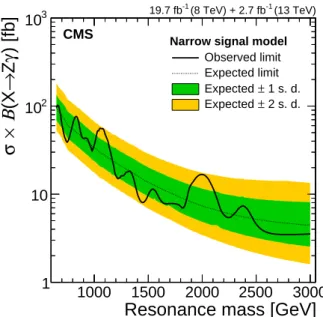
via gluon-gluon fusion mechanism at a center-of-mass energy of 13 TeV times branching frac-tion of the resonance decay in the Zγ channel. The combined expected and observed 95% CL limits for narrow resonance production are shown in Fig. 4.
Resonance mass [GeV]
1000 1500 2000 2500 3000
) [fb]
γ
Z
→
(X
Β
×
σ
1 10 2 10 3 10Narrow signal model Observed limit Expected limit 1 s. d. ± Expected 2 s. d. ± Expected (13 TeV) -1 (8 TeV) + 2.7 fb -1 19.7 fb CMS
Figure 4: Expected and observed limits on the product of the cross section at√s =13 TeV and branching fractionB(X→Zγ)for the production of a narrow spin-0 resonance, obtained from the combination of the 8 and 13 TeV analyses in the hadronic decay channel, assuming a gluon fusion production mechanism.
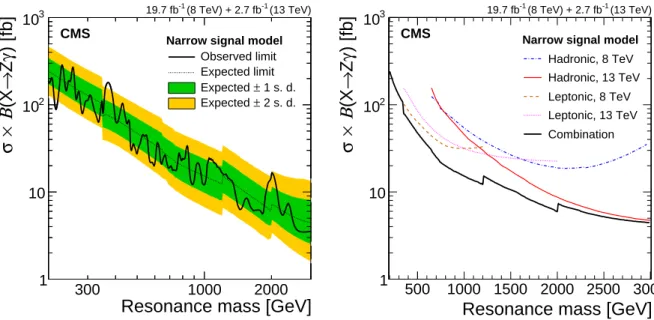
The results can be further combined with those from an analogous combined analysis in the leptonic Z boson decay channels [15], using the same technique and assumptions. The results are shown in Fig. 5, assuming uncorrelated uncertainties between the leptonic and hadronic channels, except for the uncertainties in the integrated luminosity, PDFs, and photon energy scale and resolution, which are taken as fully correlated between the two analyses. Since the leptonic analysis uses a different photon identification algorithm, the photon efficiency uncer-tainties are expected to be uncorrelated between the leptonic and hadronic channels.
12 8 Summary
Resonance mass [GeV]
300 1000 2000
) [fb]
γ
Z
→
(X
Β
×
σ
1 10 2 10 3 10Narrow signal model Observed limit Expected limit 1 s. d. ± Expected 2 s. d. ± Expected (13 TeV) -1 (8 TeV) + 2.7 fb -1 19.7 fb CMS
Resonance mass [GeV]
500 1000 1500 2000 2500 3000
) [fb]
γ
Z
→
(X
Β
×
σ
1 10 2 10 3 10Narrow signal model Hadronic, 8 TeV Hadronic, 13 TeV Leptonic, 8 TeV Leptonic, 13 TeV Combination (13 TeV) -1 (8 TeV) + 2.7 fb -1 19.7 fb CMS
Figure 5: Left: Expected and observed limits on the product of the cross section at√s=13 TeV and branching fractionB(X →Zγ)for the production of a narrow spin-0 resonance, obtained from the combination of the 8 and 13 TeV analyses in hadronic and leptonic [15] decay channels of the Z boson, assuming a gluon fusion production mechanism. Right: expected limits from the individual and combined analyses, showing the relative contribution of each channel. The discontinuities are due to the difference in the mass ranges used in the individual searches.
8
Summary
We have presented a search for new spin-0 resonances decaying to a Z boson and a photon, where the Z boson decays hadronically, in the mass range from 0.65 to 3.0 TeV, using 2012 and 2015 proton-proton collision data at center-of-mass energies of 8 and 13 TeV, respectively. The search is carried out with two exclusive categories of events, with or without identification of the Z→bb decay, and the final result is obtained from the combination of these two categories. Jet substructure and subjet b tagging techniques are used in order to enhance the sensitivity of the analysis. No significant deviation from the standard model prediction is found. Results are presented as upper limits at 95% confidence level on the product of the production cross section and the branching fraction of the Zγ decay channel of a new resonance. The results of the searches at the two center-of-mass energies are combined assuming the mechanism for production of a new resonance is gluon fusion. These results are further combined with those of analogous searches in the leptonic decay channel of the Z boson. The limits set in this analysis are the most stringent limits to date on Zγ resonances in a wide range of masses.
Acknowledgments
We congratulate our colleagues in the CERN accelerator departments for the excellent perfor-mance of the LHC and thank the technical and administrative staffs at CERN and at other CMS institutes for their contributions to the success of the CMS effort. In addition, we gratefully acknowledge the computing centres and personnel of the Worldwide LHC Computing Grid for delivering so effectively the computing infrastructure essential to our analyses. Finally, we acknowledge the enduring support for the construction and operation of the LHC and the CMS detector provided by the following funding agencies: BMWFW and FWF (Austria); FNRS and FWO (Belgium); CNPq, CAPES, FAPERJ, and FAPESP (Brazil); MES (Bulgaria); CERN;
CAS, MoST, and NSFC (China); COLCIENCIAS (Colombia); MSES and CSF (Croatia); RPF (Cyprus); SENESCYT (Ecuador); MoER, ERC IUT and ERDF (Estonia); Academy of Finland, MEC, and HIP (Finland); CEA and CNRS/IN2P3 (France); BMBF, DFG, and HGF (Germany); GSRT (Greece); OTKA and NIH (Hungary); DAE and DST (India); IPM (Iran); SFI (Ireland); INFN (Italy); MSIP and NRF (Republic of Korea); LAS (Lithuania); MOE and UM (Malaysia); BUAP, CINVESTAV, CONACYT, LNS, SEP, and UASLP-FAI (Mexico); MBIE (New Zealand); PAEC (Pakistan); MSHE and NSC (Poland); FCT (Portugal); JINR (Dubna); MON, RosAtom, RAS and RFBR (Russia); MESTD (Serbia); SEIDI and CPAN (Spain); Swiss Funding Agencies (Switzerland); MST (Taipei); ThEPCenter, IPST, STAR and NSTDA (Thailand); TUBITAK and TAEK (Turkey); NASU and SFFR (Ukraine); STFC (United Kingdom); DOE and NSF (USA). Individuals have received support from the Marie-Curie programme and the European Re-search Council and EPLANET (European Union); the Leventis Foundation; the A. P. Sloan Foundation; the Alexander von Humboldt Foundation; the Belgian Federal Science Policy Of-fice; the Fonds pour la Formation `a la Recherche dans l’Industrie et dans l’Agriculture (FRIA-Belgium); the Agentschap voor Innovatie door Wetenschap en Technologie (IWT-(FRIA-Belgium); the Ministry of Education, Youth and Sports (MEYS) of the Czech Republic; the Council of Sci-ence and Industrial Research, India; the HOMING PLUS programme of the Foundation for Polish Science, cofinanced from European Union, Regional Development Fund, the Mobil-ity Plus programme of the Ministry of Science and Higher Education, the National Science Center (Poland), contracts Harmonia 2014/14/M/ST2/00428, Opus 2013/11/B/ST2/04202, 2014/13/B/ST2/02543 and 2014/15/B/ST2/03998, Sonata-bis 2012/07/E/ST2/01406; the Thalis and Aristeia programmes cofinanced by EU-ESF and the Greek NSRF; the National Priorities Research Program by Qatar National Research Fund; the Programa Clar´ın-COFUND del Princi-pado de Asturias; the Rachadapisek Sompot Fund for Postdoctoral Fellowship, Chulalongkorn University and the Chulalongkorn Academic into Its 2nd Century Project Advancement Project (Thailand); and the Welch Foundation, contract C-1845.
References
[1] CMS Collaboration, “Search for massive resonances in dijet systems containing jets tagged as W or Z boson decays in pp collisions at√s =8 TeV”, JHEP 08 (2014) 173,
doi:10.1007/JHEP08(2014)173, arXiv:1405.1994.
[2] CMS Collaboration, “Search for massive resonances decaying into pairs of boosted bosons in semi-leptonic final states at√s=8 TeV”, JHEP 08 (2014) 174,
doi:10.1007/JHEP08(2014)174, arXiv:1405.3447.
[3] ATLAS Collaboration, “Combination of searches for WW, WZ, and ZZ resonances in pp collisions at√s=8 TeV with the ATLAS detector”, Phys. Lett. B 755 (2016) 285,
doi:10.1016/j.physletb.2016.02.015, arXiv:1512.05099.
[4] ATLAS Collaboration, “Searches for heavy diboson resonances in pp collisions at√ s =13 TeV with the ATLAS detector”, JHEP 09 (2016) 173,
doi:10.1007/JHEP09(2016)173, arXiv:1606.04833.
[5] ATLAS Collaboration, “Observation of a new particle in the search for the Standard Model Higgs boson with the ATLAS detector at the LHC”, Phys. Lett. B 716 (2012) 1, doi:10.1016/j.physletb.2012.08.020, arXiv:1207.7214.
14 References
[6] CMS Collaboration, “Observation of a new boson at a mass of 125 GeV with the CMS experiment at the LHC”, Phys. Lett. B 716 (2012) 30,
doi:10.1016/j.physletb.2012.08.021, arXiv:1207.7235.
[7] CMS Collaboration, “Observation of a new boson with mass near 125 GeV in pp collisions at√s=7 and 8 TeV”, JHEP 06 (2013) 081,
doi:10.1007/JHEP06(2013)081, arXiv:1303.4571.
[8] E. Eichten and K. Lane, “Low-scale technicolor at the Tevatron and LHC”, Phys. Lett. B 669(2008) 235, doi:10.1016/j.physletb.2008.09.047, arXiv:0706.2339. [9] R. Barbieri and R. Torre, “Signals of single particle production at the earliest LHC”, Phys.
Lett. B 695 (2011) 259, doi:10.1016/j.physletb.2010.11.037, arXiv:1008.5302.
[10] I. Low, J. Lykken, and G. Shaughnessy, “Singlet scalars as Higgs imposters at the Large Hadron Collider”, Phys. Rev. D 84 (2011) 035027,
doi:10.1103/PhysRevD.84.035027, arXiv:1105.4587.
[11] H. Davoudiasl, J. L. Hewett, and T. G. Rizzo, “Experimental probes of localized gravity: On and off the wall”, Phys. Rev. D 63 (2001) 075004,
doi:10.1103/PhysRevD.63.075004, arXiv:hep-ph/0006041.
[12] B. C. Allanach, J. P. Skittrall, and K. Sridhar, “Z boson decay to photon plus Kaluza-Klein graviton in large extra dimensions”, JHEP 11 (2007) 089,
doi:10.1088/1126-6708/2007/11/089, arXiv:0705.1953.
[13] A. Freitas and P. Schwaller, “Multi-photon signals from composite models at LHC”, JHEP 01 (2011) 022, doi:10.1007/JHEP01(2011)022, arXiv:1010.2528. [14] S. Heinemeyer et al., “Handbook of LHC Higgs cross sections: 3. Higgs properties”,
CERN Report CERN-2013-004, 2013. doi:10.5170/CERN-2013-004, arXiv:1307.1347.
[15] CMS Collaboration, “Search for high-mass Zγ resonances in e+e−γand µ+µ−γfinal
states in proton-proton collisions at√s=8 and 13 TeV”, (2016). arXiv:1610.02960. Submitted to JHEP.
[16] L3 Collaboration, “Search for anomalous couplings in the Higgs sector at LEP”, Phys. Lett. B 589 (2004) 89, doi:10.1016/j.physletb.2004.03.048,
arXiv:hep-ex/0403037.
[17] D0 Collaboration, “Search for particles decaying into a Z boson and a photon in p ¯p collisions at√s=1.96 TeV”, Phys. Lett. B 641 (2006) 415,
doi:10.1016/j.physletb.2006.08.079, arXiv:hep-ex/0605064. [Erratum:
doi:10.1016/j.physletb.2008.11.032].
[18] D0 Collaboration, “Search for a scalar or vector particle decaying into Zγ in p ¯p collisions at√s=1.96 TeV”, Phys. Lett. B 671 (2009) 349,
doi:10.1016/j.physletb.2008.12.009, arXiv:0806.0611.
[19] ATLAS Collaboration, “Measurements of Wγ and Zγ production in pp collisions at√ s =7 TeV with the ATLAS detector at the LHC”, Phys. Rev. D 87 (2013) 112003,
doi:10.1103/PhysRevD.87.112003, arXiv:1302.1283. [Erratum:
[20] ATLAS Collaboration, “Search for new resonances in Wγ and Zγ final states in pp collisions at√s=8 TeV with the ATLAS detector”, Phys. Lett. B 738 (2014) 428, doi:10.1016/j.physletb.2014.10.002, arXiv:1407.8150.
[21] CMS Collaboration, “Search for a Higgs boson decaying into a Z and a photon in pp collisions at√s=7 and 8 TeV”, Phys. Lett. B 726 (2013) 587,
doi:10.1016/j.physletb.2013.09.057, arXiv:1307.5515.
[22] ATLAS Collaboration, “Search for Higgs boson decays to a photon and a Z boson in pp collisions at√s=7 and 8 TeV with the ATLAS detector”, Phys. Lett. B 732 (2014) 8,
doi:10.1016/j.physletb.2014.03.015, arXiv:1402.3051.
[23] ATLAS Collaboration, “Search for heavy resonances decaying to a Z boson and a photon in pp collisions at√s=13 TeV with the ATLAS detector”, (2016). arXiv:1607.06363. [24] CMS Collaboration, “Description and performance of track and primary-vertex
reconstruction with the CMS tracker”, JINST 9 (2014) P10009, doi:10.1088/1748-0221/9/10/P10009, arXiv:1405.6569.
[25] CMS Collaboration, “The CMS experiment at the CERN LHC”, JINST 3 (2008) S08004, doi:10.1088/1748-0221/3/08/S08004.
[26] CMS Collaboration, “Particle–Flow Event Reconstruction in CMS and Performance for Jets, Taus, and EmissT ”, CMS Physics Analysis Summary CMS-PAS-PFT-09-001, CERN, Geneva, 2009.
[27] CMS Collaboration, “Commissioning of the Particle-Flow Event Reconstruction with the first LHC collisions recorded in the CMS detector”, CMS Physics Analysis Summary CMS-PAS-PFT-10-001, CERN, Geneva, 2010.
[28] CMS Collaboration, “Performance of photon reconstruction and identification with the CMS detector in proton-proton collisions at√s=8 TeV”, JINST 10 (2015) P08010,
doi:10.1088/1748-0221/10/08/P08010, arXiv:1502.02702.
[29] Y. L. Dokshitzer, G. D. Leder, S. Moretti, and B. R. Webber, “Better jet clustering algorithms”, JHEP 08 (1997) 001, doi:10.1088/1126-6708/1997/08/001, arXiv:hep-ph/9707323.
[30] M. Cacciari, G. P. Salam, and G. Soyez, “The anti-ktjet clustering algorithm”, JHEP 04
(2008) 063, doi:10.1088/1126-6708/2008/04/063, arXiv:0802.1189.
[31] M. Cacciari and G. P. Salam, “Pileup subtraction using jet areas”, Phys. Lett. B 659 (2008) 119, doi:10.1016/j.physletb.2007.09.077, arXiv:0707.1378.
[32] CMS Collaboration, “Determination of jet energy calibration and transverse momentum resolution in CMS”, JINST 6 (2011) P11002,
doi:10.1088/1748-0221/6/11/P11002, arXiv:1107.4277.
[33] CMS Collaboration, “Jet energy scale and resolution in the CMS experiment in pp collisions at 8 TeV”, (2016). arXiv:1607.03663.
[34] S. D. Ellis, C. K. Vermilion, and J. R. Walsh, “Techniques for improved heavy particle searches with jet substructure”, Phys. Rev. D 80 (2009) 051501,
16 References
[35] S. D. Ellis, C. K. Vermilion, and J. R. Walsh, “Recombination algorithms and jet substructure: pruning as a tool for heavy particle searches”, Phys. Rev. D 81 (2010) 094023, doi:10.1103/PhysRevD.81.094023, arXiv:0912.0033.
[36] CMS Collaboration, “Identification techniques for highly boosted W bosons that decay into hadrons”, JHEP 12 (2014) 017, doi:10.1007/JHEP12(2014)017,
arXiv:1410.4227.
[37] CMS Collaboration, “Identification of b-quark jets with the CMS experiment”, JINST 8 (2013) P04013, doi:10.1088/1748-0221/8/04/P04013, arXiv:1211.4462. [38] CMS Collaboration, “Performance of b tagging at√s=8 TeV in multijet, ttbar and
boosted topology events”, CMS Physics Analysis Summary CMS-PAS-BTV-13-001, CERN, Geneva, 2013.
[39] CMS Collaboration, “Identification of b quark jets at the CMS Experiment in the LHC Run 2”, CMS Physics Analysis Summary CMS-PAS-BTV-15-001, CERN, Geneva, 2015. [40] ATLAS Collaboration, “Search for resonances in diphoton events at√s=13 TeV with
the ATLAS detector”, JHEP 09 (2016) 001, doi:10.1007/JHEP09(2016)001, arXiv:1606.03833.
[41] T. Sj ¨ostrand, S. Mrenna, and P. Z. Skands, “A brief introduction to PYTHIA 8.1”, Comput. Phys. Commun. 178 (2008) 852, doi:10.1016/j.cpc.2008.01.036,
arXiv:0710.3820.
[42] J. Pumplin et al., “New generation of parton distributions with uncertainties from global QCD analysis”, JHEP 07 (2002) 012, doi:10.1088/1126-6708/2002/07/012,
arXiv:hep-ph/0201195.
[43] NNPDF Collaboration, “Parton distributions for the LHC Run II”, JHEP 04 (2015) 040, doi:10.1007/JHEP04(2015)040, arXiv:1410.8849.
[44] R. Corke and T. Sj ¨ostrand, “Interleaved parton showers and tuning prospects”, JHEP 03 (2011) 032, doi:10.1007/JHEP03(2011)032, arXiv:1011.1759.
[45] P. Skands, S. Carrazza, and J. Rojo, “Tuning PYTHIA 8.1: the Monash 2013 tune”, Eur. Phys. J. C 74 (2014) 3024, doi:10.1140/epjc/s10052-014-3024-y,
arXiv:1404.5630.
[46] CMS Collaboration, “Event generator tunes obtained from underlying event and multiparton scattering measurements”, Eur. Phys. J. C 76 (2016) 155,
doi:10.1140/epjc/s10052-016-3988-x, arXiv:1512.00815.
[47] T. Sj ¨ostrand, S. Mrenna, and P. Z. Skands, “PYTHIA 6.4 physics and manual”, JHEP 05 (2006) 026, doi:10.1088/1126-6708/2006/05/026, arXiv:hep-ph/0603175. [48] CMS Collaboration, “Study of the underlying event at forward rapidity in pp collisions
at√s=0.9, 2.76, and 7 TeV”, JHEP 04 (2013) 072, doi:10.1007/JHEP04(2013)072, arXiv:1302.2394.
[49] J. Alwall et al., “MadGraph 5: going beyond”, JHEP 06 (2011) 128,
[50] J. Alwall et al., “The automated computation of tree-level and next-to-leading order differential cross sections, and their matching to parton shower simulations”, JHEP 07 (2014) 079, doi:10.1007/JHEP07(2014)079, arXiv:1405.0301.
[51] GEANT4 Collaboration, “GEANT4 — a simulation toolkit”, Nucl. Instrum. Meth. A 506 (2003) 250, doi:10.1016/S0168-9002(03)01368-8.
[52] F. Garwood, “Fiducial Limits for the Poisson Distribution”, Biometrika 28 (1936) 437,
doi:10.1093/biomet/28.3-4.437.
[53] M. J. Oreglia, “A study of the reactions ψ0 →γγψ”. PhD thesis, Stanford University,
1980. SLAC Report SLAC-R-236.
[54] A. L. Read, “Linear interpolation of histograms”, Nucl. Instrum. Meth. A 425 (1999) 357, doi:10.1016/S0168-9002(98)01347-3.
[55] CMS Collaboration, “CMS Luminosity Based on Pixel Cluster Counting — Summer 2013 Update”, CMS Physics Analysis Summary CMS-PAS-LUM-13-001, CERN, Geneva, 2013. [56] CMS Collaboration, “CMS Luminosity Measurement for the 2015 Data Taking Period”,
CMS Physics Analysis Summary CMS-PAS-LUM-15-001, CERN, Geneva, 2015.
[57] E. Gross and O. Vitells, “Trial factors or the look elsewhere effect in high energy physics”, Eur. Phys. J. C 70 (2010) 525, doi:10.1140/epjc/s10052-010-1470-8,
arXiv:1005.1891.
[58] G. Cowan, K. Cranmer, E. Gross, and O. Vitells, “Asymptotic formulae for likelihood-based tests of new physics”, Eur. Phys. J. C 71 (2011) 1554,
doi:10.1140/epjc/s10052-011-1554-0, arXiv:1007.1727. [Erratum: doi:10.1140/epjc/s10052-013-2501-z].
[59] A. L. Read, “Presentation of search results: The CLstechnique”, J. Phys. G 28 (2002) 2693,
doi:10.1088/0954-3899/28/10/313.
[60] T. Junk, “Confidence level computation for combining searches with small statistics”, Nucl. Instrum. Meth. A 434 (1999) 435, doi:10.1016/S0168-9002(99)00498-2,
arXiv:hep-ex/9902006.
[61] ATLAS and CMS Collaborations, “Procedure for the LHC Higgs boson search
A
The CMS Collaboration
Yerevan Physics Institute, Yerevan, Armenia A.M. Sirunyan, A. Tumasyan
Institut f ¨ur Hochenergiephysik, Wien, Austria
W. Adam, E. Asilar, T. Bergauer, J. Brandstetter, E. Brondolin, M. Dragicevic, J. Er ¨o, M. Flechl, M. Friedl, R. Fr ¨uhwirth1, V.M. Ghete, C. Hartl, N. H ¨ormann, J. Hrubec, M. Jeitler1, A. K ¨onig, I. Kr¨atschmer, D. Liko, T. Matsushita, I. Mikulec, D. Rabady, N. Rad, B. Rahbaran, H. Rohringer, J. Schieck1, J. Strauss, W. Waltenberger, C.-E. Wulz1
Institute for Nuclear Problems, Minsk, Belarus
O. Dvornikov, V. Makarenko, V. Mossolov, J. Suarez Gonzalez, V. Zykunov National Centre for Particle and High Energy Physics, Minsk, Belarus N. Shumeiko
Universiteit Antwerpen, Antwerpen, Belgium
S. Alderweireldt, E.A. De Wolf, X. Janssen, J. Lauwers, M. Van De Klundert, H. Van Haevermaet, P. Van Mechelen, N. Van Remortel, A. Van Spilbeeck
Vrije Universiteit Brussel, Brussel, Belgium
S. Abu Zeid, F. Blekman, J. D’Hondt, N. Daci, I. De Bruyn, K. Deroover, S. Lowette, S. Moortgat, L. Moreels, A. Olbrechts, Q. Python, K. Skovpen, S. Tavernier, W. Van Doninck, P. Van Mulders, I. Van Parijs
Universit´e Libre de Bruxelles, Bruxelles, Belgium
H. Brun, B. Clerbaux, G. De Lentdecker, H. Delannoy, G. Fasanella, L. Favart, R. Goldouzian, A. Grebenyuk, G. Karapostoli, T. Lenzi, A. L´eonard, J. Luetic, T. Maerschalk, A. Marinov, A. Randle-conde, T. Seva, C. Vander Velde, P. Vanlaer, D. Vannerom, R. Yonamine, F. Zenoni, F. Zhang2
Ghent University, Ghent, Belgium
A. Cimmino, T. Cornelis, D. Dobur, A. Fagot, M. Gul, I. Khvastunov, D. Poyraz, S. Salva, R. Sch ¨ofbeck, M. Tytgat, W. Van Driessche, E. Yazgan, N. Zaganidis
Universit´e Catholique de Louvain, Louvain-la-Neuve, Belgium
H. Bakhshiansohi, C. Beluffi3, O. Bondu, S. Brochet, G. Bruno, A. Caudron, S. De Visscher, C. Delaere, M. Delcourt, B. Francois, A. Giammanco, A. Jafari, M. Komm, G. Krintiras, V. Lemaitre, A. Magitteri, A. Mertens, M. Musich, K. Piotrzkowski, L. Quertenmont, M. Selvaggi, M. Vidal Marono, S. Wertz
Universit´e de Mons, Mons, Belgium N. Beliy
Centro Brasileiro de Pesquisas Fisicas, Rio de Janeiro, Brazil
W.L. Ald´a J ´unior, F.L. Alves, G.A. Alves, L. Brito, C. Hensel, A. Moraes, M.E. Pol, P. Rebello Teles
Universidade do Estado do Rio de Janeiro, Rio de Janeiro, Brazil
E. Belchior Batista Das Chagas, W. Carvalho, J. Chinellato4, A. Cust ´odio, E.M. Da Costa, G.G. Da Silveira5, D. De Jesus Damiao, C. De Oliveira Martins, S. Fonseca De Souza, L.M. Huertas Guativa, H. Malbouisson, D. Matos Figueiredo, C. Mora Herrera, L. Mundim, H. Nogima, W.L. Prado Da Silva, A. Santoro, A. Sznajder, E.J. Tonelli Manganote4, F. Torres Da Silva De Araujo, A. Vilela Pereira
20 A The CMS Collaboration
Universidade Estadual Paulistaa, Universidade Federal do ABCb, S˜ao Paulo, Brazil
S. Ahujaa, C.A. Bernardesa, S. Dograa, T.R. Fernandez Perez Tomeia, E.M. Gregoresb, P.G. Mercadanteb, C.S. Moona, S.F. Novaesa, Sandra S. Padulaa, D. Romero Abadb, J.C. Ruiz Vargasa
Institute for Nuclear Research and Nuclear Energy, Sofia, Bulgaria
A. Aleksandrov, R. Hadjiiska, P. Iaydjiev, M. Rodozov, S. Stoykova, G. Sultanov, M. Vutova University of Sofia, Sofia, Bulgaria
A. Dimitrov, I. Glushkov, L. Litov, B. Pavlov, P. Petkov Beihang University, Beijing, China
W. Fang6
Institute of High Energy Physics, Beijing, China
M. Ahmad, J.G. Bian, G.M. Chen, H.S. Chen, M. Chen, Y. Chen7, T. Cheng, C.H. Jiang, D. Leggat, Z. Liu, F. Romeo, M. Ruan, S.M. Shaheen, A. Spiezia, J. Tao, C. Wang, Z. Wang, H. Zhang, J. Zhao
State Key Laboratory of Nuclear Physics and Technology, Peking University, Beijing, China Y. Ban, G. Chen, Q. Li, S. Liu, Y. Mao, S.J. Qian, D. Wang, Z. Xu
Universidad de Los Andes, Bogota, Colombia
C. Avila, A. Cabrera, L.F. Chaparro Sierra, C. Florez, J.P. Gomez, C.F. Gonz´alez Hern´andez, J.D. Ruiz Alvarez, J.C. Sanabria
University of Split, Faculty of Electrical Engineering, Mechanical Engineering and Naval Architecture, Split, Croatia
N. Godinovic, D. Lelas, I. Puljak, P.M. Ribeiro Cipriano, T. Sculac University of Split, Faculty of Science, Split, Croatia
Z. Antunovic, M. Kovac
Institute Rudjer Boskovic, Zagreb, Croatia
V. Brigljevic, D. Ferencek, K. Kadija, B. Mesic, T. Susa University of Cyprus, Nicosia, Cyprus
A. Attikis, G. Mavromanolakis, J. Mousa, C. Nicolaou, F. Ptochos, P.A. Razis, H. Rykaczewski, D. Tsiakkouri
Charles University, Prague, Czech Republic M. Finger8, M. Finger Jr.8
Universidad San Francisco de Quito, Quito, Ecuador E. Carrera Jarrin
Academy of Scientific Research and Technology of the Arab Republic of Egypt, Egyptian Network of High Energy Physics, Cairo, Egypt
E. El-khateeb9, S. Elgammal10, A. Mohamed11
National Institute of Chemical Physics and Biophysics, Tallinn, Estonia M. Kadastik, L. Perrini, M. Raidal, A. Tiko, C. Veelken
Department of Physics, University of Helsinki, Helsinki, Finland P. Eerola, J. Pekkanen, M. Voutilainen
Helsinki Institute of Physics, Helsinki, Finland
J. H¨ark ¨onen, T. J¨arvinen, V. Karim¨aki, R. Kinnunen, T. Lamp´en, K. Lassila-Perini, S. Lehti, T. Lind´en, P. Luukka, J. Tuominiemi, E. Tuovinen, L. Wendland
Lappeenranta University of Technology, Lappeenranta, Finland J. Talvitie, T. Tuuva
IRFU, CEA, Universit´e Paris-Saclay, Gif-sur-Yvette, France
M. Besancon, F. Couderc, M. Dejardin, D. Denegri, B. Fabbro, J.L. Faure, C. Favaro, F. Ferri, S. Ganjour, S. Ghosh, A. Givernaud, P. Gras, G. Hamel de Monchenault, P. Jarry, I. Kucher, E. Locci, M. Machet, J. Malcles, J. Rander, A. Rosowsky, M. Titov
Laboratoire Leprince-Ringuet, Ecole Polytechnique, IN2P3-CNRS, Palaiseau, France
A. Abdulsalam, I. Antropov, S. Baffioni, F. Beaudette, P. Busson, L. Cadamuro, E. Chapon, C. Charlot, O. Davignon, R. Granier de Cassagnac, M. Jo, S. Lisniak, P. Min´e, M. Nguyen, C. Ochando, G. Ortona, P. Paganini, P. Pigard, S. Regnard, R. Salerno, Y. Sirois, T. Strebler, Y. Yilmaz, A. Zabi, A. Zghiche
Institut Pluridisciplinaire Hubert Curien (IPHC), Universit´e de Strasbourg, CNRS-IN2P3 J.-L. Agram12, J. Andrea, A. Aubin, D. Bloch, J.-M. Brom, M. Buttignol, E.C. Chabert,
N. Chanon, C. Collard, E. Conte12, X. Coubez, J.-C. Fontaine12, D. Gel´e, U. Goerlach, A.-C. Le Bihan, P. Van Hove
Centre de Calcul de l’Institut National de Physique Nucleaire et de Physique des Particules, CNRS/IN2P3, Villeurbanne, France
S. Gadrat
Universit´e de Lyon, Universit´e Claude Bernard Lyon 1, CNRS-IN2P3, Institut de Physique Nucl´eaire de Lyon, Villeurbanne, France
S. Beauceron, C. Bernet, G. Boudoul, C.A. Carrillo Montoya, R. Chierici, D. Contardo, B. Courbon, P. Depasse, H. El Mamouni, J. Fay, S. Gascon, M. Gouzevitch, G. Grenier, B. Ille, F. Lagarde, I.B. Laktineh, M. Lethuillier, L. Mirabito, A.L. Pequegnot, S. Perries, A. Popov13, D. Sabes, V. Sordini, M. Vander Donckt, P. Verdier, S. Viret
Georgian Technical University, Tbilisi, Georgia A. Khvedelidze8
Tbilisi State University, Tbilisi, Georgia Z. Tsamalaidze8
RWTH Aachen University, I. Physikalisches Institut, Aachen, Germany
C. Autermann, S. Beranek, L. Feld, M.K. Kiesel, K. Klein, M. Lipinski, M. Preuten, C. Schomakers, J. Schulz, T. Verlage
RWTH Aachen University, III. Physikalisches Institut A, Aachen, Germany
A. Albert, M. Brodski, E. Dietz-Laursonn, D. Duchardt, M. Endres, M. Erdmann, S. Erdweg, T. Esch, R. Fischer, A. G ¨uth, M. Hamer, T. Hebbeker, C. Heidemann, K. Hoepfner, S. Knutzen, M. Merschmeyer, A. Meyer, P. Millet, S. Mukherjee, M. Olschewski, K. Padeken, T. Pook, M. Radziej, H. Reithler, M. Rieger, F. Scheuch, L. Sonnenschein, D. Teyssier, S. Th ¨uer
RWTH Aachen University, III. Physikalisches Institut B, Aachen, Germany
V. Cherepanov, G. Fl ¨ugge, B. Kargoll, T. Kress, A. K ¨unsken, J. Lingemann, T. M ¨uller, A. Nehrkorn, A. Nowack, C. Pistone, O. Pooth, A. Stahl14
22 A The CMS Collaboration
Deutsches Elektronen-Synchrotron, Hamburg, Germany
M. Aldaya Martin, T. Arndt, C. Asawatangtrakuldee, K. Beernaert, O. Behnke, U. Behrens, A.A. Bin Anuar, K. Borras15, A. Campbell, P. Connor, C. Contreras-Campana, F. Costanza, C. Diez Pardos, G. Dolinska, G. Eckerlin, D. Eckstein, T. Eichhorn, E. Eren, E. Gallo16,
J. Garay Garcia, A. Geiser, A. Gizhko, J.M. Grados Luyando, A. Grohsjean, P. Gunnellini, A. Harb, J. Hauk, M. Hempel17, H. Jung, A. Kalogeropoulos, O. Karacheban17, M. Kasemann, J. Keaveney, C. Kleinwort, I. Korol, D. Kr ¨ucker, W. Lange, A. Lelek, T. Lenz, J. Leonard, K. Lipka, A. Lobanov, W. Lohmann17, R. Mankel, I.-A. Melzer-Pellmann, A.B. Meyer, G. Mittag, J. Mnich, A. Mussgiller, D. Pitzl, R. Placakyte, A. Raspereza, B. Roland, M. ¨O. Sahin, P. Saxena, T. Schoerner-Sadenius, S. Spannagel, N. Stefaniuk, G.P. Van Onsem, R. Walsh, C. Wissing University of Hamburg, Hamburg, Germany
V. Blobel, M. Centis Vignali, A.R. Draeger, T. Dreyer, E. Garutti, D. Gonzalez, J. Haller, M. Hoffmann, A. Junkes, R. Klanner, R. Kogler, N. Kovalchuk, T. Lapsien, I. Marchesini, D. Marconi, M. Meyer, M. Niedziela, D. Nowatschin, F. Pantaleo14, T. Peiffer, A. Perieanu, C. Scharf, P. Schleper, A. Schmidt, S. Schumann, J. Schwandt, H. Stadie, G. Steinbr ¨uck, F.M. Stober, M. St ¨over, H. Tholen, D. Troendle, E. Usai, L. Vanelderen, A. Vanhoefer, B. Vormwald
Institut f ¨ur Experimentelle Kernphysik, Karlsruhe, Germany
M. Akbiyik, C. Barth, S. Baur, C. Baus, J. Berger, E. Butz, R. Caspart, T. Chwalek, F. Colombo, W. De Boer, A. Dierlamm, S. Fink, B. Freund, R. Friese, M. Giffels, A. Gilbert, P. Goldenzweig, D. Haitz, F. Hartmann14, S.M. Heindl, U. Husemann, I. Katkov13, S. Kudella, H. Mildner, M.U. Mozer, Th. M ¨uller, M. Plagge, G. Quast, K. Rabbertz, S. R ¨ocker, F. Roscher, M. Schr ¨oder, I. Shvetsov, G. Sieber, H.J. Simonis, R. Ulrich, S. Wayand, M. Weber, T. Weiler, S. Williamson, C. W ¨ohrmann, R. Wolf
Institute of Nuclear and Particle Physics (INPP), NCSR Demokritos, Aghia Paraskevi, Greece
G. Anagnostou, G. Daskalakis, T. Geralis, V.A. Giakoumopoulou, A. Kyriakis, D. Loukas, I. Topsis-Giotis
National and Kapodistrian University of Athens, Athens, Greece S. Kesisoglou, A. Panagiotou, N. Saoulidou, E. Tziaferi
University of Io´annina, Io´annina, Greece
I. Evangelou, G. Flouris, C. Foudas, P. Kokkas, N. Loukas, N. Manthos, I. Papadopoulos, E. Paradas
MTA-ELTE Lend ¨ulet CMS Particle and Nuclear Physics Group, E ¨otv ¨os Lor´and University, Budapest, Hungary
N. Filipovic, G. Pasztor
Wigner Research Centre for Physics, Budapest, Hungary
G. Bencze, C. Hajdu, D. Horvath18, F. Sikler, V. Veszpremi, G. Vesztergombi19, A.J. Zsigmond Institute of Nuclear Research ATOMKI, Debrecen, Hungary
N. Beni, S. Czellar, J. Karancsi20, A. Makovec, J. Molnar, Z. Szillasi Institute of Physics, University of Debrecen
M. Bart ´ok19, P. Raics, Z.L. Trocsanyi, B. Ujvari
Indian Institute of Science (IISc) J.R. Komaragiri
National Institute of Science Education and Research, Bhubaneswar, India
S. Bahinipati21, S. Bhowmik22, S. Choudhury23, P. Mal, K. Mandal, A. Nayak24, D.K. Sahoo21, N. Sahoo, S.K. Swain
Panjab University, Chandigarh, India
S. Bansal, S.B. Beri, V. Bhatnagar, R. Chawla, U.Bhawandeep, A.K. Kalsi, A. Kaur, M. Kaur, R. Kumar, P. Kumari, A. Mehta, M. Mittal, J.B. Singh, G. Walia
University of Delhi, Delhi, India
Ashok Kumar, A. Bhardwaj, B.C. Choudhary, R.B. Garg, S. Keshri, S. Malhotra, M. Naimuddin, K. Ranjan, R. Sharma, V. Sharma
Saha Institute of Nuclear Physics, Kolkata, India
R. Bhattacharya, S. Bhattacharya, K. Chatterjee, S. Dey, S. Dutt, S. Dutta, S. Ghosh, N. Majumdar, A. Modak, K. Mondal, S. Mukhopadhyay, S. Nandan, A. Purohit, A. Roy, D. Roy, S. Roy Chowdhury, S. Sarkar, M. Sharan, S. Thakur
Indian Institute of Technology Madras, Madras, India P.K. Behera
Bhabha Atomic Research Centre, Mumbai, India
R. Chudasama, D. Dutta, V. Jha, V. Kumar, A.K. Mohanty14, P.K. Netrakanti, L.M. Pant, P. Shukla, A. Topkar
Tata Institute of Fundamental Research-A, Mumbai, India
T. Aziz, S. Dugad, G. Kole, B. Mahakud, S. Mitra, G.B. Mohanty, B. Parida, N. Sur, B. Sutar Tata Institute of Fundamental Research-B, Mumbai, India
S. Banerjee, R.K. Dewanjee, S. Ganguly, M. Guchait, Sa. Jain, S. Kumar, M. Maity22, G. Majumder, K. Mazumdar, T. Sarkar22, N. Wickramage25
Indian Institute of Science Education and Research (IISER), Pune, India
S. Chauhan, S. Dube, V. Hegde, A. Kapoor, K. Kothekar, S. Pandey, A. Rane, S. Sharma Institute for Research in Fundamental Sciences (IPM), Tehran, Iran
S. Chenarani26, E. Eskandari Tadavani, S.M. Etesami26, M. Khakzad, M. Mohammadi Najafabadi, M. Naseri, S. Paktinat Mehdiabadi27, F. Rezaei Hosseinabadi, B. Safarzadeh28, M. Zeinali
University College Dublin, Dublin, Ireland M. Felcini, M. Grunewald
INFN Sezione di Baria, Universit`a di Barib, Politecnico di Baric, Bari, Italy
M. Abbresciaa,b, C. Calabriaa,b, C. Caputoa,b, A. Colaleoa, D. Creanzaa,c, L. Cristellaa,b, N. De Filippisa,c, M. De Palmaa,b, L. Fiorea, G. Iasellia,c, G. Maggia,c, M. Maggia, G. Minielloa,b, S. Mya,b, S. Nuzzoa,b, A. Pompilia,b, G. Pugliesea,c, R. Radognaa,b, A. Ranieria, G. Selvaggia,b, A. Sharmaa, L. Silvestrisa,14, R. Vendittia,b, P. Verwilligena
INFN Sezione di Bolognaa, Universit`a di Bolognab, Bologna, Italy
G. Abbiendia, C. Battilana, D. Bonacorsia,b, S. Braibant-Giacomellia,b, L. Brigliadoria,b,
R. Campaninia,b, P. Capiluppia,b, A. Castroa,b, F.R. Cavalloa, S.S. Chhibraa,b, G. Codispotia,b, M. Cuffiania,b, G.M. Dallavallea, F. Fabbria, A. Fanfania,b, D. Fasanellaa,b, P. Giacomellia, C. Grandia, L. Guiduccia,b, S. Marcellinia, G. Masettia, A. Montanaria, F.L. Navarriaa,b, A. Perrottaa, A.M. Rossia,b, T. Rovellia,b, G.P. Sirolia,b, N. Tosia,b,14
24 A The CMS Collaboration
INFN Sezione di Cataniaa, Universit`a di Cataniab, Catania, Italy
S. Albergoa,b, S. Costaa,b, A. Di Mattiaa, F. Giordanoa,b, R. Potenzaa,b, A. Tricomia,b, C. Tuvea,b INFN Sezione di Firenzea, Universit`a di Firenzeb, Firenze, Italy
G. Barbaglia, V. Ciullia,b, C. Civininia, R. D’Alessandroa,b, E. Focardia,b, P. Lenzia,b, M. Meschinia, S. Paolettia, L. Russoa,29, G. Sguazzonia, D. Stroma, L. Viliania,b,14
INFN Laboratori Nazionali di Frascati, Frascati, Italy L. Benussi, S. Bianco, F. Fabbri, D. Piccolo, F. Primavera14
INFN Sezione di Genovaa, Universit`a di Genovab, Genova, Italy V. Calvellia,b, F. Ferroa, M.R. Mongea,b, E. Robuttia, S. Tosia,b
INFN Sezione di Milano-Bicoccaa, Universit`a di Milano-Bicoccab, Milano, Italy
L. Brianzaa,b,14, F. Brivioa,b, V. Ciriolo, M.E. Dinardoa,b, S. Fiorendia,b,14, S. Gennaia, A. Ghezzia,b, P. Govonia,b, M. Malbertia,b, S. Malvezzia, R.A. Manzonia,b, D. Menascea, L. Moronia, M. Paganonia,b, D. Pedrinia, S. Pigazzinia,b, S. Ragazzia,b, T. Tabarelli de Fatisa,b INFN Sezione di Napolia, Universit`a di Napoli ’Federico II’b, Napoli, Italy, Universit`a della Basilicatac, Potenza, Italy, Universit`a G. Marconid, Roma, Italy
S. Buontempoa, N. Cavalloa,c, G. De Nardo, S. Di Guidaa,d,14, M. Espositoa,b, F. Fabozzia,c, F. Fiengaa,b, A.O.M. Iorioa,b, G. Lanzaa, L. Listaa, S. Meolaa,d,14, P. Paoluccia,14, C. Sciaccaa,b, F. Thyssena
INFN Sezione di Padova a, Universit`a di Padova b, Padova, Italy, Universit`a di Trento c, Trento, Italy
P. Azzia,14, N. Bacchettaa, L. Benatoa,b, D. Biselloa,b, A. Bolettia,b, R. Carlina,b, A. Carvalho
Antunes De Oliveiraa,b, P. Checchiaa, M. Dall’Ossoa,b, P. De Castro Manzanoa, T. Dorigoa, U. Dossellia, F. Gasparinia,b, U. Gasparinia,b, A. Gozzelinoa, S. Lacapraraa, M. Margonia,b, A.T. Meneguzzoa,b, J. Pazzinia,b, N. Pozzobona,b, P. Ronchesea,b, F. Simonettoa,b, E. Torassaa, M. Zanettia,b, P. Zottoa,b, G. Zumerlea,b
INFN Sezione di Paviaa, Universit`a di Paviab, Pavia, Italy
A. Braghieria, F. Fallavollitaa,b, A. Magnania,b, P. Montagnaa,b, S.P. Rattia,b, V. Rea, C. Riccardia,b, P. Salvinia, I. Vaia,b, P. Vituloa,b
INFN Sezione di Perugiaa, Universit`a di Perugiab, Perugia, Italy
L. Alunni Solestizia,b, G.M. Bileia, D. Ciangottinia,b, L. Fan `oa,b, P. Laricciaa,b, R. Leonardia,b, G. Mantovania,b, M. Menichellia, A. Sahaa, A. Santocchiaa,b
INFN Sezione di Pisaa, Universit`a di Pisab, Scuola Normale Superiore di Pisac, Pisa, Italy K. Androsova,29, P. Azzurria,14, G. Bagliesia, J. Bernardinia, T. Boccalia, R. Castaldia, M.A. Cioccia,29, R. Dell’Orsoa, S. Donatoa,c, G. Fedi, A. Giassia, M.T. Grippoa,29, F. Ligabuea,c,
T. Lomtadzea, L. Martinia,b, A. Messineoa,b, F. Pallaa, A. Rizzia,b, A. Savoy-Navarroa,30, P. Spagnoloa, R. Tenchinia, G. Tonellia,b, A. Venturia, P.G. Verdinia
INFN Sezione di Romaa, Universit`a di Romab, Roma, Italy
L. Baronea,b, F. Cavallaria, M. Cipriania,b, D. Del Rea,b,14, M. Diemoza, S. Gellia,b, E. Longoa,b, F. Margarolia,b, B. Marzocchia,b, P. Meridiania, G. Organtinia,b, R. Paramattia, F. Preiatoa,b, S. Rahatloua,b, C. Rovellia, F. Santanastasioa,b
INFN Sezione di Torino a, Universit`a di Torino b, Torino, Italy, Universit`a del Piemonte Orientalec, Novara, Italy
N. Amapanea,b, R. Arcidiaconoa,c,14, S. Argiroa,b, M. Arneodoa,c, N. Bartosika, R. Bellana,b, C. Biinoa, N. Cartigliaa, F. Cennaa,b, M. Costaa,b, R. Covarellia,b, A. Deganoa,b, N. Demariaa,