RIGHTS MANAGEMENT ON KNOWLEDGE-BASED DIGITAL CONTENT
Carlos Serrão, ISCTE/DCTI, [email protected] Joaquim Marques, EST/IPCB, [email protected]
Ana Mendes, ESCE/IPS, [email protected]
ABSTRACT: The digital networks have facilitated the digital content access and sharing. Although this creates the opportunities to a wider dissemination of information and knowledge, on the other hand it creates challenges on what concerns the protection and enforcement of Intellectual Property (IP). This is particular important on the IP management of digital knowledge-based that is create on a daily basis on educational and research institutions, where a set of researchers and educators contribute with their knowledge creation works to the education value-adding processes.
This paper will address the different scenarios/stages where the application of rights management solutions to the protection and management of knowledge-based content can provide an appropriate management of IP. These scenarios will consider the production and protection of the content, the rights establishment for the dissemination of content and the appropriate IP enforcement on the content user-side. This would establish a global environment where knowledge-based content IPR can be governed, allowing authors to establish the conditions that allow others to use their own work.
Keywords: knowledge-based content, security, rights management, e-learning, education, dissemination
INTRODUCTION
Higher Education Institutions (HEI), as social and complex organizations [13] with their own mission and clearly defined goals, have been pushed to rethink their role in the society, looking forward for a more pro-active leadership and managing practices of its formative offer and their products and services [14]. These institutions have been seeking, to develop/adopt new mechanisms that allow them to focus their attentions on core business – Knowledge Management.
HEI, known as the Knowledge Institutions, are responsible for: information and knowledge dissemination, through their education and training delivery; knowledge creation, through research and innovation that occurs in collaboration with external environment within consultancy services [18].
So, due to its nature, the Higher Education sector is one of the most important ones on the creation and usage of Intellectual Property (IP) content. It is at the same time, one of the largest consumers of IP creations and the entity responsible for creating new IP content and incorporating existing IP content into new creations [1]. There are different main types of IP-like patents for inventions; trademarks for brand identity, designs for product appearance and copyright for material like literary and artistic material and others [10]. The IP content production is incorporated in the knowledge
transmission that is the part of the core business of any University/Institution, and the researchers, teachers and students are the main actors in such processes [2][10].
The information age creates different opportunities in different areas of our Society. Digital information is being used on a new and larger number of applications to promote and disseminate knowledge on the academia environment, on the classroom, affecting the way students and teachers interact. The traditional learning process is changing and new technologies have been incorporated in the classroom environment [3].
On the other hand, teachers and students involved in research and development work, using information technology, can use external knowledge and produce themselves new knowledge that can be used by third parties [3]. The scientific creation process is most of the times based on IP work that was created by other authors. It is sometimes difficult to evaluate what is the contribution of others on the current work being developed.
All the involved actors can profit from the opportunities created by these new amazing digital technologies, that implement new learning and sharing environments and that stimulate knowledge creation and sharing.
Currently, most of the content exists on digital format and therefore it is very easy to make unauthorised copies and distribute them, without
any control or knowledge of the content IP owner [4], promoting violations to the IP Rights (IPR). Therefore it is necessary to implement mechanisms that help preventing and avoiding the illegal distribution and usage of copyrighted digital content, preserving the author’s rights. In consequence, a set of measures need to be deployed to prevent the issues mentioned above, preserving the author’s IPR [12].
In the e-Learning context, these aspects are extremely important since the authors and rights owners tend to loose track of their content from the time it is placed on an online platform. Most of the times it is impossible for a professor (the creator of the content) control the access to its own content and to prevent the use of such content on different contexts [5].
In a more research-oriented context, the usage of knowledge and copyrighted material created by third parties has to be considered as well [6]. This knowledge, material and content can be used and manipulated to give origin to new knowledge. This new knowledge might also be made available for further usage and manipulation. This means that the content creation chain and the rights management chain is quite complex and must be properly managed [7]. Educational and research activities require policies, standards and technologies capable to support rather than limit the sharing and reusing of educational content having in mind the respect about the conditions and requirements that rights holders have.
The authors of this paper proposed the integration between different open platforms for presentation, dissemination and sharing of learning materials/content (e-learning) and the sharing of academic developed knowledge, with a rights management platform capable of ensuring the appropriate management of the rights associated with content. The emerging platform would allow the knowledge author/creator to define the conditions under which the authored content can be used, modified or incorporated on others, having into consideration the rights and conditions defined by third parties and applying such conditions on the user side.
To achieve this goal, the authors of this paper will primarily present some of the processes that are involved on the knowledge-based content creation and publishing in an academic and educational environment, giving particular relevance to the rights establishment aspects and to the rules definition across the digital content and knowledge value chain. These rights management mechanisms will have to be integrated on the current open e-learning
platforms (such as Moodle1 and Dokeos2) and on R&D knowledge sharing platforms (such as DSpace3, ePrints4), adapting them to support the necessary requirements to allow content to be accessed and used in a controlled way managing the associated content rights.
This paper starts by providing an introduction to the most relevant knowledge-based content creation, re-creation, sharing and usage processes. Following this initial introduction some possible scenarios for the integration of rights management technologies capable of offering governance over the produced content, will be presented. Finally, the authors draw some final conclusions on the work that was presented on the paper.
This work is directly related with the academic world, and will identify the requirements that a possible solution would have to implement to carry out the rights management processes on knowledge-based content that is produced.
KNOWLEDGE-BASED CONTENT
PROCESSES
Knowledge-based (KB) content is created everyday by teachers, students and researchers everywhere. This content, which IPR is owned by the authors and by the institutions they belong to, are shared and disseminated on a true and good academic spirit. This allows students to find new information sources and researchers to conduct their creative work, and to produce new knowledge-based content [11].
It is important to know exactly which are the processes involved on the creation, usage, re-usage and dissemination of this type of content. The two most important processes are the content creation, because it involves the protection of the content itself, and the definition of the rights that govern the content, and also content usage, because it here that the content governance will be enforced. These two specific processes will be further analysed on the following sections.
Knowledge-based content creation
This is the process under which some actor (professor, student or researcher) creates new KB content. This new KB content created can be the result of other KB works created by others. Since the authors of this paper assume that knowledge will be governed by some author’s IP, it is
1 http://www.moodle.org 2 http://www.dokeos.com 3 http://www.dspace.org/ 4 http://www.eprints.org/
necessary to take measures to ensure that such IP is enforced.
This process can be described in the following simple steps:
The actor has the idea to produce some KB content;
There are three possible situations that may occur at this stage:
o The work in entirely based on others works – for instance a class presentation that is based on other presentations or in articles or books; o The work involves the creation of some new
knowledge, but is also based on the work developed by others. In this case, the new work adds values to the KB content created previously;
o Finally, the least common situation is the one in which the work being developed is entirely new and not dependent from any other existing KB content.
The work is created and the author makes the appropriated references to the other author’s works.
Traditionally, the only way that IPR is enforced on these scenarios is through the referencing system, i.e., the new created content includes references to the works it is based on. There is no formal and strong IPR enforcement on this case.
Knowledge-based content usage
Another important aspect is the usage of knowledge-based content by some specific actor (professor, student or researcher). In this specific case two types of usage may occur. Either the user just consults and consumes the knowledge-based content, assuming a passive attitude, or the user actually takes the original content, changing it or adapting it, assuming an active role.
These two different situations have a direct impact on the way the rights need to be managed and enforced over the content. On the first case the content is checked against the rights given to its visualization and consumption. The second case is much more complex, because the rights contained on the original work need to be checked for authorization of modifications and also these rights need to be preserve on the derivative works. Multiple authors can modify or combine the actual content with other content resulting a final work for other purposes without any usage restriction
Therefore, these two different scenarios would have to be supported by the rights management solutions designed for the knowledge-based content.
USING RIGHTS MANAGEMENT IN
KNOWLEDGE-BASED CONTENT
Today, rights attributions are enforced by professional norms within academic community being usage normally tracked reported by content providers/distributors.
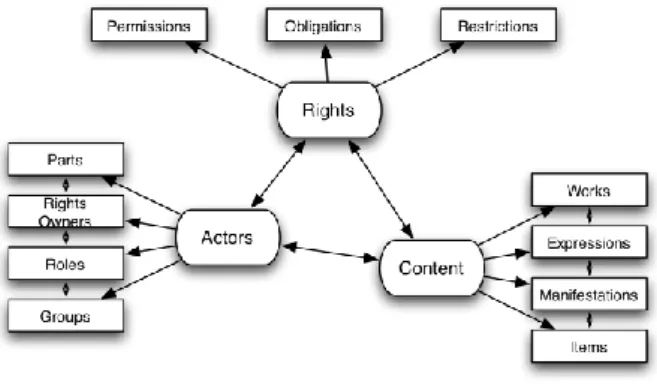
The rights management solutions (RMS) allow the implementation of several IPR policies in a World where the digital resources production, storage/preservation, re-usage, catalogue and management crosses the roles of the librarian with the ones of teachers, students and researchers. These KB digital resources produced require a careful rights management not only in terms of possession but also on the definition of the usage terms. Automated methods are needed to express, transmit, interpret and enforce rights associated with a content/owner (Fig. 1).
Fig. 1. The rights management environment
In order to support the numerous complexity of rights that are involved on these type of content, the RMS must be able to support the following requirements:
Rights recognition: what rights and who own the rights?
Rights expression: they must be clearly understood by both humans and computers; Rights exposition: the rights need to be visible and accessible;
Rights persistence: the rights associated with the content need to persist throughout the time;
Rights dissemination: how the rights are transmitted from place to place and they are aggregated with content;
Rights enforcement: how the rights are enforced on the end-user and on the content. Having this into mind and the different processes that will have to be handle by a rights management system, the following requirements will have to be met:
The content, if governed, will have to be protected. It will be possible to protect the entire digital object or just parts of that content
object. The term protection can have multiple meanings on this context, but if mostly refers to the capability of preventing non-authorized actors to perform non-authorized actions over the content;
The KB content author will have to express, using a specific rights expression language, the rights that will be “passed” by the KB author to others;
While, in the KB content creation, pieces of other author’s KB content are integrated, the rights of such pieces would have to be analysed and checked against authorization mechanisms, and the same rights would have to be included in the newly generated KB content;
The governed KB content would have to contain information about its governance mechanisms or the way to obtain such information;
The rights that are part of the KB content would have to be enforced on the user side. These rights might include some permissions and restrictions on the way the KB content could be used, displayed, shared, included or even modified.
Establish a rights management scenario that addresses such requirements is not an easy task. It requires the establishment of a trust environment between all the participating actors
(professors, teachers and researchers) and also the capability to recognise and use the different governing mechanisms that were used on the rights management processes, such as the different rights expression mechanisms [14].
In the Academia is not obvious who owns the rights associated with the content. It has traditionally been the author who has been viewed as the copyright holder. But in some countries (for instance in the US and Australia) is assumed that it is the employer who holds the copyright under the so-called work for hire clause. The copyright holder decides on the conditions for distribution and reuse. Discussions also regularly arise related to the copyright in teaching materials and, many times, give origin to “fair use exceptions”. This creates entropy on who is the copyright owner and how can this content be used without IPR infringement. Is not strange that a significant percent of author require some restrictions placed on the use of their works [8]. Some libraries also have certain rights that are mainly associated with their task of preserving copyrighted material [9].
Considering the target application (knowledge-based digital content addressing the education and research aspects) and the two different scenarios identified previously, rights management solutions will have to implement the necessary mechanisms to allow the knowledge-based content generated to be governed [14].
It is more and more important for education institutions to face the fact that its knowledge, research and pedagogic capabilities are a valuable asset. Therefore, the materials produced by the HEI (class material, their presence in classrooms, academic papers, patents, technical reports and others) are also valuable assets of the institution.
The following sections of this paper will provide a short description on how these mechanisms, provided by an open and distributed rights management solution, can be used to govern and enforce the rights on knowledge based content.
CONTENT LIFE CYCLE
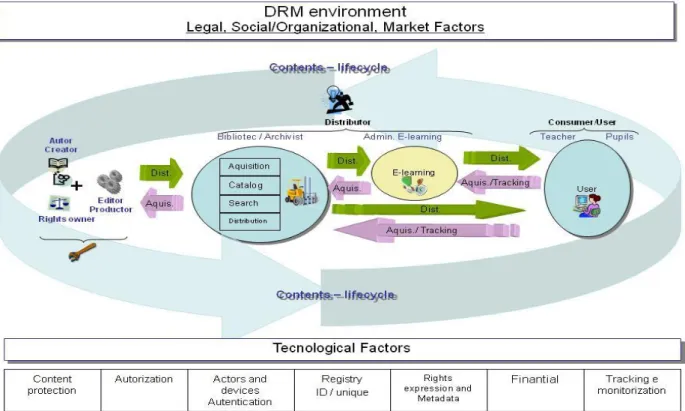
Digital rights management occurs in a larger context of content management (Fig. 2). The digital content life cycle is supported by software. Rights management capabilities must be embedded or the content in conjunction with this software to automate rights management. Authoring and assembly tools would allow authors to easily define usage and distribution licenses for their content at the time it is created recurring to a standard rights expression language (REL). All the processes related with creation, distribution, acquisition and content usage form the underlying structure that supports DRM. Rights management processes must support the previously mentioned requirements. On an educational context is possible to identify the main components modelling the DRM environment trough the content lifecycle.
During content lifecycle is important to note some stages:
Content creation: authoring and assembling; licenses should be de defined here and rights must be consolidated when coming from many sources;
Content offering: Publishing, cataloguing and distributing; rights must be associated with content and prepared to be distributed;
Content acquisition: Search and acquisition; rights must be acquired previously content is used;
Content usage: rendering and interaction; rights determine how content can be used enforced by the rights management system. Rights management begins in the authoring stage. As content moves from author to the other actors, it often passes through one or more digital content repositories, and the associated rights are transmitted (Learning Management Systems (LMS), Library Systems, Digital Asset
Management Systems (DAMS) and others). In the case of a LMS, which includes content repository functionalities, the implementation of a basic access control is enough. However, the need to manage rights is a requirement imposed both by the content author and their institutions. They both want to control the usage of learning content when that is transferred to other actors (on the end-user side).
The enforcement functions of the rights management systems are focused on the content protection from unauthorized and uncontrolled usage. A license, connected to the content is mandatory, and when the user owns it the expression/codification of rights and usage conditions can be granted to him to use content [16]. Different rights apply to different actors, and different usage licenses must be granted in compliance with a previously defined distribution license. In this approach the permissions are associated with the actors, not with content. So the process of authentication and authorization is related with actor role in this environment, allowing or not the actors to execute some actions with the content based on their roles within an institution or course. Another aspect we must consider is interoperability. In order to be reusable within a community, a learning content must be available in an interoperable way [17], i.e. it must conform to the standards that are defined within the community: not only the standards about the learning content but also the DRM system itself [15].
Within this environment it is possible to design multiple application scenarios. HEI must identify in which situations/scenarios they are involved, identifying not only the main components of content lifecycle but also the legislation, policies, and market models (internal and external) relevant to knowledge-based content digital rights. Also, it is important to consider the where, how and who aspects of the knowledge-based content to allow its usage tracking and to identify which services are needed to support the system. It is important to know the system acceptability by the different actors involved in this process, to avoid some misunderstood technology gaps.
CONCLUSION
Rights management promotes digital sharing by protecting content from unauthorized usage and enforcing a specific rights clearance policy defined by the content IP owner. Rights management is much more than enabling the content usage and sharing. Clarifying DRM requirements for knowledge-based content usage is necessary to establish the relationship within the content lifecycle components as a way to
understand the DRM environment in this area. The Academic world must evaluate their practices, technology and also the risks that this new environment raises.
This paper has presented some ideas and strategies on how to take advantage of modern and open rights management systems and its applicability to the context of educational and research knowledge-based digital content.
The application context is a very complex one, and the rights establishment and enforcement over knowledge-based content has always worked on a very informal fashion. However, with the advent of new digital technologies, and the emerging content access facilities, this informal model starts to decay. Therefore, it is imperative to impose a more formal and technological model to define and enforce the rights on the digital knowledge-based content that is created and shared all over the World by different actors.
The authors of this paper have also identified two major processes, one involved on the knowledge-based content creation and the other involved with knowledge-based content usage. In order to implement a governance model on these two major processes it was necessary to identify the rights-related requirements of each and to describe how the rights management systems could be used to fulfil such requirements.
As a final conclusion from our work, it is clear that although the current informal rights management system that is used on the educational and research communities over the knowledge-based content that is produced is continues to work, the new challenges that are posed by the digital format in terms of IPR, suggest that the usage of an appropriate open digital rights management mechanism could be of great benefit.
In this line of thought, the paper presents the way these rights management systems could be used on different digital knowledge-based content creation scenarios. These scenarios refer to the creation of new knowledge-based content and the usage of such content.
REFERENCES
[1] Uden, L.; Wangsa, I.T.; Damiani, E. (2007), "The future of E-learning: E-learning ecosystem," Digital EcoSystems and Technologies Conference, 2007. DEST '07. Inaugural IEEE-IES , vol., no., pp.113-117
[2] Polsani, P.R. (2002), "E-learning and the status of knowledge in the information age," Computers in Education, 2002. Proceedings. International Conference on , vol., no., pp. 952-956 vol.2
[3] Fetaji, B.; Fetaji, M. (2007), "E-learning Indicators Approach to Developing E-learning Software
Solutions," EUROCON, 2007. The International Conference on "Computer as a Tool" , vol., no., pp.2687-2694
[4] Serrão, C. and Marques, J. (2004). Enabling digital content protection on superdistribution models. In Proceedings of the International Workshop for Technology, Economy, Social and Legal Aspects of Virtual Goods (Virtual Goods 2004). VirtualGoods2004, Ilmenau, Germany
[5] Paola Mazzucchi (2005), “Business models and rights management for eLearning in Europe”, AIE, Milan, Italy accessed at 20/01/2009 at
http://www.indicare.org/tiki-read_article.php?articleId=142
[6] M. Warren and W. Hutchinson (2003), “Information Security – An E-learning Problem,” Advances in Web-Based Learning - ICWL 2003, pp. 21-26. [7] Arnab, A. and Hutchison, A. (2007). “Persistent
access control: a formal model for drm”. In DRM ’07: Proceedings of the 2007 ACM workshop on DigitalRights Management, pages 41–53, New York, NY, USA. ACM
[8] Oppenheim, C., Probets, S., Gadd, E. (2003). Project RoMEO Final Report. Accessed 18
January 2009 at http://xml.coverpages.org/
RoMEO-Final-Report.pdf
[9] Waaijers, L.Savenije, B. and Wesseling M. 30-October-2008"Copyright Angst, Lust for Prestige and Cost Control: What Institutions Can Do to Ease Open Access" Ariadne Issue 57
Accessed at 20/01/2009 at
http://www.ariadne.ac.uk/issue57/waaijers-et-al/ [10] AURIL, "Managing Intellectual Property: The Guide
", vol. 2009: Association for University Research and Industry Links, 2002.
[11] E. Commission, "Improving knowledge transfer between research institutions and industry across Europe," vol. EUR 22836, O. f. O. P. o. t. E. Communities, Ed.: European Communities, 2007. [12] E. Commission, "Commission Recommendation on
the management of intellectual property in knowledge transfer activities and Code of Practice for universities and other public research organisations," vol. C(2008)1329, O. f. O. P. o. t. E. Communities, Ed.: European Communities, 2008. [13] J. J. Duderstadt, A University for the 21st Century.
USA: University of Michigan Press, 2000.
[14] Filho, N. A. Santos, B. S. Universidade no Século XXI:Para uma Universidade Nova. Livraria Almedina2009
[15] Víctor Torres, Carlos Serrão, Miguel Sales Dias, Jaime Delgado, "Open DRM and the Future of Media," IEEE MultiMedia, vol. 15, no. 2, pp. 28-36, Apr.-June 2008, doi:10.1109/MMUL.2008.38 [16] Serrão, C., Serra A., Dias M., Delgado J., “Secure
License Management - Management of Digital Object Licenses in a DRM environment”, In Proceedings of the International Conference on Security and Cryptography (SECRYPT2007), Barcelona, Spain, 28-31 July, August, 2007 [17] Serrão C., Dias M., Kudumakis P., “From OPIMA to
MPEG IPMP-X - A standard’s history across R&D projects”, in Special Issue on European Projects in Visual Representation Systems and Services, Image Communications, Volume 20, Issue 9-10, Pages 972-994, Elsevier, 2005
[18] Mendes A., Romão M. (2003) A Cooperative Information Systems Framework for Knowledge Management in Higher Education Institutions: ISCTE case study, 9th International Conference of European University Information Systems (EUNIS), Amsterdam – The Netherlands, (2 a 4 de Julho).