International Conference
Sharing Society
The Impact of Collaborative Collective Actions
in the Transformation of Contemporary Societies
Conference
Proceedings
Benjamín Tejerina, Cristina Miranda de Almeida and Ignacia Perugorría Editors
© Servicio Editorial de la Universidad del País Vasco Euskal Herriko Unibertsitateko Argitalpen Zerbitzua
ISBN: 978-84-9082-678-2
Depósito Legal / Lege gordailua: BI-804-2019
Benjamín Tejerina, Cristina Miranda de Almeida and Ignacia Perugorría
Editors
Edition and book cover design: Mikel Azpiri Landa · mikelazpiri.com
CIP. Biblioteca Universitaria
International Conference Sharing Society (2019. Bilbao)
Sharing Society : the impact of collaborative collective actions in the transformation of contemporary societies, [Conference Proceedings, May 23-24, 2019, University of the Basque Country, Bilbao] /Benjamín Tejerina … [et al.](editors). – Bilbao : Universidad del País Vasco / Euskal Herriko Unibertsitatea, Argitalpen Zerbitzua = Servicio Editorial, D.L. 2019. – 423 p. : il. Textos en inglés y español.
D. L. BI-804-2019. – ISBN: 978-84-9082-678-2.
1. Acción social. 2. Movimientos sociales. 3. Economía colaborativa. 4. Redes sociales. 5. Cambio (Sociología). I. Tejerina, Benjamín, ed.
316.42(063)
Recomended citation: Tejerina, Benjamín, Cristina Miranda de Almeida, Ignacia Perugorría (editors). 2019.
Sharing Society. The Impact of Collaborative Collective Actions in the Transformation of Contemporary Societies. Proceeding of the International Conference Sharing Society (Bilbao, May 23-24, 2019).
Leioa: Universidad del País Vasco/ Euskal Herriko Unibertsitatea
All authors have assigned the organizers of the International Conference Sharing Society the rights to use, distribute, publish, record, broadcast, reproduce and archive the submitted work under the creative commons license CC BY-NC-SA
(Attribution-NonCommercial-ShareAlike).
All authors warrant that the work and its presentation are original and that they are the authors of both the work and the presentation. To the extent the work and the presentation incorporate text passages, figures, data or other material from other authors, all authors have obtained all necessary permissions to grant the license above. The authors are responsible for the reproduction of copyright material from other sources (by obtaining the necessary permission or by quoting them according to academic ethical rules).
Furthermore, all authors have granted the organizers of the International Conference Sharing Society the permission to use, distribute, publish, record, broadcast, reproduce and archive, their ORAL presentations and comments at the conference in any format or medium, exclusivelly for academic and non commercial aims under the creative commons license CC BY-NC-SA (Attribution-NonCommercial-ShareAlike).
Finally, all authors have confirmed that they have the power and authority to make and execute this statements. For jointly authored works the main author signed as authorized agent for the others.
Editors do not assume any responsibility for the accuracy, completeness, topicality or quality of the information provided. Authors are responsable for the quality and accuracy of the information provided. The opinions contained in the publications of this Book of Proceedings are solely those of the authors and do not necessarily reflect those of the editors or the publisher.
Benjamín Tejerina, Cristina Miranda de Almeida and Ignacia Perugorría
Editors
Sharing Society
The Impact of Collaborative Collective Actions
in the Transformation of Contemporary Societies
Table of Contents
11 Foreword
Benjamín Tejerina, Cristina Miranda de Almeida and Ignacia Perugorría 14 Conference Credits
14 Conference Organizers
14 Scientific Committee
14 Program Committee
15 Local Organizing Committee
15 Academic Network and Partners
16 Peer Reviewers 16 Conference Sponsors 17 Technical Assistance 17 Guest Speakers 17 Opening Address 17 Keynote Speakers
17 Round Table Speakers
18 Keynote Speaker Abstracts
Papers
Food and Agricultural Production
Food sovereignty; agroecology; zero kilometer movement; food and sustainable soil experiences; urban agriculture; and community gardens
24 La agroecología y la soberanía alimentaria como bastiones para la acción colectiva
colaborativa
Izaskun Artegui Alcaide
34 Community Gardens and Neighbourhood Movement. Benimaclet and El Cabanyal (València) Rafael Castelló-Cogollos and Ramón Llopis Goig
44 The Role of Digital Platforms in Agroecology Food Consumption Collaboration. A Comparison
between Porto and Barcelona Ricard Espelt and Sara Moreira
58 The Role of Communal Lands in The Revitalization of Rural Areas in Portugal Pedro Manuel Hespanha
TRACK 1
Sharing Society
The Impact of Collaborative Collective Actions in the Transformation of Contemporary Societies
68 Reviving the “Hakora.” Local Farming and Collaborative Efforts Abeer Musleh
79 Main Issues of the Contract Farming Structure in Sugar Cane Farming. Perspectives of
Smallholder Farmers in Kilombero Region in Tanzania Valerii Saenko and Jennifer Kasanda Sesabo
Economy, Work and Consumption
Collaborative economy; circular economy; new forms of
collaborative work and co-working; collaborative consumption; time banks; and platforms for sharing resources and experiences
92 Internet Prosuming. The Social Practices to Create Digital Content to Share on Social Media Rosa María Alonzo González
102 Solidarity Economies and Solidarity Networks among Green Consumers in Turkey Melike Bozdogan
112 Circular Economy in Fashion World
Alba Cappellieri, Elisa Borboni, Livia Tenuta and Susanna Testa
126 Collective Practices and Strategies around Leisure of Contemporary Basque Young People.
The phenomenon of Lonjas Diego Carbajo
133 Organizational Communication of the Commons. Any Particularity? Enric Castelló Cogollos
143 Sharing the Understanding of the Future. Generational Perspectives on Work in the City of Milan Enzo Colombo and Paola Rebughini
153 Solidarity Economy Markets as “Commons Ecologies.” The Politicization of the Marketspace
by Esperança-Cooesperança, Rio Grande do Sul, Brasil Ana Margarida Esteves
162 Delivery Cooperatives. An Alternative to the Great Platforms of the Digital Economy Francisco Fernández-Trujillo Moares
172 Is Crowdfunding (and a Sharing Economy) a Type of Activism? Elena Gil Moreno
186 Experiment of Sharing Economy as a Platform of Trust Reconstruction in South Korea Suk-Ki Kong and Hyun-Chin Lim
196 Sharing Economy and Young People. A Qualitative Explorative Project Ariela Mortara and Geraldina Roberti
207 Responsibilities of Sharing Economy Platforms for Cultivating Trust Selin Öner Kula
223 Supporting Sharing Societies from Sociocultural Values. Basque Auzolan, Batzarreak, and
Komunalak
Xabier Renteria-Uriarte and Jon Las Heras Cuenca TRACK
Care and Co-housing
Solidarity networks for personal care; health care; age care; childcare; personal quantification movement; and cohousing
236 Pensar las comunidades compasivas: Cuidados, compasión y vínculos colaborativos Ana Aliende Urtasun and Joseba García Martín
248 Cohousing Experiences in some Italian Urban Contexts Gabriele Di Francesco
259 Sharing Death as a New Thanatic Attitude. Contemporary Activity, Social Education and
Communication to Accompany the Dying and the Mourning Agnieszka Janiak
271 Childcare and Relationship of Trust. The Au Pair Experience as a Case of Transnational
Collaborative Collective Action Giorgia Riconda
281 Real Estate as a Commons. Collaboration between Communities, Housing Corporations, and
the Local Government in Amsterdam East Peer Smets and Firoez Azarhoosh
297 Co-Housing. Solidarity Networks for Care from an Architectural, a Legal, and a Tax Basis Irune Suberbiola Garbizu and Alex Mitxelena Etxeberria
Arts
Art and the commons; collaborative art and new forms of creative commons; and distributed design
310 La investigación Prekariart. Una red colaborativa alimentada desde las prácticas artísticas Beatriz Cavia and Concepción Elorza
320 In Dissensus, We Trust. Prototyping Social Relationships in Participatory Theatre Elvira Crois
332 Collaborative Collective Art Actions and Sensible Politics Cristina Miranda de Almeida
340 ART TOGETHER HOW Collaborative Art Practices in the Crossing with Methodologies and
Techniques Coming from the Social Sciences Saioa Olmo Alonso
355 Aesthetic Community. An Empirical Approach to the Relational Creative Process Jesús Osorio Porras
366 La acción artística en el espacio público como motor de cambio sociocultural Raffaella Regina
376 Liminality, Anti-Structure and Legitimation. Study of the Artistic Proposal A revolta dos panos
[The Revolt of the Rags] (2016)
Natalia Vegas Moreno and Arturo Cancio Ferruz TRACK
4 TRACK 3
Sharing Society
The Impact of Collaborative Collective Actions in the Transformation of Contemporary Societies
Culture
Collaborative culture and open culture movement
390 Sharing Expertise on Boosting the Use of Basque Language in Public Communication Asier Basurto Arruti and Eduardo Apodaka Ostaikoetxea
400 Ultras Utopia. Reclaiming the Spectacle Ronnie Close
409 La construcción social del escritor de graffiti en Granada: Una aproximación cualitativa José Luis González Rivas
419 Sharing Society in Old Cairo. Participatory Governance in Khalifa Neighborhood Ghaidaa Kotb and Amr Sukkar
430 Biografías colaborativas: Construyendo la memoria colectiva a través del Intercambio de
fotografías
Carmen Rodríguez-Rodríguez y Elvira Santiago-Gómez Science and Knowledge
Collaborative forms of scientific production and citizen science
444 Movimientos sociales e intelecto colectivo. Teoría y praxis pública de movilizaciones
intelectuales latinoamericanas en siglo XXI
Alberto L. Bialakowsky, Gabriela Bukstein y Luz María Montelongo
457 Mobile Solutions to the Mexican Kidnapping Epidemic (MAKE). Beyond Elite
Counter-Measures towards Citizen-Led Innovation Conor O’Reilly and Camilo Tamayo Gomez
467 11 Theses on Citizen-Led Science. Insights from Mexico and Colombia Ernesto Schwartz Marín
478 Citizen Science in Spain. Social Impact of Science-Society Collaboration Benjamín Tejerina
489 Academies for Solidarity under the State of Exception in Turkey Barış Tuğrul and Evin Deniz
499 Social (De)Construction of Disaster. Collaborative Knowledge Development and Action
through PhotoVoice Mieko Yoshihama TRACK 5 TRACK 6
Technology
Maker and DIY movement; open source technology initiatives; network manufacturing; medialab experiences; and hacktivism
514 Crosscutting Artistic Creations between Technology, Natural, and Social Sciences. Eco-Ethical
Stakes and Challenges
Emeline Gougeon and Pierre-Antoine Chardel
526 Measuring the Social Impact of Maker Initiatives. Frameworks and Guidelines for Scaling the
Assessment on Digital Platforms
Massimo Menichinelli and Alessandra Gerson Saltiel Schmidt
538 Makerspaces as Knowledge Infrastructures for the Factory of the Future Raúl Tabarés Gutiérrez
Politics
Collaborative forms of political and institutional governance; networks of cities, institutions and citizenship; participatory democracy;
participatory budgeting; open government; and collective intelligence for democracy
552 Sharing Social Identities and Solidarity. A Study on the Example of Polish Civil Protest
Movements
Adam Bartoszek and Rafał Cekiera
562 Activismo barrial, acción colaborativa y reconstrucción del lazo social. La experiencia actual
del sitio de memoria creado en el ex “Olimpo” (Buenos Aires, Argentina) Mauricio Chama y Mora González Canosa
575 Multi-Scale Intersections of Collaborative Collective Actions in Urban Regeneration. Insights
from the ROCK Project in Lisbon
Roberto Falanga and Mafalda Corrêa Nunes
582 Conflict and Collaboration in Contentious Events. The Case of the 1-O in Catalonia Ferran Giménez Azagra and Hans Jonas Gunzelmann
593 Post-Resettlement Refugee Collectives in the United States. Processes of Emergence and
Transition
Odessa Gonzalez Benson and Mieko Yoshihama
603 From Claims-Based Protests to Solidarity Initiatives. Tracing Transformations of Collective
Action in Athens, 2010-2017 Hara Kouki
613 What is the “No más AFP” Movement? New Activisms in Contemporary Chile Natalia Miranda
618 Reciprocity of News in the Context of Disaster. News Sharing, Blogs and Collective Actions
over Time Stephen F. Ostertag TRACK 8 TRACK 7
Sharing Society
The Impact of Collaborative Collective Actions in the Transformation of Contemporary Societies
628 The Case of Open Government in Madrid and its Relationship with MediaLab Prado Margarita Rodríguez-Ibáñez
642 Reclaiming the Commons in Precarious Times Carl-Ulrik Schierup and Aleksandra Ålund
652 Environmental Solidarities between Local Solidarities and Transnational Solidarities Gilles Verpraet
666 Conference Timetable 668 Conference Program 680 Conference Call for Papers
Sharing Society
The Impact of Collaborative Collective Actions
in the Transformation of Contemporary Societies 575
Multi-Scale Intersections of Collaborative
Collective Actions in Urban Regeneration.
Insights from the ROCK Project in Lisbon
1Roberto Falanga and Mafalda Corrêa Nunes
Instituto de Ciências Sociais, Universidade de Lisboa
Abstract: Collective collaboration between NGOs, associated and non-associated agents can capitalise knowledge, experience and expertise in initiatives for social change. This contribution focusses on forms of citizen engagement funded by international and local agencies for urban regeneration. Focus on the city of Lisbon allows to shed light on the multi-scale intersections between the international project “ROCK - Regeneration and Optimisation of Cultural heritage in creative and Knowledge cities” funded by the European Commission, and the programme for urban regeneration “BIPZIP - Bairros de Intervenção Prioritária Zonas de Intervenção Prioritária” promoted by the municipality of Lisbon. The international project and the local programme aim to engage foster collective collaborative actions for urban regeneration, with cultural heritage as the main driver in the ROCK project and socio-territorial cohesion as the core issue in the BIPZIP programme. Zooming in on the specific urban area of intervention between Marvila and Beato neighbourhoods, this contribution retrieves some inputs from the empirical knowledge collected within the ongoing research conducted by the authors in Lisbon. We argue that the lack of an integrated management between the project and the programme can be considered as emerging burdens due to limited multi-scale intersections between the project and the programme.
Keywords: Urban regeneration; cultural heritage; socio-territorial cohesion; Lisbon
1. Introduction
Worldwide, models of local governance are required to adopt new social, political, and economic strategies to tackle emerging challenges (Sassen 2002). Zooming in on growing inequalities and disparities in urban contexts, the governance of deprived areas raises the interest of scholars and international agencies, who reinforce the need for inclusive processes of urbanisation (Power 2000; Fraser 2008). Accordingly, public measures for the regeneration of urban areas that suffer from socio-spatial inequalities have been promoted by public and private agencies at multiple levels, with emphasis over the engagement of local communities in the design and implementation of innovative practices (Gaventa and Barret 2010). This global trend aligns with the wider attempts to incorporate values and mechanisms of citizen engagement in urban policymaking. However, concerns about the risks of manipulation through citizen engagement have been early posited by Arnstein (1969) and more recently by Cook and Kothari (2001). The instrumental use of CCAs in urban regeneration equally echo some of these concerns (Garcia 2004; Ferilli et al. 2015), as these may lead to the depoliticisation of communities’ struggles and the over-emphasis over the implementation of politically irrelevant projects (Taylor 2007).
Politics
TRACK 8
576
In Europe, the promotion of common values and mechanisms of citizen participation in urban governance tracks back to mid-1980s with the European Charter of Local Self-Government (CoE, 1985), and reaches greater visibility with the White Paper issued by the European Commission in 2001 (EC, 2001). More recently, the European Union and the United Nations have aligned on the promotion of a new Urban Agenda, which aims to foster greater citizen participation and multi-actor partnerships in local governance (Aitken, 2012). In parallel, international funding and programmes have aimed to enhance participatory tools through a wide array of opportunities (e.g. URBACT, Urban Innovative Actions – UIA, as well as funding provided through the framework programme Horizon 2020 and Erasmus plus). Against this backdrop, the implementation of collaborative collective actions (hereafter CCAs) in urban regeneration is seen as an opportunity to gather multiple actors around common issues to be solved with higher consensus in deprived areas, as well as boost the international competitiveness of contemporary cities.
While the coming together of different agents and agencies can be seen by decision-makers and governmental institutions as a cost-effective strategy for urban governance, concerns on participatory processes often lead citizens to look for alternative and antagonistic ways to reclaim their ‘right to the city’ (Groth and Corjin, 2005; Parnell and Pieterse, 2010). Against this backdrop, CCAs cannot help but account for the inherent tension between invited (or government-led) and spontaneous (or bottom-up) forms of participation. Complementarity and friction between different forms of CCAs stands at the origin of contested settings of participatory governance. Focussing on invited participation, scholars have abundantly discussed different ways through which these practices can be designed. For instance, sharing power between governmental institutions and citizens can be oriented to either one-way or two-way forms of deliberation, with the former providing narrower degrees of power to citizens when compared to the latter (Roberts, 2002). Related to that, the recruitment of participants further informs about the design of citizen participation, as it can be either open to all or selective and constitute the so-called ‘mini-publics’ of deliberation (Barnes et al., 2007). Overall, Smith (2009) argues that major attention should be paid on the ways through which participatory initiatives address key democratic challenges, such as inclusiveness, popular control, considered judgment, and transparency. Therefore, deeper understanding should be fostered on whether “these designs actually promote rather than undermine the realisation of the goods we associate with democratic institutions” (ibidem, 14).
This contribution focusses on CCAs in urban regeneration promoted by international and local agencies through projects and programmes that aim to engage NGOs, associated and non-associated citizens. According to the main literature and evidence in this field, the constitution of local partnerships among multiple actors is aimed at reinforcing their “social capital”, as Putnam (2000) put it, by fostering the opportunity for community members’ ‘bonding’ along with opportunities to ‘bridge’ deprived areas with other sectors of society (Davies, 2002). Acknowledging that local partnerships refer to a specific institutional design that is being increasingly adopted by local and supra-local agencies, we consider it as a form to design and implement government-led CCAs. Both the EU-funded project ROCK and the BIPZIP programme promote the development of local partnerships and their action coincide in the urban area between Marvila and Beato neighbourhoods. However, when considering this territory, inputs retrieved from the ROCK project shows that some burdens emerge due to limited multi-scale
Sharing Society
The Impact of Collaborative Collective Actions
in the Transformation of Contemporary Societies 577
intersections with the BIPZIP programme.
Empirical knowledge collected by the authors of this contribution is part of an extensive research conducted within the ROCK project at the Institute of Social Sciences (University of Lisbon). Light on the multi-scale intersections helps identify two main burdens that are discussed below. First, the risks associated to the effectiveness of governance in the urban area; second, the risks of self-selection and overrepresentation due to the overlapping of human resources in the field.
2. The ROCK Project and the BIPZIP Programme in Lisbon
The ROCK project is funded by the European Commission within the Horizon 2020 framework, and started in 2017 by drawing on the model of “creative cities” (UNESCO, 2005) towards cultural heritage-led urban regeneration2. The international consortium involves ten European
cities, composed of seven role models – Athens, Cluj-Napoca, Eindhoven, Liverpool, Lyon, Turin and Vilnius - which share their ‘best practices’ with three replicator cities – Bologna, Lisbon and Skopje. In the replicator cities, the project aims to bring together local residents, public and private agents into local partnerships organised through the so-called ‘living labs’ understood in this contribution as specific CCAs.
In Lisbon, the urban area of the project was selected by the local council because of its exceptional cultural heritage between Marvila and Beato neighbourhoods. Multiple historical layers range from the XVIII century “quintas” (villas) to the more recent industrial period, and compose a unique landscape for the goals of the project. Moreover, despite being close to the city centre, this area is characterised by significant physical barriers that have created a separation with the rest of the city. Public transportation is particularly undersupplied, and there are two railways crossing the neighbourhood that make internal mobility difficult and unattractive for visitors. More recently, this area has undergone great social and urban transformations that have contributed, in some cases, to improve living conditions and basic infrastructures in the area. In other cases, the massive intervention of big capitals has reinforced socioeconomic inequalities between the riverfront, with new entrepreneurial activities in the old factories and stores paired by financial fluxes in private housing investment, and the local communities living in social housing (Borghi et al., 2018).
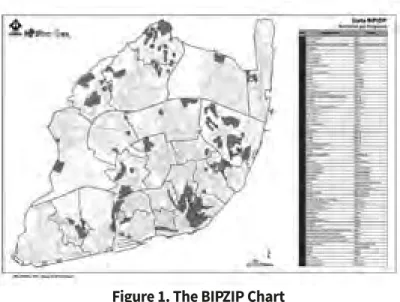
Since 2017, the design and implementation of CCAs in the ROCK area relies on a wider and longstanding context of promotion of mechanisms of citizen participation on both local and national scales (Falanga and Lüchmann, 2019). Playing a leading role in this field, Lisbon inaugurated the first participatory budget implemented by a capital city at the municipal level in Europe, in 2007/2008. The local council has placed principles of citizen participation as a northern star of the political agenda and, together with the participatory budget, goals of citizen engagement have been incorporated in the BIPZIP programme, which is the most important participatory initiative for urban regeneration in the city3. The BIPZIP programme is
based on the identification of 67 priority areas, showing critical trends in the socioeconomic, infrastructural, and/or environmental areas (fig.1). The municipal department of local housing and development issued the 67 areas into four typologies in the city master plan: social housing; historical centre; illegal housing; and other/mix4.
578
Figure 1. The BIPZIP Chart Source: Municipality of Lisbon
The BIPZIP programme was initiated in 2011 in face of long lasting socioeconomic inequalities exacerbated by the impacts of the global sovereign-debt crisis that erupted in 2009 (Falanga, 2018). Its main goal is to promote socio-territorial cohesion by supporting the implementation of short, middle, and long-term initiatives in the identified priority areas through funding local partnerships composed of NGOs, associated and non-associated citizens, and parish governments. While the programme is ongoing, the main outputs of the programme until 2017 conveyed 1015 local partners (out of 2159 local partners applying to the Programme), 270 initiatives, and almost €15 million provided for the implementation. A first look at the achievements suggests that the programme has become a main source of public funding for local partnerships in urban regeneration initiatives with some cases of successful international networking.
The design of the local partnerships is similar to the CCAs promoted by the ROCK project, which raises our interest on the potentialities of multi-scale intersections. In addition, some of the priority areas identified by the BIPZIP programme are included in the ROCK area, namely the “Quinta das Salgadas/ Alfinetes”; “Marquês de Abrantes”; “PRODAC”; and “Marvila Velha”. Despite this, however, multi-scale intersections between the project and the programme is limited and raises our major interest as researchers in the ROCK project.
3. Discussion. What Multi-scale Intersections?
The discussion retrieves inputs from the empirical knowledge collected within the ROCK project by the authors of this contribution. Considering the coincidence of the project and the programme in terms of institutional design (similar CCAs) and area of intervention (Marvila and Beato neighbourhoods), our reflection focusses on two main burdens emerging from limited multi-scale interactions.
Sharing Society
The Impact of Collaborative Collective Actions
in the Transformation of Contemporary Societies 579
to achieve goals of urban regeneration. On the local scale, the municipality of Lisbon is the main sponsor of both ROCK project and BIPZIP programme. Despite the differences in funding and strategies of action, the adoption of an integrated management plan in the coincident urban area is expected to capitalise the opportunities provided by the ROCK project and the BIPZIP programme. Considering that the ROCK project is managed by the municipal department of culture, while the BipZip is managed by the department of local development and housing, the reasons for limited intersections seem to rely on the political and organisational articulation. As Ferrão (2010) put it, the implementation of urban policies in Portugal often reflects weak efforts to connect administrative units and provide a more consistent model of governance. Likewise, this case shows associated risks to the limited attention to the design of integrated management plans that, in turn, could foster a more efficient use of the public resources provided through the project and the programme in the same urban area.
Second, limited multi-scale intersections leads to the emergence of an additional burden on the field. The overlapping of NGOs, as well as associated and non-associated citizens invited to participate to urban regeneration initiatives through similar institutional designs is expected to find significantly compacted human resources and local experts in the same urban area. Considering that the ROCK project and the BIPZIP programme call for CCAs to promote greater citizen participation, risks of self-selection, such as active citizens selecting themselves in detriment of wider community engagement are coupled by risks of overrepresentation of some local agents and agencies. At best, local communities can take advantage of a wider set of initiatives addressing multiple aspects of urban regeneration; at worst, local communities experience limited public regulation of the public resources provided for urban regeneration.
4. Concluding Remarks
Empirical knowledge on the limited multi-scale intersections between the ROCK project and the BIPZIP programme in Lisbon, which similarly fund CCAs for urban regeneration, shows the emergence of specific burdens. Focus on the ROCK area between Marvila and Beato neighbourhoods, with four of the 67 priority areas addressed by the BIPZIP programme, helps highlight two main burdens. First, risks for effective governance of the urban area due to the lack of an integrated management plan in the urban area; second, the overlapping of human resources on the field invited to participate to similar CCAs for urban regeneration with associated risks of self-selection and overrepresentation.
These burdens are discussed by taking advantage of the ongoing research conducted by the authors as members of the ROCK project at the Institute of Social Sciences (University of Lisbon) and will be further explored and validated in the next months. Towards this end, contributions on similar cases as well as wider debate on the role of multi-scale funding of CCAs in urban regeneration can help us improve the analysis and understanding of the inputs retrieved from Lisbon.
580
5. References
Aitken, Dominic. 2012. “Trust and Participation in Urban Regeneration.” People, Place & Policy 6 (3): 133-147.
Arnstein, Sherry R. 1969. “A Ladder of Citizen Participation.” Journal of the American Institute of Planners 35 (4): 216–224.
Barnes, Marian, Janet Newman, and Helen Sullivan. 2007. Power, participation and political renewal.
Case studies in public participation, Bristol: The Policy Press.
Borghi, Vando, Falanga, Roberto, Olori, Davide, Pussetti, Chiara. 2018. “Practices of Citizenship and Real Estate Dynamics: Roberto Falanga and Chiara Pussetti in conversation with Vando Borghi and Davide Olori.” European Journal of Creative Practices in Cities and Landscapes 1 (1).
Cooke, Bill, and Uma Kothari. 2001. Participation. The New Tyranny? London/New York: Zed Books. CoE – Council of Europe. 1985. European Charter of Local Self-Government. Strasbourg
Davies, Jonathan S. 2002. “The Governance of Urban Regeneration: A Critique of the ‘Governing Without Government’ Thesis.” Public Administration 80 (2): 301-322.
EC – European Commission. 2001. White Paper on European Governance. Available at: http://eur-lex. europa.eu/LexUriServ/site/en/com/2001/com2001_0428en01.pdf
Falanga, Roberto (2018) “Participatory processes for whom? A critical look at Portugal in times of austerity.” Lo Squaderno 47, 37-41.
Falanga, Roberto, and Lígia Lüchmann (2019) “Participatory Budgets in Brazil and Portugal: Comparing Patterns of Dissemination.” Policy Studies, ahead of print.
Ferilli, G., Sacco, P., & Blessi, T. (2015). “Beyond the rhetoric of participation: New challenges and prospects for inclusive urban regeneration.” City, Culture and Society 7(2): 95-100.
Ferrão, João. 2010. “Governança e Ordenamento do Território: reflexões para uma governança territorial eficiente, justa e democrática.” Prospectiva e planeamento 17: 129-139.
Fraser, Nancy. 2008. Scales of Justice. Reimagining Political Space in a Globalizing World. Cambridge: Polity Press.
Garcia Beatriz. 2004. “Cultural Policy and Urban Regeneration in Western European Cities: Lessons from Experience, Prospects for the Future.” Local Economy 19 (4): 312-326.
Gaventa, John, and Gregory Barret. 2010. “So What Differences Does it Make? Mapping the Outcomes of Citizen Engagement.” IDS Working Paper 347.
Groth, Jacqueline, and Erich Corijn. 2005. “Reclaiming Urbanity: Indeterminate Spaces, Informal Actors and Urban Agenda Setting.” Urban Studies 42(3): 503–526.
Parnell, Susan, and Pieterse Edgar. 2010. “The ‘Right to the City’: Institutional imperatives of a Developmental State.” International Journal of Urban and Regional Research 34(1): 146-162.
Power Anne. 2000. “Poor areas and social exclusion. In Social Exclusion and the Future of Cites”. CASE
Paper 35, 1– 20. London School of Economics.
Putnam, Robert D. 2000. Bowling Alone: The Collapse and Revival of American Community. New York: Simon & Schuster.
Roberts, Nancy. 2002. “Public Deliberation in an Age of Direct Citizen Participation.” American Review of
Public Administration 34 (4): 315-353.
Sassen, Saskia. 2002. Global networks, Linked Cities. London: Routledge
Smith, Graham. 2009. Democratic Innovations. Designing Institutions for Citizen Participation. Cambridge: Cambridge University Press.
Taylor, Marilyn. 2007. “Community Participation in the Real World: Opportunities and Pitfalls in New Governance Spaces.” Urban Studies 44 (2): 297-317.
Sharing Society
The Impact of Collaborative Collective Actions
in the Transformation of Contemporary Societies 581
6. Notes
1 This contribution was supported by the H2020 project “ROCK - Regeneration and Optimisation of
Cultural Heritage in Creative and Knowledge Cities” (GA: 730280), and Fundação para a Ciência e a Tecnologia (SFRH/BPD/109406/2015).
2 More information at: http://rockproject.eu 3 More information at: www.bipzip.cm-lisboa.pt
4 The programme received an award from the International Observatory on Participatory Democracy
in 2013, for being a ‘good practice’ of citizen participation. Since then, the interest in this programme has grown at both national and international levels.