A dark side of pivoting? – The effect on
employee motivation and commitment
Frederick Meiners
Dissertation written under the supervision of
Prof. Claudia Costa
Dissertation submitted in partial fulfillment of requirements for the MSc in
Management with specialization Strategy & Entrepreneurship, at the
ABSTRACT
Purpose – The thesis “A dark side of pivoting? – The effect on employee motivation and
commitment” of Frederick Meiners aims to examine how pivoting, changes to the course of action - as a concept and part of the lean startup methodology influences employees’
motivation and commitment, and as such shining light on the current criticism about pivoting.
Methodology/approach – Targeting startups that went through the process of pivoting, this
thesis uses an online survey to ask employees and startup’s founders how they evaluate job related aspects of pivoting such as their motivation and commitment totaling in a sample of 50 respondents.
Findings – The findings suggest that pivoting has an overall positive effect on motivation. In
fact, since pivoting is usually triggered by a negative business situation and offers the possibility to do a turnaround, this increases motivation. However, when startups experience high number of pivots a darker side emerges. High numbers of pivots experienced by
employees along with the effect of pivots on salaries and job security however, indicate there possibly is an inherently darks side of pivoting.
Originality/value – This thesis contributes to our understanding of the methodology of the
lean startup and in particular the under-studied concept of pivoting. The popularity of the lean startup methodology along with the concept of pivoting, and the lack of understanding of its impact on employees’ motivation demonstrate the need for studies addressing this issue.
Keywords – The Lean Startup Methodology, Entrepreneurial learning, Pivot, Employee
SUMÁRIO
Objetivo - A tese “A dark side of pivoting? – The effect on employee motivation and
commitment” de Frederick Meiners pretende examinar como o “pivot”, mudanças no curso de ação- como conceito e parte da metodologia lean startup influencia a motivação e o
comprometimento dos funcionários,iluminando a crítica resultante contra o “pivot”.
Metodologia / abordagem - Esta tese emprega uma pesquisa on-line voltada para
funcionários e fundadores de startups projetados para analisar os efeitos do “pivot” sobre a motivação, totalizando uma amostra de 50 entrevistados.
Resultados - Os achados sugerem que o “pivot” tem um efeito geral positivo sobre a
motivação. De fato, uma vez que o “pivot” geralmente é desencadeado por uma situação comercial negativa e oferece a possibilidade de fazer um turnaround, isso aumenta a
motivação. No entanto, quando os startups experimentam alto número de “pivots”, um lado mais escuro emerge. Um número elevado de “pivots” experimentados pelos funcionários e o efeito de “pivots” sobre os salários e a segurança do emprego, no entanto, indicam que possivelmente existe um lado inerentemente obscuro do “pivot”.
Originalidade / valor – Esta tese contribui para a nossa compreensão da metodologia pouco
estudada da inicialização lean e, em particular, do conceito de “pivot”. A falta de compreensão do impacto do “pivot” na motivação dos funcionários demonstram a necessidade de estudos que abordem esta questão.
Palavras-chave – The Lean Startup Methodology, Entrepreneurial learning, Pivot, Employee
TABLE OF CONTENTS
ABSTRACT ... II SUMÁRIO ... III TABLE OF CONTENTS ... IV TABLE OF TABLES ... VI TABLE OF APPENDICES ... VII
CHAPTER 1: INTRODUCTION ... 1
1.1BACKGROUND AND PROBLEM STATEMENT ... 1
1.2PROBLEM STATEMENT ... 3
1.3RELEVANCE ... 4
1.4RESEARCH METHODS ... 4
1.5DISSERTATION OUTLINE ... 5
CHAPTER 2: LITERATURE REVIEW AND CONCEPTUAL FRAMEWORK ... 5
2.1THE LEAN STARTUP ... 5
2.2PIVOTING AS KEY CONCEPT OF THE LEAN APPROACH ... 9
2.3EMPLOYEES MOTIVATION THEORIES IN STARTUPS ... 11
CHAPTER 3: METHODOLOGY ... 15 3.1RESEARCH APPROACH ... 15 3.2PRIMARY DATA ... 16 3.2.1 Data Collection ... 16 3.2.2 Measurement / Indicators ... 17 3.2.3 Data Analysis ... 18
CHAPTER 4: RESULTS AND DISCUSSION ... 19
4.1SAMPLE CHARACTERIZATION... 19
4.2RESULTS FROM QUANTITATIVE ANALYSIS ... 20
4.2.1 Level one analysis: Effect of pivoting on motivation ... 20
4.2.2 Level two analysis: Relationship of motivational factors and overall motivation ... 22
4.2.3 Level three analysis: Significance checks with control variables ... 23
4.2.4 Level four analysis: Significance check with sub-sample analysis ... 27
4.3DISCUSSION ... 28
CHAPTER 5: CONCLUSIONS AND LIMITATIONS ... 29
5.1MAIN FINDINGS &CONCLUSIONS ... 29
5.2ACADEMIC AND MANAGERIAL IMPLICATIONS ... 31
5.3LIMITATIONS AND FURTHER RESEARCH ... 31 REFERENCE LIST ... I APPENDICES ... V APPENDIX 1:ONLINE SURVEY ... V
TABLE OF FIGURES
Figure 1: Framework of lean startup
Figure 2: Motivational factors across firm types
Figure 3: Conceptual Framework
Figure 4: Sample characteristics, Startups’ industry
Figure 5: Sample characteristics, Number of employees of startups Figure 6: Effect of pivoting on overall job motivation
Figure 7: Distribution of "challenging job tasks"
Figure 8: Effect of nature of pivot on different employee types
Figure 9: T-test on technology employees motivation dependent on pivot type Figure 10: T-test on market & sales employees motivation dependent on pivot type
TABLE OF TABLES
Table 1: The nature of the pivot
Table 2: Research Questions and Hypotheses Table 3: Variables overview
Table 4: Sample characteristics, Respondents job positions Table 5: Pivots effects on motivational factors
Table 6: Motivation regressed on motivational factors Table 7: Correlations with Motivation
Table 8: Regression model with control variables
Table 9: Means of motivation for different pivot and employee types
TABLE OF APPENDICES
CHAPTER 1: INTRODUCTION 1.1 Background and problem statement
Startup pivoting is an important topic when analyzing success and failure stories in today’s startup scene. Anecdotal evidence shows that “(…) it is through learning that entrepreneurs develop and grow (…)”(Cope, 2005, p.379). Pivoting as more substantive adjustments in the business plan (Blank, 2013) is one essential part of entrepreneurial learning. Most successful startups, at one point in time, had to pivot along its way to success. Successful cases such as Instagram, PayPal or Twitter show, that pivots are among the main reasons for startups success and made their business to what it is known for now. Instagram pivoted from a Check-in app with gaming elements to the social media platform based on photos. PayPal used to focus on PDA (mobile device) based payment beaming before changing strategy to become the preferred online payment tool on the market and Twitter started as a network where people could find and subscribe to podcasts to became the status –updating micro-blogging platform of today.
In spite of successful cases, research shows that about 75% of startups fail (Ghosh, 2012). Interestingly, “pivots gone bad” are among the top 20 reasons for startups failure explaining 10% of that percentage (CBinsights, 2014). Hence, there is evidence pointing to pivots as a reason why startups fail. Understanding why pivots may lead to failure is important to reduce such high percentage of failure, particularly for entrepreneurs. Reducing the failure rate helps avoiding extensive consumption of resources and avoids going into a direction, which is not generating value for the entrepreneur or society.
The pivot literature, yet under researched, follows from Eric Ries work, “The lean startup” (2011) and focuses mainly on triggers to pivots, thus reasons that eventually lead startups to decide to pivot or how the pivot changes the business hypotheses (Bajwa et al., 2016; Comberg et al., 2014; Terho et al, 2015). However, recently in the tech and startup scene, industry practitioners and -observers questioned weather pivots themselves can lead to failure. Pivoting, a concept designed to avoid failure, involves substantial changes in the business strategy and therefore pivots have an effect on several stakeholders, like employees, founder or investors. Increasing interest to analyze pivoting more thoroughly has led for instance to suggest that there are ex-ante reasons related to the entrepreneurs’ personality and psychology (Todd, 2011) and ex-post reasons for pivot failures. Ex-post reasons are related to investors’ commitment and support as well as the motivation and commitment of employees after pivots. Frequent changes in the whole business model or badly executed pivots might
influence both investors and the startups’ team negatively (Kim, 2016). After all, these interdependences recently suggested are important to study as they are possible reasons for failure of pivots and require to take a new look on pivots literature in order to be able to understand and validate what factors are important for a successful structure of pivoting. This thesis analyzes ex-post pivoting outcomes: Particularly, we look at weather pivots affect employee motivation and commitment and if so in what direction. Negative effects might eventually result in startup failure. Employees in startups are said to often miss a high amount of commitment (Baum & Silverman, 2004). The role of pivoting can be a possible reason. Surely a pivot can have an effect on startup employees in several ways. Sales roles might worry about pivots because the time until success and the work time required selling a product could be delayed after changing the business direction, since having to pivot often requires retaking several steps, which have been done before the pivot already. Developers and engineers might be upset with the abandonment of the product, which they have been working and putting energy on. (Kim, 2016) Moreover pivots can indicate a lack of passion about the original idea, which started the business (McGinn, 2012), which is another possible reason that pivots can be demoralizing. Furthermore team motivation can be linked to performance, as studies show that work motivation is among the main factors, which has an impact on a company’s performance (Knippenberg, 2000). Again, the effects of pivots on motivation could be one reason explaining failure of pivots and subsequently startups’ failure. In a literature review we will try to understand, why pivots were the reason for success of popular examples as the motioned Instagram’s or PayPal’s and try to review in motivational literature what speaks for and against negative effects on motivation.
To test our hypotheses we conducted a survey with startups. The survey analyzes the relationship between pivots and variables of motivation/commitment as well as the dependency on several control variables. We analyze the nature of the pivots, namely if they are technology or market-oriented. Eric Ries lean startup framework (2011) suggests the differentiation between different types of pivots, which we found can be grouped either as technology or market-oriented pivots. Technology pivots are more likely to affect the work of technology employees, while market pivots relate more directly to the work of sales and market oriented employees. Therefore we include the differentiation of pivots, the nature of pivot, as variable.
1.2 Problem Statement
The aim of the thesis is to understand the impact of pivoting in team motivation and commitment and as such the likelihood of pivoting having a negative impact on performance. We also analyze determinants, which might influence the effect of pivoting on motivation. The following research questions present the topics of interest that guide us through the research.
Research questions:
• Is there a dark side of pivoting, through negative effects of pivoting on motivation? Pivoting by definition involves substantial changes in the business. This could lead to conclude that pivoting also involves effects on motivation, since you end up working in a new direction. Hence, this question investigates the link between startups’ pivoting and employee’s motivation to understand if there is a detrimental effect of pivoting, what we can call the dark side of the concept.
• What motivational framework describes the relationship between pivots and job motivation?
This research question focuses on motivational research in startups, which mainly follows from Sauermann’s (2017) framework with 5 motivational factors discriminated between extrinsic and intrinsic factors. Sauermann’s framework describes the major motives of employees in startups and how these are important for success. Additionally, given that different employees may exhibit different motivation behaviors, how are such behaviors related to the different employee categories.
• Is there a type of pivot that might affect motivation more than others?
Finally, the last research combines the two previous question by identifying the reasons of such different motivational behavior. There are different types of employees and different types of pivots. The goal is to analyze if in particular the type of pivot can explain the relationship between pivoting and job motivation controlled by variables such as the industry or the type of employee.
1.3 Relevance
The lean start up approach has first been introduced by Eric Ries in 2008 and thus is still a young research area. Nevertheless the theory behind the lean startup is commonly used among a rising number of entrepreneurs. Among the most cited articles are “Why the lean start-up changes everything” (Ries, 2013) or “Hypothesis-driven entrepreneurship: The lean startup” (Eisenmann, 2012), which focus mainly on the benefits of the approach but rarely considers why in the real world even lean startups fail. To our knowledge, literature, which critically looks at the concept of pivoting and the lean startup is missing. Hence this study tries to analyze reasons that can influence failure of pivoting fail. The importance of employee motivation and commitment as well as the ideas behind pivot failure are already part of discussions in the industry and startup forums (e.g. blogs) but such discussions miss the rigor of academic research. Comments on the Internet such as, “(…) if you have to tell your engineering team that you’re pivoting a second time? Forget about it! They’re gone.” (Kim, 2016) are not validated yet but motivation enough to test if there is a dark side of pivoting. By linking academic literature on employees’ motivational theories and the concept behind pivoting the author tries to fill a part of the gap on research on failure of startups. The results can add value to entrepreneurship and mainly lean literature by understanding how pivoting is affecting important determinants like employee motivation, which might be a reason for ex-post failure of pivots. In terms of pivoting the research is mainly embedded in existing theories like Effectuation and the thesis adds implications on the learning effects after pivoting. The results can also be valuable for entrepreneurs by creating awareness on possible mistakes that can be made within the lean startup approach. For instance entrepreneurs might have to communicate their pivoting strategy better.
1.4 Research methods
For the research of the thesis a descriptive approach is applied, with the use of primary data conducted though an online survey. First of all however a comprehensive literature review on the lean start up concept with a deep dive on pivoting as well as on motivation theories shall give an overview and foundation to the topic.
1.5 Dissertation outline
The thesis at hand is structured as follows. After having introduced the overall topic background and the research questions in chapter 1, chapter 2 is divided into three parts and will analyze the three main research questions in more detail. Special focus will be on the lean start up approach and introducing pivoting as key elements of interest in the first two parts. Following, employee’s motivational theories with focus on startups are being reviewed, before trying to make a link between pivoting and employees’ motivation. Chapter 3, again divided into three subsections, describes in detail how the research was conducted and how primary data is used in the thesis. Explanations of results and introduction of survey results followed by their critical discussion can be found in chapter 4. Chapter 5 concludes and addresses limitations and indications for further research in this area of study.
CHAPTER 2: LITERATURE REVIEW AND CONCEPTUAL FRAMEWORK 2.1 The lean startup
Startups are becoming of increasing importance as they are an important reason for the growth of an economy and responsible for a positive net creation of jobs (Kane, 2010). Estimated 100 million businesses are launched annually, according to figures from GEM Global Report. To be considered a startup there is no need for a specific size or revenue restriction, however startups are known to operate under conditions of extreme uncertainty and face many challenges (Bosch et al., 2013). One of the most important resources of startups are their employees. Founder or non-founder, technology expert or sales person, there is evidence that people and teams are the major determinant for success or failure of startups (Katz et al., 2000).
The lean startup approach allows reducing the failure rate by making more substantial changes in the business model, so called pivots (Ries, 2011). Instead of persisting with the same unsuccessful business idea and thereby wasting resources - time, stress and money, pivoting can help to avoid these problems. A suitable metaphor is found in basketball, where a player, who is not allowed to move with one foot but allowed to move and “pivot” with the other, in the lean approach the entrepreneur, keeps part of the business the same but moves and pivots other parts of the business. Pivot by definition “is a structured course correction designed to test a new fundamental hypothesis about the product, strategy and engine of growth.” (Ries, 2011, p.26)
A startups goal is to pursue entrepreneurial opportunities, which can be described as a set of environmental conditions that result in the creation of new products and/or services (Dutta & Crossan, 2005). Opportunities as such have been described to start as simple concepts, which then develop into more complex systems as entrepreneurs work on them (Pavia, 1991). Others regard “opportunity development as a continuous, proactive process essential to the formation of a business” (Ardichvilia et al., 2003, p.109). In order to provide guidance in pursuing Entrepreneurial opportunities scholars developed methodologies and tools for entrepreneurs to facilitate the creation of successful startups.
One of the methodologies is the framework of the lean startup. It has been introduced by serial entrepreneur Eric Ries and describes a new guideline for entrepreneurs to build and develop startups under these uncertain conditions, which startups face. The lean startup was introduced in order to reduce the high failure rates of startups out of the conviction that “startup success can be engineered by following the process, which means it can be learned, which means it can be taught” (Ries, 2011) answering calls for systematic entrepreneurial methods. Entrepreneurs in the startup environment face high risks and high levels of uncertainty. The benefits of lean are that allows startups to reduce risks and uncertainties, because lean means small, bearing the minimum possible cost to build something that can be tested. Through agile development practices and lean principles, close customer collaboration is ensured and short feedback help to avoid building products the customer is not demanding, thus reducing risk (Bosch et al., 2013) The lean startup is not a completely new methodology as it takes ideas from big companies and previous literature and developed them. Mainly it originates from lean manufacturing, introduced by car manufacturers, which is a production practice trying to avoid any kind of waste creation throughout the production process (Bosch et al., 2013). The figure 1 gives an overview on the framework of the lean startup in order to summarize the main tools and steps and to present a foundation for the benefits of the lean methodology.
With the hypothesis-driven approach to entrepreneurship, entrepreneurs translate their vision into falsifiable business model hypotheses. The methodology follows the seven steps from setting a vision to scaling the business. Two major tools used in the lean startup approach, are the minimum valuable product (MVP) seen in step 3 in the figure and pivots, as shown in step 6. The MVP pushes the entrepreneurs to have a prototype of the desired product or service as soon as possible. An MVP represents the smallest set of activities needed to disprove a hypothesis. (Eisenmann et al., 2013) Pivots in short, helps managers to maneuver the venture towards success by adapting parts of the business plan. The main benefit of a hypothesis-driven approach is helping to reduce the big risk entrepreneurs face when the market doesn’t want your product. Compared to antecedent methodologies for entrepreneurs the lean startup approach has the benefit that it evaluates an early stage startup’s entire business model, not only a focus more narrowly on a startup’s product. (Eisenmann et al., 2013)
Other methodologies offer alternative ways to build startups such as Customer Development (Blank 2003), Design Thinking (Brown 2009), Business Model Canvas (Osterwalder & Pigneur 2010), Entrepreneurial Operating System (Wickman 2011), The $100 Startup (Guillebeau 2012), Lean Canvas (Maurya 2012), Value Proposition Design (Osterwalder et al.
Figure 1: Framework of lean startup, taken from Thomas R. Eisenmann, Ries, Dillard
2014) or Agile Development (Shore and Warden 2008), that are among the list of books, which also offers solutions for entrepreneurs. The methodology of design thinking by Brown is often compared and contrasted to the lean methodology (Mueller & Thoring, 2012; Cranfield, 2015; Krakovsky, 2016). Design thinking is an approach based on designerly methods and principles. It was developed by the design consultancy IDEO. The methodology shares the main ideas behind the lean principle; identifying user needs in order to create appropriate solutions. The “design thinking” concept however focuses more on the idea generation, which is already preconditioned for the lean startup methodology (Mueller & Thoring, 2012). The goal is not to declare one of the methods superior. Rather it to show that different methodologies exist to guide entrepreneurs and that the lean startup methodology is not the only and best of all approaches. The lean methodology however is the most popular and the fast adoption and quickly achieved reputation of the lean startup such as adoption by leading business schools (e.g. Stanford University, Harvard Business School, Berkeley, Columbia University) and accelerators (e.g. Techstars, 500 Startups, Y Combinator) (Blank, 2013) justifies that the lean startup methodology is an important methodology to consider. There is evidence that in general the lean startup method is successful in guiding entrepreneurs and reduces failure of startups (Ladd, 2016). Despite the lean approaches’ success some scholars challenge the benefits of the methodology. The main argument is that more validation is not always better since there is a chance that entrepreneurs, who take too much feedback from customers into account, get discouraged too quickly. The lean startup method might be producing “false negatives,” as Ladd points out. The point is that with the lean approach sometimes good ideas are mistakenly rejected because there is no clear rule or instruction when to stop the testing phase and begin scaling production (Ladd, 2016). Similarly, we observe rising criticism against pivoting, as important concept of the lean approach. The article “Is “Pivot” the new “fail”?” for instance criticizes pivoting for promoting failure too much or “Too Many Pivots, Too Little Passion” (McGinn, 2009) talk about problems that arise from extensive pivoting as part of the lean approach. Silicon Valley’s mantra and also idea of the lean start up approach “fail fast, fail often” want to promote fast entrepreneurial learning. Instead is suggested, that entrepreneurs should believe in their business model more instead of planning actively to pivot. Hence pivoting is receiving more and more buzz, which led us to focus and analyze the concept in the following section. In general the lean startup approach has increasingly become a way for the development of business plans of early-stage ventures. Adherence to the methodology allows startups to
reduce uncertainty and unnecessary resource consumption (waste), which in turn helps startups to increase their chances of success. The method however is not limited to startups only, as some of today’s most successful companies adopt approaches of the lean startup methodology.
2.2 Pivoting as key concept of the lean approach
“Founders know that no matter what their original business plan, managing a start-up requires navigating a fast-moving stream of hypotheses, experiments, and redirections, which often result in the adoption of a very different model.”(McDonald & Gao, 2017, p.1)
The lean approach involves constant validations of the business plan through hypotheses testing in order to recognize when it is time to change the course of action. The foundation of the concept of pivoting is rooted in the principles of the learning theory (Mowrer, 1960). Learning is “the process whereby knowledge is created through the transformation of experience” (Kolb, 1984, p. 41).
Pivoting is a term, which recently has met high popularity in the startup world. Parts of the idea behind pivoting however have been described in previous theories of learning: the learning by trial and error learning (Young, 2009) or learning by doing theory (Schank et al., 1999) and more recently the effectuation theory. Effectuation posits a theoretical framework of decision-making in uncertain situations (Sarasvathy, 2008) such as in startup environments and as such is very similar to pivoting. The theory of effectuation is based on cognitive studies and describes how individuals in uncertain and complex conditions make their decisions. “Effectuation releases entrepreneurs from specific, predetermined goals and allows them to convert uncertainty into opportunity by treating it as a tool for the development of new goals” (Deligianni et al., 2015, p.351) Similarly pivoting is a tool for the development of new goals when startups realize that after too many iterations in the business plan you learn that some elements of your product or strategy are flawed and that it is time to pivot. (Ries, 2011)
Knowing when to pivot is also a result of learning. Several reasons can point to the need to pivot. The supply and demand do not match, the wrong market was targeted, or the product is not what customers are looking for. These are among many reasons why startups have to pivot (Bajwa et al., 2017). Similarly as there are different types of triggers for pivots, there are different types of pivots. Ries identifies nine types of pivots. A more detailed analysis shows that they can be grouped in two main categories if we are considering which main job areas
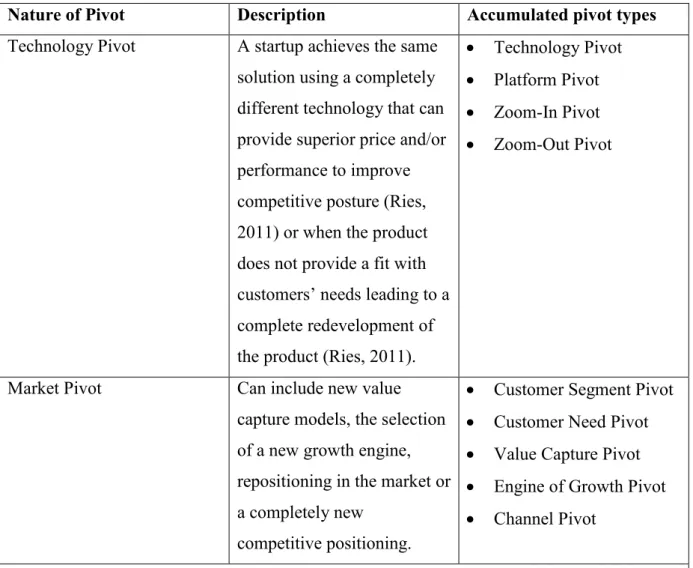
they are affecting: marketing side of business or the technology side. For the scope of the research conducted in the thesis we therefore summarize the several pivots as either technology or market oriented, since they might affect employees with different positions differently. Market and technology pivots are most related to specific tasks related to sales and marketing and developers or engineers. Table 1 illustrates the different types of pivots.
Nature of Pivot Description Accumulated pivot types
Technology Pivot A startup achieves the same solution using a completely different technology that can provide superior price and/or performance to improve competitive posture (Ries, 2011) or when the product does not provide a fit with customers’ needs leading to a complete redevelopment of the product (Ries, 2011).
Technology Pivot Platform Pivot Zoom-In Pivot Zoom-Out Pivot
Market Pivot Can include new value capture models, the selection of a new growth engine, repositioning in the market or a completely new
competitive positioning.
Customer Segment Pivot Customer Need Pivot Value Capture Pivot Engine of Growth Pivot Channel Pivot
Table 1: The nature of the pivot, adapted from Eric Ries: The lean startup (2011)
Besides the benefits of reducing risk and avoiding waste, which are accompanied by pivots, they are also often the last tool to help save a startup or at least a way to finally move into a successful direction. In software (digital) startups, merely one project failure could put a the startup out of business (Giardino et al. 2016), which highlights the risks due to very low entry barriers, which in particular digital startups face. Hence pivots should ideally have a positive impact of the performance of startups and ensure job security, as a pivot can be the tool to manage a successful turnaround. Similarly pivots can ensure entrepreneurial learning and
through change of business direction, keeping job tasks challenging and changing autonomies at job tasks, which can avoid boredom at the job (Fischerl, 1993).
Nevertheless pivoting is not the solution to everything and can also have a dark side. Pivoting if done extensively can also become a problem in particular if important stakeholders loose faith in the original idea and in the entrepreneurial team (McGinn, 2012). Following the criticism about the extensive use of pivoting from McGinn (2012), justification about the motives to pivot for employees and investors can be as important as pivoting itself. Hence, the way the management explains strategic reorientations can be crucial for successful pivoting as successful entrepreneurs not only generate and test hypotheses, they also convincingly justifying (McDonald & Gao, 2016). Good justification could also be important to ensure employees are not upset and clear about the new business direction. This indicates that understanding how the process of pivoting is structured is critical to judge if employees, who we already introduced to be a major determinant for success of startups, are prepared for a pivot or on the contrary are surprised by it. Both learning theory and pivot literature suggests that pivots are a structured process and result. Each pivot is the result of rigorous planning as the methodology of the lean startup advises entrepreneurs to follow the very structured process including possible pivots as shown in figure 2. “(…) Project failure is embraced actively and considered crucial to obtain validated learning that can lead to pivots” (Bajwa et al., 2017, p.1) Similarly, the development process within the lean framework is cyclical and iterative: an entrepreneur is likely to conduct evaluations several times at different stages of development. Those iterations could finally lead to adjustments, pivots, of the initial vision. (Ardichvili et al., 2003). There are even frameworks developed how to structure successful business model innovation and as such pivoting as suggested by García-Gutiérrez & Martínez-Borreguero (2016). Hence we can assume that employees under normal and theoretical conditions should not be surprised by pivots and can prepare to work on a new direction since its definition suggests a very structured and foreseeable path, which leads to a pivot.
2.3 Employees motivation theories in Startups
Employee motivation theories focus on motivation at an individual or team level. We focus on pivots effects on individual motivations. As such, individual’s motivation is determined by benefits the individual expect from performing on an activity (Sauermann & Cohen, 2008). The study of individual’s motivation at work is important since employees’ motivation is a critical factor for organizational success. The drive to perform well on the job is one of the
preeminent factors affecting performance of companies (Van Knippenberg, 2000). Academic studies show that changes in motivation can also lead to changes in performance since human resources are among the most valuable resources available to companies, which drive growth and proactive work behaviors are particularly important for success in dynamic and uncertain environments such as in startups (Crant, 2000; Frese & Fay, 2001; Parker, 2000). Moreover motivation is a key aspect for successful startups. For example, the business press shows that Venture Capitalists when allocating investment decisions weight more the people/teams than the product or strategy. Venture Capital is looking for startups with employees that have high levels of energy and are hungry for success (Byrne, 2000). Similarly research shows that the just quoted proactive work behavior is an evident problem startups face, since startups often have problems with employees and their commitment to the project (Baum & Silverman, 2004). Furthermore as Knippenberg (2000) points in his study team motivation can be linked to performance, as studies show that job motivation is among the most important factors affecting a companies’ performance. Motivation and commitment are two distinct concepts, however, there is empirical evidence suggested by Meyer and colleagues (2004) that both variables are interdependent as commitment leads to motivation, and motivation through other mediators is, again, closely related to commitment.
Startups offer different work environments for people and the motivational backgrounds of employees differ from established firms. Namely they end to emerge in highly dynamic and risky environments. Since our study focuses on job motivation on an individual level in startups, it is important to analyze specific motivational characteristics of this group. Motivational literature steam differentiates extrinsic and intrinsic motivational factors, where intrinsic motivation refers to the interior of a person and liking a job, because it is enjoyable and interesting, and where extrinsic motivation is linked to doing something because either positive or negative outcomes may cause them to take action (Ryan & Deci, 2000). Fishman (1998) for example points out that one reason, why people prefer to work in startups despite lower salaries and lower job security, (both indicators of extrinsic factors), is to have the chance to be very connected to the top of the company, which refers to job responsibilities, which is also extrinsic. Employees are able to play a key role already at a young age. Nonetheless the intrinsic motives seem to play an increasingly important role, namely challenging job tasks. The motivation to work on something that is interesting work and intellectually challenging (Amabile, 1997) can be a crucial factor to attract talent. Also
intrinsically motivated people tend to display higher levels of creativity, which in turn is crucial for a startups’ success (Amabile, 1997).
Motivation is not seen as a fixed trait but refers to a dynamic internal state. Several factors related to an individual’s personality as well as situational factors are determining the dynamic state and change of motivation (Wiley, 1995). Sauermann’s framework (2017), which focuses on employee motivation in startups is illustrated in figure 2, and compares five important motivational factors, differentiates between intrinsic and extrinsic motivational factors. The framework is suitable as it provides five factors of motivation, which can be measured and offers the chance to indicate the origin of overall changes in motivation. The five factors to measure work motivation are job security, salary and responsibility (extrinsic factors) and independence and challenge at work, referring to the intrinsic factors.
From figure 2 we can observe that the main difference between motives of startup employees and bigger companies is the job security. This can be explained by the fact that startup employees know that working for startups involve a dynamic environment with uncertainty about the long-term survival of the business. Hence startup’s employees show an increased willingness to bear risk (Sauermann, 2017). The most important motivational factor is a challenging job tasks (intrinsic). After all, all five factors re good indicators to motivate
Figure 2: Motivational factors across firm types, taken from Sauermann (2017) Fire in the Belly? Employee Motives and Innovative Performance in Startups versus Established Firms
employees or in our case, the effect on the single elements can indicate if motivation is affected. We can observe that employee motivation in startups is rather intrinsic so if pivoting demotivates employees the company face serious problems because they rely on the intrinsic factors, as extrinsic incentives main not be available as motivation factor, such as salaries as high as established companies offer. Pivoting, by definition involves substantial changes in the business model and thus is also always affecting employees. We already reviewed literature saying that too many pivots by McGinn (2009). Employees might get confused and mentally distant when startups pivot too much and getting demotivated from the initial idea of the founders and the startup, which leads us to the first hypothesis of the thesis motivated by the claims and statements of Kim (2016) that pivoting leads to negative motivational effects. H1: Pivoting has a negative relationship with on the job motivation in startups employees Finally it’s also important to distinguish between technical positions and sales or marketing oriented positions related to job motivation. Market pivots for instance could not at all affect the job of a technology guy and the other way around. Research shows important relationships between job motivation and personality factors. Intrinsic and extrinsic job motivation factors are found to be different across different segments of the working population such as higher educated employees are more intrinsically motivated than less educated employees, where extrinsic motivation plays a bigger role (Centers & Bugental, 1966). Additionally Scott Stern (2004) indicates that job motivation also differs between different job specializations, as scientists are highly intrinsically motivated, since they value interesting job characteristics. Conversely, for sales representatives motivational factors like striving for accomplishment and status are more likely to be motive based on extrinsic factors. Therefore it is important to keep in mind that the inherent position and the associated different motivational backgrounds can be moderating the results of the survey, which leads to the formulation of the second hypothesis, which is going to be tested.
H2a): Technology pivots have a higher effect on motivation on technology employees than market pivots.
H2b): Market pivots have a higher effect on motivation on sales and marketing employees than technology pivots.
CHAPTER 3: METHODOLOGY 3.1 Research Approach
The research conducted follows a descriptive approach, collecting primary data through an online survey. The approach was chosen to get the results, which can describe the effect of pivoting on motivation. Moreover quantitative data is used instead of qualitative data. The goal is to establish evidence with the results in a given and fixed environment. The research questions and hypotheses, which are derived in the first two chapters, are summarized below in table 2.
Research questions Hypothesis
R.Q.1. Is there a dark side of pivoting, through negative effects of pivoting on motivation?
H.1: Pivoting has a negative relationship with on the job motivation in startups employees
R.Q.2. What motivational framework describes the relationship between pivots and job motivation?
H2a): Technology pivots have a higher effect on motivation on technology employees than market pivots.
H2b): Market pivots have a higher effect on motivation on sales and marketing employees than technology pivots.
R.Q.3 Is there a type of pivot that might affect motivation more than others?
Table 2: Research Questions and Hypotheses
Pivot – Nature of Pivot Employee Motivation & Commitment Performance Type of Employee Nature of Startup H1 H2
Since the survey conducted is targeted at startup employees, first of all it is necessary to define the types of startups and employees, which are considered. The startups, which we consider for the study, have to fulfill a requirement in order to effectively address the
hypotheses. We already defined startups in the literature review as highly dynamic companies that operate under high-risk circumstances and that size and revenue is not necessarily a restriction criteria. However we try to address specific industries of startups. The claims about negative effects of pivoting arose from a tech-scene and differentiated between the effect of pivoting on either sales people or technology-oriented employees. Hence, it is crucial that all the startups of the sample have some kind of technology-orientation, e.g. employees, who fulfill technology-oriented roles. For the selection of employees it was essential that only employees were reached out to, who have a relatively higher position in the startup, since it is important that they get affected by the pivot and its consequences and thus having an
overview on the strategy, which is affected by the pivot. Moreover only employees, who have experienced pivots in their startup, are considered. In the Data Collection subsection there is a description of how the we ensured to fulfill the criteria.
3.2 Primary Data
Given the lack of data available on the influence of pivots on motivation it is necessary to collect primary data. To do so a survey is designed using the online survey software Qualtrics. The main advantage being that the software allows full randomization between respondents and offering the option to export the data set to various statistical software.
3.2.1 Data Collection
To maximize the likelihood of responses the online survey was kept small - 3 minutes in order to reduce possible disadvantages of answering under time pressure. 50% of the responses were obtained in the Websummit, the biggest technology conference in the world; technology-oriented startups were already pre selected in terms of industry. The other half of responses came from different sources of connections of the author. Incubators, Entrepreneurship centers and startups were contacted in order to distribute the survey to employees of startups. Nonetheless, within five weeks dedicated to data collection 50 responses were generated.
As mentioned it is crucial to only have employees fill out the survey, who are directly affected by pivots, since an intern, part time position or the receptionist of a startup most likely will not have the insights necessary to answer the survey. Therefore the survey was
only distributed to those employees or founders, which had a position in the startup, high enough to be affected by pivots. These were either founders or non-founders with sales or technology positions. Therefore the main respondents are developers or have technology positions in startups as well as sales and marketing management positions and can both be founders or non-founders. In order to reduce company-based bias, for example pivots, which were extremely successful the survey does not include more than 4 employees from the same startup.
The survey consists of thirteen questions and is split into four blocks. The first and last blocks include a short description of the topic and a acknowledgement for participation respectively. The second block is concerned only with the topic of the pivot. A short introduction explains the concept and subsequently respondents are asked about the impact of pivots in their startup. The third block asks general questions regarding basic demographics of both the startup and the respondent himself.
Since the survey includes employees’ responses only, who experienced a pivot before, pivoting can’t be taken as a dependent variable. Respondents were asked how a pivot, which they experienced in the startup affected their overall job motivation and commitment respectively. If they answered they have not experienced a pivot before they were excluded from the data set. For the full set of questions the complete survey is included in the appendix.
3.2.2 Measurement / Indicators
With hypothesis 1 we seek to understand if there is a positive or negative effect of pivoting on job motivation and commitment. Performance is not measured within the data set, however increased motivation can be linked by the literature to performance. Motivation and commitment are considered the dependent variables in the framework and include answers on the effect of pivoting on motivation/commitment on a 7-point-scale (7 = increased motivation/commitment). The three extrinsic factors, responsibility, salary/bonus and job security and two intrinsic factors, which are challenging job tasks and independence at work are the five explanatory variables measured on a 7-point-scale (7 = very positive effect of pivot on factor)1.
1 The results for the motivational factors were inverted for data analysis in order to fit the logic of the other
The survey also controlled for the nature of the startup, which defines the industry in which the startup operates. The remaining variables are the age- and size of the startup as well as the tenure, position and number of experienced pivots by an employee and finally a variable describing, which type of pivot would affect the respondent the most. Employees are grouped in Founders, and Non-Founders and technical-oriented positions or sales and marketing positions. Table 3 summarizes all variables conducted through the survey distinguished by dependent variables, motivational factors and the remaining control variables. The order of items asked matches the survey.
Variable Item asked
Control Variable Number of Pivots experienced
Control Variable Nature of Pivot that had biggest impact Control Variable Pivot that would affect motivation most Control Variable Frustration
Dependent Variable Effect on Motivation Dependent Variable Effect on Commitment Motivational Factors Job Security
Motivational Factors Challenging Job Tasks Motivational Factors Independence at work Motivational Factors Amount of responsibility Motivational Factors Salary/Bonuses
Control Variable Startups' age Control Variable Size of startup
Control Variable Tenure duration of employee Control Variable Industry
Control Variable Founding team or not Control Variable Job positing description Table 3: Variables overview
3.2.3 Data Analysis
In order to address research questions and hypotheses statistical tests will be run on different levels. That being said, the software chosen to analyze the data is R Studio with the
programming language R, which is the most widely and powerful, used statistical software on the market. On a first level, which focuses on hypothesis 1, the variables motivation and the intrinsic/extrinsic factors of motivation will be analyzed separately and without dependency on other variables. For this purpose, means, medians and simple descriptive statistic plots are used in order to indicate if pivots have a positive or negative effect on these variables. The whole sample is considered.
On the second level the relationship of the motivational factors on overall motivation are analyzed using simple linear regression as well as descriptive plots in order to analyze the origins of changes of motivation caused by pivots again run on the whole sample
The following level three analyzes if the results from the first levels are significant and if our sample is representative for the whole population of startups by running t-tests and simple linear regression models. We include control variables in the regression; by checking first which variables show correlations with the dependent variable. Moreover the second hypothesis is addressed by running a regression with the variables of type of pivot and position of employee and overall motivation.
Finally on the fourth level we analyze with sub samples, as the upper and lower quartile of overall motivation and compare the results in order to see if the particular quartiles can be explained by certain control variables again. Fur this purpose we will compare the means between the different quartiles.
CHAPTER 4: RESULTS AND DISCUSSION 4.1 Sample Characterization
Our sample consists of 50 respondents. The respondents, who have not experienced any pivot, are already excluded from this sample size. Figure 4 illustrates, which are the industries of the startups in the sample. Between the three categories, service oriented, technology oriented and software startups, the sample is very balanced. Software startups might be seen as technology oriented, too but were subdivided into the specific group of software startups, since they were highly represented on the Websummit and represent a significant group of the sample. Regarding the startup size (number of employees) they are either bigger (28%) than 20 employees (indicating a level development of the business as more mature) or early stage with 5-10 employees (28%) as illustrated in figure 5. The smallest group has the least representation in out sample (12%) is represented by the smallest startups, with less than 5 employees with six respondents in this group. While the sample is balanced regarding respondents of either founders (56%) or non-founders (44%), there is a majority of respondents, who have market & sales-oriented positions with 33 respondents (66%). The remaining 17 respondents (34%) have technology-oriented positions in the startup (Table 3).
Founders Non-Founders Technology Oriented Market & Sales-oriented
22 28 17 33
Additionally, the 50 survey respondents additionally come from over 30 different startups to ensure there is no company-based bias in responses on pivots influence on motivation. All respondents have experienced a pivot at least one time during the time working for the startup. This is essential because the effects from pivots on motivation can only be judged if a pivot and the consequences have been experienced at least once before. The average number of pivots in the sample, which respondents have experienced, is 1.7 and respondents have been working on average 2.5 years for the startup.2
4.2 Results from quantitative analysis
As described in the methodology the results are presented in the order of different levels. The first level analysis is dedicated to the overall effects of pivoting on motivation and the motivation factors respectively.
4.2.1 Level one analysis: Effect of pivoting on motivation
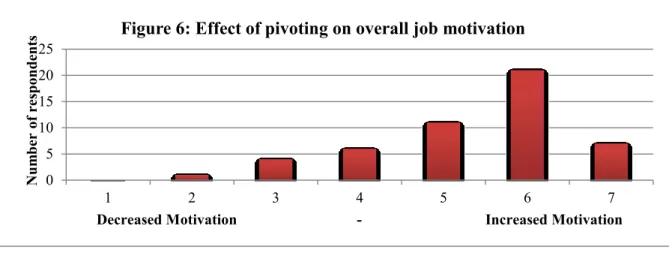
Figure 6 illustrates the distribution of respondents regarding the effect of pivots on their motivation. There is a clear growth rate towards an effect of increasing motivation with the exception of the highest possible choice. In total 39 (78%) respondents answered that pivots had a positive effect on their overall job motivation, while only 5 indicate negative effects (10%). The remaining (12%) respondents say there is neither a positive nor negative effect. Table 4 presents the mean, median and standard deviation for all respondents regarding their answers on overall job motivation and commitment as well as intrinsic factors, which
represent challenging job tasks and autonomy and extrinsic factors, which are represented by job security, responsibilities and salary.
2 The answers of “5+” pivots in the survey were counted as 5 to calculate the average. The answers of “10+”
years working for the startup have been counted as 10 to calculate the average.
Technology Oriented; 15 Service Oriented; 18 Software; 17 Startups' Industry 0 5 10 15 Less than 5 5-10 10-15 15-20 More than 20 Number of Employees of Startup
The results for commitment and motivation and in particular the median at the second highest level possible further indicates that pivots in startups have a positive effect on either job motivation and commitment. Moreover running a correlation test showed that commitment and motivation are moderately uphill correlated (correlation = 0.51), which means that both variables are increasing in the same direction and count more answers on higher ratings.
Regarding extrinsic and intrinsic factors the results are only slightly indicating positive effects of pivoting on the motivational factors but overall are rather neutral. This means that on average the effects of pivots on the respondent’s intrinsic and extrinsic motivation factors are small. Slightly higher standard deviations in particular for intrinsic factors motivate to analyze these factors more deeply and try to only consider upper and lower quartiles to see if some specific motivational factors have stronger relationships with the effect of pivots. This way we can check if the groups of respondents, who are affected negatively on motivation (lower quartile) also show specific effects in the motivational factors that differ from the whole sample. We checked the distribution for the single motivational factors and only the intrinsic factor “challenging job tasks” showed to be skewed more significantly to the left, meaning the mean being higher than 4, which is shown in figure 7 below.
Motivation Commitment Intrinsic Factors Extrinsic Factors
Mean 5,36 5,6 4,61 4,52
Median 6 6 4,5 4
SD 1,22 0,95 1,42 1,28
Table 5: Pivots effects on motivational factors
0 5 10 15 20 25 1 2 3 4 5 6 7 Num ber of re spo nd ent s
Decreased Motivation - Increased Motivation
4.2.2 Level two analysis: Relationship of motivational factors and overall motivation
In order to understand the on average overall positive effect of pivots on motivation we ran several regression models. The following table two models were run with overall motivation as dependent variable and in Model 1 with extrinsic factors as explanatory variables and Model 2 with respectively with intrinsic variables. The constant is of no meaning in this analysis; what is of interest to us are the beta values of the explanatory variables, the R-square, and significance levels. In Model 1 the factor salary is the only significant variable if the p-value lower 0.1 is considered significant. The model tells us that if salary increases by one, the overall motivation increases by 0.3. If job security or responsibility change by 1 there is an effect of close to zero. Model 2 tells us that if Challenging Job tasks change by one, the motivation increases by 0.088 and autonomy has again an effect of close to zero. While the extrinsic factors explain the relationship between pivoting and changes in job motivation slightly better with an R-square of 0.085 than the intrinsic factors (R-square: 0.018), both models are not significant and the reasons for an overall positive effect of pivots on motivation have to be further analyzed. Still what we can say is that only extrinsic factors explain motivation derived from a pivot, more specifically, the expectation of more money is what motivates employees most. The adjusted R-squares are used to compare models with different amount of variables. When we include the control variables in level three analysis we want to compare them with the resulting adjusted R-squares.
0 2 4 6 8 10 12 14 1 2 3 4 5 6 7 Num ber of re spo nd ent s
Negatative effect - Positive Effect
Overall Motivation
Model 1 Model 2
Job Security -0.016
Salary/Bonus 0.306*
Responsibility -0.023
Challenging job tasks 0.088
Autonomy 0.025 Constant 4.258*** 4.843*** R2 0.085 0.018 Adjusted R2 0.025 -0.024 ========================================================================== Note: *p<0.1; **p<0.05; ***p<0.01
Table 6: Motivation regressed on motivational factors
4.2.3 Level three analysis: Significance checks with control variables
On the third level of analysis linear regression models are extended by control variables in order to better explain the relationship between pivoting and effects on job motivation. With the purpose to control for effects that might be affecting motivation we run a correlation test on all control variables and the overall motivation. The numbers are presented below in table 7.
Correlations Table Overall Motivation
Overall Motivation 1
Number of pivots -0.07
Biggest impact pivot 0.14 Most relevant pivot -0.01
Age of Startup 0.22* Number of employees 0.13 Tenure 0.05 Industry 0.25** Founder/Non-founder -0.04 Employee type 0.18 Note: *p<0.15; **p<0.1; ***p<0.05 Table 7: Correlations with Motivation
Overall the correlation values are low in general. Nevertheless the two most correlated variables, the industry type, the age of the startups and frustration, show weak uphill (positive) linear relationships and are significant at a 0.15 and 0.10 confidence level. The number of pivots that an employee has experienced, the nature of the pivot (most relevant
pivot, biggest impact pivot) the number of employees of the startup, the tenure of the respondent and the variable distinguishing between founders and non-founders show almost no correlation at all with the impact of pivots on overall motivation. Using the two most correlated variables as well as type of employee, since we assumed this variable to be important from the literature review, in the regression with salary/bonuses, which was the only significant variable for motivation factors, the following model results.
Overall Motivation Model 3 Salary/Bonus 0.238* Industry 0.245 Type of Employee 0.384 Age of startup 0.207 Constant 2.710*** R2 0.183 Adjusted R2 0.110 F-Statistic 2.519* ================================================================ Note: *p<0.1; **p<0.05; ***p<0.01
Table 8: Regression model with control variables
The statistics shown in table 8 represent the best model describing the relationship of pivoting and work motivation within the sample. Additionally the F-statistic was run to understand if the model computed provides a better fit than the intercept-only model and shows that the explanatory variables explain some extent of the relationship between pivoting and overall job motivation and shows significance at a p-value < 0.1. Hence, the model provides a better fit than the intercept-only model. Still the variable salary/bonus stays significant which means that pivoting is perceived as a good concept and contributes to employees motivation because of expectations of a higher salary, independently of the industry, type of employee and age of the startup. F (df = 4; 45) = 2.519 and the Adjusted R2 = 0.110, now with an higher amount of explanatory variables in the model, increased from previously 2.5% (model 1) to 11% (model 3). Hence the model accounts for 11.0% (18% with R-square) of the variance of the response data around its mean.
The low R square is not necessarily inherently bad. In areas such as psychology, it is expected that squared values will be low. Attempts to predict human behavior, typically has R-squared values lower than 50% since humans are simply harder to predict (Frost, 2013).
Motivation is also part of human psychology and therefore a R-Square of 11% (18%) is able to justify some of the relationship between pivoting and motivation.
Regarding H2 where we argued that the type of pivot influences the effects on motivation of different employee types. Figure 8 shows that technology-oriented employees are more affected by technology pivots than by market pivots, whereas market & sales oriented employees are barely affected by the nature of the pivot and just slightly feel that market pivots have bigger impacts. The statistic counts the responses of what type of pivot would affect the survey participant most.
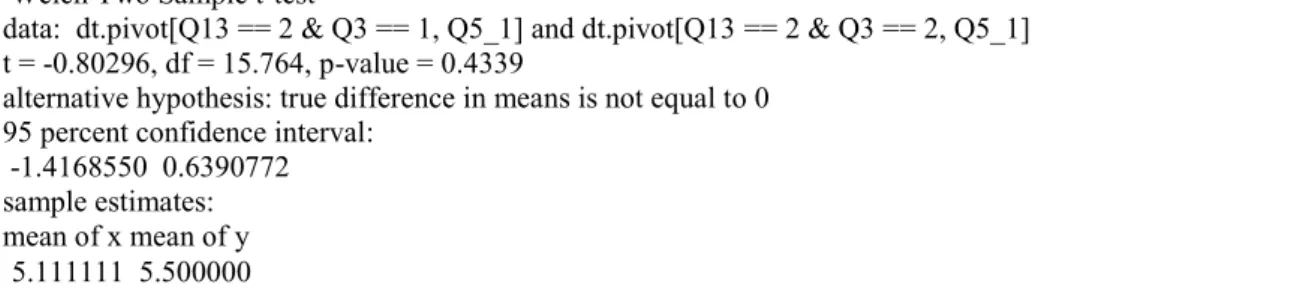
In the next step we are looking at the different means of overall motivation for different employee and pivot types (Table 9). Then a “Welch” two-sample t-test is run, to understand if certain types of pivot have significantly higher effects on either technology-oriented employees in terms of effects on job motivation. Statistically speaking, the t-test computes the differences in means and the p-values for the level of significance. The results can be seen in following figure 9 and 10. The two analyses shall also help to identify if there is a moderation effect by the nature of the pivot. From the table we can already see that the differences in means across employee types is equal to zero for the market pivot and 0.46 higher for technology employees when it is a technology pivot. Across pivot types there are again no big differences observable with almost zero difference for technology employees and 0.39 higher effects for market pivots on market and sales employees.
0 5 10 15
Indifferent Market Pivot Technology Pivot
Number of respondents
Figure 8: Effect of nature of pivot on different employee types
Technology oriented employees Market & Sales oriented employees
Running the t-test we obtained a p-value greater than 0.05 (0.93) for technology employees and market & sales employees (0.43). We cannot reject the null hypothesis in both cases and thus confirm that the means are significantly similar for different pivot types. In relation to hypothesis 2 this means that the hypothesis is rejected and there is no evidence that different pivot types neither have bigger effects on the motivation of technology employees nor market & sales employees. We cannot identify that in our sample there is any moderation effect for nature of pivot or employee type.
H2a): Technology pivots have a higher effect on motivation on technology employees than market pivots. (Figure 9)
H2b): Market pivots have a higher effect on motivation on sales and marketing employees than technology pivots. (Figure 10)
Employee Type
Technology Market & Sales
Technology Pivot 5,57 5,11
Market Pivot 5,50 5,50
Table 9: Means of motivation for different pivot and employee types
Welch Two Sample t-test
data: dt.pivot[Q13 == 1 & Q3 == 1, Q5_1] and dt.pivot[Q13 == 1 & Q3 == 2, Q5_1] t = 0.094072, df = 4.1408, p-value = 0.9294
alternative hypothesis: true difference in means is not equal to 0 95 percent confidence interval:
-2.008734 2.151591 sample estimates: mean of x mean of y 5.571429 5.500000
Figure 9: T-test on technology employees motivation dependent on pivot type
Welch Two Sample t-test
data: dt.pivot[Q13 == 2 & Q3 == 1, Q5_1] and dt.pivot[Q13 == 2 & Q3 == 2, Q5_1] t = -0.80296, df = 15.764, p-value = 0.4339
alternative hypothesis: true difference in means is not equal to 0 95 percent confidence interval:
-1.4168550 0.6390772 sample estimates: mean of x mean of y
5.111111 5.500000
4.2.4 Level four analysis: Significance check with sub-sample analysis
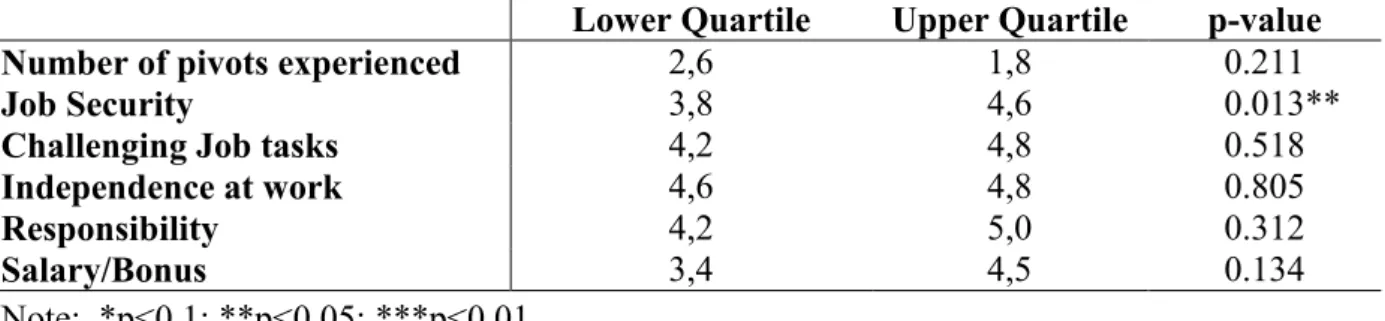
Although only five respondents were affected negatively on their job motivation by pivots investigating their reasons might provide some insights about the thesis of the dark side of pivoting. This last level of analysis checks if this group of respondents shows certain characteristics in comparison to the upper quartile of respondents and thus be able to further explain the relationship between pivots and job motivation. In table 10 the means for several motivation factors and the number of experienced pivots are compared across the groups of lower quartile (respondents with overall motivation effects of pivots of 3 or lower) and upper quartile (respondents with overall motivation effects of pivot of 6 or higher). The upper quartile consists of 28 respondents and the lower quartile of 5 respondents.
While the control variables, which were used in previous models, such as employee type and industry had no effect in this analysis, the factors presented above show differences across means between the two groups in absolute values and were tested with “Welch” t-tests for the significance in differences. In particular the lower quartile group, who got affected negatively by pivots have on average experienced around 1 more pivot during their time in the startup. Also the motivation factors are lower for the lower quartile. Moreover the differences in job security (0.8), responsibility (0.8) and salary/bonus (1.1) are on average lower for the lower quartile. Hence pivots in the upper quartile had on average more positive effects on all motivational factors. Regarding the p-values only the factor job security shows significance on a p<0.05 level. From the remaining variables only salary/bonuses (p-value=0.134) and the number of pivots experienced (p-value=0.211) come close to the significance level p<0.1. Pivoting shows to have a negative impact on job security and thus the future outlook after experiencing a pivot seems to influence the respondents of the lower quartile negatively. Also higher amounts of pivots experienced and prospective lower salaries indicate the origin of overall lower motivation of the lower quartile.
Lower Quartile Upper Quartile p-value
Number of pivots experienced 2,6 1,8 0.211
Job Security 3,8 4,6 0.013**
Challenging Job tasks 4,2 4,8 0.518
Independence at work 4,6 4,8 0.805
Responsibility 4,2 5,0 0.312
Salary/Bonus 3,4 4,5 0.134
Note: *p<0.1; **p<0.05; ***p<0.01
4.3 Discussion
The overall goal was to analyze the impact of startups pivoting on employees’ job motivation and through that, understanding whether a dark side of pivots affects employees in new ventures. The results from our first level analysis indicate that pivots have a positive impact on both motivation and commitment. As such we did not find any evidence of the presence of a dark side of picoting in technology-oriented startups. Pivoting is perceived as a motivation factor, mainly explained by positive expectations of the effects of pivots on salaries/bonuses. Such finding provides an initial answer to the research question R.Q.2. : What motivational framework describes the relationship between pivots and job motivation? The perceived effect on salaries explain why pivoting gave a positive effect on employees’ overall motivation. Pivots are designed to help startups be more successful. The more successful they become the higher wages they offer to employees. Our research findings strengthen the methodology of the lean startup from Eric Ries, since positive effects of pivots on salaries originate from the lean methodology and indicate increasing expected performance of startups through pivots, showing that in general there s a great belief in the outcomes of pivot. From the literature we also learned that compared to established firms, intrinsic motivation factors such as challenging job tasks play a bigger role in startups (Sauermann, 2017). Our results did not reveal negative effects of pivots on a more challenging job tasks, which would account for higher employee motivation. Established research shows that pivots keep jobs more challenging and increasing autonomy at job tasks avoids employees’ boredom on the job (Fischerl, 1993), which could explain why the factor challenging job tasks is not a problem caused by pivots. Similarly however, the factor challenging job tasks does not explain the positive effects on motivation of pivots. A job in the dynamic environment of a startup seems to offer challenging job tasks even without pivoting.
Further analyses indicated that despite the overall positive effect of pivots in our sample, those respondents, who were affected negatively by pivots, show characteristics that indicate a dark side of pivots. We mentioned a scholar (McGinn, 2012) who criticized entrepreneurs for pivoting too much as it could lead startups’ employees to loose motivation and faith in the entrepreneur and project. On average the higher number of pivots experienced indicates that there might be a limit to the number of pivots employees can accommodate, with too many changes affecting job security. These findings suggest that employees who experience too many pivots loose trust in the management and do not see the success of the startups guaranteed anymore and therefore fear for their job. Combining with the overall positive