EUROPEAN ORGANIZATION FOR NUCLEAR RESEARCH (CERN)
CERN-PH-EP/2012-143 2013/01/28
CMS-HIN-11-004
Measurement of jet fragmentation into charged particles in
pp and PbPb collisions at
√
s
NN=
2.76 TeV
The CMS Collaboration
∗Abstract
Jet fragmentation in pp and PbPb collisions at a centre-of-mass energy of 2.76 TeV per nucleon pair was studied using data collected with the CMS detector at the LHC. Fragmentation functions are constructed using charged-particle tracks with trans-verse momenta pT >4 GeV/c for dijet events with a leading jet of pT >100 GeV/c. The
fragmentation functions in PbPb events are compared to those in pp data as a function of collision centrality, as well as dijet-pTimbalance. Special emphasis is placed on the
most central PbPb events including dijets with unbalanced momentum, indicative of energy loss of the hard scattered parent partons. The fragmentation patterns for both the leading and subleading jets in PbPb collisions agree with those seen in pp data at 2.76 TeV. The results provide evidence that, despite the large parton energy loss observed in PbPb collisions, the partition of the remaining momentum within the jet cone into high-pT particles is not strongly modified in comparison to that observed
for jets in vacuum.
Submitted to the Journal of High Energy Physics
∗See Appendix A for the list of collaboration members
1
1
Introduction
When colliding lead nuclei (PbPb) at a nucleon-nucleon centre-of-mass energy of √sNN =
2.76 TeV, one expects to form a system of hot and dense matter at energy densities that have not been explored before. One of the early proposed experimental signatures of the formation of a dense system in such collisions was “jet quenching”, i.e. the suppression or disappearance of the spray of hadrons resulting from the fragmentation of a hard scattered parton having suffered energy loss in the medium [1]. The energy lost by a parton in the produced medium provides fundamental information on its thermodynamical and transport properties [2, 3]. Re-sults on the suppression of inclusive hadron production at high transverse momenta (pT), as
well as on the modified high-pT dihadron angular correlations obtained from nucleus-nucleus
collisions at√sNN = 200 GeV at the Relativistic Heavy Ion Collider (RHIC) [4–7] have shown the existence of partonic energy loss in dense strongly interacting matter. Similar observations have been made at the Large Hadron Collider (LHC) [8–14].
At LHC energies, high-pT jets have been fully reconstructed in heavy-ion collisions. A
sig-nificant dijet transverse momentum imbalance is observed, when comparing to a reference distribution corresponding to pp collisions at the same nucleon-nucleon centre-of-mass en-ergy [15–17]. Such an observation is consistent with enen-ergy loss of the hard scattered partons in the dense medium produced in central PbPb collisions. In the same set of results, the re-distribution of the lost jet energy is studied using jet-track correlations [16]. It is found that the missing pTopposite to the leading jet can be recovered only by summing up the
contribu-tions of particles down to a low pTof 500 MeV/c with respect to the beam axis and out to large
radii in pseudorapidity and azimuthal angle, ∆R = p(∆φ)2+ (∆η)2 > 0.8, with respect to
the jet axis [16]. Since these results show that the quenched energy is transferred out of the jet cone, the jet clustering algorithm reconstructs jets with a reduced energy from the fragments of the partons after they have lost energy in the medium. The study presented here inves-tigates to what extent the fragmentation pattern of partons that have traversed the medium resembles vacuum fragmentation, by constructing fragmentation functions in PbPb collisions and comparing them to those from unquenched jets, as measured in pp collisions. Fragmen-tation functions encode the probability for a parton to fragment into particles carrying a given fraction of the parton energy. Colour-charged partons undergo showering processes into par-tons of successively lower energy which hadronise into colour-neutral final-state particles. The evolution of such a parton radiation and splitting process leads to a characteristic shape of the fragmentation function [18]. Theoretical models of jet quenching predict an effective change of the shape of the fragmentation function due to the change of the parton radiation pattern in the medium [19–22]. Experimentally, fragmentation functions are constructed by correlating the reconstructed jet momentum with the momenta of charged particles projected onto the jet axis. The jets are defined using the final-state particles produced in the collision, clustered with the anti-kT jet algorithm [23]. In this Letter, we present a measurement of fragmentation functions
in pp and PbPb collisions and a detailed comparison of their shapes measured in the two sys-tems. The measurement is restricted to the high-pTcomponent of the fragmentation function,
using charged particles of pT >4 GeV/c that lie within∆R<0.3 around the reconstructed jets.
2
Experimental Setup
The Compact Muon Solenoid (CMS) detector is described in Ref. [24]. Only the detector sys-tems used in this analysis are discussed hereafter. The central part of the CMS detector contains a superconducting solenoid that provides a homogeneous magnetic field of 3.8 T parallel to the beam axis. Charged-particle trajectories are measured using silicon pixel and strip trackers that
2 4 Jet and Track Reconstruction
cover the pseudorapidity region|η| < 2.5, where η is defined as η = −log[tan(θ/2)]and θ is the polar angle with respect to the anticlockwise beam direction. An electromagnetic crystal calorimeter (ECAL) and a brass/scintillator hadron calorimeter (HCAL) surround the tracking volume and cover|η| <3.0. The ECAL calorimeter is segmented in quasi-projective cells of a granularity in pseudorapidity and azimuthal angle of∆η×∆φ =0.0174×0.0174 in the barrel (|η| < 1.5), increasing across the endcap (1.5 < |η| < 3.0) to 0.09×0.09 at |η| = 3.0. The HCAL has a cell granularity of∆η×∆φ=0.087×0.087 in the barrel region and a variable cell granularity, changing as a function of η, in the endcap region [24]. A forward steel/quartz-fibre Cherenkov hadron calorimeter (HF) extends the coverage to|η| = 5.2. The CMS trigger sys-tem is composed of a first level made of custom hardware processors, which use information from the calorimeters and muon detectors to select events, and the High-Level Trigger (HLT) processor farm, that further decreases the event rate, before data storage.
3
Data Selection
The PbPb and pp data analysed in this Letter were collected with the CMS detector in 2010 and 2011, respectively, at a centre-of-mass energy of 2.76 TeV per nucleon pair. The integrated luminosities for the PbPb and pp data samples used for this analysis are Lint ≈ 6.8 µb−1 and
Lint ≈ 231 nb−1, respectively. The HLT system is used to select events containing high-pT
jets reconstructed from calorimeter towers. In PbPb collisions, the trigger threshold is pT =
35 GeV/c, applied on the raw calorimetric jet energy. For pp collisions, events are selected if they pass a jet trigger threshold of pT = 40 GeV/c on the calorimetric jet energy. As found
in Ref. [16], for the jet selection used in this analysis, requiring a 100 GeV/c jet in |η| < 2, the triggers are more than 99% efficient. In addition to the trigger decision, standard event selection criteria are applied [16], including a rejection of beam related backgrounds, a selection of inelastic hadronic collisions by requiring a two-sided coincidence of signals in the HF and a well-reconstructed event vertex.
For the analysis of PbPb data, it is important to determine the degree of overlap between the two colliding nuclei in each event, termed collision centrality. Centrality is determined using the sum of transverse energy reconstructed in the HF. The distribution of the HF energy is used to divide the event sample into percentiles of the total nucleus-nucleus interaction cross section. For the purpose of this analysis, the data set is split into two centrality bins, the 0–30% most central events (i.e. those which have the largest overlap between the two colliding Pb nuclei) and the remaining peripheral events in the 30–100% centrality range. A detailed description of the centrality determination can be found in [16].
4
Jet and Track Reconstruction
For both pp and PbPb collisions, the analysis is based on jets reconstructed using the anti-kTjet
algorithm, with a radius parameter (R) of 0.3, utilizing particle-flow (PF) objects that combine tracking and calorimetric information [25, 26]. In the PbPb data, the contribution of the under-lying heavy-ion event is removed using an iterative pileup subtraction method [27]. Since this procedure determines the underlying-event background using data outside the jet, the result is insensitive to the fragmentation properties of the jet. The jet-finding efficiency is above 95% for jets of pT>40 GeV/c, and above 99% for jets of pT >50 GeV/c [25]. The relative jet momentum
resolution in pp collisions is found to be 19 (13)% at pT = 40 (100)GeV/c, improving with jet
momentum. In central PbPb collisions, the momentum resolution deteriorates to 24 (16)% at pT = 40 (100)GeV/c [25] due to fluctuations in the underlying event. For both pp and PbPb
3
events, the jet momentum response has little or no deviations from a Gaussian shape.
In all cases the reconstructed jet momenta are corrected to final-state stable particle (lifetime τ with cτ > 10 mm) level using factors derived from PYTHIA 6.422 [28] (tune D6T [29, 30],
CTEQ6L1 PDFs [31]) pp simulations at √s = 2.76 TeV [32]. The uncertainty in the corrected jet energy scale is about 3% for pp events, resulting in a per-bin jet-yield uncertainty of±15%. In the case of PbPb events, due to the influence of the underlying event, the uncertainty in the jet energy scale increases to about 4% for peripheral events (30–100% centrality) and 5% for central events (0–30% centrality) which results in per-bin jet-yield uncertainties of±20% and
±25%, respectively.
The dijets selected for this analysis consist of a leading jet (denoted by subscript 1) with pT,1 >
100 GeV/c and a subleading jet (subscript 2) of pT,2 >40 GeV/c, with axes that lie within|η| <2. The pTthresholds are chosen to ensure high reconstruction efficiency for the leading and,
espe-cially, the subleading jet. In addition, the azimuthal opening angle∆φ1,2 between the leading
and subleading jet is required to be larger than 2π/3. No explicit requirement is made on the presence or absence of a third jet in the event.
A detailed description of the charged-particle reconstruction algorithm and its performance can be found in Ref. [9]. The track-finding efficiency in the kinematic range of this study is (60– 70)% and the corresponding correction is applied as a function of track pT, jet pT, and event
centrality by reweighting the found tracks with the inverse of the reconstruction efficiency. The track reconstruction efficiency correction is derived from a GEANT4 [33] simulation of the CMS detector applied to PYTHIAevents, which are embedded into PbPb collisions simulated usingHYDJET[34] in order to include the effect of the underlying PbPb event. The momentum resolution of the track reconstruction is σ(pT)/pT ≈1–3%.
0.2 0.4 0.6 0.8 1
Event Fraction
0.1 0.2 (a) pp PYTHIA (R = 0.3) PF Jets T anti-k > 40 GeV/c T,2 > 100 GeV/c, p T,1 p π 3 2 > 12 φ ∆)
T,2+p
T,1)/(p
T,2-p
T,1= (p
JA
0.2 0.4 0.6 0.8 1Event Fraction
0.1 0.2 (b) PbPb 30-100% PYTHIA+HYDJET 0.2 0.4 0.6 0.8 1Event Fraction
0.1 0.2 (c) PbPb 0-30% PYTHIA+HYDJET -1 = 231 nb int = 2.76 TeV, L s CMS, pp, CMS, PbPb, sNN = 2.76 TeV, Lint = 6.8 µb-1Figure 1: Dijet asymmetry, AJ, distributions in (a) pp collisions, (b) peripheral (30–100%) PbPb,
and (c) central (0–30%) PbPb collisions. Data are shown as black points while the histograms
show PYTHIA dijets, which when compared to PbPb data have been embedded into HYDJET
events. Error bars represent the statistical uncertainty.
The dijet momentum balance is studied in terms of the dijet asymmetry ratio [15–17], AJ =
pT,1−pT,2
pT,1+pT,2
, (1)
which is positive by construction. Figure 1 shows the AJ distributions in (a) pp and in (b,c)
4 5 Fragmentation Functions
unbalanced pairs when compared to both peripheral PbPb collisions (30–100%) and pp data. This can be interpreted as a direct observation of parton energy loss in central PbPb collisions.
5
Fragmentation Functions
The fragmentation functions are measured by correlating reconstructed charged-particle tracks falling within the jet cones, with the axis of the respective jet [35]. As done in previous mea-surements at hadron colliders [36], the fragmentation function is presented as a function of the variable ξ =ln1 z ; z = ptrack k pjet , (2)
where ptrackk is the momentum component of the track along the jet axis, and pjet is the
mag-nitude of the jet momentum within the jet cone. The momentum components and the angle between the charged-particle and the jet axis are calculated in the dijet centre-of-mass frame, obtained by an approximate Lorentz transformation along the beam axis in the form of a pseu-dorapidity shift, defined as ηdijet = (η1+η2)/2. The tracks are selected to lie within a cone of
∆R < 0.3 around the jet axis. The fragmentation functions, defined as 1/Njet dNtrack/dξ, are
normalised to the total number of selected leading or subleading jets, Njet, respectively. To
min-imise the contribution of tracks from the underlying event, only tracks with ptrackT >4 GeV/c are selected. This restricts the measurement of the fragmentation function to the region of ξ .4.5. The remaining underlying event contribution, not associated with the jet, is estimated by se-lecting tracks that lie in a background cone, obtained by refse-lecting the original jet cone about η = 0, while keeping the same φ coordinate. The background contribution is accumulated jet-by-jet over the full event sample and subtracted to obtain the final dNtrack/dξ distribution. Due
to this procedure, jets in the region|η| <0.3 are excluded from the analysis, to avoid overlap between the signal jet region and the region used for background estimation.
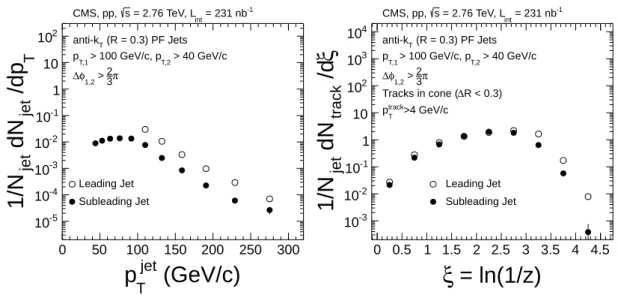
Figure 2 shows the reconstructed leading and subleading jet fragmentation functions in pp collisions (right panel) and the corresponding jet pT distributions (left panel), to illustrate the
kinematic range in which the fragmentation functions are measured. Note that the higher jet momentum of the leading jet compared to the subleading jet, leads to an increased number of particles passing the ptrackT > 4 GeV/c selection for the fragmentation function measurement. This results in the observed excess of dNtrack/dξ at high values of ξ for the leading jet over the
corresponding distribution for the subleading jet. The ptrack
T threshold on the tracks introduces
a jet-pT-dependent kinematic limit in the high ξ part of the spectrum. For a direct comparison
between pp and PbPb collisions, the jet momentum resolution deterioration in PbPb events has to be taken into account. For this purpose, the reconstructed pT of every jet in the pp data is
smeared by the quadratic difference of the underlying event fluctuations in PbPb and pp. Fur-thermore, in order to keep the kinematic constraints consistent, a jet-pT-dependent reweighting
is applied to the pp data, after fluctuation smearing, so that the resulting jet pT distribution
matches that in PbPb. The reweighting factor is applied to each jet when generating the frag-mentation function for pp. The pp-based reference distributions obtained this way ensure that the jet fragmentation functions in PbPb and pp are compared for matching jet pT spectra.
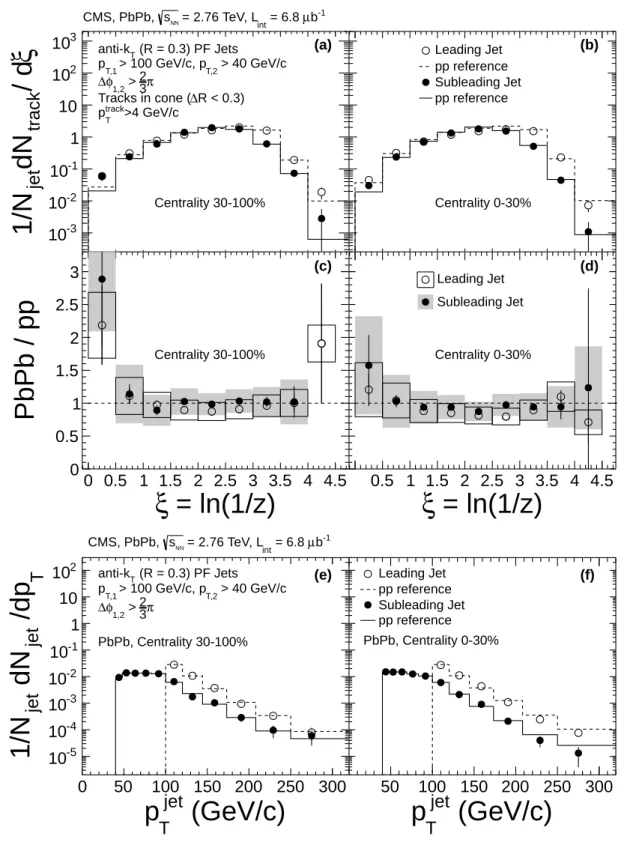
Figure 3 shows the fragmentation functions for (a) peripheral and (b) central PbPb collisions, for both the leading and subleading jets, compared to the pp-based reference. The ratios be-tween the PbPb fragmentation functions and the pp-based reference distributions are shown
5
(GeV/c)
jet Tp
0 50 100 150 200 250 300 T/dp
jetdN
jet1/N
-5 10 -4 10 -3 10 -2 10 -1 10 1 10 2 10 -1 = 231 nb int = 2.76 TeV, L s CMS, pp, (R = 0.3) PF Jets T anti-k > 40 GeV/c T,2 > 100 GeV/c, p T,1 p π 3 2 > 1,2 φ ∆ Leading Jet Subleading Jet= ln(1/z)
ξ
0 0.5 1 1.5 2 2.5 3 3.5 4 4.5ξ
/d
trackdN
jet1/N
-3 10 -2 10 -1 10 1 10 2 10 3 10 4 10 (R = 0.3) PF Jets T anti-k > 40 GeV/c T,2 > 100 GeV/c, p T,1 p π 3 2 > 1,2 φ ∆ R < 0.3) ∆ Tracks in cone ( >4 GeV/c track T p -1 = 231 nb int = 2.76 TeV, L s CMS, pp, Leading Jet Subleading JetFigure 2: Data from pp collisions. Left: Leading and subleading jet pT distributions (not
cor-rected for jet-finding efficiency and not unfolded for the jet energy resolution). Right: Frag-mentation functions reconstructed for the leading (open circles) and subleading (solid points) jets. The statistical uncertainties, shown as error bars, are smaller than the symbols in most cases.
in panels (c) and (d). The corresponding jet pT distributions illustrating the kinematic range
of the measurement are shown in panels (e) and (f). The overlaid histograms in the same set of figures show the pp-based reference distributions. The systematic uncertainty, represented by the boxes at each point in panels (c) and (d), is obtained from the propagated jet and track reconstruction uncertainties. These comparison plots show that the shape of the fragmentation functions in pp and PbPb collisions agrees within uncertainties at all centralities for the leading, as well as for the subleading, jets.
The uncertainties in the jet response may affect the results in different ways: smearing of jet energy due to fluctuations distorts the observed fragmentation functions, a miscalibration of the overall energy scale shifts the fragmentation function along the ξ axis, and a residual offset in the jet energy introduces a tilt of the shape of the distribution. These effects are studied using a Monte Carlo (MC) simulation, by varying the corresponding generator-level jet properties within the limits of the jet response uncertainty. The systematic uncertainties are determined by comparing the resulting fragmentation functions in the modified sample to the original MC reference.
The systematic uncertainty due to the charged-particle reconstruction efficiency is obtained by comparing fragmentation functions based on efficiency-corrected tracks, with the fragmenta-tion funcfragmenta-tions using the MC generator informafragmenta-tion. Since the particle-flow event reconstrucfragmenta-tion algorithm uses reconstructed charged-particles for the jet pT determination, a failure to
recon-struct a high-pTcharged-particle can lead to an underestimation of the jet momentum, resulting
in an artificially high AJ measurement. The modification of the fragmentation function
mea-surement due to this effect is studied inPYTHIA+HYDJETevents. Since the AJdistributions in
data and simulation are different, the magnitude of the corresponding effect in the PbPb data is estimated based on the reconstructed AJ distributions, and is accounted for in the combined
systematic uncertainty. The effect of momentum resolution on reconstructed charged-particle tracks is estimated by smearingPYTHIA+HYDJETgenerator-level information. This is found to have little effect on the fragmentation function, in comparison to the unsmeared generator level
6 5 Fragmentation Functions
= ln(1/z)
ξ
0 0.5 1 1.5 2 2.5 3 3.5 4 4.5ξ
/ d
track
dN
jet
1/N
10-3 -2 10 -1 10 1 10 2 10 3 10 (R = 0.3) PF Jets T anti-k > 40 GeV/c T,2 > 100 GeV/c, p T,1 p π 3 2 > 1,2 φ ∆ R < 0.3) ∆ Tracks in cone ( >4 GeV/c track T p Centrality 30-100% (a)= ln(1/z)
ξ
0 0.5 1 1.5 2 2.5 3 3.5 4 4.5PbPb / pp
0 0.5 1 1.5 2 2.5 3 Centrality 30-100% (c)= ln(1/z)
ξ
0 0.5 1 1.5 2 2.5 3 3.5 4 4.5ξ
/ d
track
dN
jet
1/N
10-3 -2 10 -1 10 1 10 2 10 3 10 Leading Jet pp reference Subleading Jet pp reference Centrality 0-30% (b)= ln(1/z)
ξ
0 0.5 1 1.5 2 2.5 3 3.5 4 4.5PbPb / pp
0 0.5 1 1.5 2 2.5 3 Centrality 0-30% Leading Jet Subleading Jet (d) -1 b µ = 6.8 int = 2.76 TeV, L NN s CMS, PbPb,(GeV/c)
jet
T
p
0 50 100 150 200 250 300T
/dp
jet
dN
jet
1/N
10-5 -4 10 -3 10 -2 10 -1 10 1 10 210 anti-kT (R = 0.3) PF Jets (e)
> 40 GeV/c T,2 > 100 GeV/c, p T,1 p π 3 2 > 1,2 φ ∆ PbPb, Centrality 30-100%
(GeV/c)
jet
T
p
0 50 100 150 200 250 300T
/dp
jet
dN
jet
1/N
10-5 -4 10 -3 10 -2 10 -1 10 1 10 2 10 Leading Jet (f) pp reference Subleading Jet pp reference PbPb, Centrality 0-30% -1 b µ = 6.8 int = 2.76 TeV, L NN s CMS, PbPb,Figure 3: (a,b) Fragmentation functions reconstructed in peripheral and central PbPb data for the leading (open circles) and subleading (solid points) jets. (c,d) Ratio of each PbPb fragmen-tation function to its pp-based reference. Error bars are statistical, the hollow boxes represent the systematic uncertainty for the leading jet, and gray boxes show the systematic uncertainty for the subleading jet. (e,f) Jet pT distributions in PbPb data (not corrected for efficiency and
not unfolded for pT resolution) compared to the pp-based reference (see text). Only statistical
7
information. The above uncertainties are combined in quadrature to give the total systematic uncertainty.
Another potential source of systematic uncertainty comes from the response of the PF technique to jets with very different fragmentation functions. Since one component of the jet energy cor-rection accounts for the loss of low-pTparticles, a large change in the contribution of such tracks
will result in an incorrect reconstructed jet energy. To study this effect, we have compared the response to separate quark and gluon jets fromPYTHIA, whose fragmentation functions differ by 20-40% in the region 2 < ξ < 4 and by larger factors for ξ < 1. These dramatic differ-ences in fragmentation pattern do result in systematic differdiffer-ences in the jet momentum but the effect is only at the few percent level [25]. The change in the reconstructed fragmentation func-tion resulting from the tiny shifts in the ξ parameter caused by these jet momentum offsets are negligible.
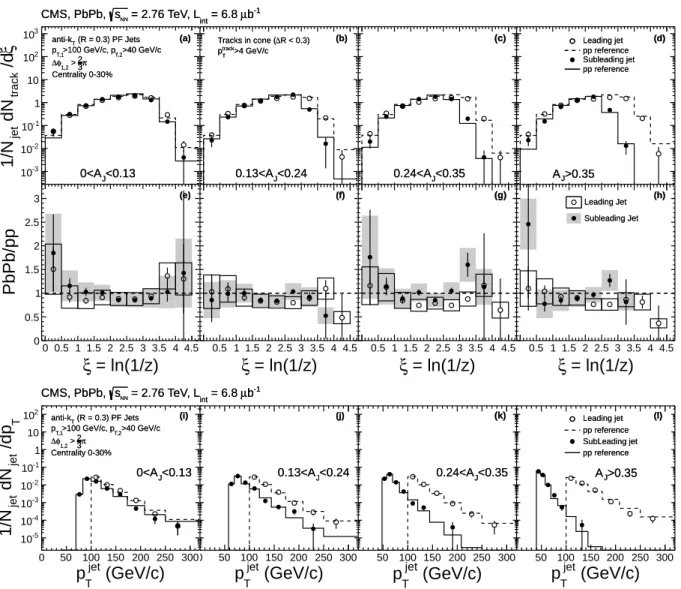
To study in more detail the potential effect of medium-induced energy loss on the fragmenta-tion properties of partons, the data sample of central events (0–30% centrality), where a large average dijet imbalance is observed, is divided into classes of dijet imbalance. Four AJ
selec-tions are chosen, which split the central PbPb data sample into approximately equal number of dijets: 0<AJ<0.13, 0.13<AJ<0.24, 0.24<AJ<0.35, and AJ>0.35. For each of these event
classes, the fragmentation functions are constructed separately for the leading and subleading jets. In Fig. 4(a–d) the fragmentation functions are shown in bins of increasing dijet imbalance, from left to right. The corresponding jet pT distributions used in the fragmentation functions
are shown in Fig 4(i–l), illustrating the kinematic range of the measurement and the energy imbalance between leading and subleading jets, as selected by the AJ interval. The overlaid
histogram in the same set of figures shows the pp-based reference distributions. Ratios of PbPb data to the pp-based reference are shown in Fig. 4(e–h). In the ξ range of 0.5–4.0 the PbPb and the pp distributions typically agree to within (10–20)% which is smaller than the systematic un-certainty in the PbPb measurement, as indicated by the size of the shaded area and open boxes for the leading and subleading jet, respectively. Within uncertainties, the PbPb data and pp-based reference show the same fragmentation properties, for different jet imbalance in leading, as well as subleading, jets.
6
Conclusions
The CMS detector has been used to study jet fragmentation properties in pp and PbPb collisions at√sNN =2.76 TeV in data samples corresponding to integrated luminosities of about 231 nb−1 and 6.8 µb−1, respectively. Jets were reconstructed based on particle-flow objects using the anti-kT sequential clustering algorithm, with a radius parameter of 0.3. The reconstructed jet
momenta were corrected to final-state particle level. Dijets were selected consisting of a leading jet with pT,1 >100 GeV/c and a subleading jet of pT,2 >40 GeV/c, with axes that lie within|η| < 2. The azimuthal opening angle ∆φ1,2 between the leading and subleading jet was required
to be larger than 2π/3. The selected jets were used to construct the high-pT component of
the fragmentation functions by correlating their momentum with the momenta of tracks of pT > 4 GeV/c within a cone of∆R< 0.3 around the jet axis. The PbPb results were compared
to those in a pp-based reference taking into account the different jet momentum distribution and the effect of fluctuations in the underlying PbPb event on the jet momentum reconstruction. The jet properties were studied as a function of the collision centrality and the dijet transverse momentum imbalance. Central PbPb events show a significant excess of unbalanced jet pairs. Nevertheless, the fragmentation functions reconstructed in PbPb collisions for different event centrality and dijet-pTimbalance agree within the measurement uncertainty with the pp-based
8 6 Conclusions = ln(1/z) ξ 0 0.5 1 1.5 2 2.5 3 3.5 4 4.5 ξ /d track dN jet 1/N 10-3 -2 10 -1 10 1 10 2 10 3 10 <0.13 J 0<A (R = 0.3) PF Jets T anti-k >40 GeV/c T,2 >100 GeV/c, p T,1 p π 3 2 > 1,2 φ ∆ Centrality 0-30% (a) <0.13 J 0<A (R = 0.3) PF Jets T anti-k >40 GeV/c T,2 >100 GeV/c, p T,1 p π 3 2 > 1,2 φ ∆ Centrality 0-30% (a) = ln(1/z) ξ 0 0.5 1 1.5 2 2.5 3 3.5 4 4.5 PbPb/pp 0 0.5 1 1.5 2 2.5 3 (e)(e) = ln(1/z) ξ 0 0.5 1 1.5 2 2.5 3 3.5 4 4.5 ξ /d track dN jet 1/N10-3 -2 10 -1 10 1 10 2 10 3 10 <0.24 J 0.13<A R < 0.3) ∆ Tracks in cone ( >4 GeV/c track T p (b) <0.24 J 0.13<A R < 0.3) ∆ Tracks in cone ( >4 GeV/c track T p (b) = ln(1/z) ξ 0 0.5 1 1.5 2 2.5 3 3.5 4 4.5 PbPb/pp 0 0.5 1 1.5 2 2.5 3 (f)(f) = ln(1/z) ξ 0 0.5 1 1.5 2 2.5 3 3.5 4 4.5 ξ /d track dN jet 1/N10-3 -2 10 -1 10 1 10 2 10 3 10 <0.35 J 0.24<A (c) <0.35 J 0.24<A (c) = ln(1/z) ξ 0 0.5 1 1.5 2 2.5 3 3.5 4 4.5 PbPb/pp 0 0.5 1 1.5 2 2.5 3 (g)(g) = ln(1/z) ξ 0 0.5 1 1.5 2 2.5 3 3.5 4 4.5 ξ /d track dN jet 1/N10-3 -2 10 -1 10 1 10 2 10 3 10 >0.35 J A Leading jet pp reference Subleading jet pp reference (d) >0.35 J A Leading jet pp reference Subleading jet pp reference (d) = ln(1/z) ξ 0 0.5 1 1.5 2 2.5 3 3.5 4 4.5 PbPb/pp 0 0.5 1 1.5 2 2.5 3 Leading Jet Subleading Jet (h) Leading Jet Subleading Jet (h) -1 b µ = 6.8 int = 2.76 TeV, L NN s CMS, PbPb, = 6.8 µb-1 int = 2.76 TeV, L NN s CMS, PbPb, (GeV/c) jet T p 0 50 100 150 200 250 300 T /dp jet dN jet 1/N -5 10 -4 10 -3 10 -2 10 -1 10 1 10 2 10 anti-kT (R = 0.3) PF Jets >40 GeV/c T,2 >100 GeV/c, p T,1 p π 3 2 > 1,2 φ ∆ Centrality 0-30% <0.13 J 0<A (i) (R = 0.3) PF Jets T anti-k >40 GeV/c T,2 >100 GeV/c, p T,1 p π 3 2 > 1,2 φ ∆ Centrality 0-30% <0.13 J 0<A (i) (GeV/c) jet T p 0 50 100 150 200 250 300 T /dp jet dN jet 1/N -5 10 -4 10 -3 10 -2 10 -1 10 1 10 2 10 <0.24 J 0.13<A (j) <0.24 J 0.13<A (j) (GeV/c) jet T p 0 50 100 150 200 250 300 T /dp jet dN jet 1/N -5 10 -4 10 -3 10 -2 10 -1 10 1 10 2 10 <0.35 J 0.24<A (k) <0.35 J 0.24<A (k) (GeV/c) jet T p 0 50 100 150 200 250 300 T /dp jet dN jet 1/N -5 10 -4 10 -3 10 -2 10 -1 10 1 10 2 10 >0.35 J A Leading jet pp reference SubLeading jet pp reference (l) >0.35 J A Leading jet pp reference SubLeading jet pp reference (l) -1 b µ = 6.8 int = 2.76 TeV, L NN s CMS, PbPb, = 6.8 µb-1 int = 2.76 TeV, L NN s CMS, PbPb,
Figure 4: (a–d) Fragmentation functions for the leading (open circles) and subleading (solid points) jets in four regions of AJin central PbPb collisions compared to the pp reference. (e–h)
Ratio of each fragmentation function to its pp-based reference. Error bars shown are statistical. The systematic uncertainty is represented by hollow boxes (leading jet) or gray boxes (sub-leading jet). (i–l) Jet pT distributions in PbPb collisions in four regions of AJ (not corrected for
efficiency and not unfolded for pT resolution) compared to the pp-based reference (see text).
Only statistical uncertainties are shown.
reference for jets of the same reconstructed momentum. This shows that, after traversing the dense strongly interacting medium, partons produced in PbPb collisions are reconstructed as jets with a significantly reduced momentum. However, the partition of the smaller momentum that remains within the jet cone into high-pT particles corresponds to that observed for jets
fragmenting in vacuum, as seen in pp collisions.
Acknowledgements
We congratulate our colleagues in the CERN accelerator departments for the excellent perfor-mance of the LHC machine. We thank the technical and administrative staff at CERN and other CMS institutes, and acknowledge support from: FMSR (Austria); FNRS and FWO (Belgium);
References 9
CNPq, CAPES, FAPERJ, and FAPESP (Brazil); MES (Bulgaria); CERN; CAS, MoST, and NSFC (China); COLCIENCIAS (Colombia); MSES (Croatia); RPF (Cyprus); MoER, SF0690030s09 and ERDF (Estonia); Academy of Finland, MEC, and HIP (Finland); CEA and CNRS/IN2P3 (France); BMBF, DFG, and HGF (Germany); GSRT (Greece); OTKA and NKTH (Hungary); DAE and DST (India); IPM (Iran); SFI (Ireland); INFN (Italy); NRF and WCU (Korea); LAS (Lithuania); CIN-VESTAV, CONACYT, SEP, and UASLP-FAI (Mexico); MSI (New Zealand); PAEC (Pakistan); MSHE and NSC (Poland); FCT (Portugal); JINR (Armenia, Belarus, Georgia, Ukraine, Uzbek-istan); MON, RosAtom, RAS and RFBR (Russia); MSTD (Serbia); MICINN and CPAN (Spain); Swiss Funding Agencies (Switzerland); NSC (Taipei); TUBITAK and TAEK (Turkey); STFC (United Kingdom); DOE and NSF (USA). Individuals have received support from the Marie-Curie programme and the European Research Council (European Union); the Leventis Foun-dation; the A. P. Sloan FounFoun-dation; the Alexander von Humboldt FounFoun-dation; the Belgian Fed-eral Science Policy Office; the Fonds pour la Formation `a la Recherche dans l’Industrie et dans l’Agriculture (FRIA-Belgium); the Agentschap voor Innovatie door Wetenschap en Technologie (IWT-Belgium); the Council of Science and Industrial Research, India; and the HOMING PLUS programme of Foundation for Polish Science, cofinanced from European Union, Regional De-velopment Fund.
References
[1] J. D. Bjorken, “Energy loss of energetic partons in QGP: possible extinction of high pT jets
in hadron-hadron collisions”, FERMILAB-PUB 82-059-THY, (1982).
[2] J. Casalderrey-Solana and C. A. Salgado, “Introductory lectures on jet quenching in heavy ion collisions”, Acta Phys. Polon. B 38 (2007) 3731, arXiv:0712.3443. [3] D. d’Enterria, “Jet quenching”, volume 23: Relativistic Heavy Ion Physics of Springer
Materials - The Landolt-B¨ornstein Database, ch. 6.4. Springer-Verlag, 2010. arXiv:0902.2011. doi:10.1007/978-3-642-01539-7_16.
[4] BRAHMS Collaboration, “Quark Gluon Plasma and Color Glass Condensate at RHIC? The perspective from the BRAHMS experiment”, Nucl. Phys. A 757 (2005) 1,
doi:10.1016/j.nuclphysa.2005.02.130, arXiv:nucl-ex/0410020.
[5] PHOBOS Collaboration, “The PHOBOS perspective on discoveries at RHIC”, Nucl. Phys. A 757 (2005) 28, doi:10.1016/j.nuclphysa.2005.03.084,
arXiv:nucl-ex/0410022.
[6] STAR Collaboration, “Experimental and theoretical challenges in the search for the quark gluon plasma: The STAR collaboration’s critical assessment of the evidence from RHIC collisions”, Nucl. Phys. A 757 (2005) 102,
doi:10.1016/j.nuclphysa.2005.03.085, arXiv:nucl-ex/0501009. [7] PHENIX Collaboration, “Formation of dense partonic matter in relativistic nucleus
nucleus collisions at RHIC: Experimental evaluation by the PHENIX collaboration”, Nucl. Phys. A 757 (2005) 184, doi:10.1016/j.nuclphysa.2005.03.086, arXiv:nucl-ex/0410003.
[8] ALICE Collaboration, “Suppression of Charged Particle Production at Large Transverse Momentum in Central Pb–Pb Collisions at√sNN =2.76 TeV”, Phys. Lett. B 696 (2011) 30,
10 References
[9] CMS Collaboration, “Study of high-pT charged particle suppression in PbPb compared to
pp collisions at√sNN =2.76 TeV”, Eur. Phys. J. C 72 (2012) 1945,
doi:10.1140/epjc/s10052-012-1945-x, arXiv:1202.2554.
[10] ATLAS Collaboration, “Measurement of the azimuthal anisotropy for charged particle production in√sNN = 2.76 TeV lead-lead collisions with the ATLAS detector”, (2012).
arXiv:1203.3087. Submitted to Phys. Rev. C.
[11] CMS Collaboration, “Azimuthal anisotropy of charged particles at high transverse momenta in PbPb collisions at√sNN= 2.76 TeV”, (2012). arXiv:1204.1850.
Submitted to Phys. Rev. Lett.
[12] ALICE Collaboration, “Elliptic flow of charged particles in Pb-Pb collisions at 2.76 TeV”, Phys. Rev. Lett. 105 (2010) 252302, doi:10.1103/PhysRevLett.105.252302,
arXiv:1011.3914.
[13] CMS Collaboration, “Measurement of the elliptic anisotropy of charged particles produced in PbPb collisions at nucleon-nucleon center-of-mass energy = 2.76 TeV”, (2012). arXiv:1204.1409. Submitted to Phys. Rev. C.
[14] ATLAS Collaboration, “Measurement of the pseudorapidity and transverse momentum dependence of the elliptic flow of charged particles in lead-lead collisions at√sNN= 2.76
TeV with the ATLAS detector”, Phys. Lett. B 707 (2012) 330,
doi:10.1016/j.physletb.2011.12.056, arXiv:1108.6018.
[15] ATLAS Collaboration, “Observation of a Centrality-Dependent Dijet Asymmetry in Lead-Lead Collisions at√sNN= 2.76 TeV with the ATLAS Detector at the LHC”, Phys.
Rev. Lett. 105 (2010) 252303, doi:10.1103/PhysRevLett.105.252303, arXiv:1011.6182.
[16] CMS Collaboration, “Observation and studies of jet quenching in PbPb collisions at nucleon-nucleon center-of-mass energy = 2.76 TeV”, Phys. Rev. C 84 (2011) 024906, doi:10.1103/PhysRevC.84.024906, arXiv:1102.1957.
[17] CMS Collaboration, “Jet momentum dependence of jet quenching in PbPb collisions at√ sNN= 2.76 TeV”, Phys. Lett. B 712 (2012) 176,
doi:10.1016/j.physletb.2012.04.058, arXiv:1202.5022.
[18] Y. L. Dokshitzer and V. A. Khoze, “Basics of perturbative QCD”. Editions Fronti`eres, 1991.
[19] X.-F. Guo and X.-N. Wang, “Multiple scattering, parton energy loss and modified fragmentation functions in deeply inelastic e A scattering”, Phys. Rev. Lett. 85 (2000) 3591, doi:10.1103/PhysRevLett.85.3591, arXiv:hep-ph/0005044. [20] N. Borghini and U. A. Wiedemann, “Distorting the hump-backed plateau of jets with
dense QCD matter”, (2005). arXiv:hep-ph/0506218. CERN-PH-TH-2005-100, BI-TP-2005-20.
[21] N. Armesto et al., “Medium-evolved fragmentation functions”, JHEP 02 (2008) 048, doi:10.1088/1126-6708/2008/02/048, arXiv:0710.3073.
[22] F. Arleo, “(Medium-modified) Fragmentation Functions”, Eur. Phys. J. C 61 (2009) 603, doi:10.1140/epjc/s10052-009-0871-z, arXiv:0810.1193.
References 11
[23] M. Cacciari, G. P. Salam, and G. Soyez, “The anti-ktjet clustering algorithm”, JHEP 04
(2008) 063, doi:10.1088/1126-6708/2008/04/063, arXiv:0802.1189.
[24] CMS Collaboration, “The CMS experiment at the CERN LHC”, JINST 3 (2008) S08004, doi:10.1088/1748-0221/3/08/S08004.
[25] M. Nguyen et al., “Jet Reconstruction with Particle Flow in Heavy-Ion Collisions with CMS”, J. Phys. G 38 (2011) 124151, doi:10.1088/0954-3899/38/12/124151, arXiv:1107.0179.
[26] CMS Collaboration, “Particle–Flow Event Reconstruction in CMS and Performance for Jets, Taus, and Emiss
T ”, CMS Physics Analysis Summary CMS-PAS-PFT-09-001, (2009).
[27] O. Kodolova et al., “The performance of the jet identification and reconstruction in heavy ions collisions with CMS detector”, Eur. Phys. J. C 50 (2007) 117,
doi:10.1140/epjc/s10052-007-0223-9.
[28] T. Sj ¨ostrand, S. Mrenna, and P. Skands, “PYTHIA 6.4 physics and manual”, JHEP 05 (2006) 026, doi:10.1088/1126-6708/2006/05/026, arXiv:hep-ph/0603175. Tune D6T with CTEQ6L1 PDFs.
[29] R. Field, “Physics at the Tevatron”, Acta Phys. Polon. B 39 (2008) 2611.
[30] P. Bartalini and L. Fan ´o, eds., “Proceedings of the First International Workshop on Multiple Partonic Interactions at the LHC MPI’08, October 27-31, 2008”. Perugia, Italy, (2009). arXiv:1003.4220.
[31] J. Pumplin et al., “New generation of parton distributions with uncertainties from global QCD analysis”, JHEP 0207 (2002) 012, doi:10.1088/1126-6708/2002/07/012, arXiv:hep-ph/0201195.
[32] CMS Collaboration, “Determination of Jet Energy Calibration and Transverse Momentum Resolution in CMS”, J. Instrum. 06 (2011) P11002,
doi:10.1088/1748-0221/6/11/P11002, arXiv:1107.4277.
[33] S. Agostinelli et al., “Geant4—a simulation toolkit”, Nucl. Instrum. Meth. A 506 (2003) 250, doi:10.1016/S0168-9002(03)01368-8.
[34] I. P. Lokhtin and A. M. Snigirev, “A model of jet quenching in ultrarelativistic heavy ion collisions and high-pT hadron spectra at RHIC”, Eur. Phys. J. C 45 (2006) 211,
doi:10.1140/epjc/s2005-02426-3, arXiv:hep-ph/0506189.
[35] CDF Collaboration, “Measurement of the inclusive jet cross section in p ¯p collisions at√ s =1.8 TeV”, Phys. Rev. D 64 (2001) 032001, doi:10.1103/PhysRevD.64.032001. [36] F. Abe et al., “Jet-fragmentation properties in p ¯p collisions at√s =1.8 TeV”, Phys. Rev.
13
A
The CMS Collaboration
Yerevan Physics Institute, Yerevan, Armenia
S. Chatrchyan, V. Khachatryan, A.M. Sirunyan, A. Tumasyan
Institut f ¨ur Hochenergiephysik der OeAW, Wien, Austria
W. Adam, T. Bergauer, M. Dragicevic, J. Er ¨o, C. Fabjan1, M. Friedl, R. Fr ¨uhwirth1, V.M. Ghete, J. Hammer, N. H ¨ormann, J. Hrubec, M. Jeitler1, W. Kiesenhofer, V. Kn ¨unz, M. Krammer1, D. Liko, I. Mikulec, M. Pernicka†, B. Rahbaran, C. Rohringer, H. Rohringer, R. Sch ¨ofbeck, J. Strauss, A. Taurok, P. Wagner, W. Waltenberger, G. Walzel, E. Widl, C.-E. Wulz1
National Centre for Particle and High Energy Physics, Minsk, Belarus
V. Mossolov, N. Shumeiko, J. Suarez Gonzalez
Universiteit Antwerpen, Antwerpen, Belgium
S. Bansal, T. Cornelis, E.A. De Wolf, X. Janssen, S. Luyckx, T. Maes, L. Mucibello, S. Ochesanu, B. Roland, R. Rougny, M. Selvaggi, Z. Staykova, H. Van Haevermaet, P. Van Mechelen, N. Van Remortel, A. Van Spilbeeck
Vrije Universiteit Brussel, Brussel, Belgium
F. Blekman, S. Blyweert, J. D’Hondt, R. Gonzalez Suarez, A. Kalogeropoulos, M. Maes, A. Olbrechts, W. Van Doninck, P. Van Mulders, G.P. Van Onsem, I. Villella
Universit´e Libre de Bruxelles, Bruxelles, Belgium
O. Charaf, B. Clerbaux, G. De Lentdecker, V. Dero, A.P.R. Gay, T. Hreus, A. L´eonard, P.E. Marage, T. Reis, L. Thomas, C. Vander Velde, P. Vanlaer, J. Wang
Ghent University, Ghent, Belgium
V. Adler, K. Beernaert, A. Cimmino, S. Costantini, G. Garcia, M. Grunewald, B. Klein, J. Lellouch, A. Marinov, J. Mccartin, A.A. Ocampo Rios, D. Ryckbosch, N. Strobbe, F. Thyssen, M. Tytgat, L. Vanelderen, P. Verwilligen, S. Walsh, E. Yazgan, N. Zaganidis
Universit´e Catholique de Louvain, Louvain-la-Neuve, Belgium
S. Basegmez, G. Bruno, R. Castello, A. Caudron, L. Ceard, C. Delaere, T. du Pree, D. Favart, L. Forthomme, A. Giammanco2, J. Hollar, V. Lemaitre, J. Liao, O. Militaru, C. Nuttens, D. Pagano, L. Perrini, A. Pin, K. Piotrzkowski, N. Schul, J.M. Vizan Garcia
Universit´e de Mons, Mons, Belgium
N. Beliy, T. Caebergs, E. Daubie, G.H. Hammad
Centro Brasileiro de Pesquisas Fisicas, Rio de Janeiro, Brazil
G.A. Alves, M. Correa Martins Junior, D. De Jesus Damiao, T. Martins, M.E. Pol, M.H.G. Souza
Universidade do Estado do Rio de Janeiro, Rio de Janeiro, Brazil
W.L. Ald´a J ´unior, W. Carvalho, A. Cust ´odio, E.M. Da Costa, C. De Oliveira Martins, S. Fonseca De Souza, D. Matos Figueiredo, L. Mundim, H. Nogima, V. Oguri, W.L. Prado Da Silva, A. Santoro, L. Soares Jorge, A. Sznajder
Instituto de Fisica Teorica, Universidade Estadual Paulista, Sao Paulo, Brazil
C.A. Bernardes3, F.A. Dias4, T.R. Fernandez Perez Tomei, E. M. Gregores3, C. Lagana, F. Marinho, P.G. Mercadante3, S.F. Novaes, Sandra S. Padula
Institute for Nuclear Research and Nuclear Energy, Sofia, Bulgaria
V. Genchev5, P. Iaydjiev5, S. Piperov, M. Rodozov, S. Stoykova, G. Sultanov, V. Tcholakov, R. Trayanov, M. Vutova
14 A The CMS Collaboration
University of Sofia, Sofia, Bulgaria
A. Dimitrov, R. Hadjiiska, V. Kozhuharov, L. Litov, B. Pavlov, P. Petkov
Institute of High Energy Physics, Beijing, China
J.G. Bian, G.M. Chen, H.S. Chen, C.H. Jiang, D. Liang, S. Liang, X. Meng, J. Tao, J. Wang, X. Wang, Z. Wang, H. Xiao, M. Xu, J. Zang, Z. Zhang
State Key Lab. of Nucl. Phys. and Tech., Peking University, Beijing, China
C. Asawatangtrakuldee, Y. Ban, S. Guo, Y. Guo, W. Li, S. Liu, Y. Mao, S.J. Qian, H. Teng, S. Wang, B. Zhu, W. Zou
Universidad de Los Andes, Bogota, Colombia
C. Avila, J.P. Gomez, B. Gomez Moreno, A.F. Osorio Oliveros, J.C. Sanabria
Technical University of Split, Split, Croatia
N. Godinovic, D. Lelas, R. Plestina6, D. Polic, I. Puljak5
University of Split, Split, Croatia
Z. Antunovic, M. Kovac
Institute Rudjer Boskovic, Zagreb, Croatia
V. Brigljevic, S. Duric, K. Kadija, J. Luetic, S. Morovic
University of Cyprus, Nicosia, Cyprus
A. Attikis, M. Galanti, G. Mavromanolakis, J. Mousa, C. Nicolaou, F. Ptochos, P.A. Razis
Charles University, Prague, Czech Republic
M. Finger, M. Finger Jr.
Academy of Scientific Research and Technology of the Arab Republic of Egypt, Egyptian Network of High Energy Physics, Cairo, Egypt
Y. Assran7, S. Elgammal8, A. Ellithi Kamel9, S. Khalil8, M.A. Mahmoud10, A. Radi11,12
National Institute of Chemical Physics and Biophysics, Tallinn, Estonia
M. Kadastik, M. M ¨untel, M. Raidal, L. Rebane, A. Tiko
Department of Physics, University of Helsinki, Helsinki, Finland
V. Azzolini, P. Eerola, G. Fedi, M. Voutilainen
Helsinki Institute of Physics, Helsinki, Finland
J. H¨ark ¨onen, A. Heikkinen, V. Karim¨aki, R. Kinnunen, M.J. Kortelainen, T. Lamp´en, K. Lassila-Perini, S. Lehti, T. Lind´en, P. Luukka, T. M¨aenp¨a¨a, T. Peltola, E. Tuominen, J. Tuominiemi, E. Tuovinen, D. Ungaro, L. Wendland
Lappeenranta University of Technology, Lappeenranta, Finland
K. Banzuzi, A. Korpela, T. Tuuva
DSM/IRFU, CEA/Saclay, Gif-sur-Yvette, France
M. Besancon, S. Choudhury, M. Dejardin, D. Denegri, B. Fabbro, J.L. Faure, F. Ferri, S. Ganjour, A. Givernaud, P. Gras, G. Hamel de Monchenault, P. Jarry, E. Locci, J. Malcles, L. Millischer, A. Nayak, J. Rander, A. Rosowsky, I. Shreyber, M. Titov
Laboratoire Leprince-Ringuet, Ecole Polytechnique, IN2P3-CNRS, Palaiseau, France
S. Baffioni, F. Beaudette, L. Benhabib, L. Bianchini, M. Bluj13, C. Broutin, P. Busson, C. Charlot, N. Daci, T. Dahms, L. Dobrzynski, R. Granier de Cassagnac, M. Haguenauer, P. Min´e, C. Mironov, M. Nguyen, C. Ochando, P. Paganini, D. Sabes, R. Salerno, Y. Sirois, C. Veelken, A. Zabi
15
Institut Pluridisciplinaire Hubert Curien, Universit´e de Strasbourg, Universit´e de Haute Alsace Mulhouse, CNRS/IN2P3, Strasbourg, France
J.-L. Agram14, J. Andrea, D. Bloch, D. Bodin, J.-M. Brom, M. Cardaci, E.C. Chabert, C. Collard, E. Conte14, F. Drouhin14, C. Ferro, J.-C. Fontaine14, D. Gel´e, U. Goerlach, P. Juillot, M. Karim14,
A.-C. Le Bihan, P. Van Hove
Centre de Calcul de l’Institut National de Physique Nucleaire et de Physique des Particules (IN2P3), Villeurbanne, France
F. Fassi, D. Mercier
Universit´e de Lyon, Universit´e Claude Bernard Lyon 1, CNRS-IN2P3, Institut de Physique Nucl´eaire de Lyon, Villeurbanne, France
S. Beauceron, N. Beaupere, O. Bondu, G. Boudoul, H. Brun, J. Chasserat, R. Chierici5, D. Contardo, P. Depasse, H. El Mamouni, J. Fay, S. Gascon, M. Gouzevitch, B. Ille, T. Kurca, M. Lethuillier, L. Mirabito, S. Perries, V. Sordini, S. Tosi, Y. Tschudi, P. Verdier, S. Viret
Institute of High Energy Physics and Informatization, Tbilisi State University, Tbilisi, Georgia
Z. Tsamalaidze15
RWTH Aachen University, I. Physikalisches Institut, Aachen, Germany
G. Anagnostou, S. Beranek, M. Edelhoff, L. Feld, N. Heracleous, O. Hindrichs, R. Jussen, K. Klein, J. Merz, A. Ostapchuk, A. Perieanu, F. Raupach, J. Sammet, S. Schael, D. Sprenger, H. Weber, B. Wittmer, V. Zhukov16
RWTH Aachen University, III. Physikalisches Institut A, Aachen, Germany
M. Ata, J. Caudron, E. Dietz-Laursonn, D. Duchardt, M. Erdmann, R. Fischer, A. G ¨uth, T. Hebbeker, C. Heidemann, K. Hoepfner, D. Klingebiel, P. Kreuzer, J. Lingemann, C. Magass, M. Merschmeyer, A. Meyer, M. Olschewski, P. Papacz, H. Pieta, H. Reithler, S.A. Schmitz, L. Sonnenschein, J. Steggemann, D. Teyssier, M. Weber
RWTH Aachen University, III. Physikalisches Institut B, Aachen, Germany
M. Bontenackels, V. Cherepanov, M. Davids, G. Fl ¨ugge, H. Geenen, M. Geisler, W. Haj Ahmad, F. Hoehle, B. Kargoll, T. Kress, Y. Kuessel, A. Linn, A. Nowack, L. Perchalla, O. Pooth, J. Rennefeld, P. Sauerland, A. Stahl
Deutsches Elektronen-Synchrotron, Hamburg, Germany
M. Aldaya Martin, J. Behr, W. Behrenhoff, U. Behrens, M. Bergholz17, A. Bethani, K. Borras, A. Burgmeier, A. Cakir, L. Calligaris, A. Campbell, E. Castro, F. Costanza, D. Dammann, G. Eckerlin, D. Eckstein, D. Fischer, G. Flucke, A. Geiser, I. Glushkov, P. Gunnellini, S. Habib, J. Hauk, G. Hellwig, H. Jung5, M. Kasemann, P. Katsas, C. Kleinwort, H. Kluge, A. Knutsson, M. Kr¨amer, D. Kr ¨ucker, E. Kuznetsova, W. Lange, W. Lohmann17, B. Lutz, R. Mankel, I. Marfin, M. Marienfeld, I.-A. Melzer-Pellmann, A.B. Meyer, J. Mnich, A. Mussgiller, S. Naumann-Emme, J. Olzem, H. Perrey, A. Petrukhin, D. Pitzl, A. Raspereza, P.M. Ribeiro Cipriano, C. Riedl, M. Rosin, J. Salfeld-Nebgen, R. Schmidt17, T. Schoerner-Sadenius, N. Sen, A. Spiridonov, M. Stein, R. Walsh, C. Wissing
University of Hamburg, Hamburg, Germany
C. Autermann, V. Blobel, S. Bobrovskyi, J. Draeger, H. Enderle, J. Erfle, U. Gebbert, M. G ¨orner, T. Hermanns, R.S. H ¨oing, K. Kaschube, G. Kaussen, H. Kirschenmann, R. Klanner, J. Lange, B. Mura, F. Nowak, T. Peiffer, N. Pietsch, D. Rathjens, C. Sander, H. Schettler, P. Schleper, E. Schlieckau, A. Schmidt, M. Schr ¨oder, T. Schum, M. Seidel, H. Stadie, G. Steinbr ¨uck, J. Thomsen
16 A The CMS Collaboration
Institut f ¨ur Experimentelle Kernphysik, Karlsruhe, Germany
C. Barth, J. Berger, C. B ¨oser, T. Chwalek, W. De Boer, A. Descroix, A. Dierlamm, M. Feindt, M. Guthoff5, C. Hackstein, F. Hartmann, T. Hauth5, M. Heinrich, H. Held, K.H. Hoffmann, S. Honc, I. Katkov16, J.R. Komaragiri, D. Martschei, S. Mueller, Th. M ¨uller, M. Niegel,
A. N ¨urnberg, O. Oberst, A. Oehler, J. Ott, G. Quast, K. Rabbertz, F. Ratnikov, N. Ratnikova, S. R ¨ocker, A. Scheurer, F.-P. Schilling, G. Schott, H.J. Simonis, F.M. Stober, D. Troendle, R. Ulrich, J. Wagner-Kuhr, S. Wayand, T. Weiler, M. Zeise
Institute of Nuclear Physics ”Demokritos”, Aghia Paraskevi, Greece
G. Daskalakis, T. Geralis, S. Kesisoglou, A. Kyriakis, D. Loukas, I. Manolakos, A. Markou, C. Markou, C. Mavrommatis, E. Ntomari
University of Athens, Athens, Greece
L. Gouskos, T.J. Mertzimekis, A. Panagiotou, N. Saoulidou
University of Io´annina, Io´annina, Greece
I. Evangelou, C. Foudas5, P. Kokkas, N. Manthos, I. Papadopoulos, V. Patras
KFKI Research Institute for Particle and Nuclear Physics, Budapest, Hungary
G. Bencze, C. Hajdu5, P. Hidas, D. Horvath18, K. Krajczar19, B. Radics, F. Sikler5, V. Veszpremi,
G. Vesztergombi19
Institute of Nuclear Research ATOMKI, Debrecen, Hungary
N. Beni, S. Czellar, J. Molnar, J. Palinkas, Z. Szillasi
University of Debrecen, Debrecen, Hungary
J. Karancsi, P. Raics, Z.L. Trocsanyi, B. Ujvari
Panjab University, Chandigarh, India
S.B. Beri, V. Bhatnagar, N. Dhingra, R. Gupta, M. Jindal, M. Kaur, J.M. Kohli, M.Z. Mehta, N. Nishu, L.K. Saini, A. Sharma, J. Singh
University of Delhi, Delhi, India
S. Ahuja, A. Bhardwaj, B.C. Choudhary, A. Kumar, A. Kumar, S. Malhotra, M. Naimuddin, K. Ranjan, V. Sharma, R.K. Shivpuri
Saha Institute of Nuclear Physics, Kolkata, India
S. Banerjee, S. Bhattacharya, S. Dutta, B. Gomber, Sa. Jain, Sh. Jain, R. Khurana, S. Sarkar, M. Sharan
Bhabha Atomic Research Centre, Mumbai, India
A. Abdulsalam, R.K. Choudhury, D. Dutta, S. Kailas, V. Kumar, P. Mehta, A.K. Mohanty5,
L.M. Pant, P. Shukla
Tata Institute of Fundamental Research - EHEP, Mumbai, India
T. Aziz, S. Ganguly, M. Guchait20, M. Maity21, G. Majumder, K. Mazumdar, G.B. Mohanty, B. Parida, K. Sudhakar, N. Wickramage
Tata Institute of Fundamental Research - HECR, Mumbai, India
S. Banerjee, S. Dugad
Institute for Research in Fundamental Sciences (IPM), Tehran, Iran
H. Arfaei, H. Bakhshiansohi22, S.M. Etesami23, A. Fahim22, M. Hashemi, H. Hesari, A. Jafari22, M. Khakzad, A. Mohammadi24, M. Mohammadi Najafabadi, S. Paktinat Mehdiabadi, B. Safarzadeh25, M. Zeinali23
17
INFN Sezione di Baria, Universit`a di Barib, Politecnico di Baric, Bari, Italy
M. Abbresciaa,b, L. Barbonea,b, C. Calabriaa,b,5, S.S. Chhibraa,b, A. Colaleoa, D. Creanzaa,c, N. De Filippisa,c,5, M. De Palmaa,b, L. Fiorea, G. Iasellia,c, L. Lusitoa,b, G. Maggia,c, M. Maggia, B. Marangellia,b, S. Mya,c, S. Nuzzoa,b, N. Pacificoa,b, A. Pompilia,b, G. Pugliesea,c,
G. Selvaggia,b, L. Silvestrisa, G. Singha,b, R. Venditti, G. Zitoa
INFN Sezione di Bolognaa, Universit`a di Bolognab, Bologna, Italy
G. Abbiendia, A.C. Benvenutia, D. Bonacorsia,b, S. Braibant-Giacomellia,b, L. Brigliadoria,b, P. Capiluppia,b, A. Castroa,b, F.R. Cavalloa, M. Cuffiania,b, G.M. Dallavallea, F. Fabbria, A. Fanfania,b, D. Fasanellaa,b,5, P. Giacomellia, C. Grandia, L. Guiducci, S. Marcellinia, G. Masettia, M. Meneghellia,b,5, A. Montanaria, F.L. Navarriaa,b, F. Odoricia, A. Perrottaa, F. Primaveraa,b, A.M. Rossia,b, T. Rovellia,b, G. Sirolia,b, R. Travaglinia,b
INFN Sezione di Cataniaa, Universit`a di Cataniab, Catania, Italy
S. Albergoa,b, G. Cappelloa,b, M. Chiorbolia,b, S. Costaa,b, R. Potenzaa,b, A. Tricomia,b, C. Tuvea,b
INFN Sezione di Firenzea, Universit`a di Firenzeb, Firenze, Italy
G. Barbaglia, V. Ciullia,b, C. Civininia, R. D’Alessandroa,b, E. Focardia,b, S. Frosalia,b, E. Galloa, S. Gonzia,b, M. Meschinia, S. Paolettia, G. Sguazzonia, A. Tropianoa,5
INFN Laboratori Nazionali di Frascati, Frascati, Italy
L. Benussi, S. Bianco, S. Colafranceschi26, F. Fabbri, D. Piccolo
INFN Sezione di Genova, Genova, Italy
P. Fabbricatore, R. Musenich
INFN Sezione di Milano-Bicoccaa, Universit`a di Milano-Bicoccab, Milano, Italy
A. Benagliaa,b,5, F. De Guioa,b, L. Di Matteoa,b,5, S. Fiorendia,b, S. Gennaia,5, A. Ghezzia,b, S. Malvezzia, R.A. Manzonia,b, A. Martellia,b, A. Massironia,b,5, D. Menascea, L. Moronia, M. Paganonia,b, D. Pedrinia, S. Ragazzia,b, N. Redaellia, S. Salaa, T. Tabarelli de Fatisa,b
INFN Sezione di Napolia, Universit`a di Napoli ”Federico II”b, Napoli, Italy
S. Buontempoa, C.A. Carrillo Montoyaa,5, N. Cavalloa,27, A. De Cosaa,b,5, O. Doganguna,b, F. Fabozzia,27, A.O.M. Iorioa, L. Listaa, S. Meolaa,28, M. Merolaa,b, P. Paoluccia,5
INFN Sezione di Padovaa, Universit`a di Padovab, Universit`a di Trento (Trento)c, Padova,
Italy
P. Azzia, N. Bacchettaa,5, P. Bellana,b, D. Biselloa,b, A. Brancaa,5, R. Carlina,b, P. Checchiaa, T. Dorigoa, F. Gasparinia,b, A. Gozzelinoa, K. Kanishcheva,c, S. Lacapraraa, I. Lazzizzeraa,c, M. Margonia,b, A.T. Meneguzzoa,b, M. Nespoloa,5, J. Pazzini, L. Perrozzia, N. Pozzobona,b, P. Ronchesea,b, F. Simonettoa,b, E. Torassaa, M. Tosia,b,5, S. Vaninia,b, P. Zottoa,b, A. Zucchettaa, G. Zumerlea,b
INFN Sezione di Paviaa, Universit`a di Paviab, Pavia, Italy
M. Gabusia,b, S.P. Rattia,b, C. Riccardia,b, P. Torrea,b, P. Vituloa,b
INFN Sezione di Perugiaa, Universit`a di Perugiab, Perugia, Italy
M. Biasinia,b, G.M. Bileia, L. Fan `oa,b, P. Laricciaa,b, A. Lucaronia,b,5, G. Mantovania,b, M. Menichellia, A. Nappia,b, F. Romeoa,b, A. Saha, A. Santocchiaa,b, S. Taronia,b,5
INFN Sezione di Pisaa, Universit`a di Pisab, Scuola Normale Superiore di Pisac, Pisa, Italy
P. Azzurria,c, G. Bagliesia, T. Boccalia, G. Broccoloa,c, R. Castaldia, R.T. D’Agnoloa,c, R. Dell’Orsoa, F. Fioria,b,5, L. Fo`aa,c, A. Giassia, A. Kraana, F. Ligabuea,c, T. Lomtadzea, L. Martinia,29, A. Messineoa,b, F. Pallaa, A. Rizzia,b, A.T. Serbana,30, P. Spagnoloa, P. Squillaciotia,5, R. Tenchinia, G. Tonellia,b,5, A. Venturia,5, P.G. Verdinia
18 A The CMS Collaboration
INFN Sezione di Romaa, Universit`a di Roma ”La Sapienza”b, Roma, Italy
L. Baronea,b, F. Cavallaria, D. Del Rea,b,5, M. Diemoza, M. Grassia,b,5, E. Longoa,b, P. Meridiania,5, F. Michelia,b, S. Nourbakhsha,b, G. Organtinia,b, R. Paramattia, S. Rahatloua,b, M. Sigamania, L. Soffia,b
INFN Sezione di Torino a, Universit`a di Torino b, Universit`a del Piemonte Orientale
(No-vara)c, Torino, Italy
N. Amapanea,b, R. Arcidiaconoa,c, S. Argiroa,b, M. Arneodoa,c, C. Biinoa, C. Bottaa,b, N. Cartigliaa, M. Costaa,b, N. Demariaa, A. Grazianoa,b, C. Mariottia,5, S. Masellia, E. Migliorea,b, V. Monacoa,b, M. Musicha,5, M.M. Obertinoa,c, N. Pastronea, M. Pelliccionia, A. Potenzaa,b, A. Romeroa,b, M. Ruspaa,c, R. Sacchia,b, V. Solaa,b, A. Solanoa,b, A. Staianoa, A. Vilela Pereiraa
INFN Sezione di Triestea, Universit`a di Triesteb, Trieste, Italy
S. Belfortea, F. Cossuttia, G. Della Riccaa,b, B. Gobboa, M. Maronea,b,5, D. Montaninoa,b,5, A. Penzoa, A. Schizzia,b
Kangwon National University, Chunchon, Korea
S.G. Heo, T.Y. Kim, S.K. Nam
Kyungpook National University, Daegu, Korea
S. Chang, J. Chung, D.H. Kim, G.N. Kim, D.J. Kong, H. Park, S.R. Ro, D.C. Son, T. Son
Chonnam National University, Institute for Universe and Elementary Particles, Kwangju, Korea
J.Y. Kim, Zero J. Kim, S. Song
Konkuk University, Seoul, Korea
H.Y. Jo
Korea University, Seoul, Korea
S. Choi, D. Gyun, B. Hong, M. Jo, H. Kim, T.J. Kim, K.S. Lee, D.H. Moon, S.K. Park, E. Seo
University of Seoul, Seoul, Korea
M. Choi, S. Kang, H. Kim, J.H. Kim, C. Park, I.C. Park, S. Park, G. Ryu
Sungkyunkwan University, Suwon, Korea
Y. Cho, Y. Choi, Y.K. Choi, J. Goh, M.S. Kim, E. Kwon, B. Lee, J. Lee, S. Lee, H. Seo, I. Yu
Vilnius University, Vilnius, Lithuania
M.J. Bilinskas, I. Grigelionis, M. Janulis, A. Juodagalvis
Centro de Investigacion y de Estudios Avanzados del IPN, Mexico City, Mexico
H. Castilla-Valdez, E. De La Cruz-Burelo, I. Heredia-de La Cruz, R. Lopez-Fernandez, R. Maga ˜na Villalba, J. Mart´ınez-Ortega, A. S´anchez-Hern´andez, L.M. Villasenor-Cendejas
Universidad Iberoamericana, Mexico City, Mexico
S. Carrillo Moreno, F. Vazquez Valencia
Benemerita Universidad Autonoma de Puebla, Puebla, Mexico
H.A. Salazar Ibarguen
Universidad Aut ´onoma de San Luis Potos´ı, San Luis Potos´ı, Mexico
E. Casimiro Linares, A. Morelos Pineda, M.A. Reyes-Santos
University of Auckland, Auckland, New Zealand
19
University of Canterbury, Christchurch, New Zealand
A.J. Bell, P.H. Butler, R. Doesburg, S. Reucroft, H. Silverwood
National Centre for Physics, Quaid-I-Azam University, Islamabad, Pakistan
M. Ahmad, M.I. Asghar, H.R. Hoorani, S. Khalid, W.A. Khan, T. Khurshid, S. Qazi, M.A. Shah, M. Shoaib
Institute of Experimental Physics, Faculty of Physics, University of Warsaw, Warsaw, Poland
G. Brona, K. Bunkowski, M. Cwiok, W. Dominik, K. Doroba, A. Kalinowski, M. Konecki, J. Krolikowski
Soltan Institute for Nuclear Studies, Warsaw, Poland
H. Bialkowska, B. Boimska, T. Frueboes, R. Gokieli, M. G ´orski, M. Kazana, K. Nawrocki, K. Romanowska-Rybinska, M. Szleper, G. Wrochna, P. Zalewski
Laborat ´orio de Instrumenta¸c˜ao e F´ısica Experimental de Part´ıculas, Lisboa, Portugal
N. Almeida, P. Bargassa, A. David, P. Faccioli, M. Fernandes, P.G. Ferreira Parracho, M. Gallinaro, J. Seixas, J. Varela, P. Vischia
Joint Institute for Nuclear Research, Dubna, Russia
S. Afanasiev, I. Belotelov, P. Bunin, M. Gavrilenko, I. Golutvin, I. Gorbunov, V. Karjavin, G. Kozlov, A. Lanev, A. Malakhov, P. Moisenz, V. Palichik, V. Perelygin, S. Shmatov, V. Smirnov, A. Volodko, A. Zarubin
Petersburg Nuclear Physics Institute, Gatchina (St Petersburg), Russia
S. Evstyukhin, V. Golovtsov, Y. Ivanov, V. Kim, P. Levchenko, V. Murzin, V. Oreshkin, I. Smirnov, V. Sulimov, L. Uvarov, S. Vavilov, A. Vorobyev, An. Vorobyev
Institute for Nuclear Research, Moscow, Russia
Yu. Andreev, A. Dermenev, S. Gninenko, N. Golubev, M. Kirsanov, N. Krasnikov, V. Matveev, A. Pashenkov, D. Tlisov, A. Toropin
Institute for Theoretical and Experimental Physics, Moscow, Russia
V. Epshteyn, M. Erofeeva, V. Gavrilov, M. Kossov5, N. Lychkovskaya, V. Popov, G. Safronov,
S. Semenov, V. Stolin, E. Vlasov, A. Zhokin
Moscow State University, Moscow, Russia
A. Belyaev, E. Boos, A. Ershov, A. Gribushin, V. Klyukhin, O. Kodolova, V. Korotkikh, I. Lokhtin, A. Markina, S. Obraztsov, M. Perfilov, S. Petrushanko, A. Popov, L. Sarycheva†, V. Savrin, A. Snigirev, I. Vardanyan
P.N. Lebedev Physical Institute, Moscow, Russia
V. Andreev, M. Azarkin, I. Dremin, M. Kirakosyan, A. Leonidov, G. Mesyats, S.V. Rusakov, A. Vinogradov
State Research Center of Russian Federation, Institute for High Energy Physics, Protvino, Russia
I. Azhgirey, I. Bayshev, S. Bitioukov, V. Grishin5, V. Kachanov, D. Konstantinov, A. Korablev, V. Krychkine, V. Petrov, R. Ryutin, A. Sobol, L. Tourtchanovitch, S. Troshin, N. Tyurin, A. Uzunian, A. Volkov
University of Belgrade, Faculty of Physics and Vinca Institute of Nuclear Sciences, Belgrade, Serbia
20 A The CMS Collaboration
Centro de Investigaciones Energ´eticas Medioambientales y Tecnol ´ogicas (CIEMAT), Madrid, Spain
M. Aguilar-Benitez, J. Alcaraz Maestre, P. Arce, C. Battilana, E. Calvo, M. Cerrada, M. Chamizo Llatas, N. Colino, B. De La Cruz, A. Delgado Peris, C. Diez Pardos, D. Dom´ınguez V´azquez, C. Fernandez Bedoya, J.P. Fern´andez Ramos, A. Ferrando, J. Flix, M.C. Fouz, P. Garcia-Abia, O. Gonzalez Lopez, S. Goy Lopez, J.M. Hernandez, M.I. Josa, G. Merino, J. Puerta Pelayo, A. Quintario Olmeda, I. Redondo, L. Romero, J. Santaolalla, M.S. Soares, C. Willmott
Universidad Aut ´onoma de Madrid, Madrid, Spain
C. Albajar, G. Codispoti, J.F. de Troc ´oniz
Universidad de Oviedo, Oviedo, Spain
J. Cuevas, J. Fernandez Menendez, S. Folgueras, I. Gonzalez Caballero, L. Lloret Iglesias, J. Piedra Gomez32
Instituto de F´ısica de Cantabria (IFCA), CSIC-Universidad de Cantabria, Santander, Spain
J.A. Brochero Cifuentes, I.J. Cabrillo, A. Calderon, S.H. Chuang, J. Duarte Campderros, M. Felcini33, M. Fernandez, G. Gomez, J. Gonzalez Sanchez, C. Jorda, P. Lobelle Pardo, A. Lopez Virto, J. Marco, R. Marco, C. Martinez Rivero, F. Matorras, F.J. Munoz Sanchez, T. Rodrigo, A.Y. Rodr´ıguez-Marrero, A. Ruiz-Jimeno, L. Scodellaro, M. Sobron Sanudo, I. Vila, R. Vilar Cortabitarte
CERN, European Organization for Nuclear Research, Geneva, Switzerland
D. Abbaneo, E. Auffray, G. Auzinger, P. Baillon, A.H. Ball, D. Barney, C. Bernet6, G. Bianchi, P. Bloch, A. Bocci, A. Bonato, H. Breuker, T. Camporesi, G. Cerminara, T. Christiansen, J.A. Coarasa Perez, D. D’Enterria, A. Dabrowski, A. De Roeck, S. Di Guida, M. Dobson, N. Dupont-Sagorin, A. Elliott-Peisert, B. Frisch, W. Funk, G. Georgiou, M. Giffels, D. Gigi, K. Gill, D. Giordano, M. Giunta, F. Glege, R. Gomez-Reino Garrido, P. Govoni, S. Gowdy, R. Guida, M. Hansen, P. Harris, C. Hartl, J. Harvey, B. Hegner, A. Hinzmann, V. Innocente, P. Janot, K. Kaadze, E. Karavakis, K. Kousouris, P. Lecoq, Y.-J. Lee, P. Lenzi, C. Lourenc¸o, T. M¨aki, M. Malberti, L. Malgeri, M. Mannelli, L. Masetti, F. Meijers, S. Mersi, E. Meschi, R. Moser, M.U. Mozer, M. Mulders, P. Musella, E. Nesvold, T. Orimoto, L. Orsini, E. Palencia Cortezon, E. Perez, A. Petrilli, A. Pfeiffer, M. Pierini, M. Pimi¨a, D. Piparo, G. Polese, L. Quertenmont, A. Racz, W. Reece, J. Rodrigues Antunes, G. Rolandi34, T. Rommerskirchen, C. Rovelli35, M. Rovere, H. Sakulin, F. Santanastasio, C. Sch¨afer, C. Schwick, I. Segoni,
S. Sekmen, A. Sharma, P. Siegrist, P. Silva, M. Simon, P. Sphicas36, D. Spiga, M. Spiropulu4,
M. Stoye, A. Tsirou, G.I. Veres19, J.R. Vlimant, H.K. W ¨ohri, S.D. Worm37, W.D. Zeuner
Paul Scherrer Institut, Villigen, Switzerland
W. Bertl, K. Deiters, W. Erdmann, K. Gabathuler, R. Horisberger, Q. Ingram, H.C. Kaestli, S. K ¨onig, D. Kotlinski, U. Langenegger, F. Meier, D. Renker, T. Rohe, J. Sibille38
Institute for Particle Physics, ETH Zurich, Zurich, Switzerland
L. B¨ani, P. Bortignon, M.A. Buchmann, B. Casal, N. Chanon, Z. Chen, A. Deisher, G. Dissertori, M. Dittmar, M. D ¨unser, J. Eugster, K. Freudenreich, C. Grab, D. Hits, P. Lecomte, W. Lustermann, A.C. Marini, P. Martinez Ruiz del Arbol, N. Mohr, F. Moortgat, C. N¨ageli39, P. Nef, F. Nessi-Tedaldi, F. Pandolfi, L. Pape, F. Pauss, M. Peruzzi, F.J. Ronga, M. Rossini, L. Sala, A.K. Sanchez, A. Starodumov40, B. Stieger, M. Takahashi, L. Tauscher†, A. Thea, K. Theofilatos, D. Treille, C. Urscheler, R. Wallny, H.A. Weber, L. Wehrli
Universit¨at Z ¨urich, Zurich, Switzerland
E. Aguilo, C. Amsler, V. Chiochia, S. De Visscher, C. Favaro, M. Ivova Rikova, B. Millan Mejias, P. Otiougova, P. Robmann, H. Snoek, S. Tupputi, M. Verzetti
21
National Central University, Chung-Li, Taiwan
Y.H. Chang, K.H. Chen, C.M. Kuo, S.W. Li, W. Lin, Z.K. Liu, Y.J. Lu, D. Mekterovic, A.P. Singh, R. Volpe, S.S. Yu
National Taiwan University (NTU), Taipei, Taiwan
P. Bartalini, P. Chang, Y.H. Chang, Y.W. Chang, Y. Chao, K.F. Chen, C. Dietz, U. Grundler, W.-S. Hou, Y. Hsiung, K.Y. Kao, Y.J. Lei, R.-W.-S. Lu, D. Majumder, E. Petrakou, X. Shi, J.G. Shiu, Y.M. Tzeng, X. Wan, M. Wang
Cukurova University, Adana, Turkey
A. Adiguzel, M.N. Bakirci41, S. Cerci42, C. Dozen, I. Dumanoglu, E. Eskut, S. Girgis,
G. Gokbulut, E. Gurpinar, I. Hos, E.E. Kangal, G. Karapinar, A. Kayis Topaksu, G. Onengut, K. Ozdemir, S. Ozturk43, A. Polatoz, K. Sogut44, D. Sunar Cerci42, B. Tali42, H. Topakli41, L.N. Vergili, M. Vergili
Middle East Technical University, Physics Department, Ankara, Turkey
I.V. Akin, T. Aliev, B. Bilin, S. Bilmis, M. Deniz, H. Gamsizkan, A.M. Guler, K. Ocalan, A. Ozpineci, M. Serin, R. Sever, U.E. Surat, M. Yalvac, E. Yildirim, M. Zeyrek
Bogazici University, Istanbul, Turkey
E. G ¨ulmez, B. Isildak45, M. Kaya46, O. Kaya46, S. Ozkorucuklu47, N. Sonmez48
Istanbul Technical University, Istanbul, Turkey
K. Cankocak
National Scientific Center, Kharkov Institute of Physics and Technology, Kharkov, Ukraine
L. Levchuk
University of Bristol, Bristol, United Kingdom
F. Bostock, J.J. Brooke, E. Clement, D. Cussans, H. Flacher, R. Frazier, J. Goldstein, M. Grimes, G.P. Heath, H.F. Heath, L. Kreczko, S. Metson, D.M. Newbold37, K. Nirunpong, A. Poll, S. Senkin, V.J. Smith, T. Williams
Rutherford Appleton Laboratory, Didcot, United Kingdom
L. Basso49, A. Belyaev49, C. Brew, R.M. Brown, D.J.A. Cockerill, J.A. Coughlan, K. Harder,
S. Harper, J. Jackson, B.W. Kennedy, E. Olaiya, D. Petyt, B.C. Radburn-Smith, C.H. Shepherd-Themistocleous, I.R. Tomalin, W.J. Womersley
Imperial College, London, United Kingdom
R. Bainbridge, G. Ball, R. Beuselinck, O. Buchmuller, D. Colling, N. Cripps, M. Cutajar, P. Dauncey, G. Davies, M. Della Negra, W. Ferguson, J. Fulcher, D. Futyan, A. Gilbert, A. Guneratne Bryer, G. Hall, Z. Hatherell, J. Hays, G. Iles, M. Jarvis, G. Karapostoli, L. Lyons, A.-M. Magnan, J. Marrouche, B. Mathias, R. Nandi, J. Nash, A. Nikitenko40, A. Papageorgiou,
J. Pela5, M. Pesaresi, K. Petridis, M. Pioppi50, D.M. Raymond, S. Rogerson, A. Rose, M.J. Ryan, C. Seez, P. Sharp†, A. Sparrow, A. Tapper, M. Vazquez Acosta, T. Virdee, S. Wakefield, N. Wardle, T. Whyntie
Brunel University, Uxbridge, United Kingdom
M. Chadwick, J.E. Cole, P.R. Hobson, A. Khan, P. Kyberd, D. Leggat, D. Leslie, W. Martin, I.D. Reid, P. Symonds, L. Teodorescu, M. Turner
Baylor University, Waco, USA
22 A The CMS Collaboration
The University of Alabama, Tuscaloosa, USA
C. Henderson, P. Rumerio
Boston University, Boston, USA
A. Avetisyan, T. Bose, C. Fantasia, A. Heister, J. St. John, P. Lawson, D. Lazic, J. Rohlf, D. Sperka, L. Sulak
Brown University, Providence, USA
J. Alimena, S. Bhattacharya, D. Cutts, A. Ferapontov, U. Heintz, S. Jabeen, G. Kukartsev, E. Laird, G. Landsberg, M. Luk, M. Narain, D. Nguyen, M. Segala, T. Sinthuprasith, T. Speer, K.V. Tsang
University of California, Davis, Davis, USA
R. Breedon, G. Breto, M. Calderon De La Barca Sanchez, S. Chauhan, M. Chertok, J. Conway, R. Conway, P.T. Cox, J. Dolen, R. Erbacher, M. Gardner, R. Houtz, W. Ko, A. Kopecky, R. Lander, O. Mall, T. Miceli, R. Nelson, D. Pellett, B. Rutherford, M. Searle, J. Smith, M. Squires, M. Tripathi, R. Vasquez Sierra
University of California, Los Angeles, Los Angeles, USA
V. Andreev, D. Cline, R. Cousins, J. Duris, S. Erhan, P. Everaerts, C. Farrell, J. Hauser, M. Ignatenko, C. Jarvis, C. Plager, G. Rakness, P. Schlein†, J. Tucker, V. Valuev, M. Weber
University of California, Riverside, Riverside, USA
J. Babb, R. Clare, M.E. Dinardo, J. Ellison, J.W. Gary, F. Giordano, G. Hanson, G.Y. Jeng51, H. Liu, O.R. Long, A. Luthra, H. Nguyen, S. Paramesvaran, J. Sturdy, S. Sumowidagdo, R. Wilken, S. Wimpenny
University of California, San Diego, La Jolla, USA
W. Andrews, J.G. Branson, G.B. Cerati, S. Cittolin, D. Evans, F. Golf, A. Holzner, R. Kelley, M. Lebourgeois, J. Letts, I. Macneill, B. Mangano, S. Padhi, C. Palmer, G. Petrucciani, M. Pieri, M. Sani, V. Sharma, S. Simon, E. Sudano, M. Tadel, Y. Tu, A. Vartak, S. Wasserbaech52, F. W ¨urthwein, A. Yagil, J. Yoo
University of California, Santa Barbara, Santa Barbara, USA
D. Barge, R. Bellan, C. Campagnari, M. D’Alfonso, T. Danielson, K. Flowers, P. Geffert, J. Incandela, C. Justus, P. Kalavase, S.A. Koay, D. Kovalskyi, V. Krutelyov, S. Lowette, N. Mccoll, V. Pavlunin, F. Rebassoo, J. Ribnik, J. Richman, R. Rossin, D. Stuart, W. To, C. West
California Institute of Technology, Pasadena, USA
A. Apresyan, A. Bornheim, Y. Chen, E. Di Marco, J. Duarte, M. Gataullin, Y. Ma, A. Mott, H.B. Newman, C. Rogan, V. Timciuc, P. Traczyk, J. Veverka, R. Wilkinson, Y. Yang, R.Y. Zhu
Carnegie Mellon University, Pittsburgh, USA
B. Akgun, R. Carroll, T. Ferguson, Y. Iiyama, D.W. Jang, Y.F. Liu, M. Paulini, H. Vogel, I. Vorobiev
University of Colorado at Boulder, Boulder, USA
J.P. Cumalat, B.R. Drell, C.J. Edelmaier, W.T. Ford, A. Gaz, B. Heyburn, E. Luiggi Lopez, J.G. Smith, K. Stenson, K.A. Ulmer, S.R. Wagner
Cornell University, Ithaca, USA
J. Alexander, A. Chatterjee, N. Eggert, L.K. Gibbons, B. Heltsley, A. Khukhunaishvili, B. Kreis, N. Mirman, G. Nicolas Kaufman, J.R. Patterson, A. Ryd, E. Salvati, W. Sun, W.D. Teo, J. Thom, J. Thompson, J. Vaughan, Y. Weng, L. Winstrom, P. Wittich
23
Fairfield University, Fairfield, USA
D. Winn
Fermi National Accelerator Laboratory, Batavia, USA
S. Abdullin, M. Albrow, J. Anderson, L.A.T. Bauerdick, A. Beretvas, J. Berryhill, P.C. Bhat, I. Bloch, K. Burkett, J.N. Butler, V. Chetluru, H.W.K. Cheung, F. Chlebana, V.D. Elvira, I. Fisk, J. Freeman, Y. Gao, D. Green, O. Gutsche, A. Hahn, J. Hanlon, R.M. Harris, J. Hirschauer, B. Hooberman, S. Jindariani, M. Johnson, U. Joshi, B. Kilminster, B. Klima, S. Kunori, S. Kwan, C. Leonidopoulos, D. Lincoln, R. Lipton, L. Lueking, J. Lykken, K. Maeshima, J.M. Marraffino, S. Maruyama, D. Mason, P. McBride, K. Mishra, S. Mrenna, Y. Musienko53, C. Newman-Holmes, V. O’Dell, O. Prokofyev, E. Sexton-Kennedy, S. Sharma, W.J. Spalding, L. Spiegel, P. Tan, L. Taylor, S. Tkaczyk, N.V. Tran, L. Uplegger, E.W. Vaandering, R. Vidal, J. Whitmore, W. Wu, F. Yang, F. Yumiceva, J.C. Yun
University of Florida, Gainesville, USA
D. Acosta, P. Avery, D. Bourilkov, M. Chen, S. Das, M. De Gruttola, G.P. Di Giovanni, D. Dobur, A. Drozdetskiy, R.D. Field, M. Fisher, Y. Fu, I.K. Furic, J. Gartner, J. Hugon, B. Kim, J. Konigsberg, A. Korytov, A. Kropivnitskaya, T. Kypreos, J.F. Low, K. Matchev, P. Milenovic54, G. Mitselmakher, L. Muniz, R. Remington, A. Rinkevicius, P. Sellers, N. Skhirtladze, M. Snowball, J. Yelton, M. Zakaria
Florida International University, Miami, USA
V. Gaultney, L.M. Lebolo, S. Linn, P. Markowitz, G. Martinez, J.L. Rodriguez
Florida State University, Tallahassee, USA
J.R. Adams, T. Adams, A. Askew, J. Bochenek, J. Chen, B. Diamond, S.V. Gleyzer, J. Haas, S. Hagopian, V. Hagopian, M. Jenkins, K.F. Johnson, H. Prosper, V. Veeraraghavan, M. Weinberg
Florida Institute of Technology, Melbourne, USA
M.M. Baarmand, B. Dorney, M. Hohlmann, H. Kalakhety, I. Vodopiyanov
University of Illinois at Chicago (UIC), Chicago, USA
M.R. Adams, I.M. Anghel, L. Apanasevich, Y. Bai, V.E. Bazterra, R.R. Betts, I. Bucinskaite, J. Callner, R. Cavanaugh, C. Dragoiu, O. Evdokimov, L. Gauthier, C.E. Gerber, S. Hamdan, D.J. Hofman, S. Khalatyan, F. Lacroix, M. Malek, C. O’Brien, C. Silkworth, D. Strom, N. Varelas
The University of Iowa, Iowa City, USA
U. Akgun, E.A. Albayrak, B. Bilki55, W. Clarida, F. Duru, S. Griffiths, J.-P. Merlo, H. Mermerkaya56, A. Mestvirishvili, A. Moeller, J. Nachtman, C.R. Newsom, E. Norbeck, Y. Onel, F. Ozok, S. Sen, E. Tiras, J. Wetzel, T. Yetkin, K. Yi
Johns Hopkins University, Baltimore, USA
B.A. Barnett, B. Blumenfeld, S. Bolognesi, D. Fehling, G. Giurgiu, A.V. Gritsan, Z.J. Guo, G. Hu, P. Maksimovic, S. Rappoccio, M. Swartz, A. Whitbeck
The University of Kansas, Lawrence, USA
P. Baringer, A. Bean, G. Benelli, O. Grachov, R.P. Kenny Iii, M. Murray, D. Noonan, S. Sanders, R. Stringer, G. Tinti, J.S. Wood, V. Zhukova
Kansas State University, Manhattan, USA
A.F. Barfuss, T. Bolton, I. Chakaberia, A. Ivanov, S. Khalil, M. Makouski, Y. Maravin, S. Shrestha, I. Svintradze
Lawrence Livermore National Laboratory, Livermore, USA