The Role of Tangible Interaction in Children’s Cognitive
Development through Music Composition and Performance
Stratos Kountouras
Department of Audio and Visual Arts, Ionian University
Greece
[email protected] Ioannis Zannos
Department of Audio and Visual Arts, Ionian University
Greece
Tangible user interfaces (TUIs) empower artists, boost their creative expression and enhance their performing art. However, most of them are designed to work with a set of rules, many of which require advanced skills and target users above a certain age. Here we present a comparative and quantitative study of using TUIs as an alternative teaching tool in experimenting with and creating soundscapes with children. We describe an informal interactive workshop involving schoolchildren. We focus on the development of playful uses of technology to help children empirically understand basic techniques of audio feature extraction. We promote tangible interaction as an alternative learning method in the creation of synthetic soundscape based on sounds recorded in a natural outdoor environment as main sources of sound. We investigate how schoolchildren perceive natural sources of sound and explore practices that reuse prerecorded material through a tangible interactive controller. We discuss the potential benefits of using TUIs as an alternative empirical method for tangible learning and interaction design, and its impact on encouraging and motivating creativity in children. We summarize our findings and review children’s behavioural indicators of engagement and enjoyment in order to provide insight to the design of TUIs based on user experience.
Keywords Tangible User Interfaces, Soundscape Composition, Human Computer Interaction. Introduction
Devices and systems that make use of gestures are fairly common in modern technology, and most users of that technology are familiar with use of gestures on tangible interfaces for everyday tasks (Saffer 2008). We can distinguish a range of gestures used in
communication, independent of computers and technology. The gestures we use differ greatly between cultures, but they are always intimately linked to communication (Morris, Collett, Marsh, and Shaughnessy, 1979). Gestures exist alone or in combination with other objects.
Tangible user interfaces work through the direct manipulation of physical objects and thus provide concrete means of interaction. They are more explorative, collaborative and expressive compared to traditional graphical interfaces (Xu, Read, Mazzone, MacFarlane, and Brown, 2007). While the use of TUIs in society is steadily growing and tangible
interaction benefits entertainment (games, fun applications) and learning (educational toys, robots for children), there is research that reports a lack of empirical evidence supporting the benefits provided from TUIs (Marshall, 2007; Xu et al., 2007; O’Malley & Fraser, 2004). Common reviews of studies that focus on tangible interaction, mostly discuss the potential benefits that TUIs can bring to adults in terms of usability, although not much is known for younger ages (Zaman, Abeele, Markopoulos, and Marshall, 2011). We predominantly aim to investigate how tangible interaction can be beneficially used as an alternative method for
teaching children. We developed an interactive tangible interface, called Gestus, which enables kids to experiment with basic-to-advanced music composition principles and explore soundscapes through audio textures. Our aim is to activate kids’ imagination by providing them a blank canvas with minimum-to-none set of rules to draw upon. Similar to the early stages of drawing, children are exploring art materials in a playful way. Scribbles transform progressively from random and uncontrolled, to steady and more controlled gestures. Drawings then become far more detailed and complex.
1. Background
1.1. Premise: An Informal Learning Environment
Our educational experiment was based on the premise that learning differs between children and adults in that children can learn through playing while having fun at the same time. Therefore, it makes sense to create educational game-like environments for creating sounds. An example of a learning environment that is less rigid than a traditional classroom is the informal museum (Xu et al., 2007). Such environments motivate schoolchildren to learn by permitting them to experiment freely and to follow their innate inclinations. This experiment also involved exploring the potential of a introducing a fun-based TUI as a learning tool to support children’s musical education as well as to encourage social interaction and increase collaborative work.
1.2. The Role of Gestures
Most of us have been exposed to various devices and systems that make use of gestures (Saffer, 2008). With respect to objects, there is a broad range of gestures that are almost universally understood or used. These gestures can be classified into three types according to their function (Cadoz 1994):
1. semiotic: those used to communicate meaningful information.
2. ergotic: those used to manipulate the physical world and create artefacts.
3. epistemic: those used to learn from the environment through tactile or haptic exploration. Additional research reviews the educational uses of tangible devices from a psychological and educational perspective (O’Malley and Fraser, 2004). It claims that tangibles are beneficial for learning since:
1. physical activity is important in learning. Children can demonstrate knowledge through physical activity.
2. physical - hence concrete - objects are important in learning. Children can often solve problems when given concrete materials to work with.
3. physical materials give rise to mental images which can then guide and constrain future problem solving in the absence of the physical materials.
4. learners can abstract symbolic relations from a variety of concrete instances. 5. physical objects that are familiar are more easily understood by children than more
symbolic entities. (O’Malley and Fraser, 2004)
1.3. The Role of Drawing and Scribbling in Children’s Cognitive Development
Drawing and scribbling are integral parts of children’s communication development. Drawing is a form of mark making that children use to communicate and record their ideas. Through drawing, children are able to learn, explore, invent and present new ideas (Hope, 2008).
Scribbles represent children’s first attempt to encounter with art. In early stages of drawing, children tend to scribble randomly but as they develop they begin to control their scribbles by repeating motions that give them a particular pleasure. Both drawing and scribbling are based on physical activity and can help children enhance their manipulative skills (Kellogg, 1970). Children use drawing as a dialectical process of expressing their emotions through visual media. By using different forms of images, children can express their emotions and make their thoughts visible on a drawing surface (Matthews, 1998, 1994). As their motor skills develop, children’s physical and conceptual awareness of their environment also grows. Therefore, it is essential to form a dialogue with children during this process to promote their mental function therefore it becomes a powerful making tool. Teachers can help this development process by providing instructions, offering time and encouragement, talking with and adequately supporting children (Brooks, 2004). This enhances their intellectual abilities and drawing activity becomes a reflection of their cognitive competence (Piaget, 1952). The artistic development of children is not a rigid process and can take place at different rates. Early theorists researched children’s artistic development according to age, language skills and characteristics of their drawings. Some theories categorize children’s artistic development in stages taking biology, cognition, into account while others
concentrate on social aspects and the cognitive development of children (Grandstaff, 2012). In relation to age, the stages of development in children’s art can be identified as follows (Lowenfeld, 1957):
1. The Scribble Stage (ages 2-4): random scribble marks and sensorimotor activity. 2. The Pre-schematic Stage (ages 4-7): representative symbols, objects and shapes 3. The Schematic Stage (ages 7-9): repetition of symbols and conceptual schemas. 4. The Dawning Realism Stage (ages 9-11): working with groups, attempts to produce
naturalistic art that meets adult standards.
5. The Pseudo-Naturalistic Stage (ages 11-13): intentionally stylish, realistic aesthetics, organised and controlled content.
6. The Decision Stage: (age 13-16): self criticism, decide whether to continue working on their drawing skills or view it as an activity.
Scribbling and drawing are purposeful activities that promote children’s social and cognitive growth. By drawing, children can improved their confidence, discover new ideas and articulate their storytelling. Traditional research supports that children scribble for pure entertainment. However, recent studies challenge this view by showing that children’s scribbles may contain recognisable forms that can be more complex than previously thought from traditional research (Roland, 2006). We investigate for similarities in children’s
gestures, skills development and social communication in early stage music education. This comprises the conceptual foundation of the presented research. Same principles are applied to design interaction as in children’s early drawings; to emulate scribbling in both range of motion and exploring textural aspects of music. Crayons and paper translate into moving objects and canvas respectively
2. Related Work
We mention here research that has influenced the design of our TUI: Digital Manipulatives (Resnick et al., 1998; Zuckerman, Arida, and Resnick, 2005) are TUIs that build on
educational toys such as construction kits, building blocks, and Montessori materials. CALL is a computer-assisted language learning in a ubiquitous computing environment. The environment, called TANGO (Tag Added learNinG Objects) system, detects the objects
around the learner using RFID (Radio Frequency Identification) tags, and provides the learner the right information for language learning (Ogata et al. 2004). Webkit is an
application that uses a large-screen graphical user interface and a tangible user interface to teach children important rhetorical skills (Stringer, Toye, Rode, and Blackwell, 2004). I/O Brush, a new drawing tool aimed at young children, ages four and up, explores colors, textures, and movements found in everyday materials by “picking up” and drawing with them (Ryokai, Marti, and Ishii, 2004). Sensetable is a system that electromagnetically tracks the positions and orientations of multiple wireless objects on a tabletop display surface. The system offers two types of improvements over existing tracking approaches such as computer vision (Patten, Ishii, Hines, and Pangaro, 2001). The scoreTable is a tangible interactive music score editor which started as a simple application for demoing “traditional” approaches to music creation, using the reacTable (Jordà, 2007) technology, and which has evolved into an independent research project on its own (Jordà and Alonso, 2006). Finally, Shapiro, Kelly, Ahrens, and Fiebrink (2016) have developed BlockyTalky, a Python based environment for teaching the programming of interactive music applications to children.
4. The Gestus TUI System
Figure 1. Construction of the Gestus system enclosure.
The basic design of Gestus is inspired by the reacTable system (see Figure 1). Gestus consists of a semi-transparent surface for placing objects with fiducial shapes for identification (using the Rear Diffuse Illumination, method for tracking) and a camera for inputting the objects, an open source software component for tracking these fiducials (ReacTIVision), a software component for translating the messages received from the tracking system into state changes, and system for real time CSS based on the tracked states. The software has been developed on a Macbook Pro using SuperCollider as a logic and real-time synthesis programming environment. Gestus uses TUIO for transmission of touch-events. TUIO is a communication protocol based on Open Sound Control
(Kaltenbrunner, O’Modrhrain, and Costanza, 2004) designed to meet the requirements of table-top tangible interactive surfaces (Jordà, 2007; Saint-Arnaud and Popat, 1995).
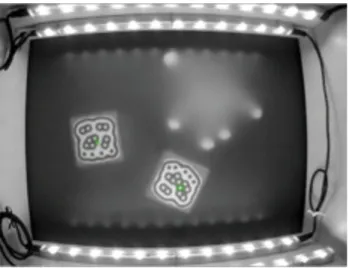
Figure 2. Interior view of the Gestus system, showing fiducial objects and fingers touching the touch surface.
To control sound synthesis on Gestus, the user places cubes or other objects that show fiducial shapes on a flat surface of a semi-transparent acrylic material. An infrared camera can detect these fiducial markers through Computer Vision (see Figure 2). Each fiducial can correspond to one sampled sound coupled with a sound processing algorithm. When the user places a fiducial object on the board, the corresponding sound starts playing, and when the user removes the object, the sound stops. We have implemented an algorithm that lets the system know when objects are placed on or removed from the board.
5. Experiment
5.1. Ιntroducing Gestus to Children in a Workshop
Our educational experiment was conducted in the framework of the EASTN children workshop and lasted for 5 days (see Figure 3). The participants 32 schoolchildren of both genders (18 male, 14 female), aged within 93% between 6 and 15 years. The children were volunteers and parental permission was given to participate in the workshop. All participants used Gestus daily. Only 5% had used similar interactive interfaces before, however another 52% had used interactive learning environments at least once.
Our workshop involved an iterative cycle of four steps: experience, record, listen and
improvise. Thirty-two participants were assigned to one of four groups based on their age (2 x
6-10) and (2 x 11-15) with gender roughly balanced. Ten short experimental compositions were created for the purposes of the study. We provided guidance through the entire process of the workshop. For the recording we let all groups out in the field for one hour to capture natural sounds relating to gesture and touch. In each group, all children participated in all process stages until the project’s completion and in each duty role (recorder, boom operators, tangible user, audio editor, pre- and post-production). Each member of the group had completed a training session, which involved three main tasks to experiment with sound. Users were taken out on the field to explore sounds made from natural sound sources and relate them to hand gestures with view to their potential of creating new sound textures. Users were asked to write down when a particular gesture was causing a significant interest or represented balance. Each group had recorded at least 3 samples for each individual (approx. 25). These were collected to form a sound library. All tasks were accompanied with set of written survey questions and a series of qualitative interview questions, reported by Kolb and Kolb (2005). The workshop was recorded on video.
5.2. Evaluation methodology
This study is not a fully controlled experiment; yet we can discuss results in terms of groups, ages and genders and make statistical comparisons taking into account data from each group. The data analysed were: videos of work sessions with the children, a questionnaire about the experience of working with Gestus, and the recordings of performances made with Gestus. We looked for common traits in usability, machine learning, fun-driven and motor cognitive learning as well as musical aspects such as spectrum, timbre, duration, textures of each one of the 10 compositions.
We evaluated the system to see whether it provides an alternative educational yet entertaining way to learn how to create sound textures and to evaluate methods for improvisation and experimentation with Gestus as a learning tool that could be applicable in music schools, workshops and live performances. In addition we sought to identify errors in the system’s design in order to develop new interaction ideas. Therefore we analysed data based on user experience studied key factors that may contribute to further development of the system. We assessed the initial experience of the user with the system. We asked teams to answer both open-ended (for each group) and closed-ended (for each individual) questions:
1. Were participants able to gain a thorough understanding of the basic interaction of the system? What did they learn?
2. Were all participants able to play, even if some of them required a little guidance? Did participants experience any problems with the multi-touch surface and the objects? 3. Were participants able to work as a team? Did teamwork help them to learn about
collaborative music composition as a process?
4. Were participants able to comprehend how their choices affect the state of the game in real-time? Did they comprehend that there is not a specific order of use?
5. Were all participants, regardless of age, able to comprehend the different types of audio features through interaction with the interface?
6. We all participants able to describe the interactive experience? Did they like the game? Would they like to play again?
5.3. Questionnaire Study
A seven-point scale (Likert) was used for this evaluation where 1 represents “strongly disagree" and 7 “strongly agree” (see Table 1). The closed-ended questionnaires were analysed according to descriptive statistics (average, median, standard deviation) in order to determine how effectively the system has responded to the initial objectives of design interaction. We also studied all participants’ responses in order to re-evaluate and create open questions that will provide a new framework for research. Additionally, we conducted informal interviews with all participants during the course of the weekend. The analysis of the results was based only on questionnaires. Reports of informal interviews were held only in cases that they provided a framework for results. We tried to identify any issues in areas where responses were less positive. Other evaluation questionnaires (artists / amateur use) are not listed in the tables presented on this report.
Table 1. Assessing Experiential qualities in using Gestus.
Questions Average Median Standard Deviation
Q1. Playing this game I gained better understanding of interaction in
music creation. 5,4 5,5 1,113
Q2. Playing this game I realised how easy it is to make changes to
sound in real-time.
6 6 0,632
Q3. By playing this game I have actively collaborated with other players. 5,4 5 1,019
Q4. I played the game mostly on my own. 4,1 4,5 1,513
Q5. Collaborating with others helped me learn something new about
creating music in groups.
5,4 5 0,489
Q6. I like to play this game with other players. 5,5 7 2,334
Q7. I liked the fact that I could use my hands to move objects on the
multitouch surface.
6,1 6 0,7
Q8. I liked the fact that I do not need to wait for my turn, in order to play
this game.
6,2 6 0,785
Q9. I enjoyed playing this game because I have learned how to create
music without musical skills or the ability to play a musical instrument.
5,3 5 0,642
Q10. I would like to play this game again. 5,8 6 0,748
Q11. I enjoyed playing this game. 6,1 6 0,538
6. Discussion
When recording sounds, all teams used various interactive ways (scratching, hitting, rubbing, touching, interacting using objects) in order to create audio textures. This shows the
immediacy of the first primitive thoughts when it comes to create sound textures by using hand gestures. These first efforts of interaction we could mainly describe as continuous, simultaneous and hasty. This shows children’s confusion and the resultant hesitation to interact at the initial stages of the experience (Xu, Read, Mazzone, MacFarlane, and Brown, 2007). Sometimes children needed guidance and encouragement to develop their own sound production techniques. For example in the recording process for the track called “Bell”, kids were hesitant to experiment with textures by exploring the surface of the bell, shouting in the bell’s cavity or interacting with any other way. Instead they were creating sounds by naturally using the bell (pulling the rope).
With the completion of the first two cycles (experience, record), samples that were interesting in terms of texture and showed variety in terms of frequency were assigned to fiducial objects. We noticed that it does not take long for children to recognize the relationship between their movements and the objects placed on the surface. As this development stage unfolds, children begin to control their movements by varying their motions and by repeating certain actions that give them particular pleasure. We observed that occasionally youngest kids had a tendency to accelerate and the fiducial objects
vigorously, to an extent that might endanger the experimental setup.
All participants used the system to interactively experiment with the sound samples. At the end of each group session, we created small teams in order to evaluate the system’s interaction design when used concurrently. Most of the participants described their second experience with the system as "very entertaining”. Additionally, we observed that children were using the system more methodically. Some maintained that they had developed their own techniques and others believed that they invented unique “combo actions”. By the end, the majority of the kids had developed their own methods of interaction with the system and the musical structure of their compositions had improved remarkably. Scribbles were transforming into methodical based-actions. One could notice a shift towards exploring the textural aspects of each sound, along with the desire for soothing moments and the effort to create points of climax in the composition (see Fig. 4). We observed that as the kids gained more experience they strove to work individually. We classified children’s interactions into categories, based on their characteristics.
Figure 4. Spectrum, Energy Peaks and Harmonicity in Works created by Children.
6.1. Signs of Cognitive Development in Different Age Groups
The experiment provided children with the opportunity to create a conceptual sound library based on natural sources and expressively compose music through audio textures. Children’s art expression is a documentation of personality in which they exhibit personal characteristics and emotions through performance (Lowenfeld, 1957). Various indicators audible in their compositions help to determine a status of the children’s mood at that particular time of performance. For example an indication of a happy mood can make children interact with a spontaneous fast pace which will create random changes to sound. Scribbles may not make any sense to adults but they are very important to a young child. Drawing and scribbling are the first steps of using the skills children will need later for writing (Mincemoyer, 2016). We observed that some of the primitive gestures of the kids were simply musical scribbles, other were more determined and complex, or even some that were real-time oriented. All of them were clearly age-related.
1. Children of younger ages (6-9) were creating random and uncontrolled movements in order to explore the surface and to play with Gestus similar to a toy or a drawing game.
We provided some guidance for them to start identifying how their gestures affect the corresponded sound changes. We can classify their movements mostly as uncertain, abstract and explorative.
2. Children of the second age group (9-12) were more interest in exploring the system’s limitations by forming various geometric patterns and shapes (circles, squares, ovals) but without being as wildly creative. Their movements were controlled and consisted predominantly of straight lines (vertical, horizontal, zigzag, etc.) They were predefined and directional.
3. Children in the last age group (13-15) were creating more complex moves. They experimented with speed (acceleration and deceleration the objects), rotation (spins or spinning while moving the object simultaneously), or creating asynchronous movements and combinations using both hands and multiple objects. Children explored sound textures interactively based on what they were hearing in real time. Finally, there were movements representing symbols, lettering or word spelling. We can describe this age-group’s movements as explorative, complex and dynamically experienced.
6.2. Using the Scribbles Metaphor in Analysis of Cognitive Development Signs Lichen and Moss is one of children's first efforts to create a textural music piece. A walk in
the surroundings of the village provided the experiential basis for this work. A library of audio samples was created by recording the children's playful game around a rock, surrounded by moss and lichens. We noticed children’s conceptual immediacy by literally interpreting the title of the workshop into this first piece. By listening to the sound library we observed that all samples were similar - harsh random sounds of hands exploring the rock. The same
vigorous concept was applied when performing with Gestus. Children were interacting by moving the fiducials objects randomly on top of the surface. These hasty movements indicate children’s lack of commitment or embarrassment in their first effort of
experimentation (Read and Macfarlane, 2002). Bell is another music piece performed from children of the youngest target group. We observed that children needed guidance to create sounds. They predominantly used the bell grip to create few sounds (hitting and rubbing bell’s interior body). Few of the collected sounds were placed on a single object to bring interaction to the minimum level. We observed that complex motions (acceleration and rotation) caused an unbridled enthusiasm to young children. Such type of interaction created an incentive for abrupt movements that were considered to be dangerous to the game. Learning requires engagement. Engagement is widely perceived as a kind of consciousness that requires cognitive effort of processing new information (Salomon and Globerson, 1987).
Soundscape I & II were created through collaborative groups (mixed ages). All participants
were introduced to soundscape recording. This time we aimed to misdirect all children from the recording process by creating an open-field gestural game. Most improvised using various ways of interaction (scratching, banging, rubbing) with objects around the location. We observed that some used their body to create textures (jumps, steps, growling, blowing, breathing) while others started to form textural-based patterns (drawing shapes, creating melodies, forming rhythms). We noticed that by providing more freedom to the game (no restrictions, specific goals or time constraints), children showed a greater tendency for experimentation.
games with the current task theme. By letting children act freely and this time without any given guidance or discussion provided, we observed that younger children were creating textures effortlessly and showed great enthusiasm throughout the whole process. Instead, we noticed that older children were acting with less intensity, with uncertain moves and were regularly asking for guidance. Some of their question included tips on how to avoid repeating patterns, improvise, create sounds without a certain phrase motive, or how to develop a tendency for experimentation. Older children tend to interact symbolically and begin conceiving of images as visual metaphors (Salomon and Globerson, 1987). For instance, older children are able to recognise emotions beyond a specific depicted object (isolated tree - loneliness). Music improvisation is a research on phenomena that are not only related to music but mainly to life (Meelberg, 2014).
6.3. The Role of Social Interaction
Several art-based studies focused on the outcome of social skills as a social component (e.g., arts-based activities with parents, other children, teachers or workshops) (Eisenberg, Fabes, and Spinrad, 2007). Practicing art in classroom-based environment benefits children’s intellectual development and evokes their emotional response. It engages competences that affect children’s relationships with teachers, peers and family (Horowitz and Webb-Dempsey, 2002; Eisner, 2004). Engagement can be assessed through
behavioural responses such as smiles, laughter, positive feedback and concentration. Conversely, lack of commitment can be measured through signs such as frowning, ear scratching and shoulder lifting (Read and Macfarlane, 2002). Most children experience rapid transformation (from 0 to 8 years of age) in three broadly defined domains: social- emotional,
physiological, and cognitive. Social-emotional development involves social skills such as
helping, sharing and caring.
Children’s reactions were mostly positive. By eliminating rules or gameplay limitations we observed an increased tendency for experimentation, collaboration and fun. This included smiles, playful moods and excited reactions, as well as moments of concentration and a plethora of questions. These were mostly interaction-oriented questions relating to system usability and music composition, and questions that concerned system’s construction such as what is inside the box, what Is its cost, how transportable is it? We observed that females worked with more concentration on creating unique textures and asked for advice from time to time, while males that worked independently aiming to have fun and enjoy their session time. Finally, we randomly formed collaborative teams consisting of either a mix of both genres or single-gender groups.
7. Conclusions
We presented an experimental study based on user experience feedback in order to form an empirical basis for usability and learning benefits of tangibility (exclusively in music
composition using audio textures). Gestus is tangible interactive tool is designed to emulate a musical blank canvas. We developed this abstract user interface to be used as an
alternative learning method of teaching children how to explore and experiment with non-musical elements such as the audio textures. The system uses characteristics and
properties of similar TUIs regarding the design, construction and the operation of the system. It creates its own autonomous data-processing algorithm and develops an alternative
method for engaging creatively with sound. It is also 1/10 of the cost and at least 1/3 of the size of existing interfaces. The first contribution is the development of an extensible TUI prototype for sound texture design using audio feature extraction as the main framework for work. The second contribution is that it provides an experiential approach for teaching art in
primary education (Schwarz, 2006). The third contribution is the set of design
recommendations as an incentive to develop similar educational training TUI interfaces. Furthermore, we believe that next steps in this study could lead to an extended version of the system addressing kids with disabilities and behavioural difficulties. We suggest that a future study should test artists and experienced users to investigate issues of advanced interaction. In future evaluations, it would be interesting to research the behavioural effects with respect to gender. In addition, we plan to continue our investigation of how Gestus can be combined with other approaches to enhance the output of the system, such as real-time graphical educational representation of the audio, color-based audio classification and puzzler music games. Our hope is that research in this direction will lead to interfaces that can solve behavioural problems that cannot be readily solved using the current predominant approaches to tangible edutainment.
Acknowledgements
The workshop for this research was organized with support from the EU Creative Europe project “European Art-Science-Technology Network” (EASTN). We thank the children and parents of Tsepelovo for their enthusiastic participation and the Department of Audio & Visual Arts, Ionian University for their support of this research.
References
Brooks, M. (2004). Drawing: the social construction of knowledge. Australian Journal of Early
Childhood, 29(2), 41–50.
Cadoz, C. (1994). Les réalités virtuelles : Un exposé pour comprendre, un essai pour réfléchir. Paris: Flammarion.
Eisenberg, N., Fabes, R. A., & Spinrad, T. L. (2007). Prosocial Development. In Handbook of
Child Psychology. John Wiley & Sons, Inc.
https://doi.org/10.1002/9780470147658.chpsy0311
Eisner, E. W. (2004). The Arts and the Creation of Mind. New Haven: Yale University Press. Grandstaff, L. J. (2012). Children’s Artistic Development and the Influence of Visual Culture.
University of Kansas. Retrieved from
http://oatd.org/oatd/record?record=%22handle%5C%3A1808%2F10645%22
Hope, G. (2008). Thinking and Learning Through Drawing: In Primary Classrooms. Los Angeles: SAGE Publications Ltd.
Horowitz, R., & Webb-Dempsey, J. (2002). Promising signs of positive effects: Lessons from the
multi-arts studies. Washington, DC: Arts Education Partnership, 98–100.
Jordà, S, G., G. (2007). The reactable: exploring the synergy between live music performance and tabletop tangible interfaces. In TEI ’07: Proceedings of the 1st international conference
on Tangible and embedded interaction (pp. 139–146). New York, USA.
Jordà, S., & Alonso, M. (2006). Mary had a little scoreTable* or the reacTable* goes melodic. In
New Interfaces for Musical Expression (NIME). Retrieved from
files/publications/1040f9-NIME06-sjorda.pdf
Kaltenbrunner, M., O’Modhrain, S., & Costanza, E. (2004). Object Design Considerations for
Tangible Musical Interfaces. Retrieved from
files/publications/COST287-ConGAS-Kaltenbrunner.pdf
Kellogg, R. (1970). Analyzing Children’s Art. USA: Mayfield Pub Co.
Kolb, A. Y., & Kolb, D. A. (2005). Learning Styles and Learning Spaces: Enhancing Experiential Learning in Higher Education. Academy of Management Learning & Education, 4(2), 193– 212. https://doi.org/10.5465/AMLE.2005.17268566
Lowenfeld, V. (1957). Creative and Mental Growth.
Marshall P. (2007). Do tangible interfaces enhance learning? (pp. 163–170). In: Proceedings of
the 1st international conference on tangible and embedded interaction., New York, NY,
USA.
Matthews, J. (1994). Helping Children to Draw and Paint in Early Childhood. London: Hodder Arnold H&S.
London ; Philadelphia, PA: Routledge.
Meelberg, V. (2014). Musical Improvisation as the Performance of Embodied Knowledge: Embodied Narrativity in Musical Performance. In Proceedings of CARPA3: Colloquium on
Artistic Research in Performing Arts. Helsinki: University of the Arts Helsinki, Theatre
Academy. Retrieved from
https://www.academia.edu/6854151/Musical_Improvisation_as_the_Performance_of_Emb odied_Knowledge_Embodied_Narrativity_in_Musical_Performance
Mincemoyer, C. C. (2016). Scribbles have meaning. The Pennsylvania State University. Morris, D. R., Collett, P., Marsh, P., & O’Shaughnessy, M. (1979). Gestures, Their Origins and
Distribution. London: Jonathan Cape.
O’Malley, C., & Fraser, D. S. (2004). Literature Review in Learning with Tangible Technologies. Retrieved from https://telearn.archives-ouvertes.fr/hal-00190328/document
Ogata, H., Akamatsu, R., Mitsuhara, H., Yano, Y., Matsuura, K., Kanenishi, K., … Morikawa, T. (2004). Tango: Supporting Vocabulary Learning with RFID tags. In International Workshop
Series on RFID.
Patten, J., Ishii, H., Hines, J., & Pangaro, G. (2001). Sensetable: A Wireless Object Tracking Platform for Tangible User Interfaces (pp. 253–260). ACM Press.
Piaget, J. (1952). The Origins of Intelligence in Children. New York: International Universities Press.
Read, J., & Macfarlane, S. (2002). Endurability, Engagement and Expectations: Measuring Children’s Fun. In Interaction Design and Children, Shaker Publishing (pp. 1–23). Shaker Publishing.
Resnick, M., Martin, F., Berg, R., Borovoy, R., Colella, V., Kramer, K., & Silverman, B. (1998). Digital manipulatives: new toys to think with. In Proc. CHI ’98 Human Factors in Computing
Systems. ACM Press.
Roland, C. (2006). Young in Art: A developmental look at child art. Retrieved June 12, 2017, from http://docplayer.net/18693054-Young-in-art-a-developmental-look-at-child-art-craig-roland-1990-2006-www-artjunction-org.html
Ryokai, K., Marti, S., & Ishii, H. (2004). I/O Brush: Drawing with Everyday Objects as Ink. Saffer, D. (2008). Designing Gestural Interfaces: Touchscreens and Interactive Devices. O’Reilly
Media.
Saint-Arnaud, N., & Popat, K. (1995). Analysis and synthesis of sound textures. In Readings in
Computational Auditory Scene Analysis (pp. 125–131).
Salomon, G., & Globerson, T. (1987). When teams do not function the way they ought to. In
Proceedings of International Journal of Educational Research 13 (pp. 89–100).
Schwarz, D. (2006). Concatenative sound synthesis: The early years. In Special Issue on Audio
Mosaicing: Feature-Driven Audio Editing/Synthesis. Place Igor-Stravinsky, 75003 Paris,
France.
Shapiro, R. B., Kelly, A., Ahrens, M., & Fiebrink, R. (2016, July). BlockyTalky: A Physical and Distributed Computer Music Toolkit for Kids. In Conference presented at the International
Conference on New Interfaces for Musical Expression. Retrieved from
http://research.gold.ac.uk/18635/
Stringer Mark, Toye Eleanor F., Rode Jennifer A., & Blackwell Alan F. (2004). Teaching
Rhetorical Skills with a Tangible User Interface. In Proceedings of the 2004 conference on
Interaction design and children: building a community (Vol. 11–18).
Xu, D., Read, J. C., Mazzone, E., MacFarlane, S., & Brown, M. (2007). Evaluation of Tangible User Interfaces (TUIs) for and with Children: Methods and Challenges. In Proceedings of
the 12th International Conference on Human-computer Interaction: Interaction Platforms and Techniques (pp. 1008–1017). Berlin, Heidelberg: Springer-Verlag. Retrieved from
http://dl.acm.org/citation.cfm?id=1757268.1757383
Zaman, B., Vanden Abeele, V., Markopoulos, P., & Marshall, P. (2012). Editorial: the evolving field of tangible interaction for children: the challenge of empirical validation. Personal and
Ubiquitous Computing, 16(4), 367–378. https://doi.org/10.1007/s00779-011-0409-x
Zuckerman, O., Arida, S., & Resnick, M. (2005). Extending tangible interfaces for education:
digital montessori-inspired manipulatives (p. 859). ACM Press.