Desenvolvimento Curricular
e Didática
Ana Raquel Simões
Centro de Investigação em Didática e Tecnologia naFormação de Formadores Universidade de Aveiro [email protected]
Resumo:
Para uma mais clara compreensão do processo de relacionamento do sujeito com as línguas e ensino de línguas e sua aprendizagem, é essencial estudar pormenorizadamente projetos de intervenção escolar desenvolvidos em colaboração com professores e alunos e que adotem uma abordagem plurilingue e intercultural.
No presente artigo propomo-nos descrever um projeto no qual foi adotada uma abordagem interdisciplinar, durante um ano escolar, com uma turma de alunos do 9.º ano e que teve como objetivos: (i) facilitar o contacto com situações que poderiam influenciar positivamente as representações dos alunos em matéria de diversidade linguística e cultural e (ii) criar, implementar e avaliar estratégias que visassem o desenvolvimento da competência plurilingue dos alunos.
Neste artigo vamos centrar-nos no (des?)conhecimento dos alunos sobre o mundo das línguas antes, durante e depois da implementação do projeto. Este estudo de caso, com traços de investigação-ação, teve como instrumentos de recolha de dados: inquéritos por questionário (inicial e final) e inquéritos por entrevista aos alunos; desenhos dos alunos; videogravação e transcrição das aulas de implementação do projeto; e fichas preenchidas pelos alunos.
Os resultados permitiram-nos refletir sobre as resistências e motivações reveladas nas conceções e práticas dos professores e alunos, bem como equacionar o papel destas conceções na construção do conhecimento dos aprendentes. Iremos apresentar possíveis contornos da ação pedagógica, nomeadamente em termos de alguns dos princípios mais bem-sucedidos para preparar os currículos em diferentes ambientes educacionais.
Palavras-chave: competência plurilingue, competência intercultural, abordagem interdisciplinar,
conhecimento
Abstract:
For a clearer understanding and improvement of the language teaching and learning process, a detailed study concerning intervention projects, undertaken in collaboration with teachers and students, adopting plurilingual and intercultural framework is essential.
We will describe such type of a project, adopting an interdisciplinary approach, during one school year with a class of 9th grade students and aiming to: (i) facilitate the contact with situations which
could positively influence students’ representations concerning linguistic and cultural diversity, and (ii) create, implement and evaluate strategies aiming at the development of students’ plurilingual competence.
Students’ knowledge about the world of languages: contribution of an
interdisciplinary project to plurilingual education
Os conhecimentos dos alunos acerca do mundo das línguas: contributos de um
projeto interdisciplinar acerca da educação plurilingue
ISSN: 1647-3582
Indagatio Didactica, vol. 8(2), julho 2016
Desenvolvimento Curricular
e Didática
In this article we will focus on the students’ (mis?)understanding about the world of languages before, during and after the project. The data collected from this case study (also with action-research features) were: questionnaire to the students, drawings, video recording of classes and transcription; worksheets filled in by the students; interviews to the students and final questionnaire to the students. The results allowed us to reflect upon the resistances and motivations revealed on students’ conceptions and teachers’ practices, and the role of these conceptions in the construction of students’ knowledge. We will present possible outlines of pedagogical action, namely in terms of some of the most successful principles undertaken when preparing curricula in different educational environments and school subjects.
Keywords: plurilingual competence, intercultural competence, interdisciplinary approach,
knowledge
Resumo:
Para una posible mejora de la comprensión de la materia del proceso de relación con las lenguas y la enseñanza de idiomas y su aprendizaje, es esencial un estudio detallado sobre los proyectos de intervención, llevados a cabo en colaboración con los profesores y estudiantes, la adopción de marcos plurilingües e interculturales.
En este artículo nos proponemos describir este tipo de proyectos, que adoptó un enfoque interdisciplinario, durante un año escolar, con una clase de estudiantes del grado 9 y con el objetivo de: (i) facilitar el contacto con las situaciones que puedan influir positivamente en las convicciones de los estudiantes en el campo de la diversidad y (ii) crear, implementar y evaluar estrategias para el desarrollo de la competencia multilingüe de los estudiantes.
En este artículo nos centraremos en lo conocimiento (o no?) de los estudiantes sobre el mundo de los idiomas antes, durante y después del proyecto. Los datos obtenidos de este estudio de caso (también con funciones de investigación-acción) fueron: cuestionario a los estudiantes, dibujos, grabación de vídeo de las clases y la transcripción; hojas de trabajo de llenar los alumnos; entrevistas a los estudiantes y cuestionario final a los estudiantes.
Los resultados nos han permitido reflexionar sobre las resistencias y motivaciones reveladas en las concepciones de los profesores y las prácticas de los estudiantes, y para reflexionar sobre el papel de estas concepciones en la construcción del conocimiento de los estudiantes. Vamos a presentar posibles contornos de la acción pedagógica, es decir, en términos de algunos de los principios más exitosas llevadas a cabo en la preparación de planes de estudio en diferentes entornos educativos y materias.
Palabras clave: competencia plurilingüe, la competência intercultural, enfoque interdisciplinario, el
Desenvolvimento Curricular
e Didática
ISSN: 1647-3582
Indagatio Didactica, vol. 8(2), julho 2016
Desenvolvimento Curricular
e Didática
Introduction
For a clearer understanding and improvement of the language teaching and learning process, a detailed study concerning the relationship individual/subject-language is essential, as well as intervention projects, undertaken in collaboration with teachers and students, adopting a plurilingual and intercultural framework. There are multiple studies on the comprehension of this relationship, which focus on different objects and use several theoretical concepts, helping us to carry out not only reflexive work concerning classroom practices, but also providing guidelines for effective school work about and with languages in different disciplinary subjects.
In this article we will describe such a type of project, developed according to an interdisciplinary approach, during one school year with a class of 9th grade students. The purposes of the project
were to: (i) facilitate the contact with situations which could positively influence students’ convictions concerning linguistic and cultural diversity, and (ii) create, implement and evaluate strategies and materials aiming at the development of students’ plurilingual competence. All the school subjects (Portuguese Language, French, English, Mathematics, Physics and Chemistry, Geography, Physical Education and Arts) participated in this project following a collaborative perspective and a network approach. Five different intervention modules were implemented (Who am I?; Diversity in Portuguese language and in Portugal’s geographical areas; Linguistic and cultural diversity around the world; Contact with different languages and cultures; three linguistic workshops with native speakers) and the students also created a portfolio. Different types of data were collected, from interviews to the students and teachers; classroom videotaping and transcription; group work recording; to worksheets filled in by the students.
With this paper we intend to present some of the project results, namely the analysis of the students’ knowledge about the world of languages (a more cognitive approach) throughout the modules and the role of such knowledge in the development of plurilingual and intercultural competence. Based on the analysis of the results, we can state that the strong initial representations of students, marked positively and/or negatively, were progressively neutralized, complexified and enriched throughout the school year. Systematic and organized school work concerning the world of languages also seemed to increase the knowledge about the world of languages and linguistic and cultural diversity (for instance, the number of languages in the world, the most spoken languages, language families, diversity of the Portuguese language and territory, writing systems, and concepts like majority/minority languages).
Plurilingual and intercultural competence
Plurilingualism has been a core principle in the language policy of the Council of Europe (CE, 2001, 2006), and in language education policies in Europe (Beacco & Byram, 2007; Candelier, 2008; Meissner, 2007), where plurilingualism is both seen as a value and as a competence (Beacco & Byram, 2003), aiming at the preparation of individuals for a more participative and democratic citizenship. The need to communicate globally, as well as the mobility growth and the increase of interactions with diversity has called peoples’ attention to the importance of: i) developing an attitude of openness towards Others, ii) promoting (inter)comprehension, iii) acknowledging difference, and
ISSN: 1647-3582
Indagatio Didactica, vol. 8(2), julho 2016
Desenvolvimento Curricular
e Didática
iv) constructing a democratic citizenship (Breidbach, 2003). In fact, “plurilingual and intercultural education is not a ‘revolution’. It takes into account above all what already exists…” (Cavalli et al., 2009, p. 7), since our societies are becoming more and more pluri and intercultural spaces. As these authors refer, plurilingual and intercultural education has become a project, as well as a right on its own (Coste et al., 2009), according not only to the linguistic rights of the individual, but also to the importance of linguistic diversity and of multilingualism in every society.
Taking these assumptions into consideration, plurilingual and intercultural education (i) “it facilitates the acquisition of linguistic and intercultural abilities”, and (ii) “it promotes personal development, so that individuals can realise their full potential: this involves encouraging them to respect and accept diversity of languages and cultures in a multilingual and multicultural society (cf. Byram, 2009), and helping to make them aware of the extent of their own competences and development potential” (Beacco et al., 2010, p. 18).
It is assumed, on the basis of a plurilingual and intercultural approach, that being in contact with other ways of life promotes human enrichment and fosters an openness of mind leading to the understanding and acceptance of other ways of thinking and of facing reality through the development of plurilingual and intercultural competence (Beacco & Byram, 2003). Keeping this in mind, language education needs to be (re)conceptualized and educators in general (not only teachers, but each citizen) are called on to participate in such an approach that values individual’s life stories, and linguistic contacts and repertoires.
School, as an education ground where languages and cultures “live” and interact, may be an excellent space to develop work on plurilingual and intercultural education, even though, as Beacco et al. (2010) conclude, schools have not been a place of great investment in the exploitation of this diversity. Therefore, the role of school needs to be reinforced, due to its responsibility in inclusion and in the development of students’ repertoires: “The purpose of schooling is to contribute to inclusion and cohesion by developing mastery of languages of schooling and also by taking into account what has already been acquired” (Cavalli et al., 2009, p. 6).
Indeed, there are many possible curriculum scenarios within plurilingual and intercultural education (Beacco et al., 2010) and plenty of available resources (Beacco, 2009), and it is essential that they are adapted and adopted according to each context, also taking into account the concept of curriculum (Van den Akker et al., 2010). In the next section we will present the project that we carried out and the curriculum approaches that were adopted.
The theoretical and pedagogical background of the project
Theoretical approach
Within the scope of our project, we worked on different dimensions of plurilingual and intercultural competence, namely: a more cognitive approach; a representational dimension; and a practical dimension. The cognitive dimension refers to the knowledge students have concerning the object in study, i.e., languages and cultures. In this dimension we would include, for instance, topics like: language families; metalinguistic concepts (e.g. language, dialect; language varieties; Mother Tongue; Foreign Language; Minority language). The representational dimension is related to the
Desenvolvimento Curricular
e Didática
ISSN: 1647-3582
Indagatio Didactica, vol. 8(2), julho 2016
Desenvolvimento Curricular
e Didática
representations/images towards languages and cultures, referring to the emotional and affective relationship that they do or do not establish with them. This includes aspects such as the will/interest to know more or to contact with other languages; self-confidence as language speakers; or the openness towards linguistic and cultural diversity. The practical dimension refers to the individuals’ behaviours and reactions in relation to the object being studied, which means that there can be behaviours of indifference, curiosity, and/or of closeness.
We will now explain in detail what we understand by the cognitive dimension, given that it is the one with the greatest interest within the scope of this paper. The cognitive dimension appears, in the plurilingual competence model, with reference to verbal learning procedures and to the “learning processes which the subject is capable of managing in situations of contact between languages” (Andrade & Araújo e Sá et al., 2003), situated at two levels: a procedural one and a meta-procedural (idem). These authors believe that this dimension encompasses linguistic learning abilities and language learning procedures, which consist in resorting to knowledge of the world, in general, and of the world of languages in particular, through the induction of rules and through observation and reflection upon languages as systems. This view is in all very similar to the one here adopted.
In the intercultural competence model, proposed by Byram, the knowledge domain includes two categories of knowledge: one concerning the knowledge of social groups, the subject’s and others’, and of their cultures; the other category including the processes of interaction at the social and individual level. This author adds that: “the first category is knowledge which may be more or less refined, but always present in some degree, whereas the second, involving knowledge about concepts and processes in interaction, is fundamental to successful interaction but not acquired automatically” (1997, p. 35).
As stated by Beacco et al. (2010, p. 19), a distinction should be made between linguistic knowledge and language knowledge (associated with knowledge about language in general), which can be developed through the medium of any language, and can be transferred from any one language to another.
Besides the role of these two approaches to our understanding of what constitutes our object of study - one concerned with the abilities of linguistic-verbal learning and the other focusing on declarative knowledge about languages, speakers and cultures –, we will also include their conceptualization which results from other studies (or parts of more general studies). The studies mentioned are concerned with the knowledge subjects possess about language(s) and in language(s), i.e., both what they know or think they know about a certain language, group of languages or languages in general, and the knowledge they have of a language, group of languages or languages in general. This dimension also includes a metacognitive component, regarding the knowledge of how languages are learnt as well as their usage, covering all types of reflection concerning these processes, since we agree with the assumption that: “the development of plurilingual and pluricultural competence promotes the emergence of linguistic awareness, and even of metacognitive strategies, which enable the social actor to become aware of and to control his own “spontaneous” ways of handling tasks” (Coste, Moore & Zarate, 2009, p. 12).
Now, within the scope of a study in the field of Didactics of Languages (DL) which focuses on the role of school in the operationalisation of work with languages, directed towards the development of plurilingual and intercultural competence, concerning the cognitive dimension in particular, and
ISSN: 1647-3582
Indagatio Didactica, vol. 8(2), julho 2016
Desenvolvimento Curricular
e Didática
creating perspectives for our empirical work, we believe that the knowledge of certain cognitive elements and the possession of a certain type of information about languages may influence the subjects’ representations and practices concerning languages and their learning process.
Hence, we believe it is important to include knowledge of the world of languages and cultures in the school curriculum, articulated among the different subjects of this curricular area, such as History (for example, focusing on the evolution of languages), Geography (namely, discussing issues relating to linguistic demography and its evolution and the concepts of land and linguistic border, for example), or even the subject of Sciences (studying, for example, the concept of symbol, language, etc.). Besides the need to complete and complexify knowledge about languages and cultures, it is even more important, within the school context, to develop competences on the management of the subject’s linguistic-communicative repertoire (along the lines of Andrade & Araújo e Sá et al., 2003), in other words, to carry out systematic work in the development of appropriation and observation strategies of verbal statements, either in the subject’s Mother Tongue (MT) or in a foreign language (FL), previously known to the subject or not, and to encourage the participation in intercultural encounters where multiple languages are present, leading the subjects to feel the need to explore their previous knowledge, but simultaneously impelling them to acquire new knowledge, in what we might call, following Vygotsky (1985), areas of proximity development of linguistic culture.
Pedagogical approach
In our project we took the stance that language education is enriched by the complexity of experiences: «Cette multiplicité d’expériences inclut des savoirs construits dans différents espaces sociaux (incluant la famille, la communauté et l’école) et différents espaces de mémoires, ainsi que dans leur articulation» (Moore, Sabatier, Jacquet & Masinda, 2008, p. 21), and we adopted this version.
Since we believe that plurilingual and intercultural education needs to be conceived as “a global language education, across all languages of the school and in all disciplinary domains” (Cavalli et al., 2009, p. 8), we considered that all school subjects contribute to this language education process, in a wide approach to the curriculum (Vollmer, 2006). Assuming also the importance of involving foreign languages, mother tongue (language of schooling, in this case), the languages of the repertoires of learners and the language of all the subjects, we decided to adopt an interdisciplinary approach (as described in the section “Intervention project: a description).
The erroneously called “non-linguistic subjects” (as History, Geography or the Natural Sciences) should not be excluded from projects concerned with plurilingual and pluricultural competence (cf. Beacco et al., 2010). Seen as culturally and linguistically neutral subjects (although this is not our conception), they supply different insights to the project, from the concepts they work with to the methodologies they use.
The idea of making different subjects work within plurilingual and intercultural competence also developed a sense of collective concern in terms of curriculum design and in terms of the responsibility towards the students and the community. In some cases, the interdisciplinary approach may also function as a decompartmentalisation, both internal (between school subjects) and
Desenvolvimento Curricular
e Didática
ISSN: 1647-3582
Indagatio Didactica, vol. 8(2), julho 2016
Desenvolvimento Curricular
e Didática
external (between places and times of learning, on the one hand, and their environment, on the other) (Coste, Moore & Zarate, 2009). Indeed, in some schools and in terms of language teaching and learning, there still seems to be a juxtaposition of separate bodies of knowledge (language by language), instead of an integrated plurilingual competence approach.
Besides the interdisciplinary approach, which we will explain further on, we also considered to be important for the students to develop their own projects, developing both in and out-of-class work methods, profiting from the use of some available school time, contacting with diverse materials and professionals and improving their learning skills in terms of autonomous work.
Intervention project: a description
The didactic intervention plan was carried out with a 9th grade class (14-15 year old students) – the
end of compulsory education in Portugal –, with 21 students (13 females and 8 males), 20 of them having Portuguese as mother tongue and one having German. The class was studying English as the first foreign language (5th year of study) and French as the second foreign language (3rd year of
study).
The researcher from the University contacted a school with which the Higher Education Institution and the researcher herself had already experience in working. After a meeting at the end of the previous school year with the Executive Board and with the Language Teachers’ Department, the project was approved and then the intervention plan was presented to all the teachers at the beginning of the year. The initial idea was that the language teachers (of Portuguese, English and French) would attend some teacher training on plurilingual and intercultural education and would then develop the modules. However, as the teachers from all other subjects became interested in the project, they all decided to participate. They were invited to read some reference texts on the research issue, and regular meetings (with a training intent) between all the teachers and the researcher from the University were undertaken. All the modules and teaching materials were prepared by the subject teachers in collaboration with the researcher, and all the intervention lessons were taught by the teachers and were videotaped and then transcribed by the researcher. The researcher video-recorded the classes and had only minor participation in the activities developed with the pupils, taking also part of all the meetings teachers were engaged in.
The intervention consisted in implementing five modules (see table 1) in different subjects, bearing in mind the interdisciplinary nature of the project, involving a total of 44 lessons.
ISSN: 1647-3582
Indagatio Didactica, vol. 8(2), julho 2016
Desenvolvimento Curricular
e Didática
Table 1- Intervention project: 5 modules
Modules Description Data collection
0. Characterization of students
[5 lessons]
Activities: students’ characterization: linguistic biography; students’ drawings (of French and English speakers and of them learning a new language, with participation of the Arts subject).
- Questionnaire - Drawings
1. Diversity of the Portuguese language (PL) and within the geography of the Portuguese territory [9 lessons]
Contents: diversity within the Portuguese language (varieties and variants); intralinguistic diversity within the geography of the Portuguese territory (including not only the varieties, but the distinction between the concepts of language and dialect and the Mirandese language); the evolution of the Portuguese language and the dissemination of Portuguese in the world. Activities:
- Portuguese language class: contact with 7 oral enunciations, in different varieties of Portuguese language and in “Mirandese” (a “minority” language in Portugal); creation of an historic chronogram of PL evolution. - Geography class: creation of a map of Portuguese language speaking countries. - Physics and Chemistry: the concept of language: research and group work activity on the “language” used in Chemistry and in the Latin and Greek symbols.
- Video recording of classes and transcription
- Worksheets filled in by the students
Desenvolvimento Curricular
e Didática
ISSN: 1647-3582
Indagatio Didactica, vol. 8(2), julho 2016
Desenvolvimento Curricular
e Didática
2. Linguistic and cultural diversity in the world
[3 lessons]
- Contents: the most spoken languages in the world, the number of languages in the world, the number of countries in the world, linguistic families, the advantages and disadvantages of having an universal language.
Activities:
- Portuguese class: work with cd rom “Apprendre à Lire en Français”, from Project Galatea, about the Romance languages. - French class: contact with 13 oral and written enunciations in different languages, where students were asked to identify the language, explain their choice, translate some words, repeat some of the enunciations, group the enunciations according tolanguage families,…
- History class: work on the French Revolution with different texts, including some in French, English and German.
- Maths class: group work on the use of different measurement units across the world (e.g.: miles/km) and their meaning. - Physical Education class: work on traditional games around the world.
- Geography class: group work with the creation of 3 maps of French, English and Spanish languages; research work on the concepts of linguistic border and geographic land border.
- Video recording of classes and transcription - Worksheets filled in by the students - Interviews to the students about the work developed since the beginning of the project.
ISSN: 1647-3582
Indagatio Didactica, vol. 8(2), julho 2016
Desenvolvimento Curricular
e Didática
3. Contact with different languages and cultures [6 lessons]- Some contents: the concepts of “stereotypes” and “prejudice”; writing systems.
Activities:
- English class: students were shown a video with 12 people of different nationalities, speaking their Mother Tongue, in three moments: first, with no sound; then, with sound; and finally with a written version of their speech. They were asked to identify their nationalities and languages in the three moments and later on to reflect upon the stereotypes that emerged, their origin and coherence.
- Physical Education class: research work on games around the world.
- Video recording of classes and transcription - Worksheets filled in by the students 4. Linguistic workshops [8 lessons]
- 3 linguistic workshops with native speakers of: Chinese, Dutch and Arabic (more or less 90 minutes each) - Video recording of the workshops and transcription - Worksheets filled in by the students - Interviews to the students
[end of the school year]
During the whole year:
- Project work in groups, where the choice of the project subject and schedule was of the students’ entire responsibility (with the teacher’s cooperation, when necessary);
- Creation of a Portfolio during the whole school year, which included the following chapters: My contacts with languages; My findings about languages and cultures; My
diary; and Project Work Material.
[Participation of Arts in the elaboration of the Portfolio and all its sections and dividers]
[around 12 lessons]
- Final questionnaire to
the students
One of the premises of the didactic intervention work was that the it would start from what was closer to the students and move towards what was more distant, i.e., the procedure consisted in working towards growing complexity and distancing. Hence, we started out with awareness activities which focused on linguistic and cultural diversity, first covering the existing diversity in the students’
Desenvolvimento Curricular
e Didática
ISSN: 1647-3582
Indagatio Didactica, vol. 8(2), julho 2016
Desenvolvimento Curricular
e Didática
surrounding world, particularly the intralinguistic diversity of the Portuguese Language and within the geography of the Portuguese territory.
We consider that the project work was of utmost importance, given that, as Morisette and Gringas state:
learning improves when the student, more than the teacher, assumes the control and responsibility of their own learning process. This implies that the student might learn (for example, an attitude) that may and even should assess the learning process itself leading to decisions based on it. (1999,
p. 168).
To collect data throughout the implementation of the modules, we video-recorded all the classes and then transcribed them, using an already established transcription code. We also collected the work produced by the students during the implementation of the modules and also the portfolio. We used a questionnaire (pre-tested and used in a previous phase of the study) at the beginning and at the end of the school year (to identify students’ linguistic biographies and their representations on languages and cultures) and undertook two phases of semi-structured interviews with each of the 20 students (at the middle and at the end of the school year), using a pre-established interview guide, tested with another class of students.
The data analysis technique selected was that of content analysis,
A set of communication analysis techniques, aiming, through systematic procedures and description objectives of the message content, to obtain indicators (quantitative or not) that allow for the inference of procedures regarding the production / reception conditions (inferred variables) of these messages. (Bardin, 2000, p. 42)
The analysis, using a triangulation method, was conducted by the researcher and five macro-categories of analysis were established: Findings of the world of languages; Images/representations of languages; Images/representations of people; Linguistic and communicative practices; and Plan assessment.
In this article we will present the results obtained in the category “Findings of the world of languages”, a more cognitive dimension. The analysis of the other categories (namely the representational dimension and the practical dimension) was already undertaken and presented not only in the final PhD thesis, but also in some articles and presentations in scientific events.
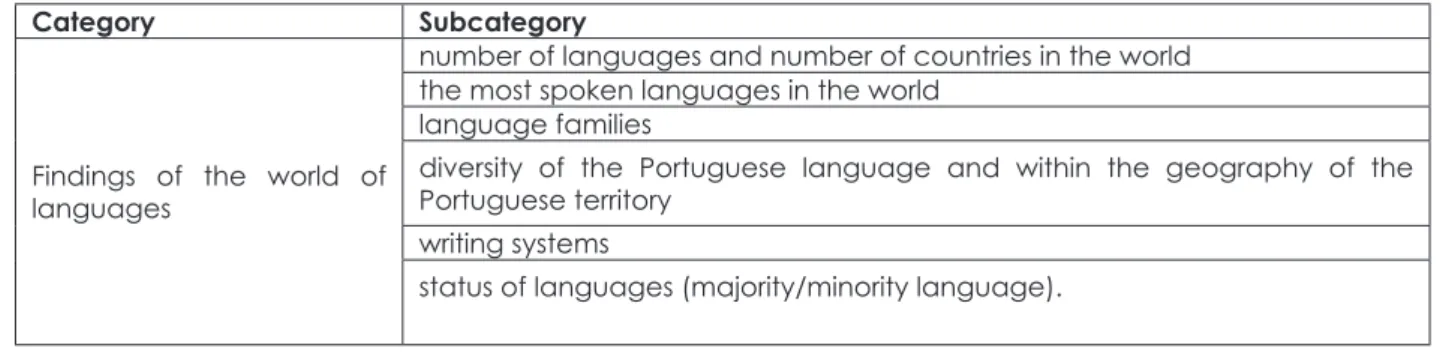
In this article, focused in the “world of languages”, a more cognitive dimension, the analysis is on students’ data, including all the elements regarding the findings they present throughout the implementation of the intervention plan concerning the linguistic universe, including the subcategories listed in table 2.
ISSN: 1647-3582
Indagatio Didactica, vol. 8(2), julho 2016
Desenvolvimento Curricular
e Didática
Table 2- Categories and subcategories
Category Subcategory
Findings of the world of languages
number of languages and number of countries in the world the most spoken languages in the world
language families
diversity of the Portuguese language and within the geography of the Portuguese territory
writing systems
status of languages (majority/minority language).
Results
Number of languages and number of countries: “many”, students say
One of the first aspects worth highlighting is the clear observation of students’ increase of knowledge throughout the entire intervention plan concerning the number of languages and countries in the world.
If we observe the results chronologically, we can see how in the two initial classes of the plan implementation, when the students were questioned about the possible number of existing languages in the world, they gave doubtful and vague answers, such as “many”, “thousands”, “hundreds” and “a thousand” in the first class, and “I have no idea”, “many”, “more than a thousand” in the second class. After being guided by the researcher’s guidelines students pointed out the following hypotheses: “more than 5000”/“no”/“maybe 10000”. Therefore, we realize that, in fact, at the beginning of the school year, students did not have much knowledge about these issues, and it was the researcher who, at the end of the class, informed the students that there are “6000 / about 6000 / 6000 languages in the World”).
However, later on, in one of the classes of the third module when the English teacher asked the students the same question, students were already able to provide a correct estimate of the number of languages, mentioning the possibility of there being 5000.
In the personal registers, where students were free to write about any subject, five students highlighted this information, revealing the interest this topic generated, for example: “Did you know that there are at least 5000/6000 languages in the world, existing only 250 countries? Weird, uh?!” (S12). It is worth noting that in the first stage of the interviews (February), when questioned about the contributions of the intervention plan, seven students highlighted this precise information: “We learnt a lot of new things […] I don’t know about other languages” (S20); “I learnt about Francophone Countries” (S11); “I learnt that there’s a great variety of languages in the world” (S19).
Regarding the number of countries in the world, in a class at the beginning of the year, the students said that the number is greater than what is in fact true, pointing out as a first hypothesis “two thousand” and “five hundred countries”, followed by “one thousand”, and after a clue given by the teacher that the number was lower than five hundred, one of the students suggested 300, another
Desenvolvimento Curricular
e Didática
ISSN: 1647-3582
Indagatio Didactica, vol. 8(2), julho 2016
Desenvolvimento Curricular
e Didática
one mentioned 345 and another student pointed towards 200.
In the students’ first answer, and after observing that the knowledge regarding the number of languages in the world had already been acquired, we understood that the students materialize one of the myths mentioned previously, that each country corresponds to one language, which means that the hypothesis of 2500 countries appeared to be an acceptable hypothesis. Only one student mentions this finding in the diary, in a surprised tone [“Did you know that there are at least 5000/6000 languages in the world, while there are only 250 countries? Weird, uh?!” (S12)].
It is also important to stress the fact that one of the language teachers involved in the project referred that she was unaware of the number of countries in the world, but that she had been informed by someone [“I know because somebody told me”], during the preparation of the intervention plan. Therefore, this is a topic within the world of languages which some teachers may also have to look deeper into and which immediately makes us to suggest that this topic be developed within teacher training.
Notice that after the implementation of the classes in Geography, the students were able to clearly identify the concept of linguistic border and geographic land border, which also helped them in the (re)conceptualisation of the relationship country-language.
The most spoken languages in the world: “it must be English”, students say
In this subcategory, one of the first relevant elements is that this was a topic introduced by student initiative, in a Portuguese Language class, during which they questioned the teacher about the languages which are most spoken in the world, which reveals their growing curiosity and interest in knowledge about the world of languages. It is worth noting that a doubtful and ambiguous answer was given (“it must be English”), a fact that causes the researcher to intervene in order to clarify the theme, reinforcing one of the students’ conception that it was Chinese.
In a subsequent class, when the subject was taken up again, but this time by the researcher, the students answered correctly, stating that the most spoken language is Chinese due to the number of inhabitants in China, followed by English. After three months, the students demonstrated the deconstruction of one of the stereotypes previously revealed about English being the most spoken language in the world. In this lesson, students showed no sign of hesitation stating Chinese as the most spoken due to the Chinese population numbers.
Two students also took up this subject in their Diaries [“In the last English class we talked about the languages which are most spoken in the World.” (S13); “Today in the English class we talked about the most spoken languages in the world. And that Chinese was the most spoken language due to the great number of Chinese people…” (S17)]; additionally, in the first phase of interviews, in the answer to the question regarding the contributions of the intervention plan, one student mentions [“I’ve learnt (…) which is the most spoken language” (S9)].
From this analysis, we can highlight two elements: the first one is that, although the topic is not mentioned as frequently in personal registers as the previous subcategory, it is clear, through the students’ transcriptions of the lessons about the modules, that there is an evolution in the knowledge of the class, as well as the consolidation of that same knowledge concerning the most spoken languages in the world.
ISSN: 1647-3582
Indagatio Didactica, vol. 8(2), julho 2016
Desenvolvimento Curricular
e Didática
The second point worth noting is that the class’s language teachers reveal a clear lack of knowledge on these subjects. Therefore it is important to acknowledge the teachers’ role in perpetuating certain myths, also the result of gaps in their scientific knowledge, as well as the absence of school work involving the world of languages, which, as we have pointed out previously, suggests some paths for professional training in the field of language education.
Language families: “Latin? Who spoke Latin?”, students ask
The data analysed in this subcategory are the outcomes of the activities from Modules 2 and 3, namely from the grouping of a set of written statements according to their linguistic family (Module 2, after the identification of languages and numerals), and the identification of Romance languages amongst the 12 presented in video (Module 3).
In general, students identify the group of Slavic languages more easily than Romance languages, which is, after all, the linguistic family their mother tongue belongs to. The Romance languages are the ones which seem more difficult to group, especially due to Italian and Romanian, languages incorrectly included in the other linguistic families, while the Germanic languages are grouped with total success.
After the subject of the language families has been covered in Module 2, there are several moments during which students’ discourse reveals this knowledge. This was the case in a project lesson, where students mention that one of their colleagues is different from the point of view of language, because his Mother Tongue is German. This student promptly answers that “maybe my language is from another group”, which immediately causes a reaction from a colleague, who states “It’s Germanic”. When students are invited to participate in the activity of identifying Romance languages amongst the 12 presented (Module 3, activity of the “intruder” previously described), they summon up some of the Latin languages they know: “French/Spanish/Portuguese” and “Romanian”, even before initiating the exercise, demonstrating their knowledge about this family.
First of all, it is worth noting that in the course of Module 3, students seem to have broader and more solid knowledge about the Romance, Germanic and Slavic language families, evidencing greater ease in identifying other languages that belong to these families, such as Ukrainian and Bulgarian, which they promptly and without any hesitation classify as Slavic languages.
At the end of Module 3, when the class reviews the theme of language families and tries to group the written statements, it is important to stress that one of the students shows her interest in the theme, when she mentions that she had looked for information about the language spoken in India, also introducing the notion of Indo-European languages. In that same class, the students recollected information provided by the teacher at a stage previous to the activity, namely about the Bantu languages. Regarding the identification of the Chinese and Japanese linguistic family, the students thought that these belonged to the same family, justifying their opinion with the “geographic” origin of these languages (“Because they are from Asia”) and the fact that they use the same writing system: “Because the characters/ the way of writing is more or less the same” (notice the correct use of terminology, when referring to characters).
In the personal registers included in the Portfolio, four students refer the language families, naming them (Romance, Germanic and Slavic languages) or listing all the languages with which they
Desenvolvimento Curricular
e Didática
ISSN: 1647-3582
Indagatio Didactica, vol. 8(2), julho 2016
Desenvolvimento Curricular
e Didática
contacted in Module 2, grouped into families, with the corresponding designation.
In the first phase of interviews, there are 17 references to the contribution of the module in the learning/ deepening of knowledge related to language families and in the second phase of interviews there are two other references to this topic: “I also learnt about the language families” (S11); “I learnt (…) their origin / the languages” (S9), where the students associated the language grouping to the origin of the languages.
Summing up, we can refer that this subcategory brings together a broad set of occurrences throughout the school year, which allows us to observe, first of all, the initial difficulty felt by the students in identifying the languages closest to their Mother Tongue and, at the same time, in becoming acquainted with the Romance family. The difficulties and problems revealed by the students during the activity of statement grouping (Module 2) is the result not only of their (in)ability to handle the statements verbally and find similarities between the statements from Romance languages, but also from the lack of knowledge concerning the inclusion of the Romanian, Catalan and/or Italian languages in this family.
Despite these initial knowledge gaps, when confronted once again with activities related to the linguistic families (Module 3), and after having discussed, in a class-group with the teacher the grouping of languages into families, the students were able to identify different groups, as well as the languages included in each group, being aware of the activities that provided them with that knowledge, and able to easily include certain languages in the corresponding families, even when such information had not been provided. We can therefore state that the knowledge concerning the language families is developed and accompanied by research on linguistic proximity/distance when in contact with new statements (for example, Ukrainian and Bulgarian), both in different languages in the comparison between them, and in the terminological genesis research of certain words (such as the designation of “tonal” or “agglutinant” families), as well as in the increasing curiosity and interest regarding the theme, manifested by the way certain students search for more information or write about these findings in their Portfolios.
Diversity of the Portuguese language and Portuguese geographical area: is “Mozambican” a language?
Within the scope of this subcategory the answers to the survey by questionnaire at the beginning of the school year allowed us to immediately identify several knowledge gaps concerning the Portuguese language and its variants, incorrectly referring languages like “Brazilian” or “Mozambican”, matching a language to a country. Furthermore, it is worth noting that the teacher does not explore the students’ statement, changing the subject and referring that he/she will “abandon that question”, which, once again, leads us to question the teacher’s ability to deal with these topics, regardless of their relevance in the development of linguistic culture and its explicit presence in the curricular guidelines.
These data allowed us to conclude that the majority of these students disclose knowledge gaps concerning the Portuguese language variants, in this case the extra-European variants (Brazilian and African), hence the importance of addressing this topic throughout the intervention plan, as we did in the first module: Diversity in the Portuguese language and within the geography of the Portuguese territory.
ISSN: 1647-3582
Indagatio Didactica, vol. 8(2), julho 2016
Desenvolvimento Curricular
e Didática
On the other hand, and on the topic of the varieties of the PL, addressed in particular in Module 1, when students were invited to listen, analyse and examine the audio recordings in Portuguese, they immediately examined the examples according to standard and regulatory evaluation, associating, for instance, speaker 1 (from Oporto) and his/her way of speaking with “villages” or surroundings, in a double stigmatization of the variety, revealing linguistic stereotypes associated to social, geographic and economic prejudice. The teacher did not deconstruct the stereotypes verbalized by the students, quite the opposite: these were reinforced, since the teacher also laughed about the examples and imitated the speakers in what could be interpreted as a pejorative manner.
In the Portfolio, one of the students writes about the status of the Portuguese language as a national language (in Portugal and in Brazil), while another one writes about its status as an official language, listing the countries. Regarding the Mirandese language, students’ limited contact with this language is certainly one of the reasons underlying their difficulty to identify it during the listening activity in Module 1. We also noticed that students had some difficulty and resistance to understanding that there is another language in the national geographical area. One student even reveals his perplexity with this growing knowledge and the complexity in its integration into acquired knowledge: “I am not understanding this... is Mirandese Portuguese?”. The confusion between nationality, country and language evinced by the students shows how difficult it seems to be to deconstruct the existing myth. However, it is worth noting the intervention of one of the students who, due to his/her interest in information about languages, namely information conveyed by television, was able to articulate that complementary information with the work in course in this module: “I saw it on the news”. Mirandese, as an official language, was taken up again in project work class, during the revision of the previous lessons. When the teacher questioned the class if Mirandese is a variant of the PL, there was an immediate and unisonous “No”, and a student promptly referred that “it’s an official language”. In the personal register, only one student highlights the fact that Mirandese is an “official language, spoken in the regions of Miranda do Douro and Vimioso”. Also in the interviews, there are 12 references to topics related to Mirandese and four to the varieties of the PL as contributions that the students highlight as an outcome of the intervention plan, for example: “We’ve learnt a lot of new things / about Mirandese / that I really didn’t know”; “I knew that / what’s the name /existed / Mirandese / but I didn’t know that it was already an official language”.
Therefore, we may conclude that in the case of this subcategory, both in the students’ initial characterization and in some of the implementation classes and in individual registers, gaps and stereotypes have been identified concerning knowledge about the varieties and variants of the Portuguese language, as well as the myth that “each country has a corresponding language” and that of “unique/standard language”. As in other studies (Dias, 2007; Gagné, 2002; Feytor Pinto, 2000; Simões, 2006; Simões & Sousa, 2012; Sousa et al., 2011), the importance ascribed to the standard register and lack of knowledge concerning intralinguistic diversity seem to be perpetuated, in a clear stigmatization of certain varieties and variants, sometimes persisting in the language teachers’ speech, as we were able to observe.
The lack of knowledge concerning Mirandese within the national linguistic area, as well as the difficulty evinced by the students, even after being appropriately informed, in deconstructing the country-language myth, is a sign of how important it is to carry out continued awareness activities concerning the world of languages, centred not only on the outer universe, but also within national
Desenvolvimento Curricular
e Didática
ISSN: 1647-3582
Indagatio Didactica, vol. 8(2), julho 2016
Desenvolvimento Curricular
e Didática
boundaries. This work, carried out in a continued and focused manner not only in the form of providing information, but also encouraging direct contact with statements in the languages and their varieties and/or variants, seems to have an effect on the perception of the intralinguistic diversity of the Portuguese language and of Portugal as a plurilingual geographical area.
Writing systems: “the alphabets of different languages are sometimes the same”, so recognize the students
In this subcategory, we observe that the knowledge obtained about different writing systems is of utmost importance for the students. In Module 3, the theme was addressed and a debate was generated concerning the writing systems, namely the distinction between alphabetic and ideographic writing.
In the individual registers there are references to this subcategory and to “alphabets” in general, as well as to those used by specific languages: “The surprise was that the alphabets of different languages are sometimes the same” (S15). In the interviews some students also refer the topic: “I learnt (...) the writing systems” (S11); “For example, some letters in Braille/I already know how to write some/and the alphabets” (S15). The references to specific languages occur in relation to the writing systems of certain languages, for instance of Arabic [the diacritical points in Arabic are very important (1), the existence of an alphabet named alifato (4) or the fact that the writing is done “from right to left” and “in circles” (2)] and of Chinese [each Chinese character corresponds to a word or to a special meaning (2); the Chinese language has characters (1)].
To synthesise, we verify that both in the module implementation lessons and in the personal registers, the students reveal that they have developed their “knowledge” about writing systems, using correct and appropriate designations and terminology in their vocabulary (for instance, the concept of “writing systems” is distinguished from “alphabet” or Chinese “characters”).
Language status (majority/minority languages)
In this subcategory the concept of minority/majority languages was introduced by the researcher during the explanation about the selection of certain speakers for the video. Students could immediately point out reasons related to population (“they are languages that many people speak”), economic and political nature (“If a country is well known I think that it’s a majority language like Chinese”) as being important to confer the status of majority to languages, referring some examples. On the subject of minority languages, the students referred Romanian, Bulgarian, Cesena, Mirandese and Catalan as possible languages with this status and invoked knowledge of a different order: political, with reference, for example, to ETA and the conflicts in the Basque country; religious, exemplified by the Muslim religion; economic; referential, such as extra-school contacts referred to by a student, in this case a film that she had seen; or even linguistic, for instance, when referring to Mirandese and to the region where this language is spoken by a reduced number of individuals. As one of the implications of the different status ascribed to languages and, consequently, the reason for their importance (or even survival) in the world sphere, the reflection carried out with the students concerning the disappearance of languages is worth highlighting. When questioned about their opinion on this issue, students declared that the disappearance of languages only brings disadvantages relating the “death” of a language to the loss of traditions, culture and to the standardization of the world, where everything becomes “too equal (…)”, given that “afterwards
ISSN: 1647-3582
Indagatio Didactica, vol. 8(2), julho 2016
Desenvolvimento Curricular
e Didática
there are no differences”. One student even referred as a possible disadvantage the existence of more racism and only one student defended the idea that the existence of only one language would be better, although the teacher did not encourage him to defend and sustain his opinion in a clear manner, which would have definitely generated an important discussion in the classroom. From these events we can conclude that the students’ concept of language has become broader and more complex throughout the year, starting to relate not only to culture and diversity, but also to well-being, tolerance and peace.
In the Diary, the disappearance of languages is mentioned by two students, when they write: “Regarding the existing languages in the world, we’ve heard that 25 disappear per year” (S12); (the class) “made us reflect a little about the advantages and disadvantages of the rapid disappearance of languages throughout the whole world nowadays” (S20). In the interviews, four students also mention this topic as a specific learning outcome of the intervention plan, for instance: “I didn’t know that per year so many languages disappeared/because we don’t even get to contact/or know that many of them even exist”.
Regarding this subcategory, “Language status”, we conclude that the students managed, in a very conscious and consistent way, to distinguish the concepts of majority/minority language and to point out reasons for this status acquired by the languages, as well as the consequences related to the appreciation of some languages in favour of others, which is the last case of the disappearance of some of them. The arguments and considerations that students present not only demonstrate the growth of knowledge in the area, but also the manifestation of positions which support the appreciation of diversity in its multiple forms, in a clear denial of the myth “there are some languages which are better than others”.
Conclusions
Summing up this analysis concerning the findings about the world of languages carried out by the students throughout the year, as we had access to them through the data collected from multiple sources, we may point out a number of relevant facts for the comprehension of the development of these students’ plurilingual competence, in terms of a more cognitive dimension. The first aspect to point out has to do with the continued work on the themes, throughout a continuous and extensive time, in different subjects, from different perspectives and by means of differentiated activities, which seems to have an effect on the development of students’ knowledge related to the world of languages and cultures, as well as on their ability to observe and reflect about languages and to conceptualize them not only as communication instruments, but also as symbolic objects, constituents and constitutors of the subjects, societies and interpersonal and intergroup relationships.
If, at the beginning of the year, the students revealed stereotypes, resistances, limitations and gaps in terms of “knowledge” about this world (for instance concerning the number of existing languages and countries or the intralinguistic diversity of the Portuguese language), as the contact with languages and the reflection about the linguistic universe were operationalized, we observed an increase in their knowledge, a greater ability to observe and the broadening of their interest and curiosity about the world of languages. The fact that the topics are continually taken up, frequently by the students themselves, both in spontaneous interventions in the classroom, and in the personal registers and
Desenvolvimento Curricular
e Didática
ISSN: 1647-3582
Indagatio Didactica, vol. 8(2), julho 2016
Desenvolvimento Curricular
e Didática
group work, seems to reveal the increase, strengthening and articulation of the findings throughout the intervention plan.
The continuous contact with different statements, articulated with activities of reflection (according to the experimental-reflexive nature of the work developed) about the languages seems to be a successful strategy, since it was even more determining for the students to increase not only their declarative knowledge about the languages, but also their ability to deal and reflect upon languages. Another outcome has been the deconstruction of certain myths initially identified, namely the one which sustains that “one country stands for one language”, the myth of the “unique/ standard language” or the myth that there are “better languages than others”. Based on the information collected, on the discussion and contact provided by linguistic and cultural diversity, this deconstruction process has also contributed towards the increasing of students’ appreciation for diversity and respect for languages. It would also be important to present the analysis of the students’ representations and practices and how the students’ images of languages were (or were not) changed by this deconstruction process and this (new) more consolidated knowledge, but it was not the purpose of this article.
In terms of methodology, we also note that the format of the data collection instrument seems to determine the information acquired, given that a greater frequency of notes on certain learning experiences and findings is more observable in one instrument than in another. Hence, while the knowledge pertaining to specific languages (whether they arelexical or phonetics) is more visible in the Portfolios (because they function as register units of elements to remember), the knowledge related to the most spoken languages or to the diversity in the Portuguese language, for instance, occurs mainly in the interviews, appearing occasionally in the personal registers, hence the methodological importance of diversifying these data collection tools, as we did in the course of this project.
Another conclusion is the existence of a clear relationship between the moments of greater focus which occurred in the implementation plan and the registers which were taken, since most of the dated registers occur a few days after the classes in which a certain theme was addressed or contact was established with a certain language. The relationship between the implementation process of the plan and the collection of data is clear if we compare the information obtained in the first and second phases of the interview, given that in the latter there is data essentially related to the modules and/or project work developed more recently (therefore the prevalence of the learning experience obtained in the language workshops), and, in the first case, elements intimately related with Module 1 (the Mirandese language, for instance), and Module 2 (the language families, for instance). These conclusions allow us to present another particular methodological implication: the importance of continually collect data, throughout the entire plan and in clear articulation with it, and not in predetermined phases established by the research outline. In the event that this option is preferred, it will not only remove the comprehensibility of the data, but it will also imply the exclusion of useful information for the proposal evaluation, one of our goals, as mentioned before.
Through the analysis of the class transcriptions, it is also possible to point out some aspects that might be formulated at the level of teacher training, for instance, when certain topics are “abandoned” by the teachers, some of the information is unknown or passed on to the students with some gaps, perpetuating myths. Therefore, it is also necessary to work with the teachers, during initial and continuous training, on the findings of the world of languages.
ISSN: 1647-3582
Indagatio Didactica, vol. 8(2), julho 2016
Desenvolvimento Curricular
e Didática
In terms of the curriculum scenario that was adopted, we may conclude that it was very important for the students to work with all the school subjects, even the wrongly considered “non linguistic”, thus “identifying bridges and organising learning paths” (Beacco et al., 2010, p. 21). The language teachers (Portuguese, English and French), as well as those from the other subjects, were able to work in a more decompartmentalised and interdisciplinary approach, which is very important for the development of students’ diverse linguistic repertoires and for the (re)formulation of (i) curricula for plurilingual and intercultural competence and (ii) teachers’ stereotypes concerning the language demands of the various subjects. The students were also able to understand that it is possible to articulate the different domains, as well as to develop their autonomy and learning competence by means of the project work they developed.
Referências
Andrade, A. & Araújo e Sá, M. H. et al. (2003). Análise e construção da competência plurilingue – alguns percursos didácticos. In A. Neto et al. (Org.), Didácticas e metodologias de educação
– percursos e desafios. Actas do IV Encontro Nacional de Didácticas e Metodologias da Educação. Évora: Universidade de Évora, (pp.489-506).
Bardin, L. (2000). Análise de conteúdo. Lisboa: Edições 70.
Beacco, J.-C. (2009). The platform of resources and references for plurilingual and intercultural
education in relation to ‘vulnerable’ groups. Strasbourg: Council of Europe.
Beacco, J.-C., & Byram, M. (2007). From linguistic diversity to plurilingual education: Guide for the
development of language education policies in Europe. Strasbourg: Council of Europe.
Beacco J.-C., & Byram, M. (2003). Guide pour l’Élaboration des Politiques Educatives en Europe – De
la Diversité Linguistique à l’Éducation Plurilingue. Strasbourg: Conseil de l’Europe.
Beacco, J.-C., Byram, M., Cavalli, M., Coste, D. Cuenat, M. E., Goullier, F., & Panthier, J. (2010). Guide
for the development and implementation of curricula for plurilingual and intercultural education.
Strasbourg: Council of Europe.
Breidbach, S. (2003). Plurilingualism, Democratic Citizenship in Europe and the Role of English. Strasbourg: Council of Europe.
Byram, M. (1997). Teaching and assessing intercultural communicative competence. Clevedon: Multilingual Matters.
Byram, M. (2009). Multicultural societies, pluricultural people and the project of intercultural education. Strasbourg: Council of Europe.
Candelier, M. (2008). Approches plurielles, didactique du plurilinguisme. Les Cahiers de l’Acedle, 5(1), 65-90.
Cavalli, M., Coste, C., Crisan, A., & van de Ven, P.-H. (2009). Plurilingual and intercultural education
as a project. Strasbourg: Council of Europe.
Desenvolvimento Curricular
e Didática
ISSN: 1647-3582
Indagatio Didactica, vol. 8(2), julho 2016
Desenvolvimento Curricular
e Didática
as a right. Strasbourg: Council of Europe.
Coste, D., Moore, D., & Zarate, G. (2009). Plurilingual and Intercultural Competence - With a Foreword
and Complementary Bibliography. Strasbourg: Council of Europe.
Council of Europe (2001). Common European Framework of Reference for Languages: Learning,
Teaching, Assessment. Council of Europe / Cambridge University Press.
Council of Europe (2006). Plurilingual Education in Europe. Strasbourg: Language Policy Division. Dias, J. (2007). Imagens da diversidade intralinguística no 1º ciclo do ensino básico. Dissertação de
mestrado. Aveiro: Universidade de Aveiro.
Feytor Pinto, P. (2000). Formação para a diversidade linguística na aula de Português. Lisboa: IIE. Gagné, G. (2002). A norma e o ensino da língua materna. In M. Bagno et. al., Língua maternal:
letramento, variação e ensino (pp.163-243). São Paulo: Parábola Editorial.
Meissner, F.-J. (2007). Grundlagen der Mehrsprachigkeitsdidaktik. In Werlen, E. & Weskamp, R. (Hrsg.),
Kommukative Kompetenz und Mehrsprachigkeit. Diskussionsgrundlagen und unterrichtspraktische Aspekte (pp. 81-101), Sprachenlernen Konkret, Band 3. Schneider Verlag Hohengehren GmbH.
Moore, D., Sabatier, C., & Masinda, J. (2008). Voix africaines à l’école de la francophonie canadienne. Réflexion pour une culture didactique du plurilinguisme contextualisée. In P. Blanchet, D. Moore, & S. Asselah-Rahal (Eds), Perspectives pour une Didactique des Langues Contextualisée (pp. 19-40). Paris: Editions des Archives Contemporaines.
Morisette, D., & Gringas, M. (1999). Como ensinar atitudes. Lisboa: Edições ASA.
Simões, A. R. (2006). A cultura linguística em contexto escolar: um estudo no final da escolaridade
obrigatória. Tese de doutoramento. Aveiro: Universidade de Aveiro.
Simões, A. R., & Sousa, S. (2012). Language teachers’ practices, representations and knowledge on intralinguistic diversity: a case study in Portugal. In Muhr, Rudolf (ed.) (2012): Non-dominant
Varieties of pluricentric Languages. Getting the Picture. In memory of Michael Clyne.
(pp.357-370). Wien et al., Peter Lang Verlag.
Sousa, S., Senos, S., Araújo e Sá, M. H., & Simões, A. R. (2011). Representações de alunos no final da escolaridade obrigatória acerca da diversidade intralinguística do Português. In A. Soares da Silva, A. Torres, & M. Gonçalves (Orgs.), Pluricentric Languages - Linguistic Variation and
Sociocognitive Dimensions (pp. 705-718). Braga: Universidade Católica Portuguesa.ISBN:
978-972-697-201-3.
Van Den Akker, J., Fasoglio, D., & Mulder, H. (2010). A curriculum perspective on plurilingual education. SLO. Strasbourg: Council of Europe.
Vollmer, H. J. (2006). Languages across the curriculum. Strasbourg: Council of Europe. Vygotsky, L. (1985). Pensée et langage. Paris: Ed. Sociales.