RE
VIE
W
Centro de Ciências da Saúde, Universidade Federal de Pernambuco. Av. Prof. Moraes Rego 1235, Cidade Universitária. 50670-901 Recife PE Brasil. [email protected] 2 Faculdade de Odontologia, Universidade Federal da Bahia. Salvador BA Brasil.
Factors associated with the utilization of dental health services
by the pediatric population: an integrative review
Abstract This integrative literature review aimed to analyze studies about factors associated with the utilization of dental health services by the pe-diatric population between zero and 15 years old, published between 2006 and 2016 and available in Portuguese, English or Spanish. A survey of articles in the Lilacs and Medline databases was carried out, using the search strategy: (“dental care/utilization” OR “dental health services/uti-lization”) AND (“child” OR “child, preschool”) AND NOT adult. To analyze the methodological quality, the adapted Critical Appraisal Skill Pro-gramme (CASP) and the Agency for Healthcare and Research and Quality (AHRQ) were used. The following predictors of use of dental health services stood out: factors associated with children or adolescents (age, frequency of tooth brushing, chronic conditions), caregivers (schooling, percep-tion of child’s dental health, perceived oral health needs), dentists (availability at night and on the weekends) and follow up of oral health by the family health team. These are inherent factors for the planning of oral health policies or programs for the pediatric population. However, these fac-tors vary according to the context, and therefore, a contextual analysis should be conducted.
Key words Health services accessibility, Dental health services, Child, Adolescent
C
ur
i DSC
Introduction
The utilization of health services is the core of health care operations, resulting from the inter-action between the behavior of the users and the professionals who conduct them within this sys-tem. It is also related to access (the act of enter-ing, entrance) and accessibility (quality of what is
accessible)1. Among health services, dental health
services (DHS) show inequalities related to use. These inequalities could be identified in several countries, regardless of the nature, scope and
ef-ficiency of the health systems2.
Children and adolescents are less prone to receiving dental care and, therefore, have unmet
oral health care needs3. Data from the National
Household Survey (2008) conducted in Brazil showed that among the 11.7% of the population that have never consulted a dentist, 47.9% were children up to 4 years of age and 36.5% were
chil-dren and adolescents between 5 and 19 years old4.
Factors related to the pediatric population, caregivers and DHS may influence the visit to the
dentist5. Therefore, it is of utmost importance
that managers and health professionals be famil-iar with these factors and analyze them carefully when offering dental services, since early inter-ventions during childhood and adolescence may affect adult life and, consequently, reduce
in-equalities in health6.
Studies that evaluate factors that influence the use of DHS are performed in the general popu-lation, and are fundamental to provide informa-tion for the planning of policies and programs that encourage the utilization of DHS and reduce social injustices. Despite the importance of these services, there are no published studies that gath-er scientific evidence on factors associated with the utilization of DHS by pediatric patients.
Thus, this study aimed to analyze articles published between 2006 and 2016 on factors as-sociated with the utilization of DHS by the pedi-atric population between zero and 15 years old, contributing to a discussion based on scientific evidence.
Methods
This is an integrative literature review, which al-lows the synthesis and critical analysis of scien-tific knowledge on a particular topic or guiding question, contributing to evidence-based health
practice7.
The study comprised six methodological steps: 1 - identification of the topic and selec-tion of the guiding quesselec-tion; 2 - establishment of inclusion and exclusion criteria of the studies; 3 - definition of the information to be extract-ed from the selectextract-ed studies and their respective categorization; 4 - methodological evaluation of the included studies; 5- interpretation of the re-sults; 6- presentation of the review and synthesis
of knowledge8,9.
For the first step, the following guiding ques-tion was constructed: “Which are the factors associated with the utilization of DHS by the pediatric population between zero and 15 years old?” Subsequently, eligibility criteria for the ar-ticles were established by searching the LILACS (Latin American and Caribbean Health Sciences Literature) and MEDLINE (Medical Literature Analysis and Retrieval System Online) databases between March and April 2016. The articles were independently selected by two reviewers, consid-ering the following sequence to verify eligibility: titles, abstracts and full text articles were read. In case of discrepancies, reviewers resolved these by consensus.
The inclusion criteria were: articles on fac-tors associated with the utilization of DHS by pediatric patients between zero and 15 years old, published between 2006 and 2016, and available in Portuguese, English or Spanish. There were no restrictions on the study design. The exclu-sion criteria were: duplicate studies in databases and publications not available in full. The arti-cles were searched with descriptors indexed at the Health Science Descriptors (DeCS) and the Medical Subject Headings (MeSH) – “dental care” and “dental health services” – associated to the qualifier “utilization” and the descriptors “child”, “child, preschool” and “adult”. The Bool-ean operators were: OR, AND and AND NOT (NOT for MEDLINE). The search strategy used was (“dental care/utilization” OR “dental health services/utilization”) AND (“child” OR “child, preschool”) AND NOT adult.
For the methodological analysis of the in-cluded articles, the following instruments were applied: 1) an instrument adapted from the
Crit-ical Appraisal Skill Programme (CASP)10 and 2)
Agency for Healthcare and Research and
Qual-ity (AHRQ)11. The adapted CASP has 10 items
e C
ole
tiv
a,
23(5):1561-1576,
2018
detailed data collection; 6) relationship between researcher and researched; 7) preserved ethical aspects; 8) rigorous and substantiated analysis of data; 9) presentation and discussion of the results and 10) contributions, limitations and indications of new research questions. For each item, the value 0 (zero) or 1 (one) is assigned, and the final result is the sum of the scores, with a maximum score of 10 points. The selected arti-cles were classified according to the scores: level A – 6 to 10 points (good methodological quality and reduced bias) or level B – at least 5 points (satisfactory methodological quality, but with in-creased risk of bias).
The AHRQ classifies studies in seven levels according to the level of evidence: I) systematic review or meta-analysis; II) randomized con-trolled trials; III) concon-trolled trials without ran-domization; IV) case-control and cohort studies; V) systematic reviews of descriptive and qualita-tive studies; VI) single descripqualita-tive or qualitaqualita-tive
study; and VII) opinion of authorities and/or re-port of expert committees.
Results
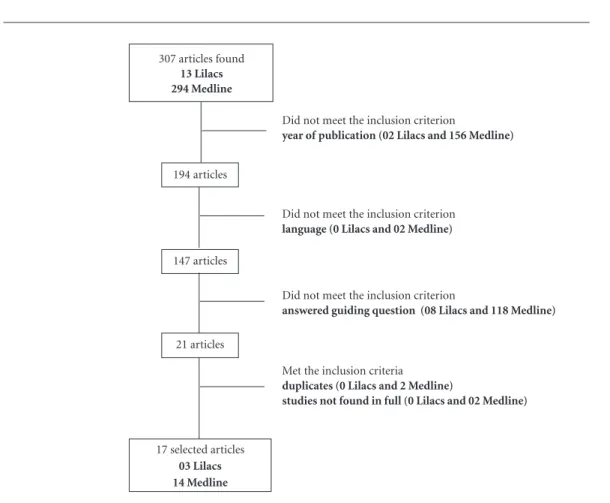
Of the 307 articles found, 158 did not meet the inclusion criterion for “year of publication”, 2 for “language” and 126 for the “guiding question”, amounting to 21 articles. Of these, 4 (2 duplicates and 2 were not available in full) were excluded, for a total of 17 articles in the final sample (Fig-ure 1). Major information on the final sample is summarized in Chart 1.
Most of the articles (58.9%) investigated fac-tors associated with the utilization of DHS in preschoolers (2-5 years) and/or schoolchildren (6-12 years), followed by 3 articles (17.6%) with infants (zero to 23 months) and preschoolers, and 2 (11.7%) with schoolchildren and adoles-cents (13-15 years). Also, 1 (5.9%) article
includ-Figure 1. Flowchart with final sample.
307 articles found
13 Lilacs 294 Medline
194 articles
147 articles
21 articles
Did not meet the inclusion criterion
year of publication (02 Lilacs and 156 Medline)
17 selected articles
03 Lilacs 14 Medline
Did not meet the inclusion criterion
language (0 Lilacs and 02 Medline)
Did not meet the inclusion criterion
answered guiding question (08 Lilacs and 118 Medline)
Met the inclusion criteria
duplicates (0 Lilacs and 2 Medline)
C
ur
i DSC
ed the age group of preschoolers to adolescents and 1 (5.9%) of infants to adolescents. Of the total, 2 (11.7%) investigated children and/or adolescents with chronic conditions. The main factors associated with the utilization of DHS included: maternal level of education, family income, health insurance plan, age, unmet oral
health needs, frequency of tooth brushing, and parental perception of child’s oral health. Addi-tionally, contextual factors related to the dentist and to the systemic health status of the pediatric population should be pointed out (Chart 1).
Regarding the language, 10 articles (58.9%) were published in English, 5 (29.4%) in Spanish Author,
year Country Study Design Sample Objective Major findings
Evidence (adapted
CAPS)
Evidence AHRQ
Jimenéz-Gayosso et al., 201512
Mexico Cross-sectional
1404
schoolchildren between 06 and 12 years old
To determine the prevalence and existence of socioeconomic inequalities in the utilization of DHS in Pachuca, Hidalgo, Mexico.
Increasing age and higher socioeconomic status of
schoolchildren were associated with the utilization of DHS.
A VI
Machry et al., 201313
Brazil Cross-sectional
478 children between 01 and 05 years old
To evaluate relationships between socioeconomic and psychosocial factors and the utilization of DHS by children in the city of Santa Maria, Rio Grande do Sul, Brazil.
Younger children (01 and 02 years old) who did not brush their teeth regularly or whose mothers had less than 08 years of schooling were more likely to have never gone to the dentist. In addition, children of low-income families, with dental caries, or mothers with poor perception of their child's oral health had a higher probability of using curative DHS compared to preventive ones.
A VI
Leroy et al., 201314
Belgium Retrospective-Cohort
1057 children at birth, 587 at the age of 03 and 699 at the age of 05
To investigate the proportion of visits to the dentist in children aged 03 and 05 years; to describe the experience of parents about their children’s first visit to dentist at the age of 03 and 05; factors associated with early use of DHS.
Children who were not first-born, who had mothers with higher levels of education, and whose parents recently visited the dentist were more likely to have visited the dentist at a younger age.
A IV
Chart 1. Description of literature and levels of evidence, according to adapted CASP and AHRQ, for each study of the final
sample of this review. Recife-PE, 2016.
e C
ole
tiv
a,
23(5):1561-1576,
2018
Author,
year Country Study Design Sample Objective Major findings
Evidence (adapted CAPS)
Evidence AHRQ
Lapresa e Sanz-Barbero, 201215
Spain
Cross-sectional
2172 children between 02 and 05 years old
To know the prevalence of the utilization of DHS, to quantify and analyze the existence of variability among the autonomous communities, and to identify the variables associated with the utilization of DHS by the preschoolers in Spain.
Increasing age, frequency of daily tooth brushing and presence of oral diseases were associated with a higher probability of using DHS. Families with low socioeconomic status, measured by both social class and maternal schooling, were associated with a lower probability of using DHS.
A VI
Pontigo-Loyola et al., 201216
Mexico Cross-sectional
1538 adolescents between 12 and 15 years old
To identify factors that influence the utilization of DHS by old Mexican adolescents from three localities in the municipality of Tula de Allende.
Children whose parents had higher levels of education and had at least one tooth with dental caries favored the utilization of DHS.
A VI
Tellen et al., 201217
United States of America
Cross-sectional
320 children between 04 and 08 years old
To assess predictors of utilization of DHS by Hispanic-American children in three neighborhoods in the city of Chicago.
Predictors of age for the first visit to the dentist were: mother´s awareness of the importance of preventive care. Predictors of the increase in the number of planned visits to the dentist were: family income and availability of the professional on the weekends. Predictors of the decision to return to the same dentist included: weekly availability of the dentist at night; satisfactory communication among dentist, mother and child, and mother´s awareness of the importance of preventive care.
B VI
Chart 1. continuation
C
ur
i DSC
Author,
year Country Study Design Sample Objective Major findings
Evidence (adapted CAPS)
Evidence AHRQ
Vallejos-Sánchez et al., 201218
Mexico Cross-sectional
1373
schoolchildren between 06 and 12 years old
To determine the sociodemographic, maternal and treatment needs associated with the utilization of DHS by school-age children in Campeche, Mexico.
Higher level of education, positive maternal attitude about the importance of child´s oral health, moderate and high levels of dental caries severity, increased schoolchildren age and frequency of dental brushing were associated with DHS use.
B VI
Chi e Raklios, 201219
United States of America
Retrospective-Cohort
25993 children with chronical conditions, between 03 and 14 years old, enrolled in Medicaid from Iowa during 11 months or longer
To assess the utilization of DHS by children with chronic diseases enrolled in Medicaid and to identify subgroups of children with chronic diseases less likely to use these services.
Children with severe, endocrine, craniofacial or hematological neurological conditions were at increased risk of not using DHS compared to other chronic disease subgroups. On the other hand, children with respiratory, musculoskeletal, digestive or ear, nose and throat conditions presented a lower risk of not using DHS in comparison to other subgroups of chronic diseases.
A IV
Chart 1. continuation
it continues
and 2 (11.7%) in Portuguese. Also, 14 articles (82.4%) were found in international journals and 3 (17.6%) in national journals. Regarding the year of publication, most articles were published in 2012 (29.4%), followed by 2008 (17.6%). The countries of origin of the study included Mexico (35.2%), Brazil (23.5%), Spain and the United States (11.8% each) and Belgium, Canada and Nicaragua (5.9% each).
After reading the studies in full, 15 (88.2%) were classified as level A and two (11.8%) as level B, according to the adapted CASP. According to the AHRQ, 14 articles (82.4%) were classified as level of evidence VI (cross-sectional studies) and
3 (17.6%) as level IV (2 cohort studies and one case-control study).
Discussion
e C
ole
tiv
a,
23(5):1561-1576,
2018
Author,
year Country Study Design Sample Objective Major findings
Evidence (adapted CAPS)
Evidence AHRQ
Lapresa e Barbero, 201120
Spain
Cross-sectional
5441 children and adolescents between 06 and15 years old
To identify individual and contextual variables associated with the utilization of DHS by children and adolescents in Spain.
Individual variables associated with greater probability of using DHS were: presence of perceived oral diseases and frequency of tooth brushing. Variables associated with a lower probability of use were: high or moderate intake of sugary soft drinks and lower socioeconomic status of the family. From the contextual variables, having a dental insurance plan (Children´s Dental Care Plan), established in the autonomous community over 10 years ago, was associated with a greater probability of using DHS.
A VI
Baldani et al., 201121
Brazil Cross-sectional
350 children and adolescents between zero and 14 years old
To evaluate the individual determinants that influence the utilization of DHS by a low-income pediatric population living in areas served by the Family Health Program (FHP) in a large city in southern Brazil.
Absence of perception about child´s dental care needs decreased the chances of using DHS. Follow-up by the FHP team increased the likelihood of use.
A VI
Chart 1. continuation
it continues
Demographic and socioeconomic factors
Age was the major demographic factor relat-ed to the utilization of DHS by the population between zero and 12 years old. The articles evalu-ated this factor among infants, preschoolers and
schoolchildren in Mexico12,18,22,23,28, Brazil13,25 and
Spain15 and confirmed a greater probability of
using DHS with increasing age. Lapresa and
Bar-bero15 observed that of 601 Spanish 2-year-old
children, only 24 had gone to the dentist and of 459 5-year-old children, 181 used DHS. A
Brazil-ian study by Machry et al.13 with children aged 1
to 5 years showed that the youngest (1 to 2 years) showed higher probability of having never visit-ed the dentist.
C
ur
i DSC
oral problems as the child´s age increases as well as the lack of parental awareness of the
impor-tance of early preventive dental health care13,25,29.
Another reason is the poor parents’ perception of the child’s need for oral health, followed by a visit to the dentist only after the presence of oral problems or the appearance of symptoms, such
as toothache30. In this context, a Mexican study
by Villalobos-Rodelo et al.22 with students aged 6
to 12 years concluded that older children (10-12 years old) were more likely to go to the dentist
due to dental pain than younger ones. The au-thors suggested that teeth of older children are exposed to cariogenic challenges for a longer pe-riod of time, increasing the likelihood of having
more advanced stages of carious lesions31 and
consequently, of using curative DHS.
The sex of the child was also associated with
the utilization of DHS22,25,26. In the Brazilian study
by Kramer et al.25 with children between zero and
5 years old, girls were more likely to use the ser-vices than boys, in compliance with Medina-Solís Author,
year Country Study Design Sample Objective Major findings
Evidence (adapted
CAPS)
Evidence AHRQ
Villalobos-Rodelo et al., 201022
Mexico Case-Control 379 cases (schoolchildren between 6 and 12 years old who used DHS in the last year due to dental pain) and 1137 controls
To identify the effect of unmet dental treatment needs and socioeconomic and demographic variables on patterns of dental visits due to toothache in schoolchildren aged 06 to 12 years.
CSchoolchildren with moderate (04 to 06 teeth affected by caries), high (07 to 09) and very high (> 09) needs were more likely to have visited the dentist due to dental pain than those with low needs (zero to 03). Schoolchildren who had no health insurance plan or were older (10 to 12 years old) were more likely to have visited the dentist due to dental pain than those who had a health insurance (public or private) or were younger (06 to 09 years old), respectively. Boys from public schools had a 70% chance of having gone to the dentist due to dental pain than those from private schools. The probability of visiting the dentist due to dental pain in girls in public schools was 28%, when compared to those attending private schools.
A IV
Chart 1. continuation
e C
ole
tiv
a,
23(5):1561-1576,
2018
et al.´s findings26 with Mexican schoolchildren.
However, a study by Villalobos-Rodelo et al.22
re-ported different results, showing that boys from Author,
year Country Study Design Sample Objective Major findings
Evidence (adapted CAPS)
Evidence AHRQ
Medina-Solís et al., 200923
Mexico Cross-sectional
3048
schoolchildren between 06 and 12 years old
To evaluate the association between socioeconomic indicators and the utilization of DHS, according to the type of service used (preventive or curative), in children from Navolato, Sinaloa, Mexico.
The following factors facilitated the use of DHS: higher socioeconomic status, health insurance and increased age. Also, higher frequency and lower age of onset of tooth brushing increased the possibility of using DHS, especially preventive services, regardless of socioeconomic status and health needs. Individuals with higher clinically evaluated health needs used more curative DHS.
A VI
Noro et al., 200824
Brazil Cross-sectional
3425 children between 05 and 09 years old
To analyze the utilization of DHS by children in the municipality of Sobral, Ceará, Brazil, relating it to socioeconomic factors and the use of health services.
High influence of socioeconomic status on the utilization of DHS. Children who had a health insurance plan were more likely to use these services. In addition, children whose mothers had lower levels of education showed greater difficulty of using DHS. Regarding the consumption of health services, the lack of home visits by a community health worker showed as a protection factor, i.e., the households that did not receive their visit were more likely to have access to dental treatment.
A VI
Chart 1. continuation
it continues
C
ur
i DSC
Author,
year Country Study Design Sample Objective Major findings
Evidence (adapted CAPS)
Evidence AHRQ
Kramer et al., 200825
Brazil Cross-sectional
1092 children between zero and 05 years old
To verify the prevalence of preschool children who have consulted with the dental surgeon and the age at which the first dental appointment was performed in a representative sample of preschool children from the city of Canela, Rio Grande do Sul, Brazil.
Relationship between age of the child and utilization of DHS. As age increased, the frequency of children who went to the dental surgeon increased. In addition, female children were more likely to use DHS than male children.
A VI
Medina-Solís et al., 200826
Nicaragua Cross-sectional
1400
schoolchildren between 06 and 12 years old
To determine factors associated with the utilization of DHS in schoolchildren in León, Nicaragua.
Older girls or schoolchildren (> 08 years old) were more likely to use DHS. Those with a higher socioeconomic status were more likely to use both curative and preventive DHS. Those who brushed their teeth at least once a day were more likely to use preventive services. Evaluated oral health needs were positively associated with the use of DHS, especially curative services.
A VI
Chart 1. continuation
DHS25. Therefore, parental factors can directly
influence the association between the child’s sex and the visit to the dentist.
Only one study14 reported that first-born
children were less likely to visit the dentist ear-lier than non-first-born children. According to the authors, parents tend to take their younger children to the dentist with their first-born child. However, this association should be carefully
analyzed because the social background32 of the
parents, according to the different types of cap-ital accumulated throughout life, can influence
the early use of preventive DHS regardless of whether or not the child is a first-born. Thus, parents who have accumulated greater cultural,
social, and economic capital33 tend to have a
bet-ter perception of their children’s oral health and may take them to the dentist earlier.
Regarding socioeconomic factors, the socio-economic status of the family was associated to the utilization of DHS by the population between zero and 15 years old. Studies showed that chil-dren and adolescents with low socioeconomic
status were less likely to visit the dentist12,15,20,23,26,28
e C
ole
tiv
a,
23(5):1561-1576,
2018
or more likely to use DHS due to dental pain22.
These findings suggest socioeconomic inequal-ities that may result from structural barriers to public services, i.e., these services have more de-mand than supply. This prompts individuals to seek the private sector, who are confronted with economic barriers, such as the costs of
treat-ments23. Moreover, socioeconomic inequalities
can be explained by Bourdieu’s sociological
theo-ry32, where caregivers with greater accumulation
of cultural, economic and social capitals
medi-ated by habitus tend to have a better perception
of oral health in children or adolescents, dental
care practices and utilization of DHS33,34.
Accord-ing to Cruz35, habitus is the product of the agent’s
position within the social space and mediates the need for health and the factors that facilitate the utilization of DHS. Thus, although parents have economic resources, universal coverage and ac-cess to DHS, their dispositions (perceiving,
feel-ing, actfeel-ing, and thinking)36 may anticipate or
postpone their children´s use of DHS35.
Most of the studies assessed the socioeconom-ic status using variables such as maternal and/or
paternal schooling and family income13-18,24. A
study conducted by Lapresa and Barbero15 with
preschool children showed that lower maternal schooling was associated with lower probabil-ity of using DHS. According to the authors, the number of years the mother attended school will eventually have greater impact on their children´s oral health than paternal schooling. However, this statement should be interpreted carefully because some children and adolescents are looked after by people other than the mothers. Therefore, a caregiver is an individual with direct kinship and is also responsible for coordinating the resources
required by the child or adolescent37,38. Their level
of education can influence the utilization of DHS. In this sense, a Mexican study by Pontigo-Loyola
et al.16 showed that adolescents aged 12 to 15
years with parents with higher level of education showed great probability of using DHS.
Regarding family income, a Brazilian study
by Machry et al.13 showed that 1- to 5-year-old
children in a lower-income family are more like-ly to use curative DHS. Also, an American study
by Tellen et al.17 showed that family income was
a predictor of the increase in the number of planned visits to the dentist of 4- to 8-year-old children. Essentially, the caregiver’s level of ed-ucation and family income are interconnected, Author,
year Country Study Design Sample Objective Major findings
Evidence (adapted CAPS)
Evidence AHRQ
Nicopoulos et al., 200728
Canada Cross-sectional
120 patients between 03 and 12 years old
To assess the prevalence of oral health needs and barriers in the utilization of DHS in hospitalized children with chronic or acute medical conditions
Children with chronic conditions were less likely to use DHS due to medical barriers than those with acute conditions. The main barriers were: hospitalization, denial of treatment and low blood count.
A VI
Medina-Solís et al., 200627
Mexico Cross-sectional
1303 children between 03 and 06 years old
To identify factors associated with the utilization of DHS in children from 10 public schools participating in an oral health program in Campeche, Mexico.
Facilitating factors for the use of DHS were: older children (05 to 06 years old); moderate and high need of evaluated oral health; greater frequency of tooth brushing; families with a higher socioeconomic status.
A VI
DHS = Dental Health Services.
C
ur
i DSC
and the former can generate the latter. In other words, education gives access to a specific occu-pation and, therefore, to a certain level of income,
and this may influence access to health care39.
Another socioeconomic factor was the pos-session of private health insurance plan. Two
studies23,24 showed that children and adolescents
with health insurance (public or private) were more likely to use DHS. A Mexican study
car-ried out by Villalobos-Rodelo et al.22 showed that
schoolchildren who did not have a health insur-ance plan presented higher probability of using DHS due to dental pain. This can be explained by the fact that children who do not have a health insurance plan are usually from families with low socioeconomic status, therefore, with greater
un-met oral health needs40.
Only Villalobos-Rodelo et al.22 related the
type of school with the utilization of DHS, and observed that children from public schools were more likely to use DHS due to dental pain in comparison to children from private schools. Usually, caregivers of public school children have
lower levels of education41, tend to have poor
perception of the child’s oral health42 and will
eventually seek dental care in advanced stages of oral diseases. However, in other contexts, the school can be notably perceived as a place to
es-tablish oral care practices35.
Parental factors
Mother´s perception13 about the child´s
den-tal care and a positive maternal attitude18 towards
it were related to the use of DHS in infants, pre-schoolers and schoolchildren. A Brazilian study
by Machry et al.13 showed that 1- to 5-year-old
children whose parents had an inadequate per-ception of the child’s oral health were more likely to use curative DHS. The authors pointed out that “poor” perception implies greater oral health needs of the child, and this is essential to measure
the need for dental care30. A Mexican study by
Vallejos-Sánchez et al.18 showed that
schoolchil-dren whose mothers had a positive attitude to-wards their child’s oral health were more likely to use DHS. The authors highlighted the relation-ship of this variable with the frequency of brush-ing, i.e., among preschoolers and schoolchildren,
the frequency usually depends on the mother43.
It is also noteworthy that according to Andersen
and Davison44, attitude towards health services is
an important predictor of DHS use.
Two other parental factors related to the
uti-lization of DHS were parents’ use14 and mothers’
awareness of the importance of preventive
den-tal care17. A prospective cohort study conducted
by Leroy et al.14 followed up on Belgian children
from birth to age 5, and showed that recent use of DHS by parents implied that children were more likely to have visited the dentist earlier. Parents with a regular source of dental care may have a
better perception of their children’s oral health45,
and therefore take them to the dentist earlier.
In this sense, a study by Tellen et al.17 with 4- to
8-year-old children living in Hispanic Ameri-can communities in Chicago (USA) suggested that the children whose mothers had improved awareness of the importance of preventive den-tal care for their children had a better chance of visiting the dentist early and regularly. Therefore, it is worth mentioning that in order to increase the frequency of early use of DHS by children, at-tention should be paid to the parents who do not
use these services regularly14. Ultimately, dentists
play a key role in oral health promotion and
pre-vention of aggravation46, being the link between
caregivers and children.
Behavioral factors
The frequency of tooth brushing was the ma-jor factor related to the utilization of DHS by the population between 1 and 15 years old. The arti-cles evaluated this factor in infants, preschoolers,
schoolchildren and adolescents in Mexico18,23,28,
Brazil13, Nicaragua26 and Spain15,20 and
conclud-ed that individuals who brushconclud-ed their teeth reg-ularly, especially 3 times a day, showed greater
chances of using mainly preventive DHS23. Also,
lower age at onset of tooth brushing (< 2 years)23
and low consumption of sugary soft drinks20
in-creased the likelihood of visiting the dentist. Notably, these are cross-sectional studies and, consequently, reverse causality may occur, i.e., because children and adolescents use DHS, they may have started brushing their teeth ear-lier and regularly and consumed less sugary soft drinks. Also, the influence of parental factors on the behavior of this population plays an import-ant part. Therefore, educational approaches with parents and children are essential to increase the
practice of healthy oral habits42, reducing the use
of curative DHS.
Factors related to oral and/or systemic health status
pop-e C
ole
tiv
a,
23(5):1561-1576,
2018
ulation between 1 and 15 years old. The articles evaluated this factor among infants, preschoolers,
schoolchildren and adolescents in Spain15,20,
Mex-ico16,18,22,28, Brazil13,21 and Nicaragua26 and
conclud-ed that people with oral health neconclud-eds perceivconclud-ed by caregivers or evaluated by the dentist presented greater chance to use DHS, especially curative
DHS26. The main reasons reported included:
se-verity and number of decayed teeth, presence of
dental pain22 and caregivers´ poor awareness of
the importance of deciduous dentition.
It should be pointed out that according to
the Andersen and Newman’s model47, health care
need is the most proximal determinant of use of health services, i.e., greater health needs would imply greater prediction of DHS use. Addition-ally, perceived oral health needs can be explained by social structure and awareness towards health, being an important predictor of the demand
for health care and adherence to treatment48. In
this review, only two studies assessed the needs
of perceived oral health15,20 and, therefore, more
research is needed including this issue.
Only two studies19,27 suggested the association
of children with chronic diseases with the utiliza-tion of DHS. In the Canadian study by
Nicopou-los et al.27 with hospitalized children aged 3 to 12
years, those with chronic conditions (oncologi-cal, hepatic, renal, congenital heart disease, im-munosuppression, among others) showed lower chances of using DHS due to medical barriers than children with acute conditions. According to the authors, the major medical barriers included: recurrent hospitalizations, dentist’s reluctance to treat this population and pancytopenia. An
American study conducted by Chi and Raklios19
with children and adolescents aged 3 to 14 years with chronic conditions revealed that the indi-viduals with neurological, endocrine, craniofa-cial or hematological conditions used less DHS than those with other chronic conditions. The authors attributed this fact to the behavioral characteristics of the caregiver, such as high level of stress in relation to the systemic health needs of this population and approach to oral health as a lower priority.
Importantly, individuals with greater vulner-ability are more affected by oral health
morbidi-ties, showing greater accumulation of needs49, as
well as they seem to have more restricted access
to DHS50,51. Thus, this group should be
consid-ered when proposing oral health policies aiming at ensuring health equity.
Factors related to the dentist
Only one study17 observed an association
be-tween factors related to the dentist and the utiliza-tion of DHS in evaluating predictors of use by 4- to 8- year-old children in three Hispanic-Ameri-can neighborhoods of Chicago, USA. The authors found that the dentist’s availability at night or on the weekends increases the number of planned visits to the dentist as well as returns visits. Possi-bly, these factors facilitate the use of DHS because the dentist is available in shifts and days in which
caregivers are usually not working17. However, in
other contexts, such as the Family Health Strategy (FHS) in Brazil, the dentist does not work at night or on the weekends, posing difficulties for
chil-dren whose caregivers work during the week52.
Therefore, this issue should be addressed when proposing public oral health policies.
Moreover, an important factor for returning to the dentist was the satisfactory communication
among professionals, mothers and children17,
with focus on the importance of the command of language, since the population of his study was composed of immigrants from Latin American countries. However, it is important to point out that non-verbal communication, humanization of care and bonding are important strategies for a satisfactory relationship among dentists,
caregiv-ers and children53,54.
Contextual factors related to dental care
Two Brazilian studies21,24 and one Spanish
study20 showed that contextual factors are
relat-ed to the utilization of DHS. A study by Noro et
al.24 observed that 5- to 9-year-old children whose
households did not receive visits from a com-munity health agent (CHA) were more likely to use DHS. According to the authors, most visited households by CHAs are those where children´s caregivers showed greater needs for follow-up due to systemic diseases or situations of social vulnerability, rendering them unable to articulate child health care, such as dental care. At the same time, it is important to point out how challenging it is for Brazilian dentists to work according to the FHS guidelines due to the historical influences of the Flexner´s model, their conceptions of FHS and the autonomy provided by this model. As a consequence, consultations will take place
exclu-sively at a dental practice46. Therefore, equity, as a
C
ur
i DSC
In contrast to Noro et al.´s findings24, Baldani
et al.21 showed that children and adolescents
be-tween zero and 14 years old followed up by the family health team were more likely to visit the dentist. This demonstrates the longitudinality of dental care and the existence of a bond between
users and staff46,55.
Lapresa and Barbero20 showed that having
a Children´s Dental Care Plan in a Spanish au-tonomous community for more than 10 years increased the probability of DHS use by the pop-ulation between 6 and 15 years old. Spain is di-vided into autonomous communities, with var-ied health system coverage and financing mech-anisms. The Children´s Dental Care Plan caters to the population between 6 and 15 years of age, offering urgent restorative and preventive treat-ment in the permanent and preventive dentition, as well as exodontia in the deciduous dentition,
not including restorative treatment here20.The
authors report that although this assistance mod-el is consolidated, the socioeconomic gradient is still present and does not vary between the au-tonomous communities. This means that parents or caregivers who have higher socioeconomic sta-tus, as well as accumulated cultural capital, tend to have better perception of child oral health and,
therefore, seek DHS34.
Final considerations
The studies of this review show that demo-graphic, socioeconomic, parental, behavioral and contextual factors as well as those related to the dentist and to the oral and/or systemic health status are associated with the utilization of DHS by the pediatric population between zero and 15 years old. Predictors of DHS use include: factors related to children or adolescents (age, frequency of tooth brushing, chronic conditions), caregivers (schooling, perception of the child’s oral health, perceived oral health needs), dentists (availability at night or on the weekends) and follow-up of oral health by the family health team.
Nevertheless, it is important to emphasize that most studies are cross-sectional; therefore, it is difficult to establish a causal relationship. Also, the studies used questionnaires, and mem-ory bias is likely to occur. Therefore, longitudinal studies should be conducted to clarify causality and minimization of bias. Research on the utili-zation of DHS in pediatric patients with chronic diseases should be further conducted, compar-ing them to healthy individuals of the same age
group, as this field has not been thoroughly ex-plored.
In this review, most of the studies used the
Andersen Behavioral Model47 to establish which
conditions facilitate or hinder the utilization of DHS. However, they did not explain the reasons for inequalities. Thus, comprehensive research
based on Bourdieu’s32 sociological theory should
be carried out. Moreover, the Andersen Behav-ioral Model was developed to analyze the use of US private health services and should be carefully interpreted, since the studies of this review ap-plied this model in contexts which are different from those in the USA.
Ultimately, the articles were written in differ-ent countries, which have differdiffer-ent health care systems. In this sense, it can be pointed out that factors related to the use of DHS by children and adolescents may vary according to the context in which the research is performed. Therefore, for the planning of oral health policies or programs for the pediatric population, an exploratory re-search should be conducted according to the context in which the actions are to be carried out. Also, increasing supply of DHS alone is not able to guarantee better utilization of dental health services and reduce inequalities between vulner-able groups. A sociological analysis of these ser-vices should be carried out following Bourdieu´s
model32.
Collaborations
DSC Curi was responsible for the concept, de-sign, analysis and interpretation of data, writing of the manuscript and critical review, as well as for the approval of the version to be published. ACL Figueiredo accounted for the concept, de-sign, analysis and interpretation of data, writing of the manuscript and critical review, as well as for the approval of the version to be published. SR Jamelli was responsible for critical review as well as for the approval of the version to be
e C
ole
tiv
a,
23(5):1561-1576,
2018
References
1. Souza LF, Chaves SCL. Política nacional de saúde bucal: acessibilidade e utilização de serviços odontológicos especializados em um município de médio porte na Bahia. Rev Baiana Saúde Pública 2010; 34(2):371-387. 2. Szwarcwald CL, Bastos FI, Esteves MAP, Andrade CLT,
Paez MS, Medici EV, Derrico M. Desigualdade de renda e situação de saúde: o caso do Rio de Janeiro. Cad Sau-de Publica 1999; 15(1):15-28.
3. Gomes AMM, Thomaz EBAF, Alves MTSSDB, Silva AAM, Silva RA. Fatores associados ao uso dos serviços de saúde bucal: estudo de base populacional em mu-nicípios do Maranhão, Brasil. Cien Saude Colet 2014; 19(2):629-640.
4. Instituto Brasileiro de Geografia e Estatística (IBGE). Acesso e Utilização dos Serviços, Condições de Saúde e Fatores de Risco e Proteção à Saúde 2008. Rio de Janeiro: IBGE; 2010.
5. Núñez L, Icaza G, Contreras V, Correa G, Canales T, Mejía G, Oxman-Martínez J, Moreau J. Factores aso-ciados a la consulta odontológica en niños/as y jóvenes de Talca (Chile) e inmigrantes chilenos de Montreal (Canadá). Gac Sanit 2013; 27(4):344-349.
6. World Healh Organization (WHO). Commission on Social Determinants of Health. Closing the gap in a gen-eration: health equity through action on the social deter-minants of health. Geneva: WHO; 2008.
7. Callahan JL. Constructing a manuscript: Distinguish-ing integrative literature reviews and conceptual and theory articles. Hum Resour Dev Rev 2010; 9(3):300-304.
8. Torraco RJ. Writing Integrative Literature Reviews: Guidelines and Examples. Hum Resour Dev Rev 2005; 4(3):356-367.
9. Mendes KDS, Silveira RCDCP, Galvão CM. Revisão in-tegrativa: método de pesquisa para a incorporação de evidências na saúde e na enfermagem. Texto Context - Enferm 2008; 17(4):758-764.
10. Toledo MM, Takahashi RF, De-La-Torre-Ugarte-Gua-nilo MC. Elementos de vulnerabilidade individual de adolescentes ao HIV/AIDS. Rev Bras Enferm 2011; 64(2):370-375.
11. Stillwell SB, Fineout-Overholt E, Melnyk BM, William-son KM. Searching for the evidence behind EMS. Am J Nurs 2010; 110(5):41-47.
12. Jiménez-Gayosso S, Medina-Solis C, Lara-Carrillo E, Scougal-Vilchis RJ, Rosa-Santillana R, Márquez-Rodrí-guez S, Mendoza-RodríMárquez-Rodrí-guez M, Navarrete-Hernández JJ. Desigualdades socioeconómicas en la utilización de servicios de salud bucal (USSB) alguna vez en la vida por escolares mexicanos de 6-12 años de edad. Gac Med Mex 2015; 151:27-33.
13. Machry RV, Tuchtenhagen S, Agostini BA, Silva Teixeira CR, Piovesan C, Mendes FM, Ardenghi TM. Socioeco-nomic and psychosocial predictors of dental healthcare use among Brazilian preschool children. BMC Oral Health 2013; 13:60.
14. Leroy R, Bogaerts K, Hoppenbrouwers K, Martens LC, Declerck D. Dental attendance in preschool children - A prospective study. Int J Paediatr Dent 2013; 23(2):84-93.
15. Lapresa LB, Sanz-Barbero B. Variables asociadas al uso de los servicios de salud bucodental por la problación preescolar en españa: Un análisis de la encuesta nacio-nal de salud. Rev Esp Salud Pública 2012; 86(1):115-124.
16. Pontigo-Loyola AP, Medina-Solís CE, Márquez-Coro-na ML, Vallejos-Sánchez AA, MiMárquez-Coro-naya-Sánchez M, Es-coffié-Ramírez M, Maupomé G. Influencia de variables predisponentes, facilitadoras y de necesidades sobre la utilización de servicios de salud bucal en adolescen-tes mexicanos en un medio semirrural. Gac Med Mex 2012; 148(3):218-226.
17. Telleen S, Rhee Kim YO, Chavez N, Barrett RE, Hall W, Gajendra S. Access to oral health services for urban low-income Latino children: Social ecological influenc-es. J Public Health Dent 2012; 72(1):8-18.
18. Vallejos-Sánchez AA, Medina-Solís CE, Minaya-Sán-chez M, Villalobos-Rodelo JJ, Márquez-Corona ML, Islas-Granillo H, Maupomé G. Maternal characteristics and treatment needs as predictors of dental health ser-vices utilisation among Mexican school children. Eur J Paediatr Dent 2012; 13(4):307-310.
19. Chi DL, Raklios N. The relationship between body sys-tem-based chronic conditions and dental utilization for Medicaid-enrolled children: a retrospective cohort study. BMC Oral Health 2012; 12:28.
20. Lapresa LB, Barbero BS. Análisis multinivel del uso de servicios de salud bucodental por población infanto-juvenil. Gac Sanit 2011; 25(5):391-396.
21. Baldani MH, Mendes YBE, Lawder JA, Lara AP, Rodri-gues MM, Antunes JL. Inequalities in dental services utilization among Brazilian low-income children: The role of individual determinants. J Public Health Dent 2011; 71(1):46-53.
22. Villalobos-Rodelo JJ, Medina-Solis CE, Maupomé G, Lamadrid-Figueroa H, Casanova-Rosado AJ, Casa-nova-Rosado JF, Márquez-Corona ML. Dental Needs and Socioeconomic Status Associated with Utilization of Dental Services in the Presence of Dental Pain: A Case-Control Study in Children. J Orofac Pain 2010; 24(3):279-286.
23. Medina-Solís CE, Villalobos-Rodelo JJ, Márquez-Co-rona ML, Vallejos-Sánchez AA, Portillo-Núñez CL, Casanova-Rosado AJ. Desigualdades socioeconómicas en la utilización de servicios de salud bucal: estudio en escolares mexicanos de 6 a 12 años de edad. Cad Saude Publica 2009; 25(12):2621-2631.
24. Noro LRA, Roncalli AG, Mendes Júnior FIR, Lima KC. A utilização de serviços odontológicos entre crianças e fatores associados em Sobral, Ceará, Brasil Use of den-tal care by children and associated factors in Sobral, Ce-ará, Brazil. Cad Saude Publica 2008; 24(7):1509-1516. 25. Kramer PF, Ardenghi TM, Ferreira S, Fischer LA,
Car-doso L, Feldens CA. Use of dental services by preschool children in Canela, Rio Grande do Sul State, Brazil. Cad Saude Publica 2008; 24(1):150-156.
C
ur
i DSC
27. Medina-Solís CE, Maupomé G, Avila-Burgos L, Hi-jar-Medina M, Segovia-Villanueva A, Pérez-Núñez R. Factors influencing the use of dental health services by preschool children in Mexico. Pediatr Dent 2006; 28(3):285-292.
28. Nicopoulos M, Brennan MT, Kent ML, Brickhouse TH, Rogers MK, Fox PC, Lockhart PB. Oral health needs and barriers to dental care in hospitalized children. Spec Care Dentist 2007; 27(5):206-211.
29. Ardenghi TM, Vargas-Ferreira F, Piovesan C, Men-des FM. Age of first dental visit and predictors for oral healthcare utilisation in preschool children. Oral Health Prev Dent 2012; 10(1):17-27.
30. Goettems ML, Ardenghi TM, Demarco FF, Romano AR, Torriani DD. Children’s use of dental services: In-fluence of maternal dental anxiety, attendance pattern, and perception of children’s quality of life. Community Dent Oral Epidemiol 2012; 40:451-458.
31. Villalobos-Rodelo JJ, Medina-Solís CE, Maupomé G, Vallejos-Sánchez AA, Lau-Rojo L, de León-Viedas MV. Socioeconomic and sociodemographic variables asso-ciated with oral hygiene status in Mexican schoolchil-dren aged 6 to 12 years. J Periodontol 2007; 78(5):816-822.
32. Bourdieu P. Razões Práticas: Sobre a teoria da ação. Campinas: Papirus Editora; 2008.
33. Chaves SCL, Vieira-da-Silva LM. Inequalities in oral health practices and social space: An exploratory quali-tative study. Health Policy 2008; 86(1):119-128. 34. Abel T. Cultural capital and social inequality in health. J
Epidemiol Community Health 2008; 62:e13.
35. Cruz DN. Desigualdades na utilização de serviços odon-tológico: posição e tomadas de posição no espaço social [tese]. Salvador: Universidade Federal da Bahia; 2015. 36. Thiry-Cherques HR. Pierre Bourdieu: a teoria na
práti-ca. Rev Adm Pública 2006; 40(1):27-53.
37. Cassis SVA, Karnakis T, Moraes TA, Curiati JAE, Qua-drante ACR, Magaldi RM. Correlação Entre O Estresse Do Cuidador E As Características Clínicas do pacien-te portador De Demência. Rev Assoc Med Bras 2007; 53(6):497-501.
38. Mensorio MS, Kohlsdorf M, Junior ALC. Cuidado-res de crianças e adolescentes com leucemia: análise de estratégias de enfrentamento. Psicol em Rev 2009; 15(1):158-176.
39. Kawachi I, Adler NE, Dow WH. Money, schooling, and health: Mechanisms and causal evidence. Ann N Y Acad Sci 2010; 1186:56-68.
40. Kumar S, Tadakamadla J, Kroon J, Johnson NW. Im-pact of parent-related factors on dental caries in the permanent dentition of 6-12-year-old children: A sys-tematic review. J Dent 2016; 46:1-11.
41. Freire MDCM, Reis SCGB, Gonçalves MM, Balbo PL, Leles CR. Oral health in 12 year-old students from pub-lic and private schools in the city of Goiânia, Brazil. Rev Panam salud publica 2010; 28(2):86-91.
42. Castilho ARF, Mialhe FL, Barbosa T, Puppin-Rontani RM. Influence of family environment on children’s oral health: a systematic review. J Pediatr 2013; 89(2):116-123.
43. Khadri FA, Gopinath VK, Hector MP, Davenport ES. How pre-school children learn to brush their teeth in Sharjah, United Arab Emirates. Int J Pediatr Dent 2010; 20(3):230-234.
44. Andersen RM, Davidson PL. Improving Access to Care in America: Individual and Contextual Indicators. In: Kominski GF, editor. Changing the U.S. health care sys-tem: key issues in health services policy and management. San Francisco: John Wiley & Sons Inc.; 2007. p. 3-31. 45. D, Spiekerman C, Milgrom P. Linking mother access to
dental care and child oral health. Community Dent Oral Epidemiol 2009; 37(5):381-390.
46. Reis WG, Scherer MDDA, Carcereri DL. O trabalho do Cirurgião-Dentista na Atenção Primária à Saúde: entre o prescrito e o real. Saúde em Debate 2015; 39(104):56-64.
47. Andersen R, Newman JF. Societal and individual deter-minants of medical care utilisation in the United States. Milbank Mem Fund Q Health Soc 1973; 51(1):95-124. 48. Andersen RM. Revisiting the behavioral model and
ac-cess to medical care: does it matter? J Health Soc Behav 1995; 36(1):1-10.
49. Peres MA, Iser BPM, Boing AF, Yokota RTC, Malta RC, Peres KG. Desigualdades no acesso e na utilização de serviços odontológicos no Brasil: análise do Sistema de Vigilância de Fatores de Risco e Proteção para Doenças Crônicas por Inquérito Telefônico (VIGITEL 2009). Cad Saude Publica 2012; 28(Supl.):90-100.
50. Institute of Medicine and National Research Coun-cil (IMNRC). Improving access to oral health care for vulnerable and underserved populations. Washington: IMNRC; 2011.
51. The Canadian Academy of Health Sciences (CAHS). Improving access to oral health care for vulnerable people living in Canada. Ottawa: CAHS; 2005.
52. Andrade RTS, Silva UA. O acesso dos trabalhadores aos serviços odontológicos na rede SUS : uma reflexão crí-tica. Rev Bras Pesqui em Saúde 2010; 12(4):45-51. 53. Ferreira JMS, Aragão AKR, Colares V. Técnicas de
con-trole do comportamento do paciente infantil: Revisão de literatura. Pesqui Bras Odontopediatria Clin Integr 2009; 9(2):247-251.
54. Coriolano-Marinus MWL, Andrade RS, Ruiz-Moreno L, Lima LS. Comunicação entre trabalhadores de saúde e usuários no cuidado à criança menor de dois anos no contexto de uma unidade de saúde da família. Interface (Botucatu) 2015; 19(53):311-324.
55. Scherer MDDA, Pires D, Schwartz Y. Trabalho coletivo: um desafio para a gestão em saúde. Rev Saude Publica 2009; 43(4):721-725.
Article presented 20/07/2016 Approved 05/09/2016
Final Version presented 07/09/2016
This is an Open Access article distributed under the terms of the Creative Commons Attribution License BY