UNIVERSIDADE DE LISBOA FACULDADE DE CIÊNCIAS
DEPARTAMENTO DE BIOLOGIA ANIMAL
3D chemotaxonomy of corals using fatty acid
biomarkers:
latitude, longitude and depth
Cátia Alexandra Alves Figueiredo
Dissertação
Mestrado em Ecologia Marinha 2014
UNIVERSIDADE DE LISBOA FACULDADE DE CIÊNCIAS
DEPARTAMENTO DE BIOLOGIA ANIMAL
3D chemotaxonomy of corals using fatty acid
biomarkers:
latitude, longitude and depth
Cátia Alexandra Alves Figueiredo
Mestrado em Ecologia Marinha Orientadores:Professor Doutor Rui Afonso Bairrão Rosa Doutora Narcisa Maria Mestre Bandarra
“Sempre chegamos ao sítio aonde nos esperam.” José Saramago
iv
ACKNOWLEDGEMENTS
I wish to show my gratitude to all the people that guided, helped and contributed to this work:
Firstly to Professor Doutor Rui Rosa for accepting me as his student and for believing in me. Thank you for all your supervision, trust, support, friendship and understanding. Thank you for believing in my work, for giving me the freedom to input my thoughts and for considering them. Your knowledge and expertise helped me to become a better scientist. You are an inspiration.
To Doutora Narcisa Bandarra for accepting to be my co-advisor, for believing in me, for taking me into her guard at IPMA – Instituto Português do Mar e da Atmosfera and for making sure I was always getting the support I needed in the laboratory.
To Miguel Baptista for his unconditional guidance, supervision and enthusiasm. Thank you for your support, for your tremendous patience, for your availability and for being there at all times. This would not have been possible without everything you taught me. Thank you for it all.
To Ana Rita Lopes, the first colleague that helped me, for her support in the laboratory, for her patience and for teaching me all that I needed to know regarding the experimental procedures of this work. Your experience and teaching helped me through this trial and I couldn’t think of another person to help me in this stage as you did.
v
To all MSc, PhD and post-doc fellows at Laboratório Maritimo da Guia: Gisela Dionísio, Marta Pimentel, Maria Rita, Tiago Repolho – The General and Vanessa Madeira – Kuka Maluka, for their warm welcome, sympathy and kindness. Was a pleasure to feel welcomed and be part of the amazing MECCA group. Meeting you was very enriching both personally and professionally.
To my best friends from high school: Bárbara Gonçalves, Ana Filipa Pinto and Sara Fernandes. Even though it’s been almost 10 years since we met we have managed to stay present and talk without really talking. You make friendship feel like home and I cherish every moment we spend together. Thank you for existing and being by my side ever since the time I firstly started dreaming about how cool it would be if I managed to became a marine biologist. It is way cool.
To Cláudia Rita, my dearest friend, for all her support in every aspect of my life. It was a big help to have someone that is able to understand me, even when I am incapable of expressing myself. Thank you for listening, understanding and caring.
To my friends from the Biology degree in ISA – Instituto Superior de Agronomia, Joana Roma – Romã, Bernardo Franco – Benny and Ana Sofia Borges – Sufas, for staying present despite all the ups and downs and for keeping me motivated, in the hopes that better days for our academic careers would come, and they came.
vi
To rede ex aequo and my board colleagues for understanding and supporting this work. I was not always able to achieve the standards we set for me because of the effort I inputted in this work but I couldn’t have it any other way. Thank you for your thoughtfulness and for being by my side in every aspect of rea. You helped me be who I am and without you I would definitely not even had the strength to fight for my academic career that brought me to this work.
To my friends and colleagues from the Marine Ecology Master in FCUL – Faculdade de Ciências da Universidade de Lisboa: Guilherme Cruz, Luisa Ramalho, Joana Castro, Filipa Silva, Margarida Antunes, Inês Leal, Joana Teixeira and Joana Manique for the friendship and the funniest times together but most of all for allowing me to be myself, accepting me and for helping me to keep my mental sanity throw out this work. I will never forget this past two years, thank you for everything. This work is a bit yours too.
To my family who are my favorite persons in the entire world. My parents, Lúcia Silva Alves and José Figueiredo Silva, for investing and believing in me, for the constant preoccupation to give us their best and for being who they are. It’s not always been easy but I have accomplished to turn my child dream into reality and this would never be possible without your support, even if you don’t realise it. I hope I made you proud. Thank you.
To my siblings, Nuno Figueiredo and Beta Paixão for being the best siblings I could ever wished for. I feel your support even when you say nothing and that makes me really proud. Thank you for helping me became the person that I am and for always being there
vii
for me. To my brother and sister in law, Zé Paixão and Sónia Dias, for being half part of what constitutes the importance I give to my siblings in my life, for loving me and for giving me my nieces Andreia Paixão and Catarina Paixão and my nephew Rodrigo Figueiredo, three amazing kids who always helped distract me and keep some sanity in my mind during this process. You show me what unconditional love is. Obrigada.
At last, but undoubtedly not at least, to Chloe Holgate, who gave me her unconditional support, concern, care and love. Thank you for giving me motivation, encouraging my work and cheering me up. Thank you for standing by me in all the stressful periods that I had, thank you for listening to me about my conquests regarding this work and about the lows I went throw. Thank you for being there every time I needed you. Thank you.
ix
RESUMO
A população mundial de corais tem vindo a diminuir ao longo dos anos, tanto em abundância como em diversidade. Esta diminuição deve-se à sobre-exploração dos recursos marinhos, à poluição, à acidificação dos oceanos e ao aquecimento global (principal responsável pelo processo de lixiviação). Sendo que aqueles organismos possuem grande importância ecológica e económica, o interesse no seu estudo tem vindo a aumentar, nomeadamente no que se refere à sua quimiotaxonomia
Os hexacorais possuem seis ou menos eixos de simetria na sua estrutura corporal e somente uma linha única de tentáculos. Estes organismos são formados de pólipos individuais, que em algumas espécies vivem em colónias, formando recifes, e podem possuir um esqueleto cálcico rígido, distinguem-se dos octocorais por estes terem um esqueleto interno excretado pela mesogleia e pólipos com oito tentáculos.
Entende-se por quimiotaxonomia o método de classificação biológica que se baseia na similaridade e/ou diferença no perfil de certos compostos e nas vias bioquímicas envolvidas na sua síntese, manutenção e obtenção. Estes compostos estudados podem ser proteínas, aminoácidos e lípidos, entre outros. Os lípidos constituem a base estrutural das membranas biológicas, podem atingir até cerca de 40% da biomassa seca de um coral e estão envolvidos numa série de processos bioquímicos e fisiológicos. Desta forma, alterações na composição lipídica reflectem alterações na ecologia, nutrição e saúde dos corais. Por exemplo, o catabolismo das ceras e triacilgliceróis pode fornecer a energia necessária para a respiração e crescimento do organismo quando a obtenção de alimento (ex. fitoplâncton, zooplânkton, matéria orgânica particulada) é reduzida.
x
Os ácidos gordos são os principais componentes dos lípidos e a sua composição é determinada, até um certo nível, pela predisposição genética de uma espécie para a sua biosintese. Apesar do perfil (composição) de ácidos gordos ser, de forma geral, específico de cada espécie de coral, este pode variar dependendo de condições ambientais, da disponibilidade e qualidade de alimento e da composição e presença de simbiontes (zooxantelas) e bactérias.
As zooxantelas são algas, geralmente dinoflageladas, que vivem em simbiose com vários invertebrados marinhos, especialmente cnidários. Estas fornecem compostos (maioritariamente lipídicos) aos coraisenquanto usufruem de um meio de suporte onde subsistir. Os corais são organismos politróficos, ou seja, que obtêm os nutrientes essenciais à sua sobrevivência simultaneamente através de uma variedade de mecanismos. Assim sendo, é actualmente aceite que corais zooxantelados podem satisfazer as suas necessidades energéticas por via heterotrófica (plankton e matéria orgânica em suspensão) e autotrófica (produção primária das zooxantelas), esta particularmente valiosa em águas pobres em nutrientes, onde a densidade de plâncton é insuficiente para suportar uma cadeia trófica robusta.
As zooxantelas podem apresentar uma composição de ácidos gordos diferente daquela o coral obtém através de outras fontes. Assim, corais zooxantelados e azooxantelados podem exibir diferenças significativas no que diz respeito à sua composição em termos de ácidos gordos. O carbono fixado fotossinteticamente pelas zooxantelas é rapidamente transformado em lípidos que, por sua vez, são transferidos para o tecido do hospedeiro na forma de triacilgliceróis, ceras, e ácidos gordos livres. Esta translocação é a principal fonte de ácidos gordos saturados, logo, a presença de ácidos gordos poli-insaturados é,
xi
provavelmente, indicativo de uma fonte de alimentação externa, como de zoo- e fitoplâncton.
Muitas famílias de cnidários caracterizam-se pela presença de ácidos gordos pouco usuais. A composição de ácidos gordos é assim, útil em estudos de quimiotaxonomia neste grupo de organismos e torna possível uma clara distinção de espécimes de acordo com a sua ordem, família, e em alguns casos género.
Com o objectivo de contribuir para uma melhor compreensão das relações quimiotaxonómicas de: i)hexacorais e octocorais, ii) corais zooxantelados e azooxantelados, iii) corais costeiros e do mar profundo, compilou-se primariamente (numa meta-análise) os dados disponíveis (literatura científica) referentes à composição de ácidos gordos de 27 espécies (35 espécimenes) de hexacorais e 39 espécies (47 espécimenes) de octocorais.Posteriormente, analisou-se o perfil de ácidos gordos de 34 outras espécies de hexacoral e octocoral oriundas do Brazil, México, Seychelles, Portugal e Vietnam, e adicionou—se essa informação à meta-análise.
Numa primeira abordagem, compararam-se os perfis de ácidos gordos de hexa- e octocorais, obtendo-se uma clara separação entre estes dois grupos, principalmente através dos ácidos gordos 24:5n-6 e 24:6n-3, apenas presentes em octocorais. O ácido gordo 20:4n-6 também desempenhou um papel importante nesta separação, podendo ser adoptado como um marcador útil na quimiotaxonomia de hexa- e octocorais.
De seguida realizou-se uma análise dos hexacorais numa perspectiva espacial e taxonómica (Ordem). Não se obteve qualquer separação; i.e., os ácidos gordos utilizados naquela não foram úteis no estudo daquimiotaxonomia deste grupo de corais. No entanto, um cenário diferente foi observado para os octocorais. Neste grupo foi obtida uma clara separação entre alcionários, penatulários e gorgónias. As gorgónias apresentaram-se mais
xii
próximas dos alcionários, enquanto os penatulários formaram um grupo bem individualizado e mais distante. Os alcionários são, desta forma, bioquimicamente mais próximos das gorgónias, indicando uma evolução divergente mais recente. Uma separação espacial foi também conseguida, revelando as espécies de regiões temperadas em costas Oeste de alta produção primária marinha (Portugal e Califórnia) como detentoras de uma geralmente maior quantidade de 20:5n-3, ácido gordo originário de fitoplâncton, disponível em maiores quantidades nestas regiões. Como esperado, o ácido gordo 18:4n-3, um dos principais ácidos gordos encontrados em zooxantelas, geralmente presente em maior quantidade nos alcionários com zooxantelas, contribuiu para a sua separação relativamente aos alcionários azooxantelados.
Por fim, uma separação espacial (incluindo a componente profundidade) foi conseguida com gorgónias. As gorgónias do mar profundo, quando comparadas com as de baixa profundidade da costa de Portugal, demonstraram uma menor percentagem quantitativa de todos os ácidos gordos estudados, confirmando que a temperatura, a ausência de luz e a disponibilidade de alimento afectam o perfil de ácidos gordos dos corais. Em conclusão, esta dissertação contribui significativamente para a compreensão da quimiotaxonomia de hexa- e octocorais oriundos de diferentes oceanos e tipos de habitat, incluindo diferentes zonas climáticas e batimétricas.
Palavras-chave:
Quimiotaxonomia; ácidos gordos; biomarcadores; Hexacorallia; Octocorallia;
xiii
ABSTRACT
Corals have the ability to biosynthesize specific sets of fatty acids (FA) and their content is also known to be influenced by food intake, presence of symbiotic zooxanthellae and bacteria. Additionally, environmental conditions such as light intensity and water temperature were also shown to affect FA profiles of corals. To uncover differences in FA composition of corals from different climatic zones (e.g. temperate, subtropical and tropical) and distinct habitats (e.g. coral reefs, intertidal and subtidal zones, and deep-sea environments), we studied the FA profile of 41 species and performed a comparison with that of 66 species, available in the literature. Five (n-6) and five (n-3) PUFAs (18:2n-6, 18:4n-3, 20:4n-6, 20:5n-3, 22:4n-6, 22:5n-6, 22:5n-3, 22:6n-3, 24:5n-6, 24:6n-3) were used for the meta-analyses and consequent multivariated tests, namely Principal Component Analyses (PCA). We show a clear separation between hexa- and octocorals (mainly due to 20:4n-6, 24:5n-6 and 24:6n-3), but the selected PUFAs were not suitable for the separation of hexacorals at the order level (Zoanthidea and Scleractinia). On the other hand, a clear separation was achieved in octocorals. Within this group, gorgonians were placed closer to the other alcyonaceans because they are biochemically closer, indicating a recent evolutionary divergence within Octocorallia. Also, a clear separation between shallow and deep-sea gorgonians was achieved. The latter generally showed a lower content of the selected FAs, highlighting the different and scarcer sources of energy available to deep-sea organisms. Summing up, the present dissertation increased significantly the existing knowledge about the chemotaxonomy of corals, by expanding it to other oceanic regions (i.e. North and South Atlantic Ocean) and habitats (e.g. abyssal plains).
xiv
Key words: Chemotaxonomy; Fatty Acids; Biomarkers; Hexacorallia; Octocorallia; Zooxanthellae; shallow water; deep-sea.
xv
TABLE OF CONTENTS
Acknowledgements ... iv
Resumo ... ix
Palavras-chave ... xiiAbstract ... xiii
Key words ... xiv
List of figures and tables ...xvii
1. INTRODUCTION ... 1
2. MATERIAL AND METHODS ... 10
2.1. Sampling ...10
2.1.1. Shallow-living corals ...10
2.1.2. Deep-sea corals ...11
2.2. Biochemical (fatty acid) analysis ...11
2.3. Meta-analysis ...12
2.3.1. Database compilation...12
2.4. Statistical analysis ...13
3. RESULTS ... 14
3.1. General differences between hexa- and octocorals ...20
3.2. Differences among hexacorals ...23
xvi
3.4. Differences among shallow-living and deep-sea gorgonians ...30
4. DISCUSSION
...33
4.1. Chemotaxonomical differences between hexa- and octocorals ...33
4.2. Hexacoral chemotaxonomy ...34
4.3. Octocoral chemotaxonomy ...36
4.3.1. Spacial (geographical) differences ...36
4.3.2. Zooxanthellae and FA profiles ...37
4.4. Shallow water and deep-sea gorgonians chemotaxonomy ...38
4.5. Fatty acids challenging current taxonomic classification ...40
5. FINAL REMARKS... 42
xvii
LIST OF FIGURES AND TABLES
Figure 1:
Chemical structure of saturated, mono- and polyunsaturated FAs... 1
Figure 2:
Photosynthetic symbiotic zooxanthellae in corals... 2
Figure 3:
Example of octocoral... 3
Figure 4:
Example of hexacoral... 3
Figure 5:
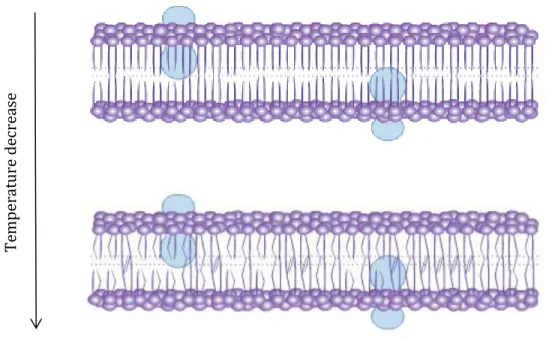
Effect of decreased temperature in the structure of cellular membranes... 4
Figure 6:
Sampling sites of coral specimens used in the present study (Azores, continental Portugal, Brazil, Mexico and Vietnam, red circles and red triangle representing deep-sea species from Azores) and those from the literature (Vietnam, Seychelles and California, black circles ...10Figure 7:
ROV Luso model Bathysaurus XL... 11
Figure 8
: Principal component analysis based on the content of 10 PUFAs (18:2n-6, 18:4n-3, 20:4n-6, 20:5n-3, 22:4n-6, 22:5n-6, 22:5n-3, 22:6n-3, 24:5n-6, 24:6n-3) of 104 hexacoral and octocoral species (123 specimens). A) Principal component plot; B) Loading plot of FAs and their contribution to the spread along PC1 and PC2; C) D) E) F) G) H) and I) Percentual content of different FAs in eight coral groups... 20
Figure 9:
Principal component analysis based on the content of 10 PUFAs (18:2n-6, 18:4n-3, 20:4n-6, 20:5n-3, 22:4n-6, 22:5n-6, 22:5n-3, 22:6n-3, 24:5n-6, 24:6n-3) of 44 hexacoral species (55 specimens). A) Principal component plot; B) Loading plot of FAs and their contribution to the spread along PC1 and PC2; C) D) E) F) and G) Percentual content of different FAs in three species (5 specimens) and other hexacorals... 23
xviii
Figure 10:
Principal component analysis based on 10 selected PUFAs (18:2n-6, 18:4n-3, 20:4n-6, 20:5n-3, 22:4n-6, 22:5n-6, 22:5n-3, 22:6n-3, 24:5n-6, 24:6n-3) composition of 57 Octocoral species (66 specimens). A) Principal component plot showcasing different locations; B) Principal component plot showcasing different coral groups C) loading plot of fatty acids (FA) and their contribution to the spread along PC1 and PC2; C) D) E) F) G) H) Percentual content of different FAs in tree octocoral orders I) J) K) L) M) Percentual content of different FAs in alcyonaceans... 26
Figure 11:
Principal component analysis based on 10 selected PUFAs (18:2n-6, 18:4n-3, 20:4n-6, 20:5n-3, 22:4n-6, 22:5n-6, 22:5n-3, 22:6n-3, 24:5n-6, 24:6n-3) composition of 21 gorgonian species (25 specimens). A) Principal component plot showcasing different sampling depths; B) loading plot of fatty acids (FA) and their contribution to the spread along PC1 and PC2; C) D) E) F) G) H) Percentual content of different FAs in shallow and deep sea gorgonians from different locations... 30
Table 1:
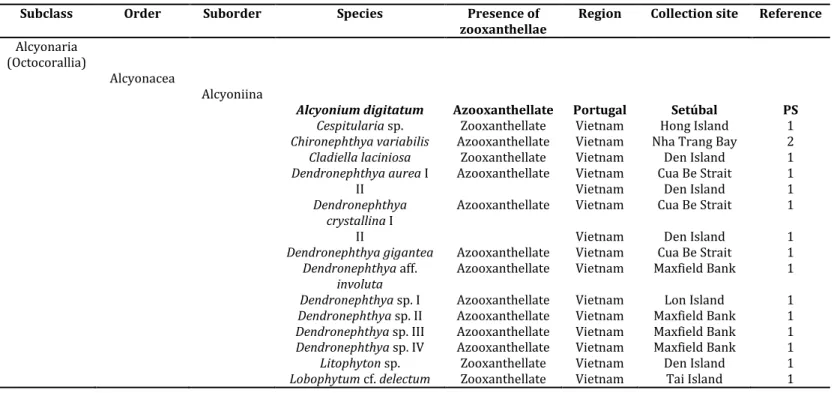
Database of the coral species used (with presence or absence of zooxanthellae), respective region and collection sites... 5
Table 2:
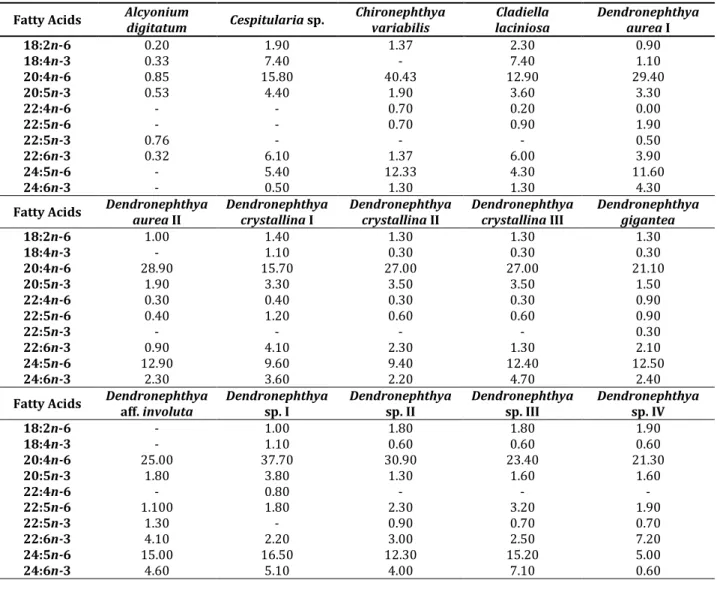
Fatty acid composition of selected PUFAs (% of total fatty acids, values greater than 0.2 % are shown)... 14
1
1. INTRODUCTION
Lipids constitute the structural base of biological membranes and perform protective and signalling functions (Spector and Yorek, 1985). In corals, these compounds can make up to 40 % of the dry weight and, thus, constitute the main source of stored energy (Stimson, 1987; Harland et al., 1993; Yamashiro et al., 1999). The principal components (“building blocks”) of lipids - fatty acids (FAs; Fig. 1), are known to be involved in the majority of biochemical and physiological processes of those cnidarians (Ibarguren et al., 2014).
Figure 1. Chemical structure of saturated, mono- and polyunsaturated FAs
Corals are polytrophic organisms, i.e. they simultaneously obtain nutrients through a variety of sources, including FA from: i) prey items (plankton), ii) particulate organic matter, iii) symbiotic photosynthetic dinoflagellates (zooxanthellae - Symbiodinium group),
2
iv) bacteria (Volkman et al., 1998)and v) de novo biosynthesis pathways occurring in their tissues (Imbs et al., 2007a). This FA biosynthesis occurs in parallel both in zooxanthellae (Fig. 2) and the host (Oku et al., 2003; Imbs et al., 2010a).
Figure 2. Photosynthetic symbiotic zooxanthellae in corals
It is worth noting that most animals cannot synthesize longer chain polyunsaturated fatty acids (PUFAs); instead, they are produced by phytoplankton and some bacteria and are transferred through the food web to higher trophic levels (Volkman et al., 1998).
There are certain differences in feeding behaviour between soft corals (mainly octocorals; Fig. 3) and reef-building corals (mainly hexacorals; Fig. 4), since soft corals, having a special anatomic structure, are believed to possess specific mechanisms of catching fine suspended food particles (Lewis, 1982; Imbs and Latyshev, 2012). These ecological dissimilarities can lead to differences in the FA profiles of hexa- and octocorals and, consequently, influence their chemotaxonomy classification.
3
Regarding the symbiosis, the diversity and quantity of zooxanthellae in a specificcoral taxonomic group depends on environmental factors such as solar irradiance and water temperature (Fabricius et al., 2004). Consequently, the presence/absence of zooxanthellae should lead to significant differences in FA composition among coral species (Imbs et al., 2007c). Photosynthetically fixed carbon is quickly converted into lipids, which are then carried into ‘host’ tissues in the form of ‘fat droplets’, consisting of triglycerides, wax esters and free fatty acids (Patton et al., 1983). These ‘fat droplet’ lipids are the main source of saturated fatty acids (SFA), while the presence of PUFA is most probably indicative of external food sources such as zoo- and phytoplankton (Kellogg and Patton, 1983; Latyshev et al., 1991). Thus, by knowing the origin of such FAs, they can be used as chemotaxonomic markers (Imbs et al., 2010b).
Changes in the ecology, nutrition, food habits and health of corals, due to environmental pressures, for example, may become detectable through changes in FA composition. For instance, a decrease in temperature may cause changes in membrane fluidity. The integrity of living cells in response to thermal stress depends on the
4
biomolecular lipid layer and the associated non-lipid components (Neidleman, 1987). In fact, the maintenance of appropriate cell membrane fluidity is of serious importance for the function and integrity of the cell, mobility and function of embedded proteins and lipids, diffusion of proteins and other molecules laterally across the membrane for signalling reactions, and proper separation of membranes during cell division (Kates et al., 1984; Hazel, 1988; Murata and Los, 1997). A fundamental biophysical determinant of membrane fluidity is the balance between saturated and unsaturated fatty acids. The general trend is an increase in unsaturated FA at lower temperatures and an increase in saturated fatty acids at higher temperatures. This compositional adaptation of membrane lipids, called homeoviscous adaptation (Fig. 5), serves to maintain the correct membrane fluidity at the new conditions (Sinensky, 1974).
Figure 5. Effect of decreased temperature in the structure of cellular membranes
It is recognized that in ectothermic animals an increase in the content of unsaturated FA (UFA) occurs in response to cold temperatures (Hall et al., 2002), suggesting that
T em perat ure de crea se
5
differences in the PUFA profile of corals may occur in relation to different climate conditions and depths.
Within this context, the aim of the present dissertation was to perform the most comprehensive examination of the chemotaxonomy of corals, by expanding the current knowledge on the subject, which is quite spatially limited (most species studied so far (85%) are from Vietnam, see Table 1). Here, I intended to uncover differences in FA composition of hexa- and octocorals from different climatic zones (temperate, subtropical and tropical) and distinct habitats (e.g. coral reefs, intertidal and subtidal zones, and deep-sea environments). More specifically, I studied the FA profile of 41 new species (19 hexacoral species from Mexico and Brazil, and 22 octocoral species from Azores Islands, Brazil, Portugal and also from Vietnam).
Table 1: Database of the coral species used (with presence or absence of zooxanthellae), respective region and collection sites.
Subclass Order Suborder Species Presence of
zooxanthellae Region Collection site Reference Alcyonaria
(Octocorallia)
Alcyonacea
Alcyoniina
Alcyonium digitatum Azooxanthellate Portugal Setúbal PS
Cespitularia sp. Zooxanthellate Vietnam Hong Island 1
Chironephthya variabilis Azooxanthellate Vietnam Nha Trang Bay 2
Cladiella laciniosa Zooxanthellate Vietnam Den Island 1
Dendronephthya aurea I Azooxanthellate Vietnam Cua Be Strait 1
II Vietnam Den Island 1
Dendronephthya
crystallina I Azooxanthellate Vietnam Cua Be Strait 1
II Vietnam Den Island 1
Dendronephthya gigantea Azooxanthellate Vietnam Cua Be Strait 1
Dendronephthya aff.
involuta Azooxanthellate Vietnam Maxfield Bank 1
Dendronephthya sp. I Azooxanthellate Vietnam Lon Island 1
Dendronephthya sp. II Azooxanthellate Vietnam Maxfield Bank 1
Dendronephthya sp. III Azooxanthellate Vietnam Maxfield Bank 1
Dendronephthya sp. IV Azooxanthellate Vietnam Maxfield Bank 1
Litophyton sp. Zooxanthellate Vietnam Den Island 1
6
Lobophytum pusillum Zooxanthellate Vietnam Den Island 1
Neospongodes atlantica Zooxanthellate Brazil Baía de
Todos-os-Santos PS
Paralemnalia thyrsoides Zooxanthellate Vietnam Nha Trang Bay 2
Sarcophyton acutum Zooxanthellate Vietnam Cua Be Strait 1
Sarcophyton buitendijki I Zooxanthellate Vietnam Den Island 1
II Vietnam Den Island 1
Sarcophyton cinereum Zooxanthellate Vietnam Lon Island 1
Sarcophyton aff. crassum Zooxanthellate Vietnam Den Island 1
Sarcophyton elegans Zooxanthellate Vietnam Cua Be Strait 1
Sarcophyton
trocheliophorum Zooxanthellate Vietnam Cua Be Strait 1
Sinularia cruciata Zooxanthellate Vietnam Den Island 3
Sinularia aff. deformis Zooxanthellate Vietnam Den Island 3
Sinularia densa Zooxanthellate Vietnam Den Island 3
Sinularia flexibilis Zooxanthellate Vietnam Den Island 3
Sinularia leptoclados Zooxanthellate Vietnam Den Island 3
Sinularia lochmodes Zooxanthellate Vietnam Den Island 3
Sinularia cf. muralis Zooxanthellate Vietnam Den Island 3
Sinularia notanda Zooxanthellate Vietnam Den Island 3
Calcaxonia
Ellisella plexauroides Azooxanthellate Vietnam Nha Trang Bay 2 Holaxonia
Acanthogorgia armata I Azooxanthellate Portugal
- Azores Banco D. João de Castro PS
II Portugal
- Azores Furnas de Fora PS
Acanthogorgia isoxya Azooxanthellate Vietnam Nha Trang Bay 2
Bebryce studeri Azooxanthellate Vietnam Den Island 2
Echinogorgia sp. Azooxanthellate Vietnam Nha Trang Bay 2
Eunicea sp. I Azooxanthellate México Madagascar
Reef, Yucatán Peninsula
PS
II México Puerto Morelos
Reef, Mexican Caribbean
PS
III México Mahahual Reef,
Mexican Caribbean
PS
IV Portugal Setúbal PS
Eunicella verrucosa I Azooxanthellate Portugal Setúbal PS
II Portugal Setúbal PS
Gorgonia sp. I Azooxanthellate México Puerto Morelos
Reef, Mexican Caribbean
PS
II México Mahahual Reef,
Mexican Caribbean
PS
Leptogorgia sarmentosa
I Azooxanthellate Portugal Setúbal PS
II Portugal Setúbal PS
III Portugal Setúbal PS
Menella praelonga Azooxanthellate Vietnam Nha Trang Bay 2
Muricea sp. Azooxanthellate México Madagascar
Reef, Yucatán Peninsula
PS
Unidentified Azooxanthellate México Madagascar
Reef, Yucatán Peninsula
PS
Paramuricea biscaya Azooxanthellate Portugal
- Azores Canal de S. Jorge PS
c.f. Placogorgia sp. Azooxanthellate Portugal
7
Plexaurella sp. Azooxanthellate México Mahahual Reef,
Mexican Caribbean
PS
Pseudoplexaura sp. I Azooxanthellate México Madagascar
Reef, Yucatán Peninsula
PS
II México Puerto Morelos
Reef, Mexican Caribbean
PS
Pseudopterogorgia sp. Azooxanthellate México Mahahual Reef,
Mexican Caribbean
PS
Rumphella aggregata Zooxanthellate Vietnam Nha Trang Bay 2
Scleraxonia
Acabaria erythraea Azooxanthellate Vietnam Nha Trang Bay 2
Stolonifera
Carijoa riisei Azooxanthellate Brazil Bahia Todos os
Santos PS
Clavularia sp. Zooxanthellate Vietnam Tre Island 1
Pennatulacea
Sessiliflorae
Cavernularia obesa Azooxanthellate Vietnam Unknown PS
Pteroeides spp. Azooxanthellate Vietnam Unknown PS
Veretillum cynomorium I Azooxanthellate Portugal Sado Estuary 5
II Portugal Sado Estuary 5
III Portugal Sado Estuary 5
IV Portugal Sado Estuary 5
V Portugal Sado Estuary 5
VI Portugal Sado Estuary 5
Renilla koellikeri Azooxanthellate U.S.A. Long Beach,
California 4
Zoantharia (Hexacorallia)
Scleractinia Acropora cerealis Zooxanthellate Vietnam Mun Island 6
Acropora florida Zooxanthellate Vietnam Thotyu Island 7
Acropora formosa Zooxanthellate Vietnam Mun Island 6
Acropora gemmifera Zooxanthellate Vietnam Mun Island 6
Acropora milepora I Zooxanthellate Vietnam Thotyu Island 7
II Vietnam Tyam Island 7
Acropora nasuta I Zooxanthellate Vietnam Thotyu Island 7
II Vietnam Tyam Island 7
Acropora nobilis Zooxanthellate Vietnam Nha Trang Bay 6
Acropora palifera Zooxanthellate Vietnam Mun Island 6
Acropora sp. Zooxanthellate Vietnam Nha Trang Bay 6
Agaricia sp. I Azooxanthellate México Madagascar
Reef, Yucatán Peninsula
PS
II México Mahahual Reef,
Mexican Caribbean
PS
Caulastraea tumida Zooxanthellate Vietnam Den Island 1
Diploria sp. Azooxanthellate México Mahahual Reef,
Mexican Caribbean
PS
Diploria strigosa Azooxanthellate México Mahahual Reef,
Mexican Caribbean
PS
Echinophyllia orpheensis Zooxanthellate Vietnam Nha Trang Bay 6
Favia sp. I Zooxanthellate Vietnam Nha Trang Bay 6
II Zooxanthellate Vietnam Nha Trang Bay 6
Goniopora sp. I Zooxanthellate Vietnam Tyam Island 7
8
Montastraea annularis Azooxanthellate México Mahahual Reef,
Mexican Caribbean
PS
Montastraea sp. Zooxanthellate México Madagascar
Reef, Yucatán Peninsula
PS
Oculina sp. Zooxanthellate México Madagascar
Reef, Yucatán Peninsula
PS
Pocillopora damicornis I Zooxanthellate Vietnam Mun Island 6
II Vietnam Thotyu Island 7
III Vietnam Thotyu Island 7
Pocillopora verrucosa Zooxanthellate Vietnam Thotyu Island 7
Porites cylindrica Zooxanthellate Vietnam Mun Island 6
Porites lobata Zooxanthellate Vietnam Nha Trang Bay 6
Porites lutea Zooxanthellate Vietnam Thotyu Island 7
Porites nigrescens Zooxanthellate Vietnam Mun Island 6
Porites porites Azooxanthellate México Puerto Morelos
Reef, Mexican Caribbean
PS
Porites sp. Azooxanthellate México Mahahual Reef,
Mexican Caribbean
PS
Sandalolitha robusta Zooxanthellate Vietnam Nha Trang Bay 6
Scolymia cubensis Zooxanthellate Brazil Baía de
Todos-os-Santos PS
Scolymia sp. Azooxanthellate México Madagascar
Reef, Yucatán Peninsula
PS
Scolymia wellsi Zooxanthellate Brazil Baía de
Todos-os-Santos PS
Seriatopora caliendrum Zooxanthellate Seychelles Aldabra Island 7
Seriatopora hystrix Zooxanthellate Vietnam Mun Island 6
Stylophora pistillata I Zooxanthellate Seychelles Coetivy Island 7
II Seychelles Coetivy Island 7
III Vietnam Mun Island 6
IV Vietnam Thotyu Island 7
V Vietnam Tyam Island 7
Tubastraea coccinea I Azooxanthellate Brazil Baía de
Todos-os-Santos PS
II Seychelles Aldabra Island 7
Tubastraea micrantha Azooxanthellate Seychelles Aldabra Island 7 Zoanthidea
Epizoanthus gabrieli I Zooxanthellate Brazil Baía de
Todos-os-Santos – I PS
II Brazil Baía de
Todos-os-Santos – II PS
III Brazil Baía de
Todos-os-Santos – III PS
Palythoa caribaeorum I Azooxanthellate México Madagascar
Reef, Yucatán Peninsula
PS
II México Mahahual Reef,
Mexican Caribbean
PS
III México Puerto Morelos
Reef, Mexican Caribbean
PS
Palythoa sp. Azooxanthellate México La Gallega Reef,
Veracruz Reef System
PS
9
os-Santos
Zoanthus sociatus I Zooxanthellate México La Gallega Reef,
Veracruz Reef System PS II México Madagascar Reef, Yucatán Peninsula PS
Zoanthus sp. I Zooxanthellate Brazil Baía de
Todos-os-Santos PS
II Brazil Baía de
Todos-os-Santos PS
References: 1 - Imbs et al. 2007b; 2 - Imbs et al. 2009; 3 - Imbs and Latyshev 2011; 4 – Pernet et al.2002; 5 - Baptista et al. 2012; 6 - Imbs et al. 2007a; 7 - Latyshev et al. 1991.
10
2. MATERIAL AND METHODS
2.1. Sampling
2.1.1. Shallow-living corals
Specimens of shallow-living hexa- and octocorals were collected by scuba-divers in Mexico [La Gallega Reef (n=2 species); Madagascar Reef (n=10); Mahahual Reef (n=10); Puerto Morelos Reef (n=5)], Brazil [Baía de Todos-os-Santos (n=8)], Portugal [Setúbal (n=4)] and Vietnam (n=2) (Fig. 6) at depths between 0.5-6 m. Samples were placed in liquid nitrogen and, in the lab, stored at -80 °C.
Figure 6. Sampling sites of coral specimens used in the present study (Azores, continental Portugal, Brazil, Mexico and Vietnam, red circles and red triangle representing deep-sea species from Azores) and those from the literature (Vietnam, Seychelles and California, black circles).
11
2.1.2. Deep-sea corals
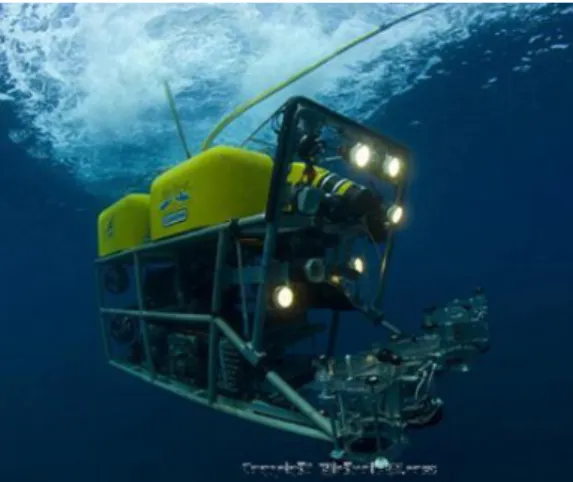
Deep-sea gorgonian corals (n=4 specimens) were collected off the Portuguese Azores archipelago (Fig. 6; red triangle), namely in Furnas de Fora, Dom João de Castro Seamount and São Jorge Channel, at depths between 313-1077 m, with the working class ROV Luso model Bathysaurus XL (Fig. 7), operated from R/V Almirante Gago Coutinho. Following collection, samples were immediately stored in an on-board -80 °C freezer. Species belonging to the suborder Holaxonia, commonly designated as “gorgonians”, were analysed as one group (i.e. gorgonians) for the sake of clarity and to allow comparison with previously published data.
Figure 7. ROV Luso model Bathysaurus XL.
2.2. Biochemical (fatty acid) analysis
Samples [145-301 mg for hexacorals and 300-301 mg for octocorals (dry mass)] were dissolved in 5 mL of acetyl chloride/methanol (1:19 v/v; Merck), shaken for 30 sec, and heated (80 °C; 1 h). After cooling in room temperature for at least 30 min, 1 mL of Milli-Q distilled water and 2 mL of n-heptane pro analysis (Merck) were added and samples were
12
shaken, for 30 sec, and centrifuged (3000 g, 3 min) until phase separation. The organic content of the upper phase was filtered using an anhydrous sodium sulphate (Panreac) and cotton column. The filtered content was evaporated under a constant flow of nitrogen. Afterwards, 100µl of n-heptane were added to each replicate. Following, an aliquot (2 μL) was injected onto a gas chromatograph (Varian Star 3800 Cp, Walnut Creek, CA, USA) equipped with an autosampler and fitted with a flame ionization detector at 250 °C for FAME analysis. The separation was carried out with helium as carrier gas at a flow rate of 1 mL min−1, in a capillary column DB-WAX (30 m length × 0.32 mm internal diameter; 0.25
μm film thickness; Hewlett– Packard, Albertville, MN) programmed at 180 °C for 5 min, raised to 220 at 4 °C min−1, and maintained at 220 °C for 25 min, with the injector at 250 °C. FAME identification was accomplished through comparison of retention times with those of Sigma standards. Quantitative data were obtained with Varian software using C21:0 FA (Sigma) as internal standard.
2.3. Meta-analysis
2.3.1. Database compilation
The FA profile of 27 hexacoral species (order Scleractinia) and 39 octocoral species (orders Alcyonacea, Gorgonacea and Pennatulacea) was compiled by means of a comprehensive search of primary literature (Latyshev et al., 1991; Pernet and Anctil, 2002; Imbs et al., 2007c; Imbs et al., 2009; Baptista et al., 2012; Imbs and Latyshev, 2012) (see Table 1). The taxonomic classification was performed following the World Register of Marine Species - WoRMS. Given that most authors only provide information on FAs
13
representing 0.2 % or more of total FA content, FA percent data below 0.2 % were not considered in the present study.
2.4. Statistical analysis
Principal component analysis (PCA) of FA profiles has been successfully applied to study the chemotaxonomy of hexacorals (Latyshev et al., 1991; Imbs et al., 2007a; Imbs et al., 2010b) and octocorals (Imbs et al., 2009; Imbs and Latyshev, 2012; Imbs, 2014). Moreover, it has also been shown that the use of a few selected PUFAs is more suitable for the determination of chemotaxonomic differences between corals than total FA matrix (Imbs et al., 2007a). Consequently, in the present study, PCA was applied in a FA matrix of ten PUFAs, namely, the five major n-3 series FAs (18:4n-3; 20:5n-3; 22:5n-3; 22:6n-3; 24:6n-3) and the five major n-6 series FAs (18:2n-6; 20:4n-6; 22:4n-6; 22:5n-6; 24:5n-6).
Additionally, differences in FA profile among coral groups were tested with analysis of variance (ANOVA) followed by multiple comparisons tests (Unequal N HSD). All statistical analyses were tested at 0.05 level of probability with the software STATISTICATM 12 (Statsoft, Inc., Tulsa, 167 OK 74104, USA).
14
3. RESULTS
A detailed overview of the coral species used in the present dissertation is provided in Table 1. The percentual content of the selected PUFAs for all species (present study and literature) is shown in Table 2.
Table 2: Fatty acid composition of selected PUFAs (% of total fatty acids, values greater than 0.2 % are shown)
Fatty Acids Alcyonium digitatum Cespitularia sp. Chironephthya variabilis laciniosa Cladiella Dendronephthya aurea I
18:2n-6 0.20 1.90 1.37 2.30 0.90 18:4n-3 0.33 7.40 - 7.40 1.10 20:4n-6 0.85 15.80 40.43 12.90 29.40 20:5n-3 0.53 4.40 1.90 3.60 3.30 22:4n-6 - - 0.70 0.20 0.00 22:5n-6 - - 0.70 0.90 1.90 22:5n-3 0.76 - - - 0.50 22:6n-3 0.32 6.10 1.37 6.00 3.90 24:5n-6 - 5.40 12.33 4.30 11.60 24:6n-3 - 0.50 1.30 1.30 4.30
Fatty Acids Dendronephthya aurea II Dendronephthya crystallina I Dendronephthya crystallina II Dendronephthya crystallina III Dendronephthya gigantea
18:2n-6 1.00 1.40 1.30 1.30 1.30 18:4n-3 - 1.10 0.30 0.30 0.30 20:4n-6 28.90 15.70 27.00 27.00 21.10 20:5n-3 1.90 3.30 3.50 3.50 1.50 22:4n-6 0.30 0.40 0.30 0.30 0.90 22:5n-6 0.40 1.20 0.60 0.60 0.90 22:5n-3 - - - - 0.30 22:6n-3 0.90 4.10 2.30 1.30 2.10 24:5n-6 12.90 9.60 9.40 12.40 12.50 24:6n-3 2.30 3.60 2.20 4.70 2.40
Fatty Acids Dendronephthya aff. involuta Dendronephthya sp. I Dendronephthya sp. II Dendronephthya sp. III Dendronephthya sp. IV
18:2n-6 - 1.00 1.80 1.80 1.90 18:4n-3 - 1.10 0.60 0.60 0.60 20:4n-6 25.00 37.70 30.90 23.40 21.30 20:5n-3 1.80 3.80 1.30 1.60 1.60 22:4n-6 - 0.80 - - - 22:5n-6 1.100 1.80 2.30 3.20 1.90 22:5n-3 1.30 - 0.90 0.70 0.70 22:6n-3 4.10 2.20 3.00 2.50 7.20 24:5n-6 15.00 16.50 12.30 15.20 5.00 24:6n-3 4.60 5.10 4.00 7.10 0.60
15
Fatty Acids Litophyton sp. Lobophytum cf.
delectum Lobophytum pusillum Neospongodes atlantica Paralemnalia thyrsoides
18:2n-6 - 1.60 0.50 0.66 1.55 18:4n-3 5.70 0.60 4.10 9.54 2.85 20:4n-6 15.00 30.40 18.40 12.39 25.55 20:5n-3 6.70 0.20 1.30 3.66 2.75 22:4n-6 - - - - 0.15 22:5n-6 - 0.10 0.20 0.47 - 22:5n-3 - 0.40 - - - 22:6n-3 0.20 2.50 6.63 2.45 5.10 24:5n-6 14.90 7.20 - 7.40 8.80 24:6n-3 0.40 0.90 - 0.80 0.50
Fatty Acids Sarcophyton acutum Sarcophyton buitendijki I buitendijki II Sarcophyton Sarcophyton cinereum Sarcophyton aff. crassum
18:2n-6 0.50 - 0.30 - 0.30 18:4n-3 8.90 4.70 8.10 4.80 2.40 20:4n-6 21.10 16.30 24.80 12.60 15.10 20:5n-3 5.00 2.20 5.20 1.50 1.00 22:4n-6 - - - - - 22:5n-6 0.20 - - - - 22:5n-3 0.30 0.20 - - - 22:6n-3 3.10 5.50 2.50 1.30 1.50 24:5n-6 4.40 8.40 4.20 4.60 4.80 24:6n-3 0.90 0.80 0.60 0.50 0.40
Fatty Acids Sarcophyton elegans trocheliophorum Sarcophyton Sinularia cruciata Sinularia aff. deformis Sinularia densa
18:2n-6 1.30 0.30 0.20 0.20 0.60 18:4n-3 3.70 6.70 6.20 5.60 4.80 20:4n-6 15.20 17.90 23.80 19.10 10.20 20:5n-3 6.20 2.20 2.20 2.40 0.80 22:4n-6 - 0.20 - - - 22:5n-6 - - - - - 22:5n-3 - - - - - 22:6n-3 3.80 3.90 2.90 1.90 3.00 24:5n-6 5.60 8.40 5.80 5.60 5.30 24:6n-3 0.80 1.20 1.80 1.20 1.10
Fatty Acids leptoclados Sinularia lochmodes Sinularia Sinularia cf. muralis Sinularia notanda plexauroides Ellisella
18:2n-6 - - - - 0.90 18:4n-3 1.10 4.40 4.50 5.20 - 20:4n-6 23.20 21.20 18.10 19.10 39.30 20:5n-3 1.00 2.30 1.50 2.20 1.97 22:4n-6 - - - - 8.97 22:5n-6 - - - - 0.90 22:5n-3 - - - - 0.43 22:6n-3 2.50 2.70 3.40 3.10 2.90 24:5n-6 8.90 6.00 6.30 7.30 3.10 24:6n-3 0.90 0.90 1.20 1.20 1.40
Fatty Acids Acanthogorgia armata I Acanthogorgia armata II Acanthogorgia isoxya Bebryce studeri Echinogorgia sp.
18:2n-6 0.51 0.70 1.03 0.70 0.70 18:4n-3 0.19 0.38 - 0.30 - 20:4n-6 - 10.54 38.77 21.70 47.60 20:5n-3 1.30 1.48 3.27 2.00 2.20 22:4n-6 - 0.64 3.83 1.10 0.40 22:5n-6 0.49 0.19 1.13 4.20 0.20 22:5n-3 - 0.71 - 0.50 - 22:6n-3 1.77 1.24 2.53 3.50 0.80 24:5n-6 3.21 1.10 7.50 7.20 8.90 24:6n-3 1.17 0.39 2.40 0.50 2.60
16
Fatty Acids Eunicea sp.
I Eunicea sp. II Eunicea sp. III Eunicea sp. IV verrucosa I Eunicella
18:2n-6 0.62 1.27 1.42 0.81 0.90 18:4n-3 1.76 0.74 0.69 0.60 1.11 20:4n-6 7.83 10.25 9.97 19.37 22.94 20:5n-3 1.75 1.67 2.24 2.66 3.02 22:4n-6 1.37 0.90 1.07 1.69 2.06 22:5n-6 0.29 0.31 0.24 0.57 0.79 22:5n-3 0.86 0.58 0.58 0.63 0.63 22:6n-3 3.66 3.86 3.97 1.29 2.32 24:5n-6 1.71 3.16 2.89 8.68 12.92 24:6n-3 0.44 2.21 2.15 1.74 2.92
Fatty Acids verrucosa II Eunicella Gorgonia sp. I Gorgonia sp. II sarmentosa I Leptogorgia sarmentosa II Leptogorgia
18:2n-6 0.92 2.06 2.94 0.75 0.82 18:4n-3 1.01 3.94 2.17 0.67 0.54 20:4n-6 21.49 12.38 - 18.67 17.19 20:5n-3 3.47 2.74 2.92 3.13 1.75 22:4n-6 2.03 0.29 - 2.76 2.81 22:5n-6 0.75 0.24 - 0.90 1.16 22:5n-3 0.66 0.22 0.21 0.49 0.50 22:6n-3 2.38 2.98 9.83 2.07 1.82 24:5n-6 11.38 4.66 3.10 9.53 11.46 24:6n-3 2.91 0.80 1.74 3.17 2.22
Fatty Acids sarmentosa III Leptogorgia praelonga Menella Muricea sp. Unidentified Paramuricea biscaya
18:2n-6 0.70 0.83 0.49 0.76 1.78 18:4n-3 0.70 0.27 2.28 2.64 1.12 20:4n-6 19.61 39.70 10.42 6.27 7.21 20:5n-3 2.68 3.67 2.80 1.19 1.76 22:4n-6 3.48 3.93 0.43 0.23 - 22:5n-6 1.15 1.27 0.60 0.45 0.55 22:5n-3 0.86 0.35 0.47 - - 22:6n-3 2.50 2.60 18.42 11.77 0.98 24:5n-6 12.01 9.13 4.23 3.55 3.65 24:6n-3 3.21 2.93 3.69 2.77 0.65
Fatty Acids c.f. Placogorgia sp. Plexaurella sp. Pseudoplexaura sp. I Pseudoplexaura sp. II Pseudopterogorgia sp.
18:2n-6 0.33 6.71 0.87 1.27 3.61 18:4n-3 - 2.08 2.85 1.52 1.03 20:4n-6 21.10 8.23 11.85 10.69 11.77 20:5n-3 4.71 3.66 4.21 4.14 5.13 22:4n-6 - 0.75 0.77 1.06 1.39 22:5n-6 - - 0.29 0.32 0.64 22:5n-3 - 0.81 0.82 0.88 2.03 22:6n-3 0.43 4.31 8.07 7.08 8.38 24:5n-6 7.46 1.78 2.42 2.23 2.94 24:6n-3 0.36 0.66 1.39 0.79 2.13
Fatty Acids Rumphella aggregata erythraea Acabaria Carijoa riisei Cavernularia obesa Pteroeides spp.
18:2n-6 0.65 0.90 0.83 2.58 0.79 18:4n-3 2.15 0.40 0.22 2.92 2.60 20:4n-6 13.15 37.20 24.18 3.71 14.52 20:5n-3 2.05 1.70 2.98 10.16 9.21 22:4n-6 0.65 0.60 2.82 1.22 5.61 22:5n-6 - 5.70 0.65 - 0.24 22:5n-3 - 0.30 0.24 0.36 0.65 22:6n-3 1.60 3.90 2.83 2.54 0.66 24:5n-6 3.40 14.50 - - - 24:6n-3 0.20 2.30 - - -
17
Fatty Acids Veretillum
cynomorium I cynomorium II Veretillum cynomorium III Veretillum cynomorium IV Veretillum cynomorium V Veretillum
18:2n-6 0.58 0.70 0.79 0.64 0.79 18:4n-3 0.39 0.53 0.86 1.18 0.64 20:4n-6 8.88 7.16 7.36 10.01 7.74 20:5n-3 9.58 8.99 12.42 11.42 9.76 22:4n-6 3.10 2.52 2.76 3.88 3.23 22:5n-6 0.12 0.22 0.30 0.25 0.29 22:5n-3 0.88 1.01 1.18 0.87 0.95 22:6n-3 0.79 0.98 2.23 1.88 1.25 24:5n-6 0.93 0.80 0.81 1.00 1.03 24:6n-3 7.72 8.00 11.54 10.31 11.10
Fatty Acids cynomorium VI Veretillum Renilla koellikeri Acropora cerealis Acropora florida Acropora formosa
18:2n-6 0.87 0.80 0.90 1.30 1.00 18:4n-3 0.77 - 1.40 5.10 1.80 20:4n-6 6.22 36.65 6.70 11.00 14.70 20:5n-3 9.56 11.35 16.50 6.90 9.50 22:4n-6 2.78 3.75 5.50 6.30 7.20 22:5n-6 0.28 - - 1.30 - 22:5n-3 1.12 1.45 3.90 1.20 3.10 22:6n-3 0.90 2.85 6.30 6.70 6.20 24:5n-6 1.02 - - - - 24:6n-3 11.16 - - - -
Fatty Acids gemmifera Acropora milepora I Acropora milepora II Acropora Acropora nasuta I Acropora nasuta II
18:2n-6 1.20 1.70 1.10 2.10 0.70 18:4n-3 1.20 1.10 6.60 2.60 4.90 20:4n-6 10.40 8.00 7.20 7.10 3.20 20:5n-3 10.30 1.60 10.40 0.80 4.50 22:4n-6 4.10 1.00 6.00 4.30 2.40 22:5n-6 - - 0.60 - 0.30 22:5n-3 2.60 0.50 3.00 0.90 1.30 22:6n-3 4.90 10.40 12.60 10.80 8.80 24:5n-6 - - - - - 24:6n-3 - - - - -
Fatty Acids Acropora nobilis Acropora palifera Acropora sp. Agaricia sp. I Agaricia sp. II
18:2n-6 1.60 0.60 1.40 1.61 1.91 18:4n-3 2.70 1.00 1.60 0.82 1.33 20:4n-6 2.30 1.80 2.00 2.93 2.22 20:5n-3 3.00 9.90 1.70 2.13 1.96 22:4n-6 1.30 2.60 1.10 1.65 1.14 22:5n-6 - - - - - 22:5n-3 1.20 1.70 0.70 1.14 0.99 22:6n-3 4.20 3.30 4.10 7.90 8.26 24:5n-6 - - - - - 24:6n-3 - - - - -
Fatty Acids Caulastraea tumida Diploria sp. Diploria strigosa Echinophyllia orpheensis Favia sp. I
18:2n-6 0.80 1.20 1.67 1.00 1.60 18:4n-3 0.80 0.78 1.09 1.10 1.20 20:4n-6 4.90 4.55 7.53 3.40 4.60 20:5n-3 2.90 1.19 1.97 1.70 0.80 22:4n-6 - 1.01 1.65 1.70 2.10 22:5n-6 - - - - - 22:5n-3 1.90 0.48 0.76 2.30 6.70 22:6n-3 10.10 5.99 4.58 9.20 3.60 24:5n-6 - - - - -24:6n-3 - - - - -
18
Fatty Acids Favia sp. II Goniopora sp. I Goniopora sp. II Montastraea
annularis Montastraea sp. 18:2n-6 3.00 2.20 1.60 1.58 1.37 18:4n-3 1.10 2.30 4.30 0.88 2.17 20:4n-6 3.70 13.30 21.90 3.75 3.11 20:5n-3 1.00 4.10 4.60 1.72 2.40 22:4n-6 2.00 3.30 6.00 1.27 1.25 22:5n-6 - - - - - 22:5n-3 6.20 1.00 0.80 0.71 0.46 22:6n-3 2.90 15.70 11.50 6.10 5.18 24:5n-6 - - - - - 24:6n-3 - - - - -
Fatty Acids Oculina sp. damicornis I Pocillopora damicornis II Pocillopora damicornis III Pocillopora verrucosa Pocillopora
18:2n-6 1.18 1.30 1.70 1.80 1.20 18:4n-3 4.09 2.10 2.20 0.80 3.30 20:4n-6 5.37 3.90 2.10 2.00 1.80 20:5n-3 4.54 3.00 1.80 1.40 3.20 22:4n-6 4.67 2.60 1.30 0.90 1.30 22:5n-6 2.58 - - - - 22:5n-3 5.21 0.70 0.60 0.40 0.70 22:6n-3 2.53 12.30 14.00 9.50 10.40 24:5n-6 - - - - - 24:6n-3 - - - - -
Fatty Acids cylindrica Porites Porites lobata Porites lutea nigrescens Porites Porites porites
18:2n-6 1.10 1.50 1.00 0.60 2.71 18:4n-3 1.70 0.60 2.90 1.60 1.33 20:4n-6 6.10 7.00 2.30 3.20 4.58 20:5n-3 4.10 2.00 3.30 4.80 3.14 22:4n-6 3.10 4.20 1.40 3.20 1.94 22:5n-6 - - - - - 22:5n-3 1.30 2.10 0.80 1.50 1.68 22:6n-3 8.70 5.50 5.30 11.60 5.23 24:5n-6 - - - - - 24:6n-3 - - - - -
Fatty Acids Porites sp. Sandalolitha robusta Scolymia cubensis Scolymia sp. Scolymia wellsi
18:2n-6 0.92 1.40 2.58 0.58 2.57 18:4n-3 1.54 0.10 1.22 0.30 1.67 20:4n-6 4.08 4.20 7.73 3.50 8.72 20:5n-3 3.71 1.60 3.30 1.05 2.97 22:4n-6 2.15 1.40 2.87 - 3.26 22:5n-6 - - - 0.34 - 22:5n-3 1.14 0.70 1.42 4.81 1.54 22:6n-3 8.74 2.60 7.28 - 6.42 24:5n-6 - - - - - 24:6n-3 - - - - -
Fatty Acids Seriatopora caliendrum Seriatopora hystrix pistillata I Stylophora Stylophora pistillata II pistillata III Stylophora
18:2n-6 1.70 0.50 1.70 0.80 0.60 18:4n-3 1.70 1.20 1.30 1.90 1.80 20:4n-6 4.80 3.50 4.30 7.60 5.10 20:5n-3 2.60 1.80 2.00 7.70 1.80 22:4n-6 1.50 1.20 1.80 3.80 1.90 22:5n-6 - - - - - 22:5n-3 1.20 1.10 1.30 4.50 1.10 22:6n-3 16.90 13.30 16.40 14.40 13.20 24:5n-6 - - - - - 24:6n-3 - - - - -
19
Fatty Acids Stylophora
pistillata IV Stylophora pistillata V Tubastraea coccinea I Tubastraea coccinea II Tubastraea micrantha
18:2n-6 1.90 1.70 0.33 2.00 1.80 18:4n-3 1.40 2.00 3.68 0.70 0.80 20:4n-6 1.70 3.10 7.16 7.80 6.60 20:5n-3 1.40 2.60 7.40 14.90 10.90 22:4n-6 1.00 1.70 10.21 4.70 5.50 22:5n-6 - - - - - 22:5n-3 4.50 0.70 13.40 16.40 17.30 22:6n-3 8.80 10.10 1.05 1.40 1.30 24:5n-6 - - - - - 24:6n-3 - - - - -
Fatty Acids Epizoanthus gabrieli I Epizoanthus gabrieli II Epizoanthus gabrieli III caribaeorum I Palythoa caribaeorum II Palythoa
18:2n-6 0.46 - - 0.84 1.14 18:4n-3 2.11 - - 2.45 1.67 20:4n-6 3.78 0.59 0.51 8.31 10.72 20:5n-3 2.65 - - 2.27 1.98 22:4n-6 1.96 - - 3.34 3.59 22:5n-6 - 2.76 3.04 - - 22:5n-3 9.84 - - 5.92 4.06 22:6n-3 2.50 8.20 7.63 2.04 2.19 24:5n-6 - - - - - 24:6n-3 - - - - -
Fatty Acids caribaeorum III Palythoa Palythoa sp. Protopalythoa variabilis Zoanthus sociatus I Zoanthus sociatus II
18:2n-6 1.56 0.53 0.33 1.03 2.09 18:4n-3 1.39 2.22 2.03 2.59 7.52 20:4n-6 9.23 7.51 5.40 5.21 1.68 20:5n-3 1.76 1.85 1.75 0.60 3.46 22:4n-6 2.81 4.07 2.91 3.40 1.04 22:5n-6 - - - - - 22:5n-3 2.73 4.95 6.99 3.72 4.08 22:6n-3 1.93 2.10 1.85 1.61 2.97 24:5n-6 - - - - - 24:6n-3 - - - - -
Fatty Acids Zoanthus sp. I Zoanthus sp. II
18:2n-6 1.69 3.78 18:4n-3 0.54 - 20:4n-6 8.08 3.46 20:5n-3 5.89 0.24 22:4n-6 7.34 1.88 22:5n-6 - - 22:5n-3 6.98 7.10 22:6n-3 - 1.70 24:5n-6 - - 24:6n-3 - -
20
3.1. General differences between hexa- and octocorals
The results of the PCA (obtained with the 10 selected PUFAs) for the 45 hexa- and 59 octocoral species from different world regions (namely Brazil, USA, México, Portugal, Seychelles and Vietnam) are shown in Figure 8.
A
21 I H E C G D F
Figure 8: Principal component analysis based on the content of 10 PUFAs (18:2n-6, 18:4n-3, 20:4n-6, 20:5n-3, 22:4n-6, 22:5n-6, 22:5n-20:5n-3, 22:6n-20:5n-3, 24:5n-6, 24:6n-3)of 104 hexacoral and octocoral species (123 specimens). A) Principal component plot; B) Loading plot of FAs and their contribution to the spread along PC1 and PC2; C) D) E) F) G) H) and I) Percentual content of different FAs in eight coral groups. Values are means (±SD). Different superscript letters represent significant differences between groups (P<0.05). Numbers on the bars of the plot for
22
18:4n-3 represent number of species in each coral group. Legend of panel A: Octo Cal-N – azooxanthellae octocorals from California; Octo Pt-N – azooxanthellae octocorals from continental Portugal; Octo Viet-Y – zooxanthellae octocorals from Vietnam; Octo Viet-N – azooxanthellae octocorals from Vietnam; Octo Br-Y – zooxanthellae octocorals from Brazil; Octo Br-N – azooxanthellae octocorals from Brazil; Octo Mex-N – azooxanthellae octocorals from Mexico; Hexa Mex-Y – zooxanthellae hexacorals from Mexico; Hexa Mex-N – azooxanthellae hexacorals from Mexico; Hexa Viet-Y – zooxanthellae hexacorals from Vietnam; Hexa Br-Y – zooxanthellae hexacorals from Brazil; Hexa Br-N – azooxanthellae hexacorals from Brazil; Hexa Sey-Y – zooxanthellae hexacorals from Seychelles; Hexa Sey-N – azooxanthellae hexacorals from Seychelles; panel C, D, E, F, G, H and I: Scl-N – azooxanthellae scleractinians; Scl-Y – zooxanthellae scleractinians; Zoa-N – azooxanthellae zoanthidians; Zoa-Y – zooxanthellae zoanthidians; Pen-N – azooxanthellae pennatulaceans; Gorg-N – azooxanthellae gorgonians; Alc-N – azooxanthellae alcyonaceans; Alc – Y – zooxanthellae alcyonaceans.
A clear separation was achieved between hexa- and octocorals along PC1 (explaining 30.04 % of the variance), with the former group to the right and the latter to the left. This separation was mainly caused by 20:4n-6 and 24:5n-6 (Fig. 8B). In terms of 20:4n-6, the separation occurred because octocorals generally exhibited a higher content of this PUFA. Yet, such differences were not always observed among members of the two coral groups (Fig. 8D). Regarding 24:5n-6, it is worth noting that this FA was only present in octocorals (Fig. 8I). The separation within each group was mainly achieved along PC2 (explaining 19,11 % of the variance). Among the hexacoral group, species belonging to the Tubastraea genera (from Seychelles and Brazil) were placed in an upper position relative to the other species. A similar result was observed in octocorals, where Veretillum cynomorium, Ellisella
plexauroides and Renilla koellikeri were also placed in an upper position. Such differences
were mainly driven by 20:5n-3 (Fig. 8E), 22:4n-6 (Fig. 8F) and 22:5n-3 (Fig. 8G). These PUFA were found in higher percentage in the above mentioned species. On the other hand,
23
A
18:4n-3 (Fig. 8C) and 22:6n-3 (Fig. 8H) were mostly found in lower percentages on those species (Fig. 8B; Table 2).
3.2. Differences among hexacorals
The results of the PCA of 44 species of Hexacorals (55 specimens belonging to Zoantharia and Scleractinia orders), from the different world regions (Brazil, México, Seychelles and Vietnam) are shown in Figure 9.
24
C B
25
Figure 9: Principal component analysis based on the content of 10 PUFAs (18:2n-6, 18:4n-3, 20:4n-6, 20:5n-3, 22:4n-6, 22:5n-6, 22:5n-20:5n-3, 22:6n-20:5n-3, 24:5n-6, 24:6n-3) of 44 hexacoral species (55 specimens). A) Principal component plot; B) Loading plot of FAs and their contribution to the spread along PC1 and PC2; C) D) E) F) and G) Percentual content of different FAs in three species (5 specimens) and other hexacorals. Values are mean (±SD), except in the case of the species (T. coccinea I, T. coccinea II, T. micrantha, E. gabrieli I and E. gabrieli II) where only one value is available. Legend of panel A: Viet-Y – zooxanthellae hexacorals from Vietnam; Br-Y – zooxanthellae hexacorals from Brazil; Br-N – azooxanthellae hexacorals from Brazil; Mex-Y – zooxanthellae hexacorals from Mexico; Mex-N – azooxanthellae hexacorals from Mexico; Sey-Y – zooxanthellae hexacorals from Seychelles; Sey-N – azooxanthellae hexacorals from Seychelles. Panel B: Scl-Y – zooxanthellae scleractininans; Scl-N – azooxanthellae scleractininans; Zoa-Y – zooxanthellae zoantharians; Zoa-N – azooxanthellae zoatharians. Panels D-G: Other Hexa – other hexacorals.
Distinct spatial (Fig. 9A) and taxonomic separations (Fig. 9B) among hexacorals were not observed (even though both axis explained 50.36% of the variance). However, it is noteworthy that Tubastraea species (T. coccinea and T. micrantha) from Seychelles and Brazil (placed upwards) were placed to the leftmost position and two Epizoanthus gabrieli specimens, from Brazil, appeared in the rightmost position. The marginal placement of
Tubastraea species occurred due to the higher contents of 20:5n-3, 22:4n-6 and 22:5n-3,
and a lower content of 22:6n-3, when compared to most other hexacorals. The placement of E. gabrieli to the right, on the other hand, was caused due to a high concentration of
26
22:6n-3, closer to that found in other hexacorals, and the lack of 20:5n3, 22:4n-6 and 22:5n-3.
3.3. Differences among octocorals
The results of the PCA with 58 octocoral species (65 specimens belonging to alcyonaceans, pennatulacenas and gorgonian alcyonaceans) from Brazil, México, Seychelles and Vietnam, are shown in Figure 10. Interestingly, clear separations in respect to sampling region (Fig. 10A), coral group (Fig. 10B) and presence/absence of zooxanthellae were achieved.
27
B
C
D E