ScienceDirect
Available online at www.sciencedirect.com
Procedia Computer Science 121 (2017) 170–177
1877-0509 © 2017 The Authors. Published by Elsevier B.V.
Peer-review under responsibility of the scientific committee of the CENTERIS - International Conference on ENTERprise Information Systems / ProjMAN - International Conference on Project MANagement / HCist - International Conference on Health and Social Care Information Systems and Technologies.
10.1016/j.procs.2017.11.024
1877-0509 © 2017 The Authors. Published by Elsevier B.V.
Peer-review under responsibility of the scientific committee of the CENTERIS - International Conference on ENTERprise Information Systems / ProjMAN - International Conference on Project MANagement / HCist - International Conference on Health and Social Care Information Systems and Technologies.
10.1016/j.procs.2017.11.024
10.1016/j.procs.2017.11.024
© 2017 The Authors. Published by Elsevier B.V.
Peer-review under responsibility of the scientific committee of the CENTERIS - International Conference on ENTERprise Information Systems / ProjMAN - International Conference on Project MANagement / HCist - International Conference on Health and Social Care Information Systems and Technologies.
1877-0509 Available online at www.sciencedirect.com
ScienceDirect
Procedia Computer Science 00 (2017) 000–000
www.elsevier.com/locate/procedia
1877-0509 © 2017 The Authors. Published by Elsevier B.V.
Peer-review under responsibility of the scientific committee of the CENTERIS - International Conference on ENTERprise Information Systems / ProjMAN - International Conference on Project MANagement / HCist - International Conference on Health and Social Care Information Systems and Technologies.
CENTERIS - International Conference on ENTERprise Information Systems / ProjMAN -
International Conference on Project MANagement / HCist - International Conference on Health
and Social Care Information Systems and Technologies, CENTERIS / ProjMAN / HCist 2017, 8-10
November 2017, Barcelona, Spain
An Agile Business Process and Practice Meta-model
Marielba Zacarias
a,b*, Paula Ventura Martins
a,b, António Gonçalves
c a Research Centre of Spatial and Organizational Dynamics, Universidade do Algarve, Faro, Portugal.b Faculdade de Ciências e Tecnologia, Universidade do Algarve, Faro, Portugal. c INESC-ID, Lisboa, Portugal
Abstract
Business Process Management (BPM) encompasses the discovery, modelling, monitoring, analysis and improvement of business processes. Limitations of traditional BPM approaches in addressing changes in business requirements have resulted in a number of agile BPM approaches that seek to accelerate the redesign of business process models. Meta-models are a key BPM feature that reduce the ambiguity of business process models. This paper describes a meta-model supporting the agile version of the Business Process and Practice Alignment Methodology (BPPAM) for business process improvement, which captures process information from actual work practices. The ability of the meta-model to achieve business process agility is discussed and compared with other agile meta-models, based on definitions of business process flexibility and agility found in the literature.
© 2017 The Authors. Published by Elsevier B.V.
Peer-review under responsibility of the scientific committee of the CENTERIS - International Conference on ENTERprise Information Systems / ProjMAN - International Conference on Project MANagement / HCist - International Conference on Health and Social Care Information Systems and Technologies.
Keywords: business process meta-models, business process improvement, agile business processes, work practices
* Corresponding author. Tel.: +351 289 800 900. E-mail address: [email protected]
Available online at www.sciencedirect.com
ScienceDirect
Procedia Computer Science 00 (2017) 000–000
www.elsevier.com/locate/procedia
1877-0509 © 2017 The Authors. Published by Elsevier B.V.
Peer-review under responsibility of the scientific committee of the CENTERIS - International Conference on ENTERprise Information Systems / ProjMAN - International Conference on Project MANagement / HCist - International Conference on Health and Social Care Information Systems and Technologies.
CENTERIS - International Conference on ENTERprise Information Systems / ProjMAN -
International Conference on Project MANagement / HCist - International Conference on Health
and Social Care Information Systems and Technologies, CENTERIS / ProjMAN / HCist 2017, 8-10
November 2017, Barcelona, Spain
An Agile Business Process and Practice Meta-model
Marielba Zacarias
a,b*, Paula Ventura Martins
a,b, António Gonçalves
c a Research Centre of Spatial and Organizational Dynamics, Universidade do Algarve, Faro, Portugal.b Faculdade de Ciências e Tecnologia, Universidade do Algarve, Faro, Portugal. c INESC-ID, Lisboa, Portugal
Abstract
Business Process Management (BPM) encompasses the discovery, modelling, monitoring, analysis and improvement of business processes. Limitations of traditional BPM approaches in addressing changes in business requirements have resulted in a number of agile BPM approaches that seek to accelerate the redesign of business process models. Meta-models are a key BPM feature that reduce the ambiguity of business process models. This paper describes a meta-model supporting the agile version of the Business Process and Practice Alignment Methodology (BPPAM) for business process improvement, which captures process information from actual work practices. The ability of the meta-model to achieve business process agility is discussed and compared with other agile meta-models, based on definitions of business process flexibility and agility found in the literature.
© 2017 The Authors. Published by Elsevier B.V.
Peer-review under responsibility of the scientific committee of the CENTERIS - International Conference on ENTERprise Information Systems / ProjMAN - International Conference on Project MANagement / HCist - International Conference on Health and Social Care Information Systems and Technologies.
Keywords: business process meta-models, business process improvement, agile business processes, work practices
* Corresponding author. Tel.: +351 289 800 900. E-mail address: [email protected]
2 Zacarias M., Martins P.V., Gonçalves A. / Procedia Computer Science 00 (2017) 000–000
1. Introduction
Business Process Management (BPM) encompasses the discovery, modelling, monitoring, analysis and improvement of business processes. Traditionally, business processes are developed by creating a detailed model of such business processes, acquiring an IT-system to support them, and then implementing the system in the organizational practice [5]. One essential aspect of BPM is to guide the design of business process models through a well-defined-language, providing a syntax (rules to build model) and underlying semantics (concepts, and relationships among them). Properly defined languages allow to easily communicate and share models among stakeholders. Such languages are commonly known as meta-models. In a previous work, we proposed the Business Process and Practice Alignment Methodology BPPAM [19]. Rather than using traditional data collection techniques such as interviews and workshops, BPPAM provides a way to build business process models from daily actions in order to assure their alignment with actual work practices. A description of the supporting meta-model of the methodology can be found in [10].
In order to cope with increasingly dynamic business environments, BPM research is looking into the notions of process agility and Agile BPM, where a number of principles, methods and tools have been proposed to adopt an agile approach to BPM [2,4,5,7,16,17]. Our own experience in the application of the methodology on small organizations points to the need of incorporating agility principles in the methodology and adjusting the supporting meta-model. The changes introduced in the agile version of BPPAM are discussed in [11]. The goal is to harness changes in business process improvement needs through business process agility. Business process agility is defined as “the ability to dynamically modify, reconfigure, deploy and control a business process (and its various components) to accommodate required and potential needs of the firm” [14]. BPPAM stresses the need of achieving business process agility by accelerating business process model (re)design within both design and execution phases. The scope BPPAM is the process level i.e. on improvements of individual business process, and its target are small enterprises or organizations.
This paper describes the meta-model that supports the agile version of the methodology. The meta-model is adjusted to accommodate agility concepts and principles, including notions from dynamic control systems fundamentals [3]. The remainder of this paper is organized as follows: section 2 presents a brief discussion of the definitions of agility, business process agility and agile BPM, as well as an overview of traditional and agile BPM meta-models. It also discusses how agile approaches achieve agility, based on the definitions of the literature. Section 3 describes the proposed meta-model and compares it with the other agile meta-models. Section 4 summarizes our conclusions.
2. Related Work
2.1. Agility, Business Process Agility and Agile BPM
The definition of a meta-model for agile BPM entails a discussion of the meaning of the concepts of agility, business process agility, agile BPM. Several agile BPM approaches are based on the agility principles and agile methodologies from the software development field. Agile methods in software engineering emerged from the need of overcoming the limitations of traditional software development approaches to address constantly evolving business needs. The principles and motivation for agile software development (ASD) are expressed in the well-known Manifesto for Agile Software Development [7]. Agile software development cope with change by delivering early and frequent working software products through a continuous planning, execution and feedback loops, performed together by business people and developers. In spite of its extensive application, a thorough discussion around the meaning of agility and no complete agreement on the meaning of agility and ASD is still lacking [5].
In BPM research literature, various authors have addressed the refinement of the concept of agility and business process agility [7,13]. From a business perspective, agility as a concept is built upon the notion of flexibility in economics [6], where flexibility is defined as the ability to respond effectively to changing circumstances. The concept of agility also entails effective responses to change but it stresses that responses must also be quick. Hence, whereas both concepts entail responsiveness to changes, agility has associated a time factor. Sambamurthy et al [14] identify three types of agility; customer, partnership and operational agility. BPM focuses on operational agility,
Marielba Zacarias et al. / Procedia Computer Science 121 (2017) 170–177 171
ScienceDirect
Procedia Computer Science 00 (2017) 000–000
www.elsevier.com/locate/procedia
1877-0509 © 2017 The Authors. Published by Elsevier B.V.
Peer-review under responsibility of the scientific committee of the CENTERIS - International Conference on ENTERprise Information Systems / ProjMAN - International Conference on Project MANagement / HCist - International Conference on Health and Social Care Information Systems and Technologies.
CENTERIS - International Conference on ENTERprise Information Systems / ProjMAN -
International Conference on Project MANagement / HCist - International Conference on Health
and Social Care Information Systems and Technologies, CENTERIS / ProjMAN / HCist 2017, 8-10
November 2017, Barcelona, Spain
An Agile Business Process and Practice Meta-model
Marielba Zacarias
a,b*, Paula Ventura Martins
a,b, António Gonçalves
c a Research Centre of Spatial and Organizational Dynamics, Universidade do Algarve, Faro, Portugal.b Faculdade de Ciências e Tecnologia, Universidade do Algarve, Faro, Portugal. c INESC-ID, Lisboa, Portugal
Abstract
Business Process Management (BPM) encompasses the discovery, modelling, monitoring, analysis and improvement of business processes. Limitations of traditional BPM approaches in addressing changes in business requirements have resulted in a number of agile BPM approaches that seek to accelerate the redesign of business process models. Meta-models are a key BPM feature that reduce the ambiguity of business process models. This paper describes a meta-model supporting the agile version of the Business Process and Practice Alignment Methodology (BPPAM) for business process improvement, which captures process information from actual work practices. The ability of the meta-model to achieve business process agility is discussed and compared with other agile meta-models, based on definitions of business process flexibility and agility found in the literature.
© 2017 The Authors. Published by Elsevier B.V.
Peer-review under responsibility of the scientific committee of the CENTERIS - International Conference on ENTERprise Information Systems / ProjMAN - International Conference on Project MANagement / HCist - International Conference on Health and Social Care Information Systems and Technologies.
Keywords: business process meta-models, business process improvement, agile business processes, work practices
* Corresponding author. Tel.: +351 289 800 900. E-mail address: [email protected]
Available online at www.sciencedirect.com
ScienceDirect
Procedia Computer Science 00 (2017) 000–000
www.elsevier.com/locate/procedia
1877-0509 © 2017 The Authors. Published by Elsevier B.V.
Peer-review under responsibility of the scientific committee of the CENTERIS - International Conference on ENTERprise Information Systems / ProjMAN - International Conference on Project MANagement / HCist - International Conference on Health and Social Care Information Systems and Technologies.
CENTERIS - International Conference on ENTERprise Information Systems / ProjMAN -
International Conference on Project MANagement / HCist - International Conference on Health
and Social Care Information Systems and Technologies, CENTERIS / ProjMAN / HCist 2017, 8-10
November 2017, Barcelona, Spain
An Agile Business Process and Practice Meta-model
Marielba Zacarias
a,b*, Paula Ventura Martins
a,b, António Gonçalves
c a Research Centre of Spatial and Organizational Dynamics, Universidade do Algarve, Faro, Portugal.b Faculdade de Ciências e Tecnologia, Universidade do Algarve, Faro, Portugal. c INESC-ID, Lisboa, Portugal
Abstract
Business Process Management (BPM) encompasses the discovery, modelling, monitoring, analysis and improvement of business processes. Limitations of traditional BPM approaches in addressing changes in business requirements have resulted in a number of agile BPM approaches that seek to accelerate the redesign of business process models. Meta-models are a key BPM feature that reduce the ambiguity of business process models. This paper describes a meta-model supporting the agile version of the Business Process and Practice Alignment Methodology (BPPAM) for business process improvement, which captures process information from actual work practices. The ability of the meta-model to achieve business process agility is discussed and compared with other agile meta-models, based on definitions of business process flexibility and agility found in the literature.
© 2017 The Authors. Published by Elsevier B.V.
Peer-review under responsibility of the scientific committee of the CENTERIS - International Conference on ENTERprise Information Systems / ProjMAN - International Conference on Project MANagement / HCist - International Conference on Health and Social Care Information Systems and Technologies.
Keywords: business process meta-models, business process improvement, agile business processes, work practices
* Corresponding author. Tel.: +351 289 800 900. E-mail address: [email protected]
2 Zacarias M., Martins P.V., Gonçalves A. / Procedia Computer Science 00 (2017) 000–000
1. Introduction
Business Process Management (BPM) encompasses the discovery, modelling, monitoring, analysis and improvement of business processes. Traditionally, business processes are developed by creating a detailed model of such business processes, acquiring an IT-system to support them, and then implementing the system in the organizational practice [5]. One essential aspect of BPM is to guide the design of business process models through a well-defined-language, providing a syntax (rules to build model) and underlying semantics (concepts, and relationships among them). Properly defined languages allow to easily communicate and share models among stakeholders. Such languages are commonly known as meta-models. In a previous work, we proposed the Business Process and Practice Alignment Methodology BPPAM [19]. Rather than using traditional data collection techniques such as interviews and workshops, BPPAM provides a way to build business process models from daily actions in order to assure their alignment with actual work practices. A description of the supporting meta-model of the methodology can be found in [10].
In order to cope with increasingly dynamic business environments, BPM research is looking into the notions of process agility and Agile BPM, where a number of principles, methods and tools have been proposed to adopt an agile approach to BPM [2,4,5,7,16,17]. Our own experience in the application of the methodology on small organizations points to the need of incorporating agility principles in the methodology and adjusting the supporting meta-model. The changes introduced in the agile version of BPPAM are discussed in [11]. The goal is to harness changes in business process improvement needs through business process agility. Business process agility is defined as “the ability to dynamically modify, reconfigure, deploy and control a business process (and its various components) to accommodate required and potential needs of the firm” [14]. BPPAM stresses the need of achieving business process agility by accelerating business process model (re)design within both design and execution phases. The scope BPPAM is the process level i.e. on improvements of individual business process, and its target are small enterprises or organizations.
This paper describes the meta-model that supports the agile version of the methodology. The meta-model is adjusted to accommodate agility concepts and principles, including notions from dynamic control systems fundamentals [3]. The remainder of this paper is organized as follows: section 2 presents a brief discussion of the definitions of agility, business process agility and agile BPM, as well as an overview of traditional and agile BPM meta-models. It also discusses how agile approaches achieve agility, based on the definitions of the literature. Section 3 describes the proposed meta-model and compares it with the other agile meta-models. Section 4 summarizes our conclusions.
2. Related Work
2.1. Agility, Business Process Agility and Agile BPM
The definition of a meta-model for agile BPM entails a discussion of the meaning of the concepts of agility, business process agility, agile BPM. Several agile BPM approaches are based on the agility principles and agile methodologies from the software development field. Agile methods in software engineering emerged from the need of overcoming the limitations of traditional software development approaches to address constantly evolving business needs. The principles and motivation for agile software development (ASD) are expressed in the well-known Manifesto for Agile Software Development [7]. Agile software development cope with change by delivering early and frequent working software products through a continuous planning, execution and feedback loops, performed together by business people and developers. In spite of its extensive application, a thorough discussion around the meaning of agility and no complete agreement on the meaning of agility and ASD is still lacking [5].
In BPM research literature, various authors have addressed the refinement of the concept of agility and business process agility [7,13]. From a business perspective, agility as a concept is built upon the notion of flexibility in economics [6], where flexibility is defined as the ability to respond effectively to changing circumstances. The concept of agility also entails effective responses to change but it stresses that responses must also be quick. Hence, whereas both concepts entail responsiveness to changes, agility has associated a time factor. Sambamurthy et al [14] identify three types of agility; customer, partnership and operational agility. BPM focuses on operational agility,
172 Marielba Zacarias et al. / Procedia Computer Science 121 (2017) 170–177
Zacarias M., Martins P.V., Gonçalves A. / Procedia Computer Science 00 (2017) 000–000 3 referred by the author as the ability to rapidly redesign existing processes. Furthermore, operational agility has been defined at the firm and process levels. At the firm level, “management can add new processes and redesign processes across the organization to take advantage or exploit the conditions of the dynamic environment” [13]. Agility at the process level, entails “the ability to redesign and reconfigure individual business process components, combining individual tasks and capabilities in response to the environment” [13]. The author further refines the concept of business process agility as construct encompassing four components; (1) reconfigurability, (2) responsiveness, (3) employee adaptability, and (4) a process-centric view. Reconfigurability is related to the ability to adapt to changes. More specifically, it refers to the ability to add or change capabilities to new or improved business processes” [13]. Responsiveness is related to the time factor and it refers to the ability to react to changes in a proper and timely fashion. Employee adaptability stems from acknowledging that the agility assumption of continuous change requires knowledgeable people able of responding to such dynamic conditions. The latter component is related to the management perspective on the business process. Since business processes cross the boundaries of functional departments, managers with a process-centric view will be more capable of understanding the business process from end to end than managers with a functional view. Thereafter, an organization with a process-centric view is better prepared for process agility since it is more able to adapt to changes at the process level than organization with a functional view.
The overlap existing between the concepts of flexibility and agility, requires distinguishing between approaches seeking business process flexibility and business process agility. The former deals with how much can business process execution deviate from business process models. Flexibility in BPM means designing processes where the participants have more degrees of freedom when performing a business process i.e. in deciding who performs an activity, when to perform it, the resources used, etc. Bider and Jalali [5] summarize four categories to achieve process flexibility; (1) Flexibility by design which means to contemplate all possible scenarios at design time, (2) Flexibility by under-specification, which separates the definition of flexible points from the process models by defining a placeholder for those points, (3) Flexibility by deviation, which allows the process to deviate from the normal path at runtime at any point, and(4) Flexibility by change proposes to adapt processes to change at runtime. A more radical flexibility is achieved by using a declarative way of defining business processes. An example is to use as few as possible constraints specifying what is forbidden through rules. The latter form of flexibility is well suited for processes where people can decide the order of activities on the fly i.e. at runtime.
Regarding agility, Bider and Jalali [5] define agile BPM as the capability of adjusting to changes in business needs or discovering opportunities in dynamic business environments. According to the authors, “becoming agile requires setting a structure that allows discovering changes and opportunities as soon as possible and react on them appropriately”. Hence, agile BPM distinguishes from managing flexible processes not only in introducing a time factor (Responsiveness), but also in the origin and degree of change that both aim at addressing. Flexible business process address variable degrees of deviation from designed process, but all aforementioned approaches assume that the process remains essentially the same. Changes addressed by flexible processes are mostly due to unexpected situations or lack of information. Agile BPM aims to harness changes in the business environment that could lead to require radically different, or even totally new processes. This goal is consistent with the Reconfigurability component of business process agility.
2.2. BPM Meta-models
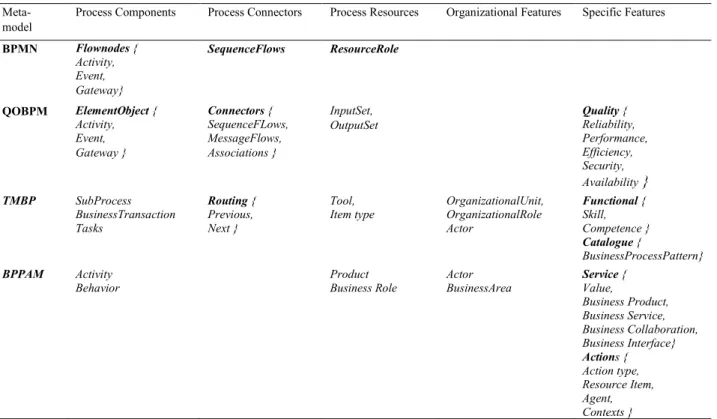
As a result of several standardization efforts, BPM research and practice provides various BPM meta-models that capture functional, informational and behavioral aspects of business processes. Table 1 summarizes the main concepts used in specifying three BPM meta-models, that are relevant for our work. These concepts are grouped in process components, connectors, resources and attributes specific to each meta-model. The Business Process Modelling and Notation (BPMN) is the de facto standard for the graphical specification of business processes and services [6]. In a BPMN Process meta-model, a Process is composed by several FlowNodes (Activity, Event, Gateway) connected by SequenceFlows. A SequenceFlow shows the order in which activities are performed in a process, and relates activities, gateways and events to each other. A Process has several resources that will perform or will be responsible for that Process which are designed by ResourceRole. As depicted in Table 1, the Quality-Oriented Business Process Meta-Model (QOBPM) [8] uses similar business process components, connectors and
4 Zacarias M., Martins P.V., Gonçalves A. / Procedia Computer Science 00 (2017) 000–000
resources but includes various quality attributes such as reliability, performance, efficiency, and availability. These attributes represent dimensions that group together single quality factors, which are related to the process as a whole or to its components. The Transactional Meta-Model for Business Process (TMBP) [18] has the following distinctive features; it includes and Organizational layer that shows organizational concepts (OrganizationalUnit, OrganizationalRole, FunctionalRole, Actor) and its relation with business processes, it enables reusing BusinessProcessPatterns from a catalogue drawn from best practices to model certain business processes, and it allows decomposing business processes in subProcesses (when the responsible is an OrganizationalUnit) or in BusinessTransactions (when the responsible is a specific Actor). BusinessTransactions are decomposed in Tasks, which are require specific FunctionalRoles (skills or competencies).
Table 1. Relevant business process concepts of three BPM meta-models
Meta-model Process Components Process Connectors Process Resources Organizational Features Specific Features
BPMN Flownodes { Activity, Event, Gateway} SequenceFlows ResourceRole QOBPM ElementObject { Activity, Event, Gateway } Connectors { SequenceFLows, MessageFlows, Associations } InputSet,
OutputSet Quality { Reliability,
Performance, Efficiency, Security, Availability } TMBP SubProcess BusinessTransaction Tasks Routing { Previous, Next } Tool,
Item type OrganizationalUnit, OrganizationalRole Actor Functional { Skill, Competence } Catalogue { BusinessProcessPattern} BPPAM Activity
Behavior Product Business Role Actor BusinessArea Service { Value, Business Product, Business Service, Business Collaboration, Business Interface} Actions { Action type, Resource Item, Agent, Contexts }
As aforementioned, the previous BPPAM version has the distinctive feature of providing guidance about how to gather patterns regarding work practices and knowledge, to contribute to business process improvement. As a result, the BPPAM meta-model is composed by 3 layers; (1) Service, (2) Structure and (3) Action Layer. The Service Layer describes the Business Products and Business Services offering some Value for external costumers, which involves some Business Collaboration. The Business Process layer describes the Business Processes used in providing a Business Service. Business Processes are composed by Business Activities, which can also be available as Business Service through a Business Interface. Each Business Activity consumes and produces a Product, and are performed by Actors playing a specific Business Role. Both Business Activities and Business Processes define a Behavior representing the best practices that guide the organization. A Business Area is an organizational unit responsible for one or more Business Activities. Hence, a Business Process encompasses several Business Areas. The Action Layer complements the Business Process and Service Layers by providing the concepts required to model work practices. Work Practices distinguish from business processes in that they do not represent standardized, normative behaviours. Rather, they reflect behaviour of particular individuals in particular circumstances. Work practices involve people engaged in activities over time, using specific tools (machines, documents, etc.). The main concepts used in our methodology to model work practices are Agents, Resource Items, Action Types and Contexts. The
meta-referred by the author as the ability to rapidly redesign existing processes. Furthermore, operational agility has been defined at the firm and process levels. At the firm level, “management can add new processes and redesign processes across the organization to take advantage or exploit the conditions of the dynamic environment” [13]. Agility at the process level, entails “the ability to redesign and reconfigure individual business process components, combining individual tasks and capabilities in response to the environment” [13]. The author further refines the concept of business process agility as construct encompassing four components; (1) reconfigurability, (2) responsiveness, (3) employee adaptability, and (4) a process-centric view. Reconfigurability is related to the ability to adapt to changes. More specifically, it refers to the ability to add or change capabilities to new or improved business processes” [13]. Responsiveness is related to the time factor and it refers to the ability to react to changes in a proper and timely fashion. Employee adaptability stems from acknowledging that the agility assumption of continuous change requires knowledgeable people able of responding to such dynamic conditions. The latter component is related to the management perspective on the business process. Since business processes cross the boundaries of functional departments, managers with a process-centric view will be more capable of understanding the business process from end to end than managers with a functional view. Thereafter, an organization with a process-centric view is better prepared for process agility since it is more able to adapt to changes at the process level than organization with a functional view.
The overlap existing between the concepts of flexibility and agility, requires distinguishing between approaches seeking business process flexibility and business process agility. The former deals with how much can business process execution deviate from business process models. Flexibility in BPM means designing processes where the participants have more degrees of freedom when performing a business process i.e. in deciding who performs an activity, when to perform it, the resources used, etc. Bider and Jalali [5] summarize four categories to achieve process flexibility; (1) Flexibility by design which means to contemplate all possible scenarios at design time, (2) Flexibility by under-specification, which separates the definition of flexible points from the process models by defining a placeholder for those points, (3) Flexibility by deviation, which allows the process to deviate from the normal path at runtime at any point, and(4) Flexibility by change proposes to adapt processes to change at runtime. A more radical flexibility is achieved by using a declarative way of defining business processes. An example is to use as few as possible constraints specifying what is forbidden through rules. The latter form of flexibility is well suited for processes where people can decide the order of activities on the fly i.e. at runtime.
Regarding agility, Bider and Jalali [5] define agile BPM as the capability of adjusting to changes in business needs or discovering opportunities in dynamic business environments. According to the authors, “becoming agile requires setting a structure that allows discovering changes and opportunities as soon as possible and react on them appropriately”. Hence, agile BPM distinguishes from managing flexible processes not only in introducing a time factor (Responsiveness), but also in the origin and degree of change that both aim at addressing. Flexible business process address variable degrees of deviation from designed process, but all aforementioned approaches assume that the process remains essentially the same. Changes addressed by flexible processes are mostly due to unexpected situations or lack of information. Agile BPM aims to harness changes in the business environment that could lead to require radically different, or even totally new processes. This goal is consistent with the Reconfigurability component of business process agility.
2.2. BPM Meta-models
As a result of several standardization efforts, BPM research and practice provides various BPM meta-models that capture functional, informational and behavioral aspects of business processes. Table 1 summarizes the main concepts used in specifying three BPM meta-models, that are relevant for our work. These concepts are grouped in process components, connectors, resources and attributes specific to each meta-model. The Business Process Modelling and Notation (BPMN) is the de facto standard for the graphical specification of business processes and services [6]. In a BPMN Process meta-model, a Process is composed by several FlowNodes (Activity, Event, Gateway) connected by SequenceFlows. A SequenceFlow shows the order in which activities are performed in a process, and relates activities, gateways and events to each other. A Process has several resources that will perform or will be responsible for that Process which are designed by ResourceRole. As depicted in Table 1, the Quality-Oriented Business Process Meta-Model (QOBPM) [8] uses similar business process components, connectors and
resources but includes various quality attributes such as reliability, performance, efficiency, and availability. These attributes represent dimensions that group together single quality factors, which are related to the process as a whole or to its components. The Transactional Meta-Model for Business Process (TMBP) [18] has the following distinctive features; it includes and Organizational layer that shows organizational concepts (OrganizationalUnit, OrganizationalRole, FunctionalRole, Actor) and its relation with business processes, it enables reusing BusinessProcessPatterns from a catalogue drawn from best practices to model certain business processes, and it allows decomposing business processes in subProcesses (when the responsible is an OrganizationalUnit) or in BusinessTransactions (when the responsible is a specific Actor). BusinessTransactions are decomposed in Tasks, which are require specific FunctionalRoles (skills or competencies).
Table 1. Relevant business process concepts of three BPM meta-models
Meta-model Process Components Process Connectors Process Resources Organizational Features Specific Features
BPMN Flownodes { Activity, Event, Gateway} SequenceFlows ResourceRole QOBPM ElementObject { Activity, Event, Gateway } Connectors { SequenceFLows, MessageFlows, Associations } InputSet,
OutputSet Quality { Reliability,
Performance, Efficiency, Security, Availability } TMBP SubProcess BusinessTransaction Tasks Routing { Previous, Next } Tool,
Item type OrganizationalUnit, OrganizationalRole Actor Functional { Skill, Competence } Catalogue { BusinessProcessPattern} BPPAM Activity
Behavior Product Business Role Actor BusinessArea Service { Value, Business Product, Business Service, Business Collaboration, Business Interface} Actions { Action type, Resource Item, Agent, Contexts }
As aforementioned, the previous BPPAM version has the distinctive feature of providing guidance about how to gather patterns regarding work practices and knowledge, to contribute to business process improvement. As a result, the BPPAM meta-model is composed by 3 layers; (1) Service, (2) Structure and (3) Action Layer. The Service Layer describes the Business Products and Business Services offering some Value for external costumers, which involves some Business Collaboration. The Business Process layer describes the Business Processes used in providing a Business Service. Business Processes are composed by Business Activities, which can also be available as Business Service through a Business Interface. Each Business Activity consumes and produces a Product, and are performed by Actors playing a specific Business Role. Both Business Activities and Business Processes define a Behavior representing the best practices that guide the organization. A Business Area is an organizational unit responsible for one or more Business Activities. Hence, a Business Process encompasses several Business Areas. The Action Layer complements the Business Process and Service Layers by providing the concepts required to model work practices. Work Practices distinguish from business processes in that they do not represent standardized, normative behaviours. Rather, they reflect behaviour of particular individuals in particular circumstances. Work practices involve people engaged in activities over time, using specific tools (machines, documents, etc.). The main concepts used in our methodology to model work practices are Agents, Resource Items, Action Types and Contexts. The
meta-174 Marielba Zacarias et al. / Procedia Computer Science 121 (2017) 170–177
Zacarias M., Martins P.V., Gonçalves A. / Procedia Computer Science 00 (2017) 000–000 5 model adjustments for the agile version of BPPAM were concentrated in this layer. Hence, the meaning of these concepts, as well as their relationships among them and with concepts of other layers is described in section 3. 2.3. Agile BPM Meta-models
Alexopolou et al [2] address the problem of business process that fail to satisfy changing organizational needs by introducing agility in business processes through an event-centric BPM approach that identifies meaningful events that drive action execution. For the authors, business process agility means the capability of adjusting and modifying business processes upon unexpected contingencies even during their execution. This capability entails a BPM approach where business process design and execution take place in parallel and there is a continuous interaction among both phases. The supporting meta-model defined encompasses the following concepts: Event, Action, Unit, Actor and Data Folder. Events represent meaningful facts that take place and cause another Event or an Action. Complex Events are combinations of events through causal or logical relations (and, or). Actions are primitive units of functionality. Logically related actions are grouped together and form higher-order functionality units. The interaction among units is represented with Boundary Events, which can be incoming or outgoing. Hence, units A and B interact when unit A has an outgoing event that is an incoming event of unit B, or vice-versa. This meta-model regards actions as autonomous units only aware of their triggering and triggered events, in order to eliminate predefined business processes sequences. The authors posit that this autonomy foster agility as it increases a modular enterprise functionality modelling. However, according to the definitions given section 2.1, this work actually aims at business process flexibility rather than business process agility. In particular, the approach corresponds to the latter form of flexibility, which uses a declarative business process specification.
Table 2. Agile BPM Meta-Model [17]
Scope Process Roles Planning Level Project Roles Meetings Artefacts Tools-Techniques
Process Process Owner Project Stakeholder Sprint planning Project artfs. Story Mapping Process Manager Sprint Team { Daily meeting Sprint artfs. Team maturity Process Participant Release Agile BPM Master, Sprint Review Sprint backlog Team Weather
Agile BPM Proc. owner, Sprint Retrospective Process backlog …. Team Member } Backlog grooming Backlog item {
Epic, User Story, Tasks,….} BPM artfs.{ Process model, Process status, User Task, Org. Chart, KPI, …. }
To address the problem of changing requirements, Thiemich and Puhlmann [17] combine a traditional BPM methodology with agile software development and define a supporting meta-model (depicted in Table 2) that puts together BPM process-related concepts with project concepts following agile principles and methodologies. The concepts are grouped in the following categories; Scope, Process Roles, Planning Level, Project Roles, Meetings, Artefacts and Techniques and Tools. The category Scope contains a single concept; Process, which represents the process to be improved. The methodology defines three Process Roles; Process Manager, Process Owner and Process Participant. Planning Level, Project Roles, and Meetings encompass project-related concepts that are based on the Scrum Methodology [14]. Planning Level and uses the concepts Project, Sprint and Release to define the project structure in terms of sprints, and associate each sprint with a specific version of the process within the scope of the project. The Project Roles defined are Stakeholder and Team, where the team is composed by an Agile BPM Master, Process Owner and Team Member. The Meetings categories groups together the type of meetings that take place during a sprint and include the same type of meetings the defined in the Scrum methodology. The Artefacts category groups a set of project, sprint, process and BPM artefacts. Project and Sprint artefacts use the same artefacts used in Scrum. This methodology defines two types of backlogs (set of tasks to be completed), one for each
6 Zacarias M., Martins P.V., Gonçalves A. / Procedia Computer Science 00 (2017) 000–000
sprint and one for the Process. Both encompass a list of Backlog Items. Backlog items are described as User Stories, which can be grouped in Epics. Each User Story has a theme, an acceptance criteria and one or several Tasks. BPM artefacts encompass typical BPM artefacts that document the process to be improved such as its model, tasks, status, and key performance indexes (KPI). It is noteworthy that User Story Tasks are related and thus, are also part of BPM artefacts. The latter category groups a set of tools and techniques mostly drawn from Scrum used in producing the aforementioned artefacts. In summary, the Agile BPM meta-model indicates that methodology introduces business process changes through projects. The wide application of Scrum concepts, as well the definition of specific process and project roles, foster Reconfigurability, Employee Adaptability and Process-centric view components of business process agility (section 2.1). Nonetheless, the effort of putting in place a project are only justified when the number of required changes are deemed sufficient by the organization, and thus several changes would have to wait for a project to be initiated. Hence, the methodology is not Responsive enough to be well suited for continuous process improvement ends.
3. Proposed Meta-model
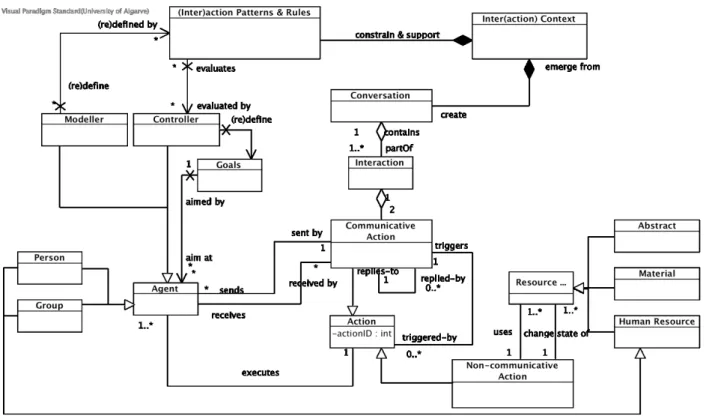
The revised version of our methodology combines traditional and agile BPM approaches to enable truly continuous process improvements. Whereas modelling the service and structure layers described in section 2.1 follow a traditional BPM, agility is infused in modelling work practices, which are captured through action layer concepts. Hence, the adaptations were concentrated in this layer. The main concepts of the updated meta-model are depicted in figure 1. Agents are specific individuals or groups. Goals are defined as an agent's aims or desired results. In order to be captured, goals must be observable and measurable. Due to the multi-tasking nature of work, agents play different business roles, which define specific patterns of behavior composed by several actions. It is
important to note that agents typically interleave among several roles. At any given moment, agents execute actions and interactions according to patterns of behavior defined by the particular role(s) played at that moment.
Actions are units of behavior executed by agents that change the state and produce an observable and
measurable outcome or result on a given resource item. Actions may also require to use resources. Resources items are material or abstract entities (information, knowledge, etc.) relevant for the operation of the organization.
Actions can be communicative or non-communicative. Non-communicative actions change the state and produce
an observable and measurable outcome or result of a material or abstract resources. Communicative actions are
essential for coordination and collaboration ends. They involve two or more agents: a sender and a receiver. A communicative action produces and observable and measurable result on the receiver. Hence in this case, the receiver is also a (human) resource. Communicative actions typically trigger other actions. Interactions are pairs
of communicative actions where the first initiates a communication from a sender to a receiver and the second is a reply to that communication. Conversations are a sequence of interactions around a given business subject.
Conversations create interaction contexts that tell a story of that particular subject. Conversations are constrained
and supported by interaction patterns & rules. Interaction patterns are recurrent sequences of actions and
interaction. Sometimes these patterns emerge from explicit or tacit interaction rules shared among agents
participating in a given interaction context, other times they simply reflect habits or preferences of those agents. Finally, interaction patterns and rules represent agents’ work practices.
In order to infuse agility by rapidly identify and reacting to changes in work practices, we draw on the idea of using dynamic control systems to address enterprise transformations [1]. Thus, work practices are managed through feedback loops comprising defining, executing, evaluating, and redefining work practices. This feedback loop is distributed among all agents. Regardless of the business role played, all agents evaluate the results of their actions and interactions. Upon changes on business needs, and depending on the frequency, dimension and degree of unpredictability of the change, agents may redefine their goals, change their pattern of behaviour or even defining a totally new behavioural pattern. In the former case, agents apply control measures and thus, play the role of a
model adjustments for the agile version of BPPAM were concentrated in this layer. Hence, the meaning of these concepts, as well as their relationships among them and with concepts of other layers is described in section 3. 2.3. Agile BPM Meta-models
Alexopolou et al [2] address the problem of business process that fail to satisfy changing organizational needs by introducing agility in business processes through an event-centric BPM approach that identifies meaningful events that drive action execution. For the authors, business process agility means the capability of adjusting and modifying business processes upon unexpected contingencies even during their execution. This capability entails a BPM approach where business process design and execution take place in parallel and there is a continuous interaction among both phases. The supporting meta-model defined encompasses the following concepts: Event, Action, Unit, Actor and Data Folder. Events represent meaningful facts that take place and cause another Event or an Action. Complex Events are combinations of events through causal or logical relations (and, or). Actions are primitive units of functionality. Logically related actions are grouped together and form higher-order functionality units. The interaction among units is represented with Boundary Events, which can be incoming or outgoing. Hence, units A and B interact when unit A has an outgoing event that is an incoming event of unit B, or vice-versa. This meta-model regards actions as autonomous units only aware of their triggering and triggered events, in order to eliminate predefined business processes sequences. The authors posit that this autonomy foster agility as it increases a modular enterprise functionality modelling. However, according to the definitions given section 2.1, this work actually aims at business process flexibility rather than business process agility. In particular, the approach corresponds to the latter form of flexibility, which uses a declarative business process specification.
Table 2. Agile BPM Meta-Model [17]
Scope Process Roles Planning Level Project Roles Meetings Artefacts Tools-Techniques
Process Process Owner Project Stakeholder Sprint planning Project artfs. Story Mapping Process Manager Sprint Team { Daily meeting Sprint artfs. Team maturity Process Participant Release Agile BPM Master, Sprint Review Sprint backlog Team Weather
Agile BPM Proc. owner, Sprint Retrospective Process backlog …. Team Member } Backlog grooming Backlog item {
Epic, User Story, Tasks,….} BPM artfs.{ Process model, Process status, User Task, Org. Chart, KPI, …. }
To address the problem of changing requirements, Thiemich and Puhlmann [17] combine a traditional BPM methodology with agile software development and define a supporting meta-model (depicted in Table 2) that puts together BPM process-related concepts with project concepts following agile principles and methodologies. The concepts are grouped in the following categories; Scope, Process Roles, Planning Level, Project Roles, Meetings, Artefacts and Techniques and Tools. The category Scope contains a single concept; Process, which represents the process to be improved. The methodology defines three Process Roles; Process Manager, Process Owner and Process Participant. Planning Level, Project Roles, and Meetings encompass project-related concepts that are based on the Scrum Methodology [14]. Planning Level and uses the concepts Project, Sprint and Release to define the project structure in terms of sprints, and associate each sprint with a specific version of the process within the scope of the project. The Project Roles defined are Stakeholder and Team, where the team is composed by an Agile BPM Master, Process Owner and Team Member. The Meetings categories groups together the type of meetings that take place during a sprint and include the same type of meetings the defined in the Scrum methodology. The Artefacts category groups a set of project, sprint, process and BPM artefacts. Project and Sprint artefacts use the same artefacts used in Scrum. This methodology defines two types of backlogs (set of tasks to be completed), one for each
sprint and one for the Process. Both encompass a list of Backlog Items. Backlog items are described as User Stories, which can be grouped in Epics. Each User Story has a theme, an acceptance criteria and one or several Tasks. BPM artefacts encompass typical BPM artefacts that document the process to be improved such as its model, tasks, status, and key performance indexes (KPI). It is noteworthy that User Story Tasks are related and thus, are also part of BPM artefacts. The latter category groups a set of tools and techniques mostly drawn from Scrum used in producing the aforementioned artefacts. In summary, the Agile BPM meta-model indicates that methodology introduces business process changes through projects. The wide application of Scrum concepts, as well the definition of specific process and project roles, foster Reconfigurability, Employee Adaptability and Process-centric view components of business process agility (section 2.1). Nonetheless, the effort of putting in place a project are only justified when the number of required changes are deemed sufficient by the organization, and thus several changes would have to wait for a project to be initiated. Hence, the methodology is not Responsive enough to be well suited for continuous process improvement ends.
3. Proposed Meta-model
The revised version of our methodology combines traditional and agile BPM approaches to enable truly continuous process improvements. Whereas modelling the service and structure layers described in section 2.1 follow a traditional BPM, agility is infused in modelling work practices, which are captured through action layer concepts. Hence, the adaptations were concentrated in this layer. The main concepts of the updated meta-model are depicted in figure 1. Agents are specific individuals or groups. Goals are defined as an agent's aims or desired results. In order to be captured, goals must be observable and measurable. Due to the multi-tasking nature of work, agents play different business roles, which define specific patterns of behavior composed by several actions. It is
important to note that agents typically interleave among several roles. At any given moment, agents execute actions and interactions according to patterns of behavior defined by the particular role(s) played at that moment.
Actions are units of behavior executed by agents that change the state and produce an observable and
measurable outcome or result on a given resource item. Actions may also require to use resources. Resources items are material or abstract entities (information, knowledge, etc.) relevant for the operation of the organization.
Actions can be communicative or non-communicative. Non-communicative actions change the state and produce
an observable and measurable outcome or result of a material or abstract resources. Communicative actions are
essential for coordination and collaboration ends. They involve two or more agents: a sender and a receiver. A communicative action produces and observable and measurable result on the receiver. Hence in this case, the receiver is also a (human) resource. Communicative actions typically trigger other actions. Interactions are pairs
of communicative actions where the first initiates a communication from a sender to a receiver and the second is a reply to that communication. Conversations are a sequence of interactions around a given business subject.
Conversations create interaction contexts that tell a story of that particular subject. Conversations are constrained
and supported by interaction patterns & rules. Interaction patterns are recurrent sequences of actions and
interaction. Sometimes these patterns emerge from explicit or tacit interaction rules shared among agents
participating in a given interaction context, other times they simply reflect habits or preferences of those agents. Finally, interaction patterns and rules represent agents’ work practices.
In order to infuse agility by rapidly identify and reacting to changes in work practices, we draw on the idea of using dynamic control systems to address enterprise transformations [1]. Thus, work practices are managed through feedback loops comprising defining, executing, evaluating, and redefining work practices. This feedback loop is distributed among all agents. Regardless of the business role played, all agents evaluate the results of their actions and interactions. Upon changes on business needs, and depending on the frequency, dimension and degree of unpredictability of the change, agents may redefine their goals, change their pattern of behaviour or even defining a totally new behavioural pattern. In the former case, agents apply control measures and thus, play the role of a
176 Marielba Zacarias et al. / Procedia Computer Science 121 (2017) 170–177
Zacarias M., Martins P.V., Gonçalves A. / Procedia Computer Science 00 (2017) 000–000 7
Figure 1. Revised meta-model for the action layer
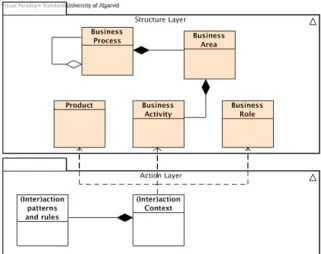
Changes in work practices may produce negative outcomes i.e. deviations or positive outcomes i.e. innovations. Hence, changes per-se should not be discouraged. Rather, mechanisms for their detection, analysis and eventual integration in current business models need to be devised. That is the main goal of our methodology. Figure 2 depicts the concepts involved in such integration. The analysis of work practices i.e. action an interaction patterns that emerge within interaction contexts allows identifying changes related to business activities, roles and products. It is noteworthy that a work practice may be related to several business activities and a business activities
may encompass several work practices. Thereafter, a proper integration cannot be fully automated since it requires discussion, negotiation and agreements among all participants.
4. Conclusions
This paper summarizes a set of traditional and agile BPM meta-models focusing on different concerns of business processes. Two BPM meta-models claiming to be agile are described and their suitability regarding their agility is discussed, based on definitions of business process flexibility and agility from the literature. As a result, we conclude that the event-centric approach presented in [2] aims at business process flexibility rather than agility. The Agile BPM meta-model [5] reflects the combination of traditional and agile BPM using a layered meta-model composed of project and process layers that show how the methodology feeds business process changes through projects. The meta-model of the agile version of our methodology also reflects a combination of traditional and agile BPM through layers where business process changes are fed through daily work practices, captured and modeled in the action layer. We posit that while both approaches satisfy to some extent all business process agility components, the agile BPM meta-model hinders the Responsiveness required for continuous process improvement, since changes are implemented only within the scope of a project. With the implementation of dynamic control of work practices through feedback loops and enabling all participant agents to play controller and modeler roles, our methodology and supporting meta-model seek to foster responsiveness in business process improvements with any frequency deemed appropriate by the organization. The meta-model proposed in this paper will be validated through case
8 Zacarias M., Martins P.V., Gonçalves A. / Procedia Computer Science 00 (2017) 000–000
studies in conjunction with the agile version of BPPAM through case studies. In this sense, it is noteworthy that BPPAM does not propose a blind application of its agile version for all situations. Rather, it specifies criteria that defines the circumstances where its application is appropriate. Thereafter, the case studies will be directed to situations where such circumstances are present.
Figure 2. Concepts involved in work practice integration into business processes
References
1. Abraham R., Tribolet, J.; Winter R. “Transformation of multi-level systems: Theoretical grounding and consequences for Enterprise Architecture Management”. In Proper H.A., Aveiro D, Galoul K. (eds) Advances in Enterprise Engineering VII. Lecture Notes in Business Information Processing 146. Springer Berlin, 2013
2. Alexopoulou N., M. Nicolaidou M. , P. Kanellis P, Mantzana v., Anagnostopoulos D., Martakos D., “Infusing agility in business processes through an event-centric approach”. Int. J. of Business Information Systems 6(1): 58-78, 2010
3. Åström, K.J., Murray, R.M.: Feedback Systems: An Introduction for Scientists and Engineers. Princeton University Press (2008) 4. Beck K., “Manifesto for Agile Software Development,” 2001; http://www.agilemanifesto.org/principles.html.N
5. Bider I., Jalali A., “Agile business process development: why, how and when - Applying Nonaka’s theory of knowledge transformation to business process development". Journal of Information Systems and e-Business Management 14(4): 693-731, 2016.
6. "Business Process Modeling and Notation BPMN", http://www.bpmn.org
7. Gong Y., Janssen M., "From policy implementation to business process management: Principles for creating flexibility and agility. Government Information Quarterly 28:S61-S71, Elsevier, 2012
8. Heidari F. Loucopoulos P., Kedad Z., “A Quality-Oriented Business Process Meta-Model,” Proc. 7th International Workshop, EOMAS, held in conjunction with CAiSE 2011, pp. 85-99. Springer Berlin-Heidelberg, 2011
9. "Manifesto for Agile Software development", http://agilemanifesto.org
10. Zacarias, M., Martins, P.V., "Business Process and Practice Alignment Meta-Model", Procedia Computer Science, 64:314-323, 2015 11. Martins, P.V., Zacarias, M., "An Agile Business Process Improvement Methodology ", accepted for the International Conference on
Enterprise Information Systems CENTERIS, 2017.
12. Object Management Group, Business Process Model and Notation (BPMN), 2011. http://www.bpmn.org
13. Raschke R.L.,"Process view of agility: The value contribution of IT and the effects on process outcomes", International Journal on Accounting Information Systems 11: 297-313, Elsevier, 2010.
14. Seethamraju R., "Enterprise Systems and Business Process Agility - A Case Study". Proceedings of the 42nd Hawaii International Conference on System Sciences HICSS, pp. 1-12, 2009
15. Scrum methodoloy, http://scrummethodology.com
16. Silva A.R., Meziani R.,Magalhães R. Martinho D., Aguiar A., Flores N. “AGILIPO: Embedding Social Software Features into Business Process Tools,” Business Process Management Workshops: BPM 2009 International Workshops, Ulm, Germany,, 2009
17. Thiemich C., Puhlmann F., “An Agile BPM Project Methodology”. Business Process Management: 11th International Conference, BPM 2013, Beijing, China, August 26-30, 2013. Proceedings, F. Daniel, et al., eds., Springer Berlin Heidelberg, 2013, pp. 291-306.
18. Thom T.H. Iochpe C., Mitschang B. “TMBP: A Transactional Metamodel for Business Process Modeling Based on Organizational Structure Aspects.,” CAiSE'05 Forum Short Paper Proceedings. O. Belo O., Eder J., Falcão e Cunha J., Pastor O. (Eds.), 2005
19. Zacarias, M., Martins, P.V., “Business Alignment Methodology: The Discovery Phase,” Inf. Resour. Manage. J., vol. 27, no. 1, 2014, pp. 1-20; DOI 10.4018/irmj.2014010101.
Figure 1. Revised meta-model for the action layer
Changes in work practices may produce negative outcomes i.e. deviations or positive outcomes i.e. innovations. Hence, changes per-se should not be discouraged. Rather, mechanisms for their detection, analysis and eventual integration in current business models need to be devised. That is the main goal of our methodology. Figure 2 depicts the concepts involved in such integration. The analysis of work practices i.e. action an interaction patterns that emerge within interaction contexts allows identifying changes related to business activities, roles and products. It is noteworthy that a work practice may be related to several business activities and a business activities
may encompass several work practices. Thereafter, a proper integration cannot be fully automated since it requires discussion, negotiation and agreements among all participants.
4. Conclusions
This paper summarizes a set of traditional and agile BPM meta-models focusing on different concerns of business processes. Two BPM meta-models claiming to be agile are described and their suitability regarding their agility is discussed, based on definitions of business process flexibility and agility from the literature. As a result, we conclude that the event-centric approach presented in [2] aims at business process flexibility rather than agility. The Agile BPM meta-model [5] reflects the combination of traditional and agile BPM using a layered meta-model composed of project and process layers that show how the methodology feeds business process changes through projects. The meta-model of the agile version of our methodology also reflects a combination of traditional and agile BPM through layers where business process changes are fed through daily work practices, captured and modeled in the action layer. We posit that while both approaches satisfy to some extent all business process agility components, the agile BPM meta-model hinders the Responsiveness required for continuous process improvement, since changes are implemented only within the scope of a project. With the implementation of dynamic control of work practices through feedback loops and enabling all participant agents to play controller and modeler roles, our methodology and supporting meta-model seek to foster responsiveness in business process improvements with any frequency deemed appropriate by the organization. The meta-model proposed in this paper will be validated through case
studies in conjunction with the agile version of BPPAM through case studies. In this sense, it is noteworthy that BPPAM does not propose a blind application of its agile version for all situations. Rather, it specifies criteria that defines the circumstances where its application is appropriate. Thereafter, the case studies will be directed to situations where such circumstances are present.
Figure 2. Concepts involved in work practice integration into business processes
References
1. Abraham R., Tribolet, J.; Winter R. “Transformation of multi-level systems: Theoretical grounding and consequences for Enterprise Architecture Management”. In Proper H.A., Aveiro D, Galoul K. (eds) Advances in Enterprise Engineering VII. Lecture Notes in Business Information Processing 146. Springer Berlin, 2013
2. Alexopoulou N., M. Nicolaidou M. , P. Kanellis P, Mantzana v., Anagnostopoulos D., Martakos D., “Infusing agility in business processes through an event-centric approach”. Int. J. of Business Information Systems 6(1): 58-78, 2010
3. Åström, K.J., Murray, R.M.: Feedback Systems: An Introduction for Scientists and Engineers. Princeton University Press (2008) 4. Beck K., “Manifesto for Agile Software Development,” 2001; http://www.agilemanifesto.org/principles.html.N
5. Bider I., Jalali A., “Agile business process development: why, how and when - Applying Nonaka’s theory of knowledge transformation to business process development". Journal of Information Systems and e-Business Management 14(4): 693-731, 2016.
6. "Business Process Modeling and Notation BPMN", http://www.bpmn.org
7. Gong Y., Janssen M., "From policy implementation to business process management: Principles for creating flexibility and agility. Government Information Quarterly 28:S61-S71, Elsevier, 2012
8. Heidari F. Loucopoulos P., Kedad Z., “A Quality-Oriented Business Process Meta-Model,” Proc. 7th International Workshop, EOMAS, held in conjunction with CAiSE 2011, pp. 85-99. Springer Berlin-Heidelberg, 2011
9. "Manifesto for Agile Software development", http://agilemanifesto.org
10. Zacarias, M., Martins, P.V., "Business Process and Practice Alignment Meta-Model", Procedia Computer Science, 64:314-323, 2015 11. Martins, P.V., Zacarias, M., "An Agile Business Process Improvement Methodology ", accepted for the International Conference on
Enterprise Information Systems CENTERIS, 2017.
12. Object Management Group, Business Process Model and Notation (BPMN), 2011. http://www.bpmn.org
13. Raschke R.L.,"Process view of agility: The value contribution of IT and the effects on process outcomes", International Journal on Accounting Information Systems 11: 297-313, Elsevier, 2010.
14. Seethamraju R., "Enterprise Systems and Business Process Agility - A Case Study". Proceedings of the 42nd Hawaii International Conference on System Sciences HICSS, pp. 1-12, 2009
15. Scrum methodoloy, http://scrummethodology.com
16. Silva A.R., Meziani R.,Magalhães R. Martinho D., Aguiar A., Flores N. “AGILIPO: Embedding Social Software Features into Business Process Tools,” Business Process Management Workshops: BPM 2009 International Workshops, Ulm, Germany,, 2009
17. Thiemich C., Puhlmann F., “An Agile BPM Project Methodology”. Business Process Management: 11th International Conference, BPM 2013, Beijing, China, August 26-30, 2013. Proceedings, F. Daniel, et al., eds., Springer Berlin Heidelberg, 2013, pp. 291-306.
18. Thom T.H. Iochpe C., Mitschang B. “TMBP: A Transactional Metamodel for Business Process Modeling Based on Organizational Structure Aspects.,” CAiSE'05 Forum Short Paper Proceedings. O. Belo O., Eder J., Falcão e Cunha J., Pastor O. (Eds.), 2005
19. Zacarias, M., Martins, P.V., “Business Alignment Methodology: The Discovery Phase,” Inf. Resour. Manage. J., vol. 27, no. 1, 2014, pp. 1-20; DOI 10.4018/irmj.2014010101.
![Table 2. Agile BPM Meta-Model [17]](https://thumb-eu.123doks.com/thumbv2/123dok_br/18041772.862216/5.816.64.768.519.743/table-agile-bpm-meta-model.webp)