PERFORMANCE OF GENERATIONS OF UENF/CALIMAN 01
PAPAYA AND CORRELATIONS BETWEEN GERMINATION,
VEGETATIVE AND REPRODUCTIVE DEVELOPMENT
1LIANA HILDA GOLIN MENGARDA2, JOSÉ CARLOS LOPES3,
RODRIGO SOBREIRA ALEXANDRE4, ADÉSIO FERREIRA3,ALICE DE FREITAS BRAGA5
ABSTRACT – The aim of this study was to characterize the seeds quality and the plant development of F1 and F2 generations of hybrid UENF/Caliman 01 papaya, and the relations between the physic-chemical
and physiological quality of seeds, vegetative and reproductive development of plants in the field for 360
days, and fruit quality. The relative contribution (Cr %) to the genetic divergence for each characteristic
was estimated. For those with higher importance for each group (Cr ≥ 25%), the Pearson correlation and
the canonical correlation analysis were applied. The F1 seeds showed higher physic-chemical and
physi-ological quality, with greater length (0.55 cm), sugar and lipid levels (5.13 and 11.58 mg g-1, respectively),
germination and normal seedlings percentages (94 and 98.31%, respectively). The F2 plants showed higher stem diameter (81.08 mm), fruits insertion height (184.8 cm) and fruits number (11.73). It was observed that higher levels of lipid in the seeds were associated with lower fruits number. Lower levels of sugar and lipid of the seeds and lower speed germination index were associated with lower survival. Thus, seed quality is
associated with survival of hybrid UENF/Caliman 01 papaya plants in the field, but it does not have relation
with the vegetative and reproductive development of plants.
Index terms: biometrics, Carica papaya, plant breeding, seed physiological quality.
DESEMPENHO DE GERAÇÕES DO MAMOEIRO UENF/CALIMAN 01
E CORRELAÇÕES ENTRE GERMINAÇÃO, DESENVOLVIMENTO
VEGETATIVO E REPRODUTIVO
RESUMO - Objetivou-se caracterizar a qualidade de sementes e o desenvolvimento das plantas das gerações
F1 e F2 do mamoeiro híbrido UENF/Caliman 01, e as relações entre a qualidade físico-química e fisiológica
de sementes, o desenvolvimento vegetativo e reprodutivo das plantas em campo por 360 dias, e a qualidade dos frutos. Foi estimada a contribuição relativa (Cr%) de cada característica para a divergência genética.
Com aquelas de maior importância para cada grupo (Cr ≥ 25%), foram aplicadas as análises de correlação
de Pearson e de correlações canônicas. As sementes F1 apresentaram maior qualidade físico-química e
fisiológica, com maiores comprimento (0,55 cm), teores de açúcares e de lipídeos (5,13 e 11,58 mg g-1,
respectivamente), porcentagens de germinação e de plântulas normais (94 e 98,31%, respectivamente). As
plantas F2 apresentaram maiores diâmetro do caule (81,08 mm), altura do painel (184,8 cm) e número de frutos (11,73). Observou-se que maior teor de lipídeos nas sementes apresentou associação com menor número de frutos. Ainda, menores teores de açúcares e de lipídeos das sementes e menor velocidade de germinação apresentaram associação com menor sobrevivência. Assim, a qualidade das sementes está associada à
sobrevivência das plantas do mamoeiro híbrido UENF/Caliman 01 em campo, mas não apresenta relação positiva com o desenvolvimento vegetativo e reprodutivo das plantas.
Termos para indexação: biometria, Carica papaya, melhoramento de plantas, qualidade fisiológica de
sementes.
1(Trabalho 026-15). Recebido em: 09-01-2015. Aceito para publicação em: 30-06-2015.
2Doutora.Pós-Doutoranda em Genética e Melhoramento, Universidade Federal do Espírito Santo. E-mail: [email protected] 3Doutor. Docente do Departamento de Produção Vegetal, Centro de Ciências Agrárias (CCA), UFES. E-mails: [email protected];
4Doutor. Docente do Departamento de Ciências Florestais, CCA, UFES. E-mail: [email protected]. 5Graduanda em Agronomia, CCA, UFES. E-mail: [email protected].
INTRODUCTION
The papaya improvement research has been aimed to the development of national hybrids, ap-pearing a demand for these genotypes evaluation for their agronomic potential. (MARIN et al., 2006
a, b; DIAS et al., 2011; DANTAS et al., 2015; LUZ
et al., 2015).
The papaya hybrids are obtained by the cross-ing between progenitors with different genetic pools, resulting in high hybrid vigor materials (MACEDO et al., 2013). In general, papaya hybrids have higher
yields than the cultivars (LUZ et al. 2015). A cross -ing between a Solo group originator (Sunrise Solo) and a Formosa group originator (JS12) generated the hybrid UENF/Caliman 01 and it shows superior morpho-agronomic characteristics.
Plants generated from the planting of hybrids F1 seeds (at maximum heterosis) show ideal morpho-physiological characteristics while the planting of F2 seeds can generate plants that show segregation and heterogeneity in the orchard, which compromises
the quality of crops (ANDRADE; PEREIRA, 2005;
MARIN et al., 2006 a, b). Therefore, the evaluation of hybrid genotypes at maximum heterosis and their segregating generations become important.
In order to increase the papaya agribusiness competitiveness and the sustainability, researches on improvement propose methodologies to the early selection of superior genotypes, which depend on the evaluation of characters that are easy to measure, if they manifest before the production and they are correlated with characteristic of interest such as the production and fruit quality (SILVA et al., 2007,
2008; OLIVEIRA et al., 2010, 2012; FERREIRA et al., 2012; REIS et al., 2015; SARAN et al., 2015).
Characters that show great genetic variability can be used in the selection processes of progenitors and
hybrids for the use per se or in crosses for the
syn-thesis of improved hybrids (DANTAS et al., 2015). Researches suggest that the early selection of hermaphrodite and more productive papaya plants can be carried out by the evaluation of stem and canopy diameters, plants height, leaves width
and flowering characteristics (SILVA et al., 2007; OLIVEIRA et al., 2010; 2012; FERREIRA et al.,
2012). It is known that the seeds vigor mainly per-forms in the early stages of development, being di-rectly linked to the percentage and speed of seedlings emergence and higher survival (MARCOS FILHO,
2005; CARDOSO et al., 2009; MACEDO, 2013).
However, there are no studies about the association between the germination characteristics and the veg-etative and/or reproductive development of papaya.
The evaluation of a genotype should be based on a simultaneous selection of a number of important characteristics for the culture, beyond the investiga-tion of the relainvestiga-tions between these characteristics
(CRUZ et al., 2011). Thus, in order to promote
progress in researches in the propagation area and improvements of the papaya, we aimed to study the characteristics related to seed quality, vegetative and plants reproductive development, characterizing the performance of F1 and F2 generations hybrid UENF/ Caliman 01 papaya and relations between the evalu-ated characteristics.
MATERIAL AND METHODS
The study was carried out at the Seed Analy-sis Laboratory of Agricultural Sciences Center of the Federal University of Espírito Santo and in a rural property in the municipality of Alegre, Espírito Santo, Brazil (20º 45’S and 41º 29’W and altitude of 138 m), between the months of July 2012 and October 2013. F1 and F2 seeds and hybrid UENF/ Caliman 01 papaya seedlings were used. The Univer-sity of Northern Fluminense Darcy Ribeiro (UENF) developed this hybrid in partnership with Caliman Agrícola S/A company, which has as progenitors cvs. Sunrise Solo (Solo group) and JS12 (Formosa group). The Caliman Agrícola S/A company provided the F1 seed and the F2 seeds were obtained from the fruits produced by the company.
Physic-chemical quality of the seeds: for the physical characterization, we evaluated initial mois-ture (M): determined by the oven method at 105 ± 3 ºC, at 24h, using subsamples of 0.18 g, expressed in
percentage (moisture base); length (L): characterized
as the distance between the base and the apex, and the diameter (D): measure from the middle portion of the seeds (mm). The weight of thousand seeds (WTS)
(BRAZIL, 2009). For the biochemical characteriza -tion, seeds samples with approximately 0.1 g dry weight were macerated by the methanol, chloroform and water method (MCW, 1:1:1) and centrifuged. The higher liquid phase from the extraction (methanol +
water) was used to quantify the soluble sugars; the
lower one (chloroform) was used to quantify the
lipids; the solid phase (pellet) was used to quantify the starch. Lipids quantification (L) – The solution
of the lower phase was placed in Eppendorf tubes of
2 mL identified and weighted with a precision scale
of 0.0001 g. Then, they were placed in the oven to
dry at 60 ºC and weighted again (BLIGH; DYER, 1959, modified). Soluble sugars quantification (S) –
sulphuric acid, modifying the dehydrated simple
sugars for furfural (YEMN; WILLIS, 1954). The
products of this reaction condense with the anthrone, forming a colored teal substance that is used for the reading of soluble sugars made in spectrophotometer
(FEMTO, Cirrus 80ST), at 620 nm. Starch quantifica
-tion (St) – the solid phase (pellet) suffered diges-tion
in HCl 3% in water bath (95-100 ºC) for 3 hours, centrifuged (4000 rpm for 5 min.) and collected the supernatant, with which proceeded the anthrone method, as described above. Total proteins
quanti-fication (P) – was carried out by inference on the nitrogen content (GALVANI; GAERTNER, 2006).
Samples of seeds of 0.1 g of dry mass were crushed and suffered digestion block digester until the color changes to green, and then distillation and titration.
The NH4+ produced in the digestion in sulphuric acid
is distilled in a strongly alkaline medium. The nitrate is condensed in boric acid solution and titrated with HCl solution. The crude protein (CP) is expressed by the factor 6.25, considering that most of the proteins has in their molecules approximately 16% of nitro-gen. The results of lipids, soluble sugars, starch and
proteins quantifications were expressed in percentage
(% m/m) of the seeds dry mass.
Seeds physiologic quality: the seeds were
distributed in paper rolls, with three Germilab®
sheets (Germilab Ind. e Com. de Produtos para
Laboratório Ltda.), dampened with distilled water (2.5 times the mass of the dry paper), and maintained in germination camera at alternating temperature of 20-30 °C. The germination percentage (G) was evaluated, considering as germinated the seeds with
primary root protrusion ≥ 0.2 cm, up to 28 days after the sowing; first and second germination count (FGC,
SGC), carried out on 7, 14 and 21 days, respectively, considering the seedlings primary root protrusion,
expressed in percentage; germination speed index
(GSI), considering the seedlings with primary root protrusion, calculated according to equation proposed
by Maguire (1962); percentage of normal seedlings
(NS), considering the seedlings with all the structures formed (root, hypocotyl and cotyledons), calculated in relation to the germination percentage, 28 days after the sowing.
Vegetative and reproductive development of the plants: F1 and F2 seeds were sowed in plastic bags (10 x 15 cm) with HS Hortaliças® commercial substrate (Holambra substrates), kept in greenhouse
shading. The seedlings were transplanted to the field
75 days after the sowing, with spacing of 1.5 x 2.0 m. Irrigations and fertilization were carried out
accord-ing to the crops needs (PREZOTTI et al., 2007). We evaluated: plant height (PH) – it was evaluated from
the soil to the canopy apex, and the result express in
cm; stem diameter (SD) – it was evaluated in stem base close to the soil, and the result express in mm; leaves number (LN); survival percentage (SP); flow
-ers number (FLN); hermaphrodite plants percentage (H); fruits number (FrN); panel height (PnH) – fruits
insertion height express in cm.
Fruits quality: Fruits collected after 360 days were evaluated in relation to: length (FrL) and
diameter (FrD) express in cm; fruits mass (FrM) and pulp mass (PM) in g; seeds per fruit number (SFrN);
larger and smaller thickness of the pulp (LTFr and STFr) in mm, evaluated from the fruits collected after 360 days.
Experimental design and statistical analy-sis: regarding seeds quality, the experiment was car-ried out in a completely randomized design (CRD), with four repetitions of 25 seeds per genotype (F1 and F2 generations). The results obtained were analyzed using descriptive statistics (average and the standard error), and the average comparison by the Kruskal Wallis test (non-parametric).
Regarding the development of the plants, the experiment was carried out in randomized block
de-sign (RBD), with four blocks and five plants per plot,
in an experimental area with 120 m2. Evaluations
were carried out every 60 days up to 180 days, and every 30 days up to 360 days. The results obtained were analyzed using descriptive statistics (average and the standard error), and the average comparison using the Kruskal Wallis test (non-parametric). For the plant development evaluation over time, the regression analysis was applied, and significant
models were adopted (p ≤ 5%) and with the highest coefficient of determination (R2), using the R pro -gram (THE R FOUNDATION FOR STATISTICAL COMPUTING PLATAFORM, 2014)
The multivariate data analysis were pro-ceeded and the following characteristics group were established: 1) Physic-chemical of seeds (M, L, D,
S, St, L and P); 2) physiological of seeds (G, FGC, SGC, GSI, GMT, NS); 3) vegetative development of the plants (PH, SD, LN, SP); 4) reproductive development of the plants (FlN, H, FrN and PnH);
5) fruits quality (FrL, FrD, FrM, PM, SFrN, LTFr, STFr). For each group we evaluated the relative contribution of the characteristics for the genetic divergence between the generations by the Singh method. With the two most important characteristics for each group, we applied the Pearson correlation analysis and the canonical correlation between the groups of characteristics related to the seeds (1 and
2), named Group I versus Group II, which included
fruits quality (4, 5 and 6). We used the Genes program
(CRUZ, 2013).
RESULTS AND DISCUSSION
The F1 seeds showed greater length (0.55
cm), greater sugar levels (5.13 mg g-1) and lipids
(11.58 mg g-1) than the F2 seeds (0.42 cm, 2.93 mg g-1
and 7.55 mg g-1, respectively) (Figure 1A). The
physi-ological characterization of the seeds highlighted that the F1 seeds showed greater vigor, with higher total germination percentages (F1 = 94% and F2 = 86%, of the counts performed at 7 (F1 = 6% and F2 = 0%) and at 14 days (F1 = 94% and F2 = 24%) and normal seedlings (F1 = 98.31% and F2 = 81.80%). The F1 seeds also showed faster germination (higher speed index, and lower average time of germination). As the commercial propagation of papaya plant is carried out by seeds, the use of high quality seeds is essential for the establishment of vigorous and healthy seedlings. In general, physiological qual-ity of the seeds is directly linked to the percentage
and the emergence speed, which influence mainly in
the early stages of seedlings development (MARCOS FILHO, 2005).
In general, comparing the F2 generation per-formance to F1 seeds, between the physic-chemical characteristics of the seeds, the F2 seeds showed lower performance for 62.5% of the characteristics (L, WTS, S, L and P). In relation to physiologic quality, the F2 performance was below 100% of the characteristics (G, FGC, SGC, GSI, AGT and NS).
The seeds of F1 generation hybrid, maximum heterosis, showed higher physic-chemical and physi-ological quality, corroborating with Macedo et al. (2013) results, which observed the heterosis effect in the physiological quality of papaya F1 seed, which showed high physiological quality. Thus, the plating of F1 seeds of hybrid UENF/Caliman 01 papaya is more suitable in order to obtain a homogeneous stand of the seedlings.
However, we found that the differences be-tween the F1 and the F2 generations of the hybrid papaya became less evident after the transplanting
of the seedling to the field (Figures 1B and 2), with
synchrony in the vegetative and reproductive devel-opment between the generations.
For the plant height and stem diameter char-acteristics, we observed an adjusted response to the plateau model (Figure 2A and B). The F1 generation plants showed growth in height until 272 days, and F2 until 252 days, when there was a tendency to stabi-lize. For the stem diameter, the F1 and F2 generations
plants showed stabilization after 244 and 263 days, respectively. 360 days after the transplanting, the F2 plants showed greater stem diameter (F1 = 69.90 mm and F2 = 81.08 mm) (Figure 1B).
For the leaves average number, the data were adjusted to the quadratic model, with maximum point estimated at 178 days for F1 generation plants and 214 days for the F2 (Figure 2C). The start of
flowering was observed after 180 days and the fruit
formation after 210 days (Figure 2D and E), and the F2 plants showed higher average number of fruits (F1 = 6.18 and F2 = 11.73) and higher panel height (F1 = 165.8 cm and F2 184.8 cm) (Figure 3), characteristics for which there was no adjustment to the regression models. However, despite of the higher average than
F1, the F2 generation showed significant heterogene -ity, especially in relation to the plants height, number and fruits format.
The F1 generation plants showed 100% of survival and the F2 showed only 75% of survival. Regarding the hermaphrodite plants percentage, the difference between the F1 and F2 generations was not observed (30 e 39.5%) (Figure 1B). The biometric characteristics of the fruits did not show difference between the F1 and F2 plants, except for the seeds per fruit number, which was higher for F1.
In general, the successive plantings with F2, F3 and F4 generations of hybrid papaya plants cause the loss of vigor, beyond the heterogeneity in
rela-tion to the characteristics of interest (ANDRADE; PEREIRA, 2005; MARIN et al., 2006 a, b). In this
study, the vegetative and reproductive development of the F2 generation plants of hybrid papaya plants, as well as the fruit quality, do not suggest the reduc-tion of hybrid vigor.
Although, segregating genotypes are not desired for the cultivation, in particular by the hetero-geneity, the segregating generations may represent an important source of genetic diversity for the papaya improvement programs. Thus, the segregating gen-erations study with the aim of select superior
geno-types, in order to the per se use or as progenitors for
the development of new cultivars become interesting
(SILVA et al., 2007, 2008; DANTAS et al., 2015).
Morphological markers, such as morphom-etry and coloration of fruits, may be used with suc-cess to determine the genetic relations in papaya genotypes (SARAN et al., 2015). However, from a set of characters, some are more representative
in the diversity studies (CRUZ et al., 2011). In this
study, within each group of characteristics, those who
showed higher relative contribution (Cr ≥ 25%) for
physical-chemical); b) speed index and average time of germination (physiological of the seeds); c) sur -vival and stem diameter (vegetative), fruits number
and panel height (reproductive); d) fruit and pulp
mass (fruit quality) (Table 1).
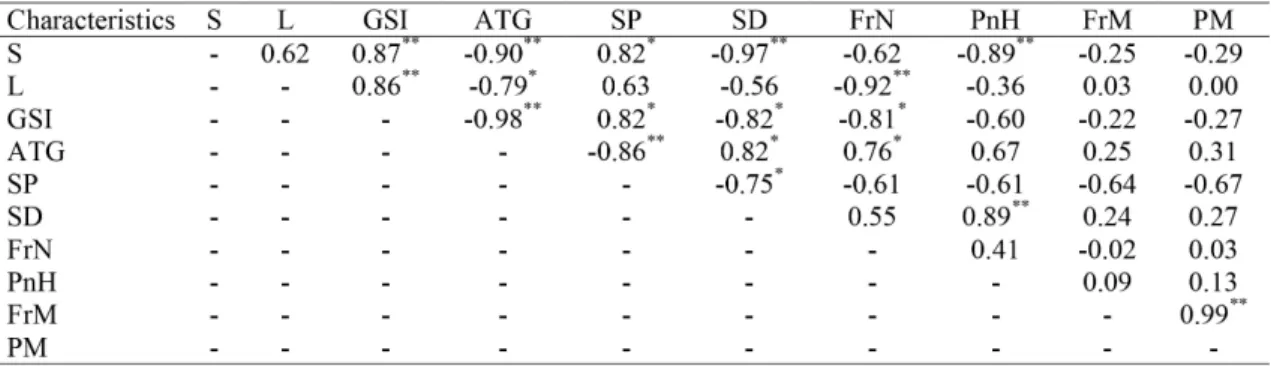
There was a positive correlation between physic-chemical quality and physiological quality of the hybrid seeds: the sugar (S) and lipids (L) contents showed a positive correlation with the germination speed index (GSI), with values of 0.87** and 0.86**, respectively, and negative with average time of ger-mination (ATG), with values of -0.90** and -0.79**, respectively (Table 2). The correlation between seeds quality characteristics was also observed with other species. In melon, the high correlation between the starch content and the average time of germination, which represented association with the highest seed
vigor (WANG et al., 2011)? In Brassica chinensis,
the correlation between the percentage and the
ger-mination time was observed (SANTANA; RANAL,
2006). In soybean, positive correlations between the lignin content and the percentage of normal seedlings were observed, which can provide greater storage
potential and germination to the seeds (MENEZES
et al., 2009).
The correlation analysis indicates that the
seed quality has a positive influence on the survival of the plants in the field: we verified that the seed
physic-chemical quality (higher S and L) showed di-rect relation to the physiological quality (higher GSI and lower ATG) which showed a positive correlation with seedlings survival (SV) after the transplanting (Table 2).
However, the seed quality has a negative
influence on the plant growth, once we observed a
negative correlation between the seed germination speed (higher GSI and lower ATG), stem diameter (SD) and fruits number (FrN) of the plants (Table 2). Thus, the characteristics that denote higher seed quality showed an inverse relation to the vegetative and reproductive development of the plants. This observation is explained because the seed vigor performs mainly in the early stages of seedlings de-velopment, being directly linked to the plant survival (MARCOS FILHO, 2005).
Investigating the relation between the charac-teristics groups, in other words, seed quality (Group I) versus plant development and fruit quality (Group
II), we observed that the first three canonical cor
-relations were significant (Table 3). This way, the groups were related in a dependent way and the first three canonical pairs should be considered (CRUZ
et al., 2011).
The association between the groups was
established mainly through the influence of the fol -lowing canonical correlations: a) higher lipid content in the seeds (Group I) was decisive in the lower fruit
number (Group II); and b) lower levels of sugars
and lipids of the seeds, and lower germination speed (Group I), were decisive in the lower plant survival, and in the higher stem diameter and panel height (Group II) (Table 3).
Studies with papaya highlighted that the analysis of vegetative and juvenile characteristics can predict higher productivity and quality of the fruits. Plants with higher stem diameter can result in more productive plants (SILVA et al., 2007). The plant
height, the number of flowers per stalk and the leaf
width are related to the fruits number (OLIVEIRA et al., 2010). The highest number of fruits can be predicted by the higher canopy diameter and the
decrease of plat height; greater fruit mass is related
to higher stem diameter, panel size and fruit length (FERREIRA et al., 2012). Also associations between quality characteristics of papaya fruits: fruits with greater length, diameter and the diameter of the inner cavity tend to have a greater pulp weight and thickness (REIS et al., 2015).
TABLE 1 – Relative contribution (Cr%), in percentage, of F1 and F2 generation characteristics of hybrid
TABLE 2 – Pearson correlation between the characteristics of greater relative importance (Cr ≥ 25%): soluble sugar content (S), lipids content (L), germination speed index (GSI), average time of germination (ATG), survival percentage (SP), stem diameter (SD), fruits number (FrN), panel height (PnH), fruit mass (FrM) and pulp mass (PM), of seeds and F1 and F2 generations of hybrid papaya plants.
. Bras. Frutic., v
. 38, n. 2: (e-358) DOI
10.1590/0100-29452016358
March/April 2016 Jaboticabal - SP
PERFORMANCE OF GENERA
TIONS OF UENF/CALIMAN 01 P
AP
A
Y
A...
* ns = significant and no significant, respectively, at 5% level of probability, by the chi-square test. (1) Underlined values are the variables that predominated in the total variance explanation.
FIGURE 1 – Seeds (A) and plants (B) characteristics after 360 days F1 and F2 of hybrid papaya UENF/Caliman 01: moisture (%), length (cm), diameter (mm),
thousands seeds weight (g), soluble sugar contents, starch, lipids and total proteins (%) (m/m), germination, first and second count of germination
(%), speed germination index, average time of germination (days), and normal seedlings (%); plant height (cm.10-1), stem diameter (mm), leaves
number, survival (%), flowers number, hermaphrodite plants (%), fruits number, panel height (cm.10-1), fruits length and diameter (cm), fruit and
pulp mass (g.10-1), seeds number per fruit (10-1), larger and smaller thickness of the pulp (mm). * the averages are statistically different by the
FIGURE 2 – Development of F1 and F2 generations of hybrid papaya plants during 360 days: A) plant
height (cm); B) stem diameter (mm); C) leaves number; D) flowers number; E) fruits number;
and F) panel height (cm). *,** and ns: significant in level of 5 and 1% probability, and no
CONCLUSIONS
The F1 seeds of UENF/Caliman 01 hybrid papaya showed superior quality and superior physiological quality and the planting of hybrid F1 seeds is more suitable in order to obtain a homogeneous stand of seedlings.
The F2 generation plants show superior performance in relation to the stem diameter, panel height and fruits number. However, they show higher mortality rates.
The highest physic-chemical and physiologi-cal quality of the seeds is associated to the highest
plants survival in the field, but it did not show positive
relation with the vegetative and reproductive devel-opment of the plants.
ACKNOWLEDGEMENT
We thank to the Caliman Agrícola S/A for supplying the seeds. We thank to CAPES for granting the post-graduate scholarships and to CNPq for the productivity scholarship.
REFERENCES
ANDRADE, J. A. C.; PEREIRA, F. C. D. Uso do
efeito xênia em híbridos comerciais de milho (Zea
mays L.). Revista Brasileira de Milho e Sorgo, Sete Lagoas, v. 4, n. 1, p. 65-78, 2005.
BLIGH, E. G.; DYER, W. J. A rapid method of total lipid extraction and purification. Canadian Journal Biochemistry and Physiology, Ottawa, v. 37, n. 8, p. 911-917, 1959.
BRASIL. Ministério da Agricultura, Pecuária e
Abastecimento. Regras para análise de sementes. Brasília: MAPA/DAS/ACS, 2009. 395p.
CARDOSO, D. L.; SILVA, R. F.; PEREIRA, M. G.;
VIANA, A. P. Diversidade genética e parâmetros
genéticos relacionados à qualidade fisiológica de
sementes em germoplasma de mamoeiro. Ceres, Viçosa, MG,v. 56, n. 5, p. 572-579, 2009.
CRUZ, C. D. GENES - a software package for
analysis in experimental statistics and quantitative
genetics. Acta Scientiarum: Agronomy, Maringá,
v. 35, n. 3, p. 271-276, 2013.
CRUZ, C. D.; FERREIRA, F. M.; PESSONI, L.
A. Biometria aplicada ao estudo da diversidade genética. Viçosa: UFV, 2011. 620p.
DANTAS, J. L. L.; LUCENA, R. S.; VILAS BOAS,
S. A. Avaliação agronômica de linhagens e híbridos de mamoeiro. Revista Brasileira de Fruticultura, Jaboticabal, v. 37, n. 1, p. 138-148, 2015.
DIAS, N. L. P.; OLIVEIRA, E. J.; DANTAS, J. L. L. Avaliação de genótipos de mamoeiro com uso de
descritores agronômicos e estimação de parâmetros
genéticos. Pesquisa Agropecuária Brasileira,
Brasília, v. 46, n. 11, p. 1471-1479, 2011.
FERREIRA, J. P.; SCHMILDT, O.; SCHMILDT, E. R.; PIANTAVINHA, W. C.; CATTANEO, L. F.
Correlações entre características morfo-agronômicas de acessos de mamoeiro. Enciclopédia Biosfera, Goiânia, v. 8, n. 14, p. 246-257, 2012.
GALVANI, F.; GAERTNER, E. Adequação da Metodologia Kjeldahl para determinação de Nitrogênio Total e Proteína Bruta (Circular
Técnica 63). Corumbá: Embrapa Pantanal, 2006. 9 p.
LUZ, L. N. da; PEREIRA, M. G.; BARROS, F. R.; BARROS, G. de B.; FERREGUETTI, G. A. Novos
híbridos de mamoeiro avaliados nas condições de
cultivo tradicional e no semiárido brasileiro. Revista Brasileira de Fruticultura, Jaboticabal, v. 37, n. 1, p. 159-171, 2015.
MACEDO, C. M. P.; PEREIRA, M. G.; CARDOSO, D. L.; SILVA, R. F. Evaluation of seed physiological
quality of papaya elite hybrids, their reciprocal crosses and parents. Journal of Seed Science, Londrina, v. 35, n. 2, p. 190-197, 2013.
MAGUIRE, J. D. Speeds of germination-aid selection and evaluation for seedling emergence and vigor. Crop Science, Madison, v. 2, p. 176-177, 1962.
MARCOS FILHO, J. Fisiologia de sementes de plantas cultivadas. Piracicaba: FEALQ, 2005. 495p.
MARIN, S. L. D.; PEREIRA, M. G.; AMARAL JÚNIOR, A. T.; MARTELLETO, L. A. P.; IDE, C.
MARIN, S. L. D.; PEREIRA, M. G.; AMARAL JÚNIOR, A. T.; MARTELLETO, L. A. P.; IDE, C.
D. Partial diallel to evaluate the combining ability for economically important traits of papaya. Scientia Agricola, Piracicaba, v. 63, n. 6, p. 540-546, 2006b.
MENEZES, M. de; VON PINHO, E. V. de R.; JOSÉ, S. C. B. R.; BALDONI, A.; MENDES, F. F. Aspectos químicos e estruturais da qualidade fisiológica
de sementes de soja. Pesquisa Agropecuária Brasileira, Brasília, v. 44, n. 12, p. 1716-1723, 2009.
OLIVEIRA, E. J.; DIAS, N. L. P.; DANTAS, J. L.
L. Selection of morpho-agronomic descriptors for characterization of papaya cultivars. Euphytica, Wageningen, v. 185, p. 253-265, 2012.
OLIVEIRA, E. J.; LIMA, D. S.; LUCENA, R. S.; MOTTA, T. B. N.; DANTAS, J. L. L. Correlações genéticas e análise de trilha para número de frutos
comerciais por planta em mamoeiro. Pesquisa Agropecuária Brasileira, Brasília, v. 45, n. 8, p. 855-862, 2010.
PREZOTTI, L. C.; GOMES, J. A.; DADALTO, G. G.; OLIVEIRA, J. A. de. Manual de recomendação de calagem e adubação para o estado do Espírito
Santo. 5ª aproximação. Vitória: SEEA/INCAPER/
CEDAGRO, 2007. 305p.
REIS, R. C.; VIANA, E. de S.; JESUS, J. L. de; DANTAS, J. L. L.; LUCENA, R. S. Caracterização
fisico‑quimica de frutos de novos híbridos e
linhagens de mamoeiro. Pesquisa Agropecuária Brasileira, Brasília, v. 50, n. 3, p. 210-217, 2015.
SANTANA, D. G.; RANAL, M. A. Linear correlation
in experimental design models applied to seed
germination. Seed Science & Technology, Zurich,
v. 34, p. 233-239, 2006.
SARAN, P. L.; CHOUDHARY, R.; SOLANKI, I. S.; PATIL, P.; KUMAR, S. Genetic variability and
relationship studies in new Indian papaya (Carica
papaya L.) germplasm using morphological and molecular markers. Turkish Journal of Agriculture and Forestry, Erzurum, v. 39, p. 310-321, 2015.
SILVA, C. A.; ABREU, A. de F. B.; RAMALHO,
M. A. P. Associação entre arquitetura de planta e produtividade de grãos em progênies de feijoeiro de porte ereto e prostrado. Pesquisa Agropecuária Brasileira, Brasília, v. 44, n. 12, p. 1647-1652, 2009.
SILVA, F. F.; PEREIRA, M. G.; RAMOS, H. C. C.; DAMASCENO JUNIOR, P. C.; PEREIRA, T. N. S.; IDE, C. D. Genotypic correlations of
morpho-agronomic traits in papaya and implications for genetic breeding. Crop Breeding and Applied Biotechnology, Viçosa, MG,v. 7, p. 345-352, 2007.
SILVA, F. F.; PEREIRA, M. G.; RAMOS, H. C. C.; DAMASCENO JUNIOR, P. C.; PEREIRA, T. N. S.; GABRIEL, A. P. C.; VIANA, A. P.; FERREGUETTI,
G. A. Selection and estimation of the genetic gain in
segregating generations of papaya (Carica papaya
L.). Crop Breeding and Applied Biotechnology,
Viçosa, MG, v. 8, n. 1, p. 1-8, 2008.
THE R FOUNDATION FOR STATISTICAL COMPUTING PLATAFORM. R: a language and environment for statistical computing. Vienna: R Foundation for Statistical Computing, 2014.
WANG, T.; SISTRUNK, L. A.; LESKOVAR, D. I.; COBB, B. G. Characteristics of storage reserves
of triploid watermelon seeds: association of starch and mean germination time. Seed Science & Technology, Zurich, v. 39, p. 318-326, 2011.
YEMN, E. W.; WILLIS, A. J. The estimation of