www.ambi-agua.net E-mail: [email protected]
Rev. Ambient. Água vol. 12 n. 1 Taubaté – Jan. / Feb. 2017
Sodium chloride as a reference substance for the three growth
endpoints used in the
Lemna minor
L. (1753) test
doi:10.4136/ambi-agua.1986
Received: 18 Aug. 2016; Accepted: 20 Oct. 2016
Aline Andrade Godoy1; Luciano Bastos de Carvalho2; Fábio Kummrow3*; Paulo Augusto Zaitune Pamplin1
1Universidade Federal de Alfenas (Unifal), Poços de Caldas, MG, Brasil
Instituto de Ciência e Tecnologia
2Universidade de São Paulo (USP), Ribeirão Preto, SP, Brasil
Faculdade de Economia, Administração e Contabilidade
3Universidade Federal de São Paulo (Unifesp), Diadema, SP, Brasil
Instituto de Ciências Ambientais, Químicas e Farmacêuticas
*Corresponding author: e-mail:[email protected],
[email protected], [email protected], [email protected]
ABSTRACT
Lemna sp. growth inhibition test standardized protocols suggest the use of compounds such as 3,5-dichlorophenol as reference substances for checking the test organism’s sensitivity routinely. However, this and other recommended chemicals present risks to human health and to the environment. Sodium chloride (NaCl) appears as a less toxic alternative reference substance which has been successfully used in routine ecotoxicological tests. However, the evaluation of this compound in multiple growth endpoints used in the L. minor test, which is required for recommending it as a reference substance for this test organism, has not yet been reported. In the present study, NaCl was tested with L. minor for the growth endpoints frond number, total frond area and fresh weight. Results showed acceptable sensitivity and reproducibility (coefficient of variance < 15.0%) for all three of the measured endpoints. Statistically significant differences were observed between the EC50 values
calculated based on the three endpoints (p < 0.05). Total frond area was the most sensitive one, with average EC50 value of 2742.80 ± 245.7 mg L-1. It was anticipated that NaCl can be a
suitable alternative reference substance and that total frond area should be the endpoint of choice for sensitivity toxicity tests using NaCl.
Keywords: Duckweed, phytotoxicity, quality assurance.
Cloreto de sódio como uma substância de referência para três
parâmetros de crescimento usados no teste com
Lemna minor
L. (1753)
RESUMO
Rev. Ambient. Água vol. 12 n. 1 Taubaté – Jan. / Feb. 2017
(NaCl) surge como uma substância de referência alternativa menos tóxica que tem sido utilizada com sucesso na rotina em testes ecotoxicológicos. No entanto, a avaliação deste composto em múltiplos parâmetros de crescimento utilizados no teste com L. minor, que é necessária para recomendá-lo como substância de referência para este organismo-teste, não foi ainda relatada. No presente estudo, o NaCl foi testado com L. minor para os parâmetros de crescimento número de frondes, área total das frondes e peso fresco. Os resultados mostraram sensibilidade e reprodutibilidade aceitáveis (coeficiente de variação < 15,0%) para todos os três parâmetros avaliados. Foram observadas diferenças estatisticamente significativas entre os valores de CE50 calculados com base nos três parâmetros (p < 0,05). A área total das
frondes foi o parâmetro mais sensível, com valor médio de CE50 de 2742,80 ± 245,7 mg L-1.
Estima-se que o NaCl pode ser uma substância de referência alternativa adequada e que a área total das frondes deve ser o parâmetro de escolha para testes de sensibilidade utilizando NaCl.
Palavras-chave:Fitotoxicidade, garantia de qualidade, lentilha d’água.
1. INTRODUCTION
Reference substances are standard chemicals used to assess organisms’ sensitivity in
ecotoxicological tests and to establish essential test conditions for each species (Zagatto, 2008; Amorim et al., 2012). They are also used to assess the precision and reliability of data obtained by a laboratory for the selected reference toxicant (Canada, 2007). Therefore, using reference substances in laboratories of ecotoxicology must be a routine procedure in analytical quality assurance schemes (Zagatto, 2008).
The criteria desired in a reference substance and used in recommending the appropriate reference toxicants in standardized protocols include chemical readily available in pure form, stable shelf life of chemical, highly soluble in water, stability of the chemical in aqueous solution, analytical methods available to verify concentrations, good dose-response curve for the test organism, ease to perform, measurable effects on test endpoints and minimal hazard posed to user (Canada, 2007; Amorim et al., 2012). However, some of the reference substances indicated in standardized protocols may represent an important risk for the researcher, with some of them even presenting carcinogenic potential, e.g. potassium dichromate (IARC, 1990).
The OECD guideline for the testing of chemicals protocol 221 (OECD, 2006) recommends the use of reference substances such as 3,5-dichlorophenol as a chemical for checking the Lemna sp. growth inhibition test procedure. However, this compound may be harmful to human health causing severe irritations or burns of the eyes, skin and respiratory tract. 3,5-dichlorophenol chronic toxicity includes headache, neurological disturbances and liver and kidney damage (NLM, 2015). It also represents hazard to the environment, because it emits toxic fumes of carbon monoxide, carbon dioxide and hydrogen chloride gas when it is heated to decomposition (NOAA, 2015). Therefore, the use of alternative substances is necessary in order to avoid unnecessary risks to human health.
In this sense, sodium chloride (NaCl) has been successfully used as an alternative reference substance for assessing the sensitivity of some species such as the midge Chironomus xanthus, the water flea Daphnia magna, the cnidarian Hydra attenuata and the freshwater green algae Raphidocelis subcapitata (Santos et al., 2007). The acceptable
coefficients of variation (C.V.) obtained in those tests (≤ 20.08%) indicated adequate
Rev. Ambient. Água vol. 12 n. 1 Taubaté – Jan. / Feb. 2017
Despite this, sensitivity and consistency of response to the NaCl effects have not been extensively assessed in tests using the macrophyte Lemna minor. An appropriate reference substance should be applicable to evaluate the sensitivity of multiple endpoints. However, the few data available in the literature concerning the NaCl toxicity effects for this test organism address just one endpoint, typically frond number (Chastinet and Silva, 2000; Keppeler, 2009; Souza et al., 2011). Although frond number is the primary measurement endpoint, the OECD guideline for the testing of chemicals protocol 221 (OECD, 2006) recommends measuring at least one other endpoint, such as total frond area and dry or fresh weight, since they may be affected in different intensities depending on the chemical tested.
It is also worthy to mention that, as stated by Pattard et al. (2009), the number of sensitivity tests performed for test systems other than algae, Daphnia sp. and luminescent bacteria is very limited. Therefore, additional reference data for test systems such as Lemna sp. can be a valuable source of information. L. minor is an important test organism commonly used for regulatory toxicity testing of chemicals. Therefore, growth inhibition tests performed with this macrophyte are very useful as an additional source of information about phytotoxicity for higher plants (Cleuvers, 2003).
The aim of the present study was to evaluate the sensitivity and the consistency of L. minor responses to NaCl as a reference substance on three growth endpoints indicated in the OECD 221 guideline (OECD, 2006) in order to provide NaCl toxicity data for multiple growth endpoints, including the ones generally neglected in routine tests, in order to contribute to the evaluation of the suitability of this compound as an alternative reference substance. In addition, the EC50 values obtained in the tests for frond number, total frond area
and fresh weight were statistically compared in order to determine possible differences in sensitivity between the growth endpoints to the NaCl effects.
2. MATERIAL AND METHODS
2.1. Test Chemical
NaCl with 99.0% of purity was purchased from Vetec®. The stock solutions used in the sensitivity tests were prepared by dissolving NaCl in Steinberg medium. The concentration of the stock solutions was 100 g L-1. Stock solutions were prepared immediately before each test. The nominal concentrations of NaCl used in the tests were 1,500; 2,500; 3,500; 4,500; 5,500; 6,500 and 7,500 mg L-1. Three replicates per treatment were used in all the tests.
2.2. Cultivation of the Test Species
Rev. Ambient. Água vol. 12 n. 1 Taubaté – Jan. / Feb. 2017
2.3. Test Performance
Sensitivity tests were carried out according to OECD guideline 221 for the testing of chemicals - Lemna sp. growth inhibition test (OECD, 2006). The temperature and photoperiod conditions used in the sensitivity tests were the same ones used in the cultivation.
The tests were carried out in 250 mL beakers filled with 100 mL of test solution. Inoculum for
each beaker was 12 fronds using only macrophytes with three fronds, all of them with similar total area. Three control and treatment replicates were performed for each test concentration. The test period was 7 days (168 h). Eight independent assays were performed. After exposure, the specific growth average rates were calculated based on the endpoints frond number, total frond area and fresh weight. In addition, visual changes in plant development, e.g., chlorosis, necrosis and colony break-up, were observed and registered.
Frond number was counted daily using a stereomicroscopic (Zeiss®, Stemi 2000-C model), at 80-fold increase. The fresh weight was calculated at the end of the tests using an analytical balance after removing excess moisture by placing the macrophytes between layers of paper towels. The difference between the weight of the plant material at the beginning and at the end of the experiments was calculated according to OECD (2006) in order to determine the fresh weight. The pH was measured at the beginning and at the end of the tests.
For the calculation of the total frond area, the test organisms were photographed at days 0, 3, 5 and 7 with a digital camera alongside a 1- x 1-cm red paper square (standard comparison scale). All the images were handled through the GIMP (GNU Image Manipulation Program, 2.8.14) free software (Godoy et al., 2015). Any visual signs of phytotoxicity were observed and registered.
2.4. Statistical Analysis
ECx-values (effect concentration at x% level) and respective 95% confidence intervals were calculated for all the three endpoints assessed in the sensitivity tests based on the specific growth rates compared to the respective controls, according to OECD (2006). These values were determined with the free software ToxCalcMix (Barata et al., 2006), using non-linear curve fitting based on a sigmoid model (three-parameter logistic function). Statistically significant differences between the endpoints frond number, total frond area and fresh weight were tested using a one-way ANOVA followed by the Scott-Knottʼs multiple comparison test (P < 0.05). Prior to perform ANOVA, the data were tested for normality using Shapiro-Wilk test with the free software SISVAR 5.3.
3. RESULTS AND DISCUSSION
The pH of the control medium did not increase by more than 1.5 units during the test (5.5 - 6.8), as recommended by the 221 OECD guideline (OECD, 2006). The EC50 values and
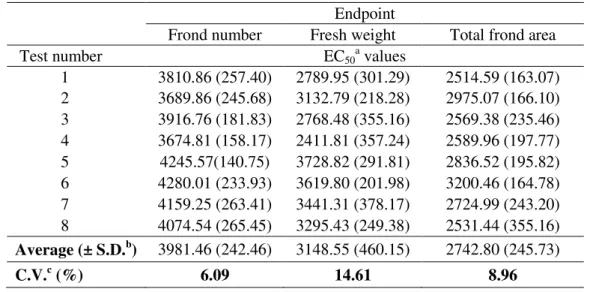
their respective 95% confidence intervals for the growth endpoints frond number, total frond area and fresh weight are summarized in the Table 1.
The frond number is the most commonly used endpoint to express duckweed test results because its evaluation is simple, rapid and noninvasive (Wang et al., 1990). Regarding the average EC50 result obtained in this study for this endpoint (Table 1), the value is similar to
the average EC50-7 days value of 4,308 mg L-1 obtained by Souza et al. (2011) under similar test
conditions as used in this study, except for the culture medium applied (Hoagland medium instead of Steinberg medium). EC50 values for the other two growth endpoints were quite
Rev. Ambient. Água vol. 12 n. 1 Taubaté – Jan. / Feb. 2017
Table 1. EC50 values (mg L-1) obtained for the endpoints frond number, total frond area
and fresh weight in L. minor growth inhibition test with NaCl, calculated from average
specific growth rates. In brackets are indicated the 95% confidence intervals estimated for EC50 point estimates.
Endpoint
Frond number Fresh weight Total frond area Test number EC50a values
1 3810.86 (257.40) 2789.95 (301.29) 2514.59 (163.07) 2 3689.86 (245.68) 3132.79 (218.28) 2975.07 (166.10) 3 3916.76 (181.83) 2768.48 (355.16) 2569.38 (235.46) 4 3674.81 (158.17) 2411.81 (357.24) 2589.96 (197.77) 5 4245.57(140.75) 3728.82 (291.81) 2836.52 (195.82) 6 4280.01 (233.93) 3619.80 (201.98) 3200.46 (164.78) 7 4159.25 (263.41) 3441.31 (378.17) 2724.99 (243.20) 8 4074.54 (265.45) 3295.43 (249.38) 2531.44 (355.16)
Average (± S.D.b) 3981.46 (242.46) 3148.55 (460.15) 2742.80 (245.73)
C.V.c (%) 6.09 14.61 8.96
aEC
50 - Effect concentration at a 50% level; b S.D. - Standard deviation; and
c C.V. - Coefficient of variation.
Figure 1. Growth rates of L. minor based on different endpoints upon exposure to increasing
concentrations of the reference substance NaCl: (A) frond number; (B) total frond area; (C) fresh weight. Standard deviation is indicated by the vertical bars on each circle. Asterisks refer to a significant difference from the control (p < 0.05).
The C.V. values obtained for all three of the growth endpoints evaluated in this study were lower than 15.0%, indicating a relatively consistent response to NaCl, since in Environment Canada guidelines there are advisements that variation in a set of test results of a
reference substance must be preferably ≤ 20% (Donnevert et al., 2009). Buckley et al. (1996) also found a relatively low C.V. value of 5.8% in four tests carried out using L. minor dry weight as an endpoint in order to assess the NaCl toxic effects. These results indicate that stable variance measures can be obtained for independent sensitivity tests with L. minor, based on growth endpoints, using the NaCl as a reference substance.
Comparing the EC50 values obtained in this study using NaCl with results reported for
the reference substance 3,5-dichlorophenol, which is indicated in OECD and Environment Canada protocols (Canada, 2007; OECD, 2006), allows one to conclude that L. minor is more sensitive to the effects posed by this last compound. Results from reference tests performed in the EU Waste Ring Test 2006/2007 for 3,5-dichlorophenol in L. minor growth inhibition tests ranged from 2.20 to 3.50 mg L-1, with mean value of 2.77 ± 0.44 mg L-1 (Pattard et al., 2009). Thus, the required range for the EC50 values determined in tests with L. minor using this
Rev. Ambient. Água vol. 12 n. 1 Taubaté – Jan. / Feb. 2017
establishes a narrower range as validity criteria for this compound, of an EC50 (frond number)
of 2.2 - 3.8 mg L-1. Based on an international ring-test including laboratories from several global regions, 3,5-dichlorophenol has been recommended for use in sensitivity tests with L. minor as it showed the best result (OECD, 2002). However, the important criteria of safety to user should have been also observed before recommending this reference substance. Chlorophenol compounds can cause severe human toxic effects, including cancer (NLM, 2015). Furthermore, disposal of its residues is another problem to be considered, since 3,5-dichlrorophenol can bioconcentrate in aquatic organisms, being toxic to them with
possible long-term adverse effects (Zagorc-Koncan et al., 2002; NLM, 2015).
Canada (2007) recommends using reagent-grade nickel (Ni), in the form of nickel sulphate (NiSO4.6H2O), in reference toxicity tests with L. minor. According to that protocol,
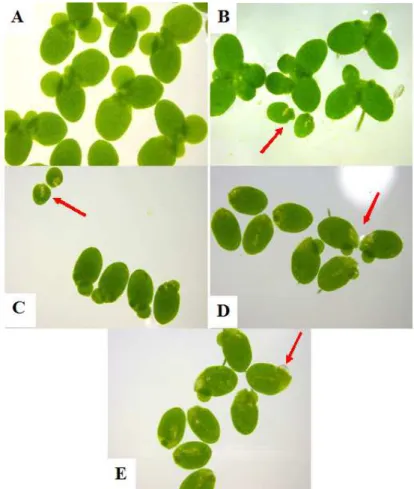
Ni was considered favorable due to the relatively steep dose response curve produced in reference toxicity tests performed with the macrophyte. Visual toxicity signs caused by Ni at concentrations > 3.0 mg L-1 include chlorosis, necrosis and frond disconnection (Khellaf and Zerdaoui, 2009). Those phytotoxicity signs are similar to the ones observed in this study in
the macrophytes exposed to concentrations ≥ 4,500 mg L-1 of NaCl (Figure 2) (A, B, C, D, E).
Figure 2. Macroscopic signs of phytotoxicity of L. minor
fronds exposed to several concentrations of NaCl: (A) Plants exposed to the control showing fronds without visual phytotoxicity signs; (B) Beginning of frond disconnection and of chlorosis signs in plants exposed to the concentration of 4,500 mg L-1; (C) and (D) Total frond disconnection and
chlorosis signs in plants exposed to the concentrations of 5,500 mg L-1 and 6,500 mg L-1 respectively; (E) Necrosis
Rev. Ambient. Água vol. 12 n. 1 Taubaté – Jan. / Feb. 2017
Therefore, similar phytotoxicity signs can be observed for the reference toxicant Ni in lower concentrations compared to the ones observed for NaCl. However, two major problems can be highlighted regarding Ni. First, the requirement that the culture medium used in tests with Ni compounds contains no EDTA restricts the choice of the dilution water to the modified APHA medium, whereas the use of other recommended and commonly used test medium such as Steinberg and Swedish Standard (OECD, 2002) is not possible. Moreover, Ni compounds are considered carcinogenic to humans (IARC, 1990).
Considering the important human safety issue, Canada (2007) suggests potassium chloride (KCl) as another possible reference substance for using in L. minor routine toxicity tests. ISO 20079 (ISO, 2006) suggested that EC50 based on frond number should be in a range
between 5,500 and 10,000 mg L-1 for KCl in reference toxicity tests with L. minor. Canada (2007) reported a lower mean EC50 value of 4,770 mg L-1 (n = 18) and a % C.V. of 15.9 % for
this compound in tests with this macrophyte. Therefore, mean EC50 value of 3,981 mg L-1
obtained in this study for NaCl (considering the same endpoint frond number) is slightly lower than the mean EC50 value reported for KCl in the Environment Canada protocol (2007).
Moreover, it must be highlighted that NaCl presents the same advantages desired in a reference substance of stability in storage, stability in solution and safety to the user as observed for KCl (Sigma Aldrich, 2016).
NaCl was found to be suitable for evaluating the sensitivity based on growth endpoints other than frond number, which is required by OECD 221 (OECD, 2006). Regarding the evaluation of the other growth endpoints, the total frond area was the most sensitive one according to the Scott-Knottʼs multiple comparison tests performed. As it occurs with frond number, total frond area also is relatively easy to perform in vivo and allow measurements over all the time of the experiment. Moreover, evaluation of total frond area overcomes the problem pointed out by Wang (1990), who stated that frond count is irrelevant to frond size or biomass and therefore it can roughly underestimate the toxic effect to duckweed.
4. CONCLUSION
To the best of our knowledge, this is the first study to generate reference data for the NaCl toxic effects by measuring simultaneously three growth endpoints recommended in Lemna sp. guidelines. Therefore, we have expanded the results published in the literature regarding the NaCl toxicity for L. minor, since we have evaluated additional endpoints neglected in routine tests, such as total frond area and fresh weight.
The results presented in this study show that NaCl can be a suitable alternative reference substance for routine toxicity tests using L. minor since the tests performed with this salt presented acceptable sensitivity and reproducibility, measured in multiple growth endpoints. Mean EC50 value obtained for NaCl based on frond number were somewhat lower than the
mean EC50 reported in standardized protocols for KCl. Moreover, this compound has the
advantages of being less hazardous to both human health and the environment than other commonly used reference substances recommended by standardized protocols, such as 3,5-dichlorophenol and Ni compounds.
Rev. Ambient. Água vol. 12 n. 1 Taubaté – Jan. / Feb. 2017
5. REFERENCES
AMORIM, M. J. B.; NATAL-DA-LUZ, T.; SOUSA, J. P.; LOUREIRO, S.; BECKER, L.; RÖMBKE, J. et al. Boric acid as reference substance: pros, cons and standardization.
Ecotoxicology, v. 21, p. 919-924, 2012. http://dx.doi.org/10.1007/s10646-011-0832-9 BARATA, C.; BAIRD, D. J.; NOGUEIRA, A. J. A.; SOARES, A. M. V. M.; RIVA, M. C.
Toxicity of binary mixtures of metals and pyrethroid insecticides to Daphnia magna Straus. Implications for multi-substance risks assessment. Aquatic Toxicology, v. 78, p. 1-14, 2006. http://dx.doi.org/10.1016/j.aquatox.2006.01.013
BUCKLEY J. A.; RUSTAGI K. P.; LAUGHLIN, J. D. Response of Lemna minor to sodium chloride and a statistical analysis of continuous measurements for EC50 and 95%
confidence limits calculation. Bulletin of environmental contamination and toxicology, v. 57, p. 1003-1008, 1996. http://dx.doi.org/10.1007/s001289900290
CANADA. Environment And Climate Change. Biological test method: test for measuring the inhibition of growth using the Freshwater Macrophyte, Lemna minor - method development and applications section. Ottawa, Canada: Environmental Technology Centre, 2007.
CHASTINET, C. B. A.; SILVA E. M. Comparação da sensibilidade de duas linhagens de Lemna minor ao cloreto de sódio (NaCl) como substância de referência. In: ESPÍNDOLA, E. L. G. Ecotoxicologia: Perspectivas para o século XXI. São Carlos: RiMA, 2000. p. 557-566.
CLEUVERS, M. Aquatic ecotoxicity of pharmaceuticals including the assessment of combination effects. Toxicology letters, v. 142, p. 185-194, 2003. http://dx.doi.org/10.1016/S0378-4274(03)00068-7
DONNEVERT, G.; UHLIG, S.; MOSER, T. Ring Test Data Evaluation. In: MOSER, H.; RÖMBKE, J. (Eds.). Ecotoxicological characterization of waste: results and experiences of an international ring test. New York: Springer Science; Business Media; 2009. p. 47-60.
GODOY, A. A.; KUMMROW, F.; PAMPLIN, P. A. Z. Ecotoxicological evaluation of propranolol hydrochloride and losartan potassium to Lemna minor L. (1753) individually and in binary mixtures. Ecotoxicology, v. 24, p. 1112-1123, 2015. http://dx.doi.org/10.1007/s10646-015-1455-3
INTERNATIONAL AGENCY FOR RESEARCH ON CANCER. IARC monographs on the Evaluation of Carcinogenic Risks to Human - Chromium, nickel and welding. Vol. 49. Lyon, 1990.
INTERNATIONAL ORGANIZATION FOR STANDARDIZATION. ISO 20079 - Water quality - Determination of the toxic effect of water constituents and waste water on duckweed (Lemna minor) - Duckweed growth inhibition test. Genebra, 2006.
KEPPELER, E. C. Toxicity of sodium chloride and methyl parathion on the macrophyte Lemna minor (Linnaeus, 1753) with respect to frond number and chlorophyll.
Rev. Ambient. Água vol. 12 n. 1 Taubaté – Jan. / Feb. 2017
KHELLAF. N.; ZERDAOUI, M. Growth response of the duckweed Lemna minor to heavy metal pollution. Journal of Environmental Health Science and Engineering, v. 6, n. 3, p. 161-166, 2009.
NATIONAL LIBRARY OF MEDICINE – NLM (U.S.). Toxicology Data Network.
Available in: https://goo.gl/WXnvoj. Access in: Aug. 2015.
NATIONAL OCEANIC AND ATMOSPHERIC ADMINISTRATION - NOAA. Database of Hazardous Materials. CAMEO Chemicals version 2.4.2. Available in: https://goo.gl/MeJU8G. Access in: July 2015.
ORGANIZATION FOR ECONOMIC CO-OPERATION AND DEVELOPMENT - OECD. Lemna sp. Growth inhibition test. In: Guidelines for the Testing of chemicals. Draft Guideline 221. Paris, 2002.
ORGANIZATION FOR ECONOMIC CO-OPERATION AND DEVELOPMENT - OECD. Lemna sp. Growth inhibition test. In: Guidelines for the Testing of chemicals. Updated Test Guideline 221. Paris, 2006.
PATTARD, M.; RÖMBKE, J.; MOSER, T. Range of Reference Tests in Aquatic Tests. In:
Ecotoxicological characterization of waste: results and experiences of an international ring test. New York: Springer Science; Business Media, 2009. p. 61-70.
SANTOS, M. A. P. F.; VICENSOTTI, J.; MONTEIRO, R. T. R. Sensitivity of four test organisms (Chironomus xanthus, Daphnia magna, Hydra attenuata and Pseudokirchneriella subcapitata) to NaCl: an alternative reference toxicant. Journal of the Brazilian Society of Ecotoxicology, v. 2, p. 229-236, 2007.
SIGMA-ALDRICH. Product Information: Sodium chloride. Catalog numbers S7653, S9625, S9888. Available in: http://www.sigmaaldrich.com. Access in: January 2016. SOUZA, J. P.; MEDEIROS, L. S.; WINKALER, E. U.; MACHADO-NETO, J. G. Acute
toxicity and environmental risk of diflubenzuron to Daphnia magna, Poecilia reticulata and Lemna minor in the absence and presence of sediment. Pesticidas: Revista de Ecotoxicologia e Meio Ambiente, v. 21, p. 1-12, 2011.
WANG, W. Literature review on duckweed toxicity testing. Environmental Research, v. 52, p. 7-22, 1990. http://dx.doi.org/10.1016/S0013-9351(05)80147-1
ZAGORC-KONCAN, J.; ZGAJNAR, G. A.; TISLER, T. Hazard identification for 3,5-dichlorophenol in the aquatic environment. Cellular and Molecular Biology Letters, v. 7, p. 381-382, 2002.