Received 6/2/2013 Accepted 15/5/2013 (005972)
1 Biology Department, Federal University of Lavras – UFLA, CEP 37200-000, Lavras, MG, Brazil, e-mail: [email protected] *Corresponding author
Characterization of spoilage bacteria in pork sausage by PCR–DGGE analysis
Francesca Silva DIAS1, Cíntia Lacerda RAMOS1, Rosane Freitas SCHWAN1*1 Introduction
Fresh sausages are highly perishable and serve as substrates for several spoilage and pathogenic microorganisms due to their high water content and abundance of essential nutrients (COCOLIN et al., 2004). Spoilage can be defined as any change in a food product that makes it unacceptable to the consumer from a sensory point of view. Microbial spoilage is by far the most common cause of spoilage and may manifest itself as visible growth (slime, colonies), as textural changes (degradation of polymers) or as off-flavors (GRAM et al., 2002). In the case of meat and meat products, microbial spoilage leads to the development of off-flavors, oxidative rancidity, discoloration, gas production and, often, slime formation (LLOYD-PURYEAR et al., 1991; COCOLIN et al., 2004).
Knowledge of the Specific Spoilage Organisms (SSOs) can ultimately be used to predict the shelf-life of a product, to aid the microbiological inspections and to design new preservation or production methods (HANSEN; HUSS, 1998). Due to the limitations of conventional microbiological methods, molecular methods, independent of cultivation, have become a very important tool and Denaturing Gradient Gel Electrophoresis (DGGE) is perhaps the most commonly used (ERCOLINI, 2004; IACUMIN; MANZANO; COMI, 2012). Many scientists have used this technique to monitor the dynamics of microbial populations and to characterize the dominant spoilage bacteria in pork meat and pork meat products (COCOLIN et al., 2004; HU et al., 2009; JIANG et al., 2010). However, there are few studies that have characterized the spoilage bacteria in pork sausages in Brazil using molecular methods. Further investigation is necessary to obtain a more
complete understanding of the microbial species in products responsible for spoilage. Therefore, the objective of this study was to characterize spoilage bacteria in fresh pork sausages by culture-dependent methods and Polymerase Chain Reaction (PCR)-DGGE analysis, as well as by monitoring pH and water
activity (aw) values of the sausages during the time of storage.
2 Materials and methods
2.1 Samples and storage
Sealed packages of industrial pork sausages from twelve different trademarks (line “fresh sausages”) were collected from commercial establishments in the state of Minas Gerais, Brazil. The sausages analyzed contained as basic ingredients: pork meat, pork fat, water, salt, monosodium glutamate, sugar, pepper, ascorbic acid and sodium nitrite/nitrate. Samples were transported in isothermal boxes under refrigeration. In the laboratory, sausages were portioned aseptically, packaged in
sterile plastic bags (Cryovac, Brazil; O2 transmission rate, 30 cm3
m−2 atm−1 24 h−1 at 20 °C) and stored at 4 °C with 80% relative
humidity for a total of 42 days. At 0, 14, 28 and 42 days, samples of sausages were subjected to molecular analysis, and triplicate
samples were used for microbiological, pH and aw analyses.
2.2 Microbiological analysis, pH and aw measurements
Ten grams of each sausage sample were homogenized in 90 ml 0.1% peptone, pH 7.00 (Difco Laboratories, Detroit, Mich.) in a Stomacher (Mayo Homogenius HG 400, Brazil).
Abstract
To investigate microbial diversity and identify spoilage bacteria in fresh pork sausages during storage, twelve industrial pork sausages of different trademarks were stored at 4 °C for 0, 14, 28 and 42 days, 80% relative humidity and packaged in sterile
plastic bags. Microbiological analysis was performed. The pH and water activity (aw) were measured. The culture-independent
method performed was the Polymerase Chain Reaction - Denaturing Gradient Gel Electrophoresis (PCR-DGGE). The culture-dependent method showed that the populations of mesophilic bacteria and Lactic Acid Bacteria (LAB) increased linearly over
storage time. At the end of the storage time, the average population of microorganisms was detected, in general, at the level of 5
log cfu g–1. A significant (P < 0.005) increase was observed in pH and a
w values at the end of the storage time. The PCR-DGGE
allowed a rapid identification of dominant communities present in sausages. PCR-DGGE discriminated 15 species and seven genera of bacteria that frequently constitute the microbiota in sausage products. The most frequent spoilage bacteria identified
in the sausages were Lactobacillus sakei and Brochothrix thermosphacta. The identification of dominant communities present
in fresh pork sausages can help in the choice of the most effective preservation method for extending the product shelf-life.
Keywords: microbial diversity; Lactobacillus sakei; Brochothrix thermosphacta.
log cfu g−1) were observed in sausages of brands 4, 5, 6, 9 and
11 at day zero. In sausage 9, LAB colonies were not detected at day 14 either. However, the LAB population increased linearly over time in all of the sausages analyzed, as explained by the first-degree equations (Table 1).
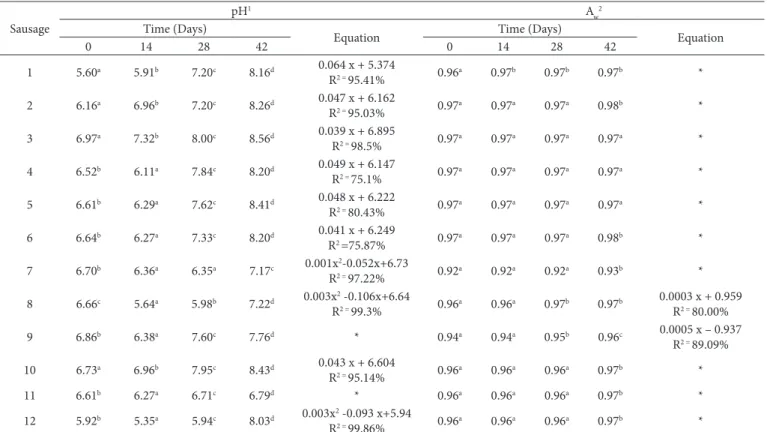
The results of pH and aw measurements are listed in Table 2.
There was a significant interaction (P < 0.05) between the
sausages and the time of pH and aw evaluation. The initial pH
values ranged from 5.60 to 6.97 for all the samples. In sausages 1, 2, 3, 4, 5, 6, and 10, the pH increased linearly over storage time in accordance with the regression equation for each sausage (Table 2). According to the quadratic equations (Table 2), the pH values of samples from sausages 7, 8 and 12 showed a reduction up to days 26, 26 and 15, respectively, with minimum values of 6.05, 5.23 and 5.22, followed by an increase from these time points until the end of the evaluation time (42 days). The water
activity (aw) values showed a significant increase (P < 0.05).
Sausages 3, 4 and 5 showed no changes in the aw values, which
remained at 0.97 over the entire study period.
3.2 Direct analysis of microbial diversity in sausages by DGGE
The results from the DGGE analysis were obtained by amplifying the V3 region of the 16S rRNA gene. Individual bands observed in the DGGE profiles, named A to V, were excised from acrylamide gels, re-amplified for sequencing and identified (Table 3). A high microbial diversity at the beginning of the storage was observed, which was indicated by the presence of multiple bands. The spoilage microbiota identified in the
brands of sausages is shown in Table 4.
The Figure 1 illustrates the cluster dendrogram, which grouped all sausage samples according to the composition similarity of microbial communities based on the presence or absence of amplicons detected by DGGE. The cluster was divided in two groups (G1 and G2), it was possible to observe a microbial diversity between the brands of sausage studied, as well as between the time of storage even in the same brand.
4 Discussion
Fresh sausages are highly perishable because of their
characteristic pH and aw values. The microbiology of fresh
sausages has only been characterized by the presence of mesophilic, psychrotrophic microorganisms and pathogens so far. Thus, more detailed studies focusing on the ecology of fresh sausages and the investigation of the population dynamics of these products should be performed (COCOLIN et al., 2004). The current study confirmed, by culture-dependent methods, that the LAB population gradually increased and later became the dominant bacterial population. However, as reported by
Hu et al. (2009), the population of LAB could not be detected
(<1 log cfu g–1) using culture-dependent methods at day zero
for some samples of meat products. Nevertheless, using PCR– DGGE analysis, LAB populations were found in the initial stage of storage, similar to observed in our study. Thus, in accordance with Iacumin, Manzano and Comi (2012), PCR-DGGE has
Decimal dilutions (10−1 to 10−10) were prepared and total aerobic
mesophilic bacteria on Plate Count Agar (PCA, Merck) for 48 h at 37 °C; and Lactic Acid Bacteria (LAB) on Man-Rogosa-Sharpe (MRS) agar (Merck) at pH 6.5 for 48 h at 30 °C were evaluated.
The pH values were determined by homogenizing 10 g of sausage in 100 ml distilled water using a pH meter PHS-3B
(Labmeter Model PH, China). The aw values were measured from
5 g of sausage using an AquaLab model 3 TE (Braseq, Brazil).
2.3 DNA extraction and PCR-DGGE analysis
Total DNA was extracted using the QIAamp DNA Mini Kit (Qiagen, Germany) according to the manufacturer’s instructions. The bacterial community DNA was amplified with the primers 338fgc and 518r (OVREAS et al., 1997). The DGGE analyses were performed using a BioRad DCode Universal Mutation Detection System (BioRad, CA, USA) as described by Ramos et al. (2010). Single pieces of DGGE bands were excised with a sterile scalpel, and the DNA from each band was eluted in 30 µL of sterile water overnight at 4 °C and amplified at the same condition. The PCR products were sequenced by Macrogen Inc. (Seoul, South Korea). Sequences were compared to those in GenBank database using the BLAST algorithm (NCBI, USA). Gels were analyzed using the Diversity Database program for determining the diversity of amplicons. The hierarchical clustering was performed using the program Systat 8.0, based on similarity matrices generated by the method of agreement (simple matching), using the algorithm of Ward and Euclidean distance.
2.4 Statistical analysis
A randomized block design with three replicates was used
for the microbiological analyses and pH and aw measurements.
The treatments were arranged in a 12 X 4 factorial design: 12 sausages of different trademarks and 4 time points (0, 14, 28 and 42 days) to monitor the process of deterioration of sausages.
The parameters bacterial count, pH and aw were subjected to
analysis of variance (ANOVA), and the means were compared by a Scott-Knott test. The quantitative data were analyzed using regression in relation to storage time. Data were considered
significantly different when the P values were below 0.05. The
statistical analysis was performed using the software SISVAR® 4.5 (Lavras, Brazil).
3 Results
3.1 Microbiological analysis and pH and aw measurements
Bacterial counts throughout the storage are shown in
Table 1. There was a significant interaction (P < 0.05) between
the sausages and time of evaluation of mesophilic bacteria and LAB populations. The population of mesophilic bacteria increased linearly over the storage time, as observed by the regression equation for the sausages in the study. At the end of the storage time, the largest population was detected in PCA
agar for sausage of brand 12 (6.72 log cfu g−1). For the other
brands of sausage, the population was, in general, detected at
Table 1. Population log cfu g–1 values of mesophilic bacteria and LAB over different storage times at 4 °C for fresh industrial pork sausage samples
of twelve different trademarks.
Sausage
Mesophilic bacteria1 (log cfu g–1) LAB2 (log cfu g–1)
Time (Days)
Equation Time (Days) Equation
0 14 28 42 0 14 28 42
1 2.30a 3.66b 3.94c 4.52d 0.05 x + 2.566
R2 = 90.60%
7.63a 7.81b 8.33c 8.82d 0.029 x + 7.533
R2 = 96.42%
2 2.75a 3.36b 4.103c 5.35d 0.061 x + 2.608
R2 = 97.18%
5.52a 6.33b 7.62c 8.07d 0.063 x + 5.545
R2 = 97.09%
3 2.53a 3.15b 4.66c 5.63d 0.077 x + 2.375
R2 = 97.79%
5.88a 6.51b 6.66c 7.09d 0.027 x + 5.966
R2 = 94.85%
4 2.20a 3.34b 4.37c 5.53d 0.078 x + 2.209
R2 = 99.94%
0.00a 2.64b 3.33c 4.32d 0.098 x + 0.526
R2 = 90.84%
5 2.51a 3.36b 4.63c 5.76d 0.078 x + 2.412
R2 = 99.39%
0.00a 2.51b 3.09c 3.39d 0.077 x + 0.635
R2 = 80.97%
6 2.08a 3.37b 4.79c 5.86d 0.091 x +2.111
R2 =99.71%
0.00a 2.63b 2.79c 3.64d 0.079 x + 0.602
R2 =82.64%
7 2.73a 3.53b 4.35c 5.10d 0.056 x + 2.736
R2 = 99.97%
5.26a 6.45b 6.65c 7.33d 0.046 x + 5.463
R2 = 92.19%
8 2.39a 3.09b 4.52c 5.09d 0.068 x + 2.340
R2 = 97.25%
2.98a 3.42b 4.59c 5.49d 0.062 x + 2.814
R2 = 97.32%
9 2.21a 2.80b 3.00c 3.09c 0.020 x+ 2.350
R2 = 85.78%
0.00a 0.00a 2.39b 2.58c 0.072 x – 0.278
R2 = 82.94%
10 2.26a 2.63b 2.93c 4.14d 0.042 x + 2.101
R2 = 88.75%
4.34a 4.63b 5.27c 6.61d 0.053 x + 4.095
R2 = 90.57%
11 2.16a 2.54b 2.64b 2.91c 0.017 x + 2.209
R2 = 95.74%
0.00a 2.10b 2.62c 3.42d 0.077 x + 0.417
R2 = 90.73%
12 3.09a 4.40b 5.56c 6.72d 0.086 x + 3.135
R2 = 99.92%
6.12a 7.31b 8.09c 8.78d 0.062 x + 6.260
R2 = 98.22%
For each row, mean values with different letters are significantly different (P < 0.005) according to the Scott–Knott test. 1SE=0.0698. 2SE= 0.0065.
Table 2. pH and Aw measurements over different storage times at 4 °C for fresh industrial pork sausage samples of twelve different trademarks.
Sausage
pH1 A
w 2
Time (Days)
Equation Time (Days) Equation
0 14 28 42 0 14 28 42
1 5.60a 5.91b 7.20c 8.16d 0.064 x + 5.374
R2 = 95.41% 0.96a 0.97b 0.97b 0.97b *
2 6.16a 6.96b 7.20c 8.26d 0.047 x + 6.162
R2 = 95.03% 0.97a 0.97a 0.97a 0.98b *
3 6.97a 7.32b 8.00c 8.56d 0.039 x + 6.895
R2 = 98.5% 0.97a 0.97a 0.97a 0.97a *
4 6.52b 6.11a 7.84c 8.20d 0.049 x + 6.147
R2 = 75.1% 0.97a 0.97a 0.97a 0.97a *
5 6.61b 6.29a 7.62c 8.41d 0.048 x + 6.222
R2 = 80.43% 0.97a 0.97a 0.97a 0.97a *
6 6.64b 6.27a 7.33c 8.20d 0.041 x + 6.249
R2 =75.87% 0.97a 0.97a 0.97a 0.98b *
7 6.70b 6.36a 6.35a 7.17c 0.001x2-0.052x+6.73
R2 = 97.22% 0.92a 0.92a 0.92a 0.93b *
8 6.66c 5.64a 5.98b 7.22d 0.003x2 -0.106x+6.64
R2 = 99.3% 0.96a 0.96a 0.97b 0.97b
0.0003 x + 0.959 R2 = 80.00%
9 6.86b 6.38a 7.60c 7.76d * 0.94a 0.94a 0.95b 0.96c 0.0005 x – 0.937
R2 = 89.09%
10 6.73a 6.96b 7.95c 8.43d 0.043 x + 6.604
R2 = 95.14% 0.96a 0.96a 0.96a 0.97b *
11 6.61b 6.27a 6.71c 6.79d * 0.96a 0.96a 0.96a 0.97b *
12 5.92b 5.35a 5.94c 8.03d 0.003x2 -0.093 x+5.94
R2 = 99.86% 0.96a 0.96a 0.96a 0.97b *
For each row, mean values with different letters are significantly different (P < 0.005) according to the Scott–Knott test. 1SE= 0.0064. 2SE= 5.807. *There was no fit of the equation to
been successfully applied to study the microbial biodiversity of complex environments.
In relation to total aerobic mesophilic counts, it was possible to establish that the sausages analyzed were of high quality. This
is because the mesophilic population was ≤ 6 log cfu g–1, which is
indicative of good manufacturing practices because the products used were raw and not heat treated. According to Gram et al. (2002), the level of microorganisms detected, ‘‘total count’’, can be used to predict the shelf life of the product.
Even in the presence of high LAB populations, the pH values increased linearly during storage time in seven different sausages sampled. This fact can be explained because it is well established that glucose, lactic acid, and certain amino acids followed by nucleotides, urea and water-soluble proteins are catabolized by almost all the bacteria of the meat microbiota and consequently there was a production of alkaline radicals (ammonia and amines), contributing to increase pH values (NYCHAS et al., 2008). LAB species are able to produce decarboxylases, enzymes with proteolytic activity that generate amines and increase the
matrix pH values (BOVER-CID et al., 2005). The aw values did
not decrease in any sample, which according to Borch,
Kant-Muemansb and Blixt (1996) contributes to the stability of LAB.
According to the cluster based on DGGE analysis (Figure 1), two groups were found (G1 and G2). The G1 group included most of the samples, including all sausages at time zero, except
Table 3. Species identification of the DGGE band sequences of the V3 region of the 16S rRNA gene of the total bacterial community DNA directly extracted from the sausage samples.
Bands Closest relatives IDa (%) Accession No.
A Lactobacillus plantarum 99 JF756323.1 B Lactobacillus algidus 99 GU430799.1 C Lactobacillus curvatus 98 AB289024.1
D Lactobacillus sakei 98 AY383042.1
E Carnobacterium divergens 98 JF756331.1 F Brochothrix thermosphacta 98 JF756334.1 G Lactobacillus fuchuensis 98 AB289024.1 H Bacillus lichenformis 97 HM640420.1
I Bacillus subtilis 97 EU130453.1
J Janthinobacterium lividum 98 HQ003440.1 K Psychrobacter immobilis 97 HQ698589.1 L Pseudomonas fluorescens 99 HM597248.1
M Paenibacillus sp 100 HM161756.1
N Leuconostoc mesenteroides 98 FR852570.1
O Psychrobacter sp 99 GQ169116.1
P Lactobacillus brevis 99 JF720006.1 Q Weisella paramesnteroides 98 HQ721270.1
R Enterococcus sp 98 JF799879.1
S Microbacterium 100 AF390085.1
T Bacillus sp 97 HQ620634.1
U Vibrio sp 98 AB038029.1
V Alcaligenes sp 98 AY346136.1
aID represents the identity with the sequences in the GenBank databases.
Table 4. Succession of bacteria identified in 12 Brazilian fresh sausage brands during 0, 14, 28 and 42 days of storage.
Bands
Sausage brands during 42 days of storage
1 2 3 4 5 6
0 14 28 42 0 14 28 42 0 14 28 42 0 14 28 42 0 14 28 42 0 14 28 42
A + + - - - + - + + - - + +
B - + - - + + + + - - -
-C + + - - - + + + + + + + + + - - + + + + - - - +
D + + + + + + + + + + + + - + + + - + + + + - -
-E + + - - -
-F + + - - + + + - + + + - + + + + + + + + + + + +
G - - + + - - -
-H - - - + - - -
-I - - - + + - - -
-J - - - + + + + + + - + + + - + + + + + + +
K - - - + + + + - + + + - + + + - - -
-L - - - + + + - + + + - + + + - - -
-M - - - + + -
-N - - - +
O - - - + + +
P - - -
-Q - - -
-R - - -
-S - - - + - -
-T - - -
-U - - -
-V - - -
-Bands
Sausage brands during 42 days of storage
7 8 9 10 11 12
0 14 28 42 0 14 28 42 0 14 28 42 0 14 28 42 0 14 28 42 0 14 28 42
A + - + + + - - - + - - - + - - - - + + +
B - - - + + + + + - + + - - -
-C - - + + - - - + - - -
-D - - - + + + - + + + - + + + - + + + - + + +
E - - - + - - - + -
-F - + + + + + + + + + + + + + + + + + + + - - -
-G - - -
-H - - -
-I - - - + - -
-J - + + + - - - + + - + + + + + + + + + + +
K - - - + + + - + + + - + + + - - + + + - -
-L - - - - + + + + + - - + - - - + - + + +
M - + - - + - - - + + + - - - -
-N - - + + + - - -
-O - + + + - - -
-P + - - - + - - - + - - - + - - -
-Q - - + + - - -
-R - - - + + + - - -
-S + - - - + + + + - - - + + + + + + + +
T - - - + - - -
-U - - - + - - - - + - - -
-V - - - + +
to B. thermosphacta. J. lividum was reported by Nichas et al. (2008) and Cavill et al. (2011) as the genus of spoilage bacteria
commonly found in meat and processed meat. Brochotrix
thermosphacta, a Gram-positive, facultative anaerobe spoilage microorganism, was previously reported by the use of the PCR-DGGE method in Córdoba sausage, an artisanal Argentinian fermented sausage (FONTANA; VIGNOLO; COCCONCELLI, 2005).
Pseudomonas fluorescens wasanother species identified in
our study and was present in eight sausages. Pseudomonas has
been demonstrated as one of the dominant spoilage microbiota in chilled pork (LI et al., 2006).
The detection of unknown species of Psychrobacter in two
sausages (6 and 7) and P. immobilis in eight (3, 4, 5, 8, 9, 10, 11
and 12), corroborates with the data reported by Gennari et al. (1992) and Albano et al. (2008) who reported the presence of
Psychrobacter species in sausage products. Although it has been
reported as a spoilage bacterium of low importance in meat, P.
immobilis is a lipolytic species and might be a cause of incidental infections (LLOYD-PURYEAR et al., 1991).
The genus Bacillus and the species B. licheniformis and
B.subtilis were found in our study. However, this genus was
detected in few sausage brands, B. subtilis was detected only
in sausage 2, during 28 and 42 days of storage; Bacillus sp.and
B.licheniformis were detected in sausage 8 and 1, respectively,
both after 42 days of storage. Alcaligenes and Vibrio were
detected at the end of the study, when the pH became alkaline
in the sausages. The genera Enterococcus, Microbacterium and
Paenibacillus were detected in few samples from different sampling times. These genera are commonly associated with
the spoilage of processed meats (NYCHAS et al.,2008).
5 Conclusions
Samples of the sausages showed good sanitary hygienic quality, as the microbiota was composed of only spoilage
microorganisms. Enterococcus, which could be an indicator of
fecal contamination, was detected in only one sample. PCR-DGGE allowed for the discrimination of 15 species and seven genera of bacteria that frequently compose the microbiota in sausage products. The most frequent spoilage bacteria identified
in the sausages were L. sakei and B. thermosphacta. This is the
first time that the microbial community present in Brazilian pork sausages is assessed by DGGE analysis. The knowledge and identification of dominant communities of bacteria in sausages can help in the choice of the most effective preservation method for extending the product shelf-life and in the evaluation of the sanitary hygienic quality of sausages produced in industry.
Acknowledgements
The authors wish to acknowledge the Ministry of Agriculture, Livestock and Supply of Brazil (MAPA- Ministério da Agricultura, Pecuária e Abastecimento), FAPEMIG and CNPq (Conselho Nacional de Desenvolvimento Científico e Tecnológico) for scholarship and financial support.
brand 3. Samples of all times evaluated of sausages 6, 7 and 12 are grouped in the G1. This group is characterized by a diversity
of bacteria. The G2 group is characterized by the presence of L.
sakei, P. immobilis, P. fluorescens, J. lividum and B. thermosphacta
in almost all samples in the group. All samples of sausage 3 were included in this group. The microbial community has changed during 42 days of storage even under refrigeration, for the different sausages studied in this work. Different bacteria species were identified by amplification of DGGE bands.
Although Lactobacillus were not detected in the time
zero of storage according to the culture dependent method, it was possible to identify their presence by DGGE analysis. The Table 4 lists the succession of bacteria species detected in 12 Brazilian fresh pork sausages during 42 days of storage.
L. sakei was identified as the predominant spoilage bacterium
by PCR–DGGE. Lactobacillus sakei is anautochthonousspecies
in sausages(BONOMO; RICCIARDI; SALZANO, 2011).
Kesmen et al. (2012) also reported as result of the PCR-DGGE
analysis of sucuk, Turkish fermented sausage, L. sakei as one
of the microorganisms dominant in the product. This species produces ropy slime that confers a strong competitive ability to this species (BJÖRKROTH; KORKEALA, 1997). A specific spoilage phenomenon of commercial significance, characterized by long, stretchy, polysaccharide ropes between sausages or
sausage slices, was also detected. L. sakei strains play a major
role in this spoilage phenomenon. Lactobacillus curvatus
has also been shown to be a common species in sausages (KORKEALA; BJÖRKROTH, 1997; ALBANO et al., 2008). This
specieswas detected in samples from sausages 1, 2, 3, 4, 5 and
11. Lactobacillus plantarum was detected in sausages 1, 5, 6, 7, 8, 9 and 11. Nguyen et al. (2013) also detected by PCR-DGGE
L. plantarum and L. brevis in Nem chua, a traditional fermented
meat product of Vietnam. Among LAB, L. sakei, L. curvatus and
L. plantarum are the most widely described species in sausages, as also reported by Parente, Griego and Crudele (2001).
Lactobacillus algidus was detected in four brands of
sausages (1, 2, 9 and 10). A previous study reported L. algidus
as apsychrophilic, predominant strain isolated from
vacuum-packaged meat stored at 2 °C for 3 weeks (KATO et al., 2000).
In relation to the band identified as L. fuchuensis (or L. sakei),
this species is phylogenetically close to but distinct from L. sakei
and also appears to be associated with (vacuum) packaged meat
(SAKALA et al., 2002). Solely based on the DGGE analysis
of 16S rDNA amplicons, this band should thus be assigned to L. sakei and/or L. fuchuensis. It is possible that the use of housekeeping genes in DGGE-based population fingerprinting could result in a higher taxonomic resolution for the separation
of closely related species such as L. sakei and L. fuchuensis
(AUDENAERT et al., 2010). Other LABs were detected
in this research: Leuconostoc mesenteroides and Weissella
paramesenteroide in three and one sample, respectively (Table 3). These microorganisms are generally present in sausages and meat products (ALBANO et al., 2008; NGUYEN et al., 2013). In general, the control of growth of spoilage LAB in processed meats is difficult because these bacteria are psychrotrophic, microaerophilic and resistant to nitrite, salt and smoke (FRANZ; VON HOLY, 1996).
Research International, v. 31, p. 703-711, 1998. http://dx.doi. org/10.1016/S0963-9969(99)00049-6
HU, P. et al. Characterization of the predominant spoilage bacteria in sliced vacuum-packed cooked ham based on 16S rDNA-DGGE. Food Control, v. 20, p. 99-104, 2009. http://dx.doi.org/10.1016/j. foodcont.2008.02.007
IACUMIN, L.; MANZANO, M.; COMI, G. Catalase-positive cocci in fermented sausage: Variability due to different pork breeds, breeding
systems and sausage production technology. Food Microbiology,
v. 29, p.178-186, 2012. PMid:22202871. http://dx.doi.org/10.1016/j. fm.2011.09.005
JIANG, Y. et al. Changes in the bacterial communities of vacuum-packaged pork during chilled storage analyzed by PCR-DGGE. Meat Science, v. 86, p. 889-895, 2010. PMid:20800372. http://dx.doi. org/10.1016/j.meatsci.2010.05.021
KATO, Y. et al. Lactobacillus algidus sp. nov., a psychrophilic lactic
acid bacterium isolated from vacuum-packaged refrigerated
beef. International Journal of Systematic and Evolutionary
Microbiology, v. 50, p. 1143-1149, 2000. PMid:10843056. http:// dx.doi.org/10.1099/00207713-50-3-1143
KESMEN, Z. et al. Combination of culture dependent and culture-independent molecular methods for the determination of lactic
microbiota in sucuk. International Journal of Food Microbiology,
v. 153, p. 428-435, 2012. PMid:22209604. http://dx.doi.org/10.1016/j. ijfoodmicro.2011.12.008
KORKEALA, H. J.; BJÖRKROTH, K. J. Microbiological spoilage and
contamination of vacuum-packaged cooked sausages. Journal of
Food Protection, v. 60, p. 724-731, 1997.
LI, M. Y. et al. Changes of bacterial diversity and main flora in chilled
pork during storage using PCR-DGGE. Food Microbiology, v. 23,
p. 607-611, 2006. PMid:16943058. http://dx.doi.org/10.1016/j. fm.2006.01.004
LLOYD-PURYEAR, M. et al. Meningitis caused by Psychrobacter
immobilis in an infant. Journal of Clinical and Microbiology, v. 29, p. 2041-2042, 1991. PMid:1774332 PMCid:PMC270256.
NGUYEN, D. T. et al. A culture-dependent and -independent approach for the identification of lactic acid bacteria associated with the production of nem chua, a Vietnamese fermented meat product. Food Research International, v. 50, p. 232-240, 2013.
NYCHAS, G. J. E. et al. Meat spoilage during distribution. Meat Science,
v. 78, p. 77-89, 2008. PMid:22062098. http://dx.doi.org/10.1016/j. meatsci.2007.06.020
OVREAS, L. et al. Distribution of bacterioplankton in meromictic lake Saelenvannet, as determined by denaturing gradient electrophoresis
of PCR-amplified gene fragments coding for 16S rRNA. Applied
and Environmental Microbiology, v. 63, p. 3367-3393, 1997. PMid:9292986 PMCid:PMC168642.
PARENTE, E.; GRIEGO, S.; CRUDELE, M. A. Phenotypic diversity of lactic acid bacteria isolated from fermented sausages produced in
Basilicata (Southern Italy). Journal of Applied Microbiology, v. 90,
p. 943- 952, 2001. PMid:11412324. http://dx.doi.org/10.1046/j.1365-2672.2001.01328.x
RAMOS, C. L. et al. Determination of dynamic characteristics of microbiota in a fermented beverage produced by Brazilian Amerindians using culture-dependent and culture-independent
methods. International Journal of Food Microbiology, v. 140,
p. 225-231, 2010. PMid:20413168. http://dx.doi.org/10.1016/j. ijfoodmicro.2010.03.029
SAKALA, R. M. et al. Lactobacillus fuchuensis sp. nov., isolated from
vacuum-packaged refrigerated beef. International Journal of
Systematic and Evolutionary Microbiology, v. 52, p. 1151-1154, 2002. PMid:12148620. http://dx.doi.org/10.1099/ijs.0.02119-0
References
ALBANO, H. et al. Characterization of microbial population of ‘Alheira’ (a traditional Portuguese fermented sausage) by PCR-DGGE and
traditional cultural microbiological methods. Journal of Applied
Microbiology, v. 105, p. 2187-2194, 2008. PMid:19120664. http:// dx.doi.org/10.1111/j.1365-2672.2008.03947.x
AUDENAERT, K. et al. Diversity of lactic acid bacteria from modified atmosphere packaged sliced cooked meat products at sell-by date
assessed by PCR-denaturing gradient gel electrophoresis. Food
Microbiology, v. 27, p. 12-18, 2010. PMid:19913685. http://dx.doi. org/10.1016/j.fm.2009.04.006
BJÖRKROTH, J.; KORKEALA, H. Ropy slime-producing Lactobacillus sakei strains possess a strong competitive ability against a
commercial biopreservative. International Journal of Food
Microbiology, v. 38, p. 117-123, 1997. http://dx.doi.org/10.1016/ S0168-1605(97)00097-4
BORCH, E.; KANT-MUEMANSB, M. L.; BLIXT, Y. Bacterial
spoilage of meat products and cured meat. International Journal
of Food Microbiology, v. 33, p. 103-120, 1996. http://dx.doi. org/10.1016/0168-1605(96)01135-X
BOVER-CID, S. et al. Amino acid-decarboxylase activity of bacteria
isolated from fermented pork sausages. International Journal
of Food Microbiology, v. 66, p. 185-189, 2001. http://dx.doi. org/10.1016/S0168-1605(00)00526-2
BONOMO, M. G.; RICCIARDI, A.; SALZANO, G. Influence of autochthonous starter cultures on microbial dynamics and chemical-physical features of traditional fermented sausages
of Basilicata region. World Journal of Microbiology and
Biotechnology, v. 27, p. 137-146, 2011. http://dx.doi.org/10.1007/ s11274-010-0439-y
CAVILL, L. et al. Detection of cold-tolerant clostridia other than
Clostridium estertheticum in raw vacuum-packed chill-stored meat. Food Microbiology, v. 28, p. 957-963, 2011. PMid:21569939. http:// dx.doi.org/10.1016/j.fm.2011.01.003
COCOLIN, L. et al. Study of the ecology of fresh sausages and characterization of populations of lactic acid bacteria by molecular
methods. Applied and Environmental Microbiology, v. 70,
p. 1883-1894, 2004. PMid:15066777 PMCid:PMC383013. http:// dx.doi.org/10.1128/AEM.70.4.1883-1894.2004
ERCOLINI, D. PCR-DGGE fingerprinting: novel strategies for
detection of microbes in food. Journal of Microbiology Methods,
v. 56, p. 297- 314, 2004. PMid:14967221. http://dx.doi.org/10.1016/j. mimet.2003.11.006
FONTANA, C.; VIGNOLO, G.; COCCONCELLI, P. S. PCR-DGGE analysis for the identification of microbial populations from
Argentinean dry fermented sausages. Journal of Microbiological
Methods, v. 63, n. 3, p. 254-263, 2005. PMid:15893830. http://dx.doi. org/10.1016/j.mimet.2005.03.010
FRANZ, C. M. A. P.; VON HOLY, A. Thermotolerance of meat spoilage lactic acid bacteria and their inactivation in vacuum-packaged
Vienna sausages. International Journal of Food Microbiology, v.
29, p. 59-73, 1996. http://dx.doi.org/10.1016/0168-1605(95)00022-4 GENNARI, M. et al. Isolation and characterization by conventional
methods and genetic transformation of Psychrobacter and
Acinetobacter from fresh and spoiled meat, milk and cheese. International Journal of Food Microbiology, v. 15, p. 61-75, 1992. http://dx.doi.org/10.1016/0168-1605(92)90136-Q
GRAM, L. et al. Food spoilage—interactions between food spoilage
bacteria. International Journal of Food Microbiology, v. 78,
p. 79-97, 2002. http://dx.doi.org/10.1016/S0168-1605(02)00233-7 HANSEN, L. T.; HUSS, H. H. Comparison of the microflora isolated