Repositório ISCTE-IUL
Deposited in Repositório ISCTE-IUL: 2019-12-11
Deposited version: Post-print
Peer-review status of attached file: Peer-reviewed
Citation for published item:
Graça, J., Truninger, M., Junqueira, L. & Schmidt, L. (2019). Consumption orientations may support (or hinder) transitions to more plant-based diets. Appetite. 140, 19-26
Further information on publisher's website: 10.1016/j.appet.2019.04.027
Publisher's copyright statement:
This is the peer reviewed version of the following article: Graça, J., Truninger, M., Junqueira, L. & Schmidt, L. (2019). Consumption orientations may support (or hinder) transitions to more plant-based diets. Appetite. 140, 19-26, which has been published in final form at
https://dx.doi.org/10.1016/j.appet.2019.04.027. This article may be used for non-commercial purposes in accordance with the Publisher's Terms and Conditions for self-archiving.
Use policy
Creative Commons CC BY 4.0
The full-text may be used and/or reproduced, and given to third parties in any format or medium, without prior permission or charge, for personal research or study, educational, or not-for-profit purposes provided that:
• a full bibliographic reference is made to the original source • a link is made to the metadata record in the Repository • the full-text is not changed in any way
The full-text must not be sold in any format or medium without the formal permission of the copyright holders.
Consumption orientations may support (or hinder) transitions to more
plant-based diets
João Graça1, 2, 3 Monica Truninger1 Luís Junqueira1 Luisa Schmidt11 Instituto de Ciências Sociais da Universidade de Lisboa, Lisboa, Portugal 2 Instituto Universitário de Lisboa (ISCTE-IUL), CIS-IUL, Lisboa, Portugal
3 CRC-W - Católica Research Centre for Psychological, Family and Social Wellbeing, Lisboa, Portugal
Corresponding author: João Graça
Instituto de Ciências Sociais, Universidade de Lisboa
Av. Prof. Aníbal de Bettencourt, 9 1600-189 Lisboa
Email: [email protected], [email protected]
Citation:
Graça, J., Truninger, M., Junqueira, L., & Schmidt, L. (2019). Consumption orientations may support (or hinder) transitions to more plant-based diets. Appetite, 190, 16-26. https://doi.org/10.1016/j.appet.2019.04.027
Abstract
There have been increasing calls for triggering and sustaining a large-scale transition toward healthier and more sustainable food systems. To help materialize this transition, the present work aims to inform efforts for developing, marketing and promoting plant-based meals and plant-forward lifestyles, following a consumption-focused approach. The findings (Nparticipants = 1600, Portugal; 52.6% female, Mage = 48.30) allowed to identify trends and differences on three sets of variables – (a) current eating habits (i.e., meat, fish, and plant-based meals), (b) consumer willingness to change (i.e., reduce meat consumption, follow a plant-based diet, maintain the status quo), and (c) enablers for eating plant-plant-based meals more often (i.e., capability, opportunity, motivation) –, considering consumer orientations toward consumption in general, and food consumption in particular. Taken together, the results suggested that some consumption orientations were aligned with the transition to more plant-based diets (e.g., food orientation toward naturalness), others were open to – but not yet materialized in – the transition (e.g., general orientation toward consumption as exploration), and still others were in tension with the transition (e.g., food orientation toward pleasure). The discussion calls for developing and testing pathways to reduce meat consumption and increase plant-based eating which capture and build upon a range of consumption orientations, rather than against them.
Keywords: Plant-based diets; Meat consumption; Consumption orientations; Sustainability; Health.
1 INTRODUCTION
There is growing consensus that the current food systems are in need of profound transformations to address pressing global health and environmental
challenges that affect human thriving and development throughout the planet (Clark & Tilman, 2017; Willett et al., 2019). In industrialized Western societies, one important feature for these transformations is a shift away from current levels of animal sourced foods, toward a greater reliance on plant-based foods and meals (de Boer & Aiking, 2019; Willett et al, 2019). The production of animal-based foods such as meat and dairy products is identified as a key driver of land degradation, loss of biodiversity and climate change, which threatens the safe operating space of the “planetary boundaries” (Clark & Tilman, 2017; Rockstrom et al., 2009; Willett et al, 2019). In contrast, plant-based foods are usually more efficient for converting natural resources into calories and nutrients for human consumption (Clark & Tilman, 2017; Aiking & de Boer, 2018; Lacroix, 2018; Poore & Nemecek, 2018). A shift toward more plant-based diets can also generate substantial gains for public health, especially when these diets are rich in foods such as nuts, fruits, vegetables, and legumes, due to increased exposure to health-protective factors and decreased exposure to harmful factors such as saturated fats (Springmann et al., 2016; Tilman & Clark, 2014; Westhoek et al., 2014; Willett et al, 2019).
Achieving relevant progress on changing the current food systems will
nevertheless require extensive collaboration and commitment from multiple actors and stakeholders (e.g., civil society, governmental agencies, market actors), with a focus on what has been recently called the Great Food Transformation (Willett et al., 2019). In terms of market and consumption, plant-based foods have been gaining traction and attention in many industrialized Western societies, but still tend to occupy smaller
shares of the market for protein-rich food products, comparing to animal-based products (Clark & Bogdan, 2019; Gravely & Fraser, 2018). Additionally, evidence suggests that many consumers are not yet willing to change their eating habits (Graça et al., 2015; Hartmann & Siegrist, 2017; Lentz et al., 2018), and common representations of ‘proper’ and ‘attractive’ meals often revolve around dish structures that comprise an animal portion as the ‘center of the plate protein’ (Bryant et al., 2019; de Boer & Aiking, 2017; Murcott, 2019). Against this backdrop, one of the challenges in terms of market and consumption seems to be on how to promote plant-based food practices in ways that appeal to increasingly greater numbers of consumers. To help address this challenge, this work develops and delivers an innovative application of consumption orientations to understand transitions to more plant-based diets.
1.1 A consumption-focused approach to transitioning to more plant-based diets
Consumption is a central feature of contemporary societies, for it brings forth public and media interest, political concern due to its role as an economic engine but also its impact on the environment, and serves as a marker of social position that can unveil inclusion and exclusion features across social groups and individuals (Gabriel & Lang, 2015; Warde, 2017). Consumption is also increasingly embedded in controversy because of its moral attributes, either deemed as associated with societies of abundance, excess and waste or with societies where hedonism, pleasure and well-being are
paramount (Mansvelt & Robbins; 2011; Warde, 2017). Despite all these different guises, consumption is considered a fundamental social activity of everyday life, and consumers can have plural faces embedded in disparate socio-cultural orientations (Gabriel & Lang, 2015; Warde, 2017).
In order to develop strategies for promoting plant-based lifestyles and eating habits, it is useful to generate knowledge on how different consumption orientations relate with plant-based relevant variables such as current consumption practices, willingness to change, and enablers to eat more plant-based meals. In other words, knowing more about how consumption orientations associate with plant-based relevant variables can help inform the development of targeted strategies, products, campaigns and materials. Which consumption orientations associate with greater openness or resistance to change? And which features and enablers are linked with different
consumption orientations to allow more frequent plant-based eating? The present study will provide evidence to address these questions. To enhance these contributions, this work addresses both general consumption orientations, and food consumption
orientations in particular.
We refer to general consumption orientations as the shared meanings and understandings that people internalize and collectively display towards goods and services during processes of acquisition, appropriation, appreciation and disposal in everyday life (Gabriel & Lang, 2015; Warde, 2017), which influence (and are influenced by) consumers’ routines (Gerooms et al., 2008). Drawing largely on the typology that depicts the many portraits of consumers advanced by Gabriel & Lang (2015), the present work addresses a set of general consumer orientations. These include orientations toward constraint (i.e., having to manage personal or family financial constraints), hedonism (i.e., consuming goods and services for the pleasure, narcissist and aesthetic features it enables), prosumerism (i.e., consumers as producers of their own goods and services, favoring self-sufficiency and a culture of do-it-yourself or ‘DIY’), choice (i.e., seeking to have as many goods and services for consuming as possible, valuing variety, diversity and freedom of choice), ethics (i.e., avoiding or
minimizing negative impacts on others and the environment), exploration (i.e., seeking new, exotic and adventurous goods and experiences), sufficiency (i.e., favoring frugal ways of consuming where “downsizing” and “downshifting” are valued, avoiding resource waste, consumption excesses and materialism), and communication (i.e., seeking to convey a message and meaning through the goods and services one uses) (Gabriel & Lang, 2015; Mansvelt & Robbins, 2011).
Additionally, we refer to food consumption orientations as the main motivations and justifications people advance for eating what they do in everyday life (Renner et al., 2012). The present work addresses a set of food consumption orientations, which include orientations toward health (i.e., seeking food that is healthy and increases wellness), convenience (i.e., seeking food that is fast and easy to access with minimal effort), pleasure (i.e., pleasing or indulging oneself through food), naturalness (i.e., preference for foods produced with less synthetic chemicals such as organic foods), sociability (i.e., eating with others, enjoying conviviality and commensal food
experiences), price (i.e., food and eating based on financial reasons), and social image (i.e., eating to present one-self positively in social contexts) (Renner et al., 2012; Sproesser et al., 2018).
A focus on general consumption orientations can be useful to inform efforts to associate plant-forward lifestyles with wider inclinations in terms of what consumers generally seek and expect to find when acquiring and using goods and services. In addition, a focus on food consumption orientations in particular can also be useful to capture and build transition paths that work with, rather than against, people’s already existing priorities with regard to what they eat, and how they eat it. Thus, we propose that this dual focus on consumption orientations can generate evidence which helps
organizations and market actors shape plant-based meals and plant-forward lifestyles to be increasingly appealing to larger numbers of consumers.
As for enablers to eating more plant-based meals that may be tested alongside these consumption orientations, we refer to a model that conceptualizes behavior change as function of three broad components. These components are capability, opportunity, and motivation features to perform the behavior (i.e., COM-B system; Michie et al., 2011, 2014). According to the COM-B model, to enable behavior change, people need to be capable of performing the behavior (i.e., capability, which includes psychological and physical/dexterity features). The context also needs to foster and support the behavior (i.e., opportunity, which includes social and physical features). Lastly, people have to be motivated to perform the behavior (i.e., motivation, which entails reflective and automatic psychological features). In this study, we will measure to what extent consumers emphasize the need for capability (e.g., knowing how to prepare plant-based meals), opportunity (e.g., having easy and convenient access to plant-based meals) and motivation features (e.g., enjoying eating plant-based meals), to start eating plant-based meals more often.
1.2 Overview of aim and objectives
Increasingly, evidence suggests that the food systems that currently support human thriving and development on Earth require a large-scale transition to address important health and sustainability challenges in our diets. One key feature for these transitions in industrialized Western societies is a shift away from the current levels of mass consumption of meat and other animal products, toward an increased consumption of more plant-based meals and food products. To help materialize this shift, the present work aims to generate inputs for developing, marketing and promoting plant-based
meals and food products, using a consumption-focused approach. It has three specific objectives. The first is to identify how different general consumption and food
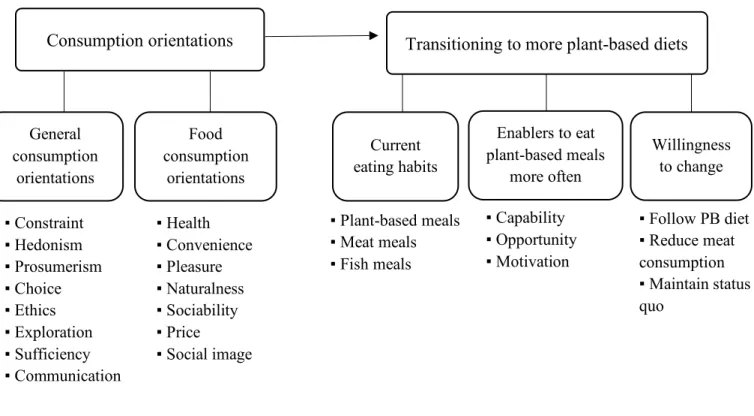
consumption orientations relate with consumers’ self-reported eating habits. The second objective is to observe how these orientations associate with consumer willingness to follow more plant-based diets. Lastly, the third objective is to learn how different consumption orientations relate with the need for different enablers to start eating plant-based meals more often. Figure 1 presents an overview of the variables and dimensions assessed in the present study.
Figure 1. A consumption-focused approach to transitioning to more plant-based diets.
2 METHODS
2.1. Participants and procedure
Data for this study were collected in face-to-face interviews with 1600
participants as part of a larger nation-wide survey on sustainability in Portugal. Quota ▪ Plant-based meals ▪ Meat meals ▪ Fish meals ▪ Follow PB diet ▪ Reduce meat consumption ▪ Maintain status quo
Consumption orientations Transitioning to more plant-based diets
▪ Constraint ▪ Hedonism ▪ Prosumerism ▪ Choice ▪ Ethics ▪ Exploration ▪ Sufficiency ▪ Communication ▪ Health ▪ Convenience ▪ Pleasure ▪ Naturalness ▪ Sociability ▪ Price ▪ Social image General consumption orientations Food consumption orientations Current eating habits ▪ Capability ▪ Opportunity ▪ Motivation Enablers to eat plant-based meals more often Willingness to change
sampling was applied to ensure a demographically representative sample in terms of gender, age groups, and geographical location. Professional interviewers from the Institute of Marketing Research conducted the interviews in the year of 2018, from November 7to December 13, at several times during the day and evening, on weekdays and weekends, using tablets to record the answers (i.e., Computer-Assisted Personal Interviewing; CAPI). Regions and cities were selected in advance to ensure
representation of the several geographical locations, and streets, buildings and households for the interviews were selected randomly. Participants within each
household where also selected randomly using the CAPI software based on gender and age group quotas (one participant per household). The sample (N=1600) was well balanced in terms of gender (842 female, 52.6%; 758 male, 47.4%), aged between 18 and 90 (M=48.30; SD=16.35), and participants had completed up to primary (30.1%), secondary (32.9%), or tertiary education (37%).
2.2 Measures
General consumption orientations. To measure general consumption
orientations, we used a 24-item measure developed for the purposes of this study based on inputs from Gabriel & Lang (2015) and Mansvelt & Robbins (2011). The measure had a 5-point Likert-type scale (1 = totally disagree to 5 = totally agree) and comprised the dimensions of constraint (e.g., “To use the lowest price as the main criteria when doing the shopping”, 3 items, a=.71), hedonism (e.g., “To enjoy buying new things”, 3 items, a=.72), prosumerism (e.g., “To make or repair things myself (‘do it yourself’)”, 3 items, a=.79), choice (e.g., “To have as many different choices as possible”, 3 items,
a=.81), ethics (e.g., “To consider how my consumption habits may impact others and
items, a=.76), sufficiency (e.g., “To acknowledge that consumption does not necessarily bring me wellbeing”, 3 items, a=.75), and communication (e.g., “To convey an image through the products and services that I use”, 3 items, a=.70). The scale items are presented in full in the Supplementary Material.
Food consumption orientations. To measure food consumption orientations, we
used 21 items from the Eating Motivation Survey (Renner et al., 2012; Sproesser et al., 2018) with a 5-point Likert-type scale (1 = totally disagree to 5 = totally agree). The measure comprised the dimensions of health (e.g., “Because it is healthy”, 3 items,
a=.77), convenience (e.g., “Because it is quick to prepare”, 3 items, a=.86), pleasure
(e.g., “In order to indulge myself”, 3 items, a=.71), naturalness (e.g., “Because it is organic”, 3 items, a=.75), sociability (e.g., “So that I can spend time with other people”, 3 items, a=.87), price (e.g., “Because I don’t want to spend any more money”, 3 items,
a=.78), and social image (e.g., “Because it makes me look good in front of others”, 3
items, a=.84). The scale items for this measure are also presented in full in the Supplementary Material.
Eating habits. To measure current eating habits, participants were asked to
indicate how many lunch and dinner meals they usually ate in a regular week which contained: (a) white meat (e.g., chicken; turkey); (b) red meat (e.g., beef; pork); (c) fish; and (d) no meat and no fish. An aggregate measure of meat eating habits was computed by adding participants’ responses on white and red meat consumption1.
1 Although the flesh of fish can also be considered meat, in this study we followed a conventional
representation in consumption and retail, which is to distinguish between ‘meat’ and ‘fish’ as broad but separate product categories (e.g., Morales & Higuchi, 2018; Schösler et al., 2012).
Enablers to start eating more plant-based meals. To measure which enablers
consumers signaled as most important to start eating plant-based meals more often, participants were first presented with a short introductory sentence “Plant-based meals may include foods coming from plants, such as legumes (e.g., chickpeas, beans), cereals (e.g., rice or wheat), fruit and vegetables, root crops (e.g., potatoes), nuts and seeds, among others. Typically, these meals do not include food products that come from animals, such as meat, fish, dairy and eggs”. They were then presented 10 items based on the COM-B framework (Michie et al., 2011, 2014) targeted to plant-based meals, and asked to indicate to what extent each of those features was important for them to eat plant-based meals more often (using a 5-point Likert-type scale, 1 = totally disagree to 5 = totally agree). The measure targeted capability (e.g., “Knowing more recipes for plant-based meals”, 3 items, a=.89), opportunity (e.g., “Ensuring that plant-based meals are more accessible and convenient (e.g., supermarkets, restaurants)”, 3 items, a=.77), and motivation (e.g., “Feeling pleasure for eating plant-based meals”, 4 items, a=.91). The scale items for this measure are presented in full in the Supplementary Material.
Willingness to change. To measure willingness to change, participants were first
presented with the short introductory sentence: “In recent times, meat consumption is being increasingly debated on the grounds of environmental concerns (e.g., water resources, deforestation) and social concerns (e.g., health; use of antibiotics). Please indicate to what extent you would be willing to perform the following actions”. Using a 5-point Likert-type scale (1 = not willing at all to 5 = entirely willing), two items
addressed distinct but related target actions, namely: “Following a plant-based diet” and “Reducing meat consumption”. Using the same 5-point scale, the other item referred to
actively reaffirming the status quo, namely: “Continue eating meat without concern for these questions”.
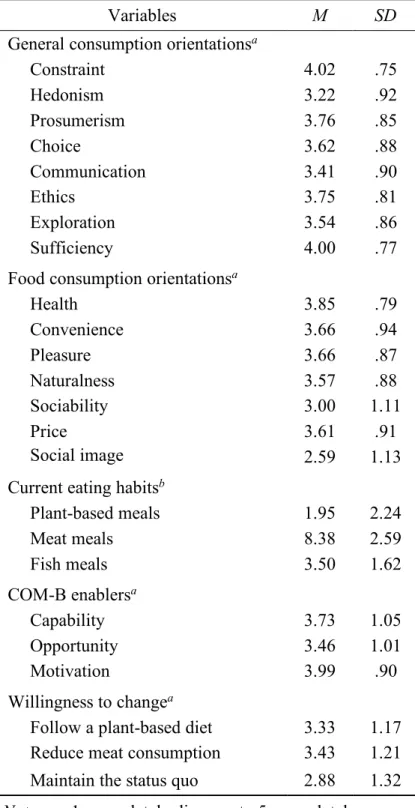
[TABLE 1]
3 RESULTS
A set of linear regressions were performed using IBM SPSS Statistics v.25, to test how general consumption and food consumption orientations related with
consumers’ current eating habits, willingness to change, and enablers to start eating plant-based meals more often (descriptive statistics for the variables in the study are presented in Table 1). We tested two models (general consumption orientations; food consumption orientations) to address each set of three criterion variables, specifically current eating habits (i.e., plant-based meals, meat meals, fish meals), willingness to change (i.e., follow plant-based diet, reduce meat consumption, maintain the status quo), and the COM-B enablers (i.e., capability, opportunity, motivation). No problems of multicollinearity were detected in the analyses (VIF range: 1.50 to 2.62; tolerance range: .38 to .67), and the residuals showed no marked deviations from normality. In addition to addressing the main research questions, findings on how current eating habits and willingness to change related with demographic variables in this sample (i.e., age, gender, education level) are available in the Supplementary Material (e.g., the female gender and higher education were associated with increased consumption of plant-based meals, decreased consumption of meat meals, increased willingness to reduce meat consumption and to follow a plant-based diet, and decreased support to maintaining the status quo; Tables S2 to S4).
3.1 How do different general consumption and food consumption orientations relate with consumers’ current eating habits?
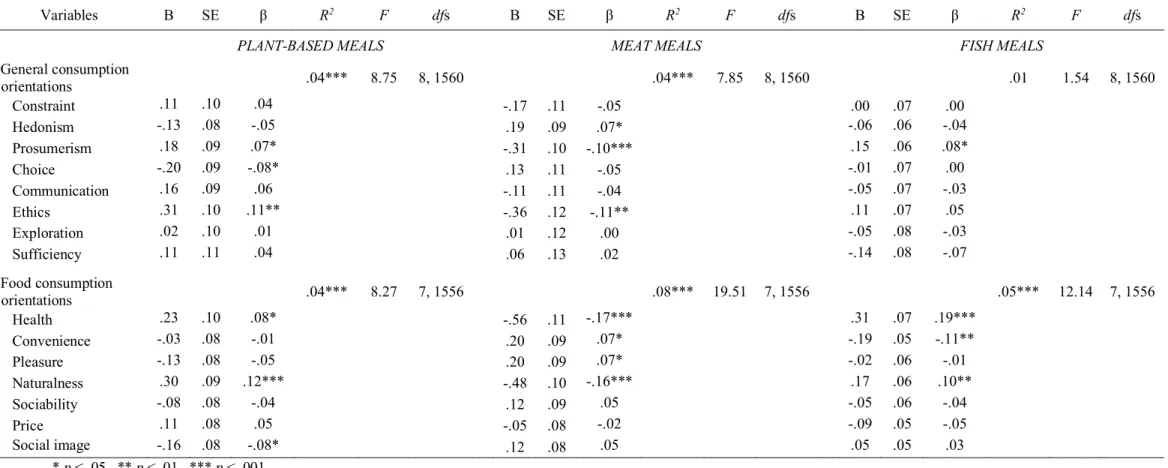
In terms of general consumption orientations, higher orientations toward prosumerism and ethics were associated with increased consumption of PB meals in a regular week (Table 2). In contrast, higher orientations toward choice were associated with decreased consumption of PB meals in a regular week (Table 2). As for food consumption orientations, consumers who particularly valued naturalness and health issues tended to eat more PB meals in a regular week, whereas consumers who
particularly valued social image tended to eat less PB meals in a regular week (Table 2). Higher general consumption orientations toward hedonism were associated with more frequent meat consumption (Table 2). In contrast, higher orientations toward prosumerism and ethics were associated with eating meat less frequently (Table 2). As for food consumption orientations, valuing convenience and pleasure was associated with eating meat more often, whereas expressing naturalness and health concerns related with less frequent meat consumption (Table 2; but see Table S5 in the Supplementary Material for the results considering white meat and red meat in separate).
The model testing the role of general consumption orientations on frequency of meals with fish did not reach the threshold of statistical significance (Table 2).
Nevertheless, orientations toward prosumerism seemed to be associated with more frequent fish consumption (Table 2). As for food consumption orientations, expressing health and naturalness concerns also related with more frequent fish consumption (Table 2). In contrast, consumers who emphasized convenience in terms of food consumption orientation tended to eat fish less often in a regular week (Table 2).
3.2 How do different general consumption and food consumption orientations relate with consumers’ willingness to change?
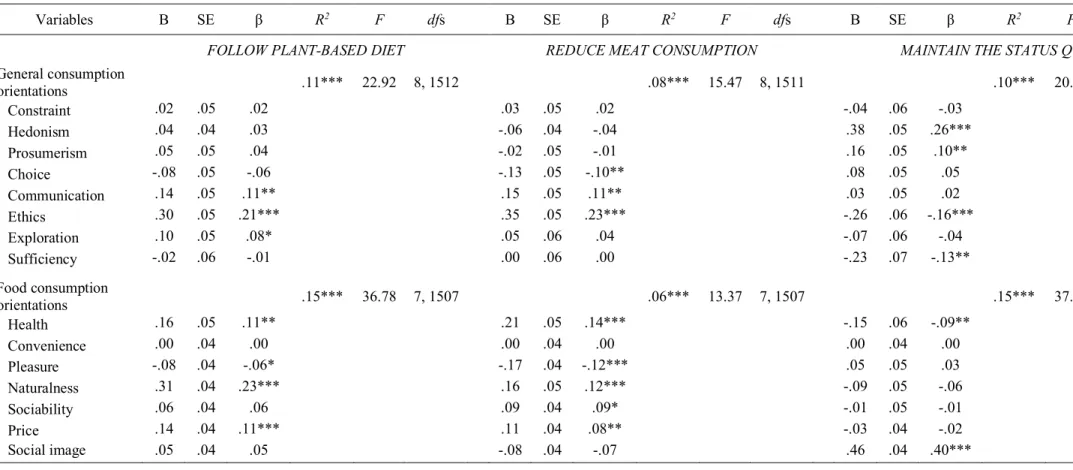
Higher general consumption orientations toward communication, ethics, and exploration, were associated with increased willingness to reduce meat consumption and/or following a plant-based diet (Table 3). However, orientations toward choice showed a negative association with willingness to reduce meat consumption, and consumers with marked orientations toward hedonism and prosumerism showed an increased inclination to maintaining the status quo (i.e. continue to eat meat
irrespectively of the social and environmental consequences) (Table 3). Higher
consumption orientations toward ethics and sufficiency were associated with expressing an affirmative stance against maintaining the status quo (Table 3).
Higher food consumption orientations toward health, naturalness, price, and sociability, were associated with increased willingness to reduce meat consumption and to follow a plant-based diet (Table 3). Sociability was positively associated with
willingness to reduce meat consumption, but not with willingness to follow a plant-based diet (Table 3). In turn, inclinations to maintaining the status quo were noticeably higher when social image was a key driver of food consumption orientations, and lower when these orientations were marked mostly by health concerns (Table 3).
[TABLE 3]
3.3 How do different consumption orientations relate with an emphasis on the need for different enablers to start eating plant-based meals more often?
Higher general consumption orientations toward constraint, ethics, and exploration, were associated with expressing increased need for all three capability, opportunity and motivation features to start eating more plant-based meals (Table 4). Orientations toward hedonism were associated with emphasizing the need for
opportunity variables, while orientations toward sufficiency associated with increased need for enhancing motivation (Table 4). Additionally, consumption orientations toward communication were associated with increased need for opportunity, and a disregard for the role of motivation features to start eating more plant-based meals (Table 4). Lastly, orientations toward prosumerism were associated with a disregard for opportunity features (Table 4).
Higher food consumption orientations toward health, convenience, and naturalness, were associated with expressing increased need for all three capability, opportunity and motivation features to start eating more plant-based meals (Table 4). In turn, sociability and price orientations were associated with increased need for
capability and opportunity features (Table 4). Pleasure orientations were associated with a disregard for the role of capability features, but highlighted the need for building motivation features instead (Table 4). Lastly, increased food consumption orientations toward social image were associated with a disregard for both capability and motivation features to start eating a more plant-based diet (Table 4).
[TABLE 4]
4 DISCUSSION
The present study aimed to provide inputs to help materialize shifts toward increased consumption of plant-based meals and plant-based food products.
Specifically, it addressed how general consumption orientations and food consumption orientations related with current eating habits, consumer willingness to change, and enablers to start eating plant-based meals more often.
The first contribution provided by this study was identifying how different general consumption and food consumption orientations related with consumers’ current consumption of plant-based and animal-sourced meals. The findings in the
present sample showed that plant-based meals already have increased traction with general orientations toward prosumerism and ethics, and food orientations toward health and naturalness. These general and specific orientations were also associated with decreased current consumption of meals with meat. This suggests that consumers who were oriented toward a greater self-reliance and ethical concern in terms of general consumption, and favor foods that are healthier and seen as more natural, were already actors in a transition to reduced meat consumption and increased plant-based eating. It also supports previous findings that emphasize both health and ethical reasons as current facilitators to follow plant-based diets (e.g., de Boer et al., 2017; Cliceri et al., 2018; Graça et al., 2015; Lacroix, & Gifford, 2019; Rosenfeld, 2018; Rosenfeld & Burrow, 2017; Ruby, 2012; Ruby & Heine, 2012). Interestingly, food consumption orientations predicted meat versus fish consumption consistently in different directions, which is meaningful in light of recent evidence that pescatarians as a consumer group (i.e., individuals who forgo all meats except fish) may have distinct dietary identities and motivations when compared both to meat-eaters and to other meat-avoiders (Rosenfeld & Tomiyama, 2019).
It was noteworthy that general orientations toward choice and food orientations toward social image were associated with decreased consumption of plant-based meals. Additionally, general orientations toward hedonism, as well as food orientations toward convenience and pleasure, were associated with increased consumption of meals with meat. Taken together, these findings suggested that consumers for whom it is important to feel enjoyment in their general consumption experiences, and to have as much choice as possible, are not yet aligned with this transition to more plant-based diets. This was mirrored in food orientations as well, in which emphasizing the value of hedonistic food experiences (i.e., pleasure) and accessible and ready-to-eat meals (i.e., convenience)
was associated with increased meat consumption. These results are in line with previous studies showing that the hedonic component of meat consumption, coupled with a sense of entitlement to eating meat, are important barriers to change (Graça et al., 2015; Macdiarmid et al., 2016; Monteiro et al., 2017; Spencer & Guinard, 2018; Tucker, 2014). It also adds to recent concerns with social prejudice against plant-based eating (Markowski & Roxburgh, 2019), and the presence of dominant social, media and market structures that still reinforce the practice of eating meat as the normalized aspect of food consumption (Gravely & Fraser, 2018; Tjärnemo & Södahl, 2015).
Most of the findings on current eating habits were also reinforced in the second main contribution of the present study, which was to identify associations between consumption orientations and consumer willingness to change. Ethical concerns (in general consumption) and health concerns (in food consumption) were particularly reliable in predicting willingness to change, followed by (general) communication and sufficiency orientations, and (food) naturalness, sociability, and price orientations. As a whole, this suggests that there are plenty of opportunities to align the transition with consumption orientations that are already associated with several manifestations of willingness to change. Interestingly, orientations toward prosumerism were associated with decreased consumption of meals with meat, but also with a lack of willingness to change, which suggests the presence of a ‘ceiling effect’ in which some consumers may have already changed their habits in the past, and may not feel willing or responsible to make further changes in the present. A mismatch was also identified in which
willingness to change was negatively related with prioritizing choice and feelings of enjoyment in one’s general consumption experiences, and valuing pleasure and social image reasons in terms of food consumption. In other words, this suggests that the pathways to more plant-based eating which may build upon some of these general
consumption and food consumption orientations are not available. Potential implications of these findings will be addressed further ahead in the discussion.
The third main contribution that this work delivered was focused on
investigating how different consumption orientations related with a need for different enablers to start eating plant-based meals more often. We considered the COM-B system of behavior (Michie et al., 2011, 2014), which proposes a set of capability, opportunity, and motivation features to enable behavior change, applied to plant-based eating. Taken as a whole, the findings showed a need for improving all three capability, opportunity and motivation features to eat plant-based meals more frequently. However, noteworthy exceptions to this trend were (general) orientations toward prosumerism and communication, and (food) orientations toward pleasure and social image. Devaluing the features of the context (i.e. opportunity) to perform a given behavior is in line with increased inclinations toward self-sufficiency, self-reliance, and a ‘do-it-yourself (DIY) attitude’, which lie at the core of prosumerist orientations (Gabriel & Lang, 2015; Ritzer et al., 2012). With regard to (general) communication orientations, conveying a message through the use of goods and products is an important feature of this orientation, and the emphasis was on building opportunity while disregarding the role of motivation. As for (food) pleasure orientations, there was a marked need for enhancing motivation, which includes improving taste experiences and expectations with regard to plant-based meals, and a disregard for capability features, likely because in this orientation the main driver of food choice is indeed enjoyment and self-reward (Renner et al., 2012; Sproesser et al., 2018). Lastly, (food) social image orientation was consistently identified as a barrier throughout the study, and this negative tendency was confirmed in this stage as well. Consumers who were more inclined to eat what they think makes them look good in front of others actively disregarded the need for capability and motivation features to eat
more plant-based meals. Potential implications of these findings will be discussed in the following section. Nevertheless, we emphasize that the overall trend was that most consumption orientations seemed to benefit from pathways that improve the three domains in parallel (i.e. capability, opportunity, motivation) to start eating plant-based meals more often, which is in line with the propositions of the COM-B system of behavior (cf. Michie et al., 2011, 2014).
4.1 Implications for developing, marketing and promoting based meals and plant-forward lifestyles
Evidence that different consumption orientations are linked to consumer transitions to more plant-based diets can be used to inform strategies for tailored marketing, communication, and materials. More specifically, designing several strategies in parallel to address distinct consumption orientations may be a means for building and communicating different pathways to a transition that work with those underlying orientations, rather than against them, with ever-increasing numbers of consumers. This focus on strategically creating conditions for improving flow - rather than building tension - is based on a growing body of evidence from behavior sciences on processes of motivated reasoning (Epley & Gilovich, 2016; Hornsey & Fielding, 2017). In short, this growing body of evidence has been showing that consumers tend to hold on to attitudes and cling to behaviors that reinforce their current practices and orientations, while disregarding efforts that may go against these practices and orientations (Bastian, 2019; Hornsey & Fielding, 2017). Also, sociological work has shown that food practices are locked in on path and culture dependent trajectories that are difficult to unlock (Warde, 2016). Moreover, there is indeed evidence that processes of motivated reasoning often come into play when consumers consider changing their
meat consumption, which are arguably triggered by loss aversion (Ang et al., 2019; Bastian & Loughnan, 2017; Graça et al., 2016; Piazza et al., 2015).
Thus, when applying these insights to the current target, part of the challenge is to associate a transition towards more plant-based diets with the shared meanings and understandings that people internalize and collectively display towards goods and services during processes of acquisition, appropriation, appreciation and disposal (Warde, 2017) and thus, reconfiguring such orientations already operating in their daily lives. Against this backdrop, the findings from the present study illustrate how some consumption orientations seem to be currently linked with a transition toward reduced meat consumption and increased plant-based eating, namely (general) prosumerism and ethics orientations, and (food) health and naturalness concerns. This suggests that current plant-based products and plant-forward lifestyles are built upon (and successfully address) mainly these orientations. Thus, one path for relevant
organizations and market actors is to build upon and sustain these associations, which are already established and operating in favor of a transition toward more plant-based diets.
Another set of orientations seemed to be not yet fully linked but somewhat permeable to the transition, as observed in our findings on consumption orientations and willingness to change. These included (general) communication and exploration
orientations, and (food) price and sociability orientations. This suggests that there is room and opportunity for organizations and market actors to successfully strengthening the links between plant-based products and consumer’s everyday practices, and these orientations. For instance, future studies could develop and test advertising strategies and materials which implicitly or explicitly associate specific plant-based meal-types with price consciousness (to target food price orientations), and see how different meals
that are positioned as ‘price-conscious’ appeal to different consumers. The same could apply for example to studies developing strategies to associate plant-based ways of life with more adventurous, innovative and creative consumption experiences, to target general exploration orientations, and again test if this could help gain traction with some consumers.
Lastly, one set of orientations measured in this study seemed to be currently in tension with a transition towards more plant-based diets, considering our findings on current eating habits, willingness to change, and enablers to eat plant-based meals more often. We refer mainly to (general) orientations toward choice and (food) orientations toward social image, although (food) orientations toward pleasure also seemed to be somewhat challenging. These orientations emerged as overall barriers to the transition throughout the study, which raises the hypotheses that some participants: (a) perceived negative links between plant-based eating and their self-determination as consumers (i.e., choice); (b) held negative stereotypes against consumers who eat plant-based meals or follow forward lifestyles (i.e., social image); and/or (c) associated plant-based eating with unattractive taste experiences (i.e., pleasure). In other words, these negative associations suggest that, to some extent, the transition activates a loss frame in some consumers with regard to these orientations (e.g., feelings of deprivation, or lack of gratification). Future studies are thus needed to test how efforts to build and convey positive associations between plant-based eating and these orientations may help move the transition forward (e.g., how to associate feelings of enjoyment with plant-based diets, which parallels or surpasses enjoyment derived from of eating meat-based dishes).
4.2 Limitations and additional future directions
Some limitations of this study should be noted so that further studies can address them in the near future. One limitation is that we did not consider all potentially
relevant general consumption and food consumption orientations due to space constraints in the survey. Thus, future studies could improve the models that were tested, and assess whether including additional consumption orientations increases explanatory capacity. Given that the internal consistency of the general consumption orientations ranged from acceptable to good (i.e., a=.70 to a=.81), efforts to further improve the measures would also be useful. Future studies could also extend the scope of the present work to focus on identifying and targeting consumer profiles, in addition to exploring consumption orientations, which will be helpful to further informing efforts to tailor contents to specific audiences. Studies measuring the present variables in diverse countries and cultural backgrounds are also warranted, to identify potential differences and similarities across contexts. Lastly, although the current study used cross-sectional data, further research using different methodological designs should be useful to extend the current findings. Longitudinal research is needed in the future to fully capture the social-cultural and psychological dynamics of consumer transitions to more plant-based diets and plant-forward lifestyles. Similarly, experimental research would allow testing how different framings, reconfigurations and experiences of plant-based eating (e.g., expensive or cheap, socially endorsed or stigmatized, self-determined or restrictive, delicious and diverse or bland and limited) would help encourage
consumers to eat increasingly more plant-based foods and meals. Additional
methodological approaches (e.g., ethnography, phenomenological research, grounded theory; Crotty, 2015) are also warranted in order to complement, deepen, enrich and expand our knowledge on this topic.
4.3 Conclusions
Putting plant-based meals and food products increasingly at the center of our diets is acknowledged as a fundamental challenge to enable healthier and more
sustainable food systems. To shape and sustain these changes at scale, market actors and relevant (public/private) organizations will need to develop strategies to convey positive and attractive representations of plant-based eating and plant-forward lifestyles, to diverse audiences and consumers. The present work aimed to provide inputs to inform these strategies, and was the first to identify trends and differences on current eating habits, consumer willingness to change, and enablers to start eating more plant-based meals, considering consumer orientations towards consumption in general and food consumption in particular. Relevant features already linked with the transition were (general) orientations toward prosumerism and ethics, and (food) orientations toward health and naturalness. Features not yet linked with the transition, but showing
permeability and promising opportunities for change, were (general) orientations toward communication and exploration, and (food) orientations toward price and sociability. Lastly, features currently in tension with the transition were (general) orientations toward choice, and (food) orientations toward social image and pleasure. Future studies are needed to expand on these findings and investigate how to create a range of
pathways that work with – rather than against – these distinct and sometimes possibly competing underlying orientations, and how to insert these pathways in the dynamics of everyday life practices.
Acknowledgements
The authors would like to thank two anonymous reviewers for their inputs that helped improve this article, which included ideas for further research presented in the section ‘Limitations and additional future directions’. This work was partly supported by Sonae MC and a grant from the Portuguese Foundation for Science and Technology (FCT; SFRH/BPD/115110/2016), awarded to the first author.
REFERENCES
Aiking, H., & de Boer, J. (2018). The next protein transition. Trends in Food Science & Technology. https://doi.org/10.1016/j.tifs.2018.07.008
Ang, C. S., Chan, N. N., & Singh, L. (2019). A comparison study of meat eaters and non-meat eaters on mind attribution and moral disengagement of animals.
Appetite, 136, 80-85.
Bastian, B. (2019). Changing Ethically Troublesome Behavior: The Causes,
Consequences, and Solutions to Motivated Resistance. Social Issues and Policy
Review, 13(1), 63-92.
Bastian, B., & Loughnan, S. (2017). Resolving the meat-paradox: A motivational account of morally troublesome behavior and its maintenance. Personality and
Social Psychology Review, 21(3), 278-299.
Bryant, C. J., Szejda, K., Deshpande, V., Parekh, N., & Tse, B. (2019). A Survey of Consumer Perceptions of Plant-Based and Clean Meat in the USA, India, and China. Frontiers in Sustainable Food Systems, 3, 11.
Clark, L. F., & Bogdan, A. M. (2019). The Role of Plant-Based Foods in Canadian Diets: A Survey Examining Food Choices, Motivations and Dietary Identity.
Clark, M. & Tilman, D. (2017), Comparative analysis of environmental impacts of agricultural production systems, agricultural input efficiency, and food choice,
Environmental Research Letters, 12(6), 064016.
Cliceri, D., Spinelli, S., Dinnella, C., Prescott, J., & Monteleone, E. (2018). The influence of psychological traits, beliefs and taste responsiveness on implicit attitudes toward plant-and animal-based dishes among vegetarians, flexitarians and omnivores. Food Quality and Preference, 68, 276-291.
Crotty, M. (2015). The Foundations of Social Research – Meaning and Perspective in
the Research Process. London: Sage.
de Boer J, Aiking H. (2019). Strategies towards healthy and sustainable protein consumption: A transition framework at the levels of diets, dishes, and dish ingredients. Food Quality and Preference, 73, 171-181.
de Boer, J., & Aiking, H. (2017). Pursuing a low meat diet to improve both health and sustainability: How can we use the frames that shape our meals?. Ecological
Economics, 142, 238-248.
de Boer, J., Schösler, H., & Aiking, H. (2017). Towards a reduced meat diet: Mindset and motivation of young vegetarians, low, medium and high meat-eaters.
Appetite, 113, 387-397.
Epley, N., & Gilovich, T. (2016). The mechanics of motivated reasoning. Journal of
Economic perspectives, 30(3), 133-40.
Gabriel, Y. & Lang, T. (2015). The Unmanageable Consumer (3rd edition). London: Sage.
Geeroms, N., Verbeke, W., & Van Kenhove, P. (2008). Consumers’ health-related motive orientations and ready meal consumption behaviour. Appetite, 51(3), 704-712.
Graça, J., Calheiros, M. M., & Oliveira, A. (2015). Attached to meat?(Un) Willingness and intentions to adopt a more plant-based diet. Appetite, 95, 113-125.
Graça, J., Calheiros, M. M., & Oliveira, A. (2016). Situating moral disengagement: Motivated reasoning in meat consumption and substitution. Personality and
Individual Differences, 90, 353-364.
Gravely, E., & Fraser, E. (2018). Transitions on the shopping floor: Investigating the role of Canadian supermarkets in alternative protein consumption. Appetite, 130, 146-156.
Hartmann, C., & Siegrist, M. (2017). Consumer perception and behaviour regarding sustainable protein consumption: A systematic review. Trends in Food Science
& Technology, 61, 11-25.
Hornsey, M. J., & Fielding, K. S. (2017). Attitude roots and Jiu Jitsu persuasion: Understanding and overcoming the motivated rejection of science. American
Psychologist, 72(5), 459.
Lacroix, K. (2018). Comparing the relative mitigation potential of individual pro-environmental behaviors. Journal of Cleaner Production, 195(10), 1398-1407. Lacroix, K., & Gifford, R. (2019). Reducing meat consumption: Identifying
group-specific inhibitors using latent profile analysis. Appetite, 138, 233-241. Lentz, G., Connelly, S., Mirosa, M., & Jowett, T. (2018). Gauging attitudes and
behaviours: Meat consumption and potential reduction. Appetite, 127, 230-241. Macdiarmid, J. I., Douglas, F., & Campbell, J. (2016). Eating like there's no tomorrow: Public awareness of the environmental impact of food and reluctance to eat less meat as part of a sustainable diet. Appetite, 96, 487-493.
Mansvelt, J., & Robbins, P. (2011). Green consumerism, an A-to-Z Guide. Thousand Oaks: Sage Publications, Inc.
Markowski, K. L., & Roxburgh, S. (2019). “If I became a vegan, my family and friends would hate me:” Anticipating vegan stigma as a barrier to plant-based diets.
Appetite, 135, 1-9.
Michie, S., Atkins, L., & West, R. (2014). The behaviour change wheel: A guide to designing interventions. London: Silverback Publishing.
Michie, S., van Stralen, M. M., & West, R. (2011). The behaviour change wheel: a new method for characterising and designing behaviour change interventions.
Implementation Science, 6, e42.
Monteiro, C. A., Pfeiler, T. M., Patterson, M. D., & Milburn, M. A. (2017). The
Carnism Inventory: Measuring the ideology of eating animals. Appetite, 113, 51-62.
Morales, L. E., & Higuchi, A. (2018). Is fish worth more than meat?–How consumers’ beliefs about health and nutrition affect their willingness to pay more for fish than meat. Food Quality and Preference, 65, 101-109.
Murcott, A. (2019). Introducing the Sociology of Food and Eating. Bloomsbury Publishing.
Piazza, J., Ruby, M. B., Loughnan, S., Luong, M., Kulik, J., Watkins, H. M., &
Seigerman, M. (2015). Rationalizing meat consumption. The 4Ns. Appetite, 91, 114-128.
Poore, J. & Nemecek, T. (2018). Reducing food’s environmental impacts through producers and consumers. Science, 360(6392), 987-992.
Renner, B., Sproesser, G., Strohbach, S., & Schupp, H. T. (2012). Why we eat what we eat. The Eating Motivation Survey (TEMS). Appetite, 59(1), 117-128.
Ritzer, G., Dean, P., & Jurgenson, N. (2012). The coming of age of the prosumer.
Rockström, J., Steffen, W., Noone, K., Persson, Å., Chapin III, F. S., Lambin, E. F., ... & Nykvist, B. (2009). A safe operating space for humanity. Nature, 461(7263), 472.
Rosenfeld, D. L. (2018). The psychology of vegetarianism: Recent advances and future directions. Appetite, 131, 125-138.
Rosenfeld, D. L., & Burrow, A. L. (2017). Vegetarian on purpose: Understanding the motivations of plant-based dieters. Appetite, 116, 456-463.
Rosenfeld, D. L., & Tomiyama, A. J. (2019). How proximal are pescatarians to vegetarians? An investigation of dietary identity, motivation, and attitudes toward animals. Journal of Health Psychology, 1359105319842933.
Ruby, M. B. (2012). Vegetarianism. A blossoming field of study. Appetite, 58(1), 141-150.
Ruby, M. B., & Heine, S. J. (2012). Too close to home. Factors predicting meat avoidance. Appetite, 59(1), 47-52.
Schösler, H., De Boer, J., & Boersema, J. J. (2012). Can we cut out the meat of the dish? Constructing consumer-oriented pathways towards meat substitution. Appetite,
58(1), 39-47.
Spencer, M., & Guinard, J. X. (2018). The Flexitarian Flip™: Testing the Modalities of Flavor as Sensory Strategies to Accomplish the Shift from Meat-Centered to Vegetable-Forward Mixed Dishes. Journal of food science, 83(1), 175-187. Springmann, M., Godfray, H. C. J., Rayner, M., & Scarborough, P. (2016), Analysis and
valuation of the health and climate change cobenefits of dietary change.
Sproesser, G., Ruby, M. B., Arbit, N., Rozin, P., Schupp, H. T., & Renner, B. (2018). The Eating Motivation Survey: results from the USA, India and Germany. Public
health nutrition, 21(3), 515-525.
Tilman, D., & Clark, M. (2014). Global diets link environmental sustainability and human health. Nature, 515(7528), 518.
Tjärnemo, H., & Södahl, L. (2015). Swedish food retailers promoting climate smarter food choices—trapped between visions and reality?. Journal of retailing and
consumer services, 24, 130-139.
Tucker, C. A. (2014). The significance of sensory appeal for reduced meat consumption.
Appetite, 81, 168-179.
Warde, A. (2016). The Practice of Eating. Cambridge: Polity Press.
Warde, A. (2017). Consumption – A Sociological Analysis. London: Palgrave MacMillan.
Westhoek, H., Lesschen, J. P., Rood, T., Wagner, S., De Marco, A., Murphy-Bokern, D., ... & Oenema, O. (2014). Food choices, health and environment: effects of cutting Europe's meat and dairy intake. Global Environmental Change, 26, 196-205.
Willett, W., Rockström, J., Loken, B., Springmann, M., Lang, T., Vermeulen, S., ... & Jonell, M. (2019). Food in the Anthropocene: the EAT–Lancet Commission on healthy diets from sustainable food systems. The Lancet, 393(10170), 447-492.
Table 1. Descriptive statistics for the variables in the study.
Variables M SD
General consumption orientationsa
Constraint 4.02 .75 Hedonism 3.22 .92 Prosumerism 3.76 .85 Choice 3.62 .88 Communication 3.41 .90 Ethics 3.75 .81 Exploration 3.54 .86 Sufficiency 4.00 .77
Food consumption orientationsa
Health 3.85 .79 Convenience 3.66 .94 Pleasure 3.66 .87 Naturalness 3.57 .88 Sociability 3.00 1.11 Price 3.61 .91 Social image 2.59 1.13
Current eating habitsb
Plant-based meals 1.95 2.24 Meat meals 8.38 2.59 Fish meals 3.50 1.62 COM-B enablersa Capability 3.73 1.05 Opportunity 3.46 1.01 Motivation 3.99 .90 Willingness to changea
Follow a plant-based diet 3.33 1.17 Reduce meat consumption 3.43 1.21 Maintain the status quo 2.88 1.32
Notes. a: 1- completely disagree to 5- completely agree; b: 0 lunch/dinner meals to 14 lunch/dinner meals,
Table 2. Consumption orientations and current eating habits.
Variables B SE β R2 F dfs B SE β R2 F dfs B SE β R2 F dfs
PLANT-BASED MEALS MEAT MEALS FISH MEALS
General consumption orientations .04*** 8.75 8, 1560 .04*** 7.85 8, 1560 .01 1.54 8, 1560 Constraint .11 .10 .04 -.17 .11 -.05 .00 .07 .00 Hedonism -.13 .08 -.05 .19 .09 .07* -.06 .06 -.04 Prosumerism .18 .09 .07* -.31 .10 -.10*** .15 .06 .08* Choice -.20 .09 -.08* .13 .11 -.05 -.01 .07 .00 Communication .16 .09 .06 -.11 .11 -.04 -.05 .07 -.03 Ethics .31 .10 .11** -.36 .12 -.11** .11 .07 .05 Exploration .02 .10 .01 .01 .12 .00 -.05 .08 -.03 Sufficiency .11 .11 .04 .06 .13 .02 -.14 .08 -.07 Food consumption orientations .04*** 8.27 7, 1556 .08*** 19.51 7, 1556 .05*** 12.14 7, 1556 Health .23 .10 .08* -.56 .11 -.17*** .31 .07 .19*** Convenience -.03 .08 -.01 .20 .09 .07* -.19 .05 -.11** Pleasure -.13 .08 -.05 .20 .09 .07* -.02 .06 -.01 Naturalness .30 .09 .12*** -.48 .10 -.16*** .17 .06 .10** Sociability -.08 .08 -.04 .12 .09 .05 -.05 .06 -.04 Price .11 .08 .05 -.05 .08 -.02 -.09 .05 -.05 Social image -.16 .08 -.08* .12 .08 .05 .05 .05 .03 * p < .05 ** p < .01 *** p < .001.
Table 3. Consumption orientations and willingness to change.
Variables B SE β R2 F dfs B SE β R2 F dfs B SE β R2 F dfs
FOLLOW PLANT-BASED DIET REDUCE MEAT CONSUMPTION MAINTAIN THE STATUS QUO
General consumption orientations .11*** 22.92 8, 1512 .08*** 15.47 8, 1511 .10*** 20.34 8, 1461 Constraint .02 .05 .02 .03 .05 .02 -.04 .06 -.03 Hedonism .04 .04 .03 -.06 .04 -.04 .38 .05 .26*** Prosumerism .05 .05 .04 -.02 .05 -.01 .16 .05 .10** Choice -.08 .05 -.06 -.13 .05 -.10** .08 .05 .05 Communication .14 .05 .11** .15 .05 .11** .03 .05 .02 Ethics .30 .05 .21*** .35 .05 .23*** -.26 .06 -.16*** Exploration .10 .05 .08* .05 .06 .04 -.07 .06 -.04 Sufficiency -.02 .06 -.01 .00 .06 .00 -.23 .07 -.13** Food consumption orientations .15*** 36.78 7, 1507 .06*** 13.37 7, 1507 .15*** 37.34 7, 1456 Health .16 .05 .11** .21 .05 .14*** -.15 .06 -.09** Convenience .00 .04 .00 .00 .04 .00 .00 .04 .00 Pleasure -.08 .04 -.06* -.17 .04 -.12*** .05 .05 .03 Naturalness .31 .04 .23*** .16 .05 .12*** -.09 .05 -.06 Sociability .06 .04 .06 .09 .04 .09* -.01 .05 -.01 Price .14 .04 .11*** .11 .04 .08** -.03 .04 -.02 Social image .05 .04 .05 -.08 .04 -.07 .46 .04 .40*** * p < .05 ** p < .01 *** p < .001.
Table 4. Consumption orientations and COM-B enablers to eat plant-based meals more often.
Variables B SE β R2 F dfs B SE β R2 F dfs B SE β R2 F dfs
CAPABILITY OPPORTUNITY MOTIVATION
General consumption orientations .16*** 35.66 8, 1535 .19*** 45.29 8, 1535 .26*** 66.91 8, 1534 Constraint .21 .04 .15*** .11 .04 .09** .18 .04 .15*** Hedonism .02 .04 .01 .11 .03 .10** -.01 .03 -.01 Prosumerism .01 .04 .01 -.08 .04 -.07* -.06 .03 -.06 Choice -.05 .04 -.05 -.04 .04 -.03 .02 .03 .02 Communication .02 .04 .02 .18 .04 .16*** -.08 .03 -.08* Ethics .26 .04 .20*** .19 .04 .15*** .21 .04 .19*** Exploration .12 .05 .10** .16 .04 .17*** .09 .04 .08* Sufficiency .09 .05 .07 .05 .05 .04 .33 .04 .28*** Food consumption orientations .20*** 53.93 7, 1534 .23*** 66.26 7, 1535 .24*** 70.01 7, 1533 Health .29 .04 .22*** .13 .04 .10** .31 .04 .27*** Convenience .08 .03 .07* .12 .03 .11*** .07 .03 .07* Pleasure -.11 .04 -.09** .04 .03 .03 .19 .03 .18*** Naturalness .16 .04 .13*** .10 .03 .09** .085 .03 .08** Sociability .17 .03 .18*** .21 .03 .23*** .026 .03 .03 Price .22 .03 .19*** .16 .03 .14*** .02 .02 .02 Social image -.20 .03 -.21*** .01 .03 .01 -.22 .03 -.27*** * p < .05 ** p < .01 *** p < .001.