BJRS
RADIATION SCIENCES
06-02-A (2018) 01-17Acepted: 2018-06-25
Environmental quality evaluation of soil from
Pernambuco’s recreational park
C. K. L. Fonseca
a; B. E. S. Melo
b; V. L. B. Souza
a, S. D. Barbosa
a; W. A. Silva
aaCentro Regional de Ciências Nucleares do Nordeste (CRCN-NE), Comissão Nacional de Energia Nuclear (CNEN),
50740-540, Recife-PE, Brasil
b Universidade Federal de Pernambuco, 50670, Recife – PE, Brasil
RESUMO
Parques e praças inseridas em ambientes urbanos são influenciados por diversas fontes antropogênicas de elementos químicos. Programas de atividade física merecem ser realizados em espaços que possuam boa qualidade ambiental e evitem o contato com substâncias químicas indesejadas resultantes da poluição ambiental. O Parque Apipucos Maximiano Campos, localizado no bairro Apipucos, na cidade de Recife – PE faz parte do Projeto Capibaribe Melhor, que visa preservar o rio Capibaribe, além de promover o entretenimento da população local. O parque era anteriormente uma área verde contendo sucatas, que foram removidas para a construção do parque, mas ainda é afetado pelas emissões de veículos. Considerando a possibilidade de efeitos negativos para a saúde causados por contaminantes locais, a concentração de Cu, Fe, Mn, Ni, Pb e Zn no solo do Parque Apipucos Maximiano Campos foi determinada pela técnica de Fluorescência de Raio X Dispersivo de Energia (EDXRF). Quinze amostras de solo foram coletadas em três locais, sob a projeção vertical das coroas das árvores, além de vinte e cinco amostras coletadas no playground. As amostras foram secas em um forno a 60 ° C durante 24 horas e pulverizadas. As concentrações de Cu, Fe e Zn foram características do solo poluído; e as concentrações de Ni e Pb foram superiores aos valores de referência para Pernambuco, quando consideradas as amostras abaixo das árvores. Essas contaminações provavelmente derivaram da sucata previamente depositada. Tais níveis de contaminantes exigem ações públicas para evitar efeitos negativos sobre a saúde da população local e ao meio ambiente.
ABSTRACT
Parks and squares are inserted in urban environments, influenced by diverse anthropogenic sources of chemical elements. Physical activity programs require spaces with proven environmental quality, avoiding undesired contact with chemical substances resulting from environmental pollution. The Apipucos Maximiano Campos Park, located in the Apipucos neighborhood, in the city of Recife - PE, is part of the “Capibaribe Melhor Project” that aims to preserve the Capibaribe River, as well as to promote entertainment for the local population. The park was previously a green area containing scrap metal, which was removed to build the park, but it is still affected by vehicular emissions. Considering the possibility of negative health effects caused by local contaminants, the concentration of Cu, Fe, Mn, Ni, Pb and Zn in the soil of the Apipucos Maximiano Campos Park was determined by the Energy Dispersive X-Ray Fluorescence (EDXRF) technique. Fifteen soil samples were collected at three locations, under the vertical projection of tree crowns. And more twenty-five samples collected in the playground. Before the analysis, the samples were dried in an oven at 60 °C for 24 hours and pulverized. The concentrations of Cu, Fe, and Zn were characteristic of polluted soil; and the concentrations of Ni and Pb were higher than the reference values for Pernambuco. These contaminations probably derived from the previously deposited scrap metal. Such levels of contaminants demand public actions to avoid negative effect to the health of the local population and to the environment.
Keywords: environmental, research, metals, parks, soil.
1. INTRODUTION
Toxic substances can remain in urban soils for long periods, causing negative effects to the environmental quality of public areas [1]; in public gardens and parks, humans as children and ancients that are exposed to significant levels of pollution and some metals may cause toxic effects by inhalation, ingestion and dermal contact with soil [2]. In high concentrations, these chemicals can cause health problems which include: respiratory, neurological and cardiac illnesses, as well as various types of cancer. Children, asthmatics, elderly people and persons with heart problems are more sensitive to environmental pollution for been directly exposed [3].
Such effects are caused by contact with contaminated soil and reach particularly children, who are more susceptible to the deleterious effects of metals on soils, due to their developing nervous system and high rate of absorption [4].
Previous studies conducted in the reservoir, close to Dezessete de Agosto Avenue, high concentrations of Pb were found [5]. The Municipality of Recife is creating Apipucos Maximiano Campos Park [6] that was a green area covered by scrap metal. Nascimento et al. (2017) [7] concluded that the area is currently contaminated by microorganisms, and its atmosphere contains significant levels of pollutants. In addition, scrap yards normally contain high concentrations of Fe, Mn, Hg, As, Co, Zn, Pb, Ni, Cd, Cu and Cr. Urban soils receive a greater load of metals, from vehicular emissions, incinerators, industrial waste, atmospheric deposition of dust and aerosols and other activities [8].
In this study, the concentrations of Cu, Fe, Mg, Ni, Pb, and Zn in the soil of the Apipucos Maximiano Campos Park was conducted by using the EDXRF. The values were compared to reference concentrations provided by environmental agencies of the state and other available literature to evaluate the possibility of contamination by these metals.
2. MATERIALS AND METHODS
2.1. Study Area
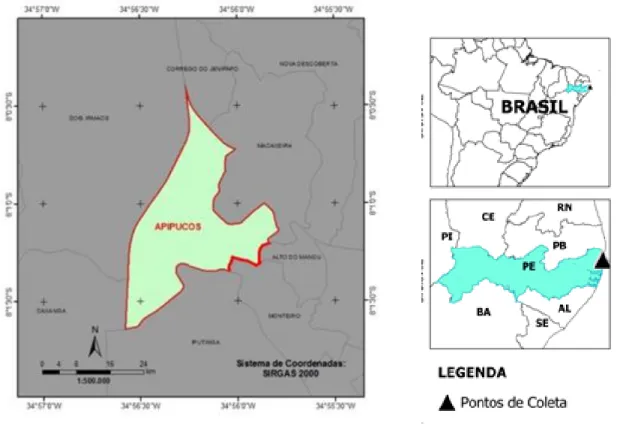
The Apipucos Maximiano Campos Park, located in the Apipucos neighborhood - Recife/PE, was inaugurated in 2012; the Apipucos Park is part of a project called "Capibaribe Melhor", that aims to improve the banks of the Capibaribe River, covering an area that runs from BR-101 to Agamenon Magalhães; from the river-city relationship with urban development; historically the Rio Capibaribe is very important in the construction and development of the city of Recife, the neighborhood of Apipucos is not out of this reality, because the of the neighborhood depends on the Rio’s dynamics.
When planned, the Apipucos Park was intended to be a cultural leisure area, with a focus on environmental education, thus bringing benefits to the population. In the Apipucos Park project, some improvements in the area would be made, such as the afforestation of the Apipucos reservoir,
which is located on the left side of the Capibaribe River. Probably the sand available in the playground area had beach sand origin, being an anthropogenic deposit, modifying the soil that was once a green area covered by old irons.
Figure 1: Study area, Apipucos Maximiano Campos Park
2.2. Collection procedure
Substrate collections were performed on September 29, 2016 at each sampling site totalizing fifteen soil samples; sample point 1- 8°01'18.6"S 34°56'00.1"W, sample point 2 - 8°01'18.7"S 34°56'00.4"W, sample point 3 - 8°01'18.7"S 34°56'00.7"W, soils were collected with a stainless steel trowel and placed into sampling bags. And others samples were collected in playground area totalizing fourth samples (Figure 2, Table 1).
Table 1: Geographic coordinates from the sampling points.
Point Latitude (S) Longitude (W)
1 8° 1’ 18,4” 34° 56’ 0,15”
2 8° 1’ 18,6” 34° 56’ 0,45”
3 8° 1’ 18,5” 34° 56’ 0,97”
4 8° 1’ 18,2” 34° 56’ 0,85”
5 8° 1’ 18,5” 34° 56’ 0,5”
Figure 2: Apipucos Maximiano Campos Park’s playground
Source: based on google maps
2.3. Sample treatment
They were dried in an oven at 60 °C for 24 hours, pulverized and separated by sieves until particles with 53µm.
2.4. Experimental measurements
EDXR was applied for determining the concentrations of metals. For controlling the quality of the analytical procedure, portions of the reference materials SRM 2709 – Soil and SOIL 7 - IAEA, were analyzed together with the samples. Statistical techniques for expression the results of chemical elements concentrations determined by EDXRF. For the validation of the analytical procedure, the number En (Equation 1) was used. To achieve the 95% confidence level, the appropriate range for the results the Number En should be between [-1 and 1], as recommended by
ISO 13528/2005 [9]. The number En allows comparing the value obtained with the certificate value, considering the expanded uncertainties of both values. Thus, between [-1 and 1] are considered admissible.
En = (Xobs – Xref)/ U2obs + U2ref (Equation 1) Xobs = observed value in the analysis of the reference material;
Xref = certificated value for reference material;
U2
obs = Expanded analytical uncertainty at the 95% confidence level of the value obtained from the reference
material; U2
ref = Expanded analytical uncertainty at the 95% confidence level of the certified value for the reference
material.
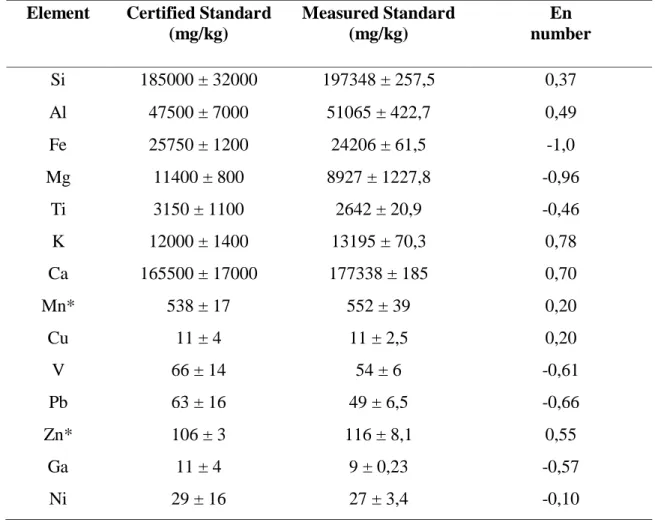
On Table 2 are showing the results for certified standards carrying out together the samples under the trees and the results obtained for certified standards carrying out together samples from the playground could be observed on Table 3.
Table 2: Certified Standard analyzing together with soil from samples obtained under the trees.
Element Certified Standard (mg/kg) Measured Standard (mg/kg) En number Mn 538 ± 17 552,3 ± 35 0,20 Ni 88 ± 5 89,9 ± 7,6 0,12 Cu 34 ± 0,7 37,2 ± 5,1 0,25 Zn 106 ± 3 115,7 ± 8,1 0,55 Ga 14 ± 4,2 9,7 ± 0,4 -0,89 Sr 231 ± 2 221,2 ± 4,4 -0,97 Pb 60 ± 16 65 ± 13 0,17 V 112 ± 5 109,4 ± 802 -0,10 Ti 3420 ±2 40 3441,1 ± 42,7 0,08 Ca 163000 ± 1700 176875 ± 334 0,81 Mg 15100 ± 500 14559,2 ± 1875 -0,14 Al 75000 ± 600 84017,9 ± 774,3 0,24 Si 296600 ± 2300 285615,5 ± 519 0,31 K 20300 ± 600 19296,2 ± 115,8 -0,92 Fe 35000 ± 1100 32633,9 ± 142,4 -0,96
Table 3: Certified Standard analyzing together with samples from playground.
Element Certified Standard
(mg/kg) Measured Standard (mg/kg) En number Si 185000 ± 32000 197348 ± 257,5 0,37 Al 47500 ± 7000 51065 ± 422,7 0,49 Fe 25750 ± 1200 24206 ± 61,5 -1,0 Mg 11400 ± 800 8927 ± 1227,8 -0,96 Ti 3150 ± 1100 2642 ± 20,9 -0,46 K 12000 ± 1400 13195 ± 70,3 0,78 Ca 165500 ± 17000 177338 ± 185 0,70 Mn* 538 ± 17 552 ± 39 0,20 Cu 11 ± 4 11 ± 2,5 0,20 V 66 ± 14 54 ± 6 -0,61 Pb 63 ± 16 49 ± 6,5 -0,66 Zn* 106 ± 3 116 ± 8,1 0,55 Ga 11 ± 4 9 ± 0,23 -0,57 Ni 29 ± 16 27 ± 3,4 -0,10
*Mn, Zn corresponding to the SRM 2709 standard. ** Other elements corresponding to the SOIL 7 standard.
3. RESULTS AND DISCUSSIONS
The mean values obtained for the chemical elements quantified in the Apipucos Maximiano Campos Park (Table 4), under the trees, are Copper ranged from 84-93 mg/kg, Fe presented values between 17,509-20,336 mg/kg, the values for Mn ranged from 138-163 mg/kg, Ni showed values between 16-19 mg/kg, the values for Pb were 48-75 mg/kg, vanadium ranged from 122-160 mg/kg,
whereas Zn showed values between 89-116 mg/kg. The concentrations of Cu were above 50 mg/kg [8], indicating high anthropogenic influence on the site.
Toxic effects due to copper are unlike to happen in humans [10]. However, those who are affected by the Wilson’s disease can present serious complications, including liver cancer and kidney problems [11].
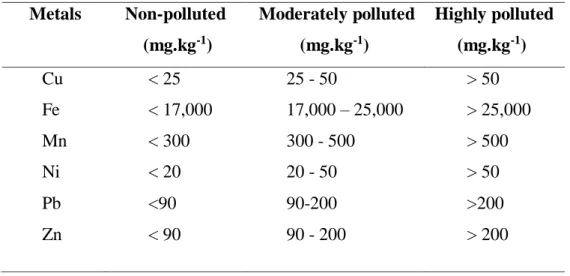
The mean values of Fe in the park’s soil went from 17,509 to 20,336 mg/kg. Since the concentrations were higher than 17,000 and lower than 25,000 mg/kg, the park can be considered as moderately polluted by Fe. Excessive amounts of iron can lead to oxidative stress in plants [12]. Regarding that soils are important sources of particulate matter that remain suspended in the atmosphere [13], it is possible for the local visitors, especially kids that play on the ground, to inhale this chemical element [14]. The values for Mn are below 300 mg/kg, demonstrating that there is no pollution by this chemical element.
The concentrations of Ni ranged from 16 to 19 mg/kg. It is much higher than the guiding value provided by the CPRH, and the biggest concentration was close to the referential value for moderately polluted soils. Nickel composes the hydrogenase enzyme, however, excessive quantities of this metal may lead to cancer, respiratory problems and dermatitis. All the concentrations of Pb were above 13 mg/kg, probably because of the previously deposited scrap metal, but, it can provoke reproductive, immune, developmental, neurological, renal and cardiovascular illnesses [15]. For zinc concentration, the first value was characteristic of polluted sites. The second and the third one showed that the soil was moderately polluted, although the third sampling site presented a mean value close to what is considered as a highly polluted soil. The excess of available zinc is extremely harmful for plants and invertebrates. Some plant species may die when exposed to soils with Zn concentrations above 100 mg/kg [16].
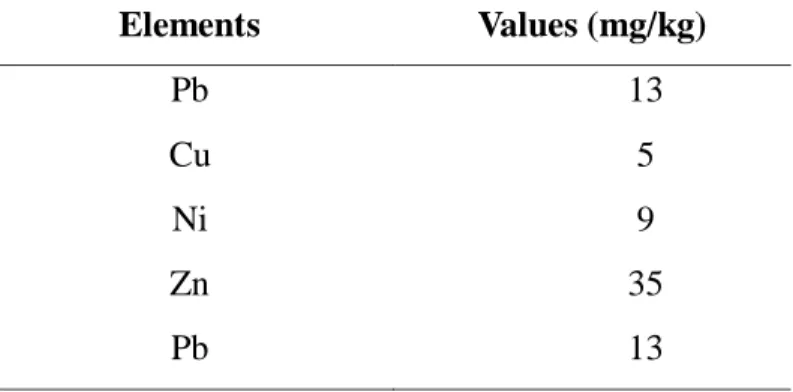
According to Thomas (1987), substrates can be classified as non-polluted, moderately polluted or highly polluted, Table 6 [17]. Either, guiding values for non-impacted soils is provided by the Environmental Agency of the State of Pernambuco (CPRH) 2014, Table 7 [18].
Table 4: Apipucos Maximiniano Campos Park soil results (from samples collected under the trees).
Metals Point 1 Point 2 Point3
(mg/Kg) Mean Value Mean Value Mean Value
Mn 142 138 163 Ni 19 19 16 Cu 87 84 93 Zn 89 91 116 Ga 11 12 11 Sr 128 136 89 Pb 56 48 75 V 122 160 131 Ti 4458 5105 4355 Ca 6919 8246 6991 Mg 5372 5077 4899 Al 73207 82687 69509 Si 284246 270902 289947 K 3568 3284 3978 Fe 17509 20336 17687
The average values shown in Table 4 show that the major elements presented are Ti, Ca, Mg, Al, Si, K and Fe. And the average values obtained for the minor elements such as: Mn, Ni, Cu, Zn, Ga, Sr, Pb and V presented expanded analytical uncertainty at the 95% confidence level of the measures <20%.
Table 5: Chemical elements’ results found in the playground area’s Apipucos Maximiniano Campos Park. Elementos Média (mg/kg) Si 403016,7 ± 530,6604 Al 9247,28 ± 393,336 Fe 6919,0 ± 53,384 Mg 4656,24 ± 1044,148 Ti 2943,0 ± 46,808 K 2508,9 ± 37,71 Ca 2339,4 ± 29,032 Mn 130,4 ± 41,908 Cu 97,7 ± 7,24 V 69,95 ± 17,688 Pb 32,76 ± 14,668 Zn 30,57 ± 7,396 Ga 9,28 ± 0,692 Ni 6,63 ± 8,68
Table 6: Substrate’s classification according to pollution degree (Thomas, 1987).
Metals Non-polluted (mg.kg-1) Moderately polluted (mg.kg-1) Highly polluted (mg.kg-1) Cu < 25 25 - 50 > 50 Fe < 17,000 17,000 – 25,000 > 25,000 Mn < 300 300 - 500 > 500 Ni < 20 20 - 50 > 50 Pb <90 90-200 >200 Zn < 90 90 - 200 > 200
Table 7: Guiding values for soils of Pernambuco Elements Values (mg/kg) Pb 13 Cu 5 Ni 9 Zn 35 Pb 13
For the results from the playground:
According to the value obtained for Ni, this is less than 9 mg/kg, so that the soil is not contaminated by Ni. The mean value on the ground of the playground for Zn is less than 35 mg/kg, and yet according to Thomas (1987) [17], all substrates below 90 mg/kg are considered unpolluted. Therefore, according to Thomas (1987) [17], then, the substrates would not be contaminated by Zn, however, for points 1 and 3 individually, according to CPRH (2014) [18], the substrates at these points would be contaminated by this element.
The average value for copper is 97.7 mg/kg, which is above the value suggested by CPRH (2014) [18] and according to Thomas (1987) [17], the substrates of the Park are highly polluted by this element.
The values for Fe in soil are up to 26000 mg/kg, in this park, the average value found is below 7,000 mg/kg, so that the evaluated substrates are not contaminated with Fe, despite the fact that, previously, there was a green area covered by old irons, which may present elements such as: As, Cd, Cu, Cr, Fe, Hg, Pb, Ni, Tin (Sn), Zn, Mn, Si, Pb, scandium (Sc), a characteristic of this type of material. The average value found in the literature for magnesium in soil is 8,000 mg/kg; the result obtained in this work is below the mentioned value, being below 5,000 mg/kg.
Vanadium may be originated from atmospheric pollution from burning of fuel or from metal alloys that existed previously at the site, the reference value of natural soil quality is 24 mg/kg and the values obtained are above this reference value, (mean value found near 70.0 mg/kg, considering all the points sampled). Ti can be originated from ores used for the production of alloys [19].
Pb values ranged from 21 to 60.08 mg/kg (the mean value of the soil is near 33 mg/kg), this value is above the suggested values 13 mg/kg by CPRH (2014) [18], so that the element can be considered a contaminant according to the guiding values for soils. However, not at all points, an excess of Pb was verified, since the value indicated in soils for lead is 29 mg/kg.
The values of Mn are below 300 mg/kg [17] demonstrating that there is no pollution due to this element. According to the results Cu, at levels above 50 mg/kg [17], is also considered a pollutant.
The Apipucos Maximiano Campos Park was a green area covered by old irons, which has been transformed into space for recreation, the place is influenced by the emission of pollutants in the atmosphere by automotive vehicles. In previous works carried out in the Apipucos Reservoir, sampling points closer to Av. Dezessete de Agosto have already shown higher Pb values [20] and sediment dating (1980) was reported [21].
The background estimated in a study for one zone of the chemical complex was 20 mg/kg for Cu, 60 mg/kg for Pb and 130 mg/kg for Zn [22]. These values are similar to the results found in this study for the samples under the tree and higher than the values suggested by CPRH (2014) [18].
Cr, Ni, Cd, Mn and Fe are typically geogenic elements, probably associated with local geology, then, these presence could be explained by this factor [23]. In the city of Palermo in Sicily the traffic was an important source of diffuse pollution contributing to the increase of concentrations of heavy metals of the soils [24], as it was verified in this investigator, mainly for Pb; just as it was observed in a "Garden with Children's Park", about 400 m from a confluence node of several important routes in Lisboa [25].
According to studies carried out in the cities of Uppsala in Sweden [26], Beijing in China [27] and Seville in Spain [28] the permanence of a soil without any removal or transport for a long time favors the progressive deposition of metals by air, and thus old gardens or parks are more likely to have higher concentrations of metals than new or frequently intervened parks. As this park “Apipucos Maximiano Campos” some metals deposition in soil by air were identified.
As, Ba, Cr and Sb are above the alert level of CETESB, in parks investigated in São Paulo City [29]. The excessive amount of As in the environment is generally the result of anthropogenic actions of uncertain nature, since this element composes several products, among them pesticides. In the case of Cr and Zn, the probable sources are the vehicular emissions, since these elements are associated with the traffic and the park are located in regions with intense flow of cars. Elements of
the Platinum Group and other elements are related to traffic, such as Cu and Zn [30]. According to Morcelli (2005) [30], As, Zn, Se, Cu and Sb have higher concentrations in surface samples (0-5 cm), which can mean related anthropogenic activity. According to CETESB (2005) the value obtained in playgroud área are from “Apipucos Maximiano Campos” Park for zinc is above the reference quality value [29]. However, for the means values obtained from samples under the trees they are near from prevention values.
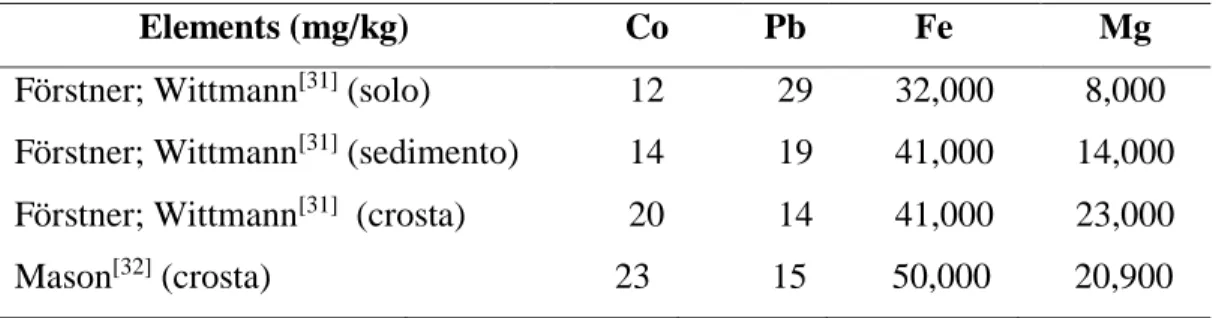
Table 8: Results on literature.
Elements (mg/kg) Co Pb Fe Mg
Förstner; Wittmann[31] (solo) 12 29 32,000 8,000
Förstner; Wittmann[31] (sedimento) 14 19 41,000 14,000
Förstner; Wittmann[31] (crosta) 20 14 41,000 23,000
Mason[32] (crosta) 23 15 50,000 20,900
3. CONCLUSION
It can be concluded that the natural concentrations of the main chemical elements found in this park area present in the city were identified; as well as those from anthropogenic activities, allowing the delineation of preventive actions of environmental exposures of the population to toxic agents that may be harmful by inhalation, oral or cutaneous.
REFERENCES
[1] FIGUEIREDO, A. M. G.; TOCCHINI, M.; SANTOS, T. F. S. Metals in playgrounds soils of São Paulo city, Brazil, Urban Environ Pollut, v. 4, p. 303 - 309, 2011.
[2] SAIKI, M.; SANTOS, J. O.; ALVES, E. R.; GENEZINI, F. A.; MARCELLI, M. P.; SALDIVIA, P. H. N. Correlation study of air pollution and cardio-respiratory diseases through NAA of an atmospheric pollutant biomonitor, J Radioanal Nucl Chem, v. 229, n. 1, p. 773 - 779, 2014.
[3] WALSH, M. P.; Motor vehicle pollution and fuel consumption in China: the long-term challenges, Energy Sustain. Dev., v. 7, n. 4, p. 28 - 39, 2004.
[4] ABRAHAMS; P. W. Soils: Their Implications to Human Health, Sci Total Environ, v. 291,
p. 1 – 32, 2002.
[5] LIMA, V. L.; SOUZA, V. L. B.; NASCIMENTO, R. K.; SANTOS, P. N. C.; ALMEIDA, M. G. O.; HAZIN, C. A. Metal fractionation in sediments as a tool for assessing the availability of trace metals: The case of Apipucos Reservoir, Radiat Phys Chem, v. 95, p. 329 - 332, 2014. [6] FELIPE, M. Um parque à espera de mais frequentadores, Diário de Pernambuco, Available
at: <https://goo.gl/47Mrts>. Last acessed: 05/08/2017.
[7] NASCIMENTO, A. F.; MELO, B. E. S.; SOUZA, V. L. B. Contaminação Biológica em Sedimento de Parque na região Metropolitana do Recife. In: CONGRESSO REGIONAL DA
SOCIEDADE BRASILEIRA DE BIOFÍSICA DA PESQUISA AO ENSINO, 2017,
Campina Grande, Annals… Campina Grande, Paraíba: Associação Brasileira de Química, 2017. p. 74
[8] MIGUEL, E.; GRADO, M. J.; LLAMAS, J. F.; MARTÍN‐DORADO, A.; MAZADIEGO, L. F. he overlooked contribution of compost application to the trace element load in the urban soil of Madrid (Spain), Sci Total Environ, v. 215, p. 113 – 122, 1998.
[9] ISO - INTERNATIONAL ORGANIZATION FOR STANDARDIZATION - ISO 13528:2005 - Statistical methods for use in proficiency testing by interlaboratory comparisons. ISO. 2005. [10] FLEMMING, C. A.; TREVORS, J. T. Copper toxicity and chemistry in the environment: a
review, Water Air Soil Pollut, v. 44, p. 143 - 158, 1989.
[11] ALA, A.; WALKER, A. P.; ASHKAN, K.; DOOLEY, J. S.; SCHILSKY, M. L. Wilson’s disease, The Lancet, v. 369, p. 397 - 408, 2007.
[12] HELL, R.; STEPHAN, U. W. Iron uptake, trafficking and homeostasis in plants, Planta, v. 216, p. 541 - 551, 2003.
[13] MILLER, M. O.; VOUTCHKOV, M. Risk analysis from naturally occurring radioactive materials in the Jamaican terrestrial environment, Air Qual Atmos Health, v. 9, n. 5, p. 551 - 560, 2016.
[14] HARRISON, R. M.; YIN, J. X. Particulate matter in the atmosphere: which particle properties are important for its effects on health, Sci. Total Environ., v. 249, p. 85 -101, 2000.
[15] . Food and drug administration. Q3D Elemental Impurities Guidance for Industry. FOOD
AND DRUG ADMINISTRATION, Silver Spring, USA, 2015.
[16] EISLER, R. Zinc Hazard to Fish, Wildlife and Invertebrates: A Synoptic Review.
Contaminant Hazard Reviews. U.S Department of the Interior, Laurel, United States, 1993.
[17] THOMAS, R. L. A. Protocol for the selection of process-oriented remedial opitions to control in situ sediment contaminants. Hydrobiologia, v. 149, p. 247 – 258, 1987.
[18] CPRH - Agência estadual de Meio Ambiente. Instrução normativa CPRH n° 007/2014. Diário Oficial do Estado de Pernambuco – Poder Executivo, 2014.
[19] GUILHERME L. R. G.; MARQUES, J. J.; PIERANGELI, M. A. P.; ZULIANI, D. Q.; CAMPOS, M. L.; MARCHI, G. Elementos-traço em solos e sistemas aquáticos. In: VIDAL-TORRADO,P; ALLEONI, L. R. F.; COOPER, M.; SILVA, A. P.; CARDOSO, E. J. Tópicos
de ciência do solo, v.4. Sociedade Brasileira de Ciência do Solo, Viçosa, 2005. p. 345 - 390.
[20] LIMA, V. L.; SOUZA, V. L. B.; NASCIMENTO, R. K.; SANTOS, P. N. C.; ALMEIDA, M. G. O.; HAZIN, C. A. Metal fractionation in sediments as a tool for assessing the availability of trace metals: The case of Apipucos Reservoir. Radiation Physics and Chemistry, v. 95, p. 329 - 332, 2014.
[21] SOUZA, V. L. B.; Rodrigues, K. R. G.; PEDROSA, E. H.; Melo, R. T.; LIMA, V. L.; HAZIN, C. A.; ALMEIDA, M. G. O.; NASCIMENTO, R. K. Sedimentation Rate and 210Pb Sediment Dating at Apipucos Reservoir, Recife, Brazil. Sustainability, v. 4, p. 2419/10.3390/su-2429, 2012.
[22] BARRADAS, J. M., CARDOSO-FONSECA, FERREIRA DA SILVA, E. A., GARCIA-PEREIRA, H. Identification and mapping of pollution indices using a multivariate statistical ethodology, Estarreja, central Portugal. Applied Geochemistry, v. 7, p. 563-572, 1992.
[23] CACHADA, A.; RODRIGUES, S.; PEREIRA, E; FERREIRA DA SILVA, E.; DUARTE, A. A origem e distribuição de metais potencialmente tóxicos nos solos da cidade de Estarreja, Portugal. Environ Geochem p. 301 - 304.
[24] MANTA, D. S.; ANGELONE, M.; BELLANCA, A.; NERI, R.; SPROVIERI, M. Heavy metals in urban soils: a case study from the city of Palermo (Sicily), Italy. Sci Total Environ, v. 300, p. 229 – 243, 2002.
[25] PRAZERES, C.; BATISTA, M. J.; PATINHA C.; REIS, A.P.; DIAS, A. C; FERREIRA DA SILVA, E.; CACHADA, A.; SOUSA, A. J.; FIGUEIRA, R.; SÉRGIO, C. Geoquímica dos solos e poeiras da cidade de Lisboa: caracterização e cartografia, suporte para futuros estudos de saúde humana - Resultados preliminares VIII Congresso Nacional de Geologia, e - Terra, 2010.
[26] LJUNG, K.; SELLINUS, O.; OTTABONG, E. Metals in soils of children’s urban environments in the small northern European city of Uppsala. Sci. Total Environ., v. 366, p. 749 – 759, 2006.
[27] CHEN, T.; ZHENG, Y.; LEI, M.; HUANG, Z.; WU, H.; CHEN, H.; FAN, K.; YU, K.; WU, X.; TIAN, Q. Assessment of heavy metal pollution in surface soils of urban parks in Beijing, China. Chemosphere, v. 60, p. 542 – 551, 2005.
[28] MADRID, L.; DÍAZ-BARRIENTOS, E.; MADRID, F. Distribution of Heavy metal contents of urban soils in parks of Seville. Chemosphere, v. 49, p. 1301 – 1308, 2002.
[29] SANTOS, A. D., SÍGOLO, J. B. Análise de metais e caracterização de solos no Parque Ibirapuera (SP) II Congresso Internacional de Meio Ambiente Subterrâneo. Revista Águas
[30] MORCELLI, C.P.R.; FIGUEIREDO, A. M. G.; SARKIS, J. E. S.; ENZWEILER, J.; KAKAZU M.; SIGOLO, J. B. PGE’s and other traffic-related elements in roadsides soils form São Paulo, Brazil. Sci Total Environ, v. 345, p. 81 – 91, 2005.
[31] FÖRSTNER, U; WITTMANN, G, T. W. Metal pollution in the aquatic environment, Springer-Verlag, 2 ed., New York, 1981.
[32] MASON, B. Princípios de Geoquímica, Barcelona, 1960.