CCKUÍH 3. npiiKjiaflH» riflpoMexaHJKa Ta MexDTpBHiK-a
NUMERICAL STUDY ON THE EFFECT OF ALiOaAVATER AND TI02/WATER NANOFLUIDS ON FORCED CONVECTIVE HEAT
TRANSFER IN A FLAT TUBE Soares, A.A. u, Ribeiro, J. A.1-4 Ribeiro, L.F.2-3
1-School ofScience and Technology, Universidade de Trás os montes e Alto Douro, Portugal 2-Mechanical Technology Department, Instituto Politécnico de Bragança, Portugal 3-Centre for Renewáble Energy Research - INEGI - Portugal
4-Centre for the Research and Technology ofAgro-Enviromnental and Biological Sciences Ponugal
Absíract
Most conventional fluids, such as water, ethylene glycol and engine oil, have lünited
thermal capabilities properties, which may impose restrictions m many thennal applications. On the
other hand, con-ectly there is an extensive research that hás proven that nanofluids (suspensions of
nanometer-sized metallic particles in a base fluid) are better heat transfer agent than conventional
fluids, e.g. [l]. An ünportant applicatíon ofnanoflluids can be used in retígeration systems such as
automobile radiators with an important impact in the reduction ofthe sizes ofradiators.
In this work we investigate numerically the ferced convective heat transfer of two nanofluids AlzOs/water and TiOs/water in a flat tobe of a standard automobile radiator to
quantitatively evaluate the enhanced heat transfer characteristics. The heat transfer characteristics of
nanofluids under forced convection were investígated for different volumetric concentrations ofnanoparticles between 0,25 and 10.0%, md compared with the base fluid (water). Tbe
computational simulations were carried out with the Ansys Fluent software pack^e.
The focus ofthis research is to compare the flow and heat transfer to the cases where water
properties are considered constant and dependent ofthe temperature. To the best ofour knowledge,
numérica! studies involving nanofluids in the flat tubes of a radiator under the eonditions of the
present study have not been done só far. Thus, the numerical results obtained were validated for
water flow by comparing the fiicüon factor and the Nusselt number in the flat tube with fheoretical
and empirical results available in the literature.
Heat trmsfer results are presented for temperature, convective heat transfer coefRcient, heat
flux, Prandtl number and Nusselt number (Nu) in tíie range of conditions studied as well as flow
and nanofluids characteristics like fiiction factor, pressure loss, dissipated power, density, viscosity,
thermal conductivity and specific heat. The results obtained wiüi nanofluids promise efBcient heat
trmsfer to develop more efficient heat transfer fluids for use in automobile motors and industrial
equipment, since the presence of alumina and titanium dioxide iianoparticles provide a greater
cooling compared with the base fluid (water).For the fluid flow in radiators, the compression work and lhe viscous dissipation are negligible. Under these conditioiis, we have numerically solved the followmg govemmg equations under a 3D flow fíeld using the computation fluid dynamics (CFD.
v. v=o W
^(v. V)v=-V/>+^V-v
A/^(v. V)T=^V2r
(2)
(3)
Many studies have shown that the low particle volumetric concentration ofthe nanoparticles
JVIarepia.ïïii XlX-MHTK«nporpeciiBHa TexHÍsca, TCXHOJIO^ÍH Ta iuaíeHepHa ocEÍTa», 2018
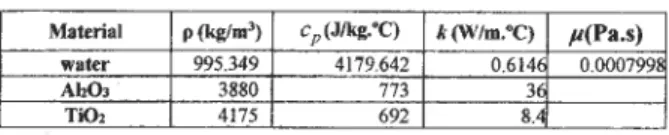
themial conductivity were obtained from [3, 4]. The volumetric concentrations of nanopartides
ranged from 0.25 and 10.0 %. The properties ofwater and nanoparticles were withdrawn fi-om [5,
6], Tablel,
Tablel. Propertíes ofthe nanopartides and water at temperature of30°C
Material water AhOa TK)2 p(kg/m3) 995.349 3880 4175 4179. 642 773 692 t<W7m. <IC) 0.6146| 3é| S.4J ft(Pa.s) 0.00079981
The geometry of the flatted tube hás a larger diameter, smaller diameter and length of 9.0, 3.0 and 345 mm, respectively [7].
The system ofgoveming Eqs. (1)-(3) was solved by the fmite volume mefhod approach using the Fluení. Specification on the numerical methods used can be found in our previous work [8, 9]. For ali simulations performed, converged solutions were considered when the residuais resulting lïom the iterative process for ali conservative equations were lower than 10 's.
The boundaiy conditions used were: on the tube wall are applied the usual no-slip condition (v = 0) and the constant temperature condition (isothennal wall, T = 30°C); at lhe tube oudet was applied the conditíon presstve-outlet of Fluent; at the tube inlet was imposed the temperafaire of
90°C and in the case of the constant water properties were imposed the velocities of 0.0429 and
0. 3434 m/s (calculated for Re = 250 and 2000 for water at 30 °C) and in the case ofthe temperature-dependent water propenies were imposed the velocities 0.0172 and 0. 1376 m/s (calculated for Re = 250 and 2000 for water at 90 °C).
For the choice of appropriate mesh, additional tests for water flow with constant properties at T = 30°C were carried out for Reynolds numbers fi-om Re = 250 to 2000 in meshes with 21576,
46138, 104949 and 159962 nodes. The tests camed out using four meshes showed that the gaúiin
accuracy ofthe fiictíon factor and average Nusselt number which resulted from the use ofthe fmest mesh (159962 nodes) was overall <2%. Then the mesh with 104949 nodes was selected for the present stuáy.
Some ofthe results obtamed in this researeh are shown in the Figures l ana 2. Figure l shows
the average temperature along the flatted tube. The temperature decreases along the tube and with
the concentradon of nanoparticles. Both nanofluids show the same behaviour. In the case of the
constant water properties. Figure l(a) and (b), for AliOj and Re = 250 the temperature decreases
46. 56 K and 50.47 K for concentrations 0. 0% and 10. 0% respectively, whereas for Re = 2000 decreases 23. 37 K and 25. 58 K for concentrations 0. 0% and 10. 0%, respectively. For concentration of 10. 0% and TiOz/water (he temperature decreases about 2 K less than for Al203/water.
In the case ofthe temperature-dependent water properties. Figure l (c) and (d), the temperature
decrease is more pronounced. For A1203 and Re = 250, the temperature decreases 57. 03 K md 58. 69 K for concentrations 0. 0% and 10. 0%, respectively. For AI203 and /?e=2000, the temperature decreases 33. 42 K and 35. 90 K for concentrations 0. 0% and 10. 0%, respectively. For concentration of 10. 0% and TiOi/water the temperature decreases about 1.5 K less than for
AhOs/water.
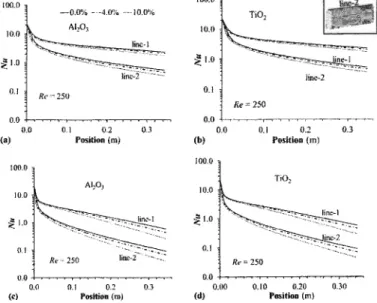
Figure 2 shows, for Re =250, the variations of local Nusselt number (Nu) along the line-1 and
line-2 (see flat tube representation in the upper right comer of Figure 2). Line-1 is located on the
plan wall md line-2 is located on the curved wall. Nu decreases along both lines however that
CeK-uin 3. npiiKjiaflHa rwpowexaHÍKa T;I wexaTpouÍKa
0. 1 0.2 0.3 Posltion (m)
Figure l. Temperature along the hibe as a fünction ofnanupartide concentration, for Se = 150 and Re = 2000 at the tube inlet For the cases of the constant water properties (a) Ah03 and (b) TiO;, and temperature-dependent
water propertics, (c) AhOjantí (d) Ti02.
100.0 a -0.0% - -4.0% -](). ()"/«
Al, 0,
liac-1
O. IB 0.20 0. 30 PtKÍtíon (m)
Ma repia.illi X1X-MHTK «UporpfCllBHa TexHÍk-a, TexHojiorin Ta ÍHiKeHFpna ocBÍra», 201 8
Referentes
[l] Maiga, S. B., Palm, S.J., Nguyan, C. T., Roy, G., Galanis, N. (2005), Heat trmster enbancement by using
nanofluids in forced convectíon flows. Int. J. Heat FIuid Flow, 26: 530-546.
[2] Akbarinia, A., Behzadmehr, A. (2007), Numerical stody of laminar mixed convection of a nanofluid in horizontal curved tubes, Appl. Thenn. Eng., 27, (S-9): 1327-1337.
[3] Vanaki, Sh. M,, Gmesan, P., Mohammed, H. A. (2016), Numerical study of coavective heat transfer of nanofluids: A review, Renewable md Sustainable Energy Reviews, 54: 1212-1239.
[4] Pak, B. C., Cho, Y. I. (1998), Hydrodynamic and heat transfer study of dispersed fluids with submicroD metallic oxide partides, Intemational Joumal of Experimental Heat Transfer, 11:151-70.
[5] Pramuditya, S. (2011), Water thermodynamic properties. Physics Dqianment - Technical Document. http://portal. fi.itb. ac. id/tecdoc/wateiprop/.
[é] Shanna, K. V., Sharma, P. K., Azmi, W. H., Rizalman, M., Kaáirgama, K. (2012). Correlations to predict
fnction and forced convection heat traasfer coefBcients of water base nanofluids ft» hirbulent flow in a tube, The
Intemational Joumal ofMicroscale and Nanoscale Thermal md Fluid Trmsport Phenomena, 3, (4): 1-25.
[7] Hussein, A. M. Bakar, R. A., Kadirgama, K., Sharma, K. V. (2014), Heat üansfer augmentation of a car radiator using nanofluids, Heat Mass Transfer, 50: 1553-1561 ,
[8] Sousa, P,, Soares, A., Monteiro, E., Rouboa, A. (2014), A CFD study ofthe hydrodynamics in a desalination membrane filled with spaceis, Desalination, 349:22-30.
[9] Soares, A. A., Silva, J., Monteü-o E,, Rouboa A. (2017), Pulsating flow effects on hydrodynamics in a desalination membrane filled with spacers, Desalination. DÓI: 10. 5772/intechopen. 68777.
y/(K 637. 134
ri^POAHHAMNHA OBPOEKA MOJIOKA RPH
TFAHCHOPTyBAHHIBouaapeHKO P.M., CeMÍKCbKa H.B.
KFÍI ÍM. Iropa CÍKOpcbKoro, M. KHÏB, yKpaïna
AHonwi^ia:
B poôomi pü3Z.THHynw ocoôjtueocmi mextíojioziï zíòpoòufíCLWHHOÏ oôpoÔKU AW.WKCI 3 euKopucmaHHs.M KOeimamopa niò vac mpaHcnopnysaHwi . vo.ioKa. 3anponOHoemm opvzmcvitHy cxe.vy KaeimaifiüHoï oôpoÔKii .vo.WKa
ôesnocepeòvbo npu mpcwcnopmyeaHm üoso òo nyHKmie fipti3HwefíHfi.
Kfiiôvoeí aioea: ziòpoòuHOMÍwa Kíïeitticitfifi; nacmepu3aïim; .vawKo; K06imamop, mpoHcnopmyewiïH
y KOMDJICKCÍ 3aXOflÍB IHOAO mflBMUeHHa aKocri npo^yiaiiï, oaepacaHOï Ha mflnpHEMCTBax
MOJIOHHOÏ npOMHCjiOBOcri, rojioBHy pojit rpaioTb 3anm-aHBM, HOB'a3aHÍ 3i 35epiraai M nepBHHHnx
BjiacTHBOcrefi MOJIOKB B npoueci noro TpaHCTOpT yaaHHa AO MÍCIM nepepoOKH. [l]
npn ubOMy cnoci6 TpaHcnopT yBaima CKPOBBHH na MOJIOIHHIÍ 3aBoa ÍCTOTHO MIJIWBW He
TÍJII,KH Ha aidcn, oaep»yBaHoï npoflyKixiï, ajie ií na eKOHOMÍxy nepepoÕHoro manpKeMCTBa B
yuioMy.
HeaejiHKa KuiLKÍCTb MojioKa nepeBOSHTíca y 4'Jiarax BaHTasKHHMK aBTOMOÕijuMH. npH ubOMy cnoco6i BejiHKÍ BHTpaT npaiii Ha BauTaiKHo-posBaHTaiKyBajii.Hi onepaitiï i BTpaTH MojiOKa, a
yuoBH nepeBeseHHa ne BinnoBuafOTi> caiuTapHO-nnemiHHM BMMorakt ao xapioaHX npoflyKTiB.
Aauo MojioKa 1000 Ji i Siju.me, TO AOUUIHO BHKOpiicroByBaTH aBTOiiHCTepHH, aio A03BOJIHTL
35ÍJ1I>UJHTB B aaa pa3M npOAyKTHBHÍCTb npaui i Ha 30-35% 3HH3HTH TpaHcnopT ui BHTpaTH
HacKÍJibKH peTejttHo ni» Hac TpaHcnopTyBaHiia Qypyn flO-rpiniyBaTHca BCÍ BerepH HapH
O-caniTapHÍ HOpMM, sajieauiTfc aMCTi KÍHueBoro npoayKTy. ToMy o6po6Ka MOjioKa Hajiiiye fleicuiBKa
eranÍB o6po6KH. OBHHM is OCHOBHMX e ftoro nacTepioayia. [2]
Icnyc BejmKe pÍ3HOMaHÍTra Bapiauifl nacTepH 3auiï MojiOKa, ogHHM ia aKHX e nacrepH3auia