This content has been downloaded from IOPscience. Please scroll down to see the full text.
Download details:
IP Address: 193.136.189.3
This content was downloaded on 19/07/2016 at 09:38
Please note that terms and conditions apply.
Quantum radiation reaction in head-on laser-electron beam interaction
View the table of contents for this issue, or go to the journal homepage for more 2016 New J. Phys. 18 073035
PAPER
Quantum radiation reaction in head-on laser-electron beam
interaction
Marija Vranic1,3
, Thomas Grismayer1
, Ricardo A Fonseca1,2
and Luis O Silva1,3
1 GoLP/Instituto de Plasmas e Fusão Nuclear, Instituto Superior Técnico, Universidade de Lisboa, 1049-001 Lisbon, Portugal 2 DCTI/ISCTE—Instituto Universitário de Lisboa, 1649-026 Lisboa, Portugal
3 Authors to whom any correspondence should be addressed.
E-mail:[email protected],[email protected],[email protected]@ist.utl.pt
Keywords: particle-in-cell, classical radiation reaction, quantum radiation reaction, laser-electron interaction Supplementary material for this article is availableonline
Abstract
In this paper, we investigate the evolution of the energy spread and the divergence of electron beams
while they interact with different laser pulses at intensities where quantum effects and radiation
reaction are of relevance. The interaction is modelled with a quantum electrodynamic
(QED)-PIC
code and the results are compared with those obtained using a standard PIC code with a classical
radiation reaction module. In addition, an analytical model is presented that estimates the value of the
final electron energy spread after the interaction with the laser has finished. While classical radiation
reaction is a continuous process, in QED, radiation emission is stochastic. The two pictures reconcile
in the limit when the emitted photons energy is small compared to the energy of the emitting electrons.
The energy spread of the electron distribution function always tends to decrease with classical
radiation reaction, whereas the stochastic QED emission can also enlarge it. These two tendencies
compete in the QED-dominated regime. Our analysis, supported by the QED module, reveals an
upper limit to the maximal attainable energy spread due to stochasticity that depends on laser intensity
and the electron beam average energy. Beyond this limit, the energy spread decreases. These
findings
are verified for different laser pulse lengths ranging from short ∼30 fs pulses presently available to the
long
∼150 fs pulses expected in the near-future laser facilities, and compared with a theoretical model.
Our results also show that near future experiments will be able to probe this transition and to
demonstrate the competition between enhanced QED induced energy spread and energy spectrum
narrowing from classical radiation reaction.
1. Introduction
Near future facilities[1–3] will provide extreme laser intensities ( >I 10 W cm22 -2), where quantum effects
such as electron–positron pair production and discrete photon emission might play a central role in laser-matter interaction[4–12]. Previously, electron–positron pairs have been produced in experiments using a moderately-intense laser of intensity ~I 10 W cm18 -2counter-propagating with the ultra-relativistic(46 GeV) SLAC
electron beam[13–15]. This setup takes advantage of the ultra-relativistic energy of the particles to observe certain nonlinear quantum effects in electromagneticfields whose amplitude remains several orders of magnitude below the critical Schwingerfield [16], which constitutes usually the threshold to observe pairs spontaneously created in vacuum. As detailed in[17], the field magnitude in the rest frame of the particles will then be of the order of the criticalfield and the probability of the process becomes optimal. By leveraging on the tremendous progress accomplished in laser technology in the last decades, one can also envisage nowadays to decrease the energy of the relativistic particles and increase proportionally the magnitude of thefield of the laser. This explains the recent growing interest[8,18–23] on configurations where a relativistic electron beam interacts with laser pulses of significantly higher intensity than in the SLAC experiment. The typical electron
OPEN ACCESS
RECEIVED
25 November 2015
REVISED
21 June 2016
ACCEPTED FOR PUBLICATION
30 June 2016
PUBLISHED
18 July 2016
Original content from this work may be used under the terms of theCreative Commons Attribution 3.0 licence.
Any further distribution of this work must maintain attribution to the author(s) and the title of the work, journal citation and DOI.
energy sufficient to diagnose nonlinear quantum effects is around a few GeV and such electron beams can now be generated from an all-optical source in an efficient manner: the current experimental record for self-injected electrons obtained in a laser wakefield accelerator is 4 GeV [24]. This shows that the near future laser facilities can be used to explore this nonlinear Compton scattering configuration without the aid of conventional accelerators.
In our previous work[25] we have studied the radiation reaction for an electron beam in a laser field with the use of the Landau–Lifshitz equation [26] which has been recognised as the best candidate to describe classically the effect of radiation reaction on charged particle orbits[27–32]. In the Landau–Lifshitz equation framework, charged particles emit radiation continuously and the direct effect of this emission can be represented as a continuous drag force in the particle motion equation. As shown in[25], when a GeV electron beam collides head-on with an intense laser( I 10 W cm21 -2), one of the key effects of classical radiation reaction is to
reduce the width of the electron energy distribution function during the interaction[8,33]. The tendency of classical radiation reaction to shrink the electron energy distribution function has been studied also in fusion plasmas[34], and in ion acceleration with solid targets [35]. If the laser intensity is raised such that the classical description of radiation reaction becomes inapplicable, the quantum effects in radiation reaction induce the opposite behaviour, leading to an increase of the energy spread of the beam spectra[36]. With the advent of quantum electrodynamics(QED) modules incorporated in the traditional particle-in-cell (PIC) algorithm, we are now able to simulate fromfirst principles quantum radiation reaction in laser-plasma interaction and therefore to validate some of the recent theoretical predictions. This paper thus deals with differences between the classical and the QED description in the transition regime where the probabilities for pair creation are still negligible, but quantum effects in the photon emission can already be significant (‘moderately quantum regime’ defined in [37]). This is of particular relevance since upcoming experiments at several facilities will be able to operate in this regime. We carry out PIC-QED simulations that allow us to evaluate the influence of quantum emission on the electron energy spread and the divergence of the electron beam. Maximum attainable energy spread due to quantum stochasticity as a function of mean electron energy and the laser intensity is computed. This result further allows us to obtain a semi-classical analytical prediction for the electron energy spread after the shutdown of the laser as a function of the initial beam and laser parameters. The prediction is in agreement with fully quantum Monte-Carlo PIC simulations.
This paper is structured as follows. In section2, we introduce the QED framework to describe photon emission. We then analyse, in section3, the evolution of the electron energy spectra, predicted analytically, and we compare the analytical results with QED-PIC simulations. In section4, we study the evolution of the electron beam divergence, another measurable quantity in these scenarios, and in section5we state the conclusions of this work.
2. QED photon emission
In QED, radiation is a discrete stochastic process and this impacts the particle trajectory in a distinct manner from the continuous emission associated with the classical radiation processes. The probabilities of the various processes in an electromagnetic plane wave are based on Volkov states[38] where the quantum-transition probability is evaluated taking into account the interaction between the particle and the background wave. In the event of emission, there is a transfer of energy from the electron to the emitted photon; otherwise, the electron momentum and energy remain unaltered. The classical limit corresponds to the case where a large number of photons, whose energy remains small compared to the electron energy, is radiated: the high frequency of the emission events allows the approximation of the trajectory as a classical trajectory with a continuous drag. The main difference between the classical and the QED approach is that QED accounts for the possibility of emitting high-energy photons even in a setup where the cross-section for Compton scattering is small(i.e. the average energy loss of the particle is negligible). In the quantum regime, the stochastic nature of emission becomes noticeable and one may expect a diffusion in energy around the mean value of the energy loss, as it wasfirst reported in[5,36].
The total probability of radiation emission by a single particle is relativistically invariant and depends on the normalised vector potentiala0=eE mc( w0)and the quantum invariant parameterχ (cefor electrons and cg for photons) defined as:
( ) ( ) ( ) c = m c = mn g m mn p F E mc k F E mc , , 1 e s s 2 2
where pμis the particle 4-momentum, kμis the photon wave 4-vector,Fmnthe electromagnetic tensor,
=
Es m c2 3 cthe Schwinger criticalfield [16], m is the electron mass, e is the elementary charge, c is the speed of light andw0is the frequency of the electromagnetic wave. The differential probability rate of photon emission by
nonlinear Compton scattering is then given[17,39–43] by ( ˜ ) ( ) ( ) ˜
ò
c a p gc x x c = - + - -g c ¥ ⎡ ⎣ ⎢⎛ ⎝ ⎜ ⎞⎠⎟ ⎤ ⎦ ⎥ P t mc K xK x d d d 3 1 1 1 d , 2 e 2 2 2 3 1 3where ˜c=2x (3ce(1-x)),x=c cg eanda = e2 (c)is thefine-structure constant.
In order to simulate the emission of photons(and electron–positron pairs), we have added a QED module [44,45] to OSIRIS [46] which allows real photon emission from an electron or a positron and decay of the photons into pairs(Breit–Wheeler process). The OSIRIS-QED framework accounts for the differential emission probability rate(2) in a similar fashion as other QED-PIC modules [9–11,47]. The QED algorithm can be summarised as follows: at particle push-time, the probability of radiating a photon is evaluated, and if the event occurs, the radiated photon quantum parameter is selected to obey the distribution given by equation(2); the particle momentum is then updated to account for the momentum of the emitted photon(assumed to be radiated in the direction of the particle motion). For Breit–Wheeler pair production, the procedure is similar but instead of emission, we evaluate the probabilities of photon decay into an electron–positron pair. If the event occurs, we then remove the photon and initialise the new particles. The OSIRIS-QED framework is also equipped with an advanced macroparticle merging algorithm[48].
3. The evolution of the electron energy spectra
Wefirst examine the temporal evolution of the energy spectrum of an electron beam as it collides head-on with an intense laser. In particular, we will focus on how the electron beam energy spread is affected by the QED photon emission. To facilitate this analysis, we define the beam width at a time t as the standard deviation in energy over all the particles
( )
å
( ( ) ( )) ( ) s = g -g = t t t , 3 N i N i 1 1 2where N is the total number of particles, ( )g t is the mean energy of the electron beam at time t, as measured in the laboratory frame, andg ti( )is the energy of the particle i at the same time t. The stochastic effects in quantum radiation reaction that are responsible for the spreading of the distribution have been analytically studied in a similar setup in[36] where the Fokker–Planck equation is used to describe the evolution of the electron
distribution function in time. This approach is valid forcg 1. The Fokker–Planck equation [49–51] is usually used in laser plasma interaction, for instance, to model kinetically the collisions between species. One can however see the quantum photon emission as a virtual inelastic collision with an electron; as long as the momentum exchange remains small compared with the emitting particle momentum, the Fokker–Planck equation proves to be adequate.
Ifw p q( , )d3qdenotes the probability per unit time of momentum changep p -q of an electron p, then the transport equation for the electron distribution function f t p( , )is given by:
( ) ( ) ( ) ¶ ¶ = ¶ ¶ + ¶ ¶ ⎡ ⎣ ⎢ ⎤ ⎦ ⎥ f t p t p A f p B f , 1 2 , 4 l l k lk where ( ) ( ) ( )
ò
ò
= = Al q w p ql , d ,3q Blk q q w p ql k , d3q 5represent the drift and diffusion coefficients respectively, and indexes l and k denote different spatial
components. Under the assumption that the electron beam is relativistic, and that the photons are radiated in the direction of motion, the problem is reduced to one-dimension.
Since the emission probability is given by equation(2) as a function of cg, we proceed to a change of variables usingc cg e »k gmcwhich is a consequence of the collinearity of the electrons and the emitted photons. We then get
( ) ( )
ò
ò
g c c c c g c c c c = c = g g g c g g g A mc P t B mc P t d d d d , d d d d . 6 e 0 e 2 2 2 0 2 2 e eAfter integration, the drift coefficient and the diffusion coefficient become respectively
( ) a c a g c » » A 2 m c B m c 3 , 55 24 3 , 7 e e 2 3 2 3 4 3
which werefirst calculated in [36]. The Fokker–Planck equation (4), which is a special case of the master equation in the continuous limit, is valid forqp. In our scenario, this validity condition can be expressed as
cg cewhich is only conceivable force1.
If there is no diffusion(B = 0), the equation of the characteristic in equation (4) is
g =
-p t mcd t A
d d d . For electrons counter-propagating with a linearly polarised wave ceis given by
ce= 2ga0 w0 mc2, while in a circularly polarised wavece=2ga0w0 mc2. This allows us to retrieve the
classical result where the photon emission results in the electron relativistic factorγ decrease. The rate of this decrease in a linearly polarised wave is given[20,25] by
( ) g a g a w = - = t e mc a d d , 4 3 , 8 rr 2 rr 2 0 2 3 0 2
wherearris a constant with units of frequency. For a circularly polarised wavearrneeds to be multiplied by a
factor of two. By integrating equation(8) with g0for initial Lorentz factor, we obtaing=g0 (1+a grr 0t)in a linearly polarised wave andg=g0 (1+2a grr 0t)in a circularly polarised wave, in agreement with[30]. By neglecting diffusion and assuming an initial Gaussian distribution for the electrons with initial standard deviation s0and initial mean energyg0, the authors in[36] have shown that ifs0g0, the distribution remains
approximatively Gaussian with an effective standard deviation ( ) ( ) ( ) s s a g = + t t 1 2 rr , 9 0 0 2
which is expressed for a quasi-monoenergetic relativistic electron beam asdg dg0 =(g g0 )2[25]. It is not
straightforward to rigorously expand this result to account for the diffusion term contribution. However, if now we assume that the drift is negligible(i.e. the average energy remains constant over a period of timeg g0), we obtain the usual diffusion equation, where we have performed the change of variablespmc :g
( ) ( ) g g ¶ ¶ = ¶ ¶ f t B t m c f , 2 . 10 0 2 2 2 2
In the case of a Gaussian distribution, the standard deviation evolves as
( )
ò
( ) ( ) s s s = ⎛ + ¢ ¢ ⎝ ⎜ ⎞ ⎠ ⎟ t m c B t t 1 1 d . 11 t 0 0 2 2 2 0 1 2It is therefore clear from equations(9) and (11) that there is a competition between the drift-like term that tends to compress the distribution width whereas the diffusion-like term tends to increase it. For an infinitesimally short period of time dt, the change of the distribution width at a time t due to the drift is given by differentiating equation(9) yielding
( ) ( ) ( )
s = - ts a g t t
d 1 4 rr d 12
and the change due to the diffusion is obtained in a similar manner by differentiating equation(11)
( ) ( ) ( ) ( ) s s s = t B t t m c t d 2 d . 13 2 2 2 2
We can then compute the total change of the electron distribution width within an interval dt:
( ) ( ) ( ) ( ) ( ) s s s a g = ⎡ -⎣⎢ ⎤ ⎦⎥ t B t t m c t t d 2 2 2 2 4 rr d . 14
A direct integration of the equation(14) is not possible because the variables cannot be separated. The expression from[36] can be retrieved by approximatings( )t =s0in the term within the squared brackets in equation(14)
and then integrating in time. The authors in[36] have shown that their expression is valid for relatively short laser interaction timesτ such thataa0(g s c tw0 0)2 e2 01.
Considering that the width of the distribution can change significantly throughout the interaction, it turns out impossible to simplify equation(14) and obtain an explicit form for the energy spread evolution.
Nevertheless, equation(14) can still provide an insight into the changing features of the electron distribution function. Depending on the specific values of the initial parameters of the beam sd can be positive(the diffusion wins over the drift) or negative (the drift wins over the diffusion). If we start from a narrow momentum spread like in our simulations, the distribution widthfirst tends to increase, and later shrink. The ‘turning point’, when classical-like drift starts winning over the QED-induced diffusion can be defined by solving sd dt =0. For a circularly polarised laser, we obtain
[ ] ( ) s g w g l m g » = ´ -⎛ ⎝ ⎜ ⎞⎠⎟ mc a a 55 32 3 2.4 m 10 , 15 T T T T 2 0 2 0 0 6 0
and for a linearly polarised laser [ ] ( ) s g w g l m g » = ´ -⎛ ⎝ ⎜ ⎞⎠⎟ mc a a 55 32 6 1.7 m 10 , 16 T T T T 2 0 2 0 0 6 0
wheregTandsTrepresent the electron average energy and energy spread at the‘turning point’, s gT Tis the relative energy spread and l0is the laser wavelength. For a givengTand a0, if s<sTthe energy spread increases, but if s>sT, the width of the energy distribution function decreases. In other words, equations(15) and (16), allow us to estimate what is the maximum attainable energy spread through diffusion depending on the laser vector potential and the average energy of the electron beam. The evolution of the electron energy distribution function can be also interpreted in terms of entropy. Neitz and Di Piazza have shown that the entropy of the electron beam increases when the quantum stochasticity dominates, and decreases when the energy spread is decreasing[36].
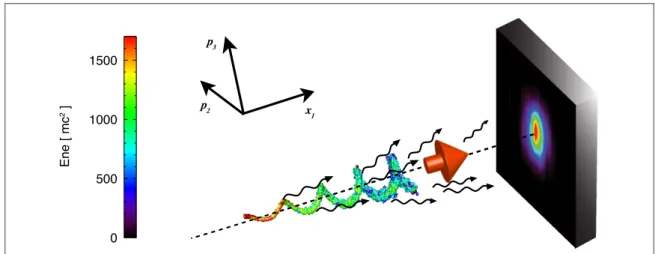
We will now compare the abovefindings with simulation results obtained using the OSIRIS-QED framework. The simulation setup is depicted infigure1where an electron bunch is colliding head-on with a circularly polarised laser and emitting photons. The electrons are presented in their transverse momentum space as a function of the longitudinal spatial coordinate. The main characteristic of the quantum radiation emission is already visible in thisfigure: even though there is an average trend to emit and to lose more energy further into the laser pulse, the energy of an individual electron is subject tofluctuations due to stochastic nature of the quantum photon emission.
To illustrate these features, wefirst present a set of simulations using two different electron bunches with mean energies of 0.5 and 0.85 GeV. The bunches are initialised with a very small thermal momentum spread, equal in all transverse directions(the initial beam divergence isp p^ ~0.2 mrad). The laser is modelled as a
transverse plane wave with a temporal envelope function f(t). The laser rise and fall sections have the same shape and duration trise=tfall=50.0w-01, while the duration of theflat part tflatis varied between 0.0 and 300.0 w-01
with a step of 50.0 w-01(seven different total pulse durationst =tflat+(trise+tfall) 2). The slope of the envelope function fort <triseis defined as ( )f t =10(t trise)3-15(t trise)4+6(t trise)5, where
t = w- =
50.0 26.6 fs
rise 01 and w =0 1.88´1015. The variable length middle section of the pulse had the laser
vector potential always at the maximum value( =a0 27). We shall stress that the interaction between the particles of the beam is negligible and since the laserfield amplitude is uniform in the transverse directions, all the particles are subject to the same conditions. This corresponds to the approximation of beam transverse size much smaller than the laser spot size. Therefore, the large amount of PIC particles(about 1 million) provides us with a good statistical sample to study the evolution of the energy spectra of the electrons. The simulations are performed in 2D, where the box size was500 ´20c2 w
0
2, resolved with 5000×200 cells and the timestep
w
=
-t
d 0.04 01using 16 particles per cell. The simulation timestep is chosen such thatdtWrad-1, where Wradis
the photon emission rate.
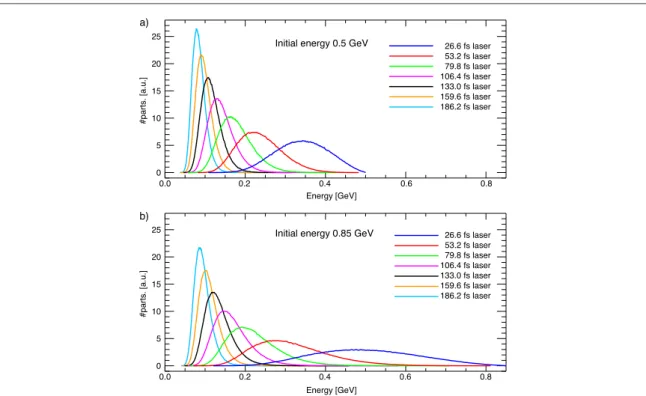
The results of thefirst set of simulations are summarised in figure2which shows the electron energy spectra after the interaction with the laser. All the spectra, as expected, are wider than the quasi-monoenergetic initial distribution. The striking fact is that after interaction with longer lasers, thefinal energy spread of the electron beam is narrower than after interacting with shorter lasers. This hints that in case of longer interaction, a ‘turning point’ predicted by the theory with properties given by equation (15) must exist. After the initial
Figure 1. QED radiation reaction and photon detection. The electron beam depicted is interacting with a counter-propagating laser during the rise-time of the temporal laser envelope function. Individual events of photon emission cause non-continuous energy loss, which is illustrated by the different colours(particle energies) for electrons experiencing the same field.
increase of the width of the spectrum due to the quantum nature of the radiation process, the‘turning point’ indicates the time at which the width reduces anew as predicted by classical radiation reaction[25].
To investigate this further, the evolution of the beam energy with the spreadg( )t s( )t 2 as a function of time for several examples is shown infigure3. Without quantum stochasticity or radiation reaction, both the electron energy and ( )s t would remain the same throughout the whole interaction. With only classical radiation reaction, both the average energy and ( )s t would reduce with time. The analysis of the beam spectral width evolution during the time of the interaction confirms that the first quantum effect is to broaden the spectrum due to quantum stochasticity. If the laser is short enough, the spectrum stays broad(this is in agreement with [36]). However, if the laser is longer, then there is a specific point in time where the spread starts decreasing due to the classical drift of the electron energy distribution function.
A second set of simulations is performed by varying the electron beam initial energy, using a laser pulse similar to the ones described previously( =a0 27, trise=tfall=50w-01, tflat=600w-01), with the same
simulation box and resolution. We would like to compare the predictions of equation(14) with the simulation results in a regime withce1, in a wave with a constant amplitude that allows for direct integration of equation(14). The black line in figure4(a) shows the evolution of the energy spread from a simulation with
Figure 2. Final electron energy spectra:(a) starting from the 0.5 GeV electron beam; (b) starting from 0.85 GeV electron beam.
Figure 3. Electron average energy evolution versus time with standard deviation as a measure of the energy spread. The electron initial energy is(a) 0.5 and (b) 0.85 GeV. Different colours denote different laser durations.
g = 100, wherece0.01. We are interested only in the constant amplitude section, so we selectt=27w-01as
the new‘initial time’(trise 2 +tbeam, where tbeam=2w-01is the electron beam‘duration’). Therefore,
( )
s =s t =27w
-0 01 andg0=g(t =27w-01). The numerical integration of equation(14) is computed from
this new‘initial time’ in order to compare with the simulation results. The panel (a) of figure4shows that equation(14) gives a result in good agreement with the simulation. Even in the case of a higher g = 17000 , which corresponds toce0.2, the integration of equation(14) provides a reasonable agreement (figure4(b)).
Infigure4(c) we show sT2as a function of gT3at the‘turning point’ for several simulations starting at different average electron energies. All the simulations are performed witha0=27and the‘turning point’ is located within the constant amplitude section of the pulse. For particles with lower energies(and therefore with lower ce), the ‘turning point’ is well identified by equation (15). For higher energies, the ceparameter is close to one and the electron energy spread is high, which makes the simulation results depart from the prediction of equation(15). However, the value obtained in the simulations is always lower than the predicted value. This confirms that the upper limit on the electron energy spread increase through diffusion as a function of a0andγ
can be estimated using equations(15) and (16). The predictions of equation (15) are shown in figure4(d) for a range of different values of the laser intensities and electron energies.
Let us comment on the underlying physics involved in this behaviour. The differential probability rate of photon emission given by equation(2) depends on the ceparameter in such manner that electrons with higher ceemit on average a larger fraction of their energy than the electrons with low ce. This is what leads to the classical-like shrinking of the electron beam energy distribution in addition to the average energy drift towards a lower value. Moreover, the photons in the nonlinear Compton regime are emitted according to a distribution, such that electrons in identical conditions can radiate photons of different energy; this leads to a diffusion in the electron distribution function. These two tendencies compete, and the drift effect becomes dominant if the energy spread is wide enough( s sT). On the contrary, if the initial electron energy spread is very low, the diffusion process dominates. This is illustrated infigure5that shows the temporal evolution of electron energy spectra in a Gaussian laser pulse with duration t = 150 fs and peak vector potentiala0=27(a pulse like this
Figure 4. Electron beam energy spread.(a) Evolution versus time for an electron beam starting atg = 1000 . The black line represents the data from the simulation, and the red line comes from numerical integration of equation(14) (b) Same as in (a) but for an electron
beam with initial energyg = 17000 .(c) Standard deviation of the distribution at the ‘turning point’ as a function of gT3. The line is
determined by equation(15) fora0=27, while the points are the simulation data corresponding to the time at which the energy spread reaches its maximum(ds dt=0). (d) Maximum attainable energy spread through diffusion depending on the energy of the
will be available, for instance, in ELI Beamlines[1]). An electron beam is initialised with g = 17000 , and we varied the value of s0. Thefirst value s = 20 (figure5(a)) corresponds to an electron beam energy spread of 0.1%
that is still a challenge for experiments. The second s = 1000 infigure5(b) corresponds to a 6% energy spread,
that has already been achieved with GeV-class electron beams in state-of-the-art laser facilities[24]. Third value s = 2000 infigure5(c) corresponds to 12% energy spread, and this is routinely achievable with laser wakefield
acceleration in the present day laboratory conditions.
It is clear fromfigure5that starting from a very narrow distribution, the diffusion appears to be faster than for an initial wider one. All the three examplesfinally converge to the same electron energy distribution function. We can take advantage of this to calculate the expected electron energy spread at the end of the interaction. We perform the numerical integration of equation(14) assuming that the initial energy spread s0is equal to the
maximum attainable energy spread through diffusionsTdetermined by equation(15) for a given a0andg0. The
result obtained in this way is valid for all s0<sT, as long as the total time of interaction is much longer than the typical emission timeTtotalWrad-1. The expectedfinal energy spread obtained through numerical integration
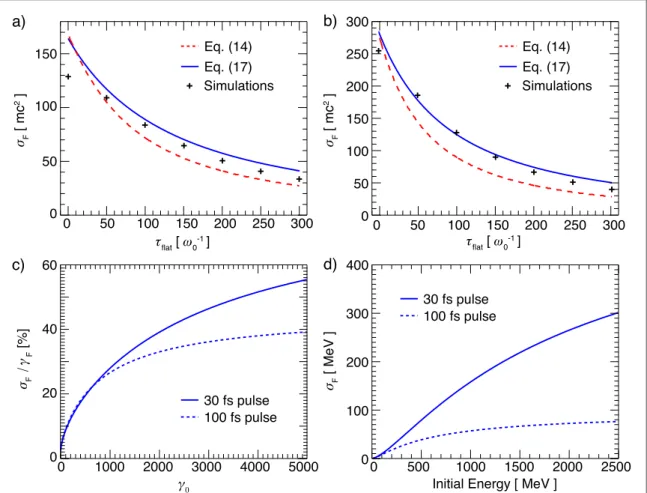
of equation(14) is compared with the simulation results in figures6(a) and (b) for all the different laser pulse durations considered in thefirst set of simulations. As expected, the agreement is better for longer laser pulses and lower average electron energies, but the order of the expected energy spread is well predicted in all cases (maximum error is about 30%).
For guiding future experiments, it would be beneficial to have an explicit expression where one could insert the initial electron and laser parameters, and estimate thefinal energy spread of the electron beam that could be measured directly on a spectrometer. It is possible to attain such an approximate expression for laser pulses with a symmetrical, Gaussian-like temporal profile. We assume that the balance point s =d 0 has been reached before the centre of the pulse. This assumption is reasonable for beams withs0~sT, and for beams with
s0 sTprovided that there is enough time for the diffusion to act and increase s0to the same order assT. This is verified when the pulse duration satisfiestfwhm> 1 8( g a0 rr). If the pulse is shorter, the stochastic effects dominate over the drift, and thefinal energy spreadsFcan be directly estimated using equation(11). Similarly,
fors0sT, the drift dominates and we can approximatesFthrough equation(9). The most difficult case is,
therefore, whens0~sT, as all the terms in equation(14) are of the same order, which renders the equation unintegrable. However, we can estimate an upper boundary forsFby assuming that at the central point of the
laser(at the point of peak intensity) the electron beam is close to the balance between the drift and diffusion, i.e.
( [ ])
s » 2.4 l mm ´10- g a
M M
2 6 3
0, wheregMis the average Lorentz factor of the electron beam in the central laser point. AsgMis easy to calculate(see [20,25,52–54]), we can retrieve an explicit expression for sMas a function of laser intensity and duration, and initial electron energy. Beyond this point, the energy spread slowly decreases, and thefinal electron energy spreadsFis smaller than sM. This yields
( [ ]) ( ) s g g t ´ + ´ -I I 1.455 10 1 6.12 10 fs , 17 F 2 4 22 0 3 5 0 22 0 3
whereI22=I 10 W cm[ 22 -2]anda0=0.855 I[10 W cm18 -2] [l mm]for linear polarisation and
[ ] [l m ]
=
-a0 0.855 I 10 W cm18 2 m 2for circular polarisation. It is worth noting that the result presented in equation(17) does not depend on the laser polarisation, but solely on intensity and duration.
Figures6(a) and (b) shows the estimate given by equation (17) compared with the simulation results. Even though the lasers in our simulations are not Gaussian, we obtain a satisfactory agreement for the sametfwhm.
Panels(c) and (d) show the predictions for the final energy spread according to equation (17) for electron beams starting at different initial energies after interacting with a 30 and a 100 fs laser of2´10 W cm21 -2intensity.
Figure 5. Electron beam energy spectrum evolution in time in a 150 fs laser pulse. Average initial energy of the electron beam is
g = 17000 , with the initial energy spread of(a)s = 20 ,(b)s = 1000 and(c)s = 2000 . The lineouts represent the electron spectra at
timest=35w
These laser durations are to be available in the near-future laser facilities such as ELI[1], so there is a possibility to verify this model in the next few years.
4. Electron beam divergence
In addition to the electron energy spread, we can also evaluate the impact of the laser interaction on the electron beam divergence. We define the weighted average of the deflection angle from the main propagation direction as
( )
å
å
q = = ^ = ⎛ ⎝ ⎜⎜ ⎞⎠⎟⎟ q p p q tan , 18 i N i i i N i 1 1where N is the total number of simulation particles, qiis the charge weight of the ith particle, and (p p^ )iis the ratio of the transverse to the longitudinal momentum with respect to the direction of laser propagation. For small angles,tanqq, and the average divergence shown infigure7is determined with this approximation (the error is less than 1 mrad).
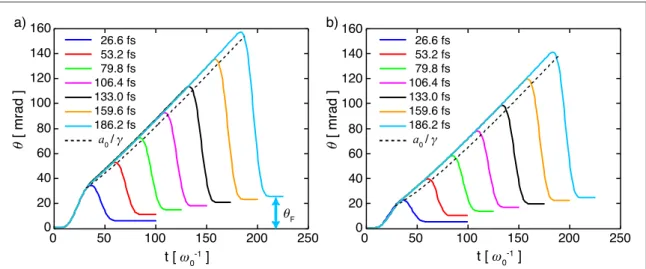
Figure7shows the evolution of the electron bunch divergence as time progresses. Classically, the radiation reaction leads to momentum phasespace contraction proportionally in transverse and longitudinal direction. According to the analytical solution for trajectory of a relativistic electron in an intense plane wave[30], on average, all momentum components and electron energy are reduced by a same factor due to radiation reaction. The angle between the particle momentum and the laser propagation direction is therefore approximately the same before and after the interaction, provided that the laser has a slowly varying temporal envelope compared to the laser period. However, during the interaction with the laser, the electron has an additional oscillatory component of the transverse momentum, whose amplitude depends only on the laser intensity( p^* a mc0 ). It
is worth noting that the oscillatory component of thep given by the laser is the same with and without radiation^ reaction, as it depends only on the normalised vector potential of the wave a0(see supplementary material [55]).
Figure 6.(a) and (b) Final electron energy spread for different laser durations and initial electron energy of (a) 0.5 and (b) 0.85 GeV. Red dashed line represents the numerical integration of equation(14), blue line is given by equation (17), while points are obtained
directly from the simulations.(c) and (d) Predictions for the final electron energy spread after interacting with a laser pulse at
= ´
In our case, the particles are counter-propagating with the laser, so the initialp^0 =0. The only transverse momentum of such a particle is therefore *p . In the^ field of a circularly polarised wave, the transverse
momentum vector rotates in the plane perpendicular to the laser propagation direction, while its magnitude remains constantp^=p^*a mc0 .
As the initial electron energy is on the order of a 0.5–1.0 GeV, we takeg0a0and the parallel momentum
becomesp=mc g2-a -1 gmc
02 . As a result, the average angle that a single electron makes with the
direction of laser propagation is approximatelyqa0 g. Without radiation reaction, this angle would stay the
same during the constant amplitude section of the laser, as there would be no change inγ. However, equation (8) shows that with radiation reaction the electron Lorentz factor decreases throughg=g0 (1+2a grr 0t)and the angle is then expected to increase linearly as a function of time:
( ) ( ) q g + a g a t 1 2 . 19 0 0 rr 0
The dashed lines infigure7show the average expected anglea0 gduring the constant amplitude part of the
pulse, whereγ is taken as the average relativistic factor of the electron bunch anda0=27. We observe a similar trend with the simulation data, which indicates that the average divergence increase due to radiation emission in the constant amplitude region of the laser envelope is well explained by the semi-classical approach. However, there is a slight difference between the simulation data and the expecteda0 gwhich increases over time.
After the interaction hasfinished, the electron beam has a residual divergence on the order of q ~ 10 mradF
which is larger than the initial divergence on the 0.2 mrad level. Semi-classical radiation reaction predicts the final divergence to be approximately equal to its initial value. In QED, we expect the finalp^ =0, but the divergence defined by equation (18) can have a larger value than initial if there is a wider particle distribution function in transverse momentum space.
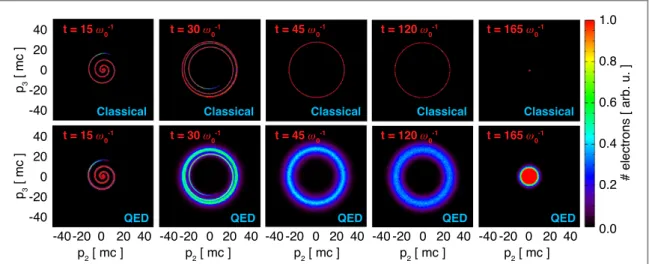
To ascertain the origin of this effect, we have examined the transverse momentum space at different times (see figure8). Initially the electron beam has a narrow momentum spread. During the plane wave stage the average transverse momentum is indeed around the predicted valuep^a mc0 . Howbeit, the QED simulations
show the existence of a momentum spread around the average value that increases with time. This is consistent with the transverse momentum spreading previously reported in[56]. The variation around the average angle as defined in equation (18) during the interaction with the constant-amplitude section of the laser can be
approximately related to the variation in energy:
( ) q g g D a0D . 20 2
This variation persists andfinally becomes the net beam divergence when the laser shuts down:
( )
qF 2 p a0 g s2F F. AsgFconverges to a lower value for a longer interaction time, andσ is from equation (15)
approximately proportional tog3 2, we can then conclude that the width of thefinal angular spread increases
slowly with the length of the interaction(as seen in figure7).
Figure 7. Electron beam divergence versus time.(a) Electron beam initial energy is 0.5 GeV. (b) Electron beam initial energy is 0.85 GeV.
5. Conclusions
In classical radiation reaction, the energy loss of a single electron depends on its initial energy. For an electron beam, the main effects are the decrease in its mean energy and reduction of the energy distribution width. When QED effects are taken into account, the intrinsic stochastic nature of photon emission leads to diffusion in the energy distribution around the mean value which would translate into the increase of the energy spread of the beam. Therefore, in the general scenario, there is a competition between these two tendencies. If we allow a long enough interaction time, there is a point when the diffusion in momentum, intrinsically quantum, is balanced by the energy width reduction, associated with the classical regime. Beyond this point, the energy spread only decreases. This allows for estimating the maximal attainable energy spread through diffusion for a set of initial parameters g0and s0. We have estimated this limit(and confirmed it with numerical simulations), which has
further allowed us to predict analytically thefinal electron energy spread, which is the relevant quantity to be measured in experiments.
The average divergence of the electron beam during the laser interaction is well-described by the classical radiation reaction. However, we have observed that the electron distribution function in momentum space has a certain spread around the average value that increases with the interaction time. This spread persists after the interaction is shut down and leads to a residual divergence of the electron beam that can be estimated analytically through its connection with the electron energy distribution function.
The control of beam properties is of relevance for all near future laser facilities that will operate at high intensities, regardless if they are aimed at optimising particle acceleration, radiation sources or fundamental research. As the quantum spreading might discriminate between the measurable effects and those whose signatures are too small to be observed due to the width of thefinal distribution function, our findings are vital for the design of upcoming experiments. They are also valuable for numerous applications with specific beam quality requirements.
Acknowledgments
This work is supported by the European Research Council(ERC-2010-AdG Grant 267841) and FCT (Portugal) Grants SFRH/BD/62137/2009 and SFRH/IF/01780/2013. Simulations were performed at Supermuc (Germany) under a PRACE Grant and at the Accelerates cluster (Lisbon, Portugal).
References
[1] The ELI projecthttp://extreme-light-infrastructure.eu/
[2] Le Garrec B, Sebban S, Margarone D, Precek M, Weber S, Klimo O, Korn G and Rus B 2014 Eli-beamlines: extreme light infrastructure science and technology with ultra-intense lasers Proc. SPIE 8962 High Energy/Average Power Lasers and Intense Beam Applications VII, 89620I(February 25, 2014)
[3] HiPER projecthttp://hiper-laser.org/
[4] Lobet M, dHumieres E, Grech M, Ruyer C, Davoine X and Gremillet L 2016 Modeling of radiative and quantum electrodynamics effects in pic simulations of ultra-relativistic laser-plasma interaction J. Phys.: Conf. Ser.688 012058
Figure 8. Transverse momentum spacep2-p3at different times. Classical and QED radiation reaction give differentfinal transverse momentum spread.
[5] Blackburn T G, Ridgers C P, Kirk J G and Bell A R 2014 Quantum radiation reaction in laserelectron-beam collisions Phys. Rev. Lett.
112 015001
[6] Sarri G et al 2015 Generation of neutral and high-density electron–positron pair plasmas in the laboratory Nat. Commun.46 6747
[7] Bulanov S S, Mur V D, Narozhny N B, Nees J and Popov V S 2010 Multiple colliding electromagnetic pulses: a way to lower the threshold ofe e pair production from vacuum Phys. Rev. Lett.+ - 104 220404
[8] Yoffe S R, Kravets Y, Noble A and Jaroszynski D A 2015 Longitudinal and transverse cooling of relativistic electron beams in intense laser pulses New J. Phys.17 053025
[9] Elkina N V, Fedotov A M, Kostyukov I Yu, Legkov M V, Narozhny N B, Nerush E N and Ruhl H 2011 Qed cascades induced by circularly polarized laserfields Phys. Rev. ST Accel. Beams14 054401
[10] Ridgers C P, Brady C S, Duclous R, Kirk J G, Bennett K, Arber T D, Robinson A P L and Bell A R 2012 Dense electron–positron plasmas and ultraintenseγ rays from laser-irradiated solids Phys. Rev. Lett.108 165006
[11] Nerush E N, Kostyukov I Yu, Fedotov A M, Narozhny N B, Elkina N V and Ruhl H 2011 Laser field absorption in self-generated electron–positron pair plasma Phys. Rev. Lett.106 035001
[12] Duclous R, Kirk J G and Bell A R 2011 Monte Carlo calculations of pair production in high-intensity laser-plasma interactions Plasma Phys. Control. Fusion53 015009
[13] Bula C et al 1996 Observation of nonlinear effects in compton scattering Phys. Rev. Lett.76 3116–9
[14] Burke D L et al 1997 Positron production in multiphoton light-by-light scattering Phys. Rev. Lett.79 1626–9
[15] Bamber C et al 1999 Studies of nonlinear qed in collisions of 46.6 GeV electrons with intense laser pulses Phys. Rev. D60 092004
[16] Schwinger J 1951 On gauge invariance and vacuum polarization Phys. Rev.82 664–79
[17] Ritus V I 1985 Quantum effects of the interaction of elementary particles with an intense electromagnetic field J. Sov. Laser Res.6 497–617
[18] Koga J, Esirkepov T Z and Bulanov S V 2005 Nonlinear Thomson scattering in the strong radiation damping regime Phys. Plasmas12 093106
[19] Di Piazza A, Hatsagortsyan K Z and Keitel C H 2009 Strong signatures of radiation reaction below the radiation-dominated regime Phys. Rev. Lett.102 254802
[20] Thomas A G R, Ridgers C P, Bulanov S S, Griffin B J and Mangles S P D 2012 Strong radiation-damping effects in a gamma-ray source generated by the interaction of a high-intensity laser with a wakefield-accelerated electron beam Phys. Rev. X2 041004
[21] Seto K, Nagatomo H, Koga J and Mima K 2011 Equation of motion with radiation reaction in ultrarelativistic laser-electron interactions Phys. Plasmas18 123101
[22] Zhidkov A, Masuda S, Bulanov S S, Koga J, Hosokai T and Kodama R 2014 Radiation reaction effects in cascade scattering of intense, tightly focused laser pulses by relativistic electrons: classical approach Phys. Rev. ST Accel. Beams17 054001
[23] Hadad Y, Labun L, Rafelski J, Elkina N, Klier C and Ruhl H 2010 Effects of radiation reaction in relativistic laser acceleration Phys. Rev. D82 096012
[24] Leemans W P et al 2014 Multi-gev electron beams from capillary-discharge-guided subpetawatt laser pulses in the self-trapping regime Phys. Rev. Lett.113 245002
[25] Vranic M, Martins J L, Vieira J, Fonseca R A and Silva L O 2014 All-optical radiation reaction at10 W cm21 -2Phys. Rev. Lett.113
134801
[26] Landau L D and Lifshitz E M 1975 The Classical Theory of Fields (Oxford: Butterworth-Heinemann)
[27] Krivitski V S and Txytovich V N 1991 Average radiation-reaction force in quantum electrodynamics Sov. Phys.—Usp.34 250–8
[28] Spohn H 2000 The critical manifold of the Lorentz–Dirac equation Europhys. Lett.50 287
[29] Spohn H 2009 Dynamics of Charged Particles and Their Radiation Field (Cambridge: Cambridge University Press) [30] Di Piazza A 2008 Exact solution of the Landau–Lifshitz equation in a plane wave Lett. Math. Phys.83 305–13
[31] Ilderton A and Torgrimsson G 2013 Radiation reaction in strong field qed Phys. Lett. B725 481–6
[32] Vranic M, Martins J L, Fonseca R A and Silva L O 2016 Classical radiation reaction in particle-in-cell simulations Comput. Phys. Commun.204 141–51
[33] Esarey E 2000 Laser cooling of electron beams via Thomson scattering Nucl. Instrum. Methods Phys. Res.455 7–14
[34] Hazeltine R D and Mahajan S M 2004 Radiation reaction in fusion plasmas Phys. Rev. E70 046407
[35] Tamburini M, Pegoraro F, Di Piazza A, Keitel C H, Liseykina T V and Macchi A 2011 Radiation reaction effects on electron nonlinear dynamics and ion acceleration in lasersolid interaction Nucl. Instrum. Methods Phys. Res. A653 181–5Superstrong 2010
[36] Neitz N and Di Piazza A 2013 Stochasticity effects in quantum radiation reaction Phys. Rev. Lett.111 054802
[37] Di Piazza A, Hatsagortsyan K Z and Keitel C H 2010 Quantum radiation reaction effects in multiphoton compton scattering Phys. Rev. Lett.105 220403
[38] Volkov D M 1935 On a class of solutions of the Dirac equation Z. Phys. 94 250–60
[39] Nikishov A I and Ritus V I 1967 Pair production by a photon and photon emission by an electron in the field of ultra intense electromagnetic wave and in a constantfield Sov. Phys.—JETP 25 1135
[40] Baier V N and Katkov V M 1967 Quantum effects in magnetic bremsstrahlung Phys. Lett. A25 492–3
[41] Klepikov N P 1954 Emission of photons or electron–positron pairs in magnetic fields Zh. Esptl. Teor. Fiz. 26 19–34 [42] Erber T 1966 High-energy electromagnetic conversion processes in intense magnetic fields Rev. Mod. Phys.38 626–59
[43] Nikishov A I and Ritus V I 1964 Quantum processes in the field of a plane electromagnetic wave and in a constant field Sov. Phys.—JETP 19 529–41
[44] Grismayer T, Vranic M, Martins J L, Fonseca R A and Silva L O 2016 Laser absorption via quantum electrodynamics cascades in counter propagating laser pulses Phys. Plasmas23 056706
[45] Grismayer T, Vranic M, Martins J L, Fonseca R A and Silva L O 2015 Seeded qed cascades in counter propagating lasers arXiv:1511. 07503
[46] Fonseca R A et al 2002 OSIRIS: A Three-Dimensional, Fully Relativistic Particle in Cell Code for Modeling Plasma Based Accelerators vol 2331(Berlin: Springer)
[47] Gonoskov A, Bastrakov S, Efimenko E, Ilderton A, Marklund M, Meyerov I, Muraviev A, Sergeev A, Surmin I and Wallin E 2015 Extended particle-in-cell schemes for physics in ultrastrong laserfields: review and developments Phys. Rev. E92 023305
[48] Vranic M, Grismayer T, Martins J L, Fonseca R A and Silva L O 2015 Particle merging algorithm for pic codes Comput. Phys. Commun.
191 65–73
[49] Lifshitz E M and Pitaevskii L P 1981 Physical Kinetics (Oxford: Butterworth-Heinemann)
[50] Planck M 1917 An essay on statistical dynamics and its amplification in the quantum theory Sitz. ber. Preu. Akad 1 324–41 [51] Fokker D A 1914 Die mittlere energie rotierender elektrischer dipole im strahlungsfeld Ann. Phys.43 810–20
[52] Bulanov S V, Esirkepov T Z, Kando M, Koga J K and Bulanov S S 2011 Lorentz–Abraham–Dirac versus Landau–Lifshitz radiation friction force in the ultrarelativistic electron interaction with electromagnetic wave(exact solutions) Phys. Rev. E84 056605
[53] Schlegel T and Tikhonchuk V T 2012 Classical radiation effects on relativistic electrons in ultraintense laser fields with circular polarization New J. Phys.14 073034
[54] Esarey E 2000 Laser cooling of electron beams via Thomson scattering Nucl. Instrum. Methods Phys. Res.455 7–14
[55] Supplementary material.