M
ASTER
M
ANAGEMENT
/
MBA
M
ASTER
´
S
F
INAL
W
ORK
P
ROJECT
H
UMAN
R
ESOURCES
P
ERFORMANCE
M
ANAGEMENT
S
YSTEM
A
PPLIED TO A
SME
J
OAO
C
ARLOS
M
ARTINS DOS
S
ANTOS
E
STANISLAU
M
ASTER
M
ANAGEMENT
/MBA
M
ASTER
´
S
F
INAL
W
ORK
P
ROJECT
H
UMAN
R
ESOURCES
P
ERFORMANCE
M
ANAGEMENT
S
YSTEM
A
PPLIED TO A
SME
J
OAO
C
ARLOS
M
ARTINS DOS
S
ANTOS
E
STANISLAU
S
UPERVISION
:
P
ROF
.
J
ORGE
F
ILIPE DA
S
ILVA
G
OMES
0
To ISEG, an institution of knowledge, to the MBA teachers for their interest and knowledge sharing, to my MFW supervisor for all support and guidance, to my employer and co-workers, for all the support during the MBA and Master, and to Claudia, for everything else… the biggest part!
i GLOSSARY
CX – Company X
EPC – Engineering, Procurement and Construction HDE – Head of Department
HR – Human Resources
HRM - Human Resources Management
HRPM - Human Resources Performance Management System JEL – Journal of Economic Literature
MFW – Master’s Final Work MNG – Management
PA – Performance Appraisal PM – Performance Management
PMS – Performance Management System SME - Small and Medium-sized Enterprise TL – Team Leader
ii ABSTRACT
The human resource performance management system is recognized as one of today’s significant factors towards the enterprise’s continuous creation of value and achievement of its full potential. Its main goal is to combine the organization’s objectives with the employee’s individual performance and development through an integrated feedback process and to allow a more efficient human resources’ management. Small enterprises, due to their nature and restrictions, either do not understand the need to structurally measure and manage their human resource performance or are unable to find a suitable management system applicable to their context. This reality has a negative impact on their employee’s performance and motivation, and ultimately in the organization’s results. Therefore, the lack of a structured human resource performance management system should be considered a business risk, which, in more extreme situations, is capable to jeopardize de organization’s existence. Due to the economic and social importance of these organizations and the highly competitive market in which they operate, any measure to raise performance and results must be nurtured and seized as an opportunity for positive differentiation and business leverage, therefore, the aim of this work is to present the advantages, requisites and importance of a human resource performance management system implementation in small enterprises and provide an applicable suggestion for a practical implementation through a case study approach in Company X, a small EPC company and, hopefully with that contribute, increase its performance and results.
KEYWORDS: human resource performance management system, performance
measurement, small and medium enterprises.
iii
TABLE OF CONTENTS
Glossary ... i
Abstract ... ii
Table of Contents ... iii
1. Introduction ... 1
2. Human Resources Performance Management ... 2
2.1. Definition ... 3
2.2. HRPM components ... 3
2.3. HRPM an integrated system ... 11
3. SME’S definition ... 12
4. SME’S HRM Particularities ... 13
4.1. Culture and Stategy: the level of informality ... 14
5. The link between HRPM and PMS ... 16
6. Literature Review’s Conclusion... 20
7. Methodology ... 21 8. Company X ... 22 8.1 Description ... 22 8.2 HR department ... 24 8.3 Characterisation ... 25 8.4 Openess to a HRPM System ... 25
8.5 Design of Company X HPRM’s implementation proposal ... 28
8.6 Status ... 32
9. Conclusions and Limitations ... 33
References ... 36
Annex I –Performance Appraisal Focus vs Approach axis matrix ... 38
Annex II – Job Description Example ... 39
1 1.INTRODUCTION
During the last decades, in all European countries and large economies, there has been a shift, a transformation of a production-based economy into an economy of services, grounded on knowledge and innovation. With such focus upon services, the classical means of production (machines, warehouses, etc) lost their importance as organizations main assets of competitive and productive advantage. Instead of it, people have become the main key differentiator between organizations, the main asset of companies – the so called “human capital”.
The “profitability and efficiency” of this capital is under management’s attention for a long time, and it has been formally operated in big organisations since the 1950s, firstly throughout performance appraisal (PA) approaches, more linked to a behavioural production/performance measurement, which later evolved to a Human Resources Performance Management system (HRPM), a much broader and integrated process whose main goal is to combine the organization’s objectives with the employees’ individual performance and development, allowing, by that mean, a more efficient Human Resources’ Management (HRM).
Small and medium-sized enterprises (SME) also felt this shift of assets importance and the value that a healthy human factor can add to an organization in terms of efficiency and innovation – cornerstones of today’s differentiation and competitiveness. But it is unpractical and unrealistic for a small company to copy and apply the HRPM models of large organizations. In large companies, HRPM is integrated symbiotically in a much more broader organization strategic tool, the Performance Management System (PMS), seen as a process focused on setting long-term goals, formulating policies to achieve those goals, and measure its level of achievement – this symbiosis sets a perfect notion and potential alignment with organization’s strategy.
In SMEs this integrated process may be also aligned, but usually, in a very foggy way with company’s strategy, since their HRM is definitely more focused on adjusting limited human resources to each day to day situation, always with the goal of maximizing immediate gain and competitive advantage in the short term. On the other hand, to an SME, any problem with its employees has a bigger impact, in its performance or, sometimes, even in its existence: “Human Capital” is “Capital” for small and medium-sized enterprises.
2
Considering that SME’s represent 99% of all businesses in the EU1, it is of vital importance
for these companies to improve their “Human Capital” performance, i.e., to improve their Human Resources Performance Management (HRPM) capabilities.
The aim of this work is to present the advantages, requisites and importance of a HRPM system implementation in small enterprises and provide an applicable framework for a suitable human resource performance management solution in Company X, a small EPC company, which has no formal PMS and HRPM system implemented.
Hopefully, the results may open an opportunity to implement a system and contribute for its performance and results increase.
2.HUMAN RESOURCES PERFORMANCE MANAGEMENT
In today’s globalized world, it is relatively easy to gain access to the competition’s technology and products (…) differentiation is no longer a key competitive advantage in most industries. So, what makes some businesses more successful than others? What is today’s key competitive advantage? The answer is people. (Aguinis, 2013).
Human Capital is the integrated set of knowledge, skills and competencies of the people in an organization (…) human capital is owned by the people who hold it and not by the organization that employs them, (Chiavenato, 2004).
Only Human Capital can produce a sustainable competitive advantage and, performance management systems are the key tools that can be used to transform people’s talent and motivation into a strategic business advantage, (Aguinis, 2013).
In accordance with the literature, there are at least three different models of organization’s performance management: performance management as a system for managing organizational performance; performance management as a system for managing employee performance; performance management as a system for integrating the management of organizational and employee performance (Williams, 1998). Although all three types of models are still valid and applied in today’s organizations, it is the third, a combination of organization’s overall Performance Management System (PMS) with the Human Resources Performance Management system (HRPM) - an organizational-employee performance integrative system – which is considered the most complete and integrated.
3 2.1.DEFINITION
HRPM can be defined as a continuous process of identifying, measuring, and developing the performance of individuals and teams and aligning performance with the strategic goals of the organization, Aguinis (2013), more empirically, Varma et al., (2008), describe it as a process by which organisations set goals, determine standards, assign and evaluate work, and distribute rewards.
Both definitions focus on HRPM alignment towards the integration of the organizational objectives and the employee’s performance, Aguinis (2013) broader and transversal concept, towards the organization, clearly underlines the HRPM alignment with strategic goals and its continuous operative demand – allowing corrections, reinforcements and adaptations of performance throughout a structured feedback. On the other hand, Varma et al (2008)’s definition opens a more practical perspective of the process, pointing out several of its main components, systematized in Crawshaw et al (2017): job assignment, performance standards, feedback, performance appraisal, goal setting and distributing/allocating outcomes.
2.2.HRPM COMPONENTS
None of these components of HRPM should be forgotten or devaluated in order not to unbalance it and secure its purpose: the alignment between the organization’s goals and the employee’s performance, self-notion and development. To miss that is to turn HRPM into a pointless process which, by paradox, will create more problems in the HRM to the ones already existing, as stated by Rego et al (2015), performance evaluation systems in which this alignment is not perceived by employees are mere tools of differentiation and discrimination, generating probable resistance and conflict.
2.2.1.JOB ASSIGNMENT
The Job Assignment can be based in the Job Description, which shall summarize the job duties, needed knowledge, skills, abilities, and working conditions. In a nutshell the Job Assignment defines the essential tasks that the employee must fulfil. This document or instruction must be acknowledged and accepted by the employee since it defines the length of activities expected to be delivered by him towards the organization, and in a HRPM system, towards the Organization’s objectives, Crawshaw et al (2017).
4
2.2.2.PERFORMANCE STANDARDS
Performance Standards are a natural consequence of the previous point, by defining what it means, in concrete terms, to "do the job well", as pointed by Torrington et al (2017), these can be applied either for the job as a whole or towards specific tasks. They can be expressed in quantitative terms such as amount of output or sales, budgets or time limits to meet; or in qualitative terms such as maintaining group cohesiveness.
2.2.3.FEEDBACK
Feedback (i.e. performance structured feedback), may be resumed as an action upon recognizing levels of accomplishment of the above concepts, opening the opportunity for the performance optimization through detected performance barriers elimination. The feedback has been a very debated component of the HRPM, according to Aguinis (2013), it includes information about both positive and negative aspects of job performance and let employees know how well they are doing with respect to meeting the established standards. The same author counterparts this very important component of the HRPM regarding the way feedback’s need to be more aligned and debated towards the future improvement and not so focused in the past. As complemented by Dessler (2017), the goal here is to identify specific concerns or problems, examine causes for these problems, and devise action plans to correct the problems. The feedback meeting should lead to a “action plan” phase, resulting in a list of actions that the manager will take to address employees concerns and boost results. It should include and approach: What is the concern? What’s your analysis? What’s the cause? and What should be done?
2.2.4.PERFORMANCE APPRAISAL
Performance appraisal (PA) is the corner stone of HRPM. The use of PA is not recent, since man started to work in a group, his performance started to be measured and evaluated, even if informally (Chiavenato, 1990) - we would add also the term “compared”, to the “measured and evaluated”.
Many organizations tend reinforce and turn their PA into their HRPM. This mistake, by not considering the other components integration, creates an unbalanced system. A HRPM strictly based in a PA is very limited, for example, in terms of feedback and actual performance correction, since it is only based in past activities and the corrections are made already in due time.
5
Aguinis (2013) clearly sets the difference: we must distinguish between performance management and performance appraisal. A system that involves employee evaluations once a year without an ongoing effort to provide feedback and coaching, so that performance can be improved, is not a true performance management system. Instead, this is only a performance appraisal system.
Even considering its evolution to an integrated HRPM, the PA is still a very significant component of it, providing the formal evaluation of how the work of the employee contributed towards reaching the purposed goals. PA provides the systematic description of individual or group job-relevant strengths and weaknesses, is a key component of any performance management system (Cascio and Aguinis 2004).
To choose the most suitable PA procedure for a company is not an easy task and it should be considered as a continuous one. In accordance with Cascio and Aguinis (2004), PA comprises two processes, observation and judgment, both of which are subject to bias. The same authors clarify that the referred biases may be associated with raters (e.g .. lack of first-hand knowledge of employee performance), ratees (e.g., gender, job tenure), the interaction of raters and ratees or various environmental and organizational characteristics. Therefore, this activity, due to its nature, is usually taken as a moment of tension between the appraiser and the appraisee.
There are several types of PA methods available and frequently debated, it is easy nowadays even to find online forms ready to use and include in a PA process. Rego et al (2015) presents a very interesting variety of types distributed in two axes: The Focus axis (streaming between behaviour and results) and the Approach axis (streaming from a Relative/Comparative approach up to an Absolute/Individual one), presented in Annex I –Performance Appraisal Focus vs Approach axis matrix. The main concept and notion to retain towards the PA to choose and use is it’s the required level of equilibrium between this axis, a ponderation between bigger objective measurability against feedback quality. This means that, for example, a PA based strictly upon numeric goals will have less behavioural inputs which can be a determinant aspect for the HRPM, and, in the end of the line, for the Organization objectives.
Besides the type of appraisal, the person, who performs the appraisal is also a very important determinant for a successful PA. The direct superior is still the core of most PAs, since, theoretically, he is more aware of the appraisee’s work and activities under evaluation. However, it is not advisable to rely solely upon him. There is always the danger of bias in favour or against the employee. In this case, without disregarding the supervisor’s main contribution, several
6
parallel appraisals can take place to complement and allow a more complete, trustful and potentially less biased view of the employee’s performance.
The involvement of other actors in the PA, besides the Supervisor and the employee will bring more perspectives to the appraisal. In many organizations this multi-perspectives are easily achieved by taking advantage of technology to minimize the amount of paperwork and time involved in collecting such information. Dessler (2017) presents five options to complement the immediate supervisor’s appraisal: Peer Appraisals, Rating Committees, Self-Ratings, Appraisal by Subordinates and 360-degree feedback.
Peer Appraisals PA
In the first option, one’s peers see aspects of the person performance that the supervisor may never see, so peers’ opinions can be very useful to consider. The notion that colleagues will also be responsible for the appraise can also change behaviour, Druskat and Wolf’s (1999) study, involving undergraduates placed into self-managing work groups, found that instituting peer appraisals had “an immediate positive impact on improving perception of open communication, task motivation, social lazing, group viability, cohesion, and satisfaction”. This process, as pointed by Rego et al (2015), can be very useful to strengthen or assess a promotion of one element of the team, where its acceptance by all team members is important to consider. Of course, as noted by same authors, there is the other side of the coin, when we are talking about considering other’s feedback, there might be a possibility of mutual back-scratching, which will contaminate the purpose of peer appraisals.
Rating Committees PA
Nominated committees are responsible for assessing the validity of the rating process and its final evaluation, in the PA it usually consists of the employee’s supervisor and three or four other supervisors. Although not directly involved with the appraisee, the committee can mitigate any biased rating and include different points of view of the employee’s performance. Since rates from different perspectives rarely match, the way the rating is defined within the committee needs to be considered and clearly agreed, Dessler (2017).
Self-rating PA
In its essence, as stated by Rego et al (2015), it can have a very positive impact in counselling and personal development. By becoming aware of what he did and what he could (and should) have done, the individual who feels self-righteous is more motivated and responds
7
more spontaneously to the assessment process. Unfortunately, this process is very little safeguarded from the biases, since the employee as a tendency to rate himself higher than do their supervisors or peers. Another negative point of this process is the risk it has to set a negotiation climate and support the setup of an anchor value for the appraisal interview from the employee’s side. This is a very common situation in PA based in numerical indicators, which in the final interview, any discrepancy between the appraiser and the appraisee, tend to generate unfairness and misbelief feelings and, ultimately, a performance fall – where it didn’t exist before.
Appraisal by subordinates
It can be extremely useful for the development of the supervisor. Grote (2002) defines it as a “upward appraisal”. A study of Walker and Smither (1999) has shown that managers who receive low to moderate leadership ratings improved more over time than those who had high (more favourable) ratings. In addition, the managers who discussed their feedback with their subordinates tend to eventually have better agreements over time. The appraisal by subordinates can also present several limitations and problems, since it can be biased due to fear or retaliation from the employees. As suggested by Rego et al (2015), the remove of the anonymity may minimize the retaliation factor… but it may raise the fear. Other factor is that the smaller the team, the bigger the risk of biased results. Nevertheless, the way the supervisor is perceived by the employee is of extreme importance to know, since it has a very important role and huge impact in all HRPM – it’s easier to adapt or change a supervisor instead of an entire team that dislikes some of his characteristics – therefore if backward feedback is used, the points against can be mitigated through the alignment with other options of appraisal, which will make easier to identify and devalue the biased inputs.
360-degree feedback
With 360-degree feedback the employer collects performance information all around an employee, specifically, information on what performance dimensions could be improved is gathered from superiors, peers, subordinates and even customers. The employee also rates himself in each performance dimension and the results are compared in a gap analysis approach showing discrepancies between how one sees one’s own performance in relation to how others see one’s performance.
The usual performance dimensions, as pointed out by Aguinis (2013), are: Communication, Leadership, Adaptability, Relationships, Task Management, Production, Development of others
8
and Personal Development. Each of these dimensions can be subdivided in questions or concepts according to which the subject is evaluated. This, also called multipoint feedback, is defined by Fletcher (2001) as a way of measuring behavioural outputs relating to contextual performance, and to combine this with personality-type questionnaires to contribute to the assessment of basic styles and tendencies that can be addressed in a more developmental context. The participants truthful feedback, which results in an appraisee developmental output, is the key for its success.
In accordance with Aguinis (2013), people are more likely to be honest if they know the information will be used to help the individual improve and not to punish or to reward him. The same author points the main advantages of the system: (1) decreased possibility of biases, (2) increased awareness of performance expectations, (3) increased commitment to improve, (4) improved self-perceptions of performance, (5) improved performance, (6) reduction of undiscussables, and (7) increased career control by the employees. On the other hand, Rego et al (2015) points several risks that must be carefully addressed to avoid the loss of process’s credibility and continuity: (1) unclear purpose; (2) use of the system as a subterfuge to manage an individual with poor performance; (3) absence of a pilot test; (4) lack of involvement of stakeholders in the process; (5) insufficient communication between the persons involved in the process; (6) breach of confidentiality; (7) lack of clarity about the feedback to be used; (8) insufficient resources for implementation; (9) lack of clarification on data ownership; (10) unfriendly management and quotation; (11) treatment of the system as an end in itself, not as a process; (12) absence of measurement of the effectiveness of the process. In resume, and based upon the same authors, the multipoint feedback is a consentaneous performance appraisal method since it has, as its main output and goal, the development and strengthen of weaker dimensions of the employee. The issue may be the link of those dimensions with the company strategic goals. Due to the complexity and number of participants in the process, even suppliers and customers can be involved, it was used before mostly at management level. Nowadays organizations have easy access to 360-degree feedback systems electronically implemented, mostly through online solutions available in the market, which may be quickly implemented, without a high level of administrative action, which provide a better data collectiona and open a more democratic usability of this procedure.
Notes for a PA decision and implementation
HRM must study carefully the organization culture, its strategic objectives and its involving factors in order to choose the most suitable “starting” PA process and to mitigate the negative
9
forces towards it: lack of confidence in the process, lack of motivation, reduced identification with the organization, degraded relations between superiors and subordinates - and, paradoxically, a drop in performance levels (Rego et al, 2015). Longenecker’s (1997) study about the most common reasons for failure of an appraisal system, shows how important it is to assess the organization before taking any PA implementation decisions. In a decreasing order, the main reasons for a PA failure are: unclear performance criteria or an ineffective rating instrument (83%); poor working relationships with the boss (79%) the appraiser lacked information on the manager’s actual performance (75%), lack of ongoing performance feedback (67%) and a lack of focus on management development/improvement (50%). Smaller numbers identified problems with the process, such as lack of appraisal skills (33%) and the review process lacking structure or substance (29%).
The integration of the PA in a broader process, the HRPM, helps the process to reach closer to all the involved parties and increases its credibility. This integration also allows to mitigate tension and align the way the PA is interpreted by the parties. The PA should always be focusing upon the future and not so much in what was done in the past, i.e., “how to improve things ahead”.
2.2.5.GOAL-SETTING
Goal-setting is the process of establishing targets for subordinates and/or team members (Crawshaw et al, 2017), it has consistently been demonstrated as a management process that generates superior performance (Grote, 2002). In accordance with Katzell (1994) there are three related reasons why goal setting affects performance. First, it has the effect of providing direction - that is, it focuses activity in one particular direction rather than others. Second, given that a goal is accepted, people tend to apply effort in proportion to the difficulty of the goal. Third, difficult goals lead to more persistence (i.e. directed effort over time) than do easy goals. These three dimensions: direction, effort, and persistence - are central to the motivation/appraisal process.
The process of goal-setting definition is, therefore, of extreme importance since it acts upon the performance improvement through the motivational approach. It is also important since it gives the employees the understanding of what delivery is expected of them, allowing a prioritization of their work in accordance. In order for goal-setting to be effective and for the individual to be able to use the goals in accomplishing his or her work, these goals should be (1)
10
specific, (2) measurable, (3) attainable, (4) relevant and realistic and (5) time-bound, (Crawshaw et al ,2017; Torrington et al, 2017).
In the goal-setting definition, the organization’s PMS plays an important role by providing the goal orientation based on the Strategic plan, leaving to HRPM the responsibility to assure the correct delivery of the required alignment between the employee performance and the organizational goals. Usually this alignment is made by defining a hierarchical goal-setting definition – company, department, employee. As bigger the hierarchical level, lesser the commitment of the lower levels of hierarchy, since the direct impact of performance is less identified by the employee. In organizations with strong strategical objectives it is common to find the goals split in accordance with a hierarchical chain of goals and with different weights attributed per section. Ultimately, the focus must be in each individual goal, but this organization hierarchical alignment somehow acts as a guarantor that everybody is going towards the same direction. The PA is the perfect moment to present the organization and department goals and make a formal individual goal-setting plan, since the participation by the subordinate in that goal setting process produces a real commitment and, therefore, a performance improvement. (Crawshaw et al ,2017; Torrington et al, 2017).
2.2.6.DISTRIBUTING/ALLOCATING OUTCOMES
Rewarding good performance is just as important and directly linked to motivating and monitoring performance. This is considered the last of the main HRPM components and, to the eyes of the employee, the consequence/result of the PA, therefore, of all HRPM implemented system.
Apart of the performance of the rendered services, which is generally rewarded through remuneration (typically financial remuneration), the reward, as a result of the performance appraisal (and all HRPM system) goes beyond simply how much people are paid. HRM action in this component is of extreme importance since, perceptions of fairness in performance reward are extremely important, particularly for employees, Crawshaw et al (2017).
Although impossible to attain to all expectations, in case of mistrusts, it may jeopardize the entire HRPM system. Therefore, the rewarding system and its policies need to be balanced regarding the importance of the function and the overall results of the company. In a fair and clear way, employees need to have a clear understanding of what kinds of rewards are likely to be associated with the relevant level of performance. HRPM must attend and try to pursue this effort. The Total Reward Models (TRM) are an answer to this concern and emphasize both
11
tangible and intangible benefits which individuals may accrue in the course of their employment, Crawshaw et al (2017).
In the rewarding system the link to pay is commonly used. It is made mainly through compensations (wage incentives, merit salary increases, bonuses, profit sharing, prizes, etc), and other tangible benefits (company car, reimburses an expense incurred by an employee, such as school fees, special discounts in company’s products, etc). These tangible rewards, due to this nature, bring more debate within the organization and, if not clearly defined, may also bring performance problems due to unfairness fillings and misinterpretations. The intangible rewarding, on the other hand, has less impact in terms of debate and, depending of the career and position level, may have bigger impact in the employee’s reward perception (special role and responsibility of the workplace, extra leave, a better work-life balance benefits, flexible working hours, training, supporting personal development beyond the skills needed for the job giving a career projection, gifts for work well done, etc).
The rewarding increases motivation due to its impact in the employee self-recognition and self-valuation in relation the organization’s goals. The company’s recognition gives a sense of purpose beyond the day to day task and make the employee to walk that extra mile when that is needed. That is why rewarding systems are a very important component of the HRPM and should always be attained. (Crawshaw et al ,2017; Torrington et al, 2017).
2.3.HRPM AN INTEGRATED SYSTEM
The interdependency between these main components of HRPM system, (i.e. job assignment, performance standards, feedback, performance appraisal, goal setting and distributing/allocating outcomes) is clear. To work and implement them partially or without a proper integration between each other it's like trying to find the whole while looking only to the half.
Without striding out of HRPM’s main goal – to optimize human capital performance towards organizations goals – several authors present other inherited functional purposes delivered by the HRPM system. Rego et al (2015) defines five major purposes: performance alignment (with organization goals - already addressed previously), clear instructions towards what is intended and valued by the organization in terms of performance, provide a structured feedback aiming motivation and future improvement in terms of capabilities and knowledge, deliver updated and detailed information to support management in its decisions and assess the efficacy of HRM procedures in terms of selection, promotions training and development.
12
3.SME’S DEFINITION
The importance of SME’s as the driving engine of economy, employment generation and innovation is recognized and led to countless SME’s study’s and several definitions.
For instance, the American Small Business Administration (ASBA) once defined as small to medium sized a firm if it employed fewer than 1,500 people.
In 2003, EU defined SMEs based upon two main factors linked to size (Staff Headcount and/or Turnover), splitting the SME’s into three sub categories: micro (less than 10 employees), small (10–49 employees) and medium-sized enterprises (50–249 employees) which have an
annual turnover not exceeding €50 million. The EU’s SME definition also includes three
categories related with ownership and the way an SME relate to another:
• Category 1: Autonomous, if the enterprise is either completely independent or has one or more minority partnerships (each less than 25 %) with other enterprises (EU 2003, Article 3.1);
• Category 2: Partner, if holdings with other enterprises rise to at least 25 % but no more than 50 %, the relationship is deemed to be between partner enterprises (EU, 2003, Article 3.2);
• Category 3: Linked enterprise, if holdings with other enterprises exceed the 50 % threshold, these are considered linked enterprises (EU, 2003, Article 3.3);
All these definitions are frequently criticized given their lack of regional, sectorial and type of industry context: a SME of the same sector of activity is completely different in Europe to the one located in Asia. Subsequently the definitions have been reviewed and gradually narrowed. For instance, the ASBA has now a comprehensive table of standards, breaking down the acceptable sizes of small businesses by industry and sub industries. The EU is currently inquiring and thinking about executing a revaluation of its actual SME definition for a possible revision.
SME’s size-linked factors of classification, even with the type of industry arrangement enclosed, are still vain and hard to standardize in terms of the SME’s characteristics, for example, a lawyer’s firm, a restaurant or even a real state agency, although under the services sector, have significant differences in terms of operations, demands and specific factors, as stated by Edwards and Ram (2009): SMEs are not homogenous but differ in terms of context, family and kinship along with variable labour and product markets.
13
4.SME’SHRMPARTICULARITIES
This lack of homogeneity does not bring only problems in terms of regulations, credit access, taxes policy fairness and even government legislation, it is also an obstacle to the implementation of successful procedures and operations between “similar organizations”, increasing the challenge and risk of applying a “once successful management activity” recipe and reaching unexpected and negative results. HRM and HRPM are directly influenced by this SME’s lack of homogeneity.
Although SME’s and Large companies share basically the same HRM goals and problems, they differ in the paths they take to reach these goals. Putting aside the specificity of each SME, there are some generalizations that are considered as applicable by several scholars of these matter, which can be resumed in five main differentiation forces between small businesses versus large companies: size, responsibilities, resources, recruiting, culture and strategy. (Dessler, 2016; Crawshaw et al, 2017; Collings et al 2019)
Size is the obvious difference between a SME and a large company. From number of clients, production capabilities, office size and number of employees, everything is at a smaller scale. If there is a HR department, most likely it will be handling other roles besides HR. This concept applies to all other organization functions, bringing us to the next differentiation factor.
Responsibilities. In large companies it is common to find an entire department to handle HR activities. With a whole department focused in developing and consolidating its expertise in the defined HRPM system and other related administrative tasks of its field. In the rest of the organization each area of work tends to have the same approach. In SME’s, due to the small number of employees, roles and responsibilities tend to overlap in order to get the job done. The work and responsibilities are carried upon a reactive approach – as the business requires – and not in a consolidated and planned manner.
Lack of resources. Also, a characteristic of the SME’s HRM reality. Training and Development, and other activities related with HRM, are always hard to accomplish due to budget, time and priority limitations of the SME. In large companies there is usually an annual budget defined for these activities whose main objective, as explained previously, is to support employee’s internal development and growth, with all the positive outcome these activities originate and their direct link in controlling/monitoring the personnel turnover.
Recruiting. The way the recruitment is carried out, and its success, may determine the future performance of the companies – which in SME’s, due to the team’s size, is a determinant factor.
14
Hiring the best employee for the job, besides being a difficult task, is time and cost consuming. SME’s tend to simplify the process due to urgency or cost saving. Generally, recruiting in smaller firms involves approaches that are convenient, inexpensive and directly controllable by the firm, such as direct applicants, personal and employee referrals and newspaper advertisements, Hornsby and Kuratko (1990), HR activities often become the responsibility of general managers, who take the hiring decision based in interviews, reference and background checking, experience and the education required for the job, Crawshaw et al (2017). In the end, the “gut feeling” has an important role. Many times, in this approach, the job description is very generical, which will originate a clash between the new employee expectations (commercially sold by the manager during the interview!) and reality: multiple roles with unclear boundaries, job responsibilities and unclear career path. The use of freelance contracting, to meet temporary needs, is also a simplified form of hiring recurrently used by SME's. It may respond immediately but, if maintained, raise other problems in the medium term given the salary difference between a freelancer solution and an employee.
4.1.CULTURE AND STATEGY: THE LEVEL OF INFORMALITY
We have already addressed four, lets call it, operational differences (size, responsibilities, resources and recruiting), beneath all these, lays the main difference: culture and strategy.
The level of formality, or informality, is a key differentiator in the culture of any organization and in its capability to define and apply a strategy. Formality and Informality were described by Marlow et al (2004), not limited to the HRM context, as the terms and conditions of employment formally contracted so both labor and management have recourse to a set of rules, should they feel it appropriate to use them. Moreover, the presence of HR professionals who can be called upon to formulate policy and apply rules and regulations facilitates a more ‘arm’s length’ or anonymous application of formality which emphasizes bureaucratic rationality.
In a SME it is almost impossible to establish a formal environment, firstly due to the proximity between employer and employee, which generates a social relationship into which formality could not readily intrude, Marlow et al (2004), but also, as stated by the same author, as a necessary response to accommodating fluctuating production and labor market demands.
SMEs can mostly be found in the attributes of a model of a company whose success basically depends on the figure of the entrepreneur-owner, who is personally responsible for managing the activities of the company, Garengo et al (2005). Several authors describe that this context generally creates a very flat organizational chart, which has its positive side in terms of
15
flexibility, quick decision-making and action/reaction to demand – the main drive, main vector and orientation of a SME.
To work driven by demand is to work by reaction. This requires the capabilities above, but, on the other hand, these attributes have a cost, usually paid by a weak process structuration and weak knowledge transmission, which mutates into an overlapping of responsibilities and a submission of the organization goals to the day to day needs.
The informality also influences and shapes the demand towards the requests transmitted and/or irradiated by the manager (or its personality), as practical example, since the manager knows everybody and is aware of every activity, hierarchy is subdued to his demands which results in a disruption of the company's purpose, i.e., to do a good job is to please the manager. Therefore, strategy and vision, that may even exist on paper, are not followed, at least, as a priority.
By contrast, in a large organization, instead of demand (at least directly), it is the objectives who drive the performance of the employees. These objectives are defined in alignment with the organization strategy, and, ultimately, each employee knows his objectives outcome in the overall performance and strategy accomplishment of the organization. Also due to its size, the management actions are taken at an upper level of involvement, forcing the organization to stablish formality which nurtures a better definition of responsibilities, hierarchic relations, tasks and allow the development of structured procedures and transmission of knowledge. In such structured environment, although challenging, it is easier to implement a HRPM system and, as stated by Marlow et al (2004), HR professionals can be called upon to formulate policy and apply rules and regulations.
Besides all these management and, in our case, HR and HRPM different paths and specific approaches for each type organization, SME’s HRM is much more sensible to specificity, a determinant factor upon its activity. Therefore, in HRM, as stated by Dundon et all (2019) the context in which SMEs operate remains a crucial factor in explaining people management outcomes be they employee job satisfaction or more hostile managerial attitudes towards collective representation, which, in accordance with the same author, it is this dynamic that represents a key challenge for HRM.
16
5.THE LINK BETWEEN HRPM AND PMS
The EU recognizes the role of SME’s2 and its actual projections strengthen this importance
as an employment and economy dynamization source for the next years3. It is under this
proliferation and competitive environment, that SME’s are opening their perspective to a more strategic dimension approach, acquiring and implementing procedures to leverage their competitive advantage. Managers are sensible and are being forced to recognize this need, as introduced by Amir et al (2014): given the intensity of the present market competition, along with the rapid development in the information and communication technologies, the lack of knowledge or managerial inexperience is no longer a permissible excuse. Indeed, to be sustainable, firms need to be proactive in moving towards success.
This strategic dimension and alignment, which was already addressed, in the previous chapters as a component of the HRPM, must be primarily defined at an upper level – in the overall performance management systems (PMS) of the organization. Thus, the current environment creates a favorable context for the implementation, or review of the already existing, performance measurement systems (PMS) in SMEs, since, as stated by Garengo et al (2005), it forces a company to do strategic planning, and by implementing and using it, the gaps between the company’s current performance and its objectives appear.
In addition to the strategic dimension, today, most PMS include measurements of the performance of both financial and non-financial aspects, such as time, quality, flexibility or efficiency, Dixon et al. (1990), against the “traditional PMS”, that only had cost/financial aspects. It is, therefore important to link any HRPM to the organization’s PMS, since it will provide the non-financial inputs to the overall Performance Management equation.
In an integrated organization, like any large company, the HRPM is a component of the PMS, contributing to the overall strategy definition but also receiving from the PMS the guidelines and alignment requirements regarding HRPM goals definitions and actions. An organization’s HRM, due to today’s personnel importance in all SME’s - the main key differentiator, the main asset of the company, the so called “human capital” - must be closely linked with any PMS implementation and definition, since both will only exist symbiotically.
2 Small and medium-sized enterprises (SMEs) are the backbone of Europe's economy. They represent 99% of all businesses
in the EU. In the past five years, they have created around 85% of new jobs and provided two-thirds of the total private sector employment in the EU. The European Commission considers SMEs and entrepreneurship as key to ensuring economic growth, innovation, job creation, and social integration in the EU. https://ec.europa.eu/growth/smes/business-friendly-environment/sme-definition_en
17
The establishment of PMS in an SME is of extreme importance for any HRPM definition since it requires, for its implementation, a structured definition of a strategic plan of the company, forcing a shift from the informal approach, described in previous chapter, into a more formal performance setup of a company. Though, the design of PMSs for SMEs must consider strategy but, as presented by Garengo et al (2005), there must also be a strong focus on operational aspects, since traditionally these are critical for the success of SMEs (…) the performance measurement process has to be based on a management information system which keeps in mind the limited financial and human resources of small and medium enterprises.
This linkage between the HRPM and the PMS is clearly evident in some of the points of Table 1, where the main characteristics of a suitable PMS (Bititci et al, 2000; Chalmeta et al, 2012) are presented and easily identifiable and applicable from one to the other.
1. Performance measures should be derived from the company’s strategy; 2. PMS must reflect the competitive position of the organization;
3. Non-financial measures should be adopted;
4. All stakeholders (customers, employees, etc;) should be involved in the selection of the measures; 5. It must allow the deployment of strategic objectives in order to include the processes at lower
levels of decision;
6. It must focus on the core areas of the business;
7. It must be dynamic and facilitate the continual redesign of business processes; 8. The purpose of each performance measure must be made explicit;
9. Methods used for data collection and for calculating the level of performance must be made clear; 10. The performance measures that are selected should take the organization into account;
11. The process should be easily revisitable, that is, measures should change as circumstances change; 12. Performance measures should provide fast feedback;
13. PMS should stimulate continuous improvement rather than just monitor the situation; 14. Use the firm’s historical data to set targets for improvements and to reach them; 15. It must make it possible to integrate people, processes and technologies;
Table 1 - The main characteristics of a PMS (Bititci et al, 2000; Chalmeta et al, 2012) In what refers to the SME’s specific applicability, the same authors highlight that the first 10 characteristics of Table 1 are determinant for a successful implementation of a PMS in a SME since they can be a barrier towards its proper implementation. Therefore, from these characteristics some questions can be raised and should be answered. For instance, the first characteristic demands a clear answer to the question “what is our strategy?”. This should be considered as a pre-step before choosing, adapting and implementing any PMS because it will also measure the organization’s willingness and openness to it.
18
Garengo et al (2005) went further in the study by assessing several PMS models applicable to SME’s. Firstly, by defining nine main analysis dimensions should be answerer by contemporary SME’s PMS models and after, by applying it in an eight PMS distinct models’ comparative analysis. The dimensions approach was intended to analyze several perspectives of each model:
- Strategy Alignment; - Strategy development; - Focus on stakeholders;
- Balance (financial and non-financial aspects);
- Dynamic adaptability (capability of a PMS to be quickly adapted to new contexts); - Level of Process Orientation;
- Depth and breadth (Depth is related with the level of detail of a PMS, the Breath is linked to the number, the scope of activities contained in the PMS);
- Causal relationship – Capability of PMS to identify the factors that affect performance and the relationships that exist between them. This would be very useful for improving the processes in SMEs, where incremental changes are often preferred over radical changes.
- Clarity and simplicity;
The conclusion of this comparative analysis, presented by its authors, showed an evolution and differentiation between the old large organization’s PMS models (applicable to SMEs) and the new ones, mostly in terms of a progressive/vertical systems to reactive/horizontal systems – which are more aligned with the SME perspective. Another important point was a detected trend in the importance decrease regarding the strategy alignment of the new models. The alignment of “translating strategy into action” is changing into a more operational aspects approach, which, as explained by Garengo et al (2005), does not mean that the importance of strategic alignment is decreasing, but that stakeholder orientation is becoming more critical (…) PMS has to ensure that stakeholders needs, strategy and organization remain aligned to maximize the stakeholders ‘satisfaction. This analysis suggests also that further investigation is required, since no model clearly showed that the above conclusions were reached due to the evolution of the generic models or to an attempt to introduce models suited to the needs of SMEs.
Posteriorly, Chalmeta et al (2012) analyzed 20 of the most prominent PMS models applicable to an SME. Their criteria for model’s selection was SME specific ones and others that do not take the size of the organization into consideration. The same authors concluded that the
19
diagnosis has not proved to be completely satisfactory, concluding that the development and implementation of PMS in SMEs is a complex affair that has still not been satisfactorily resolved by those models. Through that common ground establishment , these authors proposed, as a solution to cover the weaker points detected, a case study of an implementation of an alternative model, PMS IRIS, whose methodology incorporates and adapts aspects of methodologies based on business score card approach and complements it with specific elements for SME (process improvement, the introduction of technological aspects, model validations or emphasis on preparing the human factors for the success of the project). Besides reinforcing the need of SMEs to use PMS to support decision making and some fine tunings requirements on several implementation steps, the main final conclusions of this work went straight to the need to overcome the SME limitations already highlighted before, mainly in terms of organizational culture and lack of capability within the enterprises to process and interpret information.
Taticchi et al (2010) argue that research should focus on the creation of early conditions for performance models implementation. The same authors present the gap of literature that needs to be covered regarding PMS in SME’s.
In fact, even considering posterior PMS models applicable to SME’s, the specificity of each organization, the technological and competitive fast-changing environment and, very important, the absence of the early conditions in a SME, are constant obstacles to the implementation of a successful PMS. It is, therefore easy to conclude that there is no ideal PMS model, the existing ones may be taken as guidelines that require a constant follow-up, risk mitigation and customization into a tailor-made solution in each application. Even with a huge range of similarities, a successful solution in one organization may be poor, or even a disaster, in other. In what refers to HRPM, due to the link and interdependency of both processes, the same conclusion may apply, even more severely, since a PMS, in a very basic form, can stick to basic Financial and Quality indicators, Figure 1 – PMS future areas of research, Taticchi et al (2010), that may be more difficult to translate
into a HRPM goal definition.
Figure 1 – PMS future areas of research, Taticchi et al (2010)
20
6.LITERATURE REVIEW’S CONCLUSION
The primary goal of this literature review was to assess the applicability, advantages, requisites and importance of an HRPM in a SME, and, if attainable, to support the presentation and definition towards its implementation in Company X, which has no formal system currently applied.
Throughout the published works and the authors considered, it was possible to conclude that, an HRPM can add competitive advantage to an SME since it acts upon performance. Primarily, providing a suitable and integrated way to manage and align the performance of the “HR asset” towards the objectives of the company, and, secondly, it allows a better level of proficiency and mitigation over this asset’s risks, which in SME’s, due to the size and employees dependency, is critical. There is, therefore, no doubt regarding the HRPM’s applicability to an SME since, in its essence it provides answers to several HR management needs of any type of organization.
The literature review pointed out other important inputs to the analysis and implementation proposal:
- Attention to each SME’s specificity - the design and implementation of this system in a SME is different from the one in a large company since the two organizational setups differ and are conditioned in 5 main HR dimensions: size of the company, responsibilities’ dispersion, lack of resources, recruiting means and philosophy, culture and strategy – the last one linked to the informality level, which is typically high in an SME.
- The symbiotic link and similarity between the HRPM and the organizational PMS, since it is from the last one that it is supposed to collect the strategy to be align with.
- The requirement of a structured approach to access the level of openness or primary conditions in a SME to embrace a HRPM system, based on its components: job assignment, performance standards, feedback, performance appraisal, goal setting and distributing/allocating outcomes.
If we look to figure 1, it is also evident that even in the most informal and unstructured organization there is always a PMS, an HRPM, even a PA, in force. In the figure, the lowest PMS for a SME comes directly via financial and quality indicators, from which it is possible to define at least two strategic objectives!
With this approach, the importance of HRM and the simplicity requirement for any new process in an SME, it is now clear to us that the implementation of a HRPM is possible in a SME and it can be even the first step to drive it into a more structured and efficient organization.
21 7.METHODOLOGY
The methodology followed by this work was selected based upon the Figure 2 – Research Onion, Saunders et al (2015) and took under consideration the level of proximity to organizational problems analysis and solution proposals orientation.
Figure 2 – Research Onion, Saunders et al (2015)
The project’s research strategy was action research, which in essence is defined by Coghlan et al (2014), as an emergent and iterative process of inquiry that is designed to develop solutions to real organizational problems through a participative and collaborative approach, which uses different forms of knowledge, and which will have implications for participants and the organization beyond the research project.
The project was carried out over Company X, through a qualitative method based on the literature review (scientific articles, books and existing models/frameworks proposals for SMEs), interviews and a deductive approach analyzing the advantages and importance of implementing a HRPM system in a SME.
The Company X interviews intended to promote a free and introspective approach about performance management process, taking advantage of the close link between HRPM and PMS. They targeted employees with different levels of responsibility, age, gender and from different organization’s departments, covering by this mean all main perspectives of different responsibilities and departments. The main goal was to collect a notion of the employee self-alignment towards the organization objectives and strategy, the expectations towards a
22
performance management practice and assess the relevance/acceptance of implementing a HRPM in the organization. A deeper interview was also carried with the HR responsible to complement information, detect CX specificities requirements and weigh the presence of a possible HRPM implementation components.
8.COMPANY X
8.1DESCRIPTION
Company X (CX) is a Portuguese company, based in Lisbon, with 8 years of existence in its current form, but, due to several past change of shareholders, in reality it works since more than 30 years. It is 100% owned by a european family group whose main activity is not entirely related with CX’s scope.
The annual revenue is between the 2M€ and 5M€ and CX is struggling to obtain positive annual results in the last three years. Due to that situation the headcount has decreased more than 40% in the last years, stabilizing now to 45 employees, from whish 15% are consultants.
Regarding its scope of operations, CX presents itself as a technology-independent system integrator capable of dealing with the entire value chain of its customers in large industrial projects across the globe, in the following sectors: Oil & Gas, Power Generation, Material Handling, Port & Harbor, Urban Waste Treatment, Mining, Bridge Construction, Natural Gas Handling, Petrochemical Auxiliaries. Its experience is based in more than 30 years of activity, which allowed to gather a recognizable knowledge in EPC contracts and turnkey projects, construction and start-up of several large power generation projects. From project development to project management, all the way up to plant performance testing and handing over to commercial operations by comprising all dimensions, industrial engineering, procurement and construction of an Engineering Procurement and Construction (EPC) contractor. CX is able to provide technical concept and design, project structuring, purchasing, building, and commissioning of conventional thermal power generation plants and bulk material handling systems. In parallel CX also delivers a comprehensive range of after-sales support and plant maintenance services.
The company references are important but mostly from the late 90’s to late 00’s projects. In the past, due to the dimensions of each project, the procedures and strategy was always the project in hand, forcing and setting up the company to shape recurrently into a project execution division. During the last years, due to the lack of projects, Construction component has been
23
deactivated, therefore the company, shifted to Engineering (basic) and Project Management. This configuration shift was also forced due to a Joint-Venture with a risky country based European contractor. This partnership forced the company to adapt to a new acting sector oriented to the Oil & Gas industry.
The 45 employees are divided in indirect (15), the administrative area (Finance, Procurement, Cost Control, IT, space management and administrative) and directs (27), directly linked to operations (Engineering, Quality, Project Management and Sales), HR (1) and Management (2). The youngest employee is 34 and the oldest 72, age average is around 56, with several nationalities (Portuguese in majority). The level of salaries is above the market average. In terms of gender distribution, women are a minority, 20%, quite in line with this activity’s and company type.
The organ chart is very flat, Figure 3 – Company X organ chart, basically split between Directs and Indirects except for HR, which are directly managed by Management.
Figure 3 – Company X organ chart
These two departments (Indirects and Directs) are managed by its own Head of Department (HDE) and are divided in Sub levels/teams, managed by Team Leaders (TL), but in day-to-day activities, driven by demand, there is a constant shift and change of responsibilities, therefore Figure 3 would be the simplest way to show the organ chart.
In terms of governance the management is under the responsibilities of two foreign employees present in the company since day 1, thirty years ago, whose responsibilities during this time were Project and Construction Management. Both report to a shareholder committee through an annual business plan (reviewed every semester) which is made considering the finance dimensions – mostly facing cash flow, reporting on business doings and a projection of sales probabilities. This business plan is only accessible to a very limited number of people.
The company has an enterprise resource planning system (ERP) and a documentation management System (DMS) which deliver information to management and almost all reporting demands. Management (2) HR (1) Indirects (15) Directs (27)
24
In terms of quality, the required certifications for its activity are in force; therefore, several procedures are used and applied. These procedures have been adjusted through time, their basis is aligned and inspired with the one’s used by this industry’s big players.
8.2HR DEPARTMENT
The evolution of CX’s HR Department followed the path and results over the years. In the 00’s, since the company had more than 200 employees, it was composed by 5 team members. In the last 8 years, after an outsourcing solution, it has only one person which it is fully dedicated to HR administrative tasks (salaries and absence processing, legal requirements, recruitment, etc) and other sporadic not related tasks.
The HR responsible has a legal background and was integrated in the company 3 years ago as a result of a HR outsourcing contract’s termination. Although his background and main knowledge mostly related to labour legislation requirements, there is a huge willingness, sensitivity and interest regarding the possibility to do and provide something more than just the administrative tasks in terms of HRM. The approach regarding the study for a possible implementation of HRPM system in the company was welcomed and discussed in several informal meetings.
During those meetings, besides some information that was already shared in the chapters above, a very constructive discussion and conclusion occurred regarding the company’s need of a HRPM system implementation and the Management vision towards it, which are synthetized below:
Something tried in the past – CX already had tried in the past to implement a procedure to measure performance, which was based strictly on a Performance Appraisal (PA). This was implemented without any study, based upon a large company PA model. It didn’t work out due to its emptiness of meaning and zero alignment with goals. It was used once and never followed. This was during the company downsizing decision, therefore the PA intention and purpose possibly was a little distorted due to that.
Growing de-motivation – during the last years the company results, and the lack of projects increased the tension and the workload, since more efforts are placed to revert that situation. In addiction management does not share other objectives besides the imperative need to survive based on the day-to-day demands. The de-motivation of the employees has increased exponentially over the last years, some valuable people already left (middle management level), and others stayed only because the salary level is higher
25
regarding the market. Although the good team spirit between the employees of all departments, and the constant effort to deliver, the absence of perspective and a possible dark outlook for the company are shaping the involvement of the employees. In such a small organization, working in open space, these feelings spread like wildfire and influence enormously the performance. Other source of demotivation is the influence of a very informal and unstructured day to day demands of management in all areas of the company, for example, in the HR area, the salaries revision and rewarding are entirely controlled and decided by management who takes decisions with no structured information, bypassing the “defined” hierarchy.
The New Group Strategy and Vision – the European group that detains 100% of CX, due to new business developments, implemented a new strategic plan with a very well-structured definition of Vision, Mission, Objectives, Strategies and Policies applicable to all the conglomerate. As a natural sequence of this process, all companies of the group must align their strategy in conformity.
After this main points consolidation, it was evident that the implementation and use of a HRPM would be an advantage, not only as a mean to promote a quicker alignment regarding the group’s strategy but mostly to answer and try to counter this generalized demotivation.
8.3CHARACTERISATION
CX fits the definition of a small enterprise with a linked autonomy, in accordance with EU dimensional measure. But that is not the only matching aspect, it is also in terms of its inner characteristics, as described in chapter 3. SME’S definition, a very flat organ-chart based in informality, where the overlap of responsibilities, limited resources and management characteristics are driven by short-term demand with no clear strategy or long-term objectives.
This characterization’s outcome is important to reinforce the need to consider mitigation measures regarding a high level of specificity in any SME’s new process implementation.
8.4OPENESS TO A HRPMSYSTEM
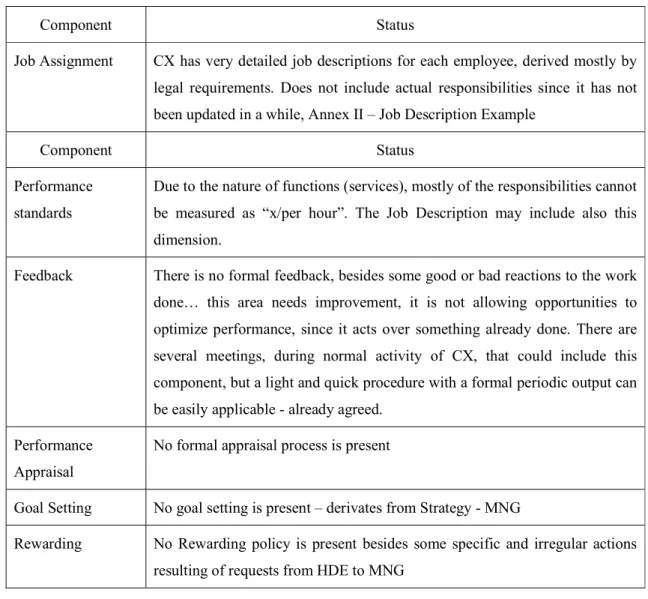
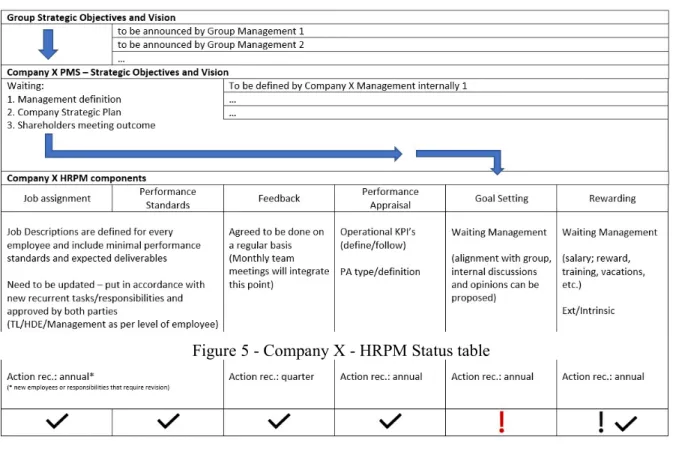
As explained in chapter 2. Human Resources Performance Management, the lack of openness needs to be considered when approaching a SME for any change or new implementation or procedure improvement. It is strongly related with the organization’s culture and must be carefully probed and, if present, mitigated.