Repositório ISCTE-IUL
Deposited in Repositório ISCTE-IUL:
2019-01-07Deposited version:
Post-printPeer-review status of attached file:
Peer-reviewedCitation for published item:
Lourenço F., Postolache, O. & Postolache, G. (2018). Tailored virtual reality and mobile application for motor rehabilitation. In 2018 IEEE International Instrumentation and Measurement Technology
Conference, I2MTC 2018. (pp. 1-6). Houston: IEEE.
Further information on publisher's website:
10.1109/I2MTC.2018.8409572Publisher's copyright statement:
This is the peer reviewed version of the following article: Lourenço F., Postolache, O. & Postolache, G. (2018). Tailored virtual reality and mobile application for motor rehabilitation. In 2018 IEEE
International Instrumentation and Measurement Technology Conference, I2MTC 2018. (pp. 1-6). Houston: IEEE., which has been published in final form at
https://dx.doi.org/10.1109/I2MTC.2018.8409572. This article may be used for non-commercial purposes in accordance with the Publisher's Terms and Conditions for self-archiving.
Use policy
Creative Commons CC BY 4.0
The full-text may be used and/or reproduced, and given to third parties in any format or medium, without prior permission or charge, for personal research or study, educational, or not-for-profit purposes provided that:
• a full bibliographic reference is made to the original source • a link is made to the metadata record in the Repository • the full-text is not changed in any way
The full-text must not be sold in any format or medium without the formal permission of the copyright holders. Serviços de Informação e Documentação, Instituto Universitário de Lisboa (ISCTE-IUL)
Av. das Forças Armadas, Edifício II, 1649-026 Lisboa Portugal Phone: +(351) 217 903 024 | e-mail: [email protected]
Tailored Virtual Reality and Mobile Application for
Motor Rehabilitation
Filipe Lourenço, Octavian Postolache
Instituto Universitário de Lisboa, ISCTE-IULInstituto de Telecomunicações Lisbon, Portugal
[email protected], [email protected]
Gabriela Postolache
Instituto de Medicina MolecularInstituto de Telecomunicações Lisbon, Portugal
Abstract—The present work presents a measurement system
and methodology for hand and finger motor rehabilitation. The interaction with serious games developed in Unity 3D game engine is performed using a natural user interface based on Leap Motion Controller. The storage and management of data related to patient identification, established training plans and training results in LeaPhysio system, is realized in a client server architecture. The stored information can be accessed through a developed LeaPhysio App for Android OS platform, which also allows configuration of training plan by a therapist. Different metrics were included in the measurement system to provide to users the possibility to evaluate in an objective way the motor rehabilitation. The tests have shown that the developed system can provide accurate data on hand and finger movements in a meaningful and motivating exercise environment.
Keywords—hand motion measurement; Virtual Reality; Leap Motion Controller; mobile application; motion anaysis.
I. INTRODUCTION
Exergaming is defined as computer games that require players to physically move in response to game demands and/or on-screen avatar [1]. As part of serious games for motor rehabilitation, exergaming has gained increased importance for training balance [2], arms and hands movements [3,4], lower limbs movements [5] and muscle strength [6]. In study [7] the impact of serious games in terms of prevention and rehabilitation was described. The benefits of serious games were analyzed by applying three criteria: i) efficiency and effectiveness of the intervention; ii) additional benefits, such as psychological factors; iii) quality of study. They concluded that serious games produce substantial benefits for some patients and this impact may increase by applications that are developed to be adaptable for the needs of the patient. To ensure sustainability, the importance of designing configurable application for evaluation and implementation of settings support for long-term motivation and engagement of patient was also underscore.
Important benefit of interventions based on serious games is the capacity to increase diversity within training programs, which can aid in creating a fun and engaging “virtual” atmosphere [8,9] and to engage and motivate the user [9,10,11] to perform high repetition of task-oriented exercises that are required in motor rehabilitation. High-repeatability and high-intensity exercise programs in motor rehabilitation
often induced low compliance or treatment adherence, especially in the presence of a long-term chronic illness. Maintaining motivation and engagement have been reported to be vital to long-term exercise adherence [12]. Also, the flow or cognitive absorption when a patient ‘‘focuses’’ more on a game than his or her impairment has been shown to contribute on turning exercise more enjoyable and motivating [13,14].
Serious games involve different technologies as virtual reality, sensors, telecommunication technologies, human computer interfaces, and dedicated server or cloud services. These technologies can support precise and detailed capture and analysis of complex kinetic and kinematics variables during motor rehabilitation (i.e., distribution of center of pressure during standing or walking, time and speed of limbs movements). Virtual Reality (VR) as “a high-end user-computer interface that involves real-time simulation and interactions through multiple sensorial channels” [15] should induced a sense of ‘presence in’ and ‘control over’ the simulated environment [16,17]. The sense of ‘presence in’ consists of the feeling of being in an environment, even if not physically present in that environment; the sense of ‘control over’ involves the possibility of interaction with the environment and objects giving a sense of being in that situation or environment [5,17]. To place the user within a loop of real-time simulation, where he/she could feel being in ‘presence’ or ‘control’ of real situation or environment, the VR systems require an output device or visual interface (e.g., computer, tablet or smartphone screen or head mounted display) and an input device for interaction (e.g., mouse, joystick, sensorized glove). In the last years several devices were developed and commercialized that allow more natural human computer interface for interaction with virtual environments (e.g. Microsoft Kinect [18], Leap Motion Controller [19]). Moreover, in study [20] was proposed a platform that might use various devices (e.g., Microsoft Kinect, Nintendo Wii Remote [21], Data Glove or CyberGlove, Leap Motion) and open source software to create low-level keyboard and mouse events that most games treat as input from a real peripheral device. The example that the authors presented is with the video game Tux Racer [22], where Microsoft Kinect or Nintendo Wii Remote devices were used to control the game. However, the changes from the last years in these commercial devices impose new developments to adapt and include these new features and proprieties in the motor rehabilitation platform.
In this work we present our developed platform based on serious games and Leap Motion Controller (LMC) for arm and fingers exercise monitoring during motor rehabilitation. The developed application allows for the physiotherapy sessions to be tailored to patient preferences and needs during rehabilitation process. The results obtained from the use of the games are stored in a data storage system (local database send data to remote database) in which they are statistically treated to present estimated metrics that can be used by physiotherapists to evaluate the patient progress in hand or fingers rehabilitation. Mobile application (developed in Android) allows visualization of stored and processed data, and also tailoring the virtual environments to patients’ needs and preferences.
II. SYSTEM DESCRIPTION
A client server architecture characterized by local and remote computation platforms was implemented to support the patient – virtual reality interaction, serious game configuration, serious game data storage and data analysis, and report generation. Different components of the measurement system for hand and fingers motor rehabilitation are following described.
A. Time Flow of the LeaPhysio System
Fig. 1 illustrates a time flow of the use of the LeaPhysio - Games Enhanced Physical Rehabilitation system. The letters of A-H indicate the execution steps.
Fig. 1. Diagram with time flow of the LeaPhysio System
After patient registration in the system, the physiotherapist can include and/or analyze data on clinical status and to create
an individualized training plan. The training plan setup involves parameters (A) as initial and final date, duration of the game, number of repetitions per training, hand(s) that should make exercises. When a training program is created for a patient, the mobile application sends the data to the remote database (B). The computer application initiates an HTTP request through the corresponding PHP script hosted on the server so that it contacts the MySQL database and sends the necessary data to the computer application according to the patient who is using it, using an HTTP response (C). In a planned session, the patient should play a serious game configured with the parameters of the training (D). The application developed in Unity uses LMC for natural user interface to replicate hands and their movements in the game scenario (E). Each session can have a repetition or more, it means that when certain training has more repetitions, the patient performs once the serious game with its duration, and after completing, has a rest period until the serious game is executed again (F), and this is repeated until all period of planed training session is executed. After finishing the training, the physiotherapist can use the mobile application to change any parameter in the patient's training if necessary and visualize the results obtained (G). Finally, in case the physiotherapist deems it necessary, he can generate a report with information about the patient (H), of the exercises already performed and their respective scores. These reports can be generated for the personal use of the physiotherapist or may be delivered for the patient to inform about his performances during the training.
B. Leap Motion Controller
Leap Motion Controller is a small, rectangular device (13mmx13mmx76mm) that weights 45g. It is a hand motion sensing system that is characterized three IR (Infrared Light) (wavelengths = 850nm emitters) and two IR cameras [23]. It’s dual platform (Macintosh/Windows), connects to a computer via USB 3.0 connection. It streams data at a variable acquisition rate that varies between mean value of less than 40 Hz [24] to up to 120 Hz [25], under both static and dynamic conditions [24]. It has a full-functioning Software Developer Kit (SDK) that allows to rebuild the 3D scene, and to track the positions of the hands and fingers. The controller itself is accesses and programmed through Application Programming Interfaces (APIs), with support for a variety of programming languages, ranging from C++ to Python [19]. Positive values of the vertical y-axis increase upwards. Based on stereoscopic vision technology it detects the hand motion characteristics in an effective range of 25 to 600 millimeters above the device. The activated sensor sends data on position of hands and finger during movements. The millimeter accuracy of the LMC when the object is placed bellow 250 mm distance from the sensors was already demonstrated [23,24,25]. To improve the repeatability of the system detection the participants were informed about the optimal position of the hands above the LMC device.
The device SDK was considered for integration of LMC in the developed serious game for physical rehabilitation. It provides data access through direct hand and finger mapping detection, making this aspect a great potential in the
development of applications that include interaction with virtual reality. The device provides a new way of interacting between the user and the computer, the ability to bring the real world to the digital domain. This technology allowing unobtrusive detection of hands movements has an important advantage for hand rehabilitation, as the patient does not need to wear data gloves or to hold any device in the hands. It has great importance mainly after hand surgery.
III. SERIOUS GAME FOR PHYSIOTHERAPY
Serious games can be developed using different technologies, such as JAVA, Unity and C#. Unity is a multiplatform game engine developed by Unity Technologies and used for the development of video games for computers, consoles, mobile devices and websites using languages such as C++ and C#. The Unity is platform that is increasingly used by programmers to develop games due to its powerful game engine. The CollectCube Game, developed using Unity platform, for hand and finger rehabilitation is following presented.
A. CollectCube Game
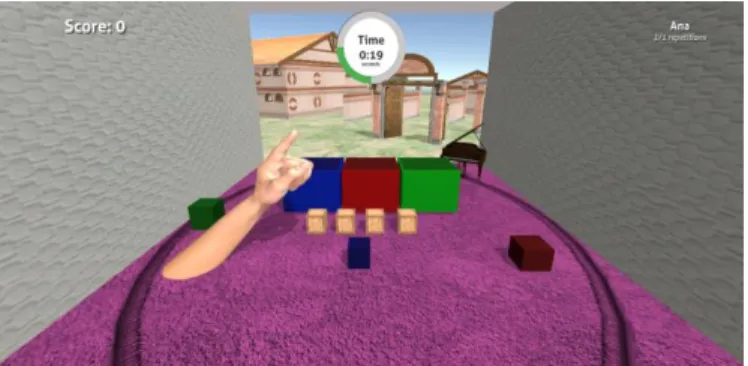
The game aim is to pick up a cube and to introduce it according with the color in the corresponding box to earn points. During the game time various cubes appear on the screen. For each correct action the patient earns a point and for each failure loses a point. Fig. 2 illustrates the CollectCube game interface. This game has three levels of difficulty:
EASY: The scenario only has a single box (green) and over time appear green cubes.
MEDIUM: The scenario has two boxes (green and red) and over time randomly appear cubes with green or red color.
HARD: The scenario has three boxes (green, red and blue), and over time randomly appear cubes with green, red or blue color.
In the difficulty level MEDIUM and HARD the boxes change places with each other in a pre-established period (e.g., 5s) demanding always checking by the user the position of the box when it grabs a cube. This is important to increase attention of the patient during the game (to induce a flow or cognitive absorption state) that might decrease the sensation of effort and increase training time and velocity.
Fig. 2. CollectCube game interface
As many types of hand or finger impairments may be trained in motor rehabilitation session the system need to be adapted to various patient needs. The application game allows different configurations. The games are adapted according to some characteristics of the patient: Gender (Male or Female) and Age. The scenario changes if the patient is male or female. The floor of the male scenario will have a certain color while in the female scenario will have another. These differences are obtained by changing the textures of the objects that make up the scenario, but also by exchanging certain objects for others. The game allows configuration of time for exercises and type of hands that can be used (i.e., left or right hand, robotic hands, man or woman hand). The boxes can change the colour during the game. Also, the user can choose to collect fruits, vegetables, or pets. The therapist may change the setting of the game creating new scenarios for the rehabilitation sessions by changing the size of objects that should be collected, their colour and texture as well as the colour of walls that limits the virtual space of game. When the physiotherapist plans a training session for the patient, the avatar hands are considered according with the patient gender or patient age. No visualization and interaction with virtual games of a not selected hand is produced during the games even if both hands are used.
B. Data Collection and Analysis
The LMC is a powerful tool to acquire finger and hand position during movements. Fig. 3 illustrates which data are collected. The data is stored in a .CSV format to facilitate future analysis. The developed software allows representation of palm, fingers or bones position in time according to the performed movement, the representation of amplitude, time interval, velocities and angles for each different movement, statistical analysis of the measured quantities (e.g., standard deviation of signal amplitude, histogram, Poincaré plots), frequency of movements realized during a game by using fast fourier transform (FFT) of X, Y and Z position signals, similarities and time delay analysis between signals from right and left hand calculated by cross-correlation and argument of the maximum.
Fig. 3. Acquired data components during the training session based on LMC and serious game
IV. SERVER SIDE
The Server is responsible for storing all the information regarding data on patients, programs of motor rehabilitation sessions, and exercise results. The main objective of dedicated server is that all information is centralized in one place and can be accessed remotely by the system applications. By storing this data in a server it’s possible to access the relevant data
through the mobile application that can be used by the physiotherapists or the system manager. Also, good performance of the Unity application for the patients, during configurations of the games and data collection, is obtained. An architecture system, called LAMP was used. It’s a combination of free and open source software. The term LAMP comes from the combination of the following technologies: Linux: Operation System; Apache: Web Server (HTTP) software; MySQL: Database component; PHP: Programming language.
V. MOBILE APPLICATION
To provide the serious game remote configuration and to visualize the training results a mobile application was developed using Android Studio. The Android OS mobile platform was chosen considering the increased number of users of this type of devices (smartphones and tablets).
The developed LeaPhysio APP can be used by two users: The physiotherapist to perform queries regarding
patient data or to register patients, to create training plans or to visualize results.
The manager to register physiotherapists in the system.
The Fig. 4 shows the layout for the patient profile. The physiotherapist can perform various operations for a considered patient. Actions such view LeaPhysio card
(associated with patient identification), generate PDF reports
with information on the exercises that were already done. In the Patient profile can be visualized data on exercises already done, on training programs and registered observations made by physiotherapists.
Fig. 4. LeaPhysio Mobile APP - Patient Profile Layout: View Data, View Trainings, View Observations and View Logins
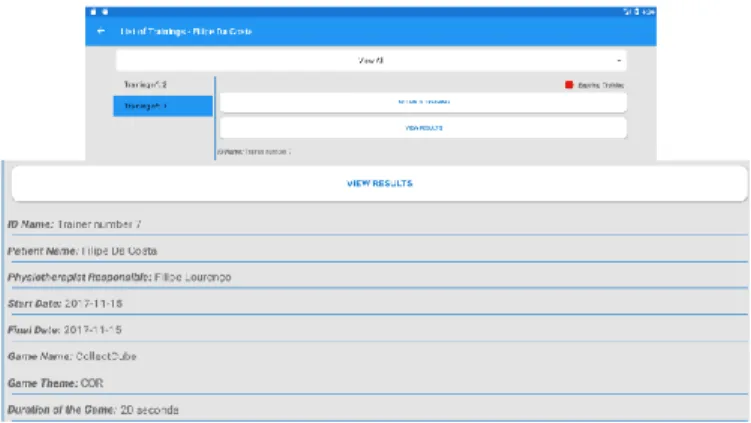
By clicking on the "View Trainings" button, information on training is obtained as it can be seen in Fig. 5. It is possible to visualize the differences between settings of each training, start and end date for each training, how many repetitions, which game and which hands are used. Also, using designed interface, the information about training plans status (active or expired) can be obtained, as so as the existing settings can be changed.
Fig. 5. LeaPhysio Mobile APP – Training Patient Profile Layout The application supports searching and sorting different functionalities (e.g., by date, by order, by status). Selecting a training and clicking on the "View Results" button a new activity is opened that allow visualization of the results related to the training program. The results are divided in score and coordinates. First are presented the score values and by clicking "Coordinates Results" button, the coordinates activity is launched (Fig. 6). It consists of two panels. The first one allows to view the selected data, select the points of interest for the analysis by clicking the "Select Data" button, or deselect all the data in the charts. The other panel allows the representation of the selected points of interest for the analysis (e.g., X, Y, Z palm position during training session) and to visualize the selected data using the line chart. When the training plan involves the usage of both hands to perform the serious game, two graphs for the left and right hand are presented. Zoom-in and zoom-out are allowed in the charts. To remove a line from a chart, it’s necessary to search for that information in the list of selected data and press the element to remove. The app that run in Android OS platform was developed taking into account easier and more comfortable management of data related to patients training programs but also because smartphone or tablet support may contribute for more informed decision making on interventions and management of physiotherapy process by including many types of resources that are required in a clinical setting: i) communication capabilities - voice calling, video conferencing, e-mail; informational resources - guidelines, medical literature; clinical software application (e.g., disease diagnosis aids). These resources are mainly provided by stationary computers, the development of the mobile apps supports now the need for mobility in healthcare settings.
VI. SYSTEM TESTS
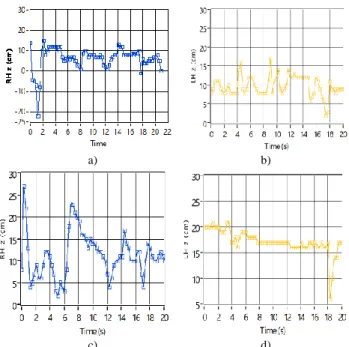
Preliminary results on usability tests of developed application were obtained after experimental tests were organized at ISCTE. The tests were realized with 8 participants - 4 female occupational therapists (age range 29-31 years) and 4 healthy volunteers (1 female and 3 men, age range 25-48 years). All participants played the CollectCube game from the Unity application using two hands with a three-minute game time. The movements of hands were recorded also by using video recording of hands movements with an action camera (Ricoh Action Cam WG-M2). Video images were analysed to evaluate the LMC precision detection at different movements’ frequencies. Hand and finger data were collected and stored o the server side for analysis. During development of applications the optimal sampling of LMC signal for good interaction with virtual environment was found to be 3 samples/s for healthy persons. Following we present some example of signals and analyzed data that can be visualized by users of the measurements system. The Fig. 7 presents data on palm position in Z axis collected from two participants during game. The charts are referring to Z values variation, as many movements for placing the cubes in the boxes are realized in Z axis. The values for the position are expressed in cm. A value equal to 0 means that the participant has no hand over the LMC, values greater than 0 means that the hand is moved to the front (towards the boxes) and negative values means that the hand is moved to the back part. The represented data show that the participant 1 use lower variability in both hands amplitude of movements to collect cube in virtual environment while the participants 2 make larger movements with right hand in comparison with left hand.
a) b)
c) d)
Fig. 7. The Z palm positions graph of left and right hand for two participants Fig. 8 presents the palm Z positions histogram for the same signals represented in Fig. 7. By this analysis can be observed that right hand movements of participants 2 presents more variability than of the left hand, and that participants 1 used
lower amplitude of right hand movements for cube collection in virtual environment
a) b)
c) d)
Fig. 8. Histograms of the Z positions of left and right hand from two participants
The users may use the histogram of fingers or hand X, Y, or Z positions analysis for understanding the use of large or lower amplitude movements during training sessions and the diversity of movements. Information on the coordination of hands (similarity of use of right and left hand) can be extracted from histogram analysis, and also from Poincaré plot (Fig. 9) or cross correlation of acquired hands or fingers signals (Fig. 10). We used Poincaré plot to analyze the variability of one hand movements or self-similarity (asymmetry) of both hands motion.
Fig. 9. Poincaré plot using data for Z positions of right and left hand from four participants
In Fig. 9 are represented right and left hand signals from 4 participants. Can be observed more variability (asymmetry) of left hand movements compared with right hand movements.
Fig. 10. Cross-correlation using data on velocity in Z axis from of right and left hand from two participants
In Fig. 10 is represented cross-correlation graph using data on velocity in Z axis from of right and left hand from two
participants. Coordination of right and left hand is higher for the participant 2 as cross-correlation data are higher than for participant 1.
This data processing may facilitate objective and comparative analysis of motion realized by one patients, or different patients, in one session or various training sessions to better understand progress in rehabilitation but also as a motivational feedback for patient. Whenever participants played it was possible to see their enthusiasm, eagerness to try again to increase the score in the game and for novel experience that LMC provides in VR scenarios.
VII. CONCLUSIONS
The developed system can be used in the physiotherapy area, namely motor rehabilitation of hands and fingers. The designed technology has as main objective improving the quality of motor rehabilitation by engaging the patients in their training plan. The developed software platform by providing objective data on type, intensity and frequency of movements during motor rehabilitation interventions, may help therapists and patients in selection of appropriate movements or activities that offer meaningful and motivating exercise environment.
The LMC prove to be a very useful device for extracting information about the hands of the user in unobtrusive way. Throughout the process of developing serious games, different tests were conducted with healthy volunteers including physiotherapists to extract information about the usability as well as to receive suggestions that can be used to improve the serious games scenario and the whole LeaPhysio system. The use of serious games made possible acquisition and analysis of the data associated with execution of the exercises in an objective way, and a different approach in the execution of traditional exercises for hands and fingers motor rehabilitation that may increase motivation by including psychological, physiological sensory–motor and social factors. Also, VR allows representation of the analyzed data in a simple and highly personalized format for the patient, information that can be used for biofeedback or for decision making of therapists or other health professionals.
ACKNOWLEDGMENT
The work was supported by Fundação para a Ciência e Tecnologia, project PTDC/DTT-DES/6776/2014 and Instituto de Telecomunicações project UID/EEA/50008/2013.
REFERENCES
[1] D.M. Harris, T. Rantalainen, M. Muthalib, L. Johnson and W.-P. Teo, “Exergaming as a viable therapeutic tool to improve static and dynamic balance among older adults and people with idiopathic Parkinson’s disease: a systematic review and meta-analysis” Front. Aging Neurosci., vol. 7(167), pp.1-12, 2015.
[2] L. Donath, R. Rossler, O. Faude, “Effects of virtual reality training (exergaming) compared to alternative exercise training and passive control on standing balance and functional mobility in healthy community-dwelling seniors: a meta-analytical review”, Sport Med., pp.1-17, 2016.
[3] K.E. Laver, S. George, S. Thomas, J.E. Deutsch, M. Crotty, “Virtual reality for stroke rehabilitation”, Cochrane Database of Systematic Reviews, vol. 9, pp.1-75, 2011.
[4] E.F. Ogawa, T. You, S.G. Leveille, “Potential benefits of exergaming for cognition and dual-task function in older adults: a systematic review”. J Aging and Physical Activity, vol. 24, pp.332-336, 2016. [5] D. Corbetta, F. Imeri, R. Gatti, “Rehabilitation that incorporates virtual
reality is more effective than standard rehabilitation for improving walking speed, balance and mobility after stroke: a systematic review. J. Physiotherapy, vol.61, pp.117-124, 2015.
[6] Y. Nagano, K. Ishida, T. Tani, M. Kawasaki, M. Ikeuchi, “Short and long-term effects of exergaming for the elderly”, Springerplus, vol. 5 (793), pp.1-10, 2016.
[7] J. Wiemeyer and A. Kliem, "Serious games in prevention and rehabilitation - a new panacea for elderly people?," European Group for Research into Elderly and Physical Activity, vol. 9, pp. 41-50, 2012. [8] G. Barry, B. Galna, L. Rochester, “The role of exergaming in
Parkinson’s disease rehabilitation: a systematic review of the evidence”, J. Neuroeng. Rehab., vol. 11, pp. 1-17, 2014.
[9] K.E. Ravenek, D.L. Wolfe, S.L. Hitzig, “A scoping review of video gaming in rehabilitation”, Disabil. Rehabil. Assist. Technol., pp. 1-9, 2015.
[10] N. Skjaeret, A. Nawaz, T. Morat, D. Schoene, J.L. Helbostad, B. Vereijken. Exercise and rehabilitation delivered through exergames in older adults: An integrative review of technologies, safety and efficacy”, Int. J. Med. Inform., vol. 85, pp. 1-16, 2016.
[11] B.S. Lange, P. Requejo, S.M. Flynn, A.A. Rizzo, F.J. Valero-Cuevas, L. Baker, C. Winstein, “The potential of virtual reality and gaming to assist successful aging with disability”, Phys. Med. Rehabil. Clin. N. Am., vol. 21, pp. 339-356, 2010.
[12] J. Huberty, L. Ransdell, C. Sidman C,. “Explaining long-term exercise adherence in women who complete a structured exercise program”, Res. Q. Exerc. Sport, vol.79(374), 2008.
[13] S.R. Wood, N. Murillo, P. Bach-y-Rita P, R.S.Leder, J.T.Marks, S.J. Page, “Motivating, game-based stroke rehabilitation: a brief report”, Top Stroke Rehabil., vol. 10, pp.134-140, 2003.
[14] Y. Tian, Y. Bian, P. Han, P. Wang, F. Gao, Y. Chen, “Physiological signal analysis for evaluating flow during playing of computer games of varying difficulty”, Front. Psychol., vol. 8, 1121, 2017.
[15] G.C. Burdea, “Virtual rehabilitation—benefits and challenges”, Methods Inf. Med., vol. 42, 519, pp.1-11, 2003.
[16] M. Kim, C. Jeon, J. Kim, “A study on immersion and presence of a portable hand haptic system for immersive virtual reality”, Sensors, vol. 17(5), pii: E1141, 2017.
[17] B.G. Witmer, M.J. Singer, “Measuring presence in virtual environments: a presence questionnaire, Presence, vol. 7, pp. 225-240, 1998.
[18] "Kinect for Xbox One | Xbox," Xbox, [Online]. Available: https://www.xbox.com/en-US/xbox-one/accessories/kinect. [Accessed November 2017].
[19] "Leap Motion," Leap Motion, [Online]. Available: https://www.leapmotion.com/. [Accessed November 2017].
[20] R. Unnikrishnan, K. Moawad and R. R. Bhavani, "A Physiotherapy Toolkit using Video Games and Motion Tracking Technologies," Global Humanitarian Technology Conference: South Asia Satellite (GHTC-SAS) IIE, pp. 90-95, 2013.
[21] "Wii Remote (Accessory)," Giant Bomb, [Online]. Available: https://www.giantbomb.com/wii-remote/3000-13/. [Accessed November 2017].
[22] "Tux Racer," Sunspire Studios, [Online]. Available: http://tuxracer.sourceforge.net/. [Accessed November 2017].
[23] F. Weichert, D. Bachmann, B. Rudak, D. Fisseler. Analysis of the accuracy and robustness of the Leap Motion controller. Sensors, Vol. 13, 2013, pp. 6380-6393.
[24] J. Guna, G. Jakus, M. Pogacnik, S. Tomazic, J. Sodnik. Na analysis of the precision and reliability of the Leap Motion sensor and its suitability for static and dynamic tracking. Sensors, Vol. 14, 2014, pp. 3702-3720. [25] A.H. Smeragliuolo, N.J. Hill, L. Disla, D. Putrino. Validation of the
Leap Motion Controller using markered motion capture technology.