
Sociocognitive processes in ethical decision making
239
0
0
Texto
(2) .
(3) School of Social Sciences Department of Social and Organizational Psychology. Sociocognitive processes in ethical decision making Vítor Hugo Ferreira da Silva. Thesis presented in partial fulfillment of the Requirements for the Degree of Doctor in Social and Organizational Psychology, area of Work and Organizational Psychology Jury Doutora Margarida e Sá Vaz Garrido, Professora Auxiliar do ISCTE – IUL (Presidente por delegação do Reitor do ISCTE – IUL) Doutor Madan Mohan Pillutla, Term Chair Professor of Organizational Behavior, London Business School Doutor Avelino Miguel da Mota de Pina e Cunha, Professor Catedrático da Nova Business School, Universidade Nova de Lisboa Doutora Neuza Manuel Pereira Ribeiro Marcelino, Professora Adjunta da Escola Superior de Tecnologias e Gestão do Instituto Politécnico de Leiria Doutor João José da Silva Pissarra, Professor Auxiliar Convidado do Departamento de Psicologia da Universidade de Évora Doutor José Gonçalves das Neves, Professor Associado com Agregação do Departamento de Recursos Humanos e Comportamento Organizacional do ISCTE – IUL Doutor Joaquim Eduardo Simões e Silva, Professor Auxiliar do Departamento de Recursos Humanos e Comportamento Organizacional do ISCTE – IUL December, 2014.
(4) .
(5) Sociocognitive processes in ethical decision making Vítor Hugo Ferreira da Silva. December, 2014.
(6) .
(7) Sociocognitive processes in ethical decision making. Resumo As decisões éticas são aspetos centrais na vida das pessoas e organizações. A complexidade que as caracteriza leva a que frequentemente os indivíduos revelem problemas quando se encontram perante questões de natureza ética. As abordagens normativas dominantes têm vindo, face à constatação da ineficácia das prescrições sociais na prevenção da corrupção nas organizações, a revelar-se incapazes de explicar por que e como ocorrem os comportamentos antiéticos. A falta de ética não constitui uma característica individual. Sob certas condições, todas as pessoas podem cometer atropelos éticos. Os factores de contexto parecem ter um papel decisivo na formação dos julgamentos éticos. Neste trabalho, em que assumimos uma abordagem descritiva do comportamento ético, procurámos, a partir dos contributos da psicologia, compreender o modo como a interacção entre factores individuais e os elementos do contexto organizacional afectam o processo de tomada de decisão ética individual. A partir da análise do impacto das relações de responsabilização nas organizações e do processo de estabelecimento de objetivos concluímos que a capacidade de reconhecer situações eticamente problemáticas e agir em acordo depende da forma como os indivíduos interpretam o conjunto de mensagens provenientes do contexto as quais, em muitos casos, incentivam ou ignoram o comportamento antiético. Neste sentido, o aumento da capacidade de escrutínio ético nas organizações parece depender do reconhecimento, por parte da gestão, da necessidade de alinhamento entre as políticas e práticas organizacionais e as preocupações éticas assumindo-se como decisivo o papel dos processos comunicacionais que suportam as relações sociais entre pessoas e grupos. Palavras-chave:. tomada. de. decisão. individual,. ética. organizacional,. responsabilização, estabelecimento de objetivos. Classificação da tese nas classificações definidas pela American Psychology Association (PsycINFO Classification Categories and Codes): 3600 – Psicologia Organizacional e Industrial, 3660 – Comportamento Organizacional; 3040 – Percepção Social e Cognição.. vii.
(8)
(9) Sociocognitive processes in ethical decision making. Abstract Ethical decisions are dominant in people and organizations’ lives. Due to the complexity that illustrates this type of decisions, individuals frequently show problems when faced with ethical issues. Given the inefficiency of social prescriptions in preventing organizational corruption, the normative approaches reveal themselves unable to explain why and how unethical behavior occurs. The lack of ethics is not an individual feature. Under specific conditions, everyone can make ethical abuses. Contextual factors seems to play a decisive role in the way people make ethical judgments. This work, which assumes a descriptive approach to ethical behavior, takes contributions from social psychology to understand how the interaction between individual factors and organizational context affects the ethical decision making process. From the analysis of the impact of accountability and goal-setting processes in ethical decision making, we concluded that the ability to recognize ethical issues and act in an ethical manner depends on how people interpret contextual messages which, in many cases, encourage or ignore unethical behavior. In order to increase organizational ethics, managers should focus on communication processes that support social relationships between people and groups and make the necessary alignments between ethical concerns, management practices and organizational policies. Keywords: decision making, organizational ethics, accountability, goal-setting (PsycINFO Classification Categories and Codes): 3600 – Industrial & Organizational Psychology, 3660 – Organizational Behavior; 3040 – Social Perception & Cognition.. ix.
(10)
(11) Para a Susana e Carolina.
(12) .
(13) Agradecimentos Ao Professor Eduardo Simões por ter feito este percurso comigo. Por todas as reflexões, sugestões e apoio. Pela partilha de conhecimentos. Pela incessante disponibilidade, confiança, motivação e sobretudo amizade. Obrigado. Ao Professor José Neves pela motivação constante e pelos preciosos conselhos que ajudaram a focar no que realmente importava. Aos Professores Ana Passos, Nelson Ramalho, Irina Cojuharenco e João Pissarra pela partilha de conhecimentos, reflexões e contribuições que fizeram ao longo do trabalho de investigação. À amiga Patrícia Duarte pela partilha de ideias, reflexões e enorme apoio durante todo o doutoramento. Contribuiu para que este percurso fosse ainda mais gratificante e divertido. Aos colegas de doutoramento. Em especial à Cláudia Andrade, D’Jamila Garcia, Sara Fernandes e Tomás Palma. À S.I.B. A Voz do Operário e ao amigo Vítor que permitiu e ajudou a compatibilizar este percurso com as minhas obrigações profissionais. Ao pai, mãe e irmã pelo apoio incondicional, motivação e presença. À Susana pela compreensão inesgotável, apoio e carinho. À pequena Carolina que tornou tudo muito mais importante..
(14) .
(15) Sociocognitive processes in ethical decision making. Index Resumo ........................................................................................................................... vii Abstract ............................................................................................................................ ix Agradecimentos ............................................................................................................... ix Index ............................................................................................................................... xv Index of tables ................................................................................................................ xix Index of figures .............................................................................................................. xxi General introduction Introduction ....................................................................................................................... 3 Chapter 1 From collective to individual ethics 1.1. Introduction ................................................................................................................ 9 1.2. Psychology and individual ethical behavior ............................................................ 11 1.2.1. The nature of ethical behavior .............................................................................. 13 1.2.2. Normative approach versus descriptive approach ................................................ 14 1.3. Contributes from Psychology .................................................................................. 16 1.3.1. Moral judgment development according to Jean Piaget ....................................... 17 1.3.2. Moral development according to Kohlberg .......................................................... 19 1.3.3. Four-component model of moral behavior ........................................................... 22 1.4. Conclusion ............................................................................................................... 24 Chapter 2 Judgment and ethical decision making 2.1. Introduction .............................................................................................................. 29 2.2. Decision anatomy, limits of rationality and cognitive functioning.......................... 31 2.3. On the construction of knowledge: The dual processing ......................................... 33 2.3.1. The heuristic-systematic model ............................................................................ 34 2.3.2. The elaboration likelihood model of persuasion ................................................... 36 2.3.3. Attitude-behavior process model .......................................................................... 37 2.4. Ethical decision making: The case of bounded ethicality ........................................ 39 2.5. Ethical decision making in organizational context .................................................. 41 2.5.1. The interactionist model of ethical decision making in organizations ................. 42 2.5.2. Issue-contingent model of ethical decision making by individuals in organizations ................................................................................................................... 47. xv.
(16) Sociocognitive processes in ethical decision making. 2.6. Contexts of ethical behavior in organizations .......................................................... 53 2.6.1. The role of ethical infrastructure in organizations ................................................ 54 2.6.2. Effects from culture and organizational ethical climate ....................................... 55 2.6.3. The influence of ethical leadership ....................................................................... 58 2.7. Individual determinants of ethical behavior in organizations .................................. 61 2.7.1. Mechanisms of moral disengagement ................................................................... 62 2.7.2. Moral identity and ethical behavior ...................................................................... 64 2.8. Conclusion ............................................................................................................... 66 Chapter 3 Effects of accountability in ethical decision making 3.1. Introduction .............................................................................................................. 73 3.2. Accountability theory............................................................................................... 75 3.2.1. Process accountability and outcome accountability ............................................. 76 3.2.2. The social contingency model of accountability .................................................. 78 3.3. The effect of consequences in ethical decision making ........................................... 80 3.4. Study 1 – The role of context in the formation of judgments about the ethical acceptability .................................................................................................................... 83 3.4.1. Introduction ........................................................................................................... 83 3.4.2. Objective and hypotheses ..................................................................................... 85 3.4.3. Method .................................................................................................................. 86 3.4.4. Results ................................................................................................................... 89 3.4.5. Discussion and conclusions .................................................................................. 92 3.5. Study 2 – The role of context in ethical intentionality............................................. 97 3.5.1. Introduction ........................................................................................................... 97 3.5.2. Objectives and hypotheses .................................................................................... 99 3.5.3. Method ................................................................................................................ 101 3.5.4. Results ................................................................................................................. 104 3.5.5. Discussion and conclusions ................................................................................ 107 Chapter 4 Goal setting and ethical judgment 4.1. Introduction ............................................................................................................ 113 4.2. Goal setting theory ................................................................................................. 117 4.2.1. The dark side of goal setting procedures ............................................................ 120 4.3. Study 3 – Individual ethical performance: The impact of goal setting procedures 123 xvi .
(17) Sociocognitive processes in ethical decision making. 4.3.1. Introduction ......................................................................................................... 123 4.3.2. Objectives and hypotheses .................................................................................. 125 4.3.3. Method ................................................................................................................ 127 4.3.4. Results ................................................................................................................. 129 4.3.5. Discussion and conclusions ................................................................................ 132 4.4. Study 4 – The role of goal specificity and psychological distance in ethical decision making........................................................................................................................... 137 4.4.1. Introduction ......................................................................................................... 137 4.4.2. Objectives and hypotheses .................................................................................. 141 4.4.3. Method ................................................................................................................ 142 4.4.4. Results ................................................................................................................. 149 4.4.5. Discussion and conclusions ................................................................................ 152 4.5. Study 5 – Effect of ethical climate in the relationship between goal setting procedure and ethical leadership ................................................................................... 157 4.5.1. Introduction ......................................................................................................... 157 4.5.2. Objectives and hypotheses .................................................................................. 160 4.5.3. Method ................................................................................................................ 161 4.5.4. Results ................................................................................................................. 165 4.5.5. Discussion and conclusions ................................................................................ 168 Conclusion General discussion and conclusions.............................................................................. 175 References ..................................................................................................................... 181 Notes ............................................................................................................................. 213 Appendix A ................................................................................................................... 215 Appendix B ................................................................................................................... 217. xvii.
(18) .
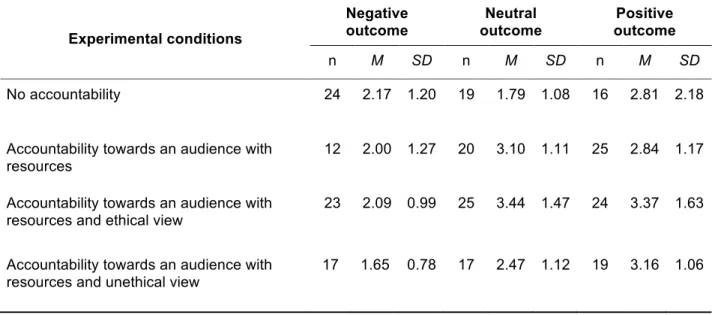
(19) Sociocognitive processes in ethical decision making. Index of tables. Table 1 – Levels and stages of moral development ........................................................ 21 Table 2 – Ethical climates ............................................................................................... 57 Table 3 – Means ratings and standard deviations of ethical acceptability depending on experimental conditions and decision outcomes ...................................... 90 Table 4 – Mean ratings and standard deviations for ethical intentionality according to the experimental conditions and decision outcomes ................................ 105 Table 5 – Mean ratings and standard deviations for ethical behavior .......................... 130 Table 6 - Means, standard deviations and t-test values for each group of decisions .... 148 Table 7 – Means ratings and standard deviations for ethical decision making ............ 151 Table 8 – Means, standard deviations and correlation values between variables ......... 166. xix.
(20) .
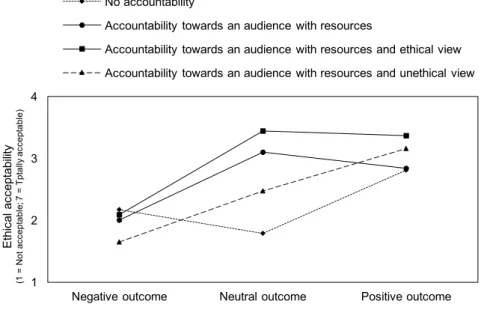
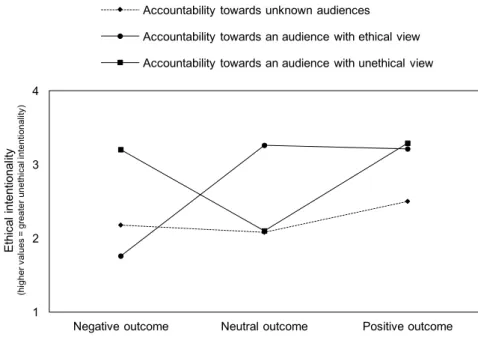
(21) Sociocognitive processes in ethical decision making. Index of figures. Figure 1 – Four-component model of ethical decision making ...................................... 23 Figure 2 – The interactionist model of ethical decision making in organizations .......... 44 Figure 3 – The issue-contingent model of ethical decision making by individuals in organizations ............................................................................................ 48 Figure 4 – Mean ratings for ethical acceptability ........................................................... 91 Figure 5 – Mean ratings for ethical intentionality ........................................................ 107 Figure 6 – Participants ethical behavior........................................................................ 131 Figure 7 – Effect of goal specificity objectives and psychological distance in ethical decision making .............................................................................. 152 Figure 8 - Multiple mediation model of the direct and indirect relationship between goal difficulty and ethical leadership.............................................................. 167. xxi.
(22) .
(23) General introduction.
(24) .
(25) Sociocognitive processes in ethical decision making. What happens when good people are put into an evil place? Do they triumph or does the situation dominate their past history and morality? (Philip Zimbardo). Introduction Organizational ethical behavior is one of the social phenomena that truly arouses most interest and indignation in public opinion. The numerous corporate scandals that marked the early years of this century, which had a strong economic and social impact, resulted in an almost widespread suspicion in relation to the conduct of organizations and their leaders. In response to the pressure to act more ethically, many organizations were involved in the construction and implementation of codes of conduct, as well as other control mechanisms of ethical behavior of their employees. By the legal side have emerged regulation instruments to prevent the occurrence of new ethical failures in business. However, despite these efforts, ethical problems continue to occur. As pointed by Bazerman and Tenbrunsel (2011), one of the essential aspects of ineffectiveness of these strategies concerns to the assumption that people are able to recognize ethical problems. However, the individual ethical behavior is a complex phenomenon: the way people approach problematic issues in ethical terms depends on how people process information related to the subject of judgment, but also of normative inferences they draw from the interaction with others and the different forms of integration in social groups. The general hypothesis that guides this work assumes that social context factors decisively affect large part of individual judgments about ethical issues in the organization. In order to find evidence to support this assertion, we delineated a journey of research, mobilizing the contributions of Social Psychology, which have allowed, in particular in the last decade, an empirically supported understanding of decision making processes in ethical issues, favoring a descriptive approach to cognition and ethical behavior, as opposed to the dominant normative approaches.. 3.
(26) Sociocognitive processes in ethical decision making. This thesis is organized in four chapters. The first chapter starts with a review of the main contributions from psychology in order to build a comprehensive view of individual ethical behavior. Firstly, we explore the limits of the normative paradigm. This approach, supported by the philosophical conception of morality, assumes that ethical decisions occur in the field of rationality, i.e., that people orient their behavior based on the observation of pre-established moral rules. In this case, ethical failures are the result of conscious adherence to courses of action where ethical concerns are not present. However, given the complexity that characterizes the current ethical problems, this vision has been considered simplistic and was gradually replaced by a descriptive conception of individual ethical behavior. This is especially concerned in understanding, explain and predict how people react when they encounter ethical problems. The comprehension of the individual ethical behavior starts to sustain itself in the analysis of empirical data obtained from the concrete experience of individuals, creating conditions for the emergence, in the field of psychology, of important theoretical contributions in the area of moral development and behavior. From the analysis of the theoretical models proposed by Piaget (1965), Kohlberg (1968) and Rest (1986), which emerged from cognitivism, we discuss the idea that ethical behavior does not result from the acquisition of pre-established rules and moral principles but rather, from the level of development and maturation of cognitive structures that support moral reasoning and, also from the social interaction processes initiated by individuals in order to solve ethical problems. The central aim of this review is to reflect if the individual ethical action depends on social prescriptions about the morality or indeed is the consequence of individual interpretations of the world. Given that the change of perspective in the analysis of this phenomenon withdrew from normative position the exclusivity in dealing with ethical and moral issues, psychology has assumed a prominent role in explaining how people think and behave ethically. In line with this evidence, the first chapter ends questioning the existence of linear relationships between ethical belief, judgment and behavior, as well as discussing the robustness of theoretical models of ethical decision making process exclusively based on internal mechanisms and levels of moral development. The second chapter proposes to capture the complexity that characterizes the formation of individual judgments and ethical decision making. With a particular focus 4.
(27) Sociocognitive processes in ethical decision making. on organizational behavior we analyze, from an interactionist perspective, the role of individual and contextual factors in the how people guide their ethical conduct. In individual terms, we discuss two fundamental issues. First, as we know, when making decisions people do not follow rationality criteria (Simon, 1955). Unless they are specifically motivated to expend time and energy in information analysis, people are likely to simplify the decision process. We departed from this assertion in order to discuss the ways in which this limitation of deliberate action applies to ethical decisions. Second, knowing that some individual characteristics seem to increase the likelihood of unethical behaviors, we also analyze the prominence of the individual ethical values and the propensity to rationalize unethical conduct in the way people deal with ethical problems. The salience that we attribute to this problem stems from the evidence that ethical behavior does not depend exclusively of what people think or feel (e.g., Dubinsky & Loken, 1989; Ferrell & Gresham, 1985; Hunt & Vitell, 1986; Jones, 1991; Treviño, 1986). Hence, it is necessary to evaluate all the features that characterize the situation where the ethical behavior occurs, including the organizational ethical infrastructures and all social influence processes performed by leadership and/or by organizational peers, which emerge from the organizational dynamics. In sum, although fully aware of the difficulties of analyzing processes involving the interaction between the individual and organizational levels, this chapter aims to contribute to a systematic approach to how people interpret and deal with ethical issues. The following chapters include a set of empirical studies developed from the previous theoretical reflections. The third chapter discusses the role of accountability in judgment formation and decision making about ethical problems. Accountability refers to a state that is activated when people expect to give justifications about their individual decisions and actions to third parties. We empirically assess the impact of accountability as a possible motivator of cognitive effort (Tetlock, 1983a; Tetlock & Levi, 1982) on the ethical scrutiny of individuals. The two empirical studies that integrate this chapter focus on the influence of accountability, as a relevant variable from the social context, in the judgment formation in ethical questions, special attention being provided to the role of social contingencies associated to it. The fourth chapter analyses the impact of goal setting procedures on individual ethical behavior. Usually considered as one of the principal approaches to human. 5.
(28) Sociocognitive processes in ethical decision making. motivation, goal setting theory determines the existence of a linear relationship between goal difficulty and specificity and the performance level of people in organizations (e.g., Locke & Latham, 2002; 2006; 2013). Regardless of the widely proven motivational benefits of goal setting procedures, in this chapter we discuss the existence of eventual negative consequences of goal setting procedures regarding the ethical behavior of people in organizations. In three studies – two experimental and one correlational – we sought inquire how the goal nature affects the way people guide ethical conduct. Assuming that ethical behavior is inseparable from the context in which it occurs, in this last chapter, the effects of how goals are communicated by leaders, which can be perceived as ethical or unethical (e.g., Brown & Treviño, 2006), the influence of the set of assumptions, beliefs and values shared by organizational members (Victor & Cullen, 1988), and the type of structures and control mechanisms of ethical behavior in organizations are also analyzed (Tenbrunsel, Smith-Crowe, & Umphress, 2003).. 6.
(29) Chapter 1 From collective to individual ethics.
(30)
(31) Sociocognitive processes in ethical decision making. But when the news of his arrest began to spread on Dec. 11, the first thought that struck an old friend who had known him as a pioneer on Wall Street, was, “There must be an error. It must be another Bernie Madoff.” Then he added, “But then, there is no other Bernie Madoff.” (The New York Times, 19/12/2008)1. 1.1. Introduction Individual ethical behavior is a complex phenomenon. The growing interest of social sciences in this issue shows that understanding ethical flaws perpetrated by individuals and organizations go beyond general prepositions concerning the nature of individual character. Ethical conduct relates to a particular field of people psychological and social life that stems from the reciprocal interaction between personal, professional and social domains that constitutes the individual universe. This chapter proposes to analyze the role of psychology in the study of individual ethical behavior. First we establish the necessary distinction between ethics and morality and analyze the main philosophical conceptions concerning ethical conduct. We claim that the deterministic positioning of philosophy is too simplistic given the need to target an understanding of current ethical problems. In this sense, we explore the boundaries of normative paradigm and the proposal to adopt a descriptive alternative able to generate the necessary understanding of the processes leading to judgment and ethical decision making. The gradual expansion of this area of study led to the emergence of an ethical science based on the analysis of empirical data coming from people concrete experience. Piaget's (1965), Kohlberg’s (1968) and Rest’s (1986) contributions were decisive in the centrality assumed by psychology in theorizing about individual ethical conduct. The cognitive perspective, which serving as a conceptual reference to them, places these authors in an early stage of the development of the psychological approach to ethical behavior. Specifically, advanced theoretical bases are fundamental to the understanding of ethical action under the contemporary perspectives.. 9.
(32) Sociocognitive processes in ethical decision making. We present a reflection on the evolution of the theoretical models of development and ethical behavior and also on their contributes to the evolution of psychological theorization of decision making and ethical behavior in organizational contexts. As mentioned, we start with an analysis about the role of psychology in the study of individual ethical behavior.. 10.
(33) Sociocognitive processes in ethical decision making. 1.2. Psychology and individual ethical behavior In quotidian language, the distinction between ‘ethics’ and ‘moral’ is not always clear. People tend to consider these expressions as synonyms when in fact there is a conceptual difference between them. Moral concerns to the set of principles, norms and values accepted freely and consciously by a society. It is a reasoning system which provides clear and accurate guidelines about how people should behave. In turn, ethics relates to individual actions translated in concrete behaviors which results from people adherence to the principles of conduct emerging from morality. From this point of view, people are moral agents aware of the consequences of their own actions and so, disposed to consider previous convictions as a result of the observation of these principles of conduct. However, the general consensus about certain moral principles is not always a sufficient condition for people behave in an ethical manner. For example, most people consider honesty as a fundamental moral principle in the relationship they have with their organization, even if sometimes they use the company’s telephone to deal with particular issues. In many cases, people tend to discount the impact of their actions or to consider that the ethical character of these is based on strict compliance with the law (Simões, 2015). That is why is natural that some behaviors, although not considered illegal, are seen unethical by the majority of society. See the example of government leaders who, after the ending of their mandate, immediately assumes the administration of a corporation under the influence of the cabinet they previously coordinate. Or the example of medical doctors working in the public health system who prescribe medical procedures subsequently made by themselves in a private clinic or a person knowing irregularities in the organizations where he/she works and decide not to denounce them because of concerns about his/her career. In all these cases, people tend to justify their own actions simply evoking the legality of this actions or considering that such behaviors do not constitute ethical misconduct because their performers are guided by high moral standards (Moore, Tetlock, Tanlu, & Bazerman, 2006). The study of ethical behavior, traditionally seen as in the philosophy field, has been progressively assumed by other sciences as psychology, economy and management. The numerous examples of unethical behavior were made public in recent decades had a. 11.
(34) Sociocognitive processes in ethical decision making. major influence on this process. First, they have shown that philosophy is unable to offer adequate explanations to many of the ethical problems that arise today. Ethical flaws are not the product of isolated actions perpetrated by identifiable individuals. These flaws could be conducted, under particular conditions, by any person. This fact reveals that the existence of prescribed guidelines for ethical behavior, as for example ethical codes, are not enough to prevent the occurrence of unethical behaviors. Second, the recognition of the high complexity which characterizes ethical problems, namely in what concerns to the contexts where they happen, is responsible for profound changes in the way as individual ethical conduct is analyzed. The exclusively normative focus based on the rationality of the ethical awareness as assumed by philosophy was replaced by a descriptive approach concerned with the explanation and prediction of ethical behavior. Specifically, the analysis of the ethical action was no longer saw under a normative approach concerned in providing preestablished rules of conduct and independent from the context (Werhane, 1994). It began to being dominated by the assumption that the explanation about the nature of individual ethical behavior was beyond the premises advocated by the normative perspective (Over, 2008). So it is necessary an approach that provides clear indications about how people think and act towards ethical issues. Ethical behavior was no longer a matter related to the way people should behave and, began to be regarded as related to the way people actually behave. In this case, recent contributions by psychology (e.g., Epley & Caruso, 2004; Gino, Moore, & Bazerman, 2009; Jones, 1991; Schweitzer, Ordóñez, & Douma, 2004; Treviño, 1986) are fundamental for understanding the nature of individual ethical behavior translated on individual actions or in the organizational ability to deal with ethical problems. People do not guide the ethical behavior based solely on the observation of pre-determined moral values. The social and cultural components play a key role in the process of ethical decision-making revealing the existence of cognitive limitations that affect individual ability to ethical reasoning. For example, the difficulty in recognizing conflicts of interest (Chugh et al., 2005; Donaldson & Dunfee, 1994) which can lead people to act contrary to their own ethical values or the occurrence of bias in the formation of ethical judgments due to perceptions of self-enhancing (Epley & Caruso, 2004) which lead people to consider themselves more ethical than others. 12.
(35) Sociocognitive processes in ethical decision making. 1.2.1. The nature of ethical behavior What is an ethical behavior? How do we make ethical decisions? What leads us to act ethically? From a philosophical perspective, we can distinguish between three orientations of ethical behavior. The deontological orientation proposes the existence of a universal structure, firm and unconditional support to morality. Ethical behavior is prescriptive and categorical, i.e., independent from external intentions and based on the individual rationality. Under this perspective, ethical choices are supported by the observation of explicit formal rules such as professional codes of conduct. The consequentialist approach in its utilitarian version settles that the ethical value of an action resides on the analysis of the cost-benefit relationship about the consequences produced by this action. Ethical behavior is assessed in terms of the adjustment between individual and collective interest, i.e., is not subjected to inflexible rules. On the contrary, it adopts the utility principle: the production of benefits and/or the least harm to all parties involved, as the decisive criterion to justify an action, i.e., the consequences of an action determine it value moral. Finally, virtue ethics orientation emphasize the moral character of the individual and his adherence to principles of conduct. In this case, more than the action itself, is the moral integrity of the individual, i.e., his ability to apply the principles of conduct to specific situations, which determine the morality of behavior. For example, disclose confidential information over the organization is considered unethical, not because of the damage that can cause or because it violates the code of conduct of the organization but because it is simply contrary to the behavior of an honest and loyal employee. The demand from philosophy for universal guiding principles of conduct of ethical action defines ethical behavior as the product of universally accepted rules whether a priori or socially determined laws. However, the specificity that characterizes ethical problems has prompted a debate on the scientific validity of ethical prescriptions. Specifically, the interest of psychology on individual ethical action, alongside with the criticism of the normative position of moral philosophy, is responsible for a growing misunderstanding between psychology and philosophy leading to autonomous and divergent paths. The progressive separation between the two social sciences places the. 13.
(36) Sociocognitive processes in ethical decision making. study of ethical behavior in two distinct grounds: The normative approach characteristic of philosophy and the descriptive approach sustain by psychology. The epistemological debate which opposes philosophy and psychology is based mainly on the discussion about the most appropriate methodology for the study of ethical behavior. Philosophy considers that the exclusive focus on the analysis of the perceptions people had concerned their own reality, as assumed by psychology, devalues the normative bases underlying these perceptions (Victor & Stephens, 2008). For its part, psychology refuses that the theorization of ethical action should be subjected to idealize models of human experience (Werhane, 1994) and considers that normative approaches are unable to provide appropriate responses to current ethical problems. Therefore, is necessary the adoption of a descriptive approach which, based on the analysis of factual and statistical information allows the explanation and prediction of ethical behavior (Donaldson, 1994; Treviño & Weaver, 1994).. 1.2.2. Normative approach versus descriptive approach Normative approaches aim to provide specific cognitive schemata which are rules that reinforce ethical decisions and increase the ability of individuals to act rationally when faced with dubious ethical issues. Following this approach, the interpretation of ethical problems occurs in the field of consciousness and obeys to universal rules (Velasquez, 1996). So, it is expected that people be intrinsically capable to prevent ethical lapses. Normative approaches translate their actions in the production of codes of conduct and ethical guidelines. They assume that people hold the ability to act in accordance with pre-established principles of conduct. In general terms the implementation of codes of conduct seems to have a positive effect on organizational ethical behavior (e.g., Kaptein, 2008; Valentine & Fleischman, 2002; Weaver, Cochran, & Treviño, 1999a) and it is expected that the clearer and more specific they are, greater be their capacity to promote ethical behavior. However, the exclusive reliance on formal mechanisms to promote ethical behavior, such as adopted by many organizations, is in most cases too idealistic and restrictive regarding the nature of ethical behavior. In many cases, these codes of. 14.
(37) Sociocognitive processes in ethical decision making. conduct only provide vague orientations about how people should act when facing specific ethical problems. In this sense, the need to reduce the level of abstraction in the theorization of ethical issues led to a change of focus in determining how people should act, traditionally assumed by normative approaches, to a concern with understanding how people really act when they meet ethical problems. Psychology has played, in this case, a key role in modifying the focus of ethical behavior analysis. The growing interest about the role of the social context in ethical behavior – for example, achieved through the laboratory evaluation of variables such as individual motivation for cooperation and competition (e.g., Batson, O'Quin, Fultz, Vanderplas, & Isen, 1983; Sanfey, Rilling, Aronson, Nystrom, & Cohen, 2003), or how people judge hypothetical ethical actions (Greene, Sommerville, Nystrom, Darley, & Cohen, 2001; Kohlberg & Hersh, 1977) – led to a gradual change in the conceptualization of ethical conduct linked to prescriptions for judgments about justice, rights and welfare which rule the relations between individuals (Turiel, 1983) and give place to a conception of ethical behavior seen as the result of the interaction between individual and social factors. Descriptive approaches proposes the explanation of individual ethical behavior based on the analysis of concrete evidences resulting from the interaction between individual factors and contextual elements that characterize the decision making process. Their contribution to the field of psychological research on ethical behavior were reflected initially in the proposal of various theoretical models of development and moral behavior (Kohlberg, 1968; Piaget, 1965; Rest, 1986). The first period of study of ethical behavior by psychology reflects the need assumed by descriptive approaches regarding an ethical science that would allow reducing the subjectivity in the study of ethical behavior. Strongly drove by the cognitive revolution2, these theoretical models characterize themselves by the emphasis on mental processes underlying judgment and by the concern to identify the set of intellectual abilities and interpersonal experiences which made possible the apprehension of moral truth. However, this perspective has been losing exclusiveness in the last 30 years due the emergence of more holistic perspectives of ethical behavior translated into proposals of theoretical models based on social psychology (Haidt, 2013), as well as due to the. 15.
(38) Sociocognitive processes in ethical decision making. gradual specialization of these models, namely in what regards the applications to specific contexts such as organizations. This has been an important step towards the construction of a comprehensive and multidimensional ethical approach focused on the study of active psychological mechanisms in ethical decision making and their interaction with the social structures that make possible social life (Haidt, 2007; Haidt & Kesebir, 2010; Shweder, 1990).. 1.3. Contributes from Psychology The psychological theorization on ethical behavior was until mid80’s of the last century under the dominance of cognitive theory. According to this view, the nature of ethical conduct depends on the conscious ability of individuals to understand the world around them. It assumes that ethical reasoning evolves to the extent that the mental structures which underlie it are developed, allowing that individuals form the ethical judgments suitable to the socially established rules and moral principles. We can distinguish between three theoretical conceptions that marked the initial approach from psychology to the study of ethical behavior. The work of Piaget (1965) in the field of moral development proposes that individual ethical conduct is independent from learning processes based on the transmission of norms and moral principles. According to the theory of moral development, ethical behavior is intimately tied to the level of individual cognitive development and mental maturation and emerges from the processes of social interaction undertaken to find answers to ethical problems. Following this work, Kohlberg (1968; Kohlberg & Kramer, 1969) proceeded with the operationalization of moral reasoning development based on a system of six progressive stages of reasoning about the social world. According to this author, people use ethical systems consistently with their own level of reasoning and they are able to evolve in terms of the nature of their own principled conduct. Finally, the theoretical proposal developed by Rest (1986; 1994) argues that determining the nature of ethical behavior based on the level of development of moral reasoning represents a limitation since it corresponds to the analysis of default cognitive schemes about the meaning people give to social situations and not a way to differentiate 16.
(39) Sociocognitive processes in ethical decision making. different levels of moral reasoning. As suggested by Rest (1986), one approach to ethical behavior under the moral development perspective only offers intuitive notions to interpret social world, and the proposal of developing moral stages is essentially an analysis about the judgment conceptualization and does not take into account other components of the psychological processes involved. In Rest perspective, ethical behavior is not dependent exclusively on the level of moral reasoning of the individuals, so an approach that considers the psychological processes underlying the formation of ethical judgments is necessary.. 1.3.1. Moral judgment development according to Jean Piaget As proposed by Piaget (1932), people’s ability to interpret and understand the world depends on the progressive re-organization of mental processes which result from biological maturation as well, from individual participation in social interaction processes. His interest in the nature of knowledge has guided Piaget to the study of child cognitive development. Bases on the evaluation of children of different ages, Piaget (1928/2002) has established that the process of maturation and cognitive development occurs in progressive and sequential stages organized in cognitive developmental stages. The acquisition, adaptation and utilization of the concepts that mediate the relationship between the child and the world does not depend on innate skills or explanations provided by others. The re-organization of knowledge in cognitive structures progressively more complex results from a process of self-construction that comes out of the relationship of the child with their peers. Piaget’s (1965) research about the nature and development of moral awareness intended to understand the social construction processes and the recognition of laws and rules by societal groups. He defined the psychological nature of moral reality as the result of the relationship between the practical application of rules and the way which rules are conceptualized. From the observation of children playing, Piaget (1965) had determined that the nature of moral judgment evolves in a four stage sequence which reflects the transformation process of moral awareness from a heteronomous perspective subject to authority norms to autonomous perspective ruled by action norms. Depending upon age,. 17.
(40) Sociocognitive processes in ethical decision making. children could conceive rules as sacred and mandatory or, otherwise, as a product of autonomous choices revealing capacities to follow or change rules and resolve conflicts. The first stage of moral judgment runs until three years old. The moral judgment in this stage is based on the formalization of ritualized schemes and the compliance with rules depends on children’s skills and their mobility limitations. Compliance with the rules is detached from social relationships and social reality is perceived by children as not obligatory or compulsory. From this age, the agreement with the rules assumes a central role in the processes of social interaction. Children perceive the rules as untouchables and their change is seen as a transgression. Is this conception of rules that frameworks the second and third stages of moral judgment development. The second stage, called egocentric occurs between three and six years old. Here, children adopt a self-centered perspective based on the idiosyncratic application of the rules, i.e., children act in an individualistic way with materials that are social. Specifically, they play alone even if they are in a group context. The third stage begins around seven years old and represents an evolution on the understanding about abstract concepts. Children move from individual rituals to the adoption of concrete rules which result from interaction with other children. Relation with rules assumes a cooperative perspective based on equality, mutual respect and reciprocity. Children show a concern with control and rule unification as an underlying condition of social order. The last stage, which begins from 12 years old is characterized by rule perception as a product of mutual consensus between individuals and, for that, liable to changes regarding individual interests. Moral judgment development could be described as a construction process of social and moral intelligence which depart from mere observation of rule systems with mandatory content externally imposed to the individual to a progressive increase of the ability to interpret and understand these rules which are product of mutual agreement between individuals involved in social interaction processes. Moral awareness development presupposes an increase in children’s ability to understand other point of views including the perspectives that are in conflict with their own views. However, as stated Piaget (1965), this ability could be facilitated or constrained by relationships between people. In this case we can distinguish between two types of social relationships: those dominated by constraint related to the unilateral respect to authority and those 18.
(41) Sociocognitive processes in ethical decision making. which are characterized by cooperation were all individuals are on equal terms and able to consider different points of view to justify their own actions. These two worlds – constraint and cooperation, coexist in childhood and persist in adulthood (Carpendale, 2000; 2009). Both children and adults make use of the two types of moral reasoning. Its use depends on the situation or on the nature of interaction and not exactly on the individual moral development stage. Specifically, social interaction ranges in a continuous between constraint and cooperation relationships limiting in this way the use of different types of moral reasoning. By this, the nature of social relationships assumes a facilitating or inhibitor role in the awareness process related to others and determines the nature of ethical behavior.. 1.3.2. Moral development according to Kohlberg Inspired by Piaget’s seminal work (1965) about the nature of moral judgment, Kohlberg’s moral development theory (Kohlberg, 1968; 1975; Kohlberg & Hersh, 1977) remained until the 1980’s as the most important approach to the moral reasoning development. Over 20 years, Kohlberg and colleagues (1987; Kohlberg, 1981) followed, through the analysis of the answers to hypothetical moral dilemmas, the moral reasoning evolution in a group of individuals. They concluded that moral judgment is subject to a progressive maturation, organized around a moral structure which develops and changes based on preceding structures of moral reasoning. In Kohlberg’s view (1968), moral development is more than a transference of rules aiming the adjustment of the individuals to socio-moral agreements. Children hold their own mental structure and construct meanings about universal categories. The same applies to moral issues, which are subject to an evolutionary transformation resulting from the dialogue between cognitive structures and environment complexity, which impels progress in moral reasoning stages. Specifically, morality results from the universal liability that individuals have to empathize and become aware of others (Kohlberg, 1975). In this sense, the moral evolution does not correspond solely to the internalization of simple social rules, but results from the reconstruction of the sense of justice and reciprocity in response to the social problems that the individual is confronted with.. 19.
(42) Sociocognitive processes in ethical decision making. The assumption of these propositions leads to the moral development theorization taking in account three levels of judgment orientation: pre-conventional, conventional and post-conventional. Each of these levels includes two specific development stages giving rise to an organization in six progressive, sequential and invariable reasoning stages through which the moral information is processed (Colby & Kohlberg, 1987; Kohlberg, 1968; 1981; Kohlberg & Hersh, 1977). Each of these stages corresponds to a structure of principles that define the type of thought characteristic of a particular developmental phase and the acquisition of new structures of moral reasoning presupposes as mentioned above, the development, transformation and replacement of previous structures. The structures that come later corresponds therefore to a higher cognitive sophistication, i.e., they are more complex, differentiate, integrated, logical and organized than the structures they replace. In sum, higher stages – who occurs in later stages – correspond to a larger capacity of individuals to become aware of others yielding prescriptive, universal and impartial moral decisions (Krebs & Denton, 2005). The progression between stages underlies a socio-moral perspective corresponding to the basic criterion that sustains the sequence of proposed stages. In this view, the cognitive component that allows the stage grounding is intrinsically moral rather than a logical or socio-moral structure applied to the moral field.. 1.3.2.1. Stages of moral development In the first level – pre-conventional, moral dilemmas are associated with individual needs. Situations of moral conflict are interpreted based on the perception of the power of those with ability to punish or reward behavior. This assumes that an egocentric or individualistic perspective related to moral problems defines conduct validity in terms of the physical consequences they produce. Individuals can be exclusively motivated to avoid punishments (first stage) or concerned with satisfying personal or other person’s needs (second stage). In conventional stage, resolution of moral conflicts changes its focus from an individualistic perspective to the group context. It can be seen a highlight on the need to adjust to social norms of conduct. An action morally right implies individual adherence to stereotyped forms of conduct in order to accomplish 20.
(43) Sociocognitive processes in ethical decision making. others expectations (third stage) advancing to a concern with social order (fourth stage) translated into behaviors guided by fixed and immutable rules. Finally, the postconventional level presupposes individual effort in (re)definition of principles and moral values so they can have application beyond socially established conventions. People conceive moral action in terms of its utility and they are clearly aware about the relativity of personal values namely, because these are liable to adjustments in order to build consensus between people (fifth stage). Lastly, the evolution to the final stage of moral reasoning (sixth stage) depends on the adoption of abstract ethical principles that are translated into categorical imperatives focused on the universality of justice, reciprocity, and equity as essential conditions to an individual moral conduct. Table 1 displays the levels and stages of moral development proposed by Kohlberg (Colby & Kohlberg, 1987; Kohlberg, 1975). Table 1 – Levels and stages of moral development Level 1. Pre-conventional. 2. Conventional. 3. Post-conventional. Stage 1. Heteronomous morality 2. Individualism 3. Interpersonal conformity 4. Social system and conscience 5. Social contract or utility 6. Universal ethical principles. Socio-moral perspective Concrete individual perspective. Member-of-society perspective. Prior-to-society perspective. Adapted from Colby and Kohlberg (1987). The evolution of the moral reasoning structures defines the way how people perceive and decide about ethical issues. In fact, this evolution increases the individual ability to perceive accurately how decision outcomes affect the others. The progression between stages assumes a cumulative perspective, i.e., reasoning structures previously acquired are organized, along the moral development process, in a more balanced and comprehensive way (Kohlberg, 1968; Rest, Turiel, & Kohlberg, 1969). As already mentioned, moral development follows a linear and invariable sequence. Specifically, an. 21.
(44) Sociocognitive processes in ethical decision making. individual who is in stage three always moves to stage four and not directly to a higher or a lower stage. However, this evolutionary process is not the same for different individuals. It could occur at different paces depending from social, cultural or religious variations (Kohlberg, 1968). As mentioned by Rest and colleagues (1969), progression between stages depends on the individual ability to understand higher reasoning structures which, when presented as a solution for a specific moral problem, can led individuals to perceive their actual mode of reasoning as functionally inadequate. It is a personal characteristic related to the openness to other modes of reasoning which, not being directly dependent from age, mental age or the level of intelligence (Rest et al., 1969), can be inhibited by specific personality features or lack of moral conflict situations through which individuals are exposed to more differentiated modes of reasoning.. 1.3.3. Four-component model of moral behavior Regarding the critics to the moral development theory concerning the ability of this approach to provide concrete explanations about the relation between moral judgment and moral behavior (e.g., Blasi, 1980), James Rest (1979), Kohlberg’ collaborator, advocates that moral judgment stages theory reduces moral judgments to a basic benchmarking of the level of moral reasoning development. Specifically, the analysis of moral development stages refers to the level of moral reasoning conceptualization providing few information about how and under what conditions people act when they face moral situations (Rest, 1994; Thoma, 1994). The cognitive perspective assumes that moral judgments are directly related to moral behavior. Moral judgment and moral behavior are connected in the sense that the ability to define moral problems with more detail leads to more appropriate actions (Thoma, 1994). The [moral] cognition allows to understand and solve moral problems, i.e., recognize who might be affected by the consequences of the behavior, support the establishment of priorities, and finally, to decide the specific action to be undertaken. As the moral reasoning progresses to more complex levels, individuals are more capable to define more adequately the moral situations they face and, consequently, more able to pursue moral responses in accordance. However, the use of interpretive systems seems to 22.
(45) Sociocognitive processes in ethical decision making. be insufficient to forecast specific behaviors in specific situations since they fail in the explanation of the process which links the understanding of the situation with the action. This problem requires a model that considers all additional factors that are beyond moral judgment and be capable to describe the process by which specific actions are developed regarding specific situations. The four-component model of moral behavior (Rest, 1994) proposes that moral actions are a final result of conceptually distinct processes that work together and in an interactive way. Specifically, moral action is accompanied by a focus on processes related to the identification, construction and implementation of ethical behavior. Rest’s model maintains the emphasis on cognitive development, but specifies a group of other processes that overcome the existing gap in the understanding of the relationship between moral judgment and moral action, thus providing a new approach on research about morality. This model assumes, to some extent, that moral behavior results from the interpretation of specific situations. In this sense, Rest (1994) proposes a model consisting in four components related to the psychological processes that occur when people pursue moral behavior. Figure 1 presents the four-component model of ethical decision making. Figure 1 – Four-component model of ethical decision making. Recognize moral issue. w. Make moral judgment. w. Establish moral intent. w. Engage in moral behavior. Adapted from Rest (1994). The first component, named recognize moral issue is related to the interpretation of the situation, i.e., how the individual is aware (or not) of different courses of action and how those actions affect third parties involved in a given moral situation. This first component implies the construction of hypothetical scenarios and the ability to recognize the causality chain between events. In order to be successful in this task, individuals should be able to empathize and to adopt others’ perspective in the analysis of moral situations. The second component, called make moral judgment is related to the evaluation of the morally acceptable actions from the various courses of action foreseen.. 23.
(46) Sociocognitive processes in ethical decision making. Establish moral intent is the third component and requires a choice between different moral and personal values. The moral behavior depends of the person’s motivation to adopt moral values instead of personal interests. Finally, engaging in moral behavior is the last component of the moral behavior process and implies the capacity to achieve moral actions. It is possible that people recognize a moral issue and the available courses of action (first component), establish which behavior is morally justifiable (second component) but, confronted with a certain conflict of interest, decides to satisfy individual needs or personal values rather than moral values. In sum, people can be able to recognize moral issues, decide about what is a morally action, put moral values above other values or interests but, finding themselves under pressure they can be easily distracted, discouraged or driven to engage in immoral behaviors. The order of the components in Rest’s model (1994) is more than chronological, is logical. It is possible, for instance, that the establishment of moral intent arises before the recognition of moral issue and, in this case, are the moral values that drive people in the interpretation of the situation. This aspect is based on the assumption that psychological processes underlying moral behavior are distinct and, therefore, can mutually influence each other (Rest, 1986). A moral failure can occur due to an insufficiency in any of the components. Although valuable in understanding how people conduct moral decision process, Rest’s model reveal itself unable to explain the reason why the recognition of a moral ethical issue does not necessarily imply an ethical behavior. The perception of ethicality seems to be insufficient to explain or predict an ethical decision or an ethical behavior.. 1.4. Conclusion In this chapter we observed that, more important than producing rational considerations about morality, it is necessary to understand social constrains related to ethical behavior. Until recently, the explanation of ethical misconduct lay in the assumption that ethical behavior occurred in the context of social prescriptions. This conception, of intuitive nature, has gathered over the time quite a number of followers since, in practical terms, it would make easier the identification and punishment of those 24.
(47) Sociocognitive processes in ethical decision making. responsible for unethical behavior. The widening of ethical behavior research to social sciences led to a significant change of paradigm. The rational and normative position assumed by philosophy was progressively replaced by a descriptive approach interested in understanding how and under what conditions ethical behaviors occur. As we have seen, from a conceptual point of view, psychology has played a decisive role in the evolution of the perspective of ethical behavior as a result of the interaction between individual and social domains which affect the way people perceive the world. The exclusivity given to the cognitive component in judgment formation and ethical decision making dominated initially the conceptualization of individual ethical behavior. Cognitive models establish a linear path between ethical believes, judgment, behavior and, the underlying system of inputs and outputs which attempts to capture the complexity of ethical decision making. In this perspective, ethical values reflects individual moral maturation and they are exclusive in judgment formation. In practical terms, ethical behaviors are examined under perfect conditions, i.e., external influences and their meaning are not contemplated. This aspect results in an objective difficulty from cognitivism to explain the relation between judgment and ethical behavior. As we will see in the next chapter, the need to establish an holistic approach to ethical behavior gave origin to an attempt to synthetize the individual and situational components of the ethical decision making process. This was a change of focus from the identification on internal mechanisms and individual stages of moral development to a global approach about how people make ethical decisions. Attention began to be focused on the set of factors and influences produced by the specific contexts where ethical decision making processes occur. The influence of individual differences and social contexts on ethical intentions, decisions and behaviors was recognized. In this dissertation, we intend to go beyond the usual assumption that ethical misconduct is a result of an individual orientation that aims self-interest at the expense of the action considered as correct. Taken as reference the work of Herbert Simon (e.g., 1955; 1983) concerned to the bounded rationality, psychological research in decision making area has challenged the basic assumption that humans are aware of their own actions and thoughts. In practical terms, the analysis of ethical situations implies that individuals have available large cognitive resources (Fiske & Taylor, 1991; Simon, 1997). Hence, people may be. 25.
(48) Sociocognitive processes in ethical decision making. led to exclude from the decision making process information related to ethics through the use of cognitive schemata that are insensitive to moral incentives. The organizational context can constrain or even ignore the ethical dimension of problems that people face in their daily lives. People with limited experience in dealing with ethical issues or when confronted with ethical dubious situations tend to reveal more difficulty in recognizing ethical problems in their own decisions. Therefore, it is not surprising that the attention or the strategies adopted faced to an organizational ethical dilemma often gives priority to strictly organizational information, because this is or is made to be more salient than the ethical component that is present in many situations.. 26.
(49) Chapter 2 Judgment and ethical decision making.
(50)
(51) Sociocognitive processes in ethical decision making. 2.1. Introduction Over the last decades, research on individual ethical decision making has underwent intense developments (e.g., Barsky, 2008; Bazerman & Gino, 2012; Bazerman & Tenbrunsel, 2011; Brady & Logsdon, 1988; Brown, Treviño, & Harrison, 2005; Chugh et al., 2005; Gino et al., 2009; Gino, Shu, & Bazerman, 2010; Jones, 1991; Jones & Ryan, 1998; O’Fallon & Butterfield, 2005; Schweitzer et al., 2005; Treviño, 1986; Victor & Cullen, 1988), partially motivated by the numerous scandals in the corporate world. A generalized perception of erosion of ethics and moral values in organizations (De Cremer & Tenbrunsel, 2012) has underlined, faced to an increasingly ethical scrutiny in public opinion, the need to devote a greater attention to ethical behavior in organizational context. In this chapter we examine the set of aspects underlying the formation of judgments and decision making in ethical issues. Departing from the analysis about the limitations of human cognition and the theoretical proposals about the construction of knowledge, we explore the role of individual and contextual factors in organizational ethical decision making. Evidence shows that people in their judgment are affected both by individual aspects and context elements (e.g., Kahneman & Tversky, 1979; Stanovich & West, 2000; Stanovich, West, & Toplak, 2013). If on the one hand, the use of structures of knowledge developed based on motivations, goals and individual experience (Ashforth, 1988; Fiske & Taylor, 1991) may constrain de decision making process (Bargh & Thein, 1985; Pillutla & Chen, 1999) – for example: the difficulty in recognize ethical issues that can result in unintentional unethical actions (Bazerman & Banaji, 2004; Chugh et al., 2005; Tenbrunsel & Messick, 2011). On the other hand, the influence of external factors can cause the vanishing of moral component and, consequently, increase the difficulty of the individual to acknowledge that is meeting an ethical problem. This is a limitation of ethical awareness which often leads people to make decisions contrary to their own moral values (Chugh et al., 2005) and personal interests (Sparks & Pan, 2010). In this case, the research about obedience and authority developed by Milgram (1963; 1965) or the Stanford Prison Experience conducted by Zimbardo and his colleagues (Haney, Banks, & Zimbardo, 1973) are the initial reference of the moral. 29.
(52) Sociocognitive processes in ethical decision making. behavior interactionist perspective. The works of those author were pioneers in the analysis of the role of context in judgment formation and, represent a fundamental contribution to a change in the focus of analysis about ethical behavior. As we will see, ethical decision making in organizations does not depend exclusively from dispositional attributions, i.e., individual characteristics. Through the analysis of the principal models of ethical decision making in organizational context (Jones, 1991, issue-contingent model of ethical decision making; Treviño, 1986, person-situation interactionist model) ethical behavior is conceptualized as the result of the relationship between individual characteristics and the context attributes where the action takes place.. 30.
(53) Sociocognitive processes in ethical decision making. 2.2. Decision anatomy, limits of rationality and cognitive functioning The notion of bounded rationality (e.g., Simon, 1955; 1997; Thaler, 2000) emerges as an essential element in the rejection of the conception of the human being as an agent which seeks, through decision processes based in the analysis of all available information about options and implications, the maximization of self-interest (Bazerman & Tenbrunsel, 1998; Jurgermann, 2000; Simon, 1959). The use of processes of bounded rationality emerges from the need to obtain sufficient satisfactory decisions based on the available resources. For that, individuals tend to use simplified processes of information analysis which are driven by the demand or need of responses which cannot be obtained by using requirements of rationality. The simplification of decision making processes stem from the fact that individuals get constrained both by limited attention and memory and the context where decisions take place, such as, all the costs in time and cognitive work associated to search for information. Simon’s analogy (1990) related to decision behavior which would be “shaped by a scissors whose two blades are the structure of task environments and the computational capabilities of the actor” (p.7) illustrates perfectly how decisions refer to a set of choices identifiable in time and space and under the influence of the emotions, imagination and memories of the decision-maker. The recognition that individuals do not always make decisions based on criteria coherent and consistent with available decision alternatives (Tversky & Kahneman, 1981) as stated by rational decision making model put the decision process in dependence of personal inferences about the world (Bazerman & Tenbrunsel, 1998; Higgins & Bargh, 1987). So, if on the one hand, individuals try to follow logical, explicit and conscious procedures, on the other hand, frequently they adopt intuitive, automatic and emotion based processes (Bazerman & Moore, 2009; Kahneman, 2003; Stanovich & West, 2000). The distinction between intuition and reasoning constitute a research topic of great interest in social psychology (e.g., Epstein, 1994; Haidt, 2012; Simon, 1997; Stanovich, 1999; Stanovich & West, 1998; 2000). Specifically, concerned to the distinction between two types of cognitive processing, Stanovich and West (2000) propose two systems: system 1 and system 2. In system 1 mental operations are typically rapid, associative, implicit and do not require large amounts of cognitive effort since they are usually ruled. 31.
Imagem


+7

Documentos relacionados
Neste trabalho fez-se uma análise à estrutura de um Plano de Prevenção e Gestão de Resíduos de Construção e Demolição (PPGRCD), e avalia-se o interesse da
A análise da estrutura divide-se em três abordagens distintas: caracterização mecânica do material constituinte da chapa que dá origem às telhas; caracterização do
A 16 de Junho de 2005, numa iniciativa conjunta da UNESCO, OCI, ISESCO,.. ALECSO, do Centro Dinamarquês para o Diálogo entre Culturas e da Fundação Anna
Apesar da grande tradição e cultura de PI das universidades dos EUA, a Johns Hopkins University foi a que apresentou no indicador de síntese a qualidade global mais
com a teoria proposta onde se verifica se é necessário rever/substituir ou se é somente necessário afinar. Por conseguinte, inicialmente o projeto tem como objetivo analisar
No geral os doentes ostomizados que frequentam a consulta de estomaterapia no CHCB, numa primeira fase encontram-se “perdidos, sem chão”, totalmente dependentes, frágeis,
a) Os administradores das sociedades que no exercício das suas funções pratiquem algum crime tributário são pessoalmente responsáveis, nos termos do artigo 6º
7 necessidades educativas especiais, “que se apresenta enquanto perspectiva dominante na maioria dos países (Mittler, 2000)” (p. 234), assumindo uma inclusão centrada em
