Carlos Pestana Barros & Nicolas Peypoch
A Comparative Analysis of Productivity Change in Italian and
Portuguese Airports
WP 006/2007/DE
_________________________________________________________
Lara Mónica Machado Fernandes, Maria Rosa Borges
Interbank Linkages and Contagion Risk in the
Portuguese Banking System
WP 23/2013/DE/UECE
_________________________________________________________
De pa rtme nt o f Ec o no mic s
W
ORKINGP
APERSISSN Nº 0874-4548
School of Economics and Management
1
Interbank Linkages and Contagion Risk in the Portuguese
Banking System
LARA MÓNICA MACHADO FERNANDES
[email protected] Portugal
MARIA ROSA BORGES1
ISEG (School of Economics and Management) of the Technical University of Lisbon
UECE (Research Unit on Complexity and Economics) Rua Miguel Lupi, 20
1249-078 Lisboa Portugal
1
2
Interbank Linkages and Contagion Risk in the Portuguese
Banking System
Abstract
Interbank money markets play a fundamental role in financial systems but they can also be a
channel through which problems in one institution can spread to the remaining ones. In
particular, the potential for contagion stemming from interbank money markets is closely
related with the pattern of interbank lending relationships. In this study, we characterize the
Portuguese overnight interbank money market between 1999 and 2009 and analyze its
inherent potential for contagion, based on bilateral interbank exposures. We conclude that: (i)
the Portuguese overnight interbank money market has a multiple money center structure,
where some banks have, simultaneously, an important role as lenders as well as borrowers;
(ii) although unlikely, the failure of one institution can have contagion effects, pushing others
into failure; (iii) however, even under the most extreme assumptions, banks that fail by
contagion represent less than 10 per cent of the total banking systems assets.
JEL codes: D40, G15, G21.
3 1. Introduction
Interbank money markets play a fundamental role in financial systems, allowing
financial institutions to cope with their day-to-day cash imbalances, by borrowing and
lending central bank money among themselves. But, despite its crucial role in the
redistribution of liquidity, interbank lending relationships are not just a way to mitigate
liquidity risk. They can also be a contagion channel through which financial problems in one
bank can spread to the remaining ones. Thus, interbank lending relationships might increase
the risk of contagion, i.e., the risk that one financial institution’s inability to meet its required
obligations will unable others to meet their own obligations when due, causing significant
liquidity or credit problems. Ultimately, contagion risk can be seen as a form of systemic risk
as, in case of contagion, financial instability can become so widespread that it may impair the
functioning of the financial system to the point where economic growth and welfare might
suffer significantly. That is why one of the prime concerns of contemporary monetary
authorities is to increase system resilience to contagion risk, since it can endanger financial
stability.
This dual role of the interbank money market has been especially emphasized by the
subprime crisis that started in 2007. Given the resulting context of uncertainty and having
asymmetric information about the solvency of their money market counterparties, banks
stopped lending to each other at all but the shortest maturities (Kapadia et al., 2012), resulting
from several motivations (Arinaminpathy et al., 2012), thus causing the market to become
dysfunctional. As a consequence, banks highly exposed to subprime mortgages or heavily
4
saved from default. Such was the case of the British Northern Rock and Bradford and
Bingley, the North-American AIG, the Spanish Caja Castilla la Mancha, the Danish Roskilde
Bank, and the German IKB Deutsche Industriebank, Sachsen Landesbank and Depfa Bank,
just to mention a few examples.
These public rescues of distressed banks are normally justified as an attempt to contain
contagion risk and ensure financial stability, thus avoiding a wide systemic crisis.
Nevertheless, even if, for some, this justification is enough, for others the prevention of
contagion risk may not be worth the financial costs and the moral hazard involved in public
bailouts. In fact, this was the perspective underlying the refusal to bail out Lehman Brothers
in September 2008. Therefore, before deciding to rescue, or not, distressed banks, national
authorities should carefully balance the costs and benefits imposed by those rescues,
including the potential knock-on effects that a bank’s default can have on the financial health
of its peers, either indirectly, via the fire-sale of assets and the emergence of credibility
issues, or directly, via direct exposures arising from payment systems or from the interbank
money market.
In this context, any additional knowledge about the way financial systems work and,
particularly, about the different channels of contagion risk and its potential effects can be of
utmost usefulness when financial instability emerges, as it happened in 2007. Following this
line of reasoning, the aim of the present study is to analyze the potential for contagion
stemming from a very specific source, the overnight lending relationships established in the
Portuguese interbank money market, in case of a participant’s default. Although this exercise
has been carried out for a large set of European interbank markets, to the best of our
5
studies that focus on a single point in time, we analyze the evolution of contagion risk in the
interbank overnight money market over a period of eleven years, from 1999 to 2009.
Our results are in line with the findings of previous studies on other European financial
markets. We find that the Portuguese overnight interbank money market is characterized by a
high exposure to cross-border counterparties and by a multiple money center market
structure, where some banks play simultaneously an important role as lenders as well as
borrowers. As regards contagion, although unlikely, the failure of one bank can have adverse
knock-on effects, pushing others into insolvency. However, even under the most extreme
assumptions, banks that fail by contagion represent less than 10 per cent of the total banking
system assets. Our main conclusion is that although contagion may occur through linkages
between banks operating in the money market, the impact on the banking system cannot be
considered a major threat to financial stability. We argue that this resilience is explained by
the underlying multiple money center structure of the Portuguese interbank money market,
with only a few banks accounting for a significant part of the value of both lending and
borrowing transactions, is a major factor for the dissipation of the impact of financial threats.
The remainder of the study is organized as follows. Section two reviews the theoretical
literature on financial contagion, respectively, within interbank money markets. Section three
presents a brief characterization of the Portuguese overnight interbank market. In section four
we explain the data collection process and the filtering criteria used. In section five we
explain how we investigate the contagion process between banks. Section six presents the
6 2. Literature review
2.1. Theoretical perspective
Despite the important role of the overnight interbank money market in the daily funding
activity of banks, the theoretical literature on this subject, in particular on the potential for
contagion stemming from this market is not very extensive. There is, however, general
agreement on the fact that contagion risk in the interbank money market depends on the
pattern of interbank linkages, i.e., on the interbank market structure. Allen and Gale (2000)
provide the theoretical foundation for this approach and argue that complete structures, where
all banks are symmetrically linked with each other (see Figure 1a), are more robust to
contagion than incomplete structures, where banks are linked only to a small number of
counterparties. The argument is that if each bank holds deposits in all the other banks and if
the market is sufficiently large, the impact of the failure of one of the banks is absorbed by a
high number of banks and, therefore, each bears a small share of the shock. On the other
hand, in incomplete markets, each bank has a small number of counterparties and,
consequently, in case of failure, the impact is felt more strongly by each one of the other
banks.
As regards incomplete markets, the extent of contagion also depends on the market
interconnectedness, which can be seen as the length of credit chains. In an incomplete market
with a high degree of interconnectedness, banks are linked to most other banks, either directly
or indirectly, as links in a chain (see Figure 1b). In an incomplete market with a low degree of
interconnectedness, there may be disconnected market segments, that is, some banks may
7
INSERT FIGURE 1 HERE
While in an incomplete but highly interconnected structure (see Figure 1b) a liquidity
shock can spread by contagion to others because all banks are financially linked, directly or
indirectly, in a disconnected structure (see Figure 1c) the extent of contagion is reduced, since
a bank’s default effects are confined to its segment of the market. Thus, contagion can be
more limited in an incomplete and disconnected structure than in an incomplete and
interconnected structure.
Like Allen and Gale (2000), Freixas et al. (2000) also argue that complete structures
enhance the system’s resilience to withstand shocks, whereas incomplete ones increase
system fragility. Additionally, they describe a different type of incomplete market structure, a
money center structure, where smaller banks are linked to a central bank, the money center,
but not among them. In this case, although the problems of banks in the periphery would
hardly have significant adverse spillover effects, a default by the money center bank can have
negative knock-on effects on peripheral banks, thus increasing the risk of contagion. Figures
1d and 1e depict connected and disconnected multiple money centers market structures.
More recently, some authors question the view that complete markets are more resilient
to contagion than incomplete ones. Brusco and Castiglionesi (2007) advocate that to attain a
certain level of liquidity and assuming that there are no agency problems, in a completely
connected market each bank has to exchange a smaller amount of deposits with each of its
counterparties, than in an incompletely connected market. However, although this results in a
higher diversification of risk and lower exposures, a bank’s failure also affects more
counterparties. Thus, a completely connected structure can be more conducive to contagion
8
latter than on the former. Gai and Kapadia (2010) also highlight that complete markets,
exhibit a “robust-yet-fragile” tendency as, while the likelihood of contagion can be smaller in
this kind of markets, if it occurs, it will spread through the system more easily and reach
more banks. The losses imposed by a bank’s failure can be more dispersed and hence
absorbed by a wider set of banks, thus lowering the probability of contagious defaults. On the
other hand, as there are more financial linkages, the chances that a bank affected by the initial
failure is also exposed to other defaulting counterparties increases. Thus, even if the exposed
bank survives to the initial failure, additional exposures can increase its vulnerability. Georg
(2011) shows that network structures with a few highly interconnected, and many less
interconnected banks turn out to be more resilient than random network structures where on
average all banks have equally many interconnections.
Nier et al. (2007) argue that, depending on its pattern, interbank linkages may either act
as “shock absorbers” or as “shock transmitters”. While the first effect dominates when
connectivity is sufficiently high, with low levels of connectivity the “shock transmitter”
effect prevails. Hence, connectivity affects the risk of contagion in a non-monotonic way: in
less connected systems, a slight increase in connectivity increases the contagion effect but,
after a certain threshold, it improves the system’s ability to withstand shocks. Yet, these
conclusions just hold true for well-capitalized systems since, in undercapitalized ones,
interbank linkages only act as shock transmitters, because, in the absence of capital, there is
no absorption effect. The authors argue that adequate capital buffers tend to decrease
contagion, since better capitalized banks have a higher capacity to withstand contagious
defaults.
Therefore, one should keep in mind that a system’s resilience to contagion does not
9
of interbank exposures, the market concentration, and the capitalization level of banks. As
expected, higher interbank liabilities tend to increase the risk of knock-on defaults. Similarly,
as in more concentrated systems each bank tends to become bigger, a failure might also have
a more significant impact on the remaining banks than in more decentralized systems.
Conversely, adequate capital buffers tend to decrease contagion, since better capitalized
banks have a higher capacity to withstand contagious defaults (Nier et al., 2007). Moreover,
macroeconomic shocks leading to an erosion of banks’ capital buffers can thus turn the
system particularly susceptible to contagion (Gai and Kapadia, 2010). Kapadia et al. (2012)
claim that large, well-connected banks are key for system stability and should be subject to
stricter capital level demands, consistently with Drehmann and Tarashev (2011) who find that
bank size is a reliable proxy of their systemic importance,
All in all, we can state that the completeness and interconnectedness of each market
structure plays a key role in the determination of its inherent potential for contagion. In
particular, it seems that completeness is especially important to determine the likelihood of
contagion, whereas interconnectedness determines the extent of contagion. Yet it is not clear
which effects are higher: the diversification effects stemming from market completeness,
which decrease the contagion risk, or the increase of contagion risk due to higher
connectedness. Therefore, it is not possible to deduce the potential for contagion in a specific
market solely based on theoretical premises. This highlights the importance of empirically
analyzing the potential for contagion in each market, as we do in the present study.
10
Contagion risk in the interbank market has been widely analyzed empirically. Sheldon
and Maurer (1998) and Müller (2006a, 2006b) study the contagion risk in the Swiss interbank
market, and Furfine (2003) in the federal funds interbank market. Blavarg and Nimander
(2002), Upper and Worms (2004), Wells (2004), Amundsen and Arnt (2005) assess the
potential for contagion in the Swedish, German, British and, Danish interbank markets,
respectively. The contagion risk in the Dutch, Austrian, Belgian and Italian markets is studied
by van Lelyveld and Liedorp (2006), Elsinger et al. (2006), Degryse and Nguyen (2007) and
Mistrulli (2005, 2011), respectively. More recently, Toivanen (2009) analyzes the Finnish
interbank market and Krznar (2009) the Croatian one.
In general, these empirical analyses are based on a two-steps approach: the first step
consists in determining the matrix of bilateral interbank exposures, and the second step is the
assessment of the potential for contagion, based on scenarios where the impact of the default
of each participant in the market is simulated, one at a time.
First step: Determining bilateral interbank exposures
The interbank market structure can be represented by a × matrix of bilateral exposures,
where is the exposure of bank towards bank , i.e. the liabilities of bank towards bank
, and is the total number of banks. Each bank’s total assets (bank lending) and liabilities
11
(1)
The methodology adopted by the different authors to determine interbank bilateral
exposures largely depends on the data available. Furfine (2003) and Amundsen and Arnt
(2005) compute the matrix of bilateral exposures based on overnight loans obtained from
Federal Reserve’s large-value transfer system and from Denmark’s gross settlement system
data, respectively. However, normally settlement data is not available due to confidentiality
issues. Therefore, most of the empirical literature on contagion risk relies on balance sheet
data. This approach allows authors to cover all exposures arising from interbank lending and
not just overnight exposures. However, balance sheet data only provides aggregate
information about each bank’s interbank assets and liabilities. Thus, authors have to estimate
each element of the matrix of bilateral exposures.
One possible approach is the maximum entropy method, which assumes that banks
spread their interbank lending equally among counterparties, maximizing the dispersion of
their interbank exposures. This is equivalent to assuming a complete market structure, where
banks symmetrically hold claims on each other, conditional on their size (Upper and Worms,
2004). Cocco et al. (2009) argue that the assumption of maximum entropy method might not
correspond to the actual interbank lending pattern of the market, thus affecting the validity of
the results. In fact, it is not realistic to assume that interbank activities are completely
12
other banks but just to a small number, for instance, just to the banks in the same
geographical area, i.e., just to “neighboring banks” (Allen and Gale, 2000). To mitigate the
drawbacks of the maximum entropy method, authors complement balance sheet data with
additional information about interbank linkages reflected in large exposures or survey data.
Such is the case of Wells (2004), Upper and Worms (2004), Degryse and Nguyen (2007), van
Lelyveld and Liedorp (2006) and Toivanen (2009). van Lelyveld and Liedorp (2006) study
the Dutch market and show that the maximum entropy method underestimates contagion
effects, namely the number of failed banks and the percentage of total assets lost. Upper and
Worms (2004) also conclude in the same direction. The maximum entropy method applied
only to balance sheet data leads to an underestimation of the contagion effects. An opposite
conclusion is reached by Mistrulli (2011), who finds that, in the Italian case, the maximum
entropy method overestimates the scope of contagion, relative to the balance sheet method.
Elsinger et al. (2006) also reach similar conclusions. Therefore, the maximum entropy
method is not the most adequate estimate of the matrix of bilateral exposures, as it tends to
bias the extent of contagion. According to Mistrulli (2011), this bias can either be negative or
positive, depending on the actual interbank linkage structure, the loss given default rate
(LGD) and banks’ capitalization.
We can conclude that the choice of methodology to determine the bilateral exposures
represents a trade-off between the interbank exposures that each kind of data allows to cover
and the information available on the interbank linkage structure. If, on the one hand, applying
the maximum entropy method may bias the potential for contagion, on the other, using
settlement data allows the identification of contagion risk stemming solely from a specific
segment of interbank exposures. In our case, given the availability of a unique dataset – the
13
the matrix of bilateral exposures based on settlement data, following the approach of Furfine
(1999, 2011), as described in section four. In addition, this approach allows us to infer the
actual pattern of lending relationships, which would be ruled out by the application of the
maximum entropy method.
Second step: Assessing the potential for contagion
After estimating the matrix of bilateral exposures, it is necessary to assess the effect
that a bank’s failure may have on the entire system, that is, to analyze contagion risk. With
that purpose in mind, authors tend to simulate the sudden and unexpected insolvency of each
bank in the system due to an idiosyncratic shock, and verify the effect of that failure on the
remaining banks. This approach raises two questions.
The first one relates to how much capital needs to be lost, for the event to be considered
a failure. Kaufman (1994) argues that a bank is considered insolvent (i.e., it fails) when its
losses exceed a specific capital threshold. Müller (2006a, 2006b) consider as an adequate
threshold the regulatory capital holdings. Blavarg and Nimander (2002) consider that a bank
fails if its Tier 1 capital ratio falls below the statutory level of 4 per cent. Degryse and
Nguyen (2007), Mistrulli (2011), Wells (2004), van Lelyveld and Liedorp (2006) and Krznar
(2009) consider that a bank fails if losses are higher than its Tier 1 capital. Sheldon and
Maurer (1998) assume that a bank is insolvent if the return on assets falls below a default
threshold defined by the ratio of overheads2 to total assets and by the capital-to-assets ratio.
For Toivanen (2009) and Amundsen and Arnt (2005), a bank fails if its solvency ratio falls
below 8 per cent. So, there is no generally consensual threshold. The second question is
related to the LGD rate imposed by a bank’s default, i.e., the share of assets that are not
14
recovered by creditor banks. James (1991) reports that, in the United States, in the
mid-1980’s, the average loss was 30 per cent of the assets of the failed bank, without taking into
consideration administrative and legal costs. On the other hand, Upper and Worms (2004)
point out the failure of Herstatt bank, which defaulted in 1974. Its creditor banks have by now
recovered 72 per cent of their assets. They also refer the case of Bank of Credit and
Commerce International (BCCI) that failed in the early 1990’s and although creditors were
expecting losses up to 90 per cent, they ended by recovering more than half of their deposits,
though many years later. Given the uncertainties about the LGD rate related to the fact that
the share of assets recovered can be influenced by several factors such as the availability of
collateral or the hypothesis of bailouts, most authors assess the losses imposed by a
hypothetical process of contagion using different values for this parameter (Upper and
Worms, 2004; Degryse and Nguyen, 2007; Mistrulli, 2011; Blavarg and Nimander, 2002;
Wells, 2004 and Toivanen, 2009).
Some empirical results
Notwithstanding the drawbacks of the methodologies, it is possible to draw some
conclusions from the set of empirical studies, about: (i) the inherent contagion risk in each
market and, in some cases, (ii) about the importance of the pattern of interbank linkages as a
determinant of the extent of contagion.
As regards to the first issue, although contagion may occur, its impact on the banking
system differs from market to market. Upper and Worms (2004), study the German interbank
market, and conclude that a bank insolvency has almost always knock-on effects, mainly on
15
total banking system assets, large scale contagion may occur if the LGD rate is above 40 per
cent. Müller (2006a) finds that there is some potential for contagion in the Swiss interbank
market since a default situation can trigger the insolvency of nine per cent of the Swiss banks,
accounting for three per cent of the total banking sector assets. Sheldon and Maurer (1998)
also analyze the Swiss interbank market and conclude that contagion effects exist, but are
small. In the Finnish interbank market, Toivanen (2009) finds that although contagion is
considered a low probability event, it may occur in a large scale. In the British interbank
market, Wells (2004) finds that in the worst-case scenario with a 100 per cent LGD,
knock-on effects can trigger the failure of banks representing more than knock-one quarter of the banking
system assets. Even if banks do not fail, a single bank insolvency can lead banks accounting
for over half of total banking system assets to suffer losses exceeding 10 per cent of their Tier
1 capital. Nonetheless, contagious bank failures are rare and with LGD rates below 50 per
cent less than 1 per cent of total banking system assets are affected by contagion. Elsinger et
al. (2006) find that the Austrian banking system is very stable and default events are unlikely.
The median default probability of an Austrian bank is below 1 per cent and the vast majority
of defaults are due to macroeconomic shocks instead of interbank contagion. In the Belgian
interbank market, analyzed by Degryse and Nguyen (2007), even with a 100 per cent LGD
rate, from the 65 domestic banks in the system, only four large banks are contagious and none
of them are able to trigger the failure of another domestic bank. Actually, even in the
worst-case scenario, the banks that lose their Tier 1 capital never account for more than 3.8 per cent
of the system total assets. On the other hand, the default of some large foreign banks can
trigger significant domino effects by causing the failure of seven domestic banks, accounting
for 20 per cent of the system total assets. Thus, the increase in cross-border exposures lowers
16
foreign ones. The same holds true for the Dutch interbank market (van Lelyveld and Liedorp,
2006). In the remaining banking systems analyzed, although financial contagion due to
exposures in the interbank money market may also occur, it does not seem to represent a big
threat (Furfine, 2003 and Mistrulli, 2011).
As regards the second question, i.e., the importance of the pattern of interbank linkages
as a determinant of the extent of contagion, conclusions are also not completely consensual.
Upper and Worms (2004) and van Lelyveld and Liedorp (2006), analyze the German and the
Dutch interbank markets, respectively, and find that the likelihood of contagion is smaller in
a complete market. Furthermore, Upper and Worms (2004) conclude that the largest
contagion effects occur when a money center bank fails. Müller (2006a, 2006b) highlights the
significant impact of the pattern of interbank linkages on system resilience against spillover
effects. She concludes that centralized markets are more prone to contagion than
homogeneous ones. Wells (2004) analyses the potential for contagion in the United
Kingdom’s interbank market under different market structures and concludes that different
interbank structures do imply different levels of contagion. The majority of failures occur as a
first-round effect (i.e., as direct effect of the initial failure) and only affects small banks. The
author also finds that, even though contagion is more severe on a money center structure than
on a complete one, the contagion effects on a more incomplete structure are lower than in a
complete one. Mistrulli (2005) also finds that the change in the interbank market structure
from an almost complete one to a multiple money center, due to financial consolidation, is
accompanied by an increase in the risk of contagion. Conversely, in the Belgian interbank
market, its evolution from a complete structure to a more concentrated one (a multiple money
center) was accompanied by a decrease in the risk and impact of contagion (Degryse and
17
between completeness and interconnectedness. In fact, in the Italian interbank market the
increase in the risk of contagion, due to the decrease of market completeness, might have
overcome the reduction in the extent of the contagion, due to the decline in market
interconnectedness. The opposite applies to the Belgian interbank market: the decrease in
market completeness amplified the potential for contagion, but the decline in market
interconnectedness overcomes the first effect.
To sum up, some studies partially corroborate the theoretical findings of Allen and Gale
(2000) and Freixas et al. (2000), since more concentrated markets are more vulnerable to
contagion (Upper and Worms, 2004; van Lelyveld and Liedorp, 2006; Müller, 2006a, 2006b;
Mistrulli, 2005). However, complete structures are not always less conducive to contagion.
Furthermore, the extent of contagion in incomplete market structures, such as money center
structures, depends on the trade-off between market interconnectedness and completeness.
Indeed, as highlighted by Nier et al. (2007), tiered structures are not necessarily more prone
to contagion. It depends on the connectivity of the money center bank. If connections to the
money center are significant enough, that could lead to shock dissipation as in highly
connected (and complete) markets.
3. The Portuguese interbank market
The Portuguese overnight interbank market has changed significantly between 1999
and 2009, especially concerning the amount of funds traded, market concentration, the
18
Between January 1999 and December 2009, the TARGET Portuguese component3
settled around 320,000 overnight money market operations (including advances and
repayments) in the value of 23,363 billion. From those, 11,685 billion represented loans
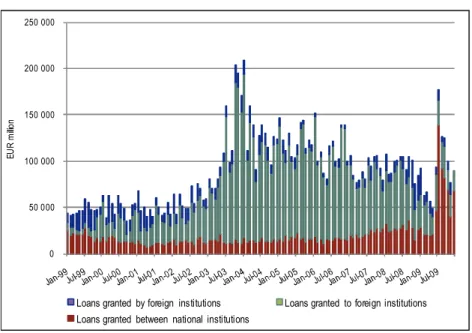
granted4. As Figure 2 reveals, the period between 2003 and 2006 was marked by the greatest
expansion of the overnight interbank money market. On average, until 2002, around 2,425
million of funds were bought and sold per day. Between 2003 and 2006, that value more than
doubled, amounting to 5,685 million. From 2007 onwards, and until the first half of 2009,
the overnight interbank market suffered a clear break, as the average amount traded per day
did not exceed 4,048 million. However, in the last half of 2009, the average amount of
loans traded per day increased again, to 5,417 million, as a result of a surplus on banks’
liquidity arising from the measures taken by the Euro system after October 2008, in the
context of the “enhanced credit support” to the European banking system.
INSERT FIGURE 2 HERE
It is also worth highlighting that, except for the last half of 2009, most of the operations
held were border, between a national and a foreign bank. In fact, until June 2009,
cross-border loans accounted on average for 77 per cent of the total value of the overnight loans
settled per month. In the last half of 2009, that share was only 33 per cent. In the second half
of 2009, due to the measures taken by the Euro System within the framework of the enhanced
3
TARGET is the real-time settlement system for the euro. Its first generation started on 4 January 1999, following the launch of the Euro. It was composed of 17 national real-time gross settlement systems plus the ECB payment mechanism (EPM). In 2008, after a six-month migration phase, this first generation was replaced by TARGET2, the second generation of the system. Although based on a centralized technical platform, legally TARGET2 is still composed by the different national components of the participating countries (European Central Bank, 2009c). In our study, “TARGET Portuguese component” refers to the Portuguese component on both the generations of the system.
19
credit support to the banking system and the consequent liquidity surplus, there was a sharp
increase in loans between Portuguese counterparties, with a monthly average of 81,848
million, while the corresponding value of cross-border loans did not exceed 26,378 million.
The average value of the loans has also followed the same trend. While in 1999 the
average value of the loans was around 29 million, in 2002 it reached 57 million and
between 2003 and 2006 it almost doubled, ascending to 99 million. Between 2007 and the
first half of 2009, there was a slight decrease in the average value per loan (to 80 million),
but in the last half of 2009 it reached the historical maximum of 128 million.
Another remarkable aspect about the Portuguese overnight money market is the high
concentration on the lending side, despite the relative dispersion among borrowers. Indeed,
during the sample period, while the five and ten major lenders were responsible on average
for 65 per cent and 78 per cent of the total amount lent each year, respectively, the five and
ten major borrowers accounted on average for only 35 per cent and 47 per cent of the total
amount of funds borrowed (see Table 1)..
INSERT TABLE 1 HERE
Regarding the group of lenders, its composition during the sample period was always
very stable. One bank remained as the most important lender during the eleven years
analyzed, being responsible on average for 30 per cent of the total loans granted each year.
Three other banks remained always in the top ten lenders during the sample period and were,
on average, responsible for around 16, 7 and 6 per cent of all loans granted in each year,
respectively. Regarding the group of major borrowers, except for the 2004-2006 period, when
20
subset of Portuguese banks had always a prominent role in the market, playing the roles of
both major lenders and major borrowers, in what can be described as a multiple money center
banking structure.
During the sample period, 772 different banks participated in the overnight money
market on at least one day, either as lender or borrower. From those, 69 were national and the
remaining were foreign (91 per cent). Nevertheless, 678 were present in the market only
once. On the other hand, 61 banks were present in the market more than one quarter of the
period, and 27 were there more than 50 per cent of the days. The number of banks
participating in the market in each year gradually decreased to less than half. While in 1999,
433 banks participated in the market at least once (374 foreign), in 2009 that number only
included 201 banks (171 foreign). This significant reduction can be explained by several
restructuring and consolidation processes that occurred in this period. Indeed, as pointed out
by Barros et al. (2010), in 2000 only, there were several consolidation moves involving four
of the seven major financial Portuguese groups.
To analyze the pattern of interbank lending relationships, we use some useful measures
drawn from Graph theory, following a growing literature that applies this approach to depict
and analyze financial systems, namely Boss et al. (2004), Müller (2006a, 2006b), Soramäki et
al. (2007), Georg (2011) and Arinaminpathy et al. (2012).
In order to analyze the interbank lending relationships in the Portuguese overnight
interbank money market, we represent it as a network, where banks are nodes and the
interbank lending relationships are the links between them. In our study, we model each day
as a separate network, resulting in 2815 daily networks. Each lending relationship represents
a directional link from the lender to the borrower and is weighted by the value of loans
21
interbank loan between them, on that day. Over the sample period there was a total of 4,854
different direct links5 established in the Portuguese overnight money market. Nevertheless,
93 per cent of the links occurred in less than 100 days and 25 per cent occurred in just one
day. Only two links occurred more than 50 per cent of the days, and they were both between
banks from the same financial group. Moreover, as a consequence of the reduction in the
number of active banks in the market per year, there was also a sharp reduction in the number
of links. Actually, between 1999 and 2009, the number of directed links per year dropped by
69 per cent, from 2,192 to 671.
The number of links relative to the number of possible links, given the number of
nodes, is a measure of the degree of completeness of a network. It varies between zero, for
completely disconnected networks, and one, for complete networks. The Portuguese
overnight interbank market was extremely sparse as, on average, the degree of completeness
did not exceed 2 per cent. This means that 98 per cent of the potential links were not used.
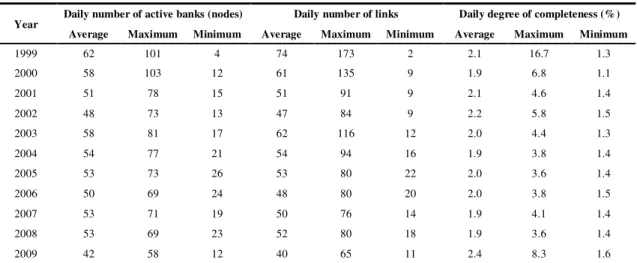
The maximum degree of completeness (2.4 per cent) was achieved in 2009, due to the sharp
reduction in the number of active banks in the market (See Table 2).
INSERT TABLE 2 HERE
To summarize, it is possible to identify three distinct phases in the Portuguese
overnight money market between 1999 and 2009. First, an “adaptation phase”, from 1999 to
2002, marked by the restructuring processes held in this period, both at national and
European level, and also by the integration in the European Monetary Union, which allowed
the access to wide funding sources as well as wide investment opportunities. The second
phase, between 2003 and 2006, are the “peak years of the Portuguese interbank money
22
market”. In 2007, a new phase in the money market started to emerge as a result of the
financial turmoil. The amount of funds traded started to decrease and the national segment of
the market increased in participation. This trend culminated in the actual shutdown of the
interbank market following the failure of Lehman Brothers in September 2008. In an attempt
to control the situation, the Euro system enhanced its intermediation role in the Euro area
money market by providing unlimited liquidity to the banks that needed it, and receiving
deposits from banks with liquidity surpluses. In the Portuguese case, liquidity surpluses
predominated as there was an unprecedented application of funds in the central bank
overnight deposit facility.
Despite the different phases that the overnight money market went through during the
period 1999 to 2009, it has been always characterized by an underlying multiple money
center structure, evident both in the number of days that each bank was in the market and in
the level of market concentration, in terms of lending and borrowing. Moreover, the degree of
completeness of the market during the sample period was very low. These results are in line
with Craig and von Peter (2010), who claim that interbank markets are sparse and tiered6,
mostly functioning between a reduced number of core banks, which act both as lenders and
borrowers.
4. Data
To analyze the contagion risk in the Portuguese interbank market we use a unique data
set provided by the Payment Systems Department of Banco de Portugal, which contains
6
23
information about all operations settled through the TARGET Portuguese component
between 1999 and 2009. TARGET is the Euro system’s real-time gross settlement system and
is normally seen as the “backbone” of the Euro financial infrastructure. It allows the
settlement in central bank money, in real-time, of every kind of transaction in a fast and
reliable way. Most important, it reduces systemic risk as, once settled, all transactions are
final and irrevocable.
Since the aim of our study is to analyze the exposures in the Portuguese overnight
interbank market, to distinguish overnight loans from the remaining transactions settled via
TARGET, we have applied the search procedure described by Furfine (1999, 2001). This is a
two-step procedure. First, we identify “candidate” transactions to qualify as interbank loans
in day d; second, we look for the respective repayments in the following business day (d+1).
This has to be a payment between the same counterparties but in the opposite direction and
involving a slightly large amount, the difference being the accrued overnight interest.
Additionally, the implied interest rate has to be within a reasonable range.
Regarding the first step, following Farinha and Gaspar (2008), who also apply this
procedure to the Portuguese TARGET data, we identify candidate transactions as those above
a minimum threshold amount of 100,000 and in round lots.
In the second step, the main issue is to decide what the reasonable range for the interest
rate is. We start by allowing the interest rates to fluctuate within an interval defined by the
official interest rates fixed by the ECB council for the Euro system’s standing facilities: the
marginal lending facility and the deposit facility. It is important to note that the standing
facilities interest rates should be a reference for the interbank money market interest rates
since, at least theoretically, banks have no motivation for lending below the overnight deposit
24
intra-group loans might have smaller interest rates. Moreover, since loans from the Euro
system have to be fully collateralized, banks can find it preferable to pay an interest rate
slightly higher than the marginal lending facility interest rate. Allowing for this, we run the
procedure using alternative limits for the interest rate range, defined by the EONIA7 plus and
minus 100 basis points and the EONIA plus and minus 50 basis points. The value and volume
of transactions identified with these different intervals are not significantly different from the
ones obtained with the interval defined by the standing facilities interest rates. In the end, we
decide to use as upper limit the marginal lending facility interest rate, or the EONIA plus 50
basis points, if wider, and, as lower limit, the overnight deposit interest rate, or the EONIA
minus 50 basis points, if lower, since this was the range that enabled us to achieve the most
accurate results.
In addition to the need of establishing a reasonable range for the interest rates, Furfine’s
procedure has some other caveats. First, it fails to identify operations made through
correspondents8 or other large value payment systems, like EURO1, the net clearing system
of the European Bankers’ Association and the main competitor with TARGET. Second, it
does not allow the identification of overnight operations where principal and interest are paid
separately or when several initial loans are repaid through a single repayment. Despite these
caveats, there is no doubt that Furfine’s procedure allows the identification of interbank
exposures, mainly unsecured, stemming from the overnight money market. Indeed, in
addition to the in-depth analysis about the Portuguese banks participation on the euro money
market between 1999 and 2005, a major contribution from Farinha and Gaspar (2008) is
precisely the assessment of Furfine’s procedure accuracy on the identification of overnight
7
EONIA (Euro OverNight Index Average) is an effective overnight interest rate computed as a weighted average of all overnight unsecured lending transactions in the interbank market.
25
money market operations. The authors test the algorithm adequacy by comparing the results
obtained with the application of the procedure to the Portuguese TARGET data and the actual
interbank money market operations recorded in SITEME, the Portuguese market electronic
payment system. They conclude that the procedure allows an accurate identification of 95 per
cent of the overnight money market transactions.
Millard and Polenghi (2004) and Amundsen and Arnt (2005) also report the successful
identification of overnight operations using Furfine’s procedure. They apply it to settlement
data from the British Clearing House Automated Payment System (CHAPS), the Danish
large value payment system (Kronos), and the Dutch TARGET component, respectively.
5. Methodology
Following the approach adopted by previous empirical studies on financial contagion,
we measure the contagion risk stemming from overnight lending in the Portuguese interbank
market by performing a scenario analysis where each bank is left to fail at once due to a
sudden, idiosyncratic and exogenous shock. Then, we estimate the knock-on effects on the
remaining participants using different recovery levels.
Hence, given the initial failure of a particular bank, any creditor bank that has an
exposure to the failed bank larger than its capital (which represents each bank’s capacity to
withstand shocks) is also considered insolvent. To put it differently, given the matrix of
bilateral exposures, bank is considered insolvent if
> (2)
where LGD is the loss given default rate, i.e., the loss rate imposed to bank by the default
26
round failure. Second round failures occur if, given bank , its combined exposure to all the
first-round failures exceeds its capital, i.e., if
+ > (2)
The process is iterated until there are no additional failures. The chain of failures triggered by
the initial failure is the “domino effect”, which can persist for several rounds.
Following previous studies (van Lelyveld and Liedorp, 2006; Mistrulli, 2011; Wells,
2004; Toivanen, 2009), to measure the potential for contagion we need to assume that: (i)
The time span between the increase of debtors’ credit risk and their failure is too short for
creditor banks to react, for instance, by decreasing their exposure to the affected bank or by
raising capital to compensate for the losses suffered; (ii) The LGD rate is constant across
banks and over time; therefore, it does not reflect an increased risk awareness following the
initial default nor banks’ heterogeneity; (iii) The analysis focuses on the propagation of
shocks among domestic banks, due to domestic or foreign shocks. Since we do not have
information about capital buffers nor interbank lending relationships with foreign banks, we
are not able to measure contagion between them. As a result, in our analysis foreign banks
can only cause contagion by acting as the source of the initial shock, never can never fail by
contagion. This might underestimate contagion risk since spillover effects of a domestic
failure on foreign banks and the possible repercussions of those effects on the domestic
market are not taken into consideration. However, these underestimation effects can be offset
by the overestimation implied by assumptions (i) and (ii) since, in practice, it is more
common that banks experience a gradual weakening rather than a sudden failure. Therefore,
their counterparties can prevent losses by taking corrective actions (Wells, 2004). For
27
degree of participation in the market (Iori et al., 2006). Moreover, we also assume that the
Central Bank, due to its role as last resort lender, never fails.
To sum up, there are four key elements in this contagion process that determine the
severity of the spillover effects stemming from a bank’s failure: its assets’ structure, its
liabilities’ structure, the level of capital, and the LGD rate imposed to its creditors (Wells,
2004). The assets’ structure determines whether or not the bank is affected by the previous
default of another bank. The level of capital defines the relative strength of each bank to
support losses. If the bank has enough capital to support the losses without jeopardizing its
counterparties, it can even stop the contagion process. On the other hand, if losses are higher
than the bank’s capital, thus pushing it into default, that will amplify the dynamics of the
contagion process, since the shock transferred to other banks congregates the spillover effects
not only from the initial failure, but also from this second failure. The way the shock is
transferred, and to whom, depends on the interbank liabilities structure. The LGD rate
determines the impact of the shock transmitted to creditors and, as most part of the studies
highlight, the danger of contagion is crucially dependent on the assumed LGD rate, i.e. the
losses experienced by the creditor bank in case of insolvency of the debtor bank.
In our study, the assets and liabilities of each bank within the framework of the
overnight interbank money market are provided by the matrix of bilateral interbank exposures
computed from the information obtained through the application of Furfine’s procedure to the
TARGET settlement data, as explained previously. The information about banks’ capital
level was obtained from the Portuguese bankers’ association (Associação Portuguesa de
Bancos), Therefore, we gather all the necessary elements to simulate the contagion process,
except for the LGD rate, which has to be defined as an assumption. Given the uncertainty
28
run the contagion process assuming four different LGD rates: 25 per cent, 50 per cent, 75 per
cent and 100 per cent. Our results are presented in the next section.
6. Results
A general result from our contagion simulations is that, even though it can materialize
in a few scenarios, the risk of contagion stemming from the interbank market never
represented a significant threat to the Portuguese financial system and it has even decreased
over the sample period 1999-2009.
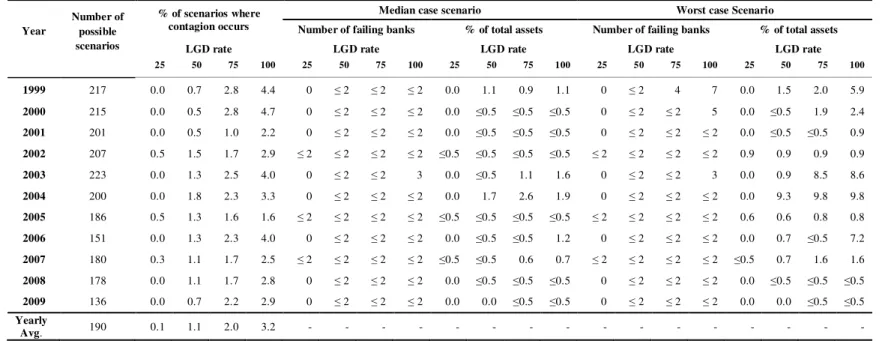
As shown in Table 3, from the 190 possible scenarios of contagion that existed on
average per year, even assuming a LGD rate of 100 per cent, contagion could have only
occurred in 3.2 per cent of the cases. If we assume a more reasonable LGD rate, such as, for
instance, 75 per cent, contagion could have occurred in just 2 per cent of the cases. With a 25
per cent LGD rate, contagion hardly occurs. These results are similar to the ones obtained by
van Lelyveld and Liedorp (2006), Degryse and Nguyen (2007) and Mistrulli (2011), who also
found that, for LGD rates below 75 per cent, contagion is unlikely.
INSERT TABLE 3 HERE
When contagion could have occurred, assuming a median scenario and any LGD rate,
banks’ failings were never more than 3 and never represented more than 2.6 per cent of the
total banking system assets. As shown in Table 3, except for the years 1999, 2003, 2004 and
2006, assets represented by the failing banks never exceeded half per cent of the total banking
29
scenario represents the average impact across all the scenarios where contagion could have
occurred, expressed as the average percentage of total banking systems assets represented by
(and the average number of) failed banks per scenario.
Yet, in the worst-case scenario under contagion (i.e., the scenario among the ones
where contagion occurs for which the share of the total banking system assets represented by
the failing banks is higher), and assuming a 100 per cent LGD rate, the impact of contagion
could have had a more significant effect. In fact, as shown in Table 3, in some cases the
percentage of banking system assets affected could have surpassed 5 per cent. For instance, in
1999, 2003, 2004 and 2006, the percentage of the total banking assets represented by the
failing banks reached 5.9, 8.6, 9.8 and 7.2 per cent, respectively. Nevertheless, we should
keep in mind that these results just hold true for the worst-case scenario and assuming a 100
per cent LGD rate, which is an extreme assumption. In addition, 2003-2006 was the period
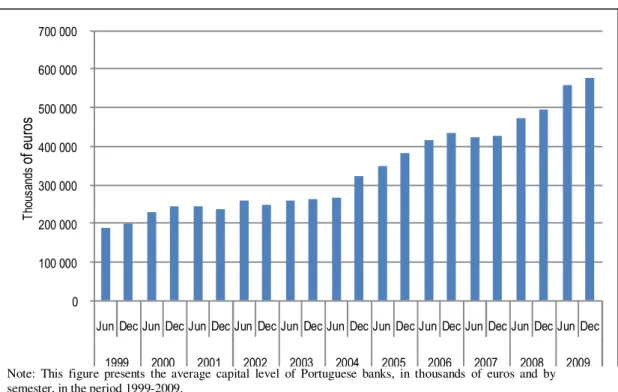
when interbank exposures were also higher, as discussed in section 3. Moreover, as Figure 3
illustrates, bank’s capital levels have increased substantially from 2004 onwards, thus
increasing the median buffer available per bank to withstand shocks.
INSERT FIGURE 3 HERE
As a result of the reinforcement on capital levels, the proportion of exposures
representing more than 20 per cent of capital declined, with the corresponding increase in the
proportion of exposures that represent less than 10 per cent of banks’ capital (see Figure 4).
30
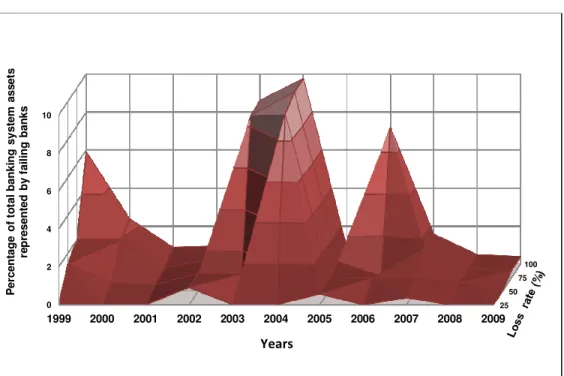
The increase in banks’ capital contributed to a substantial decline in the severity of
contagion effects throughout the time, measured as the percentage of banking system assets
represented by the failing banks, as graphically shown in Figure 5.
INSERT FIGURE 5 HERE
In 2008 and 2009, with the decrease in the money market activity and the reinforcement
of the average capital levels per bank, even in the worst-case scenario assuming contagion,
banks failing by contagion would represent a negligible share of the total banking system
assets (not exceeding half per cent).
The potential for contagion can also be expressed by the number of banks whose
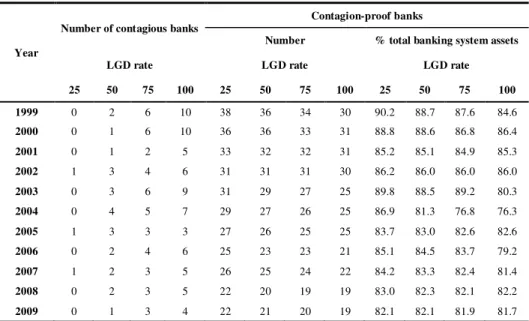
default causes at least another bank’s failure (contagious banks). As presented in Table 4, the
high number of contagious banks in 1999 and 2000 (10, if we assume a 100 per cent LGD
rate), decreased sharply in 2001 and 2002 (when there were just 5 contagious banks). With
the exception of 2003 and 2004, when it almost reached the 1999 and 2000 levels, the
number of contagious banks remained relatively constant until 2009 (averaging 5,
considering a 100 per cent LGD rate). However, it is important to highlight that, as shown in
Table 4, most of the exposed banks in the overnight interbank money market over the sample
period are contagion proof-banks, i.e., they never fail, irrespective of the LGD rate assumed
and of the defaulting bank. On average, contagion-proof banks always account for more than
82 per cent of the banking system total assets.
31
Wells (2004) argues that even if a bank does not fail, the losses suffered can deteriorate
its financial health and trigger rating downgrades, collateral calls or even turn it unviable.
Therefore, in addition to the number and share of assets represented by failed banks, another
important measure of the potential impact of a bank failure on the banking system is its
spillover effect on other banks’ capital (i.e. their capital loss), even if the latter do not fail.
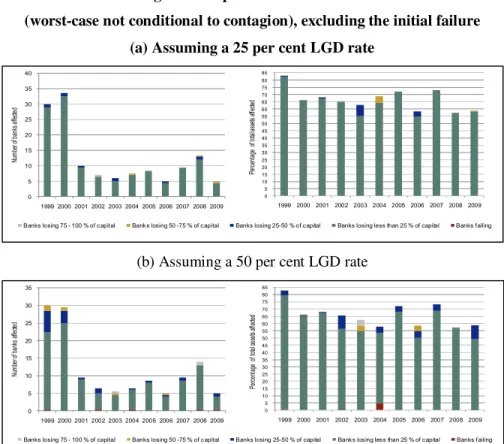
INSERT FIGURE 6 HERE
As Figure 6d illustrates, the worst-case scenario (insolvency) does not always occur
when there is contagion. In 2001, 2005 and 2007, although no contagious failures would have
happened, the default of a given counterparty could have imposed losses above 25 percent of
capital on banks representing around 5, 8 and 9 per cent of the total banking system assets,
respectively (under the assumption of a 100 LGD rate). It is also noteworthy to highlight that
in the situations where contagion could have occurred (and irrespective of the loss rate
assumed), the contagious banks were mainly national ones. The analysis of the worst-case
scenario also highlights the decrease of the spillover effects’ severity stemming from a given
counterparty default over the sample period. Indeed, assuming a LGD rate of 100 per cent, in
the worst-case scenario, in 1999, a counterparty failure could have affected 33 banks,
representing about 84 per cent of the total banking system assets, and almost half of them
would lose more than 25 per cent of their capital. In 2009, that effect would be felt just by 6
banks, most of which would lose less than 25 per cent of their capital. The conclusions are
similar if we assume a loss given default of 25 per cent, 50 per cent or 75 per cent, as shown
32
To sum up, contagion risk in the overnight interbank money market is a very low
probability event and, even if it had occurred between 1999 and 2009, it would not have led
to the collapse of the Portuguese banking system. Yet, it is possible to observe a change over
time in the possible impacts of contagion. Thus, in case of contagion, in the worst-case
scenario, it could have had sizable effects in 1999 and also in 2003, 2004 and 2006. As we
have seen in section 3, the Portuguese banking system went through a profound restructuring
process between 1999 and 2002, which can justify the decrease in the potential for, and
severity of, contagion in the period after 2001. On the other hand, the increased effects of
contagion in 2003, 2004 and 2006 can be explained by the fact that these were the years when
the interbank money market most expanded, particularly concerning cross border activity. In
our opinion, the underlying multiple money center structure of the Portuguese interbank
money market contributed to maintain the potential effects of contagion at relatively low
levels. These conclusions are in line with Degryse and Nguyen (2007), who have similar
findings for the Belgian interbank market, which can also be described as a multiple money
33 7. Conclusions
Despite the deep commitment of public authorities central banks to ensure financial
stability, this stability can be affected by events such as the recent the subprime crisis and the
undergoing sovereign debt crisis, and has happened many times, in different times and region
of the world. Financial instability can be exacerbated by contagion effects between financial
banks. Therefore, it is important to understand if, given the structure of financial systems, and
the level of exposures that banks have to each other, systemic risk, in general, and contagion
risk, in particular, van be a threat to financial systems.
In this study we investigate whether contagion risk emerging from the interbank
lending relationships established in the overnight money market would have been a threat to
the Portuguese financial system, in the period 1999 to 2009.
Our results for the Portuguese interbank market are in line with the results regarding
other financial markets such Italy, Belgium, Austria and The Netherlands. Although
contagion between banks might have occurred, its impact on the banking system cannot be
considered a major threat to financial stability. Even in the worst-case scenario, banks that
would have failed by contagion represent less than 10 per cent of the banking system total
assets.
Note, however, that contagion risk inherent in the Portuguese interbank money market
was not stable during the period under analysis, as we can identify three distinct phases. In
the first phase, between 1999 and 2002, contagion risk decreased significantly, as a result of a
profound restructuring process that led to higher concentration in the market. In the second
phase, between 2003 and 2006, coinciding with a rapid increase of transactions in this
market, and an increase of bank exposures to each other, led to the increase of contagion risk
34
sharply as a consequence of the financial turmoil, and capitalization levels increased
consistently, both facts leading contagion risk to become lower. As expected, with the
interbank market frozen after the failure of the Lehman Brothers in September 2008, the risk
of contagion almost ceased to exist. However, the interbank market also ceased to play its
redistributing role and forced banks to turn to the Euro system’s standing facilities operations
to adjust their day-to-day cash imbalances. Thus, the risk of contagion disappeared, but the
interbank market also became inoperative, affecting the intermediation role of the banking
system in the economy.
Our results are in line with Nier et al (2007) who argue that incomplete market
structures, such as money center ones, are not necessarily more prone to contagion, as it
depends on the connectivity of the money center banks. In the Portuguese case, it seems that
the specific multiple money center structure leads to the dissipation of shocks, and not to their
amplification. We have also confirm Nier et al.’s (2007) views that, as expected, an increase
in the banks’ capitalization levels leads to a decrease in the potential for, and severity of,
contagion, and that the risk of contagion is higher when interbank liabilities are also higher.
Thus, our results empirically sustain Nier et al.’s (2007) findings. Yet, a major
contribution of our work was to fill a gap in the existing research on financial contagion as,
even though this exercise has already been carried out for the majority of the European
interbank markets, at least to the best of our knowledge, no similar work existed for the
Portuguese case until the moment. Moreover, contrary to other studies that focus on a single
point in time, we have analyzed the evolution of contagion risk in the interbank overnight
money market over a period of eleven years.
More importantly, with this work we have also contributed to a better understanding of the
35
unique kind of data – the data about the settlements on the large value payment systems –
based on which we can obtain valuable insights regarding the behavior of the financial
system and, in the limit, about the economic activity in general almost on a real-time basis,
since the data is available to the central banks directly running the payment systems on a
daily basis.
However, despite our achievements, there is room for improvement. In fact, since the
analysis was carried out considering just overnight exposures, future developments of this
work could include, however subject to the availability of data, the run of the simulation
process based on information covering a wide range of interbank exposures, thus
complementing the data about overnight interbank exposures with data about longer-term
exposures.
In addition, as pointed out by Mistrulli (2005), due to the increasing internationalization of
interbank linkages in most of the markets, the failure of a foreign counterparty can pose a
higher threat to the national financial system than the failure of a domestic bank. However,
since the majority of contagion analyses are limited to domestic markets, disregarding the
possible effects of second-round failures of foreign banks on domestic banks can lead to an
underestimation of contagion risk, especially in high internationalized markets such as the
Belgian and the Portuguese one. Therefore, one possible extension not only of this work, but
also of research on empirical financial contagion in general, would be to carry out the
analysis including the information about the interbank exposures to cross-border
counterparties. However, due to the confidentiality issues that the disclosure of this type of
information normally raises, probably this kind of analysis could only be done, for instance,
36
Still within the field of financial contagion, since contagion risk can also arise from the
interbank exposures established through payment systems, it would also be interesting to
analyze this source of contagion using the TARGET settlement data. Actually, there are
already some works in this field, such as the ones by Soramäki et al. (2007), who have
analyzed the Fedwire Funds Service, the Federal Reserve Banks real-time gross settlement
system and, Becher et al. (2008), who have examined the Clearing House Automated
Payment System (CHAPS), the United Kingdom’s large value payment system.
On the other hand, in this work, network theory was only used as a useful tool to draw
some conclusions about the pattern of interbank lending relationships. However, another
interesting line of research would be to carry out a deeper network analysis of the interbank
money market which, combined with the contagion simulations, would help to identify the
role of each bank in the market. That would help to design measures adjusted to the systemic
risk that each bank´s problems represent, which is of utmost importance as problems from
one (systematically important) bank can represent a higher threat to financial stability than
problems in another (non-systematically important) bank. This approach could also help to
justify (or not) the assistance provided to some distressed banks, by assessing the possible
contagion effects of their default.
Finally, it would also be of major interest to analyze the interbank relationships
established through the payment systems following a network approach, since it could reveal
important information for the operators of these systems (for instance, the strongest and the
weakest nodes). This could be especially useful in the context of real-time settlement
systems, were the window to solve problems is very short and the measures required to solve
it may be different, depending on the role played by the bank in trouble. For example, in case